




Abstract
In response to the climate crisis, the international community continues to advocate resilience-based solutions in the Pacific. While often well-intentioned, these external interventions rarely meet expectations. One reason for this lack of implementation lies in a disconnect between underlying value systems between the global north and the Pacific. This article questions this straightforward dichotomy by exploring the extent to which climate resilience can become legitimate and locally owned. Through a critical post-colonial perspective, we consider the possibilities of Indigenous-based learning in tertiary education and how this can be integrated with the imported concept of resilience. Even if Indigenous-based resilience practices served communities for generations prior to the universalizing practices of western-centric epistemes via colonization, this does not necessarily require a rejection of western-centric understandings of climate resilience. Instead, scientific facts and Indigenous knowledge can co-exist to strengthen local climate resilient capacities and yield the possibility for novel climate solutions.
Introduction
The climate crisis and its multifarious effects present one of the greatest threats to the global community and current advances in development. This threat is compounded as much by continuing contributions to carbon emissions, deforestation and terraforming as by more intense weather-related hazards such as hurricanes, cyclones and tsunamis that impact Pacific Island Countries (PICs). The COVID-19 pandemic, and the threat of other pandemics, represent a rude awakening, adding to the realistic possibility of an existential crisis for humanity. Moreover, the effects of climate change are here to stay and will “continue, beyond and in some cases, for many centuries to come or even millennia” (Hamilton, 2017, p. xx). Climate change is producing adverse deep structural and lasting consequences on livelihoods, social life, cultural practices and national development. Together, these are fracturing efforts to meet the Sustainable Development Goals, internationally championed and globally advocated as a universal means for managing climate risks, while established resilience capacities face enormous challenges.
Climate resilience is understood as the “capacity to prepare for, respond to and recover from the impacts of hazardous climatic events while incurring minimal damage to societal wellbeing, the economy and the environment” (Mehryar, 2022; This is often confused with or overlaps the related concept of climate adaptation, which emphasizes “adjustments in ecological, social or economic systems in response to actual or expected climatic stimuli and their effects” (IPCC, 2001)). This remains a central and global concept used as a means for managing climate variability, which is often presented with specific “solutions” based on, informed and measured by the natural sciences. These include, for example, climate re-insurance schemes, building seawalls, climate risk awareness programmes, risk mapping and establishing early warning systems. While these and other initiatives are well-intended, successful implementation in, and by, local communities including PICs has been limited. One of the reasons for this lack of success has been a disconnect between underlying value systems between the Global North and the Pacific (Hollis, 2021). For example, different perceptions on what climate and disaster risk means, which are intricately connected to alternative temporal assumptions, mean that external development packages on climate resilience are unlikely to produce their intended effect.
This article adds a more nuanced and critical approach to this argument by exploring the extent to which climate resilience initiatives can be integrated with, or complement, Indigenous and locally owned understandings, knowledge (Brugnach et al., 2017), as well as teaching and learning (Cajete, 2007, 2018, 2020; Charles & Cajete, 2020; Tyler & Moench, 2012; De Graaf-van Dinther & Ovink, 2021). Noting Howitt’s (2020) caution on the “risk in stereotyping, oversimplifying and marginalizing the diverse experiences and insights” of Indigenous peoples, we aim to build on existing literature that connects Indigenous knowledge to climate resilience (Berkes, 2017; Berkes et al., 2000, 2008, 2021; Ford et al., 2020; Howitt, 2001, 2020; Howitt et al., 2012; Ramos-Castillo et al., 2017; Salick & Byg, 2007; Salick & Ross, 2018; Tsosie, 2007) by emphasizing the importance of tertiary education and the use of talanoa as a vehicle to enable a transformative shift in education.
While some aspects of worldviews may be incommensurable, they are rarely dichotomous; instead, a fusion of horizons with some assumptions of reality is possible. The key towards a more integrated approach, suggested in this article, is through an open, safe and equitable dialogue commonly known as talanoa (Hollis & Halapua, 2025). Of course, the Sendai Framework, Intergovernmental Panel on Climate Change (IPCC) reports and the Conference of Parties (COP) acknowledge the role of Indigenous knowledge and practices for risk reduction; yet climate justice issues remain a major issue (Mistel Segovia Tzompa, 2023), which is related to a continual under-appreciation of Indigenous knowledge and practices. It is not enough to claim that “Indigenous and local knowledge and practical knowhow can come together to provide more relevant effective actions . . . [where] values and worldviews can be reconciled if everyone works together” (IPCC, 2023). Such idealism, which in practice tends to privilege “westernized” generalizing statements and gloss over the value and complexity of Indigenous epistemologies, can be interpreted as constituting what has been described as “epistemic violence” (Spivak, 2010).
Adopting a critical post-colonial perspective, we ask to what extent Indigenous ecological knowledge systems, which served Pacific communities over generations prior to the universalizing practices of western-centric episteme via colonization, can be integrated into existing tertiary education or, if a more systematic and transformative approach will provide a just and appropriate means for climate resilience by and for local communities. This must be done as part of, and not an alternative to, emerging and already theorized, western-centric, understandings of climate resilience strategies which flow down from the global north (Nunn, 2009).
Post-colonial and decolonial theorizing, especially in the social sciences and humanities (de Mignolo, 2013; de Sousa Santos, 2021; Spivak, 2010), has opened up discourse on the silencing of Indigenous knowledge and practices. Said’s (1974) Orientalism and Culture and Imperialism (Said, 1993) contributed to an enduring critical discourse on colonialism and its effects and aftermath (Cesare, 1972; Fanon, 1967; Mbembe, 2021; Nkrumah, 1964) and engendered a re-thinking on colonial presentation and understanding of the “other.” Other recent works on post-colonialism continue to articulate the existence and survival of Indigenous epistemologies and practices that continue to serve Indigenous communities (de Sousa Santos, 2021; Smith, 2013) including Pacific Island Indigenous communities (N.-K. Plange et al., 2023, 2024; Smith, 2013; Vaai & Nabobo-Baba, 2017). Indeed, Homolar and Turner (2024) suggest that the narrative practices of western science “enact, socialize and consolidate or delegitimize certain sets of norms and behaviours, which also holds for the realm of global politics” (p. 205). This epistemic dominance is now evident in the broad and emergent area of climate change definitions, explanations and prescriptions for climate resilience and response. Nunn (2009) notes that “People living on any type of Pacific Island who interact daily with the environment to acquire food – rather than buy it – are vulnerable to the vagaries of changing climate” (p. 212). In this light, it is instructive to at least re-balance the scales by giving more voice to local climate resilience knowledge and worldviews.
Against this background, we ask if Indigenous practices and epistemologies within family and community contexts ought to be more explicitly included in formal learning, teaching, research and curricula. This could potentially strengthen local climate resilient capacities and provide the opportunity for novel climate solutions. In addition, teaching and learning climate resilience cannot afford to overlook the root causes of the climate crisis strongly linked, as they are, to the Anthropocene. This is especially the case if top-down approaches to climate resilience prioritize, mainly, structural solutions, such as building seawalls and installing early warning systems, over learning practices that can engender deeper structural changes at the local level (Hollis, 2021). It remains doubtful if the global call for resilience is likely to achieve long-term dividends if it does not properly reflect and be inclusive of local knowledge systems; it can even contribute to ignoring issues relating to the root causes of climate change.
Concentrating on Indigenous knowledge systems for improving climate resilience can, moreover, provide an important heuristic for climate action in profiling unique and creative approaches to living with and mitigating climate risks. This is an enormous task in the face of watered-down COP agreements on reducing carbon emissions and promises of a net-zero future. Nevertheless, PICs possess enormous potential to push climate action towards a more sustainable future. There is much that the Global North can learn from the Pacific, which starts by focusing on the abundance of multiple local learning practices. In this vein, we follow other scholars who discuss the role of multiple epistemologies, including Vilsoni Hereniko’s (2013) work and his apt image of a double-hulled canoe wherein both hulls can provide balance.
This article begins with a description of climate-related socio-ecological and economic vulnerabilities in PICs. This descriptive element of this article is important for identifying the specific types of risk exposure for framing the discussion on resilience, learning and Indigenous knowledge (IK). This article then turns to existing climate resilience measures in the Pacific region with a focus on the value of Indigenous knowledge. The third section outlines the main challenges this brings for a resilience future before discussing the connections between Indigenous knowledge, tertiary education and climate resilience. We conclude by looking to the past practice of community and communication for a more secure future.
Climate vulnerability in Pacific Ocean states
The impact of global warming on the PICs and territories has had a disproportionate effect on the livelihoods of many Pacific Islanders. A combination of low-lying atolls – the average elevation of most PICs is 2 m above sea level – 50% of built infrastructure located within 500 m of the coastline and 90% of the population living within 5 km of the coast (World Meteorological Organization [WMO], 2024) exposes a majority of persons residing in the Pacific to coastal erosion, tsunamis, storm surges, salinification and rising sea water levels. The latter has been a major concern for the existence of some states, such as Kiribati, Tuvalu and the Marshall Islands (see N.-K. Plange, 2021) and has already seen forced internal migration or relocation of coastal communities with varying degrees of success (Piggott-McKellar & Vella, 2023). As depicted in Figure 1, the Pacific has experienced a disproportionate rise in sea water levels over the last two decades. The following outline the socio-ecological and economic vulnerabilities that have emerged as a consequence of these geophysical and climate-induced hazards. It remains important to keep in mind that vulnerability does not mean a lack of resilience and that while the land area of PICs might be small—representing roughly 1$ of the area of the Pacific Ocean—a combination of their Exclusive Economic Zones is equivalent to the combined land area of China, the USA and Canada. They are Big Ocean States.
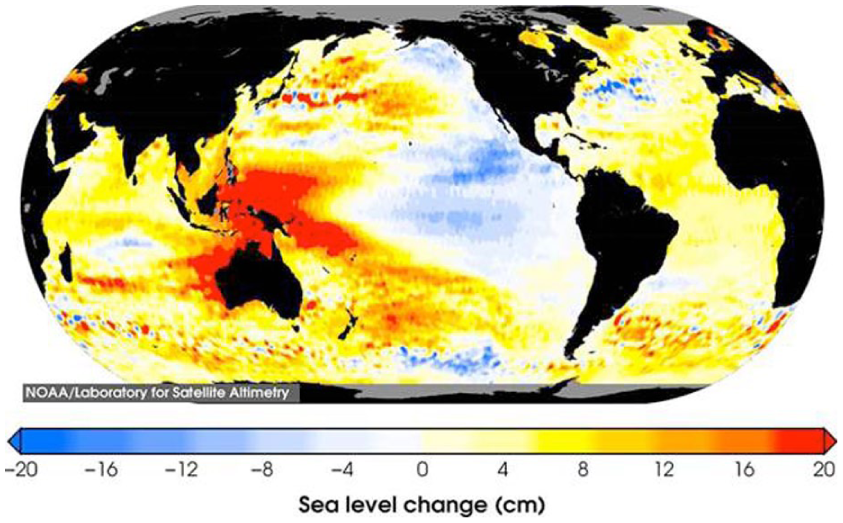
Global variability in sea-level rise since 1993, showing a greater relative increase in Oceania/South Pacific.
Socio-ecological vulnerability
As a Sea of Islands (Hau’ofa, 1994), life spaces and natural resources in the Pacific are fragile, exposed and vulnerable to the variable impacts of climate change and disasters (Nunn, 2009). The 2021 IPCC Report notes, for instance, that coastal areas will see continued sea-level rise throughout the 21st century, contributing to more frequent and severe coastal flooding in low-lying areas and coastal erosion and that extreme sea-level events that previously occurred once in 100 years could happen every year by the end of this century (IPCC, 2021). These will lead to, as the report further notes, changes to the ocean, including warming, more frequent marine heatwaves, ocean acidification and reduced oxygen levels, which have been clearly linked to human influence. These changes affect both ocean ecosystems and the people that rely on them, and they will continue throughout the rest of this century onwards. Additional hazards include unprecedented cyclones with destructive wind speed, hurricanes and storm surges (Walsh et al., 2012; Yoshida et al., 2017). These negatively affect the natural, social and ecological systems with devastating implications on, for example, biodiversity, economic stability and national security. Such vulnerabilities, however, are not equally dispersed across the Pacific; there are differential impacts and effects, a wide variety of cultural and societal responses, as well as varying capacities to withstand and respond to climate-related hazards. Kiribati, for example, is experiencing an existential risk through sea water rise, while volcanoes, earthquakes and landslides are a major concern for Papua New Guinea. These various hazards, in turn, can animate culturally specific responses.
Socio-economic vulnerability
For Pacific Island governments, the development deficits of climate variability and disaster effects are onerous. Recent estimates suggest that the average economic costs of disasters in the Pacific are equivalent to as much as 5% of Gross Domestic Product (GDP) annually but can be worse for some countries (Economic and Social Commission for Asia and the Pacific [ESCAP], 2020, p. 1). For example, Tropical Cyclone Pam cost the equivalent of more than 60% of GDP in Vanuatu in 2015, and the 2018 Tropical Cyclone Gita caused damages and losses equal to nearly 40% of GDP in Tonga (Global Facility for Disaster Reduction and Recovery [GFDRR], 2018; Government of Tonga, 2018).
The unprecedented impacts of climate change on the societies, economies and livelihoods of ocean states in the Pacific continue to be voiced in international arenas. These effects cut across all aspects of society and the economy including: migration (Collymore, 2022; A. N. Plange, 2022); challenges to food security (Holbrook et al., 2022); and health (N.-K. Plange et al., 2023), especially for children and older persons (N.-K. Plange, 2021; Turagabeci, 2022) which is often aggravated by weak social protection regimes (N.-K. Plange, 2021; Ratuva et al., 2021). The consequences are debt- and deficit-driven economies (Collymore et al., 2021). The pressing challenge, now, is how to prepare the next generation to understand the existential risks of multiple disaster situations and build, as well as become resilient for the future (N.-K. Plange, 2021).
That the climate situation has now reached a threatening and foreboding level is also a consequence of a development path and practice characterized by increasing consumption, demands for energy, industrial production for profit and the aggressive search for, and extraction of, natural resources with the consequent emission of greenhouse gases. This development practice has its roots in capitalism as a global economic system and with its contemporary designation as neoliberalism. It is underscored by a continuous and competitive production for profit and search for natural resources, with an imperialistic and exploitative logic in its relations with other societies and cultures.
The structure of the global economy and its prejudicial industrial policy has largely benefitted the Global North (Sundaram, 2024) by oppressing societies and economies in the Global South through trade, aid and debt (Moyo, 2009). This form of globalization has been a major source of greenhouse gas emissions, and hence climate variability, which has only been exacerbated by aggressively industrializing economies such as China, India and Australia in the 20th and early 21st centuries. Commenting on this, Achille Mbembe (2021) notes that humanity “has entered a new geological epoch characterized by massive and accelerated changes to the Earth’s climate, land, oceans and biosphere . . . the transnational regime of petrochemical extraction and Petro agriculture is the chief engine of the Anthropocene” (p. 20). Not only has neoliberalism been a driver of global warming and environmental degradation, it has also helped to propagate consumerism and the idea that economic growth is synonymous with development. This can fracture the socio-economic structure of Pacific communities either through increased urbanization or emigration, leading to increased vulnerabilities and even the reduction of resilience found in community-based relations (N.-K. Plange et al., 2024).
Climate resilience in the Pacific
Along with the Sustainable Development Goals (SDGs), the Sendai Framework (2015–2030), and other global agenda-setting initiatives, the COPs promote resilience as one of the main tools for managing climate and environmental risks. Resilience, now almost a development-inflected concept, inhabits a policy complex with a combination of cross-cutting activities and behaviour within, and by, households, communities and national entities. The idea is that this will ensure and enhance the ability of respective constituencies to prevail and manage future disaster and climate situations. In contemporary societies, the state, in the national resilience complex, becomes an active coordinator to design and ensure competent governance structures (Collymore, 2022) and, within the overarching international funding infrastructure, the disburser of resources to municipalities. Put differently, climate resilience is often seen as a top-down system of governance designed to shift the responsibility of managing risk to the person and community via the state.
While resilience programmes designed in the Global North for the Pacific are attached to lucrative funding, and while some acknowledge locally based ownership, we suggest that Pacific Island states and its tertiary education infrastructure ought to reflect carefully on the value of resilience programmes that impose “scientific planning” without regard to traditional Indigenous knowledge systems.
Pacific Island states have, nevertheless, not been complacent and fatalistic in their reaction to these prevailing challenges. Since the formation of the Alliance of Small Island States (AOSIS) in 1990 and the UN Earth Summit in 1992, Pacific states have been proactive in regional and international spaces, issuing strategies for effective responses to global warming and the reduction of vulnerability and hazard exposure. This is clearly seen in the engagement of regional organizations, such as the Pacific Islands Forum (PIF) and the South Pacific Regional Environmental Programme (SPREP), as well as Pacific states, in COPs. This global forum continues to provide an important mouthpiece for climate action and global awareness of the extreme climate vulnerability of Pacific states. Regionally, many PICs remain reliant on development and humanitarian aid for resilience financing. It is therefore noteworthy that the Pacific Resilience Facility could be made operational in 2025, which is a regionally owned financing facility for projects that cover climate and disaster resilience and social and community resilience. This is significant because it reduces dependency and allows for a more culturally sensitive approach to resilience measures that can link into existing resilience practices.
Apart from climate diplomacy, the Pacific contains a wealth of resilience practices. For over 3,000 years, Indigenous peoples across the Pacific region have used their traditional knowledge to prepare for and cope with and survive disasters and climate variability. These methods and practices originated within their communities and have been orally passed down over generations. An increasing volume of work on climate change has been highlighting the role of Indigenous knowledge systems in relation to adaptive practices, routine living activities and resilience (A. N. Plange, 2022; Vunibola & Leweniqila, 2021b). These include, for instance, Lagi and Raisele (2023) study on the role of Indigenous Knowledge in addressing sea-level rise and dried water sources in Vatutavui, a Fijian village; Fujieda and Kobayashi’s (2013) work building disaster resilience with Indigenous knowledge (p. 642); traditional food preservative practices in the face of salination of agricultural land by sea-level rise in a remote communities (Holbrook et al., 2022); and traditional understandings of weather changes for disaster preparedness and prevention (Nussey et al., 2024). As observed by Hollis (2021),
Pacific Island communities had established practices to ensure their survival from natural hazards. Careful observations of wave formations and sea currents, acquiring medical properties from local fauna . . . noting the behaviour of animals . . . represent just some of the many resilient traditions of Pacific communities. (p. 88)
Donors and international actors acknowledge this important set of capacities; however, it is not always integrated into risk and vulnerability assessments or into critical livelihood areas such as fisheries, agriculture and environment, where research shows the existence and indeed practices are rooted in Indigenous knowledge (Vunibola & Leweniqila, 2021a). For example, a World Bank Group (2017) climate vulnerability assessment, “Making Fiji climate resilient” had nothing on Indigenous adaptation and resilient practices in critical livelihood areas (Vunibola & Leweniqila, 2021b). A similar approach is presented in the Climate Risk Country Profile: Fiji (World Bank, 2021). Here too, in spite of references to health, agriculture and droughts, nothing on Indigenous knowledge and practices is referenced either as existing knowledge or an area for exploration of alternative practices in resilience and adaptation. This void is replicated in an Asian Development Bank (ADB, 2019) presentation on investments in Climate Adaptation and Disaster Resilience). Moreover, Indigenous knowledge on resilience can also be reduced to existing “tools” that fit or complement Eurocentric understandings, that is when practical weather prediction that can be backed up, explained or confirmed with modern scientific data (see Belfer et al., 2017). Less focus has been placed on recognizing a deeper understanding of resilience found in community formation and alternative epistemologies. Indeed, it is no coincidence that the first Pacific-owned resilience facility has prioritized community development as a centrepiece of climate resilience. Still, the dominance of western paradigms of resilience and adaptation is evident and ought to be re-evaluated.
Given the high levels of vulnerability, disaster risk and the promise of Indigenous knowledge systems for improving local resilience, we argue that learning and teaching resilience and adaptation to climate change, especially in tertiary institutions, must endeavour to navigate, and at times even resist, the monopoly of the western science of climate change, which is already in vogue, and increasingly advocated by Global North academic and research institutions with, at times, already prepared indicators and methods rooted in distant experiences. On the contrary, teaching and learning climate change resilience and adaptation must be informed by a critical reflexivity and the recognition of, without valorising, “the nuanced understandings of islanders’ perceptions and historical actions in the context of both their physical locations and their dynamic socio-cultural systems” (Lata-Niusulu et al., 2019; Vunibola & Scobie, 2022). In this way, a site of learning and teaching that allows for critical evaluation and alignment of alternative epistemologies, understandings, methodologies and archived knowledge and practices will contribute to a repertoire of sustainable resilience strategies.
Efforts at socio-economic resilience also ought to be linked to a recognition of Indigenous practices, especially at the community level. These are directed to ensure better livelihoods and sustainability through intimate knowledge of environment and natural resources, as well as food preservation and conservation practices that are yielding favourable results (Lako et al., 2023) with production architecture and limited carbon emissions. This would require significant challenges to the structure of industry, employment and work due to innovative technology. It would require collaboration with worker unions and governments to upskill, retrain and reskill to “strengthen the capacities of all people to benefit from opportunities of a changing world” (International Labour Organization [ILO], 2019, p. 2) and national efforts, informed by policy, to ensure employment and protection of the most vulnerable constituencies of society. This is a difficult task, especially for PICs experiencing high levels of emigration, which is also encouraged through agreements such as the Australia-Tuvalu Falepili Union and the Pacific Australia Labour Mobility (PALM) Scheme.
The challenge
Global warming and climate-related disaster impacts for the PICs are threatening culture, life, the environment, health, wellbeing and identity. Accumulated knowledge that has evolved and endured over centuries (Smith, 2013) is at risk of being eroded from climate-induced displacement from land and country. It is also a viable threat to Pacific economies, many of which rely on tourism (This is a business sector that relies on the environment: salubrious climate, sandy beaches, reefs and crystal-clear blue ocean as well as exquisite flora and fauna. To date, tourism remains the largest foreign exchange earner for PICs with a total employment of around 90,000 people. Agriculture and fisheries, while behind tourism in foreign earnings, also provide sources of employment and income (Asian Development Bank, 2013; ILO, 2019)). Significantly, industrial production remains low and almost negligible in many of the countries. But these employment-generating sectors pale into insignificance in the face of climate effects with consequences of relocation of villages and communities, such as recent and ongoing relocations in Fiji, the existential possibility of the complete displacement, and the loss of nationhood, sovereignty and ancestral sources and sites of identity, as demonstrably represented by Kiribati and Tuvalu. The challenge of climate change is precisely that its effects will fracture and undermine years of concerted efforts and development gains and undermine strategies for achieving the SDGs.
With time, climate variability has evolved from an environmental issue into one that requires collective expertise in sustainable development, energy, security, health, water conservation, sanitation and general wellbeing of communities. It is from this perspective that we underscore the importance of Indigenous knowledge and practices of adaptation and resilience by communities who possess a history of enduring exposure to the vicissitudes of climate change not as an alternative but rather in addition to climate science for effective resilience practices. This underlines the imperative of a critical interdisciplinary approach in teaching and learning—an approach that distances itself from valorising only one form of knowledge system.
Learning and teaching climate change resilience
Efforts in seeking effective solutions to the devastating effects of climate change open a new area of challenges, responsibilities and opportunities for academic institutions. The challenge embraces the crucial role of academic learning, teaching and research to first critically interrogate prevailing understandings of climate change and resilience and then to explore and deliver new ideas and knowledge through a serious engagement with Indigenous epistemologies.
This challenge is not dissimilar to the understandings, and the production of theoretical knowledge, of what was inaugurated as modernization in the middle of the 20th century, from the institutions of the Global North (Rostow, 1957). Set within a modernizing process, Euro-American historical experience of socio-economic and political development and change was taught widely at Universities of the Global South (N.-K. Plange, 1996) and reinforced by embedding “modernization” policy advisers from the Bretton Woods institutions in governmental structures. This development theory and practice was framed within and across the social sciences, and later emerged, in the neoliberal vocabulary, as development economics, with a growth-oriented philosophy. It underscored and elevated private enterprises and individualism enunciated as possessive individualism (Macpherson, 1970) as the engine of development and growth. This aggressively silenced and denigrated Indigenous economic thought and was predicted to occasion a rising tide of prosperity from which all boats will rise. The consequence of these modernization practices has been described provocatively by Gunder Frank as underdevelopment. In real terms, this has meant poverty, unemployment and debt for many developing countries. This, in turn, has led to socio-economic and socio-ecological vulnerability in many parts of the Pacific, thereby creating a space to propagate western concepts of resilience. However, this should not be outright rejected because it is western. Instead, it should be considered and weighed in equal measure to context-specific Indigenous understandings of resilience.
Lessons learned from the 20th century development practice can inform the crafting of resilience strategies with attention to reclaiming what was lost. Indigenous knowledge and values of South Pacific countries, especially as they relate to climate resilience, ought to be integrated into and even reshape tertiary institutions. Indeed, a weaving of knowledge systems ought to be encouraged (N.-K. Plange, 2019). This task may require a restructuring of universities away from the western model with its singular disciplinary structures towards robust interdisciplinary collaboration and departments. In this way, resilience can be reimagined in a more holistic sense rather than a specific capacity to be applied to specific sectors of society. For example, consider a department of Indigenous Studies working with engineers, or consider social science departments engaging with Indigenous elders, leaders and villages in an exercise of co-producing knowledge. Education on resilience requires more than just adding a new course or changing pedagogies in the classroom. Instead, it requires a more fundamental shift in mindset, and practices, that breaks down disciplinary boundaries and dichotomous thought, focusing instead on deep relational forms of knowledge that will contribute to more meaningful and rooted resilience based on wellbeing and community. The task also must eschew the imposition of theories and formulae that claim, and privilege, a superiority of scientific knowledge of climate change. Equal measure must be given to Indigenous thought including, but not limited to, relationality, rituals, community, deep reflection, active listening, intuition, social rhythms, socio-natural entanglement, storytelling and intergenerational experience. Many of these aspects of a Pacific cosmology not only provide a rich source of learning for the Global North but also provide the necessary foundations for establishing an ethics of resilience based on personal flourishing and community building (Hollis, 2021).
The challenge of integrating Indigenous knowledge and practices will be acute in the absence of written material and texts that are archived at traditional libraries. This vacuum opens up the importance of researching, exploring and indeed learning from these communities to bring out knowledge and practices relevant to climate resilience. It even calls for the value of oral-based knowledge in the university system. As enunciated by a Pacific researcher in public health, we need “to align the science with traditional knowledge to gain maximum output of understanding and designing resilience strategies” (Turagabeci, 2022) while also exploring and elucidating the limits of combining different ontologies of climate resilience. We need to build a double-hulled canoe. This means ensuring that not one type of Indigenous or non-Indigenous worldview or episteme becomes insular, dominant or romanticized so as to ignore others.
The broad and bold statements above may smack as idealism, but they should nonetheless suggest an aim to strive for. A series of intercultural dialogues within the Pacific to discuss these issues would be necessary to move from this state of idealism towards a pragmatic reality. One way to achieve this is by establishing talanoa dialogues on climate resilience within a university setting. This would foster reflection, active listening and a robust dialogue for navigating change while ensuring that every participant’s voice is heard and acknowledged. Keeping in mind the many variations of talanoa that exist across the Pacific, a talanoa can provide a creative space for producing understanding, insight and expand horizons through the equal space it provides to all participants, including advocates of western science and Indigenous epistemologies as they relate to resilience. Included in such reflections should be the contentious issue of research and research methods (Nabobo-Baba, 2008; Smith, 2013; Tuhiwai-Smith, 1999), which too often valorise western-centric and Cartesian-informed methodologies that are underpinned by positivism with an emphasis on objectivity and quantitative techniques of data collection and analysis. This methodological orientation is fraught with issues of subject and object relations, and the denigration of narratives and Indigenous oral histories and particularly elevates the written word (Mignolo, 2003). The research practice for “retrieving” Indigenous knowledge from its archive of song, dance, festivity and oral traditions must be informed and guided by more than one dominant method(ology) which decentres the individual subject and gives the primacy of place to relations, community and ways of representation that are different from the orthodoxy of the scientific method. These research practices and methods are already in existence, as “counter-hegemonic approach to Western forms of research” (Tuhiwai-Smith, 1999, p. 189). In the Pacific, for example, there is the Vanua Framework in Fiji (Nabobo-Baba, 2008), Kaupapa Māori research in Aotearoa New Zealand (Tuhiwai-Smith, 1999) and the use of talanoa as a methodology.
Conclusion
This article recognizes the value of local and Indigenous knowledge in addressing the current and existential crisis of climate change and the search for strategies of resilience. It argues that Indigenous recognition is imperative and will contribute to efforts at designing, in situ, resilience strategies. This effort does not constitute a complete abandonment of the western episteme but recognizes the wider “problem-space” of climate effects and resilience thought and practice and the benefits of multiple epistemologies. This argument is made in the face of the persistence of western-centric knowledge and science, established in developing countries via colonialism, and their pervasive adoption in development problem solving. Recent and continuing work in the Pacific continues to unearth and advocate for previously silenced knowledge, practices and research approaches that can be fruitful but without valorising them. With the recognition of these by the COPs, this article suggests the introduction of these into the curricula of education and research institutions in the Pacific, particularly to equip and empower the next generation of climate resilience researchers.
Footnotes
Authors’ note
Both authors acknowledge power asymmetries in research and support Indigenous self-determination.

Funding
The authors received no financial support for the research, authorship and publication of this article.
Declaration of conflicting interests
The authors declared no potential conflicts of interest with respect to the research, authorship and publication of this article.
Glossary
Aotearoa New Zealand
Māori Indigenous people of New Zealand
kaupapa a set of principles and ideas that inform behaviour and customs
talanoa a form of dialogue practised in the Pacific Islands