




Abstract
In Colombia, water is usually physically available, but in some municipalities it is not safe for human consumption, which demonstrates that there is a persistent risk due to poor water quality for public health. In this line, previous research has identified demographic, psychosocial, and infrastructural determinants of water conservation in households, in contexts of scarcity and high contamination, leaving relevant analytical gaps in environments where the risk is determined by water quality and not by restrictions in the supply of the water resource. Only a small number of studies examine cases in which the quantity of water is sufficient in situations where the quality is compromised. In addition, the evidence in these contexts remains limited and scattered. This study examines conservation practices in thirteen Colombian municipalities with IRCA above 80 and focuses on how different factors interact when contamination, and not scarcity, shapes household decisions. The article addresses two main objectives. The first is to identify the socioeconomic, perceptual, and structural factors that predict the adoption of conservation practices across increasing levels of complexity. The second is to estimate the causal effect of perceived contamination on the probability of adopting these practices. The analysis is based on data from 4,246 households from the 2024 Quality of Life Survey (ECV, DANE). The dependent variable is an ordinal variable that captures the degree of complexity (associated with greater technical and financial requirements) of water conservation practices. Methodologically, the study combines cumulative threshold logistic models with L1 regularization to select the relevant variables in the prediction of the dependent variable. In addition, it applies a Double Machine Learning framework with AIPW estimation and cross-fitting to achieve causal identification under flexible control of confounding variables, of the effect of the perception of water contamination on the conservation practices of this resource. The results indicate that socioeconomic and educational capacity drives low-complexity saving and conservation practices, while persistent environmental degradation produces a saturation effect that restricts progress toward the adoption of intermediate-complexity practices. At the highest levels of complexity, the level of schooling and economic resources become decisive, evidencing that high-complexity conservation is less likely in low-income households and in the Afro-descendant population. DML-AIPW estimates show that perceived water contamination causally reduces the probability of conservation at the three levels of the dependent variable, with average treatment effects of −16.3, −8.1, and −5.6 percentage points. The estimates remain robust to alternative treatment definitions and propensity score trimming. The findings support the implementation of targeted equipment subsidies for the lowest socioeconomic stratum, the design of ethnically differentiated interventions, and the strengthening of communication strategies that promote the comprehensive adoption of conservation and raise awareness among the population about the harmful effects of contamination of the water resource.
Plain Language Summary
In many parts of Colombia, families have enough water flowing from their taps, but the water is contaminated and unsafe to drink. This study looks at 4,246 households across 13 Colombian municipalities where water pollution is a major health risk. Using advanced data analysis, researchers investigated what makes a family more or less likely to adopt water-saving habits—ranging from simple actions like turning off the tap to expensive upgrades like installing water-efficient appliances. The study found a “saturation effect”: when people feel their water is heavily polluted, they are actually less likely to invest effort in conserving it. Specifically, the perception of water contamination decreased the probability of saving water by 16.3% for basic tasks and 5.6% for more complex actions. Money and education also play a massive role. While low-income families might try simple saving methods, more technical or expensive conservation is nearly impossible for them. The data highlights a significant gap in environmental justice, showing that high-complexity water conservation is significantly less likely to occur in low-income households and among Afro-descendant populations. The researchers conclude that telling people to save water isn't enough when the water itself is dirty. To fix this, the government needs to provide subsidies for water-saving equipment to the poorest families and create specific programs that respect and support Afro-descendant communities.
1. Introduction
Access to safe drinking water is a fundamental human right that is closely linked to the right to a healthy environment and to the legal recognition of the rights of nature. However, in Colombia there are municipalities where the Water Quality Risk Index for Human Consumption (IRCA) 1 exceeds 80 points, showing that the water is not suitable for human consumption. The above leads to the rights previously stated being systematically violated, even though there is no context of scarcity. This distinction is relevant from an analytical point of view, since in arid environments conservation is usually associated with the limited availability of the water resource.
In households in Colombian municipalities with a high IRCA index, chronic contamination generates risks to public health; in these scenarios, social relations, territorial inequalities, and daily decisions can limit the capacity of communities to adopt sustainable practices. In turn, this undermines environmental justice. Despite the relevance of this problem, behavioral, institutional, and psychological responses to structurally unsafe water remain insufficiently understood. Standard water conservation models have been developed mainly for contexts of physical scarcity and offer limited guidance on the study of water contamination, where scarcity is not considered a problem. 2
Therefore, when contamination is chronic and is not institutionally resolved, it can trigger what we call a cascade of structural violations, which refers to the fact that in these municipalities where households cannot trust public water systems, they are simultaneously deprived of the right to health and the right to a healthy environment. This situation occurs in thirteen Colombian municipalities with IRCA > 80 analyzed in this research. In these contexts, the lack of guarantee of safe water by the State leads households to adopt adaptive strategies, such as boiling water, filtering it, or buying bottled water, which although they protect health in the short term, may displace conservation practices that could reduce water stress in the long term. In this context, understanding why the perception of contamination suppresses, instead of activating, conservation of the water resource in these municipalities is a matter of environmental justice.
Existing research on household water conservation has generated important conclusions, but they are context dependent. The dominant theoretical frameworks (the Theory of Planned Behavior, 3 the Norm Activation Theory, 4 the Theory of the Commons, 5 and the Model of Sustainability of Pro-environmental Behavior,6,7 for the understanding of environmental conservation, share a common premise, which refers to the fact that perceived environmental risk should stimulate conservation through attitudinal and normative pathways. This premise has been studied in scarcity contexts, where a causal chain is identified that starts from risk perception to intention and adoption.7,8
In environments where water scarcity is not the problem, but contamination, the nonexistence of structural deprivation may break the link between motivation and action. In this line, studies that have focused on contexts dominated by contamination9,10 generally have not used methodological strategies that allow causal identification capable of isolating the effect of risk perception from socioeconomic constraints. As a result, it is not clear whether perception reflects a causal mechanism or a correlation driven by other factors.
In this context, standard conservation models deserve careful reexamination, since the Theory of the Commons predicts that recognizing water as a shared vulnerable resource should strengthen conservation commitments. 5 But when contamination is perceived as an issue that has not been institutionally resolved, the belief that individual action cannot produce a significant change disconnects perception from behavior.
Similarly, the Model of Sustainability of Pro-environmental Behavior suggests that perceived scarcity and environmental values activate pro-environmental habits.6,7 However, awareness can generate fatalism instead of action, which is consistent with the mechanisms of helplessness studied by environmental psychology.11,12
In this context, two research questions emerge: • Predictive question: What socioeconomic, perceptual, and structural factors predict the adoption of water conservation practices and the progression toward greater complexity among households in Colombian municipalities with IRCA > 80 in 2024? • Causal question: Does perceived water contamination causally increase or decrease the probability of adopting conservation practices, and how does this effect vary according to the levels of complexity of the practice, once the structural capacity of the household is held constant?
To address these questions, we combine regularized logistic regression (threshold cumulative LASSO) with Double/Debiased Machine Learning (DML-AIPW) using a sample of 4,246 households belonging to municipalities where the IRCA is greater than 80; the data were obtained from the 2024 Quality of Life Survey (ECV, DANE). The dependent variable is an ordinal variable that classifies into three binary margins the practices for water saving and conservation according to their complexity, allowing us to separate the factors that trigger initial adoption from those that allow scaling.
Employing the DML framework, executed within the Interactive Regression Model utilizing AIPW estimation alongside K=4 crossfitting, causal estimates for the effect of perceived contamination on each margin are credible, while allow flexibly controlling high-dimensional confounders, per Chernozhukov and colleagues, from 2018.
Analysis of the results exposed a constant tendency: the perception of water contamination diminishes the likelihood of adopting conservation measures across the three strata of the dependent variable. Treatment effects averaged −16.3 percentage points (pp) for practices of low-complexity, −8.1 pp for those with medium complexity and finally, −5.6 pp for those of a high-complexity. These estimates remain strong with varying treatment definitions, and under propensity score trimming and when employing other outcome constructions. The findings contest the presupposition of automatically triggering pro-environmental actions stemming from the mere perception of an environmental danger. Moreover the data suggest the direction for policy focus towards targeted subsidies for essential equipment for the lowest socioeconomic stratum, plus ethnically differentiated interventions design, and reinforcing communication initiatives, which enhance comprehensive adoption and raise awareness surrounding the population on harmful consequences linked with water contamination, and of its import in mitigating the issue itself.
2. Literature Review
2.1. Conceptual Approaches to Household Water Conservation
Household water conservation assumes great importance in ensuring water resource sustainability, especially as scarcity and pollution increase rapidly. Effective home water management is an intricate thing affected by various factors thoroughly assessed across a range of theoretical angles in this approach enabling a comprehensive look at the subject.
Within these perspectives, the Theory of the Commons 5 and the Sustainability Model of Pro-Environmental Behavior6,7 offer strong conceptual frameworks that help us fully understand what determines household water conservation habits. These theories facilitate our evaluation of how perceived water scarcity, prevailing social norms, personal conservation intentions, and sociodemographic traits influence decisions related to water use.
Focusing on the Theory of the Commons perspective, water is conceptualized as a shared commodity. Therefore, sustainable management necessitates the effective application of norms, monitoring, and governance methods which are recognized and seen as legitimate and effective by the community. Ostrom’s research argues that an individual understanding the vulnerability of water to over exploitation leads to higher likelihood to adhere to conservation practices. In this system of thought, trust within the organizations managing water and perceptions regarding water quality assumes crucial importance, influencing whether households incorporate water-saving methods.
Supporting these proposed mechanisms is the recent evidence. Research findings support the idea of enhancing sustainable practices, and it has been seen when communities get clear and easy to understand information surrounding their water usage that their acceptance has increased from studies conducted by Tucker et al 13 in 2023. Likewise, collaborative governance approaches have correlated improvements in both conservation and distributions, within both rural and urban areas. 14
Corazza and Robinson 15 expand the conversation through the concept of a “water culture”, highlighting the pivotal role of technological management and educational initiatives within communities in curbing household water consumption. Urban studies on water conservation indicate that the integration of automated monitoring systems, alongside public awareness initiatives, can yield substantial savings, potentially reaching up to 30%. 15 Supporting this perspective, Cooperman et al. 16 provide experimental evidence from Brazil, showing that for shared groundwater resources, the implementation of social control mechanisms combined with active community involvement enhances conservation outcomes. This effect is particularly evident under conditions of water scarcity.
Conversely, the Sustainability Model of Pro-Environmental Behavior emphasizes the interplay of individual motivations, contextual factors, and social influences as primary drivers of conservation efforts. It suggests that pro-environmental behavior does not stem solely from values or beliefs, but is also shaped by infrastructure availability, social pressures, and perceived resource scarcity.6,7 Auer et al. 17 further argue that governmental policies promoting collective identity and shared accountability can significantly strengthen water conservation practices. Previous experiences with scarcity often heighten the perceived need for conservation, while economic incentives, such as tiered pricing structures, influence households’ adoption of more efficient technologies and behaviors. 18
2.2. Determinants of Household Water Conservation: An Empirical Approach
Empirical studies have identified three major dimensions that influence household water conservation: (i) individual and sociodemographic factors, (ii) perceptual and attitudinal factors, and (iii) structural and economic factors.
2.2.1. Individual and Sociodemographic Factors
The influence of sociodemographic traits on household water conservation is well established. In their 2022 study, Grespan et al. 19 argue that a clear understanding of the drivers of water use is essential for effective resource management, as interventions tend to succeed only when they are tailored to usage patterns across different demographic groups. This argument is supported by empirical evidence.
Ramsey et al, 20 using binary logistic regression, found that individuals aged 26–35, those with higher incomes, and those indifferent to governmental responsibility for drought were more likely to install dual-flush toilets. Surprisingly, education was not found to be significantly associated with water-saving behaviors or the adoption of advanced technologies.
Furthermore, a consistent cluster of related predictors emerges across multiple studies. Wolters 21 identifies age, gender, and income as key determinants of conservation behavior. In Ecuador, Alvarado Espejo et al. 22 report that gender, marital status, and homeownership significantly influence conservation practices, while also finding a strong association between environmental awareness and pro-conservation behavior. Taken together, these findings imply that governments may need comprehensive policy packages—incorporating outreach programs, financial incentives, and regulatory measures—if widespread conservation adoption is to be achieved across diverse sociodemographic groups.
2.2.2. Perceptual and Attitudinal Factors
Households’ uptake of water conservation strategies frequently hinges on how they perceive both water quality and the risks associated with scarcity. A diminished sense of urgency often follows low-risk assessments; consequently, the postponement of water-saving practices becomes common. Conversely, heightened awareness of water scarcity tends to foster more careful and responsible water consumption habits.
Recent research offers a clearer understanding of these dynamics. Dean et al. 23 show that factors such as environmental stability, community social norms, and how difficult people believe it is to conserve water all play a crucial role in shaping conservation behavior. At the individual level, elements like a person’s environmental identity, the conservation norms they internalize, their water-related knowledge, and their past experiences with water scarcity also influence whether they adopt responsible water-use practices.
Additional studies emphasize the role of information and psychological motivators. Silva and Martínez Omaña, 24 comparing Mexico City and Singapore, find that informational campaigns, combined with clearly presented data on household water use, can produce significant behavioral changes. From a psychosocial perspective, Sarpong and Amankwaa 25 argue that stronger environmental values and greater knowledge of water management are associated with a higher likelihood of adopting conservation practices.
Taken together, the evidence suggests that effective interventions cannot rely solely on infrastructure. Environmental values must be strengthened, practical knowledge disseminated, and supportive social conditions cultivated to ensure that conservation efforts take root and remain sustainable over time.
2.2.3. Structural and Economic Factors
Access to water-related infrastructure and a stable supply are often preconditions for sustained domestic conservation. Without a reliable baseline service, households may prioritize short-term coping strategies over long-term efficiency measures, thereby limiting the practical scope for conservation decisions. Against this backdrop, Rodríguez-Sánchez and Sarabia-Sánchez 9 show that personal commitment to conservation practices is a decisive factor, particularly in regions experiencing water stress. Although their model was not highly sensitive to scarcity conditions, respondents living in water-scarce areas reported a stronger commitment to water conservation.
Experimental evidence points in the same direction. Holland et al. 26 examine how direct experience with water shortages, message framing, and political ideology shape conservation perceptions and behaviors. Their findings indicate that prior exposure to water crises increases concern about efficient water use and strengthens willingness to adopt water-saving strategies. Taken together, these results suggest that policy design should account not only for infrastructure and pricing signals, but also for individuals’ lived experiences of scarcity, as these experiences can influence how messages are interpreted and whether conservation is perceived as necessary and feasible.
3. Methodology
3.1. Data
This study draws on data from the 2024 Quality of Life Survey (ECV) conducted by Colombia’s National Administrative Department of Statistics, 27 as well as the Water Quality Risk Index for Human Consumption (IRCA) compiled by the National Institute of Health. 1
The ECV 2024 employed a stratified, probabilistic, multistage, cluster sampling design. In the first stage, municipalities (Primary Sampling Units) were selected with probability proportional to population size, based on the 2018 Population Census. In the second stage, clusters (Secondary Sampling Units) were constructed, each consisting of ten systematically selected adjacent households. The final sample included both urban and rural households and was designed to ensure adjusted margins of error at a 95% confidence level. This methodology yields accurate and nationally representative estimates. 27
For the purposes of this study, the analysis focuses on Colombian municipalities where water contamination levels exceeded 80 points on the IRCA scale, indicating that the water is classified as unfit for human consumption. Municipalities categorized as “sanitarily unviable” in July 2024 include Colosó (100) and San José de Toluviejo (100) in Sucre; Puerto Guzmán (96.6) in Putumayo; El Playón (91) and Sucre (91) in Santander; Zaragoza (89.6) and Titribí (87.6) in Antioquia; Margarita (89.2) in Bolívar; Mongua (88.9) and Viracachá (88) in Boyacá; Bosconia (82.6) and Chimichagua (81.5) in Cesar; and Coello (82.2) in Tolima. 1
We restrict the sample to municipalities with IRCA > 80 based on three considerations. First, normatively, this threshold corresponds to the National Institute of Health’s classification of water as “sanitarily unviable,” ensuring that the analysis centers on contexts of objectively critical risk rather than moderate contamination. Second, theoretically, it ensures that all municipalities face contamination levels severe enough to plausibly activate the structural deprivation and environmental saturation mechanisms hypothesized to disrupt the standard risk perception–conservation pathway. Third, empirically, because these municipalities constitute the full relevant target population as of July 2024 within a probabilistic sampling framework, the findings are generalizable to the universe of Colombian municipalities where water is officially deemed unfit for human consumption.
3.2. Variables
Household water conservation is shaped by multiple, interrelated drivers that can be grouped into three broad domains: (i) individual and sociodemographic factors, (ii) perceptual and attitudinal factors, and (iii) structural and economic conditions.
To avoid collapsing heterogeneous conservation behaviors into a single, overly broad indicator, we construct an ordinal variable that captures the highest level of complexity achieved by each household in adopting water conservation practices. This measure is derived from three dichotomous variables based on Question P5012 of the 2024 Quality of Life Survey (ECV),
27
which asks: “Which of the following practices does this household carry out to reduce water and electricity consumption?” The three indicators used to build the ordinal variable are: • P5012S4: Reuse of water (1 = Yes; 2 = No). • P5012S5: Rainwater harvesting (1 = Yes; 2 = No). • P5012S6: Use of low-flow toilet tank (1 = Yes; 2 = No).
Each variable was recorded as a binary indicator (1 = practice adopted; 0 = not adopted).
An increasing order of complexity was assumed across the analyzed practices. Household water reuse was classified as a low-complexity measure, as it primarily depends on behavioral adjustments and requires minimal infrastructure investment. Rainwater harvesting was considered a medium-complexity practice because it involves physical adaptations to the dwelling, including the installation of gutters, conveyance systems, and storage tanks. Finally, the installation or use of low-flow toilets was categorized as a high-complexity measure, as it entails financial investment and permanent modifications to household infrastructure.
This differentiation aligns with recent literature indicating that water conservation measures vary according to their technical, structural, and financial requirements.28,29 • Low complexity (S4): Reusing water. • Medium complexity (S5): Rainwater harvesting. • High complexity (S6): Installation or use of low-flow toilets.
This ranking is theoretically justified based on economic costs, infrastructure requirements, adoption barriers, and the degree of permanence of technological or behavioral change.
The ordinal variable (practices_ord) was constructed using a “highest level achieved” criterion, which classifies each household into one of four non-overlapping categories. • 0: No conservation practice adopted. • 1: Only low-complexity practice adopted (S4). • 2: At least one medium-complexity practice adopted (S5), regardless of S4 adoption. • 3: High-complexity practice adopted (S6), regardless of S4 or S5 adoption.
Formally:

This specification makes it possible to differentiate among three types of adoption behaviors: the extensive margin, referring to the initial decision to adopt any conservation practice; the intensification margin, which involves taking on more demanding measures; and the high-complexity margin, which captures structurally or technically advanced forms of conservation. Together, these distinctions provide a more coherent way to assess how committed households are to conserving water.
Predictors of Water Conservation Practices in Colombia
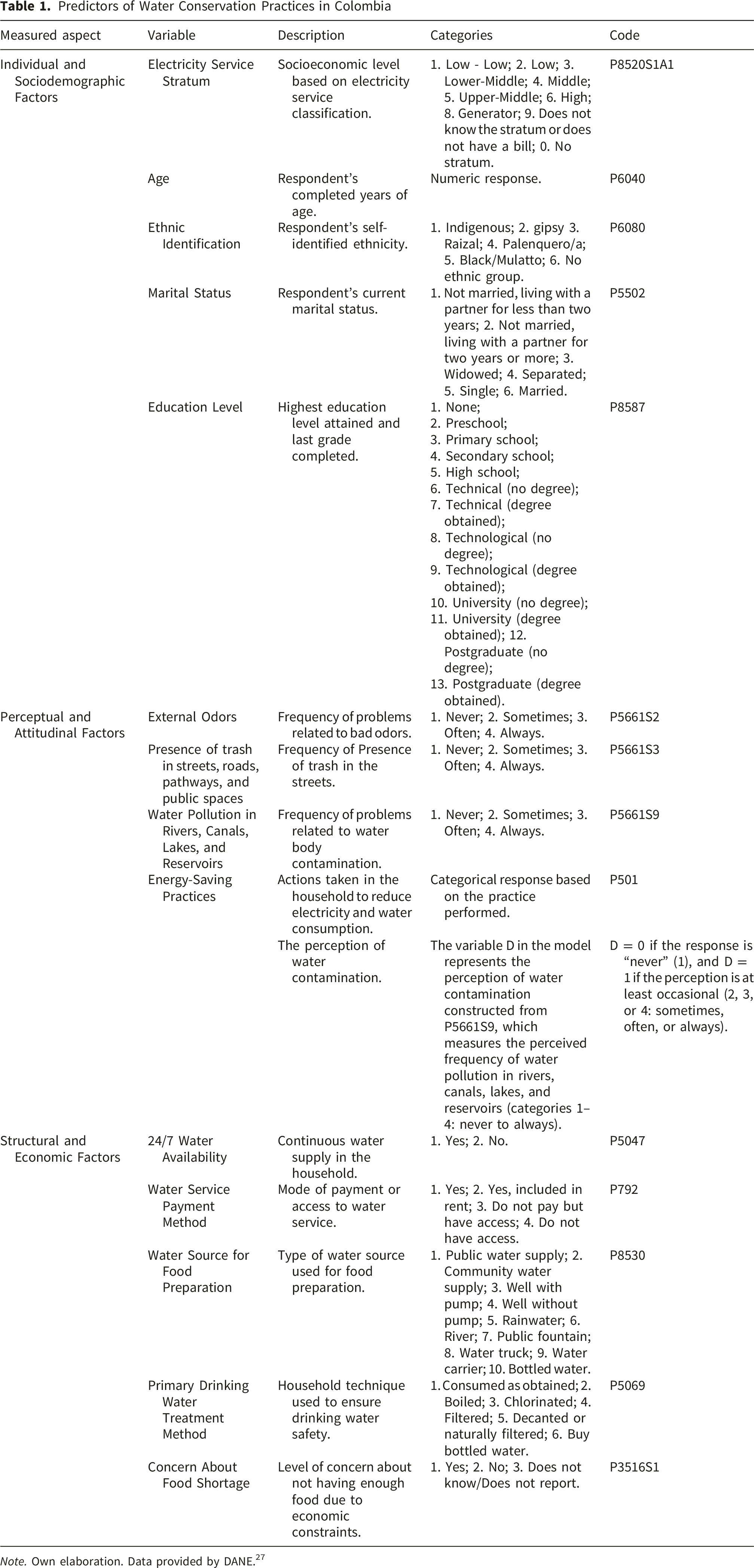
Note. Own elaboration. Data provided by DANE. 27
Perceptual and attitudinal factors are equally important. Beliefs about water quality and availability shape everyday decisions, and according to the Theory of the Commons, perceiving water as vulnerable can strengthen conservation commitments. 5 The Sustainability Model likewise highlights how environmental attitudes and social norms encourage the development of sustainable habits. 30
Finally, structural and economic conditions determine the practical feasibility of conservation. Access to infrastructure and the ways in which households pay for water services influence both consumption and conservation potential. Recent research shows that collaborative governance can improve water distribution and support conservation efforts. 16 The Sustainability Model also underscores how public policy and financial incentives shape household decisions 18 (Table 1).
3.3. Algorithms
To model the ordinal dependent variable—which reflects the highest level of conservation complexity reached by each household—we employed a cumulative-by-threshold approach. In this framework, the ordinal outcome is expressed as a series of cumulative binary logits, allowing us to trace how households move across increasingly complex conservation behaviors. Each cumulative model was estimated using L1-penalized logistic regression (LASSO), a method that supports automatic variable selection and coefficient shrinkage in high-dimensional settings while maintaining interpretability.31-33
To assess how well the models perform and to prevent overfitting, the dataset was randomly split into an 80% training sample and a 20% test sample. All models were trained exclusively on the training data, and their predictive accuracy was evaluated using out-of-sample results from the test set. 34
3.3.1. Penalized Logistic Estimation
For each cumulative threshold, we estimated a logistic regression model including sociodemographic, perceptual, and structural covariates. Estimation was conducted using cross-validated LASSO via the glmnet package in R, with pure L1 regularization (α = 1). The penalty parameter was selected using the λ1se criterion, which favors more parsimonious specifications while maintaining predictive accuracy. 33 This regularization procedure reduces dimensionality, mitigates multicollinearity, and identifies the most relevant predictors and interaction effects without imposing ex ante restrictions on model complexity.
Because categorical variables were expanded into dummy indicators, discrepancies between training and test matrices may arise when certain factor levels appear in only one partition. To ensure dimensional consistency, we implemented a matrix-alignment procedure that fixed factor levels in the test data to match those of the training set, added missing dummy columns with zero values, removed extraneous columns, and reordered predictors to ensure compatibility with the trained model. This guarantees valid out-of-sample predictions.
3.3.2. Double Machine Learning
To estimate the causal effect of perceived water contamination on conservation behavior, we applied the Double Machine Learning (DML) framework within the Interactive Regression Model (IRM), a specification designed for binary treatments. In this context, the treatment variable captures whether households perceive contamination in rivers, lakes, and reservoirs. In the main definition, the treatment is coded as zero when contamination is never perceived and as one when it is perceived at any positive frequency. Additional dichotomizations were also explored to assess the robustness of the results.
For each cumulative threshold, the parameter of interest is the Average Treatment Effect (ATE)
35
:
The parameter captures the change in the probability of crossing threshold k when moving from no perceived contamination to perceived contamination. Thus, for each cumulative conservation threshold, the Average Treatment Effect (ATE) reflects how perceived contamination alters the likelihood of advancing to more demanding conservation behaviors.
Causal identification relies on three assumptions: (1) conditional ignorability, meaning treatment assignment is independent of potential outcomes given observed covariates; (2) positivity, requiring that all covariate profiles have a non-zero probability of treatment; and (3) i.i.d. observations, following the standard potential-outcomes framework. 36
We estimate the ATE using the Augmented Inverse Probability Weighting (AIPW) estimator, which is doubly robust—consistent if either the propensity score or the outcome model is correctly specified. 37 To reduce overfitting in machine-learning nuisance models, we apply 4-fold cross-fitting following Chernozhukov et al, 38 training nuisance functions on K–1 folds and evaluating them on the held-out fold. This orthogonalization ensures valid inference even with flexible ML methods.
To enhance numerical stability, folds were stratified by treatment status, constant predictions were used when outcome variation within a fold was insufficient, and the propensity score was trimmed at ε = 0.01 1 , with additional robustness checks at ε = 0.05.
Standard errors were obtained using the empirical variance of the influence function, and 95% confidence intervals were constructed under normal approximation. To address multiple testing across thresholds, p-values were adjusted using the Benjamini–Hochberg procedure.
Overlap was evaluated by inspecting the distribution of estimated propensity scores and identifying the share of observations in extreme regions. We conducted sensitivity analyses using alternative treatment definitions and alternative constructions of the ordinal outcome—including reordered complexity rankings and a count-based measure—to verify that results were not driven by arbitrary modeling choices.
Although the DML-AIPW framework flexibly adjusts for a rich set of socioeconomic, perceptual, and structural covariates, the conditional ignorability assumption remains untestable. Unobserved factors—such as institutional trust, previous water-related illness, local informational campaigns, or community norms—may jointly influence contamination of perception and conservation behavior. Accordingly, the estimated effects should be interpreted as causal conditional on the assumption that no relevant unobserved confounders persist after adjustment. The broad set of controls reduces (but cannot eliminate) this risk.
4. Results
4.1. Predictive Performance (Ordinal LASSO by Threshold)
Out-of-Sample Predictive Performance (Test Sample)

Note. Elaboration based on own work using R. 39
AUC is highest for Y≥3, indicating that observed covariates discriminate high-complexity adoption better than intermediate adoption; this is consistent with (but does not prove) a stronger role of capacity-related determinants in high-cost decisions.
Regression Coefficients and Odds Ratios for Predicting Water Conservation Practices Across Thresholds of Complexity

Note. Elaboration based on own work using R. 39
Conversely, the LASSO selected as salient barriers household drinking-water treatment via chlorination (P50693;
Taken together, these findings indicate that the onset of conservation behaviors is primarily linked to socioeconomic/educational status and environmental perceptions (trash and odors), whereas adoption is lower in the presence of structural constraints or weaker economic incentives (e.g., lack of direct payment for the service). Age (P6040) exhibited a near-null effect (OR
At the threshold Y≥2 (adoption of at least one médium or high-complexity practice), the LASSO retained a partially overlapping but qualitatively distinct set of predictors. Positive associations persisted for socioeconomic stratum 3 (P8520S1A13; β = 0.358, OR = 1.43), incomplete technological education (P85878; β = 0.388, OR = 1.47), and intermittent water availability (P50472; β = 0.086, OR = 1.09). The latter finding suggests that households experiencing supply interruptions may adopt medium-complexity strategies, such as rainwater harvesting, as a water security response (Table 3).
Drinking water treatment through filtration again emerged as the strongest barrier (P50693; β = −0.749, OR = 0.473), followed by the constant perception of garbage in public spaces (P5661S34; β = −0.587, OR = 0.556), payment for water service included in rent (P7922; β = −0.431, OR = 0.650), and the absence of ethnic identification (P60806; β = −0.245, OR=0.783) (Table 3).
Notably, the coefficient associated with the perceived water contamination indicator (D; β=−0.117, OR = 0.889) attenuated substantially compared to the Y≥1 threshold, indicating that risk perception plays a diminishing role in the transition toward structurally more demanding practices.
At the threshold Y≥3 (adoption of a high-complexity, investment-based conservation practice), the strongest positive predictor in the entire analysis was incomplete technological education (P85878; β = 1.186, OR = 3.27), which more than tripled the odds of adopting low-flow sanitation infrastructure, underscoring the role of technical cognitive capacity as a prerequisite for investment-based conservation decisions (Table 3). Additional positive associations were retained for postgraduate technical education (P858713; β = 0.347, OR = 1.41), socioeconomic stratum 3 (P8520S1A13; β = 0.748, OR = 2.11), and access to water without direct payment (P7923; β = 0.245, OR = 1.28).
By contrast, the LASSO identified socioeconomic stratum 1 as the strongest barrier at this threshold (P8520S1A11; β = −0.751, OR = 0.472), reducing the likelihood of high-complexity adoption by more than half and reflecting that households with the greatest need for safe water solutions simultaneously face the most severe capital constraints. Additional barriers included the constant perception of garbage in public spaces (P5661S34; β = −0.521, OR = 0.594), Afro-descendant or mulatto ethnic identification (P60805; β = −0.517, OR = 0.597), a gap that emerged exclusively at this threshold and may reflect inequalities in access to credit or housing subsidy programs, the community aqueduct as the primary water source (P85302; β = −0.457, OR = 0.633), household drinking water filtration (P50693; β = −0.317, OR = 0.728), and intermittent water availability (P50472; β = −0.256, OR = 0.774), the latter indicating that severe scarcity constrains the financial capacity required to undertake permanent technological upgrades (Table 3).
Perceived water contamination did not survive the λ1se penalty at this threshold, indicating that, once household structural capacity is accounted for, environmental risk perception alone does not drive investment-based conservation.
4.2. DML-AIPW With Cross-Fitting
The Double Machine Learning (DML) framework was implemented under the Interactive Regression Model (IRM), which is appropriate for binary treatments.
38
The parameter of interest at each threshold k is the Average Treatment Effect (ATE):
Causal identification relies on three assumptions: (i) conditional ignorability (selection on observables), (ii) positivity/overlap, and (iii) i.i.d. The AIPW estimator is doubly robust: consistency is preserved if either the propensity score model or the outcome model is correctly specified. 37
Conditional ignorability is supported by the inclusion of a comprehensive set of socioeconomic, perceptual, and structural covariates that capture the main plausible confounding channels. Positivity/overlap is assessed through the distribution of the estimated propensity scores, with trimming sensitivity analyses (ε = 0.01 and ε = 0.05) confirming that results are not driven by regions of limited common support. Finally, SUTVA 2 /i.i.d. is discussed in light of the survey’s clustered sampling design, acknowledging potential neighborhood interference while arguing that restricting the sample to high-IRCA municipalities mitigates intracluster treatment variation. Together, these diagnostics enhance the transparency and credibility of the identification strategy.
Cross-fitting with K = 4 folds stratified by treatment was implemented, with propensity scores trimmed at ε = 0.01 (robustness checked at ε = 0.05).
Main Results (ε = 0.01)
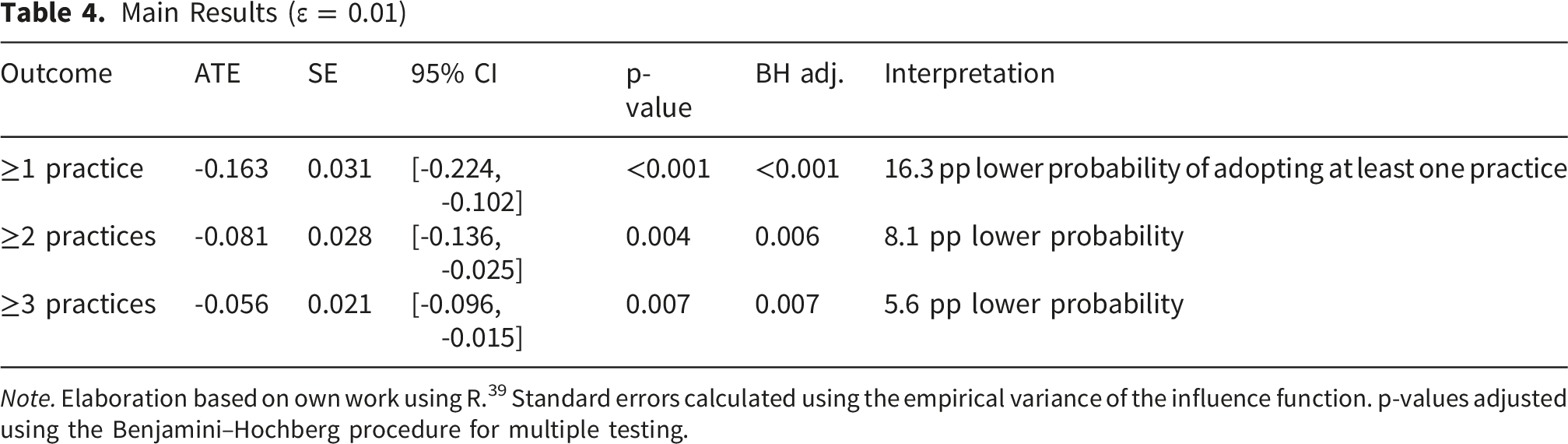
Note. Elaboration based on own work using R. 39 Standard errors calculated using the empirical variance of the influence function. p-values adjusted using the Benjamini–Hochberg procedure for multiple testing.
This finding challenges the assumptions of the Theory of Planned Behavior and the Norm Activation Theory. Instead, it aligns with a structural resignation mechanism—a vulnerability paradox—in which households most exposed to contamination also face the strongest material constraints, limiting their ability to conserve and ultimately overriding any motivational effect of risk perception.
Robustness to Propensity Trimming
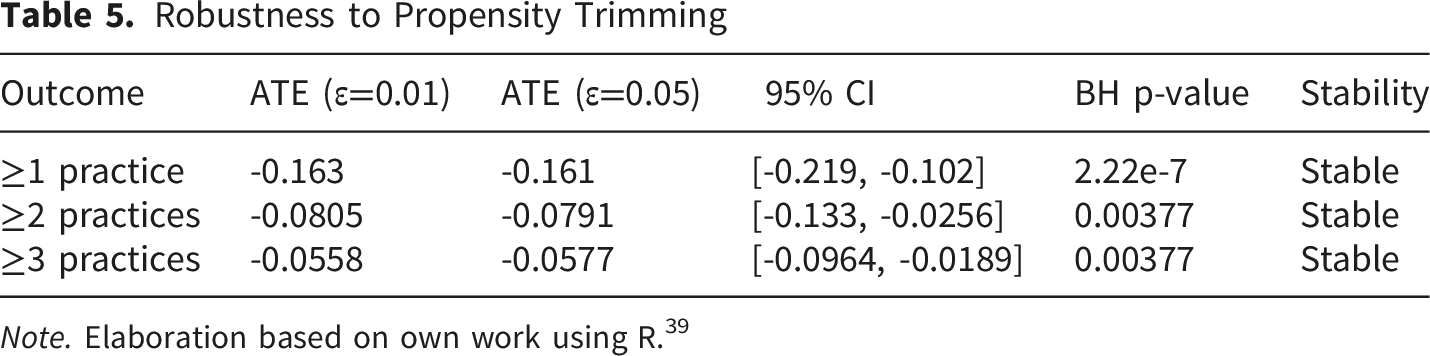
Note. Elaboration based on own work using R. 39
Sensitivity to Alternative Definitions of D
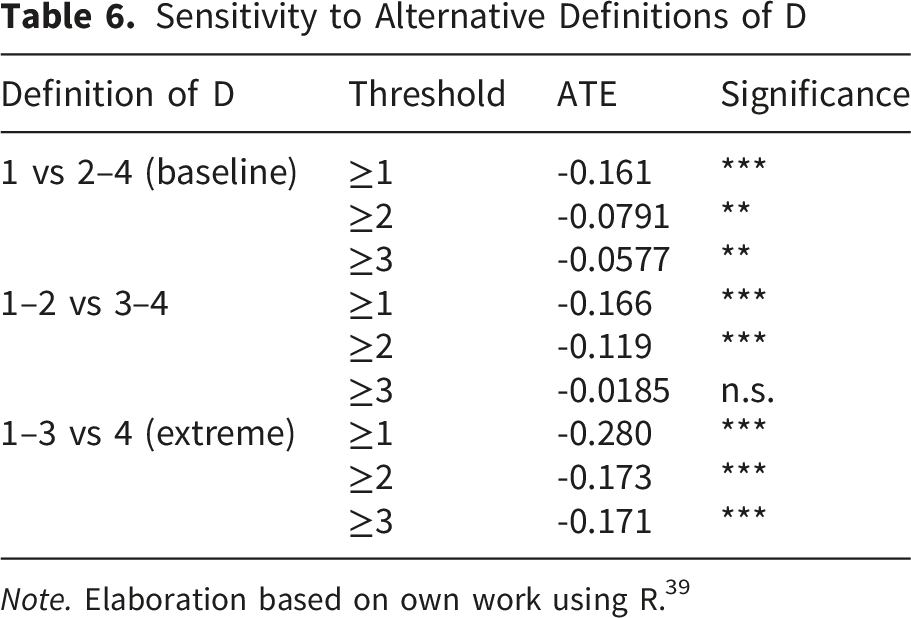
Note. Elaboration based on own work using R. 39
Definitions Robustness to Outcome Construction (ε = 0.05)
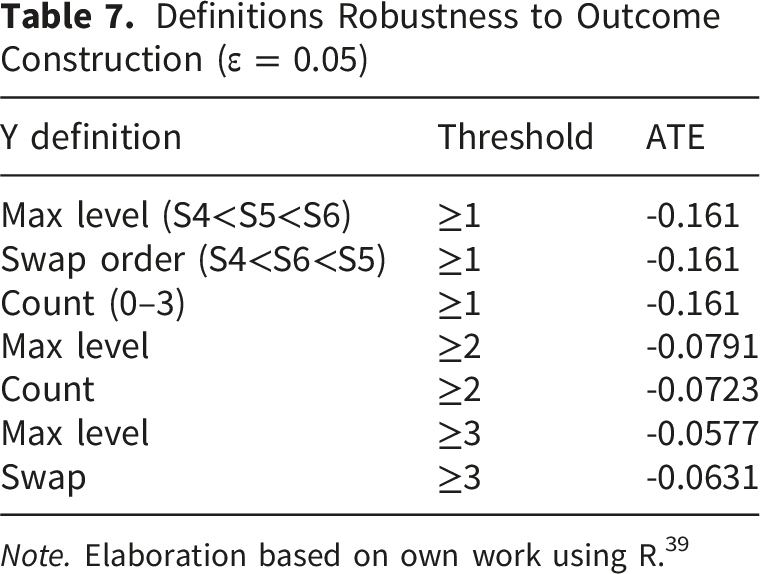
Note. Elaboration based on own work using R. 39
5. Discussion
The results of this study provide three contributions to the literature on water conservation in households where, although contamination exists, scarcity is not a problem: a theoretical reinterpretation of the link between perception and behavior in contexts, an empirically identified hierarchy of factors that affect conservation at three levels of complexity, and a set of policy implications derived from the results.
The central finding of this study is that perceived water contamination causally reduces the probability of conservation at the three levels of complexity (ATE: −16.3, −8.1, and −5.6 pp, respectively; Table 4); this finding does not support the predictions of the Theory of Planned Behavior 3 and the Norm Activation Theory, 4 since both treat perceived environmental risk as a motivational antecedent for pro-environmental behavior.
Additionally, the finding is also inconsistent with the Sustainability Model of Pro-environmental Behavior, 6 which assigns a positive role to environmental concern in activating conservation habits. In this context, we propose that this anomaly may be explained by a vulnerability paradox that operates through two mechanisms. First, clustering of deprivations, since the perception of contamination does not independently activate pro-environmental behaviors; since this phenomenon is correlated with a broader spectrum of deprivations, such as low socioeconomic stratum (OR = 0.472 for stratum 1 in Y ≥ 3), dependence on community aqueducts (OR = 0.633), and intermittent supply (OR = 0.774 in Y ≥ 3), which simultaneously limits the material capacity for conservation. Households exposed to the worst water quality are precisely those that are least able to invest in its improvement, which makes perception causally counterproductive once structural constraints are taken into account. Second, environmental learned helplessness11,12; this is evidenced in the inversion of signs observed for the garbage perception variable, positive at occasional frequency (OR = 1.50 in Y ≥ 1) but negative at constant frequency (OR = 0.556 in Y ≥ 2), suggesting that chronic exposure to environmental degradation may induce a form of fatalism where individuals perceive collective action as useless, consistent with the perceived behavioral control dimension of the Theory of Planned Behavior 3 and with empirical findings on environmental apathy under chronic stress factors. 30
These mechanisms identified previously have important theoretical implications, since they show that the applicability of standard conservation models depends on the context; the empirical results corroborate that the perception–behavior pathway is severely restricted when the population is exposed to other types of deprivations, and it may reverse when contamination is chronic. This finding expands the work of Wagan et al, 40 Rodríguez-Sánchez et al, 9 De Matos et al, 10 who identified contextual limitations of standard models without being able to estimate causal mechanisms, and provides the first causally identified evidence of this inversion in a Colombian context dominated by contamination and not by scarcity.
The LASSO results reveal a hierarchy of determinants that shifts systematically across the three margins of adoption. At the initiation margin (Y ≥ 1), the most relevant finding is the moral licensing effect produced by household water filtration (OR = 0.339): households that already treat their water have a 66.1% lower probability of adopting any additional conservation practice. This is consistent with the literature on moral licensing, 41 which documents that a completed pro-environmental action reduces the perceived obligation to perform complementary actions.
At the intensification margin (Y ≥ 2), the saturation effect documented for the constant perception of garbage (OR = 0.556) suggests that in communities with visible environmental degradation awareness campaigns are probably ineffective. Therefore, tangible structural improvements in different environmental aspects should precede or accompany informational interventions to restore the perceived behavioral efficacy that allows motivation for conservation. This is consistent with the literature on Community-Based Social Marketing, 42 which identifies perceived feasibility as a prerequisite for the adoption of behaviors.
At the high-complexity margin (Y≥3), the dominant finding is that incomplete technological education more than triples the probability of adopting low-flow sanitation infrastructure (OR=3.27), while belonging to stratum 1 reduces it by more than half (OR=0.472). Together, these estimates define the boundaries of a conservation poverty trap: the capacity for investment-based conservation requires a minimum threshold of both technical cognitive capacity and economic resources that are systematically absent in the most vulnerable households. Breaking this trap requires direct asset transfers, equipment subsidies targeted at stratum 1 households, rather than informational or attitudinal interventions. The Afro-descendant ethnic gap at this threshold (OR=0.597), which does not appear at lower complexity levels, points additionally to ethnically differentiated barriers in credit access and housing subsidy programs that require ethnic-specific policy design.
6. Conclusions
The findings of this study showed that in Colombian municipalities where water is not suitable for human consumption, the determinants of conservation behavior of this resource change systematically as complexity increases. At the initial margin, these factors are mainly linked to socioeconomic capacity and the perception of other environmental problems, but it is suppressed by household water filtration. At the medium complexity margin, the emergence of an environmental saturation effect, such as the constant perception of garbage, reveals that environmental degradation can invert the motivational effect, turning them into inhibitors of water conservation. While, at the high complexity margin, structural and human capital determinants dominate, since technical education almost triples the probability of adoption, while the lowest socioeconomic stratum reduces it by more than half; the above configures a poverty trap in conservation. Regarding the Afro-descendant ethnic gap that emerges exclusively at this margin, which contrasts with standard conservation models that had not previously identified this situation in the Colombian context.
Regarding the causal question, the results of DML-AIPW establish that perceived water contamination causally reduces the probability of adopting conservation practices of this resource at the three levels of complexity. This finding is robust to alternative definitions of treatment, conservative trimming of propensity scores, and alternative outcome constructions. The previous results emerge as direct evidence against the assumption, embedded in the Theory of Planned Behavior, the Norm Activation Theory, and the Sustainability Model, that the perception of environmental risk is a generalizable motivator of conservation.
In contexts of structural degradation where there is no scarcity, the perception of water contamination seems to activate learned helplessness rather than behavioral intention; the above is consistent with environmental psychology research on chronic stress factors. 12
The findings show the existence of a vulnerability paradox, since, in municipalities with a highly contaminated water resource (IRCA > 80), the households most exposed to this environmental problem are simultaneously the least structurally equipped to adopt conservation behaviors. This paradox has three concrete policy consequences that follow directly from the estimated effects. First, conservation interventions in high-IRCA municipalities should not lead with awareness campaigns, which the causal results suggest are likely ineffective or counterproductive where contamination perception is already high, but with structural investments in water quality infrastructure and household equipment subsidies that restore the material preconditions for behavioral agency. Second, filter distribution programs require complementary messaging explicitly framing filtration as a complement to conservation, not a solution to it, in order to prevent the moral licensing suppression of additional practices documented at Y≥1. Third, the Afro-descendant gap at the high-complexity margin requires ethnically differentiated program design, specifically, targeted credit access and equipment subsidy schemes, that addresses not only economic but also institutional barriers to conservation investment.
More broadly, this study provides evidence consistent with that the behavioral response to water contamination cannot be understood without accounting for the structural context in which that response is embedded. Environmental awareness, in the absence of material capacity and institutional trust, does not translate into conservation behavior. Closing the conservation gap in Colombia’s most water-vulnerable municipalities therefore requires the State to address, simultaneously, the institutional failure that produces chronic contamination, the distributional inequalities that generate the conservation poverty trap, and the behavioral mechanisms, including moral licensing, through which structural deprivation transmits itself into behavioral resignation. This is, fundamentally, a question of environmental justice, and it demands policy responses designed at that level of ambition.
A limitation must be considered: the cross-sectional design of the ECV did not allow studying the evolution of water resource conservation behaviors. In future analyses through the use of longitudinal data. Additionally, it would be interesting to explore territorial and socioeconomic heterogeneities through spatial approaches.
Footnotes
Ethical considerations
This study is based exclusively on secondary data obtained from publicly available sources. Specifically, we use microdata from the 2024 Colombian Quality of Life Survey, which are made publicly accessible by the National Administrative Department of Statistics (DANE) through its official microdata repository ( ). The data are fully anonymized by the data provider prior to public release and do not contain any direct or indirect personal identifiers that would allow the identification of individual respondents. As a result, this research does not involve interaction with human subjects, nor does it include the collection of primary data. Given the public, anonymized nature of the dataset, this study does not require approval from an institutional ethics review board, in accordance with widely accepted ethical guidelines for research using secondary, non-identifiable data. The data was used strictly for academic and research purposes, and all analyses were conducted in compliance with the terms and conditions established by DANE for the use of its microdata.
Funding
The authors disclosed receipt of the following financial support for the research, authorship, and/or publication of this article: This research was supported by internal resources of the authors’ affiliated institutions, Fundacion Universitaria Konrad Lorenz, Universidad El Bosque.
Declaration of Conflicting Interests
The authors declared no potential conflicts of interest with respect to the research, authorship, and/or publication of this article.
Data Availability Statement
The data used in this study are publicly available from the National Administrative Department of Statistics (DANE) through its official microdata repository. The primary dataset corresponds to the 2024 Colombian Quality of Life Survey and can be accessed at . Additionally, municipal-level data from the 2024 Water Quality Risk Index (IRCA) were used. These data are publicly released by the National Institute of Health (Instituto Nacional de Salud, INS) as part of Colombia’s official water quality surveillance system. All datasets are anonymized and made available for research purposes by the respective data providers.
AI Usage Statement
The authors utilized the Claude (Anthropic) large language model for the translation and linguistic adaptation of the text from its original Spanish version into English. Following the AI-generated translation, the authors conducted a comprehensive manual review and editing process to ensure the accuracy of technical terminology and academic coherence, maintaining full accountability for the final content.