




Abstract
Objective
This study was aimed to investigate the blood composition and potential mechanism of Liujun Jiaoxian Tang (LJJXT) for treating sepsis.
Methods
After drug intervention in rats, the main active components in LJJXT liquid and serum were identified by UPLC-QE-MS analysis. The effective components and their targets of LJJXT were further screened through the TCMSP database; the disease-related action targets were retrieved by using the Disgenet and Genecards databases. The intersection of the two sets of targets was taken to construct the “LJJXT-components-targets-diseases” network, PPI diagram, GO and KEGG enrichment analysis diagram. Subsequently, molecular docking studies were conducted on the key targets for treating diseases screened by PPI and the corresponding effective components in LJJXT.
Results
There were 2159 active ingredients in LJJXT, of which 90 were effective in blood. The 20 screened active ingredients matched 139 targets. There were a total of 2585 disease-related targets, and 76 targets shared by drugs and diseases. There were 2113 biological processes, 43 cell components, 211 molecular functions in GO analysis and 172 pathways obtained by KEGG analysis. The results showed that LJJXT may act on AKT1, TNF, PTGS2 and other targets through the active ingredients in blood such as terpenoids, flavonoids, phenols and alkaloids. It was involved in the regulation of lipid and atherosclerosis, toxoplasmosis, and other signaling pathways to play anti-inflammatory, immune enhancement, reduce oxidative stress and other effects, so as to exert drug efficacy and alleviate sepsis. Molecular docking results showed that kaempferol and vitamin A had high affinity with key therapeutic targets involved in lipid and atherosclerotic signaling pathways, and the combination of kaempferol and JUN was the best.
Conclusions
This study revealed the effective ingredients and potential mechanisms of LJJXT for treating sepsis, providing sufficient theoretical basis for its clinical treatment of sepsis and subsequent basic research.

1. Introduction
Sepsis refers to a clinical syndrome of acute systemic inflammation induced by infection and trauma, which leads to secondary injury of tissues and organs. 1 It affects more than 30 million people worldwide each year and is one of the leading causes of death in severely ill patients worldwide. 2 The core pathogenesis is inflammatory imbalance, where the immune response cannot restore homeostasis, leading to persistent excessive inflammation and immunosuppression. 3 The early treatment field has always focused on anti-inflammatory therapy, but it has shortcomings such as increased drug resistance and the increase of conditional pathogens, so the current treatment focuses on improving immunity. In traditional Chinese medicine (TCM), the pathogenesis of sepsis belongs to the imbalance of Yin and Yang, and it has been proved that both TCM monomer components and compounds can play a role in the field of immune regulation of sepsis without the risk of increased drug resistance.
Sijunzi Decoction originated from Prescriptions of the Bureau of Taiping People’s Welfare Pharmacy, which is the basic formula for invigorating spleen and replenishing qi. 4 It and its modified formulations possess immunomodulatory functions, capable of improving immune organ and cytokine activity and relieving immunosuppression. 5 Liujun Jiaoxian Tang (LJJXT) is the protocol for the clinical treatment of sepsis in the First Traditional Chinese Medicine Hospital of Changde, which evolved from Sijunzi decoction. The Intensive Care Unit of our hospital included patients with sepsis of the spleen and stomach deficiency syndrome who met the criteria. After administering the medication, clinical observations were conducted on them. It was found that the LJJXT had a significant therapeutic effect in treating such patients in addition to the conventional treatment, and was safe and reliable. 6
The composition of LJJXT includes Codonopsis Radix 30g (Dangshen [DS]), Atractylodes Macrocephala Koidz. 15g (Baizhu [BZ]), Citrus Reticulata 12g (Chenpi [CP]), Arum Ternatum Thunb. 9g (Banxia [BX]), Poria Cocos (Schw.) Wolf. 15g (Fuling [FL]), Glycyrrhiza uralensis Fisch. 6g (Gancao [GC]), Crataegus pinnatifida Bge. 30g (Shanzha [SZ]), Massa Medicata Fermentata 20g (Liushenqu [LSQ]), Hordei Fructus Germinatus 10g (Maiya [MY]), Aucklandiae Radix 5g (Muxiang [MX]), Pogostemon Cablin (Blanco) Benth. 15g (Guanghuoxiang [GHX]), Syringa oblata Lindl. 3g (Dingxiang [DX]), Nelumbinis Plumula 12g (Lianzi [LZ]), Amomum villosum Lour. 9g (Sharen [SR]). This prescription increases the effect of dryness and turbid, nourishing the heart and calming the spirit, of which DS is the sovereign medicine to tonify the spleen and stomach; BZ assists it. It then uses CP and BX tonifying spleen transport to dry dampness, uses FL removing dampness and turbidness, and uses LZ and SR soothing and calming the mind. Other drugs (such as SZ, SQ, MY, MX, GHX, and DX) play the role of enlivening the spleen and regulating the stomach, and GC is used to reconcile all medicines. LJJXT has been used clinically for decades, and the effect of treating sepsis is remarkable, but its therapeutic mechanism is not clear.
Due to the complexity of various components and the unknown pharmacodynamic mechanisms in LJJXT, in this study, UPLC-QE-MS analysis and network pharmacology will be used to explore it. First, the effective therapeutic component of LJJXT entering the blood was identified,
7
and it was combined with network pharmacology to obtain a clear target and pathway of action, and then preliminary verification was carried out through molecular docking experiment.
8
The specific process of this study is described in the
2. Materials and Methods
2.1. Main Reagents and Instruments
Ultra-High Performance Liquid Chromatography (Vanquish, Thermo Fisher Scientific); Orbitrap Exploris 120 Mass Spectrometry (Q Exactive Focus, Thermo Fisher Scientific); Centrifuge (Heraeus Fresco17, Thermo Fisher Scientific); The electronic analytical balance (BSA124S-CW, Sartorius); UPLC BEH C18 Chromatographic Column (UPLC BEH C18 1.7 μm 2.1*100mm, Waters); Methanol (CAS:67-56-1, CNW Technologies); Acetonitrile (CAS:75-05-8, CNW Technologies); Formic acid (64-18-6, SIGMA); 2- Chloro-L- phenylalanine (103616-89-3, purity >98%, Shanghai HC Biotech Co.Ltd). LJJXT, a Chinese herbal formula developed by the First Traditional Chinese Medicine Hospital of Changde, was prepared by boiling disinfected distilled water in recommended proportions.
2.2. Database and Software
TCMSP (https://old.tcmsp-e.com/tcmsp.ph); DisGeNET (https://www. disgenet.org/); GeneCards (https://www.genecards.org); Uniprot platform (https://www.uniprot.org); PubChem (https://pubchem.ncbi.nlm. nih.gov/); PDB platform (https://www. rcsb.org/); String database (https://string-db.org/); Cytoscape 3.7.0 Software and its plugins. All data retrieval and network pharmacological analyses were performed using the following databases and software during November 2024-July 2025.
2.3. Preparation of Experimental Drugs
According to the proportion of the prescription, the Chinese herbal medicines were taken. They were soaked in 7 times the amount of water for 1h, heated to reflux extraction twice (each time for 1h), combined with the extracted aqueous solution, concentrated to 3.0g/ml under reduced pressure to obtain the water extract of LJJXT. The above process was prepared by the Pharmacy Department of Changde Hospital affiliated to Hunan University of Chinese Medicine, and the same batch of medicinal materials was selected. After preparation, they were refrigerated at 4°C for use.
2.4. Preparation of LJJXT-Containing Serum
SPF male mice, weighing 15-25 g, were purchased from Beijing Vital River Laboratory Animal Technology Co. (Animal order No. DWDG-202304170009). The research was conducted by the Ethics Committee for Animal Testing at Hunan University of Chinese Medicine (The ethics approval reference number 20240417-15, the original document can be found in the supplementary file). Twelve mice were randomly divided into control group and LJJXT group. According to the clinical dose, the administration dose of mice was converted to 28.7g/kg, and the calculation formula was as follows: daily administration dose of mice =191g (total weight of LJJXT)/60kg (adult standard body weight) ×9.01 (dosage conversion multiple of mice and humans).
After 7 days of adaptive feeding, mice were daily treated with intragastrical administration of distilled water or LJJXT at doses of 28.7g/kg for a period of 7 days. At the end of administration, rats were sacrificed by isoflurane asphyxiation, and blood samples were collected from the abdominal aorta. Blood samples were then centrifuged (4 °C and 3600 rmp) for 15 min to obtain blank or LJJXT-containing serum. The collected serum was inactivated at 56°C for 30 minutes and frozen at -80°C.
2.5. Sample Preparation of LJJXT-Containing Serum, Blank Serum and LJJXT Extract
The serum sample 100mg was weighed and 500μL of extraction solution was added (methanol: water =4:1, with an internal standard concentration of 10μg/mL). The mixture was vortexed for half a minute, stirred at a frequency of 45Hz for 4 minutes, and then sonicated in a cooled water bath for 60 minutes. After standing at 4°C for 1 hour, the sample was centrifuged at a temperature of 4°C for 15 minutes at a speed of 12000 revolutions per minute (rpm) (equivalent to a centrifugal force of 13800×g, radius of 8.6 cm). The liquid floating above the sediment was collected and filtered through a microporous filter membrane with a pore size of 0.22μm. Samples were stored at a temperature of -80°C until further testing was conducted. 40μL of hydrochloric acid (2mol/L) was added to 400μL of serum samples. Subsequently, the mixture was stirred for 1 minute and then left to stand at 4°C for 15 minutes. This process was repeated four times, then 1.6mL of acetonitrile was added. Following stirring for 5 minutes, the samples were centrifuged at 12000 rpm for an additional 5 minutes. The supernatant (1800μL) was collected and dried using nitrogen blowing. 150μL of 80% methanol (with an internal standard concentration of 10μg/mL) was added to the supernatant. After vortexing the blend for 5 minutes, it was subsequently centrifuged at 12000 rpm for another 5 minutes. After centrifugation, the liquid above the sediment (120μL) was transferred to an injection vial for additional analysis.
The LJJXT extract was thawed on ice. after vortexing the blend for 30s, it was subsequently centrifuged for another 5 minutes (4°C, 12000 rpm). 300μL of the supernatant was taken into the EP tube and 1000μL of the extract solution (methanol: water =4:1, with an internal standard concentration of 10μg/mL) was added. The combination was swirled for half a minute, and sonicated in a chilled water bath for 5 minutes. After standing at 4°C for 1 hour, the sample was centrifuged at a temperature of 4°C for 15 minutes at a speed of 12000 rpm. The liquid floating above the sediment was collected and filtered through a microporous filter membrane with a pore size of 0.22μm. Samples were stored at a temperature of -80°C until additional testing was conducted.
2.6. Screening of Mass Spectrometry Condition and Identification of Incoming Blood Components
Liquid Chromatography Mobile Phase Conditions
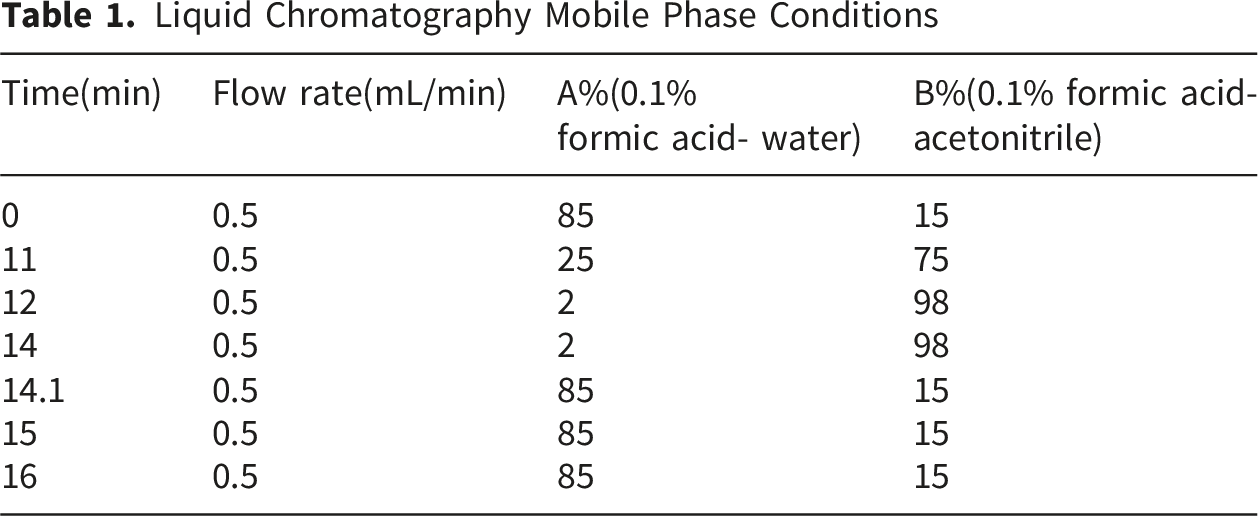
Data from mass spectra and tandem mass spectrometry (MS/MS) were obtained using an Orbitrap Exploris 120 mass spectrometer with Xcalibur software in accordance with the Information Dependent Acquisition (IDA) mode. In every round of collection, the mass range covered was between 100 and 1500, with the first four data points of each round examined and then the corresponding MS/MS data further data obtained. The sheath gas flow rate was set at 35Arb, the auxiliary gas flow rate at 15Arb, the ion transfer tube temperature at 400°C, and the vaporizer temperature also at 400°C. The complete MS resolution was to 70000, with the MS/MS resolution at 17500, and the NCE mode was set to 15/30/45. The spray voltage was adjusted at 4kV (positive) or -3.6kV (negative).
XCMS software was used to import the original mass spectra. The process included correcting retention time, identifying peaks, extracting peaks, integrating peaks, and aligning peaks. The peaks with MS/MS information were recognized and annotated with compounds by utilizing a custom-built secondary mass spectrometry database of BiotreeDB and the corresponding cleavage rule matching technique.
2.7. Core Signaling Pathways of LJJXT in the Treatment of Sepsis
The metabolites of the LJJXT-containing serum, blank serum and LJJXT extract group were qualitatively analyzed by using the UPLC-QE-MS technology. Through the mass spectrometry data, the components entering the blood were determined. The components that were jointly contained in the LJJXT-containing serum group and the LJJXT extract group but not in the blank serum group were located as the research objects and imported into the TCMSP database to obtain the action targets of the components entering the blood. Potential treatments for sepsis were discovered using the GeneCards (https://www.genecards.org) and DisGeNET database (https://www.disgenet.org). The association between the two was visualized using the Venn diagram, and the intersection was the target of the drug for treating the disease.
The overlapping targets were brought into the String network platform (https://string-db.org), and the protein species was specified as “Homo sapiens” to construct the Protein-Protein Interaction (PPI) network.
The node relationship information was imported into Cytoscape 3.9 to construct a network graph, and the targets of LJJXT in the treatment of sepsis were sorted by Degree value. And intersection targets were uploaded to the Gene Ontology (GO) (https://www.geneontology.org/) and Kyoto Encyclopedia of Genes and Genomes (KEGG) database platform (https://www.kegg.jp/kegg/pathway.html) enrichment analysis, to pinpoint important signaling pathways.
2.8. Molecular Docking
The protein names of the hub targets were searched within the Uniprot database, namely “Entry”, and their respective 3D receptor structures were identified using the PDB database (https://www.rcsb.org). The LJJXT active ingredients corresponding to the targets were searched, and the 3D structure of the ligands (the LJJXT active ingredients) was obtained in the TCMSP database. After the preparation of the receptor and ligand is completed, the AutoDockTools software was used to perform hydrogenation, dewatering and ligand removal operations on the receptor, and at the same time obtain the size of the docking box. The receptor and ligand documents were imported into Raccoon, and the document format was converted from “pdb” to “pdbqt”. The program for molecular docking was set in the cmd command mode of the Windows system. The calculated minimum binding energy and the output file after docking were statistically analyzed. The docking results were visualized in the Discovery Studio 2020 Client software.
3. Result
3.1. Identification of the Effective Blood-Entering Components of LJJXT
The molecular composition of LJJXT compounds and their characteristic fragment ions was confirmed based on the precise molecular mass information of excimer ion peaks and fragment ions provided by high resolution mass spectrometry and related literature data. A total of 2159 active ingredients were isolated from LJJXT, and the LJJXT-containing serum contained 2107 active ingredients. The intersection of the two was taken and the components contained in the blank serum were removed. There were a total of 90 effective blood-entering components of LJJXT. It includes 6 terpenoids, 9 flavonoids, 3 phenolic compounds and 3 alkaloids (Figure 1A and B and Supplemental document Table 1). Ionogram of the active ingredient of LJJXT (B) and its drug-containing serum (A)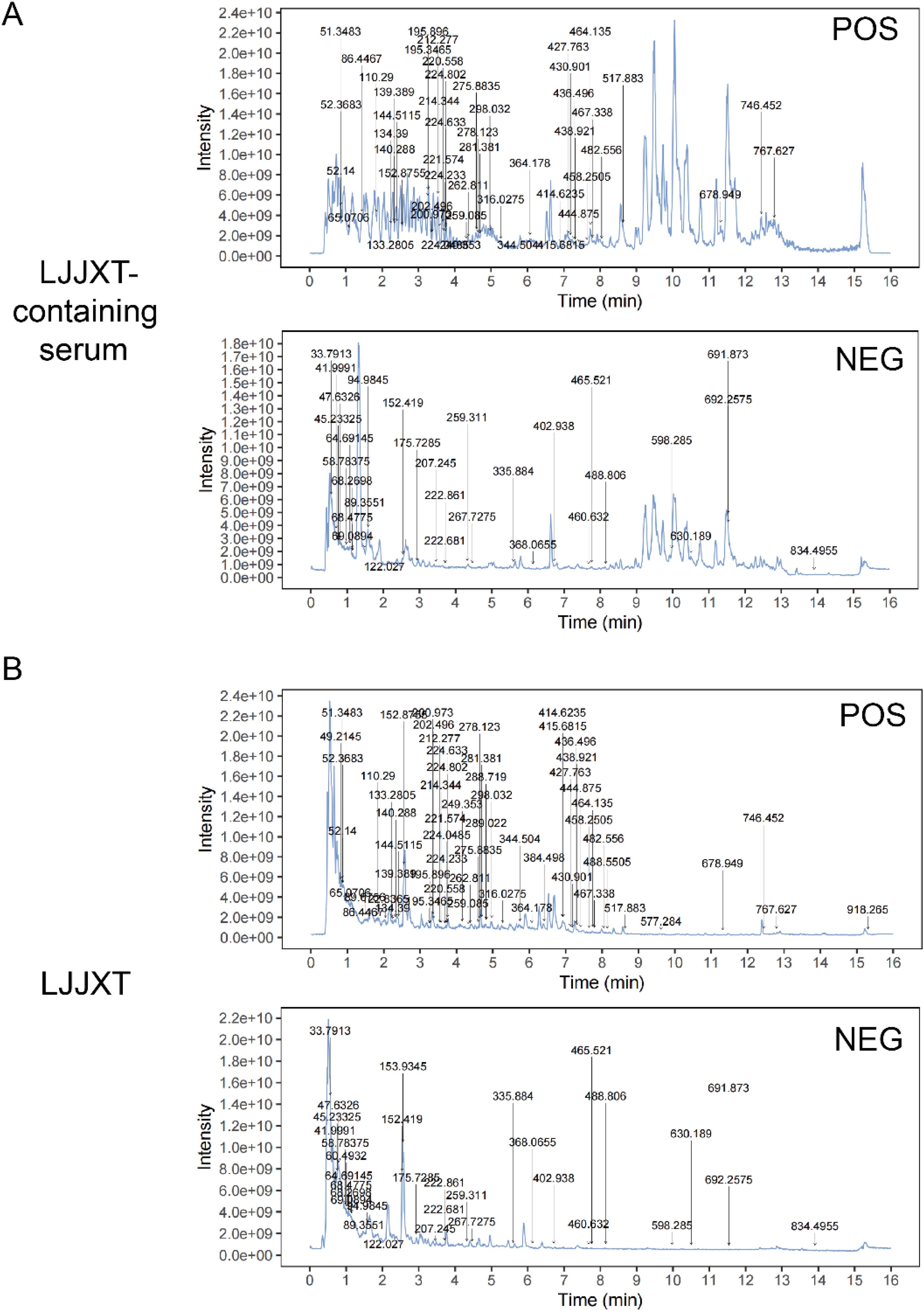
3.2. Exploring the Core Targets and Signaling Pathways of LJJXT for Sepsis Treatment
There were a total of 90 components of LJJXT that did not intersect with its blank serum but with the drug-containing serum, which were defined as effective blood-entering components (Figure 2A). Among them, 20 components matched 139 targets. A total of 2585 disease targets were identified for sepsis, thus generating 76 intersection targets (Figure 2B and C). The intersection genes were subjected to GO and KEGG enrichment analysis. Network pharmacology prediction for LJJXT treatment of sepsis. (A) The Venn diagram of blank serum, drug-containing serum and decoction of traditional Chinese medicine LJJXT; (B) The Venn diagram in both LJJXT’s effective blood-entering components and sepsis. There are 76 intersection targets between the LJJXT targets (139 targets) and the sepsis targets (2585 targets); (C) “LJJXT- effective Blood entry components-target” network. The active ingredients in LJJXT are marked in blue rhombus squares, targets in green squares. In the graph, the edges represent the relationships between compounds and targets
The target information was input into the Gene Ontology database (https://www.geneontology.org/) for functional enrichment analysis. A total of 2113 GO entries were screened out, including 211 in molecular Function (MF), 43 in Cellular Components (CC), and 1859 in biological processes (BP). The top ten entries in the three categories were saved (Figure 3A). From the perspective of biological processes, the main blood-entry component of LJJXT in the treatment of sepsis was primarily related to response to nutrient levels, response to xenobiotic stimulus, response to decreased oxygen levels, muscle system process, response to oxygen levels, response to nutrient, and response to the molecule of bacterial origin. The treatment mainly focuses on the interaction with heme binding and tetrapyrrole binding, as well as involvement in regulating estrogen 2-hydroxylase activity, monooxygenase activity, G protein-coupled amine receptor activity, estrogen 16-alpha-hydroxylase activity, oxidoreductase activity, adrenergic receptor activity, and steroid hydroxylase activity. The cellular composition primarily involved membrane raft, membrane microdomain, plasma membrane raft, caveola, secretory granule lumen, cytoplasmic vesicle lumen, vesicle lumen, nuclear envelope lumen, ficolin-1-rich granule lumen, external side of plasma membrane. The component targets involved in various enrichment analyses are shown in Figure 3B. GO enrichment analysis for potential therapeutic targets of LJJXT. The top 10 biological processes, cell components, and molecular functions for GO enrichment analysis are represented by square, circle, and triangle, respectively. (A) Bubble chart: GO enrichment analysis; (B) “LJJXT effective blood-entering components- GO analysis main items-targets of involved items” network diagram
The intersection targets were imported into the Metascape platform (https://www.metascape.org/) for KEGG enrichment analysis. The option was set as “Homo sapiens”, and 172 significantly enriched pathways were obtained. Upon screening, these pathways were found to be associated with Lipid and atherosclerosis, AGE-RAGE signaling pathway in diabetic complications, Chemical carcinogenesis - receptor activation, Toxoplasmosis, Fluid shear stress and atherosclerosis, TNF signaling pathway, IL-17 signaling pathway, Non-alcoholic fatty liver disease, Kaposi sarcoma-associated herpesvirus infection, C-type lectin receptor signaling pathway, The corresponding targets of LJJXT involved in the treatment of sepsis-related pathways are shown in Supplemental document Table 2, confirming that LJJXT achieves the treatment of sepsis through multiple pathways and approaches (Figure 4). KEGG enrichment analysis for potential therapeutic targets of LJJXT. The top 10 pathways for KEGG enrichment analysis are shown in the bubble chart. The pathway correlation is proportional to the pvalue, and the size of the points represents the number of intersection targets participating in the pathway. (A) Bubble chart: KEGG enrichment analysis; (B) “LJJXT effective blood-entering components- KEGG analysis main items-targets of involved items” network diagram
The 76 intersection targets were imported into the STRING database, and the species was selected as human (Homo sapiens). The obtained data were imported into Cytoscape 3.9.1 software. The Protein-Protein Interaction (PPI Network Analysis) network was constructed, and the cytohubba plugin was used for scoring calculation to obtain 10 hub targets for the treatment of sepsis by LJJXT. They were respectively AKT1, TNF, PTGS2, CASP3, JUN, PPARG, BCL2, IL10, HMOX1, and ICAM1 (Figure 5). The regulatory network and candidate targets for LJJXT to treat sepsis. (A) PPI network of the therapeutic ingredient targets. The 24 orange nodes in the inner ring represent the core targets of LJJXT-sepsis, the node size is proportional to the degree of the target in the network, and as the target correlation decreases, the node color changes from red to orange and then to yellow; (B) The hub targets of the PPI network are explored by CytoHubba plug-in. The top 10 targets were analyzed, the node color was from light yellow to red, and the corresponding degree gradually increased
3.3. Molecular Docking of LJJXT Effective Blood-Entering Components on the Targets Related to the Treatment of Sepsis
Table of Molecular Docking Binding Energy


Molecular docking reveals the binding of LJJXT components into its targets. (A–I) Visualization of docking results. The binding of components and targets (AKT1-Kaempferol, TNF- Kaempferol, TNF- Vitamin A, CASP3- Kaempferol, JUN- Kaempferol, JUN- Vitamin A, PPARG- Kaempferol, BCL2- Kaempferol, ICAM1- Kaempferol) are shown in a two-dimensional diagram, with nodes representing amino acid fragments of targets associated with ingredients, and different colors representing different connection modes
4. Discussion
Sepsis is a life-threatening organ dysfunction and systemic inflammatory response syndrome caused by the dysregulation of the host’s response to infection, and it is a common clinical critical illness with a mortality rate of 30% to 50%. 9
Its pathogenesis is complex, involving multiple aspects such as the systemic inflammatory network effect, immunosuppression and coagulation dysfunction, and endothelial barrier injury caused by the infection of pathogenic microorganisms and their toxins on the host body. It is closely related to the pathophysiological changes of multi-system malfunctions, multi-organ dysfunction, and multi-organ failure in the body. Moreover, the risk of death is even higher if the patient suffers from other serious underlying diseases, and the late inflammation will lead to severe disease, which makes the clinical treatment of sepsis very tricky.10,11 Therefore, the discovery of clinically effective drugs for treating sepsis and the exploration of the molecular mechanism of their efficacy have attracted more and more attention from researchers and scholars.
LJJXT is a proprietary Chinese medicine for the treatment of sepsis, but as it is a complex system, much work remains to be done on its molecular mechanism. In this study, we used network pharmacology and molecular docking technology based on effective blood-entering components to analyze the mechanism of action of LJJXT on sepsis from the perspective of inflammation (lipid and atherosclerosis signaling pathway), revealing the therapeutic potential of LJJXT in alleviating inflammation in sepsis.
The active ingredients of drug enter the bloodstream after drug administration. Therefore, the active ingredients detected by UPLC-QE-MS may be the key to determining the effectiveness of the drug. In recent years, network pharmacology, which combines high-throughput screening and computer technology, has been widely applied to the study of active components -protein/gene-disease interactions in traditional Chinese medicine. 12 An increasing number of studies have used systems biology to preliminarily elucidate the mechanism of the pharmacodynamic effects of Chinese medicines on sepsis.13,14 In this study, the UPLC-QE-MS-based metabolomics analysis and network pharmacology investigation are highly complementary and mutually supportive. Metabolomics identified blood-entering components of LJJXT, providing the precise material basis for subsequent network pharmacology target prediction. These experimentally validated active components served as core input data for network pharmacology, avoiding the bias of virtual component screening and ensuring the authenticity of component-target interactions. UPLC-QE-MS analysis indicated that the total number of active blood components of LJJXT was 90, including terpenoids, flavonoids, phenolics and alkaloids. Studies have shown that flavonoids, terpenoids and polyphenols were all able to alleviate sepsis by regulating pyroptosis, and polyphenols were relatively safer than flavonoids and terpenoids, as they have a wider dose range. 15 Alkaloids were also able to exert a therapeutic effect on sepsis-induced acute lung injury by influencing macrophage polarization. 16 A large number of blood-entering components discovered in this study have anti-inflammatory effects, which leads us to believe that anti-inflammatory agents may be the next focus of research.
Conversely, network pharmacology analysis of these metabolomics-identified components revealed their downstream targets and signaling pathways, explaining how these blood-entering metabolites exert anti-sepsis effects. The results of GO analysis showed that it was closely related to inflammatory factors such as oxygen levels, lipopolysaccharides, and bacterial molecules. KEGG analysis revealed hsa05417: Lipid and atherosclerosis is the most crucial signaling pathway in the LJJXT treatment of sepsis, and research data indicate that the atherosclerotic lipid profiles emerge and persist among survivors of sepsis, 17 and the two are closely related. We found that the targets involved in the relevant therapeutic pathways were concentrated in aspects such as apoptosis, cell differentiation, cell metabolism and inflammatory response.
Among them, AKT1, TNF, CASP3, JUN, PPARG, BCL2, and ICAM1 were the direct targets of LJJXT in the treatment of sepsis through lipids and atherosclerosis, and molecular docking was carried out successively on them. The results showed that the active substances such as compound kaempferol and vitamin A could bind well with the above-mentioned targets, thereby regulating sepsis. The binding energy of JUN to kaempferol was the lowest, indicating the most stable binding. As demonstrated in previous studies, kaempferol alleviates sepsis-induced acute lung injury by regulating the SphK1/S1P/S1PR1/MLC2 signaling pathway. 18 Moreover, its anti-inflammatory and antioxidant properties have been found to significantly improve the survival rate of septic animals. 19 Inhibiting JUN NH(2)-terminal kinase (JNK) and AKT has been demonstrated to reduce the activities of activator protein 1 (AP-1), nuclear factor (NF)-κB, and interleukin (IL)-6 in LPS-stimulated macrophages. This reduction in inflammatory responses has been identified as a critical component in the management of sepsis. 20 Therefore, it can be speculated that kaempferol can directly regulate JUN and exert therapeutic effects on patients with sepsis. Furthermore, it is speculated that the therapeutic effect of LJJXT on sepsis is related to its anti-inflammatory properties, and the disease is treated by regulating the relevant targets for treating sepsis in lipid and atherosclerotic signaling pathways.
This study adopted a “blood-entering component-centered” strategy, using UPLC-QE-MS to identify actual absorbed components in serum rather than virtual database components, greatly improving the accuracy of mechanism prediction. Second, the integrated application of metabolomics, network pharmacology and molecular docking forms a multi-level analytical system, realizing comprehensive exploration from chemical composition to molecular targets. Finally, key components like kaempferol were verified by molecular docking and literature support, providing reliable evidence for LJJXT’s mechanism, and this study provides a methodological reference for researching complex TCM preparations against critical illnesses. However, this study has several limitations that should be fully acknowledged. The accuracy and timeliness of web-based pharmacology databases remain to be scientifically verified. The possibility exists that unproven and undocumented compounds or therapeutic targets were not included in the analysis. Furthermore, kaempferol and vitamin A, which were identified as the most important biologically active components in the treatment of sepsis with LJJXT in this study, may not be fully representative of LJJXT. Molecular docking results reflect only theoretical binding affinity, lacking cellular and animal experimental validation of actual regulatory effects on target expression and function. Consequently, pharmacodynamic experiments and molecular biology experiments need to be considered to further verify our research findings, which will serve as the guiding principle and motivation for subsequent studies. According to clinical data, LJJXT has a good therapeutic effect on sepsis, 6 but the precise mechanism of LJJXT and its potential active ingredients have not been elucidated and substantiated. We posit that further research is warranted to explore the potential for development and research significance.
Overall, this study provides important implications for future sepsis and TCM research. First, the identified 90 blood-entering components and core targets (AKT1, TNF, JUN, etc.) can serve as candidate targets for developing novel anti-sepsis drugs. Second, the lipid and atherosclerosis pathway provides a new direction for understanding sepsis-related metabolic disorders. Third, the “metabolomics+network pharmacology+molecular docking” strategy offers a methodological paradigm for researching complex TCM. Fourth, key components like kaempferol deserve in-depth pharmacodynamic studies to develop monomer drugs. Finally, the component-target-pathway network can guide the optimization and secondary development of LJJXT. Therefore, this study promotes the modernization and internationalization of TCM for sepsis treatment.
5. Conclusion
In this study, we found that the composition of LJJXT is complex. It may act on targets such as AKT1, TNF, PTGS2, CASP3, JUN, PPARG, BCL2, IL10, HMOX1, and ICAM1 through blood-entering components (terpenoids, flavonoids, phenolics, and alkaloids). And it treats sepsis by regulating lipid and atherosclerotic signaling pathways to exert its anti-inflammatory properties. However, the present study lacks sufficient in vitro and in vivo experimental validation, and the pharmacological activities and mechanisms of LJJXT and its active ingredients remain to be further explored.
Supplemental Material
Supplemental Material - Mechanistic Elucidation of Liujun Jiaoxian Tang in Management of Sepsis Through Metabolomics and Network Pharmacology
Supplemental Material for Mechanistic Elucidation of Liujun Jiaoxian Tang in Management of Sepsis Through Metabolomics and Network Pharmacology by Muzi Peng, Runjun Sun, Wenjuan Quan, Biao Deng and Zhenlong Li in Biomedical Engineering and Computational Biology
Supplemental Material
Supplemental Material - Mechanistic Elucidation of Liujun Jiaoxian Tang in Management of Sepsis Through Metabolomics and Network Pharmacology
Supplemental Material for Mechanistic Elucidation of Liujun Jiaoxian Tang in Management of Sepsis Through Metabolomics and Network Pharmacology by Muzi Peng, Runjun Sun, Wenjuan Quan, Biao Deng, Zhenlong Li in Biomedical Engineering and Computational Biology
Footnotes

Ethical Considerations
The ethics approval reference number 20230417-15 (date: 2023.4.1), the original document can be found in the supplementary file. All animal procedures followed ethical principles and standard laboratory animal care protocols.
Authors’ Contributions
Muzi Peng and Runjun Sun wrote the main manuscript text and prepared figures. Wenjuan Quan and Biao Deng revised and reviewed the first draft. Zhenlong Li provided financial support for this publication project. All authors reviewed the manuscript.
Funding
The authors disclosed receipt of the following financial support for the research, authorship, and/or publication of this article: This study was funded by grants from the Natural Science Foundation of Hunan (No. 2025JJ70663, 2026JJ80310), the Guiding Project for Scientific and Technological Innovation in Changde City (No. 2024ZD86), the University-level Project by Hunan University of Chinese Medicine (No. 2023XYLH079, 2022XYLH060).
Declaration of Conflicting Interests
The authors declared no potential conflicts of interest with respect to the research, authorship, and/or publication of this article.
Data Availability Statement
All data generated or analyzed during this research process are included in this published article.
Supplemental Material
Supplemental material for this article is available online.
Appendix
References
Supplementary Material
Please find the following supplemental material available below.
For Open Access articles published under a Creative Commons License, all supplemental material carries the same license as the article it is associated with.
For non-Open Access articles published, all supplemental material carries a non-exclusive license, and permission requests for re-use of supplemental material or any part of supplemental material shall be sent directly to the copyright owner as specified in the copyright notice associated with the article.
