



Abstract
This article maps out and conceptualizes the way cinema emerged as a novel type of technology of the self and psychic individuation. It analyzes how cinema, in its inception, implemented a binding sensory dynamic that affected the convergence of spatiotemporal patterns into a constantly modifying hybrid self. Technologically animated images started to produce transformational spaces where the individual became problematized and regulated, not only in narratives and rhetorical figures, but more importantly, in the spatial patterning of perception, in affect transmission and collective organization. The article approaches cinema’s bodily and psychic dynamics in topological terms and employs three basic concepts—continuity, nearness, and neighborhood—so as to problematize what has become of the question of the individual in the age of moving images.
The emergence of the moving image at the turn of the 20th century was one of the critical turning points in the history of images and technologies that, instead of merely reiterating already existing modes of experience and subjectivity, effectively created and shaped new potentialities of being. Most of all, cinema came to modulate the sensing, feeling, and doing individual and its relation to itself and others. My purpose in this article is to map out and conceptualize how the moving image, in its inception, produced transformational spaces where the individual became problematized and regulated in a new manner—not only in narratives and rhetorical figures that have been the focus of film and visual studies until recently, but more importantly, in the spatial patterning of perception, in affect transmission and collective organization. The focus is on the problematic of individuation in cinema: how moving image media implemented a binding sensory dynamic that would affect the convergence of spatiotemporal patterns into a constantly modifying hybrid self (see Stafford, 2009). In this regard, I will follow a “deanthropomorphized” view that takes into account the individual’s dependence on the fluctuating external environment, including audiovisual technologies that since the birth of film have heavily invested in sensorimotor and affective dimensions of subjectivity. I will approach these bodily and psychic dynamics and codependences in topological terms and, in this respect, employ three basic concepts—continuity, nearness, and neighborhood—so as to problematize and describe, at least metaphorically, what has become of the question of the individual in the age of technologically animated images. These concepts will be treated in relation to three scenes from the period of early film in which cinema exhibited itself as a specific kind of realm of psychic organization and emergence.
Scene 1: Continuity
The first two scenes I will concentrate on are actually two consecutive sequences in Louis Feuillade’s 1915 film La tête coupée (The Severed Head), the first episode of the highly popular series of altogether 10 films entitled Les Vampires. As my analysis of the sequences will be formal, concerning potentialities of perception and individuation in cinema, I will not recount the film’s narrative in detail. Suffice to say that in the first sequence, the journalist Philippe Guérande spends a night in a castle owned by a certain Dr. Nox, while chasing the leader of the notorious criminal gang called “Les Vampires.” Philippe wakes up in the middle of the night to the fact that somebody has been in his room and left a curious note, even if the room door has been locked from the inside. He searches for alternative ways to access the room and suddenly discovers that the painting hanging on top of his bed is not simply the pictorial composition that it first appears to be. The perspectival painting shows a museum interior that is filled with antique statues, but it is not the contents of the picture that stimulate Philippe’s curiosity but rather its presence as a thing that can be handled and explored. He probes the picture frame and accidentally touches something. All of a sudden the picture canvas rolls up and discloses a secret tunnel beneath it, which Philippe feels around with his hands (Figure 1). Crucially, the painting draws Philippe’s attention to the extent that it opens up kinetic exploring and mapping. It is rather as a sensorimotor puzzle than as a representational composition that the image presents itself to the agile journalist.

La tête coupée, by Louis Feuillade (The Severed Head, 1915)
I am focusing on this “image-within-an-image” shot, as it can be considered crystallizing what happens to visuality in the movies. When suddenly transfigured, from thousands of years of stillness to automatic motion, the image started to embody “action possibilities,” to borrow a concept from the psychologist James J. Gibson (1986). Or the possibility for kinetic exploring is what the still image, when endowed with self-motion in the cinema, suddenly disclosed as the secret it has kept within itself. Gibson’s theory of ecological perception that stresses motility and constant interactions between the observer and the material environment is particularly well equipped for analyzing the change of visuality in this respect. Gibson (1986) in fact applied his theory to moving images in cinema too, arguing that the situation of watching films is to be understood as “analogous to the temporary field of view of a human observer in a natural environment surrounding the observer” (p. 302). Generally speaking, Gibson described the observer’s field of vision with two basic concepts: surface and event. Surfaces mark the qualities of the substances that the observer perceives in the environment—their texture, shape, layout, color, and viscosity, for example. Events, on the other hand, are the changes that surfaces undergo—deformation, transition, destruction, emerging, and so on. For Gibson, these two are the most fundamental and concrete factors that compose the environment (time and space, for example, are considered mere abstractions of them). Yet they do not only put up the “objective” world but affect the observer as well. Crucially, Gibson argues that events and surfaces afford behavior and action, relative to the perceiver. Events and surfaces, in other words, embody “affordances” for different kinds of behavior. Gibson’s (1986) radical thesis is that what we perceive in the environment are affordances instead of qualities. Perception is direct rather than representational in nature. Epistemologically speaking, the theory of affordances considers the subject and the object continuous with respect to each other; according to Gibson (1986), an affordance “is equally a fact of the environment and a fact of behavior. It is both physical and psychical, yet neither” (p. 129).
Importantly for our purposes, Gibson understands this subject–object continuum in essentially dynamical terms. The observer is constantly moving about, and what becomes perceived as space varies according to the mobile viewpoint. “Instead of geometrical points and lines,” Gibson (1986) writes, “we have points of observation and lines of locomotion” (p. 17). Spatiality, one could say, becomes shaped in the interplay of affordances that open up when the observer gets in contact with the surfaces and events of the environment. This is at least how Philippe’s perceptual reality gets organized. The painting hanging on top of his bed is not seen as a perspectival view to the space the picture represents, but it becomes a surface that forms a part of Philippe’s immediate environment and that affords an enclosure beneath it, a tricky layout that calls for a certain type of action. The automation of movement in the cinema produces a novel type of technologically rendered visual environment where images lose their representational status and begin to act like affordances in Gibson’s sense. Gibson’s theory thus helps us understand cinematic perception as geared toward action and, fundamentally, the image itself as a continuum of movement. The image automated in cinema becomes a dynamic surface under constant modifications, deformations, and becomings, which afford such sensorimotor activities as tactile probing and spatial mapping, for instance.
This notion becomes clearer as soon as we take into account the way moving image filmed itself, so to speak, in the early cinema of attractions—the period of film culture before movie theatres and established narrative formulas that was characterized by intense experimentation with the expressive and experiential potentialities of the new medium (see Gunning, 2006). Common to the cinema of attractions were tricks that exhibited the event of the image’s achieving self-motion as a specific type of perceptual fascination. Figures painted on a two-dimensional surface became suddenly animated, escaped the picture frame, and started to act like objects and events themselves. In the Artist’s Dilemma (Edison Manufacturing Company, 1901), a clown paints the image of a female model standing in front of him. As soon as it is finished, the figure steps out of the frame and greets her double (the original living model). Here, the automation of movement in cinema results in the image’s becoming an affordance that calls us to act with it, to participate in it, or, as in Feuillade’s film, to cut into it.
At the same time, the image of course also cuts into us, kinesthetically. One popular experiment in the cinema of attractions included mounting the camera on a moving vehicle such as a train, resulting in 1- or 2-minute long “phantom rides” like, for example, The Haverstraw Tunnel (American Mutoscope & Biograph, 1897) in which the camera, mounted at the front of a locomotive, registered the event of entering a tunnel on the West Shore Railroad, New York. A signal feature here was the unprecedented mobility of the “first-person” viewpoint, which produced an experience of immersion, of being thrown in the middle of the situation. When shown to the public, spectators felt they were drawn inside the event itself. Lynda Nead (2007) quotes an account of this experience, published in Phonoscope in 1897: “The spectator was not an outsider watching from safety the rush of the cars. He was a passenger on a phantom train ride that whirled him through space at nearly a mile a minute” (p. 29). Crucial in these early phantom-rides was that they emphasized the sheer velocity of the image, rendering the image as a dynamic surface that required that spectators respond to it kinetically—in terms of the fundamental feeling of being moved that the viewers experienced in their bodies. As Nead (2007) argues, the phantom rides were based on “a physiological model of perception and experience of motion, in which the movement of the image is transposed more or less directly to the body of the viewer” (p. 30).
What Nead comes up with is an idea of a sort of psychophysiological continuum that the phantom rides established between the screen and the viewer—a “space” of continuous transformation in which visual movement is transposed into proprioceptive sensation, for example. These kinds of transpositions were also what Erwin Panofsky articulated in his 1947 essay “Style and Medium in the Moving Pictures,” where the art historian, referring back to his childhood memories of the film culture in the first years of the 20th century, described how cinema introduced spectators with a perceptual challenge, which they needed to resolve on the level of the experience of sensorimotor potential. In cinema, according to Panofsky (1974), the spectator is “in permanent motion as his eye identifies itself with the lens of the camera, which permanently shifts in distance and direction” (p. 155). Although Panofsky misconceives the spectator as a sort of Cyclops, he nonetheless captures the essentials: movement and kinesthesia. Panofsky’s argument vividly supports the assumption that the moving image functions as a set of affordances composed of surfaces, textures, and events, instead of putting up a static metrical grid of temporal and spatial coordinates. In addition, worth noticing in Panofsky’s analysis is that this physiological experience is qualified psychologically too. For Panofsky (1974), the dynamics of movement is a prerequisite for the power of the image to “convey psychological experiences by directly projecting their content to the screen” (p. 155). In the movies, Panofsky (1974) argues, “the eye of the beholder” is replaced by “the consciousness of the character,” so that the “imaginings and hallucinations of the drunkard,” for example, become rendered as “stark realities” (p. 155).
What Panofsky instinctively puts forward is a statement about the way in which the automation of movement suspends the spectator not only on a physiological but also on a psychological continuum of a relative inner and a relative outer world. Here the fundamental question, which already surfaced in relation to the phantom train ride films, is how the outside comes in; how the outside screen turns, paradoxically perhaps, into the space inside our bodies. In the cinema, something happens to the distinction between exterospecific and propriospecific information, which according to Gibson (1986) specifies the self from the environment, the subject from the outside. In projecting automatic movement on the screen, cinema technology animates the self-referential experiences that are the building blocks of psychic individuation. The silver screen captures the very sense of being moved and the displacement of parts of the body in relation to each other that is the basis of subjectivity (Sheets-Johnstone, 1999). In this way, moving image technology implements a dynamics of continuous transformations in which two realities can, qualitatively speaking, merge with one another—the spectator’s inner world with the external world of the screen, and vice versa.
Scene 2: Nearness
Thus far, we have considered the moving image a surface of action, and hence also, a particular kind of process of individuation. As Gilbert Simondon (1964, 2007) argued, the production and organizing of individual reality as well as identity take place through action. It is in action that disparate sensations—the kinesthetic sensations that ensue from cinema’s mobile patterns, for instance—are stabilized and converted into a single viewpoint and separate directions that tell the subject where it is. The sequence in The Severed Head analyzed above gestures toward a conception of the moving image as an environment of action and individuation in this sense: something that affords the organization of a world that spectators can, most basically in physiological terms, grasp as theirs. However, the second sequence in Feuillade’s film that immediately follows the one analyzed above complicates the picture, as it rather suspends the process of psychophysiological organization instead of prolonging it. The sequence takes place in a room adjacent to Philippe’s, where Mrs. Simpson is sleeping with her diamond necklaces. A person dressed in black and the head covered with a black hood, quite obviously a member of the “Vampires” criminal gang, uses a secret passage to enter the room and creeps around the bed, with the obvious intention of stealing Mrs. Simpson’s valuable possessions (Figure 2). Here, we are in another locality of the psychic topology that the automation of movement produced in cinema, at the other end of the secret tunnel that we first witnessed in Philippe’s room and the composition of which we can only guess.
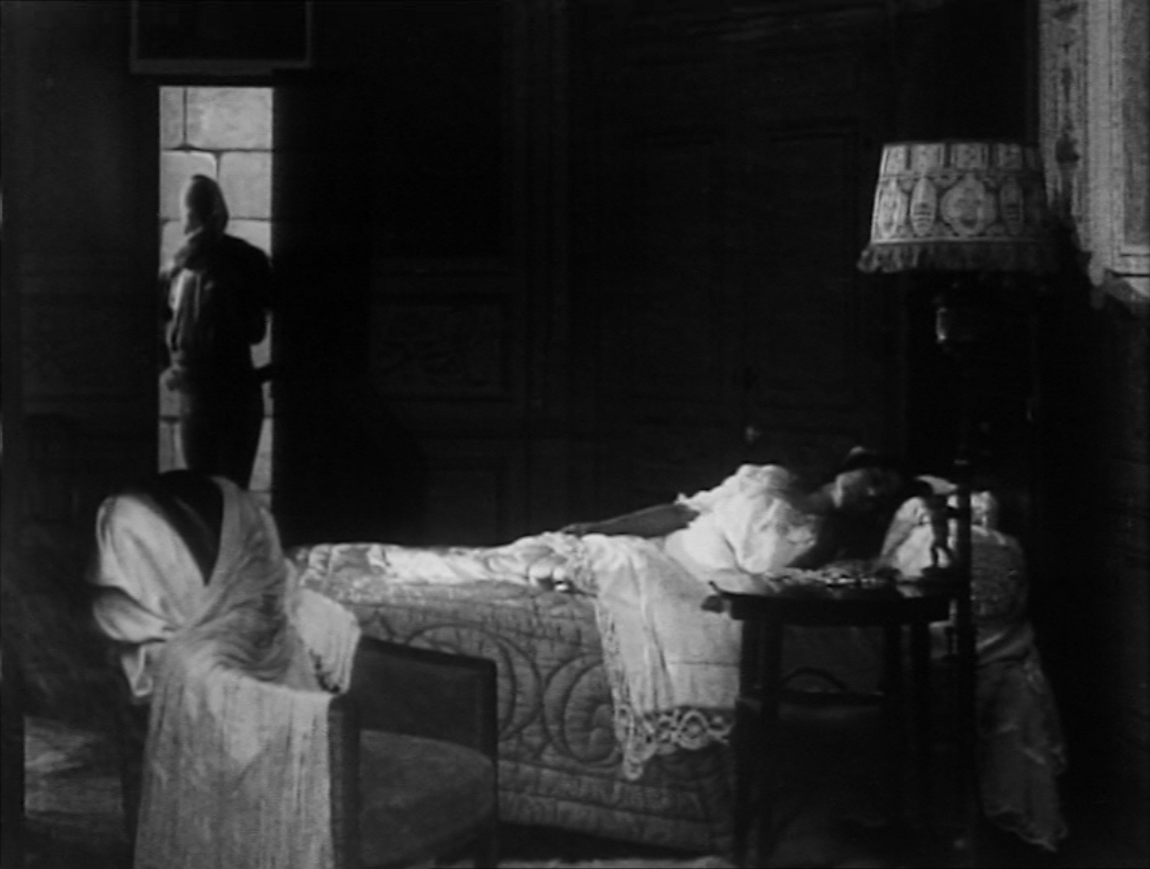
La tête coupée, by Louis Feuillade (The Severed Head, 1915)
This shot too develops into a demonstration of cinema’s powers. The villain appears in the secret opening in the wall and emerges through the beautiful interplay of the intensities of light and darkness, shadow and luminosity. The shot takes full advantage of cinema’s unique capacity to create a world based on dynamic textures of light in which figures flicker on thresholds of visibility. At one level, the black figure comes up as an iconographic presentation of the moving image itself. This idea is more easily grasped, if we take into account the close connection that the figure has with cinema’s “prehistory” and the physiologist Etienne-Jules Marey’s chronophotographic time–motion studies from the 1880s in particular. Interested in recording the dynamics of the moving body instead of its substance, vectors of movement instead of stable forms, Marey ended up reducing the body’s visibility and recognizability into a minimum. He dressed his subjects in black cloth and covered their heads with a black hood, marking the joints with shiny buttons (Figure 3). What the camera registered and rendered as perceptible was not the individual body’s contours but the trajectory of its movement, with the result that the figure even tended to merge with the ground understood as “pure movement.”
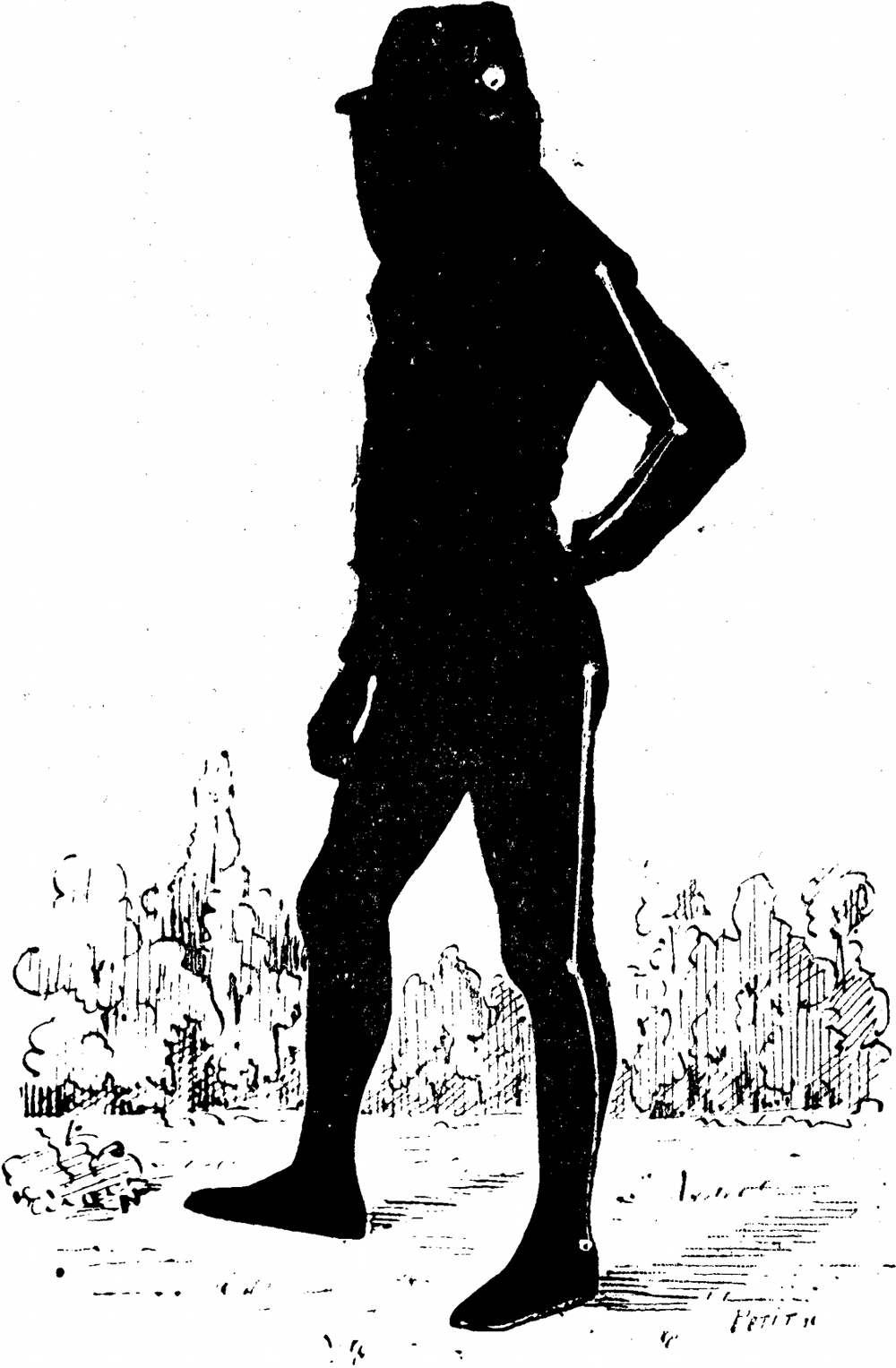
Marey’s test subject; from Etienne-Jules Marey, Le mouvement (1894)
The resemblance between Marey’s walking subject and Feuillade’s creeping figure is striking, and the scene in question takes full advantage of the fact that, when tracked down in terms of their dynamics, bodies lose their essential form, becoming the play of movement, light, and darkness. Instead of being representational, perception becomes “diagrammatic” in the sense that it maps and automates intensities and rhythms of movement. Yet at the same time, in Feuillade’s film this iconographic figure links perception with affectivity and otherness rather than simply the physiology of motion and the tendency for action. When the hidden door is opened, the visual field is transformed into a revelation of the impersonal other: the appearance of the figure without a visible face, without identity, is an event that incites a shock and perhaps even a fearful response to the body we cannot recognize. We do not know whose body it is, or who the other is—it can be anybody, and in this sense, here the act of disclosing an enclosure inside or behind the image plays on affectivity that suspends recognition. Whereas the sequence taking place in Philippe’s room addresses psychic individuation in terms of fundamental kinesthetic sensations at the heart of self-experience, this sequence induces affectivity and suspension as the primary response to the image, introducing thus a novel dimension to cinema’s psychic topology.
What the sequence displays is an anonymous figure of the pre-individual, to borrow a concept from Simondon (1964). Simondon coined the notion of the pre-individual to describe a topological dimension of the living, consisting of processes and phenomena that actually make the individuation of the self and its others possible. In Simondon’s use of the term, topological refers, among other things, to the lack of the concept of distance when describing this level of psychic organization, which takes place before the body–mind emerges as an individuated whole and signals a universe of rhythms, tendencies, and instincts that has a specific function in the development of the subject. For Simondon, in general terms, it is affectivity that characterizes the pre-individual, distance-less dimension within the individual, a dimension that embodies potentiality with respect to individuated structures.
In Simondon’s view, the lack of distance that affectivity implies comes up as the very condition of ontogeny. Nearness is the function of an immediate, immanent contact, and affective relationality with others that the subject implicates in its constitution. Affectivity, then, also means the individual’s fundamental incompatibility with itself, its noncoincidence. Simondon (2007) argued that the subject is at once an individual and other than individual: perception that tries to negotiate the individual’s identity within its environment according to sensorimotor structures, and affective exchanges that in contrast always relay the individual to those tendencies and rhythms that precede and anticipate it, the residue of not-yet-individuated potentials that every individual contains within itself. Crucially, at the pre-individual level, the subject coincides, not with itself, but with something that it fundamentally shares with other individuals.
Simondon’s work stands as pivotal, as it challenges the still prevailing assumption of the subject as something self-contained rather than contingent and open, and effectively dissolves—quite like the scene with the impersonal figure all dressed in black and susceptible to disappear in the ground—the individual as a clearly bounded figure. As Brian Massumi (2002) has noted, Simondon’s concept of the pre-individual insists on the transformative power of bodily potential. It speaks of the dynamics of continuous transformations that the subject bears within itself as potentiality. It is this dynamics that the oneiric shot in The Severed Head mobilizes with the play of light and darkness. Following the psychologist Philippe Rochat, one could say that the individual is like a snapshot, differentiated at the moment when a figure emerges as relatively distinct from its surroundings. “The self can exist only in relation to others (no-self entities), as a figure can exist only in relation to a ground,” Rochat (2009, p. 158) writes. However, when the image (or the self) is put in motion, this process of differentiation is at least potentially suspended: the black figure in Feuillade’s film tends to constantly merge with the ground and appears as an ephemeral pattern that only momentarily provides a texture and a shape for the sense of selfhood to emerge.
Should we then say that it is precisely at such a level of engulfing psychic nearness to the other that the moving image captures its spectator? The gloomy hotel room scene in The Severed Head suggests the possibility of a reality and logic of sense of the image that is affectively shared beyond interindividual divisions between the self and another self, a reality in which, individual differences notwithstanding, people coincide with each other. Something is shared when we watch moving images unfold on the screen based on the spatiotemporal patterns developing, shifting, and/or abruptly changing. In contemporary developmental psychology and psychoanalysis, these kinds of phenomena of sharing and being engulfed in the other—constant interchanges between figure and ground that the individual implicates in its constitution—are described in terms of affect attunement, which refers to experiences in which two subjects occupy the same psychic universe despite housing two separate bodies. For Daniel Stern (2000), affect attunement signals a micro-temporal dimension of experience in which, through the cross-modal communication of gestures, vocal intonations, bodily rhythms and intensities, eye movements, and so on, there is a match of internal states and a sense of emotional connectedness between two or more individuals. The question is not simply about imitating the others’ behavior externally but about incorporating and sharing the same affect state, the same inner universe. Not surprisingly, in some therapeutic settings, for example, affect attunement can also be seen as leading toward dissociative states (see Hoppenwasser, 2008). Generally speaking, affect attunement marks the subject’s essential relationality and establishes a kind of pre-individual psychic space in which two or more minds get layered and even merged into each other through sharing the same rhythmic and spatiotemporal patterns.
It is this kind of psychic layering that the anonymous, creeping figure in Feuillade’s film essentially embodies. The surfaces that the moving image animates can thus also point to the pre-individual level of psychic life characterized by rhythms, attunements, and tendencies instead of the recognition of the self and its difference from others. The question here is about fundamental psychic nearness that the moving image demands of its spectator. In addition to the masked figure that thwarts recognition, the mise-en-scène in the second sequence uncannily engages this kind of affective investment via the empty chair covered with a white garment that occupies the foreground. The garment calls for presence; it is there to envelop the spectator into the affective texture of the situation. Its folds, and the way in which it is folded onto the chair to suggest that someone get dressed in it, turn the image into a topological surface of contact. The image becomes a polarized membrane or a fold itself that implements a constant interchange between its own reality and the inner universe of the spectator, pre-individual potentiality, and individual organization.
Scene 3: Neighborhood
To approach the questions of affectivity and individuation in cinema from a slightly different angle, let us focus on a third scene that comes, not from the world of films themselves, but from the so-called external world of their reception. Similarly to the two sequences from The Severed Head, this scene exemplifies the moving image as a particular kind of contact surface, but one that introduces the problematic of collectivity into the analysis of cinema’s psychic folds.
In September 1907, when on one of his regular trips to Italy, Sigmund Freud wrote a letter to his family from Piazza Colonna, Rome, where his hotel was located (Figure 4). In the letter, Freud described a late-summer evening on the Piazza where thousands of people would congregate, his focus being on the screen that was installed on top of a building at one end of the square. On the screen, società Italiana projected magic lantern slides as well as moving images, and this letter is one of the rare instances in which Freud directly mentions the new visual medium of his times:
They [the lantern slides] are actually advertisements, but to beguile the public these are interspersed with pictures of landscapes, Negroes of the Congo, glacier ascents, and so on. But since these wouldn’t be enough, the boredom is interrupted by short cinematographic performances for the sake of which the old children (your father included) suffer quietly the advertisements and monotonous photographs. They are stingy with these tidbits, however, so I have had to look at the same thing over and over again. When I turn to go I detect a certain tension in the crowd, which makes me look again, and sure enough a new performance has begun, and so I stay on. Until 9 p.m. I usually remain spellbound; then I begin to feel too lonely in the crowd. (Freud, 1992, pp. 261-262)
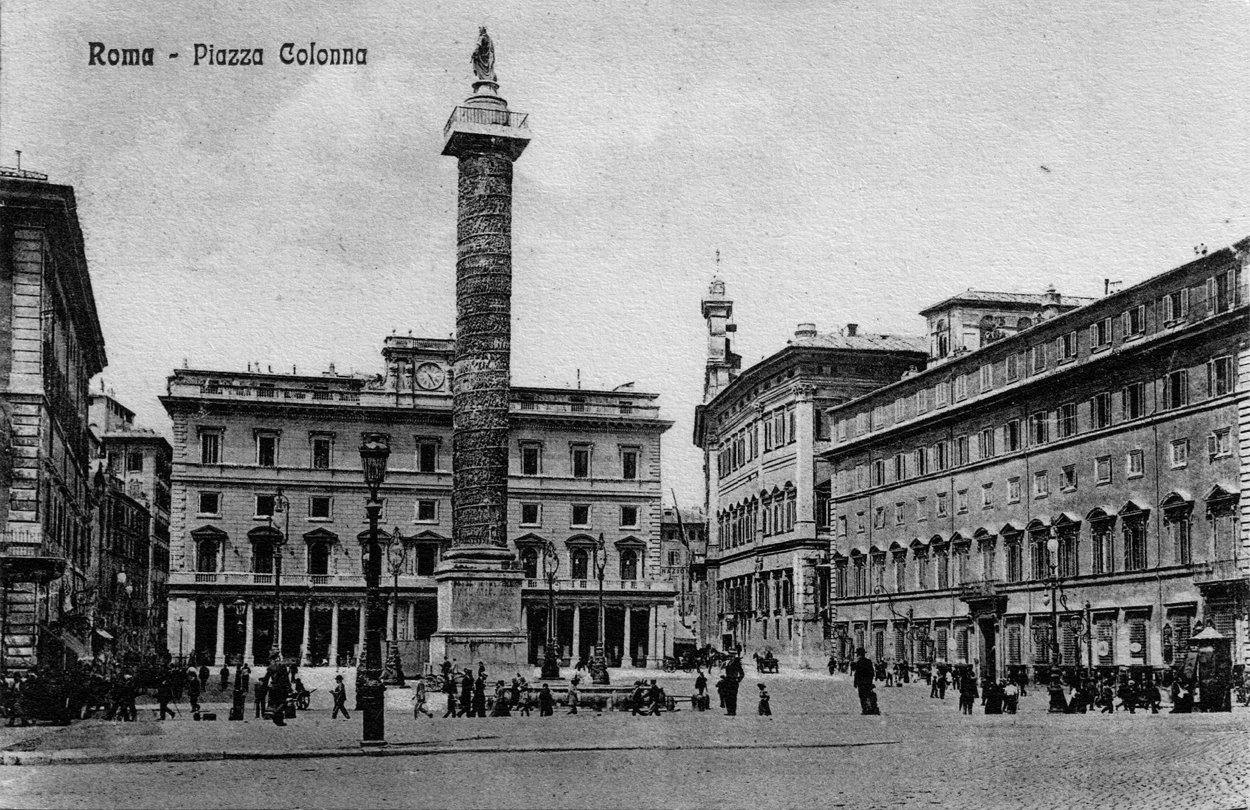
Piazza Colonna, Rome; postcard from 1908
Freud’s letter is fully focused on what takes place on the screen, at the expense of the Piazza itself. Under the pull of the technological spectacle, the external environment of the Piazza becomes secondary with respect to the psychic layering and rhythmic attuning that the screen performance produces. Quite interestingly, however, there is no mention of the contents of the short movies, no interest expressed in the kinds “picture puzzles” of which Freud’s work on dreams and also classic pieces of visual arts is famous. The psychologist, who came up with one of the most influential articulations of figuration, regression, and fantasy in modernity, shows no sign of self-consciousness regarding the workings of moving images in this context. Instead, Freud is, as he puts it, “spellbound” (der Zauber zu Wirken)—at least for a short moment. In Freud’s experience, the screen binds the spectator under its spell through the careful management of attention and affectivity in the rhythmic interplay of stillness and movement. While stillness seems to yield repetition and distraction, movement triggers attentive absorption and immersion. What is remarkable in Freud’s letter is that it describes affectivity as the primal dimension of cinematic experience, the absorptive power of moving images being based on rhythmic attuning between the embodied viewer and the screen. As Freud writes, “a certain tension in the crowd,” that is, immanently shared affective intensity, makes him “look again.” In other words, the moving image’s spellbinding force is in the affective charge that goes through the crowd and fixes all those thousands of individual minds into common rhythmic patterns. The individual “Sigmund Freud” then coincided, not with himself, but with a collective body and psychic space that the cinema produced in this event. The individual drew the force of its existence from the collective affective life that we all bear within us, and fundamentally share with one another.
Freud’s epistle displays how the production of modern subjectivity occurs at the thresholds of the self and its others, where the individual’s self-consciousness flickers uncertainly in-between more absorptive states of losing oneself in the present moment of the cinematic spectacle. In his analysis of Freud’s letter, Jonathan Crary (1999) discussed “a dehistoricized perpetual present” that wavers “between boredom and absorption, between self-extinguishing immersion in the crowd and unbearable social solitude” (p. 367). What Crary outlines is the dialectic inherent in the modern individual between autonomy as well as self-enclosure (solitude) and engulfing deindividuation (immersion). Yet as in every dialectical relation, the real problem does not here concern the endpoints but rather the “third” middle term that makes the relation possible in the first place. In Freud’s letter, this third is articulated in terms of processes of binding, or, to use a topological metaphor once again, the establishing of zones of neighborhood—the psychic boundaries and folds that envelop individual minds in cinema.
Binding (Bindung) is in fact a recurring concept in Freud’s metapsychology and refers to an essential process in the constitution of the ego (see, e.g., Freud 2001a). To put it bluntly, binding is in function with the repetitive processes of channeling and structuring unconscious and instinctual energy by which the ego maintains its unity. In the “Unconscious” from 1915, Freud (2001b) wrote about “the existence of two different states of cathectic energy in mental life: one in which the energy is tonically ‘bound’ and the other in which it is freely mobile and presses towards discharge” (p. 188). In Freud’s vocabulary, “unbinding” (Entbindung) means the sudden liberation of instinctual excitation, such as the surging of traumatic memories or the discharge of affective energy, which effects a serious disturbance to the functioning of the ego. Without wishing to stretch the scope and applicability of these concepts too far, it might be possible to argue that what Freud went through on the Piazza was something akin to the interplay of the processes of binding and unbinding, which occur on the very boundary of the self and the nonself, the individual and its pre-individual potential. Freud’s letter puts forward how a certain affective discharge is involved in the perception of the movement of images, a discharge that makes the individual lose himself in the screen spectacle. Perhaps there was even some kind of involuntary sensorimotor excitation that animated Freud’s body, at least more or less unwilled nervous tensions in tune with the persons standing next to him and with the rhythms of the screen. Yet then the inhibitory mechanisms took over, as the ego must find its bearings again, whence the feeling of loneliness and Freud’s eventual retreat to his hotel room.
To use Freudian terminology, the spellbinding force of the screen means, from the individual’s viewpoint, affective discharge. Being spellbound in cinema is a function of becoming unbound, a function of the fundamental fissure that the moving image cracks open within the individual and that makes the person coincide with the collective event. Hence, the threat of the moving image to the modern conception of the subject as an already individuated entity and to the dualisms of individuality and collectivity, activity and passivity. Freud’s concepts, however, provide unfortunately very little help in thinking beyond these dual terms, fixed as they are within the complexes of the individual subject. His letter, instead, gestures to moments of reciprocity and individual indetermination—to the kind of affective resonance that, following Simondon, is the very condition of collectivity. Collectivity, Simondon (2007) argued, arises from the pre-individual level of affective potential. Affectivity that embodies the individual’s noncoincidence with itself needs to be “resolved” by a collective being, which is structured around emotional significance and which provides the ground for social existence. Signification, for Simondon, is a question of the collective, whereas collectivity is fundamentally emotional in nature. Simondon (2007) calls transindividual the kind of psychic reality that emerges from affectivity and in which individuals coincide via a moment of emotional significance. For Simondon, importantly, the transindividual does not mean the abolishing of individual differences—it does not refer to the kind of deindividuation that is usually considered the opposite of subjectivity—but, rather, a “metastable” level of organization that surpasses the individual, a second mode of individuation qualitatively distinct from the genesis of the individual. With Simondon, we are thus able to approach collectivity and individuality, not as opposite terms, but in terms of topological organization in which interiority and exteriority, the self and its others, emerge as relative to each other, and at critical thresholds become one another, in the processes of individuation.
The “tensions” triggered by cinema that Freud experienced at Piazza Colonna refer to the kind of critical process in which the individual, immanently participating in the pre-individual rhythms of the screen, coincided with its others at the level of the collective. Spectators became, in Freud’s words, “old children” (Freud himself included), that is, the physiological tension (a somatic affect) was specified into a feeling or “mood” that arose at a given moment with regard to surrounding objects, people, rhythms, and sensations. What is essential is that this transindividuation did not necessitate the realm of words and reference and hence reflection and distance, but emerged from shared affectivity. As Simondon (2007) noted, it is not language that creates signification; on the contrary, signification is a relationship between beings. Important to us is the observation that it was the moving image that created this basic relationship in which emotionally imbued significance and hence collective individuation emerged. Generally speaking, the moving image has the power to envelop the individual into original transindividual relationality, or zones of emotional neighborhood, the image functioning as the unbinding force that makes the individual “spellbound” with its others. The cinemagoer, then, is fundamentally not to be seen as a clearly bounded psychological individual but rather as a transindividual subject that emerges from the affective surfaces and the attentive economy of the image.
To conclude, what I have wished to show is that the patterns and experiences the moving image produced at the time of its emergence demand us to reevaluate such quite fundamental concepts as individuality and collectivity, in addition to reassessing the status of embodiment and selfhood, and cinema’s influence on them, in modernity. In this purpose, basic topological notions can give us effective metaphors to discuss and describe—and perhaps even functional tools to conceptualize—cinema’s transformational spaces, the psychic and bodily potentiality that moving images introduced into experience. First of all, the notion of continuity, supplemented with Gibson’s concept of affordance, assists in analyzing how the moving image solicits interaction in perception and demands most basically physiological investment of its spectators. The elementary spellbinding power of cinema is in the way it takes hold of the basic kinesthetic experiences that form the core of embodied subjectivity. Second, this kinesthetic binding also potentially initiates an affective experience of nearness that, following Simondon, every subject contains within itself as the pre-individual “stuff” of existence. Cinema, in other words, can animate the pre-individual dimensions of life composed of rhythms, tendencies, and instincts. Third, the lack of psychic distance that the moving image thus actualizes may result in the creation of zones of neighborhood where individuals get organized in collectives according to shared emotional significance. What cinema in this way gives rise to can be termed the transindividual subject—a concept that would nonetheless need more developing than is possible within the limits of this article. In all these three dimensions, the initial encounter we had with the moving image was nothing less than a confrontation between life and its potentialities, a confrontation of which the theory and history has by no means yet been completed.
Footnotes
Declaration of Conflicting Interests
The author(s) declared no potential conflicts of interest with respect to the research, authorship, and/or publication of this article.
Funding
The author(s) received no financial support for the research, authorship, and/or publication of this article.