




Abstract
Against the governing tendency of analyzing the production of space in Israel in purely political terms, the article demonstrates that the cultural dimension is critical for understanding the Israeli paradigm of territory. Extensive and intensive analysis of the key Israeli expression for concreteness and the term designating the territories occupied by Israel since 1967 (which both stem from the same root), thereby bringing together cultural, linguistic, historical, and political perspectives across several registers, reveals the Israeli paradigm of territory as a core part of a thick Israeli cultural ideology. The article concludes by pointing out how and why, under the weight of the present occupation, this paradigm is in the process of breaking up.
Keywords
Introduction
The Hebrew terms shetach (lit. territory, area, surface) and bashetach (lit. “in the territory”; roughly akin to the English “in the field,” “in the area,” or “on the ground”) are key terms in Hebrew as it is both written and spoken today. This is the case in a variety of linguistic and cultural registers, and these terms hold a prime position within a language that is uniquely Israeli. By far the most significant political use of the term arose when the conquest of land in the Six-Day War put the Shetachim (“the Territories”) at the center (perhaps at the very center) of Israeli political discourse. In this context the term is used to refer to the areas captured in the war; land that had once been the West Bank now became the Occupied Territories, the Liberated Territories, or the Territories of Judea and Samaria. Today, Israeli formal records refer to the “administered” or “disputed” territories, rather than using terms such as liberated or occupied. Only the term territories serves to unite all these expressions, as well as the vastly differing worldviews that produced them. 1
The term territories links political and military strategies with older cultural notions. The problematic at the core of this article, then, pertains to the relationship between culture and politics and more concretely, to how the term is used to legitimize a political project. Why were the lands captured in 1967 called the “Territories,” and why did political factions with diametrically opposing ideologies consent to adopt the term? In attempting to answer such questions it is tempting to analyze the terms shetach and bashetach against the backdrop of the actual Territories, taking the cultural primacy of the former to be a by-product of a political reality dominated by the latter. Nevertheless, such a view is both incomplete and philosophically weak. It may be challenged on two fronts. First, from an empirical perspective, shetach and bashetach became culturally significant terms some time before 1967. Second, from a methodological or conceptual standpoint, linguistic and cultural realities are rarely if ever a direct result of political forces—culture and politics are related, but the relationship is by no means one of mere identity, causation, or blind acceptance. Rather than approaching these questions through theory or politics, this article employs a cultural-pragmatic perspective in order to bring to the surface the cultural conditions of politics. To do so the study juxtaposes between the linguistic sensitivity of the study of “keywords” as developed and applied in anthropology (Katriel, 1999; Ortner, 1973; Williams, 1985) with the structural-anthropological perspective of Louis Dumont (1970), which recognizes ideas as socially and culturally defined by their relative place within larger social “wholes.” This article therefore begins from the fact that today, in both spoken and written Hebrew, shetach (territory) and bashetach (in the field) may be viewed as “keywords”—cultural symbols that act as central systems of meaning in the cultural and social realm, possessing both cognitive and emotional value. Thus, for example, to be bashetach (“in the shetach”) is the central metaphor for all that is “here and now” in both the Hebrew language and contemporary Israeli culture. Bypassing contemporary obsessions with the political in studies of Israeli “space,” the present article thus identifies shetach and its derivative terms as part of an “Israeli cultural ideology.” 2 In so doing the intent is not to circumvent the political but, on the contrary, to identify and formulate its underlying conditions of possibility. By way of an extensive discussion of the cultural meanings of these terms, two dominant, yet in themselves opposing, senses of the terms are identified, which may for convenience be labelled here as “definiteness” and “superficiality.” These contrasting or even contradictory meanings, it is shown, not only stand behind present Israeli discussion of “The Territories” but are also to be found at the heart of modern Israeli cultural ideology. Most of this article, then, attempts to define shetach as a critical component of the Israeli paradigm of territory and to introduce it as a term into academic discussion. At the same time, however, and in a way that necessarily complicates the account, I will argue that it is crucial to recognize shetach not only “positively” but also “negatively.” Using Dumont’s strategy of seeking culturally bound contrasts, I will oppose shetach with makom (place), which latter is inherently laden with inexchangeable religious, national, or historical value (a point to which I will return below).
Shetach in Contemporary Hebrew
Today, both shetach and bashetach are key terms in a range of fields of discourse, including the media, law, planning, and architecture. While it is very difficult to document their oral history, speakers of Hebrew instinctively recognize their origin in military discourse, probably predating the establishment of the Israel Defense Forces in 1948. While shetach and bashetach were subsequently disseminated throughout society, their military flavor and connotations were to some extent carried with them. Today, across many different fields, both terms are used in a wide variety of senses. Shetach clearly appears in a large number of “bound expressions,” the meaning of which differ from that of their constituent units, which retain their original meanings in other contexts. The list is long; examples include shetach esh (military firing zone), p’il shetach (an activist “on the ground”), shtachim ptuchim (“open spaces,” unmarred by construction or other development), hashtachim (“the [Occupied] Territories”), shetach emunim (“training grounds”), avodat shetach (“work that takes place ‘in the field’”), shetach met (a “dead zone”), tachles bashetach (“reality,” as opposed to theory), shtachim yerukim (“green land,” i.e., land in which construction is prohibited), shetach prati (“private property”), boded bashetach (“the only one ‘out there’”), shetach hekfer (“no-man’s-land”), shetach shiput (“jurisdiction”), shetach tzva’i (“military zone”), shetach tzva’i sagur (“closed military zone”), shetach naki (“area that has been ‘cleared out’”), katav shetach (“correspondent”), targil shetach (“military drill held outdoors”), rechev shetach (“offroad vehicle”), likbo’a uvdot bashetach (“to create facts on the ground”), shetach A (“Area A,” under full Palestinian civil and military control), and shetach B (“Area B,” under Palestinian civil and Israeli military control).
The term bashetach (“in the shetach”) is today an expression of definiteness in a number of related senses. One is that of an “area” or “place,” in expressions such as “he’s out in the shetach [field]” or “he’s not in the office—he’s bashetach [in the field, at the building site, etc.].” Another meaning of the term is “in reality” or “in practice”: “He may be the official chairperson, but bashetach [in reality], she calls the shots,” “They issued a condemnation, but bashetach [in practice], they did nothing,” or “The reality bashetach [in practice] says differently [i.e., contrasts with the original or stated plan].” Bashetach also acts as a linguistic intensifier and is used to highlight a given statement—“Tell me, bashetach, who do I need to talk to?” Another important aspect of bashetach is that it causes the listener to look for a contrast—“as opposed to what?” To borrow a term from Roman Jakobson (1971), bashetach acts as a shifter—a word devoid of semantic meaning that is completely context-dependent; its work is to direct the hearer to focus on that which is “practical,” the underlying opposite of that which is “hypothetical,” “unrealistic,” and “abstract.”
Shetach often appears in contexts having to do with experimentation, namely, as an “arena” or “scene” within which events take place; shetach is where “real things happen.” Here the term can be contrasted with words like “laboratory” (ma’abada) and “field” (sadeh). Shetach is used to describe experiments conducted under “real-world” conditions, in which disorder or relative disorder is inherent, or in which some degree of contamination is to be expected. “Israeli empiricism,” in this sense, takes place outdoors, in the “real world”—the shetach. It should thus come as no surprise that the area between Tel Aviv and Jaffa, today the site of Tel Aviv’s seediest neighborhoods, a “gray area,” was known before Israel’s establishment as “the big shetach.” 3
Shetach may also have a vertical spatial reference: Within a metaphorical framework in which definiteness is seen as “low” rather than “high,” shetach is something that one must go “down” to reach. One reason for this is that military bases and towns have typically been set up on relatively high ground, overlooking their surroundings (Segal & Weizman, 2003). One goes “down” to reach the “field” (shetach) in order to perform “low-level” activities. On the other hand, when the task at hand is not limited to the here and now but is rather a part of more long-term, even idealistic plans, one goes “up” to the ground (karka, NOT shetach!). In deictic terms—those pertaining to the manner in which the speaker “places” himself or herself in the utterance, such as in the geographic sense—shetach is not “here,” but it is not entirely “there,” either. The shetach abuts the base but is not inside of it. From within the base, the sheatch is “there,” not “here”—a matter of location, not distance. Yet shetach is not exactly “there”—there is a corridor between the two, namely, the “outskirts.” Shetach is thus that part of “there” that is “right near here.” As a result, shetach has some of the features of “here,” but this is a “here” that one needs to go “out” or “down” to reach; it’s a “here” that is “there.” There is also evidence of this in the verbs of motion used with the term: One “goes down” (yordim) or “out” (yotz’im) to the shetach. In other words, one needs to “go” to get there, but unlike in phrases such as “hu halach basadot” (“He was walking in the fields”), the motion here suggests purpose—one goes to the shetach to perform some sort of task.
As a central metaphor for place, earth, and land, shetach is not just a 20th-century Hebrew construct. A vertical notion of shetach pertaining to the Land of Israel, for instance, is built into the deep cultural roots of Hebrew. Linguistically, an immigrant to the Land of Israel (regardless of ethos) is said to be going “up” (oleh) to Israel—even if the starting point for the move is, geographically speaking, higher ground. This particular metaphor long predates Zionism; it can be found in the Book of Genesis (13:1): “And Abram went up out of Egypt, he, and his wife, and all that he had, and Lot with him, into the south.” 4 But there is also Genesis 12:10: “And Abram went down into Egypt to sojourn there; for the famine was grievous in the land.” Where the metaphors of going “up” for some things and going “down” for others meet, the result is a rich linguistic and cultural tapestry. One goes “up” to Earthly Jerusalem or to the Land of Israel, only to go “down” to the field or shetach to work. The closely interwoven cultural-ideological constructs and layers of Hebrew linguistic history work in tandem to produce pragmatically “correct” modes of speech (i.e., in “normal” usage, it would be “wrong” to say “I am going down to Israel” or “I am going up to the field [shetach]”).
It is also possible to approach the term shetach using the concept of “family resemblance” (Wittgenstein, 1953, p. 66). Here the term appears as but one of a family of spatially related terms. Terms like “territory” (shetach), “area” (ezor), “expanse” (merchav), “field” (tchum), “place” (makom), “site” (atar), “lot” (migrash), and “plain” (meishor) are interrelated—they bear certain similarities to each other, overlap in some respects, and differ in others. These interrelationships are apparent from the terms’ dictionary definitions. It is interesting to observe, however, that shetach in fact appears in the definitions of all of the other terms. Even Shoshan’s (1975) The New Dictionary suggests that “expanse” (merchav) designates “a spacious place, very large territory” (p. 779). “Place” (makom) refers to “the territory or volume taken up, or potentially taken up, by a given body” (p. 765), whereas “field” (tchum) points to “a boundary; a dividing line between two jurisdictions, as well as the territory within its borders” (p. 1444). Even Shoshan (1975) further describes “lot” (migrash) as “the territory surrounding a house, available for animal grazing” (p. 629), “area” (ezor) as “a strip or portion of the surface [shetach] of a sphere between two parallel circles” (p. 26), “plain” (meishor) as “a flat [shatuach] area, straight locale with no valleys or hills . . . territory in which a straight line can be drawn though any two points, [the line itself] being entirely along said territory” (p. 683), and sadeh as meaning “field” in the agricultural sense: “territory designated for agriculture” (p. 1330). While the Israeli paradigm of territory has perhaps no archetype, in terms of family resemblance it is, so to speak, more of a fraternal than a patriarchal family.
The spatial terms just noted differ in their linguistic and cultural connotations. The word makom (“place”), analyzed at length by Zali Gurevitch and Gideon Aran, has Biblical, religious, and mystical connotations (Gurevitch, 2007; Gurevitch & Gideon Aran, 1993). 5 Similarly, merchav (“expanse”) has religious and metaphoric connotations of its own: one goes out into the merchav but not in the same sense that one goes down to the shetach. Merchav, from the root ר.ח.ב (which crops up not infrequently in the military conveys a sense of “opening up,” broadening, and mission, all of which are absent in the term shetach). The dichotomy of the going out into the “real” versus the symbolic-metaphorical merchav (“to the Merchav”/Lamerchav being the name of the pre-1948 Labor Party’s now-defunct newspaper) stands in contrast to the static nature of being bashetach. Sadeh (“agricultural field”) has connotations of its own: “The field always carries with it a notion of a home, village, or path, and as such the term field [sadeh] serves to refer to both an open field and one that has been cultivated for agriculture,” writes Gurevitch (2007), adding “[It is] loaded with this notion of ‘home,’ a vast space, social, cultural and physical gathering place—a place” (p. 114). The plain (meishor) is a place within reach. It may be imperceptibly thin (the term may also refer to one’s mental “field”); yet it is not definite in nature. Likewise, migrash/“lot” (from the root ג.ר.ש once a term used to denote extravagant wealth—“having a migrash”), today means a “field” in the intentional sense—not in the focused sense of shetach but in the sense of negotiation, initiative, and an awareness of one’s surroundings (“The ball is in your migrash [court],” or “That’s not their migrash [playing field, i.e., familiar territory]”). Chalal/space, which in most European languages would not be distinct from merchav, comes from the root ח.ל.ל and means “an empty space, hollow area within a building or body” as well as “infinite space” (Even Shoshan, 1975, p. 398). Unlike merchav, it does not refer to the “arena” in which we live, grow, and expand, nor does it mean a place in which people congregate—one that, like makom, facilitates gathering and settlement; chalal is not a place for human creativity. In Israeli “cultural geometry,” shetach is not the center of the “field” (merchav) and does not look toward any specific point or place, holy or otherwise (see Table 1).
Summarizes and Visualizes the Semantic Meanings, the Communicative and Linguistic Functions, and the Main Pragmatic Oppositions of Bashetach and Shetach.
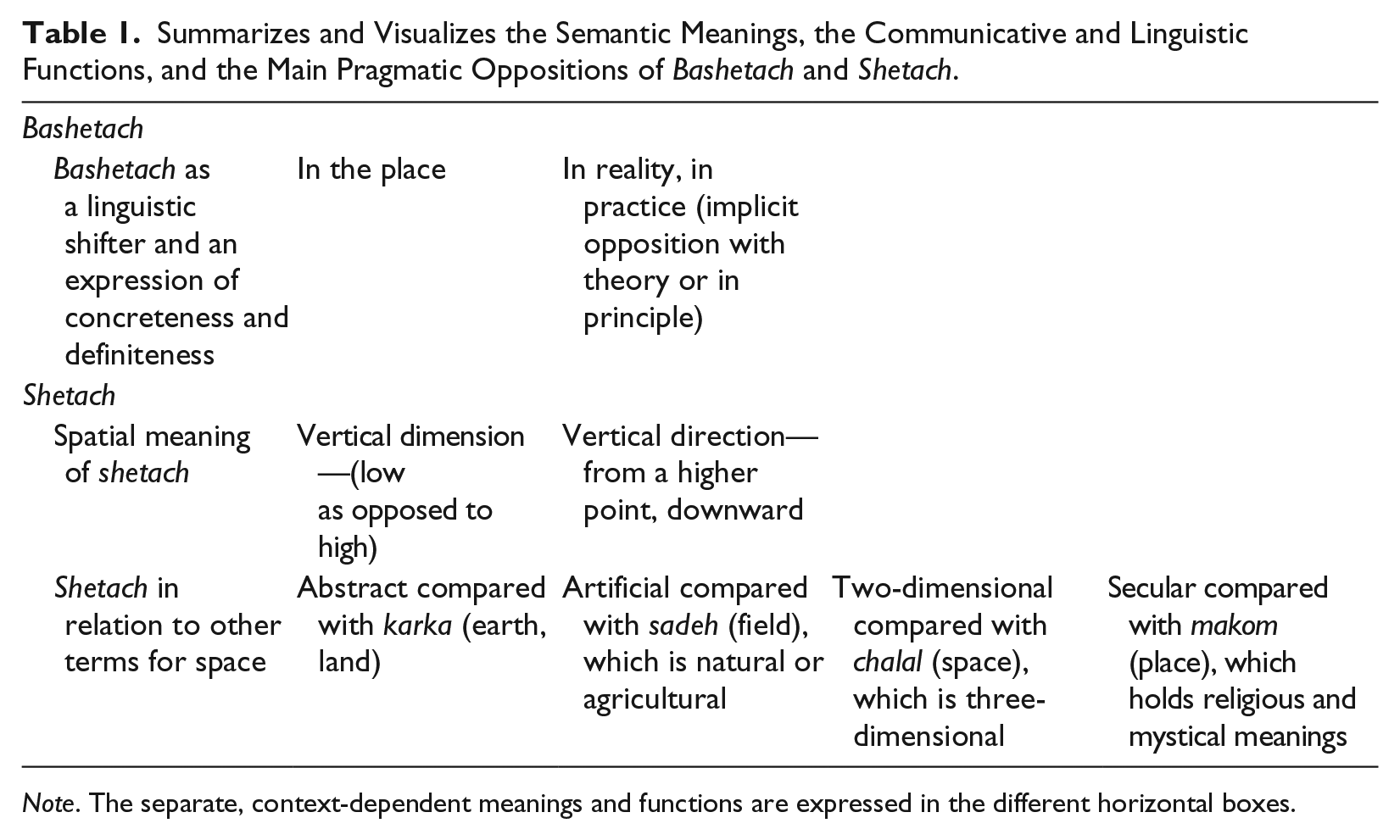
Note. The separate, context-dependent meanings and functions are expressed in the different horizontal boxes.
From Geometry to Superficiality and Definiteness: A Semantic History of Shetach
As expressions of definiteness, shetach and bashetach are a product of 20th-century culture and the language of the Yishuv, or pre-Israel Jewish society and, later, Israel, while shetach as connoting a two-dimensional space is of medieval origin (Koselleck, 1985). Of course, the triliteral root—ש.ט.ח—is older than the word itself. The Bible contains the occasional verb derived from this root (Gesenius, 1883). 6 In fact, and as with many other words, the noun shetach was in the first instance a product of a concerted linguistic effort on the part of the Jewish communities of the Middle Ages to keep up with the overarching Arab scientific culture of the day. Thus the earliest textual instance of the noun is found in a medieval translation of an Arab text, and as a technical term, the word came into widespread use in medieval Hebrew scientific texts. 7 This scientific usage was still prevalent in the 18th century: Menahem Bonafos’s Lexicon of the Sciences (1798) defines shetach as “that which is delineated by a line or lines,” shtachim as “representations, the angles of which are equal and the legs surrounding which lie at equal angles to each other,” and shticha as “spreading lengthwise and widthwise as a result of having a force applied” (p. 66). This earlier meaning of shetach has no clear connection with the connotations of definiteness in contemporary Hebrew but, as we shall see, this early usage is continued today in technical uses of the word in fields such as architecture and planning.
This technical and scientific usage continued as the sole meaning of the term through to the end of the 19th century, and even beyond. Indeed, the classic modern Ben Yehuda dictionary (E. Ben Yehuda, 1951-1952) offers several definitions for the word shetach, but none of them include the meanings now associated with bashetach. Continuing the Medieval tradition, E. Ben Yehuda (1951-1952) defines shetach as a technical term meaning a flat surface, which has a length and width, but no depth or volume:
[A] geometric concept, denoting something which is laid out, with a length and a width, as opposed to a line, which has only length, and a body, which also has depth (face, Fläche). Likewise, the surface of an object—the top face of a body (surface, Oberfläche). [Also] a plain or flat area, which is carved out and laid flat; a value with length and width, but no depth, constructed entirely of lines, whereas volume is a quantity which has length, width and depth or height, delineated entirely by plains or flat areas, etc. Shetach is [thus] a flat region defined by lines. (p. 7035)
E. Ben Yehuda’s definition thus has nothing to do with the current Hebrew meanings of shetach and beshetach as “the here and now,” “reality,” and “definitely,” although it is clearly related to contemporary uses of the word to denote a two-dimensional abstract or superficial space. Today, shetach continues its earlier medieval meanings when used as a technical as opposed to a general term in contemporary Hebrew. In its technical sense, as “received space,” shetach plays a role in the production of “superficial” two-dimensional space: “superficial” inasmuch as it is concentrated on the “surface.” Shetach transposes all that is geographically, historically, and culturally particular in a given space into directly quantifiable terms, be it in terms of physical area, cash value, or as a political bargaining chip (“Land [shtachim] for Peace”). This may be illustrated by reference to architectural vocabulary, which makes use of expressions such as “open shetach [land],” “open public shetach,” “key shetach,” “service shetach,” and “floor shetach [space]”—all of which spaces share the common trait of being two-dimensional, measured in square meters. Yet it is chalal (“[empty] space”), which is three-dimensional and “built-in,” that serves as the key concept in architectural planning; shetach, given in square meters, is the part of the chalal that is on the “ground,” used for “practical” purposes such as the assessment of property taxes. Architectural discourse speaks of “indoor” and “outdoor” chalal, public chalal, enclosed chalal, and disrupted chalal, among other variants. 8 Thus, in contrast to its general connotations as discussed above, shetach as a technical term points to the superficial—the flattening of “space.”
The phenomenological aspect of “lived space” is connected to the way in which people perceive space (shetach): It can be dangerous, occupied, “cleansed,” vacant or inhabited, dead, open, gated, or divided into individual lots or parcels. Yet, by definition, it is without connotations of “environment,” “nature,” or “depth” (all of which, of course, are linguistic constructs, no less dynamic, socially, and culturally bound than “shetach” itself). In relation to Henri Lefebvre’s (1991) comparison of fantastic, mythical, and mystic spaces with rational, state-controlled, and bureaucratic spaces; Israeli space as embodied by shetach would appear to be more rational than mystical. In contrast to the notion of a Biblical or international-legal deed to the land, shetach is a function of de facto ownership, a result of domination, presence, and perseverance—the creation of “facts on the ground [shetach].” 9 “Zion,” “Jerusalem,” and “the Tombs of Our Patriarchs” are the subject of prayer, yearning, longing, and love. Shetach, by contrast, is abstract, functional, bureaucratic, legal, and fiscal. Quoting Marx, Lefebvre (1991) wrote that a commodity is a “concrete abstraction”; a definition that would seem to befit shetach quite nicely. Lefebvre wrote of the production of space in terms of mountaintops, sky, and abyss. Yet it is in the nature of shetach to bring all the depth of the space at hand to the surface, where valleys, hills, secrets, and riddles do not exist. At this point, one would be hard-pressed not to see the direct connection between the struggle for control of the land, in terms of its surface, and the flattening of that land into shetach. 10 Space in the form of shetach also suggests a particular notion of time: Whereas the “land” has a past, history, and layers, “shetach” has nothing but a monotonous present.
It is here that shetach cannot be understood only positively; its meaning must be sought also comparatively and negatively. As a component in a multilayered compound, shetach is an alternative to makom (“place”), with which it forms a contrast and which it undermines. If place is irreplaceable, invested with inherent meaning and value, shetach is its pragmatic counterpart, its emptied form, devoid of particularity, and exchangeable. As both belong within the same cultural economy, I will return to their relations in the concluding section of the article.
It seems that the meaning of shetach as superficial and culturally vacuous space was developed and given new political connotations in the criticism of earlier Zionist ideology by the generation of 1948. Already in the beginning of the 20th century the term had begun to relate to concrete patches of land, perhaps an extension of, but also a definite movement out of, the original restricted geometric sense of the term. But it is the generation of 1948 who endowed shetach with its connotations of concreteness—an endowment that was at times quite literal. “We shall dress you up in a gown of concrete and cement”; these famous words, penned by Nathan Alterman, have become a lyrical depiction of Zionist modernism—an ethos dating back to at least the 1920s and centered on tending to and expanding over the “surface” of the land (shetach). Here we witness the moment at which, in shetach, concreteness and militarism converge, in an expression that already pertains to the land. After 1948 this modernist ethos became identified with a failure to strike deep, historical, social, and cultural roots, and so a reaction set in against a supposedly superficial preoccupation with shetach as surface space. One cannot, therefore, document the history of the term shetach as used in planning and architectural discourse without accounting for the specific context in which this discourse took place. And this context should not be limited to political history alone. In Jerusalem, for example, Nitzan-Shiftan (2006) has shown that the generational changing of the guard and migration from international to local trends in Israeli architecture, rather than political trends, were responsible for the sea change in post-1967 urban planning toward “rootedness” (p. 134) and “local flavour” (p. 188). 11
By the second half of the 20th century, however, shetach was already acquiring its distinctive contemporary general significance. In later dictionaries we begin to find extended and additional definitions that begin to approach the current general Hebrew usage. Thus, for example, the 1975 edition of Even Shoshan’s dictionary defines shetach as “a defined stretch of land,” (p. 1675), thereby extending the sense of the term to encompass not only a region, ring, domain or place but also a “here” and “in practice.” The metaphoric sense of definiteness, it would seem, is to be found mostly in the context of the form bashetach—shetach as combined with “being in” something: in other words, presence.
Dictionaries are rarely at the vanguard of linguistic development. Textual evidence for the modern meanings of shetach and bashetach can be found already in the early 20th century. Thus in Uri Nissan Gnessin’s short story Etzel, published posthumously in 1913, (ba)shetach appears in various senses, some approaching its modern meaning in that the term is applied to actual territory: “Ah, those wild geese, already crying out in that hazy parcel of land [bashetach] in [our] homeland” (Gnessin, 1913, p. 72).
12
In 1920, we find Haim Brenner (1985) complaining of the Arabs’
refusal to allow us to found a workers’ society in empty land [shetach] that they do not need—here, we are the righteous ones . . . lands [shtachim] that they don’t need, given the sheer amount that they have—entire countries, yet not enough people—whereas we have so many nomads-exiles with no place to settle. (p. 1723)
Here shetach already refers to both an abstract or idealized space (a “workers’ society”) and a particular stretch of land. By 1958 we find this same term as a recurring motif in Yizhar’s (1958) Days of Ziklag: “to be left alone in the field [bashetach]” (p. 46); “When it comes to sniper fire, we’re in a dead zone [shetach]” (p. 124); “But on the ground [bashetach], we can’t see them, just hot hills—some tilled, others uncultivated” (p. 181). 13 While shetach here has geographical or topographical connotations, it clearly conveys a sense of “in practice” or “as a matter of fact.” Likewise, the works of Netiva Ben Yehuda, a Palmach bomb disposal official who went on to become a celebrated author, while written and published long after the War of Independence, nonetheless describe that era and—more important—demonstrate extensive use of the term. 14
Slang dictionaries, compiled by everyone from Ben-Amotz and Ben Yehuda to Ruvik Rosenthal, and which have typically identified colloquial speech with slang, have all devoted an entry to bashetach. Ben-Amotz and Ben Yehuda (1972) define bashetach as “in the vicinity or area” (p. 44). In A Lexicon of Hebrew and Military Slang, shetach is defined as “in the sense of: in practice, in reality, for all intents and purposes”; tachles is listed as a synonym (Achiasaf, 1993, p. 36). Breaking with these earlier works, however, Rubik Rosenthal’s (2005) dictionary presents a broader definition of bashetach:
1. In reality: “The situation on the ground [bashetach] is so different from that described in prophecy; what is this all coming to?!” 2. In the vicinity or area: “Yup, I’m the guy who breaks the women down. They see me around [bashetach] and the fighting begins.” 3. In an open area (military): “Then, it was the heat of summer, a pinecone breaks loose, a helicopter lands and I am lying there in the field [bashetach], alone.” (p. 59)
Of course, the profoundly novel development in the modern meaning of shetach is not unique to this term; other words have also undergone semantic shifts. For example, hagshama (“materialization,” a grave sin in the Middle Ages) has transformed into a key phrase in Israeli culture, with an entirely positive meaning. Other words, such as hitnachalut (“settlement”), have undergone similar, if not as extensive, changes. Shetach, however, is different in that it has witnessed not simply a change in meaning but also a phenomenal rise in popularity. The widespread use of shetach and bashetach in the present day is probably primarily a product of military discourse, most likely that of the 1948 generation—the first generation of native Hebrew writers born, raised, and come of age in Israel. In military discourse, shetach refers to an area or place outside of the home base or camp. Shetach in this military context thus includes firing zones, training grounds, shooting ranges, as well as “the field” in the broadest sense. Yet in both military and general usage, shetach when denoting a place also serves to defuse and render the place to which it refers abstract; it effectively separates a geographical location or area from the people living in it.
Conclusion
The aim of this article was to introduce shetach to academic discussion as a crucial component of the Israeli paradigm of territory. To do so this article has employed a methodological strategy that sidesteps politics for a cultural and linguistic perspective. Most of the article has been devoted to illustrating shetach as a keyword, a “positive” component of Israeli cultural ideology, marking the territories conquered in the 1967 “Six-Day War,” but also the central metaphor for concreteness in contemporary Hebrew.
But it has also been argued that within the multiple layers of Israeli cultural ideology, shetach is a “negative” concept that can be understood only as an alternative and a pragmatic contrast to makom [place], the latter standing for the particular and saturated with religious, national, or historical particularity. It is crucial to recognize that the relative position of this conceptual pair or duality within the multilayered “whole” is asymmetric: While the cultural can be mobilized by the political, unlike makom, shetach is foreclosed from being mythologized or mystified. As a contrasting pair, there is always the question as to which is to be given precedent in any given social situation. But while the relationship between the pragmatic and the theoretical characterizes various forms of negotiation and dialectics, shetach is inferior to makom by the very nature of its definition.
Following the reconstruction attempted in this article, it should now be clear that “Israeli cultural ideology” is not so much based on a common political thread as located on a level that stands below the political disputes pervading Israeli culture. Nevertheless, the relations between politics and culture are complex, and not in any way simple unidirectional correlations. The tensions that have been revealed within the term shetach are not the product of mere political developments but, rather, are related to historical conditions at the very cultural heart of Zionist history. Israeli cultural ideology, with all its inner contradictions and paradoxes, serves to connect specific political subcultures on both the right and left—thus, in the present context, providing Israeli political discourse with its opposition between “Liberated Shtachim” and “Occupied Shtachim.” From this cultural perspective it becomes clear that, in its post-1967 lexical role, shatchim was a thoroughly secular term, devoid of religious, mysterious, or mystical sentiment, and that its use to describe areas captured in 1967 signified an attempt to sidestep the Jewish religious significance of the territory in question while, at the same time, creating a “geometric-political abstraction” that served to (mentally) separate the territories captured from their Palestinian inhabitants. The conclusions of this cultural exegesis are reinforced by the fact that the notions conveyed by the term were not a product of the Six-Day War and remained relatively stable following it.
Nevertheless, when judged from the perspective of today, it seems that the attempt to co-opt an historical term failed. For while the cultural may serve as the grounds on which the political is debated and contested, this does not mean that developments on the level of the political cannot impinge on and even subvert that cultural ground. Initially, the “neutral” notion of shetach served to circumvent the religious (i.e., messianic) status of the areas captured—areas whose significance in Jewish historical memory cannot be overstated. Likewise, it served to detach the people who came under Israeli rule from the areas and places in which they lived, in a sense distinguishing between the land and its Palestinian inhabitants. 15 As time went on, however, the weight of the Occupation took its toll, and the term increasingly came to be marked by the two things that it had been intended to circumvent: for many on the right the territories or shtachim came to acquire anew both religious and historical significance as “Jewish places”—while, for many on the left, the realization dawned that the shtachim in question were, as a matter of fact, home to the Palestinians. Thus, the cultural ground on which the political disputes of post-1967 Israel were conducted has itself become sundered by these very political rifts themselves. But this cultural development has by no means played itself out, and this in itself suggests some interesting political implications. Today, the term shtachim as a reference to the Territories appears to have exhausted itself, and indeed other terms are now replacing it; yet the terms shetach and bashetach (as expressions of concreteness) are at the height of their use. What remains unclear at the present moment, but must soon be resolved in a concrete fashion, is, on one hand, whether and how the political exhaustion of this term will affect the conceptualization of concreteness in Israeli culture, and on the other, what will be the ramifications within Israeli political discourse of the fact that use of the term shtachim no longer works.
Footnotes
Declaration of Conflicting Interests
The author(s) declared no potential conflicts of interest with respect to the research, authorship, and/or publication of this article.
Funding
The author(s) received no financial support for the research, authorship, and/or publication of this article.