




Abstract
This article examines how the practices of street vendors in contemporary Santiago relate to changes in their identities, which have been reconfigured along with city’s form and organization under the capitalist economic system. It explores the way street sellers adapt their working practices to a new understanding of their work as maximizing economic returns over all else. As part of this process, they display diverse spatial techniques (to circumvent increased policing, for example), use infrastructure and traffic flow changes for their own purposes, and adapt their public images and organization to the modernization of the transport system. On the basis of ethnographical observation, this article argues that the practices of street selling in Santiago have acquired particular traits from the interrelations between specific elements: The sellers develop skills and attitudes pertaining to the flexible labor economy, such as the ability to adapt to new enterprises and individual ambition, and that these new dispositions reconfigure their identities.
Introduction
Street selling is one of the most common forms of informal work in Latin America (Abramo, 1998; Organización Internacional del Trabajo [OIT], 2013) and has accordingly been the subject of multiple research works on informal labor. Today, 47.7% of Latin American workers are classified as informal (Cepal/OIT, 2014) and a third of them (31%) are in the outright informal sector of the economy. 1 Despite ongoing efforts by policymakers, the number of informal workers has held steady in the region and remains a public policy challenge in terms of providing decent work and formalizing the labor market (Cepal/OIT, 2014). Street selling has also been much studied in the framework of the right to the city (Lefebvre, 1996), resistance to authority and urban governance (Stillerman, 2006), and the ambiguous relationship between the state and the informal sector (Bromley, 1998; Cross, 1998). Street sellers have thus been studied as agents of community organization and social movements, and as activators of the public space and cultural interchange.
This article explores street commerce beyond practices relating to the desire for respect from authority or recognition of rights, to examine it as a form of informal employment within an advanced capitalist economic system, and against the backdrop of Santiago’s urban development over the past 20 years. By describing the broad variety of sellers and, among other factors, how their practices change depending on what is being sold and how and where it is sold, I will focus on relations between these practices and changes in the protagonists’ identities. The analysis of the practice of street selling in Santiago in a context of thoroughgoing economic change turns a spotlight on important relations between ways of doing work and giving it meaning and the development of capitalist global cities (Harvey, 1990). To explore the relationship between practices and identities, I will follow Charles Taylor’s (1989) definition of identity as “the way things have significance for me” (p. 34), so its construction is a process that involves taking moral stances and discriminating “what is right and wrong, better or worse, higher or lower” (p. 4). Starting from this point, relationships between vendors’ work and their self-formation can be identified by delving into the values that orient their discourses and practices.
I focus on the relationship between vendors’ identities and their practices, understanding practice as a constellation of constituent elements. Insofar as new configurations and combinations shape practice, so practice will change and take on new characteristics (Pantzar & Shove, 2005). Starting from the premise that social practices do not occur in a vacuum, but are the substance of social change and connect with actors and environments (Crossley, 2001; Ingold, 2000), these routine actions governed by certain understandings and shared rules may be expected to form part of the changes occurring in time and space while Santiago, Chile, enters fully into a capitalistic phase.
At the same time, any practice must show some continuity with its previous forms if it is to be recognized as a group of ways of doing things, and I propose to show how these continuities are manifested in the practice of street vending in Santiago. In particular, we will see how traditional customs associated with street vending persist, and how these manifest the continuity of the practice.
In both the changes and the continuities, I concentrate on the central actor in the practice, the street seller. It is in this figure that we see a fundamental change in the practice of street selling as a way of work and source of meaning. In the light of what has been termed the new spirit of capitalism (Boltanski & Chiapello, 2002) or the new capitalism (Sennett, 2006), I situate street selling in contemporary Santiago in the context of these reflections.
One of the striking changes in the Santiago metropolitan area within the past 25 years has been the massive increase in car and land use (Galetovic, 2006). Unlike in the period 1960-1990, when urban expansion in Santiago was largely carried out by the state through social housing programs, from the 1990s onward, the city’s expansion was driven chiefly by private sector real estate projects that took advantage of permissive urban regulations: For years, no urban limits existed, and even once they did, developers were allowed special terms (Sabatini & Soler, 1995). This type of project, in which real estate companies build whole neighborhoods, has seen housing built for middle- and upper-income groups in parts of the city that were traditionally occupied by population groups with less purchasing power. Meanwhile, industries have grown up along access routes distant from their workers’ housing, increasingly lengthening travel times within the city. Shopping centers—which most Chileans call by the American name “malls”—have proliferated throughout Santiago (Cáceres, Sabatini, Salcedo, & Blonda, 2006), many of them close to new urban highways built to satisfy the steadily increasing demands of car users.
Within this new urban form shaped by highways, long travel distances, and traffic jams, street sellers form the largest group of informal labor in Chile’s capital city, Santiago. Multiple restrictive policies deployed by municipal authorities throughout the city have proven that they are unable to remove street sellers from the streets or to reduce their numbers. Avoiding patrols is part of the daily routine of street sellers, and they have learned to live with it as part of the meaning of their work.
Control began to tighten in the early 1990s when, although social democrats ruled in the national government, right-wing politicians maintained a hold over Santiago’s principal commercial districts. Strongly influenced by figures such as former New York City mayor Rudolph Giuliani, and encouraged by media campaigns decrying alarming levels of crime, they embarked on a hard-line persecution of street vendors. 2 Despite the harassment, many street sellers say they like working on the street and enjoy having no boss, uniform, or set hours. As a place of work, the street is open to everyone. It does not discriminate, and the rewards are by no means insignificant: Many (especially those who did not finish school) report earning more money than they would in formal employment.
Street sellers have thus made the street their own: Those who sell at an established spot recognize its boundaries, the part of the pavement that belongs to them, where the right to set up their spot begins and ends—whether the “spot” is a sheet spread on the ground, a cart, or a makeshift stall. Place is central to practice: It is where a series of elements are combined in space as part of social interactions and co-presence (Massey, 1996). Location is directly linked to the possibility of selling more or less, and the social and institutional factors that can change the characteristics of their spot intersect with their daily work.
Methodology
The exploration of street selling practices in this article is part of a larger qualitative study of informal workers (Palacios, 2011b) in which the working practices of 48 low- and middle-income workers were observed ethnographically over a 6-week period. Then, in-depth interviews were held with each of them. The data given here are those provided by respondents working as sellers of goods and services in the street.
Access to these individuals was obtained by approaching them directly, after a few days of observing them and identifying their work. This was not easily accomplished since, working on the fringes of the law, they tend to be mistrustful of strangers who could be police or municipal officers. In addition, since they were always looking out for raids, interviews could not be conducted in the workplace in working hours, but had to be arranged specially. The information recorded thus corresponds to field notes from participant observation (Atkinson & Hammersley, 1994; Garfinkel, 1967; Willis, 2000); informal conversations during observation, which were also registered as field notes; and in-depth interviews with an ethnographical approach based on respect for and understanding of the respondents (Bourdieu, 1999; Geertz, 2000). The respondents’ names have been changed to protect their anonymity; however, many of them thought this unnecessary and made no objection to appearing in photographs that illustrate their daily lives.
The spatial practices discussed below are some of the tactics developed by street sellers to adapt to changes in the urban space in Santiago—in other words, to changes in the meaning of place. The notion of “tactics” used here in reference to observation refers to the concept coined by Michel de Certeau. “Tactics” thus contrasts with “strategy,” which refers to an established path for obtaining a goal, in this case vending: “Strategies are able to produce, tabulate, and impose these spaces, when those operations take place, whereas tactics can only use, manipulate, and divert these spaces” (de Certeau, 1984, pp. 29-30).
The notion of spatial tactics, then, refers to the practices of street sellers that were observed in the field and treated as interview subjects. For tactics, key points are the way street vendors relate to the establishment, with the rules of the city and its demarcations, and with the space, the order by which it is governed in the city and its functionality.
The information compiled during the field work was sorted and analyzed reflexively, without preconceived categories, aiming to give a faithful portrayal of the respondents’ revelations. In this regard, although the approach was akin to grounded theory in the sense of reading the data inductively, it was not an attempt to categorize findings within a theoretical framework, but rather a thick description (Geertz, 2000) of the phenomenon of street selling in contemporary Santiago. The aim was to show the diversity of practices of street sellers, rather than to group and reduce them to typologies. Importantly, the study does not attempt to give a comprehensive view of all the spatial tactics employed in the city, but a sample of those that are in evidence and that were identified in this research.
Dealing With Increasing Police Control
One of the main changes that street sellers have had to deal with in the past few years is tighter police surveillance and control. In the central areas of the city, surveillance is greater, and there is a longer history of initiatives aimed at removing sellers from the streets. However, the street sellers remain, and those who choose to work in the central, more tightly controlled, area are called “warriors” by their peers. They act under the umbrella of stigma, in a gray area of legality in which they could be associated—in people’s imaginations or in reality—with criminals (Goffman, 1968). The risk of being arrested keeps them permanently alert and poised for flight. The sellers use different means to display and transport their goods: baby buggies, sheets that can be swept up to form sacks, photos of wares that are stowed in rucksacks, or suitcases that open out into display cases (see Figures 1-4).

Vendors displaying their goods at sidewalks in different ways, such as sheets that can be swept up to form sacks, photos of wares that are stowed in rucksacks, or suitcases that open out into display cases, 2015, Image.

Metro entrance transformed into a little market protected from rain and sun underneath the metro line, 2015, Image.
This sort of makeshift spot (Peran, 2009) has enabled sellers to deal with the permanent police threat and has, at the same time, become a central element of the practice, giving it a new materiality. From the perspective of actor network theory (Latour, 2008), it could be said that the spatial tactics of selling from makeshift spots has made the sellers’ practice into a makeshift practice too—one of assembling and disassembling several times over every day. The forms that the particular assemblages acquire are closely associated with the materiality of what is being sold.
At the exit of a Providencia
3
shopping centre stands a young man, with the tip of his shoe holding down a sheet of paper spread out on the ground. It is a print-out of the covers of the films he is selling. They are all pirated and he doesn’t have them physically with him. His partner, standing a short distance away, has a backpack with the films. When a customer wants to buy one, the boy signals to his partner, who comes over with the copy (field notes, August 2010).
The boy offers DVDs in a busy pedestrian avenue in a sector of Santiago. To sell the films, his wares, he relies on potential customers’ prior knowledge of them. He does not need to project them to get customers to buy them, nobody needs to try them on. They only need to know the titles beforehand. The seller thus shows a representation of the product and does not need the product itself; the materiality of the goods lends itself to that possibility. It is different for those selling gloves, hats, socks, vests, and other garments; customers want to see and touch what they are buying, so they devise different ways of sweeping their goods up quickly into suitcases, backpacks, and prams.
In any of these cases, social networks of street sellers are essential for circumventing police control. Sellers form groups who move together through shopping streets, many of them bustling pedestrian avenues. One of the sellers in the group acts as a lookout, watching out for patrols and giving the alert. This routine makes the sellers’ working day into a series of rapid assemblies and disassemblies of their wares, interspersed with rapid flights from police checks raids amid throngs of pedestrians, as I recorded in this field note:
The warriors only stay a while in their spots until a police patrol comes. They move in groups and one is always scanning the street, watching for the police. They set up very quickly on the ground, with little regard to how their merchandise is laid out on the cloth. Some have their stuff all bunched together, in no particular order. They shout their wares out loud, offering special deals for multiple purchases. They want their stuff to go fast, before a patrol comes (field notes, August 2010).
Adapting to the street means being alert to patrols, setting up and dismantling at strategic times and places, hiding the merchandise and choosing seasonal goods that will attract passersby. Mitchell Duneier’s description of how magazine sellers in Sixth Avenue in Manhattan adapt to the street differs little from the warriors in Santiago: “Some combination of imitating existing behavior, learning from others on the street, and learning from the police” (1999, p. 138). This is adaptation in constant movement, since the technologies of police control change. Video cameras are set up, patrol times and methods change: Sometimes it is just two police officers on foot, but sometimes a group of five or more mounted police encircle the vendors. This stressful routine does not prevent the sellers from persevering, however, drawn by the earnings promised by large numbers of potential buyers passing through the central areas.
Business Opportunities in the New Infrastructures
Rolo, who sells necklaces and earrings alongside other vendors under a metro bridge, thinks that the police turned their attention back to the street vendors after the return to democracy because before they had been too busy “chasing communists.” Rolo is almost 50 years old and has been selling on the street for the past 30 years. He has worked in different parts of the city, but lately has chosen places where the municipal authorities are more tolerant of street selling, even if there are fewer passersby. He thinks that mayors, who were designated during the dictatorship but now need to work on getting elected or reelected, use their efforts against street vendors to show potential voters their credentials on public order and safety. For that reason, Rolo has been going to a district where the mayor is attempting to formalize street selling, rather than eradicate it. “He wants to build us some stalls here, under the metro line, and we’ve got the support of the university students,” he says. The students from around about—his main customers—have lobbied the municipal authority to let a group of sellers use the space in an orderly fashion, and architecture students from the university are working on a design proposal for the site.
This arrangement between the municipality and the street sellers illustrates how arbitrary their treatment is. Since there is no specific law against street selling, the inspectors appeal to transit legislation, which sanctions anyone obstructing free movement on pedestrian pavements. These circumstances have led some vendors to look for places that are not being inspected. The new urban infrastructures have been particularly targeted by street sellers looking to set up somewhere else. These are “places” that did not exist before, built-up areas around intersections, metro and bus stops, carparks, and the surroundings of recently built shopping centers. They are the product of Santiago’s explosive urban development of the past 25 years, which has seen metro lines, shopping centers close to new middle-class housing schemes on the city’s outskirts, bus and metro stops of the Transantiago transport system launched in 2006, and carparks to cope with the growing vehicle fleet (Galetovic, 2006). Street sellers have flocked to make these new sites places of work, with their mass movement of traffic and pedestrians. The exits of certain metro stations are especially sought after, and those underneath the raised metro line provide a roof (the underside of the tunnel or bridge) enabling the vendors to work even on rainy days. As a result, many of the new sites colonized by street sellers have developed into small street markets (Slater, 1993) with a variety of goods on offer.
Rolo is part of a permanent group of eight vendors at the exit of the San Joaquín metro station, which is in the vicinity of two universities. They all gravitated to work underneath the metro line after stressful experiences with police control in other parts of the city. Another part of the attraction of many of these new infrastructures for street sellers is the fact that they are associated with services or institutions close to universities, health centers, or malls. Rolo feels that he is part of the university across the street. It is his point of reference: He uses the toilet facilities in the campus buildings, and he knows the students and the security guards. His crafts are popular among the students walking to the metro station. Rolo has learned the most common class timetables, so he can plan to be at his post at strategic times of day. He knows at what time the students leave campus to go for a drink, when the night-class students arrive, what time the daytime students take a mid-morning break, and so on. He sells every day from Monday to Friday and has gained a hitherto unknown stability in his practice.
Other street sellers have adopted carparks and access areas around shopping centers as their places of work. At many of these sites, special markets are set up for dates like Mother’s Day, Father’s Day, Independence Day, and Christmas, and these attract larger crowds. The street sellers say they share information on where and how these openings will be offered, and whether they have to apply, fill in forms online, or follow some other procedure to secure a spot. This way they can work in peace without harassment, and be part of the activity of the mall, selling their crafts and objects. The mall treats them as crafts businesses and sometimes rents them the space, but the sellers are still informal inasmuch as they give no receipts for their products nor do they have any sort of contract with the mall. Since these are not permanent sales areas, but associated with markets for festivities, the sellers change their places of work as the opportunities arise. This makes them itinerant and forces them to return to less safe places to sell between opportunities for such markets.
Milton, a craftsman who sells leather accessories (hairbands, clasps, rings, earrings, and bracelets), takes the opportunity to sell at “enterprise markets” whenever he can, although he criticizes the way malls turn crafts into mass consumption goods and craftspeople into micro-entrepreneurs (a word he says is “in”). He sees himself as a craftsman, not as an entrepreneur or as a small businessman. But he admits that he sells much more outside a supermarket or in a shopping center carpark than on any street corner. And he doesn’t have to run from the police.
When he is not at a market, Milton sells his goods in Bellavista, a Bohemian area of Santiago with bars, restaurants, and theater and concert halls, where the streets are busy well into the night. He complains that although it is a tourist area with craft shops and people looking for crafts, there is a lot of police control and harassment of street sellers, and it is more and more difficult to sell on the street. He has been so harassed (he has been arrested more than once and had his goods—which are his work—taken away and not returned to him on his release) that he has chosen to sell in the markets set up around shopping centers as a compromise. He likes having contact with people, talking about his work, and how he does what he does. At his spot in the market, he can do that—chat with anyone who is interested and with craftspeople at neighboring posts—but he admits that the spirit is not the same as in the street and that most of the customers see him as just another stall.
Street Selling and Social Networks
Many of the informants talked about their experience of being arrested, not only in terms of what it meant to go to jail and have to pay a fine but also in terms of losing their merchandise. This is not governed by the law, but is left to the discretion of the judge and the criteria of the arresting police officers. Amanda helps make the leather flowers that Milton, her husband, sells on the street. She recounts bitterly how the police took Milton’s goods last summer and never sent a summons or police notice to recover them.
And someone who knew him and his things told him that there was a place in La Florida
4
where they were selling his stuff [ . . . ] Milton went and the person at the bazaar had a haircut like a policeman and was selling his stuff. So they’d kept his things, but there was nothing we could do (interview with Amanda, May 2010).
One of the strategies the street sellers use is to minimize losses by not carrying much merchandise on their person. They often hide their goods close to where they sell them or keep them with a trusted third party working in a shop or kiosk nearby. Social networks between the street sellers and other permanent inhabitants of the street are thus very important. Other people not only alert them to approaching patrols but also keep their merchandise safe, often along with other necessities for a day in the street, such as warm clothing or food.
Joanna, a woman aged 53 years who sells fridge magnets and cleaning products at the entrance to a public hospital, keeps her things at a nearby kiosk that sells sweets. She has made friends with the kiosk attendant, who looks after her stuff and invites her in to chat and rest for a while. Joanna has a plan in case a patrol comes: She will sweep up her goods into the sheet on which they are spread out on the pavement and toss the whole bundle into the bushes behind the hospital railing. If she is caught and arrested anyway, her friend from the kiosk will retrieve her things and keep them safe.
Having someone to help her evade patrols is essential for Joanna. The friends she has today at her spot, as well as the lady at the kiosk, respect and look out for her, even though they have not always been together. Joanna has stood up for her right to her place on the pavement as more vendors have arrived, which has meant learning to trust the new arrivals, resigning herself to selling less and dealing with competition.
Social networks are important, too, for other people who don’t sell things, but offer a service. Claudio, aged 38 years, washes the windscreens of cars stopped at the traffic lights at a very busy junction between a major avenue and the entrance to the motorway on the south side of Santiago. Many of the high points of his day are owed to Silvia, the owner of the kiosk on the corner, who says she “adopted him like a son.” Silvia is 53 years old, single with no children, and it is very important to her to take care of Claudio because she thinks he doesn’t take care of himself. They met at this corner more than 5 years ago, and Claudio told her that he had been on drugs and didn’t want to slip back into addiction. Silvia took Claudio on as a personal mission: She brings him homemade meals every day from her home and lays a table. Other street sellers from the corner sit at the table and eat Silvia’s lunch too, but only Claudio eats free.
Claudio and the other sellers on this corner have no problems with the police because this area is not patrolled. They have regular customers who pass by almost every day. Some even pay by the month to have their windscreens washed in this dusty city. However, the site is fairly inhospitable, and there are no other businesses nearby apart from Silvia’s kiosk. There are no trees to give shade and no other people except for the corner sellers because there is only through traffic. As a result, the shared meals and social relations among the vendors are a very important part of the day. They begin early, with breakfast, and end when it gets dark. Breaks are taken sitting on the barrier between the two lanes of the avenue under a line of scrubby trees. It is not comfortable, but it is the only available space to be, except for Silvia’s kiosk. Claudio, Silvia, Bruno, Eduardo, Carlos, and René are like family when they are in the street. They share their stories of the heart, problems, and personal satisfactions.
In the Middle of the Traffic
Santiago’s vehicle fleet has grown dramatically in the past 20 years: from 90 automobiles per 1,000 inhabitants in 2001 to 178 in 2014. New infrastructures have developed in tandem with the increase in the volume of cars moving through the city, in response to the demand for rapid throughways, urban highways, and more surface space for cars. However, congestion and tacos (traffic jams) have become increasingly unsustainable, and some corners have become fabulous opportunities for petty commerce and services, such as Claudio’s windscreen washing. Drivers held up for 10 minutes or longer are potential clients for workers washing windscreens, selling food and other goods, (technological accessories, tools, medicines, among others) and performing circus acts.
Ale, Alberto, Coti, and Marcos work in a high-income residential and commercial neighborhood. Their experiences on the street are a lot less community minded than those of Claudio’s. They take a more individualistic approach to their work and what they care about is making the most of their hours on the corner and defending their patch. Ale, a young artist, arrives every day around 8:00 p.m. and performs juggling and other tricks for the drivers at the traffic lights until he has made 10,000 pesos (about £10 or US$14). He lives on what he makes from his evening’s acting and juggling at the crossroads, plus the proceeds from daytime work.
Drivers tend to be well disposed toward the jugglers and actors working in Santiago: Many of them are talented, and they look clean and unthreatening (see Figure 5). The practice of juggling for drivers at the red lights began in the early 1990s in Santiago (Palacios, 2011a), and there is a recognizable movement associated with circus practice. Ale will let no one else work on his corner, whether selling or performing. Whenever someone else has tried to share the space with him, Ale has made it clear that there is no room for another person and has managed to get rid of them. His only support for his work is his girlfriend, who comes from time to time with something to eat and waits for him so they can go home together. He draws great sustenance from his public; he is proud of the relationship he has built up with the people who come to watch him perform, many drivers who pass by regularly recognize him, know his routines and look forward to seeing more of his work. Ale has a novel act dancing and executing cheerleader pirouettes with a huge doll. He also juggles with fire and performs acrobatics. He is always renewing his repertoire and looking out for new and attractive acts; he is a professional of street performance, owns his corner, and administers it like his personal theater.
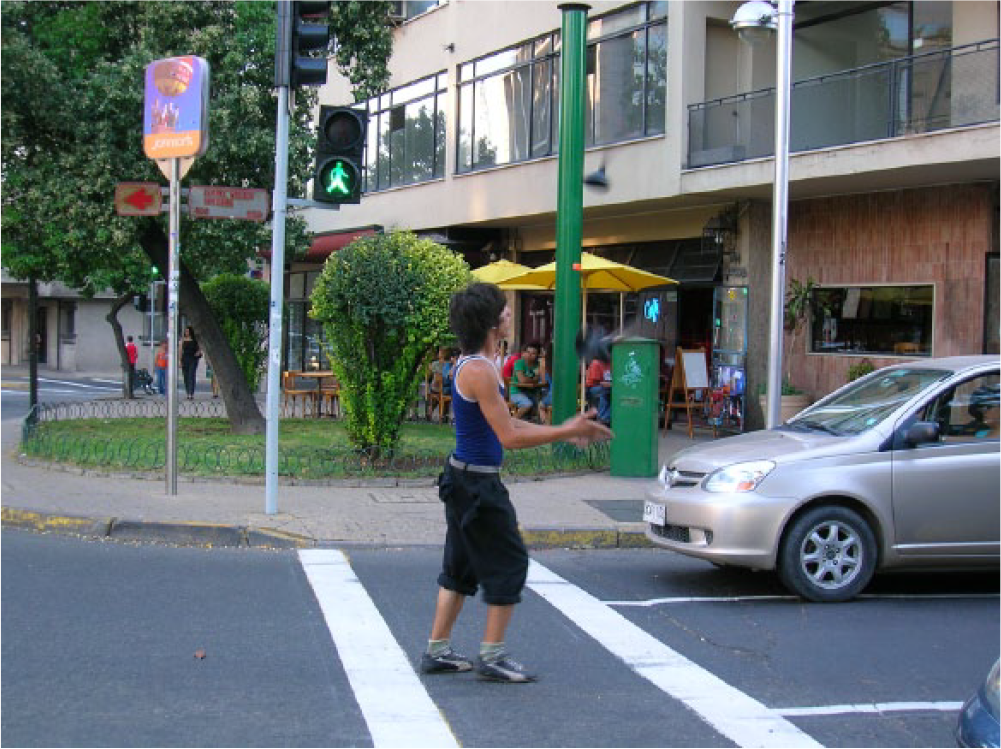
Juggler taking advantage of an “in car” audience, 2015, Image.
On the other side of the street, across the park, Alberto and his friend Coti wash windscreens. They tear from one corner to another as the lights change to reach as many customers as they can. The place is theirs from 4:00 in the afternoon to midnight; in that time, like Ale, they let no one else sell, perform, or beg on their patch. They stand up for each other in dealing with the occasional disrespectful, violent, or unfriendly driver. Unlike Ale, Alberto and Coti are not welcomed by the drivers. On the contrary, people often associate them with muggings or with dropouts not making an effort to earn a living, and even fear them. Coti and Alberto have to work hard for their coins, circumventing prejudices and often using intrusive strategies to prevent drivers from refusing. Basically, they splash soapy water all over the windscreen before or despite the objection of the driver, who then has little choice but to let them finish washing it. Coti and Alberto know that these are aggressive tactics, but they prefer to be insistent and cheeky than to not make enough money and be tempted back into stealing. Both have been in jail for robbery, and they neither finished secondary school nor do they have any sort of training. It seems pointless to them even to think about doing something else. At the end of the day, they earn enough washing windscreens to eat and pay some rent, and even to have a beer or two on hot summer days.
On Board Public Transport
The metropolitan Transantiago transport system launched in 2006 has also had a hand in making the public space amid the traffic into a business opportunity. The Transantiago integrated bus-metro system has been one of the great public policy failures of recent years (Ureta, 2014) and changes are still being made, almost a decade after it began, to get it to work adequately. The integration of different modes of transport—the bus and metro—had two impacts: a rise in demand for the metro, since the total travel time in the combined metro-bus trip was in theory shorter; and crowding on the buses, whose numbers were reduced on the basis that the metro would now absorb part of trips and the combination rationale would maximize the use of space on each bus.
The huge crowds of waiting passengers—the casualties of the Transantiago system—represent an opportunity for sellers, however. Maraí is one of those to have benefited from the new system. She began to sell sweets and candies to people standing in the—sometimes hour-long—queues. She has customers all day, but business is best at rush hour when the system collapses and the queues of tired, hungry workers stretch around the block. Maraí’s experience shows how practice makes use of specific arrangements of elements and connections in the framework of the new transport system.
For as long as anyone can remember, vendors have come on board Santiago buses selling everything from band aids, chocolate, ice lollies, and cold drinks to prayer books. Under the old system, they used to leap on and off buses at or between stops, with no more permission than a nod from the driver. But under Transantiago, they were banned from what was supposed to be a rapid, agile, and modern system. Transantiago, thus, posed a direct threat to the livelihood of these agile vendors. Some of them joined forces and started a union called SINTRALOC (Sindicato de Trabajadores de Locomoción Colectiva—Union of Collective Transport Workers) to protest their right to work on board the city’s buses. Their strategy was to make themselves visible, emphasize that they had a legal right to sell on board the buses, and differentiate themselves from petty hawkers who were often associated with muggings. Accordingly, they designed a mandatory uniform and photocard pass, with their name and ID number. After a number of protests and meetings with MPs, they secured permission to sell on board for all union members with a decree signed by President Michelle Bachelet.
Hardy and Joan were part of this process and founders of the union. One of the things that stands out about their story is the way they relate to their customers. They tell me how, under the old system before the union was formed, people would tighten their hold on their bags or turn away for fear of being robbed or harassed. Now that they wear a uniform and identification, passengers’ attitudes are totally different, and they are accorded respect as honest workers. Here, it is interesting to focus on something that has been crucial for the success of the organization and the shift in the perceptions of Santiago passengers: visibility. Joan relates enthusiastically how people’s attitudes have changed since the sellers have a union and wear uniform on the buses:
Because we have the name, SINTRALOC across our back [ . . . ] we model as well, we’re like models, while we talk we’re doing like models showing off clothes (field notes, September 2010).
Joan’s comments speak not only to her good humor but also to the dignity afforded to her work by the recognition of others—which comes, in part, from her uniform. The material form of the SINTRALOC workers—specific and recognizable with their uniforms, photo IDs, vocabulary, and forms of behavior governed by the union—is a source of individual respect and trustworthiness in the space. It helps them present themselves to others in a nonconflictive manner, thus making their work easier. Goffman (1990) argues that “when the individual presents himself before others, his performance will tend to incorporate and exemplify the officially accredited values of the society, more so, in fact, than does his behaviour as a whole” (p. 45). In this line, the SINTRALOC vendors reaffirm their position as serious, honest, and systematic workers through their new visibility. On the one hand, the union has thus given the vendors stability and better working conditions, and on the other, it has made them into uniformed employees.
The material form of the SINTRALOC workers is part of what makes up their work, shapes it, and constitutes it along with other elements and relationships. In this sense, materiality has agency (Latour, 2008), and one of its productions is the regularization of the work of the vendors who belong to SINTRALOC. I propose, then, that the forms in which the practices of the sellers are assembled and enacted (Mol & Law, 2004) do not exist independently of the materiality of their ways of doing.
Conclusion: the New Street Seller
The regularization of the work of Transantiago street vendors is governed chiefly by SINTRALOC, the union. It also occurs through self-discipline in the other cases of street vendors described earlier, in a way that is closely bound up with the urban changes described. I argue that this and other changes in the practice of street vending may be construed as a response to changes in the urban environment, and are rooted in a new understanding of the world and their work, as competitive and ruled. Just as workers in private companies must adapt to new forms of production, distribution, communication, and organization in the framework of what some scholars have termed new capitalism (Sennett, 2006), street vendors have adapted the arrangements for the practice to function in a new urban space.
Interestingly, some of the characteristics of this new street vendor turn out to be similar to those needed to be successful in the flexible economy: adaptability and personal ambition. In fact, paradoxically, to be successful, street vendors have become micro-empresarios of the new capitalism: They work overtime and are skilled in finding new places and ways to sell, and customers to sell to. The practice encapsulates a sort of self-exploitation that reduces their much-cherished freedom to the fact of not having a boss, rather than not having to work intensively. Self-discipline sustains their work and replaces the instructions of a boss, working hours increase, and they manage their working time as rationally as possible to maximize profits.
Paradoxically, having always shied away from institutions, street vendors have always had the skills to work in a flexible noninstitutional context; in many ways, they epitomize the skills that formal sector workers have had to develop to adapt to an institutional set-up that no longer offers long-term employment security. 5 Street vendors are capable of improvising their life trajectories by reacting to opportunities and spaces; they develop specific talents for particular situations; and they are not tied to a history that obliges them to keep doing what they do. The interesting question here is whether this form of street work constitutes freedom and allows the vendors to build a work-related identity. It is striking how often interviewees refer to their form of work as way to be left in peace, to have time, to be in control of their own hours, and to be free from the capitalist order’s organization of life. Yet observation of the practice suggests that their narrative of many of these street selling experiences is the story of what it was like before urban expansion and police control. Using the terminology of Luc Boltanski and Laurent Thévenot (2006), we could say that there is a sort of transition between the city of inspiration—in which the working climate is one of freedom, experimentation without schedules, uniforms, or formalities—and the city of commerce, which prizes audacity, and the flexibility needed to close a deal, seize an opportunity, and reach a goal.
The practices observed do have points in common with the street vendors’ narratives of them, and those points have to do with the centrality of social networks in their daily lives. Social networks continue to be essential for selling in the street without getting arrested and for safeguarding one’s belongings. Trust in others is essential when working in a shared space. Place becomes a kind of social glue for them—it binds them together, connects them, and operates as support for the network. In the case of the SINTRALOC union, the social networks sustaining the organization are central. The members of SINTRALOC know each other, and there is a kind of complicity when they come across each other during the working day. In this sense, the practice of street vending does not function in an atomized manner, even though the people involved pursue their own individual interests.
Footnotes
Declaration of Conflicting Interests
The author(s) declared no potential conflicts of interest with respect to the research, authorship, and/or publication of this article.
Funding
The author(s) disclosed receipt of the following financial support for the research, authorship, and/or publication of this article: The author gratefully acknowledges the research support provided by CEDEUS, CONICYT/FONDAP 15110020.