



Abstract
In this piece, I argue that the city of Cairo has witnessed unprecedented urban transformations for the past 4 years, owing to urban wars and confrontations during the two regimes that followed Mubarak’s ouster. Street politics, although mesmerizing, have been highly exhausting. With the reemergence of the army in civil life, after the ousting of President Morsi, street activism is becoming hazardous and highly costly in terms of human life. Whether Egypt is witnessing the persistence of a counter-revolutionary moment, firmly marching toward the uncompromising neoliberal city, exemplified in Dubai as a model and planned prior to 2011, will be difficult to answer, precisely because Cairo is not Dubai. Experts on Arab revolutions have spoken of the emergence of new “subjectivities” that have opened novel mental, visual, and physical interactions in the city, perhaps encouraging optimism in the long term.
Introduction
“We are being punished for having made the revolution.” This is a recurring statement heard in Cairo since the military takeover in 2013. The resigned collective response that has come to dominate Egyptian political life is highly revealing of the paradox of the “incomplete revolution.” The neoliberal policies that were established under Mubarak’s “cabinet of businessmen” and their entourage of crony capitalists, following the dominant “laissez faire” free market economic policies and accompanied by the massive deregulation of the working condition and firing of workers, continue to be carried out under the current military regime. For example, workers have been detained, as in the recent attacks on bus and shipyard workers in October 2016 (Retrieved from https://egyptsolidarityinitiative.org/2016/10/17/alexandria-shipyard-workers-and-cairo-bus-workers-in-court-18-and-19-october/; Abaza, 2013b). Observers have been debating about the latent conflicts of interest between the so-called “twenty powerful family” crony capitalists—the former business elite who were in the entourage of Gamal Mubarak—and the parallel economy of the armed forces, 1 which has gained greater public visibility after 2013. However, as Stephan Roll argues, the business elite continues to prosper, as none of them were seriously put on trial for the previous corruption cases nor was their inflated wealth confiscated. The dilemma remains; the same “ancien régime” mind-set is continuing today under military rule. Meanwhile, even harsher policing and security measures, massive incarceration and violation of human rights, and attacks on the civil liberties of medical doctors (Egypt Solidarity Initiative, 2016), activists, journalists, and writers have been instituted. As usual, the price of a state’s retreating from its welfare obligations is the doubling of the costs on the increasing numbers of the poor and destitute. 2 Economic liberalization—the project that was initiated under Sadat and continued under Mubarak—had already disadvantaged large sections of the middle classes and the poor before 2011. It can only work for the elites, and even then, only with increased policing measures and further political repression. The specter of a future insurrection is already contemplated. But who will lead the next rebellion, and what form would it take, is part and parcel of the unpredictability of life in Egypt. Having said that, for the sake of avoiding mechanic, simplistic interpretations, the current amplified economic deterioration does not necessarily translate into a systematic insurrection of the “starving” poor. As large sections of the middle classes and better off citizens have been present in the early days of the revolution on the square, lending to the interpretation that the political deprivation epitomizing in the murdering of a middle class young man (Khaled Said) in a police station in Alexandria in 2010 was a stronger motive to take to the streets. In effect, a number of observers commented on the increasingly tarnished image of the activists and the revulsion toward the revolution from large sections of the poor, 3 since they endured most from the escalation of violence and the economic deterioration.

The second Mohammed Mahmud violent incidents in November 2012, captured on November 23, 2012, photograph. Source: Author©.
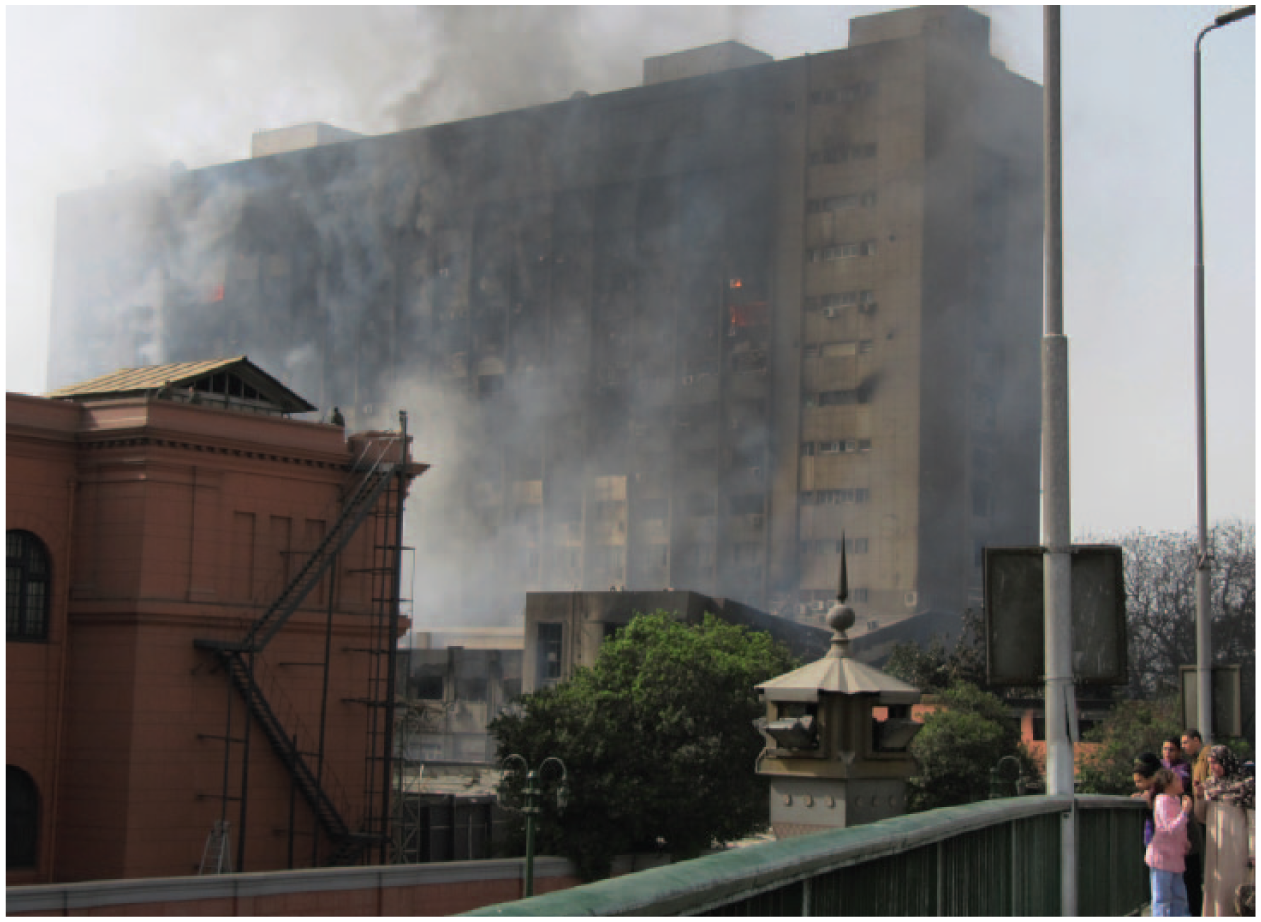
The burning of the National Democratic Party headquarters on the 28th of January, captured on January 29, 2011, photograph. Source: Author©.
It is possible to view revolutions as traumatic, upsetting moments of reversals that result in a multiplicity of unprecedented collective reactions. As Florentina Andreescu (2013) has argued, such exceptional moments obviously affect the collective “phantasy formation,” leading either to stronger communal bonds and connectivity or to further destruction and alienation. The past 5 years have witnessed numerous killings, massacres, and deaths. The culture of mourning—the public celebration of martyrdom; the creation of memorial spaces through graffiti; the public display of colossal photographs of the dead, of mock coffins and tombs in Tahrir Square, of oversized portraits, and of martyrs on flags in marches and in text messages as dramaturgical performance—all these dominated the street until 2013. Then all these performances and iconic displays of symbols disappeared when martial law was imposed after the ouster of former president Morsi. However, in spite of these performative public displays, no essential memorial space for the martyrs of the revolution was erected by the government. 4 Today, insults, poems, and graffiti have been all whitewashed from the walls of the city as a conscious act of erasure of the turbulences of the past years. The regime’s denial of the martyrs of the revolution and the subsequent killings of the pro-Morsi squatters in Rabe’a al-’Adawiyya Square in summer 2013, as well as the massive killings of soldiers and innocent citizens from impoverished backgrounds in the escalating attacks directed against the authority of the state, call to mind Judith Butler’s question of which lives count as “grievable” and which ones do not count as lives worth living, and which are then dehumanized or forgotten (Butler, 2009) in the unfolding political processes of aborted revolutions.
Further reflection would be desirable regarding the transformation of the city of Cairo under the aspect of precarious performative collective action. The argument here bears similarity to Robert Emerton’s observations (in this volume) on the various political actors in Beijung, inviting us to think about the impact of the “duration of an event.”
Above all, there is a collective feeling of hopelessness, because the possibility of dreaming for a better future is discouraged by an increasingly difficult daily life, clear evidence that positive change will not materialize in the near future. The neoliberal, counterrevolutionary forces have blamed the revolution for the massive deterioration of the economy over the past 5 years, which is untrue. The recent floatation of the pound (in October 2016) as a condition to receive a loan from the World Bank has only speeded up the specter of a “revolution of the starving” as a nightmare of the elites and middle classes. Not only has the pound lost almost 80% of its value against the dollar overnight, but the unregulated increase in the price of fuel has doubled the price of transport, accompanied by wild increases in the prices of countless consumer goods, including food.
Not only do chaos and unpredictability seem to be reigning in the street and in the daily lives of the poor, but uncertainty likewise seems to reign in financial milieu. Banks have recently proposed an interest rate of up to 20% on Egyptian bonds, as a desperate way to maintain capital in local currency. This effort paralleled a volatile foreign-currency black market that was never really controlled. To some people, it suggests an analogy with the Argentinian depression in early 2000. Precarious lives, pervaded by uncertainty and volatility, are becoming the very essence of the “urban” in the cities of the Global South, in a precisely counterrevolutionary momentum. These paradoxical forces not only inflict hardship but also engender creativity and forms of solidarity (Simone, 2016a, 2016b).

Two photos of Ultras Ahli. Portraits of the young victims of the Port Said massacre of the Ultras Ahli in February 2011—one of the few graffiti that were not erased. Located at the front gate of the Ahli Club in Zamalek, captured on December 2, 2015, photographs. Source: Author©.
How can one speak of change when the military establishment is as present as ever in public life? Corruption and violence are even worse than before. The brutality of the internal security apparatus was epitomized in the murder of Giulio Regini, an Italian PhD candidate from Cambridge (Malsin, 2016), whose body showed horrific signs of torture when it was found along the desert highway. The question was immediately raised of who was behind such a barbaric act, and what message such an unprecedented act on a foreign researcher was meant to convey. Prior to this incident, foreigners had been considered more or less untouchable for the internal security apparatus. Could this incident be read as revealing the tensions and clashes between the internal security of the police and military intelligence, as gossip has been suggesting? And how is one to interpret such frightening brutality after the cause célèbre of Khaled Said, whose smashed, tortured face, which went viral in social media in 2010, was a major trigger of the 2011 revolution? Is the Regini affair simply a targeted escalation of pure violence on the part of the state that lost the legitimacy of its monopoly of violence after January 2011, its purpose to further intimidate its citizens? Since Regini was working on sensitive topics such as social movements and the Egyptian working classes, could it be a message addressed to the circles of local and international academics that anyone who dares undertake research in Egypt had better think twice, because such research is no longer possible?
There have been over 200 cases of forced disappearances of activists in recent years. At the expense of sounding cynical, Regini’s body could have disappeared, and the regime would not have been embarrassed by the graphic exposure of torture in international media, causing a diplomatic crisis. How to explain this exposure? Are there competing internal security apparatuses working against each other, so that Regini became a victim of inner struggles? Or is it as simple as the fact that right up until today (in 2016), even nonpoliticized, poor, and innocent Egyptian citizens continue to be tortured and killed by “mistake” in police stations, to be declared heart-attack deaths in the media. 5 So was it a mistake and Regini was killed unintentionally through still being tortured? If numerous police stations were torched and destroyed in 2011, it was precisely because of the long and well-known history of police brutality in Egypt.
However, the Regini affair coincided with increasing surveillance of academic life and the banning of several foreign researchers from entering the country for political reasons (Mada Masr, 2016). The impossibility of undertaking any serious research was recently confirmed when the Minister of Higher Education issued a statement “obliging private universities to review all research papers and thesis dissertations to ensure they do not include any ‘direct or indirect insult to societies or individuals belonging to any brotherly or friendly countries’” (Shams El Din, 2016b). And even further interference was exercised when an assistant professor in the arts faculty at Cairo University was awarded a doctoral scholarship at the Catholic University of Leuven in 2015. After obtaining the official approval of her university, she traveled to Belgium to find out that the approval had been withdrawn, apparently through the direct interference of the Interior Ministry, which demanded that she return to Egypt (Shams El Din, 2016a).
Tahrir Is Not Repeatable
It seems certain that the 2011 Tahrir collective experience will not be repeatable. If it were, the human cost would be extremely high. People understand that any future insurrection will be harshly suppressed. In the weeks before November 11, 2016, social media spread the call of a group named the “Ghalaba Movement” (meaning “the poor and marginalized”) to take to the streets on that date against the regime to protest the soaring prices and obviously deteriorating economic conditions. It seemed possible that the campaign might have been instigated by either the regime or the Islamists (Sakr, 2016). In the end, November 11 turned out to be a peaceful and extremely pleasant day for a stroll, as almost all Cairo streets were empty. In fact, the city was overrun with intimidating security forces spread all over the center of Downtown and its major nodes. The clear message being conveyed by the regime was that extreme violence would descend on protesters. It seems that the threats worked quite well. The display clearly benefited the image of the regime as the powerful keeper of order. But, equally clearly, the immediate solution to economic recession is not the immediate occupation of squares with extensive military force. Imaginative forms of resistance continue, even if it is not taking place in the immediate sight of squares and public spaces. For instance, when 47 protesters against the annexing of the islands of Tiran and Sanafir to Saudi Arabia were sentenced to 5 years in prison, 4.7 million Egyptian pounds were collected from various individual and group sources to pay for their released (Gabr, 2016).
Cairo would appear to be a typical example of what Stephen Graham, in his brilliant futuristic work Cities Under Siege: The New Military Urbanism (Graham, 2010), describes as a growing process of urban militarization, which merges military and surveillance strategies with civilian and consumer urban life. Nothing could be more apt than Graham’s theory to explain what Cairo has witnessed during the past 3 years, as it has become the site of an ongoing battlefield. Eyal Weizman, quoted in Graham’s book, says it all: “The City is not just the site, but the very medium of warfare—a flexible, almost liquid medium that is forever contingent and in flux” (Graham, 2010, p. 21). Graham’s predictions render Cairo a stimulating laboratory for experimenting with the erection of walls as an urban-warfare strategy and as a way of counteracting demonstrators by military planning to reinvent and subvert space (Weizman, 2005).
So many of the army’s actions remain in the collective memory as vivid images of the mounting militarization of daily urban life: The presence of the army tanks in the streets of the center of town (constantly appearing, disappearing, and reappearing from 2011 until 2014); the erection of concrete walls as barriers between the protesters and police forces; the piercing and demolition of these isolating and paralyzing walls by the citizens; the blockading of entire areas for security reasons; checkpoints, barbed wire, the various forms of urban combat; the vertical control of the city through the presence of helicopters at peak moments in Tahrir in January 2011 and on 30 June 2013; the numerous attacks and retreats and killings by the police forces in various busy, central streets of the city between 2011 and 2013; the tear gas, resulting in numerous deaths and epileptic attacks; the emergence of newly created paramilitary troops parading in the city; and finally, the Rabe’a al-’Adawiyya massacre and its aftermath, the escalating number of militarized terrorist attacks by the opposing Islamists. These attacks targeted not only state representatives and police forces but also torched a large number of churches in summer 2013 and killed numerous innocent citizens. 6
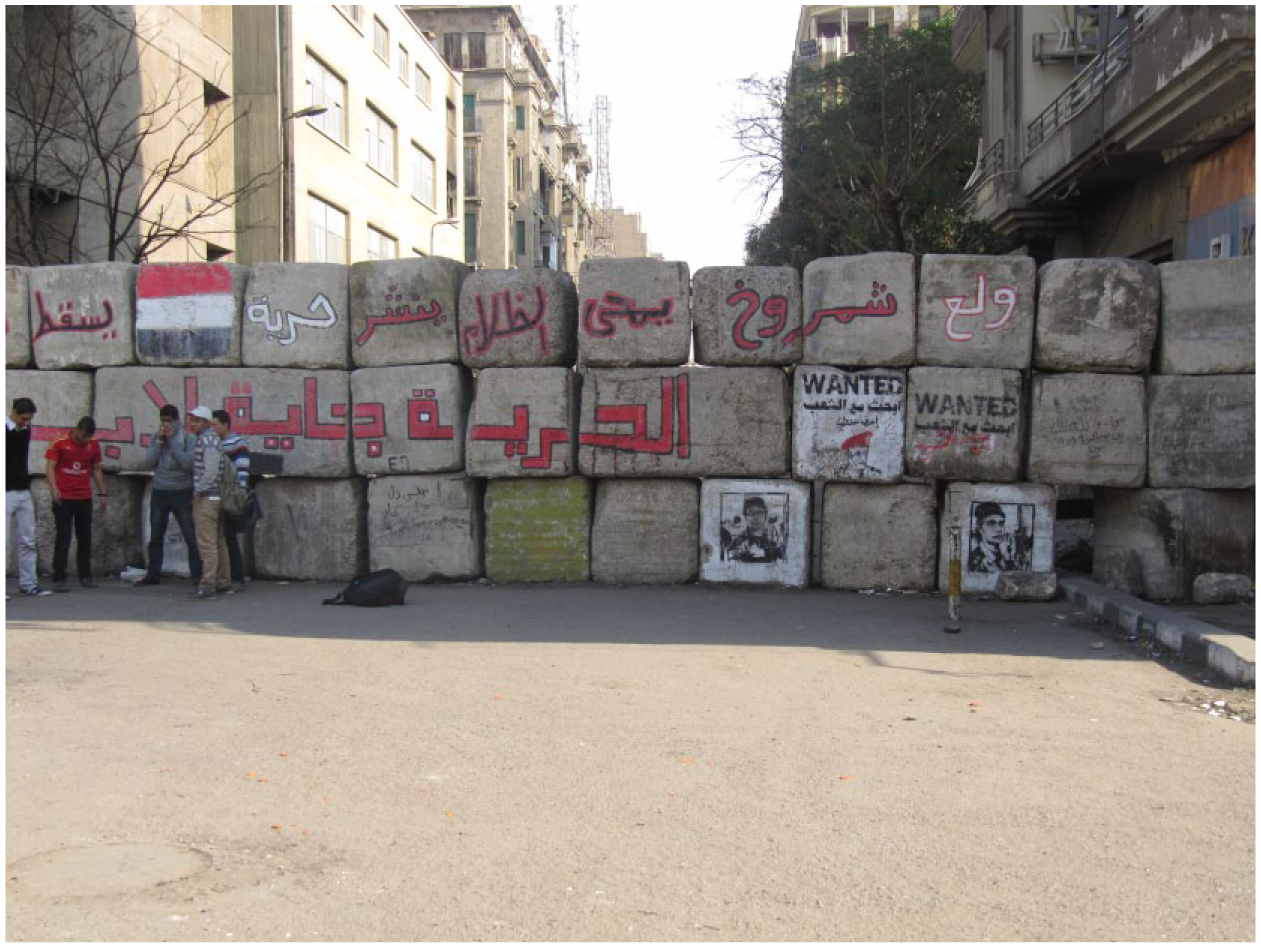
The Mohammed Mahmud street after the erection of the wall, captured on December 15, 2011, photograph. Source: Author©.
Nasserite journalist Abdallah al-Sennawi commented in the al-Shurouk newspaper in August 2015 on the mutiny of a group of low-grade officers, identified as the umanaa’ al-shurtha in Sharquia, as representing the cry of the unheard, deprived police forces. Because they are poorly paid, these low-grade officers have gained a reputation for pettiness and corruption. During the past few years, a myriad of jokes circulated about them. They are recruited as officers precisely because of their poor education and low status. But al-Sennawi rightly insists that they are perceived as both the evil victimizers and the victims of the corrupt and vindictive state apparatus, because of their position at the bottom of the hierarchy. Their protests were a response to the killing of three officers and the wounding of several others in a terrorist attack (which have significantly multiplied against police forces in the past years) on the road between Damanhour and Rashid al-Sennawi (2015) draws an analogy with the violent 1987 rebellion of the police forces, warning that their ambiguous position and violent behavior toward innocent citizens, together with their reputation for being corrupt, are highly revealing of the escalating tensions that led to the army’s intervention.
This bring us to the next point. Although the Ministry of Interior has been reinforced and its budget and personnel significantly consolidated after 2011, it remains far from being a homogeneous and consistent apparatus. Its hierarchical structure comprises vast class and economic disparities, with the result that it speaks with multiple interests and “voices,” as Maha Abdel Rahman (2017) has argued. Clearly the poorly paid, often rural-origin conscripts who were posted on the front lines with barely any shelter or proper food, squatting for endless days in the streets behind the concrete buffer walls erected around Tahrir by the army in 2011 and 2012, confronting demonstrators, represent an entirely different world from that of the highly placed officers and generals who gave the orders to fire on the protesters.
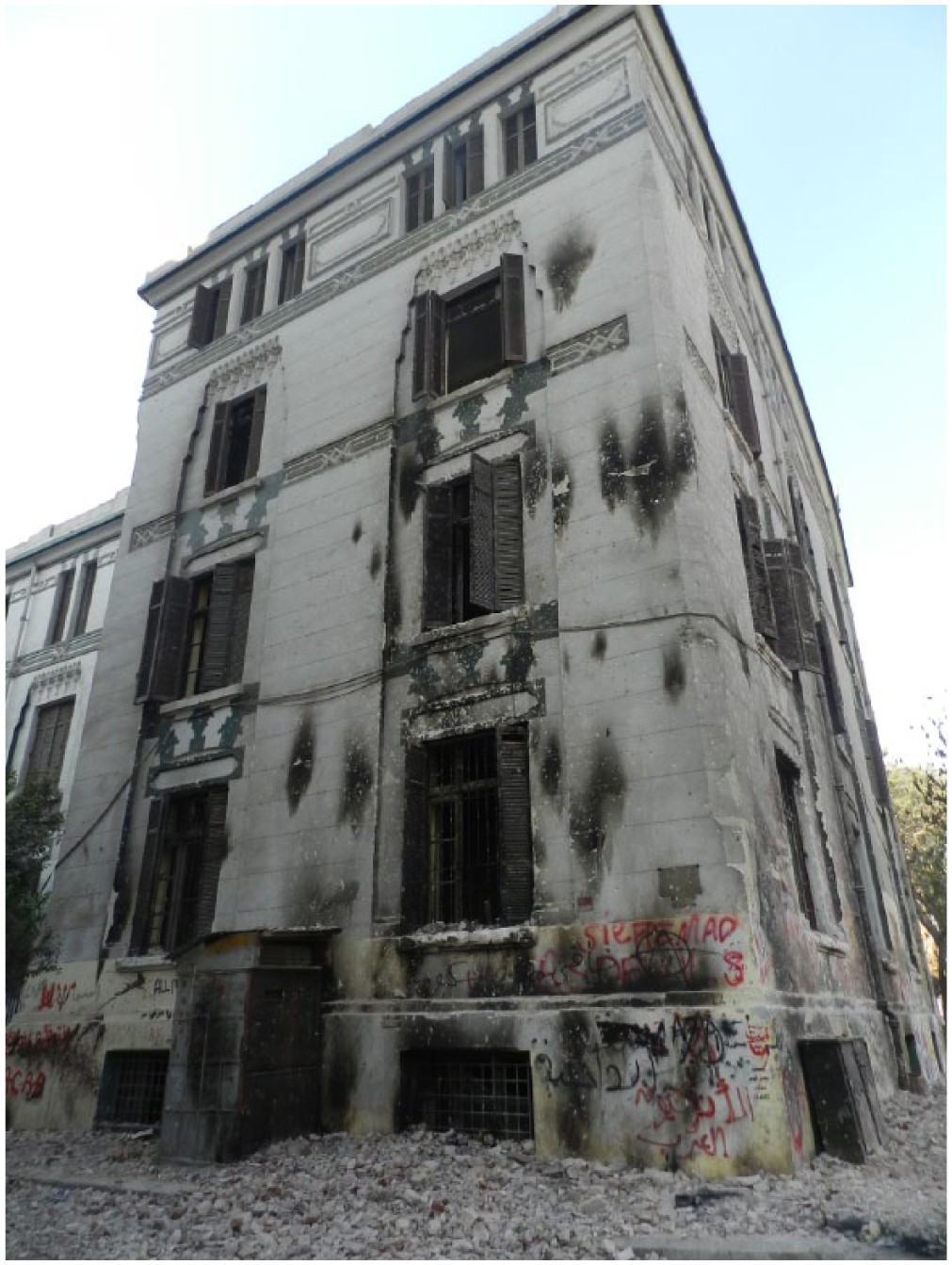
Fire that caught the building of the Lycée School in Mohammed Mahmud Street, captured on November 30, 2012, photograph. Source: Author©.
The military have turned out to be our urban planners as Graham prophesied. They have gained popularity by building roads and bridges connecting provincial towns. They have also built sewers and power lines and have recently announced their intention to build schools (Gotowicki, 1997). But the militarization of urban life, and the increasing public visibility of the military in quotidian matters, takes a myriad of forms. They own numerous factories producing food, water, and other beverages, apart from weapons and military industries, and operate industrial farms. They distribute rationed food and subsidized bread through a “smart card” system, allowing five loaves per family (Fick, 2015). They collect many of the proliferating “modern” gas stations together with small attached supermarkets. The armed forces are today the largest owner of desert land in Egypt, and one of the major players in the construction of the Dubai-inspired new Egyptian capital city in the Eastern Desert. This means that they have become the main speculators in real estate and in the further development of the satellite cities. The choice of the location of the new capital on the Cairo–Suez Road, as part of the development of an economic node around the Suez Canal zone, raised eyebrows, since the question of transport was time and again not addressed, just as occurred in the planning of the previous satellite cities. Nor does the expansion toward the desert solve the problem of increasingly decaying services and buildings in the center.
The Armed Forces Land Projects Agency recently took over the supervision of the new capital city and the Sheikh Zayed development, extending to some 16,000 acres (Sawaf, 2016). A year earlier Sisi announced the military’s involvement in a $40 billion joint project for low-income housing with the Arabtec Company from the United Arab Emirates (Saba, 2014). The CairObserver reports that in 2014 the Defense Ministry signed a contract with the mega-company Emaar, based in the UAE, to construct a huge Emaar Square that would include the largest shopping center in Uptown Cairo, contrasting the neoliberal, market-oriented Dubai as a model against Tahrir. Yet this dream of a market economy is envisaged only under authoritarian military rule, under which the army becomes the major manipulator of vast amounts of land and can market it as it wishes without providing any transparency in the transactions (CairoObserver, 2014).
Zeinab Abul-Magd’s crucial work (Abul-Magd, 2016) is perhaps among the first studies to have pointed to the paramount role of the army’s involvement in the current economy and why their activities have been kept opaque from the public sphere. Essentially, according to Abul-Magd, the armed forces have been financially involved for many decades in an estimated 25% to 40% of Egypt’s economy. This includes some mega-projects, including large factories in the food and beverage industries, cafeterias, and gas stations. The public visibility of the army is further evidenced through their expanding empire that had already existed for decades. They own clubs, hotels, and recreation areas, and have numerous privileges through access to cheaper housing. This would explain why the army opted to depose Mubarak and his son’s entourage of crony capitalists, who constituted a parallel competing elite to the army’s economic interests.
Malaise
Of particular concern has been the recent issuing of two draconian laws. One law relates to protests, as a retaliation against the violent demonstrations of the Muslim Brotherhood after ousting former president Morsi; the second law curtails the activities of NGOs and human rights organizations. These two laws have unquestionably had a negative effect on the political and cultural spheres. 7 A large number of young activists, who protested against the antiprotest law, have been arrested.
Egypt seems to be confronting an insurmountable malaise in which witch hunting the unfamiliar is becoming quite familiar. The state seeks to frame itself as the highest authority protecting “public morality” (revealing the striking continuity in the government mind-set with former presidents Sadat and Mubarak). It shut down a so-called “atheist” café in the center of town for harboring “Satan worshipers” (Mezzofiore, 2014). Odd news continued to thrive during that year with the arrest of two Englishmen in the metro because they spoke English, and the arrest of a student because he was carrying George Orwell’s novel 1984 (Tarek & Maher, 2014). Many people feel that the government is excelling at repelling tourists and foreigners from visiting Egypt, exactly at a time when tourism is badly needed.
There is a growing collective feeling of being personally targeted, while the circle of one’s acquaintance narrows day after day. This is what Basma Abdel Aziz’s article in al-Shourouk newspaper has warned of (Abdel Aziz, 2014). 8 Can this be considered a sort of collective depression, after almost 4 years of euphoric moments fostering hope, collective dreams, and desires for a better life? In various circles today, there is a massive exodus of intellectuals, artists, and human rights activists. Similarly, there are emerging narratives on the struggles and hard life of former Egyptian activists living today in exile in the United States. These scenes evoke Milan Kundera’s The Unbearable Lightness of Being, and invite striking analogies with the aftermath of the Prague Spring. Of course, not everyone can leave the country. For those who stay, internal or “inner” migration 9 and the intentional boycott of the official media and television channels (local and satellite channels alike) become the only ways to maintain some sanity under the noise of such a high-pitched propaganda machine.
The authorities’ decision to conduct a relentless “war on terror” as a retaliation against the escalating terrorist attacks against the army has certainly contributed to a collective feeling of angst. So, too, have the actual uninterrupted attacks by terrorists, whereby numerous Egyptian soldiers on both the eastern and western borders have not merely been killed but many beheaded, indicating that the so-called Islamic State organization, or its supporters, have reached the country. Dare one say that with the pervasive media propaganda, combined with the multiplying actual terrorist attacks, popular sentiments have shifted toward the opinion that the respect of human rights and the right to protest remain secondary to the grander cause of national security threats? Why are the young revolutionaries in prison receiving so little popular support for protesting against the regime? And why is it that a large majority of the Egyptian population believes that between the two evils—the Muslim Brotherhood versus the army—the army remains the best of two bad solutions? With Syria as an example where the disintegration of the state and the army have led to a civil war, exacerbated by infectious global Islamic terrorism, these fears are not irrational. How might these transformations, which some observers have recently described as the entire Middle East plunging into an “Arab winter,” translate into the urban reshaping of Egyptian cities?
We need to think about alternative modes of resistance, after almost 3 years of turbulent and, on the human level, costly street politics, especially now that the police forces and the army have reemerged in the streets with highly sophisticated counterinsurgency weapons, vehicles, squads, and methods of vertical control by means of helicopters, 10 barricades, and checkpoints. This post-Tahrir moment is happening simultaneously with an unprecedented escalation of Islamist terrorist acts, with the result that detonating bombs and terrorist actions are becoming a quotidian routine not only in Cairo but in numerous provincial towns. Reflections concerning the “city or megacity as a target” of violence and a site of urban confrontations through “the control of the circulation of information images, violence, space, action-at-a-distance and technology,” such as occurred in Mumbai in 2008 (Bishop, 2010, p. 4), could provide an enriching example for reading today’s Cairo.
Fuel was added to the fire with the acquittal of former president Mubarak on 29 November 2014. Apparently, according to the gossip, it was the oil oligarchs of the Gulf who pressured against a just trial of the ousted president. What was to be avoided at all costs was setting a precedent for punishing authoritarian regimes. Mubarak’s acquittal was immediately preceded by the draconian law curtailing the role of the NGOs, a law that was described by human rights activists as “unconstitutional” (Ahram Online, 2014). The law seeks to silence human rights organizations by imposing the death penalty if an institution or individuals receive foreign funds without the authorities’ consent. Many see this as a troubling threat to democracy, the extent of which remains to be measured in the longue durée of the complexity of revolutions.
Renowned activists such as Alaa Abdel Fattah, his 20-year-old sister Sana Seif Abdel Fattah, Yara Sallam, and Ahmed Douma (Kholaif, 2014), like countless other nameless innocents who were picked up by mistake in the streets during the violent confrontations with the pro-Morsi protesters, are today harshly punished by long prison sentences. These young activists, who have become icons of the revolution, organized a march in the Heliopolis district in June 2014 against yet another draconian law curtailing demonstrations. The demonstration was not well attended and did not earn any significant popular support because the interference of the army in urban life was perceived by a large majority as restoring order, and thus as legitimate, after the extremely violent pro-Morsi protests. It was also evidence that the Muslim Brotherhood has lost the support of the street.
The Battle Between Encampment and the Neoliberal Order
The power of the street through the reinvention of public spaces as performative sites of contestation, together with the “decentered” absence of leading parties in the Arab revolutions, have inspired various observers to novel ways of rethinking the changing mental life of Middle Eastern cities (Abaza, 2011a, 2011c; Mehrez, 2012). They have recently launched a rich theorization in the direction of an emerging “new political subjectivity” (Bamyeh, 2013; Challand, 2011; Hanafi, 2012), as well as a new “political imaginary” (Challand, 2011, p. 271) that seemed already to be in the making. Paul Amar argues on a similar line: while the Egyptian revolution has failed to be a “social revolution” that would have overthrown class hierarchies and provided social equality, it nevertheless succeeded in instigating change in the political sphere. It mostly accomplished a “revolution in consciousness” (Amar, 2014, p. 38).
In relationship to this emerging political subjectivity, numerous writings have focused on how to rethink these novel advocacies and new forms of individuality in connection to collective action in the public sphere (Salvatore, 2013) and the transformation of the very understanding of public spaces in relationship to innovative forms of contestation (Abaza, 2013a, 2013b, 2013c). For example, Mohammed Bamyeh argues that the Arab revolutions have widened the horizon for a new paradigm that could be read as a promising innovative “enlightenment” that will influence the future of the entire region (Bamyeh, 2013). It is important in that context to point out that numerous observers of social movements in Egypt predicted that the January revolution would unthinkable without the prelude in the long history of organized protests, sit-ins, and demonstrations that were first instigated by the Kefaya movement in 2004, followed by the largest demonstrations ever (before January 2011) of the al-Mahallah al-Kubra textile workers, along with the numerous strikes and protests that were carried out by the syndicates of journalists and lawyers, by bus drivers, by tax collectors, by peasants, by the students of April 6th movement, and by numerous local collective initiatives. Other protests that arose in reaction to water and bread shortages and to the increasing failure of the government to provide basic services had an equal effect. These different forms of protest then expanded to include the Egyptian Anti-Globalization Group, Engineers for Democracy, bloggers, and Facebook groups, thus leading to an unprecedented dissemination of information (Abaza, 2013a; Abdel Rahman, 2009a, 2009b; Beinin & el-Hamalawy, 2007b; Charbel, 2007). The combined result was that, beginning in 2004, Egypt saw its most intensive rate of strikes, sit-ins, and organized protests since the Second World War (Beinin & el-Hamalawy 2007a, 2007b); 2007 came to be considered the most important year for labor strikes. Paul Amar argues that the January revolution heightened consciousness for mass mobilization toward what he calls “imaginative labour actions” and “boundary-challenging solidarity” (2014, p. 41). Teti and Gervasio, on the other hand, trace the continuity and significance of the political mobilization prior to the revolution to the NGOs, human rights organizations, and trade unions such as the real estate tax collectors’ unions. They also point out that, after the revolution, these unions and human rights NGOs fostered literally hundreds of new unions, which have been struggling to improve labor legislation and fighting the resistance to an increase in minimum salaries (Teti & Gervasio, 2012, p. 104).
Parallel to the ongoing, and constantly multiplying, writings speculating on the success or failure of the Arab Spring (or Winter) are the previous studies that focused on the impact of neoliberal policies and consumer culture on the reshaping of the Middle Eastern cities, with a particular emphasis on Dubai as a successful and replicable utopia/dystopia for the entire Middle East (Abaza, 2006, 2011b; Davis, 2006; Elsheshtawy, 2010; Kanna, 2010). The recent work of Elsheshtawy (2010) provides, nevertheless, an interesting positive alternative reading of the city of Dubai, challenging the systematic assumptions on the Disneyfication of urban life through the overwhelming multiplication of mega malls and consumerism as the trademark for tourist attraction in Dubai. By highlighting Dubai’s often neglected history and heritage, Elsheshtawy’s reading of Dubai as integrative of various communities could be understood as a counterreading to Davis’s segregating, gloomy, science-fiction, “Jurassic Jungle” description of the Dubaiscape (Davis, 2006).
Egypt, standing at the crossroads of a counterrevolutionary moment, seems to suggest that the struggle over the appropriation of the postrevolutionary city of Cairo will be between these two opposing “subjectivities”—a struggle between preserving the memory, knowledge, and experience of urban wars and performative revolutionary advocacies and succumbing to neoliberal agendas obsessed with erasure; a struggle today confronted by a neoliberal gentrification supported by a military “order.” Parallel to the neoliberal agenda, the aggressive politics of the “war on terror” might end up encouraging even more terrorism in Egyptian cities as a retaliation against the unresolved economic crisis, in a way that is becoming a normalized quotidian reality, similar to the “new military urbanism” (Graham, 2010). It is no coincidence that Dubai’s neoliberal subjectivity as an urban utopia (Abaza, 2011b), with grandiose shopping complexes, is what is represented in the proposed 2050 futuristic plan of reshaping Cairo that was proposed by the government before 2011. In that plan, broad avenues, highways, skyscrapers, and gentrified neighborhoods will necessarily lead to a typical massive eviction of countless slum dwellers. The recent announcement of the futuristic, science-fiction-like new capital of Egypt in the Eastern Desert, featuring impressive virtual mockups filled with skyscrapers, reconfirms, time and again, Dubai as a dream.
The encampment/occupation movements gave birth on a global scale to an unprecedented accumulation of relevant knowledge in reevaluating the value of public spaces. People have learned to read their own cities in a new light, through protests, marches, urban wars, and refinement of their tactics of attack and confrontation with police forces. The recent years of intensive street politics and urban wars resulted in an ascending toll of martyrs, the militarization of space, heavy-handed policing, gassing protesters lethally, walling off and segregating spaces in Cairo and various other cities, public performances, graffiti, and covering the walls of the city with insults. These confrontations created an entire new visual landscape and “know-how” in learning about and moving in the city. Yet it also exhausted and physically ruined some neighborhoods, such as Mohammed Mahmud Street and the historic building of the Lycée school, which caught fire in the midst of the confrontations in 2012. 11 This explains why some of those proclaiming to adhere to the revolution might share similar views with the counterrevolutionary camp in the matter of restoring “order” by clearing the square and Downtown, by drastically eliminating the so-called riffraff, poor street vendors, and street children.
While this particular moment in history enriched the image of Cairo’s creative chaos as if it were a surreal Bruegelian tableau, how long can a revolutionary liminal moment last? For how long could the power of the street have continued? For how many years could the power of mass demonstrations have stood against the violent confrontations and the mounting toll of deaths by the day? How long could the oft-repeated slogan have survived: “More blood ought to be spilled in the streets and more martyrs are needed to complete the revolution”? These questions raise the issue of the longevity and the precariousness of the modes of resistance of the recent performative “Occupy” movements on the global scale. Robert Emerton’s reflections on China in this volume are highly informative for the Egyptian case, as he compares the “staged,” “performative” student protests in Tiananmen Square to the “unstaged” workers’ movement, arguing that the workers’ movement was more challenging and effective in negotiating with the regime because of its use of shock tactics. His observations lead to the conclusion that “performative” resistance is apparently bound to be ephemeral. In addition, the performative dramaturgical moment can be collectively highly exhausting.
Restoration: As if the Revolution Never Occurred
It is evident that counterrevolutionary forces have reemerged in a fiercer manner, exemplified in the internal security apparatus that solidified its physical omnipotence by surrounding its numerous ugly buildings with countless soldiers on the alert around the clock, while huge, insurmountable cement blocks concealed all the windows after the buildings were conquered by the protesters. For the collective Cairene imagination, these monstrous constructions systematically evoke torturers and countless disappeared prisoners. The multiplying squads, the up-and-coming police forces with new and terrifying ninja-like outfits in the streets, are meant to heighten angst and restore order. And yet, the attempts at bringing order to the street, by regimenting cafés and arresting homosexuals, has not hindered the rampant criminality, the growing phenomenon of child kidnapping for high ransom, the flowering market of car theft, the horrific road accidents, and last but not least, the commonplace practice of sexual harassment, perpetrated by some police officers themselves.
The regime’s main effort in restoring order has been through an endless attempt at erasure of memory. Nonetheless, Cairenes have acquired a cumulative knowledge through collective street activism that cannot simply be deleted from the collective memory. Nor can their newly discovered sensitivity toward public spaces and the appropriation of the city’s landmarks be forgotten.
It is with considerable optimism that one can observe the continuing effort of Cairenes to collect endless narratives about the revolution. This has happened not only by dissecting visually, with photographs and documentaries, the mini-utopian, 18-day “State of Tahrir” that produced clinics, barbers, kindergartens, toilets, checkpoints, and food stalls in and near the mosques surrounding the square. The movement and tensions of publics and counterpublics, of the revolutionaries, the police forces, the thugs paid by the regime, the army, the Islamists (both Muslim Brotherhood and Salafis), the street vendors, and the street children have been given attention in numerous press reports, documentaries, and academic articles. (See, e.g., the numerous informative articles on Tahrir posted on the Jadaliyya website; Abaza, 2011c; Alraouf, 2014; AlSayyad, 2011; Alpert, O’Neill, Soohen, 2012). The collective work Amkenah (“spaces”) on the January revolution is an excellent example of documenting the revolution all over the country (Khaled & Rashaad, 2014). Numerous architects, such as Galila El Kadi, wrote on public spaces, squares, and the revolution (2014), and her earlier groundbreaking work on the Belle Époque Downtown (El Kadi, 2012), complements her latest writings on the squares. Omar Nagati and Beth Stryker (2013), Ali A. Alraouf (2014), Khaled Adham (2013), Nezar AlSayyad (2013), AlSayyad and Guvenc (2015), Mohammed El Shahed’s (n.d.) excellent blog CairoObserver with its fascinating photography of architecture, history of the city, and thorough ethnographic vignettes on current transformations—all these writers have been closely archiving and documenting the history and transformation of the key public spaces of the city.
In a nostalgic postcolonial mood, attempting to draw analogies with the 1919 Egyptian revolution, 12 numerous YouTube clips were posted on Facebook accounts about the long tradition of political life in public squares in Egyptian history. These were reevaluated in relationship to demonstrations and protests that date from colonial times. 13 Later on, nationalism and Pan-Arabism were essential in the creation of the Arab League, whose building, another important architectural landmark, directly faces Tahrir Square on the Nile side (AlSayyad, 2011). The official discourses about the publics and counterpublics of the square (i.e., debates in the press about whether they should be cleared of the poor and the street children), and the role of infiltrated thugs and organized gangs of sexual harassers in tarnishing the revolution’s image and intimidating women, were also well documented. The numerous architectural transformations of the city, the pervasive neoliberal agendas of gentrification, the urban catastrophes (bridges collapsing, the countless road accidents), collective actions for upgrading slums, violent slum evictions and disasters, the “passive encroachment of the poor” (a term borrowed from Asef Bayat, 1998)—information on all of these endeavors became available through various blogs and websites. The Tadamun initiative (Retrieved from http://www.tadamun.info/?lang=en) is one of the most informative websites created by architects. Cluster is another such site, created by the architects Omar Nagati and Beth Stryker (Retrieved from https://www.facebook.com/clustercairo). The role of social media and the powers or limits of the virtual social media and their effects on the public sphere and the city have attracted the attention of numerous writers (AlSayyad & Guvenc, 2015; Salvatore, 2013). Nezar AlSayyad (2013) provides a controversial post–Arab Spring reading of the city, arguing that religion will continue to be paramount in the urban reshaping, drawing connections between fundamentalism, terrorism, and what he calls the “fundamentalist city.”
Order
Many people believe that a restoration has been set in motion with General Sisi becoming president. For these people, the army’s occupation of the streets, after the rule of the Islamists, means “restoring order,” which seems to be synonymous with the reinstatement of the political figures and financial tycoons of the ancien régime. After January 2011, the street witnessed the rule of thugs (even though these were the thugs of the ancien régime), together with an increase of criminality and violence in the street. For the middle classes, the thousands of street vendors conquering all possible and unimaginable spaces, occupying entire streets, corners under and on bridges, passages, and alleys of the entire city, hindering traffic, symbolized the “disorder” of the city. The public visibility of the street vendors says a great deal about the consequences of the long years of failed neoliberal policies—policies that pauperized millions, including university graduates, to whom nothing was left but street vending.
Contrary to what some Western pundits believe, Sisi had won considerable popularity with his discourse of restoring “order” and stability in the country before he became president. One sign of this appeared when the regime proposed to collect funds from the citizens in the form of shares and bonds for the Suez Canal project: The banks were invaded by flocking customers. In just a few weeks, some $8.5 billion was raised. Evidently, Sisi touched a chord of nationalist sentiments that was highly effective (Oakford, 2014).
David Harvey reminds us that the process of Louis-Napoleon Bonaparte’s restoration was a matter of extracting surplus value through capitalist appropriation of the city. The Haussmanization of Paris that occurred under that same Bonaparte went hand in hand with further despotism and suppression of rights (Harvey, 2008). Reading David Harvey with the Egyptian landscape in mind is compelling in view of the striking analogy between Sisi and Louis-Napoleon Bonaparte. Both authoritarian regimes of order were enamored with grandiose infrastructure projects. Napoleon, for example, extended his Cairo infrastructure plan to Europe. Both resorted to supporting or enlarging the Suez Canal—Napoleon financed the original digging of the Suez Canal and Sisi is currently working on enlarging it. 14 The two “restoration cases” bear similarities: in both cases, the expansion in infrastructure is essential for appropriating the capitalist resources of the city. For example, the Egyptian army has recently been extremely busy constructing highways, roads, and bridges at nodal points to provincial towns and all around Cairo. The Belle Epoque Downtown underwent a face lift in March 2015, consisting of a massive whitening of the façades of all the buildings surrounding Talaat Harb Square, exactly as it was previously done under Mubarak (see Abaza, 2011b). As this article is being written, the large Orabi Square is being transformed into a pedestrian zone, while the authorities continue to rigidly close down almost all the popular cafés in the pedestrian zone of Sherifein Street. Once again, this could be interpreted as a populist move, uplifting the nation with a sentiment of grandeur and above all “order” in the street.
This restoration in the city is occurring precisely simultaneously with the massive campaign led by the Sisi regime to “clean up” Downtown by the forcible eviction of the large number of street vendors. At stake here are the vested interests in revamping the Belle Epoque Downtown, whose historic buildings have attracted the capitalists and tycoons who dominated the scene well before 2011, with the intention of appropriating the center and its surplus value. Al-Ismaelia Real Estate Company has been acquiring a significant number of historic buildings in Downtown, such as the Art Deco Gharib Morcos Building, constructed in 1916; the Kodak Buildings, constructed in 1924; the Davis Bryan Buildings; the 22 Abdel Khalek Tharwat Building, constructed in the 1920s; and Cinema Radio, built in the 1930s (Al-Ismaelia, n.d.).
The Kodak Buildings, including the wide passages adjacent to the Jewish synagogue, have been renovated in an exceedingly sophisticated way. In 2014, this area was transformed into art spaces hosting fascinating installations and exhibitions, which certainly strengthened the image of a unique metropolitan flavor. Several trendy cafés, catering to the youth, opened around that area. In a way, this space is becoming a window to the nostalgia of Cairo’s colonial grandeur. The aim is obviously a neoliberal form of gentrification of the Downtown center, whereby art and culture (including revolutionary art) have been already instrumentalized in the process of further appropriation of the historic buildings (Abaza, 2014). It is interesting to note that the architect Omar Nagati, who has been working closely with street vendors, collaborated in another project to upgrade passageways, taking place in precisely the gentrified Kodak and Philips passageways that were inaugurated in January 2015.
Concluding Snapshots
While the police forces have been kept busy shutting down public cafés, clamping down on NGOs, and restoring “order,” this article has tried to present a mosaic of paradoxes pertaining to living under successive authoritarianisms albeit after a much-contested incomplete revolution. I have tried to convey a dual tableau: on the one hand, pessimism with respect to short-range perspectives; on the other, a number of promising groundbreaking transformations in the public sphere.

Renovation in the center of Town, ‘Urabi Square, captured on March 29, 2014, photograph. Source: Author©.
In a globalized world, exile will not be able to hinder overseas activists from working for Egypt. For example, various intellectuals, singers, and public figures in exile continue to write, diffuse songs, and comment on Egyptian political life on a regular basis, while the velocity of the media, websites, and Facebook instantly distributes their production on a global scale. This situation calls for rethinking the notion of “exile” as it was referred to in the European context and articulated by Wolf Lepenies (2000). Certainly, too, the velocity and diffusion of information on the violation of human rights, on strikes and labor actions, on censorship, trials, freezing of assets, imprisonment, and travel bans on activists and NGO workers—not only through social media, but through bloggers and the mainstream media—in spite of increasingly harsh clampdowns, reveal that, in the context of these heightened tensions, the struggle will be long.
The optimists, on the other hand, point out that Downtown has never lost its charm. For intellectuals and artists, it remains one of the liveliest spaces. The restoration of the old Downtown flats and indoor spaces, which are essential to the process of the gentrification of Downtown, are fashionable and lucrative projects. Mohammed Mahmoud Street, which witnessed the most violent incidents in November and December 2011, is becoming a smart area, hosting popular sidewalk and indoor cafés, art galleries, cultural centers, and offices for young architects working for the promotion of the heritage of the city. Will the “Street of the Eyes of Freedom”/“Street of Martyrs” 15 soon be turned into hyper-fashionable quarter, full of cappuccino-gentrified cafés, now that the Greek campus of the American University has been rented out to a tycoon as a smart/technology space? Downtown has witnessed recently the opening of numerous indoor cafés, galleries, art spaces, restaurant, public libraries, and alternative cinemas like Zawiyya that screen a wide spectrum of genres to cater to less moneyed intellectual youth as well as for a wider public. A new terminology is arising, labeling these buildings as “coworking” spaces, offering free Internet, recreational space, scanners, snacks and beverages, libraries, and independent work places (Gabr, 2013).
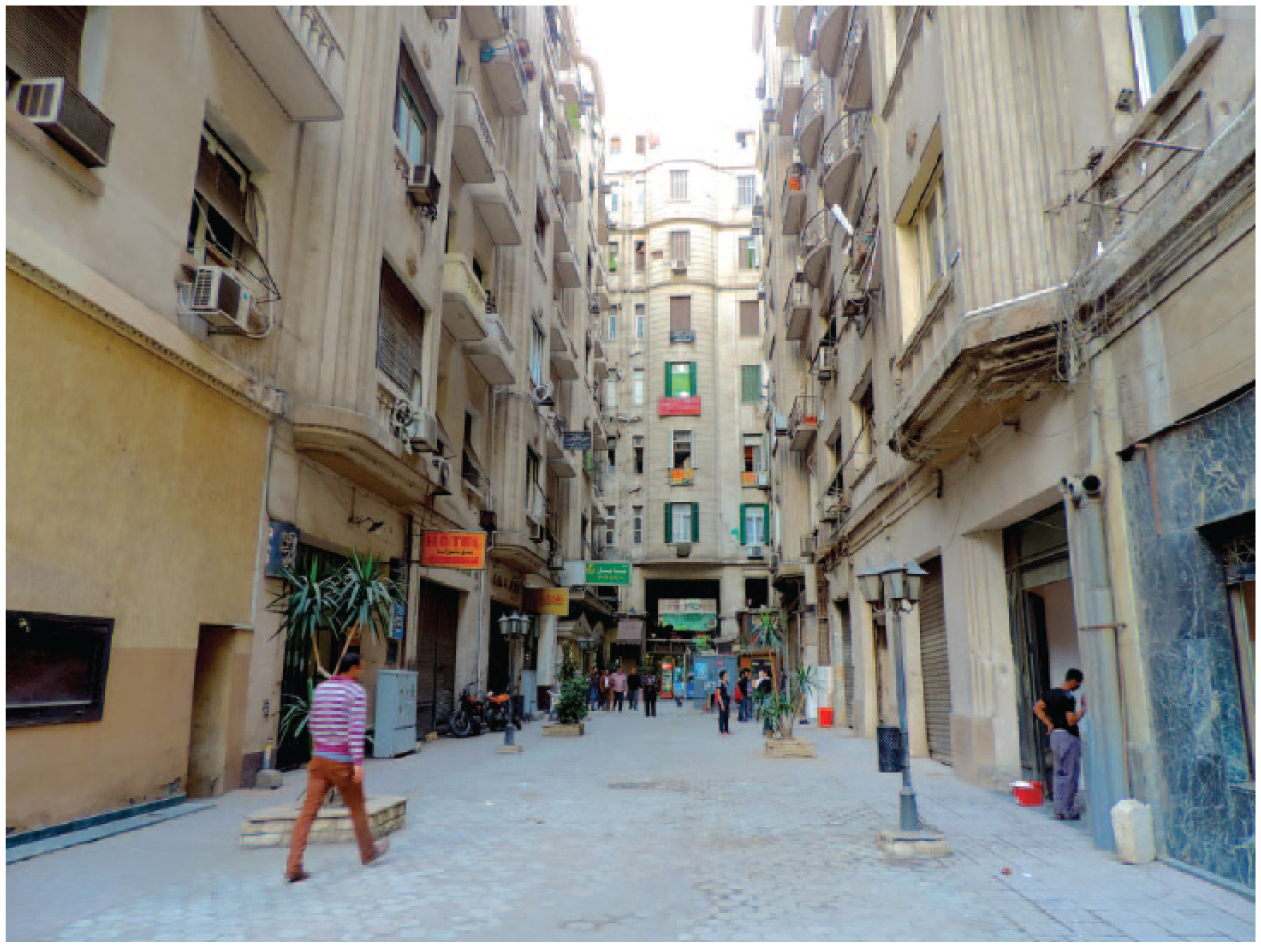
The Kodak passage after upgrading it, captured on February 7, 2015, photograph. Source: Author©.
Culture and the arts did magnificently in 2014, similar to 2012 and 2013, paradoxically, even under the rule of the Islamists. Various Egyptian films won international awards. Fascinating documentaries continue to thrive. Novels, modern dance, theater, music, installations, and photography exhibitions continue to flourish (Mada Masr, 2014a, 2014b). Theater is booming like never before, with a blossoming younger generation of actors and directors. El-tahmaninaat we enta talee’ [The Eighties Onwards] (Retrieved from https://www.youtube.com/watch?v=G-rBXkDVJys) is a good example of the continuation of the subversive, satirical spirit of Tahrir. The cultural scene is clearly dominated by a fresh, young, promising population. Perhaps inevitably, street politics is bound to be replaced by indoor theaters, galleries, and cultural spaces.
Yet even if the revolution did provide new horizons in the field of culture, it still remains restricted to the urban middle classes. On the other hand, life continues to be extremely hard for the majority of the poor. 16 If the revolution did change something, it is precisely that provincial towns like Mansura, Port Said, and Alexandria are now incubating fascinating musicians and artists, thus widening the circle of urban cultural actors. But culture alone can certainly not match the pace of the two million new Egyptians born per year, reaching a total population of over 90 million in 2016, and culture will not solve the acute economic crisis under further curtailing of human rights. Egypt seems to be at the crossroads of major transformations pertaining not only to new subjectivities and imaginaries but equally to challenging the neoliberal cityscape. While the “war of terror” marked by the regional emergence of ISIS, together with the internal confrontation with the ousted Muslim Brotherhood, have provided a legitimacy for the militarization of urban life, the story of the unfolding revolution is not yet finished.
Footnotes
Declaration of Conflicting Interests
The author declared no potential conflicts of interest with respect to the research, authorship, and/or publication of this article.
Funding
The author received no financial support for the research, authorship, and/or publication of this article.