



Abstract
Even though it seems that riding a fixed-gear bike is to take the line of least resistance in search for the optimal flow in between cars, or with respect to traffic arrangements in general, in doing so, fixed-gear cyclists simultaneously reject social conventions of interaction with and within the urban space. Hence, the question emerges: how far can resistance, practical critique, or even social change be detected in fixed-gear cycling and related practices? A motto like “you own a car, not the road” indicates that some fixed-gear cyclists insist on a specific “right to the city”; a claim that particularly criticizes the relationship between drivers and cyclists and also touches upon the further issue of personal mobility centered on the term “urban cycling.” Two practical examples will be discussed to show that such claims are inherently “critical” meanings of the idealized—still bodily enacted—fixed-gear rider and to show the ambivalence and limits of such a critique’s potential.
Keywords
Social change is messy. Small changes always occur, large changes embrace and arise from myriad smaller ones, and the difference that any change makes to the world is open until the world responds. There is no easy template for studying or fostering sociotechnical change. Studying it requires examining actual cases through investigations of the interrelated bundles and constellations involved that are informed, not by theories or models, but by concepts and typologies with which aspects of this mass can be analyzed. (Schatzki, 2011, p. 25)
The performers of practices such as skateboarding, BMX, in-line skating, parkour, cross-golfing, or urban climbing leave behind the spatially separated, fenced, institutionalized facilities of sport, transcend their traditional programs of movement, and move their bodies with new gestures, rituals, and forms of representation in public urban spaces. In comparison to well-established forms of sportive cultures, such as those practiced in the set frameworks of schools or sports clubs, these new sportive cultures are of a peculiar nature. Most of these practices neither have an institutionalized framework nor clear-cut positions, which their performers could fill out.
My contribution provides some thoughts on examples of these practices in examination of actual cases of sociotechnical change, as Theodore Schatzki put it in his emphatic formulation in 2011.
Following current analytical considerations about the status of the subject in practice theory (Reckwitz, 2008), I will argue that particular processes of subjectivation with serious individual and social impacts emerge within these urban sportive practices. Such an approach is analytically promising, as it transposes a peculiar theoretical doublet, which Judith Butler developed in her work on The Psychic Life of Power (1997), into a practical dimension. While Butler (1997) suggested “that a subject is not only formed in subordination, but that this subordination provides the subject’s continuing condition of possibility” (p. 8), I will investigate this doublet of subordination and agency within a spatiopractical setting, in which “the city” or “the urban space” become important elements of the self and its world. I am interested in how this bundling of practice and (specific) environment is a certain form of an individual becoming a social subject and a self because the practices provide an experimental ground, on which new ways of self-making can be tested practically and—at the same time—a ground, on which possible courses of action within urban spaces can be fathomed, extended, and recoded. By participating in a dynamic interplay of bodies, space, and artifacts, the individual merges into a yet evolving form which does not fit in traditional structures of urban life, thus gaining a plausible sense of “irritation” or “resistance.”
This form’s individual or social meaning, however, cannot solely be deduced theoretically or captured just by its medial representation, but only through empirical research into observable and experienceable practices. In this case, I chose fixed-gear cycling as such a practice, which revolves around individual and collective means of locomotion with track- or fixed-gear bikes (“fixies”) in the city. The puristic bicycle without gears, freewheeling or conventional brakes provokes a quick and “pragmatic,” that is, fluid movement in the interspaces and gaps of traffic; a seemingly “stubborn” dealing with the momentum of a body-bicycle-unit amid urban traffic, which is often perceived as dangerous and deviant. Inquiring about such a kind of subject evolving as a hybrid appearance composed of a human body, a bike, some specific accessories, and a certain and somehow “critical” use of the sociomaterial environment of urban public spaces touches upon one crucial topic: One apparently important point about fixed-fear cycling is that it comprises a large number of material elements, which are elements of other practices, too. 1 In contrast to other new sportive cultures, fixed-gear-cycling decidedly joins into a broader complex of practices, that is, the urban traffic(-space). Being interested in such an ensemble of a specific (cycling) practices in motion and the setting in which (or as part of which) the practice appears, situates my study alongside of a growing number of cycling-related studies (Aldred, 2013; Furness, 2007, 2010; Jungnickel & Aldred, 2014; Kidder, 2011; Larsen, 2015; Oldenziel & de la Bruhèze, 2012; Spinney, 2011; Strüver, 2015) as well as within the intersection of research on subjectivation and mobility studies (see, e.g., Doughty & Murray, 2014; Manderscheid, 2014), including the development of adequate “mobile methods” (Büscher & Urry, 2009; Büscher, Urry, & Witchger, 2011; Manderscheid, 2014; Merriman, 2014; Spinney, 2011).
The difference to most other (cycling) practices is that fixed-gear cycling obviously “resists” many of the affordances of the built environment and related conventions that routinely structure public interaction. There is no question that most cyclists and other traffic participants tend to bend explicit traffic rules for pragmatic reasons and for convenience (varying from city to city). But in the case of fixed-gear cycling, it appears like it is all about rejecting the rules and even the routinely deviation of this rules by realizing an anarchistic and willful risky movement through all different traffic sites, often explicitly executed “just for fun” and on the edge of one’s own skills (e.g., one indication for this incipiently assumption is the self-description of some fixed-gear riders as “outlaw- or asphalt-cowboys”). Therefore, one crucial question of my work is the following: How is urban space (co-)produced by practicing fixed gear or urban cycling and to what extend could the apparent “critical” style of fixed-gear riding be perceived as resistance?
In order to investigate the specific resisting appearance of fixed-gear cycling, the phenomenon has to be clarified. Following this information about “fixie” and fixed-gear, I will provide a brief overview about the methodological means employed to analyze the phenomenon as well as the so generated empirical insights in performing fixed-gear cycling. Following this section, I will also touch upon the context of “urban sports” and commonalities with art-performances more generally, too. Against this background, I will elaborate two empirical examples (namely specific gestures) about how urban cycling could not solely be seen as a critical practice, but as practical critique. Finally, the implications such a particular form of critique has for questions of duration, range and limits of resistance will be discussed.
What Is Fixed-Gear Cycling?
A fixed-gear bicycle is a very puristic kind of a bike. The sprocket on the rear wheel is completely fixed to the axle (therefore the name) so that (due to the direct connection of cranks/chaniring and sprocket/rear wheel via the chain) one has to keep pedaling whenever the bicycle is moving—even if it moves backwards. It has just one gear, no fenders, no lights—there is nothing left to remove, if you still want to actually ride it. The idealized form of practicing fixed-gear cycling is to use the bike without normal brakes—a form of the practice called “brakeless.” For this form, it is important to learn “skidding,” which means to block the revolving cranks by a sort of active backwards-pedaling so the rear wheel stops as well (it then skids) and the cyclist starts to decrease speed. Technically there is nothing new about it: The fixie technically equates the track bike, which is primarily dedicated to allow a fast and effective movement; a most idealized form of cycling mobility. What is new, though, is that these bikes are not used in the velodrome or for sportive purposes exclusively. They are used in the streets—but still in order to go fast, precisely because this could entail conflicts with traffic rules or other social practices (see Figure 1).
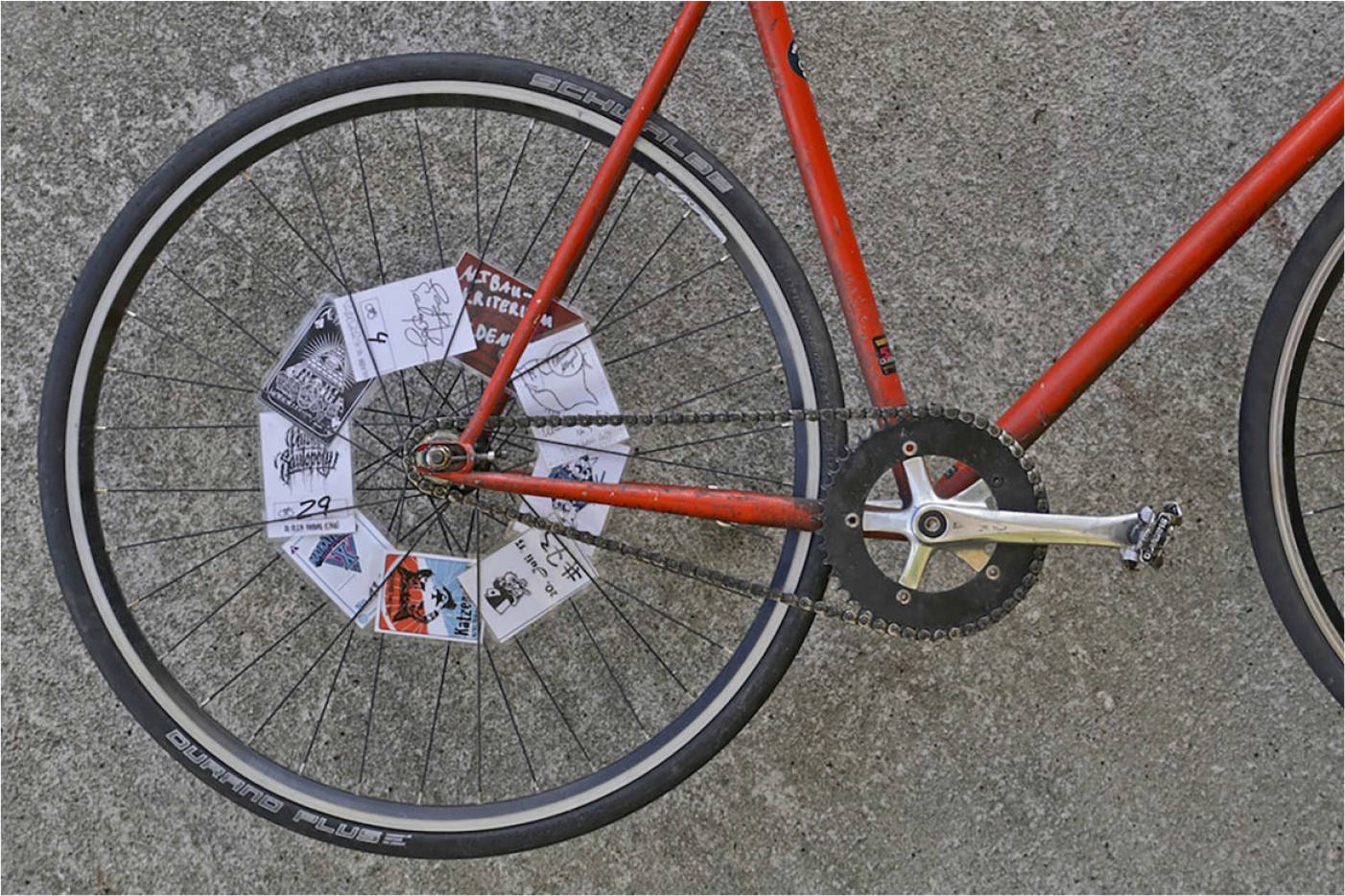
“Fixie.” Detail: Drive train and rear wheel with “spoke-cards.” 2015, photograph. Source: Author.
In the 1980s, bike-messengers in cities like New York and San Francisco took the principle of the track-bike to the streets, because they needed a solid tool for their work. The relatively inexpensive technology and the fact that this simple mechanism does not wear out as quickly as a more complicated bike are related to a certain spirit of the messengers’ lifestyle, which is completely organized around the bicycle and cycling in the city. During my field research I met many people who are committed to the subculture scene of fixed-gear in a way, which is influenced by the ideal of bike messengers. In short and from an ideal standpoint, their explicitly distinctive narrative of fixed gear in the city is that of an “asphalt cowboy,” a “bicycle samurai,” or a “wizard on wheels,” who carries everything he needs (even tools for repairing and weather proof clothing), who skillfully knows his business and his limits and is thus able to defy any circumstances of traversing a city with dangerous traffic under any conditions (especially in winter the appearance of the riders underlines this notions; see Figure 2).
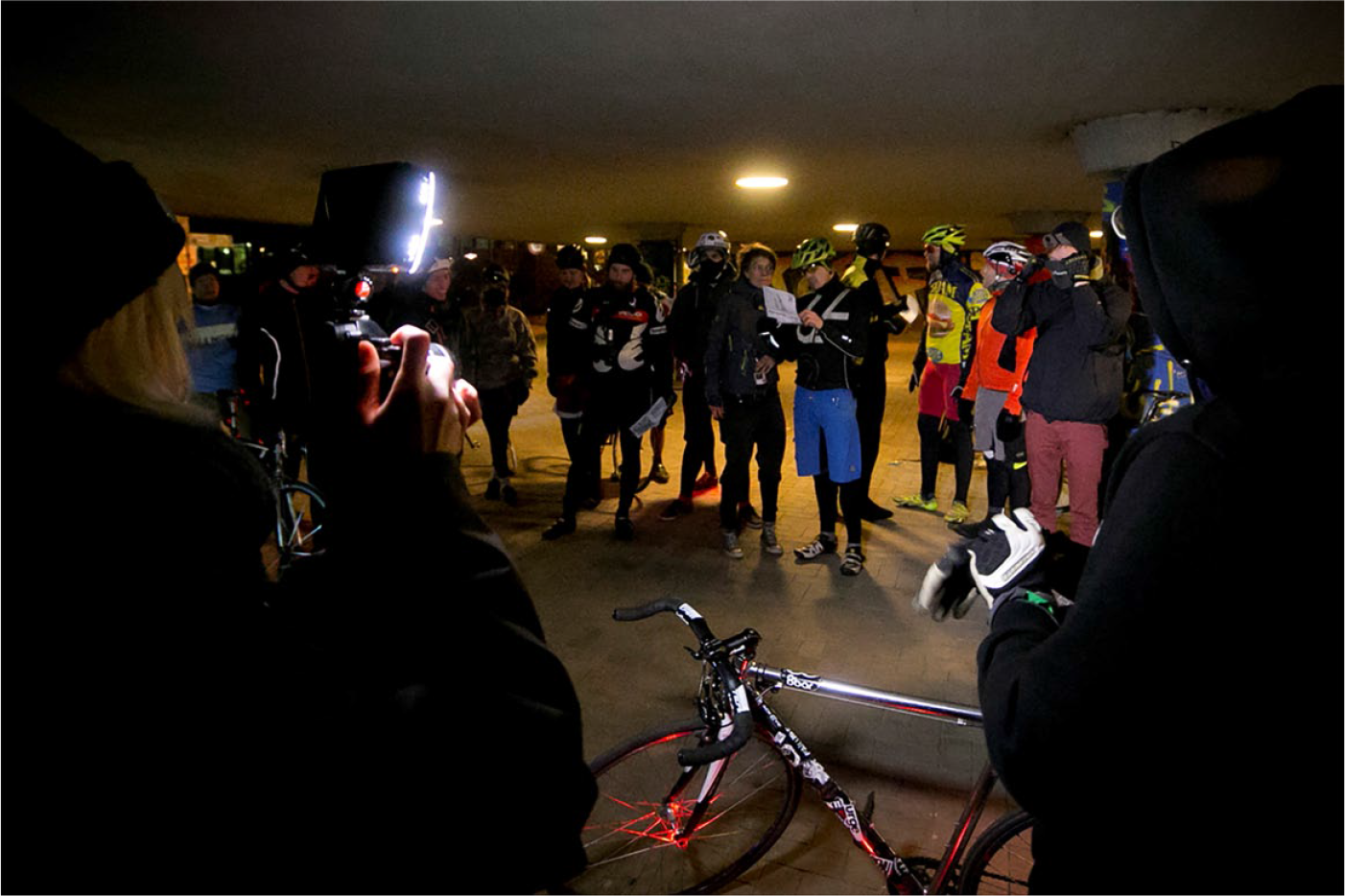
Alleycat, some of the riders before the start (“five-bridges”-Alleycat, Bremen, 2015-01-03), photograph. Source: Author.
At irregular intervals, different forms of events are arranged, some of them as sportive competitions, for example, sprint-races or “Alleycats.” An Alleycat race is an unsanctioned bicycle race through a city that mimics the messenger’s work. Each participant receives a so-called manifest, that is, a map or text that lists checkpoints spread all over the city, and a card (called “spoke-card”), which could be fixed into the spokes of the bicycle-wheel and functions as a badge and proof for attendance. The first rider (or team) who has visited all checkpoints first wins the race. Normally, the order in which the checkpoints are visited is up to the riders themselves. These competitions literally turn the streets of a city into a complex racetrack on which the riders could prove their skills in riding and navigation. Participating in such races in different cities (and collecting “spoke-cards”) appears to be constitutive for being an admissible fixie-rider.
The lifestyle surrounding the usage of a fixed-gear bike as a special device for spatial mobility or as a central axis for the organization of leisure and collectivization developed into a “trend” beyond the inner circle of the messengers. Currently, it is frequently associated with the phenomenon of the “hipster” (Greif, 2012). Even Hollywood productions, namely Premium Rush (Stalter-Pace, 2013), and newspapers (Weyland, 2007), or news channels (ABC News, 2014) have started to feature fixed-gear cycling and Alleycat racing. The fixed-gear bicycle, respectively, a “single-speed” bike, a bike that shares the puristic look and the maximal reduced gearing with the fixie but has freewheel and brakes, has become a globalized eye-catching lifestyle accessory. For a better understanding of inner distinctions of urban cyclists it is worth knowing, even not surprising, that for the circle of older riders who are often messengers and consider themselves as the “real” bearers of fixed-gear cycling this has become an issue of authenticity. With the term “fakenger” (a person who fakes being a messenger through copying their outward appearance) they have even invented a neologism to name the phenomenon and simultaneously express disdain. Furthermore, for most of the bike owners and also in a much media coverage, the bike functions as an iconic stylization of modern urban bicycling as such (simple, fast, assertive) and can, thus, also become related to broader topics such as alternative urban mobility. At the same time, the number of committed riders who are riding brakeless increased. In Germany, it was around 2009 that the Berlin police even began to confiscate fixies without brakes claiming they were potentially deadly weapons. Recently, conventional road cycling gained an increasing influence on a growing inner circle of committed riders. Concerning the bundling of sociomaterial elements, this becomes visible in the increasing usage of road cycling helmets or spandex-jersey kits and in the diversification of events orientated toward an establishment of sanctioned (i.e., legal) and athletic demanding competitions. 2 This results in and is caused by an increasing number of younger participants “recruited” by the practice (Shove, Pantzar, & Watson, 2012). A significant number of them are “renegades” from conventional road-cycling.
However, due to the increasing detachment from the professional messengers one cannot claim that there is such a thing as a homogeneous group of fixed-gear riders or corresponding clear laws of style (although the participants are mostly male and young adults, but in average not as young as in other urban sportive subcultures). The very extreme case of an idealized participant could be the sensation seeker who proves his self as stress-resistant in risky situations, a type of person who is often seen as the ideal participant of trend sports or “edge work” in general (Lyng, 2005). But there is neither just one typical form of participation in a single and static practice. Rather, the practice is a heterogeneous bundle of somehow related practices such as riding a bike as the main form of mobility, participating in special events, being interested in diverse bike-related topics and sharing this interest with others. What is more, during the last few years one could witness a process of differentiation, which led to special forms of sportive cycling such as bike polo (polo, but on a bike) or fixed gear freestyle (which is comparable to BMX riding or artistic cycling). In addition, the participant’s engagement can differ between being really committed to a subculture or just riding a fast bike. 3 In the end, despite questions, fights, and discussions about authenticity and inner distinctions, a strong self-conception as an “urban cyclist” and the differentiation as a specific social group (mostly against “the group” of “car drivers”) turns out to be more important than inner differences (first of all, you ride a bike).
On the one hand, the term “urban cycling” is used to somehow summarize this bundle of fixed-gear and messenger-related practices in the widest sense. 4 On the other hand, however, it designates the commitment of strictly using a bike as the only means of transportation in bigger cities. Hence, the term urban cycling does not only refer to a fixie rider, but could also relate to bicycle enthusiasts or people commuting by bike daily; to people who are not part of the subculture centered on the fixie, but who are still committed to an assertive style of cycling (the critical mass movement perfectly fits in this bundle and will be discussed later on). However, a fixie rider could be treated as an idealized, very condensed figure of that form of participation in traffic, which could sharpen our understanding of the principle and recommended skills concerning a fast and asserted maneuvering through traffic on a bike—and could also refocus the question of cycling’s potential as a form of resistance in urban public spaces.
Researching Fixed-Gear Cycling as a Practice
Methodologically, I was challenged to analyse a practice that could neither easily contoured nor be witnessed from an immobile point of view. Therefore, my project is as open as possible, following a “toolkit approach” (Nicolini, 2012), which is embedded in practice theory (Nicolini, 2012; Schatzki, 2002) and actor-network theory (see, e.g., Belliger & Krieger, 2006). Exploring the personal and social meaning of fixed gear or urban cycling means to trace and reconstruct practices as a process of assembling different socio-material elements or entities. Among other things, there are one’s own body, the bike, and traffics’ infrastructure, which are assembled to form certain “arrangements” or “sites” (Schatzki, 2002) and contain an idea about the participant of these actions (Reckwitz, 2008). The analysis’ empirical material ensues from participatory observation in Berlin, Oldenburg, and Hamburg and interviews with key actors, who competently and acceptably embody “the” scene; additionally, I analyze weblogs, films, and print media. Since certain artefacts and a particular way of dealing with spatial arrays are constitutive for this practice I focused on the “interobjectivity” (Latour, 1996) of practices of subjectivation, implementing a motto, borrowed from actor-network theory and multisited ethnography: follow the practice, follow the processual entanglement of different “bearers” and “participants.” Because there is no coherent representation of a distinct fixed-gear scene, the participatory research began where any fixie-user is plausibly palpable: the usage of a fixed-gear-bike. Its specific handling, but also the handling of further artifacts (e.g., clothes and accessories) as well as interactions in urban traffic(-spaces) were analyzed micro-ethnographically (Streeck, 2009). The intention was to carve out style-generating moments or moments with effects on subjectivation within a gradually accessible bundle of practices. The crucial access for mostly implicit or tacit dimensions of the phenomenon derives from my very personal confrontation with the fixie, in the beginning rather accidently and as a snoopy novice: Not fully convinced about the vague or mythical explanations about the very special riding-experience with a fixie, I tried fixed-gear cycling by myself, following the ideal of an “analytic autoethnography” (Anderson, 2006). After 5 years of riding fixed (and participating in countless rides and Alleycats in different cities), now, this turns out to be a rather intense “observant participation” in the sense of an “enactive ethnography” (Wacquant, 2014) on cycling in urban spaces (Kidder, 2011; Spinney, 2011).
What Is Fixed-Gear Cycling About? Empirical Insights
The goal of riding a fixie is to go fast (often as fast as possible) and smoothly from A to B, especially during Alleycat races. The challenge is to keep a constant high speed despite the traffic’s stop-and-go structure, for example, by catching a green wave, by disobeying red lights or the system of road signs and road markings. This principle or “teleoaffectivity” (Schatzki, 2002, p. XXI) of keeping a constant high speed also derives from the fixie’s technical characteristics. As it is not only acceleration that demands physical effort but also deceleration, riding a brakeless fixed-gear bicycle means playing with the momentum of the human–bicycle unit and realizing opening or closing gaps in the traffic’s pulsatile rhythm. This demands a lot of skills in terms of riding the bike, but also in terms of the anticipation of traffic(-space). Hence, the fixed-gear perception of traffic’s space is different to that of other participants thereof. Lucas Brunelle, a former bike messenger who is well known for his recently released video-documentary “Line of Sight” (2012) says,
It’s a place in between cars, in between trucks and busses. And taking a certain line through a curve or through a corner, the people just don’t realise it’s there. And we use these spaces; we use those openings, those opportunities, those blind spots. And that’s the area that we are exist in, that’s the space that we exist in and where we race. (Brunelle & Zenga, 2012)
By realizing gaps and space-in-between the traffic’s rhythm, the committed participants successively develop a complex engagement (abilities, attitudes, credos) within a process of informal learning; particularly a specific awareness, a selective perception and a strange familiarity with spaces, “normally” not used. On the one hand, traffic(-space) appears as a quasinatural, impersonal environment, as floating, threatening, yet controllable ambit within which cars, buses, or trucks are not considered as first and foremost human actors. Flowingly and speedily “snaking” through this environment, the participant can experience his/her self as a “competent” cyclist—an experience he/she can share with a community of riders. On the other hand, traffic(-space) is a social environment, structured by explicit rules and locally specific conventions of locomotion, within which convinced fixed-gear cyclists meet other road users in a seemingly disrespectful, yet very conscious manner. Such cyclists obviously refuse to keep their distance or to respect the decent distances underlying conventional “territories of the self” (Goffman, 1971).
For most urban cyclists even the daily commute can turn into a (sportive) challenge. The motivation of maneuvering through traffic arrangements at higher speed is often narrated as the intention to attain a hassle-free state of “flow.” Because a cyclist (even with normal speed) is endangered by inattentive car drivers, this means the cyclist has to arrange himself in a very pragmatic way under given circumstances. Every committed fixie rider is deeply convinced that the fixie is the proper tool for doing so. They (and I follow them against the background of my personal experience) even claim that riding a fixie is the ultimate and purest experience of cycling just because this particular bike creates a “passionate attachment” (Butler, 1997) with the “flow”: The continual revolving pedals, no shifting gears, anticipating gaps, minimal adjustments of speed—and if all works together well: a perfect single line to the finish. Beside the daily commute, this could also be done for the fun of breaking up the allegedly strictly structured public space and to sort out its conventional scope, to prove oneself within the hassle caused by intentionally misinterpreting the public policy, and to experience situations of self-empowerment: First the possibility to traverse a whole city in one rush and despite all rules or conventions and second to actually claim a right to use all the traffic’s arrangements as a cyclist, too, which often (another initial personal experience) leads to severe struggles with car drivers. 5
Merging body, bicycle, and other artifacts into a (vehicular) unit is crucial for the successively improving calculation of individual bodily scopes as well as the scopes of traffic(-space); only against the background of this hybrid quality, the “fixed-gear subject” becomes comprehensible. In the following, I will try to give a vivid yet very condensed impression of the transformation of one’s self, mostly on basis of a vast amount of personal field notes.
Before you can play in or with traffic, obviously, you have to get familiar with your bike. Or to put it more correctly: You have to get used to yourself riding on such a bike. This process is a transformation of your body and appearance, and in the very first beginning there is much irritation and failure. Making the key first step—learning how to skid—is especially frustrating; the first time you want to try out what you have seen in the videos—nothing happens. You need up to one week to make the first skid and up to one year to gain the skill to use a brakeless fixie at high speed routinely. Skidding can be hard on your knees, as it is for shoes and tires. By and by, you do not only develop corresponding muscles but also a proper technique to effectively work with the forces of the momentum, not only concerning the skidding but also the riding in general (there is always a gap). The process of getting used to the bike’s characteristics and to gain the recommended skills goes hand in hand with the handling of certain artefacts: Rolling up the leg of your pants on the side of the drive train, using and carrying a lock (and the belonging key readily to hand), wearing a helmet, applying tools for repairing, or even the weekly maintenance and the storing in your living room. I met people at home and it was not clear whether I am in a living room or a bicycle repair shop; they even give names to their bicycles or carry their bike with them into the shower to clean it. And there are some serious results of this process: You act as if the bike is an extension of your body or your body an extension of the bike. You feel with your tires, you steer by thinking. The merging is a mutual transformation of body and bike. A “coherent organism” (at least in situations when everything works together in a proper way) evolves. It is a highly emotional, almost mythical merging; the bicycle becomes a part of your live, it becomes a bearer of your experiences, your biography, a part of your self. We together have acquired both scratches and scars.
The merged body and bicycle as a vehicular unit has to be considered as a “hybrid actor” (Latour, 1994, p. 33). Following Latour, it is important to consider a cyclist (or a car driver/motorist as well) not or not primarily as the human on a bicycle or inside a car but as a hybrid (bodily material, sociotechnical) performance. Whenever technical or other artefacts are significant “bearers” of social practices—and especially if a person is “using” a bicycle or a car—“a third agent emerges from a fusion of the other two” (Latour, 1994, p. 32).
Context: Urban Sports, “Urban Practices,” and Art Performances
Fixed-gear cycling could be considered as a specific example for a great number of globally spread and mostly nonorganized urban sports such as Skateboarding, BMX, Stunt Scooter, or Parkour. All of these practices explore the city, appropriate urban space and are mostly perceived as different to conventionalized public interactions.
Whereas most urban sports are tied to a certain “spot” or use niches of public spaces (even if they in some cases partly “re-migrate” to institutionalized spaces such as skateparks or gyms), fixed-gear cycling, however, is far more expanded and forms a different “geography of resistance” (Keith & Pile, 1997): First, there is no “spot” (a place in the city) but rather a “line” (through the city). Second, urban cycling is (therefore) much more interwoven with constantly ongoing activities in public space, namely traffic. This is what makes the conflicting use different: The committed or medial idealized fixed-gear rider does not only deal with acceptance in certain areas or places such as plazas with stairs or rails contesting the connivance of neighbors or people passing by. Instead, in participating in traffic he plays with massive opponents weighing a ton or more and the potential to kill the contender. Therefore, obviously, the reception through others could be more coercive.
Following Michel de Certeau and his work The Practice of Everyday Life, the group of urban sportive practices could be seen as a case of what he called “urban practices” (de Certeau, 1988). de Certeau distinguishes between “strategy” and “tactics.” While “strategy” is linked to an ideal picture of the city as structured by institutionally enacted power, “tactics” describe the way that everyday life’s practices (de Certeau called them “urban practices”) handle this structuring. The city’s everyday space therefore has to be seen as a performative product of a structured array and an agency that is not determined by strategy and, hence, has the ability to differ from plans. This also means that tactics could undermine or resist strategies. de Certeau’s vivid example is the shortcut. He points out that urban practices and urban space are a complex coherence of strategies and tactics and are enacted mostly unconsciously so that pedestrians are strangely familiar with their city. It is obvious that fixed-gear riding, urban cycling, or urban street sports could be treated as tactics or urban practices in the sense of de Certeau. This does not come as a surprise since almost all practices can. But how does the committed fixed-gear riding become tactical? By the first time you leave a cycling path and invade the “car-zone” (that’s how it is expressed verbally by many riders)—and at least if you cut straight over a vast intersection with crosswise flowing motorcades, it becomes obviously that you are leaving the spectrum of conventional behavior and even routinely deviation of reproducing traffic(-space). In describing this and the special perception of traffic(-space) as quasi-natural environment, recurring particular spatial rhetorics come to the fore, underlining the assumed link to de Certeau’s concept. The description in terms of swimming or surfing is significant for urban cycling: you “dive” into gaps, “swim” amid “streams” of cars, catch green “waves,” and so on. 6 What is more, with the asserted (verbally and practically) rearranging of the city’s space the fixed-gear practices show a particular intimacy with the city.
Concerning a sense of irritation, I want show that there are many similarities between urban cycling, urban sports and art performances. Cie W. Doner’s description of his project “Bodies in Urban Space” could illustrate a close connection to art performances:
“Bodies in urban spaces” is to point out the urban functional structure and to uncover the restricted movement possibilities and behaviour as well as rules and limitations. By placing the bodies in selected spots the interventions provoke a thinking process and produce irritation. Passers by, residents and audience are motivated and prompted to reflect their urban surrounding and their own movement behaviour and habits.
7
The resistance inherent in these practices or what might be called the principle of bodily performed resistance can be summarized as follows: Bodily variation of a scheduled practice or use of space could be interpreted as a tactic that causes irritation (not merely alter practice or space in an everyday range of a more or less unconscious acceptance). All mentioned practices use the structured and routinely reproduced urban space as a material to play with and as a place where they can or actually do interfere with everyday routines. They all have the (intended or unintended) effect to situationally break up and rearrange the interwoven material and social interaction layout of everyday life, which could be perceived as mostly governed by “strategies.” In doing so, they irritate this complex and—what is most important—indicate its contingency.
Resisting Practices in Public Spaces as Bodily Performed Gestures: Two Examples
Among the many mottos within the field, “you own a car, not the road” is a prominent slogan. This slogan puts an assumed attitude underlying the appropriation of the traffic’s space into words and indicates the status of the practices as a tactic with a clear sense of resistance. Two examples will illustrate how the motto’s concretion as a bodily performance in general and as specific gestures in particular becomes observable:
1. With a certain surplus of speed, the (bike-)rider overtakes the car(-driver) by using the gap between the traffic lines. When reaching the car wing he lightly touches the car, as if it were not dangerous and he not the weaker and more exposed road user. He knocks on the hull of the car(-driver) within his reach, goes ahead and in front of it—it seems as if he is pushing the car(-driver) aside. The principle the cyclist enacts with this specific arrangement of the situation condensed in the particular gesture is quite simple: He turns the normal relationship between car(-drivers) and cyclists upside down by exposing his bicycle-body in a way that forces the (car-)driver to give way—otherwise he would harm the cyclist. What is more, the cyclist is able to arrange an open situation amid the traffic’s site. Normally, the road is perceived as a strictly car-related zone, structurally optimized for car usage, while pedestrians and cyclists are not allowed to use this space at will, but are strictly bound to rules about how to interact with or within this system (Goffman, 1971; for cyclists, in particular, see Jungnickel & Aldred, 2014). For the pedestrians, but most of all for the cyclist who is much more involved in the midst of this system, the road could be a danger zone, an “urban death maze” as messengers call it (Kidder, 2011). But the still shows a fixed-gear rider asserting himself, respectively claiming the right to use the traffic’s space for biking, too, and at his will (Figure 3).

Touching a car amidst moving traffic, 2012, video still. Source: Brunelle & Zenga (2012, min. 4:27).
Thus, there is more to the depicted situation than a merely functional activity: a “gestural conceptualization”:
Gestural conceptualization (“ception”) means that a person in a situation of communication draws upon and enacts for symbolic purposes bodily schemata and thereby gives visible and haptic form to content: experiences in real or fictional worlds (in the case of narrative), ideational realms (in talk about what we call “abstract matters”), or the interaction itself. (Streeck, 2009, p. 162)
Concerning especially the citation’s last part, the cyclist obviously refuses to keep his distance and refuses to reproduce the conventional aforementioned “territories of the self.” With such gestures he actually challenges the idea of only one version of a well-regulated public of traffic(-space). What is more, in doing so, the cyclists stress the ambivalence and contingency of what we might call “car-culture” in general (Furness, 2010), a gestural conceptualization of a resisting stance, which does not have to be considered as explicitly political but could be interpreted as aiming both at a conservative mind and the rationalization of bodily movement in public space (Deleuze & Guattari, 1977, p. 514). But there is another example that could extend this idea.
2. A second example for such gestural performed resistance can be witnessed during critical mass rides. 8 The figure shows a participant “corking” a crossroad so that the “mass” could pass safely. As for resistance in terms of rearranging the traffic’s site through specific gestures, note the foot of the cyclist and how he blocks the car with nearly only the tips of his toes. His orientation displayed in gaze and bodily composure is also important here—he ignores the car(-driver), showing his back only and displays his refusal of the actual priority of road users. Obviously embodied in Figure 4, a significant number of participants are only loosely involved with the fixed-gear scene, but share the willingness to expose one’s own body in a certain way to undermine conventional structures.
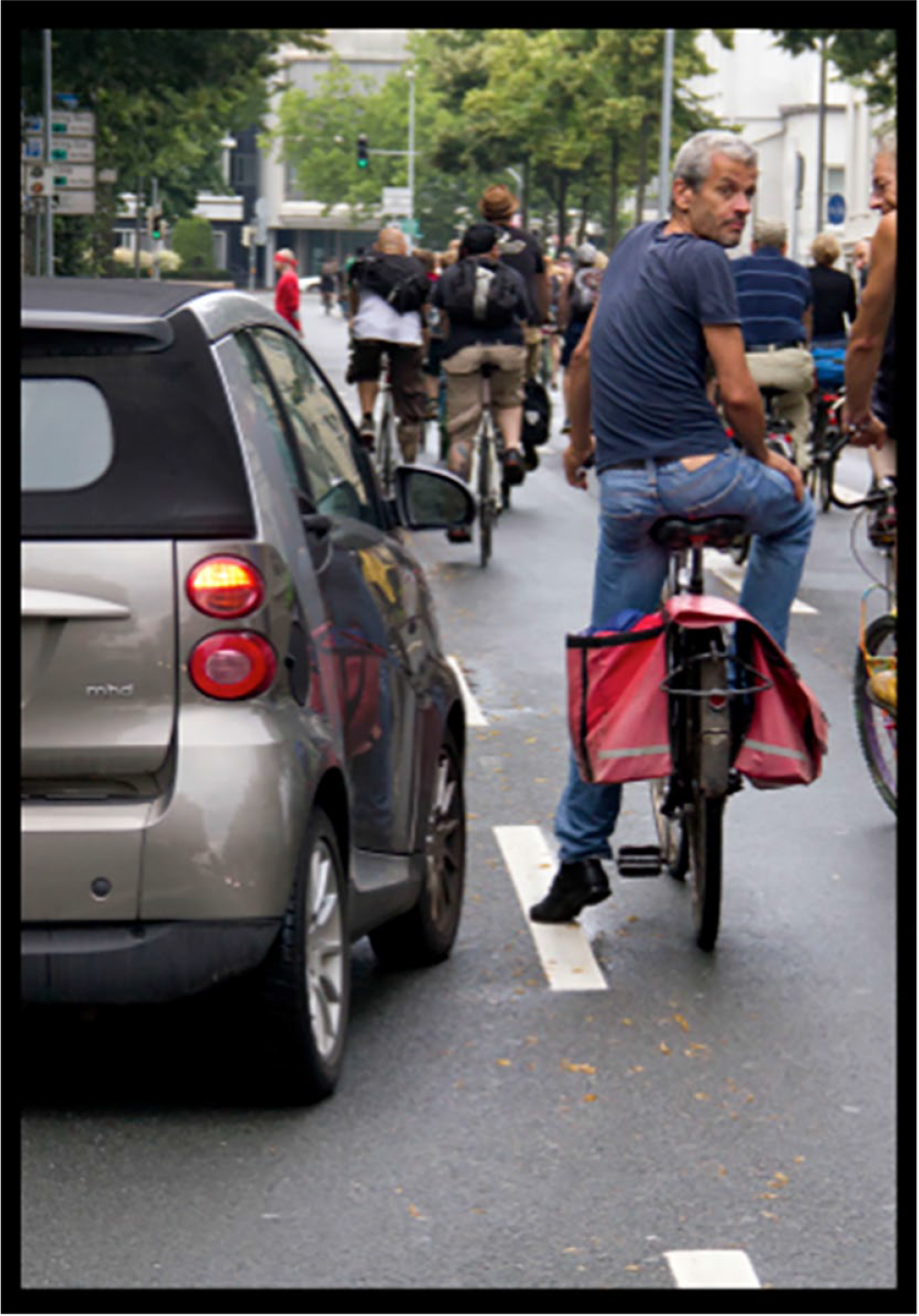
Blocking a car during a critical mass ride, 2012, photograph. Source: Author.
Not all but some of the participants of critical mass rides stand out due to their high interest in bicycle or traffic politics. However, it is important to stress the performative (gestural) characteristics of their engagement or commitment. Otherwise, speaking of resistance would become too metaphorical or would miss the actual impact of the practices whenever they enter daily traffic. It is crucial that we have to deal with a “gestural conceptualization” of a complex stance or situations at least containing the self-perception of embodying agency (Noland, 2009) within an allegedly coercive structure: the fixed-gear or urban cyclists practically discover the space in between the “infrastructure” or possibilities of its use within and beyond the conventional use.
Theorizing Resistance as (Practical) Critique
Considering the mediation of one’s self as a participant of traffic, it is plausible that this being “in between” or “beyond” matches, Judith Butler’s understanding of resistance or respectively her understanding of critique. Referring to Foucault, Butler said,
Power sets the limits to what a subject can “be,” beyond which it no longer “is,” or it dwells in a domain of suspended ontology. But power seeks to constrain the subject through the force of coercion, and the resistance to coercion consists in the stylization of the self at the limits of established being. (Butler, 2001)
As shown, some situational performed gestures of urban cycling and particularly the figure of the committed, somehow idealized fixed-gear rider match this stylization of a self that operates on the limits of and practically challenges or rejects an assumed established being. In re-arranging everyday traffic’s arrangements—which are at the same time certain “arrangements of the self”—they practically debate how traffic transforms us into a certain social subject. Material arrangements such as traffic signs, red lights and other “stuff,” for example, “cars” or some paint, bear the traffic’s specific array and keep this order in its place. It seems plausible that the particular practice of cycling rejects this strict ordering for pragmatic reasons. But you could simultaneously see this as a “stylization” (a specific “gestural conceptualization”) concerning the materially structured technical mediation of one’s self as a subject of traffic or the city’s infrastructure. 9
In this sense, the daily commuting of the urban cyclists, the international events as well as the global medialization of the fixed-gear riders establish performative as well as discursive “spaces of negotiation” (Murdoch, 1998). And this negotiation, even after all perceived as a mere gesture of “fun,” matches an understanding of critique, which aims not primarily on a morally based or highly sophisticated sense of critique but on a problematization of “the” established being through demonstrating its contingency. In this sense, doing (or analyzing) the intrusiveness of fun could be considered as a critical reflection (Butler, 2001; Latour, 2004b). The perception or analysis of the cyclists’ observable gestures could stimulate us to deconstruct this subjection (what it means to become or be a cyclist) or at least to expound related issues of that practice (the dynamic meaning of cycling) in relation to other practices and on different levels, even politics. 10
Limits of That Fun’s Critique
The final reach of this phenomenon’s expansion and its political impact remains an open question due to the selective focus of the study (concerning only particular cyclists, not other road users), the methodological or conceptual approach of the study (ethnographically based practice theory) and due to the heterogeneous attitude of urban cyclists. Movements like critical mass could become a medium for very heterogeneous bike-enthusiasts—for persons who are engaged in traffic politics as well as for fixed-gear riders (George, 2016).
As shown, irritation, resistance, or critique through fixed-gear cycling is mostly driven and limited by the motivation to have fun and the limits of this fun’s critique seem to be serious: Limits could be the enforcement of law, moral considerations of the riders or the fact that if critique was successful, resistance would become pointless—which in this case would mean a loss of fun (rather there is a serious economical impact, for example, the increasing number of bicycle brands and bicycle-related accessories). Even for the critical mass movement (until now and in Germany) there are no stable or increasing connections to social effective discourses in a wider sense, like politics, parties or institutions. However, and as previously mentioned, I found data, which suggest that the fun in fixed-gear riding has utterly serious aspects, at least for the rider him-/herself and related others who are bodily involved in “critical” situations or arrangements but also that the stylization and the perception of committed cyclists and their specific gestures could encourage others to become more self-confident (urban) cyclists, too, or to get involved in the reproduction of that “movement.”
For the question of resistance’s duration, reach and limits, it is worth mentioning that they do not only perform this resistance in the streets, but are also producing a vast number of images and slogans with a political subtext. They share them on blogs or websites so that a global, discursive, circulation of these stances evolves. In doing so, they are also raising a critical discourse about “car-culture” in a wider sense. The enrichment with or expansion of related topics (such as sustainability, environmental consciousness, cutbacks in the use of technology, deep interest in DIY-activities, personal mobility and health, design of urban public space) actually affect other people to get involved with the world of bicycle-activism, to gain knowledge about transportation politics, laws, alternatives, and so on (maybe to even read Evan Illich’s “The fool’s praise of the bicycle”; Illich, 1983). The exploding media coverage of the critical mass movement in Germany in 2014 could be treated as an indicator for this, too, including a so induced political advertency for the demands of a blatant mass of urban cyclists.
Another serious limiting factor is the alleged difference between art performances and urban sports. While the former contain an explicit intention (at least in the particular example), the latter are often merely recognized as parasitic, as some noise in the well-choreographed every day routines of public spaces; but without a real intention to say something with it or to cause any significant change. At the same time, however, they also make a clear statement: They also “articulate” something (Latour, 2004a); and they actually alter practices, spaces, or sites. Their gestures of practical critique might not be as sophisticated as in artistic or scientific discourses, but in altering the daily routines or sites of traffic they could induce others—mostly other cyclists but also car drivers—to reflect on what we might call the “normal” (the actual reach remains an open, rather statistical question). What is more, their disturbance of (or evoking “para-sites”) amid the “normal traffic” could make us reflect upon the inherent “matters of fact” in contrast to “actual”—maybe first and foremost gestural conceptualized—“matters of concern” (Latour, 2004b): the privilege of the car, the separation of transport and exercise, or transport and fun, and so on. The rearranging cyclist resists but at the same time negotiates being this traffic’s subject.
In the end, the apparent ambivalence or tension between “fun” and effective sociopolitical engagement leads to the enormous question of the impact of such noninstitutionalized practices on social change. As stated, even the theoretical or methodological approach via practice theory itself limits the evaluation of that question and therefore conclusions about the reach, duration, or limits of the phenomenon. Or, repeating the initial citation of Schatzki, “The difference that any change makes to the world is open until the world responds” (Schatzki, 2011, p. 25).
Conclusion
Following this perspective, until now, analyzing the scopes of fixed-gear-cycling does not result in findings about a simple concept of resistance with a clear political agenda but brings the transformative dynamics of practices of subjectivation to the fore. The analyzed cycling-subjects (“the” fixed-gear cyclist as well as the even fuzzier self-confident “urban cyclist,” who increasingly gains discursive contours) and the practices in which they occur are not just an indicator, but also a catalyzer of social demands concerning urban mobility—their critical movements and distinctions are a requirement for change; the beginning and modus operandi, not the result. Hence, the analysis provides insights into current performative (not necessarily discussed) social distinctions and re-orientations in urban mobilities, which relate to the material shape and the technical mediation of the self, foreshadowing (not determining) a potential transformation of individual habits of locomotion and the irritation of collective locomotive habits. Through further use of practice theory in the described ethnographically manner and applied to concerns of mobility studies, contingent, yet already accessible spatial and symbolic-normative scopes could become visible. In using mobile methods, which follow practices, new thresholds within which the individual and society arrange themselves and become arranged themselves, not only become visible, but—actually—become established and stabilized.
Footnotes
Declaration of Conflicting Interests
The author declared no potential conflicts of interest with respect to the research, authorship, and/or publication of this article.
Funding
The author received no financial support for the research, authorship, and/or publication of this article.