



Abstract
This article explores the multidimensional concept of home through the relationship of the self and the city. The case study is Tokyo, and sense of home and homelike activities of its young dwellers are explored, analyzed, and discussed within the integrated unity of their spatial, sociocultural, and psychological/temporal properties. Semistructured interviews were conducted in order to grasp the rhythm and the dynamics of the daily lives of the respondents and to recognize significant places in the city where homelike activities happen. As a result, a dispersed model of home is revealed, which is juxtaposed to the existing, more traditional, concept. In this model, home becomes a territory, a collection, or network of (semi)public and (semi)private places connected by routes made by an individual who gives them specific values and meanings. Spatially, home is transposed from the singular space of a house/dwelling to a field of activities and actions, giving the city and its systems significant roles.
Introduction
Without home, man would be a dispersed being
Disciplines such as anthropology, psychology, sociology, and geography are (few among many) fields of study which deal with the meaning of home. Within each discipline, there are multiple ways of studying the home—focusing on psychological aspects, social relations, meanings, and behaviors, all within a specific culture (Altman, 1975; Blunt & Dowling, 2006; Bowlby, Gregory, & McKie, 1997; Mallett, 2004; Sixsmith, 1986). Other studies focus on households and domesticity discussing particular spaces within the home and gendered spaces of domestic work (Blunt, 2007; Domosh, 1998).
In the fields of architecture and spatial studies design, spatial organization, furnishings, and the ways they influence concepts of home were examined in detail, as well as the housing policies and economics of housing (Cramer, 1960; Hellman, 1983; Segal, 1953; Sixsmith, 1986). The emphasis is commonly on the house/dwelling and few researchers address issues of different scales (such as neighborhood, city, region, nation), exploring the concept of home as multiscalar and open ended (Beatley, 2005; Hidalgo & Hernandez, 2001; Lewicka, 2010; Marston, 2000; Ng, Kam, & Pong, 2005). Even fewer researchers have dealt with the social and psychological implications of their design (exceptions are the studies of the suburban houses as ideal homes and the high-rise apartments in terms of absence of the sense of home; Blunt & Dowling, 2006; Polikoff, 1969). Just recently, there has been a growing interest in this area of study on a bigger scale that includes studies into alternative ways of living, and of alienation caused by constant movement, temporality, and attenuation of family bonds (Geis & Ross, 1998). These are usually related to transnational mobilities and migrations on one hand, and urbanity, megacities, global cities, and metropolises, such as Tokyo, New York, and London on the other (Boyer, 1992; Castells, 2011; Cervero, 1998; Sassen, 2005; Soja, 2000). Although these cities are different in many ways—historical experience, governance systems, level of development, geographical settings (Sorensen, 2011)—they are construed as settings that shape and change ways of living, and consequently—people’s sense of home.
In the social sciences, home was explored through the concept of the self and through the relationship between the self and the other in different cultural groups (Doi, 2001; Sullivan, 2013). Japan, where family ties are equally significant as ties between members of social groups (Kuwayama, 1992; Lebra, 1992; Rosenberger, 1994; Ueno, 2009), was fruitful ground for the emergence of new ways of living. This was specifically relevant to Tokyo, where industrialization during the Meiji Restoration was more dramatic than in other, smaller Japanese cities. 1 Studies on Tokyo lifestyles often emphasize ideas of a nomadic life, with the usage of various facilities for domestic functions such as trains, convenience stores, vending machines, noodle shops, public baths, coin wash machines, karaoke, love hotels (Caballero & Tsukamoto, 2006), and typically small apartments used only as storage and bedroom (Ashihara, 1989; Yūko & Yokokawa, 1995). This series of public facilities provide spaces that have the attributes usually embodied in the home—privacy, intimacy, comfort, convenience, and efficiency (Rybczynski, 1987; Sixsmith, 1986). With an increase in the use of mobile technologies, functional devices, and utilities, the home has been further transformed from being static and permanent to being dispersed through the environment and absorbed by the body itself (Abe, 2015).
Within cultural, psychological, and social studies, whether defined as a dwelling, a homeland or a constellation of relationships, home is always represented as a spatial and relational realm from which people venture into the world and to which they generally hope to return (Bachelard & Jolas, 1994; Casey, 2013; Dovey, 1985; Mallett, 2004; Norberg-Schulz, 1980; Sixsmith, 1986; Tuan, 1977).
In this article, we explore home as a multidimensional concept and the scale of the city is emphasized. As a result, the concept of “dispersed home” in contemporary city is defined and its characteristics are juxtaposed to the traditional concept.
Theoretical Background
Studies of home as a multidimensional concept provide frameworks for its examination as a unity of physical, sociocultural, and psychological/temporal features 2 (Després, 1991; Dovey, 1985; Sixsmith, 1986; Werner et al., 1985). In the section “How the City Becomes a Home,” the first two features of the framework are discussed: physical (or spatial) and sociocultural. Specifically, we discussed the spatial decline of the house as the primary site of domesticity and the change of the idea of home from a static concept to a dynamic one and in sociocultural sense the concept of person, self, and self-other relationship. The section “Dwelling by Moving” focuses on the third feature of the framework—on psychological/temporal properties of home. It explores home as a point of reference and as a point of return.
How the City Becomes a Home
The decline of the house as the primary site of domesticity started in the second part of 19th century with the Industrial Revolution in all industrialized societies and especially in big cities. The family life became separated from work and distinct public and private spheres appeared. Since then, following Abe’s (2015) classification, the purview of domesticity followed the developments of economics, politics, technology, and conceptions of environment. Transformations from the industrialized era (1906-1939) advanced with the age of “consuming domesticity” 3 (1945-1972), “roving domesticity” of bubbles and artificial environments, “dispersing domesticity” (1968-1996), “branded domesticity,” and finally “network domesticity” with many traditional demarcations between spaces of work and domestic life being drastically altered and blurred (Abe, 2015).
In Japan, even before the Meiji Revolution, 4 traditional forms of living were embodied into two types of houses—big houses (large and carefully constructed) and small houses (koya; more modest and unassuming; Yanagita & Terry, 1957). The small houses were used only for sleeping. During the Meiji era in Tokyo, traditional forms transformed into a variety of accommodations (such as middle-sized houses, rental houses, and multifamily dwellings) for what was to become the salaried middle class. Social structures changed along with the physical structures; the traditional form of ie 5 transformed into modern katei, which describes a nuclear family and the physical structures that contain it (Ueno, 2009; Yūko & Yokokawa, 1995). The Meiji Revolution and Industrial Revolution accelerated a process of dispersion. The home, which once represented a monolithic whole in a spatial, social, and experiential sense, was now split first into a living place (the house) and a working place. With the appearance of working place (“second place”), and appearance of private and public sphere, social life of industrial societies significantly changed. The working environment and time spent at work contested traditional family life causing alterations in time-space dynamics of individuals. Soon after, “third places” (other or socializing places) appeared “as a generic designation for a great variety of public places that host the regular, voluntary, informal, and happily anticipated gatherings of individuals beyond the realms of home and work” (Oldenburg, 1989, p. 16). Together, these places became a setting for daily life.
With the rapid development of transportation systems and technological achievements, this meant the appearance of transit places; places that accommodate movement, dislocation, and travel; “inauthentic” nonplaces (Augé, 2008) and for an individual this meant an extension of daily routes in the form of commuting. The lines connecting places formed fields of daily actions and activities. As the distances between these significant places were becoming greater and the time spent in transit grew exponentially, the management of time became inseparable from the management of space. From a static phenomenon, home started to become a dynamic concept, a form of territory without geographic reference points, a network of spaces with people and their moving bodies at its center (Little, 1965; Porteous, 1976; Sommer, 1958). Hence, to study home and the domestic environment is to study concepts of the person and the body which, as an intelligent agent, familiarizes itself with the immediate environment and gains an understanding of the place (or, in contemporary city, of a network of places; Seamon, 1979). The concept of “person,” however, varies cross-culturally (Bhabha, 2012; Shweder & Bourne, 1982) and in the Japanese context, the closest notion is expressed by the word “ningen” 6 (Tetsuro, 1996), that as a concept includes “both the person or self as individual and the self or person as inescapably involved in interaction” (Carter, 2001, p. 126). Because of its interactional qualities the concept of “self” is more promising to investigate the perception of home. Construed as the product of social participation and cultural representation (Lebra, 1992), the self lends itself to be used in the context of the city as the quintessential interactional environment that provides limitless possibilities for social encounters (Simmel, 1903).
Dwelling by Moving
In current studies, the categories of staying, leaving, and journeying are integrally associated with notions of home represented as a spatial and relational realm from which people venture into the world and to which they generally hope to return (Casey, 2013; Mallett, 2004). It is a place where people “go back even if they’re going there in the future” (Dovey, 1985, p. 36), an “irreplaceable centre of significance” (Relph, 1976, p.39) and “a localization of our memories” (Bachelard & Jolas, 1994, p. 8). Home is significant both as an ideal and as an imagined place, both real and remembered, with an emphasis on childhood home as a primal point of reference (Cieraad, 2010). Through practices and through the application of acquired knowledge memories of previous homes are projected into our present and future or ideal home. The recreation of previous homes does not only evoke memories of the past, it also provides the setting for bodily routines and habits. For Dovey, the notion of home is embodied not in a house or building, but in the patterning of experience and behavior. It is a way of relating to the environment that may be transposed from place to place and in this way the meanings of home may be reevoked if the patterns are recreated (Dovey, 1985). Consequently, home is what emerges out of the dwelling activities, and a place where space becomes a field of prereflective actions grounded in the body. The body gains an understanding of places (or network of places) without intention or preconsciously and as an intelligent agent, it allows us to move without paying constant attention to our gestures (Seamon, 1979). “Becoming-at-home” (Dovey, 1985, p. 58) then would be the point when the body familiarizes itself with the environment and reaches a state of rest. Rest, time of inactivity and quiet, whose essential experiential structure is “at-homeness”: “the usually unnoticed, taken-for-granted situation of being comfortable in and familiar with the everyday world in which one lives and outside of which one is ‘visiting,’ ‘in transit,’ ‘not at home,’ ‘out of place,’ or travelling” (Seamon, 1979, p. 70).
However, in the contemporary city movement is integrated into daily life, and it is almost as if “one does not move to a dwelling but dwells by moving” (Casey, 2013, p. 307; Deleuze & Guattari, 1988). In the contemporary city, movement and dislocation rely on the body and its own knowledge less than in the historical or even modern city, because the body is being transported by the third “thing”: the machine. Often, a state of rest is achieved “in transit” (out of the house, at a “second” or “third place”). The body familiarizes itself with the process (on urban scale) and home becomes a connectedness, a state of being grounded less in place and more in the series of activities that occur within a (network of) place(s).
Therefore, in the contemporary city to study home spatially is to study the field of actions and dynamic processes rather than its static aspects; and in sociocultural terms it is to emphasize the relationships between the self and others. In psychological/temporal terms, it is to study at-homeness, the state of rest, and the patterning experiences. In this sense, this study takes an integrated approach and explores home as a unity of these three theoretical layers.
Method
Data Collection
To understand how a city like Tokyo frames the sense of home, a series of 30 semistructured interviews was conducted. As a systematic procedure for analyzing qualitative data, a grounded theory approach as an inductive methodology was applied (Thomas, 2006). The method was based on “selective coding,” where all categories were unified around a “core” category. The other categories stand in relationship to the core category as conditions, action/interactional strategies, or consequences (Strauss & Corbin, 1997). To include all relevant aspects of the topic, data collection and analysis were recursive processes. Interviews were developed through questions addressing the following theoretical categories (Dovey, 1985; Werner et al., 1985): (a) spatial characteristics of home, (b) sociocultural characteristics, and (c) psychological/temporal characteristics of home. More specifically, the questions about spatial characteristics of home included physical location of the respondents’ current living place, working place, and other (third or socializing) place; and their qualities and attributes. That made us understand where the homelike activities take place, the significance of these places and the distances between them. The sociocultural properties of home were discussed through the self and other relationships via the questions about “significant others,” 7 their places of residence and the ways of communicating and “keeping in touch.” These topics examined the importance of the face-to-face contact, of mutual dependence, as well as the relative social proximity and the roles of different social groups. With the third group of questions intention was to understand respondents’ dwelling activities, habits and daily routines, patterns which they recreate, where they feel at home, and where they achieve the state of rest.
Interviews were from 30 to 60 minutes long. Audio recordings made during the interviews were transcribed. The data were conceptualized following the methodological guidelines by Strauss and Corbin (1997) and Glasser and Strauss (1967). The conceptual labels coded during the analysis were classified into more abstract categories (nostalgia, temporality, others, and family) and from the relationships and interactions of the two core categories (field and accessibility) several characteristics of a “dispersed home” were explored (Figure 1).
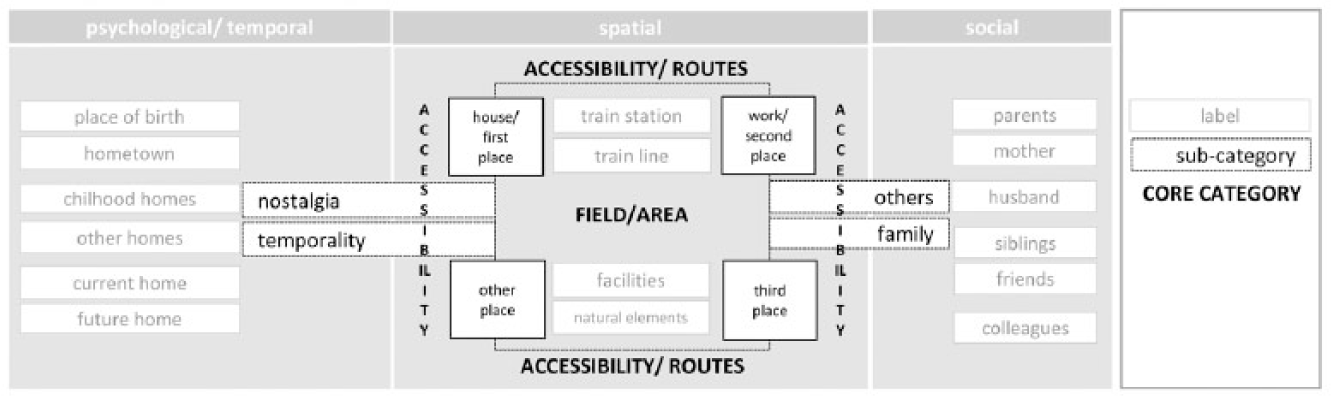
Conceptual labels, subcategories, and core categories.
The Sample
The average age of the participants is 35 years, where the minimum is 23 years and the maximum is 60 years 8 ; the sample is made of 17 males and 13 females. The interest group is represented by 25 out of 30 respondents who are in “early adulthood” 9 (aged 23 to 39 years). They live in Greater Tokyo Area 10 and work in Central Tokyo, constituting its daytime population. 11
The central wards of Tokyo (also known as Tokyo Metropolis) have a distinct character and identity, and they are made of commercial, business, and entertaining districts on one hand, and of residential and working districts on the other. However, the city is understood as a place which produces and is produced by the activities of people and institutions (Pred, 1984), and the focus is on movement and connectedness, while the complexity of the different Tokyo wards in social, spatial and economic terms is out of the scope of this study.
Discussion
In the following chapter, two core categories, “field” and “accessibility,” are discussed. Within these, variations and interactions of subcategories are also specified. The category “field” emerged from the analysis of spatial characteristics (in relation with living, working, socializing, and the so-called “other places”) and from temporal/psychological characteristics of home (in relation with places of rest and habitual actions and activities). The “field” category, in other words, is construed as the network of physical places that are being reconnected daily through the means of transportation and whose location and qualities are relevant only in relation with other places and other facilities. The category “accessibility,” on the other hand, emerged from the analysis of the perceived social and psychological characteristics of home, and specifically: (a) how it emerges from the relationships with significant others and (b) how it emerges from memories of places, from the importance of an easy access to them and from a possibility of return.
Field
First, Second, and Third Place
When asked about their living place all the respondents were describing a district (“cho” in Japanese 12 ). They do not think that their “place” is their apartment, but rather all the facilities in its vicinity that they tend to use. One of the respondents, a 25-year-old man, says that his “place” is “special” because there is a lake and a shrine close to it. Another respondent, a 36-year-old man, says that his “place” is good because there are three parks that he can reach on foot. About her current apartment, a 36-year-old woman says it is good because the supermarket and restaurants are close to it. And, she stresses, it takes only a couple of minutes on foot to the station. Choosing a place to live in Tokyo Greater Area is all about choosing a strategically good point within other facilities.
“Ebisu is really comfortable to live in.” says M26. “[ . . . ] Cafes, bars, restaurants . . . [ . . . ] and it’s really easy to get anywhere. Close to Shibuya, close to Daikanyama
13
. . . it’s really comfortable.” (Interview No. 7) There are so many people coming from outside of Tokyo and make transit in Shinjuku or Shibuya station which is really hard. So that’s why I decided to live on some station on Yamanote line, Takadanobaba.
14
(Interview No. 3)
Working place is always talked about through its relation to the living place but even more through the connections with socializing place. Often the working place is not chosen but assigned by the company, and there is a sense of inevitability related to it. Allocation and predetermination are alleviated if they are within attractive and popular Tokyo wards.
When answering questions about third places, where they socialize and spend free time, respondents were also describing a ward or a district, an area (Such as Shibuya, Shinjuku, Ebisu,
15
etc.). In Interview No 5, a 39-year-old man says that when he wants to meet his friends and to go out he goes to Harajuku
16
or Shimokitazawa
17
and a 33-year-old woman describes Shibuya, Shinjuku, or Ebisu as places where she meets her friends. This is how a 25-year-old student describes his favorite places, where he exercises weekly:
I often go to Shibuya. For a drink. Or Roppongi. [ . . . ] And also . . . [ . . . ] In Gotanda,
18
there are some gyms where we play futsal every Thursday. . . . (Interview No. 1) [ . . . ] we meet up in Tokyo. Shibuya, Shinjuku, Ebisu . . . like that. [ . . . ] Here [where she lives] there is no much to do. So Shibuya, Shinjuku . . . and regularly I go to Ebisu for shopping and food . . . [ . . . ]. (Interview No. 6)
Even when specifically asked about the physical properties of the places where they live, work, and socialize, respondents were describing connections rather than discrete spatial entities. The first mentioned thing when talking about preferences and locations of all the three significant places is always closeness to the station and the train line.
Other Places
When talking about other places (other than living, working, and socializing places), the most important ones are places with natural elements. A 24-year-old student says:
Nature. Nature is the most important. When I was in Osaka there was a bamboo forest. When I am in Tokyo there is a big park and shrine. Now there is a big lake close to where I live. [ . . . ] It’s nice [M24]. (Interview No. 4)
Another respondent says that he mostly spends time in the park and that was the reason he chose to live in Kogane.
19
For her current home, F28 says that the place is good because of the closeness of the ocean, and for her future home she also says that she would choose to live close to the ocean. Memories of the respondents’ hometown or other previous homes are also memories of different places scattered around the city, not the house nor the apartment itself:
My apartment . . . there was . . . a watermelon! Yes, there was a watermelon yard, garden . . . behind my apartment. (Interview No. 14) In Mito,
20
in my birth place, there is a river close to my birth house. [ . . . ] When I was a child, I often went to the riverside with my friends. And [we were] throwing stones in . . . fishing . . . etc. (Interview No. 11) So it was very easy to get to the sea. That’s why in summer season we often went to the sea . . . [ . . . ] and the night view was . . . [ . . . ] Night view was very impressive, especially next to Numazu
21
port and the small hills. (Interview No. 9)
In one case, it is a river, in another case, it is a sea, in another case, it is a bamboo forest, then parks, shrines, or as seen in previous examples, orchards and gardens. These were all mentioned both as places of rest and as memorable places. Even if they are not frequently visited they are mentioned as accessible.
Accessibility
Social Groups
At different life stages, bonds and relationships are developed with different social groups. During the childhood and school years, family and friends are the most important categories of others. During the early adulthood, there is a shift from family to coworkers and colleagues who often become close friends. The working place becomes the place with the strongest social connections and leisure time is spent mostly with friends from work.
When it comes to family relationships, significant difference appeared between the respondents who were born in small, local towns, or Tokyo suburbs and those who were born in Central Tokyo wards. For the former group, families stayed in their hometown but in one case only it is actually the same house. For the latter group, it is always a different dwelling (and different city), not the one they grew up in and because of these frequent relocations they are less attached to the living place itself, and they are more attached to their families.
I have no home. Actually, because my parents are not from Fukuoka, but they live in Fukuoka, when I go to their house I don’t have any friends there. [ . . . ] I go there to see my parents, but I don’t feel it’s my house. I don’t have my room because when they bought the house I was not there . . . (Interview No. 21)
Overall, during the interviews family relationships were rarely mentioned, especially with fathers. Only one respondent (M26) mentions growing up in a small town and doing daily tasks with his father. The mothers, on the other hand, are the most significant persons related to childhood homes, previous homes, and the sense of home in general—especially for the respondents who were born in Tokyo. These were born in their mother’s hometown, they stayed there for a short time after being born and they grew up with single-parent mothers. During their childhood and adolescence, they would change the place of residence because of the mothers’ jobs and she was the only constant presence in all the places they lived. Now, they keep in touch and visit each other regularly and for them this is where their home is—next to their mother.
My parents live in Osaka. Actually my mother . . . and grandmother. My parents divorced. And my father lives in Tokyo. [ . . . ] And when I go there [to Osaka] I feel I am at home. (Interview No. 4)
In different stages of life, the importance of the relationship with the mother stands out as the dominant one among all relationships and physical connection and accessibility to a mother’s place of residence is important, whether the mother lives in their hometown (or place of birth) or not. The same is the case with nuclear families with both parents: respondents who lived with their families moved from one city to another following their father’s job. For them too, it is important to have easy and good connection with the place where the parents live, whether or not this is the city where they grew up.
In Interview No. 28, a 37-year-old woman who moved with her first boyfriend and now husband three times over the past 3 years says that the most important thing for her was accessibility—she has always chosen good and fast train connections with her parents. In her case, as well as in other cases, the possibility of maintaining relationships matters and therefore she needs to have easy access to her significant others.
In general, respondents show less attachment to the physical environment and stronger attachment to the parents (or mothers in case of growing up in Tokyo), which makes the social aspects of home more relevant than the spatial features of home. Once again, it is the city that plays an important role providing accessibility to significant others (friends, colleagues, and family) at all times.
Possibility of Return
Once they move, respondents do not have nostalgic feelings about the places they leave, neither spatially nor socially. M37, who lived in Paris for 4 years, does not feel like moving or going back, he does not miss it, but when he does go back, he enjoys the way of life. He lived in Yokohama for 18 years and his family is still there, but he feels at home in Paris too. Socially, keeping in touch is reduced to occasional gatherings with family during holidays or with friends or colleagues for special occasions such as weddings. When he talks about his sisters who live in Yokohama M25 says:
It’s not that far from Tokyo so we meet sometimes. [ . . . ] For holidays. Shogatsu
22
is an opportunity . . . [ . . . ] But I don’t miss my family so much, just when I see them I am happy. (Interview No. 1)
And even if they live in the same city, in one of Tokyo’s wards, this does not change. When asked whether they miss something or someone, or feel like meeting more often or moving back to their hometown the usual response goes back to accessibility.
If I miss my family, I just call them. And I know that I can go home if I feel like it. (Interview No. 16)
Living in a new place is always challenging and exciting, without feelings of regret or loss. The return itself is not relevant, but the possibility of return is. And this is what the city affords: accessibility and possibility of return.
My mother gave me phone calls sometimes and later. . . . I didn’t give them a single call! [laughs] [ . . . ] but if I felt lonely I could do that. I didn’t feel lonely, I had friends and colleagues and a lot of communication through my work. That was enough for me. (Interview No. 26)
Respondents are aware of the fact that they do not remember their first homes and cities where they were born. At this point, it is important to emphasize the difference between a place of birth and a hometown, which is not necessarily the same place. Respondents moved often and childhood homes include different cities or towns and it was often difficult or impossible for the respondents to say which city or town is their hometown among all of those they have lived in. In case of the respondents being born in small towns, relocation meant different locations within the same town or in the same prefecture; and in the case of the respondents born in Tokyo, it meant different Tokyo wards.
In many cases, the only attachment that develops is the attachment to the city in general, or to different spots and elements in the city, to the lifestyle and to the network of places, but not to the dwelling itself. In this case, it was the moment the dwelling was left that any attachment dissolved:
Now my friend is living there. So I moved out and he came in, he moved in. And what was really interesting is that after . . . like a day after he moved in I went to visit him and then. . . . It really felt foreign. It didn’t feel like my home anymore. It was all of a sudden his home, not mine. After a day. Just . . . it felt so different. I was kind of surprised really. Because nothing really has changed but . . . like . . . I left all my furniture there so . . . most of the furniture is there, just arranged differently. And then just one different chair I think. So how people use it just makes it their home. How people occupy the space. (Interview No. 12)
To talk about home therefore is to talk about the network of places. Accessibility and connectedness are related to the new concept of home that we are discussing, the one that is dispersed in at least four dimensions: the house (first place), work (second place), socializing (third place), and fourth place (another place). Another place or fourth place is a place of rest that accommodates comfort, intimacy, or other activities usually embodied in the home. It is not a socializing place, it is a solitary place experienced individually but with the possibility of the somewhat distant presence of others. Place of rest is easily accessible from the first and/or second place; it is a place where the subjects see the possibility for inactivity and quiet, and it can be generally found within different public facilities, for example, where natural elements are presents (parks, shrines, etc.).
These four points are now distributed within the city and are being constantly reconnected through the means of transportation, making stations the focal points of this network. This multilayered network constitutes a dispersed home, a territory with the body at its center; a fluid structure of places and of daily actions, with significant others being accessible at all times.
Conclusion
The purpose of this article is to emphasize the importance of the city and its role in formation of the concept of home in
the epoch of juxtaposition, the epoch of the near and far, of the side-by-side, of the dispersed when our experience of the world is less that of a long life developing through time than of a network that connects points and intersections with its own skein. (Foucault as cited in Casey, 2013, p. 298)
Theoretical definitions and characteristics of multidimensional concept of home are explored and applied to the study of Tokyo, as a contemporary and global city, which was, and still is, a fruitful ground for the emergence of alternative ways of living (Hildner, 2013; Kitayama, Tsukamoto, & Nishizawa, 2010).
In this research, home was explored as a process, as a phenomenon which is not embodied in the dwelling, and whose dispersion started with the Industrial Revolution and the separation of work; and whose dispersion continued with the emergence of third places. Therefore, studying homes became studying a network of places and fields of (daily) actions. The specificity of Japanese culture points toward the exploration of the self, and in this case, exploration of home became a study of Tokyoites and their dwelling habits.
Theoretically this study takes an integrated approach where a tripartite framework is used as a reference for the exploration and analysis of the concept of home. In a spatial sense, the current home is a field or a network of places where homelike activities take place. Locations of the sleeping place and working place are significant only among other facilities, especially in relation to the train station and its proximity, and the state of rest is achieved out of home, in motion. The gravity shifts from the living place toward the working place which is connected with the socializing place and which is highly domesticated. In a social sense, attachment to different social groups arises at different times and in different life stages: in childhood and adolescence, it is attachment to family, but in early adulthood it is attachment to coworkers. And because of the frequent change of residence, social properties become more significant than spatial properties in defining the sense of home. The psychological/temporal dimension of home reveals that memorable places and places of rest are places in the city, out of the dwelling, usually those with natural elements (such as orchards, parks, shrines, etc.) and it is the city that is referred as home when talking about previously lived environments.
“Accessibility” becomes important for all three properties of dispersed home: it forms a “field” by connecting significant places and allowing access to significant people and places and providing a possibility of return. Hence, by affording and enabling accessibility, it is the city and its systems that, to a large extent frame the sense of home.
As a concept, home thus becomes anthropocentric rather than place-centric. It is not a static but a dynamic process, constantly changing in a lifetime of movement, which causes less attachment to the physical environment and domestic objects. Functional devices used for domestic activities are not being possessed, they are being borrowed, rented, and used for a short period of time sometimes within facilities provided by the city. In daily life and daily movement, through its transportation systems and institutions, the city itself imposes on a person and on a self, as a realm with its own corporeality (Altman, 1975; Somerville, 1997).
In light of such notion of home, the integration of its understanding with planning practices is inevitable, especially in contemporary city where new ways of living are already existing, constantly emerging, and pushing the boundaries of the ordinary. To plan, design, build, and finally live in an environment that accommodates real needs and practices (Werner et al., 1985), it is therefore necessary to deal with the social and psychological implications highlighted by this study with regard to spatial planning. Some implications are already becoming visible in the work of contemporary architects and urban designers whose design embodies new social forms of living and can be construed as a response to the evolving social perceptions. At the architectural and urban scales, design professionals are exploring the new emerging relationship of social and spatial dimensions through collective housing, collective living, and the idea of compact volume that disintegrates within the city (Hildner, 2013; Kitayama et al., 2010).
This article adds to the emerging qualitative and multidimensional approach to planning (Ohno, 2009; Radovic, 2013), emphasizing additional social and psychological implications that are addressed at the city scale. If “the place is elevated into a home by virtue of allowing homelike activities to take place” (Dovey, 1985, p. 39), we need to plan, design, and build places and cities which nurture this virtue, aware of the possibility of and potential for social change. Because whether spatially disintegrated within the city or located in a singular space, whether conceived, perceived, and lived as a static or as a dynamic phenomenon, the home remains a most essential and intimate locus of the self.
Footnotes
Acknowledgements
We would like to thank all the respondents for inspiring discussions.
Authors’ Note
Vedrana Ikalovic conducted the interviews and prepared the initial draft of the paper. Vedrana Ikalovic and Leonardo Chiesi contributed to the design and implementation of the research, to the analysis of the results and to the writing of the manuscript. This research has been conducted as a part of the doctoral thesis supported by the Japanese Government.
Declaration of Conflicting Interests
The author(s) declared no potential conflicts of interest with respect to the research, authorship, and/or publication of this article.
Funding
The author(s) received no financial support for the research, authorship, and/or publication of this article.