




Abstract
Encouraged by neoliberal policies promoting entrepreneurialism and free markets, many cities have begun to try and formalize informal industries using schemes including new regulations and licenses. However, given the importance of controlling urban space, many of these policies often continue to marginalize vulnerable workers who operate in public space. Comparing the outcomes of formalization for three industries in Chicago between 2012 and 2015—pedicabs (bicycle operated cabs), food trucks, and street vendors, this article finds that an effect of formalization has been policies of exclusion in the form of spatial and temporal bans, severely limiting where and when informal workers are allowed to operate. The findings suggest that a simplistic emphasis on formalization, without an accompanying discussion on uneven geographies or considerations on the intersection of uses and the users of space, is misplaced.
Introduction
An early morning drive through Chicago’s north side Avondale neighborhood, a mix of residential, commercial, and industrial areas, reveals the dynamic complexity of the city’s informal economy. On one corner, a large commercial truck unloads an elaborate setup, allowing a vendor to sell atole, coffee, and tacos from a table on the sidewalk parallel to a major street. Across the road in a parking lot of a now-vacant paint store, cars pull up to purchase homemade tamales from a vendor operating out of his van. Half a block further, men linger outside Home Depot hoping to be picked up for a day of construction work. Recognizing the vulnerability of informal workers but also their potential to contribute to economic development, institutions like WIEGO and The World Bank suggest that cities support urban informal economies through initiatives like simplifying licensing procedures, education, and reduced fees (Sepulveda & Syrett, 2007; The World Bank, 2016). Some policy makers have taken heed, experimenting with ways to bring informal industries into a more official relationship with the city. While the literature on this topic is relatively new, studies suggest only modest success in formalizing under the policy rubric of encouraging informal entrepreneurs to increase their regulatory compliance (Bruhn & McKenzie, 2013; de Mel, McKenzie, & Woodruff, 2013; Jaramillo, 2009; La Porta & Shleifer, 2014).
To better understand the effects of formalization on informal workers, this article compares the experience of three informal industries in Chicago—pedicabs (bicycle operated cabs), food trucks, and street vendors. All three industries experienced policy change between 2012 and 2015, including new fees and regulations under newly elected Mayor Rahm Emanuel. In comparing policy changes across three informal industries, this research uncovered a pattern of municipal rules and regulations steeped in fragmented temporal and geographic bans, limiting when and where informal workers are allowed to operate. These spatial and temporal bans suggest that efforts to formalize the informal are saturated by local political concerns and that simplistic policy efforts to formalize the informal are misplaced. Following Chen (2007) who advocates for appropriate regulation rather than an all or nothing approach, we do not see regulation as the problem. Instead, our findings point to the politics behind the policy and regulation as problematic. Until there is a shift in how city governments and elites view public space and who can use it for what purposes, we can expect a continuation of exclusionary policies. Even as cities seek to expand their emphasis on public places such as parks, the emphasis remains on public spaces that are rarely truly public (Mitchell, 1995).
City-designed spatial and temporal exclusions are powerful tools used by policy makers to formalize the informal, creating additional stigmatization rather than acceptance of these industries. Furthermore, while spatial (in)justice has received attention from urban theorists, especially in the form of right to the city arguments (see Harvey, 2003; Lefebvre, 1996; McCann, 2002; Soja, 2010), temporal restrictions as regulatory tools have received less attention. Taking stock of both space and time allows us to see the multiple ways in which policy can create vulnerable industries and workers. Our findings, and in line with Chen’s (2007) thinking, indicate that formalization is not a straightforward prescription for informality. This article will begin with an overview of research on formalization efforts, followed by a discussion of how theories of urban space and time can help us understand the marginalization of informal work. We then outline the specific policies of each of the three informal industries, which will lead to a more general discussion on the ways in which marginalities are shaped by urban policy.
Formalizing the Informal
Efforts to “formalize” the informal economy often begin with the understanding that formalization should encourage compliance of new or preexisting regulations by creating policies where there previously had been none, and lowering licensing costs to encourage entrepreneurs to acquire licenses. However, such approaches do not account for the potential costs incurred by entrepreneurs that formalization may represent (Chen, 2007), and that compliance of regulations can exist in degrees. For example, a street vendor may have the appropriate licenses, selling in authorized spaces, but vending unauthorized items. Taking stock of the lived experiences of informal entrepreneurs tasks us to see formalization as a process in which entrepreneurs may be on a spectrum of compliance.
Efforts to control public commerce have been deeply engrained since at least the 19th century, when cities actively sought to control and exclude informal activities taking place along public streets (Bluestone, 1991; Ehrenfeucht, 2016; Morales, 2000). Municipal control included the creation and implementation of physical markets, licenses, and vending bans, among others. Modern policy prescriptions seek to do much of the same and are applied in three general ways: eliminating informal activities (Sepulveda & Syrett, 2007); deregulation (de Soto, 1989; Kaplan, Piedra, & Seira, 2007); and facilitation approaches which provide financial aid or other supports to encourage entrepreneurs to formalize their operations (Bruhn & McKenzie, 2013; Vallianatos, 2014; Williams & Nadin, 2012, 2014).
The attempts at bringing informal workers into a more official relationship with city institutions may be driven by a tendency to define informality itself in contrast with what it is ostensibly not, namely formal. In order to “fix” informality, policy solutions seek to bring workers into the formal sphere. This understanding is problematic though. As Tokman (2007, p. 4) explains, informality engenders a middle ground where “certain registration prerequisites are met,” while others including taxes and labor laws are not wholly followed or altogether disregarded. Admitting the wide variability of informality, the International Labour Organization has advanced a new definition of the informal economy: “economic activities by workers and economic units that are—in law or in practice—not covered or insufficiently covered by formal arrangements” (International Labour Organization, 2002). This update suggests that formality is regulated and managed by urban institutions to varying degrees (Batréau & Bonnet, 2016; Devlin, 2011; Roy, 2005, 2009, 2011). In addition to the inadequacy of formalization efforts to promote the desired outcomes, our research adds that municipal regulation can be destructive, given that the policy process regarding public space is often overlaid with political concerns regarding the desired use and users of that space.
Time, Space, and Urban Informality
Urban space is rife with contradictions, including critical tensions between social or lived space and space as a product or creation (Lefebvre, 1991). Soja (2010, p. 18) touches on these seeming incongruities, explaining that “life is consequently and consequentially spatial, temporal, and social, simultaneously and interactively real and imagined.” Potential tensions in space that is both lived and produced mean that space is never a neutral or empty void (Soja, 2010), but rather a political arena. According to Lefebvre (1991), political and contested spatiality exists because three different but connected types of social space—spatial practice (perceived space), representations of space (conceived space), and representational space (lived space)—are in constant conflict with one another. Indeed, this research demonstrates that it is the transgressions by actors in Chicago’s three informal industries against perceived and conceived space that creates contention between informal entrepreneurs, government, and other business interests.
At the core of contending types of space are economic concerns, or the process of social reproduction (Harvey, 1990). For example, when hegemonic processes of social reproduction are threatened, government, and business interests will attempt to manage the endangered productive, economic, or accumulation processes. Citing planned developments such as Faneuil Hall and Disneyland, Mitchell (1995, p. 119) explains that “designed-and-contrived diversity creates marketable landscapes, as opposed to uncontrolled social interaction which creates places that may threaten exchange value.” Thus, when pedicabs, street vendors, or food trucks, have the potential to negatively affect the profitability of surrounding stores, restaurants, or the visual environment, they become the targets for intrusion and management by city officials. Ehrenfeucht and Loukaitou-Sideris (2007) explain that a primary way to control space is to differentiate among spaces by defining appropriate uses and activities within them, legitimizing some uses while condemning others.
A critical, but less discussed element of regulation is the consideration of how time is subject to management. From the invention and use of the clock, calendar, and even interest rates, time and time horizons indicate expected behaviors. In Discipline and Punish, Foucault (1995) explains how timetables have been used to impose docility in subjects, from the classroom to the factory floor. Despite the importance of time, as McCann (2003) points out, current geography research has prioritized space over time. 1 By exploring both the spatial and temporal exclusions of informal workers in Chicago, we demonstrate the multiple forms of restrictions that city officials can create in urban policies. Additionally, we add to the conversation about whom public space is for by highlighting those that are excluded. Comparing three informal industries is especially fruitful to this end since the demographics between each industry are different. While food truck owners often are aspiring young chefs, some who went to prestigious culinary schools, pedicab drivers, and street vendors often are working class, with street vendors in Chicago dominated by immigrants and minorities (Agyeman, Matthews, & Sobel, 2017). While we might expect to see more leniencies toward food trucks, our research shows that this is not the case. Ultimately even if formalization may provide a level of legitimation for certain activities, this legitimation is only within socially—or politically—acceptable forms.
Chicago Politics
In 2011, Rahm Emanuel was elected Mayor of Chicago, in part on a platform promising reform to cumbersome city licensing and fees. Since then, our three industries that operated informally prior to 2012 found themselves profoundly affected by the implementation of formalization policies, all under Mayor Emanuel’s time in office. Concerned with understanding the struggle for power that lies at the heart of the tensions between the city and the use of public space, our methods include both ethnography and data analysis. Participant observation of a street vending union, Asociación de Vendedores Ambulantes (AVA), was conducted from 2011 to 2016. 2 We followed AVA as they lobbied Aldermen (locally elected officials) for support of a policy proposal they coauthored. To understand the opportunities and challenges faced by informal workers and entrepreneurs, we conducted 24 semistructured, in-depth interviews with street vendors, pedicabs, food truck operators, and Aldermen. Finally, this research was informed by city of Chicago licensing data 3 and legislation that affected each of these industries.
Crucial to the story of informality in Chicago are the city’s political structures. Chicago operates as a strong-mayor, weak-council form of government, with a city council that rubber stamps the Mayor’s agenda (Simpson, 2001). However, in exchange for deference to the Mayor’s agenda, Aldermen are granted the long-standing norm of aldermanic privilege which allows them significant discretion in governing their wards (Simpson, 2001). Aldermanic privilege is an important governing tool in the story to formalize the informal and represents an ad hoc and fragmented decision-making terrain (Zhang, 2013), for example, by augmenting the compartmentalization of the use of public spaces within ward boundaries.
Policies of Exclusion
Pedicabs
A critical mode of transportation in other parts of the world, including India, Bangladesh, and Thailand, the widespread use of pedicabs represents a relatively new phenomenon in the United States. While still emerging, some common municipal regulations include permits (e.g., business license, vehicle registration, pedicab driver’s license), mandated insurance, and driving and criminal history background checks (Conway & Khallouki, 2014). Ostensible goals of such regulations include consumer protections, controlling the growth of the industry and driver operations (Conway & Khallouki, 2014). Spatial exclusions for pedicabs also appear to be a standard part of regulation, arising partly from protectionist sentiments of competing industries such as taxi cabs.
Prior to 2014, pedicabs operated in Chicago without any restrictions, allowing them to work when, where, and how they chose. This led one journalist to describe the city’s industry as the Wild West (Wisniewski, 2014). The most popular areas for pedicabs to operate include tourist destinations in the central business district (i.e., the “loop”), Wrigley Field (home of the Cubs baseball team), and Soldier Field (home to the NFL Bears team). Pedicab drivers in Chicago are overwhelmingly young, noting the independence and flexibility that driving a pedicab provides. This industry promotes itself as a hip and environmentally sustainable alternative to traditional forms of transportation with many customizing their cabs with flashing lights and music. There is also a contingent of pedicab operators who move from city to city, following the winds of economic opportunity. Two pedicab drivers interviewed for this project were only in Chicago for the summer, citing the increased tourism during these months as the reason behind their temporary relocation to the city (personal interview, June 4th, 2016).
The free-wheeling nature of pedicabbing changed when Alderman Tom Tunney (44th ward, where Wrigley Field is located) introduced an ordinance including licensing requirements and fees for the industry. The ordinance passed City Council in June 2014, placing the industry into the existing chauffer’s licensing category which includes horse-drawn carriages, taxi cabs, and livery drivers. It created two new licenses: the pedicab license ($250), issued to the owner of the vehicle, and a chauffer’s license ($25), issued to the driver of the pedicab. The chauffer’s license mandates applicants have a valid driver’s license for at least 1 year prior to obtaining a pedicab license. This regulation is problematic precisely because, as one pedicabber noted, those who partake in the industry often do not own cars, so they likely have not had a valid license in years (personal interview, May 18, 2015). The regulations further include a criminal background check, drug test, and physical exam. While the new ordinance puts pedicabs in a similar category as taxi drivers, the fines or penalties are significantly higher for pedicabs. While fines are between $50 and $100 for taxis, they are between $100 and $500 for a pedicab. A second or repeated offense of the licensing requirement for a taxicab is $50 to $400, while for a pedicab it is $500 to $1,000,000.
These regulations, especially the monetary fees (including mandatory insurance) have prevented many individuals from obtaining the requisite pedicab license, and have allowed national-level pedicab corporations easier access to the licenses who subsequently rent out their cabs to licensed drivers. While an estimated 200 to 250 pedicab drivers were working in the city prior to the new ordinance (Wisniewski, 2014), only 15 licensed operators were “officially” operating 4 months after passage of the new ordinance (Spielman, 2014; Wisniewski, 2014). This number has increased slowly and as of October 2016, there were 136 licensed pedicabs active in the city. Although there have been complaints from pedicab operators, some also note positive effects of the ordinance, including curbing unscrupulous operators from being able to rip off passengers, and limiting competition (personal interview, May 18, 2015; personal interview, July 11, 2016). Furthermore, pedicabbers explained that during large events (e.g., Lollapalooza), police ignore existing bans, instead encouraging operators to help relieve crowds by shuttling people out at the end of the night (personal interview, June 4, 2016). This example illustrates the ambiguity of informality, not merely as a legal distinction, but a grey area which allows city officials to manipulate rules and norms at their discretion (Roy, 2009).
Spatial Exclusions
While the licensing requirements and penalties garnered some pushback from pedicab operators, the most controversial aspects of this new ordinance were spatial and temporal bans. TC O’Rourke, of the now defunct Chicago Pedicab Association, described these bans as the most problematic part of the ordinance since it effectively shuts pedicabs out of lucrative areas (personal interview, May 18, 2015). The bans were proposed by Alderman Brendan Reilly (42nd), whose ward covers the “loop.” Spatially, pedicabs are prohibited from operating at all times in one of the most profitable areas of the “loop”—Michigan Avenue and State Street, south from Congress Parkway, north to Oak Street (see Figure 1). While traffic is technically only banned on two streets, the length of the ban prohibits pedicabs from easily, efficiently, or cheaply maneuvering through the tourist-heavy downtown area. Popular attractions in the area include Millennium Park which is home to free concerts in the summer months, the Lyric Opera House, and the Art Institute, among many others.

Spatial bans on pedicabs.
Temporal Exclusions
Additionally, a temporal exclusion is coupled with another geographic ban during rush hour. From 7 a.m. to 9 a.m. and 4 p.m. to 6 p.m., pedicabs are further prohibited from operating at all in the designated “loop” area (see Figure 1). While the ostensible reason for this additional temporal exclusion is to limit traffic during peak travel times, the practice of limiting smaller and more energy-efficient modes of transportation than a bus or taxi cab is questionable. Indeed, while the Emanuel administration imposed these regulations, it simultaneously promoted other green forms of transportation, overseeing the installation of 108 miles of protected bike lanes (as of April, 2016). Despite the bans, operators are still able to access a number of popular destinations, including Wrigley Field, Soldier Field, and the United Center (home of the Blackhawks hockey team) which fall outside the designated bans. However, as one pedicab driver explained, she moved from Seattle, which had a much more relaxed environment for pedicabs, and did not know how much longer she could afford to operate in Chicago’s restrictive atmosphere (personal interview, July 11, 2016).
Food Trucks
With early roots in lunch and catering trucks, food trucks burst onto the Chicago scene around 2009, following the culinary explosion of these popular eateries in cities like Los Angeles and New York. Food trucks depart from their lunch and catering truck counterparts by offering high-quality restaurant-style food in a hip way. Many food truck owners are aspiring young, self-identified entrepreneurs who eschew the high cost of restaurant ownership for the more accessible and creative option of running their own mobile eatery (Dunn, 2017). Early efforts to regulate the industry in Los Angeles imposed restricted areas and health letter ratings, but few other spatial or temporal restrictions (Norman, Frommer, Gall, & Knepper, 2011; Vallianatos, 2017; Wessel, 2017). In New York, the food truck industry was riddled with uncertainty given the city’s severe locational restrictions and food safety regulations (Basinski, Shapiro, & Morales, 2017). During the early years of Chicago’s food truck scene (2009-2012), operators were allowed to operate on an extremely limited basis. They were prohibited from preparing food onboard, instead forced to prepare their goods in a licensed industrial kitchen, and sell it from their trucks in prepackaged form. This policy forced many food truck owners to operate informally, preparing and altering their products onboard their trucks in ways not authorized by the city. An initial attempt to amend Chicago’s restrictive ordinance came from food truck owner, Matt Maroni. While this early legislative attempt was unsuccessful, Mayor Emanuel sponsored and saw the approval of an ordinance in 2012 allowing operators to cook onboard.
The 2012 ordinance separates food trucks into two categories: mobile food dispensers and mobile food preparers. Mobile food dispensers can only sell packaged foods that were prepared in a licensed kitchen (similar to the original ordinance), with the license $700 for 2 years. Meanwhile, mobile food preparers can prepare and serve directly from their truck, with a license of $1,000 every 2 years. These fees are in addition to other costs for bringing a food truck up to code, including inspections, commissary rental, and application fees all of which can drive the total cost of initiating a food truck to over $25,000 (Loerzel, 2013). Currently, there are 55 food trucks licensed to cook onboard (mobile food preparer) and 39 food trucks licensed to sell prepackaged foods (mobile food dispensary).
Spatial Exclusions
Prohibited from operating 200 feet from a restaurant or store selling food items (Shpigel, 2015), Chicago food trucks are in the unenviable position of having some of the most restrictive geographic policies of the industry in the U.S. Like pedicabs, these spatial restrictions essentially ban food trucks from the lucrative “loop.” As one food truck operator put it, “the loop is where the bread and butter is” (personal interview, September 25, 2014), due to the high volume of foot traffic. Additionally, food trucks are required to have GPS onboard to monitor compliance with the 200-foot policy. In an apparent attempt to mollify food truck owners’ concerns about being shut out from the “loop,” Mayor Emanuel introduced the concept of food stands which are designated spots where food trucks are allowed to park, regardless of the 200-foot rule. There are currently 37 spots located throughout the city, but only 10 which are located in the “loop” (see Figure 2).
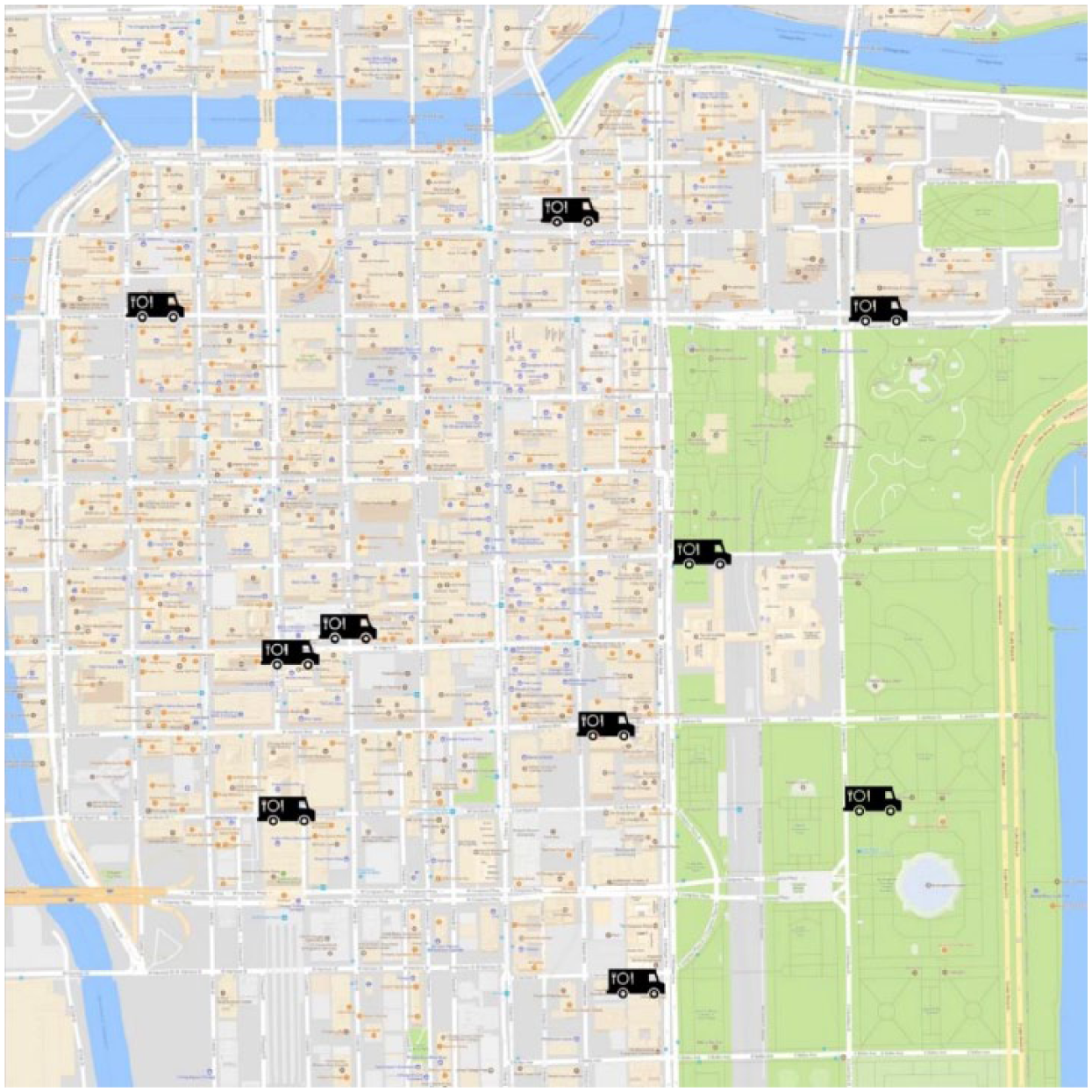
Chicago’s food stands in the “loop.”
Temporal Exclusions
While the food truck spots are meant to walk a middle ground, protecting both restaurant owners and food trucks, operators are only allowed to park in one of these spots for 2 hours. Food truck owners have argued that the 2-hour increment is unrealistic if they are cooking onboard, given that prep and cleanup time has to be accounted for, leaving little time to be able to sell their goods. Furthermore, the spots inspire fierce competition among food trucks rushing to claim the limited spaces. Since their inception, some of the more controversially located spots have been removed, including one in front of the busy Groupon building in River North. According to the Alderman, this spot was heavily congested, with food trucks further adding to the overcrowding (Alderman Burnett, personal interview, July 9, 2012). Moreover, several complaints were made by the restaurants inside the Groupon building, ostensibly unhappy with the new competition. Despite Chicago’s image as a food city, entrenched business interests (e.g., the Illinois Restaurant Association—IRA) have sought to restrict the proliferation of food trucks, fearing the competition they produce. Although the IRA claims cooperation with food trucks to ensure Chicago as a culinary destination, IRA notes obtained by a Chicago Tribune report say differently. During a meeting on the impending 2012 food truck ordinance, the IRA came up with policy recommendations, including the following:
Requiring that all food truck operators “have an existing brick-and-mortar establishment.”
Imposing “stringent location and hours of operation restrictions.”
Requiring mobile vendors to submit a “designated route that limits where they are allowed to make sales.”
Reworking the language of current rules that restrict food truck operation within 200 feet of a “similar” establishment (Eng, 2012).
Some of the more restrictive elements of the 2012 food truck ordinance were litigated in court, including the 200-foot rule and GPS requirement. The lawsuit was brought by food truck operator Laura Pekarik, of Cupcakes for Courage, and libertarian law group, the Institute for Justice, claiming that the ban unconstitutionally prohibits food trucks from operating a business. The lawsuit was ultimately decided in favor of the city in 2016, keeping in place the restrictive spatial and GPS requirements (Knowles & Piston, 2016).
Street Vendors
Prior to 2015, street vending in Chicago was licensed only for the sale of nonperishable items, prepackaged ice-cream desserts or whole, uncut fruits. As a result, many of the street vendors, whose goods ranged from elotes, tamales, to atole—all homemade items, were working informally. The precarity of their work resulted in constant police harassment, fines, and even arrests. One vendor described this contentious situation poignantly: while their “job is to go out [to vend], it is his [the police officer’s] job to remove you” (personal interview, August 7, 2012). While pedicab and food truck entrepreneurs are predominately white, young entrepreneurs, the majority of Chicago’s street vendors are Latino/a and sell their homemade food in predominantly lower income, Latino neighborhoods.
In the mid-1990’s, AVA campaigned to reform the city’s restrictions and with the Institute of Justice, crafted a new more liberal proposal. In 2014, Alderman Maldonado (26th) sponsored the bill, and it passed City Council in 2015. The new ordinance extended the list of permissible goods for street vendors, allowing the sale of foods that are prepared and packaged in a licensed kitchen, though still prohibiting the sale of homemade items or preparing items at the point of sale. The licensing fee was originally set at $350 for 2 years, but lowered to $100 through an amendment introduced by Alderman Maldonado (26th). Initially, only four street vendors successfully applied and received a license, taking an average of 44 business days to pass all inspections and issuance. As of May 2017, there are 24 licensed street vendors operating throughout Chicago. However, as estimates of Chicago street vendors ranges from 1,500 to 2,000 (Berg, 2016), there are a significant number of vendors who continue to operate informally.
Spatial Exclusions
Formal spatial restrictions largely stem from the ability of Aldermen to create no peddling zones, areas where all forms of vending are prohibited. Aldermen are able to do this by introducing an ordinance the City Council, and given their aldermanic privilege, such ordinances see zero pushback from other Aldermen or the Mayor. Prior to the 2015 street vending ordinance, there were 26 no peddling zones throughout the city (see Figure 3), located in commercial corridors, Special Service Areas (similar to business improvement districts), and entire wards. Similar to pedicabs and food trucks, the “loop” is largely off limits to street vendors, and with the passage of the new street vending ordinance, an additional 43 areas became prohibited (see Figure 3).

Chicago’s no peddling zones.
Temporal Exclusions
Like pedicabs and food trucks, temporal bans are an important aspect of street vending policy. The new license imposes strict regulations on the types of pushcarts used by street vendors as well as a 2-hour time limit for staying in one place. However, most vendors are stationary, and do not adhere to this temporal regulation which would require them to pack up and continually move their cart throughout the day. As one couple who split the labor of operating a food cart expressed, place matters; staying “stationary in one place” within proximity to their clientele is vital (personal interview, August 7, 2012). Thus, even a vendor who obtains the proper licenses will often still operate informally in defiance of the temporal regulation. Additionally, street vendors are only allowed to operate between 7 a.m. and 5 p.m. This is an important limitation since many street vendors cater to an early morning crowd of low-income workers who are out the door well before 7 a.m. Some vendors hit the streets as early as 3:30 a.m. selling breakfast staples like atole and tamales (personal interview, August 7, 2012).
Discussion
Often uneven spatial practices evolve as a way to preserve hegemonic social reproduction patterns such as land values or redevelopment projects. For example, Mitchell (1995) notes that part of the problem with activities in People’s Park in Berkeley, California—from the homeless, to political activists—is that nearby businesses were concerned such activities would drive customers away. Thus, the inclination to control space is often derived from the desire to control and maintain profitability—be it of surrounding businesses, homeowners, and their property values, or the ability to develop or redevelop land. Furthermore, Ehrenfeucht and Loukaitou-Sideris (2007) explain how sidewalks were created in order to provide access to storefronts. This historical foray into the creation of sidewalks leads us to question if and when public space has actually been public, and who it has been public for. Public space for certain commercial interests is evident in the spatial and temporal bans described above. While the IRA’s protectionist approach against food trucks is the clearest example, the ban on pedicabs in the “loop” indicates a number of possible protectionist interests—from taxis and public transportation, to business interests which prefer a sanitized streetscape.
At the heart of the effort to control space, is a related desire, one that resonates in right to the city arguments. In these debates, there is a concern with who is allowed to make decisions on the use of public space. As Mitchell (1995) explains, public space has always held an exalted place in democratic society as a place of meeting and debate. However, Mitchell (1995) also reminds us that the idea of “the public” has evolved over time. Relatedly, some informal activities threaten hegemonic decision making by proving an alternative narrative on important social and political issues. For example, in a report on the pedicab regulations of 2012, the Illinois Policy Institute suggested that “it’s unclear what aldermen are really worried about: being run over by a tricycle or the fact they’re not the ones peddling” (Rickert, 2014). Of course, the struggle over political power is often complicated by a host of factors including race, class, gender, and ethnicity (Dunn, 2017). In interviewing an Alderman sympathetic to street vendors, he warned that some officials were debating the industry’s “legal virtue,” and about vendors operating “where they shouldn’t be” (Alderman Waguespack, personal interview, December 1, 2014). When asked why it took so long for a street ordinance to come to fruition, another Alderman put it more bluntly, “my gut feeling tells me that they (other policy makers) can push around these small vendors with brown faces like me” (Alderman Maldonado, personal interview, November 20, 2014). Rather than vending and use of space as the sole problem, the question of who is doing the vending is also contentious.
A final concern which emerged was that spatial and temporal exclusions could be connected to yet another element, much less discussed in the literature—that of protection for certain noneconomic groups (Loukaitou-Sideris & Ehrenfeucht, 2009). In analyzing no peddling zones, we attempted to understand the ostensible logic and patterns behind the zones. The patterns we found include expected areas which are devoted to accumulation and financial growth (e.g., SSAs and the loop). However, others patterns emerged. When a layer for parks and schools was introduced to the map, it became apparent that some of the no peddling/vending zones were associated with school and park boundaries (see Figure 4), indicating another ostensible reason for spatial bans: protection for vulnerable groups (i.e., children) from undesirable elements. Mitchell (2003) explains that street vendors are often put on par with other objectionable groups like the homeless and prostitutes. Moreover, municipal leaders have historically sought to limit certain people in public spaces. For example, in their detailed history of sidewalks, Ehrenfeucht and Loukaitou-Sideris (2007) explain how the use of sidewalks was racialized (e.g., with Black people expected to step in the gutter to let White people pass by) and created a space for control and surveillance of undesirables like members of the Socialist party. The notion of informal work and workers as socially or aesthetically undesirable was illustrated during an interview with a pedicab operator who attended a meeting with Business and Consumer Protection officials to provide suggestions on new pedicab policy requirements. The meeting attendees walked out of City Hall together, where they were met by the chauffeur’s pedicab. One of the Business and Consumer Protection officials scoffed at the sight of the cab and remarked that she would never take a ride in one of those (personal interview, May 18, 2015, italics added).

Schools and parks within no-peddling zones.
Whatever the ostensible reasons for restricting the scope and practices of informal entrepreneurs, an overarching goal of these regulations is to limit the activities of these workers to certain areas. Beckett and Herbert (2008) explain that containment through landscape is only part of the exclusionary picture, with the other necessary part being legal reinforcement and coercion to the penal code. Thus, containing undesirable informal elements is done through the adoption of new policies and regulations which offer formalization as a means to legitimation, but in reality, serves to further restrict how informal entrepreneurs operate.
Conclusions
The passage of new regulations for three informal industries in Chicago between 2012 and 2015 presented a natural opportunity to analyze the policy contents and outcomes of “formalizing” the informal. While pedicabs, street vendors, and food trucks are distinctly different enterprises, they all experienced significant spatial and temporal bans when city officials attempted to formalize them. The analysis presented above seeks to contribute to discussions of urban space in two ways: by showing how temporal bans provide another layer of exclusion in addition to spatial exclusions, and by exploring the ostensible, reasons for spatial and temporal bans. While economic concerns are vastly important in this regard, the analysis shows that power and fear also play into exclusionary policies. Although it may not be possible to separate where economic motivations end and power concerns begin, the desire to curate social space is multilayered, complex, and intersectional.
This article also contributes to the literature on formalization by demonstrating how municipal governments attempt to formalize informal entrepreneurs as a way to control the informal, effectively seeking to reduce its size, or regulate it out of existence. These formalization attempts help question a binary understanding of formal and informal by demonstrating how formalization of these industries does not equal full acceptance and legitimation. The analysis of policy changes here invokes Lefebvre’s (1991, p. 156) critical assertion that to induce change, “policy is not enough.” Indeed, until greater vicissitudes are made to how we live in, experience, and use cities, policies will continue to reflect the uneven spatial dynamics required by neoliberal policies.
Footnotes
Acknowledgements
The authors want to thank Sultan Tepe and Scott Braam for their close readings and thoughtful critiques.
Declaration of Conflicting Interests
The author(s) declared no potential conflicts of interest with respect to the research, authorship, and/or publication of this article.
Funding
The author(s) received no financial support for the research, authorship, and/or publication of this article.