




Abstract
The concept of a port city, when narrated by popular visualities, goes through intense transformations of port spaces. Globalization, technological transformations of the maritime industry, and waterfront renewal programs influence a romantic myth of the port town and maritime culture. The aim of the article is to interpret the cultural conventions governing the portrayal of port cities and present a picture postcard as a visual narrative. Visual discourse analysis is used for a study of seven European port cities and their visual representations. Three metaphorical dominants of visual discourse have been distinguished: (1) waterfront and the port town tertiary sector; (2) technology, power, and domination; and (3) maritime culture and romanticism. The postcards that are analyzed reflect a tension between the intensely transformed postindustrial areas and the romantic images of a port city.
Introduction
Interrelations between the port and the city undergo constant transformation, with the most significant displacement of port spaces away from city centers, as described by Brian Hoyle (2000). Images of a port city shaped in the earlier epochs still have a strong impact on the way in which urban spaces are designed, drawing on romantic ideas of the port prior to the era of advanced transportation technologies and container terminals (Hall & Jacobs, 2012; Quilley, 2000). An analysis of images about the transformation of port cities requires a study of popular visual representations—a kitschy picture showing a ship at stormy sea or fishermen at work is an equally important representation of social beliefs as is maritime literature or marine art. Postcards—a part of popular culture and the tourist experience—seem to be the perfect object of study for researchers analyzing the iconography of port cities. The concept of a port city, narrated by popular visualities, goes through intense transformations of the port areas. Globalization, technological transformations of maritime industry (with containerization as the most notable example), and waterfront renewal programs (Daamen & Vries, 2013; Ducruet & Lee, 2006; Lorente, 2016) influence the romantic myth of the port town and maritime culture. To learn more about these processes, one should refer to port city iconography—with its contradictory narrative of not only nostalgia and cosmopolitanism but also colonialism, inequality, and political unrest (Mah, 2014). The aim of this article is to analyze visual representations of port city spaces and to understand the role of postcards as visual narration.
Port City and Its Symbols
The term port city does not refer only to economic functions or employment in a maritime economy (Hannigan, 2017). A port city is a cultural image created by narrations, collective imagination, and visual discourse (Low, 1996). The main questions that are raised when analyzing the symbols of port cities primarily concern beliefs related to spatial, economic, and geographical issues (Borsay & Walton, 2011; Evers, 2011). Studies about the images of port cities are usually interdisciplinary. For example, Eric Van Hooydonk’s (2006) book, A Plea for Soft Values Management by Port Authorities, contains an essentially sociological analysis of the influence of a port on a city in terms of values. This author juxtaposes the negative images of a large contemporary transshipment port with soft values that exist in the minds of the inhabitants of these port cities. These are various historical or myth-making values that are related to symbols of ports in the Western world (e.g., a port as a symbol of openness to the world, the exchange of ideas, free trade).
The beliefs that are described herein are not created in isolation from the economic or historical context. The changing economy, space, politics, and social relations are of crucial importance for the relationship between a city and a port—similar to the influence of global processes: the shifting geographies of the transport economy, crises of small traditional port cities, and the transformation of ports for water-related cultural and entertainment sites with maritime museums (Lorente, 2016).
Moreover, according to some authors, the changing relations between local and supralocal urban and transportation systems have a key role in defining the functions of a port city (Hoyle, 1989). When adopting such a research perspective, attention to the discursive character of the notions about a port city is needed. Port cities—as well as their space, economy, architecture, and society—are of a discursive nature. Because of the multitude of equally important images associated with the relations between a city and a port, there are heterogeneous representations of beliefs about a port city that are dependent on the changing historical context. Carola Hein (2013) writes about the consecutive stages in the development of port cities: from mercantile cities and the era of colonization to the age of steam, age of petroleum, containerization, and global trade issues. As Waltraud Kokot (2008) states, “Economic and technological changes have fundamentally restructured ports all over the world, dramatically altering the relation between port and city, the cities’ images and representations, and the condition of people living and working around the ports” (p. 7).
Modernization and globalization constitute two important stages of change in the images of a port city. The first stage could be regarded as disenchantment with a port city’s myth—in the sense proposed by Max Weber. A port in a city becomes an enterprise detached from the city and its citizens—one that is constantly growing to be able to handle more ships and transshipments. Rationalization and the power of technology prevail over the romantic nature of discovery—a ship and the loading place have become inaccessible, whereas port districts have disappeared from many cities; ports no longer have an informative function, trade is not only conducted by sea, and so on. New technological solutions, such as ships with a limited number of crewmembers as well as computerized fuel and container terminals, in many cases, have mechanized work at sea. According to Kokot (2008): Most communities close to the inner city ports had already lost their economic connections to port and docks, long before the onset of this process. Nonetheless, in many cases the port-related history of these neighborhoods still acts as an important factor in shaping local identities, while often migrant and diaspora communities have also concentrated in these areas, setting a distinctive mark on the urban space. (p. 18)
Nonetheless, the original myth—featuring sailing ships and the stereotypical notions of a sailor and port—acts as a resource that makes it possible to develop a city’s identity and its tourist image. Sailing ships still belong to the world where work at sea is a kind of adventure and a challenge of facing the elements (Rancew-Sikora, 2010).
The impact of globalization on port cities is rather more complicated (Daamen & Vries, 2013; Ducruet & Lee, 2006; Lorente, 2016). Changes in the urban space are related to the transformation of multifunctional city districts into a relatively homogeneous office space and the limiting of public space by organizing trade outside the central areas or by increased demand for gated space. The disintegration of a coherent city constituting a spatial whole is related to barriers that prevent access to functioning industrial areas such as ports.
Urban waterfront renewal projects of disadvantaged port districts or waterfronts are undertaken with an aim to counteract the degradation of boulevards, reduction of pedestrian traffic, and social exclusion . The gentrification of urban space is a part of the same process—renovated areas of a port city are nothing else than a product that can bring profits to the subsequent owners (Bunce, 2009). The attractive waterfront areas of port districts are renovated because of their location and, mostly, because of their cultural value (Hagerman, 2007). Many of these projects are criticized for the gentrification of port and waterfront areas as well as for the commercialization of space and the limitation of its housing function. HafenCity in Hamburg is a well-known example of controversy about the construction and revitalization of port districts (Grossman, 2008; Kostka & Fiedler, 2016)
A port remains an important element of local identity, but this identity is often associated with leisure and not with work. In a sense, this struggle between a port’s industrial and tourist functions has been taking place in port cities since the end of the 18th century—for example, Borsay and Walton (2011) argue that maritime trading and fishing were the most obvious roles that co-existed or competed with pleasure and health in the resort economy. But they were by no means the only ones. Coastal and estuarine locations, particularly ports, were magnets to industry. (p. 5)
Nonetheless, the stages in the transformation of port cities, which have been briefly discussed, do not supersede the images of ports from the preindustrial era. The natural myth of a port is universal and independent of the changing contexts. It was only on this natural myth that an artificial illusion was built that aimed to serve an ideological or a marketing function.
A natural myth, furthermore, constitutes a reference to the relationship between man and nature, and a port symbolizes human attempts to control the natural elements. Over time, the symbols of relations between man and nature have been replaced by the symbols of power: A port has become a means and symbol of ruling over land and sea—a sign of both economic and military expansions and dominance over other, colonized countries. At each of these stages, however, a seaport represents a challenge posed to the sea, human weaknesses, and other countries. The connection between a port and power causes symbolism to become political, and idealization is, thus, a characteristic feature of the myth of a port city. A port city is, therefore, a gate to the world and a place for the exchange of people, ideas, and goods. In the collective imagination, it is usually a highly prosperous center of commerce that sustains the whole region. The images of port districts are sometimes embellished—there are no disreputable dives; these are not meeting places for smugglers, thieves, or prostitutes anymore. The world of a port district is not closed to other citizens. Moreover, other elements of this myth become idealized: a simple hired seaman, a port district with its nightlife (Bavinton, 2010), promiscuous girls in a port (Cordingly, 2001), a brave pirate (hardly ever a “bandit”), physical work (during which people are singing sea shanties for entertainment), a sailor’s love affair with a different girl in every port, and so on.
Postcard as a Perfect Image of the City: Research Methodology
Studies on tourist photography and postcards explore various topics, such as the creation of the identity of a place and community (Kurti, 2004; Milman, 2011), the history of tourist places (Evans & Richards, 1980; Markwick, 2001; Papadaki, 2004), (post-)colonialism (Prochaska, 2011; Spennemann, 2006), ethnicity (Whittaker, 2009), gender (Sigel, 2000), and tourist experience (Hillman, 2007). The social studies perspective on postcards goes even beyond—including postcards as a source of historical data issue (Lynn, 1988), studies on social communication mediated by a postcard (Andriotis & Mavrič, 2013; Jaworski, 2010), and, finally, urban studies of the postcards that refer to the structure and functions of a city’s imagery (Crang, 1996; DeBres & Sowers, 2009; Dotterrer & Cranz, 1982).
Most of the mentioned studies agree that postcards refer not only to objectives of the image but also to cultural beliefs and simplified visual representations (Pritchard & Morgan, 2005). Some authors refer to the critical tradition of Michel Foucault—ascribing a significant role to postcards in creating a political narrative (Burns, 2004). Some authors state that the cultural impact of a traditional postcard in the new technological era has decreased (Andriotis & Mavrič, 2013; Van Dijck, 2008). Postcards are considered a part of the whole that is called the visual tourist experience, which is created through—but not exclusively—printed or paper images (Everett, 2008; Scarles, 2009). I argue, however, that postcards are not only nostalgic and historic symbols but also a vivid resource for studies on urban space transformation. Although postcards present idealized images by using conventions as well as photo-editing techniques, they can be treated as a document—it is not so much the appearance of an area that a given picture shows but rather the symbolic representation of beliefs about this spaces that is important. We are aware of postcard exaggeration and illusion but, nonetheless, we regard them as a document of urban life. The postcard is sent as an official (certified with postmark) certificate, confirming our presence in a given location. Both buyers and sellers seem to be interested in postcard aestheticization and authentication as well as in presenting what is typical. Despite a demand for dangerous places or dark tourism images (Stone & Sharpley, 2008), the demand for “nice” urban landscapes is the greatest.
The postcard does not represent the neutral eye, historically or sociologically; it recalls myths, simplifications, and identities of places and people. This concept might assume that a picture postcard reflects a clash between intensely transformed postindustrial areas and the romantic images of a port city. For the study of spaces in port cities and their visual representations on postcards, a visual discourse analysis was applied (Banks, 2007; Christmann, 2008; Kress & Van Leeuwen, 1996; Kuronen, 2015; Rose, 2001). This approach derives from the tradition of discourse analysis, which is performed according to the rules of Foucault’s view of the relationship between language and power. If an image is regarded as a type of text (Wodak & Meyer, 2009), it is possible to define visual discourse as a set of visual representations referring to ways of thinking and talking about the reality (Cranny-Francis, 2005) and as a narrative mediated by images. A single image that is analyzed is related to cultural representations of a similar structure and can be regarded as the context and source of rules for creating images.
Before the actual analysis in this study, the postcards underwent a simple transcription, taking into account information on date and place (city) as well as editorial information about the publisher and, possibly, photographers. In the study, two groups of codes referring to Erik Cohen’s (1993, p. 43) methodological proposal were applied: (1) the representation of the port city, defined metaphorically (“tourism,” “waterfront and tertiary sector,” “technology, power, and domination,” “maritime culture and romanticism,” and “urban related”) and (2) metonymically (describing space or objects, number of people presented, composition of the photo, etc.). Erik Cohen distinguishes two approaches: the “outside,” the relation between the image and the “reality” of the tourist experience, and the “inward” view, when the object of analysis is the image itself or, more precisely, the meanings encoded in the image (p. 38). Limitations of the analysis include accessibility issues, especially to postcards as archival materials, sample selection and typological representativeness, limited intersubjectivity of visual communication, and so on. Moreover, postcards do not explain, by themselves, the motives and reactions of the buyer or the receiver. The analysis of visual discourse applied here is unable to answer all the questions a study should investigate into the meaning of postcards to create a way of thinking about port cities. These questions refer to the interpretation of images by their users, the scope of social circulation, and so on, and they certainly require further studies.
Postcards were selected 1 for the study based on the logic of theoretical sampling (Glaser & Strauss, 2009)—that is, the process of selection lasted until the already collected elements appeared in subsequent pictures. In total, I studied 91 picture postcards from seven of the biggest European port cities—Antwerp, Hamburg, Le Havre, Marseille, Portsmouth, Rotterdam, and Valencia (albeit with different functions—cargo, passenger, transshipment ports). The main selection criteria were references to a port (its area, infrastructure, and symbols), waterfront, or the sea. All the postcards analyzed were printed between 1985 and 2015. Only conventional postcards were collected—that is, those that use traditional ways of portrayal 2 ; postcards that were hand drawn, humorous, and had three-dimensional pictures were excluded.
Iconography of Port Cities
In this study, the dominant elements of visual discourse were distinguished, without indicating the frequency of their occurrence. The frequency analysis is not justified in this case—mainly due to differences among the studied cities. As Robert Bartłomiejski (2016) noted, port cities differ in their size, location, relation to the open waters of the sea, the city center, as well as their position in the global or regional shipping industry and economy. Furthermore, the investigated cases have different domination ranges about urban or port functions that influence the methods that portray visions about the port city. What is typical of these analyzed postcards is a particular manner of portrayal. Most often, postcards show a panoramic (the bird’s eye) view—unavailable from the perspective of an ordinary passerby. As Alvin Boyarsky (1996) argues, postcards have a universal language, which makes it possible to translate a city’s language into single photographs and views. A city shown on a postcard ceases to exist as a whole for a tourist and begins to be perceived as a mosaic of the most important places to be seen. Another feature of the port city postcards that were analyzed was idealization. Picture postcards show illusive images; yet, we buy them because we see them as documents of a city’s life. A postcard is not only a form of ritual communication (Rogan, 2005) but also has been sent as an official certificate (certified with a post stamp) of the tourist’s presence in a given place. The unreality of such images is taken seriously, with an assumption that, as Jeffrey L. Meikle (2016) noticed, “they do say it’s real.” The depicted views are “nice”: The photographs are of high quality (sharp and with a proper visual composition), and most of them present classic scenes (e.g., the skyline of a city, a panorama). Although there is a demand for art postcards, the highest demand is for depictions of typical places (not necessarily ordinary ones). A postcard does not present reality from a reporter’s perspective and even less so from a historical or sociological point of view. What it does do, however, is reproduce stereotypes, myths, simplifications, and beliefs about the identity of places and people.
Nonetheless, stereotypes and cultural clichés about the port city keep changing simultaneously as the port changes over time. The relation between the romantic image and the industrialization of the harbor, in a globalized world, is significant in the postcards examined. The ship and the area of its loading are usually a closed zone, the port no longer serves an informative function, trade takes place not only by sea, and so on. Fuel terminals and ships with limited crew (or autonomous shipping units) seemingly do not refer to a universal primary myth.
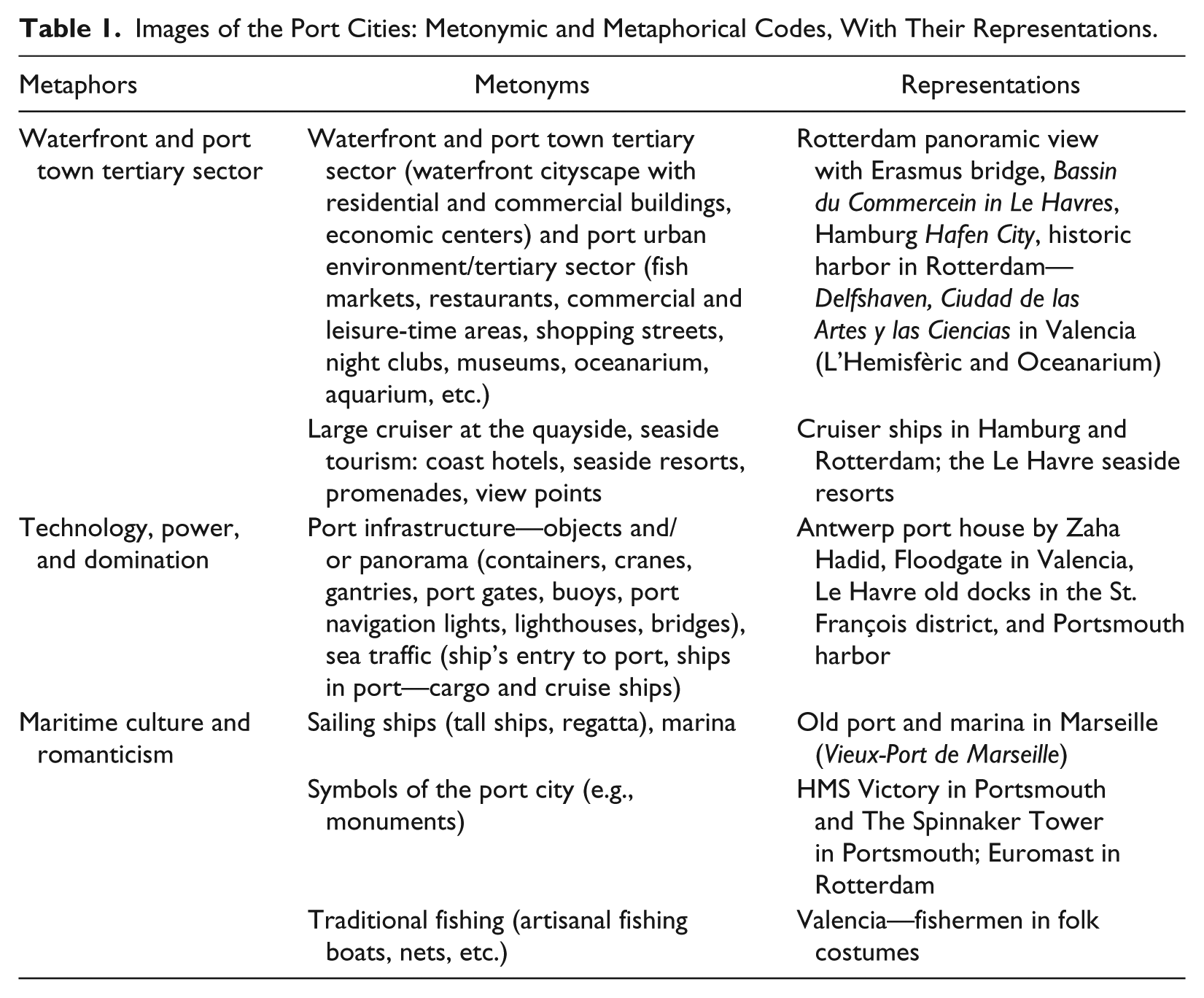
Paradoxically, a port city that wants to remain attractive transforms this universal myth: This transformation is illustrated by two postcards from one city. Both pictures (despite obvious differences of style and technique) show the busy Hamburg port traffic. The postcards are separated by almost a 100 years—although the main study included postcards from the turn of the 20th and 21st centuries, the juxtaposition of these two photographs reflects not only the change in the relationship between the city and the port but also the continuity of the port city imagery. The first one, dated from the beginning of the 20th century (Figure 1), shows small- and medium-sized ships, in a somewhat chaotic but seemingly intense traffic, despite the small number of transshipments. The air is smoky, people are practically absent, and, yet, transshipment work is intensified. The second postcard (Figure 2, Elbe River and Hamburg Harbor view), from the beginning of the 21st century, presents a giant global (but not a boring) industrial port illuminated by a range of colors and lights. The traffic in the port is dominated by ships with masts and hiking boats, and the illuminated night-time bay appears to have a vibrant life (although, here too, you cannot see human figures). Tourist traffic, the power of technology, tourism, and the traditional maritime culture are present on this postcard together. I use these four elements as metaphorical codes in the study (see Table 1): (1) The waterfront and the tertiary sector—referring to idealized spatial representations of the social environment of a port city as well as commercial and leisure-time areas associated with a port city (Weinhold, 2008), a service base for port operation, and a place of location of maritime industry and institutions that are directly and indirectly related to the sea. Seaside tourism refers to the touristic importance of the sea coast as a significant space—historically, socially, and culturally (Osbaldiston, 2017). (2) Technology, power, and domination—recalling the port as the dominant economic sector and the economic position of the port city (Ducruet, Cuyala, & Hosni, 2016). (3) Maritime culture and romanticism—referring to cultural ideas about traditional sailing and fishing as a romantic and mysterious adventure (Hunter, 1994).

Artist unknown. Kaiser Wilhelm Quay in Hamburg Harbor (Kaiser Wilhelm Hafen Hamburg-Amerika Linie, 1925).
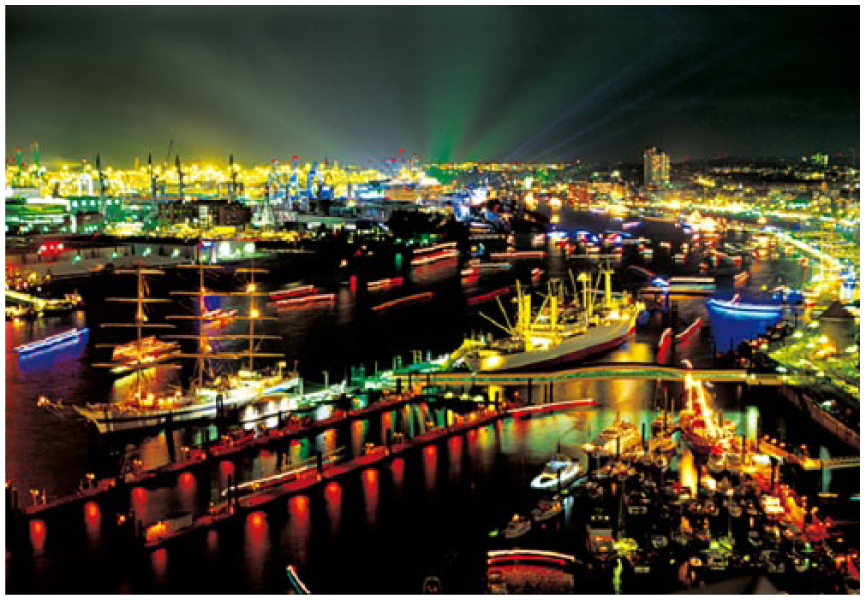
View of the Elbe River and Hamburg Harbor (Blick auf Elbe und Hafen, 2010) by Marian René Menges.
Images of the Port Cities: Metonymic and Metaphorical Codes, With Their Representations.
Waterfront and Tertiary Sector
A view of a quay (waterfront) is one of the typical visual representations of port cities. The grand scale of this industrial and service-oriented enterprise—a port—is shown in a picture taken in a wide shot as well as in aerial or panoramic photographs. It seems that a panorama shown on a postcard signifies the power of creating things—regardless of whether creation means building a port or revitalizing a waterfront. The grandeur, vastness, and giant scale of this space that is presented on postcards symbolizes human dominance over the world of nature and the built-up environment such that nobody has doubts as to who holds power; moreover, some postcards additionally feature national or local symbols such as a flag or a city’s (or region’s) coat of arms.
Objects of the urban landscape that represent imagery about a port city were, for example, ship fittings, anchors, masts, bolts, and chains as well as monuments referring to particular symbols and people. Intersubjective beliefs were associated with the objective features of a port city’s space and beliefs about work at sea, the history of a city’s port, the stereotype of a port as the heart of a city, as well as the stereotype of a multicultural and open city (Evers, 2011, Stevenson, 1999). For that purpose, the images of the dominant (iconic) architecture and open public spaces (e.g., a boulevard, quay, waterfront, or beach) as well as spatial and institutional solutions (e.g., a maritime museum or a sea aquarium) were used. More often, they were depicted on postcards if they were spaces of festivals and celebrations related to the connections between a city and the sea (e.g., events, fish markets).
The images of a port district, facilities, and service districts oriented toward handling port traffic are a vital element of the visual discourse on port cities. The most important functions of a port require it to be supported by various institutions of a tertiary sector with its “ship agents, forwarders, warehousers, migrant labor and commodity brokers, dealers, insurers, compradors, tasters, the water front services” (Miller, 2012, p. 4). Their activity belongs to the same mythical story: Taverns, cafés, oriental shops, tattoo studios, and places providing simple entertainment are becoming constant elements of representations in popular marine art (Rudolph, 1980), with notable sample pictures of New Orleans, with its lasting reputation for “violence, sexual license and excessive drinking” (Mah, 2014, p. 20). Dark alleys and infamous streets do not attract tourists themselves; therefore, contemporary postcards often present entertainment areas by using illumination. Street and neon lights as well as illuminated advertising are symbols of a city that never sleeps and an entertainment district that is always ready to serve guests (Jakle, 2001). The attractiveness of the port city is enhanced by promising re-entertainment and abolishing rigid rules of everyday life such as through the presence of entertainment venues. Furthermore, contemporary designs of waterfront reconstructions refer to these images of places of nightlife (Bavinton, 2010). An image of a great ship, usually a cruiser, entering or leaving a port is a symbolic scene that is most often depicted in the analyzed photographs and that complements a port’s panorama. Historical postcards usually show a liner—symbolizing a journey to a distant world that is made both by migrants, who are leaving ports such as Hamburg to get to the United States, and upper-class tourists, going on a leisure trip on a luxurious ship. Nowadays, a cruise ship entering a port indicates the great importance of a given city for tourists who, while traveling from port to port, decide to disembark there.
These tourists, however, are not visible. If people appear in a port city postcard, they are mostly locals; it appears, then, that tourists shown on a postcard could be associated with inauthenticity (i.e., an uncommon situation), whereas a picture postcard pretends to represent ordinary life. Contemporary postcards do not usually present human figures in the foreground, or they are presented only in a long shot (Papadaki, 2004; Thurlow, Jaworski, Ylanne-McEwen, 2005). Sailing ships and yachts have replaced human crowds in picture postcards, which are very rarely depicted in open public spaces on a waterfront. In the past, picture postcards often showed crowds of people watching something, engaged in a trade, or boarding a ship, whereas, in the present day, depictions of people are usually avoided.
Technology, Power, and Domination
In general, images did not present a port as such—an industrial area with special functions (with few exceptions)—but rather as a city where the presence of a port function is visible. The “invisible” feature of images of ports is that they play a specific role in the economy of a city, region, country, or the world (Ducruet, 2016). A port can be used for transshipment; moreover, there are ports for fishing vessels or yachts and ports of a tourist or military character (most often, however, they have mixed functions). However, if the ship is present on a postcard, it is usually a passenger or sailing ship, and the illuminated marinas with yachts are shown more often than color containers and industrial spaces. The case of the Valencia postcards is typical—the port itself (one of the busiest in Europe and the largest in the Mediterranean Sea) is hidden, whereas the buildings of the Ciudad de las Artes y las Ciencias (“district of arts and sciences”) are exposed, as representations of the port town tertiary sector. Similar is the case with Antwerp—the second largest port city in Europe after Rotterdam with a total annual handling capacity of 110 million tons, which does not include the port infrastructure on postcards (with the notable exception of the Port House designed by Zaha Hadid).
Maritime Culture and Romanticism
A port is a symbol of “safe return” and a “place for rest” as well as a refuge and safe haven during a storm. Moreover, an early modern image of a port (before ports were “massified” and the character of transhipments changed) refers to the romantic style exemplified by popular clichés such as sunset at sea, a fog-shrouded city, or a lonely sailor looking at the horizon. In this context, the romantic narration is characterized by elements of unreality and a transition to another dimension, which are important for pictures showing port cities. Musings, nostalgia, and reflection on the vastness of the world are parts of the discourse on a port as a place for rest. The look of people standing on the quay and staring at the horizon—which symbolizes wistfulness, loneliness, and, simultaneously, a desire for adventure—has become an indispensable element of this world. It seems that those who take part in the tourist experience in a port city want to find such a romantic aura when visiting particular places.
Modern technology is admixed with a twinge of nostalgia and the elements of the romantic myth on postcards. A view of a city with sailing ships at the quayside is an example of such popular symbols. The parades of tall ships and races of smaller sailing vessels occupy a part of the view of a port and waterfront. A parade of sailing ships clearly is an echo of the past and constitutes a reference to the universal beliefs about a port as a window to the world as well as a place of geographical expansion and the beginning of a romantic adventure. Sailing ships are, most of all, tourist assets—that is, they are used to attract tourists. Nonetheless, they are things on display, symbols of their owners’ prestige, such as luxury motor yachts. The images of a city depicting sailing ships indicate its wealth; pictures of marinas perform a similar function—for example, postcards from Marseilles often show scenes of exclusive yacht tourism in the French Riviera.
Discussion
The image of port cities undergoes constant changes, and the making of a port into a tourist attraction occurs in the next stage. The models of transformation of port areas indicate a shift from industrial functions toward service and residential functions, whereas the cultural image of the urban space is maintained (Caulfield, 1994)—referring not to the economic or transport functions but to the urban heritage of port city, with its “old warehouses, silos, wharfs, industrial archeology heritage and lighthouses” (Fusco Girard, 2013, p. 4330).
A visual discourse analysis of the collected postcards indicates that the pictures are governed by the idea of creating an ideal image of a port city by using existing stereotypes. Four dominants of visual discourse were distinguished: (1) depersonalization, (2) idealization, (3) romanticism, and (4) power and domination. In this sense, postcards from port cities create a double illusion: A postcard is an ideal picture, and the image of a port city it presents is also embellished. A picture postcard showing heavy sail-ship traffic in a port is a double lie: Such ships are not an everyday occurrence in a contemporary port, whereas the picture itself (which has been digitally processed) shows a perspective view from above, which is unavailable to a passerby. Postcards certainly change the way in which we perceive a port city by creating its visuality.
I do, however, realize that there are many questions this article does not answer. Do all port cities undergo the same transformative processes? What are the other symbols and their visual representations (Wells, 2007) that appear in the iconography of port cities? How do particular topics evolve over time, for example, work, nature, power, and economy? To what extent does a port city’s myth lend itself to changes? These questions require that further studies be conducted on the changing image of port cities. Postcards are just one of the media used for creating such an image; in addition, travel brochures, advertising materials, visual arts, and architecture should be analyzed.
The creation of a city’s image can be a planned process—local authorities attach great importance to the development of the appropriate image of a city that would attract visitors. The popularity of a place among tourists is related not only to real resources but also to beliefs about places that are worth seeing. Visual materials play a particular role in creating such stereotypes. But, most of all, picture postcards are not only able to attract tourists but also can maintain cultural beliefs about sailors’ work and the myths associated with a port city space.
Footnotes
Declaration of Conflicting Interests
The author declared no potential conflicts of interest with respect to the research, authorship, and/or publication of this article.
Funding
The author received no financial support for the research, authorship, and/or publication of this article.