




Abstract
This article addresses the role of vertical detachment in J. G. Ballard’s novel High-Rise (1975/2006) and its recent screen adaptation by Ben Wheatley (2015) through the lens of Michel Foucault’s concept of heterotopia (1967/1984). In particular, it elucidates the specific pressures and possibilities of high-rise living by drawing on Foucault’s distinction between heterotopias of compensation and illusion as well as by assessing their roles in the residents’ gradual slide into tribal anarchy, as charted by the novel and the film. Throughout, my findings are embedded in the context of modern architecture and urban planning, most notably high-rise housing, in postwar Britain and its reflection in other influential cultural productions of the time. Finally, the idea of heterotopia is championed as central to Ballard’s continual engagement with a ‘dark logic’ inherent in modern architecture and technology. The article thus contributes to ongoing debates on verticality and height as factors in past and current urbanistic schemes and their social and psychological impact as reflected in professional discourses as well as in literary-artistic engagements (see “vertical turn” in Graham & Hewitt, 2013).
Among fictional works addressing vertical experience, or more precisely life in tall buildings, J. G. Ballard’s (1975/2006) novel High-Rise looms as among the more exceptional examples. Set in a newly built, super-modern 40-floor high-rise block, the story meticulously follows the building’s 2,000 inhabitants as social order slowly breaks down and gives way to a tribalism of brutally rivalling gangs and individuals. The novel is outstanding in its detailed psychological interest in the high-rise residents as well as in their complex relations with the giant built structure they call home, including the ways in which it continually transforms and reflects their situations. In this essay, I explore the role of vertical life in distancing the high-rise’s residents from the larger social field, thus either intensifying or subverting the social norms and rules in it. In that sense, it may also assess the responsibility of these conditions for the residents’ slide into tribal warfare. In my analysis, I will draw on key concepts from the spatial theories of Michel Foucault (1975/1979, 1984) and Michel de Certeau (1980/1998). At the same time, I will continually refer to the novel’s recent screen adaptation by producer Jeremy Thomas and director Ben Wheatley (2015) and examine how far aspects such as set design and visual language either support or run counter to my interpretations. 1
Ballard’s high-rise may be an imaginary one, yet it is situated in his long-time hometown of London and the specific historical and cultural context of postwar residential skyscraper construction, bringing to mind a number of real-life models and inspirations for his fictional high-rise structure. Ballard introduces the reader to a high-rise block that contains an abundance of facilities, such as supermarkets, swimming pools, a bank, a gym, and a junior school: “In effect, the apartment block was a small vertical city, its two thousand inhabitants boxed up into the sky” (Ballard, 2006, p. 9). This description clearly links the building to one of the icons of postwar modern residential architecture, namely the Swiss-French architect Le Corbusier’s Unité d’Habitation, first built in Marseille and later also realized in other French cites as well as in West Berlin. Although much smaller in scale—the Unités only comprised 12 stories—Le Corbusier’s design of the Unité nevertheless embodies the ideal of a self-sufficient vertical city, a term Ballard borrows from the master architect (2006, pp. 9, 50; see also Luckhurst, 2016; see Figure 1).
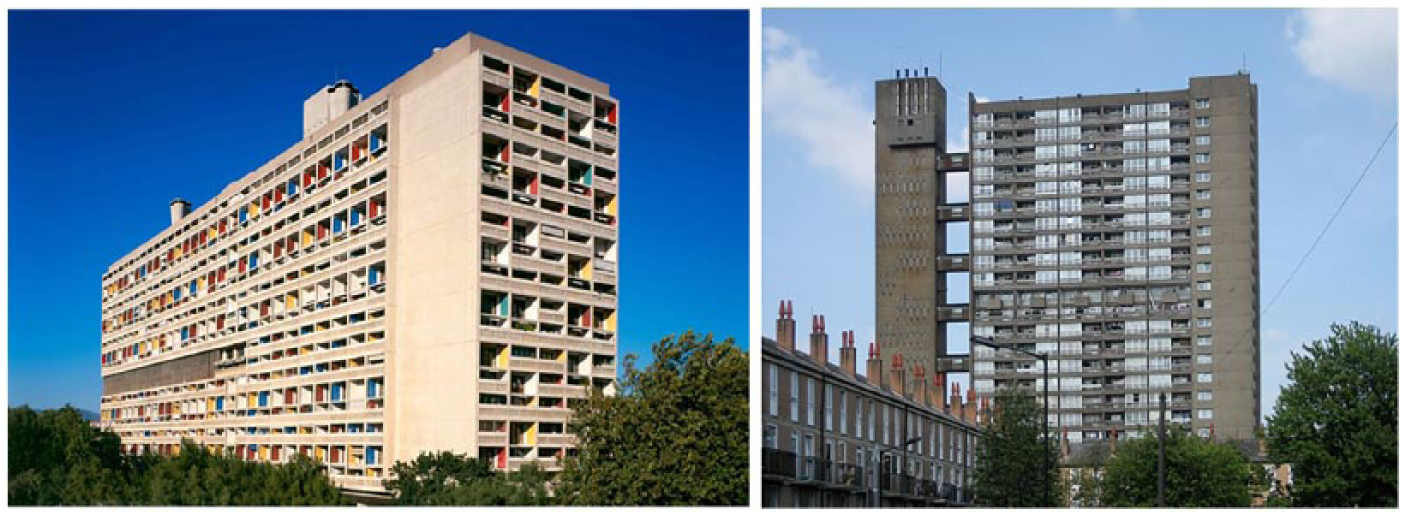
Vertical cities: Le Corbusier’s original Unité d’Habitation, the Cité Radieuse in Marseille (left), built 1947-1952 (12 floors, 337 units), served as the blueprint for all postwar residential high-rise buildings, such as Ernőö Goldfinger’s Balfron Tower in London’s East End (right), built 1965-1967 (27 floors, 146 units). (Left) Paul Kozlowski for fondationlecorbusier.fr and (right) Sebastian F (CC) for wikipedia.org.
Whereas modern city planning and high-rise residential architecture transformed cities around the world from the 1940s onward, Britain is nowadays hardly ever identified with such excessive vertical urbanism as may be encountered in the cities of many other countries around the globe. 2 Yet postwar Britain, however reluctantly, also participated in the wave of modern urban renewal, even though high-rise housing, in effect, has stayed “a doubtful guest” to Britain (Turkington, 2004, p. 147). While the single-family house remained the residential ideal to a greater extent than in any other European country, British cities—faced with a dramatic lack of housing space after World War II—commissioned and lavishly funded residential high-rise constructions throughout the 1950s and 1960s (Turkington, 2004). Apart from mega complexes such as the Barbican Estate in the City of London, residential towers were constructed throughout the country and appealed to the middle class rather than to urban elites or lower income groups. Projects such as the Southmere Estate in East London’s new neighborhood of Thamesmead are typical examples of the high-rise developments of the time. It was this estate that gained special prominence from its repeated use in British screen productions from Stanley Kubrick’s Clockwork Orange (1971) to the Misfits TV series (2009-2013). Its perception as a quintessentially modern and/or gloomy site varied with the changing reputation of high-rise housing over the decades. While these tall residences were initially built and marketed as super-sophisticated utopias heralding a new, healthy, and just society in the optimistic spirit of postwar modern architecture and urban planning, 2 they quickly fell from grace within only a few decades after their construction (Hall, 1988).
The partial collapse of the Ronan Point residential tower in Newham, East London, on May 16, 1968, which killed four people, first threw a shadow on the modern dream of a carefree living experience in the skies of Britain (see Figure 2). Also, with the economic depression of the 1970s, national and local authorities were no longer able to fund the necessary facilities and adjunctions, such as shops, schools, and community centers, needed in order to make high-rise buildings and projects work. Once these complexes were largely neglected and consequently decayed both in an architectonic-material and socioeconomic sense, high-rise housing developed a reputation for accommodating and promoting all sorts of social problems: poverty, crime, vandalism, and gang violence. As a result, high-rise towers and even entire projects were officially demolished as early as the 1980s (see Turkington, 2004). In these years, the public and professional criticism of high-rise housing, which began with the postwar redesign of cities in accordance with the ideals of modern architecture and urban planning, gained momentum. Immensely influential critics such as Jane Jacobs (1961/1992) scorned high-rise architecture for its lack of human scale as well as for its disadvantageous effect on a vivid street life deemed fundamental to any healthy urban community (see Jacobs, 1992, pp. 187-190, 241-256, 393-404). Fellow American urban planner Oscar Newman even regarded high-rise estates as a threat to urban security. Due to their height and thus detachment from natural street-level surveillance as well as their promotion of indifference and irresponsibility among the anonymous mass of residents, these vast buildings constituted ideal breeding grounds for all sorts of crime while remaining virtually uncontrollable by law enforcement forces (Newman, 1973; see also Hall, 1988, and Luckhurst, 2016). Ballard’s gloomy tale of civilizational breakdown in a super-modern high-rise block unmistakably owes much to the 1970s climate of suspicion toward universal progress and benefit promised by both modern technology and architecture. Yet at the same time, Ballard’s fiction goes well beyond and even subverts common 1970s critiques of architectural and technological modernity, such as were voiced by prominent intellectuals like Lewis Mumford and Jane Jacobs and popularized even further by the Club of Rome’s 1972 report on The Limits to Growth or Godfrey Reggio’s experimental film Koyaanisqatsi (1982).

High-rise disasters such as the partial collapse of Ronan Point tower in Newham, East London, on May 16, 1968 (left) and the fire in Grenfell Tower in North Kensington, West London, on June 14, 2017 (right), added to the bad reputation of public high-rise housing as unsafe and underfunded in the eyes of the British public. (Left) The Daily Telegraph and (right) Natalie Oxford (CC) for wikipedia.org.
While the modern dream of vertical cities for the broader masses was clearly buried under Margaret Thatcher (1979-1990), luxury high-rise residential development in Britain has experienced an ongoing boom for the past decade. In London, one can recognize a growing number of super-expensive residential towers already built or about to be built on favored locations such as Canary and St. George Wharf, reaching out to the needs and budgets of an affluent urban or international elite (Turkington, 2004). In this sense, Ballard’s novel proves to be visionary, introducing the reader to exactly such an ensemble of super-sophisticated vertical cities inhabited by well-to-do professionals, thus making “Ballard’s building seem . . . much more current in the present day than at the time he was writing” (Hatherley, 2016, p. 70). High-Rise therefore is of enormous relevance in a contemporary context since it offers insight into the characteristics and consequences of a phenomenon that has recently been labelled “vertical urban splintering.” In their seminal article “Getting Off the Ground”, urban geographer Steven Graham and literary scholar Lucy Hewitt argue that “the global proliferation of iconic as well as more prosaic high-rise residential, corporate and hotel skyscrapers [might] contribute in many cities to the emergence of a myriad of vertically stratified gated ‘communities’” (Graham & Hewitt, 2013, p. 79). Such “processes of ‘vertical sprawl’ erecting archipelagos of ‘vertical gated communities’—solipsistic capsular spaces for elite groups—into the sky” (p. 80) can be detected globally in almost every larger city. Ballard’s novel, though avant la lettre, gives a powerful impression of the sociopsychological consequences that such extreme vertical capsularization might have on people residing high above.3,4
As a matter of fact, the 2,000 residents of Ballard’s 40-story- and 1,000-unit-high-rise block are isolated from the city around them in a double sense. First, they live in a residential project that is set in a mile-square area of abandoned docklands and ware-housing along the north bank of the river [Thames]. . . . For all the proximity of the City two miles away to the west along the river, the office buildings of central London belonged to a different world, in time as well as space.
5
The city center thus appears to Robert Laing, one of the protagonists, as “the landscape of an abandoned planet receding slowly from his mind” (Ballard, 1975/2006, pp. 8-9). Second, the high-rise residents are isolated vertically, in “a small vertical city abandoned in the sky” whose apartments appear like the “gondolas of a Ferris wheel permanently suspended three hundred feet above the ground,” allowing one to “look down at the sky, rather than up at it” (pp. 7-9).
Moreover, the high-rise—much like in the original plans of Le Corbusier’s Unité d’Habitation – is described to contain . . . an impressive range of services. The entire 10th floor was given over to a wide concourse . . ., which contained a supermarket, bank and hairdressing salon, a swimming-pool and gymnasium, a well-stocked liquor store and a junior school. (p. 9)
thus giving the residents few reasons to exit the block altogether: “Delighted by this glut of conveniences,” Ballard writes, “Laing made less and less effort to leave the building” (p. 9). The picture of Ballard’s skyscraper thus culminates in the impression of an almost fully self-sufficient, self-centered, capsularized community, “a sealed rectilinear planet” permanently split and autonomous from the city around it, with “an artificial psychological climate, operat[ing] to its own rhythms, generated by a combination of alcohol and insomnia” (p. 103). It was precisely this vertical detachment of high-rise buildings from and the social draining of their immediate urban environment that constituted one of the major points of criticism against postwar modern high-rise construction, as may be grasped from the writings of Jane Jacobs, Oscar Newman, and many other urban scholars from the 1960s onward. This discourse is reflected in the novel’s character Anthony Wilder whose increasing uneasiness about living in the tower stirs a chain of critical reflections on life in high-rises, intended to culminate in an investigative documentary (Ballard, 1975/2006). 6
Unsurprisingly, the very condition of the building’s both horizontal and vertical isolation notably shapes the living quality of its 2,000 inhabitants. Their experiences of life in that super-tall and super-facilitated complex are ambiguous, shifting between the not necessarily contradictory poles of uneasiness and seemingly endless possibility. On the one hand, the residents often experience feelings of disorientation or are simply overwhelmed by its sheer size and height as well as the vastness and diversity of its space(s). Moreover, there is a nagging sense of being at the mercy of the immense architecture and the many technologies that make the building work—especially when they fail to function: power failures, broken lifts, jammed garbage-disposal chutes, or wilfully vandalized corridors are a daily fare in the vast anonymous structure, letting the building at times appear “like a huge and aggressive malefactor, . . . determined to inflict every conceivable hostility upon” its tenants (p. 57). Yet apart from all the hassle caused by the building and its fragile infrastructure, there are also the pressures and discomforts of 2,000 people living densely together and sharing various facilities, a condition bearing the potential for constant annoyance and conflict.
On the other hand, the residents also experience a life whose dimensions are “space, light and the pleasures of a subtle kind of anonymity” (p. 9). That very anonymity (abhorred by others) coupled with the sheer mass and proximity of people seem to create an atmosphere of ubiquitous possibility and quickly realized intimacy—exciting not only in Laing “a confusing blend of lechery and romantic possibility” (p. 13). In fact, many residents quickly have affairs with one another. Considering the building’s overall promiscuous climate, Laing comes to the conclusion that “[s]ex was one thing . . . that the high-rise potentially provided in abundance” (p. 13). Furthermore, the block’s extreme anonymity, as well as a general sense of nonresponsibility for the vast building shared with so many people, allows—in full accordance with Newman’s major argument—for countless acts of deviance and misdemeanor, ranging from vandalism against the building to numerous provocations or even violent attacks among the tower’s residents.
In view of these ambiguous experiences of the occupants of Ballard’s high-rise, I propose reading this fictional building—as well as skyscrapers in general—as heterotopias. The concept was introduced by Michel Foucault in his influential 1967 text Of Other Spaces, based on a talk he gave to architects earlier that year. Foucault (1984) defines the concept of heterotopia as follows: There are also, probably in every culture, in every civilization, real places—places that do exist and that are formed in the very founding of society—which are something like counter-sites, a kind of effectively enacted utopia in which the real sites, all the other real sites that can be found within the culture, are simultaneously represented, contested, and inverted. Places of this kind are outside of all places, even though it may be possible to indicate their location in reality. (pp. 3-4)
Heterotopic sites thus appear as countersites that either differ from or radicalize the way in which the space around them is ordered. In this way, Foucault may define utopias as imaginary and imagined places, places without real existence, whereas heterotopias constitute “effectively enacted utopias,”—that is, utopias realized within and to be exactly located in actual space. 7
In his various definitions of the heterotopia concept, Foucault offers one specification that captures the ambiguous and apparently contradictory experience of high-rise living particularly adequately. As the sixth and last principle of heterotopias, Foucault introduces the dichotomy of heterotopia of illusion and heterotopia of compensation: The last trait of heterotopias is that they have a function in relation to all the space that remains. This function unfolds between two extreme poles. Either their role is to create a space of illusion that exposes every real space, all the sites inside of which human life is partitioned, as still more illusory. . . . Or else, on the contrary, their role is to create a space that is other, another real space, as perfect, as meticulous, as well arranged as ours is messy, ill constructed, and jumbled. This latter type would be the heterotopia, not of illusion, but of compensation. (p. 8)
So there are, first, heterotopias that seem to subvert or even reverse the norms, values, or the entire order of their surrounding space, thus revealing them as illusory. Examples of this permanently or temporarily realized type of a subversive heterotopia can be found in brothels, fairgrounds, carnivals, or alternative lifestyle communities. This type of heterotopia may be broadly aligned with other theoretical conceptions, such as Hakim Bey’s (1991/2003) “temporary autonomous zones”(pp. 93-132) or Mikhail Bakhtin’s (1963/1984) concept of the “carnivalesque” (pp. 107-180) (Figure 3). 8 Second, there are heterotopias that differ from the space around or below them, not by subverting but by radicalizing and perfecting its order and principles: a site compensating for all its surrounding space’s supposed flaws and imperfections—its essentially “messy, ill constructed, and jumbled” state (Foucault, 1984, p. 8). One may well think here of those classically panoptic spaces and institutions described and analyzed by Foucault in Discipline and Punish (1975/1979), namely prisons, schools, factories, military institutions, hospitals, or psychiatric asylums, and yet also of colonies and communities, such as those established by the Jesuits in Latin America or by the Puritans in New England (Foucault, 1975/1979; 1984).
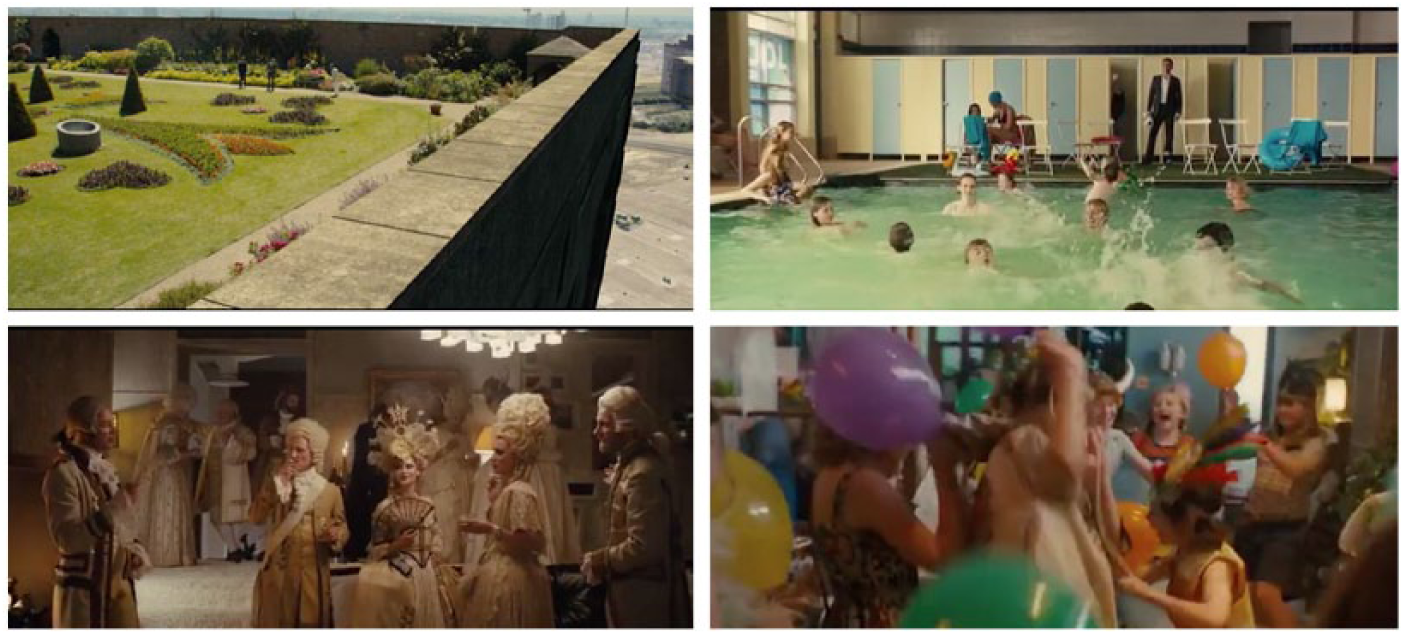
Vertical heterotopia. Already before the high-rise’s slide into a state of permanent illusion heterotopia, the film version stages various sorts of carnivalesque heterotopic sites on its different floors—from the rooftop garden (the “happy universalizing heterotopia”; Foucault, 1984, p. 6), to the chronically overcrowded swimming pool as well as the Baroque costume party in Royal’s penthouse, and the exuberant children’s birthday party in the Wilders’ apartment; film stills.
It is crucial to bear in mind that some sort of spatial division from the larger social field is a necessary precondition for the establishment and existence of heterotopic sites. This also explains the reason why skyscrapers with their vertical detachment from the world below—often, as in the case of Ballard’s tower, coupled with a geographical horizontal isolation—prove to be such favorable sites for the realization of these countersites, able to either intensify or subvert the social norms active in the surrounding social realm. As a consequence, the concept of heterotopia and its potential for either compensation or illusion with regard to its social outside offers a promising key for understanding the peculiarities of life in high buildings and as well as the resident community’s gradual slide into social mayhem as charted in Ballard’s High-Rise.
First, I consider Ballard’s high-rise in light of Foucault’s heterotopia of compensation. The high-rise residents all belong to a rather wealthy section of society and thus already mark the building as a socially homogenous, if not elite, countersite, effectively one of the “vertical gated communities” described by Graham and Hewitt (2013, p. 80). In fact, Laing observes that the two thousand tenants formed a virtually homogeneous collection of well-to-do professional people. . . . By the usual financial and educational yardsticks they were probably closer to each other than the members of any conceivable mix, with the same tastes and attitudes, fads and styles. (Ballard, 1975/2006, p. 10)
Yet despite this homogeneity, the mass of people is subdivided into three larger groups along the 40 floors of the high-rise—if only as a result of their respective budgets: Clerks dwell on the first 15 floors, while professionals and academics—like Laing, a senior lecturer in physiology—inhabit floors 15 to 30. The top 10 floors are reserved for an affluent business elite, with one of the building’s architects living in a penthouse on top of everyone else (Ballard, 1975/2006).
9
This strict social hierarchy within the building reads like a perfect sociological chart of the middle to top section of Western society—a structure obviously intended by its architects. In fact, Anthony Royal, the only member of the architects’ board to inhabit the building, justifies the social hierarchy as a powerfully coercive force necessary for upholding a basic sense of order when he claims that a rigid hierarchy of some kind was the key to the elusive success of these huge buildings. As he often pointed out to Anne [his wife], office blocks containing as many as thirty thousand workers functioned smoothly for decades thanks to a social hierarchy as rigid and as formalized as an anthill’s, with an incidence of crime, social unrest, and petty misdemeanours that was virtually nil. (p. 70)
10
Royal’s building here appears as a means of social control as well as of perpetuating a rigid social hierarchy, similar to the coercive regimes and professional floor hierarchies of office buildings.
In addition to the pressures and discomforts emanating from the strict social stratification in the tower, there is also a more manifest source of unease for most residents: With 2,000 residents densely packed on top and next to one another, each resident is bound to be constantly aware of the presence of others—be it immediately through one’s neighbours’ curious gazes or the noise, smell, and trash they produce, always threatening to penetrate the thin partition walls or to reverberate through entire corridors. On countless occasions, the three protagonists come to realize this constant presence of other residents and the great discomfort born out of it. “Developing a powerful phobia about the high-rise” Richard Wilder, a second-floor resident and, together with Laing and Royal, a main protagonist in the novel, is “constantly aware of the immense weight of concrete stacked above him, . . . conscious of each of the 999 other apartments pressing on him through the walls and ceiling, forcing the air from his chest” (p. 48). On yet another occasion he is uncannily reminded by his own bedroom “of a cell he had filmed two days earlier in the psychiatric wing of [a] prison” (p. 44). On one of his few brief expeditions to the floors below his rooftop penthouse, even Royal “had felt crushed by the pressure of all the people above him, by the thousands of individual lives, each with its pent-up time and space” (p. 88).
Foucault again provides a concept for describing such a meticulously structured space that renders the individual inside visible and also aware of his or her own transparency at all times: the panopticon —a term and concept borrowed from English philosopher Jeremy Bentham’s famous plan for a circular prison design, in which all cells should be open to inspection from one central watchtower. Yet as that logic of coercion and control does not so much work on vision in the case of High-Rise but primarily via sound/noise and smell, one might rather label the high-rise as a pan-acousticon or a pan-olfactorium. These two functions of the high-rise grow in significance once the high-rise suffers from a permanent power failure and its residents stop bothering about personal hygiene and garbage disposal. In this sense, it is no longer being visible but rather producing noise and smell that poses a trap, if not downright danger to one’s life in the increasingly brutalized climate of the building (Foucault, 1975/1979). Ben Wheatley’s film adaptation puts special emphasis on the tower’s internal transparency. For a start, the film’s high-rise exerts significant panoptic pressures due to its terraced rendering of the upper floors (not mentioned in the novel), thus exposing a good number of balconies to the curious gazes of most upper-floor residents. This is already suggested in one of the film’s first scenes when Charlotte Melville spies on her lower floor neighbor Laing who is sunbathing naked on his balcony (see also Butt, 2016). Especially Melville’s child, Toby, acts as an observer of many scenes when he is shown peering from balconies, through door cracks, or holes in walls and floors (see Figure 4). The constant pressure resulting from this situation quickly finds ways to release itself. Indeed, the extreme proximity is both a source and a catalyst of permanent conflict and rivalry among the residents. As Laing comes to realize, “the high-rise offered more than enough opportunities for violence and confrontation” (Ballard, 1975/2006, p. 7).

Vertical panopticon: In a large number of scenes, Ben Wheatley’s screen adaption of High-Rise stages the building as a space of ubiquitous panoptic, panacoustic, and panolfactoric regimes. Toby spying from the balcony and through a hole in the floor; Royal and a group of children peering into his occupied office; Wilder, crawling through an airshaft, watching and sniffling into Royal’s penthouse apartment; film stills.
Whereas the residents first vent their rage on the architecture itself, along with its lavish facilities by vandalizing the building’s public spaces and services, they soon turn onto one another. Neighbors provoke one another by having noisy parties, throwing bottles and other trash off their balconies, or even attacking one another’s pets. Soon, they bond in tribelike gangs, cautiously defending their respective territories and brutally punishing every foreign intruder who dares to set a foot into ‘their’ floor. At the same time, traditional social units such as the family fall apart, while common rules of social conduct and personal hygiene are willfully neglected. This seemingly regressive development can be studied in the individual evolution of the novel’s three protagonists.
Anthony Wilder abandons his family in their second-floor apartment, and thus his role as husband and father, to embark on a megalomaniac ascension to the skyscraper’s top so as to confront its architect Anthony Royal whom he holds responsible for having designed the building as “a huge and aggressive malefactor” (p. 57). In their confrontation across the vertical architectural axis, Royal and Wilder embody the two forces that determine urban and thus also architectural space in Michel de Certeau’s lucid analysis in The Practice of Everyday Life (1980). Wilder, the tricky walker and climber in the vertical city, escapes and subverts the rigidly ordered, pan-optic/-acoustic/-olfactory architectural spaces (places) devised by the kinglike architect Royal, who resides powerfully on top of the building: Wilder struggles to turn Royal’s rigid-static places into enacted spaces according to his own purposes (Certeau, 1980/1998). As he walks and climbs floor after floor, Wilder turns ‘wilder’—becoming more brutal, more ruthless, and finally, when dropping most of his clothes, also more shameless. Ballard’s narrator offers a sharp (psycho)analysis of the high-rise climber: Wilder’s “free and degenerate behavior became easier the higher he moved up the building, as if encouraged by the secret logic of the high-rise” (Ballard, 1975/2006, pp. 120-121).
Dr. Robert Laing, by contrast, entrenches himself in his 25th-floor apartment, fortifying it against intruders with barricades made from his expensive furniture and rubbish bags, thus also transforming the abstract place of his normed apartment cell into a personal space in accord with his own wishes. Eventually, he succumbs to his most-repressed oedipal desires when moving his sister into his fortified cave in order to live with her in an incestuously charged relationship while feeding on the culled pets of fellow residents (pp. 7, 170-172). Ironically, it is only the decline of the building along with its shift toward a veritable heterotopia of illusion, and thus a carnivalesque subversion of larger society’s rules and norms, that seems to offer the true comfort and bliss in search of which Laing moved into the ultra-sophisticated tower in the first place.
Every rule, order, or norm that makes society around, or rather below, the high-rise function so smoothly is sooner or later suspended within the tower’s microcosmic bubble, thus effectually exposing these ‘ground-level’ customs as the thin illusory patina covering a ruthlessly drive-driven human existence. A process to which “there had been no obvious beginning, no point beyond which their lives had moved into a clearly more sinister direction” has gradually been set in motion: Floor by floor, resident by resident, the once so well-ordered and hierarchized high-rise turns into a perfect Foucauldian heterotopia of illusion, a full-blown countersite that reverses millennia of civilizational achievement in fast-forward (p. 7). Crucially, the residents are united in their will to keep every ordering force, be it police or maintenance crews, out of the temporary autonomous zone of their ever more decaying building and its ever more decaying social order.
The high-rise’s architect is the first to realize the full meaning of these developments. At first haunted by the awareness of having designed a flawed building, Royal soon comes to not only accept but actually cherish his role as a social engineer, or rather as a midwife to that “unmistakable emergence of this new social order—apparently based on small tribal enclaves” (p. 70).
11
In the end, he is convinced that the present breakdown of the high-rise might well mark its success rather than its failure. Without realizing it, he had given these people a means of escaping into a new life, and a pattern of social organization that would become the paradigm of all future high-rise blocks . . . helping the two thousand residents toward their new Jerusalem. (p. 70)
Royal’s transformation is thus intellectual rather than bodily or psychical, as is the case for most other residents. Yet he, too, is able to realize his innermost, ultimately anti-humanistic desire by way of the massive tower block. Fascinated by the developments inside his building, he is determined to stay in his penthouse, patiently awaiting his annihilation by the feral forces his architecture helped to set loose. Finally, it is at the hand of the building’s restless walker and climber, a totally bestialized Wilder, that he finds death. Thus, Royal is no longer able to witness that his prediction for a future paradigm of archaic high-rise life proves correct when Laing observes a first power failure in the neighboring tower block, “ready to welcome them to their new world” (p. 173). As a “new social order” has fully emerged with the help of his building, the architect himself has become obsolete. In this view, Ballard’s novel offers a biting subversion, or rather an inversion of modern architecture’s idealized mission to help shape and create a more human(ist) society, or even a new, more civilized human being after the atrocities of World Wars I and II. Given the various metaphors of vertical sky and space travel (“airliner,” “planet,” pp. 36/103) used in connection with the high-rise, Ballard reinforces his architect character’s notion of the tower as a technology-enabled exploratory mission into uncharted psychosocial human abysses. However, as the building is also religiously framed as a “new Jerusalem,” this mission, at least in Royal’s perception, does not lead down into an abyss but rather up into a higher, ultimately spiritual realm. The emergence of a “new social order” inside the tower may thus appear to him as an inverted process of refinement, a human epiphany in the Nietzschean sense; its product looms as a quasi-godlike übermensch, a hetero-anthropos liberated from all social taboo and constraint and thus in total harmony with his or her bestial instincts. This is probably best represented by Wilder’s arduous ascension to the tower’s top and his parallel bestialization “the higher he moved up the building” (p. 120).
As Ballard’s narrative powerfully attests, buildings of extraordinary height harbor a significant heterotopic potential in terms of an extreme radicalization, or even a wholesale subversion, of the order and rules of the social space below them. Due to their extreme vertical isolation—a virtual “abandon[ment] in the sky” (p. 7)—combined with the self-containment of these vertical cities, they appear to be ideal testing grounds, indeed laboratories, for social experiments of all kinds.
Ballard’s fictional high-rise building simultaneously realizes the heterotopic potentials of compensation and of illusion. Yet one may also detect a more general shift from an oppressive compensation heterotopia of rigid social hierarchies, employing a host of pan-optic, pan-acoustic, and pan-olfactory regimes, toward a liberating state of illusion heterotopia in the form of archaic tribalism. As Chris Hall (2015) has argued, this latter state of increasingly feral brutality inside the tower “can certainly be read as a premonition of the selfish Thatcherite society to come—a man-eat-dog society as well as a dog-eat-dog one” (para. 9). Yet why, one must ask, should a group of well-to-do elite characters turn against one another within the confines of their luxurious tower? Quite obviously, there is an important group of people missing in this supposedly proto-Thatcherite scenario, namely the large majority of those not profiting from its sociopolitical regime. A group that is absent from or invisible within the building is that of most wealthy residents’ personnel and those working in the tower’s shopping arcade and restaurants. Rather, it seems that the illusion of heterotopia realized inside the building is emblematic of a 1960s and 1970s liberalism, a last orgy of subversion and exuberance, a final celebration of human instincts freed from old constraints. Also, Ballard’s vision sets up a notion of solidary communality—at least against any ordering intervention from the outside—that a modern high-rise building was meant to fabricate in the first place, against Thatcherism, which ended this liberal social climate with its emphasis on individual initiative, moral conservatism, and unleashed capitalism. 12
Ben Wheatley’s 2015 film adaptation supports this interpretation on many levels. Most notably, it clearly situates the action within the 1970s and thus also in the decade of the novel’s initial publication. The 1970s and its generally liberal climate are evoked in countless instances, from the typical fashion, interior designs, a 1970s(-inspired) soundtrack to antiauthoritarian educational methods that seem to invite the tower’s group of exuberant ‘feral’ children to imitate their increasingly unruly parents. Above all, however, the film closes with a scene that has one of the children lounging at the top of the derelict tower and playing with a radio device from which Margaret Thatcher is heard speaking on the advantages of private over state capitalism. As her agitated voice reverberates over the apocalyptic concrete block, this last scene suggests a powerful premonition of the end rather than an affirmation of the savagely orgiastic “new social order” established in the building (Ballard, 1975/2006, p. 70). After all, one is left to ask oneself: Do all these excesses, all the savagery and amoral liberalism just witnessed, not ultimately call for an ordering impulse? Might these alarming events not even justify a conservative backlash and demand a call for someone to set it all right again?
Yet, in contrast to the film version’s political-historical allusions to the Thatcher era of the 1980s, Ballard’s high-rise tale addresses a more universal issue and does not exhaust itself in mere political allegory or premonition. Similar to many of his other novels, Ballard explores the ‘dark logic’ of a modern site par excellence and its potential for triggering and ultimately liberating humanity’s repressed instincts. Suspicious of modern narratives of progress and human refinement that are also inherent to modern architecture and city planning, Ballard explores an architectural and technological modernity that may lead humans not further away from but right into a confrontation with their most repressed archaic impulses.
In High-Rise, Ballard voices his ‘dark’ anthro-techno-logy through Laing when he has him reflect in the following way, which echoes his name twin, prominent Scottish anti-psychiatrist R. D. Laing: For the first time, it [the high-rise] removed the need to repress every kind of anti-social behaviour, and left them free to explore any deviant or wayward impulses. . . . Secure within the shell of the high-rise like passengers on board an automatically piloted airliner, they were free to behave in any way they wished, explore the darkest corners they could find. In many ways, the high-rise was a model of all that technology had done to make possible the expression of a truly “free” psychopathology. (p. 36)
In fact, the massive modern building offers each resident the possibility to explore and realize his or her innermost, most repressed instincts and desires safely secluded in the sky from the moral and social pressures of the ground level. While allowing a self-contained Laing to withdraw completely into his own entrenched cavern (spatially and psychically) as well as to play out his secret incestuous-masochistic desires regarding his sister, the high-rise in all its vastness and immensity offers the ideal playground for Wilder’s megalomania and energetic physicality, thus making him feel “like a climber who has at long last reached the foot of the mountain he has prepared all his life to scale” (p. 49). And although unintended, the building also realizes its architect’s clandestine dream of both building and owning a private (human) zoo and reveling in his secret role as engineer of a new uninhibited (a)social order.
Beyond simplistic visions of either utopia or dystopia, Ballard’s recurring engagements with modern architectures, infrastructures, and technologies prove to be meticulous explorations of heterotopia in the Foucauldian sense. As Ballard’s entire oeuvre demonstrates, the realization of heterotopia is not restricted to vertical sites but may as well find favorable conditions in much smaller milieus, in terms of both height and volume, as long as they provide for a sufficient detachment or split from the larger social realm. 13 And yet the vertical heterotopia of High-Rise probably remains Ballard’s most radical, most coherent literary take on the subversively anti-humanistic potentials of modern technology and its spaces. This is also because its specifically vertical setting, the skyscraper, may be the one heterotopic site in Ballard’s oeuvre that is most drastically characterized by not only a simultaneity but also a powerful dialectic of compensation and illusion/subversion within a single cohering space. Moreover, the skyscraper, or rather the tower, brings along a rich symbolic-motivic tradition that allows for multiple metaphoric connections and interpretations regarding its special nature and effects. Throughout the novel, the high-rise is compared to a foreign planet or other modern technological marvels, such as Ferris wheels, airliners, or space ships. These images do not only stress the sealed-off microcosm produced by and within the building, permanently split off from the earth below, but also imply a certain movement or rather a journey or mission, prompting one to think of the strange things happening inside as a well-planned long-term sociopsychological experiment—endorsed by both the tower’s architect and its residents. As a vertical city, the high-rise is also consistently read as a (well-to-do section of) society in nuce, thus opening the narrative up to notions of class hatred and conflict (especially relevant in the British context) or, in the case of Royal, the building’s (mis)use as a human zoo and thus as a laboratory for the breeding of a regressive-progressive “new social order.”
There also are a host of religious-spiritual implications connected with height and verticality. The biblical trope of the Tower of Babel and its logic of human hubris and divine punishment may well be read into both Royal’s godlike position atop his own building and his self-styled role as social engineer and Wilder’s megalomaniac ascent to the tower’s top and his gradual transformation into a bestial übermensch. Royal’s interpretation of the high-rise as a “new Jerusalem” accommodating a new community of decivilized ‘hetero-anthropoi’ urges one to read civilizational breakdown within the tower not as a descent but as an ultimate ascension, an elevation toward transcendence, to a heavenly (vertical) city and thus to a perfect state of social and spiritual bliss and harmony, well removed from the earthly vale of tears. After all, this idea is also reflected in the film version’s tower design: Its staircase-like terracing of the tower’s upper third of floors not only implies an either upright or reversed ascension to a higher state of bestial transcendence but is also inspired, as the architect claims in the film, by a half-clenched finger. Seen as an ensemble of five towers, the buildings would form an entire hand about to clench into a fist or to violently grab something, thereby already anticipating feral violence within the architecture’s design (see Figure 5).

Gloomy ascensions. (Left) While not specified in the novel, the film version’s tower designs imply a staircase-like ascension into the sky, either upright or in reverse. As an ensemble, the five towers are planned to suggest the image of a half-clenched hand; film still.
And herein also lies the strength of the novel’s screen version: It intensifies and at times also expands the rich ideas and motifs of its literary template by even richer, sometimes profuse, images: It stresses, for example, the social divide with a festive reenactment of feudal society and a Baroque rooftop garden; it renders palpable the residents’ gradual slide into archaic tribalism by an increasingly experimental-kaleidoscopic montage of sequences and upbeat music; it aestheticizes this process of steady brutalization in often beautiful images while also constantly revealing its abject-repulsive aspects, such as in the case of a facial mask torn off a skull in Laing’s surgery class, Cosgrave’s cut-off head, or the gutting and frying of Royal’s dog by Laing—the very scene that frames both the literary text and its film adaptation.
These visual-affective excesses sometimes, especially during the film’s second half, come at the expense of narrative clarity, which has certainly contributed to its mixed critical response. It thus seems as if the massive high-rise offers the spatial complexity and detachment needed not only for the social experiment inside but also for Wheatley’s cinematographic experiments that range from juxtaposing and at times even fusing most disparate spaces and times (the 1970s, the present socially polarized neoliberal era, the Ancien Régime) in one film to subverting common standards of realism and narrative coherence. Yet the very richness of images, the ideas evoked, and their possible readings ultimately turn this film about a vertical heterotopia into a filmic heterotopia itself, a site for both exaggerating and subverting the norms and conventions of cinema.
Footnotes
Declaration of Conflicting Interests
The author declared no potential conflicts of interest with respect to the research, authorship, and/or publication of this article.
Funding
The author received no financial support for the research, authorship, and/or publication of this article.