




Abstract
In a prior paper (Suartika, Zerby, & Cuthbert, 2018), cultural space and its social meaning were examined in detail. While the three main gateways into culture were analyzed, the actual processes through which culture is abstracted by capital were not discussed. Below we seek to advance on our initial model. Hence the dominant processes by which culture is both politicized and commodified by capital are explored using political economy as a reference point. Historically, appropriation and exploitation have dominated the development process universally. But while they remain functional, they have lost much of their relevance. We maintain that expropriation is now on the ascendant, a process we call sleight of hand due to the closeted nature of expropriation processes. Since all three principles are frequently used in isolation or conflated to each other in error, the paper first clarifies terminology before exploring their relevance for Bali. We then outline the nature of resultant conflicts, with examples from nature, economy and ideology using the littoral zone as exemplary of tourism impacts. In conclusion, we suggest that processes of expropriation establish a baseline for understanding how culture is used to further political and economic agendas in Bali.
Hence it is no longer realistic to treat—even by way of abstraction—the crucial political-economic struggles of our day as if they were confined primarily to the exploitation of labour within production. Instead, social conflicts are increasingly being fought over capitalism’s expropriation and spoliation of its wider social and natural environment. (Foster & Clark, 2018, p. 1)
Introduction
At the beginning of the sixteenth century, Bali had its first European contacts, by Serrao in 1512, Magellan in 1522, and Drake in 1580. Dutch colonization began in 1597 and continued with increasing intensity until Indonesian independence took place in 1946, with the Japanese occupation lasting from 1942. In all cases Bali was recognized as having a unique culture, continuing today as a global tourism destination. An island of such repute therefore became the focus of significant research into its culture and traditions with world class scholars such as Margaret Mead and Clifford Geertz involved in the task of understanding its complexity. The seminal work was arguably a book by the Mexican artist Miguel Covarrubias “The Island of Bali” first published in 1937. An overview of the research since that time demonstrates two things. First the historical focus on cultural anthropology and ethnographic research. Second, a tempering of this approach in recent times that reflects political changes in Indonesia since Suharto’s forced resignation in 1998.
There were arguably several causes for this redirection of interest – escape from dictatorship, the exhaustion of ethnographic studies of village life and customs, scholars with diverse backgrounds offering new perspectives, the globalization of the world economy, the rise of postmodernity, and the impacts of informational capitalism and the network society (Castells, 1996, 2001, 2015). The anthropological-ethnographic model that had dominated academe for the best part of 60 years had great explanatory power but a limited focus and inability to adapt to these events (Geertz, 1977, 1981; Reuter, 2002a, 2002b; Suartika & Cuthbert, 2017). As might be expected, substantial criticism emerged – ‘Despite such scholarship, some have come under serious criticism, not only for the limited bias of the studies, but their blindness to the reality of the times, for example, “important as they were [Geertz’s research] as anthropological studies, to a political historian these early post-war works are remarkable for their lack of attention to time, place, or historical and political context beyond the village level” (Robinson, 1995, p. 8). Nonetheless, discussion of elements in the Balinese political economy started to emerge, reflecting global, national, and local change in Indonesia and Bali from 1990 (Aditjondro, 1995; Cribb, 1990; Warren, 1993, 1998). Three classic texts by Robinson (1988, 1995) and Schulte-Nordholt (1998) are exemplary.
This reorientation continued into the 21st century, with a broadening field of study (Bakker, 2003; Hauser-Schäublin, 2012; Hobart, 2011; Lewis & Lewis, 2009; McGraw, 2009; Mehr, 2009; Scarpello 2017). Recent publications on waste management, tourism, and cultural heritage also explore new directions (MacRae, 2005, 2015, 2017; MacRae & Arthawiguna, 2011). Agung Wardana’s current text is a paradigm for this new focus, and is broadly aligned with certain concerns of political economy in the realm of legitimation and development (Wardana, 2019). Nonetheless, studies that directly address the political economy of Bali remain fragmented and incomplete. We can speculate that this is probably due to the fact that Marxism/political economy did not fit well with most Western anthropologists studying Bali. Another problem has been that Marxism itself has been restricted by its inability “to deal with culture as a distinct and irreducible order of signs and meanings” (Spenser, 2010, p. 448), despite substantial works that address the subject such as that of Nelson and Grossberg as early as 1988 (see also Merrifield, 2002). Key figures in the area of Marxist anthropology such as Maurice Bloch, Aihwa Ong, Maurice Godelier, Eric Wolf, and others have not addressed Bali, nor are their paradigms reflected in any of the existing literature.
Political economy is frustratingly hard to define, and its coherence as a singular identifiable theory and resultant methodology is consequent upon the extent of its application—to ideology, politics, economy, culture, philosophy, and other dimensions of social life. It is defined in the Oxford Dictionary as “the study of the way in which a government influences or organizes a nation’s wealth.” It focuses on a radical critique of the material basis for life within capitalism, the ideologies that are deployed, the conflicts that are generated, and the methods that are used to perpetuate inequality in the production and reproduction of the capitalist system. Significantly, political economy is characterized by a language that allows analysis and critique of these concepts, such as modes, means, forces and relations of production, ideology, use values/exchange values etc., as well as the three related concepts indicated above. It is also perpetuated today in an extensive literature that include world-class social scientists such as Castells (1977, 1996, 2015), Scott (2000, 2010), Harvey (2017), and Gottdiener (2019).
Currently there is no political economy of Bali, or even of tourism, and it is not our intention to undertake this work in the limited space available. Instead we wish to make a small contribution in promoting this form of analysis by examining expropriation as a fundamental strategy in relation to Balinese development. While processes of appropriation and exploitation still exist, both have been historically contingent. We argue that expropriation is the dominant process today and we remain committed to the overall framework and methodology of political economy in our analysis. In what follows there is no intention to encompass Balinese society as a totality. So the paper does not try to totalize forms of accumulation such as agriculture, industry or tourism as main regions where Hindu Balinese are being deprived both in use and exchange, nor to concentrate exclusively on a single facet of nature, (environmental degradation, pollution of air, land and water, of marine life); of the economy (industry, employment, taxation, wage rates, development); or culture (vernacular government, religion, art forms, ceremonies). This would demand an entire text. Instead, limited examples will demonstrate the usefulness of the concept of expropriation rather than exposing in great detail its effects on any single social function. Since appropriation, exploitation, and expropriation have impacted historically on Bali in the accumulation of capital, they add a useful analytical tool to ongoing research. They do not however float free from an overall governing system referred to as a mode of production, so a brief comment on definitions and interrelationships is required.
Modes of Production (MoP)
The concept of a Mode of Production remains a contentious project, and has been discredited and restored in equal measure (Banaji, 1977; Clifton, 1977; Donaldson, 2012; Graeber, 2006). Overall it is a term that attempts to summarize the totality of a social formation characterized by its economic, political, and ideological vectors. The simplest possible definition is arguably “the connection of real appropriation of nature and the relations of the appropriation of the product” (Bottomore, 1983, p. 236). Attempts to define the precapitalist MoP and its influence on social structure are seldom addressed in the literature despite its retaining influence over Balinese identity and politics today (Hauser-Schäublin, 2003). This is not surprising, since none of the alternative descriptors—feudal, quasi-feudal, proto-feudal, primitive accumulation or pre-merchant capital are sufficiently encompassing (Bonefield, 2011). In the scholarship about Bali, the term “feudal” is rarely mentioned, and some of the confusion is expressed as follows. For example, in reference to Republican military resistance in 1949, “the strength of the nationalist and anti-feudal movement was given vivid expression which in the process challenged the idea of caste hierarchy” (Robinson, 1995, p. 167). Elsewhere it has been noted that after Suharto’s new republic was fully established, the old rulers were referred to as “Feudal” (Vickers, 2012, p. 25). He defines “feudal” as “use of any aristocratic or pre-modern social system or actions” which does not comply at all with any of the usual descriptors which address the society as a whole.
Overall, land ownership in Bali did not support traditional definitions of feudalism. On an island where rice growing has traditionally been the staple economy, the idea of hydraulic society that Marx referred to as “Asiatic Society” still retains value in the practices surrounding subak (Balinese traditional irrigation system) and its social inclusion—the water management system for paddy fields that was developed in the 9th century, (Krader, 1975; McRae & Arthawiguna, 2011; Warren, 1998; Wittfogel, 1957). In general, “Asiatic societies had autarchic village communities which combined crafts with cultivation” (Jessop, 1990, p. 5). So far this works, “but they were also dominated by a centralized state which claimed absolute title to the soil and appropriated the bulk of the economic surplus in the form of tax or labor levies” (Jessop, 1990, p. 5). While the first part fits, the second does not. Since nine separate regencies existed, traditional Balinese society did not constitute a centralized authority. But the problem of defining an overarching mode of production today is made even more complex with the introduction of globalization and informational capitalism. If anything, the concept has become even more diffuse.
In regard to informational capital, Castells offers a method of restoring value to the idea of mode of production (MoP) by distinguishing between the mode of production—which determines how production surpluses are distributed—and the mode of development, which drives productivity and thereby determines the amount of surplus production. The mode of development is technological: according to Castells, the industrial mode of development centered on energy, since the oil shock and stagflation of the 1970s capitalism has seized upon informationalism to produce growth. The mode of development influences social relations, but is not determined by capitalism and, according to Castells, may survive it: “the new economy. . .may well outlast the mode of production where it was born” (Castells, 2016, p. 173). This is arguably the case in Bali, where three modes of production exist in varying degrees. Expropriation takes place discriminately between differing MoPs, quasi-feudal, industrial, and informational, tempered by the fact that the mode of development that deals with social relations will struggle to retain its past coherence and identity as suggested in Picard (2002, 2008).
Today, feudal social systems with capitalist market economies are unexceptional, as in the case, for example, of Saudi Arabia that is structured round tribal social relations, indentured labor, industrialism (oil production), and informational capitalism. Significantly, in prior modes “culture” was not considered a means of accumulation. But today, culture has become big business, a new arena to be expropriated within the totality of the development process, with Bali’s entire economy dependent on tourism (Aditjondro, 1995, 2007, 2008; Akis, 2011; Cooke, 1996). So a major flaw in traditional Marxian theorizing was the separation of economic base and superstructure (all noneconomic institutions). This flaw was recognized in structural Marxism where it was suggested that economic, political, and ideological levels should be considered a structured totality. But this was still problematic. Culture has gradually become a central feature of economic development rather than an independent arena of social practice. Feudal social systems seemingly extinguished centuries ago have not disappeared, remaining today in a plethora of possible mutations.
It is also notable that in Bali the prevailing diversity generated by the mixture of informational capitalism with prior modes is left unattended, so to speak. While substantial residues of prior modes remain, it is in the realm of culture (ideology) that specific social structures persist, for example, in religion, cultural mores, and forms of sanction. In tandem, the nation-state experienced two major transformations in the 20th century, first into the corporate state, and today into state neo-corporatism. The dominant strategy is for private capital to expropriate state functions in all of their diversity through public–private partnerships and other means (such as flexible regulation), “whereby the regulated get to write the rules of regulation while ‘public’ decision making becomes even more opaque” (Harvey, 2006, p. 27). This striving for momentum by capital on the one hand naturally clashes with the vernacular custom of adat (striving for stasis). Conflict then becomes a clear and present danger to cultural authority and cohesion. Before defining the processes of appropriation, exploitation, and expropriation, we justify our use of the term “vernacular” below.
Vernacular Defined
The etymology of the word “vernacular” indicates that it originated from the Latin word vernaculus, meaning domestic, indigenous, of or pertaining to home-born slaves. Arguably the first use of the term “vernacular culture” was by Lantis (1960) to define the vernacular as commonplace or ordinary, or the culture as it is lived appropriately or ordinarily in well-defined places and situations. Although it is used widely in architecture, it applies equally to all art forms, languages, and cultures. While it is true that existing vocabulary is probably adequate to describe the diversity of Balinese society in fragments, there is no inclusive terminology beyond “traditional culture.” Overall the elementary structure and organization of Balinese society has been enunciated in great depth, and it is unnecessary to repeat this work here (Suartika, 2010; Warren, 1993, 2002). Instead we translate terminology in italics as it is used, for instance, banjar dinas (administrative hamlet), desa adat (customary village) etc. As an encompassing concept, “vernacular” is useful since it includes custom and traditions in their entirety. It also allows us to use the term “institution” explicitly in relation to state and/or national government and the legal system as politically separate from “customary law.” When institutions and businesses are formed into a well-defined structure, they can no longer be considered vernacular since they reflect a more formal organizational framework frequently associated with a more advanced MoP. This is important in Bali, since vernacular culture and national culture are somewhat polarized and heavily politicized round power differences, which allows expropriation to flourish. As Lantis suggests, “Here is where Gemeinschaft and Gesellschaft mesh” (1960, p. 203).
Howard (2008) used this division as a means for underscoring the power struggle arising from vernacular culture versus the institutions established by the political class. In more recent years, it is taken to be the culture that is available to everyone within a specific community, while so-called “high culture” is available only through the community’s elite (Huppauf, 2005; Lantis, 1960). “Aesthetic standards of low (or popular) culture stress substance, form and being totally subservient; there is no explicit concern with abstract ideas or even with fictional forms of contemporary social problems and issues” (Gans, 2008, p. 108). Modern society, however, has a vast diversity of hybrid and popular cultures. These cultures transcend class boundaries within a network society that contains new tribal communities generated by digital communication and informational capitalism. In order to further the relationship between vernacular culture and those processes that it has been subjected to past and present, we outline the necessary dimensions of appropriation, exploitation, and expropriation prior to situating specific examples of the latter process.
Appropriation
Appropriate also originates in Latin, from appropriare, meaning “to make one’s own.” The Oxford Dictionary defines appropriation as “the action of taking something for one’s own use, typically without the owner’s permission.” It can also mean to allocate resources such as assets or capital for a specific outcome, usually in support of private sector interests. Also implied is that such resource allocation is the correct way to proceed given the circumstances. This has licensed all forms of thievery, since the appropriation of property was seemingly justified by colonization as a whole in Indonesia and across the globe. However, given the political economy of the state, the term has to be set in context - in other words politicized by accounting for the methods used to enhance the means of production through the dispossession of ownership, rights and privileges. The term appropriation has also been used as follows “The social construction of nature [in Marx] is reduced to the social appropriation of nature. . .. [T]his social construction is always the history of the cognitive, moral and aesthetic interaction with nature” (Eder, 1996, p. 8). He argues that labor will always be divorced from the system which it inhabits if its contribution is constantly measured in terms of system reproduction. Here, labor only exists as an exchange value with nature reduced to property relations. Clearly, conditions of existence, symbolism, morality, etc., have little currency.
The meaning of the system therefore continually eludes its producers, which Eder admits remains a theoretical puzzle, He warns that there can be no natural economy, due to the incapacity of nature to be reduced to the market mechanism, suggesting that for a reconstructed historical materialism, “one must go back to the symbolic forms that allow people to make an image for themselves of what their needs are and of the objects correspondence to those needs” (Eder, 1996, p. 15). Bluntly stated, labor not only loses through the appropriation of assets, cultures and traditions. It also loses in the creation of an emerging semiotic vacuum where the system itself has no real meaning - its trajectory is to reduce nature and society as totalities to commodity relations. It is precisely this consequence that Balinese vernacular society resists, despite having to generate surplus value from its employment. By “surplus” Harvey refers only to the surplus generated from the labor process, not from other forms of value such as rent from land and profit from capital. In other words, it represents the difference between what workers are paid (exchange value) and the value of goods and services they produce (use values). He refers to this process as appropriation by dispossession. Appropriation occurs on the basis that individuals will produce more than they consume, with the ensuing surplus privately commandeered. For Harvey the only interesting questions are: “who gets to do the appropriating, how much surplus can be appropriated, and how does the surplus get used?” (2006, p. 163).
Exploitation
Exploitation emanates from the Latin word explicare meaning ‘to unfold’. But the term is so widely used that its meaning can only be realized in context. The dictionary definition states ‘to make full use of and derive benefit from a resource’ or ‘to benefit unjustly or unfairly from someone, typically from overworking or underpaying them,’ a prevailing practice across the island. In purely economic terms, to exploit simply means to extract value from something. Here we already have three possible interpretations all of which have in effect been somewhat sanitized. Overall, exploitation implies using a situation or a resource for potential benefits as in exploiting the land or other natural resources, even children as in child labor. Therefore, a major distinction must be made between exploiting something and exploiting someone (Fields, 2016). While the first has no normative implications, the second is replete with possibility. In principle, exploitation remained dependent upon labor existing as the free subjects of wage contracts, through which labor is deprived of access to its own means of production and the surplus value it generates.
Labor will always produce more than it consumes but while the surplus is collectively produced it is privately appropriated, thus creating two classes that are condemned to conflict in perpetuity – between waged labor and those who own the means of production. Labor power is purchased at a wage equal to its value, and thus is alienated from its own conditions of existence as well as its means of production. Wages for the majority of the world’s poor are calculated on the basis of the socially necessary costs of their means of subsistence—what they need to stay alive and reproduce themselves. In Bali at the moment this has been calculated as US$ 175 per month. During the rule of Rajas, appropriation also occurred by outright theft, but in principle exploitation occurs only after such theft has occurred—where there is some prevailing institutional framework that can be exploited, as occurred during Japanese and Dutch Imperialism. But processes of abstracting nature and economy have now become much more subtle than outright robbery, slavery and abuse. So we argue that neither appropriation nor exploitation as chosen strategies in capital accumulation have significant analytical value in Bali today.
Expropriation
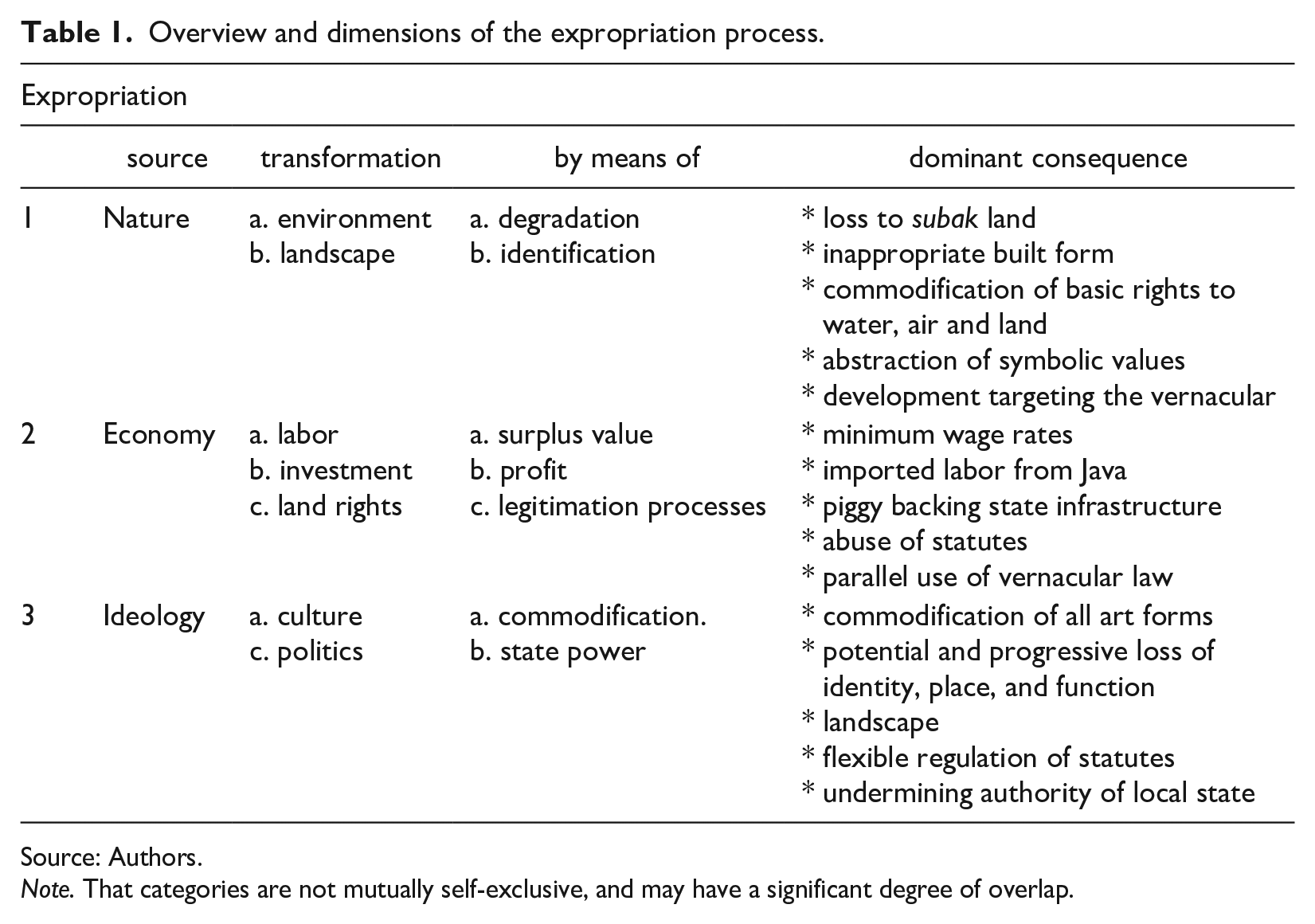
Balinese culture (while attempting to remain the same) is already been absorbed in a multitude of ways into capitalist production (where it is being transformed into capital) (Table 1). This occurs on the basis of invading both the means of subsistence and the means of production through three main methods of appropriation, exploitation and expropriation of resources. While it cannot be stated that appropriation and exploitation no longer occur in Bali, their value as process has diminished as the complexity of modern society has advanced, although farmers have been coerced into selling their land for development through a variety of exploitive strategies that include violence, coercion and deceit (Aditjondro, 1995). But we argue that today expropriation is the predominant method of capital accumulation deployed locally, whereby culture, environment, and economy are equally subjected to the processes of expropriation in multiple manifestations. This logic can also be extended to the non-material sector that includes the service industry and information (Horie, 1991).
Overview and dimensions of the expropriation process.
Source: Authors.
Note. That categories are not mutually self-exclusive, and may have a significant degree of overlap.
Expropriation emerges from two Latin words, ex (out, from) and proprium (property). In its liberal, more benevolent form, “Expropriation occurs when a public agency (for example, the provincial government and its agencies, regional districts, municipalities, school boards, post-secondary institutions and utilities) takes private property for a purpose deemed to be in the public interest” (http://dbpedia.org/resource/Expropriation). In other words, expropriation may be seen as a positive force through which public assets are enhanced, mitigated by state urban planning processes (Suartika, 2010). As we shall see, this can function inversely in Bali whereby both environment and public tax money are expropriated in the interests of private capital, supported de facto by prohibitions over the compulsory acquisition of land. More likely is Marx statement that “The capitalist mode of production and accumulation and therefore capitalist private property have for their fundamental condition, the annihilation of self- earned private property; in other words, the expropriation of the labourer” (Marx, 1954, Vol. 1, p. 724).
There is however another interpretation of expropriation. The process is exemplified where there has been a massive investment in public funds as in major infrastructure projects such as Benoa Bay Toll Road in Bali (Adityanandana & Gerber, 2019). Developers can then potentially expropriate use values created elsewhere and convert these to exchange values gaining massive profits from public assets. The simplest example of this process universally is developers expropriating the value of a public park and/or views by proximal building thus increasing the value of the asset without any cost. Marx uses the term as follows “The expropriation of the agricultural population from the land’ with the disappearance of serfdom and the introduction of feudal title under which their right of property was hidden” (Marx, 1954, Vol. 3, Ch. 27). Today it is not merely feudal title that is at stake. Globalization and the expansion of monopoly capitalism now places the expropriation of the entire planet in its sights, and with it cataclysmic shifts in the social relations of production and consumption (Cox, 2003; Foster & Clark, 2018). These relations will constantly be in a state of flux since “The inner dynamic of the system is governed by the process of exploitation of labor power, under the guise of equal exchange, while its primary relation to its external environment is one of expropriation in Marx’s terms ‘appropriation without exchange’ or ‘without equivalent. . . expropriation thus meant theft of the title to property’—as opposed to the outright appropriation of property by any other means” (Foster & Clark, 2018, online).
Fraser (2016) points out that expropriation as a mode of accumulation can also mean the confiscation of assets that include labor, land, resources and even livestock, also people, their children and even their organs. To this we could add the reserve army of labor required to exist in a permanent state of suspense in order to absorb the fluctuations of the market mechanism that has so far been unable to “trickle down” to their level. Fraser (2016) stresses expropriation in relation to “expropriable subjects” whereby far the most overwhelming example is that of women, whose unwaged labor world-wide is expropriated for free in the necessary processes of social reproduction (Delphy, 1988). She argues that the exploitation of wage labor in commodity production must include unwaged labor as well, labor that is expropriated and “subject to domination unmediated by a wage contract” Frazer (2016, p. 165). Added to this ‘the commodity’s dominion over the economy was at first exercised in a covert manner. “The economy itself, the material basis of social life, was neither perceived nor understood” (Debord, 1967, p. 41). One somewhat radical answer to this situation has been suggested, that expropriating the expropriators would arguably be legal due to the manner in which this has been accomplished—massacre, rape, pillage, fraud, and theft, resulting in massive dispossession, alienation, poverty, and class rule (GSE, 1979).
In any consideration of the means by which capital accumulation takes place, appropriation and exploitation have had dominance in terminology, possibly because their deployment in the violence of ownership is more transparent. In contrast, while the processes of expropriation remain truly capitalist in nature, their fundamental quality is that they are buried deeper and therefore more difficult to identify. Sleight of hand is omnipresent. So overall the governing question is “What are the Hindu Balinese giving up for development in general and tourism development in particular that is most important to them and which can never be fully compensated?” While local culture has developed over time, an overarching assumption in this paper is that proto-feudal practices and ideology still imbues Balinese Hindu society, and it is this consciousness that is also being expropriated, not merely its economic possibilities. While we reduce our investigation to three categories for convenience, we point out that there may be considerable overlap between them. While a resource such as Benoa Bay simultaneously has natural, cultural, legislative, and landscape identities, we will focus in each case on what seems to be the dominant relationship to expropriation. We now turn to the manner in which expropriation plays out in practice in the Balinese context—to nature, to the economy, and to ideology.
Expropriation and Nature
As a case in point, the littoral zone qua nature is Bali’s greatest attraction. But it is also a religious site used predominantly for three functions—melis (to sanctify the deities), nganyut (cleansing after cremation), and melukat (self-cleansing). So the entire littoral zone constitutes potential conflict between the global and the local. The main tourist zones of Nusa Dua, Kuta, and Sanur represent magnets for tourism and development (Gormsen, 1997). In order to give a legitimate and coherent narrative about tourism and the littoral zone, it is difficult to remain within normal academic discourse where the following reflects the truth of the situation. “Finding a common denominator for the variety of outward manifestations leaves even renowned academics with a sense of despair, for neither simplicity nor uniformity are Balinese virtues. The complexity of the Balinese society is notorious. . .. We are dealing here with what I would call ordered anarchy” (Hobart, Ramseyer, & Leemann, 1996, p. 65). Overall, processes of expropriation are probably as close to this “common denominator” as one can get. Examples given below are from Sanur beaches (Segara, Karang, Mertasari, and Sindu beaches) with the implication that illustrated practices are prototypical and widespread. Discussions with Balinese friends and colleagues reinforce the fact that illegal building and development exists within a morass of anarchic social practices. The law is interpreted at will rather than judicially implemented so that involved parties are happy with outcomes for reasons that defy legitimate processes—illegal operations, extortion, bribery, the abuse of statutes, calling in favors, and the extrajudicial sharing of wealth creation.
In Sanur, for example, much of the “real” decision-making is carried out by an informal organization of power brokers called Yayasan Pembangunan Sanur (Sanur Development Committee). The membership includes the kapala desa dinas (head of the government agency), kapala desa adat (village head), kelian banjar (banjar head), hotel and business owners, and other individuals ad hoc. While the committee has no legal authority, its operations are concentrated in such a shifting amalgam of power, social relations, personal favors, and capital that any meaningful analysis would be next to impossible. Just to complicate things even further, there are two independent local ‘associations’ with significant influence, whose activities it would be unwise for us to elaborate, but it is clear that the recent attempt to create a tourism tax on small businesses failed because agreement could not be reached by the Yayasan Pengbangunan Sanur as to who would receive the largest share of the profits. The amalgam of interests between business, local communities, and local government generates a volatile and dynamic process that expropriates and subverts prevailing statutes.
In many cases, only lip service is paid to legal process. Some other brief examples of expropriation are informative. For instance Penyanding constitute members of the community, who exist at the proximity of a development site, and who are asked for an opinion before a development permit is issued by the Local Permit Board). This means that any neighbor who does/does not agree to a proposed development scheme, is legally warranted to object when a development is slated. Interested parties are solicited and signatures sought as was the case with a friend of the authors. One person did not sign. The development did not pass. Later it was revealed that the nonsignatory had built illegally and wanted to avoid discovery, therefore expropriating his neighbor’s rights to develop legally. Paradoxically, the legal process was expropriated by illegal building. In a permitted development next to the coastal mangroves of Sanur, the kelian banjar told the adjacent owner to stop building since development was not permitted (despite development approval). Soon after he was also told by the military to desist since the owner had a surat sakti (powerful letter) which allows individuals to flaunt the law at will. In the gap between the law and social practices, the power of capital prevails, and its influence is derived from its capacity to expropriate existing legislation, customary law, and personal relations.
In contrast, what is written down at a national level dictates planning orthodoxy. Undang-Undang (Indonesian Government Regulation) Nomor 27, Year 2007, in regard to the management of coastal areas and small islands, states in Article 1, point 21 that there should be no development within 100 meters inland from the highest water mark. In other words, the littoral zone constitutes a defined public realm, arguably the only one that exists in Bali. What this means is open to question and the right of access by the public is not stated. In order to maximize revenue from Bali’s tourist development, the national government has designated virtually all accessible Bali coastlines into a strategic zone for tourist development which in national terms is referred to as Kawasan Strategis Pariwisata Nasional (KSPN) (Suartika, 2015). In theory, this not only permits access to the coast across the entire island, it has allowed all forms of development that inhibit or even deny its use as a public realm and is therefore vulnerable to expropriation by development interests (Figure 1 and 2).

Illegal structure adjacent to the high tide mark.
Given that the littoral zone represents both a religious site and the largest concentration of tourism development, this public space constitutes a major ground for conflict through the expropriation by capital of all land on or adjacent to beaches (Low & Smith, 2006). The authority of desa adat is also subject to expropriation where independent committees are set in place to approve or support development. Given the congruence of the capital–state relationship and the banjar’s lack of resources, the temptation for the banjar to support projects is significant, particularly when some “sweeteners” can be added to the process. Membership of local committees by banjar leaders can contribute to the legitimation of private sector actions. Meetings and agendas are frequently controlled by business leaders with the result that traditional values, national legislation, and common sense are eroded. Recent construction on, for example, Sanur Beach is flagrant and in breach of the law, and buildings are now constructed directly onto the sand using reinforced concrete piles (Figures 1 and 2).
Supporting this process is the private policing by business interests along the coast, where the assumption is that large hotels can expropriate the beach and police it in the interests of their clientele. This has the effect of alienating the Balinese from the use values of their own landscape by passively expropriating use rights through the deployment of private security who have no real awareness that it is their actions that are illegal. They enforce an exclusion zone without the right to do so, but clearly with the passive consent of the banjar/desa adat. It is transparent that much of the expropriation of public beaches could not have happened without the alignment of banjar politics with the agendas of capital. Instead of protesting uncontrolled encroachment, frequently it is actively supported by banjar complicity, paradoxically acting against its mandated role as custodian of tradition. This is supported at least in part by the expropriation of information or more simply “insider trading.” Members of government departments at all levels are owners of a variety of tourism-related businesses as was the case with the former governor of Bali Bapak Pastika (Cole, 2012). This suggests that the state (government) itself is inadvertently complicit in the overall process of accelerating the extraction of capital from the littoral zone.
Overall the desa adat must bear a large portion of the responsibility for the blatant infringement of Indonesian legal statutes and the expropriation of public space. At the same time, the expropriation of customary sanction has not only assisted capital formation but has undermined the communal responsibilities of desa adat. In other words, banjar have expropriated their own social capital for purposes it was not intended to serve. This has resulted in the symbolic value of places being eroded in the interests of development across the entire littoral zone (Suartika, 2015). But expropriation by capital is not limited to the land. For example, the Segara Beach is rapidly being occupied by ferry transport to outer islands with its religious functions being displaced to alternative sites. In Sanur and associated beaches, ceremonial and religious functions have had to migrate north to a black sand area known as Matahari Terbit (which is also getting swamped by tourist activities).
Expropriation and the Economy
In this context, arguably the dominant example of the simultaneous expropriation of tax funds and degradation of the environment is that of infrastructure built to support the circulation of commodities, labor, information, and resources in the interests of capital accumulation. The most outstanding example to date is the Bali Mandara Toll Road (also referred to as the Nusa Dua Ngurah Rai Toll Road), a 12.7-kilometer, elevated road that was opened in 2013. Its stated purpose was to improve airport access and direct traffic to the prime tourism center at Nusa Dua. Nonetheless questions related to its location remain. Since the bypass could have been located much closer to the coast, its current location conveniently allows space for development to take place on either side. It is therefore difficult to conceive that the expansion of the toll road to include significant development by its location and excess capacity were not always implicit. In other words, the capacity of business to expropriate value from the proposed scheme was inherent in the design concept from its inception, but was presented simply as a tourism transport problem. It conveniently allowed the proposed development of a dozen or so islands on reclaimed land in Benoa Bay on either side of the bypass. The developer Tomy Winata and his privately owned PT Tirta Wahana Bali stand to gain USD 2 billion in profits from reclamation alone since “Reclamation circumvents exorbitant land prices in the south. One hectare currently costs up to US$ 7 million and the price for 700 would total about $5 billion. Winata would save at least US$ 2 billion on the total cost of the US$ 3 billion project” (Cassrels, 2016). While the original development permit expired in August 2018, a new one was issued in November. If finally approved based on an amended environmental impact study, this would constitute arguably the largest development project in Bali’s history (analyzed in Suartika et al., 2018; Wardana, 2019).
What was not mentioned in that article, however, was the detail on how exactly such expropriation took place. Clearly the development could never have been realized without the expenditure of IDR 2.4 trillion (USD 220 million) in state revenues, with Winata “piggy backing” on top of state funding at no cost to himself. While final approval has not yet been given, the overall project would have multiple serious side effects. First, there will be the irreparable damage to the fragile ecosystem of an extremely sensitive tidal estuary (Wibawa, 2017); second, the impact on the economy of villages surrounding the bay; third, local culture and community would be affected, where the life of 150,000 people will be disrupted (even flooded) along with 70 religious sites. The community reaction has been immense, and hence the phrase tolak reklamasi (against/refuse the reclamation). The phrase is now a household mantra and marks a new threshold in the politics of expropriation in Bali. If the project is finally approved, it will be so huge and destructive to the environment and community that opportunities for similar expropriation by other developers will be impossible. Winata not only expropriated IDR 2.4 trillion in tax monies, he also monopolized it in such a totalizing manner that all other expropriators have themselves been expropriated, and will likely be excluded from the rampage. How this can happen is a matter of speculation, but one possible cause is due to the devolution of power in the National Act of the People’s Assembly (Ketetapan Majelis Permusyawaratan Rakyat) No. XV/1998 in regard to local autonomy, whereby “the head of each regency, via its administration, has total authority, often bypassing the role of the provincial government in making and enforcing regulations and policies . . . every regency can make its own rules. . .. In Bali, this system results in planning chaos, with no consistency” (Karazija, 2012, p. 2). The consequences are that the governor being unable to address significant planning problems “being stymied by autonomous regencies which not only compete with each other for handout money but whose very survival is dependent on funds from development licenses, fees and taxes—and, of course, the eternal bribe windfalls from granting inappropriate development permits” (Karazija, 2012, p. 2). While more democratic arrangements then became possible at the local level, the cost of being unable to resist projects that are threatening to Balinese ideology, culture, and traditions as a whole has decreased substantially.
Another significant example of expropriation is that of subak, traditionally the predominant means of subsistence across the island. The traditional subak system in Bali faces an average loss of 1,000 hectares a year to development, predominantly the result of improving tourism infrastructure (Hauser-Schäublin, 2003). Here three factors are significant. First, we have the appropriation of productive land; second, the appropriation of the monopoly over rice production itself; and third, the states land use policy. In the first case, developers have appropriated the right to land containing a water source, but have then expropriated the traditional rights of affected farmers (subak). This renders the land useless for wet cultivation but available for development. In the second case, rice farming has also effectively been monopolized by big capital. Traditionally, farmers could use their own crops to seed the next harvest. This is now not possible since farmers have traded their own “fertile” rice for an “infertile” substitute. Most have traded in the capacity to reproduce their own means of subsistence for grain bought from multinational companies, who offer a package of grain plus fertilizer, and where the rice provided as a seed crop cannot be used to reproduce itself. This is obviously a trade-off, since the grain is pest resistant and potentially has a higher yield, despite the fact that sustainable agriculture contains many possible alternative strategies. Third, this situation calls into question whether the planning system is in collusion with capital (in allowing this to happen). Most agricultural land is also zoned as green open space (ruang terbuka hijau). This implies the land cannot be developed although rights over it are privately held. In reality, however, green open space has been frequently developed to accommodate various functions. Of course, such practices are not done legally with proper permits. When proof of development consent is required, it must be obtained by illegal means such as bribery, close social connections with government officers in charge, or the development is sanctioned by “powerful” officer/s at the higher administrative/official level. So the island’s unique agricultural history is put up for sale by the legitimating system made for its conservation.
Expropriation and Ideology (Vernacular Culture)
When we talk about vernacular culture, we refer to the material reproduction of tradition. In contrast, however, another reality profoundly affects Balinese vernacular culture that should not go unmentioned. A parallel world to the material envelops the return of the dead, prophesy, magic, premonition, inexplicable events, sorcery, ghosts, and “the eternal passage of the soul” (Hobart, 2005, 2011). These beliefs and practices lie submerged below the level of material culture. Yet they also structure daily life, lying beyond material culture and the somnambulant nature of the tourism experience (Urry, 1999). While culture historically remained outside the purview of private capital, the pillaging of cultural histories is now a necessary part of expropriation. While a cultural history cannot be bought, it can be expropriated in terms of its traditions—everything from language, ceremonies, landscape to architecture and art forms, and in the case of Bali, even agriculture. These cultural forms now fall within the orbit of capital accumulation, by adding symbolic and material value to commercial development, real estate, advertising campaigns, guided tours, exhibitions, etc.
The expropriation of culture extends from the use of traditional symbols on placemats in restaurants to the Garuda Wisnu Kencana monument—145 meters in height, the largest statue in the world, and slated to cost 4 trillion rupiah (USD 276 million). It is located in a “Culture Park” of 240 hectares, which not only commodifies Balinese culture, it is packaged for sale in a variety of forms, from the use of Balinese Gods—Wisnu, the origin of wisdom, or moksa (enlightenment) riding on the back of Garuda (eagle/big bird), symbolizing the overcoming of earthly bonds in seeking tirta amerta (holy water). The concatenation of images and symbols in the park support the idea that “good brand development must be made. . .by positioning the brand in the mind of the consumer or target market accomplished through segmentation or the act of identifying, profiling and dividing a market into smaller groups of buyers” (Putra & Desiana, 2013, p. 455). So the entire project is an exercise in cultural expropriation for brand development and profit. While we know that expropriation not only applies to people, processes, and objects, it is as much a semiotic process as it is material (Putra & Desiana, 2013). Here, cultural meaning is also being expropriated—so symbolic values are diffused, commodified, transformed, and potentially destroyed. All of this is in interest of “branding” Bali for tourism consumption (Hobart, 2011).
As a major cultural icon, the landscape is also expropriated in a plethora of transformations, predominantly to add value to tourism development where vistas count as capital. This applies to Garuda Wisnu Kencana that can be seen from a great distance as an advertisement for the park, which in effect expropriates the landscape for itself. Overall, many development permits have been issued, giving the green light for all kind of developments across the island, many of which deliberately ignore cultural mores, particularly sacred sites and other attendant religious prohibitions. For example, temples are iconic cultural symbols, and have a recognized “no-go” zone depending on the temple hierarchy and determined by their right not to be overlooked. As in all things Balinese, prohibition in this context is extremely complex, since conditions vary from temple to temple, and are established by Bhisama Kesucian Pura, the law (consensus) in regard to the physical boundary of the holiness of temples, which is administered by Parisada Hindu Dharma Indonesia—the Indonesian Hindu Religion Board. It is a law (consensus) amenable to abuse.
So even the cultural landscape is expropriated by hotel developers, where prohibited views over religious sites have value in the salability of rooms; for example, at the Mulia Hotel and Trump Jr’s potential new development overlooking the Tanah Lot Temple. The same expropriation occurs at Jatiluwih, where the landscape of rice terraces are world famous, not only the views are captured, but a recent helipad has been built for tourism access, presumably giving rich tourists a better vista, that would clearly destroy the tranquility of the site they came to visit (Figure 3).

Jatiluwih rice terraces: A World Heritage Site.
The landscape is also expropriated through the legal system. Legislation is expropriated in construction, where building permits are issued but details are ignored. Frequently the rule over building height is freely interpreted, as in the Mulia Hotel, in theory limited to four stories but where five to seven stories have been incorporated into the structure, a major temple is overlooked, and building encroaches on the beach (Figures 4 and 5). In the Bali Hilton Resort (previously Nikko Hotel), the accepted building height of four stories was taken as datum, and a further eight stories added by building down the face of a cliff to a now formed private beach, simultaneously expropriating legislation and public space (Figure 6).
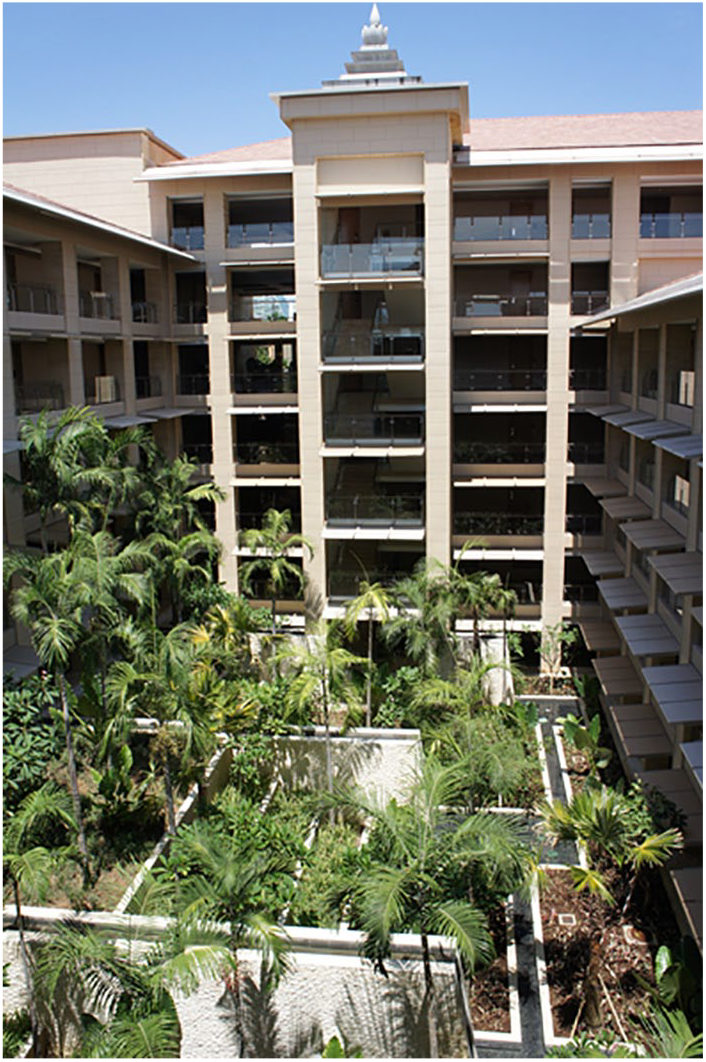
Mulia Hotel illustrating building outside the code.

Mulia Hotel encroaching on the beach.

Bali Hilton Resort (Nikko Hotel) four stories above datum and eight below.
Conflict and Resistance
Resistance to all of the above has condensed into what Castells termed “Urban Social Movements (USM)” in Bali, which are traceable to historic and cultural origins in civil action against oppressive forces (Castells, 1984, 1989). In addition, the changing paradigms of USM have morphed in conjunction with the informational city and the use of the internet as the key medium of communication, which has affected the scale of local protest (Castells, 1989, 2015; Cole, 2006; Edelman, 2001). In preference to being humiliated in surrender, the Balinese have in the past adopted a defensive attitude of fighting till the last drop of one’s blood, known as puputan. Notable puputan occurred in 1906 (at Sanur) and in 1908 (at Klungkung), where 100 people were killed by the Dutch (Wiener, 1995). Both cases were examples of mass resistance against the perceived abuse of power. Since then things have been quieter. Arguably the first major USM in recent times was over the Bali Nirwana Resort in 1991 (Warren, 2000). This was followed by objections to the construction of Garuda Wisnu Kencana Cultural Park (Putra & Desiana, 2013), and opposition to the plan to redevelop Bali Nirwana Resort into a new tourist accommodation by Trump Jr and his Indonesian business associates. Recent protests over Benoa Bay reclamation recently mobilized 30,000 Balinese, by far the largest to date. At the moment both the Benoa Bay and Trump Jr projects have been suspended (Suartika et al., 2018). There is no doubt that the Balinese are becoming more militant about the threats to their way of life as a result of developments from which they gain few material or spiritual benefits.
The new politics of conservation via USM in Bali must rate as one of the most positive developments to date. Given the above examples, the processes of expropriating Balinese culture have not gone unnoticed, and the most flagrant abuses of power have been reflected in the growth of USM. Recent USM constitute a revealing thermometer about Balinese ideology and identity, since much redevelopment combines profane action against religious sites, the destruction of the natural environment, ecological action in the form of flooding, damage to existing communities or the expropriation of state resources, and the legitimation process. What is interesting, however, is the perpetuation of the idea that the dynamics of most USMs revolve around the inadequate provision of items of collective consumption. To date collective consumption has eluded any form of protest in Bali where all USMs have focused on culture qua religion. Given that every dimension of social welfare is seriously inadequate and poverty widespread, this is somewhat surprising. Overall, any instrumentality to ameliorate their own material conditions of existence by the Balinese is missing from the equation.

Potential conflicts between globalization and the vernacular. Inner section rotates to indicate four dominant conditions.
Conclusion
Given the three intertwined economic functions of appropriation, exploitation, and expropriation, it is clear that expropriation is useful not merely as an abstract economic category but also one that fits snugly at the center of development processes, informs action, and is arguably the current driver of vested interest. In Bali the processes of cultural abstraction and the need for accumulation by such means provides us with insight into the extent, deviousness, and complexity of the sleight of hand that accompanies expropriation. It applies to the expropriation of landscape, land rights, access to land, rights, cultural sites, and much else. If we follow Picard’s suggestions, it even applies to Balinese identity itself. Clearly national and local government are not wholly compromised and between the lines, advances are being made, so we do not wish to suggest a return to “The New Middle Ages” (Eco, 1987). Nonetheless the resulting clash of ideologies based in proto-feudal and vernacular local culture have begun to mobilize Balinese people to an unprecedented level, indicating that improvements are insufficient and tardy (Suartika, 2019; Suartika & Saputra, 2019). But despite the apparent focus on religion qua ideology as the bedrock, and the prevalent consciousness of ethnicity and caste as social divisions, it is clear that more substantial distinctions must be made (Hobart, 2015). Marx made clear the difference between class in itself and class for itself (which unfortunately he didn’t elaborate upon in later writings though it informs all of them). Marx, however, eliminates a most important aspect of group formation: group belongingness is established by an objective conflict situation, in this case, a conflict of interests; but only by experiencing this antagonism, that is, by becoming aware of it and by acting it out does the group (or class) establish its identity. An ideological focus on expropriation will hopefully fulfil this expectation, expanding to include a better material life for all.
Footnotes
Acknowledgements
The authors would like to acknowledge the considerable help they have received from the insightful reviews by Dr. John Zerby as well as the funding from Udayana University research grants in completing this article.
Declaration of Conflicting Interests
The author(s) declared no potential conflicts of interest with respect to the research, authorship, and/or publication of this article.
Funding
The author(s) disclosed receipt of the following financial support for the research, authorship, and/or publication of this article: The authors received financial assistance from Udayana University, Bali and from an Indonesian Government research grant.
