



Abstract
Drawing from multisite ethnographic research conducted at four Canadian UNESCO World Heritage natural sites, this writing focuses on the geosocialities of fossils and argues that fossils are alive: vitalist matter capable of affecting and being affected by the geosocial meshworks in which they are entangled. In the present writing, these relations are explored through more-than-representational ethnographic fragments intended to enliven the geophilia of fossils by underscoring the way they are animated through affect, memory, performance, narrative, possibility, and imagination.
The UNESCO World Heritage list is comprised of 1,121 sites: 869 cultural, 213 natural, and 39 of mixed natural and cultural significance. Canada has ten of the 209 natural heritage sites. Four of these ten are sites recognized for the outstanding universal value of how their fossil deposits reveal unique information about geological eras. These four sites are Dinosaur Provincial Park in Alberta, Joggins Cliffs in Nova Scotia, Miguasha National Park in Quebec, and Mistaken Point in Newfoundland. This paper share narratives about some of the fossils and people living at these sites. We use the word “living” deliberately as we think of fossils as alive: vibrant, vitalist matter capable of affecting and being affected by the geosocial meshworks in which they are entangled.
In what follows, we will attempt to understand fossils through three ethnographic fragments. This is an approach that entails encountering people who care about fossils and listening to their stories; people whose narratives, memories, and actions enliven fossils and the places they inhabit. This is an approach that allows us to animate an affective ecology entangling fossils and people. We will refer to this entanglement and affective connection as geophilia. In his recent essay on geophilia Cohen urges us to think about how “the lithic inhabits the secret interiors of the earth” (Cohen, 2015, p. 19). Enchanted by the appeal of that secrecy and its affective power, we characterize geophilia as a life embedded in and emergent in the vibrant materiality of fossils and fossil landscapes. Our three short ethnographic fragments will thus portray geophilia as an ordinary affect that is vibrant with a unique lithic vitality.
We are among a very small number of geographers and ethnographers who have dedicated empirical research attention to fossils (Breakey, 2012; Clark, 2017; Elden, n.d.; Ferraby, 2015; Slater, 2011). In writing about fossils, we hope to alert others to take greater notice of the importance of fossils and fossil sites around the world as we believe that studying how fossils are alive is particularly revealing of broader more-than-human natures.
Our research at fossil sites is part of a bigger multisite project, focused on the significance of natural heritage and wildness worldwide. For our broader project, we have conducted over 200 interviews at 19 UNESCO World Heritage sites worldwide. We base the present writing on fieldwork conducted in 2017–2018 at the four mentioned fossil sites where we conducted 34 interviews with people living and working at and near the cliffs, beaches, and badlands where fossils are found. We approached each of our interviews as an open-ended way of understanding how fossils mattered. Whenever possible, we asked our interlocutors to lead us to the places where they connect with fossils. As part of these walk-along interviews we strove to relate to fossils ourselves. Due to space limits in this paper, we only present ethnographic material from three of the four mentioned sites and we portray such material through in-depth fragments that portray certain individuals in vivid detail.
The three fragments are presented in a subjunctive, more-than-representational style. This is an ethnographic writing style intended to animate and provoke; to enliven what things could be and what they could become through performance, possibility, and imagination. In this sense, we are not interested in treating our interlocutors as a representative subset of our sample. Rather, we view our encounters with them as ruptures in the way we ourselves thought of fossils before; ruptures that may in turn allow our readers to re-imagine fossils—to understand not so much what they are, but what else they may be. Our writing and organizational style is therefore unconventional and is intended to be affective, and to generate rupture, re-envisionings, and atmospheric moods.
The Rock Cycle
“There was a time that you could actually take fossils from the beach. I have a small collection of my own. But, you’re not allowed to do that now,” Len tells us with a quiet hint of nostalgia in his soft-spoken words. “But I still come down and I still look.” He pauses and turns around to look toward the cliff in the distance. “Anything important, I’ll pass it over to the museum up there.”
Len is the son of Don Reid, the man who was known around Joggins as the “keeper of the cliffs.” Don Reid died recently, at the age of 94 years. Don was a miner, not a paleontologist. He would go to the beach, look for fossils, and bring them home. He started as a young boy and never stopped, Len recounts. “He did that until the day he died.” The wound left by his departure is still raw.
It’s a hazy summer day. We are about a half mile away from the main beach where on every summer day the museum leads small groups of visitors on short guided tours. We to stroll on the beach in search of fossils, unhurried. “It’s very peaceful for me to be here, relaxing,” Len reveals as we walk just steps away from the Atlantic waters. We are alone here, away from the visitors and the guides, alone with the fossils and Len’s memories of his father. “People, geologists, paleontologists, scientists—they would come here and they’d ask him questions,” Len recalls. “And he had questions of his own too. That’s how he got his education.”
Over time Don collected enough fossils and enough knowledge to open a small private museum in the family house’s backyard. “So many people came to see it that the community decided to build a bigger one. So, they built a bigger one on Main Street. He ran that for a number of years. Then he decided, ‘Well I’m getting too old for this.’ So, he passed his entire collection over to this new museum that was just recently built.” Len stops to collect his thoughts, his eyes gazing at the waves softly hitting the shore at low tide. “That’s how it all came together.”
Joggins Cliffs was inscribed as a UNESCO World Heritage site in 2008. That was a big day for the Reid family as Don had played an instrumental role in getting the UNESCO recognition. Joggins was once a booming coal mining town. But like it happened elsewhere in Atlantic Canada, the mine eventually shut down. People and business started moving away. Only a few hundred people remain today. “So, I guess being a World Heritage Site meant people would be coming back,” Len reflects pensively.
“Has it turned out that way?”—we inquire.
“I think eventually it will. It’s not happening as fast as I thought. I thought that perhaps there would be more souvenir shops, cafes, and that sort of thing. That’s coming slowly.” But all of that seems to matter little to Len. The fossils aren’t commodities for him. The reason why he comes down to the beach is different. “It’s for peace,” he says. “I can come down here and not see anybody for hours. I come here in a bad mood and when I leave, that’s gone away.”
Highway 242, coming in from Maccan, intersects with Pit Road and eventually with Lower Cove Road, and that is where the town of Joggins comes together. Reid’s General Store is there, just down the road from the Crab Apple Inn—Joggins’ only hotel—and Fundy Treasures Gifts and Tours up the street. The new museum and visitor center is a short walk away, confidently perched above the cliff facing Chignecto Bay, part of the Bay of Fundy. There are no Starbucks here, not even a single Tim Horton’s coffee and donut shop in a 35-km radius. But there are millions of fossils. And alongside Len Reid, Brian Hebert—the guy behind Fundy Treasures Gifts and Tours—is arguably the one man alive who has connected with most of them.
“I started when I was 12. I started quite late,” he tells us as we hike the northern side of the beach. Brian is in his 30s now (see Figure 1).

Brian on the beach.
My dad was very much an outdoorsman. I found a set of tracks on the beach one day with him in rock, and it really caught my attention. And then I found a tooth. It was my first fossil ever. And I found a fern, and all these really amazing little fossils for someone that’s 12 years old that really didn’t know how they formed. So, I went to the library. I really got interested in scientific papers from the beginning. I think that helped me develop the obsession I had with them, because I was seeing things that were found in other countries, in other continents, and were similar things to what I was finding here.
Brian is known among geologists doing research at Joggins Cliffs for being an indefatigable and inextinguishable resource of knowledge. His thoughts race as we scrutinize rock after rock, just steps away from the cliff. The tide is dropping so we decide to push further. Brian tells us we’re in a very special area, it was here that he remembers finding his very first set of footprints. We pause to take a picture. “These rocks weren’t like this,” he says. “This is eroded back far enough for us to see all this. The cliffs here erode quite quickly. In certain areas around the corner, there’s 20 feet of erosion sometimes where it’s very sandy. So, we’re constantly looking for new things.” Brian picks a rock made of limestone and starts knocking it apart in search of fossils it may reveal. He tells us that some of his favorite fossils are hidden in limestone.
Remember how I said Joggins was like a coal swamp at one time? So, imagine this one hundred-kilometer-wide coal swamp, like a basin. And over here are the Caledonia mountains which are more like hills, but back then they were as big as the Rockies. All that sediment coming down into these rivers are over-flooding the banks. Anything that’s on the ground, be it a dead animal or a plant, would get buried time and time and time again.
Brian’s own animated manners seem to make the earth around us come to life. He goes on: At one time this was sand. So, under compression and the depth, it’s turned into sandstone. And then eventually this will erode back into sand and the rock cycle starts over again. As a kid the rock cycle really impressed me. Being able to take a rock and break it down and have it turned into something else, and then heat up and turn into something else, and erode and turn into something. It’s . . . yeah.
The rock cycle. Things turning into something else. And then into something else. And it’s still doing that under our feet, before our eyes. Just like the ripples made by the tides, Brian tells us.
They form the same way they do now as they did millions of years ago. There’s a term for that and I learned this as a kid, and at the time it was the biggest word I ever knew. It’s called uniformitarianism. It means things that formed the way they did millions of years ago are still forming the same way today.
We follow Brian’s gaze as he turns back toward the cliff. He points to a large tree with a swinging root sticking out of the cliff. It is not a normal tree; it is a fossil tree. “It’s a Lykopod tree,” he explains, “it’s one of the largest ones in Joggins history. It just showed itself just over a month ago and you’re one of the first people ever to see it.” It “showed itself,” he says, as if the tree was in the mood for some new company.
Like everything else, that tree could be there for a while, and it could be destroyed by the tides, Brian explains. Everything moves, everything shifts, everything gets re-assembled. “Three to five days and it could be gone. Nobody will ever see that fossil again,” Brian predicts. And that is the way it’s always been.
The cliff is constantly eroding and there’s new fossils all the time. Also, on the edges of them, where they curb up, there’s trackways. It’s like the sides of the river where the water doesn’t reach: the animals might be walking along—salamanders and reptiles—and then the sun comes out, bakes that, and then the river will kind of slosh around and more sediment will flow into those little prints and they harden. And then another one will go across again, so every layer has little tracks going along. Eventually they may become fossilized. And when you split them open like a book, you can see those tracks. If you think about that, in that small little section it’s a specific thing that happened in time. And if they’re well-preserved, you can tell the speed of the animal, the size of the animal based on the size of the tracks, the spread, and the pace. It’s pretty incredible stuff.
***
Palsson and Swanson (2016) call the entanglements of the earth with multiple forms of life geosocialities. Geosocialities are not only material, organic meshworks of geological and biological lives but also co-minglings of the multiple sensibilities inherent in those forms of life. Examinations of geosocialities are sensitive to issues of distributed agency, the vibrancy of materials, vitality, and affect. A study of geosocialities opens reflections on nonlinear geologic time scales and on how human and non-human lives are enmeshed in relations of becoming that exceed the limits of present time and space. As Palsson and Swanson (2016, p. 155) put it “geosocialities are always down to earth, grounded in particular encounters, and they also draw attention to questions of scale. They attend to the intertwinings of bodies and biographies with earth systems and deep time histories.”
“The vastness of geologic time is. . .incomprehensible” and interestingly, observes Hugh Raffles (2012, p. 526) it also feels somewhat “banal.” Such banality is perhaps best revealed by the ordinary affective way in which people like Len and Brian so habitually, so mundanely seem to relate to deep geological time. It’s that simultaneous incomprehensibility and banality that appears to slow down Len’s days, burying his bad moods, allowing for relaxation. It’s the liveliness of fossils—their animated elán vital under his very feet as he walks on the beach—that energizes Brian every time, invoking his enchantment. Perhaps this is what’s most incredible about it all; that fossils, seemingly so inert, can do so much.
What can a stone do?—asks Raffles (2012). And, relatedly, what can a fossil do, we ask. Brian and Len teach us that a fossil can heal, and it can calm. A fossil can remind us, and it can teach us. A fossil can open up a path into a deep past that can only be activated by the most fertile imagination, the most insightful geological reconstruction. “A fossil is a time traveller and a spark,” Cohen (2015, p. 19) argues, “an interpenetration of epochs.” Plucked from its bed and brought into a home or a museum, a fossil can bring a dollar to a home or a town. A fossil can help people become friends; it can bind together a parent and a child, a dweller and a place. A fossil can knot the mineral and the bodily.
Geophilia can take many shapes. Rocky cliffs and the fossils they host can be loved for the way they cement a bond between two people together, or one person with the immensity of time and all of life. Fossils can also be loved for the way they embed us into a place, ensconcing the geo-genealogy of our life within the earth. And they can also be loved for the way they bring memories to life. In this sense, fossils are more than the natures they reveal. As “petrified remnants that upon excavation start moving again” (Cohen, 2015, p. 99) fossils engender new geosocialities through old and new stories told and retold about them. Through these narratives, fossils remind us of the presence of life, and they yield traces of the absence of that life from modern times.
As people like Len and Brian pick up a fossil from a beach and wonder about the presences and absences it may reveal, they perform the memories of a nonanthropocentric past, evoking actual and possible resonances of deep time. As they crack a rock open they hold material memories into their hands, apprehending the past by engaging with its solid materiality and its capacity to be opened-up like a book. In this manner, fossils open a world not to firm fact but to malleable possibility, not so much to historical evidence but to the potentiality of narrative.
Edensor (2012) argues that its relationality is such that a stone is not fixed, finished, or bounded, but rather a growing knot tying together eternal flows of multiple time scales. The same can be said of fossils. A fossil is forever exposed to erosion, the breaking of rock into multiple pieces, the flow of tides. Like a stone in a building, a fossil in a cliff, in a basin, or on a beach slowly but continuously sheds and takes on previous and new incarnations “as it becomes repositioned and resituated within a host of changing co-constituents and agencies” (Edensor, 2012, p. 449). In this manner, a fossil exercises its properties and capacity to change connections, to make and remake places, revealing and hiding the historical depth of its actions. What may appear to us to be slow movement is temporality on a scale that we humans are simply not accustomed to, reminds us Brian, yet it is an ecology in which everything moves, everything shifts, everything gets re-assembled.
Geophilia is enchantment with such animacy, such fervor, such vitality. “Geophilia is the lithic in the creaturely and the lively in the stone,” writes Cohen (2015, p. 19). “Expansive, dilatory, recursive, semicyclical from a long perspective, full of residuum, temporal intimacies, intermixed strata,” he continues, “geophilia entwines the modern and the ancient, the contemporary and the medieval, the primordial with expansive futurity” (2015, p. 21). In relation to fossils, geophilia finds itself connected to the multiple temporalities of earth’s lively inhabitants—inhabitants whose organic lives become inscribed onto the surface of fossils. Fossils are traces from different times whose imagined recollections spark “a play of temporal juxtapositions that incites an improvisational and fragmented account rather than a sequential narrative” (Edensor, 2012, p. 450). Therein lies the thrill. Fossils have left us with fractured traces, blurry memories we can’t quite remember, which yet we wish to recall.
The Beauty of the Rocks
Like the landscape at Joggins Cliffs, there isn’t much to the narrow strip of beach below the Miguasha Cliffs. This isn’t a place for sandy holidays, for sunbathing, or snorkeling. Yet, that quiet, pebbly bay facing where the Restigouche River bends southwest, separating Quebec’s Gaspé Peninsula from New Brunswick is where many of the Plourde family’s memories still live today. Like Don and Len Reid did in Nova Scotia, Ralph used to come to the small beach at Miguasha to look for fossils with his dad, Clyde—just like Clyde did with his own dad and Ralph’s grandfather, Anthony.
Now retired, Ralph spent most of his life in nearby New Richmond working at a paper mill. His father Clyde was a fisherman. Even in his adult years, Clyde and Ralph would come to the beach at Miguasha to look for fossils, like they had done for years when Ralph was a child. Ralph laughs as he tells us the story about he asked tourists to pay 500 dollars for a fossil. People could freely collect them from the beach back then. When he found out he had sold a good one his dad told him, “My God! I should always ask you to make the price from my fossils! I’d be rich!’”
Over time the Plourde family became well-known for their fossil expertise not only with tourists but with researchers too. Years ago, Ralph’s grandfather Anthony began a friendship with the then-renowned Scottish archaeologist Hugh Miller and later with other visiting fossil researchers. Anthony, Ralph tells us, used to pick fossils and bring them home. And the people around here would say, “Well, Anthony is picking rocks again, why?” But he would continue to bring them to the house and talk with dad, his son, and he would say “well they won’t laugh at me one day. People are going to find that they are very important and that they’re going to be looking for these fossils!” And here we are today.
Miguasha was inscribed on the World Heritage list in 1999 as the most outstanding fossil site in the world for the way it represents the Devonian period known as the age of fishes. Many of the fossils still preserved, studied, and displayed today were found by the Plourde family. Clyde in fact donated his collection to the Université Laval and in turn the museum, and later worked for the museum—very happily, Ralph tells us—for a few years before he died.
As we continue strolling on the beach, with Ralph looking by his feet scanning for fossils, he tells us that his dad had the “pif” to find fossils; what in Quebecois French people call the “nose” (see Figure 2).
He’d walk on the beach with archaeologists and they’d walk on the fossils and they’d look at dad and they’d say “well, Mr. Plourde, did you find anything?” “Well, I found two or three!” “But Mr. Plourde, we never saw you going in the bank!” “Well,” he’d say, “you were walking on them!” Dad just had a pif to find them. Me and him would walk on the beach and he’d say “you see that concretion there, Ralph? Can you go up there and get it?” I was 12–13 years old. I’d just run up the bank and he’d say “don’t throw it down there. Just let it slide down the bank.” And he’d open it and it was a fossil almost every time.
As the memories flow, Ralph’s eyes light up, “Yeah. It was beautiful. At the time I didn’t see how important it was, but it was. When my dad passed, oh God. He was my chum, my friend, my fossil, it was everything.” In 1951, archaeologists realized that the Plourde’s had found a fossil no one had a name for. To honor the Plourde family, Swedish paleontologist Tor Ørvig named a Miguasha placoderm Plourdosteus. “My dad was my friend, my buddy, my pal,” he tells us with a soft smile.
I mean I was always behind him, and I was the only boy in the family. And if he went in the woods, I went in the woods. And if he went fishing for salmon, I went fishing for salmon. I was always with him, you know. We passed our life down here. We’d run in those banks and we’d make bonfires and we’d cook fish on the beach. I wouldn’t trade my young life here in Miguasha with no one. You know, it was paradise. We’d grab a sleeping bag and sleep on the beach and whatever. It was wonderful.
“What do you think you dad would say to us if we asked him what’s special about this place?”
“He would probably say that he wouldn’t trade it for anywhere, any other place,” Ralph answers.
He just loved what he did, and he dug fossils and he lived one day at a time. He used to come down to the beach here and pass hours and hours and hours. And just sat there on the beach and my mom would say “go down and see what your dad’s doing!” I’d come down. I’d say “Dad: mom told me to come and see what you were doing.” He’d say “I’m not doing that much. I’m sitting on the beach and I’m looking at the beauty of the rocks.’”
Pif.
***
Fossils are petrified remains of organisms who began their life millions of years ago. Geographers like Ferraby (2015) have shown that fossils’ lives continue to this day. Many people around the world collect fossils and bring them into their homes and gardens while others collect them to sell them for profit. Regardless of motive, fossils hold distinct meanings for different groups of people, meanings that transcend their scientific value. From “devil’s toenails” to “snakestones,” fossils have often been valued by people for their magical and medicinal properties for a long time (Cohen, 2015). These kinds of connections show how fossils hold a personal and intimate value, connecting lives of humans and non-humans over geological time (Ferraby, 2015).
When multiple generations within a family are involved in collecting fossils, stories, memories, and personal bonds become materialized in the fossils themselves. Thus, unlike the fossils which we may observe for the first time in a museum exhibit, fossils found and collected by people like the Plourde or the Reid family are alive with the passions, intentionality, memories, and intimate ties weaving them with the lives of their human companions. “This human link brings these assemblages of stone to life in a way that reflects the cultural and geological, and the inspiring inter-weavings that form between them,” argues Ferraby (2015, p. 189).
Our encounters with people like Len, Brian, and Ralph show the depth of the geosocial connection among people, places, and rock, a depth made all the more meaningful by their knowledge. This is an especially profound affective ecology because of the intimacy of such place-based knowledge, an intimacy that shows how humans are “not distinct from materiality but are actively and passively imbricated in its continuous emergence” (Edensor, 2012, p. 448). It is such continuous emergence and relationality that contributes to the vitality of fossils. As a kind of rock fossils may seem still, quiescent, and unmoving, but they are “aquiver with an activity that is usually imperceptible to humans” (Edensor, 2012, p. 449). Or at least, most humans. Our encounters with Brian, Ralph, and Don alert us to the capacities of fossils to affect people, to exercise a vitality emergent in their constant entanglement with human and as non-human lives.
Fossils are like rocks, but they are different from them. Fossils are alive with a distinct vitality that no ordinary rock can possess. Pick up a fossil, Brian teaches us, and you will feel the will of a wildlife that wants to persevere. This is a life, a wild life—whether a tree, a fish, a bug, a dinosaur, or whatever—that in its petrified form is still striving to persist. A fossil is a type of conative nature: a wild, uncanny, and ornery thing with the power to continue its own life (Bennett, 2009). Even as a fragment disjointed from the totality of its body, a fossil retains a vital materiality that can never vanish. This kind of vitality tells us, is “the curious ability of inanimate things to animate, to act, to produce effects dramatic and subtle” (Bennett, 2009, p. 6). A fossil, to borrow from Bennett is perhaps neither alive nor dead but “ontologically multiple” (2009, p. 8): exhibiting a vital materiality that hints at the animate (and its death), hints at the vegetal and animal (and its petrification), and hints at its kinetic power (and its stillness). More than just a trace of a bygone ecosystem, more than a memento, a fossil is continuity itself: unstoppable becoming, a wild life that refuses to be domesticated into oblivion.
In their conative nature, fossils are alive. Loosened from their moorings into a cliff or a beach, fossils free themselves from eons of solitude—solitude from humans—to recount narratives revealing material and ecological companionships that have shaped their existence, telling us stories of catclysmic and mundane environmental impacts through their simple material imprint. “Active matter,” a fossil contains energy and radiates agency” (Cohen, 2015, p. 22). Once dug out, a fossil opens itself up to new relations, intimate and reciprocal bonds, and affiliation and connection. This is a fossil’s “promiscuous desire to affiliate with other forms of matter, regardless of organic composition or resemblance to human vitality” (Cohen, 2015, p. 27).
Second Life
A dense, moody fog envelops Mistaken Point for nearly half of the year. The landscape of much of the Avalon Peninsula’s eastern shore, on the island of Newfoundland’s east coast, is almost unimaginable without its thick cloud of white mist. Mistaken Point’s history drips in the fog’s blurry traces too; from St. Mary’s Bay and Bay Bulls, 356 shipwrecks have been recorded in modern times, and nearly 2,000 mariners have lost their lives. Many of those bodies have never been recovered.
Amidst the steep cliff walls looking south on Portugal Cove, glancing the opposite direction from the nearby Cape Race Lighthouse and out towards the violent sea waters is a cliff of mudstone and sandstone unlike others. Cleaved at a slant on the hard rock is a smooth floor inhabited by fossils “of the oldest, large, complex life-forms found anywhere on Earth. 1 ” These Ediacara biota lived from 580 to 560 million years ago, when all of the planet’s life was in the sea. For nearly all their existence, the fossils lived quietly, with their human neighbors unaware of their presence in the misty shore. They were discovered in 1967.
By the time we visited the place in July of 2017, Mistaken Point was celebrating its first birthday as a UNESCO site. A wooden sandwich board decorated with a red balloon had been placed on the shoulder of Highway 10—steps away from the new Edge of Avalon Interpretive Centre—to alert visitors that this was “Now a World Heritage Site!” Excitement was in the foggy air. When the fishing was in full swing, about 400 people lived in Portugal Cove South and nearly 1,000 in Trepassey. That was back in the early 1990s. After the collapse of the cod industry, the population was cut into a third, and many began to look at the fossils as a way of bringing back economic life to these shores.
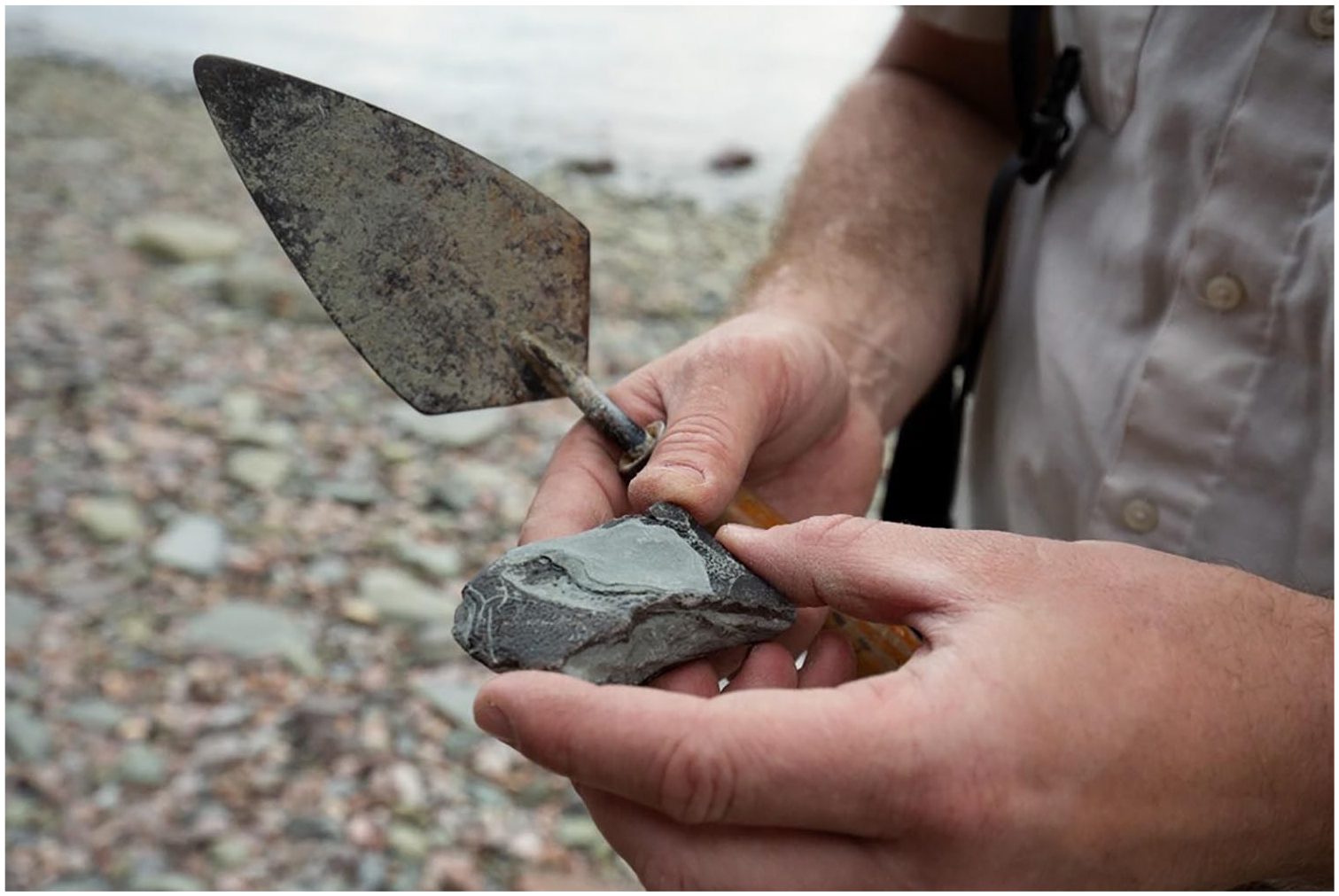
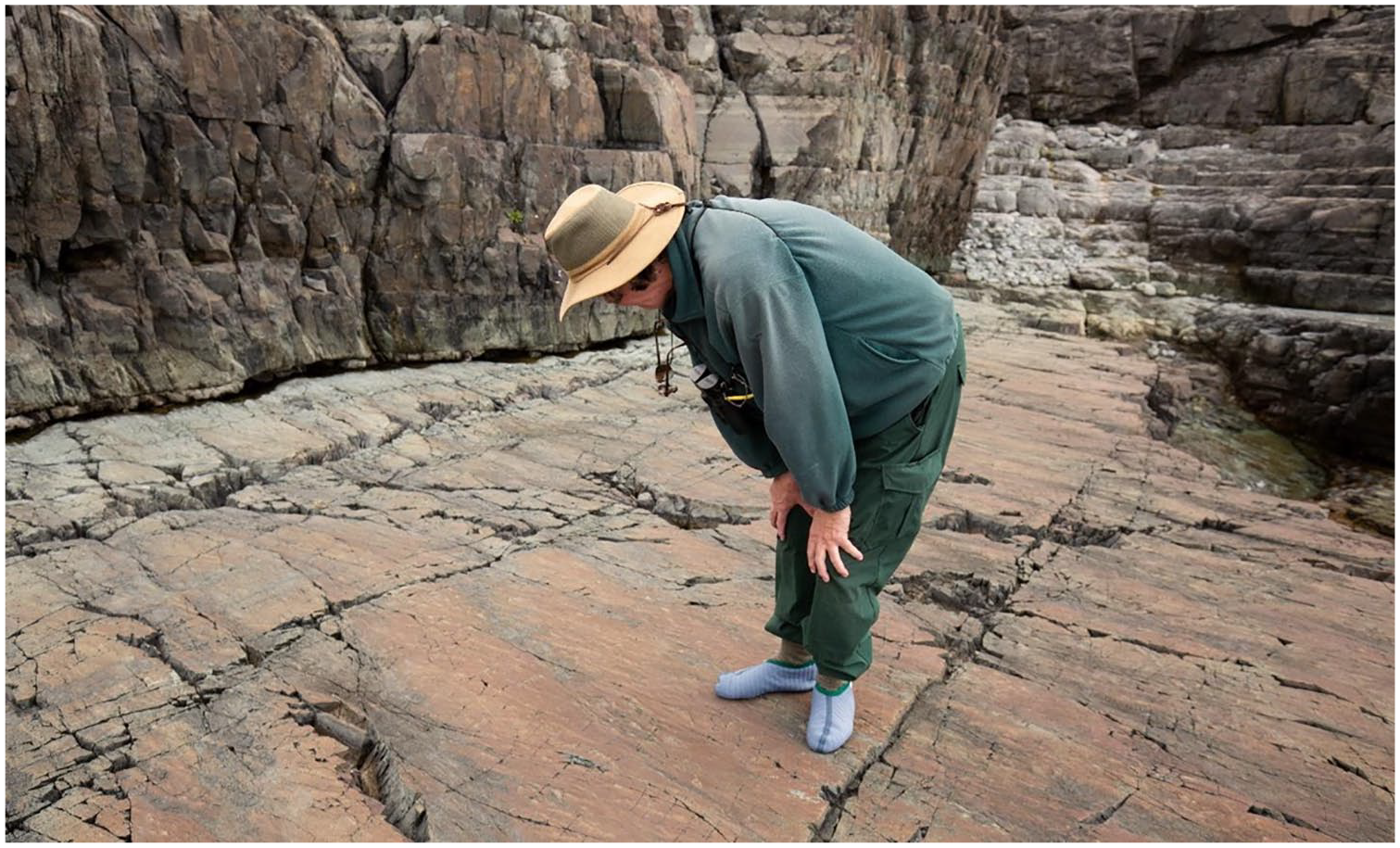
Richard Thomas was one of the people directly involved with preparing the World Heritage application (see Figure 3). Now working as the chief conservation geologist for the Mistaken Point Ecological Reserve, tourism growth worries him. “All I see is feet on the surfaces wearing away the fossils,” he tells us as we hike our way into the mist toward the cliff. “At Joggins, everyday you’ve got the chance of finding new fossils exposed by the previous night’s erosion or whatever,” he continues, “here, it’s not like that. Fossils do get uncovered but it’s a very, very gradual process. So, we have to be extra careful. We can’t afford to damage fossils because they’re essentially lost, and we won’t have them replaced by erosion and uncovering of the fossil bearing surface for decades and decades.”
Richard with fossils.
Nearly an hour later we reach the cliff that only researchers and small groups of people with an official guide are allowed to visit. Richard instructs us to remove our shoes and put booties on. We can detect anger in his words as he tells us that recently a pupil on a school filled trip was dumb enough to carve his name on the fossil bed with a pebble. On top of that, he says, “the power of the sea here is unbelievable. We had a tropical cyclone in 2010, and the waves were bursting 25 meters in the air. I see that, and I just go, ‘Oohh those poor fossils!’”
Fossils’ lives are entangled with those of their researchers. Beyond their intellectual and scientific interest it’s easy to detect a personal relationship between geologists or paleontologists and their favorite fossils—a relationship based on profound care. “Plus, it’s the aesthetics of the place,” reveals Richard, “I mean look at this. One of the magical properties of this place for me is the lack of technological noise, and the peace and solitude. I mean, it’s magical.”
We begin exploring the fossil bed as Richard directs our attention to fossils and their names. As we direct our cameras to the ground, he tells us that “the amazing thing about these surfaces in particular is that you have a community of deep-sea organisms that were killed and buried and preserved where they lived.” The word “killed” stands out, seemingly lingering in the air for a moment. Organisms died here. In a way this is a graveyard, a cemetery of tombstones with engraved mementos of a life lived through generic nouns but no proper names. Geologists and paleontologists are the caretakers here, their geophilia giving these organisms a new afterlife. But is that really a life?
In Miguasha, during an interview with paleontologist and conservation and research manager France Charest and geologist and conservation and education manager Olivier Matton, we asked that very question: “Are the fossils alive?” “They had their own life 380 million years ago. They were alive,” Olivier reflected, They lived a few months, a few years, in a very warm estuary that was on the south shore of the Gaspé Peninsula. So, they had their first life, their biological living life, and one day unfortunately for them they died from natural causes or accidental ones. But, in their cases something strange happened for some of these animals. They were caught in sedimentary layers of mud or sand and what was their predicted end—that they would be destroyed by scavengers and decomposition—is something they avoided not for one season but for 380 million years until we found them. So, today we find remains of dead plants and animals, but actually we can say that they get some kind of a new life. Because we take time to collect information about their death context and after that they will live inside the Miguasha national park museum. They will be cleaned by Jason in the laboratory. They are gonna be cherished by Joanna, who is gonna put them in their own section in the collection. And one day if this animal is lucky enough—maybe it was very unlucky in the Devonian period, it was stuck by a great turbidity current in the bottom of the water and it died very quickly and in awful conditions—today it’s going to have its revenge and it’s gonna be put inside a display in the exhibition room and thousands of visitors will have the chance to discover it. So, it’s a chance for us and for visitors to learn about the second life of these animals.”A second life is an enchanting “mystery” of a wild life, in Olivier’s words, “an extinct one that raises questions about us,” animating our curiosity, filling us with empathy for their life and their death, for our life and our death, a life asking us for their ongoing care, dotting our sea cliffs and edge lands with signs of their demise and will to persist. Gifting us of foggy memories dense with lost lives, now found again.
***
The environment, writes Alphonso Lingis (2000), is dense with energies. These are fleeting vitalist energies, impossible to harness. Geological energies inherent in the forces of volcanic explosions, ocean tides, drifting glaciers, and rumbling tectonic plates. Vitalist energies that intermingle with the winds, the patching of fog, the affective registers of animals. “So, how can the passions of penguins,” Lingis argues, “albatrosses, jaguars, and humans not lift their eyes beyond the nests and the lairs and the horizons? How can these passions not sink into volcanic rock and the oceanic deserts?” (Lingis, 2000, p. 21). How can windswept cliffs not be swept by the same energies, by the hauntings of shipwrecked sailors, of forsaken fishing communities forgotten by the world economy, of extinct animals petrified onto rock?
These are experiments of thought, of course; little more than mystifications driven by curiosity and possibility: a subjunctive “what if” asked in order to shock, to animate a moment of doubt. These are ordinary affects, in the language of Kathleen Stewart (2007), committed to speculation, impact, and the power of the subjunctive. Ordinary affects are “the varied, surging capacities to affect and be affected that give everyday life the quality of a continual motion of relations, scenes, contingencies, and emergences” (Stewart, 2007, pp. 1–2). And maybe these are also feelings blurred by the fog. Ordinary affects after all, like foggy days, just happen, just come and go. Ordinary affects happen to humans. But what if they don’t just happen to humans? But what if they happen to animals, to rock cliffs, and even to fossils? What if the contagion of affect doesn’t stop at the human threshold? Ordinary affects are imminent, erratic; “they work not through ‘meanings’ per se, but rather in the way that they pick up density and texture as they move through bodies, dreams, dramas, and social worldlings of all kinds” (Stewart, 2007, p. 3).
Folklore across the ages has portrayed fossils as magical, mysterious forces capable of doing things like detecting poison and indicating the presence of riches. Fossils render the everyday strange, making nature seem unnatural. It’s a mystery, like Olivier says. Though as solid as rock, certainty becomes blurred in the speculation required for a fossil to tell a story we can recognize. Like a live animal, a fossil seeks companionship, affiliation, while also reveling in the failures of understanding. Like a stone, a fossil is “a thing that makes demands, scripts stories, and does not fully yield to human enframing” (Cohen, 2015, p. 31). Perhaps this is so because human stories demand words to make sense of the world, yet all fossils can reveal are pictorial remains: no prose at all, instead nothing a lapidarian sketch telling the mysterious story of an undead thing. This is a vexing narrative that draws us humans into a world to which we never belonged, “a world indifferent to us, a world that excludes us, and a world that impinges with discomforting intimacy” (Cohen, 2015, p. 36).
Geophilia is a conjoining force, a force that draws land- and seascapes, animal and vegetal, human and petrous into a generative union, “together to create, compose, produce” (Cohen, 2015, p. 26). This is a vitalist force, but not one whose effects one can isolate. The people, the fossils, the economy, and everything else are all drenched in the impulses, passions, daydreams, visions, deaths, and memories that have circulated these parts for years, even millions of years. These are fleeting vitalist energies that feel like something neither we nor our research participants can quite describe. But the fossils and the rocky cliffs these affective registers inhabit have a habit of letting us all feel something, something that has been in the making for a long time. And what is significant about this something is the intensity of whatever this is: the tension that intimacy with lives lost so long ago builds up, and the ordinary affects such tension makes possible. Ordinary affects after all are an “animate circuit that conducts force and maps connections, routes, and disjunctures” and the question we ought to ask of them is not what they mean, “but where they might go and what potential modes of knowing, relating, and attending to things are already somehow present in them in a state of potentiality and resonance,” as Stewart (2007, p. 3) writes.
A Lingering Feeling
The vitality of fossils does not stop at the bodies of individuals like those we have met through this writing. Fossils have a way of bringing hope to entire communities, people perhaps less enchanted with their vibrant materiality than they are with their instrumental value. In some places, fossils, dinosaur bones and their museums in fact draw big crowds. In places like much of rural Atlantic Canada, villages and towns in search of their economic identity after the collapse of coal and cod may view fossils and the recognition granted by UNESCO as harbingers of hope, even tourist magnets. Yes, magnets. We could be using that word metaphorically, of course. But we could use it literally too. For what is geophilia if not an attraction? What is vital matter if not a pull? What is affect if not a draw? This is geophilia too.
Economic analyses could now be tallied, the contribution of natural heritage sites to regional economies budgeted and computed. But we will leave the task to others. In search not so much of economics but of something we have called geophilia here, we want to simply ask why the pull of the earth exists, why the magnetic draw of its elements takes place. So what is it, again, that fossils can do? What is about geophilia that is so rich with vitality? Perhaps it is its conative power, its will to persist across echelons of time. “A life,” writes Bennett (2007, p. 53) echoing Deleuze, “inhabits that uncanny nontime existing between the various moments of biographical or morphological time.” Bennett might as well have been writing about fossils. The pure power of fossils is in fact in a restlessness, an active force that draws humans to witness the destruction that led to their extinction. It is in a vitality that somehow resisted annihilation, in an obstinacy to leave a trace. This power too is geophilia: a fascination with the vibrant materiality of an earthly life, with a lithic matter that bonded with us, with a petrified will that transformed itself to be something other than it once was.
In its inorganic unfamiliarity, Cohen (2015, p. 19) argues, stone has a tendency to remain aloof, yet “a mutuality is always possible, some narrative of companionship and concurrency” is always potential. Unlike stone, a fossil is seemingly sociable, somehow seeking companionship, demanding to be kept present, pulling us closer to the depth of unfathomable time. Herein lies the magnetic pull of fossils, drawing us humans to become entangled with long webs of time, divulging secrets about long-lost places and memories that wish to be told, and inviting us to contemplate obscure cosmic powers unaffected by human force. There is something wild about this, something self-willed enough to seek affiliation while remaining confident of an irreducibly larger autonomous existence. Something of a wild life that even after all this time, all these encounters, all these words, and all these theories, is still capricious enough to escape our understanding. A failure of human explanatory power that somehow, deep down, you feel that fossils are enjoying.
Footnotes
Declaration of Conflicting Interests
The author(s) declared no potential conflicts of interest with respect to the research, authorship, and/or publication of this article.
Funding
The author(s) received no financial support for the research, authorship, and/or publication of this article.
