



Abstract
Recently, the concept of “cultural governance” has gained analytical traction in research on Chinese urban development. This is mostly diagnosed as a top-down process of defining and imposing cultural forms in government-led projects, such as in tourism. We argue that the case of Shenzhen manifests important differences, and is highly significant, considering the national and international status of this mega-city. Based on detailed field studies, supplemented with information about other cases, we show that in Shenzhen local cultural forms show resilience and increasing public presence, while also being shaped by inclusive cultural policies that are informed by the national drive towards reinstating traditional Chinese values as part and parcel of national identity. One manifestation is the enactment of the traditional ritual space of the village in urban architecture, such as the duality of ancestral hall and village temple, often at so-called “cultural squares,” and the expression of territorial ambitions of lineages in competitive projects of redevelopment. We suggest enhancing the concept of cultural governance by the concept of governmentality to grasp these phenomena analytically.
Introduction
In contemporary approaches to culture and urban development, the role of cultural creativity is often emphasized, especially in the creative industries: ideas that have also gained much traction in China for long (Keane, 2007). However, whereas these views focus on the role of grassroots level activities, diversity, and cultural autonomy of various groups in urban society, the emerging Chinese model increasingly assigns culture to the role of a medium of urban governance. This fits into the larger pattern of “cultural governance” that has been identified as a trend in Chinese politics by China scholars (Perry, 2013). By this term, they refer to the observation that the Communist Party increasingly endorses traditional values and customs as means to strengthen societal mechanisms of behavioural control and adherence to politically correct standards of public life (Kubat, 2018). Ubiquitous party propaganda of the “China dream” explicitly highlights Chinese virtues such as loyalty and filial piety, which are an essential part of the Confucian canon.
In Chinese urban studies, the concept of cultural governance has been seminally invoked by Tim Oakes (2019) to make sense of certain developments in urban planning that highlight the role of culture, such as in the context of tourism projects. His own research (Oakes, 2017) is based on a detailed case study, the city of Tongren in Guizhou province, a place with a high share of various ethnic minorities. He shows that, first, culture becomes a specific domain in urban developmental projects, and second, culture is also a medium of governing urban society. This is salient in the Tongren case, where the topic of minority culture is highlighted in urban development strategy, yet less in the sense of activating independent cultural projects and more in creating artificial cultural amalgams as an official multicultural synthesis that is strongly oriented to economic functionalities, thus effectively denying the underlying diversity of cultural identities.
Oakes (2019) emphasizes the variety of forms of cultural governance in China. In this paper, we look at another important case, Shenzhen metropolis. To some extent, Shenzhen is a place with similar concerns about cultural diversity versus cultural integration (O’Donnell et al., 2017). But different from the Tongren case of ethnic diversity, in Shenzhen subethnic cultural, diversity looms large, since migrants from all over the country live together, with the native population—the original farming communities—now a tiny minority. This includes large subethnic variety: for example, many locals are Hakka, but an estimated three million newcomers are from Chaoshan region (Eastern Guangdong), beginning with organized immigration of construction workers in the first years of the Special Economic Zone (SEZ). In official policies, culture is important for two reasons. First, given the nature of Shenzhen as a huge melting pot, there is a debate about Shenzhen identity and citizenship, which touches upon issues such as civic engagement and responsibilities (Bach, 2017). This partly reflects the cultural gap between urban and rural population, as most of the migrants originally are farmers-turned-factory-workers. Second, Shenzhen is facing the challenges of industrial upgrading and restructuring, which requires the development of new areas of economic activity. Cultural and creative industries are important in a direct and an indirect sense: Directly as new fields of promising business ventures, and indirectly as creating an urban space that is attractive for highly qualified individuals working in the lead industries of industrial restructuring, such as the internet behemoths headquartered at Shenzhen.
In our field research, we concentrate on a specific phenomenon, which is the re-emergence of traditional kinship and its ritual ramifications. Shenzhen is a special case here, because this is mostly tied to the role of the native Shenzhen population. The original population, although a tiny minority in terms of numbers, plays an important role in urban development because they were and partly remain the owners of the land or land use rights. This had huge impact on the development of urban infrastructure, because the original communities had been active in creating the unique phenomenon of “urban villages,” the origin of which has been studied by numerous authors (e.g. Cheng, 2014; Chung & Unger, 2013; Lai et al., 2017; Wang, 2016). Although urban villages also exist in other Chinese cities, they are particularly large in Shenzhen: It is estimated that about 50 percent of Shenzhen population lives in these places (explaining the huge gap between factual and official population figures). Whereas in many other cities, and partly also in Shenzhen, the original owners have been bought out by the municipal governments cooperating with developers, in Shenzhen, we observe many cases where the village communities have reasserted their control and used their land assets to create new forms of economic activities that contribute to reinstating their identities as a group (on variation of outcomes, see Wong, 2015). This is where traditional kinship and ritual in the broader sense comes into play: Many of the villages are single-lineage villages, and affirmations of group identity therefore take the shape of a revival of public functions of ancestor worship and related ritual activities.
Different from the case that Oakes analyses, in Shenzhen, we observe a strong interaction between autonomous grassroots level actions and forms of cultural governance that operate top-down, and which manifest a congruence between economic entrepreneurship and revival of tradition (Herrmann-Pillath et al., 2019). Hence, the fundamental difference to the Tongren case is that we observe a continuous bargaining between local groups and government over the authority to define culture, and a very active and partly autonomous role of locals in shaping the public role of “tradition” in modern Shenzhen. That being said, we do not claim that what we describe represents the cultural mainstream in metropolitan life that is shaped by a highly diverse population and the leading role of modernist cultural imaginaries, such as associated with the vibrant high-tech industry. Yet, we show that what on first sight appears to be a minority culture is in fact becoming an important element in urban cultural governance, which is manifest in evolving spatial and architectural features of the city.
In this paper, we look at two lineages in detail, but also add observations on other original communities in Shenzhen, such as the Pan and the Zhang lineages (we indicate the location of our fieldsites in Figure 3). The first is the Wen lineage, and mainly a branch in Fenghuang village, a community in Bao’an district, that is, the rural areas that originally did not belong to the Shenzhen SEZ. The second is the Huang at Xiasha village, which is at the Central Business District and the centre of the original SEZ. Our aim is to not only present empirical details but also give a theoretical interpretation that we will unfold in the analytical conclusion. Our central concept is “ritual,” referred to the concept of “governmentality” (Herrmann-Pillath, 2017): We generalize over the notions of kinship and popular religion in terms of the revival of traditional ritual activities, which in contemporary Shenzhen results in the emergence of patterns of governmentality as part and parcel of the larger scheme of cultural governance. This opens the view on continuities with Imperial statecraft, as Oakes also points out. Our cases allow for a stronger argument in this regard because we deal with a central phenomenon in historical South China: the co-optation of local lineages for state power via cultural governance (Faure, 2007). The role of lineages in the Shenzhen social fabric has been recognized by many scholars studying urban villages (e.g. Wang, 2016), but there are few in-depth anthropological field studies, with Trémon (2015a, 2015b) being the closest to our own work, inspiring and corroborating our analysis.
The paper is based on two years continuous fieldwork in Shenzhen, as one of the authors is permanent Shenzhen resident, allowing for many forms of participatory research, combined with a long series of interviews with lineage members, officials, and experts (see our monograph Herrmann-Pillath et al., 2020). We combine information received in interviews and conversations with information from published sources. Our argument proceeds as follows. In section two, we briefly describe our two core cases, the Wen and the Huang. In section three, we explore the impact of lineage structures on the trajectories taken by urban redevelopment, as mediated by resulting institutional phenomena. In section four, we detail the forms of co-opting lineages in modern urban governance. Section five discusses theoretical implications and concludes.
Setting the Scene: The Wen at Fenghuang and the Huang at Xiasha
To clarify a few important concepts at the beginning, this paper deals with the role of lineage rituals in shaping urban development in Shenzhen, and their spatial manifestations. Often, lineages are called “clans,” but it is important to be precise here (Baker, 1979; Chun, 2000; Ebrey & Watson, 1986; for a more detailed discussion, see Guo & Herrmann-Pillath, 2019a). Taking our Wen case as an example, we have six original Wen villages in Shenzhen. Every village was, and partly is, inhabited by a Wen lineage branch. These lineages trace themselves back to common ancestors, being branches of a shared genealogy. If we treat the various Wen as a group, this can be approached as a “higher order lineage” or as a “clan”. However, the term “clan” is ambiguous in possibly also including artificially constructed genealogies. This is salient in the case of the Huang. In Shenzhen, there are two local Huang lineages at Xiasha and Shangsha, two neighbouring villages, belonging to the subethnic group of early settlers (the so-called “guangfu” people). There are other Huang lineages, such as those belonging to the Hakka subethnic group, mainly at Longgang district. The two Huang lineages at Xiasha and Shangsha have their own ancestral halls relating to two different focal ancestors. But as we shall see, the Huang are part of a larger genealogical community of huge size that is traced back to a Tang dynasty scholar-official, Huang Qiaoshan (his descendants allegedly count more than 10 million individuals, with almost 3 million in Guangdong, but much less in other provinces, such as in Hunan only about 200,000; for more data and sources, see Guo & Herrmann-Pillath, 2019a). There are many Huang communities in China, which may not necessarily be organized as lineages, but often (and increasingly) as surname associations. If they cooperate in creating common organizations that involve joint kinship ritual, this matches with the more precise definition of a “clan.” In other words, we may distinguish between a lineage as a group of kin living together at a certain place (Chinese “jiazu”) and the descent group that is manifest in holding certain joint ritual activities (Chinese “zongzu”). In the classical definition of a Chinese lineage as suggested by Freedman (1966), one would add the criterion of common kinship ritual and commonly held land in order to distinguish between the lineage and mere extended kinship and shared descent. This established the more specific meaning of lineage as corporate lineage, which was prevalent in South China (Cohen, 1990). As we shall see, this criterion applies for the Wen and the Huang.
With reference to the Huang, we further need to highlight the notion of surname association (if related to genealogy, surname is mostly “shi”, the neutral modern term is “xing”), with fuzzy conceptual borders to the clan (a surname association is typically called “XXX shi zong qin hui”, thus combining the characters for surname shi, descent zong and relatedness qin, and often we also find the translation of “clansmen association”). Formally, these are all individuals who share a surname, such as “Huang,” without any implication for a shared genealogy. But surname associations mostly also refer to a genealogy, which we could approach as “cultural descent.” The Huang are special in this regard, because their myth of origin even goes back to the “Yellow Emperor,” the origin of Han civilization. This is important for the potential of networking with other Huang. Apart from local surname associations, there are global ones: Occasionally, the World Huang Surname Association held its conventions at Xiasha, and since April 2018, the local Huang leader, Huang Yingchao, is President of this association. The conceptual muddles are apparent in realizing that often the term “Huang clan” or even “Huang family” is used when referring to this largest possible group who explicitly recognizes shared descent.
The Wen villages differ in shape and size. An important fact is that there is one Wen branch in Hong Kong, the New Territories. All Wen are Cantonese speakers, and their surname is pronounced ”Man” (the Huang pronounce as “Wong,” which is mostly used by emigrants). In Hong Kong, the Man were one of the most powerful “great lineages” with large corporate landholdings in Imperial times, rented out to other lineages (Watson 1985/2003). Institutionally, this was arranged in terms of a system of dual ownership rights, with tenants factually enjoying rights of long-term possession (hereditary tenancy). When the British reshuffled the traditional land ownership system according to Common Law rules at the beginning of the 20th century, the Man lost much of their territory to their former tenants. In the 1950s and the 1960s, many Man emigrated to other countries, especially Europe, while keeping contact with their original community (Watson, 1975). The Shenzhen Wen always stayed in touch with the Hong Kong Wen (Man), which during Maoist times enabled many of them to flee to Hong Kong and emigrate (Watson 2004, 2010). When the Shenzhen SEZ was created, the Hong Kong Wen (Man) were active in channelling foreign investment to Shenzhen, while also supporting the reconstruction of ancestral halls and relaunching ancestral rites (a universal pattern found with emigrant communities, see Kuah-Pearce, 2011).
Our focal case is the Wen in Fenghuang village, Bao’an district. Another famous example of an urban village, Gangxia, is located in the Central Business District, Futian. The structures differ widely (for lively reports and pictorial impressions of urban villages, see the blog by Mary Ann O’Donnell 1 ). In Gangxia, we observe the typical case of an urban village that emerged from the spontaneous activities of villagers in building cheap housing for the huge numbers of inflowing migrant workers: Extremely dense multi-storey buildings with low-quality design and materials, and electricity, sewage, and other infrastructures provisionally provided. In comparison, Fenghuang village followed a different developmental track, receiving many foreign-invested companies, and organically growing the original village into a suburban community (shequ).
In recent years, one important aspect of Fenghuang development is tourism and leisure. Different from Gangxia, the original village is still there and has been renovated mainly as a tourist attraction, with the original owners moving out and renting the houses to shops and restaurants. The maintenance of the original village includes the renovation of a central public square that hosts the ancestral hall and other public buildings, such as an academy for “national learning,” which offers a wide array of activities in the adult education field, broadly spoken. The other big project is a mountain park in the hills that belong to the original village territory. The park includes a huge temple complex, which has been erected on the site of the old village temple and which has a large Guanyin temple and smaller ones such as devoted to the Earth God. The temple is formally recognized as a religious institution, with a sitting Buddhist monk and the various statues ritually enacted as sacral entities.
The Xiasha case differs from both Wen cases, although it started out from the same position as Gangxia in building cheap housing for migrants. Neighbouring Shangsha adopted a different track in early implementing the development of a technology park. At the beginning, Xiasha was notorious for its red-light district and being a “second wife” home for Hong Kong mobile people, such as truck drivers. But in recent years, building on the initiative of its leader Huang Yingchao, it implemented an upgrading strategy, with a focus on urban amenities and with a flagship project, the KKmall, in cooperation with Kingkey developer. The core urban design element is the “Cultural Square” at the centre of the village, which hosts a large lineage hall and a Houwang temple, and includes a mixture of other artefacts with religious meanings.
Both the Wen and the Huang case share certain organizational features. The core is a “shareholding cooperative company” (gufen hezuo gongsi). After launching reforms, many villages in South China started to create own management companies that took care of collectively held assets, as a part of the nationwide movement towards “Township and village enterprises” that often were integrated into village-level holding companies (Trappel, 2011). In the Pearl River delta, one core asset managed by the companies was collectively owned land. In the 1990s, these structures were mostly cast into the legal form of a shareholding cooperative to which the land rights were transferred. This was possible because Chinese law was indeterminate about the specific structure of the “collective” that owns the land (Ho, 2001, 2013). Shareholding cooperatives are often co-terminous with the village, which is important once the former villages were made part of urban communities shequ in 2004. Formally, the shequ are part of the urban administrative hierarchy. But the shareholding cooperatives are independent business entities that, however, assumed a leading role in defining local development strategies, including urban redevelopment and design. This is reflected in the fact that the villages still refer to themselves as such, with many artefactual markers, such as historical village torii or turnpikes (Hang, 2006). The borders of old villages have been aligned with the borders of shequ, as in the Xiasha case in 2005, which publishes a map of its territory using the old internal divisions of the village (called “fang”). There are more than 1,000 shareholding cooperatives in Shenzhen, with roughly a third being congruent with shequ.
In both our cases, the shareholding cooperatives have become quasi-governmental bodies that operate parallel to the formal urban administration (on the parafiscal role of shareholding cooperatives, see Po, 2008, 2012). For example, the building of the Fenghuang company looks modest from the outside, but the executive floor is huge and replete with political symbols, such as large arrays of the national flag, wall posters with slogans by President Xi Jingping, and other artefacts with political meanings. The Xiasha company boasts a museum on the first floor that is open to the public and that recounts the glorious history of the Huang and their success story at Xiasha. The organizational integration with the formal administrative and political hierarchy works via multiple assignments of leaders: The chairman of the Fenghuang company is also Party secretary of Fenghuang village, and the leader of Xiasha is Vice Chairman of the Futian district Political Consultative Conference. According to the 2019 regulations on shareholding cooperatives, the local party secretary is directly assigned to the role of chairing a supervisory board (for a detailed description of the governance structure of shareholding cooperatives, see Herrmann-Pillath et al., 2020). This creates a direct channel between company and government.
Urban Villages as Ritual Spaces
We will now further explore the institutional structures and establish the relationship with ritual. An interesting reference point is the New Territories (Chun, 2000). The British had explicitly recognized that the original inhabitants (bendi ren) could maintain “local customs.” That included corporate landholdings of lineages and the customary rights of inheritance (Nissim, 2017). In the 1970s, special rights to construct buildings were extended to original inhabitants. Both policies clearly contributed to the resilience of the lineage institution in the New Territories, despite the strong forces of disintegration resulting from large scale out-migration (Watson, 2004). In other words, if we define the lineage as a landholding corporate organization, we can also approach it the other way around, approaching lineage ritual as expression of underlying landownership patterns.
This view is appropriate for understanding the resilience and resurgence of lineages in the Pearl River delta. Although collectivization in the 1950s also aimed at crushing the local power of lineages, in fact it reconstituted lineage corporate rights implicitly, because the “collective” that owned the collective rights was identical with the lineage in single-lineage villages, such as in our cases (Potter & Potte,r 1990). For example, in the Xiasha museum, a direct line of organizational descent is established between the village, the production team in Maoist times, and the current shareholding cooperative, personified in the respective leaders, who, as in the case of Huang Yingchao today, is the lineage leader apart from his official positions. In other words, the institutional arrangement of collectively held land rights creates strong incentives to maintain lineage-related identities of the communities even via economic motives, as long as the collective rights are not fully privatized (which is prohibited by the Chinese constitution).
This is important in the context of Shenzhen urban governance. Formally, all municipal land is state-owned (in the SEZ, since 1992; in outer districts, since 2004). But because Shenzhen has grown via the inclusion of rural territory in the physical urban structure, large swathes of land use rights remained collectively controlled, to which the land needs to be added on which the houses of the farmers were built. The phenomenon of “urban villages” is the physical embodiment of this peculiar institutional structure: The territory of Shenzhen municipality included 320 so-called administrative villages with a population of about 330,000 (Huang, 2017). By implication, the governance structure of planning and implementing urban development is fragmented, with many original villages implementing their partly autonomous measures via the shareholding cooperatives (Po, 2012). That means, at the core of the Shenzhen municipal governance structure unfolds a complex process of negotiating and struggling over power between the formal administration and the villages. In this struggle, lineage identity becomes a crucial factor because it establishes and expresses an interest group in the urban system that countervails the authority of formal municipal government (Cheng, 2014).
The outcome of this power struggle has been always contingent, across China anyway, but also within Shenzhen (Kan, 2019; Wong, 2015). On the one hand, the municipal government can just impose policies on the population by simply overruling their rights via claims on public interest and direct reclamation of collective land for the state. More informally, but based on the same principle, is the often-used strategy to buy out the individual members of the collectives, combined with political pressure. This is tactically complex, but a strong weapon, as urban villages started out from individual initiatives of farmers building multi-storey building on the sites of their own homes, of which they can claim individual rights of possession, even in the collectivist framework (Chung & Unger, 2013). The state can simply offer a rich compensation to the individual farmers, and once collective decision-making bodies (the village councils) agree, the land would be transferred to the municipality and hence effectively nationalized; typically, the land use rights would then be transferred to large developers.
As is well known, in this process there is much room for strategic misinformation, cheating, and outright corruption. Often farmers are not aware of the economic potential of redeveloping their territory and may be satisfied with relatively low compensation (Wong, 2015). If communities are more tightly knit, the chances are high that they can mobilize other information and join forces in negotiating with the government, especially by maintaining their unity and suppressing deviant individual interests in quick profits. This crucial role of lineages in enabling collective action has been noticed also in other studies beyond the Pearl River delta (Tsai, 2002, 2007; Zhang & Zhao, 2014). As a result, the process of redeveloping urban villages in Shenzhen turned out long, protracted and complex (Wang, 2016). Often negotiations may last many years and remain unfinished. This is easily visible in the continuing existence of many urban villages in their old shape, such as Gangxia. In this process, collective learning occurs on part of the villagers, combined with the upgrading of their skills in managing their business.
As an additional factor, public opinion has been emerging as an important force (O’Donnell, 2019). Two topics loom especially large. First, in the negotiations between the villagers and the municipality, the interests of the tenants are not formally presented, although they form the majority of affected groups. Redevelopment often may imply gentrification, with many negative effects on the migrants who would be forced out of cheap living space (He, 2019). This issue is increasingly debated in the public, also in the context of a feeling of shared destiny of Shenzhen people who are almost all migrants. Second, urban villages may attain the status of a distinct Shenzhen architectural design legacy. This has motivated approaches to redevelopment that would not just destroy but renovate the existing buildings. This is particularly salient if urban villages include historical buildings. A famous example is Hubei village in Luohu district, which allegedly has buildings that even go back to Ming times (Mao & Gu 2020; O’Donnell, 2019). The owners of the territory are the Zhang lineage, who moved out entirely so that the village is today populated by migrants who mostly stem from Chaoshan region, with many of them living there for a generation already. That means, Hubei village is an urban village with two distinct identities, one the Zhang, still represented with an ancestral hall, and the Chaoshan community. The Zhang readily agreed to redevelopment, but now the institutional ambiguity surrounds the customary rights of the owners of the houses, the migrants. Public awareness was suddenly erupting, and a heated debate started involving many intellectuals, urban planners, and architects about the merits of alternative approaches to urban renewal that might preserve Hubei village as a distinct community, also in architectural terms (Hubei is now under redevelopment).
The Hubei case is of interest here because the village is a very visible example of the traditional village as a ritual space (for a concise analysis of the traditional village as an ideal-type, see Lagerwey, 2010: p. 153ff). There are various active small temples and makeshift altars where villagers (mostly women) conduct ritual activities daily, such as burning “ghost money.” Instalments for incense are found everywhere in the alleyways. The rituals are those of Chaoshan origin and they express the newly established local identity of the group.
In traditional China, villages were ritual spaces in which two notions were merged, that of the village community (diyuan) and that of the lineage (xueyuan), both related via the reference to the history of migration (Chun, 2000). Lineages always stay in competition over the control of territory, and the single-lineage village is the result of such competitive processes, such as when a lineage moved to a certain territory that was occupied by indigenous people initially. Yet even in this case, the difference between village community and lineage is manifest in distinct ritual arrangements, in particular the duality (in simplest form) between ancestral hall and village temple, with the latter often at a propitious place close to the village, such as a pagoda on a hill.
It is highly significant that in our two cases, the Wen and the Huang, who still inhabit their original territory (different from the Zhang), this ritual space is re-affirmed in the guise of tourism and village renovation projects, as we have already seen. One should take into consideration that religion still is a sensitive topic in China, so building a mountain park, as in the Wen case, does by no means require the inclusion of a temple to attract visitors (any other kind of theme park or amusement park would have served the same business purposes). What matters is the manifestation of village identity in the lavish temple complex (tellingly, the largest temple has two distinct altars: one addressing the public with a huge Buddha statue, the other, considered more important by the villagers, displaying a statue of the Wen high ancestor, Wen Tianxiang). Both Fenghuang and Xiasha, as other villages, manifest the duality of temple and ancestral hall—in Xiasha just located side by side, in Fenghuang at two different locations that span the village territory. In general, the visible manifestation of a ritual space is a public square, often uniformly named an “XXX cultural square,” where a temple and an ancestral hall is located (for the case of Xiasha, see Figure 1). Fenghuang maintains the traditional spatial structure of a village, so that the ritual space is spanned by the two separate locations of ancestral hall (in turn located at a public square) and temple complex (Figure 2).

Ritual space of Xiasha village (cultural square with ancestral hall and temple).
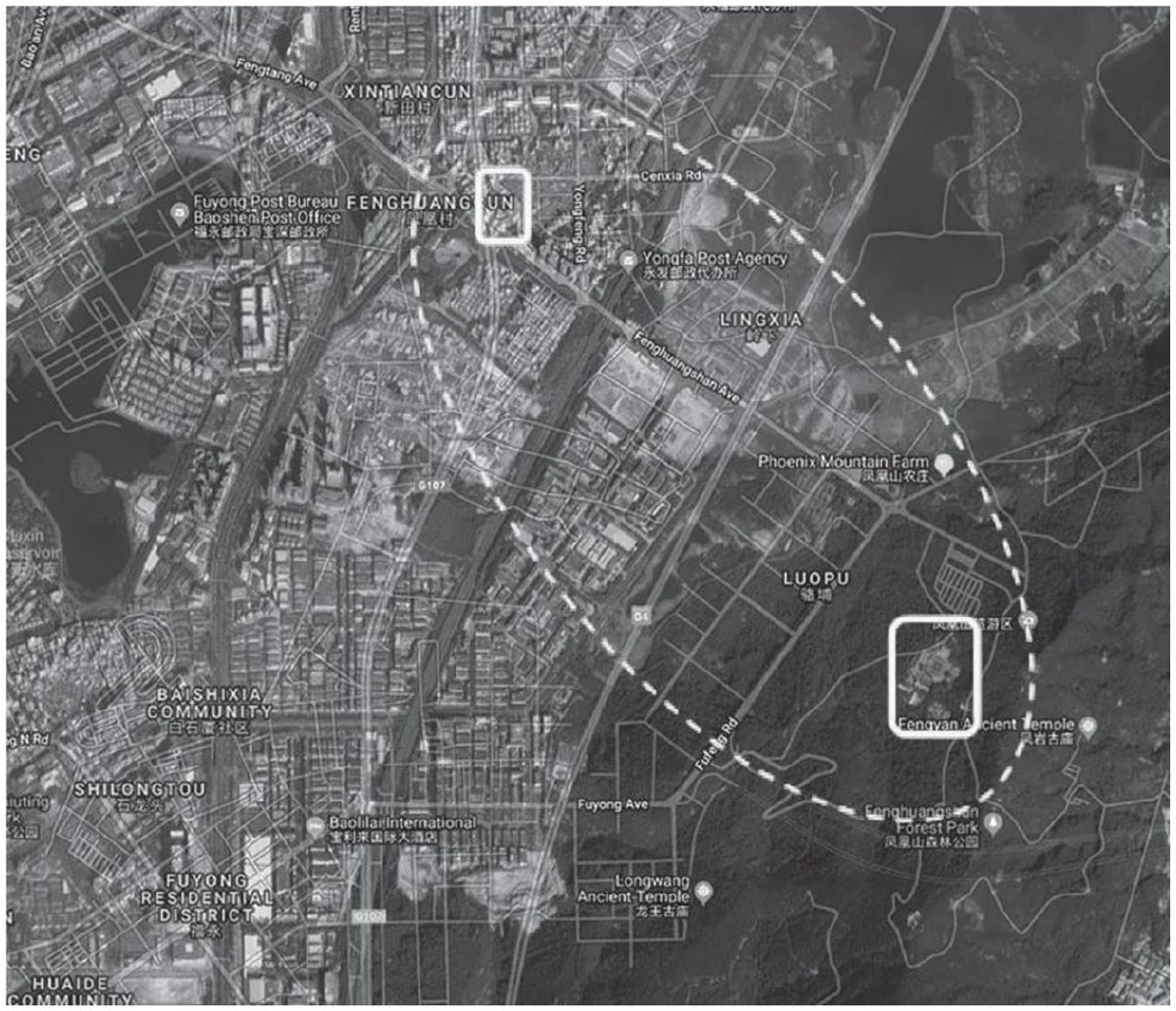
Ritual space of Fenghuang village (broken lines; small square: location of ancestral hall; large square: Temple complex).
One particularly important aspect of ritual space is its manifestation in local prosperity. Traditionally, the specific location of the village would have observed ecological and economic factors thst would be ritually reflected in Fengshui practices (Freedman, 1966). These practices necessarily involve competition between lineages and villages as, in economic parlance, there can be many negative externalities of actions taken by one group on another group. This competition between lineages is clearly visible in the modern context of Shenzhen. Urban redevelopment mostly involves the construction of flagship projects designed and realized by large developers who cooperate with the local lineage. These projects naturally compete against each other in attracting customers, clients, and tenants or buyers of apartments. One can directly relate landmark real estate projects to different local lineages: for example, Xiasha cooperates with Kingkey group in the KKmall, Shangsha with Lvjing Holdings in the Lvjing mall, and Gangxia has Hilton Mall with Dazhonghua Group. Most interestingly, recently patterns of lineage cooperation are emerging: For example, the Zhang, who perceive themselves as losing out in the competition (it is said that many Zhang also emigrated, hence replicating the Hong Kong pattern), have recently joined forces among for Zhang branches to launch a joint real estate project. There are formally completed plans to arrange a multi-lineage cooperation that centres on the Huang territory (Xiasha and Shangsha) in one huge project of redevelopment.
In this sense, approaching ritual means distinguishing between explicit and implicit forms. This is most evident when considering the institutional core, the shareholding cooperatives. Astute observers of the history of collectivization in China had already observed that some measures factually follow lineage rules, though cast in different wording (Potter & Potter, 1990, 173f.). One element is that lineages always organized joint economic activities via the creation of shareholding structures (Faure, 1996; Zelin, 2009). Indeed, the core asset, jointly held land, was always managed in this way, with the revenue invested in collective activities, such as conducting ritual ceremonies or funding lineage schools. Today, the shareholding cooperatives have many features that resemble these lineage organizations (compare Trémon, 2015a). This implicit similarity becomes explicit if certain ritual concerns are manifest. One important litmus test are the inheritance rights of women (Zhou, 2014). In many cases, originally shares were distributed per household, which means that the male households heads have control. Women claimed their rights in the 1990s, and thus, for example, the Wen women also own shares. But in violation to the Chinese inheritance law, they are not allowed to carry them along when marrying, and they cannot inherit the shares along the affinal line. To avoid such troubles, the Xiasha company has even fixed the original distribution of shares, thus effectively transforming them in family property that is inalienable. In all cases, shares can never be sold to lineage outsiders.
Public lineage rituals reflect this implicit ritual dimension of the shareholding cooperative. In local lineage customs, a public feast is prominent, the “common pot” (“pencai”; for more detail, see Guo & Herrmann-Pillath, 2019b). The dining practice differs fundamentally from Chinese standards in offering a huge pot with mixed ingredients to a crowd sitting at many tables and just picking out pieces as they wish. Its ritual meaning was analysed by the anthropologist James Watson (1987, 2014) who was the first describing it in the New Territories. The “common pot” is typically held, with different scope, to celebrate and express the unity of the kinship group and its willingness to share with others. Thus, there were smaller “common pot” feasts on occasion of the birth of a son, and bigger ones at certain holidays. An important function of the traditional common pot was to redistribute “pork,” literally with fat pork as main ingredient, but also metaphorically, as benefit reaped from joint assets. This is exactly what we observe in Fenghuang: Traditionally, the dividends will be distributed on New Year, and on that occasion a “common pot” feast will be held. Similarly, common pot feasts are held by Shenzhen lineages if a deal is brokered in selling collective assets to the government, which regularly turns lineage members into wealthy people overnight.
In the case of the Huang, the “common pot” has achieved a new dimension that can be also observed in the New Territories today. In Hong Kong, huge “common pot” feasts have obtained a political meaning in local identity politics (Chan, 2010). The Huang have launched the “big common pot,” which is typically offered at Huang conventions, sometimes involving tens of thousands of guests gathering on the “cultural square.” They successfully registered the “common pot” as a regional cultural legacy, thus turning it also in a tourist attraction. However, the deeper significance of the ritual is salient when visiting the Huang museum, where a large space is devoted to two life-sized bronze installations showing locals at two tables enjoying the dish: Ominously, this installation is duplicated at the flagship Shenzhen museum, in separate showroom devoted to local customs.
To summarize, we defend the view that urban villages do not simply reflect economic interests of a landowning group, but ritual spaces of traditional villages in a modern metamorphosis. A similar argument has been presented by Trèmon (2015a, 2015b) when discussing another Shenzhen lineage, against the background of the question whether the evolution of urban villages reflects the expansion of a neoliberal capitalist logic into the traditional social fabric. She also points out that there are many facets that show how traditional forms build a synthesis and sometimes strike a balance with capitalist mechanisms, such as maintaining features of a moral economy of sharing benefits in the community. Similarly, modern urban design and ritual spaces are synthesized in projects of renewing urban villages in Shenzhen.
Cultural governance and governmentality in the revival of traditional values
The role of lineages in shaping the development of urban villages can be empirically vindicated by comparing two sets of data, which we do in Herrmann-Pillath et al. (2020). One is the published plans for urban redevelopment that shows the spatial distribution of urban villages and the other is the location of ancestral halls that are officially recognized as historical monuments: In Figure 3, we reproduce one of our maps for the newest plan of 2018, which clearly reveals the close congruence between the two sets of data: Where ancestral halls remain operative and are in good shape, we can interpret this as indicating the strength of the local lineage and its desires to express lineage identity via official recognition of their halls. This translates into the resilience of the urban village, even during redevelopment. A contrary case in point is Baishizhou, arguably the biggest and most famous urban village, which is now being redeveloped: Baishizhou does not have a strong local lineage, originally located at a state farm, and hence does not constitute a ritual space in our sense. The prominence of Baishizhou in research on urban villages (e.g. Wan, 2017; Wang, 2016) may explain why the phenomenon of ritual artefacts as markers of ritual spaces of villages have been overlooked by many studies of Shenzhen development.
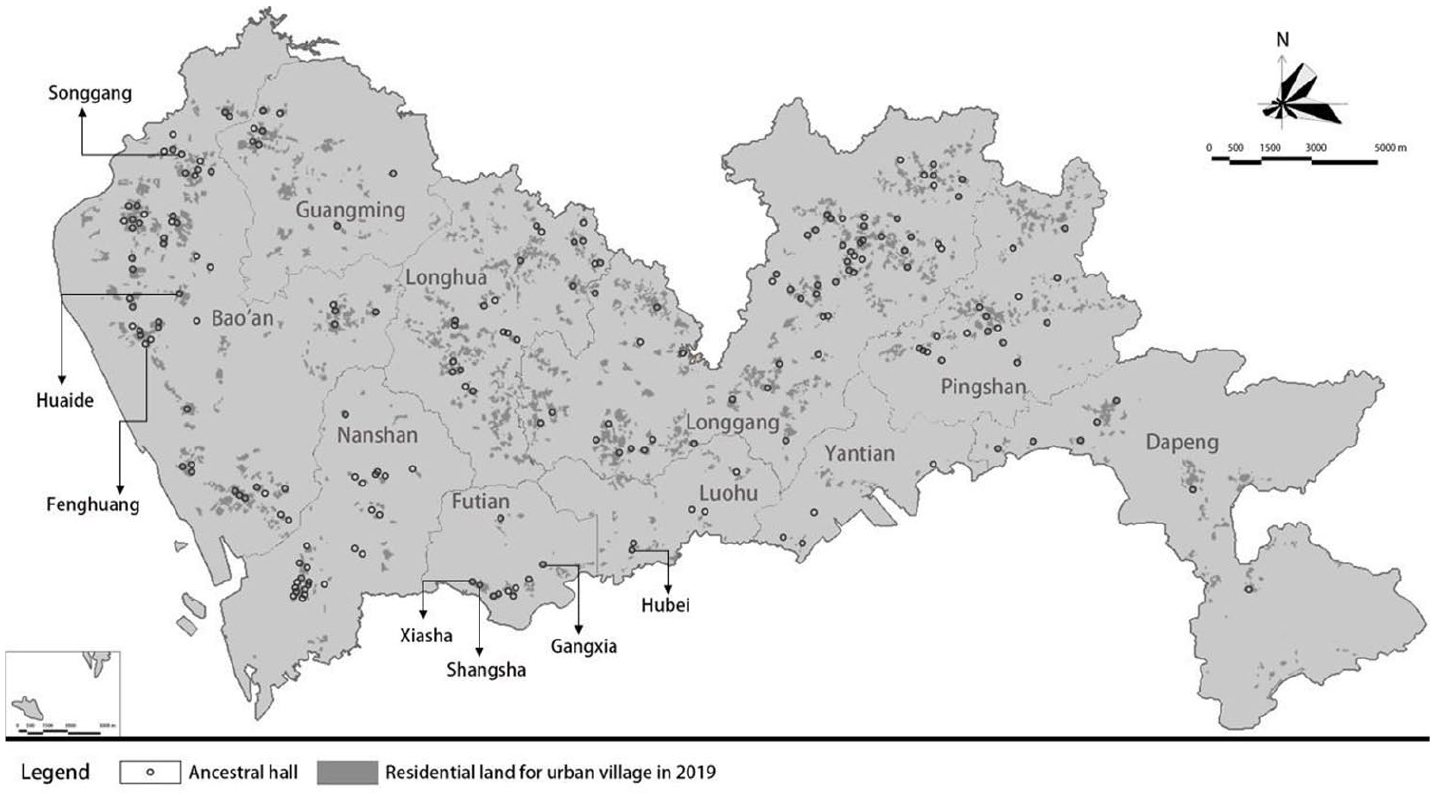
Ancestral halls and urban villages in Shenzhen. Circles: location of halls; dark grey areas: residential spaces of urban villages. The map includes the location of fieldsites mentioned in the paper.
The revival of lineages has been mostly interpreted as a transitory phenomenon, presumably reflecting the weak position of native Shenzhen people in the larger setting of the urban political economy (e.g. Cheng, 2014; Chung & Unger, 2013). However, as we have seen, the cases of the Wen and the Huang clearly reflect the ascendance of local power groups. At the same time, the government increasingly recognizes their role in governing local society. Indeed, in his research on the Pearl River Delta, the Japanese anthropologist Kawagusa (2016) distinguishes between two stages of the resurgence of lineages: The stage of restoration until the turn of the millennium and the stage of renaissance since then until today. “Renaissance” means the active support of lineages, especially in terms of propagating traditional values in society, and in propagating a traditional cultural conception of Chineseness as Han national identity.
To grasp this phenomenon analytically, it is fruitful to consider the historical dimensions of lineages. As we have outlined previously, lineages are embedded in concepts of historical descent, which have different scope and layers. In South China, many local lineages trace themselves back to migration events in Song China when the Han were driven southwards by the relentless military pressure of the Mongols. Many villages refer to founding events at that time, and local lineages have genealogies that directly connect them with the original settlers, typically single males who are married with several women, thus quickly generating a rich array of descendants. In Song times, these migration events refer not only to hapless farmers fleeing southwards but also to members of the Imperial elite. Thus, local lineages may claim the status of elite lineages, referring to “high ancestors” of historical and political significance (Cohen, 2017’ Trémon, 2014).
In this respect, the comparison between the Wen and the Huang is highly informative. The Wen trace themselves back to the Song general and scholar Wen Tianxiang, partly via related agnatic branches, that is, his brothers or direct descendants. Wen is a national hero recognized also by the Communist Party, which lends much legitimacy to reasserting Wen lineage identity in Shenzhen. Interestingly, this is another parallel to Hong Kong, where prior to handover the British administration started frenzy activities in recognizing local historical legacies, often related to the history of lineages in the New Territories. The Wen (Man) in Hong Kong have restored their lineage halls and erected statues devoted to their high ancestors. In Shenzhen, there are various ancestral halls or memorial sites devoted to Wen Tianxiang. This reveals a common ambiguity between historical legacies and ritual: As it happens in many places in China, lineage identities may also be expressed in the shape of memorial sites, sometimes alongside an ancestral hall, sometimes as a substitute.
Wen Tianxiang is a cultural symbol that mediates between efforts at cultural governance and assertion of lineage identities. The Wen Tianxiang memorials are formally recognized even as “educational sites” of the CCP, and every week hundreds of groups, school children and adults, are guided through the museums. This is part and parcel of the government effort to promote conservative values among the population that are conceived as defining Chinese identity, which partly resonates with grassroots level activities, especially regarding so-called popular Confucianism that is vigorous in Shenzhen (Billioud & Thoraval, 2015). The public school at Fenghuang, established in 1908, includes “great national learning” as mandatory in its curriculum, following the general trend to revive “guo xue” (“national learning” often translated as “sinology,” that is, the Confucian canon and pertinent skills such as calligraphy) in the educational system: When the renamed “Wen Tianxiang elementary school” at Gangxia was inaugurated, pupils wore Han dress.
In these efforts, the “lineage rules” or “family customs” (jia feng or jiaxun) play a central role, sometimes explicitly combined with village covenants (for an early study of these in contemporary China, see Anagnost, 1997). For example, in Huaide village neighbouring Fenghuang, the village keeps the territorial identity in a design that is very similar to villages in the New Territories, since many of the local Pan emigrated to Hong Kong already before 1949. At the community centre, the village covenant is posted in the public space, reminding people of standards of civilized behaviour and proper moral conduct. These public statements include rules and values of different levels of generality and significance, beginning with simple behavioural norms such as avoiding noise in the public garden. But typically, family customs are based on the Neoconfucian canon, in particular with reference to “filial piety” or “xiao.” which is promoted as a central value of lineages. For example, another Shenzhen Huang lineage at Shanghe village organizes public festivals devoted to a legendary hero of filial piety, Huang Shu, thus projecting Huang values on local society, where non-Huang dominate by far.
In the family customs, cultural governance and identity politics are fused in a way that may be best grasped by the notion of “governmentality”: By this Foucaultian concept, we refer to patterns of self-governance generated by hegemonic values and beliefs that channel individual behaviour, even in domains of intimacy, towards conformity with established structures of political power (in the context of Chinese studies, see Sigley, 2006). In the case of the Huang it is interesting to notice that this transcends the boundaries of the local community. The Huang are nationwide and are globally connected via many ritual activities that connect local groups. Without being able to go into detail here (Guo & Herrmann-Pillath, 2019a, add more detail and sources), suffice to mention that this relates with the complex migration history that is even going back to pre-imperial times. There are various key locations in that history, such as Jiangxia at Wuhan city, which even obtained the status of a cultural marker of Huang. Local groups often pay visits to such places, and they visit each other. Some places are pivotal in mediating transnational connections, such as the ancestral temple and Jiangxia site at the port city of Xiamen. These activities are increasingly mediated via the internet and especially public WeChat groups. These sites report about the activities and contain material about Huang history.
Promoting Huang values is an important element in the package. For example, one of the leading Huang portals has a separate section of “family customs.” At the Xiamen site, an entire showroom is devoted to different versions, and boasts two posters with citations of President Xi Jinping highlighting the significance of family customs for China today. Chinese leaders have expressed their support for the revival of lineage rituals in taking part in the visiting routines (for example, former President Hu Jintao visited the Hu ancestral site in 2013. 2 President Xi Jinping sent his greetings to the Xi lineage ancestral hall. 3 It needs emphasis that such visits often have an immediate ritual meaning, including the explicit form of “pilgrimage.” For example, the Wen lineages take part in regular pilgrimages of Wen worldwide to the tomb of Wen Tianxiang in Ji’an, Jiangxi Province, often taking the shape of “ancestral worship convoys” with many cars joining. Beyond these activities, increasingly lineage rituals tie up with other forms of rituals with national scope. This is most visible in case of the Huang. There are annual “Grand rites” offered to the Yellow Emperor at Xinzheng, his presumed birthplace, with military honours and national political leaders attending. The Huang send delegations to this event, thus boosting their image. Similarly, in recent times. another Grand Rite was created devoted to another founding hero of Chinese civilization, Emperor Shun (McNeal, 2014). In all these cases, the important point is salient that the genealogy of lineages is not simply reflecting the history of the kinship group, but the history of the Chinese, seen as being divided into different family branches. Accordingly, the rituals express “family customs” as shared values of all Chinese and are endorsed by the CCP as such.
For assessing this development, the Singapore experience is significant, where the government actively supported the role of surname associations in bolstering Singapore Chinese identity (Chan, 2002). This is possible precisely because the surname groups are themselves large in scope, thus bridging subethnic and even ethnic boundaries. In Shenzhen, the surname Huang can be found among all subethnic groups, such as the Hakka and the Chaoshan people, who speak different dialects or. better, languages. We know of cases in Guangdong where the new introduction of ancestral rites via reference to the surname Huang overcomes subethnic differentiations with almost ethnic meanings, such as the “fishermen” (Dan people, “Tanka,” and “boat people”), whom some trace back to Mongols (Inazawa, 2016). After all, the original Huang tribe (and kingdom celebrated today in Huang memory) in the Warring states period was in the territory of today’s Inner Mongolia.
In other words, lineages are today acknowledged as important ingredients of Chinese national identity. This feeds back on increasing their status in Shenzhen, with the effect of partly legitimizing forms of hybrid governance that are organizationally embodied in the shareholding cooperatives. This establishes a highly significant merger between ritual and economy, in the sense of activating business entities in the general framework of urban governance. In modern Shenzhen, developers play a pivotal role in designing and implementing large-scale redevelopment projects that often include the provision of essential public services, such as private schools or hospitals. Developers such as Vanke corporation envisage themselves not merely as builders, but more comprehensively as service providers. Most large developers are not related to the original villages, although there is one important example, the Huaide shareholding company that was transformed into a real estate company a decade ago, which has been legally separated from the cooperative and which, however, remains the owner. The shareholding cooperative retains important features of belonging to the village collective, such as publishing accounts on billboards in the village, including daily excerpts of the bank account. Considering the role of Huang, there are many Chaoshan Huang who sit at important nodes in the Shenzhen network of real estate projects.
Summarizing the results of this section, we can identify a specific pattern of cultural governance in which lineages and lineage related groups adopt the role of intermediaries and power brokers in designing and implementing urban development. The notion of “governmentality” seems appropriate here, as we do not simply refer to cultural categories that are imposed on society by government but the co-optation of cultural forms that were condemned as “feudal” and “clannish” until most recent times. This clearly differs from the case of Tongren city analysed by Oakes. The medium by which this co-optation becomes possible is history, and the status of some lineages as elite lineages in Imperial times. In this context, it is interesting to notice that the Huang at Xiasha cannot refer as closely to a national hero as the Wen can, since the anchoring ancestor Huang Qiaoshan is too remote and reference for too many different Huang lineages all over China. Still, the political genealogy with the Chinese modern state is also affirmed: At the entrance to the cultural square, two larger than life statues remember the first Huang “jinshi” scholar-official who entered the ranks of the Imperial elite, and a Huang military leader of the Xinhai revolution.
Conclusion: Governance by Ritual
Let us now present a theoretical reflection on our case studies. Scholars analysing the Shenzhen case increasingly think that urban villages will remain a permanent feature of Shenzhen in the future precisely because of the way how redevelopment is implemented (Bach, 2017; O’Donnell, 2017). O’Donnell recommends changing wording to “urbanized villages” to highlight that the social structures of villages are of primordial significance and resilience. As we have seen, contrary to earlier expectations, in many cases, local lineages have grown in strength, political impact, cultural impact, and public visibility. At the same time, however, we cannot say that they dominate the governance structure. The resilience of urban villages is not directly reflecting their powers, but the complexity of the governance structure that combines informal and formal institutions, and various social dynamics. In a nutshell, we might speak of a quadrangular structure of agents:
Municipal government
Local lineages
Developers
The public
Tellingly, the tenant-migrants are not included here, if only via the category of “the public,” as was evident in the Hubei case. But there is also the possibility that their interests may be included via the grassroots level administration, that is, the community and neighbourhood level, with the district government as the most important governing body. But this is not automatically the case if the migrants do not have obtained the status of formal and permanent Shenzhen citizens.
We can distinguish between two stages: the 1990s and early 2000s, and the present, the 2010s until today. We can say that the initial governance structure of urban villages was mainly focused on the lineages and the government, in the sense of a conflict-ridden and complex bargaining process in which identity politics was a frame through which lineages could express aspirations of countervailing power, based on their control of land and the concomitant economic resources (Po, 2008, 2012; Lai et al., 2017). Government would sometimes impose urban development projects top-down. However, at the same time, government was constrained in economic respects, both in terms of resources and own interests. The extremely rapid growth of Shenzhen could not be achieved via public investment alone, thus creating the need for business initiative, including the grassroots level of the original villages. There was urgent need for accommodating the huge inflow of migrant workers mostly in the low-wage labour intensive industries, including construction. Hence, the informally designed and managed urban villages presented a viable economic solution from the viewpoint of government, too, while local people also had a strong interest in creating grassroots level structures of public governance (such as operating their own security forces; Wang, 2016; for similar cases at other places, see Tang, 2015).
In the second stage, large developers have obtained an increasing role in urban governance as comprehensive designers and providers of urban infrastructure and services. However, different from many other cities in China, there is no simple shift towards an alliance of government and developers because the lineages could even strengthen their relative position, which includes growing informal networks among local business elites and also in subethnic structures, most importantly, Chaoshan people. Local lineage elite leaders become members of these networks, such as the Xiasha leader Huang Yingchao. This resulted in a tripartite structure. The public comes in, additionally, though as a much less powerful agent.
One can approach this in mere political economy terms, that is, patterns of interest. However, we argue that culture matters, not just in terms of ideological camouflage but also as a force of its own. One way to integrate the two perspectives is focusing on legitimacy of interests. As we have pointed out, the fact that the national government recently promotes traditional values and even endorses lineage practices, such as ancestral worship and family customs, widens the scope for local lineages to reinstate their legitimate role in the larger urban governance framework. This establishes forms of governmentality that are mediated via rituals, partly with religious dimensions.
In the theoretical approach to “interaction ritual chains” developed by the sociologist Randall Collins (2005xs), rituals are conceived as collective patterns of behaviour centring on ritual artefacts that mobilize emotions of identification with the group, thus staying in the tradition of Durkheim’s analysis of rituals (for an overview, see Stephenson, 2015). This matches with the ritual practices of the Wen and the Huang that we have described, such as pilgrimages to ancestors’ tombs or “common pot” festivals. Collins also emphasises the role of rituals in enabling economic interactions, such as via creating emotional ground of mutual trust. We think that this view provides powerful micro-foundations for applying the concept of “governmentality” as a necessary complement to the “cultural governance” notion that refers more to the macro-level, that is, formal institutions and policies (we further develop this framework in Herrmann-Pillath et al., 2020).
In this context, critical anthropological approaches to the New Territories of Hong Kong are suggestive, especially Chun (2000) and Cheung (2016), who also make analytical use of the concept of governmentality. In modern Chinese anthropology, the New Territories have long been approached as presenting the “native” or “original” Chinese tradition, since the British authorities had officially proclaimed to protect and pay respect to local customs, which has been also actively claimed as a right by local interest groups, with the Heung Yee Kuk in the lead. However, in fact the British had always interfered with “local custom” in many ways, beginning with abolishing the institutional foundations of heritable tenancy via substituting customary law by Common Law notions of property rights. After the Communist riots of 1967, additional policies were introduced that undergirded lineage power in the New Territories. In this sense, critical anthropologist argue, the allegedly “pristine” form of kinship, family, and lineage in the New Territories was a cultural hybrid deeply shaped by the colonial experience. In other words, this is a case of cultural governance involving distinct patterns of governmentality.
We argue that, increasingly, the neighbouring Shenzhen case comes close to this, which suggests an interpretation of Shenzhen urban governance as “quasi-colonial.” Indeed, vis á vis the local population and the extremely fast creation of an entirely new urban infrastructure, simultaneously attracting millions of migrants from all over China, certainly bears much resemblance with a colonization. This impression is bolstered by the fact that in the early development of Shenzhen, the defining institutional feature of Maoist China, the distinction between rural and urban was maintained, even spatially, with the border between the original SEZ and Bao’an: The SEZ was dominated by state-led construction and SOEs, whereas in the rural areas the development of Township and Village enterprises was launched (O’Donnell, 2017). The distinction between rural and urban also referred to the majority of the migrants from other rural areas, who would keep their rural household registration. Whereas in the first stage of Shenzhen development, the relationship between government and local lineages was one of benign neglect and certainly mistrust, in recent times, a more constructive interaction emerged, which is reflected in more sophisticated approaches to redeveloping urban villages, and the recognition of the former villages as elements in the urban governance structure. A central aspect is the role of economic interests in keeping the complex pattern running. Economic motives also play an important role in Collins’ theory of ritual, as he approaches rituals as important embedding forces for market interactions.
Coming back to Oakes’ (2017) analysis, adding the notion of governmentality offers a complementary perspective that highlights the role of grassroots-level activities in undergirding cultural governance in contemporary China. In the Shenzhen case, cultural revival was an expression of local forces in the first place and was then gradually recognized by constructing mainstream cultural accounts of traditional values and national identities. This allows for grounding cultural governance in forms of governmentality, that is, value-based forms of governance that are societal in nature, and not primarily hierarchical and imposed by government fiat.
Footnotes
Acknowledgements
Many People have offered us valuable support on our field research: Fan Gang, Mary Ann O’Donnell, Feng Xingyuan, Zhou Jianxin, Li Xiangfeng and our Wen friends. We are grateful of their help.
Declaration of Conflicting Interests
The author(s) declared no potential conflicts of interest with respect to the research, authorship, and/or publication of this article.
Funding
The author(s) disclosed receipt of the following financial support for the research, authorship, and/or publication of this article: Guangdong planning office of philosophy and social sciences 2020: The study of community level governance based on ritual space and clan network in Shenzhen (General Project)

Supplemental Material
Supplemental material for this article is available online.