



Abstract
This article reports on some of the findings from case studies conducted with six secondary school music teachers in New Zealand. The purpose of the study was to investigate and explain the ways in which teachers manage the relationship between classical and popular music in their elective classroom programs, utilizing a theoretical framework drawn from the work of educational sociologist Basil Bernstein and more recent social realist theory. In each case, the focus of the research was the teacher and the influences on their curriculum decision-making. Students in each music department were interviewed to triangulate teacher interviews and observations. The findings indicate that a significant tension is present between the affirmation and validation of students’ musical interests and pre-existing skills, and the development of the knowledge considered fundamental within the discipline. It is teachers’ ability to ‘find a balance’ between these central concerns of their educational work that is significant in maintaining the epistemic integrity of a subject which has become strongly influenced by socio-cultural influences.
Within a cultural context dominated by aesthetic and epistemological relativism, music teachers face tremendous challenges and responsibilities as they act as curriculum constructors (Barrett, 2009; Carey, 2005; Jorgensen, 2003; Westbury, 2002). In New Zealand, secondary school music education is in the process of a shift of an ideational nature, whereby the collective habitus of teachers is changing in response to the dynamic contexts within which education and music are located. As Sloboda (2001) suggests, ‘the “meaning of music” is a constantly shifting function of the discourses of . . . diverse groups which coalesce around a “dominant ideology”’ (p. 243). Most significantly, the music curriculum has been affected by the growth of popular music’s importance in people’s lives and its omnipresence as a cultural and social force. Music teachers generally seek to affirm student interests and skills by including popular music in the curriculum, and in New Zealand music teachers are given a high level of autonomy to recontextualize potential curriculum components into locally-devised programs. This localized curriculum, designed to be inclusive, creates challenges for music teachers who are predominantly trained in classical traditions. Who now says what music knowledge is of most value and what is the source of this authority?
While many influences are brought to bear on curriculum realization within the field of education, Westbury (2002) suggests that ‘it is teachers with their priorities and their ambitions . . . not curricula or policies, who animate the work of schools’ (p. 156). A teacher’s curriculum conception and realization is likely to be the result of a complex web of factors in which their personal experiences and values have a pivotal influence. While the impact of the Musical Futures program worldwide (Green, 2008) and recent ethnographic studies by Wright (2008) and Finney (2003, 2007) have increased our knowledge of teacher practices, we still know relatively little about music teachers’ views of the cultural changes of recent times and how such changes are being reflected and managed in classroom curriculum decision-making. The research reported in this article aims to add to that knowledge by addressing the challenges faced by New Zealand secondary school music teachers in relation to the inclusion of Western classical and popular music within the curriculum, an issue considered central to music education’s current project (Allsup, 2008; Bowman, 2004; Feichas, 2010; Stalhammar, 2000; Walker, 2007, 2009). The research focuses on teachers’ management of the complex relationship between these two musical styles and the forms of knowledge associated with each. This ‘management’ is in turn a reflection of the perceptions each teacher holds concerning the educational significance and cultural value of these two categories of music. On one level, this is an exploration of the challenge to the traditional emphasis on classical music within education brought about by the ubiquity of Western popular music forms. At a deeper level, the research identifies tensions between different forms of knowledge, informal and disciplinary, and the role each might contribute to cultural transmission and transformation within the school. In Bernsteinian terms, music and its manifestation in education is a form of symbolic control given expression in the discourses of the teachers. Bernstein (2000) describes such complex and dynamic processes, where various discourses converge in the classroom, as a process of recontextualization. The significant point is that the teacher has a central role to play as knowledge and meanings from various domains (musical and educational) are recontextualized in the classroom with students. As boundaries in the classification of knowledge move, resulting in a strong discursive shift from knowledge to knower (Bernstein, 2000; Maton, 2010; Maton & Moore, 2010; McEneaney & Meyer, 2000), teachers must continually ask themselves whose interests are being served by the newly emerging forms of consciousness and identity (Allsup, 2003; Bernstein, 2000).
New Zealand music teachers have considerable autonomy in the development of curriculum content,
1
and recent debate on the Ministry of Education website musicnet
2
encapsulates the often dichotomized nature of debates regarding approaches to curricular and pedagogic conception: Increasingly the very vague curriculum documents seem to lend themselves to simply teaching to students’ particular interests/tastes/preferences and not bothering to educate them more widely into the diverse richness of other music styles and genres. Are we not supposed to be ‘educators’? (Hamilton, 2009) Of course teachers should listen to their students and find out what their students want to learn. It is about the students, their music, their education, not the teachers. By way of metaphor the teacher can be at the centre of an empire, colonising the students – a political model one hopes we have discarded or . . . the teacher can participate in a democratic milieu in which everybody gets recognised. (Galvin, 2009)
On the one hand, teachers are looking to broaden student experience, often by exposing them to the musical heritage of Western classical traditions, but this can be seen as a form of cultural colonization. The other perspective appears to suggest that students’ learning is best facilitated by acknowledgment of their own aspirations and through a focus on their own music. A third view, supported by the case studies in this research, suggests that teachers generally attempt to find a balance between affirming student interests and pre-existing skills and knowledge, which is often focused on popular music, and bringing students into contact with the collectively-developed conceptual and historical knowledge of the discipline. Of the six case study teachers, five were highly responsive to student interest in popular music and gave it a central place in the curriculum. Three of these teachers cited their own musical interests as additional motivating factors for teaching popular music. Nevertheless, teachers recontextualized this knowledge to varying degrees to bring it into line with the more formal and ‘vertical’ context of school learning and assessment discourses (Bernstein 2000). In this way there is a tacit recognition of the deeply embedded knowledge forms that Durkheim (1998) recognized as fundamental to all societies and that Bernstein (2000) subsequently termed horizontal and vertical discourses; the knowledge of the everyday as distinct from conceptual knowledge within a historically developing discipline.
Formal, and informal, knowledge is not inherent to certain styles of music or musical traditions. In the empirical data which this article utilises, however, there was a correlation between classical music and formal knowledge and pedagogies, and popular music and informal knowledge and pedagogies. The approaches of the teachers reflect the way that these two musical styles tend to utilize a dominant mode for production and transmission of knowledge; popular music the informal and classical music the formal. As popular music, the relative newcomer within education, moves into schools and universities, aspects of its pedagogic practices and knowledge conceptualization (predominantly informal) will undergo change. Conversely, the more formal practices of the classical paradigm may be influenced by a growing awareness of informal pedagogies and knowledge (Feichas, 2010; Finney & Philpott, 2010). This article argues that a binary opposition between the two main styles explored in this research is more likely to be avoided where conceptual knowledge is utilized as the foundation for the content of the elective curriculum. The conceptualization of the knowledge required for diverse forms of musicianship provides a means to hear what is distinctive and common across musical styles. A crucial point is that it is the role of the school to provide access to this conceptual knowledge which may be acquired in an ad hoc fashion or not at all in other contexts. In agreement with Young’s recent work (2009) I suggest this is what schools are for.
Methodology and design
The research was carried out as a series of case studies in which data was collected in a sequence: an initial teacher interview, lesson observations, focus group interviews with students, and a follow-up teacher interview. Qualitative research methods were utilized to explore and interpret the views, curriculum conceptualizations and actions of the individual teachers (Creswell, 2007). A collective case study design (Stake, 1995) provided a flexible structure for bringing together particularistic, descriptive, and heuristic foci (Merriam, 1998), providing the potential for generating analytical and naturalistic generalizations or assertions (Stake, 1995, 2006; Yin, 2003). Discussions with teachers were the main method used to obtain data concerning their beliefs and educational practices related to the research area. This data was triangulated by observation of each teacher at work and discussions with students concerning their experiences in their teacher’s class. The teachers were also invited to read the case study report and give feedback concerning its accuracy and resonance for them as key participants.
Analytical theoretical process and framework
While the analytical phase of the research began with some general thematic categorizations derived from the research questions (such as values and beliefs of teachers in relation to classical music, popular music, curriculum actions and curriculum influences), the findings arose inductively from the analysis of the data, often with in-vivo themes, rather than from a priori expectations or testing of theory. The generally accepted procedures for coding and developing concepts inductively from data were followed as an initial coding process and the first step in the process of data interpretation (Corbin & Strauss, 2008; Thomas, 2006).
The strongest themes recurring across all six cases are discussed in this article, and they present what Corbin and Strauss (2008) term ‘the analytic story.’ The main themes may be subsumed into one overarching core concept and how a researcher defines the core concept ‘depends upon how he or she wants to place the emphasis’ (Corbin & Strauss, p. 266). My interpretation sees teachers working as recontextualizers of multiple influences on curriculum construction, constantly seeking to balance various social and epistemological aims in the conceptualization of musical learning and the musical development of their students. The core concept derived from the stories is therefore one concerned with ‘finding a balance’ (an in-vivo theme derived from the pilot study, McPhail, 2010) and one that encapsulates the interactive work of teachers as ‘recontextualising agents’ (Bernstein, 2000). Each case was analysed separately (within-case analysis) and then collectively (cross-case analysis) (Stake, 1995).
The initial division of data into thematic categories was followed by a ‘theoretical’ phase which involved placing the data into a more abstract explanatory framework derived from the work of Bernstein (1975/2003a; 1990/2003b; 2000), in particular the concepts of recontextualization, classification and framing of knowledge, and knowledge differentiation (knowledge as vertical and horizontal discourses). Bernstein’s work includes the search for principles underpinning the organizational, discursive, and transmission practices within pedagogic contexts: ‘general principles underlying the transformation of knowledge into pedagogic communication’ (Bernstein, 2000, p. 25). Bernstein’s theory argues that pedagogic communication is underpinned by power and control relations realized through a complex assemblage of processes and ‘rules’; rules of distribution, recontextualization, and evaluation of knowledge. Distribution includes determining what classes of knowledge are legitimized for transmission (to whom and by whom), recontextualization is the process of how specific discourses are adapted and reshaped at official and local levels, and evaluation includes the monitoring of the valid acquisition of legitimate knowledge. These pedagogic principles are a mechanism for ‘the production, reproduction and transformation of culture’ (Bernstein, 2000, p. 38) and act as ‘a symbolic regulator of consciousness’ (p. 37). The development of his theory is a means to consider underlying concerns in relation to democracy and pedagogic rights by asking ‘whose regulator, what consciousness and for whom?’ (p. 37). Sadovnik (1995) argues that ‘Bernstein has provided a tentative integration of structuralist and conflict approaches within sociology’ (p. 20). Moreover, Wheelahan (2010a) suggests that Bernstein’s key insight was that ‘the structure of pedagogic discourse and the nature of pedagogic practices carry the message of power as much as the content of pedagogic discourse’ (p. 47). In essence, Bernstein’s work suggests that changes in the division of labor have resulted in different meaning systems within education. Through the classification (what) and framing (how) of knowledge unequal power relations are realized (Sadovnik, 1995) and access to the esoteric is mediated (Wheelahan, 2010b). More recent social realist theory building on Bernstein’s categorizations of knowledge suggests that knowledge differentiation is the key to accessing ‘powerful knowledge,’ knowledge that provides access to the site of the ‘unthinkable’ and ‘yet to be thought’ in that it has the potential to challenge the social distribution of power (Bernstein, 2000; Maton & Moore, 2010; Rata, 2011; Young, 2008).
Introducing the participants
Stake (1995) suggests that the first criterion in the selection of cases should be ‘to maximize what we can learn’ (p. 4). Hammersley (1992) and Maxwell (2005) suggest identifying dimensions of variation most relevant to the study and then selecting cases that represent the most important dimensions. Moreover, since the aim of qualitative research is increasing understanding of the research issue rather than reporting on a representative sample, I asked the question, ‘do I know of particular teachers from particular backgrounds who are dealing with the curricular relationship of classical and popular music in particular ways?’ With this in mind, five teachers were asked if they would be interested in participating in the study. After the completion of the first case study, the teacher left the school and a Head of Department with a new perspective took over the job. I returned to that school a year later to talk to previously interviewed students to see how the emphasis in the department might have changed. Case study six therefore involved a new teacher at a school already visited. Overall there was a spread of different career stages across the cases (see Table 1).
Overview of participants.
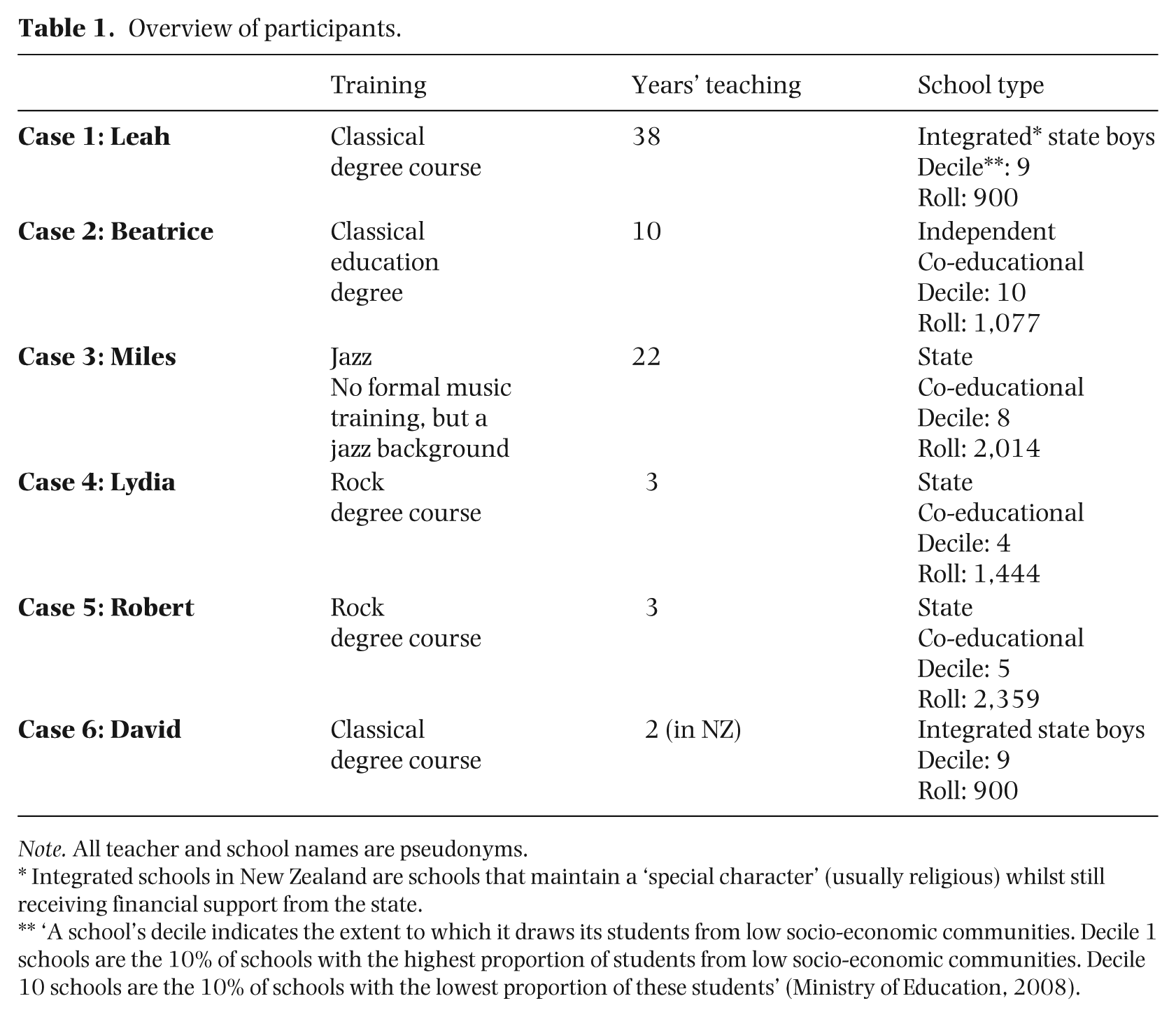
Note. All teacher and school names are pseudonyms.
Integrated schools in New Zealand are schools that maintain a ‘special character’ (usually religious) whilst still receiving financial support from the state.
‘A school’s decile indicates the extent to which it draws its students from low socio-economic communities. Decile 1 schools are the 10% of schools with the highest proportion of students from low socio-economic communities. Decile 10 schools are the 10% of schools with the lowest proportion of these students’ (Ministry of Education, 2008).
The findings: Key concepts from the case studies
Affirmation
Of the six teachers in this study, five spoke explicitly of the importance of recognizing and affirming students as individuals with particular interests and needs as music learners. Implicit in this recognition and affirmation is the acceptance of a certain degree of learner-centeredness, and an acknowledgment of the existence of musical pluralism. In this regard, teachers acknowledge that students bring varied and diverse interests, skills, and levels of commitment to the music classroom, and that students have a democratic right to have those interests acknowledged and developed (Bernstein, 2000). The classroom is then a place with a multiplicity of ideas concerning what music and musical knowledge is of value (Stalhammar, 2000), as every case in this research demonstrated. Teachers accepted to varying degrees the implications of affirmation affecting curriculum choice and approaches to pedagogy. Miles most clearly articulates this position: In the senior music programme there are a mixture of students with a mixture of backgrounds and mixture of instruments and a mixture of abilities, and the fact that none of them have felt excluded gives an idea of the type of programme that I hope to try and run . . . all of the students should feel that their music, their instrument and their experiences and their likes are valid. (Miles, Interview 1)
Extending this sense of affirmation, Beatrice aims to provide as many experiences as possible for her students to draw on: Everybody should have the right to have their musical interest valued. I guess what I want to give them is the whole lot, and in my perfect world my kids would take both courses, the performance [classical] course and the contemporary course. (Beatrice, Interview 1)
Significantly for Beatrice, there is a correlation between varied practical experiences and musical conceptual development: They have a whole raft of experiences to draw from and so when they come to sit down and discuss music or think about music on an academic level, they’ve got a whole lot of other things to draw from. (Beatrice, Interview 1)
Affirmation and accommodation of classical and popular music varied across the cases. Lydia is at one end of the continuum, where the values affecting learning programs and pedagogy are strongly focused on student interests and experiences. These interests and experiences are almost exclusively centered on popular music. Lydia considers popular music the ethical choice for the classroom as it creates fewer socio-cultural and socio-economic barriers for her students within the context of her school community. Lydia’s overriding values concern the affirmation of students’ musical interests and the utilization of music as a means of personal expression and identity formation. This is realized primarily through what Bernstein (1975/2003a) described as an integrated curriculum code: weak classification and framing and tending towards an invisible pedagogy. In strong contrast to Lydia, David’s educational focus is to provide strongly framed access to the classical knowledge that students might not otherwise come into contact with: ‘I’m absorbing classical now whereas at home I wouldn’t really get it’ (Year 11 student (d), case six). The result is an emphasis on knowledge content or a collection code; a visible pedagogy embedded in relatively strong instructional and regulative discourses (that is, explicit rules regarding conduct, curriculum content, delivery and evaluation). David’s argument is that the classical paradigm provides the best foundation for student development, ‘maximising their ability. Classical music supports them in the future’ (David, Interview 1).
If Lydia and David’s curriculum conceptions are considered as two contrasting points on a continuum, then the other case study teachers are in the middle areas between them, balancing the particular emphases described in these two cases. Robert described his curriculum conception process as ‘balancing [emphasis added] the different kinds of work the students were doing, trying to be more even across the board and giving the kids lots of stuff to get interested in, but also giving them a good rounded education’ (Robert, Interview 2).
Teachers saw affirmation as a fundamental part of their work in motivating, caring for, and educating students. On the other hand, the concept of affirmation is held in check at the institutional level by the regulative expectations of the school culture, and at the national level by the official discourses surrounding evaluation and assessment for qualifications. Forms of balance are sought between the requirements of the state and the autonomy of the teacher to modify learning experiences for each student.
Knowledge differentiation
While teachers’ affirmation recognizes the rights of students to have their musical areas of interest acknowledged and developed, teachers also spoke of the need to provide access to knowledge considered by them and by society as culturally significant. Even strongly-held values concerning student-centered and pluralistic cultural values are modified and recontextualized as they meet discourses of epistemic value for learning. After Muller (2006) and Young (2009), I term this second major influence on local pedagogic discourse knowledge differentiation. This involves the identification of knowledge considered by the teachers as most important for various types of learning within the segments of the official curriculum. Although not described by teachers in these terms, knowledge can be theorized: a) in terms of the verticality of its internal structuring principles (knowledge structures), and; b) more broadly as the knowledge required for academic learning versus the knowledge of everyday learning and experience, termed vertical and horizontal respectively (Bernstein, 2000). Bernstein theorizes that everyday knowledge, or horizontal discourse, is ‘likely to be oral, local, context dependent’ (p. 157). This knowledge tends to be situated and acquired through ad hoc experience rather than through ‘systematically related sets of concepts’ (Young, 2010, p. 25) or systematic instruction. For example students may acquire guitar playing, song writing and singing skills at home without any theoretical knowledge. On the other hand, the world of vertical discourse is one where their knowledge acquisition is related to the more sequential nature of the structure of the knowledge itself. Music theory is one such vertical discourse, where traditional rules beginning with pitch and duration usually lead sequentially to facility in advanced concepts such as harmony or arranging. Rather than being context-dependent, this form of knowledge is context-independent. Acquisition usually requires the guidance of a teacher who is conversant with the knowledge and useful pedagogical approaches. Bernstein (2000) argues that the distinction between these knowledge forms is significant not only in terms of how knowledge is produced and structured, but also how it is acquired and the identities engendered by the boundaries created around disciplines. There are both epistemic and social dimensions to knowledge creation and acquisition.
The process of recontextualization for the case study teachers included a clear differentiation of types of knowledge along the lines described by Bernstein (2000). This was expressed as comprising ‘knowledge about music’ or theoretical and historical cultural knowledge, mostly associated with the classical paradigm (theory, harmony, analysis, history of Western music), as compared to ‘music as knowledge’ (Tagg, 2002), the socially-contextualized procedural knowledge of playing, singing and song writing, most strongly (but not always) associated with popular music. In case study five, Robert suggested that classical and popular knowledges are most often realized by performers as procedural knowledge. An essential component of the popular musician’s craft is to create music often from minimal written material, relying heavily on the ear and skills of improvisation, whereas for classical players interpretation and technical assurance take on more significance.
Even the best professional orchestra member possibly couldn’t get in a room with four people and just jam whereas a great rock musician couldn’t go into a room and sight read a concerto. Those two skills are very, very different and very necessary. (Robert, Interview 1)
The degree to which underlying conceptual knowledge is made explicit for discussion and evaluation is one of the key differences between the contexts of informal learning and learning at school.
Theoretical knowledge enhances other music learning
A further recurring dimension within the knowledge differentiation theme was the potential for theoretical knowledge to enhance creative and expressive outcomes particularly by exposing students to varied ways of conceptualizing music’s structure and language through composition: It’s understanding that not all music has to have two guitars, bass, drums, vocals and then some synth keyboards in there . . . you can do so much more than be locked onto three verses, a chorus, a bridge and a build-up. (Beatrice, Interview 1)
Miles and Robert utilized popular music’s potential to draw in social and contextual issues as well, and in this way brought some degree of academic legitimation to popular music’s delineations (Green, 2005): In broader terms I would say popular music is more relevant socially to a lot of these kids. You can discuss the social implications and the social pressures that someone like Mozart or Beethoven had to write under but if you had to talk about slavery with blues you can compare it with poverty in the States or even in parts of New Zealand . . . you can make it very relevant and you study a lot about the world through contemporary music. (Robert, Interview 1)
Legitimation – recontextualizing the horizontal
Bernstein (2000) has noted a trend in education towards incorporating aspects of horizontal discourse ‘to facilitate access’ (p. 169). The inclusion of popular music is what he describes as the utilization of aspects of horizontal discourse as ‘a crucial resource for pedagogic populism in the name of empowering or unsilencing voices to combat the elitism and alleged authoritarianism of Vertical discourse’ (Bernstein, 2000, p. 170). Affirmation of student interests can be formalized through legitimation, where certain music or musical practices become authorized or sanctioned within a learning program as legitimate texts requiring evaluation. If there is scaffolding of learning from the horizontal to the required verticality of school knowledge, then the inclusion of aspects of horizontal discourse can be a source of motivation; beginning with the known and moving to knowledge that may be more empowering. Such empowerment could take the quite simple form of moving from knowing only the names of guitar chords or how to play them, to understanding their relationship within a key structure, and the transference of those chords onto other instruments or to the context of composition.
The findings across all of the case studies indicate that while teachers regard student experience as important and relevant to learning, they recontextualize aspects of this more horizontal discourse substantially for the school setting. In this way affirmation and matters of student identity interact with the adaptation and reframing of horizontal knowledge forms to align more readily with the innately vertical structures of schooling. In this way, school knowledge is not seen as simply a reflection of ‘real-world’ musical practices but a place where students come into contact with a structured form of knowledge acquisition under the guidance of an expert teacher. As Young (2009) suggests, ‘the concept of knowledge differentiation implies that much knowledge that is important for pupils to acquire will be non-local and counter to their experience’ (p. 16).
Nevertheless, as discourses become recontextualized at the local level and realized in personal social interactions, the seeds for change emerge as teachers question the dimensions of vertical discourse that can result in student detachment or alienation in relation to certain knowledge expectations. The case studies showed how teachers continually work to find a balance between the requirements of national assessment, expanding knowledge, and legitimating students’ areas of interest. A prominent area of tension for many students whose main interest is playing popular music, is their reluctance to engage with music reading and notation. Robert, who recalls a similar reluctance from his school days, suggests that engagement with theoretical knowledge is vital: That’s the thing that gets me, kids in music say ‘Oh I don’t want to learn this; I don’t know how to read music, what are these notes?’ Well my answer is ‘you come to school to learn; you don’t come to school to play what you already know on guitar’. Kids come to music with a certain set of ideas and come to maths with a whole different set of expectations I guess. (Robert, Interview 1)
In Robert’s view, music at school should expand students’ knowledge base, otherwise music is merely ‘facilitating their practices’ (Interview 1). In such a scenario, Robert would question the value and point of teaching music at school: ‘Why are they taking it and why are you teaching them?’ Nevertheless, the starting point for the pedagogical relationship is the interests and tastes of the students: ‘You’ve got to respect kids’ tastes even when you don’t agree, turning that side off, being the teacher’ (Robert, Interview 1).
Summary – Finding a knowledge balance
A prime motivating value for all participants’ curriculum conception is their ethical responsibility as a teacher. Personal musical values to a large degree become modified by educational values. Teachers seek to affirm and validate students’ interests and experience but also balance this with knowledge they think is epistemologically important. Teachers’ recontextualizing principles tend to emphasize either the epistemic or the social, or otherwise attempt to balance both dimensions. In each context, teachers make decisions bringing into play many influences such as their personal values and experiences, influential educational discourses, the values of the school, the interests of the students, and the pragmatic realities of daily teaching. These influences vary according to the type of knowledge being taught at any particular time such as composing, performing or analysing. Central to this process are the teacher’s own knowledge and values and the way in which varied and multiple influences impact on their curriculum making and enactment. Where there is scaffolding of learning – from the horizontal to the verticality of school knowledge – the inclusion of aspects of horizontal discourse appears to be highly productive, at least in terms of positive attitudes to musical diversity. This is particularly significant in elective programs where students are more likely to be destined for tertiary study.
While the influence of multicultural perspectives on curriculum content is acknowledged as significant within the discourse of Western music education, it was not the focus of the research, and therefore, this article aims to represents teachers’ views of the relationship between the two major styles of classical and popular music. While it is easy to consider these two types of music as creating a binary opposition directly associated with formal (classical) and informal (popular) knowledge, this was in fact not the case exemplified by most of the teachers in this study. Both styles of music became part of formal and informal approaches, depending on how the knowledge was appropriated or recontextualized (Bernstein, 2000). Moreover, while knowledge types are not exclusive or intrinsic to particular music traditions, historically and in practice some types of knowledge are more strongly associated with each style of music. Classical music is more often associated with formal theoretical knowledge (for example, knowledge of compositional techniques and harmony) and popular music with procedural knowledge (for example, facility with aurally derived improvisational practices and song writing).
Conclusion
In the introduction to this article, two teachers were quoted to illustrate dichotomous positions in relation to knowledge in music education. One used the metaphor of the colonization of students to make his point, while the other spoke of the need to educate widely. Bernstein (2000) has suggested that at the micro level of the classroom relations can take colonizing, complementary, privileging, or marginalizing realizations according to the way in which the influences play out in the recontextualizing arena. There was little evidence of colonizing or marginalizing in these case studies. Rather, teachers’ overall concern was to affirm, legitimate, and accommodate varying influences – most significantly the interests of their students – through the lens of educational values. It is interesting that such positioning eschewing binary oppositions seem to stand in contrast to much commentary from the academic field. It is at this level that symbolic control, mediated through Bernstein’s concept of the ‘pedagogic device,’ where knowledge is classified and framed, has the potential to engender change and ‘point away from determining systems’ (Bernstein, 2000, p. 125). Bernstein suggests that framing relations can lead to a change in classificatory relations: ‘the outcome of framing in interaction has the potential for changing classification’ (2000, p. 125). Teachers’ discomfort on both philosophical and inter-personal levels can lead to a weakening of the subject’s traditional boundaries within the instructional discourse and even to a relativism of aesthetic values. This weakening of classification may be justified as a mechanism for inclusion, but such ethical motivations can also be in tension with teachers’ sense of what is epistemologically important. One teacher participant’s struggle exemplifies this tension between structure and agency at the micro level. Below, Leah describes attempts to find a balance between students’ demands for more time to play ‘their’ music and the inclusion of other sorts of knowledge she considers important.
[The push for practical work] comes from the kids, ‘when are we going to do practical’, they beat you down, and then sometimes you wonder, when you’re verging on madness, now really there is too much of this, and for your sanity you think it would be so nice to do a bit more listening. And I never know when I have a listening lesson, and I really enjoy it and they seem to be compliantly doing the stuff, I never actually know if that’s for me or for them. (Leah, Interview 2)
In this way, the music curriculum in Leah’s school (case study one) was greatly influenced by the world of popular music. She was prepared to give way to the pressure from her students in giving a great deal of time for them to ‘play.’ The classification of what types of music were regarded as legitimate was changed within the school, and to a large degree the power was shared with the students. Nevertheless the structures and requirements for national assessment exerted a similar pressure resulting in some necessary modification to the production of ‘texts’ considered legitimate for the educational context. Interestingly, in the same school (case study six), a year later, the power had been reclaimed somewhat by David, whose recontextualizing principles place greater emphasis on theoretical knowledge. This is what he considers as most important for the development of his students.
What the cases show is dynamic and varying degrees of power (classification) and control (framing) in terms of how classical music and popular music are utilized as the means for developing musical knowledge. In no case was there an explicit either/or dichotomy, rather there were varying degrees of accommodation and balance emphasizing epistemic and social dimensions of knowledge along a continuum. Similar to the scenario described by Wright (2008) in her case study of one school, the teachers in this research had ultimate ownership and responsibility for the curriculum; but unlike the teacher in Wright’s study, these teachers were able to share the ownership through various means according to the contextual influences of the setting. While aspects of both curriculum content and pedagogy acknowledge and are responsive to the authority of the knower, this is held in check by epistemological concerns and the values and knowledge of the teacher in a particular context. The success with which students engage with music’s various ‘ways of knowing’ is dependent on the skills of the teacher in recognizing the epistemological intent of their practice.
The music classroom needs to be a site of both affirmation and dissonance. In the former, teachers will aim to develop skills of musical experience that are embodied by students in socially meaningful ways. In the latter, teachers will challenge narrow and comfortable accounts of what students consider to be music, bringing students into contact with conceptual knowledge – both old and newly developing – that is collectively regarded as foundational and powerful within the field. Teachers recognize that there is epistemological power at stake, not just cultural or political power, and this is why they retain classical and theoretical knowledge in their teaching programs. In this study, formal conceptual knowledge was not generally seen as colonizing knowledge but as a means to connect students with the generative concepts of the discipline. Students seemed most engaged, motivated, and positive about their developing musicianship where their teachers were using forms of visible pedagogy to ensure awareness of conceptual knowledge and enable knowledge ‘boundary crossing’ (Young & Muller, 2010). As a result there is the potential for students to take part in music programs where any tension between classical and popular music is minimized. Given the vast range of music available for inclusion within education, the challenge remains to negotiate what is of most value for students to learn in a twenty-first-century educational context. Educational environments need to provide both the dissonance required to inspire learning and the consonance required for students to recognize themselves as of value within the acoustic of the school. In other words, there is a place for both the canon and the kids.
Footnotes
Funding
This research received no specific grant from any funding agency in the public, commercial or not-for-profit sectors.