



Abstract
The purpose of this research was to investigate teachers’ beliefs about compositional experiences in the elementary music classroom. Elementary music teachers (N = 176) in Michigan completed a researcher-designed questionnaire, which included a combination of forced-choice and open-ended questions regarding how teachers define composition, why they believe engaging students in compositional experiences is valuable, and what factors motivate teachers to engage or not engage their students in compositional experiences. Results indicate that participants’ conceptions of composition vary widely. Many teachers believe composition involves creating, expression/communication, and replication; however, teachers varied in other beliefs about composition, including the necessity of notation and the level of complexity involved. Teachers who believe that composition is important in elementary general music feel it is valuable because it helps students develop and apply musical understanding and skills, gives students ownership of their music-making, helps develop creativity, and provides an opportunity for self-expression. Teachers identified numerous impediments to incorporating composition in the elementary music classroom, including time and logistics.
Keywords
Introduction
Creativity has come to be considered an important and highly valued human characteristic (Sullivan, 2007). “Creativity is now considered good for economies, good for society, good for communities, and good for education,” and thus the promotion of creativity may be considered an issue “of global importance” (Burnard, 2007, p. 1175). This growing interest in creativity has resulted in a focus on the incorporation of creative experiences in schools and the inclusion of composition and other creative experiences into music education curricula (Barrett, 2003). While composition is not the only activity through which a person can exercise creativity, numerous countries, including Australia, England, and the United States, have developed national documents that “advocate composition as a component of a complete music education” (Barrett, 2003, p. 3).
Scholars and researchers in music education have described numerous benefits of providing children with compositional experiences in addition to encouraging creativity. Compositional experiences can enable children to further develop their musical skills and divergent and higher-order thinking, as well as provide an opportunity for musical self-expression, voice, agency, and ownership (Levi, 1991; Miller, 2004; Stauffer, 2003; Wiggins, 2007). Composition also allows students to demonstrate and use their prior knowledge, connecting their school music experiences with their out-of-school musical experiences. In doing so, composition gives teachers insight into their students’ musical experiences and understanding (Gromko, 2003; Stauffer, 2002; Wiggins, 2007).
Numerous music educators and researchers have found that children in elementary school are capable of composing and have successfully implemented composition with young children (Barrett, 1996; Burnard, 2000; Davies, 1992; Hickey, 2003a; Upitis, 1992). Davies (1992) found that children aged 5 to 7 years can compose songs that use four-phrase structure, transformation of musical ideas, pattern, repetition, and closure with varying degrees of sophistication. Burnard (2000) studied 12-year-old children’s experiences of composing and discovered that, in addition to their ability to compose, “children can talk eloquently about their own musical experience when their creativity is cherished and musical beliefs are respected and accepted” (p. 243). Structuring and modification of compositional tasks can influence student success with composing and their preference for composing, as well as the perceived level of musicality in their compositional products (Miller, 2004; Smith, 2008). Additionally, Hickey (2003a) has developed a suggested sequence for teaching music composition to children that teachers may find helpful.
Clearly, incorporating composition in elementary music classes is possible and can be a valuable experience for students. However, because national curriculum documents such as the U.S. National Standards in Music Education may be voluntary, teachers in the U.S. decide whether to engage their students in compositional experiences, and, as a result, composing tends to be one of the most neglected activities. In a survey of 250 K–12 music teachers in South Carolina, Kirkland (1996) found that on average K–4 general music teachers rated composing as the National Standard at which students were least proficient and the least important goal for student achievement. In a survey of K–12 music teachers in Indiana, Schmidt, Baker, Hayes, and Kwan (2006) discovered that general music teachers devoted the least amount of class time to improvisation and composition out of seven activities, spending only about 6.89% of class time on those activities (less than program preparation, which was 11.5%). Orman (2002) looked specifically at elementary music teachers’ use of class time, gathering multiple videos of 30 experienced elementary music teachers over an 18-month time period, and results indicated that the mean percentage of class time spent on composing was only 1.03%.
The small amount of class time devoted to composition may stem from teachers’ beliefs about the importance of composition and their priorities for their programs. Bell (2003) surveyed K–12 music teachers in New York and found that only 29% of participants reported incorporating improvisation or composition in their teaching, citing reasons such as time constraints and performance schedules as obstacles. Strand’s survey of 339 K–12 music teachers in Indiana (2006) found that only 5.9% of survey respondents reported using composition “often”. The most common reasons given by participants for using composing were “Children learn more through composing” and “I use it to enrich other learning” (p. 158), while the most common reasons given by participants for not using composing were “Not enough instruments” and “Composing is not an appropriate activity for the types of classes that I teach” (p. 160). Peddell (2005) surveyed 102 elementary music teachers in Pennsylvania and found that, out of 27 activities, composing was one of the two least frequent activities reported by participants and was rated as one of the three least important activities. Reasons for this included the belief that composing is for older grades, special resources are needed in order to do composing, and other activities are more important than composing. Results also suggest that there is a significant correlation between how frequently teachers used activities and how important teachers perceived the activities to be.
In a four-year study of six secondary teachers in England, Odena and Welch (2007, 2009, 2012) found that the teachers’ conceptions of creativity and the ways in which they approached improvisation and composition in their classrooms were influenced by their own previous experiences. Teachers who had a greater variety of musical experiences, including composition, were “more articulate at describing” the type of environment that fosters creativity (2009, p. 428), citing hindrances to the creative environment such as “‘anxiety’ due to exams or preparation of concerts and ‘lack of time’” (2007, pp. 76–77). However, teachers with narrower previous musical experiences were more likely to simply “give the class a predetermined activity and expect creativity to ‘grow’” (2012, p. 40). The breadth of teachers’ own musical and teaching experiences also influenced their views of creative pupils, the openness of the creative process, and the degree to which they accepted a variety of creative products (2007). Odena and Welch’s (2012) resultant generative model of teachers’ thinking on creativity depicts the intricate relationships between teachers’ experiences, their perceptions of creativity, and what occurs in their classrooms.
Despite existing research that supports the use of composition with elementary students and the value of doing so, other studies suggest that some elementary music teachers may not feel that composing is a valuable activity for music class and may devote little or no class time to composition. This may be related to the ways in which teachers conceptualize and personally define the act of composing, as “there is little agreement on the cultural definition of composition, even within the context of contemporary Western culture” (Impett, 2009, p. 403). More research is needed to explore teachers’ beliefs regarding composition in elementary general music, specifically focusing on: how elementary music teachers conceive of composition; the factors that influence whether they engage students in composition; and their perceptions regarding the value of engaging students in compositional experiences. Gaining insight into teachers’ beliefs about what composition is and does for students may shed light on their decisions to include it in the elementary music program.
The purpose of this research was to investigate teachers’ beliefs about compositional experiences in the elementary music classroom. The specific research questions that guided this study are as follows:
How do elementary general music teachers define composition?
Why do some elementary general music teachers believe that engaging students in compositional experiences is valuable?
What factors, either positive or negative, motivate elementary general music teachers to engage (or not engage) their students in compositional experiences?
What relationships exist between teachers’ beliefs about the importance of composition and their years of teaching experience, the extent to which they currently include composition in the classroom, and their interest in incorporating composition into future classes?
Methodology
This study used a questionnaire to investigate the beliefs and practice of Michigan elementary music teachers regarding composition. Rather than using existing questionnaires, which mainly consist of forced-choice items, the researcher chose to develop a questionnaire that included more open-ended response items in order to more freely explore participants’ beliefs. Furthermore, this tool was designed to gather information pertaining to the specific research questions of this study (see Appendix for questionnaire items).
After piloting the questionnaire with several teachers and revising the instrument, the researcher used the SurveyMonkey™ (n.d.) website to distribute the questionnaire and collect responses. The researcher solicited contact information for members of various state organizations for music teachers, including the Southeast Michigan Kodaly Educators, the Detroit Orff–Schulwerk Association, the Michigan Gordon Institute for Music Learning, and the Michigan Music Educators Association (MMEA). In order to broaden the sample, the researcher also obtained email addresses of potential participants by searching the websites of various school districts in Michigan.
A total of 245 people responded to the questionnaire invitation, resulting in a 26% response rate. Because MMEA membership is not limited to elementary music teachers, it is possible that more members did not respond because they did not teach elementary music and thus were ineligible. Had the researcher known who those teachers were and removed them from the sample, the response rate may have been higher. Additionally, there is evidence that the use of web-based surveys results in a much lower response rate than other methods (Sax, Gilmartin, & Bryant, 2003; Wright, 2005). Despite these issues, the results of the current study provide meaningful insight into the beliefs of these participants regarding composition in their elementary music classrooms.
After collecting the questionnaire responses, the researcher analyzed the data by calculating response frequencies and correlations between forced-response items using SPSS and by coding open-ended responses and identifying emergent categories. This was done through content analysis, which involved “the simultaneous coding of raw data and the construction of categories that capture relevant characteristics” as well as the calculating of the frequency of these characteristics (Merriam, 2009, p. 205).
Results
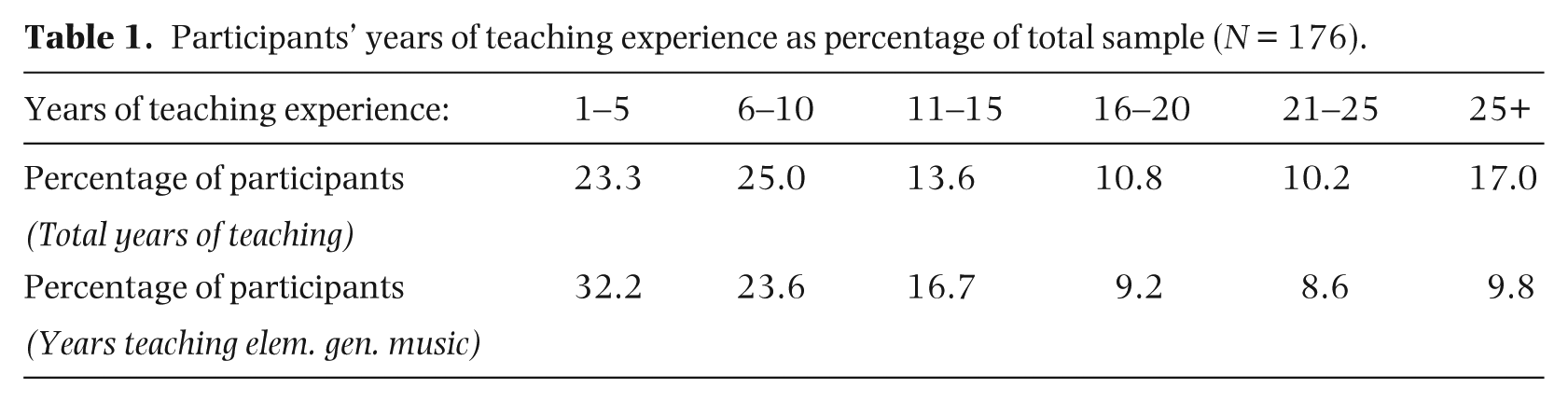
Of the 245 participants who responded to the invitation to participate, 22 had not taught elementary general music in Michigan in the last three years and were disqualified from the study. Responses from an additional 47 teachers were removed because they did not fully complete the questionnaire, leaving a sample of 176. Of the remaining sample 79.5% taught kindergarten, 85.8% taught grade 1, 83.0% taught grade 2, 80.7% taught grade 3, 77.8% taught grade 4, 63.1% taught grade 5, and 4.5% did not currently teach elementary general music but had in the previous three years. Participants varied in their years of teaching experience, both overall and specifically in elementary general music (see Table 1).
Participants’ years of teaching experience as percentage of total sample (N = 176).
Definitions of composition
In order to gauge participants’ personal definitions of composition, the questionnaire provided the open-ended prompt “Please describe the characteristics of music composition (e.g., What is composition? What does it entail?)”. Though the participants’ conceptions of composition varied widely, there were several prominent similarities, as well as two key differences. Similarities among the participants’ definitions of composition included the categories of creating, expression, and replication, while differences existed within the categories of notation and complexity.
The most prominent category among the participants’ definitions was that composition involves creating. Of the 158 participants who provided descriptions of composition, 103 (65%) used some form of the word “create”, including
“the creating of original music”;
“creation of musical thought”; and
“creative process”.
A number of participants also shared the belief that composition is a form of being expressive and communicating musical ideas. Thirty participants (19%) made reference to the communicative or expressive nature of composing, which included
“the process of expressing one’s ideas through music”;
“creating using a palette of sounds and silence, in order to express your self [sic]”; and
“the musical expression of a person”.
Another category that emerged in teachers’ definitions of composition was replication. Thirty-three participants (21%) stated that the ability to replicate the music one is creating is a necessary part of composing. Participants described this in various ways, including that composition
should be “reproducible in basically the same way each time it is performed”;
“is when you create something and are able to re-create/play/sing it again and again”; and
“can be replicated, either from written record or memorized recall”.
Participants differed in their beliefs about whether composition necessarily involves notation. Twenty-five participants (16%) expressed the view that composition need not be notated to qualify as composition or that the ability to read and write music notation is not a prerequisite for composing, making such comments as
“whether it is composed by ear, or written”;
“for some, this may entail writing notes down onto a staff … For others, composition may be strictly aural”; and
“one does not need to know notation in order to compose”.
However, 30 participants (19%) specified that composition by nature does require notation, stating that composition
“should be written in some form”;
“is the process of notating musical ideas”; and
“is the written form of communication from one musician to another”.
Comments from some participants also implied a belief that composition exists on a continuum ranging from simple to complex. Twenty-four participants (15%) made reference to varying levels of simplicity or complexity in composition, commenting that composition
“can be as simple as creating an interesting rhythm or melody or as complex as creating a piece for several singers or instruments”;
“can be in an advanced form … or can be quite simple, experimenting with given sounds or basic musical concepts”; and
“is the process of creating something new musically, whether it be a simple ostinato pattern, or a lengthy complex piece”.
Meanwhile, other participants made reference to composition as the creating of a “work” or “piece” of music, implying a view of composition that results in a more complex and sophisticated final product. Thirty-four participants (22%) made such comments, including that composition
“is the process of coming up with a unique musical idea and building upon that idea to create a whole musical piece”;
“entails the use of rhythm, pitch, melody, instrumentation, using music notation to create an original piece of music”; and
“is the process of writing a complete piece of music. It involves rhythm, melody, chords, tempo, dynamics, and occasionally lyrics”.
Other frequent characteristics mentioned in participants’ definitions of composition included the following: requirement of musical skills/knowledge (“It requires a certain amount of knowledge of theory”); the presence of guidelines or restrictions (“Composition is creating music within specific guidelines”); and the relationship between composition and improvisation (“Composing is one step beyond improvising”).
Importance, use, and value of composition
One hundred and seventy-one participants responded to the question “How important is it for elementary general music students to engage in composition?” Participants indicated their belief on a 5-point Likert scale, ranging from “Extremely” important to “Not at all”. Of these 171 participants, 51 (30%) felt that composition is “Extremely” important, and 80 (47%) felt it is “Very” important (see Figure 1). Only 30 teachers (18%) thought that composition is just “Somewhat” important, while 9 (5%) believed composition to be only “A little” important. A single teacher in the sample believed that composition is “Not at all” important in elementary general music.
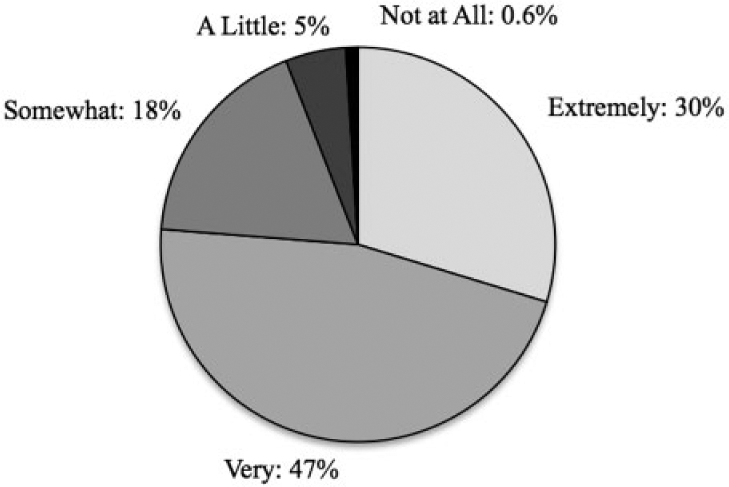
Participants’ beliefs about the importance of engaging elementary general music students in composition (n = 171).
There was a weak negative correlation (r = .200, p < .01) between participants’ beliefs about the importance of composition and years of teaching experience. Participants who had taught for fewer years tended to regard composition as more important in elementary general music than those with more years of experience. However, there was no significant relationship between belief about the importance of composition and years of elementary general teaching experience.
When asked whether they currently incorporate any composition into their elementary music classes, 84.2% of participants responded “Yes” while only 15.8% responded “No”. There was a moderate positive correlation (r = .379, p < .01) between participants’ beliefs about the importance of composition in elementary general music and whether they currently incorporate composition into their elementary music classes. Teachers who believed more strongly that composition is an important experience for elementary students were more likely to incorporate composition into their elementary general music classes. Of the participants who teach at each grade level, the percentage who currently incorporate composition increases with grade level, with a slight decrease between grades 4 and 5 (see Figure 2).
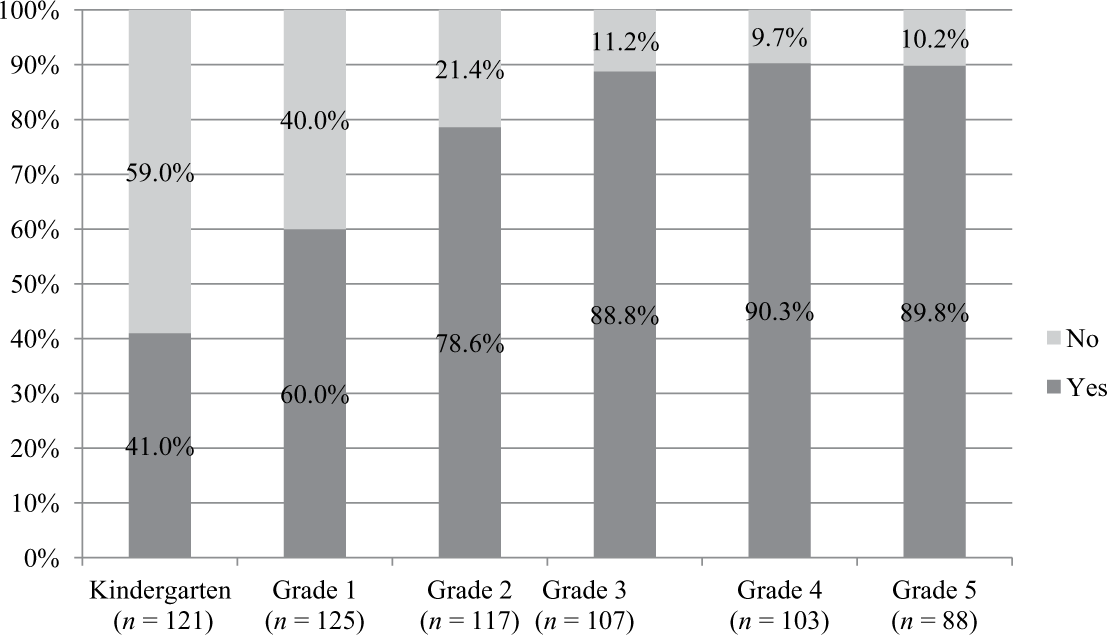
Percentage of participants who incorporate composition at each grade level.
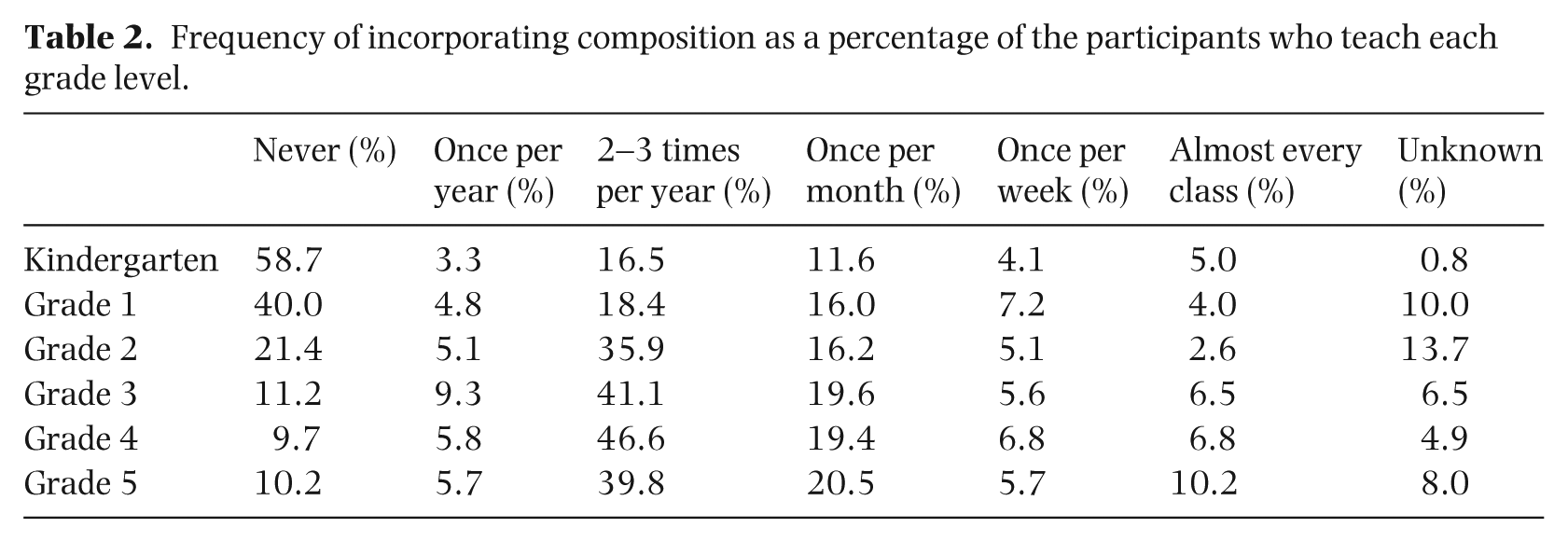
The questionnaire asked those participants who reported incorporating composition to estimate how often they do so, ranging from once per year to almost every class period. Results show that teachers incorporate composition with varying frequency at various grade levels (see Table 2). There were moderate positive correlations between participants’ beliefs about the importance of composition in elementary general music and frequency incorporating composition in kindergarten (r = .352, p < .05), grade 2 (r = .397, p < .01), grade 3 (r = .357, p < .01), grade 4 (r = .385, p < .01), and grade 5 (r = .487, p < .01). A non-significant correlation of r = .212 was found for grade 1. Teachers who believed more strongly that composition is an important experience for elementary students were likely to incorporate composition more frequently at these grade levels.
Frequency of incorporating composition as a percentage of the participants who teach each grade level.
Results suggest that most teachers are interested in incorporating composition into future elementary general music classes. When asked to indicate their level of interest on a 5-point Likert scale, 30.4% of participants chose “Extremely”, 47.1% chose “Very”, 15.2% chose “Somewhat”, 5.8% chose “A little”, and only 1.4% chose “Not at all”. There was a strong positive correlation (r = .780, p < .01) between participants’ beliefs about the importance of composition in elementary general music and their level of interest in incorporating composition into future classes. Teachers who believed more strongly that composition is an important experience for elementary students were more likely to be interested in including composition in future teaching.
In order to gauge beliefs about the value of composition, participants provided open-ended responses to the prompt, “Why do you feel composition is or isn’t important for elementary music students?” Content analysis of these responses revealed four main categories: musical understanding and skills, student ownership, creativity, and self-expression. Of the 164 responses given, 67 (41%) stated that composition is valuable in elementary general music because it helps students develop, demonstrate, and apply their understanding of musical concepts and skills. Some participants referred to composition as a tool for developing musical understanding, as exemplified in the excerpts below:
“[Students’] understanding of other people’s compositions can also increase.”
“In order for students to fully understand music they listen to, they must understand how it is put together.”
“If students are actively involved in creating music just as much as they sing, play, and listen to music, they will have an even greater and more cemented understanding of music and its principles.”
Other participants referred to composition as an opportunity for students to apply and synthesize knowledge and skills:
“When students are given the opportunity to compose, they apply that knowledge and learn how to really use it.”
“It is a time for them to synthesize the concepts they have learned and to create something new with them.”
Some participants also referred to composition as an avenue for assessment, including comments that composition
“[enables teachers] to assess how well students understand the dimensions of music”;
“is a way for students to demonstrate their understanding of music in a deep, meaningful way”; and
“allows [the] teacher a window into their students’ musical minds and a way to see what musical knowledge their students have mastered and internalized”.
Another category that emerged in participants’ descriptions of the value of composition was their belief that composition provides a chance for students to take ownership of their music–making. Forty-three participants (26%) referred to composition as a way to give students choice or voice and empower them to take ownership of and pride in their music making and learning. Comments included the following:
“Musical composition teaches kids that they can also be music inventors, that they don’t always have to perform what someone else has already done.”
“Students need to be aware that they have the power to create music.”
“The kids usually love it because they get to play “their own” music.”
“Creating original music gives each individual student ownership of a special piece of music that he/she will master and cherish.”
Creativity was another prominent characteristic that emerged among the participants’ beliefs about the importance of composing for elementary music students. Forty-two participants (26%) felt that composition is valuable because it allows students to be creative and/or develop and demonstrate creativity. Comments included the following:
“Every other subject regurgitates facts and applies formulas. Music is one of the few areas where we can create.”
“[Students] also discover that music is a truly creative process—it’s not a passive one in which they just sit there.”
“I think there are many students whose creativity is boundless and it would be a shame to hold them back because our own agenda dictates that they sing, dance, and perform.”
“It encourages music students to think creatively. … The students in my classes who are imaginative and somewhat ‘dreamy’ seem to flourish when practicing composition!”
Another category that emerged from participants’ responses was self-expression. Thirty-three participants (20%) referred to composition as a way to give students an opportunity to express themselves, commenting that composition
“[is] a practice in learning to communicate through music”;
“affords [students] the opportunity to express themselves musically”; and
“gives students a chance to ‘directly’ express who they are with sound, something that is extremely valuable, something that is often times missing in school music programs”.
Other explanations regarding the value of composition included the following: encouraging critical/higher-order thinking (“They can make mistakes and learn from them, figuring out the ‘why’ part of something that doesn’t sound right”); helping students become well-rounded musicians (“It allows them to feel and experience music in a whole different way than just performing”); allowing students to develop independent musicianship (“We’re creating life-long music learners or lovers who are much more INSIDE the music for having tried their hand at composition”); and motivating student learning (“[Composition] helps with student ‘buy in’ to our music programs. The look on their faces when they get to hear their compositions are priceless”).
While most participants believed that composition is an important musical activity for elementary students, 10 participants expressed the belief that composing has very little or no importance in the elementary music program. Several of these teachers explained that, while there may be value in composing, they felt that their limited amount of contact time with young students was better spent on other activities. Their comments included the following:
“My students are seen once a week. The footprint for our music ed curriculum is vast and as it is, I can only touch on some elements before moving forward throughout the school year.”
“With the limited amount of time that I see my students, I feel it is more important to develop other musical skills.”
“Composition is time consuming, and only one of the experiences students need to have in my room. It is a matter of time vs. many experiences, which places limitations on doing more composition in music classes.”
Impediments to composition
One hundred and one participants provided open-ended responses to the prompt “What influences your decision to NOT incorporate composition in elementary general music? (OR what influences you to not incorporate composition more frequently?)”. Within these responses, the most frequent reason cited was lack of time, which was mentioned by 52 participants (51%). Some participants referenced inadequate amount of contact time with students:
“I do not incorporate more (or longer) composition experiences due to the infrequency that my classes meet.”
“Budget cuts to the music program in which some classes have been reduced to once a week.”
“If I had more time with my students I would like to incorporate composition more.”
Other participants referenced the amount of time required to do composition:
“Composition is time consuming.”
“The reason I don’t include composition more frequently is because it is a timely [sic] exercise.”
“It tends to take up more class time than I feel is appropriate.”
The next most common reason for not including composition more frequently was logistics, cited by 24 participants (24%). Some mentioned class size as an impediment to composition:
“There is only one of me and there are 25 students who need my help.”
“I had difficulty being able to assist the number of students who required it.”
Others mentioned a lack of resources:
“If I had more instruments … that my students could use to make a composition, it would be easier for the entire class to participate in a composition assignment.”
“I work at a small school and the resources can influence activities I do.”
Still others mentioned working at multiple buildings or teaching “from a cart” as reasons why they don’t do more composition:
“I travel to 3 schools, do not have my own room, teach ala cart [sic].”
“I lost my music room. Having access to all the instruments and a place for students to work is critical for this type of activity.”
Other frequently-cited impediments to composition included the belief that other activities are more important (“There’s so much other ‘stuff’ that I want to get to, that composition isn’t the highest priority”); students’ lack of readiness/ability to compose (“the difficulty in getting students to write quality compositions” or “I don’t feel the students are musically ready”); the demands of performance preparation (“I do not incorporate more frequently due to working on concert material for upcoming performances”); and a lack of ability to teach composition (“I do not have much experience with composing myself and am unsure how to teach it to students”).
Discussion and implications
Compared to earlier studies in which a large number of music teachers reported little or no use of composition (Bell, 2003; Orman, 2002; Peddell, 2005; Schmidt et al., 2006; Strand, 2006), one might be surprised by the high percentage (84.2%) of participants in this study who report incorporating composition in their elementary general music classes. This unexpectedly high percentage may be related to the nature of the sample. The majority of participants were members of state music education organizations, who may tend to be more involved in ongoing professional development and may be more progressive in their ideas about music education. While the researcher tried to include teachers who were not members of such organizations, an examination of composition practices among a broader sample of teachers might reveal a smaller percentage of elementary music teachers incorporating composition.
It is possible that this increase in teachers’ use of and beliefs about the importance of composition in elementary music may be a result of increased focus on composition and creativity in music teacher professional development. There has been a surge in recent publications and professional presentations addressing composition and the ways in which teachers might implement composing in their classrooms, which may have better prepared teachers for using composition in their classrooms (Hickey, 2003b, 2012; Kaschub & Smith, 2009, 2013; Strand & Newberry, 2007). Results of the current study also suggest that newer teachers tended to believe that composition in elementary music is more important than did teachers with more years of teaching experience, one explanation for which might be changes in music teacher education. It is possible that teacher education programs may be focusing more on composition and thus might be positively affecting pre-service music teachers’ beliefs about and attitudes toward composition as an important component of students’ music education. Teacher education also may be providing pre-service teachers with more firsthand composing experiences and better preparation for teaching composition, as indicated by the fact that only 12 (12%) of the 101 teachers who described impediments to composition reported feeling unsure of how to teach it. Odena and Welch (2007, 2009, 2012) found that teachers’ own diversity of musical experiences (including composition) affected their views of creativity in the classroom, and Koutsoupidou (2005) reported that teachers who had experienced improvisation in higher education were more likely to engage their own students in improvisation. A similar study might examine the ways in which music teachers experience composition in their undergraduate music education programs, as well as their own school music experiences, and the ways in which these experiences affect subsequent beliefs about and use of composition in their classrooms.
The large percentage of elementary music teachers in this study who incorporate composition also might be related to increased beliefs about the importance of composition. While past studies (Bell, 2003; Kirkland, 1996; Peddell, 2005; Strand, 2006) found that many music teachers felt composition was a low priority for their classrooms, 77% of the teachers in the current study expressed the belief that engaging elementary music students in composition is extremely or very important. The belief that composition is an important experience for their students may influence these teachers to incorporate composing activities into their classrooms.
Another explanation for the unexpectedly high percentage of teachers incorporating composition in elementary general music might be related to the range of personal definitions of composition. These varying personal definitions of composition may influence the extent to which teachers incorporate composition in their classrooms, if at all, as well as the ways in which they do so. The most prominent differences in teachers’ definitions of composing pertained to the level of complexity of the musical product and the necessity of notation in composing. These differing beliefs may relate to the ways in which teachers approach composing with their students and the composition tasks they set up in their classrooms. Are teachers who believe that composition can be simple more likely to incorporate composition in elementary general music than teachers who believe composition must result in a complex “work” of music? Do elementary music teachers who believe composition need not be notated begin incorporating composition with younger students while teachers who believe composition must be notated wait until students are older to begin composition (if at all)? Future research might seek to investigate the relationships between teachers’ beliefs about the nature of composition and the ways in which they use and approach composition in the classroom.
While this study lends some insight into elementary music teachers’ beliefs about and use of composition, it can only provide a limited amount of self-reported information from a narrowly (and often self-) selected sample of teachers. Furthermore, this study reveals nothing about the nature or quality of the compositional experiences these teachers are providing for their students. Future researchers might explore teachers’ compositional beliefs and practices in a richer, deeper way through teacher interviews, focus groups, and/or classroom observations.
Recommendations
It is not surprising that this study found a correlation between teachers’ beliefs about the importance of composition in elementary music and their interest in and use of composition in the elementary music classroom. It makes sense that teachers who believe composition is important are more likely to engage their students in composing while teachers who believe composition is less important are less likely to do so. However, this leads to questions regarding whether teachers’ beliefs can be changed and whether development of elementary music teachers’ valuing of composing for their students can lead to a greater likelihood that they will teach composition.
The elementary music teachers in the current study were more likely to use composition, and reported incorporating composition more frequently, as students get older. It is possible that this is related to their beliefs about the nature of composition, specifically the level of complexity and/or the necessity of notation in composition. Teachers who believe that composition must result in a complex “work” of music or must be notated may believe that students first must amass significant musical knowledge and skills in order to be successful composers. However, Barrett (2003) advocates that, rather than a mere demonstration of existing musical skill and understanding, composing is a valuable way in which students actually construct meaning and can take place at a very young age. Hickey (2012) reports observing “a deeply ingrained assumption that music notation is not only key to music learning, but central to music composition” (p. 20) but that “once students understand that music composition is simply the act of organizing sounds into a logical form, they begin to see themselves as capable composers” (p. 42). Music teacher education might seek to help music teachers reconceptualize their own definitions of composition in this way so that they do not feel as if they must wait until students can read notation and understand music theory to begin teaching composition.
Broadening teachers’ conceptions of composition also might help to lessen the effects of perceived impediments. As in prior studies (Bell, 2003; Odena & Welch, 2007, 2009, 2012; Peddell, 2005; Strand, 2006), participants in the current study articulated that issues such as time, logistics, and student readiness prevent them from incorporating composition into their elementary music classes. However, it is possible that these perceived impediments to composition may be related to teachers’ beliefs about what composition is and that helping teachers to reconceptualize composition might help lessen their perceptions of these impediments. For example, helping teachers understand that composition need not be notated might encourage them to implement it earlier, rather than delaying composition until students have developed sufficient notation reading and writing skills. Teachers who believe that they lack sufficient resources for composing may see composition as something that requires special instruments or technology but might be more inclined to incorporate composition if they can be shown that these resources are not necessary. Teachers who believe that there is not enough time for composition might change their minds if they see that composing can be implemented in simple, small ways rather than only through the construction of complex “works” of music.
Additionally, we might seek to help teachers broaden their concepts of musical creativity. Numerous participants in the current study described composing activities at the kindergarten and first grade levels that involved improvisation. This may be due to a lack of distinction between their definitions of composition and improvisation, or it may be a result of a view that improvisation is a readiness for composition and thus could be considered a composing activity. More research is needed to examine teachers’ conceptions about the relationship between improvisation and composition and other ways in which students can develop and utilize creativity. As Burnard (2012) states, “we need to hold more than one mode of musical creativity, such as written composition, in mind” (pp. 22–23). If teachers come to value the spectrum of ways in which musical creativity can be developed and exercised, they might be more likely to provide a variety of creative experiences for their students. More specifically, if teachers are shown the broad range of possible definitions and conceptions of composition, as observed in the responses of teachers who participated in this study, they may be more likely to incorporate a variety of composing experiences into their classrooms, thus providing students with a richer, more fulfilling music education.
Footnotes
Appendix
Funding
This research received no specific grant from any funding agency in the public, commercial, or not-for-profit sectors.