



Abstract
This study extends an eight-country mapping exercise (McPherson & O’Neill, 2010; see Research Studies in Music Education issues 2010–2011) to include students’ motivation to study music within the Australian context. It sought to determine whether music learners (students learning an instrument or voice), might be more motivated to study academic subjects at school, and whether gender and socio-economic status (SES) affected student motivation to learn music at school. A total of 2,727 students from grades 5 to 12 completed a questionnaire based on Eccles and Wigfield’s expectancy-value framework. Data collected included: ratings of competence beliefs, interest, importance, usefulness and difficulty for music, English, maths, and science; indications of whether the students were currently learning a musical instrument or voice (music learners); and whether they would like to if given the opportunity. There was an overall significant decline in competence beliefs, interest, importance, and usefulness across the school years, in contrast with increased task difficulty ratings across the school years. Music learners reported significantly higher competence beliefs, interest, importance, usefulness, and less task difficulty than non-music learners. This advantage applied across all school grades for music, competence beliefs for English in upper primary and lower secondary school grades, and for maths in lower secondary grades. Although females reported music as more important and useful than males, their competence beliefs and task difficulty ratings were equivalent. Music was considered slightly less interesting for females than for males. The value of music as a subject declined significantly for upper SES students from upper primary to lower secondary schools. The greatest number of participants (40.8%) who expressed a desire to learn a musical instrument came from the lower SES category in upper primary school. This is an important result in the Australian context, indicating that this may be a positive time to recruit learners. This study provides new information regarding the relationship between motivation and desire to learn a musical instrument across school grades, gender, and socio-economic factors.
Keywords
Introduction
The intrinsic and instrumental benefits of arts education for young people and the communities in which they live and develop have been regularly asserted in reviews conducted both in Australia (Ewing, 2010) and internationally (Dwyer, 2011). Nevertheless, research seeking evidence to support the positive impact of music education has provided equivocal findings (Cabanac, Perlovsky, Bonniot-Cabanac, & Cabanac, 2013; Rickard, Bambrick, & Gill, 2012), thus fuelling an ongoing debate regarding the value of arts and music education both within schools and the wider community. More generally across the arts, Martin et al. (2013) have found that children benefit from arts participation where the quality of arts engagement is the priority, and children’s arts participation is supported through positive adult role models and a supportive home environment. In the study, school, home, and community-based arts participation was shown to exert a positive impact on academic (e.g., motivation, engagement) and nonacademic (e.g., self-esteem, life satisfaction) outcomes for students (Martin et al., 2013).
Global mapping of student motivation to study music
The current study builds on the major mapping exercise across school grades 5 to 12, which was undertaken by McPherson with colleagues from Brazil, China, Finland, Hong Kong, Israel, Korea, Mexico, and the USA. The aim of this series of articles was to establish how and why students develop the desire to pursue music as a school subject, and how their beliefs and attitudes about music may differ from other subjects.
In the eight-country study, the major theoretical framework chosen to explore individual differences in students’ motivational orientation was expectancy-value motivation theory (Eccles, 2005; Eccles & Wigfield, 2002). The theory seemed to fit the case of music learning, with motivational constructs including competence beliefs, subjective task values, and task difficulty all seeming to have relevance to music. Competence beliefs comprise expectations for success (i.e., a student’s belief about how well s/he can perform in a specific subject or upcoming task). It is measured through current and future expectations of ability and comparative estimates of personal competence. According to expectancy-value theory subjective task value includes four major components: attainment value (i.e., importance), intrinsic value (i.e., interest), utility value (i.e., usefulness), and cost. Because cost includes negative valence factors such as anticipated anxiety and cost of failure (in terms of what is given up or suffered as a consequence of engaging in the activity), it was not included in this study (Eccles, O’Neill, & Wigfield, 2005). The positively valenced components of importance, interest, and usefulness were grouped together to form one subscale values. Task difficulty is distinguished from competence beliefs because it has been found to influence goals and motivational outcomes differently (Harackiewicz, Barron, Pintrich, Elliot, & Thrash, 2002). For example, students can feel that music is hard, but that they are still good at it. If students believe the difficulty is too great, they may invest less effort in learning music or abandon music activities altogether (O’Neill, 2005; Wigfield, O’Neill, & Eccles, 1999).
Longitudinal research according to the expectancy-value framework shows that students demonstrate a decline in motivational beliefs as they progress through school, which varies by subject and gender (Jacobs, Lanza, Osgood, Eccles, & Wigfield, 2002). For example, a decline in beliefs was observed for language arts in elementary school years, but levelled or increased through high school, in contrast to a rapid decline in sports’ beliefs in the high school years. Ability self-perceptions accounted for most of the gender differences in task values for language arts and sport, suggesting that as students get older, their ability self-perceptions exert a greater influence on whether they value, and hence choose, certain subjects at school.
For their eight-country research study, McPherson and O’Neill (2010) reported a general decline in competency beliefs and values for school subjects, including music, from the earlier to later years of schooling, accompanied by a general increase in perceptions of task difficulty. In addition, music was ranked lower on competence beliefs and value components compared with “academic” subjects (mother tongue, maths, science), whilst academic subjects were considered the most difficult school subjects. Music was also rated the easiest for all countries apart from Mexico. Important differences were identified between male and female students. In all countries except for Brazil, females valued music more, expressed higher competence beliefs, and considered music to be an easier school subject (lower task difficulty) than males. Females also expressed higher valuing of music in five out of the eight countries. In all countries, students who were learning an instrument reported more competence in, and valuing of, music than non-music learners. The important overall conclusion from this study was that many students find music less valuable and feel less capable in school music as they progress through school.
The present study explores the extent to which findings observed in the original eight-country survey are reflected in the Australian setting. A decade ago, the Australian Commonwealth Government National Review of School Music Education (NRSME; Pascoe et al., 2005) found that only 23% of public schools were meeting the review’s criteria for the minimum requirements for school music, in contrast with 88% of independent ones. In arguing for a stronger presence in music in public schools, Pascoe et al. (2005) highlight the inequitable provision of opportunities for music learning along a social and economic divide. This investigation adds to growing knowledge about a global view of music learning and academic motivation, and can be expected to provide evidence to inform future music education policies and practices in Australia itself.
The Australian context
Music is offered in school curricula from Kindergarten to Year 12, and classroom music generally forms part of the curriculum in primary schools. Through the implementation of the new Australian Curriculum endorsed in July 2013 (ACARA, 2013a), all school children are entitled to be educated in each of five arts subjects (Music, Visual Arts, Drama, Dance, and Media Arts). In this curriculum a notional 100 hour allocation of teaching for all five arts subjects during Years 3 and 4 does not appear to have initiated a dramatic change in policy from past practice (ACARA, 2011b). Furthermore, seven general capabilities embedded across the Australian Curriculum allude to arts education without explicitly acknowledging the artistic knowledge, skills, and behaviours that can be deployed and applied across the curriculum. Therefore, it seems that under the new Australian Curriculum, specific allocation of time for Arts learning, including music, will remain a school-based decision.
Prior to the implementation of this new Curriculum, there were substantial differences in classroom music programmes and co-curricular instrumental/vocal lessons across Australian states and territories, which prohibited a complete and accurate portrait of student participation and achievement in music (Pascoe et al., 2005). For example, many schools offer classroom music in the first two years of secondary school (Years 7 and 8) but this may not always be the case. From the information that is available through the NRSME we know that compared to other school subjects, enrolment rates in music in upper secondary school are very poor and accompanied by a high rate of attrition, even though this varies from state to state. Across Australia final year secondary school music enrolments grew 3% from 1991–2004, compared to increases of 19% in the visual arts and approximately 66% in performance arts and media. As an example, in the state of Western Australia in 2004, and despite government schools being supported with low cost instrument hire schemes and music libraries, only 328 students were enrolled in music as a tertiary entrance subject, and 450 students in Music in Society, a non-tertiary school-assessed subject, both of which are offered in Years 11 and 12. This is despite 5,120 instrumental students starting in school Years 3 to 6, along with a smaller number of new students in Years 7–12 (enrolment numbers approximate and supplied by the Western Australian Department of Education and Training School of Instrumental Music).
The NRSME established an immediate priority for improving and sustaining the quality and status of music education, based on stark evidence about the shortcomings, inequalities, and substantial student disengagement in school music (Pascoe et al., 2005). Entitled Augmenting the Diminished, the report concluded that the quality and perception of music education in Australia had diminished to a critical point, suffering through decreased scholastic attention, loss of identity, status, and participation. Alongside the widely held public view that music is not a subject worthy of serious study (McPherson, 2006), the review illustrated the contradiction between the paucity of opportunities for music learners in many Australian schools and the evidenced benefits from music education and its value as a school subject.
Music-dedicated services to government schools in support of instrumental and vocal learning have been reduced by successive restructuring within education systems. Within three of the seven Australian states and territories, and in the independent schools sector nationally, instrumental and vocal tuition is most often provided at an individual school level on a user-pays basis, thus highlighting the dictum that “those who play music are those who can pay for music” (Pascoe et al., 2005, p. xi). Financial costs, as well as access to suitably qualified instrumental and vocal teachers, are key contributing factors to the impoverished music education system. Music resources in a subset of 21 Australian schools considered to have effective and exemplary music programmes were assessed as “well-resourced”, comprising mostly of purpose-specific music-classrooms including a wide range of instruments (typically percussion, guitars, keyboards) and computers with various music software programmes for composition, music production, and/or access to recordings (Pascoe et al., 2005, p. 72). Yet, the overall conclusion is that students in rural communities and low socio-economic circumstances are disadvantaged in musical development. Some students with identified gifts and talent in music would appear to miss out on realizing their musical potential.
Within Australia, schools have a high degree of autonomy in their delivery of classroom music education. In the state of Victoria, for example, there is a framework for the delivery of classroom music education from Foundation (Kindergarten) to Year 10, yet schools are under no obligation to deliver music programmes after Year 4. Government primary schools do not receive specific funding to deliver instrumental music programmes, and therefore participation is on a user-pays basis. Government secondary schools in Victoria do receive funding which enable instrumental music programmes to be offered at a heavily subsidized rate or at no cost to students. A Victorian government inquiry into the extent, benefits, and potential of music education in schools revealed that only some Victorian schools were providing high quality musical experiences (Parliament of Victoria, 2013). Access to sequential and in-depth music education appears to be missing for the majority of students in public schools and low socio-economic status (SES) areas, particularly in the primary school years.
Socio-economic status and desire to learn music
Both the NRSME and Victorian Government music education inquiries generated substantial public response, indicating there is strong support in the community for the provision of equitable and sustainable music education in schools. What these reports did not include, and what is not yet known, is the motivational profile of Australian school students to learn music at school, and in particular, given the substantial financial costs associated with music education in Australia, how this might be affected by SES.
In Australia, a school’s SES is measured by the Index of Community Socio-Educational Advantage (ICSEA; ACARA, 2011a). This was established by the Federal government in 2010 to facilitate meaningful comparisons across schools by taking into account socio-economic characteristics of the areas where students live, such as accessibility and remoteness, proportion of Aboriginal and Torres Strait Islander students and students of a language background other than English, and family background data including parents’ occupation and level of education completed. The ICSEA was developed to enable fair and meaningful comparisons of the key performance measures that correlate with educational outcomes as indicated in the National Assessment Program for Literacy and Numeracy (ACARA, 2013b).
Research in the United States demonstrates significant differences in SES between students who elect and do not elect to study music and between those who persist in learning an instrument and discontinue instruction (Kinney, 2010). Students enrolled in music programmes in public and private schools are more likely to come from families with higher SES (Elpus & Abril, 2011). During adolescence, students from high SES backgrounds are more likely to study music as an extracurricular activity than those from low SES (Feldman & Matjasko, 2007). High SES schools have higher enrolments in music programmes than low SES schools (Costa-Giomi & Chappell, 2007), and higher enrolment in music as a subject, which incidentally has a greater disparity according to SES than other arts subjects (Nabb, 1995). Therefore, music participation is related to SES background, regardless of whether students are in the public or private systems, or the programme is curricular or extra-curricular (Costa-Giomi, 2012).
Aim of the study
This study extends the eight-country mapping exercise undertaken by McPherson and colleagues (McPherson & O’Neill, 2010) to include an examination of students’ motivation to study music within the Australian context. Perceptions of interest, importance, usefulness, difficulty, and competence in academic and music subjects were profiled by expanding theoretical and methodological techniques used in the original eight-country study.
The study had three principal aims:
To determine whether music learners who were learning an instrument or voice within or outside of school, might be more motivated to study academic subjects at school.
To determine whether gender and socio-economic status analysed individually might affect student motivation to learn music at school.
To examine any interactions between school level and SES level in students’ motivation to study music at school.
Method
Sample
Questionnaires were completed by 2,727 school students across grades 5 to 12, and drawn from 15 schools in the state of Victoria, Australia. Victoria is the second largest state in Australia, with a diversity of school systems and socio-economic levels that is consistent with other school systems across Australia. Seven schools were located in the metropolitan suburbs of Melbourne. Eight schools were located in rural Victoria, four of which were located in large regional towns. There were slightly more males in the sample (n = 1534; 56.3%) than females (n = 1193; 43.7%). The mean age for males was 13.33 years (SD = 1.84) and females 12.91 years (SD = 1.73).
Of the full sample of 2,727 students, 1,486 (54.5%) indicated they were learning to sing or play a musical instrument (music learners). Students learned to sing or play their instruments at school only (44%), or in combination with outside school lessons (26.4%). A third (29.5%) of students learned outside of school only. Instruments learned by the student sample in descending order were piano (40.3%), guitar (32.3%), voice (26.1%), woodwind (20.6%), string (15.4%), percussion (14.8%), and brass (11.8%).
Table 1 shows the number of students according to school grade level, gender, and music learner (defined by whether the student was learning a musical instrument or voice within or outside of school). Grades were divided into three levels as per the McPherson and O’Neill (2010) eight-country study: Primary (P) = year 5 and 6 of upper primary school; Lower Secondary (LS) = years 7 to 9; and Upper Secondary (US) = years 10 to 12.
Number (and percentage) of participants according to school level, gender, and music learner.
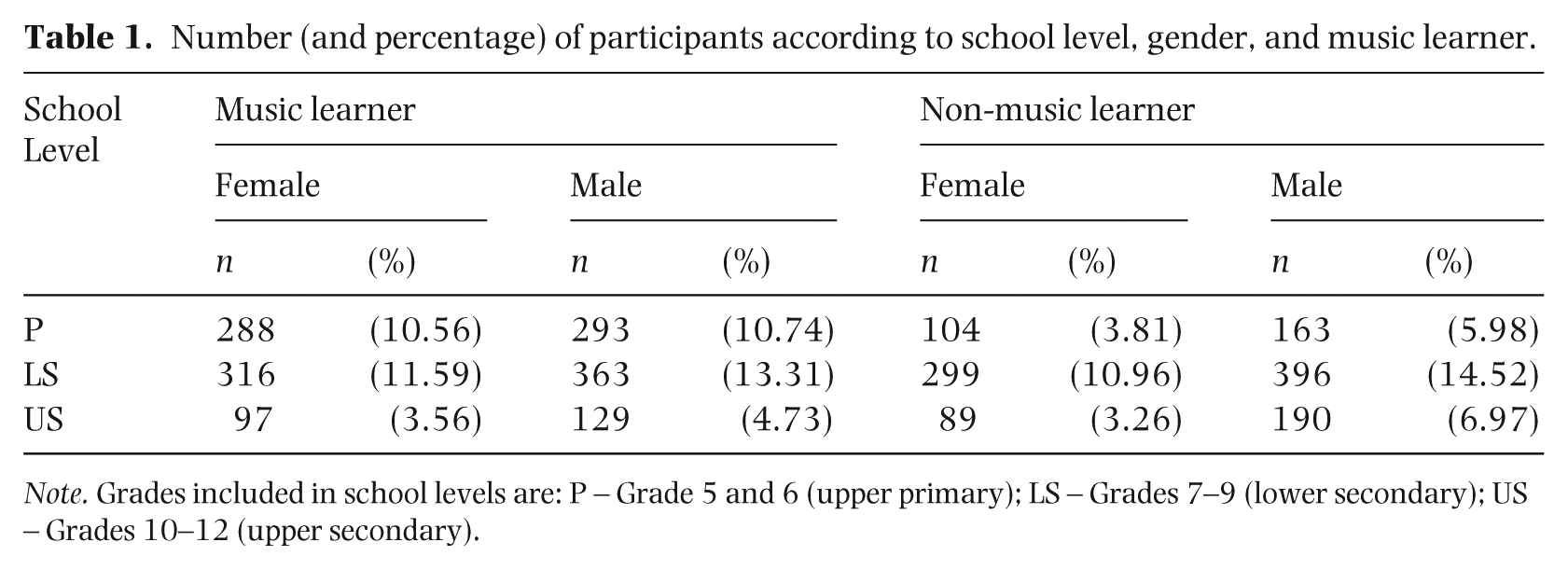
Note. Grades included in school levels are: P – Grade 5 and 6 (upper primary); LS – Grades 7–9 (lower secondary); US – Grades 10–12 (upper secondary).
The 2010 ICSEA values for participating schools in this study ranged from 947 to 1207 (M = 1,101.33, SD = 84.33). Socio-economic comparisons were obtained by dividing the ICSEA range into three equally divided groups: lower third (947–1,039), middle third (1,075–1,151) and upper third (1,159–1,207).
Table 2 lists the number of students in the sample by grade and SES levels.
Number (and percentage) of participants according to school level and SES level.

Note. SES lower – lower third in sample; middle – middle third in sample; upper – upper third in sample. School levels are: P (upper primary); LS (lower secondary); US (upper secondary).
Questionnaire
A 42-item questionnaire, mostly answered using a 7-point Likert scale, determined beliefs and attitudes about music compared to other “enrichment” school subjects (art and PE/health) and “core” academic subjects including English, maths, and science. It builds on McPherson and O’Neill’s (2010) eight-country comparison study which employed expectancy-value motivation theory (Eccles & Wigfield, 2002) to garner student perceptions about the role and function of each school subject and how it might equip them after they leave school; their beliefs and judgements about their capabilities to learn each school subject; the reasons why they choose to engage in and devote effort to each school subject; and expectancies about, and valuing of, each school subject. Demographic questions included school grade, age, gender, number of siblings, participation in out-of-school leisure activities and academic coaching outside of school, and access to musical instruments at home. Music learning was assessed by asking whether students were learning to sing or play a musical instrument, and if so, which instrument(s) and where they were learning (at school, out of school, or both).
Motivation measures
Motivation to study each subject was measured through five subscales (competence beliefs, interest, importance, usefulness, and task difficulty) and based on the McPherson and O’Neill (2010) questionnaire. The only modification was for the construct Usefulness, where two items in the original study (“How useful are these subjects compared to your other activities?” and “How worthwhile for you is the amount of effort it takes to do the following subjects?”) were omitted due to observed redundancy following statistical analysis of the eight-country data. To increase reliability, the school subjects were rotated for each item to maximize student attention and minimize response sets. McPherson and O’Neill (2010) report subscale internal consistency of Cronbach’s alpha from .81 to .86 across the eight countries. For this study, we observed similar internal consistency in the measures, with all subscales demonstrating very high internal consistency across all six subjects, with Cronbach’s alpha ranging from .83 to .95. Additional descriptive information for the subscales can be obtained from the corresponding author upon request.
Competence beliefs were measured through four items:
How good are you at [subject]? (1–Very bad to 7–Very good)
How well do you think you will do this year? (1–Very poorly to 7–Very well)
If you were to order all the students in your class from best to worst, where would you put yourself for [subject]? (1–The worst to 7–The best)
Compared to other students in your class, how well do you expect to do this year in [subject]? (1–Much worse to 7–Much better)
Values were measured through three subscales examining participants’ subjective values in terms of importance, interest, and usefulness of engaging in each school subject.
Two items measured interest:
At school, how much do you like learning the following subjects? (1–I don’t like it to 7–I like it a lot)
At school, how interesting do you find [subject]? (1–Not interesting to 7–Very interesting)
Three items measured importance (all rated as 1–Not important to 7–Very important):
For you, how important is it to learn [subject]?
For you, how important is it to be good at [subject]?
For you, how important is it to get good results in [subject]?
Three items measured usefulness (all rated as 1–Not useful to 7–Very useful):
In general, how useful is what you learn in [subject]?
How useful is it to learn these subjects for daily life outside school?
How useful do you think learning these subjects will be for when you leave school and get a job?
Task difficulty: Student perceptions of how difficult they believed each subject to be were assessed through two questions:
How hard are these subjects for you? (1–Very easy to 7–Very hard)
Compared to your other school subjects, how hard is it to do [subject]? (1–Easiest subject to 7–Hardest subject)
Two additional questions were included to capture student perceptions of how hard their parents and teachers expected them to work in each subject:
How hard do your parents/teachers expect you to work in [subject]? (1–Not hard to 7–Very hard).
Effort
Required effort was not included as a separate construct because of the relationships both to perceived task difficulty and cost. As Eccles and Wigfield (2002) explain, “Cost is conceptualized in terms of the negative aspects of engaging in the task … as well as the amount of effort needed to succeed” (p. 120). Furthermore, Eccles (2005) describes effort as a “double-edged sword”, because although trying is important for success (and is encouraged by both parents and teachers), if children try and fail, then it is difficult for them to escape the conclusion that they lack ability. Therefore, if failure seems likely, some children will not try, precisely because trying and failing threatens their ability self-concepts. (p. 113)
Ability self-concepts are measured more directly in this study through competence beliefs. The construct of effort was measured by Eccles et al. (2005), and in the eight-country study by McPherson and O’Neill (2010, unpublished data) through the questions: “How hard would you have to try to do well in [name of subject]”, and “How hard do you have to try to get good grades in [name of subject]”. However, these items were found to be poorly related to Task Difficulty by Gonzalez-Moreno (2010) in her extended analysis of the eight-country data and thus were removed from the questionnaire used in the current study. Furthermore, in the series of studies undertaken across eight countries by McPherson, O’Neill, and others (see McPherson & O’Neill, 2010) only importance, interest, and usefulness were used as they represent the positive valence of the task (Eccles et al., 2005). Thus, items relating to effort were not included in this study.
Two final questions asked students, “Would you like to learn an instrument or voice, if given a chance?” (Yes/No), and if Yes, “Which instruments would you like to learn if you had the chance?” (checklist supplied of instruments).
Procedure
Ethics approval was obtained from The University of Melbourne Human Research Ethics Committee. Schools were sampled from the state of Victoria according to the ICSEA (ACARA, 2011a). The average ICSEA value is 1000 (SD = 100), with most schools scoring between 900 and 1100. Independent and government schools across and within two standard deviations above and below the ICSEA mean of 1000 were invited to participate in the study.
Schools participated on a voluntary basis. Introductory letters were sent to school principals and year subject coordinators. After agreeing to participate, notices were placed in school newsletters describing the study, and plain language statements and consent forms were distributed to all students in school grades 5 to 12. Primary school students were included in order to understand the beliefs and values held by primary school students before their transition into high school. After pilot testing with grade 4 students, grade 5 was chosen as the youngest age at which students could generally be expected to have acquired the cognitive ability needed for them to interpret the questions and complete the 30–40 minute survey at a level that would provide sufficient depth for our analyses. Most surveys were administered offline on iPads (version 2) using the “Polldaddy” App (www.polldaddy.com). This provided an engaging and efficient way of capturing large amounts of survey data and removed the need to organize access to the internet using school computers and information technology systems. One research assistant attended classes at each school and gave a brief introduction to the purpose of the study before handing out the class set of iPads. Whole classes completed the questionnaire during school academic class periods.
Data analysis
Motivation measures
Variables of interest included students’ mean ratings for each of the five motivation measures (competence beliefs, interest, importance, usefulness, and task difficulty). Assumptions for normality and homogeneity of variance were tested in SPSS version 20 and found to be satisfactory. Each analysis included a within-subjects factor Subject for school subject (music, English, maths, science). Between-subjects factors included school level (Grade: primary, lower secondary, upper secondary), Gender (male, female), Instrument learner (music learner, non-music learner) and socio-economic status (SES: lower, middle, upper).
Repeated measures data was stacked from wide form into long form using SPSS version 21. Due to the large processing power required to run the analyses, linear mixed models were performed using the MIXED procedure in SAS version 9.2. The random subject effects were Schools and Students nested within Schools, and the fixed effects included all terms (subject, gender, music learner, grade, and SES) up to three-way interactions. The method for calculating the denominator degrees of freedom was the BETWITHIN method (see Schluchter & Elashoff, 1990) that is appropriate for very large repeated measures data sets. All least squares means and differences of least squares means were outputted with unadjusted p-values. Based on the large sample size and to correct for Type 1 error, significance was tested at p < .001.
Results
Due to the large number of analyses conducted (see data analysis section), only significant analyses are discussed, with means given in tables or parentheses. We chose a stringent significance level of p < .001.
In order to address the first aim, which sought to examine whether music learners were more motivated to learn core academic subjects, we started by examining for music, maths, English, and science, whether students’ overall perceptions of competence and value (interest, importance, and usefulness) would decline, whilst perceptions of task difficulty would increase, as they progressed through school. We then sought to determine whether music learners (ML) as compared to non-music learners (NML) reported higher competence beliefs, more interest, greater importance and usefulness, and lower task difficulty, than non-music learners for each of these subjects within each grade level.
Table 3 includes mean and standard error values and univariate test effects for all subscales by grade level. Ratings for competence beliefs, interest, importance, and usefulness declined significantly across the school years. In contrast, task difficulty ratings increased across the school years.
Means, standard errors, and univariate effects for motivation subscales across school level.
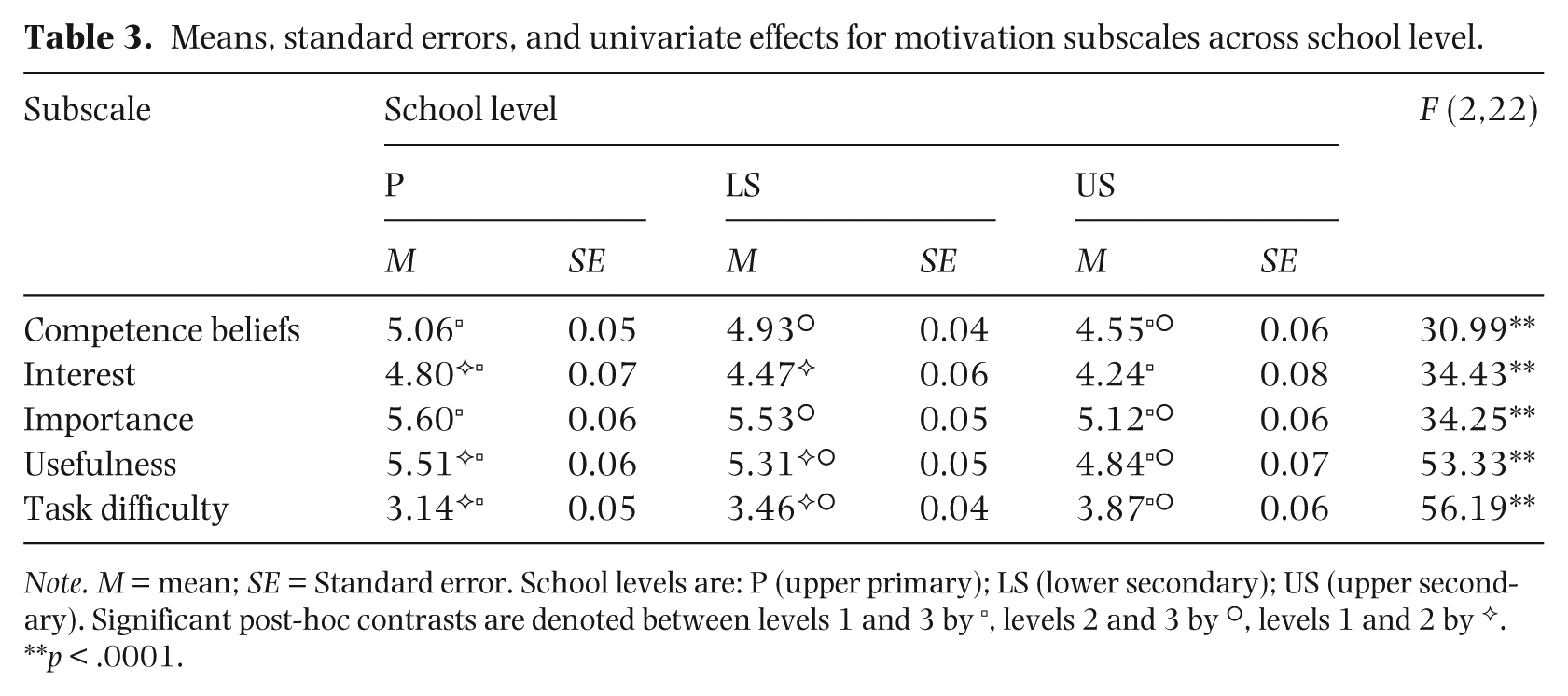
Note. M = mean; SE = Standard error. School levels are: P (upper primary); LS (lower secondary); US (upper secondary). Significant post-hoc contrasts are denoted between levels 1 and 3 by ▫, levels 2 and 3 by ○, levels 1 and 2 by ⟡.
p < .0001.
Motivation subscale least squares mean estimates and standard error values for music, English, maths, and science by grade level and music learner are presented in Table 4.
Mean motivation subscale scores for music, English, maths, and science by school level and music learner.
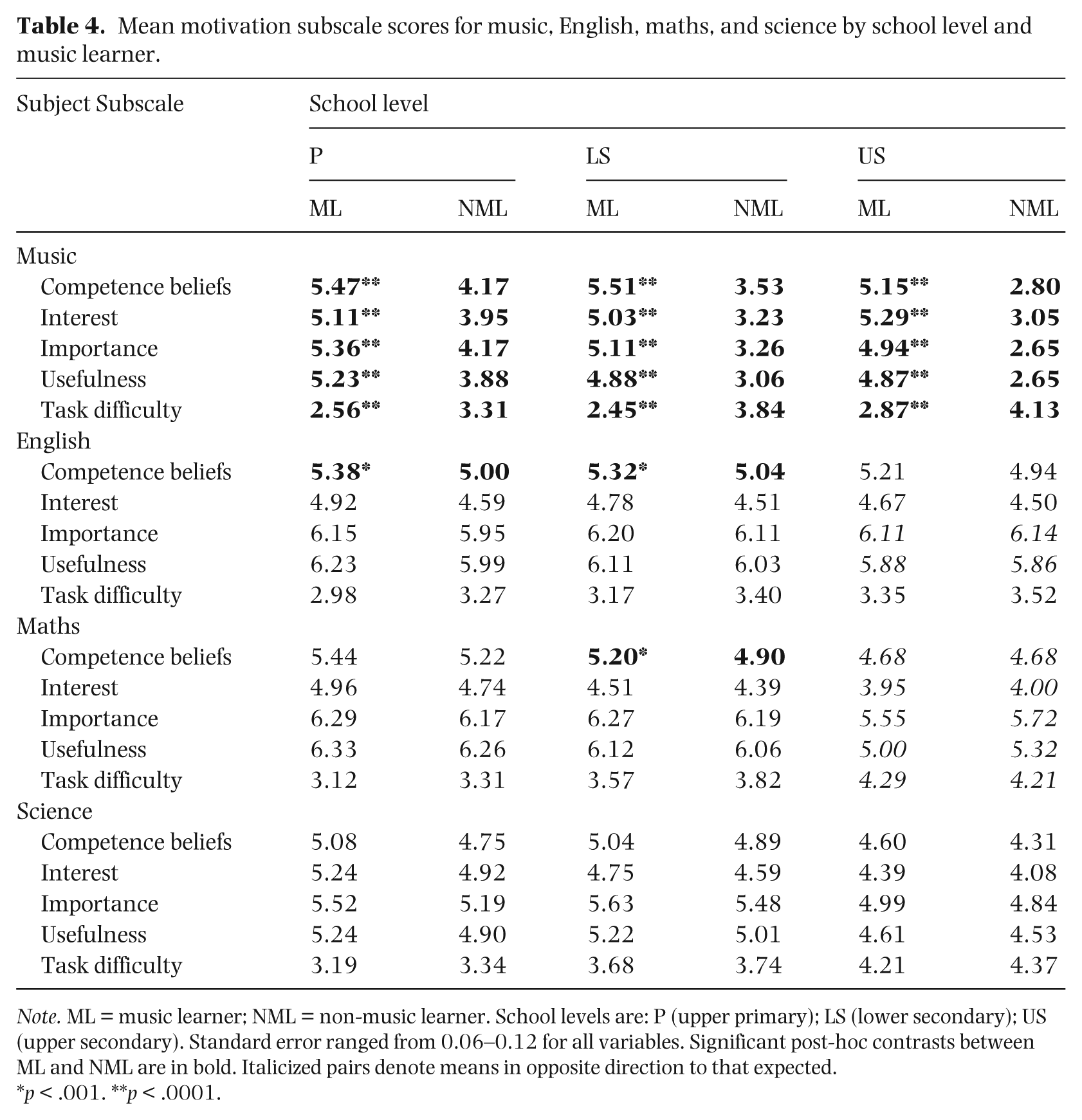
Note. ML = music learner; NML = non-music learner. School levels are: P (upper primary); LS (lower secondary); US (upper secondary). Standard error ranged from 0.06–0.12 for all variables. Significant post-hoc contrasts between ML and NML are in bold. Italicized pairs denote means in opposite direction to that expected.
p < .001. **p < .0001.
Across all subjects and school levels, music learners reported significantly higher competence beliefs [ML = 5.17; NML = 4.52; F(1,13) = 190.23, p < .0001], interest [ML = 4.80; NML = 4.21; F(1,13) = 136.98, p < .0001]; importance [ML = 5.68; NML = 5.16; F(1,13) = 141.91, p < .0001]; usefulness [ML = 5.48; NML = 4.96; F(1,13) = 124.33, p < .0001], and significantly less task difficulty [ML = 3.29; NML = 3.69; F(1,13) = 65.78, p < .0001] than non-music learners.
Three-way interactions between subject, grade level, and music learner were significant for competence beliefs [F(6,60) = 11.99, p < .0001], interest [F(6,60) = 8.08, p < .0001], importance [F(6,60) = 13.62, p < .0001], usefulness [F(6,60) = 9.81, p < .0001], but not task difficulty [F(6,60) = 4.11, p = .002]. Examined by subject and music learner within school level, the direction of the difference in most means was as predicted: music learners had higher ratings for competence beliefs and values, and lower ratings of task difficulty. Music learners expressed significantly greater beliefs in their competence for English in upper primary and lower secondary school grades, and for maths in lower secondary school. Anomalously, in the upper third (senior secondary) school level the direction of difference in mean scores was contrary to that predicted for importance and usefulness in English and maths, as well as competence beliefs, interest, and task difficulty in maths.
To extend these analyses and address the second aim, we sought to determine whether 1) there were differences between gender for competence beliefs, values, and task difficulty, and 2) the degree to which socio-economic status impacted on student’s motivation to study music.
Gender
Across all grades and subjects females scored slightly higher than males on importance [females = 5.47, males = 5.36; F(1,12) = 5.63, ns], usefulness [females = 5.23, males = 5.21; F(1,12) = 0.03, ns], and task difficulty [females = 3.49, males = 3.48; F(1,12) = 0.30, ns], but not for competence beliefs [females = 4.84, males = 4.84; F(1,12) = 0.00, ns], or interest [females = 4.47, males = 4.54; F(1,12) = 2.04, ns].
Table 5 displays means for music as a subject, with two-way comparisons for gender by subject, three-way comparisons by gender, grade, and subject, and post-hoc comparisons within grade level between females and males. The higher mean values for female competence beliefs and values, and lower for task difficulty were as expected in the upper primary and lower secondary grades, with post-hoc contrasts showing this difference as significant for female competency beliefs and significantly less for male task difficulty. Contrary to expectation, and similar to the aforementioned music and non-music learner data, the direction of scores was opposite to that expected for gender in the upper secondary grades for competence beliefs, interest, usefulness, and task difficulty.
Motivation subscale means for music only, by school level and gender with tests for gender by subject (df 3,36), and gender by subject by school level (df 6,66).
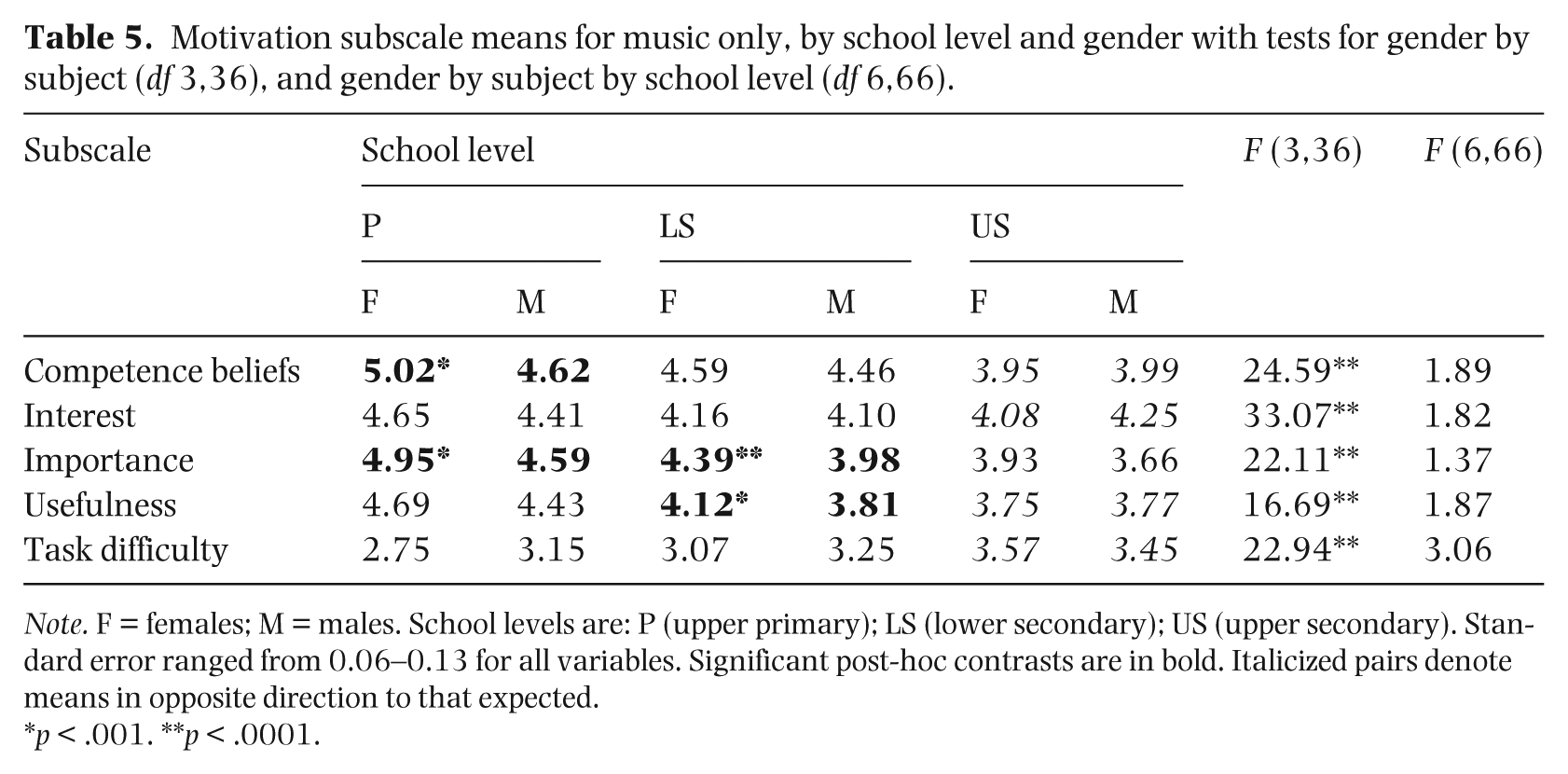
Note. F = females; M = males. School levels are: P (upper primary); LS (lower secondary); US (upper secondary). Standard error ranged from 0.06–0.13 for all variables. Significant post-hoc contrasts are in bold. Italicized pairs denote means in opposite direction to that expected.
p < .001. **p < .0001.
SES level
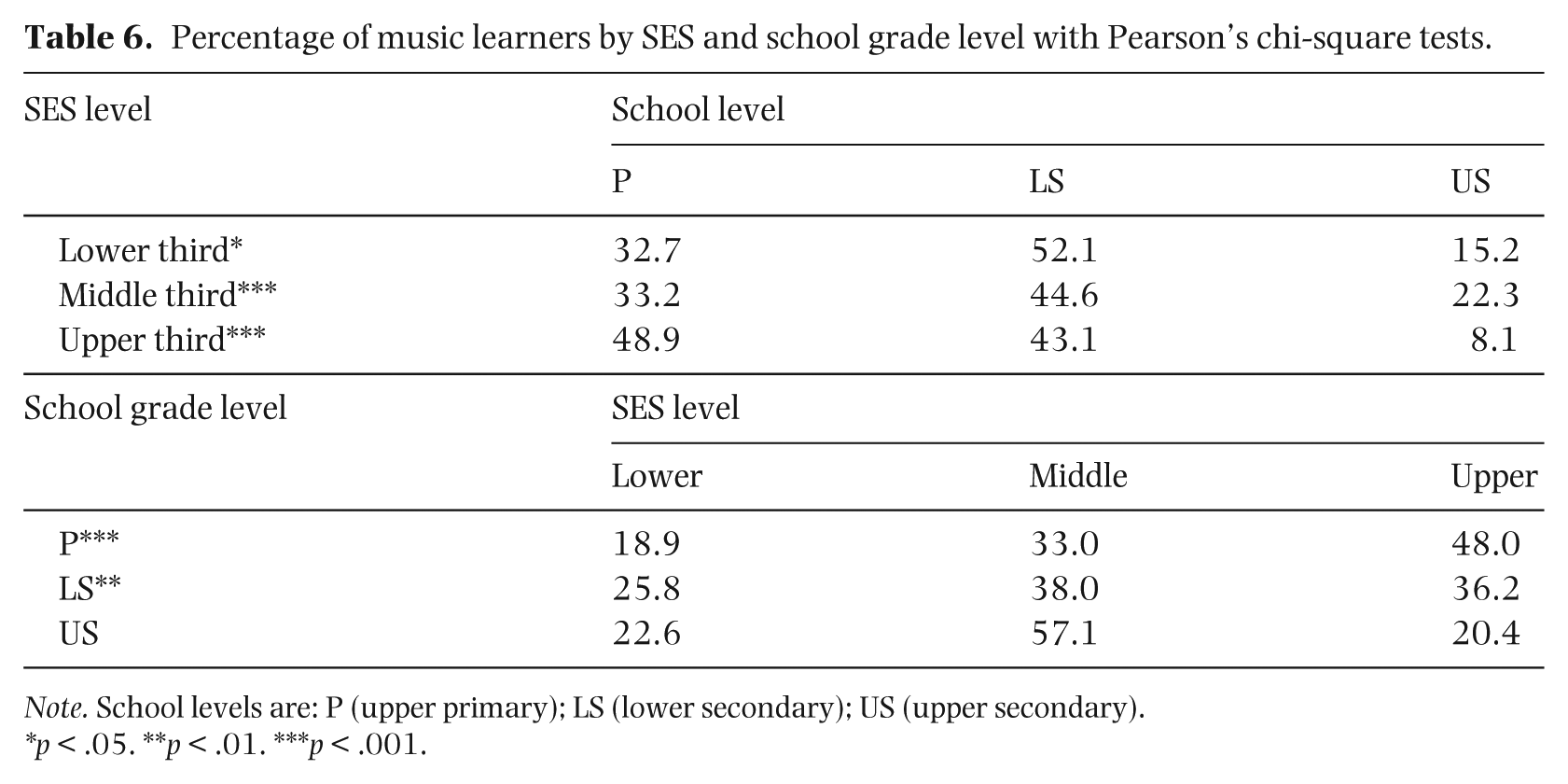
Across the sample as a whole, 1,501 (54.7%) students reported they were learning to sing or play a musical instrument. This differed significantly by SES [Pearson’s χ2 (4) = 75.94, p < .001], with most students falling in the middle (39.6%) and high SES thirds (38%), and less in the lower third (22.4%).
This relationship was further explored in two 2 (music learner versus non-music learner) by 3 (SES level/School level) cross-tabulations using Pearson’s χ2 test. Table 6 shows the percentage of music learners within SES and school grade levels. There were significant differences in the percentage of music learners across school levels within each SES level: lower SES χ2 (2) = 8.41, p < .05; middle SES = 43.92, p < .001; upper SES = 57.60, p < .001. Within the lower and middle SES bands, lower high school students were the highest percentage of music learners, followed by upper primary and the least percentage in upper secondary students. In the high SES category, the percentage decreased from greatest number of music learners in upper primary, followed by lower secondary, and a marked reduction in upper secondary students.
Percentage of music learners by SES and school grade level with Pearson’s chi-square tests.
Note. School levels are: P (upper primary); LS (lower secondary); US (upper secondary).
*p < .05. **p < .01. ***p < .001.
Inversely, differences in the number of music learners across SES levels within each school level were significant, but only for upper primary and lower secondary school levels: upper primary χ2 (2) = 24.53, p < .001, and lower high school χ2 (2) = 13.66, p < .01. In upper primary grades, high SES students were the highest percentage of music learners, followed by the middle SES and lower SES levels. Within the lower secondary grades the highest number of music learners was from the middle third SES band, followed by the upper SES, and the least in the lower SES level. In the senior secondary grades, the middle SES level was again the greatest percentage of music learners, the second highest being in the bottom third SES, with the least in the top SES level.
To summarize, music learning rates for high SES students were highest in upper primary years, and the lowest across all SES in senior secondary years. Lower SES students were the least frequent in upper primary and lower secondary grade levels, with the high SES students being the least frequent learners in upper secondary grades. Middle third SES students had the highest percentage of music learners in secondary school. Lower secondary students were most frequent in lower and middle SES levels.
Choice to learn an instrument
Of the 1,246 (45.4%) of students who reported not learning an instrument or voice, just over half of these students (n = 689, 55.3%) reported they would not like to learn if given the chance. The desire to learn a musical instrument differed significantly by grade level: upper primary = 23.3%, lower secondary = 51.9%, and upper secondary = 24.8%, χ2 (2) = 7.06, p < .05. Differences between SES levels within each grade level were not significant. There was a significant main effect across SES in desire to learn an instrument: lower SES = 32.5%, middle SES = 40%, and upper SES = 27.5%, χ2 (2) = 12.88, p < .01. An examination by grade revealed this effect was only significant within the upper primary grades, χ2 (2) = 7.88, p < .05, with percentages of prospective music learners in the bottom third SES = 40.8%, middle SES = 27.7% and upper SES = 31.5%. In secondary school there was no significant difference between SES levels in the percentage of students who wanted to learn an instrument if they had the chance.
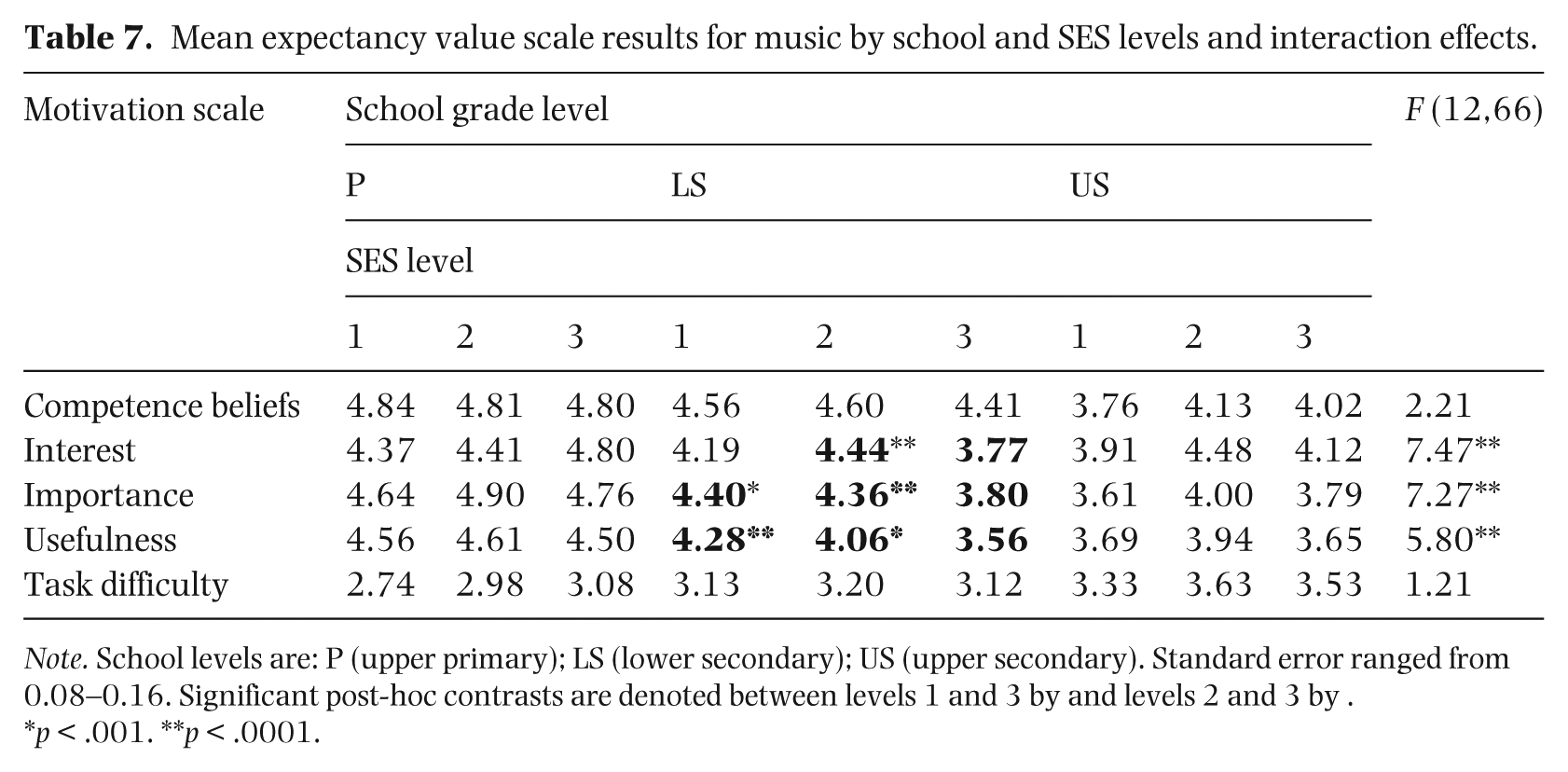
To address the final aim, differences in motivational profiles for music only were explored using a 3-way ANOVA for subject by SES by school grade. Mean values and interaction effects are provided in Table 7. As for previous analyses on the motivational profiles, significance was set at p < .001.
Mean expectancy value scale results for music by school and SES levels and interaction effects.
Note. School levels are: P (upper primary); LS (lower secondary); US (upper secondary). Standard error ranged from 0.08–0.16. Significant post-hoc contrasts are denoted between levels 1 and 3□ by and levels 2 and 3 by○.
p < .001. **p < .0001.
There were significant differences in the perceived value of studying music by SES level and grade. Examining Table 7 and Figures 1 to 5, it can be seen that the overall pattern of decrease in competence beliefs, increase in task difficulty, and decrease in value perceptions (interest, importance and usefulness) associated with studying music were consistent with those observed for the core academic subjects English, maths, and science.
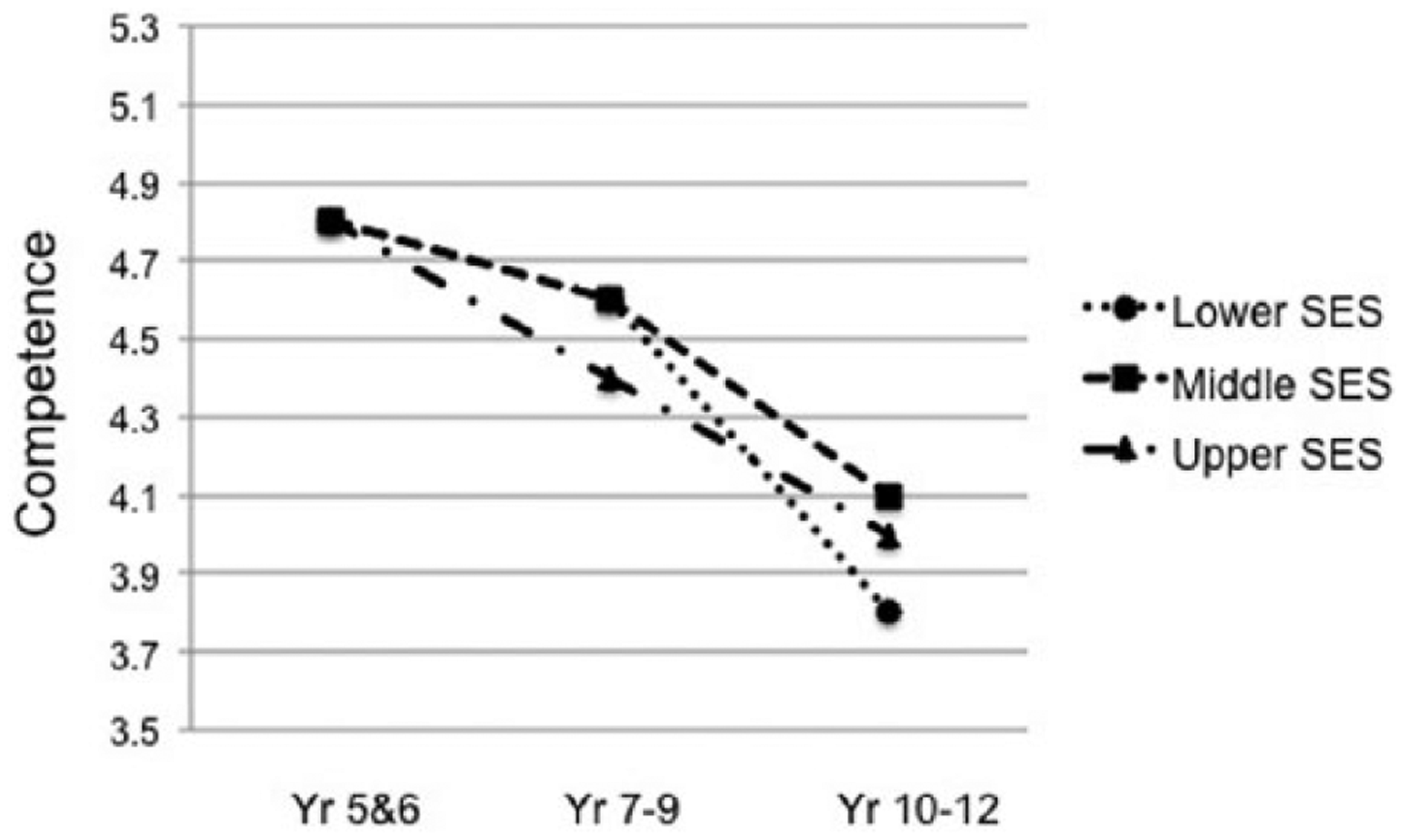
Competence beliefs scale mean values by grade and SES levels.
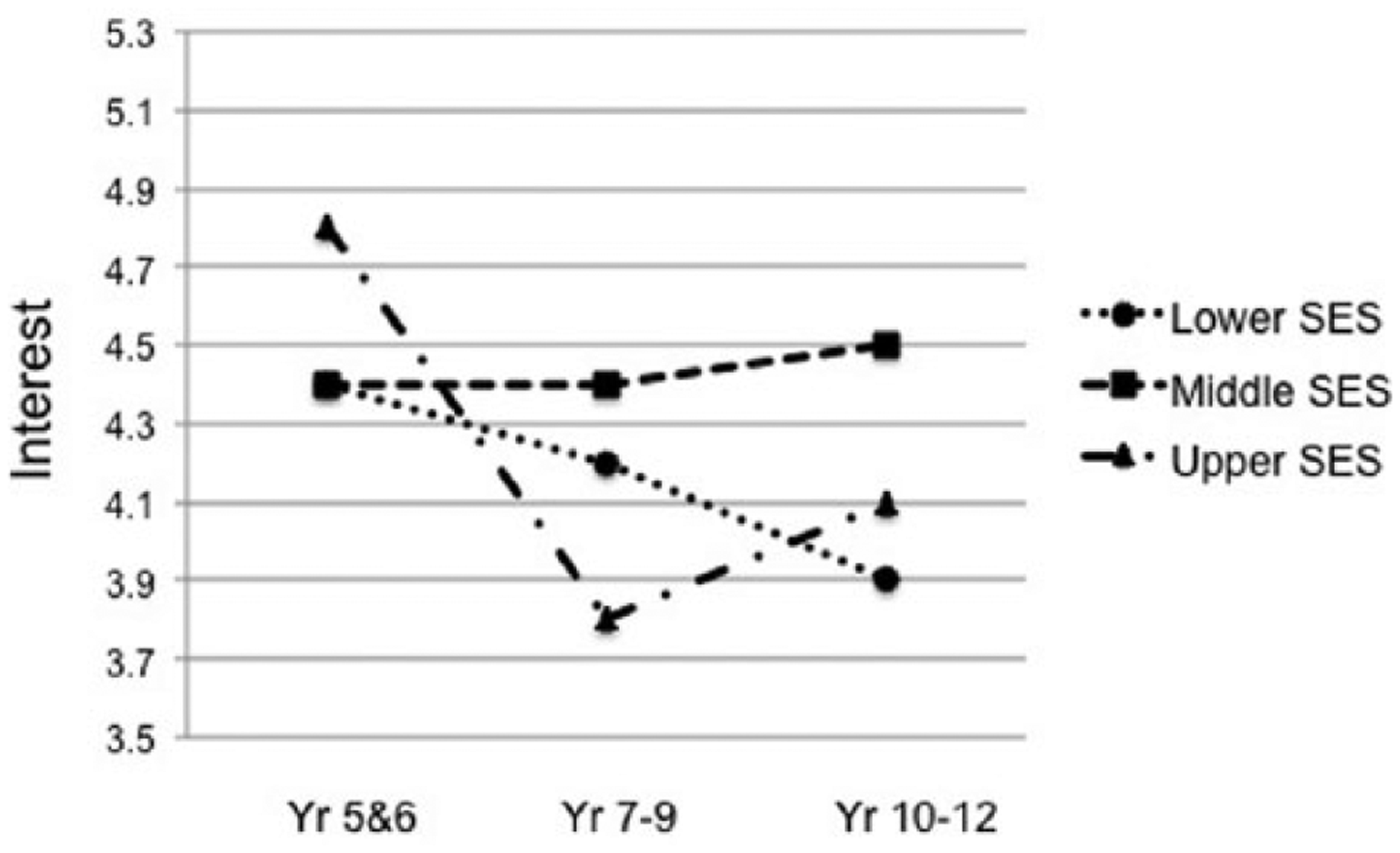
Interest scale mean values by grade and SES levels.
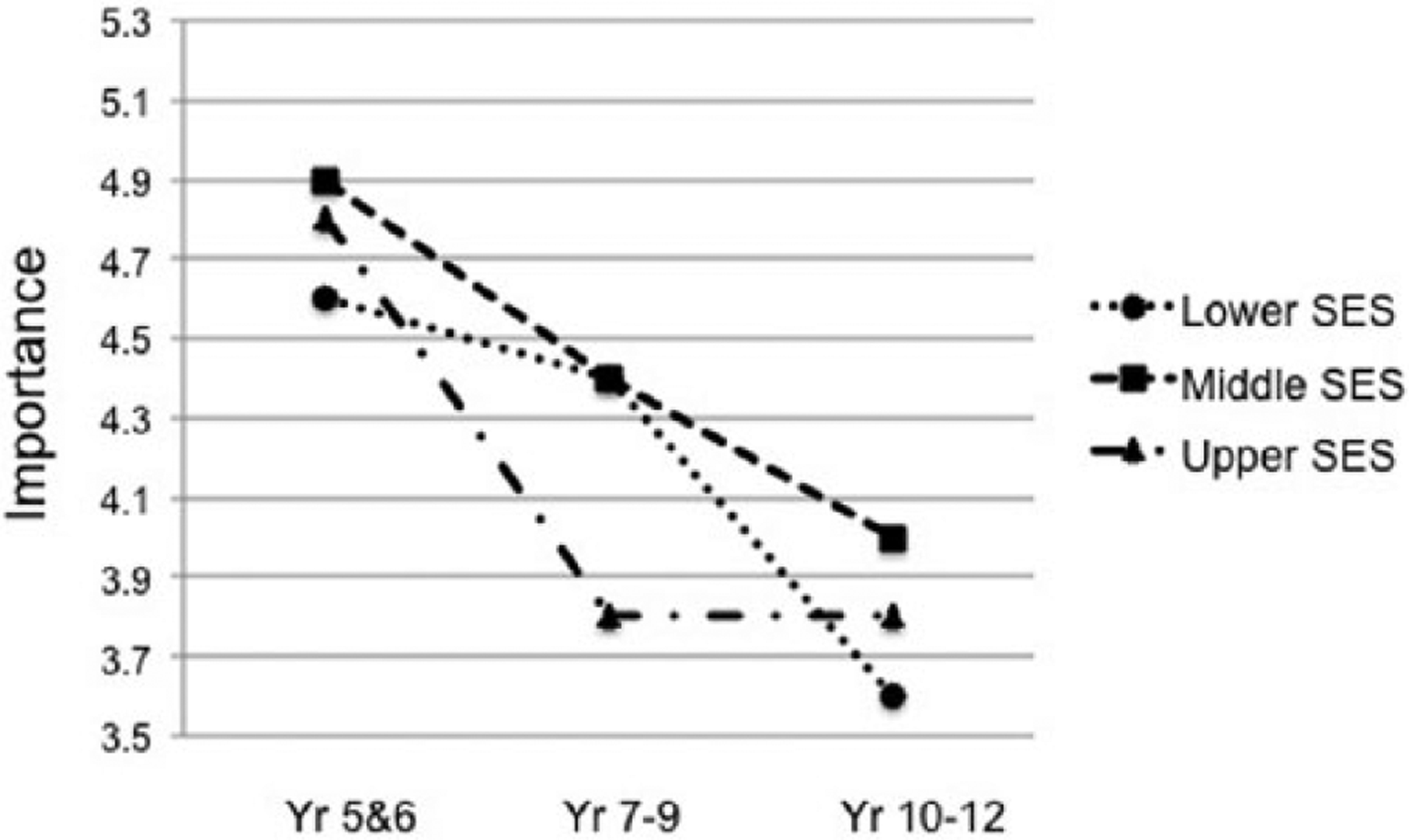
Importance scale mean values by grade and SES levels.

Usefulness scale mean values by grade and SES levels.

Task difficulty scale mean values by grade and SES levels.
Examining variability between SES levels within each school year level showed minimal differences for competence beliefs (Figure 1) and task difficulty (Figure 5). There were five significant post-hoc contrasts, all within the lower secondary school level. Interest in music (Figure 2) was significantly greater for middle SES than upper SES students, t(66) = 3.39, p < .001. Lower SES students also rated music as more interesting yet this was not a significant difference compared to higher SES students. Middle SES students had the most even spread of interest across school years. The increase in high SES interest ratings in upper secondary school was not significant.
Music was rated as progressively less important as school years increased, with minimal variability between SES levels in upper primary and upper secondary levels (Figure 3). A marked decline was observed for higher SES students in lower secondary school grades, where lower SES [t(66) = 4.13, p < .001] and middle SES [t(66) = 3.95, p < .001] students rated music as significantly more important than upper SES students. A similar pattern was observed for declining perceptions of usefulness of music with increasing school years, and another marked decline for upper SES students compared to lower SES [t(66) = 4.93, p < .0001] and middle SES [t(66) = 3.52, p < .001] students.
Discussion
By focusing on the Australian context, this paper extends findings from an eight-country research programme that examined students’ motivation to study music. Specifically, it sought to determine whether as a group, music learners reported more positive motivation for studying academic subjects at school, whether gender and socio-economic status might affect student motivation to learn music at school, and whether students’ motivation to study music was impacted by school level or SES level.
In order to establish consistency with the previous eight-country studies, perceptions of competence, task difficulty, and value (interest, importance and usefulness) were examined across school Years 5 to 12. Consistent with the report by McPherson and O’Neill (2010), across all four subjects (music, English, maths, and science) perceptions of competence, interest, importance, and usefulness declined significantly, commensurate with a significant increase in ratings of task difficulty across all subjects.
Distinct differences were found for music learners as compared to non-music learners. As would be expected, music learners not only felt more competent and interested in music, but also reported higher perceptions of the importance and usefulness of music as a school subject than did non-music learners. They also believed music to be less difficult. Consistent with the McPherson and O’Neill (2010) report, across all subjects, music learners (as compared to non-music learners), held higher expectations for success, and were more interested in other subjects, which they perceived as being more important, useful, and less difficult.
A more detailed analysis within each school level for English, maths, and science revealed that music learners felt more competent in the upper primary school years for English, and in lower secondary school for English and maths. These music learners also held greater expectations for doing well in English and maths than non-music learners. Although not significant, the pattern of differences in means reported by music learners in upper primary and lower secondary school in music, English, maths, and science were all in the expected direction. That is, music learners reported themselves as more competent and interested, they found the subjects more important and useful, and rated them as easier, than non-music learners. Interestingly, this pattern was reversed in upper secondary school grades for all motivation scales in maths, and for importance and usefulness judgements in English where students have already chosen their final year subjects and embarked on a programme of study that would prepare them for a career after they left school.
Consistent with the eight-country study (McPherson & O’Neill, 2010), this study found an expected pattern of results for gender with females reporting greater levels of competence, interest, importance, and usefulness and less task difficulty for school subjects than for males, in upper primary and lower secondary school levels only. Contrary to expectations, and similar to the aforementioned music and non-music learner comparisons, the direction of scores was opposite to that expected for gender in the upper secondary grades for competence beliefs, interest, usefulness, and task difficulty.
The gender effect found in the eight-country study for expectancy and value attributed to music was partially replicated in this Australian sample. Across all school years, females reported that they found music more important and useful than males. In contrast to the eight-country study, their perceptions of ease and success in music were essentially equivalent to males, and they found it slightly less interesting than their male counterparts. Analysis by grade level revealed that this applied to three of the five motivational subscales for the upper primary and lower secondary years only, and there were no differences in interest or task difficulty. In upper primary grades females felt significantly more competent in music, and felt it to be more important. In lower secondary school levels they still reported it to be more important, as well as more useful. By senior secondary grade levels there were no differences in music motivation according to gender. This indicates a possible changing trend in gender differences with males showing slightly more interest in music than females.
One of the most striking findings of this study was the significant decline in the value of music for upper SES students from upper primary to lower secondary schools. Within the lower secondary school grades, the highest SES students valued music significantly less than students in the lower and middle SES levels. Given that perceptions of subject value predict the choices that students make to continue engaging with a given activity in the future (Eccles, 2005; Eccles & Wigfield, 2002; McPherson & O’Neill, 2010), this suggests that students from more affluent backgrounds are potentially making decisions about their future and careers earlier than students from lower SES backgrounds. Specifically, their earlier disengagement with music possibly reflects a belief that they see limited opportunities for future formal involvement in music, especially as an upper secondary school elective. Although not significant, by the end of their school lives lower SES students valued music the least, and it is uncertain whether this result might reflect a more general disillusionment with school.
There were significant differences in the number of students learning an instrument by SES level. Even though the mean SES index distribution of schools in our sample was one standard deviation higher than the Australian school population, separating the SES distribution of participating schools into thirds showed that just under 80% of the participants who were classified as music learners came from the middle and upper SES thirds, as compared to just over 20% from the lower SES level. The high SES participants were the most frequent music learners in upper primary school, and the least frequent in upper secondary school. The percentage of lower SES students was fairly consistent across all school years, peaking in the lower secondary years. The highest percentage of learners in secondary school came from middle SES schools.
The question relating to a desire to learn an instrument if given a chance also varied significantly by SES level, but only in upper primary school, where the greatest percentage (40.8%) of potential music learners came from the lower SES category. It is important to note that this category includes schools which fall within the lower 50% of the national norm distribution of socio-educational advantage. Consequently, efforts to optimize music learning opportunities for children who are studying in schools that fall within this classification might best be achieved through providing offerings in upper primary school, at a time when these children express the greatest desire to learn music.
This article presents initial results focused on patterns of motivation to study music and other school subjects according to expectancy-value theory in the Australian context. Students who are learning an instrument or voice are distinctly more motivated in music and other school subjects than non-music learners, demonstrated by significantly greater expectations for success and positive value perceptions. By investigating motivational patterns according to grade and SES level this study presents important new information to guide the provision of music learning opportunities according to equity and access. Lower and middle SES students are more interested in learning music than upper SES students, yet just over 20% of music learners were situated in lower SES areas. Furthermore, the greatest number of students who expressed a desire to learn a musical instrument come from lower SES areas in upper primary school. This discrepancy between “actual” and “potential” music learners according to SES supports the conclusions of both the Australian Commonwealth and Victorian Government music education inquiries. The financial strain of providing music education services is disadvantaging the musical development of students with the highest unmet need for music learning opportunities. Our findings suggest that, in the Australian context, efforts to improve and sustain the quality of music education should be prioritized towards upper primary school children in lower SES areas.
The findings of the current study need to be expanded through complementary work that clarifies the range of academic and non-academic outcomes and perceptions of meaning and value obtained from learning a musical instrument. Identifying the main enabling conditions which support high engagement, commitment, and flourishing in music during childhood and adolescence should be a priority as it will help music educators understand how they can provide learning environments which foster active engagement, commitment, and valuing of music as a school subject.
Footnotes
Funding
This research was funded by a Discovery Project grant (DP1093041) awarded by the Australian Research Council.