



Abstract
This article reports part of the results of a larger study, where the goal was to explore music composer’s representations of music composition. Previously published interviews of 57 established vanguard contemporary music composers (based across continents) were subject to a thematic analysis, validated by an independent analysis of a percentage of those interviews. The analysis revealed two overarching dimensions relating to learning. The first of those dimensions referred to the experience of developing the competency to compose and the second dimension referred to learning as changing through composing. First of those dimensions involves a diversity of aspects (i.e., learning context, learning process, learning product), for which a variety of notions emerged from the interview analysis. Second dimension also comprises a variety of aspects (i.e., insights on other realities, insights on sounds, increased self-awareness). Implications for the teaching and learning of musical composition are drawn.
Introduction
When investigating learning music composition, different dimensions ought to be considered. On one hand, music composition is the product of becoming competent at composing music, which is formalised, at least in Western culture, in the educational context of schools and conservatories. On the other hand, music composition has itself an impact in terms of personal development.
The study presented here aimed to identify composers’ representations of the learning process of music composition, in the context of a broader project, initiated by the authors in January 2017, that aims to contribute to the characterisation of the creative process involved in music composition, through analysis of composers’ testimonies. Specifically, this project focuses on the ‘antecedents’ of composition (e.g., learning, conditions, motivation), on the composition ‘process’ (e.g., inspiration, preparation, elaboration, revision) and on the ‘consequents’ of composition (e.g., performance, well-being, development). Some implications of the study’s findings are discussed at the end.
Developing competency at composing music
As for musical development in general (Gaunt & Hallam, 2009; McPherson & Hallam, 2009), developing competency at composing music seems to result from the interaction between individual characteristics and the learning experience derived from environmental stimulation. On one hand, Kozbelt (2012) states that studies of composers’ careers (i.e., beginning of studies and first relevant composition) suggest that experience, in the form of intensive and relatively prolonged musical study (i.e., at least for a decade, with few exceptions), seems to be a requirement for the kind of expertise that can produce original, enduring works. However, on the other hand, Kozbelt (2012) also argues that expertise acquisition seems modulated by innate talent, which allows rapid assimilation and use of knowledge, as eminent composers tend to start studying and composing earlier and to finish composing later than less eminent ones.
Focusing on the role of the learner, a variety of studies reviewed by Gaunt and Hallam (2009) revealed that the general learning of music skills is influenced by a diversity of individual characteristics, such as gender differences, physiological characteristics, age, personality, cognitive and learning styles, and approaches to learning. In another review, Hallam (2009) focused on a variety of studies that revealed how music-making is influenced by motivation, which includes a plethora of variables such as types of motives, musical self-concept, self-efficacy and self-esteem, goals, affect for music or motivational strategies.
In addition, focusing on the role of the environment, multiple studies, also cited in Gaunt and Hallam (2009), point to the influence of musical culture and socio-economic status on learning music skills. Within this framework, two key factors for learning music have been identified: parental support or encouragement (Burnard, 2012; Creech, 2009) and a stimulating school environment in which the institution, teachers and peers play a significant role (Burnard, 2012; Welch & Ockelford, 2009). Specifically, the early learning of music composition in an educational context seems to demand modelling (demonstration) and scaffolding (encouragement and support in stages) of young musicians by teachers to allow the creation of meaningful music products in a self-regulated way (Byrne, Halliday, Sheridan, Soden, & Hunter, 2001). The practise of modelling, knowledge-sharing, and problem-finding dialogue, while leaving decision-making to the students, was registered in the teaching of orchestral composition (Love & Barrett, 2016). Moreover, the use of modelling and scaffolding, as well as the use of coaching and reflective processes, was also observed in the teaching of music improvisation (de Bruin, 2019). Also, teachers’ feedback seems to play a significant role in students’ compositional intent and action (Ruthmann, 2008). Nevertheless, it is complex and even doubtful that individuals learn to compose through teaching, especially at a time where individual originality has become the main goal, as testified by many composers and musicians themselves (Mateos-Moreno, 2011; Sætre, 2011). This assertion is in line with the notion that learning music composition is not only done explicitly (in school or using books) but mostly implicitly or self-evidently from direct experience in the global environment (Wiggins, 2012). In fact, although the learning of music composition might be specially localised in the educational years, there are observations that it is prolonged through experience in a continuous learning process (Rose & MacDonald, 2012). Different approaches and studies have addressed how individuals learn composition procedures that allow them to compose music. For some researchers, this learning occurs by deriving from previous creative practices rules or schemes that are rooted in musical tradition, which is then modified by being extended and innovated (Donin, 2012; Kozbelt, 2012). Indeed, as the composer Aaron Copland (1939) said, ‘Every well-trained composer has, as his stock in trade, certain normal structural moulds on which to lean for the basic framework of his compositions’ (p. 31). A grasp of those composition schemes is assisted by the availability of other examples and of one’s own past works composed in the same manner (Kozbelt, 2012).
In a study of learning music composition, Falthin (2014) also observed that, on top of involving a spectrum of learning strategies that vary between students, learning music composition basically concerns the development of new sounds on the basis of old familiar ones. Falthin (2014) framed this process in Vygotsky’s (1986) notion that new concepts are built from restructuring previously organised parcels of objects. Going deeper, Kozbelt (2012) suggests that the acquisition of specific music knowledge and the practice of composing traditional schemes would allow the internalisation and implicit use of the elaborated problem-solving and decision-making processes involved in composition. Aligned with this notion, Collins (2012) also stresses that learning to compose involves the domain of the problem-solving process implied in transforming ‘acquired understandings’ in music.
Specifically, regarding the implicit learning of musical style by a musician, Toiviainen and Eerola (2005) suggest that this process occurs by internalising a model of the style that characterises the environment where he or she is acculturated. Wiggins (2012) suggests that this implicit learning is mostly done by non-conscious generalisation based on examples that allow the apprehension of critical properties then applied in the appreciation and creation of music in the framework of a certain style. This hypothesis received some empirical grounding through the development of computer software (Pearce & Wiggins, 2007), which, after an input of a large body of melodies in the style of those harmonised as chorales by J. S. Bach, was able to create ‘rarely good’ but recognisable melodies in the same style. Convergent with this finding, in view of a systems perspective of creativity, which focuses on how a community of persons can learn by sharing and imitating each other (Csikszentmihalyi, 1999), Faukner (2003) stressed and empirically demonstrated how learning music composition can also occur on the context of a group of students who share and distribute ideas/experiences between themselves. In the same line, Love and Barrett (2016) point how learning to compose for orchestra may involve a collaborative immersion in orchestral culture and tradition. Moreover, the notion of learning composition as an internalisation process aligns with the suggestion of Wiggins (2012) that music learning occurs in levels following the general stages of learning identified by Karmiloff-Smith (1995): data acquisition and storage with no changes in internal representation (e.g., a music studies freshman harmonising a melody with effort according to taught rules), knowledge internalisation with internal representational change and reflection with reconciliation of new internal representations with external knowledge (e.g., an experienced musician who intuitively applies effortlessly and apparently unconsciously the same rules). Similarly, Cope (2012) notes that the process of composing music bears a resemblance to the process of playing games in the sense that both involve learning rules, acquiring proficiency in employing those rules and applying those rules to attain goals. In addition, in a study that interviewed music students, Lupton and Bruce (2010) found three hierarchical and inclusive ways of experiencing learning composition: as a craft (i.e., composing as applying techniques), as a process (i.e., composing through a process of discovery) and as an art (i.e., composing through expressing oneself).
Finally, whatever the cognitive processes involved in learning to compose music, there is evidence that learning music composition tends to be a flow experience (Baker & MacDonald, 2013), characterised, as described by Csikszentmihalyi (1990), by a high level of absorption, concentration, action-awareness, sense of time distortion and intrinsic motivation (Chirico, Serino, Cipresso, Gaggioli, & Riva, 2015). More specifically, it was observed in undergraduate music students that higher levels of flow during music composition were related to greater creativity (MacDonald, Byrne, & Carlton, 2006).
Composing music as a source of learning
The experience of composing music is not only a product of learning but also a source of learning and development. Although most of the research on this topic addresses the impact of making music on students’ learning and development, the results allow considering the possible effect of music composition on composers’ transformation.
First, there is evidence (Rose & MacDonald, 2012) that learning music composition can be an opportunity for some students to succeed in an area different from the oral or written domains.
Going further, some studies focus on the impact of music composition on basic competencies. In a meta-analysis of studies that focused on how children’s learning to ‘make’ music affects their spatial abilities, Hetland (2000) observed a moderate and consistent effect in terms of enhancement of spatial-temporal performance during and up to 2 years following learning. In the same direction, Rose and MacDonald (2012) found that composing by improvising involves the development of learning by kinaesthetic action.
Other studies take into consideration the effect of music composition on the affective aspects of learning. For example, in a study with elementary students, An, Kulm and Ma (2008) observed that the integration of a music composition activity with the learning of mathematics had a positive effect on students’ attitudes and beliefs towards mathematics learning.
Finally, some studies have addressed the relationship of music-making with the social aspects of learning. For instance, there is evidence (Rose & MacDonald, 2012) that certain forms of musical composition that involve interpersonal relationships – such as group improvisation – also result in learning about the social world – such as learning about the collective and the value of inclusion. For example, participation in musical creativity activities in cross-community settings can promote social and ethnic inclusion (Odena, 2018).
Summarising, learning to compose music spreads across lifetime and contexts, tends to happen in flow and involves a plethora of aspects that include talent, gender and age, physiology, personality, motivation, experience of intensive prolonged study, learning strategies, approaches and styles, problem-solving, collaboration, parental and educational support, musical culture and tradition, and socio-economic status. Moreover, learning music composition can also act as a source of learning through the development of achievement experiences, of spatial abilities, of learning by kinaesthetic action, of positive attitudes and beliefs to learning of specific contents and of social inclusion.
Although much of the above-mentioned research in learning music composition is empirical, most of it is purely theoretical, with the need to be empirically tested. This study contributes to such enterprise, since it intends to categorise composers’ representations about the learning component of music composition. The study’s research question was therefore how music composers represent their learning of music composition. Besides, the study also aimed a needed insight into music composers’ experiences from their own perspectives, based on the expression of their personal voices.
Method
The sample consisted of 57 experienced and established vanguard contemporary music composers who were interviewed by composer David Bruce from November 2004 until April 2014 (Bruce, 2004–2014). The interviews were published in ‘Composition today’, a website with resources for composers (www.compositiontoday.com) and were accessed from there, having David Bruce “Composition Today” administrator, authorised its use for the purpose of this study. In all, 15.78% interviewees (n = 9) were female and 84.2% (n = 48) were male. Four (7.0%) composers were born in the 1940s, nine (15.8%) in the 1950s, 19 (33.3%) in the 1960s, 16 (28.0%) in the 1970s, six (10.5%) in the 1980s and birth dates were not found for some of them (n = 3, 5.3%). A total of 265 pages of transcribed double-spaced interview pages, containing 76,565 words, were analysed.
Despite the fact that the interviews did not consist of fixed questions that were submitted to all composers, most answered similar questions (interview questions in Supplemental Material). Some of the questions were submitted to the majority of interviewees, while some were submitted to just a few. Questions can be grouped into the ones that are oriented to music and the ones that are not.
From the questions oriented to music, some referred to composition, while others referred to other aspects of music. Considering the questions oriented to composition, the following themes were addressed: composition in general (e.g., ‘What advice would you give to a young composer just starting out?’), the interviewee’s musical learning environment (e.g., ‘Did you have individual composition lessons?’), motivation towards composing; influences on the composer (e.g., ‘Who has been the greatest influence on your musical style to date and why?’), composition goals, conditions of composing, starting element or phase of composition (e.g., ‘How did you start composing?’), working method of composition, collaboration with other musicians, and exhibition of the interviewee’s work. These questions instigated the interviewees to elaborate about a variety of issues related with the topic of learning music (among others). This served research’s intention of this research in identifying composers’ representations of learning music composition.
Regarding the questions oriented to music but not specifically to composition, the following themes appeared: music output of the interviewee, how the interviewee’s music can be accessed, music teaching, the interviewee’s music appreciation and the interviewee’s conceptions about music.
Interviewees’ responses that specifically addressed music composition were subject to thematic analysis (Miles & Huberman, 1994). The analysis involved three phases: segmentation, categorisation, and validation. Segmentation involved subdividing the discourse in units to be categorised (i.e., single ideas that refer to any particular dimension of music composition). Categorisation involved the classification of segmented units for reaching a system of categories that map interviewees’ representations of music composition. Categorisation included four phases: (1) construction of an initial system of categories on the basis of the literature review on the psychology of music composition and analysis of four interviews by two analysts, A and B; (2) analysis of all interviews with the initial system of categories by Analyst A (i.e., classification of units, when possible, in this system; classification of units, when not possible, in new categories); and (3) construction of a final system of categories on the basis of the previous analysis; and (4) At last, the final system of categories was validated through an independent categorisation of six (10.5%) of the interviews by Analyst B, followed by a calculus of the agreement with the categorisation performed by Analyst A (agreement coefficient = 79.27%). For this calculation, the formula suggested by Bakeman and Gottman (1986) was used: PA = (Na / (Na + Nd)) × 100, where ‘PA’ stands for percentage in agreement, ‘Na’ for frequency of agreements and ‘Nd’ for frequency of disagreements.
Results
Thematic analysis of interview answers that specifically addressed music composition resulted in categories that were organised into three distinct themes: antecedents of composition (i.e., learning involved in composition, conditions of composition and motivation to compose), composition (e.g., first ideas, preparation, elaboration, etc.) and consequents of composition (i.e., exhibition of composed music, consequences of composition).
This article focusses only on results regarding the learning involved in composition. The results of the analysis of the interviews includes two dimensions: learning as developing the competency to compose and learning as changing through composing.
Learning as developing the competency to compose
This dimension of the learning component involved in music composition refers to the experience of developing the competency to compose and involves the following aspects: learning context, learning process, and learning product. For each of these aspects, a variety of notions (categories) emerged from the interviews that are presented below, and most are illustrated with a representative original discourse excerpt.
Learning context
This aspect refers to the characterisation of the context where learning composition occurs, generally or specifically (i.e., teacher, family and community).
When referring to the general context where learning composition took or occurred, 27 of the interviewees describe it as formal and time-localised, such as music schools or music lessons. For example, [The PhD in music at University] was a useful experience both in terms of being able to really spend time writing and investigating what I was doing and where I was going, and also in that it gave me a taste for ‘full-time’ composing which afterwards was something I always aspired to. (Interviewee 27)
Alternatively, the context where music composition was learned is described by eight interviewees as informal and time-diffused, such as learning from the family, from other musicians or even from the self. For example, [. . .] when I was about twelve years old, I started trying to write music. [. . .] mostly attempts to imitate the ‘classics’ that I occasionally heard at that time, but a few pieces contain moments of charm and originality. (Interviewee 25)
The general context where learning composition occurs is also described by one interviewee as a constrained context where freedom in learning is absent: ‘[. . .] I’ve visited and lectured at other schools [. . .] where there is a definitive viewpoint and aesthetic; it strikes me as a frightening and difficult place to find one’s own unique voice’. (Interviewee 7)
However, the context of composition learning is also referred by another as a context of much freedom, which is characterised as not only positive but also disorienting: [. . .] ‘Mixed Messages’ is a great way to describe the scene at [music school]; diverse, but almost too diverse. It can be confusing. There have been times where there have been as many aesthetic viewpoints as there have been composers, which can make the possibility of dialogue difficult [. . .]. (Interviewee 7)
Considering the music teacher’s role as a specific element of formal contexts where music composition is learned, two interviewees perceive that role as more directive, such as disciplining and promoting cognitive change. For example, ‘[the music teacher] had a huge effect on me – he was the first person to really look at my work [. . .] and he helped me to become a lot more disciplined’. (Interviewee 33); and I had the best composition lesson [. . .] [the music teacher] took one look [at my written composition] and said ‘Chaos!’ and tipped it all onto the floor and replaced the mess with 2 strips of material, placing them across the paper and said, ‘Now, look how much more powerful that is’. (Interviewee 54)
Nevertheless, two interviewees also describe the teacher’s role as non-directive, such as helping students to develop using a horizontal relationship. For example,‘My PhD supervisor [. . .] is an extraordinary teacher. His guidance in helping me find my voice as a composer was absolutely critical’ (Interviewee 49); and ‘I met a lot of composers through my teacher [. . .] I began gravitating toward the [. . .] [ones that were] nicer, less uptight, less judgmental people’. (Interviewee 39)
Other two interviewees mention the role of the family as an important aspect of the learning context. One regards the family as a supportive force, permissive to learning music: ‘My mum allowed me to give up the piano five times before I was eleven, which was a very sensible thing to do, as I was always drawn back to the sound of the thing anyway and didn’t feel forced’. (Interviewee 22)
Another interviewee describes the family as supportive in terms of the logistics that such learning requires:‘My dad was heroic in carting me around from band practise to orchestral practice to jazz orchestra concerts etc. etc.’. (Interviewee 22)
Finally, one interviewee recognises the role of the community as an important motivation for musical activities: Living in Cornwall at that time (a long way from any urban life) meant that the local communities has little if any access to touring culture, professional orchestra concerts, shows etc. This meant that there was a plethora of locally driven musical activity, operas, ensembles, bands, etc., which allowed people like me to participate constantly in public events. I found this enormously useful. (Interviewee 22)
Learning process
This aspect involves the internal dynamics of learning music composition and refers to the origin of that learning, the means used at its start, what motivates it, its process and its product.
Regarding the developmental level during which the interviewees started to compose, 19 indicated that it mostly coincided with childhood and 11 (19.30%) with adolescence. For example, I started composing as soon as I started playing the cello when I was seven years old: I think the first piece I wrote was just for open strings as that was all I was able do at the time. (Interviewee 6) When I was 16, I began the long journey of teaching myself how to read and write music. It took many years. As soon as I understood something, my imagination quickly moved on, demanding new techniques to be mastered. My musical imagination was constantly running ahead of my ability to keep up with it. (Interviewee 43)
Two interviewees started to compose later, at the beginning of adulthood. For example, ‘[. . .] only around twenty one I started enjoying, playing and creating classical music’. (Interviewee 40)
The interviewees indicated different methods for starting to compose. Three started to compose with the voice. For example,‘I also used to sing to myself as I walked home from school. Again, endless, shapeless rambling improvisations rather than songs that I’d heard’. (Interviewee 56) One started to compose using a music toy: ‘In 1977 when I was nine, I composed my first work on a toy banjo-ukulele. The result of such work was not particularly promising’. (Interviewee 38) Four started to compose by composing for an instrument. For example, Whenever I was at a house where there was a piano or at my grandmother’s house, where there was an old Estey organ, I used to make things up, and on these keyboard instruments I found I could remember what I’d made up last time, and work on it, changing bits and adding sections. (Interviewee 56)
Three interviewees started to compose using a recorder. For example, Looking back, though, what might have been formative was playing with a portable Aiwa cassette recorder I first got when I was five. I still have some of the recordings, mostly sound effects, non-linear cuts, and weird kind of sounds like some of the stuff I’m still doing now, actually. (Interviewee 37)
Concerning what drove or drives the interviewees to learn music composition, a variety of motivators were mentioned. One interviewee revealed an extrinsic motivator related to the inability of following an alternative career: Towards the end of my first year at West Point, I suffered an injury and had to return home and rethink my life plan. I had no idea what I was going to do with the rest of my life. For almost two years, all I did was convalesce and play electric guitar (having discovered Jimi Hendrix the year before going off to college). Eventually, I decided to pursue music. (Interviewee 37)
Another interviewee stated an extrinsic motivator related with the need to compensate for limitations as a music performer:‘Before then, my musical focus had been on playing the trumpet, but I realised I was never going to be technically proficient enough to play the music I was really interested in’. (Interviewee 53)
One interviewee mentioned an extrinsic motivator related with the need to cope with boredom:‘It must have been around the age of 19 during my “gap” year. I was living in London doing a series of awful temping jobs and knew I needed to do something to take my mind off the tedium’. (Interviewee 53)
On the contrary, as one interviewee implied, learning music composition can be intrinsically motivating in connection with both the intention to learn music and to learn from music:‘Trying to push myself so that I keep learning from and about music’. (Interviewee 37)
Regarding the ways through which participants learned or learn music composition, a variety of forms are reported. More ‘closed’ learning modalities embrace, in one case, repetitive practice: [. . .] I remember being told to practice X amount of hours a day. I was terrified by this. It would have been so much better for me if I had been told to grow my relationship to music every day. (Interviewee 1)
One interviewee learned music composition by finishing his teacher’s music pieces:‘[the teacher] was always bringing new sketches of her music [. . .] and we would finish writing the pieces [. . .]’. (Interviewee 1)
On the other extreme, more ‘open’ learning modalities of learning music composition comprise, in six cases, self-directed learning by discovery. For example, [. . .] [the teacher said:] ‘composing is like painting – time is your canvas and sound your palette – go compose!’ He really didn’t offer any more instruction than that, which I think was crucial. Since I was not presented with any musical models to follow, I had to rely upon the music that I knew, and create my own music either through synthesis or abstraction. I feel like I’ve forged new territory [ . . .]. (Interviewee 36)
Two interviewees learned music composition by music performance, orchestration and arrangement. For example, I was an electric bassist playing original rock in cafes or lounge music at hotels, a conductor of chamber choirs, music director of string, wind ensembles, conducted opera and symphonic repertoire, composed and played piano for theatre, played and arranged Argentine tango music, and much more. I feel that my head has become a big bucket where some strange musical cocktail has been stirring for almost twenty years. (Interviewee 36)
One interviewee mentioned the relevance of having received critical feedback:‘[the teacher] would look at what I had done and just make general comments which, nevertheless, were very good, because they were right on the button’. (Interviewee 34)
Two interviewees learned music composition by hearing and discussing music. For example,‘A composer we listened to a lot together was the late serial Stravinsky. I remember him [the music teacher] playing to me the Huxley Variations, which is an extreme twelve-tone piece. We would discuss these works’. (Interviewee 34)
Finally, one interviewee learned music composition by collaborative learning: ‘My musical life was centred on an intimate percussion studio in my neighbourhood where the teacher there had all of her students play in percussion ensembles together’. (Interviewee 1)
Learning product
Learning to compose is recognised, by two cases, as developing the ability to better organise more elaborated and original music. For example, I began to compose very much as a by-product of enjoying piano repertoire and certainly ‘a la maniere’ of all sorts of composers [. . .] [it was] in my late teens that I really sought out something much more interesting, colourful and organised. (Interviewee 38)
In addition, one of the recognised products of learning to compose, at least in the academic context, coincided, in one case, with the acquisition of the ability to compose in an intentional way, rather than doing so by instinct: ‘I’m not naturally very cerebral and compose very intuitively, so going down the academic route was good for me I think’. (Interviewee 6)
Learning as changing through composing
This dimension of the learning component involved in music composition has to do with its impact on the composer. Two cases refer to this impact of music composition.
The process of music composition is recognised by one interviewee as bringing personal insights to other realities: ‘In my experience, the act of deriving music from [visual] art brings great insight for me into both disciplines’. (Interviewee 30)
In addition, another interviewee acknowledged that composing music might bring insights not only into sounds but also into increased self-awareness: [When I composed in the acousmatic genre], I heard what one can do with a sound, how deeply I can go into its spectrum, that is how far I can transform and transcend its own physical nature. For me, this was more than an attraction: it still gives me gooseflesh! It brings me back to my consciousness. It’s like a journey into the inner-self; a very breathtaking experience. In the acousmatic tradition one speaks of ‘cinema for the ears’. But, I would go further and say ‘cinema for the soul’. (Interviewee 31)
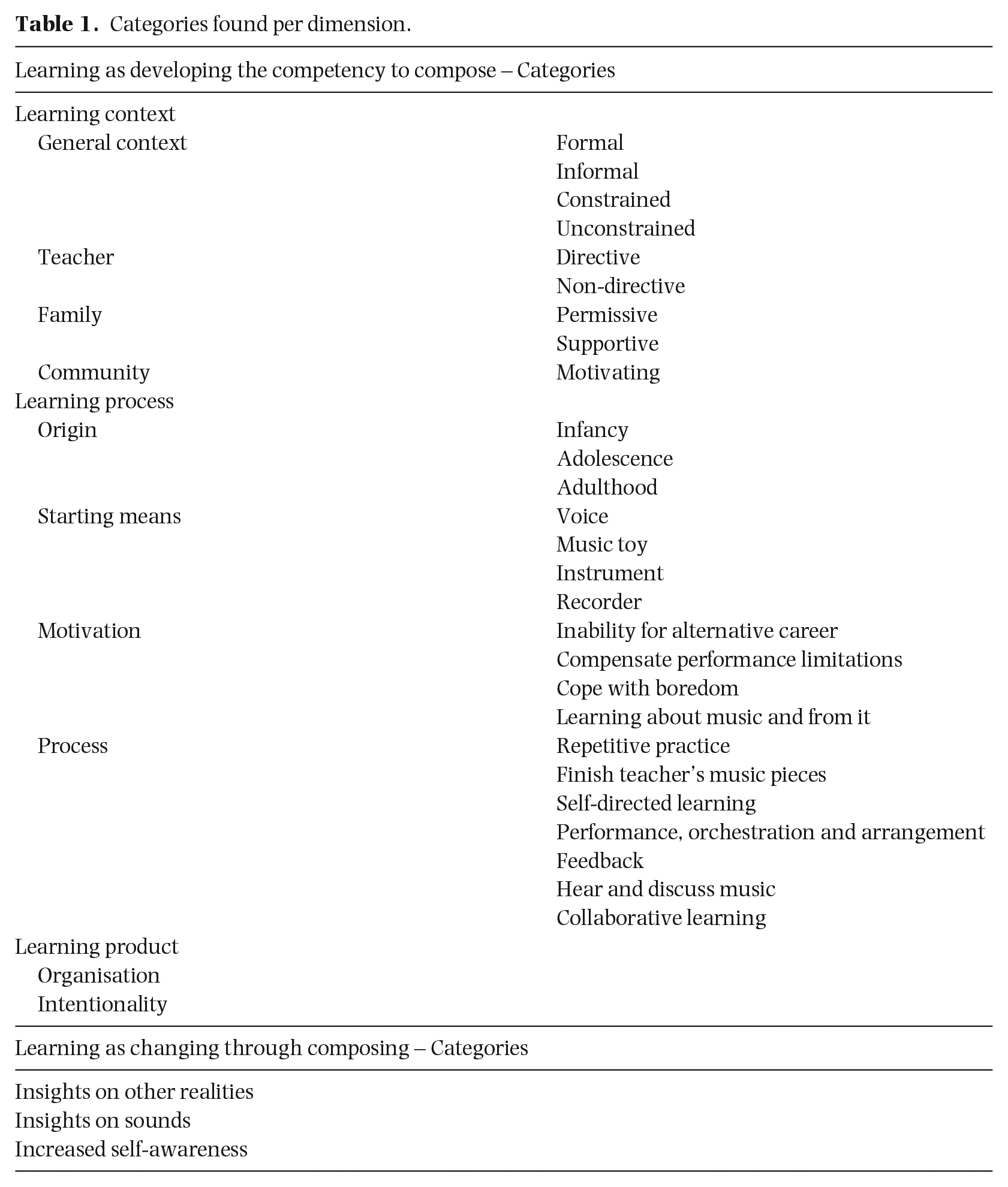
Table 1 shows a summary of the categories found.
Categories found per dimension.
Discussion
We found the results presented here have the advantage of expressing the personal voices of music composers, allowing an insight into their experiences from their own perspectives. In addition, they provide evidence that helps to substantiate some merely theoretical notions about learning musical composition and to derive some practical implications.
The reference to the context where learning composition occurs as mainly formal and time-localised (e.g., music schools, music lessons) corroborates the known importance of formal music study to learning music composition (e.g., Kozbelt, 2012). This result can be first interpreted both on the basis of the existence of a widespread tradition of ‘schooling’ music composition and of the technical complexities of it (e.g., music annotation), the learning of which, for the majority of individuals, requires – or at least is facilitated by – a guided external initiation. Also, the same result aligns with the suggestion of several authors (Byrne et al., 2001; de Bruin, 2019; Love & Barrett, 2016; Ruthmann, 2008) that learning music composition may require pedagogical orientation, in a variety of forms (i.e., modelling, scaffolding, knowledge-sharing, problem-finding dialogue, coaching and feedback).
On the contrary, the indication of the learning context for music composition as informal and extended over time (e.g., family, other musicians, self), aligns both with the notion of Wiggins (2012) that learning music composition can also occur through a process of implicit learning from direct experience in the general environment and with the notion of Rose and MacDonald (2012) that learning music is a lifelong experience. Therefore, the results suggest that it might be useful to encourage self-directed and lifelong learning of music composition. Informally learning music composition can also be possibly explained in relation to what appears to be a generalised human tendency (even in non-musicians) to spontaneously organise sounds in simple tunes (e.g., ‘ear-worm’ phenomena), as was observed by Beaman and Williams (2010).
References in the interviews that learning music composition can be both liberating and constraining, as well as the references to the music teacher as more or less directive, might imply that there had been different approaches to teaching music composition. These approaches can constitute possible equivalents of what Trigwell (2012) differentiated as teacher-focused versus student-focused ‘approaches to teaching’ in general. Training of music teachers should allow awareness of such differentiation of approaches to teaching music composition, as well as of the implications of these approaches in learning.
References to the supportive role of the family for learning music composition supports the notions of Burnard (2012) and Creech (2009) that parental support might act, and be used, as a key factor for that kind of learning and of learning of music in general. In addition, the testimonies on the motivational role of the broader community also suggest the importance of social opportunities and encouragement for the motivation to learn music composition.
Considering the results on the learning process, an early start to music composition in life (mostly childhood and then adolescence) corroborates both the possible existence of an innate talent for that activity and the importance of a relatively prolonged (and therefore advantageously early, if possible) musical study for the development of learning composition, as suggested by Kozbelt (2012). Nevertheless, the fact that some composers start composing later, in the beginning of adulthood, suggests that at least in some cases, this activity might be delayed. A hypothetical explanation for this would be the need in some musicians for a possible latency period for composing.
The existence of a variety of means to start composing (i.e., voice, music toy, instrument, recorder) reflects that the drive to compose (for some) surpasses the resources to do it. It also converges with the idea that learning to compose can be implicit or self-evident from direct experience in the general environment, as suggested by Wiggins (2012). Furthermore, this also aligns with the notion that learning music composition involves the domain of a problem-solving process (Collins, 2012). Thus, it seems to make sense to encourage composing with a variety of means and also informally, despite the fact that this might also mean that in the early experiences with music composition there is not a consolidation of working habits yet.
The fact that the composers testified to a variety of motivations to learn music composition validates the important influence of motivation for that kind of learning, as discussed by Hallam (2009). The reference to intrinsic motivators confirms that these kind of motivators are also important in learning music composition, as stated by Chirico et al. (2015).
The existence of a variety of forms to learn composition aligns with the observation that learning music composition involves a variety of learning strategies (Falthin 2014), as well with a probable variety of external resources available to learning music. In particular, the image of more ‘closed’ or more ‘open’ learning modes for learning music composition aligns both with the suggestion of Wiggins (2012) that learning musical skills occurs in levels and with the differentiation between ‘surface’ and ‘deep’ approaches to learning in general (e.g., Entwistle, 2015), which might be the matrix for those modes. Learners of music composition might benefit from reflection on such differentiation of learning modes, as well as of the implications of such modes in the learning products. Moreover, learning by repetitive practice and by finishing teachers’ music pieces goes along the notion that learning music composition is done by previous creative practices, rules or schemes rooted in musical tradition, as noted by Donin (2012) and Kozbelt (2012). Learning by listening to music corroborates the notion of Falthin (2014) that learning music composition fundamentally involves the development of new sounds on the basis of old familiar ones. Finally, learning by discussing music and in association with other people corroborates the view of Faukner (2003) and the observation of Love and Barrett (2016) that learning music composition can occur on the context of collaborative learning. Knowledge, reflection and discussion on all these forms of learning composition might be beneficial for those involved in it.
The result that learning to compose involves the development of the ability to better organise more elaborate and original music corroborates the notion that learning music composition might occur by level (Faukner, 2003; Lupton & Bruce, 2010), starting by explicitly applying taught rules and moving to composing by intuition using those rules in an expressive way. Reference to the acquisition of the ability to compose in an intentional way, rather than by instinct, might also be an instance of the first level of applying taught rules. Respect for such progression might facilitate learning of music composition.
Considering the results on learning as changing through composing, the reference that composing music brings personal insights to other realities is convergent with studies which indicate that learning to compose has a positive impact on cognitive abilities (e.g., Hetland 2000). Both this reference and the one to composing music resulting in an increased self-awareness suggest that music composition can function as a way of knowing about the world and about the self. Involvement in music composition might be, therefore used, as a way of promoting personal development. However, although this result seems interesting, its reduced differentiation, related to its low representativeness, limits its interpretation. It will therefore be important to carry out future research on this aspect.
The main limitation of this study derives from the fact that it used non-standardised (not intentionally constructed) interviews with a convenient sample of music composers. Furthermore, its results, as the results of any interview study on music composition, have to be seen as a complementary contribution to other qualitative and quantitative methods that involve direct observation or immediate subsequent inquiry during ongoing composition processes and materials (Donin, 2012). Nevertheless, by analysing composers’ voices about the learning of music composition, this study contributes with a needed empirical test of purely theoretical literature in such process, which usually does not focus in their perspective. Besides, the study subsidises with some key implications for the management of such learning, specifically, providing opportunities and encouraging it early in life; as an informal, self-directed and lifelong prolonged process, which can use a variety of means; but also, externally supporting it through modelling, scaffolding, knowledge-sharing, problem-finding dialogue, coaching and feedback; and raising awareness of the variety of learning and teaching modes (e.g., practicing, finishing existing pieces, moving from rules to expression, discussing, collaborating) along with their implications on learning.
Supplemental Material
Supplemental_material – Supplemental material for Learning and music composition: An analysis of composers’ testimonies
Supplemental material, Supplemental_material for Learning and music composition: An analysis of composers’ testimonies by António M Duarte and Niki P Constantinidi in Research Studies in Music Education
Footnotes
Funding
The author(s) disclosed receipt of the following financial support for the research, authorship, and/or publication of this article: The authors received financial support for the language revision of this article from Centro de Investigação em Ciência Psicológica da Universidade de Lisboa.

Supplemental material
Supplemental material for this article is available online.
Author biographies
References
Supplementary Material
Please find the following supplemental material available below.
For Open Access articles published under a Creative Commons License, all supplemental material carries the same license as the article it is associated with.
For non-Open Access articles published, all supplemental material carries a non-exclusive license, and permission requests for re-use of supplemental material or any part of supplemental material shall be sent directly to the copyright owner as specified in the copyright notice associated with the article.
