




Abstract
Music self-efficacy has been acknowledged as a strong predictor of successful performance among musicians and music students, but is less researched among amateur musicians. The purpose of this study is to examine the connection between music self-efficacy and learning and playing habits of amateur musicians who had preferences for online music tutorials as an informal learning technique. Two hundred and twenty-two amateur musicians completed four research questionnaires: (a) a general background questionnaire including learning and playing habits, (b) music self-efficacy, (c) self-esteem, and (d) online music tutorials users’ preferences, which distinguish between autonomy online music tutorials (fostering independent learners, incorporating context, and background) and dependent online music tutorials (offering mainly imitation options and providing little further knowledge). The results of the study supported the hypotheses, which predicted high music self-efficacy to be associated with the use of autonomy online music tutorials, co-playing, studying with a teacher, and self-esteem, and low music self-efficacy to be associated with the use of dependent online music tutorials. As music self-efficacy is crucial for students’ learning processes, we argue that music educators could refer students to optimal use of online music tutorials, thus fostering autonomous learners. Further research is required for clarifying the impact of personal characteristics and playing habits among amateur musicians on their music self-efficacy.
Keywords
Introduction
The aim of the present study is to explore amateur musicians’ learning and playing habits, as well as their personal characteristics, to provide formal music education with a new way of incorporating online materials and guidance. For this purpose, our study examined the connection between music self-efficacy of amateur musicians as affected by their self-esteem, preferences for autonomy versus dependent online music tutorials, duration of practice time, and experience in co-playing and studying music with a teacher.
Music educators constantly seek improvement and often recommend borrowing methods used outside of the educational field, such as interactions via improvisation (Wright & Kanellopoulos, 2010), garage band practices (Jaffurs, 2004), and the adoption of methods drawn from anthropological observations of near-extinct musical traditions (Isabirye, 2021). Pedagogical changes occasionally include incorporating technology as a valid learning tool and rethinking online music learning (Crawford, 2017). Some educators stress the importance of student-focused pedagogy and the integration of informal learning into the curriculum (Vasil, 2019), while claiming that informal music learning requires similar methods to be applied in online formal learning (Johnson & Hawley, 2017).
While formal pedagogy has structure, planned instruction, and a teacher as a professional instructor, informal pedagogy is situational, experience-based, and leans on context (Jenkins, 2011; H. H. Ng, 2020). Advocacy for a more autonomous form of music learning that allows students some freedom and self-direction was pioneered by Green (2009) who suggested that teenagers can benefit from and enjoy peer learning while having the freedom to choose the music with which to engage. Green’s (2002) approach to informal learning allows learners to adopt methods and materials borrowed from outside formal settings to develop musical knowledge and skills, and has been used in British schools (Stowell & Dixon, 2014) and reinforced by an Australian conservatory (Lebler, 2008). Lebler (2008, 2019) expressed the concern that introducing more popular music into the curriculum while treating it with a classical, traditional approach to music analysis and performance is not enough. Popular music is chiefly self- or peer-directed, and therefore requires not only the willingness to include students in choosing the repertoire (Stavrou & Papageorgi, 2021) but also the relevant teaching methods, well-supported independent learning, and self-evaluation.
Formal pedagogies are gradually shifting toward owning a “richer,” more popular musical library and toward fostering more self-directed music students and teachers (H. H. Ng, 2018). The contribution of music-video creation to music students, for instance, has been acknowledged (Cayari, 2014), as well as the efficiency of video instructions and pre-recorded music lesson assignments (D. T. Ng et al., 2022; Park, 2021). Some music educators encourage their students to post filmed performances of themselves on YouTube, executing a rehearsed piece to receive professional feedback (Koutsoupidou, 2014). However, changes are not easily welcomed, and teachers may prefer to avoid pedagogical shifts, including embracing popular music and its relevant approaches (H. H. Ng, 2020). In a “do-it-yourself” society, where online music tutorials are easily accessible (Lian, 2016), formal education is not solely responsible for learners’ exposure to materials, but is in charge, nonetheless, of their professional development. The rapid growth of accessible, online information might challenge learners in determining quality within the quantity and appreciating the impact of materials on their learning process, music abilities, and music self-efficacy.
To provide formal education with a new guiding tool for students, this study examines the online learning practices of amateur musicians. Amateur musicians have the freedom to choose a leisure activity, such as co-playing, as well as to abandon it while professionals might feel compelled to engage in it even though dissatisfied (Stebbins, 1992). Amateur musicians are often found to have better physical and psychological health than professionals (Bonde et al., 2018). Considering the popularity of amateur music-making and the likelihood of amateurs to report a wide range of learning habits (with or without a teacher, co-playing or not), we found them suitable for exploring online music tutorials use and music self-efficacy.
Accepting that amateur musicians spend a significant time playing in informal learning environments (Lebler, 2008) and that educational programs and positive reinforcements can improve students’ self-efficacy (Dinther et al., 2011), this study explores the connection between the music self-efficacy of amateur musicians, their online music tutorials preferences, and other learning and playing habits. We aim to provide an aid for music educators in presenting a new way of incorporating online materials and guidance in formal learning contexts.
Music self-efficacy
Self-efficacy refers to one’s belief in one’s capabilities to organize and execute the courses of action required to achieve a desired goal (Bandura, 1982, 1997). High self-efficacy is correlated with persistence and reaching high levels of accomplishment (Zimmerman, 2000). For example, Alhadabi and Karpinski (2020) showed that high levels of self-efficacy can predict high levels of academic performance in university students. Self-efficacy has been linked to various personal characteristics, including self-regulatory skills, academic performance, risk-taking behaviors (Pajares & Urdan, 2006), sport performance, and coping with anxiety, depression, and eating disorders (Bandura, 1997).
Bandura’s concept of self-efficacy has been developed over time to address the need to accommodate domain-specific tests of particular goals and populations (Bandura, 2006, 2018; Pajares & Miller, 1995). The concept of music self-efficacy has been highlighted as an important factor for musicians (Ritchie & Williamon, 2012), especially regarding performance anxiety issues (McPherson & McCormick, 2006; Zarza-Alzugaray et al., 2020), learning, motivation, and belief in one’s musical abilities (Harasim, 2017).
Perceiving self-efficacy as domain-specific has led to the distinction between performance music self-efficacy and learning music self-efficacy, when referring to music students or professionals (Ritchie & Williamon, 2011; Schunk, 1996). However, there is also a clear connection between performance and learning music self-efficacy: Hendricks (2015) implemented educational methods of both music learning and performance, aiding educators with raising their students’ overall music self-efficacy. Nielsen (2004) focused on learning music self-efficacy among music students and concluded that it relates to performance. McCormick and McPherson (2003, 2006) studied performance and offered references to learning skills using questionnaires that self-graded musical abilities such as sight-reading. T. Clark et al. (2014) demonstrated interaction between self-efficacy and performance quality through researching musicians’ performance experiences and satisfaction. The relationship between performance, self-efficacy, and self-evaluation has also been studied among school band students (Hewitt, 2015).
Different perspectives upon the music self-efficacy concept have resulted in a variety of research interests, targeting both professional and semi-professional populations as well as different research methods and measuring approaches (Hendricks, 2009; McCormick & McPherson, 2003; Nielsen, 2004; Ritchie & Williamon, 2011; Zelenak, 2015). The present study, as part of a series of studies (Harpaz & Vaizman, 2021) is, as far as we know, the first to address music self-efficacy regarding amateur musicians and therefore uses an accommodated measuring approach.
Self-efficacy and self-esteem
Self-esteem has been defined as a global evaluative attitude toward the self (Rosenberg, 1965) and as a combination of competence and self-worth (Mruk, 2006). Self-esteem and self-efficacy are both forms of believing in oneself: the first involves judgment and sense of self-worth, and the latter is a cognitive evaluation of one’s own capacity (Dinther et al., 2011).
Self-esteem and self-efficacy have an impact on people’s ability to deal with difficulty, challenges, and achievements. Examples include the self-efficacy beliefs of teenagers as correlated to school achievement and self-esteem (D’Amico & Cardaci, 2003); self-esteem and self-efficacy as correlated with attitudes toward help-seeking among teachers (Huang et al., 2007); and academic self-efficacy mediating the path between self-esteem and anxiety, and promoting psychological sustainability and resilience in the face of challenges (Mao et al., 2020). Moreover, a connection has been demonstrated between higher levels of career adaptability, general self-efficacy and self-esteem, and higher levels of life satisfaction in adolescents (Marcionetti & Rossier, 2019). Self-esteem and general strategies for learning have also been shown to predict perseverance and course grades among college students (Lane et al., 2004; Weisskirch, 2018). These studies indicate that self-esteem and self-efficacy have a positive relationship in different contexts and a positive effect on successfully coping with challenges.
Preferences in Online Music Tutorials and other learning and playing habits: Co-playing, studying with a teacher, years, and weekly hours of playing
Informal online technology use can be beneficial for young musicians (Green, 2014). YouTube has become a popular channel for users, allowing access to professional and amateur demonstrations (Cayari, 2018), with Vlogs (video blogs) being particularly accessible marketing channels (Bhatia, 2018). YouTube has also attracted the interest of music education researchers, who have explored its incorporation in formal studies (Kruse & Veblen, 2012). Programs like Hotttabs meticulously gather and present songs, tutorials, and tablature notations (tabs; Barthet et al., 2011). Although online materials might challenge the formal educator, a calculated sharing of their benefits with students may aid the latter with the acquisition of lifelong skills (Cayari, 2015).
Online Music Tutorials are popular ways for amateur musicians to learn independently of formal educational systems. When amateur musicians search the internet for tutorials on how to play a song, they encounter a vast array of options, different tutoring approaches, and a diverse range of depth and knowledge. It is therefore important to examine how online music tutorials influence learners. In this study, we address online music tutorials of two types, following Nadler’s (1997) theory of autonomy versus dependent help-seeking and help-giving orientation (Nadler et al., 2009), and viewing tutorials as tutors coming to the aid of music learners.
The aid of a tutor could either provide the solution for a challenge, and therefore foster a dependent learner, or provide an explanation and different views on a challenge, thus fostering an autonomous learner who might accomplish a similar task the next time on their own (Nadler, 1997). Autonomy online music tutorials, therefore, promote autonomous learners by offering high-quality knowledge relating to music theory, scales, harmony, exploring sound, offering background information, and/or presenting charted music in the form of notes or tablature notations. The comprehensive information provided encourages autonomous learning, improves a learner’s ability to cope with similar challenges in the future, and supports mastery of a new musical piece, which may also strengthen music self-efficacy. Accordingly, dependent online music tutorials offer mainly imitation options and provide little further knowledge. They usually zoom in on a player’s hands or fingers and take the learner step-by-step toward accomplishing the execution of a specific task. They do not address general music understanding nor deliver knowledge or opportunities for similar independent coping in future. For example, a person wishing to learn how to play House of the Rising Sun by The Animals on their guitar using a tutorial on YouTube would come across many options. Among the first would be a video of a tutor guiding the learner through the chord changes, with the camera focusing on his hands as he names the chords and tells the learner which strings to strum. In other words, the learning technique would be of imitation, leaving the user with little musical knowledge. Another tutorial shows not only the tutor’s guitar from different angles but an explanation of the chord progression and positions using several different charts such as chord fingering, music sheets, tablature, and strumming methods—all common music-writing methods. This tutor also offers background on the song and the band, and talks about the benefit of printing music sheets, giving the learner broad music learning means on top of the executional instructions.
We consider the first tutorial mentioned and similar models to be dependent online music tutorials, as the tutor’s intention is mainly to take the learner step-by-step toward the execution of one specific song. Without giving the learner tools for managing future challenges, the learner is left dependent on other tutorials for their next project of choice. The second tutorial mentioned and similar models would be considered autonomous online music tutorials, as the tutor’s intention is to foster a skilled learner, offer cognitive challenges, and better prepare the learner for future tasks. Exploring different music charting methods and being exposed to learning strategies allows for a wide range of learning options and gradually gaining autonomy when learning other new songs. Such autonomy can be seen in advanced music students who apply different strategies to a musical challenge, based on their cognitive development as learners over time (Nielsen, 2015).
In addition to online music tutorials preferences, other music playing habits can correlate to music self-efficacy. Playing with others, or co-playing, was found to be a predictor of music self-efficacy (Harpaz & Vaizman, 2021), and while it can be stressful for professionals in a working environment, it may present a form of escapism, social opportunity, stress relief, or feeling of well-being for amateurs through a sense of community and family (Pitts et al., 2015; Silverman, 2011).
Finally, this study examines the effect of studying music with a teacher and practicing duration on amateur musicians’ music self-efficacy. A teacher’s verbal feedback can be a source of confidence for the amateur musician (Bonshor, 2017). Teachers might provide amateurs with tools for fostering music self-efficacy, whereas informal online learning—substituting for formal learning—might deny learners the teacher’s impact on their practicing habits (Barry, 2007). This substitution can come in the form of co-playing communities, which are known to develop the self and strengthen one’s personal identity (Davidson, 1999), as well as being correlated with high musical self-esteem (Kruse, 2012). Online and offline communities raise participants’ enthusiasm and drive them toward practicing (Bayley & Waldron, 2020), compensating for the lack of formal learning sometimes denied to them due to geographical situations (Waldron, 2013). Members of co-playing communities learn through engagement in practice and shared knowledge (Kenny, 2013). However, suggestions by music teachers regarding practicing methods and general supervision might aid students in understanding the role of practicing in building toward achievement and success (Barry & Hallam, 2002).
This study aims to examine the relationship between preferences for autonomy versus dependent online music tutorials, other learning and playing habits, and self-esteem and music self-efficacy of amateur musicians. Based on the literature, we examine the following research hypotheses:
Method
Participants
Amateur musicians (N = 222) who use online music tutorials while learning how to play new pieces completed the research questionnaires. All the responders’ answers were analyzed and are presented in the “Results” section. The age range of the participants was 16 to 66 (M = 28.17; SD = 10.49), with 31% aged 21 years and younger, 35% between 22 and 30, and 34% were 31 and older (148 men, 72 women, 2 others).
Participants came from 23 countries, grouped into three samples: 77 Israeli participants (35%) completed questionnaires in Hebrew. The remaining 145 participants filled out questionnaires in English, divided into two additional groups: 82 participants (37%) from six Anglophone countries, and 62 participants (28%) from 16 non-Anglophone countries. One participant did not disclose their country of origin.
Participants had been playing music for 11 years on average (SD = 8.93) and spent an average of 4 hr per week playing (SD = 2.71). Approximately one in four participants (24%) had never studied music with a teacher; the remaining 168 participants (76%) studied with a teacher for 4 years on average (SD = 3.66). The majority of participants (60%) were occasionally involved in co-playing with others, and 190 participants (86%) played one instrument and 32 (14%) played multiple instruments.
Measures
Participants completed the following online questionnaires:
A General Background Questionnaire Including Learning and Playing Habits
This measured the variables gender, age, extent of education, country, years of playing, years of studying music with a teacher (if any), hours spent playing per week, co-playing experience, and main instrument.
Music Self-Efficacy Questionnaire
A general self-efficacy scale (Chen et al., 2001) was used as the basis for music self-efficacy measurement and was adapted to situations of learning new musical pieces, with modified items reflecting the subject and population. This adaptation stemmed from our interest in researching the self-efficacy beliefs of amateur musicians about their ability to learn to play new pieces, and the fact that the existing tools for measuring music self-efficacy focus on coping with performance and training and are suitable mainly for professionals or music students (McCormick & McPherson, 2003, 2006; Nielsen, 2004; Ritchie & Williamon, 2012). Participants in the present study were asked to indicate on a 5-point scale—1 (to a very small extent) to 5 (to a great extent)—the extent to which each of the eight statements described them while learning new pieces. Higher scores indicated a stronger sense of music self-efficacy, for example, “I believe I can succeed in any endeavor I set my mind to when I’m studying a new piece of music,” and “I will be able to successfully overcome many challenges when I’m studying a new piece of music.” The predictive validity, content validity, and discriminant validity of Chen et al. (2001) were found to be better than other measures of general self-efficacy. Moreover, discriminant validity was found to have stronger correlations to motivational factors than other measures of general self-efficacy, especially in multicultural studies, and was therefore relevant to the present study. Reliability was Cronbach’s α = .92.
Rosenberg Self-Esteem Scale
We used the Rosenberg (1965) 10-item scale statements on a 4-point scale—1 (strongly opposed) to 4 (strongly agree)—with higher scores meaning a higher sense of self-esteem (e.g., “On the whole, I am satisfied with myself”; negative: “I wish I could have more respect for myself”). The scale was scored by totaling the individual 4-point items after reverse-scoring the negatively worded items (2, 4, 6, 8, 10). Reliability was Cronbach’s α = .75.
Online Music Tutorials Users’ Preferences Questionnaire
Participants were asked to fill this questionnaire according to their common tendencies in selecting tutorials online while learning new songs. Based on the distinction between autonomous versus dependent help-seeking (Nadler, 1997, 2015) and the help-seeking orientation questionnaire (Komissarouk et al., 2017), we formulated an original questionnaire, recently published in a shorter version (Harpaz & Vaizman, 2021), to measure participants’ online music tutorials preferences. Participants rated their agreement with 12 statements on a 5-point scale—1 (strongly disagree) to 5 (strongly agree). Six items were designed to reflect autonomous online music tutorials users’ preferences (e.g., “It’s important for me to base my playing on theoretical knowledge”; “Other than fingering and positions, it’s important for me to know what I’m doing and what to call it”), and another six reflected dependent online music tutorials users’ preferences (“I prefer a demonstration to reading a musical text”; “It’s important for me to study a musical piece in the easiest way possible”). Exploratory factor analysis with Varimax rotation revealed two factors, as expected: a six-item autonomy online music tutorials subscale—Cronbach’s α = .68—and a five-items dependent online music tutorials subscale—Cronbach’s α = .63. One negative item that was part of the dependent online music tutorials subscale was ruled out due to lack of reliability (“The chord or sound names are not important for me”). Results of this exploratory factor analysis are presented in Table 1.
Results of the Exploratory Factor Analysis of Online Music Tutorials Users’ Preferences.
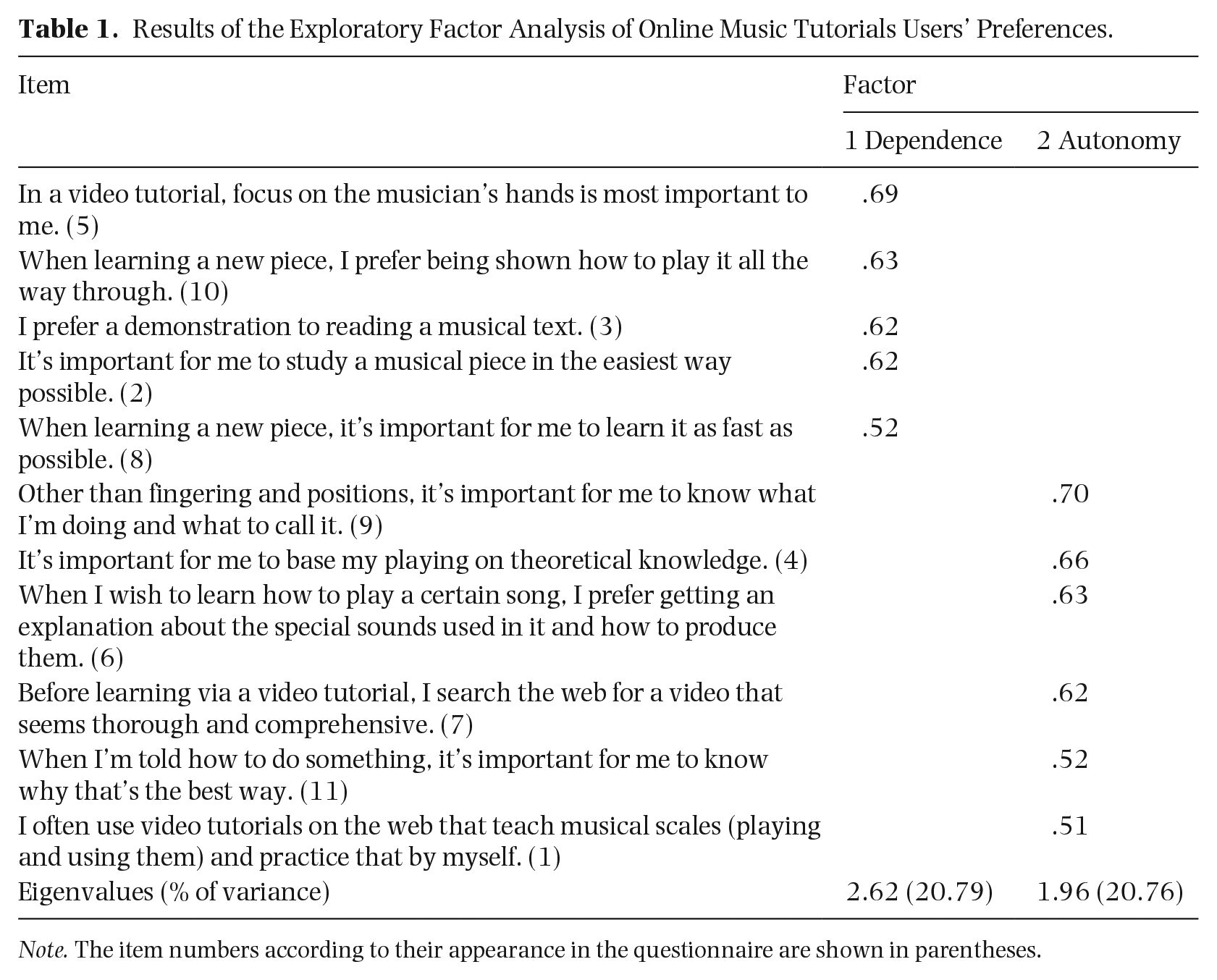
Note. The item numbers according to their appearance in the questionnaire are shown in parentheses.
Procedure
After receiving approval from the relevant Research Ethics Committee, Google forms containing questionnaires were sent using snowball sampling to the Israeli sample that completed Hebrew questionnaires. Participants filled out an informed consent form prior to participating in the study, in which the purpose of the study was explained to them, anonymity was guaranteed, and the possibility of retiring from the study at any time was offered. Moreover, after completion, the participants were given an explanation of the research hypotheses as well as contact information for the researchers to both receive the findings after completion of the data analysis and to clarify any questions they might have on the subject.
To increase the generalization capacity, the questionnaires were translated into English, using a double-blind translation method by four bilingual-speaking experts at mother tongue level. The English sample was collected using online participant recruitment through Prolific (www.prolific.co). It took participants about 10 min to answer the questionnaires, in both the Hebrew and English versions. For the statistical analysis, we used SPSS, Version 25. Data were collected throughout September to October 2019 before the spread of the COVID-19 pandemic.
Results
To perform an initial test of the research hypotheses, we calculated Pearson correlation coefficients for all continuous study variables. The results indicated support for the research hypotheses. Specifically, music self-efficacy was found to be positively correlated with self-esteem, autonomy online music tutorials, number of years playing a musical instrument, and weekly hours of practice. Furthermore, music self-efficacy was found to be negatively correlated with dependent online music tutorials. Descriptive statistics and Pearson correlations are presented in Table 2.
Descriptive Statistics and Pearson Correlations Between the Study Variables.

p < .05. **p < .01. ***p < .001.
Moreover, to test the hypothesis that those who were taught by a teacher have higher music self-efficacy than those who were not, an independent-samples t-test was conducted. The non-significant Levene’s test indicated equality of variances between the groups (p = .62). Furthermore, a significant t-test indicated a difference in means between the groups, t(220) = 2.76, p = .003, with a medium effect size, Cohen’s d = .43. Specifically, those taught by a teacher (M = 3.57, SD = .74) were significantly higher on music self-efficacy than those who were not taught by a teacher (M = 3.25, SD = .82).
Similarly, to test whether those who play with other people (who have co-playing experience) have higher music self-efficacy than those who do not, we conducted an independent-samples t-test. A non-significant Levene’s test indicated equality of variances between the groups (p = .14). Furthermore, a significant t-test indicated a difference in means between the groups, t(220) = 4.72, p < .001, with a medium to large effect size, Cohen’s d = .65. Specifically, those who play with others (M = 3.68, SD = .68) had a significantly higher music self-efficacy than those who do not play with others (M = 3.20, SD = .80).
To test whether music self-efficacy differs between men and women, an independent-sample t-test was conducted. A non-significant Levene’s test indicated equality of variances between the groups (p = .67). Furthermore, a non-significant t-test indicated no difference in means between the groups, t(218) = .96, p = .34. Specifically, males (M = 3.54, SD = .76) were not significantly different in music self-efficacy than females (M = 3.43, SD = .79).
Finally, to test whether music self-efficacy differs between countries (native English speakers, non-native English speakers, and Israeli native Hebrew speakers), a one-way analysis of variance (ANOVA) was conducted. The results indicated a significant difference between countries, F(2, 218) = 11.14, p < .001, with a medium effect size, η2 = .09. Bonferroni post hoc tests indicated that Israeli native Hebrew speakers (M = 3.82, SD = .59, n = 77) were higher on music self-efficacy than non-English speakers (M = 3.33, SD = .74, n = 64; p < .001). Similarly, Israeli native Hebrew speakers scored higher on music self-efficacy than native English speakers (M = 3.31, SD = .85, n = 82; p < .001). However, native English speakers and non-English speakers were not significantly different from one another (p = .98).
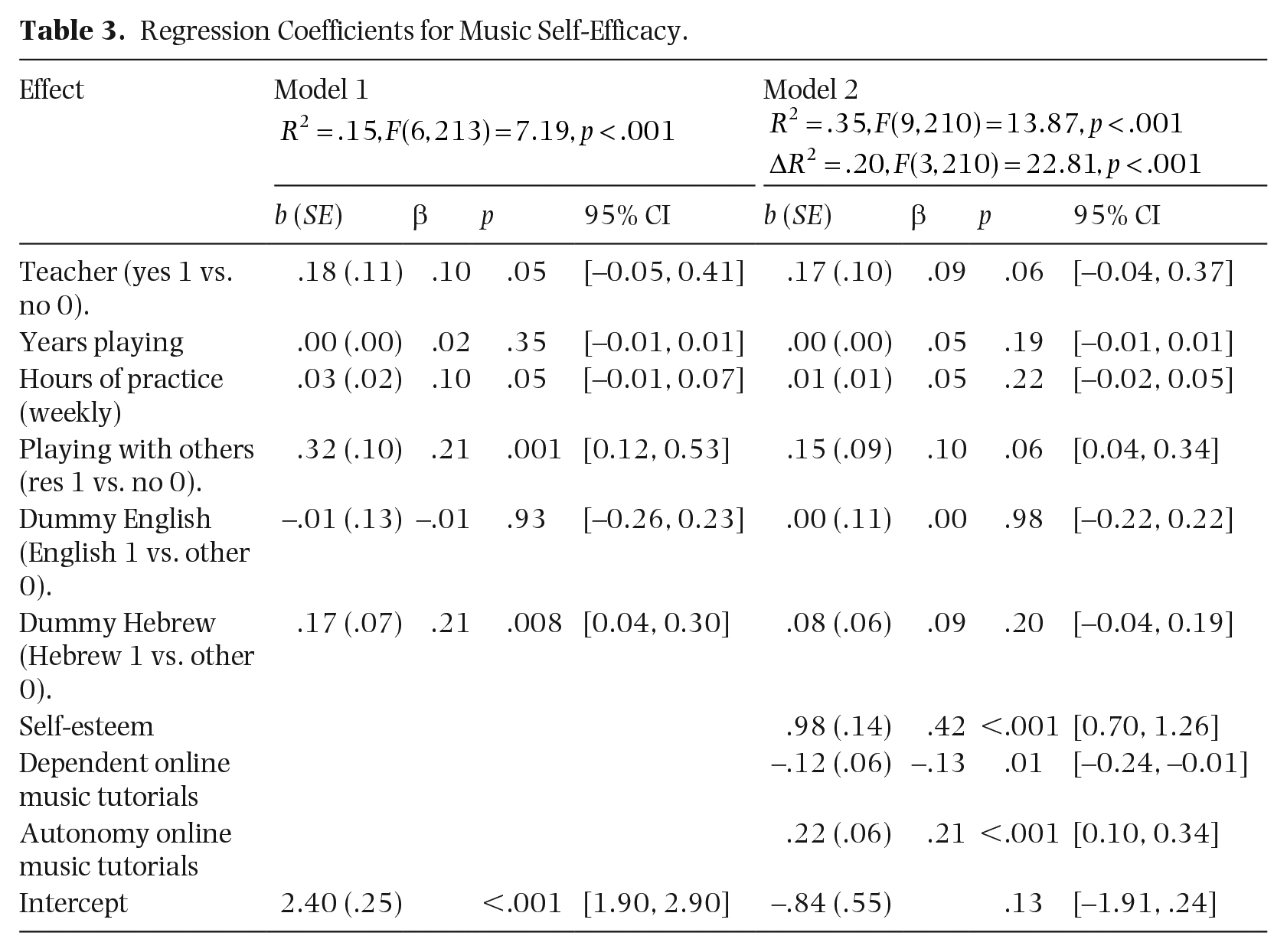
To test the unique effects of all the independent variables on music self-efficacy, an ordinary least squares (OLS) hierarchical regression was conducted in two steps. In the initial step, background variables were inserted into the model as predictors: studying music with a teacher, years of playing, co-playing experience, and hours spent playing per week. To control for differences between countries, two dummy variables were calculated and were entered into the first step as well: English speakers versus others, and Hebrew speakers versus others. In the second step, to test the effect of the theoretical independent variables on the dependent variable above and beyond the background variables, autonomy and dependent online music tutorials users’ preferences and self-esteem were inserted into the model.
The results of the first model indicated that the background independent variables accounted for 15% of the variance of the dependent variable. Analysis of the regression coefficients indicated that while controlling for all other variables, those who play with others have higher music self-efficacy than those who do not, and those who study music with a teacher have higher music self-efficacy compared with those who do not. In addition, weekly hours of practice were shown to have a positive effect on music self-efficacy. Finally, both English speakers and non-native English speakers have lower music self-efficacy compared with Hebrew speakers.
The results of the second model indicated that the independent variables accounted for 35% of the variance in the dependent variable and that the model was significant. Furthermore, the theoretical independent variables accounted for 20% of the variance in the dependent variable, above and beyond the variance explained by the background independent variables. The results of the second model indicated that when controlling for all other variables, self-esteem and users’ preference for autonomy online music tutorials have a positive effect on music self-efficacy, and conversely, users’ preference for dependent online music tutorials has a negative effect on music self-efficacy. Both models’ regression coefficients are presented in Table 3.
Regression Coefficients for Music Self-Efficacy.
Discussion
The results supported the research hypotheses. Preference for autonomy online music tutorials and self-esteem were found to be positive predictors of music self-efficacy, while preference for dependent online music tutorials was a negative predictor of music self-efficacy. Furthermore, participants who had experience with co-playing and studying with a teacher had significantly higher music self-efficacy than those who were lacking such experience. Weekly hours of practice were also positively correlated to music self-efficacy.
Additional results showed a correlation between preferences for autonomy online music tutorials and weekly hours of practice. In addition to the connection between long practicing hours and performance abilities (Ritchie & Williamon, 2012), long periods spent with one’s instrument are also connected to autonomy learning skills.
Conclusions and implications
Adoption of technological tools as part of a pedagogical approach is encouraged (Johnson, 2017), whether for the purpose of collaborative work (Harasim, 2017) or for the advantages of recorded lectures (O’Callaghan et al., 2017). However, to know how to incorporate technology in education, exploration of how students use it themselves is needed (Henderson et al., 2017).
We suggest that learning about the connections between music self-efficacy, online music tutorials preferences, and learning habits may assist educators in directing their students toward beneficial ways of using online music tutorials. As results show that music self-efficacy is negatively predicted by preference for dependent online music tutorials, we believe that while dependent online music tutorials might be a useful aid when time is of the essence, it might also foster learners who remain dependent on online music tutorials in future challenges. Furthermore, as online music tutorials use is usually self-directed, we suggest that educators offer their students a professional point of view on self-directed techniques, including effective use of online music tutorials.
Educators who acknowledge the amateur field, popular online materials, preferences of their users, and the well-documented connection between self-efficacy, creativity, and performance (Hewitt, 2015; Khedhaouria et al., 2015; Ritchie & Williamon, 2012) might benefit from a deeper understanding of autonomy versus dependent online music tutorials use. However, responsible adoption of informal learning methods which binds community learning with creativity and modern technology (Burnard, 2007; Green, 2009) might still place the teacher as a mediator between the student, the platform, and the materials. We therefore suggest that learning about the connections between music self-efficacy, online music tutorials preferences, and learning habits may assist educators in directing their students toward a beneficial way of using online music tutorials through offering a professional point of view on matters with which they are already concerned: informal, self-directed learning.
Considering that music self-efficacy is a vital element for building confidence, perseverance, and excellence in music learning and that music learners use online music tutorials in addition to or as a substitute for formal learning, we believe informal guidance within the formal learning framework to be beneficial for music students. It may lean on past successes, such as instrument teaching methods adopted in class (Abramo & Austin, 2014). Presenting students with online learning options allows them to continue autonomously during their leisure time and be more in charge of their schedule (Johnson & Hawley, 2017). However, while YouTube is used in the classroom for many different reasons, such as sharing music, lyrics, and analyzing instrumentation (Stowell & Dixon, 2014), there are currently no reports of YouTube being used formally as a pedagogical tool in self-directed learning environments. Presenting online materials in such a way could encourage students to engage in well-planned, self-regulated activity, building up their self-efficacy in the process (Hendricks, 2015).
Given the importance of incorporating cultural diversity in the classroom—as discussed by scholars in the United States, United Kingdom, and Finland (Campbell, 2017; Fitzpatrick, 2012; Kivijärvi & Rautiainen, 2020)—it should be recognized that online music tutorials has the potential to deal with any musical content and allow personal expression. Indeed, prediction of music self-efficacy by online music tutorials users’ preferences was not affected by country or region. Therefore, addressing online music tutorials and using them in formal education worldwide could foster students’ music self-efficacy. Moreover, while taking all the variables into consideration, no differences were found in comparing the music self-efficacy of the three groups into which the participants were divided (Israeli, Anglophonic countries, and non-Anglophonic countries).
Limitations and future research
Three main limitations of the study should be addressed, the first being the lack of causality between online music tutorials preferences and music self-efficacy. We suggest establishing a possible causality using congruous research, as well as exploring the relationship between music self-efficacy and online music tutorials preferences over time. The second limitation is the wide spread of ages of the research participants. Focusing on different age groups separately would be an interesting contribution to the subject.
The third limitation lies with the collection of data prior to the worldwide COVID-19 lockdowns (Rubin & Wessely, 2020). Considering that music is a coping tool which aids relaxation and healing (Giordano et al., 2020; Mastnak, 2020), it would be interesting to explore any reshaping of learning and playing habits following the lockdowns. Studying with a teacher is one of the factors found to predict music self-efficacy, and there were many changes during the lockdowns and restrictions, such as spending more time online or ceasing to learn with a teacher altogether. The effect of teachers on their collegiate students’ music self-efficacy was found to be positive, especially regarding performance music self-efficacy (J. C. Clark, 2013; Harpaz & Vaizman, 2021; Lewis et al., 2022). We suggest exploring the influence of teachers on amateur musicians’ music self-efficacy, especially as COVID-19 may have strengthened the use of online music tutorials. Furthermore, to understand the extent of online music tutorials use by amateur musicians and students during the pandemic, it is important to explore any change in online music tutorials preferences, especially while learning in times of social distancing, the shutdown of schools, and the cancelation of concerts.
Our approach to online music tutorials leans on Nadler’s (1997, 2015) theory of autonomy versus dependent help-seeking orientation, which affects one’s ability to gain control over a learning subject and become an independent learner. Therefore, further research that explores the connections between online music tutorials use, other personal preferences, music self-efficacy, and personal characteristics, such as help-seeking orientation, is worth consideration. Further research is also needed for exploring the factors that might influence online music tutorials preferences of amateur musicians, such as musical styles, learning goals, or time pressure; the degree of uniformity of the online music tutorials choices made by amateur musicians; and the nature of the relationship between favored online music tutorials characteristics and users’ music self-efficacy. The issue of the possible moderation of amateur musicians playing alone versus playing with others should also be addressed.
It has recently been acknowledged that balance between formal and informal learning techniques is important even on the professional level, and some musicians state the importance of being self-taught or wish they had had more informal instruction (Hess, 2020). While actual use of online music tutorials for practical instrumental learning is, and perhaps should remain, self-directed or in addition to guidance from a popular instrument teacher, professional guidance for the avid learner who uses online music tutorials could boost the learner’s music self-efficacy while offering a certain pedagogical balance. Teachers could either incorporate online music tutorials use in the curriculum or simply address different types of online learning advantages for tutorial users. Learners could benefit either directly from online music tutorials carefully selected by the teacher or from the general encouragement to be flexible in music learning strategies (Freire et al., 2020).
Addressing both the need to incorporate more popular music in the curriculum and the advantages of autonomy online music tutorials, teachers could take the opportunity to demonstrate their own online music tutorials selection and filtering: picking out a song or two, reviewing some tutorials, and indicating the differences between them. Labeling some of them as autonomous and some as dependent would offer students some recommendations of structure. This could allow substantial freedom for each teacher to use their own preferred materials and favored instrument, their own time, and their own definition of “proper autonomy online music tutorials” while promoting their students’ music self-efficacy.
Footnotes
Declaration of conflicting interests
The author(s) declared no potential conflicts of interest with respect to the research, authorship, and/or publication of this article.
Funding
The author(s) received no financial support for the research, authorship, and/or publication of this article.
