



Abstract
The topic of language awareness in intercultural music education has received surprisingly little attention in discussions on meaningful and responsive musical practices, despite language being an ubiquitous issue that every music educator encounters when entering a multilingual learning environment. This study explores a language-aware perspective that is embedded in a dynamic and dialogical choir practice drawing on the direct social needs of adult choir participants with culturally and linguistically diverse backgrounds. The analysis sets the practitioner experiences, planning, and implementation of the choir practice against the theorisation of activity systems and the concepts of boundary object and boundary crossing, in particular. The theoretical exploration considers how a dual meaning choir practice (a) integrates musical and linguistic activity, (b) crosses boundaries between the disciplines of music and language education, and (c) justifies change in music educational thinking. The study suggests that a dual meaning choir practice provides meaningful musical activity for adult immigrants, expanding the understanding of musical practice and the profession of music educator by blurring the dichotomous thinking of music and music education as being either instrumentalized or existing only for purely musical purposes. The study further advocates that a hybrid musical practice can widen professional understanding with novel insights, out-of-the-box perspectives, and new opportunities.
Introduction
Music education has an ambiguous relationship to practices that aim at non-musical outcomes (Westerlund et al., 2021), as musical practice typically draws on tradition and is defined against its historically and socially constructed raison d’être (e.g., Elliott, 1995, p. 45). This study addresses the dilemma between genre-related, established musical practices and emerging new practices that include seemingly distant elements and goals of music making, by focusing on a choir practice that is characterized by cultural and linguistic diversity. The investigated choir practice serves a dual purpose: to create meaningful musical experiences for adult immigrants, while at the same time supporting their second language use (second language denotes Finnish as a second language being studied in the language environment where it is spoken and as the language of schooling; Larsen-Freeman & Long, 1991). The aim is to complicate the still-prevalent dichotomous view of the musical versus non-musical ends of music and music education by exploring the Learn-Finnish-by-Singing (henceforth LFBS) choir from a theoretical perspective, as a new practice in the context of music education. Since 2011, LFBS choirs have responded to the broader need for the participatory inclusion of immigrants in Finland. Moreover, the choirs aim to serve newly arrived residents who are easily excluded from arts and cultural services. LFBS choirs have been developed based on the positive experiences of the adult immigrants, the LFBS choir conductor, and second language teachers engaging in musical activities as part of integration training. 1
Despite Finland having a large number of choirs, these choirs typically do not address the increasing pace of immigration, and hence the diversifying reality of the country. Currently, every fourth person living in the Helsinki capital area has a foreign background (Tilastokeskus, 2021). Researchers in education and the labor market (Susanna Ahonen-Coly et al., 2020; Turja & Riikonen, 2019) emphasize the importance of second language proficiency in the integration process. Studying Finnish as a second language most often focuses on skills in grammar, reading, and writing (Mustonen, 2015; Virkkunen & Toivola, 2020) and uses a paper-based, sedentary approach (Teräs, 2012). Consequently, features that support communication such as pronunciation or spoken language, which differ remarkably from written Finnish (Lehtonen, 2015; Ruuska, 2020), are rare (Virkkunen & Toivola, 2020). Moreover, especially adult immigrants in Finland lack social contexts where they could actively use the Finnish language as it is spoken (Mustonen, 2015; Tammelin-Laine, 2014).
Studies in linguistics, psychology, cognitive science, and neuroscience suggest that music and language have cognitive relations that can enhance communicative abilities in language processing (e.g., Arbib, 2013; Patel, 2008; Patel & Morgan, 2017), and that singing, in particular, can facilitate second and foreign language learning by promoting writing skills, vocabulary acquisition, pronunciation, and grammar learning (e.g., Alisaari, 2016; Busse et al., 2021; Ludke et al., 2014; Schön et al., 2008). These studies, aligning with research on music psychology (e.g., Gabrielsson, 2011; Juslin & Sloboda, 2001), emphasize the meaning of affective resources in musical experiences. Accordingly, a variety of studies suggest that choir singing has potential beyond music learning to holistically promote well-being and health (e.g., Dingle et al., 2012; Siljamäki, 2021). However, in her sociolinguistic study on Finnish as a second language, Ruuska (2020) found that being a member of an established choir did not seem to support productive language skills, but rather seemed to contribute to “basic receptive language skills” (p. 235). Nevertheless, research on choir singing and second language learning in immigrant adults remains scarce, despite the fact that language use, pronunciation through articulation, and the repetition essential for language learning are self-evidently also central to choir singing.
Aligning with the practitioner research tradition (Cochran-Smith & Lytle, 2009), this study explores a choir practice where productive language skills, such as pronunciation and the use of spoken language, are emphasized in and through collaborative, embodied music production. More specifically, this study is an analytical reflection on the specific features and underlying principles of the choir singing design that is meant to support second language learning. The study turns the perspective of music’s influences on language learning toward opportunities for musical activity to approach challenges in second language use and learning. Importantly, in line with the growing body of research that promotes embodied learning, particularly in music education (e.g., Abril, 2011; Juntunen, 2020; Westerlund & Juntunen, 2005) and in language teaching and learning (e.g., Atkinson, 2010; Kosmas & Zaphiris, 2020), this study advocates a holistic approach to both musical and linguistic teaching and learning, highlighting the engagement of the whole human body through the cognitive, affective, and behavioral states embedded in the socio-material environment (e.g., Barsalou, 2020; Thompson, 2017). By and large, active music making and experiencing through singing in a (social) choir context enables a holistic approach to language use and learning as social endeavors.
The two choirs that are the focus of the study were led by the author (as a researcher-practitioner) and housed at an Adult Education Centre and a Cultural Centre in the Helsinki capital region; the first choir engaged over 40 active participants and the other, a newly founded one, half this amount during weekly choir rehearsals. The original impetus for the choir practice was to create a novel and meaningful social context for adult immigrants to practise the use of Finnish. In this context, the lack of second language proficiency does not lead to exclusion. The members of the choirs came from every continent and spoke over 20 different native languages, including Chinese, Vietnamese, Nigerian, French, Spanish, Hindi, Malay, Kurdish, Turkish, Persian, Ukrainian, Russian, Japanese, Georgian, Portuguese, English, and German, manifesting the cultural and linguistic heterogeneity and diversity of the choir community. The attendance was voluntary, free of charge, and organized as a leisure interest once a week. The choirs were assisted by a Finnish as a second language teacher. In the choir, language was understood in a wider sense as a mode of communication, and the participants were seen as language users rather than language learners. Following the notion of translanguaging (García & Wei, 2014; Li, 2018), all modes and ways of communication, including verbal, embodied, and sensory resources, as well as the possibilities provided by the material and physical surrounding, were nurtured within the choir context.
In this article, the LFBS choir is explored through activity theory as a single activity system (Engeström, 1987, 1999) and as part of interacting activity systems (Engeström, 2001) in order to analyze a hybrid musical practice that reflects the rapid changes and new needs of the broader society. To approach the dual meaning of LFBS choir practice, the analysis employs the concepts of boundary object and boundary crossing (Star, 2010; Star & Griesemer, 1989). The triple role of the choir conductor and author of this study as (a) choir conductor/music educator, (b) language teacher, and (c) researcher allows a participatory perspective in the choir practice, yet without an immigrant background.
Theoretical lenses: Activity theory and boundary crossing
My first research task of analytical reflection concerns the question of how to conceptualize LFBS practice that highlights the collaborative and productive nature of language use in and with (via) singing in a choir. In the light of the activity system (Engeström, 1987), which draws upon the ideas of cultural-historical activity theory (Engeström et al., 1999), the LFBS choir conductor and the choir member can be seen as performing culturally mediated individual actions in the Vygotskyan sense (Vygotsky, 1978), whereas the choir as a whole performs the part of collective actor, functioning as a unit of analysis for individual actions. The activity system links “the individual and social structure” (Engeström, 2005, p. 17) and reflects the multivoicedness of such a system. An activity system (see Figure 1) consists of elements such as subject, object, mediating tools and signs, community, rules, and the division of labor. An object of activity under transformation is the force that integrates different elements. To better meet challenges in exploring “questions of diversity and dialogue between different traditions or perspectives” (Engeström, 2001, p. 136), Engeström further elaborated the theory to focus on two or more activity systems functioning as intertwined, to enable conceptualizing change in relation to societal needs and developments. In this study, I use activity system analyses to reveal the subject-community relationships within LFBS choir and the significance of the individual and social structures.
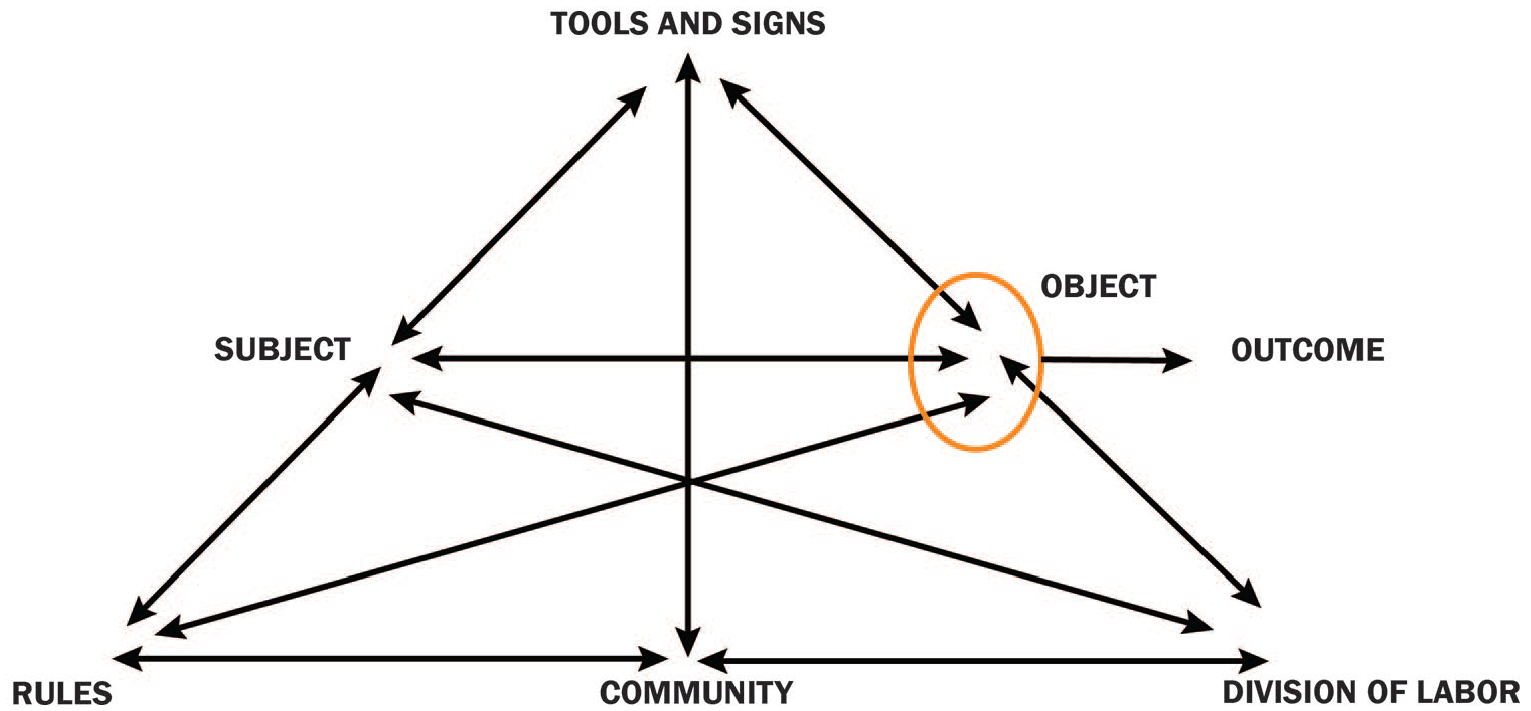
A Complex Model of an Activity System (see Engeström, 1999, p. 31).
My second research task focuses on the question of how to broaden the understanding of the educational potential of emerging hybrid musical practice, particularly in increasingly intercultural societies. To approach this task, I use the concepts of boundary crossing and boundary object (Star, 2010; Star & Griesemer, 1989), which help to expand activity theory beyond “learning within single domains and practices” (Akkerman & Bakker, 2011, p. 150) by pinpointing the ambiguity and challenges as well as the potential of activity that intersects and crosses different disciplines and professional practices to serve multiple needs in “a horizon of possibilities” (Engeström, 2005, p. 10). Boundary crossing includes professional work that, in the current state of societal complexity, needs to deal with aspects such as unfamiliarity and unqualification (Suchman, 1994) on one hand, and on the other hand needs to overcome difficulties in dealing with “ingredients from different contexts to achieve hybrid situations” (Engeström et al., 1995, p. 319). A boundary both divides and unites different sociocultural worlds being “neither one nor the other” (Akkerman & Bakker, 2011, p. 141). Negotiation across boundaries is facilitated by boundary objects that communicate between different sociocultural worlds and that are “common enough to make them recognizable across these worlds” (p. 140, see also Engeström & Käyhkö, 2021). These conceptualizations are used to analyze language awareness in the context of intercultural music education.
Outcome of the analysis
The outcome of the analysis is presented in three phases, addressing practice-based theorizing (Gheraldi & Nicolini, 2014) that describes how “knowing-in-practice is constructed” (p. 134). The analysis reflects a practitioner-researcher’s (choir conductor’s) experiences of planning and implementing LFBS choir practice.
The first phase of the analysis: Emerging hybrid musical practice
In the first phase of the analysis, I use my experience of over two decades conducting different kinds of choirs, from children’s to senior choirs, and working as a music teacher for immigrants in multiple contexts ranging from integration training to once-a-month open LFBS workshops for second language teachers and classes of all ages and language levels. This also includes conducting LFBS choirs and collaborating with second language teachers. In addition, diverse contemporary initiatives from international workshops, such as Choir improvisation, “Singen ohne Noten” (Singing without sheet music), and Global Choir Leadership, have influenced the planning. Earlier research on phonetics and Finnish as a second language have contributed to the linguistic orientation focusing on pronunciation and phonetic aspects (Aho et al., 2016; Virkkunen & Toivola, 2020); the courage to use the language (Mustonen, 2015; Tammelin-Laine, 2014); and spoken language (e.g., Lehtonen, 2015; Ruuska, 2020) through embodied approaches (e.g., Eilola, 2020; Lilja et al., 2020). Furthermore, studies in linguistics that discuss the benefits of visual facilitation for second language learning (e.g., Gaboury & Lessard, 2020; Smotrova, 2017) and the contributions of active language use in language ownership (Lehtonen, 2015; Ruuska, 2020) have served as references for the language approach.
Altogether, these experiences and dialogues, crossing disciplinary boundaries and working with different groups of participants and social networks, have resulted in a set of underlying pedagogical principles that have supported the construction of the hybrid musical practice. I have called this set a metaplan, which has provided a mediating tool (an artifact) for crossing the boundaries. Appropriating the definition of boundary object as indicating how tools and signs can “fulfill a specific function in bridging intersecting practices” (Akkerman & Bakker, 2011, p. 134), the metaplan can be considered as a boundary object for developing LFBS choir activity, while also being constantly further developed in the processes of choir activity. Boundary objects (Star & Griesemer, 1989) such as diverse technologies, drawings and models (Kimble et al., 2010), or teaching methods (Loughland & Nguyen, 2018) have the potential to overcome discontinuities, thus enabling boundary crossing as a process of establishing continuity of meaning making in a situation of multivoicedness and intersecting practices (Akkerman & Bakker, 2011).
Within the framework of a boundary object, I divide the metaplan into six fields of action in which the diverse ways of musical and linguistic actions become meaningfully integrated. These actions are voiced, embodied, and material in nature, producing a dynamic and flexible boundary object (Star, 2010) that can be used as a tool for facing complexity and unfamiliarity in interdisciplinary domains and work, and overcoming the difficulties of dealing with hybrid situations. Here, I provide a condensed view of these fields of action (see a more detailed table in Appendix 1):
(1) Warm-ups aim at the holistic opening of the voice, body, and mind for singing and language use in creative ways, by playing with musical sounds and language through holistic expression while focusing on the challenging sounds of the Finnish language. (2) Collaborative improvisations aspire to an interactive and “mistake-is-a-gift” approach to music and language production, with the emphasis on various ways and modes of communication. (3) Singing songs in different genres and themes, which forms the core field wherein all of the other action fields are connected, aims at encouraging the active, embodied, and multisensory use of language through singing in collaboration with others in a safe and supportive environment, while simultaneously focusing on the multiple intertwinings of music and language such as articulation, hearing, rhythm, and the cultural content embedded in the songs. (4) Creating new lyrics strives to support language production in both oral and written forms by involving co-creation and re-creation of the song lyrics while encouraging intercultural dialogue and the use of spoken utterances. (5) Immersing in the stumbling blocks of Finnish with “Funny Finnish language songs” aims at memorizing and recalling the most challenging aspects of the Finnish language, such as its phonetic features and difficult grammatical rules, as well as everyday proverbs in Finnish, with the help of gripping melodies and lyrics that follow the rhythm of the spoken language and emphasize a relaxed and humorous approach to both language learning and singing. (6) Familiarizing with songs brought by the choir participants and translated into Finnish aims to open up a dialogue between the native languages of the choir participants and Finnish, as well as between the musical and linguistic features of the songs from which the translations arise.
The underlying principle is that all six interwoven fields of action are integrated in each choir rehearsal. For example, Creating new lyrics (4) can be embedded in Singing songs in different genres (3), in Collaborative improvisations (2), and in Familiarizing with songs brought by the choir participants (6). Collaborative improvisations (2) can also be integrated with Warm-ups (1), serving as a facilitation when singing songs (3, 5, and 6) or as a break between the different fields. Moreover, LFBS choir practice is constantly developed based on the arising needs, experiences, and suggestions of the participants.
The second phase of analysis: The dual meaning object of LFBS choir activity as an outcome of interacting activity systems
Figure 2 illustrates how two institutionally established activity systems (ordinary choir activity and language learning, second language class activity) can be seen to form the broader social frame of LFBS activity and generate a dual meaning object for this choir activity.
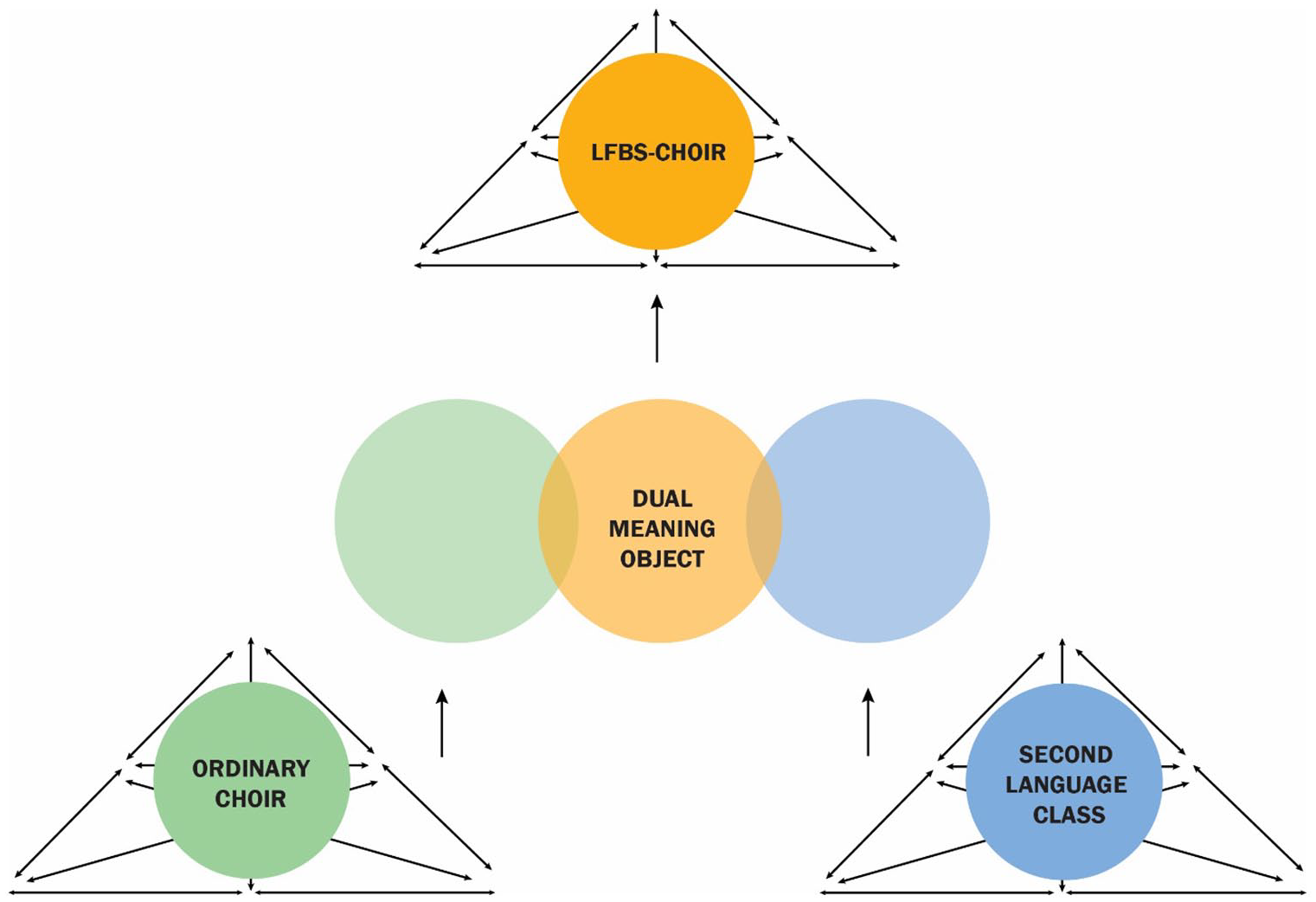
The Dual Meaning Object of Learn-Finnish-by-Singing (LFBS) Activity (see Engeström, 2001, p. 136).
The dual meaning object is not merely the sum of two activity systems (see also Westerlund et al., 2019) but turns the focus toward those processes which allow us to recognize the possibilities and contradictions that are potentially marked by new forms of activity and ways to participate in its practices. To take an extreme example, LFBS activity that draws on diversity and the “mistake-is-a-gift” approach differs from choir activity that strives for homogeneity and avoids mistakes. Likewise, constant negotiation and reflecting on choir participants’ here-and-now situational experiences forms a bedrock for constant constructing and re-constructing of LFBS activity, rather than upholding the conventional role of the choir conductor as an authority for predefined choices of repertoire and rehearsal practice. Importantly, LFBS activity involves active and embodied approaches where attention is given to spoken language instead of written language and a sedentary approach (Teräs, 2012), both more typical of teaching activity in a second language class.
The third phase of analysis: LFBS choir practice as an activity system
The activity of this study represents a new joint activity, which is anchored in the prevailing social structures of music and language education. The aim of the third phase of the analysis is to organize the elements of the activity (see Figure 3) in relation to each other from the perspective of my triple role. As a part of a social network with its interrelationships, my triple role performs as the subject of the LFBS activity system. The object of the activity is to produce a novel social context for adult immigrants to allow active second language use in a natural setting. The term “natural” highlights the authentic situation of language use (Lehtonen, 2015, p. 297) through singing. The mediating artifacts include all musical and linguistic repertoire utilized during the rehearsals, the Powerpoint presentations with pictures and lyrics of the songs projected on the wall during the rehearsals, the accompanying musical instruments, and the technical devices such as a computer, bluetooth speaker, and smart board system that facilitate the activity. In addition, the metaplan functions as an intermediate tool for restructuring not only the choir practice but also its epistemological basis, by positioning LFBS choir practice within thinking that happens “in the middle of things, in a state of in-between-ness” (Jackson & Mazzei, 2017, p. 721). In Engeström’s (1999) terms, the outcome of an activity system consists of “societally important new objectified meanings and relatively lasting patterns of interaction” (p. 31). In the LFBS choir, the outcome extends to enhancing second language learning. The element of community refers to the choir itself as a social entity, including the choir participants, the assisting second language teacher, accompanists, as well as other affiliates participating in LFBS activity occasionally through concert performances and other projects, visiting student-teachers, and the cooperative staff of the public organizations. The rules cover aspects such as translanguaging, which acknowledges the versatile use of linguistic, embodied, multimodal, and spatial resources for communication; diversity as a guiding principle for LFBS choirs, which are characterized by linguistic, cultural, and age-related multiplicity; and open access (i.e., no requirement of earlier experiences in music or Finnish). The division of labor in the system includes the tasks of the choir conductor (conducting, music and language teaching, researching); language teaching by the Finnish as a second language teacher; the collaborative work of the choir conductor and language teachers; the constant negotiation with choir participants; occasional accompaniment; and the work of the administration, such as in advertising, registration, and organizing concerts.
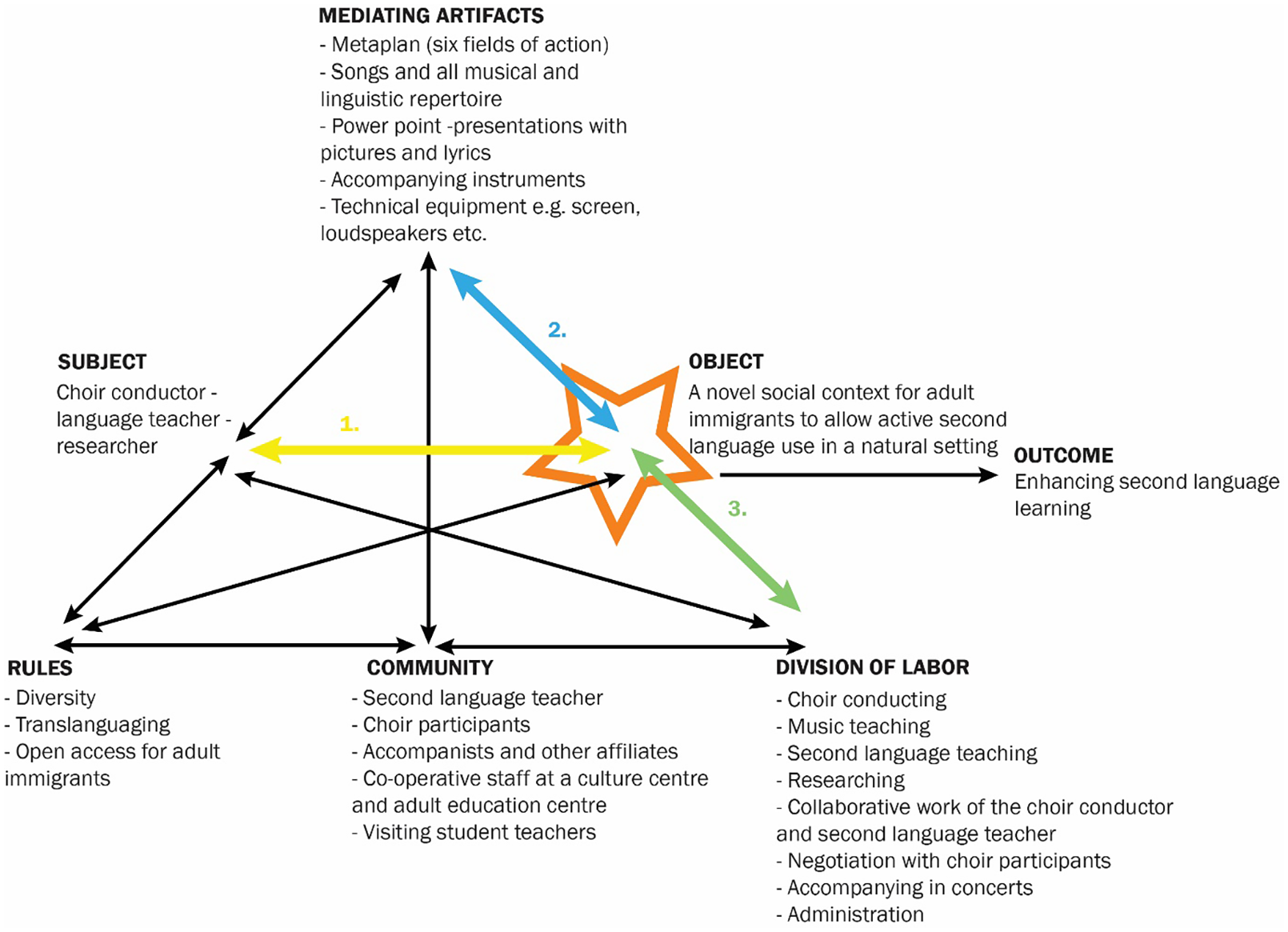
Generating Learn-Finnish-by-Singing (LFBS) Choir Practice as an Activity System (see Engeström, 1999, p. 31).
The activity system highlights that “the internal tensions and contradictions of such a system are the force of change and development” (Engeström & Miettinen, 1999, p. 9). In LFBS activity, these tensions do not refer to problems or conflicts but to “historically accumulating structural tensions” (Engeström, 2001, p. 137); they denote the challenges that LFBS activity faces as a new orientation when intersecting with and transforming accustomed practices, pedagogical approaches, and institutional structures. These tensions are illustrated with bolded arrows in Figure 3. The first relationship between the subject and the object involves the need for the choir conductor to expand their professional thinking and acting toward new insights and novel perspectives when integrating the language orientation meaningfully into musical activities. The second relationship between mediating artifacts and the object refers to the need to engender a new practice that is based on the entanglements of music and language learning and use, and on the constant negotiation with choir participants’ needs and wishes. The third relationship between the division of labor and the object signifies the challenges related to transforming accustomed and different habits of teaching and learning music and language into an integrated LFBS choir practice. This relationship also manifests silos between disciplines (music and language education) at the institutional level, where the required interdisciplinary collaboration lacks structures and resources.
Summary of the analysis
The analysis reflects a hybrid choir practice (a) proposing a “metaplan” with six fields of action as an intermediate tool of boundary crossing between music and language education, (b) as an outcome of interacting activity systems with a dual meaning object, and (c) as a LFBS activity system raising tensions between the elements of the system that strive to expand music educational thinking.
The starting point for the activity theoretical thinking in this study lies in the need for conceptualizing change in musical practice. In LFBS choirs, the need for change lies in the dual meaning object with respect to music and language. In line with the analysis, the dual meaning object is the driving force for the tensions in the activity system, being also a source for the constantly developing pedagogical principles of LFBS choir practice (metaplan). The analysis is synthesized through six reflections (Figure 4) that show how this dual meaning becomes actualized in and through LFBS choir practice. The reflections highlight changes that the language-aware perspective brings with it when transforming a musical practice into a hybrid practice. The six fields of action serve as a resource for these reflections being diversely included within them, as illustrated below.
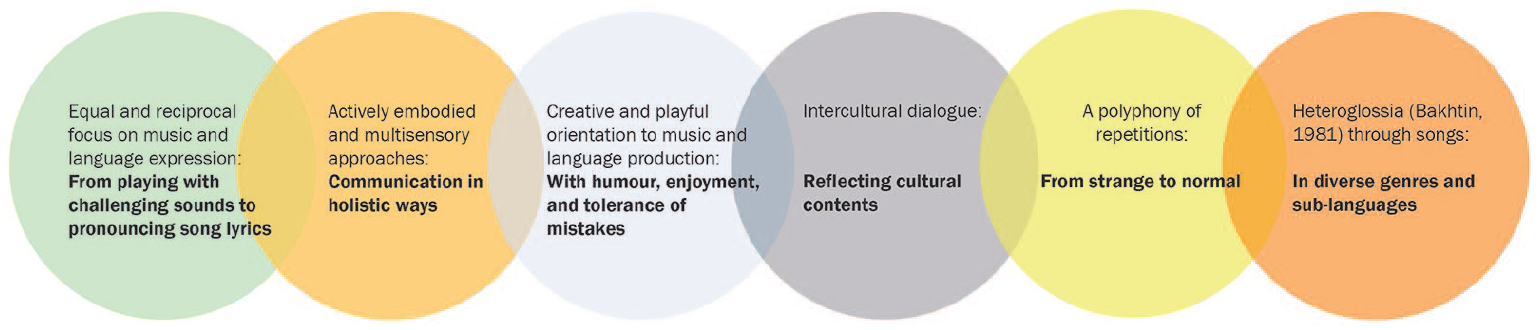
Reflections of Dual Meaning in and through Learn-Finnish-by-Singing (LFBS) Choir Practice.
Equal and reciprocal focus on music and language expression: From playing with challenging sounds to pronouncing song lyrics
LFBS choir practice, as a form of collaborative musical practice, manifests a particular form of social language use where simultaneous hearing, listening, and sensitizing oneself to music, to language, and to others—here called “sensitised hearing”—is constantly fostered. Against this specific framework, the first reflection, Equal and reciprocal focus on music and language expression, highlights articulation as an equal aspect with music in singing. This emphasis on articulation, which is usually subordinated to music in an ordinary choir, is comparable to phonetic awareness (e.g., Bolduc, 2009; Gaboury & Lessard, 2020) and pronunciation in LFBS choirs. Following the notion that practising pronunciation “should start with spoken language, not the written form” (Virkkunen & Toivola, 2020, p. 38), the phonetical orientation in LFBS choirs begins with “playing with spoken sounds.” In the Warm-ups, even the smallest units of language, such as single phonemes and challenging phoneme combinations like vowels, diphthongs (two different vowels in one syllable), and double consonants (typical in the Finnish language), are embedded in musical activity such as vocalization and breathing exercises. For instance, in “The most difficult word of the week” warm-up, choir participants suggest challenging words they have encountered. Starting with the difficult sounds of the word using the Call-and-Response approach, then rhythmically “playing” with them and exaggerating mouth and lip movements, the exercise stretches toward longer units until the whole word is sung or rapped with a simple repeating ostinato (a short repeating musical idea). Examples of such typically difficult words are: äiti (mother) [æiti], löyly (heat in a sauna) [løyly], or hyvää yötä (good night) [hyvæ: yøtæ].
The phonetical orientation is extended when focusing on the articulation of song lyrics. This involves approaching pronunciation in longer phonetic structures such as sentences, phrases, and verses that are embedded in the melody and phrasing of the music. In addition, attention to pronunciation while singing allows LFBS choir participants to implement word stress (always on the first syllabus in Finnish), the perception of long words, and words with endings that are typical to Finnish, without prepositions (Aho et al., 2016). Along with “sensitized hearing,” the articulation is facilitated in diverse ways, for example, with the help of rhythmics, embodiment, and emotional expression.
Actively embodied and multisensory approaches: Communication in holistic ways
In LFBS choirs, embodied actions such as mimicry, gestures, and movements, as well as the use of multiple senses, are constantly integrated into the communication and musical and linguistic activity. Hence, actively embodied and multisensory approaches manifest the second reflection, embracing embodied learning “as a systemic and holistic process that takes place within the entire human being and between human beings, and in connection with the social and physical reality” (Anttila, 2018, p. 3). The human body is thus understood as a holistic instrument for music and language production. For instance, musical expression and the meaning of lyrics are facilitated and coupled with embodied expressions. Likewise, rhythmic challenges in music and language production are constantly reciprocally facilitated through bodily engagement such as body percussion and putting “groove in the body” to emphasize the rhythm and intonation of spoken words being linked with syncopated rhythm in music, as is typical, for instance, in Finnish pop songs.
Embodied orientation also engages the active use of learning space. For example, “Follow-and-Interrupt” collaborative improvisation draws on moving freely around the space and communicating with bodily, vocal and spatial initiatives made by someone and then followed by the others. That is, the use of diverse modes and ways of communication—or holistic communication—is encouraged, highlighting that the point is “not merely that language serves communicative purposes but rather that language is part of a much broader set of semiotic possibilities” (Pennycook, 2016, p. 455).
The multisensory approach manifests the active use of various senses throughout LFBS choir practice. For instance, all music is learned without notation, emphasizing the active use of Call-and-Response and repetition. Visual facilitation is supported by projecting pictures and lyrics of the songs on the wall while singing, enabling the combination of pictures and written words with audible utterance (e.g., Gaboury & Lessard, 2020). Aligning with Toohey’s (2019) description, where language “may be understood as a song, but deaf communication research reminds us that it is also more or less dance” (p. 944), the visual facilitation also manifests showing-in-front approaches that allow choir participants to see and imitate the production of music and language through embodied actions made by the choir conductor and the second language teacher. Imitation denotes creative and interactive negotiation instead of mere copying. Sense of touch refers to the intentional sensing and feeling of how music and language, such as different pitches and vowel sounds, resonate in the body. Bodily sensing is also connected to how emotional states are emphasized as a natural part of musical and embodied expression throughout LFBS choir activity.
Creative and playful orientation: With humor, enjoyment, and tolerance of mistakes
The third reflection encompasses the intertwining of music and language through creative and playful orientation as a general mindset in LFBS choir activity. It stems from the “mistake-is-a-gift” perspective. A creative and playful orientation, where humor and enjoyment are related to music and language production, acknowledges learning as a process where “actions do not need to be intentional in order to evoke learning processes” (Van Oers, 2009, p. 6; see also Reber, 1993). For instance, in Funny language songs, traditionally “serious” language content is turned “upside down” with gripping melodies that follow the humorous lyrics in various genres, indicating that language learning through singing can be accomplished in alternative (holistic) ways, in contrast to the conventional “cognitivist view” (Atkinson, 2010). These language songs are made in interprofessional collaboration with the choir conductor (music) and the second language teacher (lyrics) and act as mediating tools for memorizing and recalling essential challenges such as the grammatical rules and phonetic peculiarities of Finnish. Each song conveys a specific character of music and language.
For the most part, the creative and mistake-tolerant mindset is emphasized by encouraging choir participants to create and recreate new lyrics to familiar melodies and collaborative improvisations, to support language production, a feeling of language ownership (Lehtonen, 2015; Ruuska, 2020), and the expression of one’s own thoughts. In this case, the melodic and rhythmic structure of a song generates a motivating base for the active language use. The lyrics are created in small groups and written down so that they can also be seen in visual forms. Individual spoken utterances are created in whole verses, or by just replacing some words. New lyrics are generated for all kinds of songs, but for the most part for folk tunes where the lyrics include difficult dialects and old-fashioned Finnish that are simultaneously translated to a more usable form.
Intercultural dialogue: Reflecting cultural contents
The Intercultural dialogue that emerges in various ways and situations during the choir rehearsals generates the fourth reflection, addressing both musical and linguistic aspects. That is, cultural content and meanings associated with the musical and linguistic repertoire are constantly discussed and co-reflected based on the choir participants’ linguistically and culturally diverse backgrounds and previous and current experiences in living and learning (second language Finnish) in Finland. The creation and re-creation of song lyrics highlights the expression of one’s own thoughts. Singing the songs that were brought and then translated into Finnish by choir participants themselves opens up a dialogue between their native languages and Finnish, diverse music cultures, and the ways in which different languages influence the musical features in songs. In this sense, the activities forge what Marsh (2012) describes as “new connections within the host culture while maintaining links with the home culture” (p. 108). Importantly, critical reflection reveals cultural assumptions in Finnish songs that, through discussions and co-constructions, can enhance cultural understanding (e.g., Ilari et al., 2013).
A polyphony of repetitions: From strange to normal
A natural way to become immersed in a piece of music, like a song, is through repetition. In LFBS choirs, the importance of musical repetition is emphasized by approaching the music without notation. However, musical repetition has multiple other meanings aside from merely facilitating the memorization of a song. Immersing individuals in a song in LFBS choirs manifests how both music and second language are mutually transformed from strange to normal. A polyphony of repetitions (the fifth reflection) highlights this process, which reciprocally supports both musical and linguistic expression and the choir participants’ different needs and wishes.
While the repetition of songs helps with becoming familiar with challenges in music from multiple perspectives related to musical elements, it also mutually facilitates familiarity with difficult sounds and other aspects of pronunciation, providing mnemonic material for new vocabulary, “ready-made” sentences (e.g., Gaboury & Lessard, 2020; McCormack & Klopper, 2015), and grammar rules (Busse et al., 2021). Repetition also demonstrates the joy of singing songs already learned, as seen in the request raised by choir participants to repeat “old” songs and to finish every rehearsal with a “favourite” song. That is, repetition carried out from diverse perspectives nurtures not only aspects of learning but also well-being and communality. At the same time, it also allows choir members to become familiar with more challenging musical material in different musical genres, not only focusing on “songs with very simple melodies, as lyrics paired with complex or unfamiliar melodies are less likely to be remembered” (Busse et al., 2021, p. 9; see also Tamminen et al., 2017), as is often suggested in research that focuses on short-term interventions in language classrooms. The music educational environment enables the use of a wide range of songs, from children’s songs to canons, circle songs, folk tunes, pop songs, rap, and songs brought or wished for by the choir participants, as well as language songs made by the choir conductor and second language teacher. Songs are also improvised and sometimes collaboratively composed. Importantly, the choices of repertoire are constantly discussed and reflected upon in relation to choir participants’ experiences and wishes. Accordingly, musical (e.g., rhythmic and melodic) and linguistic (e.g., articulative) challenges are reciprocally facilitated to support each other and to manifest the close intertwining of music and language in songs. Linguistically and ethically appropriate songs are also arranged to best reflect the situated and local circumstances, so that they can be sung in unison or with up to four voices (female and male), but always with accompanying lyrics and pictures rather than sheet music.
Heteroglossia (Bakhtin, 1981) through songs: In different genres and sublanguages
By singing Finnish songs in different genres, different sublanguages such as the spoken language in pop songs, dialects and old Finnish in traditional music, or the plain language in children’s songs can be focused upon. The sixth reflection, Heteroglossia (Bakhtin, 1981), manifests the intertwining of musical genres and sublanguages in the Finnish songs. Heteroglossia involves the stratification of language into sublanguages or “social languages” (Bakhtin, 1981, p. 356), in contrast to “unitary language as an abstract entity often presupposed in linguistics” (Moro, 1999, p. 170). Unitary language refers to the written Finnish language being focused on in second language classes. However, it is not spoken as such (e.g., Lehtonen, 2015), so the emphasis in LFBS choirs is on the use of spoken language. Furthermore, singing songs in different genres enables one to encounter language more broadly. This allows familiarization with the specific features of sublanguages, their relationships and differences (such as those between spoken and written language), as well as their correspondent use in music. For instance, the lyrics of traditional music often include sounds, syllables, and particle-like words without meaning, serving as approachable ways to focus on phonemic peculiarities of dialects in relation to the specific rhythmic and melodic characteristics of a folk tune.
Discussion
By exploring a new choir practice within the theorization of activity systems (Engeström, 1987, 1999, 2001) and boundary crossing (Star, 2010; Star & Griesemer, 1989), this study has strived to dismantle the still-prevalent dichotomous view of the musical versus non-musical ends of music and music education. Advocating for the purely musical (intrinsic) value of music and music education easily avoids addressing other values that call for recognizing the emerging, nonmusical aspects and needs of a society. In this way, an emphasis on the assumed intrinsic value of music tends to uphold the status quo of existing musical practices, aiming at purely musical ends. This makes difficult, and even inhibits, the emergence of novel practices. Abandoning this dichotomous view allows looking beyond purely musical or instrumental values and taking a more holistic approach (see Westerlund, 2005, 2008) that recognizes “the good of the whole” (Meadows, 2009, p. 184), not just one’s own or one’s discipline’s good.
Contextualizing the previously unrecognized dual meaning of LFBS choir practice, this theoretical analysis has also aspired to reach beyond the existing norms and dominant notions of music educational practice. Moreover, the study contributes to wider interdisciplinary discussion on the relationship between music and language learning by addressing the relationship between musical activity and embodied language learning, which has not been recognized in earlier studies on this topic (Jusslin et al., 2022).
The LFBS activity system highlights that the dual purpose of LFBS choir activity generates a need to expand music educational thinking at three levels. First, at the practical level, the dual meaning conveys a tension in relation to expanding the tools underpinning LFBS activity that cannot continue to draw on the existing norms and principles of either choir or language teaching. That is, the developmental LFBS choir practice reflects changes in the local working environments (e.g., Engeström, 2005), in the needs of the students, and more broadly in society due to increasing immigration, rather than some abstract practice of music making with norms and principles related to the musical repertoire alone (cf. Elliott, 1995). Second, at the professional level, LFBS choir activity shows a need for expanding the responsibilities and tasks of the choir conductor. Through the language-aware perspective, the choir conductor becomes a resourceful practitioner (Edwards, 2010) through whom the interprofessional and interdisciplinary collaboration with second language teachers, as well as the constant intercultural negotiation with the choir participants, creates new resources. Third, at the disciplinary level, the dual meaning of LFBS choir practice emphasizes an equal and reciprocal approach to both music and language and reveals a tension that originates in the siloed thinking in and between the disciplines. Therefore, through LFBS choir practice the hierarchies and boundaries between music and other disciplines are blurred.
The dual meaning of LFBS choir practice does not merely combine activities of an ordinary choir and a second language class, as the underlying principles (six fields of action) and their implementations (reflections) indicate. Instead, the dual meaning emphasizes holistic experience that can be approached from both musical and linguistic perspectives, conveying the hybridity of LFBS choir practice. Altogether, the dual meaning object conceptualizes LFBS activity as a kind of metamorphosis of musical activity, where active second language use can be performed in enjoyable, uplifting, and agentic ways. In that sense, the dual meaning of LFBS choir displays a potential to transform the collaborative musical activity “into a resource for performing citizenship” (Peters, 2016, p. 478) that creates successful experiences and “‘happiness’ through acts that are constitutive in this way” (p. 477) for the choir participants.
In line with the theoretical analysis, any hybrid musical practice can comprise potential for widening music education toward novel insights, out-of-the-box perspectives, and new opportunities. In terms of LFBS choir practice, however, this requires contesting conventional dichotomies such as music’s instrumentalization, blurring and crossing boundaries between disciplines and professions, as well as transforming the accustomed habits of musical practice and expanding professional boundaries (cf. Westerlund & Gaunt, 2021). However, as the case of LFBS choir shows, this kind of expanding practice is necessary when “old practices fail to connect with current purposes and intentions” (Edwards, 2010, p. 13). Such change, like the language-aware perspective in LFBS choir practice, reflects changes that originate from outside of established professional practice, that is, from environments both near (teaching and learning environments) and far (societal and global situations). Consequently, more research is needed on hybrid musical practices and students’ experiences of such practices. Moreover, the potential of musical activity for embodied language learning should be explored from diverse perspectives due to its invisibility in the fields of both music and language education.
Conclusion
To conclude, this study has provided a theorization of a dynamic and dialogical choir practice that has its origin in the needs and wishes of adult immigrants and second language teachers in an increasingly intercultural society. The analysis of LFBS choir practice in Finland exemplifies and justifies change in music educational thinking that reflects the changes in the surrounding society and the consequential need to reach beyond the existing norms and principles of commonly known music education practices, including the theorisation of such practices. The illustrated dual meaning of the hybrid LFBS choir practice reveals the potential for consciously expanding professional boundaries, and hence blurring the dichotomous thinking of music and music education. As Dewey (MW 9, p. 254) notes, we cannot separate different interests or disciplines since in our experience different aspects such as musical and non-musical are integrated holistically, generating various meanings. The hybrid nature of LFBS choir practice underlines the holistic nature of experience. In this way, it also highlights a non-hierarchical approach toward music and language education. The study further suggests that a hybrid musical practice, and an analysis thereof, can significantly broaden professional understanding through novel insights, out-of-the-box perspectives, and new opportunities. Finally, although the choir participants’ motives to join the LFBS choir may have been linguistic, the targeted, holistic, here-and-now meaning and individual and collective experience in LFBS choir practice aspires to such intercultural meaningfulness that enables performing citizenship (Peters, 2016) in ways that exceed purely musical or linguistic goals.
Footnotes
Appendix 1
Metaplan for the Learn-Finnish-by-Singing Practice.
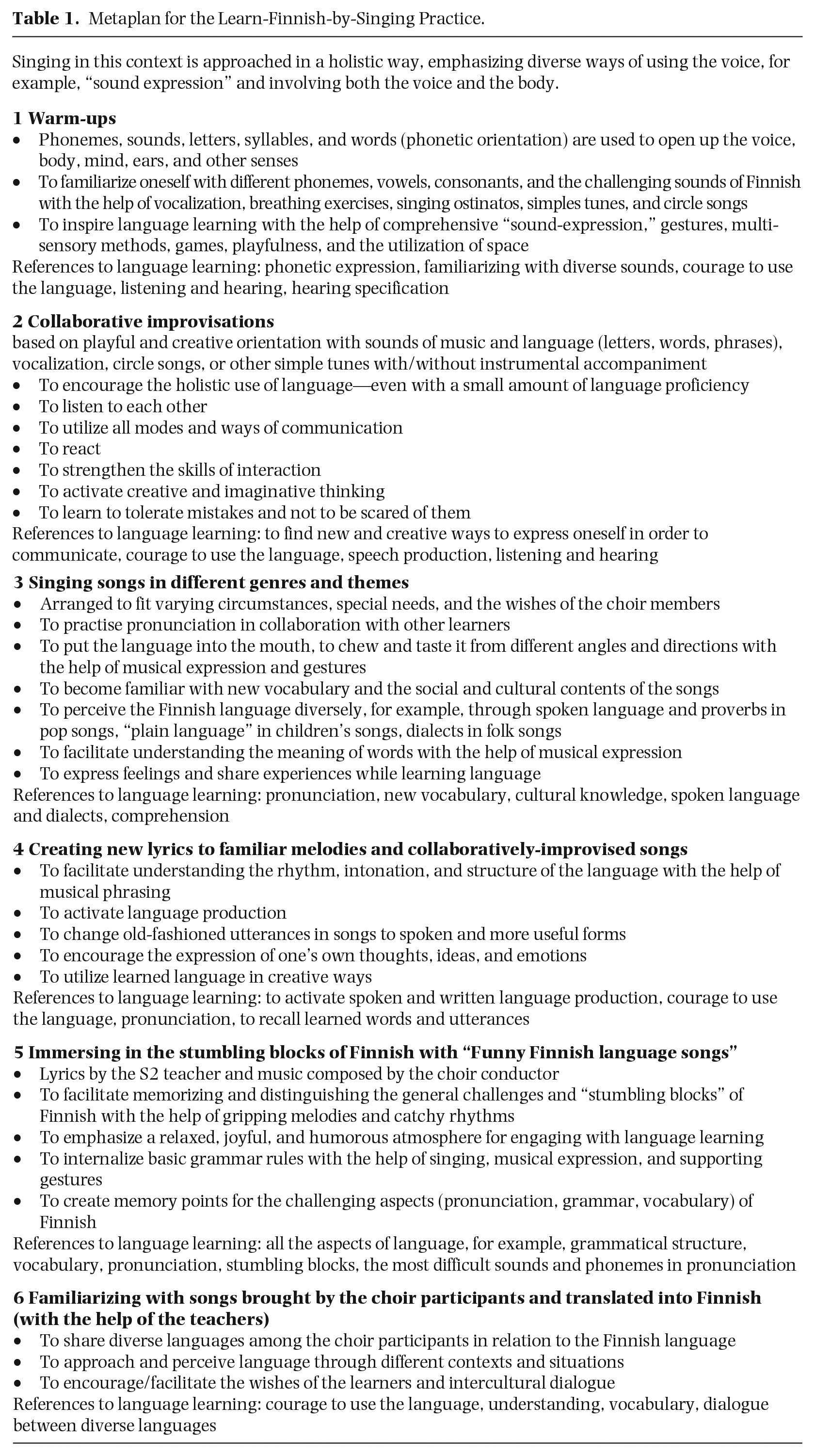
| Singing in this context is approached in a holistic way, emphasizing diverse ways of using the voice, for example, “sound expression” and involving both the voice and the body. |
• Phonemes, sounds, letters, syllables, and words (phonetic orientation) are used to open up the voice, body, mind, ears, and other senses • To familiarize oneself with different phonemes, vowels, consonants, and the challenging sounds of Finnish with the help of vocalization, breathing exercises, singing ostinatos, simples tunes, and circle songs • To inspire language learning with the help of comprehensive “sound-expression,” gestures, multi-sensory methods, games, playfulness, and the utilization of space References to language learning: phonetic expression, familiarizing with diverse sounds, courage to use the language, listening and hearing, hearing specification |
based on playful and creative orientation with sounds of music and language (letters, words, phrases), vocalization, circle songs, or other simple tunes with/without instrumental accompaniment • To encourage the holistic use of language—even with a small amount of language proficiency • To listen to each other • To utilize all modes and ways of communication • To react • To strengthen the skills of interaction • To activate creative and imaginative thinking • To learn to tolerate mistakes and not to be scared of them References to language learning: to find new and creative ways to express oneself in order to communicate, courage to use the language, speech production, listening and hearing |
• Arranged to fit varying circumstances, special needs, and the wishes of the choir members • To practise pronunciation in collaboration with other learners • To put the language into the mouth, to chew and taste it from different angles and directions with the help of musical expression and gestures • To become familiar with new vocabulary and the social and cultural contents of the songs • To perceive the Finnish language diversely, for example, through spoken language and proverbs in pop songs, “plain language” in children’s songs, dialects in folk songs • To facilitate understanding the meaning of words with the help of musical expression • To express feelings and share experiences while learning language References to language learning: pronunciation, new vocabulary, cultural knowledge, spoken language and dialects, comprehension |
• To facilitate understanding the rhythm, intonation, and structure of the language with the help of musical phrasing • To activate language production • To change old-fashioned utterances in songs to spoken and more useful forms • To encourage the expression of one’s own thoughts, ideas, and emotions • To utilize learned language in creative ways References to language learning: to activate spoken and written language production, courage to use the language, pronunciation, to recall learned words and utterances |
• Lyrics by the S2 teacher and music composed by the choir conductor • To facilitate memorizing and distinguishing the general challenges and “stumbling blocks” of Finnish with the help of gripping melodies and catchy rhythms • To emphasize a relaxed, joyful, and humorous atmosphere for engaging with language learning • To internalize basic grammar rules with the help of singing, musical expression, and supporting gestures • To create memory points for the challenging aspects (pronunciation, grammar, vocabulary) of Finnish References to language learning: all the aspects of language, for example, grammatical structure, vocabulary, pronunciation, stumbling blocks, the most difficult sounds and phonemes in pronunciation |
• To share diverse languages among the choir participants in relation to the Finnish language • To approach and perceive language through different contexts and situations • To encourage/facilitate the wishes of the learners and intercultural dialogue References to language learning: courage to use the language, understanding, vocabulary, dialogue between diverse languages |
Acknowledgements
I am deeply grateful to Professor Ritva Engeström who contributed to the activity theoretical thinking of this article. Moreover, I owe my deepest gratitude to Professor Heidi Westerlund and Dr. Sari Levänen for their constructive and inspiring comments during the whole process of writing this article.
Ethical approval
The construction and handling of unpublished data for this research adhered to the Ethical Instructions of the University of the Arts (UNIARTS 2015), the code of ethics of the European Commission (EC 2010), and the Responsible Conduct of Research (RCR) guidelines of the Finnish Advisory Board on Research Integrity (TENK 2012). The study has received the approved statement regarding the ethicality of the research from the University of the Arts Helsinki Ethics Committee, and research permissions from the related organizations according to their research integrity guidelines. In addition, DPIA (Data Processing Impact Assessment) has been processed and approved by the Data Protection Officer at the University of the Arts Helsinki. The participants have provided their written informed consent to participate in this study.
Declaration of conflicting interests
The author(s) declared no potential conflicts of interest with respect to the research, authorship, and/or publication of this article.
Funding
The author has received financial support for the research, authorship, and/or publication of this Article from Mutri doctoral school of Sibelius Academy, University of the Arts Helsinki, where she has been employed as a research associate.
