




Abstract
This article highlights the nature of the emerging field of ecoliteracy in music education and contributes to expanding the conversation in this area. A recent model of musical ecoliteracy is presented, that integrates ecomusicological and ecosocial research traditions. This model of musical ecoliteracy is applied to analyse empirical data that maps the prevalence of ecological awareness and ecoliteracy across 18 internationally esteemed and high-quality scholarly music education journals over a period of 6 years (2019–2024). Results show that only 0.4% of 2,266 articles were related to ecological awareness or ecoliteracy. The eight articles that were identified as relating to the subject were further analyzed thematically, bottom-up and top-down, using the model of musical ecoliteracy as a guiding analytical lens. The results present the theoretical frameworks employed and the pedagogical implications suggested in these studies. This paper argues that this model of musical ecoliteracy is a useful framework, offering both theoretical insights and practical guidance for designing ecologically literate music education.
Keywords
Introduction
In the face of an accelerating ecological crisis, it is increasingly acknowledged that humanity has pursued development at the expense of nature to such an extent that it now threatens the well-being and survival of the whole planet (Steffen et al., 2015). In 2015, United Nations Member States adopted the 2030 Agenda to guide the promotion of sustainable development in 2016–2030 (United Nations, 2015). The agenda includes several ecological goals, such as Sustainable Development Goal 12—related to responsible consumption and production—and Sustainable Development Goal 13, which emphasizes climate action and education about climate awareness. Promoting ecological awareness has therefore become a pressing educational imperative.
Direct experiences in nature during childhood have been shown to foster lifelong environmental concern (Chawla, 2020). However, young people’s relationships with nature are becoming polarized (Hakoköngäs & Puhakka, 2023; Puhakka, 2014), as many adolescents spend most of their lives indoors (Chawla, 2020; Eames et al., 2018). Even in forest-rich Finland, approximately 7% of adolescents—especially in urban areas—may lack any connection to nature (Puhakka, 2014). In contrast, adolescents in rural or Indigenous communities often maintain stronger ties with the natural world (Bang et al., 2015; Bates, 2011; McDonald et al., 2018). For those who do maintain connections with nature, adolescents report associations with adventure, restoration, aesthetic enjoyment, and memorable experiences (Puhakka, 2014; Schwab et al., 2020; Sjöblom, 2012). Tranquility, silence, and natural beauty are especially meaningful (Hakoköngäs & Puhakka, 2023), and deeply immersive experiences in wilderness areas are often the most memorable (Tseng & Wang, 2020). At the same time, young people also report eco-anxiety and grief related to biodiversity loss (Chawla, 2020).
Research suggests that music can support adolescents’ processes of individual and social transformation, as it moves people emotionally, supports affective regulation, enhances well-being, fosters resilience in times of crisis, and plays an important role in adolescents’ identity development (Juslin, 2019; Kim, 2018; Myers-Coffman et al., 2019; Paananen, 2022; Saarikallio & Erkkilä, 2007). When combined with nature, musical activities such as songwriting may further strengthen young people’s connection to the environment (Arbuthnott & Sutter, 2019), suggesting that music education has the potential to serve as a powerful medium for expressing and cultivating ecological awareness.
Ecomusicology, an interdisciplinary field, has offered compelling insights into how music can promote ecoliteracy (Allen, 2017; Shevock, 2018; Titon, 2021; Torvinen, 2012; Torvinen & Välimäki, 2019). Nevertheless, the literature suggests that many music educators remain unaware of ecological sustainability, often prioritizing social sustainability instead (Kang, 2019; Uitto & Saloranta, 2017). While discussions on social sustainability and professional responsibility in arts education are ongoing (Barrett & Westerlund, 2023), ecoliteracy remains a marginal area of inquiry within the field of music education research. The present study focuses on ecoliteracy grounded primarily in ecological sustainability perspectives rather than anthropocentric social sustainability frameworks. This article contributes to expanding this field by presenting a recent theoretical model of musical ecoliteracy (Paananen, 2023) that synthesizes ecosocial and ecomusicological theories. While ecosocial thinking provides a broader educational framework for understanding sustainability in education, and ecomusicology offers music-specific theoretical perspectives on human–sound–nature relations, ecoliteracy in this study refers to the pedagogical competence framework that integrates these perspectives into music education practice. This theoretical framework is then applied to empirical research that is reported here in two parts: First, the presence of ecological awareness and ecoliteracy in recent scholarly music education discourse is mapped. Second, different perspectives on ecoliteracy in selected articles are analyzed from the bottom-up and the top down, using the model (Paananen, 2023) as a guiding analytical lens. The study aims to answer the following questions:
What is the frequency and percentage of ecoliteracy-related articles in international scholarly music education journals during a period of 6 years (2019–2024)?
How is ecoliteracy defined, theorized, and pedagogically operationalized in current ecologically oriented music education research articles, and how do the findings relate to the present model of musical ecoliteracy?
Theoretical Background: Ecosocial and Ecomusicological Foundations of Musical Ecoliteracy
Ecosocial Theories and Sustainability
The dominant anthropocentric worldview posits that humans are above all other forms of life, and that nature is primarily a resource for human use. In contrast, ecosocial thinking, which has its roots in environmentalism and systems theory research, emerged as a critique of unsustainable consumption, which is seen as a characteristic of a distorted relationship with nature and the root cause of the environmental crisis (Capra, 2015; Devall & Sessions, 1985; Naess, 1973; Salonen, 2010, 2014; Salonen & Bardy, 2015). This trajectory is closely linked to industrialization, urbanization, modernization, and a competitive economy (Lähde, 2010; Salonen, 2010; see also Schafer, 1977/1994 and Shevock, 2015). In contrast, Indigenous territories hold up to 80% of Earth’s biodiversity: In these areas, forests are better preserved, and production systems exert less pressure on ecosystems (FAO and Alliance of Biodiversity International and CIAT, 2021). The ecocentric worldview posits that all organisms possess an equal right to exist, and humans have an ethical responsibility to protect ecosystems, including both their living and non-living components (Capra, 1996; Naess, 1973; Salonen, 2010). Rather than prioritizing material wealth, ecosystems should be preserved and regenerated in ways that serve both current and future generations, thereby securing critical Earth-system processes (Steffen et al., 2015).
Sustainability, in this context, is multidimensional and comprises ecological, economic, social, and cultural dimensions (Capra, 2015; Salonen, 2010; Wolff, 2004). Ecological sustainability ensures the resilience and diversity of ecosystems, while economic sustainability involves the responsible use of resources and consideration for labor rights. Social sustainability promotes equity and well-being, while cultural sustainability supports diversity, identity, heritage, and dialogue. It can also be understood as an overarching concept integrating ecological, economic, and social dimensions (Salonen, 2010, p. 33). Central to the ecosocial approach is systems thinking: the ability to recognize the interdependencies between ecological, social, and economic systems (Salonen & Bardy, 2015). This perspective asserts that social life, economic activity, or cultural development cannot be sustained without ecological sustainability.
According to Värri (2018), ecosocial educational philosophy is based on the idea that self-expression and understanding and recognition received from others create a more lasting experience of life’s meaning than the pleasure derived from consumption (see also Devall & Sessions, 1985). A person’s identity develops through recognition from other people. Only an individual who values their own existence can also appreciate others and feel responsible for the state of the world. Responsibility for another living being requires a return to moderation. When a child feels significant, they can also learn to respect other people, animals, and nature. A crucial aspect of considering others is empathy, which enables a heightened sensitivity to one’s relationship with nature. Värri (2018) further develops a view of the human–nature relationship informed by Merleau-Ponty’s (1968) existential-phenomenological philosophy. Through embodied perception and compassion, humans can experience the vulnerability of other embodied beings and act ethically. Nature is inseparable from their existence, and human subjectivity is intertwined with nature. Since human thought arises from nature, which is the pre-objective condition for thinking, humans cannot grasp nature as such; their relationship with the world is originally asubjective (Värri, 2018, pp. 6–9). In this way, Merleau-Ponty dismantles the dualistic relationship between humans and nature. While distinct from Indigenous worldviews (see Titon, 2021), this ecocentric stance shares similar ethical implications. To revive humans’ connection to nature, the values that guide our lives and education must change. Vadén (2016) goes even further, arguing that modernization entails the forgetting of ancestral knowledge, whereas re-indigenization or bioregionalism represents its recovery.
Ecomusicology
Solving the problems associated with the environmental crisis requires a multidisciplinary approach between various sciences, arts, and humanities (Emmett & Nye, 2017). While the ecosocial approach focuses on promoting sustainability at a more general level, ecomusicology specifically examines how music can foster ecological awareness through its aesthetic, cultural, and communicative dimensions (Torvinen & Välimäki, 2019). Ecomusicology complements the natural sciences by offering emotional and cultural interpretations of ecological phenomena and focusing on how sonic cultures reflect and construct our relationship with nature. Placing the environment at the center of inquiry, ecomusicology challenges the assumptions of technological progressivism and anthropocentric social constructivism (Torvinen, 2012). Allen (2011, 2013, 2017) defines ecomusicology as the intersection of music, culture, and nature, while Titon (2013) expands this definition to include the study of music, culture, sound, and nature in a period of environmental crisis. Torvinen (2012) highlights the activist orientation of ecocritical musicology, and according to Torvinen and Välimäki (2019), music can support ecologically sustainable cultures thematically by representing nature, addressing ecological concerns via eco-composing and eco-listening practices, and performatively through eco-musical projects that engage communities.
Drawing from soundscape studies, cultural musicology, ethnomusicology, and zoomusicology, ecomusicology expands the boundaries of music beyond human agency. While Blacking (1973) defines music as humanly organized sound, Shevock (2018) proposes a broader definition: the intentional experiencing of sound. Zoomusicologists have demonstrated that animals such as birds, primates, and whales engage in rhythmic entrainment and/or socioemotional vocalizations and transformations (Dufour et al., 2017; Geissmann, 2000; Lameira et al., 2019; Patel et al., 2009; Titon, 2021), supporting the evolutionary musicological view of music as an ancient interspecies communication system (Cross, 2016; Mithen, 2005; Snowdon et al., 2015). Ecocritical musicology thus challenges narrow definitions of music and reinforces the importance of musical ecoliteracy.
While environmental aesthetics examine environments such as urban forests from both ecological and aesthetic perspectives (Hauru, 2015), our everyday soundscapes can also contribute to ecological awareness. In contrast with traditional definitions of art, which often exclude the aesthetic experience of nature from the category of art because it lacks human intent, avantgarde composers (Cage, 1981, 2004; Oliveros, 2005; Schafer, 1977/1994) have redefined musical authorship and emphasized the ecological implications of soundscapes. For example, John Cage (1981) argues for unbiased listening to sounds: We must consider the ecology even more than the individual. It is not simply by observing the individuals, but by reintegrating individuals into nature, by opening the world to the individual, that we will get ourselves out of this mess (p. 56).
Raymond Murray Schafer (1977/1994) identifies the soundscape as a mirror of societal conditions, contrasting the quiet of pre-industrial societies with the pervasive noise of industrialized life. To Schafer (1977/1994), listeners are composers of their acoustic environment and should therefore take responsibility for it: The soundscape is not a random by-product of societal activity; rather, it is a deliberate construction of its creators, a composition that stands out as much for its beauty as for its ugliness (p. 237).
Natural sound experiences may evoke awareness of temporality, vulnerability, and interdependence. Our experience of time and our future orientation are influenced by the awareness of transience and the uncertainty of the planet’s future. In a deep connectional experience of nature, when ego is relinquished, nature resonates within the self and the perceived boundary between human and nature dissolves (see Naess, 1973; Oliveros, 2005). This realization can be transformative, and this unique moment can also be seen as part of a continuum, from the conditions before the aesthetic experience to the initial idea for an improvisation or composition. The composition process, in turn, extends into a longer continuum of composing tied to dialogue, activity, and participation with nature and music cultures. Where the process begins and ends cannot be precisely defined. Musical works are, in a sense, culminations in a holistic and networked “musical ecosystem” known as music. This idea aligns with Deleuze and Guattari’s (1996) fundamental notion that reality is shaped by processes of becoming that unfold and differentiate themselves over time.
The Model of Musical Ecoliteracy
The concept of ecoliteracy evolved from environmental and ecological literacy concepts originating in the natural sciences and expanding into the humanities. Capra (1996) defines ecoliteracy as the ability to understand the principles of ecosystem organization and to apply these principles in the formation of sustainable communities and societies, ensuring that natural resources are sufficient for future generations. The concept of ecoliteracy not only emphasizes the principles of sustainable development but also includes connectional and holistic components (McBride et al., 2013). According to Capra, (1996, 2007) ecoliteracy requires four areas of competence:
Cognitive competence: critical thinking, ethical evaluation, and long-term foresight;
Emotional competence: empathy, care, justice, and respect for diverse perspectives;
Active competence: decision-making and responsible community engagement; and
Connectional competence: deep aesthetic and affective connection with nature and place.
Wooltorton’s (2006) framework of ecoliteracy also includes participation in local culture, history, and community alongside the ecosystem. Education for sustainable development is experiential, participatory, interdisciplinary, and central from as early an age as possible (McBride et al., 2013). In music education, Shevock (2015) identifies four key practices for ecological awareness: connecting local places, experiencing music and nature in connected meaningful and ethical ways, developing ecological consciousness by ritualizing and creating music rooted in soil, and connecting to the planet more broadly by linking local understandings to global ecological crises.
Figure 1 presents the model of musical ecoliteracy (Paananen, 2023), which is based on the integration of ecosocial and ecomusicological theories. At the model’s core is embodied nature connection and ecological awareness. Humans are part of nature through their embodiment, and all higher-level human functions are fundamentally embodied. Thus, embodiment is the basis of both human existence and ecological awareness, upon which the cognitive, emotional, connectional, creative, and sociocultural competencies of musical ecoliteracy are built. The five competencies are not separate but interconnected, overlapping, and mutually reinforcing through embodiment. For example, a sound walk might foster:
Cognitive competence through critical, exploratory, attentive, and analytical listening;
Emotional competence through empathy, care, and nature-/environment-related emotions;
Connectional competence through aesthetic or spiritual responses;
Creative competence through seeking inspiration and ideas for eco-composing; and
Sociocultural competence through collective sound environmental and ecomusical initiatives.
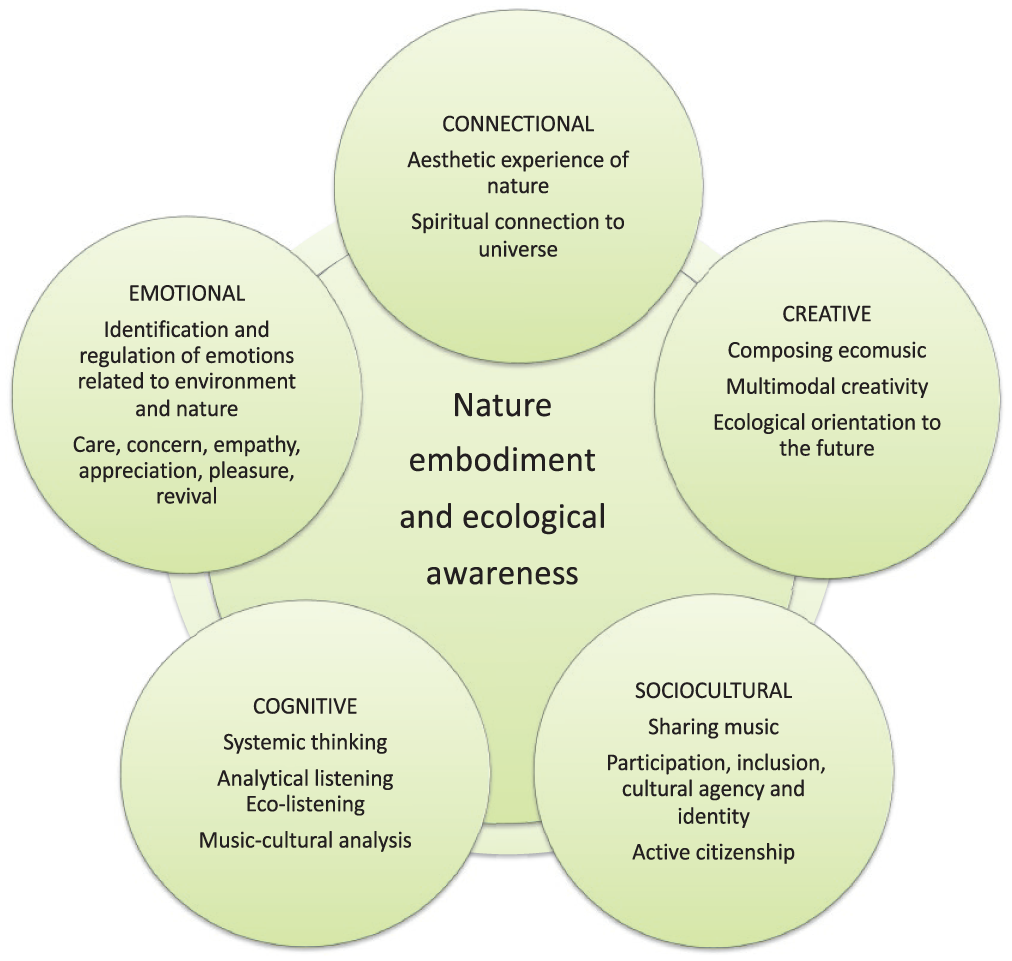
Paananen’s (2023) Model of Musical Ecoliteracy.
Cognitive Competence
Cognitive competence encompasses critical and systems thinking, analytical listening, recording of sounds, eco-listening, and the sociocultural analysis of music (Paananen, 2023). A multidisciplinary systemic approach can be developed by examining the local and global impacts of musical activities. Sustainability can be examined by considering the origin of instruments and music technologies, the materials used, their durability, repairability, recyclability, the ecological use of materials, the economic benefits of their production, and the ethical problems generative AI poses for music composing (Paananen, 2025; Shevock, 2018; Titon, 2020). The social and cultural sustainability of music cultures can be examined by eco-listening and focusing on ethics, equality, fairness, social structures, Indigenous cultures, cultural dialogue, and cultural appropriation, as well as ecological values, materials, and the nature relationship of different cultures (Keskitalo et al., 2016; Merivirta et al., 2021; Slobin & Titon, 1992). Human impacts on local ecosystems can be explored through sound walks, attentive and analytical listening, recording and analyzing sound properties to improve awareness of sounds and soundscapes (Cage, 1981; Oliveros, 2005; Schafer, 1977/1994), and studying the sounds of different species (Collenberg, 2021; Kass, 2024; Rothenberg, 2008).
Emotional Competence
Emotional competence involves addressing concerns about environmental issues, fostering empathy for other beings and ecosystems, and recognizing and regulating emotions triggered by environments, soundscapes, and eco-music (Paananen, 2023). Empathy develops gradually in childhood, promoting prosocial behavior toward others (Cheng et al., 2014; Hoffman, 1987; Rabinowitch et al., 2013). Through encounters with more-than-human nature, young people can develop a deeper understanding and greater compassion for different life forms (Lithoxoidou et al., 2017). Unpleasant sounds such as noise pollution may cause stress (Barbaresco et al., 2019) and climate anxiety (Chawla, 2020), which can be addressed through music (Kim, 2018; Myers-Coffman et al., 2019). Nature is also a powerful source of stress reduction, and research suggests that natural sounds provoke positive emotions in young people (Hakoköngäs & Puhakka, 2023).
Connectional Competence
According to Paananen (2023), connectional competence engages aesthetic and spiritual experiences (Ashley, 2007; Brattico & Pearce, 2013; Chatterjee, 2011), where heightened awareness and focused attention enable deeper connections with nature, such as a sense of belonging to a larger whole (Devall & Sessions, 1985; Naess, 1987). Spirituality, as described by Dewey (1989a, 1989b), involves a sense of unity with nature in which nature is seen as a source of life’s mystery. Spiritual experiences of nature evoke peace, joy, and humility (Ashley, 2007), and aesthetic experiences in nature may include an appreciation of grandeur, beauty, and diversity (Hauru, 2015). This dimension can be fostered by attentive listening exercises such as “ear cleaning” and “ear training” (Schafer, 1976), sound walks in nature—where students listen attentively to the sounds of nature in quiet, undisturbed places—and deep listening, which is a meditative practice that requires attentive listening and improvisation aiming to expand one’s consciousness and the perception of sounds to include the whole space/time continuum of sound (Oliveros, 2005).
Creative Competence
Creative competence refers to musical imagination and inspiration for creating eco-music and multidisciplinary creative eco-projects (Paananen, 2023). Creativity makes full use of cognitive, emotional, contextual, and social processes but constitutes a separate area in the model because music is essentially creative as art. Through musical creativity, individuals can explore sounds and soundscapes and imagine future scenarios. Schafer’s (1976, 1977/1994) listening exercises train both sound awareness and composition skills, beginning with environmental sound exploration and progressing to creative imagination. Eco-music compositions can range from soundscapes that integrate music technology and multimedia and/or incorporate sounds from the environment (Oliveros, 2005; Schafer, 1977/1994) into songs with ecological messages (Arbuthnott & Sutter, 2019). Recycled materials and Indigenous instrument-building techniques can be used, making the composition process both ecologically meaningful and creative. Students can also be inspired by animal communication (Allen, 2017; Shevock, 2018) or engage in interspecies improvisation (Collenberg, 2021; Kass, 2024; Rothenberg, 2008; Titon, 2021).
Sociocultural Competence
Sociocultural competence involves the social sharing of music and participation in groups and communities that aim to promote sustainable development, cultural dialogue, and active citizenship through music (Paananen, 2023). The activities’ purpose is to define and promote common goals related to ecological awareness. Activities inside and outside schools can be related to projects, campaigns, events, eco-music concerts, and the ecology of practices of musical cultures and institutions to promote sustainable development (Torvinen & Välimäki, 2019). According to Paananen (2023), pupils can make statements about the ecological, aesthetic, and well-being state of their nearby sound environments, participate in the planning of the school’s sound environment from an ecological point of view, and participate in the selection of music learning materials and the evaluation of ecology.
Research Design and Methodology
In this study, a sequential mixed-methods design was employed. In the first phase, a quantitative screening was conducted to identify ecoliteracy-related articles for further analysis, while in the second phase, a qualitative thematic analysis was carried out on the selected articles to explore in-depth patterns and meanings.
Quantitative Screening
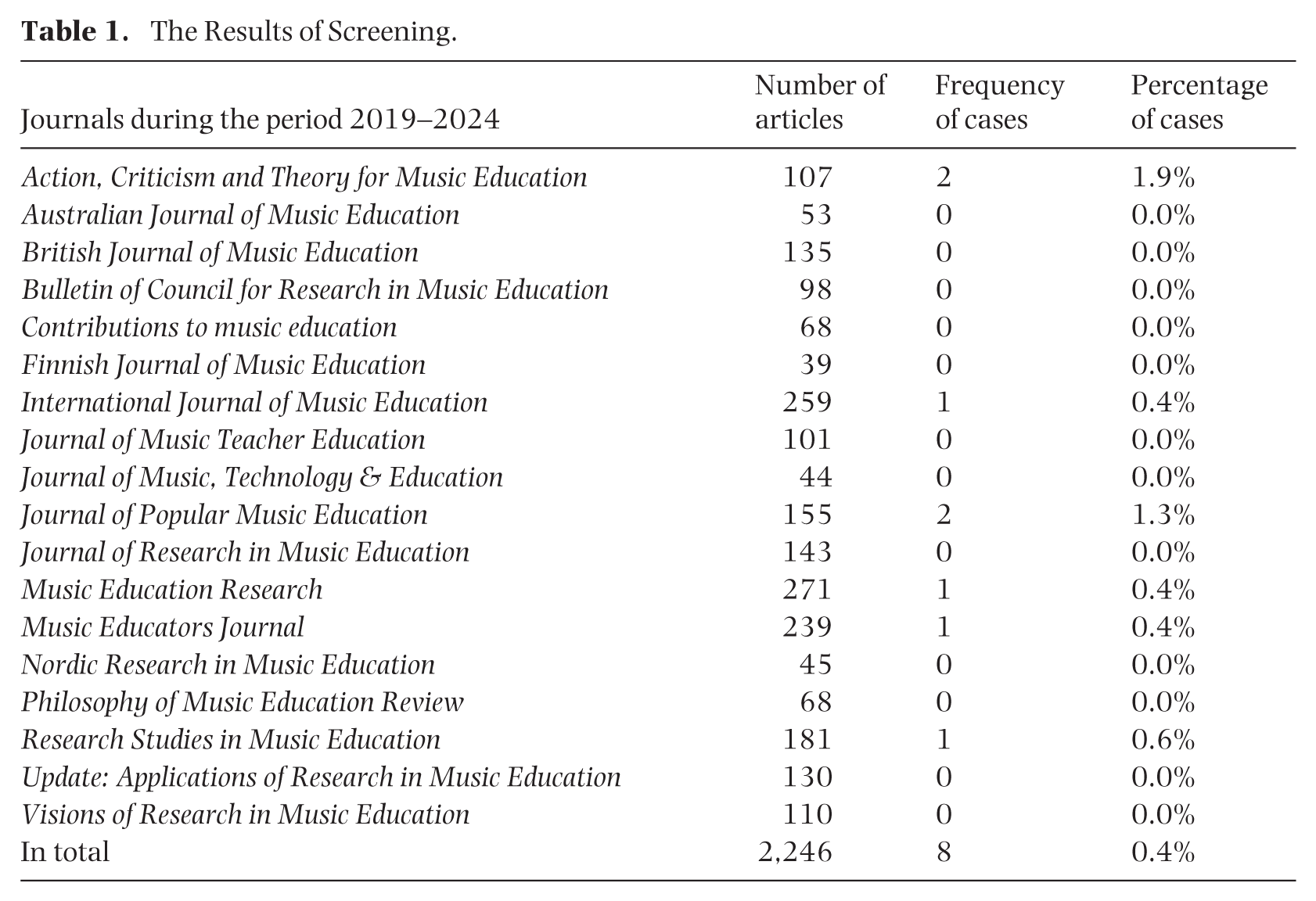
All international scholarly music education journals from 2019 to 2024 that published English articles and were listed in the Finnish Publication Forum were selected for screening 2 . The list of journals (n = 18) is presented in Table 1. This time period was chosen because ecological and climate-related topics in music education research became more visible in journal publications during the late 2010s, making the selected timeframe analytically meaningful for examining recent scholarly engagement with ecoliteracy. The purpose of the screening was not to map an entire field—as in scoping reviews—but to identify individual studies that explicitly addressed ecological awareness or ecoliteracy.
The Results of Screening.
All abstracts and full texts were manually screened using the pre-defined keywords, selecting only articles that met this conceptual criterion. The purpose of screening was solely to delimit the dataset, while the study’s analytical focus was on the close conceptual examination of individual publications. In the screening of individual theoretical, empirical, and pedagogical articles, ecoliteracy, ecological or environmental awareness/consciousness, climate consciousness, and nature connection were used as keywords to select cases for further investigation. These keywords were intentionally selected because the study focused specifically on ecological awareness and ecoliteracy rather than on broader sustainability discourse.
Thematic Analysis of Selected Cases
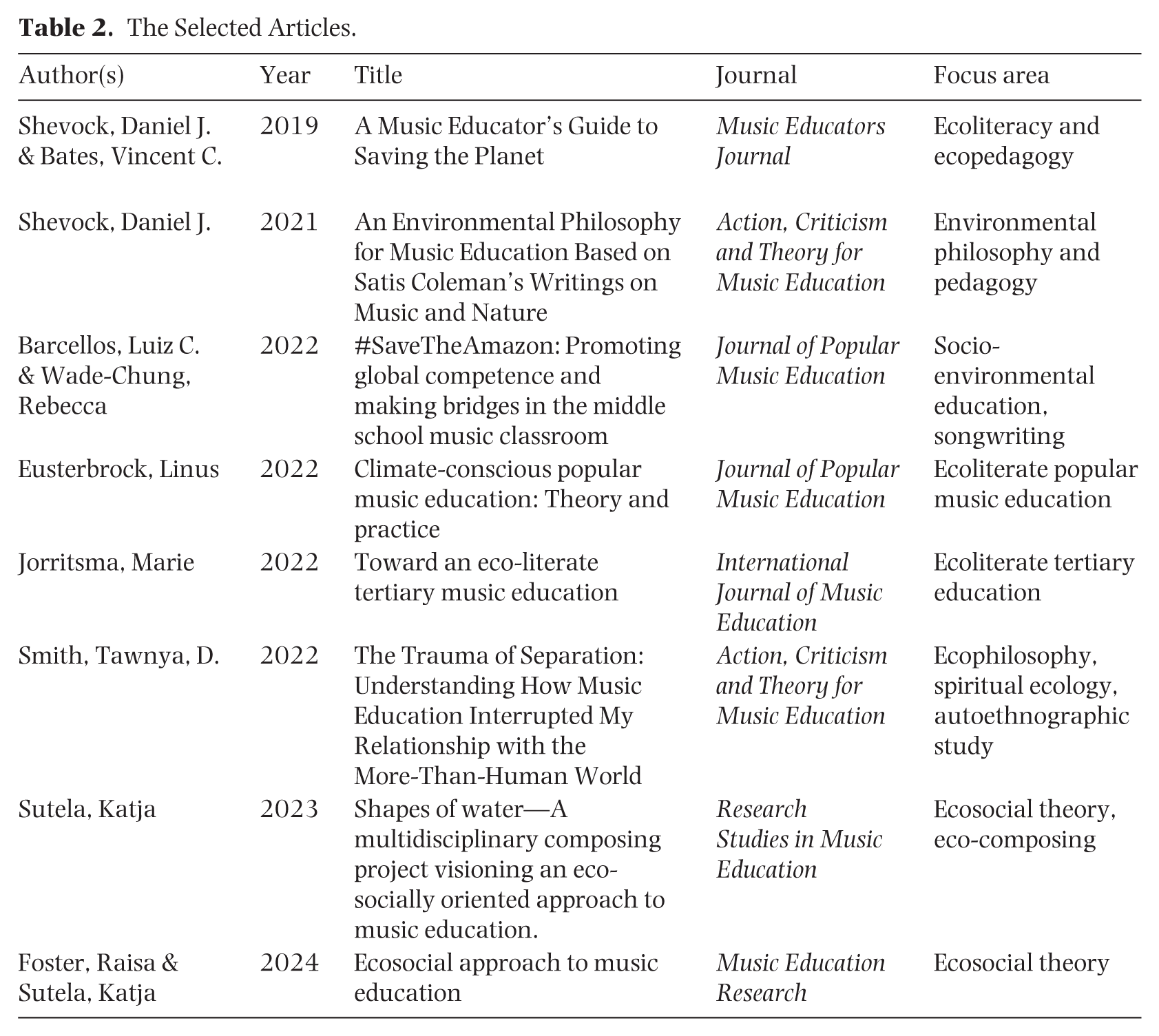
The selected articles—listed in Table 2—formed the data set for a six-step thematic analysis (Braun & Clarke, 2006; Clarke et al., 2015): (a) the data were familiarized, (b) initial codes were generated, (c) themes were searched, (d) reviewed, (e) defined and named, and (f) the report was produced. Thematic analysis allowed for both theory-informed coding and the inductive emergence of new categories. The model of musical ecoliteracy (Paananen, 2023) was used as a guiding analytical lens. Internal coherence and consistency, avoidance of overlapping between themes, and interpretations consistent with the theoretical framework were central objectives of the analysis (Braun & Clarke, 2006).
The Selected Articles.
Findings From the Quantitative Screening
Out of the 2,266 screened articles in 18 journals during 2019–2024, only 0.4% (n = 8) were cases explicitly addressing ecological awareness or musical ecoliteracy. The frequency and percentage of ecoliteracy-related cases are presented in Table 1, and the eight cases are presented in Table 2.
Findings From the Thematic Analysis
As a result of the thematic bottom-up analysis, four larger themes were found:
Definitions of ecoliteracy in the context of music education;
Ecocentric versus anthropocentric values;
Theoretical perspectives to ecological awareness; and
Pedagogical implications and practices.
In what follows, each theme is described in detail. Then the discussion identifies manifestations of the five musical ecoliteracy competencies as a result of top-down analysis, in which the musical ecoliteracy model was used as a guiding analytical lens.
Definitions of Ecoliteracy in the Context of Music Education
According to Shevock and Bates (2019), ecological literacy 1 is defined as reflection and action aimed at the positive transformation of humanity in response to ecological crises. For them, ecology refers to the web of life, encompassing both human and non-human life as interconnected and nested. The concept of interconnectedness and equality of life forms can already be found in deep ecology (Naess, 1973) and in Capra’s (1996) notion of ecoliteracy. For Shevock and Bates (2019), ecological literacy also involves an understanding of the local and global dimensions of interconnectedness embedded in everyday actions and the school curriculum as an interdisciplinary practice. Similarly, Jorritsma (2022), drawing on Capra (1996), defines ecoliteracy as an understanding of the principles governing the organization of ecosystems and the application of those principles to the creation of sustainable human communities and societies.
Eusterbrock (2022) defines ecological consciousness as a connection to and appreciation of nature, as well as an awareness of how human life is interconnected with the local environment. He adopts Shevock’s (2018) view of ecoliterate music education as being grounded in local places and ethical and meaningful music—nature experiences, ritualization, and the integration of global and local ecological issues through music. He also argues that the imaginative, emotional, expressive, and communal characteristics of popular music, along with its strong influence and long-standing tradition in environmental activism, have a strong potential to address climate change.
While Sutela (2023) and Foster and Sutela (2024) do not offer a definition of ecoliteracy, they describe ecosocial music education as aiming to foster students’ sensitivity to sonic environments and awareness of ecological crises; the appreciation of multispecies communities and mutually beneficial interactions; students’ critical thinking, creativity, and collaboration in addressing social and ecological issues; and ethical values, attitudes, and behaviors that respect and care for nature.
There are also more spiritual definitions of ecological awareness. In his article on Satis Coleman, a pioneer of environmentally oriented music education, Shevock (2020) describes Coleman’s philosophy, which emphasizes a love for nature and a deep understanding of its musics. For Coleman, Mother Earth personifies a spiritual force from which musics emerge, aligning with the principles of Deep Ecology (Naess, 1973). Similar ideas are central to Smith (2022), whose theoretical foundations lie in spiritual ecology. She argues that humans need to re-establish a relationship with the anima mundi, which may allow them to envision themselves as part of “a sea of equal beings”—the entire web of life (Smith, 2022, p. 177).
Taken together, these definitions suggest that ecoliteracy in music education is not a singular concept but a multidimensional framework that spans ecological systems thinking, local-global awareness, activist potential, and spiritual connection with nature.
Ecocentric Versus Anthropocentric Values
Shevock and Bates (2019) represent an ecological systems-centered perspective, according to which non-human lifeforms possess inherent and intrinsic value. Both organic and inorganic entities form part of an interconnected, dynamic system in delicate balance wherein the whole transcends the sum of its parts. This interconnectedness extends to relationships between human and non-human musics (Shevock and Bates, 2019). Similarly, Jorritsma (2022) follows ecomusicologist Allen’s call to adopt an ecological systems-centered perspective. Foster and Sutela (2024) also value the more-than-human world as equal—an idea rooted in Deep Ecology and environmental philosophy (Naess, 1973) and central to ecosocial thinking (Salonen, 2010; Värri, 2018).
Eusterbrock (2022) advocates for social change toward climate justice, promoting action beyond the mere development of ecological awareness. In a similar vein, Barcellos and Wade-Chung (2022) emphasize the need for critical awareness of socio-ecological issues within music education. According to Foster and Sutela (2024), both social and ecological problems stem from modern society’s emphasis on consumerism, individualism, rationalism, instrumentalism, and anthropocentrism—values that position humans as separate from and superior to nature.
Shevock (2020) argues that many music education philosophies neglect the environment and Indigenous worldviews due to the influence of the Eurocentric philosophical tradition, “which has a long history of placing emphasis on the mind above the body, wealth above poverty, human action above non-human action, Whites above non-Whites, and men above women” (Shevock, 2020, p. 196). As values are adopted through education, Shevock (2020) highlights the importance of ecomusicological research in music education, as it draws attention to ecologically sustainable music cultures and challenges binary distinctions between nature and culture.
According to Smith (2022), Western education may directly contribute to a child’s separation from nature, as it teaches children that human-made sounds are more important than the natural soundscape. She contrasts the Indigenous ecocentric conception of self with Western anthropocentric and egocentric enculturation. In ecocentric thinking, the self is identified with the Earth, whereas in egocentric thinking, the self is considered an individual entity that exists in relation to other humans. Egocentric maturation results in the child’s disconnection from nature, as their attention is directed toward exclusively social concerns external to the self. Smith (2022) also critiques the anthropocentric orientation of music education philosophies that emphasize adapting music education to the needs of the local (human) community.
Theoretical Perspectives on Ecological Awareness
The authors discussed in this study share certain theoretical premises, most notably the web of life (Naess, 1973), the interconnectedness of beings, and systems thinking. However, their approaches diverge along two primary axes: one between critical pedagogy and spiritual ecology, and the other between ecomusicological and ecosocial research traditions.
A critical societal perspective is emphasized by Jorritsma’s (2022) critique of colonialism and slow violence, Eusterbrock’s (2022) urban climate activism rooted in Freirean pedagogy, Barcellos and Wade-Chung’s (2022) socio-ecological education, and Sutela’s (2023) and Foster and Sutela’s (2024) ecosocial analyses. The strong emphasis on social critique renders these approaches somewhat more anthropocentric than those foregrounding spiritual and nature-centered worldviews.
According to Jorritsma (2022), extractivism denotes a non-reciprocal, dominance-based relationship with the Earth, whereby natural resources are exploited for the benefit of colonial powers. This process devastates Indigenous land and silences Indigenous voices and musics. Eusterbrock (2022) frames education for climate consciousness as an essential part of critical pedagogy, suggesting that beyond recognizing ecological crises as cultural issues, they must be seen as complex political problems involving intergenerational and global climate justice. He thus calls for climate-conscious music education that combines ecoliteracy with critical social justice theories.
Shevock (2020) critiques neoliberal capitalism and its logic of efficiency, which he argues permeates all areas of life, including education. He stresses the importance of making space in music classrooms to reflect on the past, present, and potential sustainable futures. Drawing on Indigenous philosophies, Shevock also emphasizes being in the world as a condition rooted in soil and embedded in place.
Smith (2022)—representing spiritual ecology—advances a more radical ecocentric view. Here, not only is the more-than-human nature perceived as equal, but the human self is understood as identified with the Earth and the web of life rather than shaped by socially constructed goals. In this view, the soul is defined by a thing’s position within the broader web of being, analogous to the ecological concept of niche. This perspective de-centers humans and repositions them within a relational ecological matrix shared with all beings and objects.
The environmental movement is approached differently in ecomusicology than in ecosocial education. Ecomusicological research focuses on the sonic cultures of different species and cultures, their evolutionary origins, natural soundscapes, the ecological embeddedness of sound, and definitions of music itself. In contrast, the emphasis of the ecosocial approach (Foster & Sutela, 2024; Sutela, 2023) is in phenomenological philosophy, especially in the process of ecosocialization (Keto & Foster, 2021; Merleau-Ponty, 1968; Värri, 2018), by which humans share common life with other organisms, which occurs through direct, holistic, and bodily interactions between various multidisciplinary agents. This framework includes three core dimensions that reinforce sustainable life orientation: (a) embodiment, or individuals interacting and co-creating reality between relational living beings; (b) imagination, or envisioning ecologically and socially responsible ways of being; and (c) care, or respecting and nurturing all forms of life (Foster & Sutela, 2024; Sutela, 2023).
Pedagogical Implications and Practices
In these selected articles, pedagogical practices that promote ecological literacy in music education are grounded in critical reflection, activist engagement, emotional experiences, creativity, and interdisciplinary integration. However, the authors emphasize these elements in varying ways. Shevock and Bates (2019), Jorritsma (2022), Barcellos and Wade-Chung (2022), and Eusterbrock (2022) stress cognitive and scientific methods, such as interdisciplinary and societal approaches, systems thinking, and sustainable teaching practices—using online resources, natural sounds, long-lasting materials, recycling, and reusing or constructing instruments.
Another key theme is place-based music education rooted in ecomusicological and ethnomusicological research (Shevock, 2018). It manifests as care for local sound environments and communities (Jorritsma, 2022; Shevock & Bates, 2019; Sutela, 2023), and as a spiritual connection to Earth (Shevock, 2018; Smith, 2022). Ecomusicology highlights the value of non-industrialized and Indigenous musics and their connection to specific environments, encouraging reflection on how humans choose to live today (Jorritsma, 2022; Smith, 2022). Jorritsma (2022), for example, describes how instrument construction can be examined through lenses such as mining, extractivism, colonialism, and traditional techniques. She also shows how music and religion may be integrated by exploring shamanism, oral literature, anthropology, and history in connection with Indigenous peoples.
Although singing about ecological issues can raise awareness (Shevock & Bates, 2019), many authors focus on student-created eco-music or even interspecies improvisation (Eusterbrock, 2022). In Barcellos and Wade-Chung’s (2022) project, students learned rhythms, crafted percussion instruments, composed activist music, and studied Amazonian ecology, UN Sustainable Development Goals, and Indigenous cultures. Sutela’s (2023) work on water in its different forms used expressive movement and shared climate memories to support collaborative songwriting.
Foster and Sutela (2024) argue that while objective knowledge of sounds is required, sound is, above all, subjectively experienced. They introduce the concept of attunement—a present-focused, judgment-free state influenced by Oliveros’ (2005) deep listening—which refers to the pre-reflective sensory relationship between listener and sound beyond subject–object dualism (Vadén & Torvinen, 2014). Students may find inspiration for co-composing with nature through attunement and discussing personal sound memories.
Eusterbrock (2022) reminds the reader that not all students are receptive to a nature orientation. Activist music education can then employ more rational composition strategies such as sonification, in which climate data is transferred into musical form to express, for example, apocalyptic feelings of doom. The challenge for educators in urban contexts is to find ways to revive students’ emotional connectedness to nature. Ecological concern may wane if nature is no longer experienced as meaningful and empowering (see Vadén, 2014). As Smith (2022) states, a sense of separation from nature is the root cause of ecosystem collapse.
Discussion
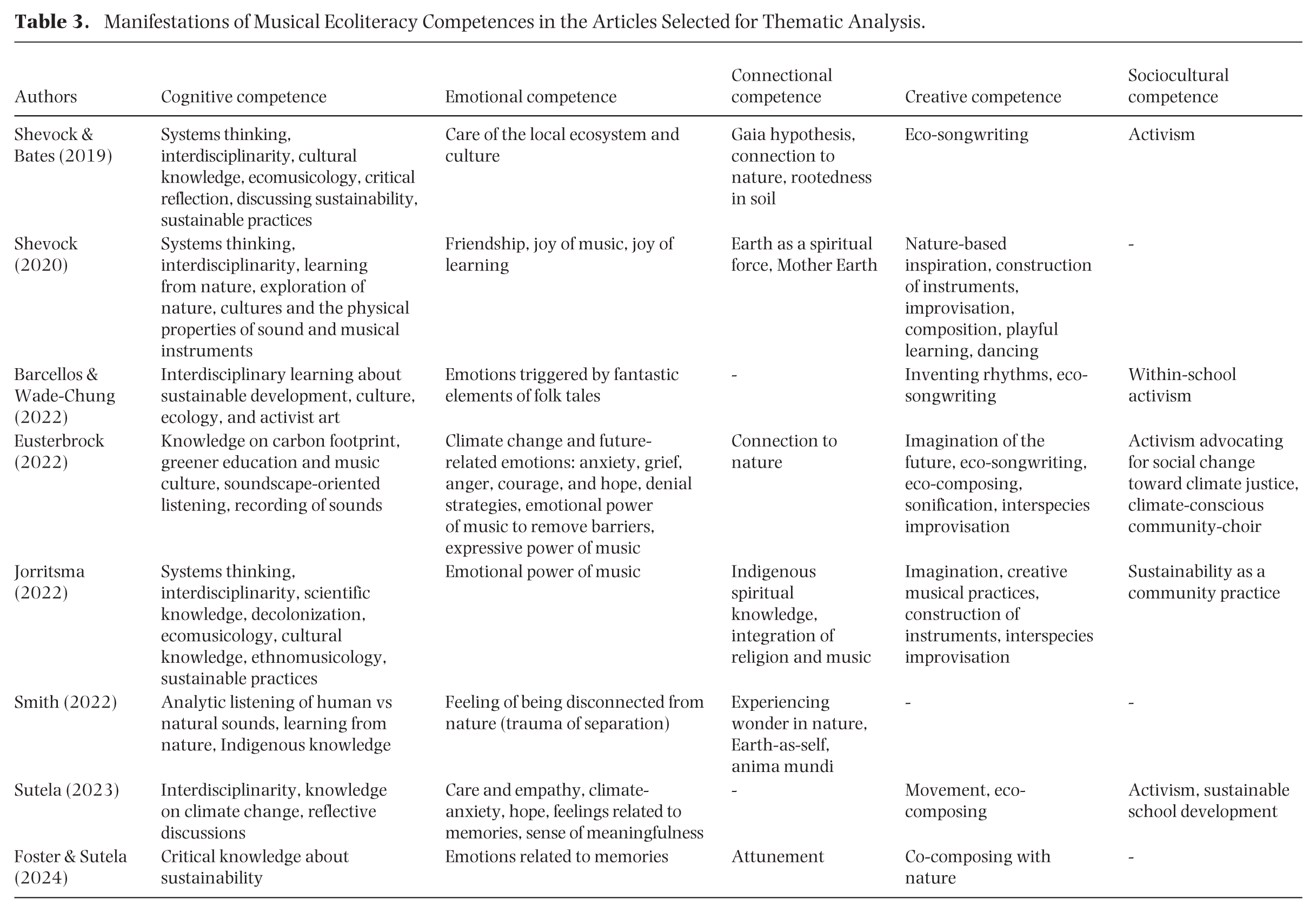
The present model of musical ecoliteracy (Paananen, 2023) includes five interdependent competences that complement one another and were used as an analytical lens for interpreting this review’s thematic findings. While none of the authors explicitly specify what kinds of competences ecoliteracy might comprise, all the dimensions addressed align with aspects of the model, indicating that the competence-based framework captures meaningful features already embedded within the current discourse. In the following section, I examine which competence manifests in each author’s text. Table 3 provides a more detailed overview of the perspectives presented by each author, categorized according to the different competences.
Manifestations of Musical Ecoliteracy Competences in the Articles Selected for Thematic Analysis.
Cognitive Competence
As expected in the model, cognitive competence is clearly reflected in all articles. Most authors demonstrate it through interdisciplinary knowledge and systems thinking. Authors with an ecomusicological or ethnomusicological orientation—such as Shevock and Bates (2019), Jorritsma (2022), Barcellos and Wade-Chung (2022), and Smith (2022)—emphasize knowledge of not only the natural sciences but also diverse cultures, particularly Indigenous cultures. However, some authors focus more narrowly on climate awareness (Eusterbrock, 2022; Foster & Sutela, 2024; Sutela, 2023) or adopt a more societal perspective by highlighting climate ethics (Eusterbrock, 2022). In line with the model, analytical listening to soundscapes and the study of sound (Eusterbrock, 2022; Smith, 2022), interdisciplinary inquiry-based learning, and critical discussion emerge as key methods for developing cognitive competence.
Emotional Competence
In accordance with the model, emotional competence is expressed in a multidimensional manner, encompassing the recognition and processing of both positive and negative emotions related to nature and soundscapes, as well as empathy toward all living beings. The authors highlight experiences of climate anxiety (Eusterbrock, 2022; Sutela, 2023), courage and hope for a more sustainable future (Eusterbrock, 2022; Sutela, 2023), and the positive and empowering emotional effects of eco-music and eco-art practices (Barcellos & Wade-Chung, 2022; Eusterbrock, 2022; Jorritsma, 2022; Shevock, 2020). Expressions of empathy and care are also emphasized (Shevock & Bates, 2019; Sutela, 2023). Furthermore, episodic memories rich in emotional content are described as sources of inspiration for eco-composing (Foster & Sutela, 2024).
Connectional Competence
The connectional dimension comprises aesthetic and spiritual experiences arising from encounters with nature. This dimension is most explicitly addressed in Smith’s (2022) work, where nature is a source of aesthetic wonder and spiritual meaning and a locus for identification (Earth-as-self). Indigenous spiritual worldviews are central to Jorritsma’s (2022) article, while nature as a spiritual force is also emphasized by Shevock (2020).
Surprisingly, explicitly aesthetic experiences are discussed less frequently than anticipated by the model despite empirical research suggesting that young people’s most meaningful encounters with nature are often aesthetic and immersive (Hakoköngäs & Puhakka, 2023; Puhakka, 2014; Schwab et al., 2020; Sjöblom, 2012; Tseng & Wang, 2020). Instead, connectedness is often conceptualized through abstract metaphors such as the “web of life” (Shevock & Bates, 2019) or described simply as a connection to nature (Eusterbrock, 2022). Nevertheless, the concept of attunement proposed by Foster and Sutela (2024) is reminiscent of the attentive and meditative forms of listening outlined in the model (Schafer, 1976; 1977/1994; Oliveros, 2005), and their view of embodiment is also aligned with the model’s emphasis on embodied nature connection and ecological awareness.
Creative Competence
Creative competence is reflected in the articles through inspiration drawn from nature (Shevock, 2020), eco-composing (Barcellos & Wade-Chung, 2022; Eusterbrock, 2022; Foster & Sutela, 2024; Shevock & Bates, 2019; Sutela, 2023), and interspecies improvisation (Eusterbrock, 2022; Jorritsma, 2022). While the model assumed the use of music technology in musical and/or multimodal productions, the articles also featured dance and movement (Shevock, 2020; Sutela, 2023), the construction of self-made instruments (Barcellos & Wade-Chung, 2022; Jorritsma, 2022; Shevock, 2020), and sonification (Eusterbrock, 2022).
Sociocultural Competence
Sociocultural competence manifests as sustainability-oriented community practices (Jorritsma, 2022) and, more frequently, as engagement in environmental or climate activism (Barcellos & Wade-Chung, 2022; Eusterbrock, 2022; Shevock & Bates, 2019; Sutela, 2023).
Integrating Perspectives Across Competences
The thematic findings align with and nuance the ecoliteracy model, reinforcing its integrative character while refining how its competences manifest across differing pedagogical ideologies. Critical orientations such as climate activism can be understood as educational outcomes arising from the combined development of the model’s existing competences—particularly cognitive competence involving ethical reflection and critical thinking—alongside sociocultural competence facilitating collective action toward ecological goals. Such critical positioning does not require redefining ecoliteracy as a primarily political practice.
Spiritual ecology perspectives deepen understandings of connectional competence by emphasizing experiential engagement, ecological identity formation, and the existential dimensions of learning. Connectional competence presupposes direct experiential encounters with nature and forms of slow, contemplative thinking. Spiritual and aesthetic experiences may be understood as peak psychological experiences that expand consciousness in ways distinct from rational cognition, sometimes enabling identification with nature as self-as-Earth.
Ecosocial perspectives originate in broader phenomenological philosophies not specific to music. Within ecosocial frameworks, music is viewed as a form of pre-reflective engagement through which empathy and care toward the more-than-human world may emerge. Therefore, these perspectives relate primarily to the embodied grounding of the model and to emotional competence, while their application in the arts also supports creative competence. However, ecosocial theories conceptualize the more-than-human world as a collective rather than as intersubjective agents (e.g., individual animal species). For this reason, ecosocial theory alone is insufficient as a foundation for musical ecoliteracy.
Ecomusicological research complements ecosocial theory by highlighting the importance of acoustic ecology, zoomusicology, and ethnomusicology in music education. These perspectives draw attention to non-human sound worlds, more ecologically sustainable musical cultures—notably Indigenous traditions—and non-industrial soundscapes. They foster cognitive competence while simultaneously calling for emotional and connectional engagement with nature and other species.
Conclusion
Musical ecoliteracy remains a highly under-researched area. Only 0.4% (n = 8) of articles published between 2019 and 2024 across 18 international scholarly music education journals engaged directly with ecoliteracy themes. Certain journals demonstrated greater engagement, including Action, Criticism, and Theory for Music Education and the Journal of Popular Music Education. It is therefore essential to strengthen ecological awareness among music educators to promote students’ musical ecoliteracy.
The bottom-up thematic analysis identified four overarching themes across the selected articles: (1) ecoliteracy as a conceptual construct, (2) values, (3) theoretical orientations, and (4) pedagogical practices. Shared premises included systems thinking, the interconnectedness of life, and the metaphor of the web of life (Naess, 1973). However, approaches diverged along two principal axes: between critical pedagogy and spiritual ecology, and between ecomusicological and ecosocial research traditions.
The model of musical ecoliteracy was applied as a theoretical lens to interpret these findings. Importantly, the relationship between the model and the analyzed literature should be understood as reciprocal: the model served as a heuristic framework for examining existing conceptualizations rather than as a tool for confirming pre-determined assumptions.
In pedagogical practice, all competences should be developed in a mutually reinforcing manner. An approach focusing solely on cognitive competence may not lead to creative musical expression or public engagement, while exclusive reliance on emotional or creative dimensions may fail to cultivate the critical capacities necessary for meaningful ecological action.
The competence-based model provides music educators with clear pedagogical reference points for integrating ecological awareness into music teaching. By identifying distinct but interconnected competences, the model supports the systematic design of pedagogical strategies and learning activities that link theory to practice. From the educators’ perspective, the model functions as a planning and assessment framework; for students, its multidimensional structure fosters holistic engagement with ecoliteracy across cognitive, emotional, embodied, creative, and sociocultural learning processes.
Given the limited scope of current research, the model also offers a structured conceptual foundation for future pedagogical development and empirical inquiry (Hakanpää et al., 2025). Its competence-based orientation further enables the potential systematic assessment of ecoliteracy growth in music education contexts. Overall, the model offers a valuable theoretical and pedagogical framework that integrates ecosocial and ecomusicological research traditions into a coherent approach for advancing ecologically literate music education.
Footnotes

Author Contributions
Funding
The author received no financial support for the research, authorship, and/or publication of this article.
Declaration of Conflicting Interests
The author declared no potential conflicts of interest with respect to the research, authorship, and/or publication of this article.