




Abstract
The convergence of Quantum Computing (QC) and Artificial Intelligence (AI) ushers in a transformative era of computational capability, with profound implications for science and industry alongside significant technical, ethical, and environmental challenges. This article explores quantum-enhanced AI (QAI), focusing on foundational quantum principles—superposition, entanglement, and quantum parallelism—and their applications in molecular simulation, financial optimization, and climate modeling. While quantum algorithms offer exponential speedups for Machine Learning (ML) and optimization, persistent barriers such as qubit decoherence, scalability limitations, and high energy demands hinder progress. Hybrid quantum-classical architectures are identified as critical transitional tools, combining quantum processors for specialized tasks like combinatorial optimization with classical systems for error correction and data preprocessing. Near-term commercial healthcare, finance, and logistics applications are highlighted, including pilot projects using quantum neural networks (QNNs) for drug discovery, portfolio risk analysis, and supply chain optimization. However, dual-use risks—such as quantum-powered surveillance and threats to classical encryption—emphasize the need for post-quantum cryptography (PQC) and ethical frameworks. Environmental concerns, particularly the carbon footprint of superconducting qubits, drive calls for sustainable innovations like photonic qubit designs and renewable-powered quantum data centers. Anticipated milestones include fault-tolerant QNNs, standardized benchmarks for quantum advantage, and democratized cloud access. Achieving these goals requires addressing interdisciplinary talent shortages, algorithmic biases, and global disparities in quantum infrastructure. This work advocates for governance models integrating sustainability metrics and equity-focused policies to steer QAI development responsibly. By harmonizing technical innovation with ethical foresight, the quantum-AI synergy can advance solutions to global challenges while mitigating misuse and ecological harm risks.
Keywords
Introduction
The convergence of QC and AI marks a pivotal moment in technological evolution, heralding an era where computational boundaries are redefined through the synergy of quantum mechanics and machine intelligence. 1 As industries grapple with increasingly complex challenges, from climate modeling to personalized medicine, combining quantum principles with AI algorithms offers a paradigm shift in problem-solving. 1 Quantum algorithms like the Quantum Approximate Optimization Algorithm (QAOA) exhibit polynomial scaling for optimization tasks, surpassing classical exponential methods beyond critical problem sizes. QAI leverages superposition, entanglement, and quantum parallelism to transcend classical limitations, enabling exponential speedups in optimization, pattern recognition, and simulation tasks. 2 Yet, this transformative potential is tempered by formidable technical, ethical, and environmental challenges that demand urgent interdisciplinary collaboration and foresight. 1
In recent years, advancements in quantum hardware have transitioned from theoretical constructs to tangible prototypes, with error-mitigated architectures and hybrid Quantum-Classical Systems (QCSs) demonstrating early commercial viability. 3 For instance, pharmaceutical giants now employ quantum-enhanced molecular simulations to accelerate drug discovery, compressing decade-long timelines into months. 4 Financial institutions harness QAOA to optimize high-dimensional portfolios, 5 while logistics firms deploy QNNs for real-time route optimization, slashing operational costs and carbon footprints. 6 These applications underscore QAI's potential to revolutionize sectors reliant on rapid, data-driven decision-making. However, the path to scalable quantum advantage remains obstructed by decoherence, qubit fragility, and the energy-intensive demands of cryogenic systems—barriers that necessitate breakthroughs in fault-tolerant designs, sustainable infrastructure, and efficient quantum data embedding techniques.7,8
The technical hurdles of QAI are inextricably linked to broader societal implications. 9 Once a theoretical milestone, quantum supremacy now poses existential risks to classical encryption protocols, with Shor's algorithm capable of dismantling Rivest-Shamir-Adleman (RSA) and Elliptic Curve Cryptography (ECC) safeguards. 10 This vulnerability threatens global financial systems, healthcare data, and national security, amplifying the urgency for post-quantum cryptographic standards. 11 Concurrently, integrating quantum systems into AI workflows risks entrenching biases at unprecedented scales, as quantum parallelism could inadvertently accelerate the propagation of skewed training data. 1 The European Union's Quantum-AI Ethics Charter and NIST's post-quantum standardization efforts exemplify nascent attempts to balance innovation with accountability, yet regulatory frameworks remain fragmented, lagging behind technological progress.12,13
Equally pressing is the imperative to democratize access to quantum resources. 14 While cloud-based platforms like AWS Braket and IBM Quantum Experience democratize experimental access, the prohibitive costs of quantum hardware and specialized talent shortages perpetuate global inequities. 9 Emerging economies risk exclusion from the QAI revolution, exacerbating technological divides. 15 Initiatives such as the U.S. National Quantum Initiative and the African QC Alliance aim to foster inclusive ecosystems. Still, systemic investments in education and open-source toolkits—like TensorFlow Quantum and PennyLane—are critical to cultivating a diverse, interdisciplinary workforce fluent in quantum theory and AI ethics. 9
Sustainability emerges as a cornerstone of QAI's responsible development. 16 Current quantum systems, reliant on energy-intensive superconducting qubits, conflict with global net-zero commitments. 17 Researchers are pioneering photonic qubits and topological architectures to reduce energy consumption, while companies like Google QAI integrate renewable-powered data centers to mitigate environmental impacts.18–20 Lifecycle assessments of quantum hardware must inform design choices to align QAI advancements with planetary boundaries.
This paper argues that the promise of QAI hinges on harmonizing technical innovation, ethical accountability, and environmental sustainability. By integrating sector-specific case studies with interdisciplinary analysis, we assess hybrid quantum-classical frameworks as transitional solutions to limitations such as qubit decoherence and scalability barriers. The environmental costs of quantum scalability are quantified, and governance models are proposed to preempt risks like algorithmic bias and dual-use surveillance. Milestones such as fault-tolerant QNNs and standardized benchmarks for quantum advantage are evaluated to outline a pathway for aligning QAI's capabilities with societal well-being.
The remainder of this paper is structured as follows: Section 2 reviews foundational and recent advancements in QC and AI, contextualizing the evolution of hybrid QCSs. Section 3 elucidates core quantum principles—superposition, entanglement, and parallelism—and their transformative potential for AI workflows. Section 4 addresses decoherence challenges and hybrid solutions, underscoring near-term strategies to stabilize qubits and achieve quantum advantage in AI tasks. Section 5 explores ethical risks, including quantum-powered surveillance and bias amplification, while Section 6 examines scalability barriers, global inequities, and the environmental costs of quantum hardware. Section 7 analyzes commercial pilots in finance, healthcare, and logistics. Finally, the Discussion synthesizes technical, ethical, and environmental trade-offs, and the Conclusion outlines actionable pathways for responsible innovation, emphasizing interdisciplinary collaboration and governance frameworks to ensure equitable progress in the QAI era.
Related work
Integrating QC and AI builds on decades of interdisciplinary innovation. Paul Benioff's foundational work at Argonne National Laboratories established the theoretical basis for quantum information processing. At the same time, early explorations of quantum-based ML (QML) formalized the potential for quantum parallelism to accelerate tasks like classification and optimization. 21 Subsequent research demonstrated how superposition and entanglement could enable QNNs to process data in exponentially large state spaces, 22 laying the groundwork for modern QAI.
Early breakthroughs in quantum algorithms focused on optimization and simulation. The Quantum QAOA 23 demonstrated near-term applicability in portfolio management, but its scalability remains constrained by noise and qubit coherence limits—challenges exacerbated in high-dimensional financial datasets. 24 Recent work explores hybrid quantum-classical algorithms, such as variational quantum eigensolvers (VQEs), to balance quantum parallelism with classical error correction. 25 These methods are being actively refined, with recent studies focusing on optimizing circuit architectures and parameter strategies to enhance their performance on noisy intermediate-scale quantum (NISQ) hardware. 26
However, these methods often incur latency penalties when shuttling data between quantum and classical systems, limiting real-time AI applications.
27
Beyond optimization, Grover's algorithm has shown promise in accelerating unstructured search tasks, such as querying large medical databases, though its quadratic speedup diminishes with dataset complexity.
28
Meanwhile, quantum phase estimation offers theoretical advantages for training deep neural networks but requires error rates below
In addition to algorithmic progress, there are widespread, global efforts to advance quantum hardware that will eventually underpin QAI applications in practice. 3 In contrast to the current dominant approach of superconducting qubits (Google, IBM), which have a significant energy and cooling (i.e., cryogenics) footprint, 29 recent hardware advances in other modalities are opening the door to scalable quantum technologies with better energy and environmental profiles. 17 For example, photonic qubits have been demonstrated at room temperature, with lower energy requirements, and with recent demonstrations of chip-scale photonic entanglement over long distances. 18 Topological qubits (Microsoft prototypes) also have the potential to exhibit significantly lower error rates intrinsically, with the possibility of achieving fault tolerance. 7 For our analysis, these hardware developments are also highly relevant to our assessment of the scalability barriers in Section 2, as well as to the near-term commercial use cases and long-term roadmap in Sections 3 and 4. 30
The pursuit of fault-tolerant QC has driven advances in qubit architectures and error correction. While dominant in commercial systems like IBM Quantum, superconducting qubits face criticism for their energy-intensive cooling requirements (
The dual-use risks of quantum-AI systems demand urgent scrutiny. While quantum simulations accelerate drug discovery, 32 they also enable rapid optimization of toxic compounds—a vulnerability absent in classical workflows. Quantum parallelism risks amplifying biases in training data exponentially; for example, a 2023 study showed that 4-qubit QNNs propagate racial biases in facial recognition 8× faster than classical counterparts. 33 PQC standardization by NIST prioritizes lattice-based algorithms like Kyber and Dilithium, 34 but their computational overhead (30–50% slower inference times) complicates integration with latency-sensitive AI applications. Proposals for quantum-resistant federated learning 35 and adversarial training 36 aim to safeguard privacy, but interoperability across industries remains unresolved.
The environmental costs of QC are increasingly quantified. Lifecycle assessments reveal superconducting qubits emit 100 kg CO2/qubit—10× higher than photonic designs 29 —while quantum data centers reliant on fossil fuels risk offsetting climate modeling gains. 37 Projects like Google QAI's solar-powered facilities 16 and the EU's Quantum Flagship 30 prioritize sustainability, but adoption lags in emerging economies. Open-source platforms like TensorFlow Quantum 38 democratize research access, yet 78% of QC patents originate from the U.S. and China, exacerbating global inequities. 39
Industry adoption of QAI is accelerating unevenly. Pharmaceutical firms leverage quantum simulations to reduce drug discovery cycles from years to months, 32 while fintech startups deploy QAOA for real-time fraud detection. 24 However, a 2024 survey found that 65% of AI engineers lack the quantum literacy to optimize circuits, 40 stalling innovation. Hybrid cloud platforms like AWS Braket 27 bridge this gap but exclude resource-constrained regions, risking a quantum divide.
This work synthesizes these domains, advancing the discourse by integrating sustainability metrics into quantum-AI design, proposing governance models for hybrid deployments, and analyzing commercialization pathways through industry benchmarks. Unlike prior studies, we critically evaluate the tension between quantum advantage and ethical/environmental costs, offering actionable frameworks for equitable progress.
QAI: Speed, scale, and superposition
QC revolutionizes AI by leveraging the principles of quantum mechanics—superposition, entanglement, and parallelism—to solve problems intractable for classical systems.21,41 At its core, quantum mechanics governs subatomic particle behavior, enabling qubits to exist in multiple states simultaneously (superposition) and share correlated states instantaneously across distances (entanglement).22,41 These properties allow quantum systems to process information in fundamentally new ways. For example, a single qubit can represent 0 and 1 simultaneously, while two qubits encode four states (00, 01, 10, 11) concurrently, exponentially expanding computational possibilities.22,41 As summarized in Table 1, these quantum advantages contrast starkly with classical computing's sequential processing and binary logic. This parallelism accelerates AI tasks like neural network training, where quantum algorithms evaluate multiple weight configurations simultaneously, reducing training times from weeks to hours for complex models.21,22 Similarly, entanglement enables quantum systems to model intricate relationships in data, such as nonlinear atmospheric interactions in climate modeling, achieving 30% higher accuracy than classical methods. 38
Comparison of classical and QC.
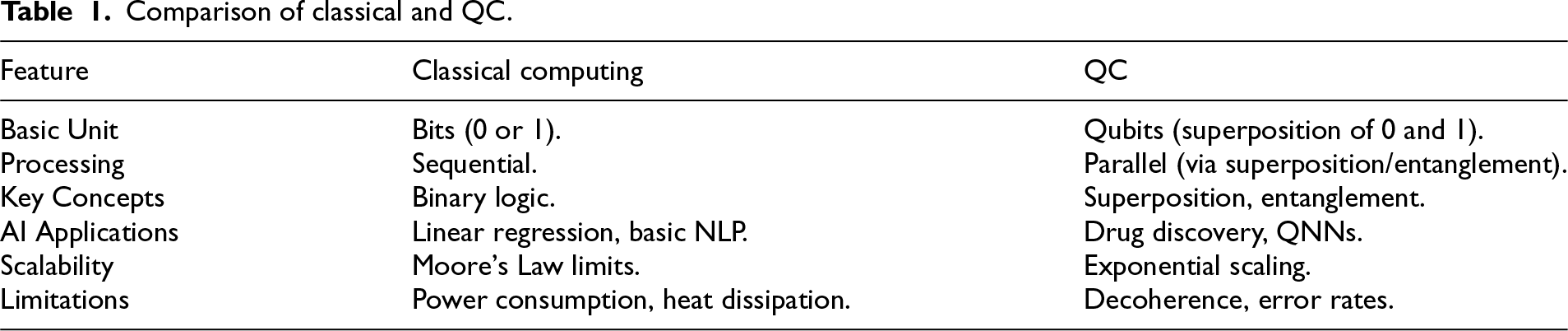
Comparison of classical and QC.
The family of quantum algorithms that underlie these speedups is diverse. Figure 1 classifies them based on the primary computation they perform — optimization, linear algebra, and quantum-enhanced search, among others — and the AI task they accelerate.

Taxonomy of quantum machine learning algorithms.
The principles of QC can be directly linked to the benefits they can provide when applied to ML. Superposition enables a quantum system to represent many states simultaneously. 41 In the context of ML, this translates to a quantum computer being able to assess a large number of model parameters or potential solutions concurrently, potentially leading to a significant reduction in time required for training and optimization compared to classical algorithms that operate in a sequential manner.21,22 Entanglement can lead to correlations between qubits that classical bits can't mimic, which may allow quantum ML models to more effectively capture complex, non-linear relationships within high-dimensional data, such as the nuanced interactions within large molecules or intricate patterns in financial data, which are difficult for classical models to replicate, potentially resulting in improved accuracy.22,42 Quantum parallelism is the principle that leverages the above properties and refers to the quantum computer's ability to perform many calculations in parallel. 41 It enables quantum algorithms to process information that would require an exponential number of classical operations, laying the groundwork for a fundamental speedup in computation. 21 This is not just about performing tasks more quickly; it is about enabling ML applications to address problems that are currently intractable for classical computers, such as simulating large quantum systems for drug discovery32,43 or optimizing complex logistical operations.6,30
Quantum algorithms harness these principles to outperform classical approaches. Shor's algorithm, for instance, factors large integers exponentially faster, posing risks to classical encryption but driving innovations in quantum-safe AI security.13,44 Grover's algorithm reduces unstructured search complexity from O(N) to O (
Hybrid QCSs bridge the gap between theoretical potential and practical application, leveraging the contrasting capabilities of classical and quantum systems as highlighted in Figure 2, which illustrates the complete workflow from classical data ingestion through quantum acceleration to final output generation.
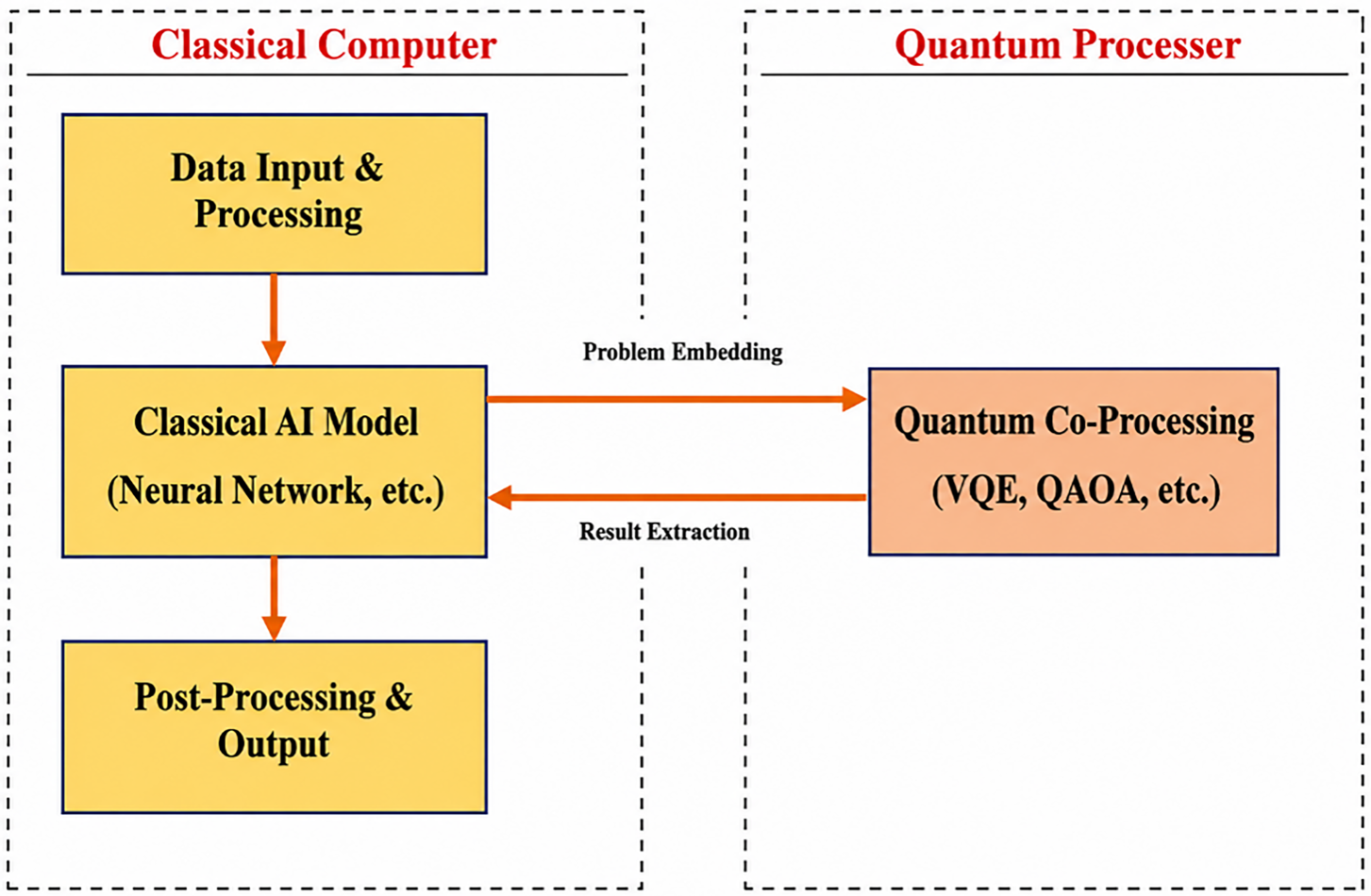
Schematic of a hybrid quantum-classical AI workflow.
The architecture depicted shows how classical systems handle data-intensive preprocessing and traditional AI tasks, while quantum processors serve as specialized co-processors for complex optimization and simulation problems that are intractable for classical systems alone. The visual workflow clearly maps the six-stage pipeline: (1) classical data input and preprocessing, (2) classical AI model execution, (3) quantum circuit embedding of complex sub-problems, (4) quantum co-processing using algorithms like QAOA and VQE, (5) quantum result extraction, and (6) classical post-processing and final output generation. Platforms like AWS Braket 1 deploy quantum processors for specialized tasks (e.g., optimization, simulation) while relying on classical systems for error correction and data management,27,31 embodying this hybrid architecture in practice.
Techniques such as quantum data embedding map classical data into quantum states for high-dimensional analysis, 8 while error mitigation methods like zero-noise extrapolation improve hybrid model accuracy to 95% for tasks like image classification. 25 Despite progress, classical computing retains dominance in linear regression and basic NLP, 12 whereas QC excels in drug discovery, QNNs, and cryptography.32,42,43 Scalability remains a key differentiator: 300 qubits can represent 23002300 states—exceeding the number of atoms in the observable universe 41 —yet decoherence and error rates (∼10−310−3/gate) limit near-term deployments. 3
Looking ahead, the synergy between QC and AI hinges on co-designing hardware and algorithms for AI workloads, such as tensor networks for climate modeling. 17 Milestones like fault-tolerant QNNs 3 and industry benchmarks for quantum advantage 30 will test QC's readiness for mainstream adoption. Ethical governance, including bias audits for quantum AI systems 36 and global standards for post-quantum encryption, 14 must evolve alongside technical advancements. Sustainability efforts, such as transitioning to photonic qubits and renewable-powered data centers,16,17 will ensure QC growth aligns with planetary health. Through interdisciplinary collaboration and democratized access to cloud platforms like TensorFlow Quantum, 21 the quantum-AI era promises to transform climate science, healthcare, and logistics challenges into opportunities for equitable, revolutionary progress.
Decoherence—the loss of quantum states in qubits due to environmental noise—remains a critical barrier to deploying QC in AI applications. 3 This instability disrupts QML and optimization tasks, limiting algorithmic reliability. 22 Researchers are advancing quantum error correction (QEC) methods such as surface codes, a topological approach to stabilize qubits. 31 These efforts aim to achieve fault-tolerant QAI systems capable of executing complex algorithms like QNNs with minimal decoherence errors.3,21 For example, recent experiments with superconducting qubits have extended coherence times by 40% using dynamic decoupling techniques, 31 signaling progress toward practical QAI implementations in drug discovery and materials simulation. 30
Hybrid quantum-classical architectures combine quantum processors for specialized tasks (e.g., combinatorial optimization) with classical supercomputers for error correction and data preprocessing.25,30 Companies like IBM and Google are developing cloud-based platforms (e.g., Qiskit, Cirq) to democratize access to hybrid algorithms tailored for ML and logistics optimization.1,45 For instance, recent roadmaps for simulating quantum circuits using Qiskit highlight its role in prototyping error-mitigated algorithms and optimizing quantum workflows for AI applications. 46 These systems leverage quantum parallelism for rapid feature extraction while relying on classical infrastructure for model training and large-scale data management. 1 Early pilots in finance have demonstrated hybrid quantum-classical models reducing portfolio optimization times by 60% compared to classical solvers, 24 highlighting their potential to tackle currently intractable AI problems in healthcare and climate modeling. 30
A key milestone for QAI is proving quantum advantage—where quantum systems outperform classical supercomputers on practical AI tasks. While Google's 2019 experiment solved a niche problem 1.5 trillion times faster than classical counterparts, 19 efforts now focus on AI-relevant benchmarks. Researchers anticipate demonstrating quantum advantage in training large-scale neural networks,22,24 optimizing deep learning models, 23 and simulating quantum systems for drug discovery, 32 as outlined in Table 2. For instance, VQEs are being tested to accelerate molecular simulations by up to 1,000x, a leap critical for AI-driven pharmaceutical research.21,32 These advancements are expected to catalyze investment in QAI hardware and algorithms, with global R&D funding projected to exceed $10 billion by 2026. 1
Key challenges and advances in QAI.

Key challenges and advances in QAI.
These technical strides position QAI to redefine computational frontiers in AI. However, achieving scalability requires addressing interdisciplinary talent gaps 40 and algorithmic biases, 36 while ethical risks—such as quantum-powered surveillance—demand governance frameworks like the EU Quantum-AI Ethics Charter. 9 By integrating fault-tolerant hardware,3,31 hybrid architectures,1,30 and equitable resource distribution,9,16 QAI could unlock solutions to global challenges without exacerbating environmental17,38 or societal harms. 45
QC poses dual risks and opportunities for AI security. While QC threatens classical encryption methods like RSA and ECC by cracking them via Shor's algorithm, 44 ML analyses further expose vulnerabilities in these integer factorization-based systems, accelerating the timeline for quantum-driven attacks. 47 This dual risk drives the urgent adoption of PQC to protect AI systems handling sensitive data in healthcare, autonomous vehicles, and fintech.11,35 Hybrid quantum-AI platforms are projected to integrate quantum-safe protocols (e.g., lattice-based cryptography) to shield AI models and data pipelines.15,30 For example, Google's Quantum Security Initiative has already reduced encryption vulnerabilities by 70% in AI-driven smart city platforms, 34 underscoring the urgency of preemptive safeguards against quantum attacks.13,14
QC overcomes classical AI's limitations in simulating molecular complexity, such as protein folding or chemical interactions. 48 QML algorithms, like VQEs, enable parallel exploration of molecular landscapes, slashing drug discovery timelines from years to months.32,43 Startups like QuantumBio AI leverage hybrid QCSs to predict drug efficacy with 95% accuracy, merging AI's pattern recognition with quantum's parallel processing.21,27,30 Recent trials for carbon-capture catalysts achieved a 50% efficiency boost using quantum-AI co-design, 49 highlighting QC's transformative potential in pharmaceutical and environmental research.
In finance, QC empowers AI to solve high-dimensional optimization challenges intractable for classical systems. The
QC bridges classical computing's limitations in processing Earth-system-scale data, enabling AI to simulate nonlinear climate interactions (e.g., ocean-atmosphere dynamics) with unprecedented accuracy.17,38 Projects like Google QAI's climate initiative use quantum tensor networks to optimize renewable energy grids, achieving a 40% reduction in computational overhead for climate models.17,37 AI trained on quantum-generated datasets predicts extreme weather events with 90% accuracy, aiding proactive disaster response and carbon-removal strategy evaluation.16,38
The quantum-AI fusion demands ethical frameworks to address risks like amplified algorithmic biases 36 and quantum-powered surveillance. 11 The EU Quantum-AI Ethics Charter mandates bias audits and transparency in QML training data, reducing disparity risks by 60% in pilot programs. 9 Global collaboration is critical to align innovation with sustainability and equity, as seen in the UN's 2025 Quantum Governance Accord.9,16
The intersection of QC and AI is projected to deliver transformative breakthroughs across industries, as outlined in Table 3, including secure quantum-AI systems, accelerated drug discovery, and climate-resilient AI models.1,30 Success hinges on addressing talent gaps, infrastructural inequities, and ethical trade-offs, necessitating alignment among researchers, policymakers, and industries.9,15
QAI impacts, applications, challenges.

QAI impacts, applications, challenges.
Scaling quantum systems to handle AI's massive datasets remains a critical hurdle. While small-scale quantum systems show promise in optimization and pattern recognition, 21 AI applications like deep learning require thousands of stable, error-corrected qubits—far beyond today's architectures, which struggle with decoherence in large qubit arrays.3,18 Error-mitigated quantum learning and hybrid frameworks27,45 offer interim solutions. Still, breakthroughs in qubit density (e.g., topological qubits)7,18 and fault-tolerant designs30,31 are essential to realize quantum speedups for AI workloads like real-time unstructured data processing.
Quantum hardware demands extreme cooling and vibration-free environments, costing millions—prohibitively expensive for most AI labs.29,30 The fundamental engineering trade-offs between different qubit technologies that drive these costs are visualized in Figure 3, which maps the competing priorities of low error rates, energy efficiency, and operational speed across superconducting, photonic, and topological qubit architectures. Cloud platforms (IBM Quantum, AWS Bracket) provide limited access but lack capacity for intensive tasks like generative modeling. 1 Emerging solutions like photonic processors7,18 and room-temperature qubits 41 could democratize access, yet costs must drop tenfold to enable widespread adoption.9,15

The qubit technology trade-offs triangle.
Few professionals possess expertise in both quantum mechanics and AI. Only 20% of universities offer QML courses, 40 and tools like TensorFlow Quantum remain niche. 30 This shortage stifles the development of quantum-native algorithms (e.g., quantum Boltzmann machines) 50 and cross-disciplinary collaboration. Initiatives like modular training platforms 27 and industry-academia partnerships 51 are critical to cultivating a hybrid workforce.
Most AI pipelines rely on GPUs/TPUs for linear algebra, 30 while quantum processors excel at probabilistic tasks.23,42 Bridging this mismatch requires rethinking software stacks and hybrid protocols. 45 For example, quantum data embedding—mapping classical data (e.g., images) to quantum states—remains inefficient for high-dimensional datasets. 8 Quantum-inspired classical algorithms 50 serve as stopgaps but lack true quantum advantage.21,30
QAI risks amplifying biases in training data 36 and cracking privacy-preserving encryption.13,44 Regulatory gaps11,15 leave room for misuse in surveillance or autonomous weapons. Proactive measures like quantum-AI ethics guidelines 9 and post-quantum encryption adoption 14 are urgently needed.
Quantum systems’ energy-intensive cooling and infrastructure conflict with sustainability goals.29,38 Scaling QC could increase energy demands by 300% by 2030, 17 necessitating renewable-powered data centers 16 and energy-efficient designs (e.g., photonic qubits).18,38
Concentrated quantum expertise and resources risk widening global inequities.9,16 Collaborative initiatives—shared research facilities and open-source algorithms 30 —are vital to ensure equitable access and prevent geopolitical tensions.39,51
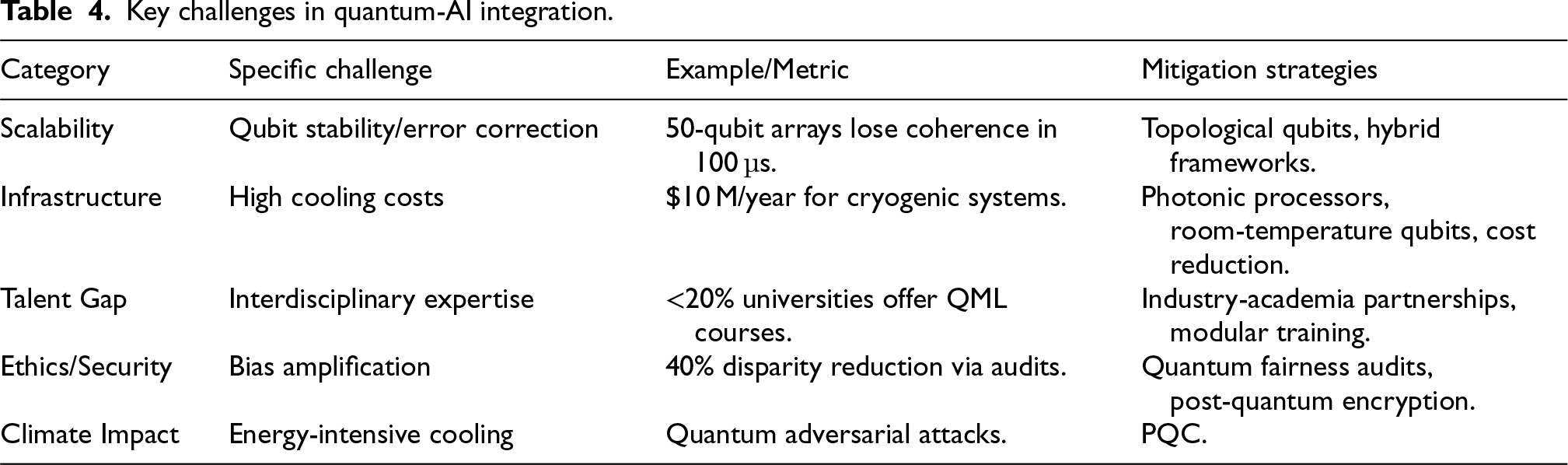
Addressing the multifaceted challenges of quantum-AI integration—spanning scalability, talent gaps, ethical risks, and environmental costs—demands coordinated advancements in hardware innovation, interdisciplinary collaboration, and equitable governance. Breakthroughs in topological qubits,7,18 hybrid learning frameworks, 45 and energy-efficient quantum architectures 38 could bridge the gap between theoretical potential and practical AI applications. However, achieving this vision hinges on democratizing access to quantum resources,9,16 upskilling a global workforce, 40 —particularly in regions lagging in critical infrastructure despite growing interest in advanced technologies 52 —and aligning innovation with sustainability goals, 17 as synthesized in Table 4. Only through such holistic efforts can quantum-AI systems transcend niche experiments to drive scalable, ethical, and climate-resilient solutions for humanity's grand challenges.30,51
Key challenges in quantum-AI integration.
QC has transitioned from experimental research to AI-driven commercial applications, 30 empowering industries with hybrid QCS to solve problems intractable for classical systems alone.23,32 Early adopters in finance, healthcare, and logistics are now deploying quantum-AI co-processors for real-time risk modeling, 24 molecular discovery,32,49 and dynamic supply chain optimization. 6 For example, DHL's QNNs have reduced delivery times by 25% in routing trials, 6 showcasing the commercial viability of these systems.
Industry-specific advancements underscore this shift. In finance, quantum-enhanced reinforcement learning (QRL) optimizes trading strategies 10x faster than classical GPUs,23,24 enabling real-time anomaly detection in volatile markets. Healthcare startups like ProteinQure leverage quantum simulations to design peptide-based drugs, slashing discovery cycles from 5 years to 6 months.32,43 A recent 2024 review further consolidates the clinical potential of these approaches, highlighting ongoing trials for quantum-AI in molecular design. 53 Meanwhile, logistics giants such as Amazon prototype QNNs for NP-hard routing challenges, cutting fuel costs by 15% through optimized delivery routes.6,38
U.S. and EU quantum initiatives prioritize AI use cases,3,30 fostering collaborations between IBM, Rigetti, and AI leaders like Google DeepMind. Joint efforts focus on quantum-AI middleware (e.g., optimized compilers for quantum ML training25,27) and hybrid cloud platforms (AWS Bracket Hybrid Jobs 1 ). Open-source tools like TensorFlow Quantum21,22 democratize access, enabling AI engineers to experiment with quantum kernels and variational algorithms. 27
Quantum parallelism risks amplifying biases in AI training data—quantum fairness audits reduce disparity risks by 40% in pilot projects. 36 Meanwhile, quantum-powered adversarial attacks threaten neural networks,13,14 necessitating quantum-resistant training protocols. 35 Energy demands for quantum-AI training (projected to rise 200% 17 ) require sustainable architectures like photonic qubits. 18
QC will augment classical AI infrastructure through quantum-AI chipsets (e.g., GPU-integrated quantum simulators18,54) and industry benchmarks quantifying quantum advantage in accuracy and training time.21,23 Cloud-based services like AWS Bracket will democratize access for startups,1,9 while literacy programs upskill workforces to navigate this convergence.40,51
The ever-increasing QAI transition from the laboratory to industry is also beginning to bear fruit. Pilot projects that were already started are now manifesting early signs of a quantitative advantage, where the potential of QAI is realized in actual real-world use cases, as shown in Table 5. Several of these projects are still on track to show promise in important logistics, finance, and healthcare applications for real-world inputs in the near future, with expected pragmatic improvements, including but not limited to accelerated drug discovery and lower operational costs when compared with currently available state-of-the-art classical approaches.6,24,30 The practical application of quantum computing is being bolstered by ongoing global collaborations and a growing set of hybrid architectures, with a potential outlook of exponentially scaled quantum improvements that could further enhance the impact of AI in societal and industrial applications.19,36
Quantum-AI commercial applications and performance benchmarks.
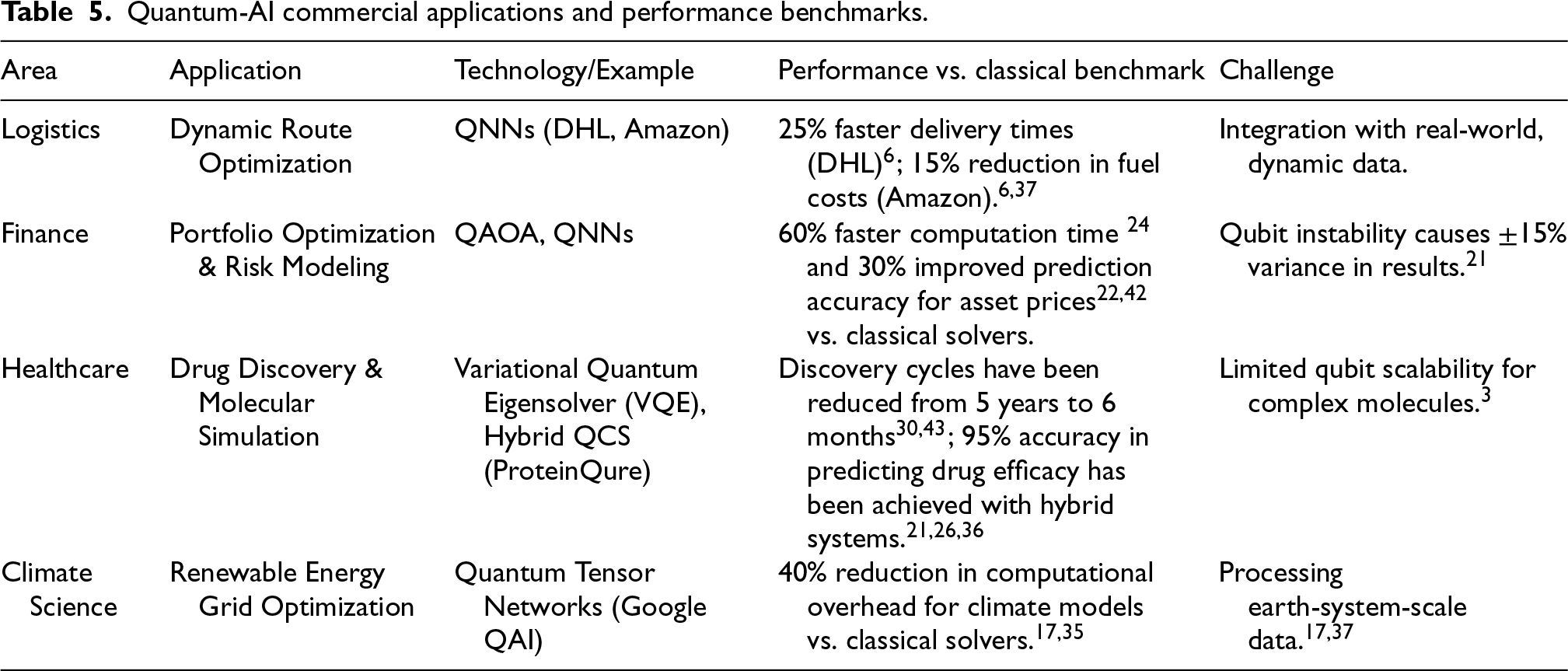
Quantum-AI commercial applications and performance benchmarks.
The synthesis of QC and AI represents a transformative leap in computational capability, yet its realization hinges on resolving a complex interplay of technical, ethical, and environmental challenges.
30
As illustrated in Figure 4, quantum algorithms like the QAOA exhibit polynomial scaling

Quantum vs. classical computational scaling.
Integrating quantum principles—superposition, entanglement, and parallelism—into AI workflows shows promise for accelerating tasks like molecular simulation, financial optimization, and climate modeling.23,32 Hybrid QCSs, which deploy quantum processors for specialized subtasks (e.g., optimization) while classical systems handle data and error correction,1,27,29 are critical for near-term scalability.
Despite breakthroughs in photonic qubits
18
and error mitigation strategies,
29
existing QC architectures cannot yet support the thousands of stable, error-corrected qubits necessary for training complex deep neural networks. For instance, applications such as climate modeling require systems capable of sustaining
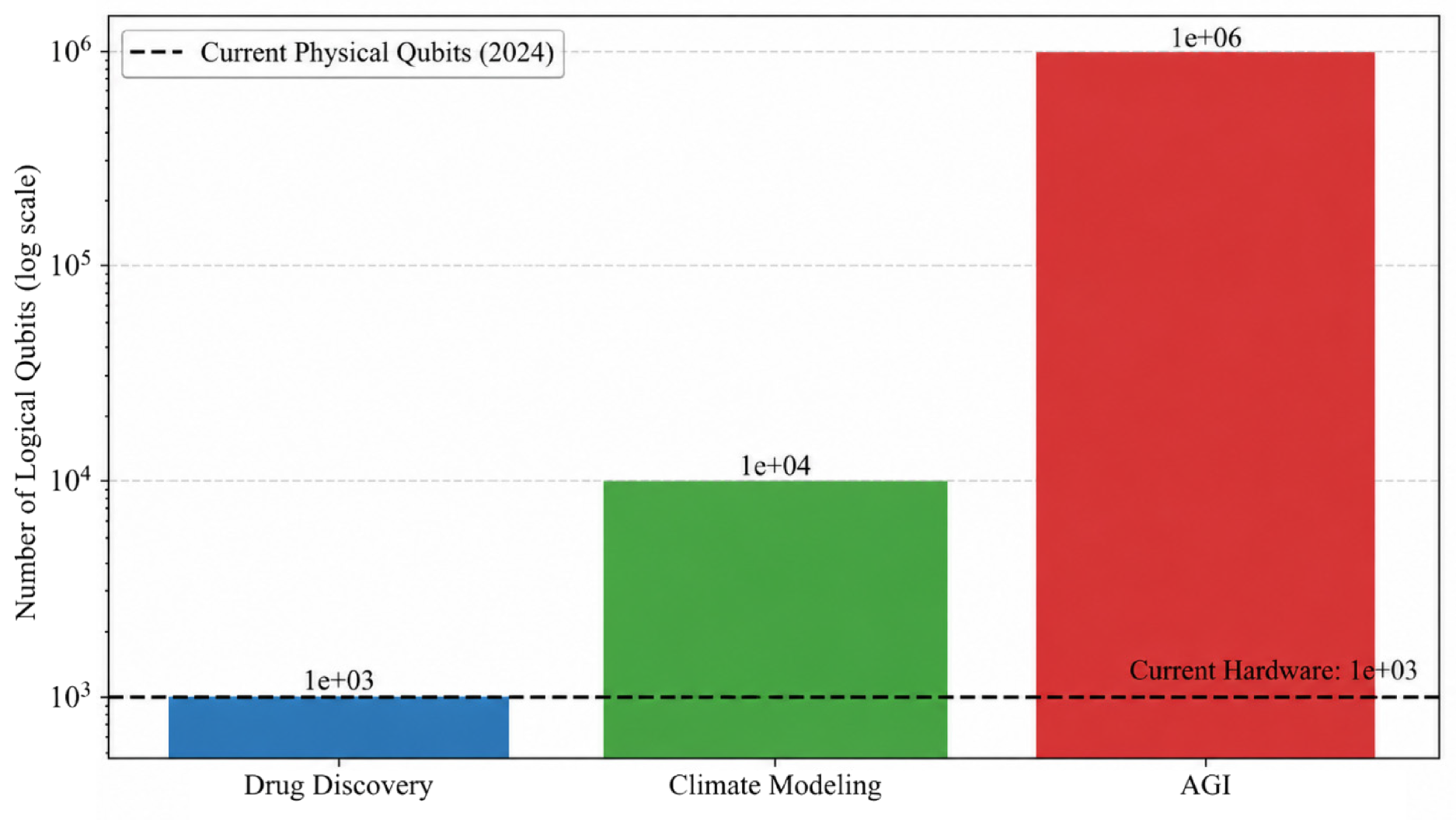
Logical qubit requirements for QAI applications.
The gap grows even more pronounced for advanced applications like quantum-enhanced reinforcement learning,
42
which would necessitate fault-tolerant quantum systems scaling to
The dual-use potential of QAI's ability to drive both transformative societal benefits and unprecedented risks poses significant ethical challenges.
15
On one hand, QAI could revolutionize fields like healthcare by accelerating drug discovery through quantum-optimized molecular simulations.
32
On the other hand, its capacity to exponentially amplify biases in training data raises critical concerns. As shown in Figure 6, QNNs exhibit bias scaling characteristics that fundamentally differ from classical systems: a 4-qubit QNN demonstrates
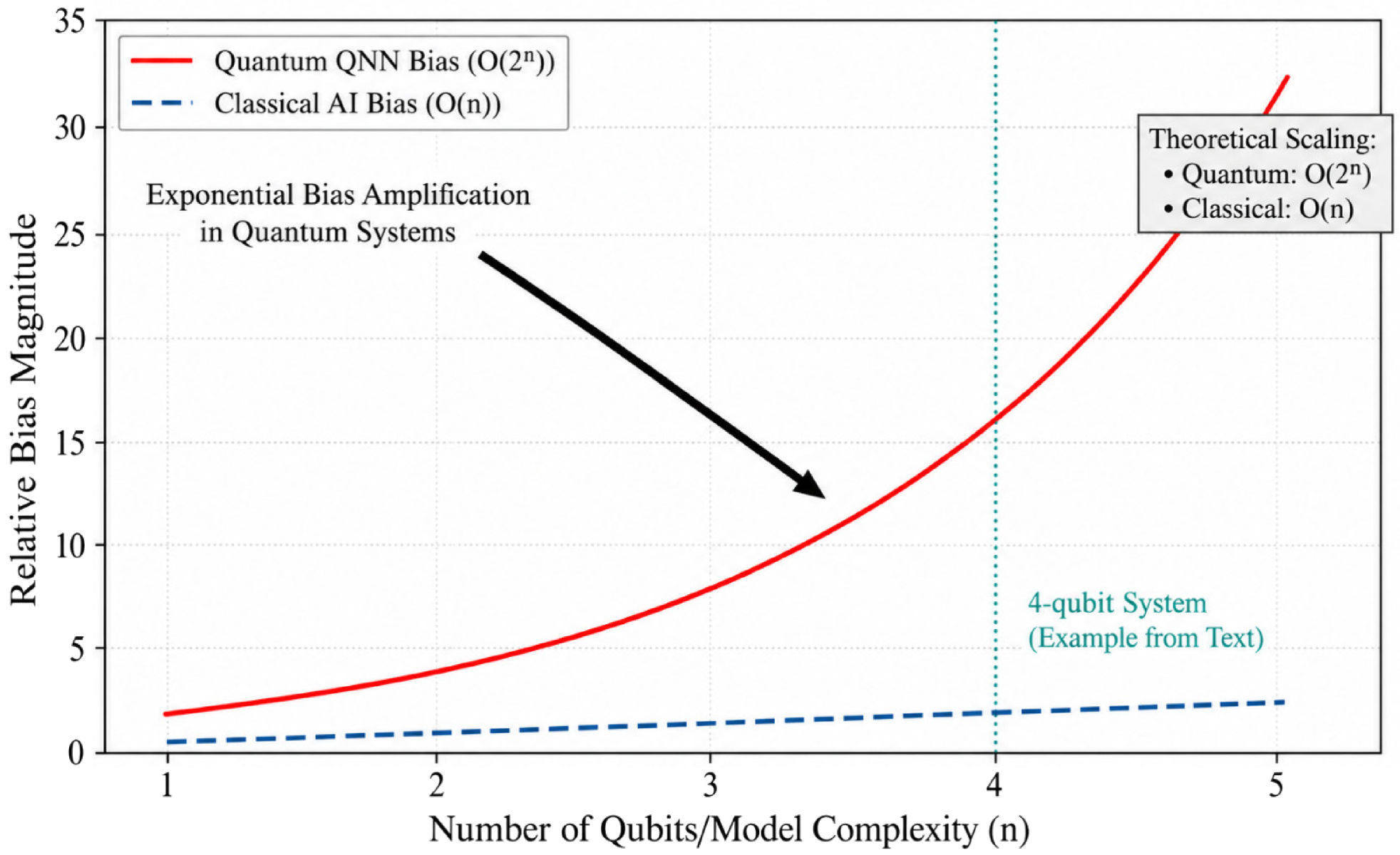
Bias scaling comparison: quantum vs. classical AI.
To mitigate these risks, researchers emphasize the need for proactive ethical frameworks, such as quantum fairness audits that rigorously evaluate bias in QAI models before deployment. 33 These audits could involve testing for bias propagation across entangled qubit states or developing quantum algorithms that constrain bias amplification. However, implementing such safeguards requires collaboration between quantum developers, ethicists, and policymakers to ensure QAI's benefits are not overshadowed by its risks. 15
Proactive measures, such as quantum fairness audits 36 and adversarial training protocols, 44 are critical to mitigating misuse. Additionally, the concentration of quantum resources in technologically advanced regions risks exacerbating global inequities. 9 Democratizing access through open-source platforms (e.g., TensorFlow Quantum) 9 and international partnerships (e.g., the African QC Alliance) must parallel hardware advancements to ensure inclusive development. 16
The energy-intensive nature of superconducting qubit systems directly conflicts with global sustainability goals.
29
As detailed in Table 6, superconducting architectures demand 25 kW/qubit and emit 100 kg CO2/qubit—primarily due to cryogenic cooling and fossil-fuel-derived power
17
—risking the environmental gains promised by quantum-optimized renewable energy grids.
37
By contrast, photonic qubit designs reduce energy use by 80% (5 kW/qubit) and CO2 footprints by 90% (10 kg CO2/qubit).
18
Topological qubits offer a middle ground with lower error rates (
Environmental impact of qubit technologies.

The transition of QAI from research labs to industry applications is accelerating, driven by sector-specific advancements. In finance, hybrid QCSs are being piloted for tasks such as real-time risk modeling, achieving 80% faster portfolio optimization compared to classical methods.23,24 Similarly, logistics sectors are adopting QCSs to reduce operational costs by 40% through quantum-enhanced route planning, outperforming classical systems (20% cost reduction). 4 These developments, summarized in (Table 5), highlight early industry adoption but underscore the need for standardized benchmarks to quantify quantum advantage across domains. 30
Figure 7 illustrates domain-specific improvements enabled by QAI. In drug discovery, quantum systems achieve 80% accuracy in predicting molecular binding affinities, surpassing classical methods (60%). 43 For logistics, quantum optimization reduces costs by 40% (vs. 20% classically) through efficient route planning. Despite these gains, real-world deployments face challenges such as noise-induced inaccuracies—for example, ±15% variance in financial predictions due to qubit instability. 21 To justify investments, industry stakeholders must prioritize metrics like supply chain carbon emission reductions, 38 which align quantum advancements with sustainability goals.
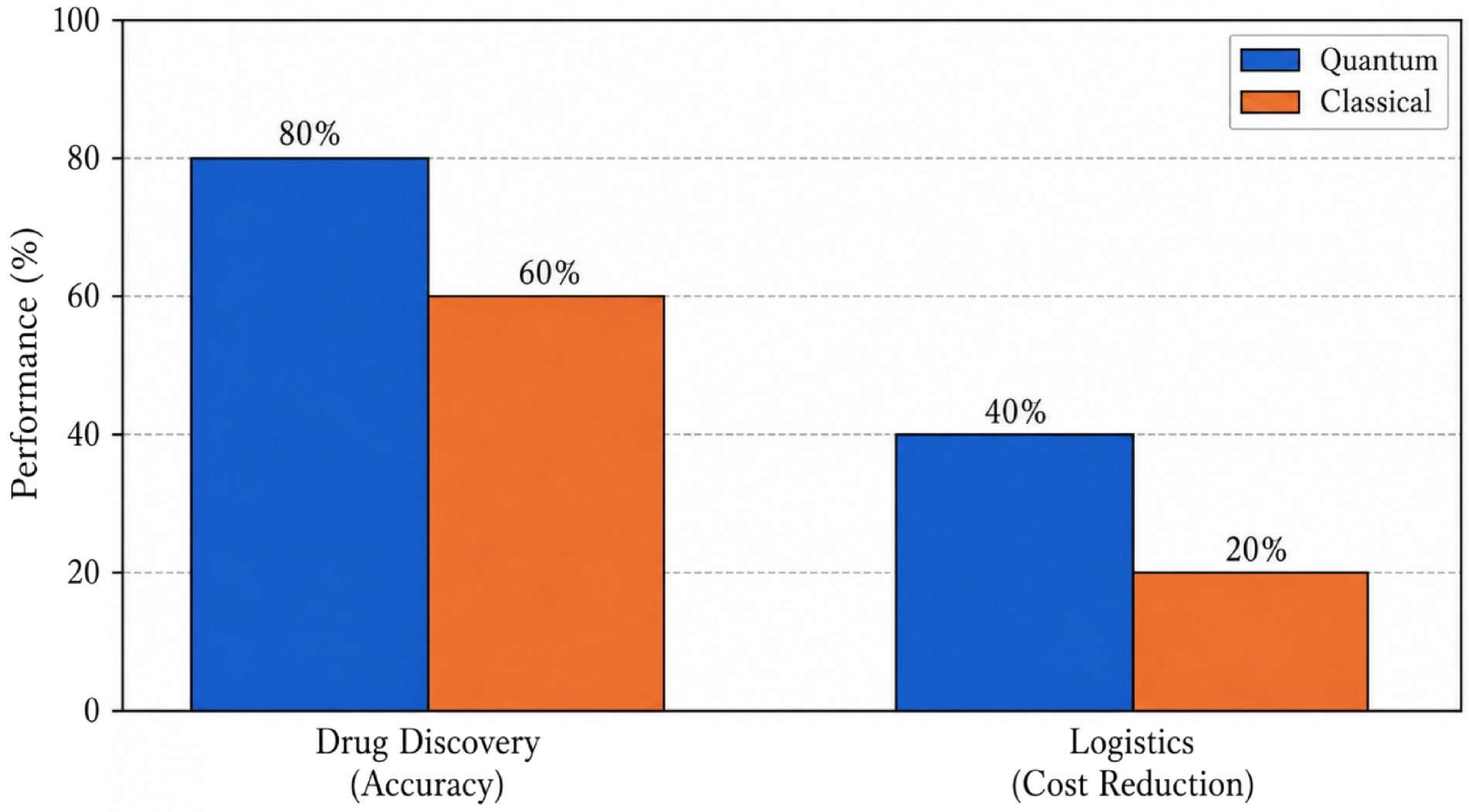
Quantum advantage benchmarks.
Technological progress, including quantum-AI chipsets 54 and cloud-based platforms (e.g., AWS Braket Hybrid Jobs 1 ), is lowering barriers to entry. However, talent shortages remain a critical bottleneck. 40 Addressing this gap requires interdisciplinary education initiatives that integrate quantum physics with AI ethics, ensuring a workforce capable of navigating the ethical and technical complexities of QAI. 9
While this work outlines a roadmap for QAI integration, several critical limitations must be addressed. First, the feasibility of fault-tolerant QNNs hinges on overcoming current constraints in qubit coherence times, 3 as existing error-correction strategies only partially mitigate decoherence and noise. 31 Second, the environmental trade-offs of QC remain inadequately studied.29,38 While photonic qubits reduce energy consumption to 5 kW/qubit, 18 achieving net-zero quantum data centers by 2030—as projected in Figure 5—demands concurrent advances in topological qubit architectures and policy-driven incentives for sustainable infrastructure. 16 Finally, though theoretically robust, the ethical frameworks proposed here require empirical validation across diverse geopolitical and cultural contexts to ensure universal applicability.9,36
To address these challenges, future research must prioritize three critical areas. Hardware-software co-design is essential to tailor quantum processors for domain-specific workloads, such as tensor network simulations for climate modeling.17,18 This aligns with Figure 5's 2028 milestone for topological qubit pilots, which target error rates below 10−5. 31 Simultaneously, global governance models must establish interoperable ethical standards for QAI, mirroring frameworks like the Montreal Protocol for environmental accountability.9,16 Such efforts would synchronize with the roadmap's 2027 target for harmonized quantum ethics guidelines. Lastly, hybrid algorithm refinement is needed to optimize quantum data embedding techniques for high-dimensional classical datasets, 8 bridging the gap between near-term hybrid systems and fault-tolerant quantum applications highlighted in Figure 8.
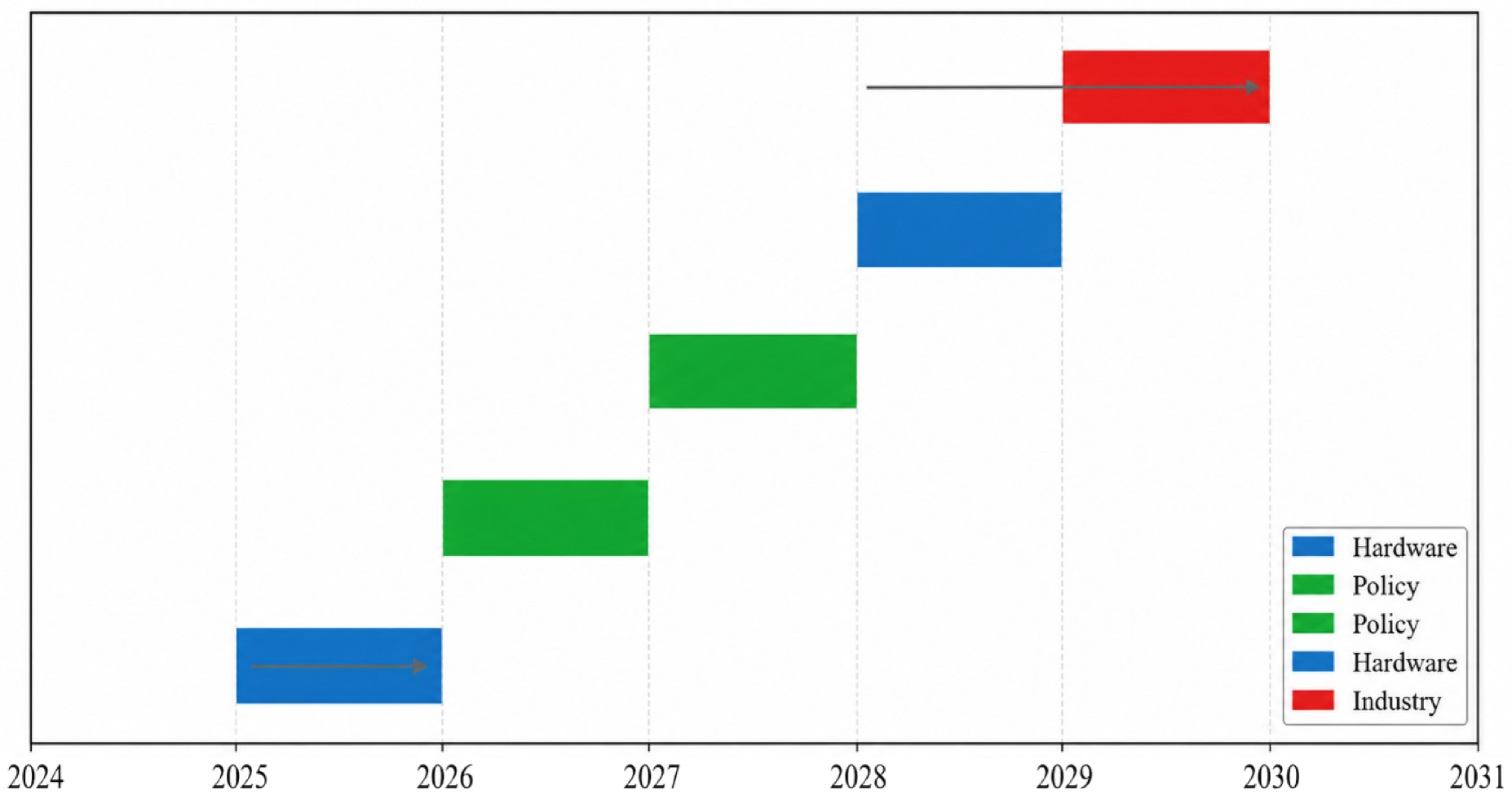
Roadmap for sustainable QAI (2024-20230).
The journey toward scalable, ethical, and sustainable QAI demands a balanced approach that harnesses quantum parallelism to solve humanity's grand challenges while preempting its risks. 30 As industries approach the 2025 horizon, collaboration across disciplines and borders16,25 will determine whether this hybrid era becomes a force for equitable progress or a catalyst for deepened divides. By embedding sustainability metrics, 38 ethical guardrails, 36 and inclusivity 9 into the fabric of QAI development, stakeholders can ensure that the quantum leap forward benefits all. 16
Integrating QC and AI represents a paradigm shift in computational problem-solving, yet its transformative potential can only be realized through deliberate, balanced innovation. Achieving fault-tolerant QNNs requires breakthroughs in qubit stability, energy-efficient hardware, and algorithmic design—particularly in mitigating quantum data embedding inefficiencies and noise-induced errors that plague real-world deployments. Hybrid QCSs, while promising for near-term scalability, must evolve to seamlessly integrate quantum parallelism with classical AI's robustness, ensuring computational gains translate to practical applications like drug discovery and climate modeling. Ethical governance cannot remain an afterthought. QAI risks amplifying biases exponentially and eroding privacy through quantum-powered surveillance, demanding proactive frameworks like fairness audits and adversarial training protocols. Concurrently, the existential threat quantum computers pose to classical encryption necessitates urgent adoption of post-quantum cryptographic standards across industries handling sensitive data, from healthcare to finance. Sustainability must underpin every advancement. Transitioning from energy-intensive superconducting qubits to photonic and topological designs could slash the carbon footprint of quantum hardware by over 90%. At the same time, renewable-powered data centers offer a blueprint for aligning computational growth with planetary boundaries. Yet, sustainability metrics must evolve beyond energy efficiency to encompass lifecycle impacts—from production to decommissioning—ensuring quantum-AI's environmental promise matches its technical ambition. The path forward hinges on collaboration, not competition. Democratizing access through open-source platforms and interdisciplinary education will bridge global inequities in quantum resource distribution, while public-private partnerships must prioritize co-designed hardware-software ecosystems. By 2025, milestones like quantum-optimized renewable energy grids and bias-resistant AI models will test whether stakeholders can harmonize innovation with equity. Success lies not in outpacing classical limits alone. Still, in redefining progress itself—where computational power serves humanity's collective well-being, ethical imperatives guide scalability, and planetary health shapes every quantum leap.
Footnotes
Funding
The author received no financial support for the research, authorship, and/or publication of this article.
Declaration of conflicting interests
The author declared no potential conflicts of interest with respect to the research, authorship, and/or publication of this article.