



Abstract
This article examines the use of player-controlled avatars on digital gambling platforms and apps. Through a discussion of the influential, but now defunct, online gambling platform PKR ‘The Second Life of gambling’ the article illustrates how the avatar has a key role in the routinization of online gambling and cultivating affective investment from gamblers. The process of creating, maintaining and updating avatars promotes spending winnings in-house as the house now provides digital items that allow players to personalize their avatars. For gamblers, the affective investment in avatars adds a crucial qualitative and social dimension to what is otherwise a game of numbers and odds. The customizable avatar introduces a qualitative uncertainty by creating the possibility for indirect communication through avatar appearance, accessories and gestures, which reconnects online poker to face-to-face gambling through traditions such as bluffing. Affective investment in the avatar thus creates a feeling of co-presence between gamblers while gamblers and gambling platforms.
In the past decade, a wide variety of games of chance such as online poker and online slots have expanded their expressive, experiential and affective capacities through the incorporation of the cultural dynamics of social media sites and apps, and digital games. Among these dynamics, the creation of digital avatars is one of the most significant innovations for gambling platforms. Gambling avatars are created for online casinos and mobile gambling apps and allow gamblers to tailor how they appear to other gamblers. Avatars mediate gamblers’ interactions in digital spaces and add a role-playing dimension to games of chance. Digital entertainment and gambling companies have recognized the creative and affective labour involved in the creation and maintenance of avatars. They have also taken note of the monetary value inherent in avatars, as well as the opportunities for profit in avatar design.
This article brings together literature on the technocultural history of gambling devices and academic research on avatars as sites of affective and creative labour. Through a discussion of the now defunct online casino PKR, we argue that the presence of avatars in digital gambling spaces alters the cultural and media dynamics of digital gambling. This change comes via the intensification of the affective and creative investment from the gambler. A sense of gambling against ‘real’ people is created, which heightens the possibility of deception and being deceived, known as bluffing in gambling, and greatly valued as a critical element of poker and its variants. Avatar-based gambling also marks a substantial shift in everyday gambling that brings great benefits for the gambling provider or house, as the investments of affect and capital are increasingly contained within the house itself, reconceptualized as a social app or platform.
Digitizing the gambling experience
The recent history of gambling industries is closely related to media change, and the digitization of gambling practices. This is evident in both terrestrial games (e.g. slot machines or roulettes in casinos) and screen-based gambling technologies (online poker and slot apps, for instance). Contemporary digital gambling draws from the design of analog gambling technologies but incorporates the expressive capacities of digital entertainment media. Gambling companies employ engineers, designers and psychologists to manufacture products that engage gamblers intensely and utterly. Thus, contemporary gambling does not involve the mere consumption of risk, but a media experience from which players can get entertainment value. Gambling companies like Aristocrat Limited and IGT, two leading slot machine manufacturers, have released products branded with Hollywood franchises such as the TV show The Walking Dead and the James Cameron film Avatar, and celebrities such as Ellen DeGeneres. Gamblers are more likely to play a particular machine if it speaks to their existing desires and cultural affiliations. We argue that the incorporation of avatars into the design of gambling experiences continues this trend of providing gamblers with more than just the opportunity to consume risk. Gamblers also consume social interaction, an entertaining experience and the chance to earn social capital through constant play, that Albarrán-Torres (2018) calls ‘gamble-play’. This in turn adds to the risk and uncertainty associated with the pleasurable intensities of gambling as it reinforces the ‘realness’ of what is at stake.
To understand contemporary digital gambling applications that remediate slots and poker, it is important to briefly explore how technology has been used to shape intensive gambling experiences. For example, a particular concern for casino gambling was the materiality of coins, as both ‘wins’ from the machines, and the need to get more coins to cover ‘losses,’ created points of disruption in the smooth flow of gambling. Thus, cashless terrestrial casinos were pioneered to facilitate patrons spending more ‘time-on-device’ (Schull, 2012: 58). The gambling industry’s interest in this design configuration, based on smoothing the transition into gambling while also removing reasons to stop gambling, led them to develop a complex understanding of the machine gambler. Increasingly, they recognized that the Las Vegas holidaymaker was no longer the most important consumer, as the majority of the industry’s profits came from everyday, low-stakes gamblers, who were often locals. The figure of the local, low-stakes, everyday machine gambler contrasted starkly with the glamorous image of Las Vegas, where globe-trotting, high-rolling elites gathered around high-stakes gaming tables.
In Natalia Dow Schull’s (2012) history of machine gambling in Las Vegas, she pinpoints several key shifts in the design of the ‘gambling experience’ during the latter half of the 20th century. She notes the interest of the casino industry in designing the environment where the gambling machines were located. This was achieved particularly by the triangulation of ambient affects in order to produce experiences that made people more likely to gamble. In a parallel development, the gambling industries also began to consider the design of gambling machines in more nuanced ways that emphasized the intersection of the software experience with the spatial and environmental experience of the casino floor. In this vein, the design of online casinos where digital poker is played draws from architectural traditions of brick-and-mortar gambling spaces in that they set spatial and temporal rules that momentarily demarcate the gambling space from the rest of everyday experience. However, because desktop and mobile gambling apps can be accessed by players anywhere, and at any time, the relationship between the players and ‘the house’ is considerably disrupted. The introduction of avatars from digital games to gambling apps and platforms suggests a strategy of complicating this disassociation by re-establishing a spectacular – albeit virtual – dimension to everyday digital gambling practices.
In this article, we argue that the remediation of machine gambling to the gambling app by the gambling and social games industries encapsulates the intensification of their interest in the technological management of affective states. Using gambling apps is a markedly different experience from being on the ‘floor’ of a casino. But rather than creating a spectacular rupture where gambling is an exception, casino apps offer gamblers more control over the ambience of their gambling experiences because they can blend the experience more-or-less seamlessly with other activities and multiple locations (see Hjorth and Richardson, 2014). Through gambling apps, gambling becomes one of many activities that is made available through the mobile device and can be used to module affective states.
Affective investment
The etymology of ‘avatar’ originates from Sanskrit for the terrestrial incarnation of a deity (Basu Thakur, 2015). It entered the popular and technical languages of digital gaming during the course of the 1980s and 1990s. In digital gaming, an avatar is usually understood as the graphical representation of the user in a virtual space. Typically, contemporary graphic or visual avatars take a three-dimensional form, such as Desmond Miles and Altaïr Ibn-La’Ahad in Assassin’s Creed (Ubisoft Montreal, 2007). Avatars have a functional role as they provide a tool for locating the player in virtual space and thus enabling the navigation, exploration and mapping of that space (Fuller and Jenkins, 1995; Newman, 2002). However, the avatar is more than just a functional device. It has become a way of embedding character in digital games (Aldred, 2012), which establishes emotional identification with the avatar (Isbister, 2016: 11–12). The incorporation of avatars into digital gambling experiences heightens the emotional investment of gamblers while strengthening the relationship between them and ‘the house’. Avatars are key in the cultural and media process through which gambling is increasingly transforming from an episodic event to an everyday experience in desktop and mobile apps through different games of chance that include slots and poker.
The avatar concept has been extended to describe the user’s online alter ego, in the sense of how someone who self-represent online may be different from their ‘actual’ selves (Coleman, 2011; D. Miller, 2011). In such cases, what constitutes an avatar may vary widely, and generally the term includes the following:
Operator-controlled three-dimensional figures, which are used in game-like virtual worlds, for example, Second Life (Linden Lab, 2003), and in the digital games, for example, Overwatch (Blizzard, 2016);
Operator-controlled two-dimensional figures, which are also used in game-like virtual worlds, for example, Whyville; and in digital games, for example, Child of Light (Ubisoft Montreal, 2014);
A customizable icon that is used to represent the user in Internet forums and social networking sites, for example, on Twitter the picture that appears beside a tweet is called the user’s ‘avatar’ (Marwick, 2013: 309);
A text-based persona a player takes on in an MUD (multi-user dungeon) or MOO (MUD object oriented) (V. Miller, 2011: 173).
The notion of ‘avatar’ is deployed to demarcate the difference between the private individual and the public performance of their persona through social media (D. Miller, 2011: 66). The avatar is a performance of the self to public audience which creates a sense of ‘co-presence’ (D. Miller, 2011: 74). Co-presence is a computer-augmented sense of ‘being together’ (Schroeder, 2006), which is often associated with avatar-based platforms (Coleman, 2011: 18). The introduction of avatars on gambling platforms seeks to capitalize on this sense of co-presence to raise the stakes of online gambling by emphasizing its social dimensions.
In digital gambling, co-presence involves not only a swift transmission of player inputs and game dynamics but also reliable and real-time financial transactions. Play and monetary transactions need to take place in real time to allow for the temporal flow of traditional gambling experiences to translate into digital spaces. With the improvement of Internet speed in desktop and mobile gambling, lag is uncommon in the more established online and mobile casinos. The online gambling industry has implemented certifications that enhance user trust by guaranteeing the reliability of the software. The gamblification of the avatar takes place in this context of reliability and securitization through the implementation of a defined, stable, and platform-endorsed online persona.
Avatars may have a carefully designed ‘character’ through which the player experiences the game, for example, Link in Legend of Zelda: Breath of the Wild (Nintendo, 2017) or Max Caulfield in Life Is Strange (Dontnod Entertainment, 2015). In other digital games and virtual worlds, avatars are configured from a more-or-less tight set of options, while others allow players to design their avatars in any way they wish (Castronova, 2007: 52). For example, Dark Souls III (FromSoftware, 2016) or Stardew Valley (ConcernedApe, 2016) allows players to choose numerous elements of the avatar’s appearance. But with the right tools, virtual worlds like Second Life (Linden Lab, 2003) can accommodate very specific customizations of avatar appearance. Processes of customization can often involve the player in making decisions that will shape the powers and abilities of the avatar, which will have follow-on effects on how the player experiences the game (Apperley & Clemens, 2016, 2017) and increase their affective investment in the avatar (Isbister, 2016: 32). Gambling avatar design not only involves videogame-like character customization but also continues traditional gambling practices specific to poker in which gamblers tailor a specific persona to deceive their adversaries. For example, professional poker players are involved in the creative configuration of a gambling persona through the use of props, body language cues and rags-to-riches backstories.
In digital games, both the use of a strong designer-defined character and allowing customization of the avatar are seen as strategies for increasing the emotional connection that the player has with the game (Isbister, 2016: 14–16, 32). In the first case, the player gradually comes to know the story of their avatar, which heightens the emotional connection; while in the case of the customizable avatar, the player makes increasing affective investments through the design, and later development and progression, of the avatar. When Castronova (2007) argues that the avatar is ‘the fullest possible expression of self in the online environment’, he is referring to multiplayer online games where there is a high degree of customizability (p. 51) and other people to which ‘the self’ can be performed. Such activity is not limited to digital games, and a high degree of avatar customization can be found in virtual worlds such as Whyville (Numedeon, 1999) and Gaia Online (2003 Gaia Interactive), as well as in online casinos (like the now defunct PKR that we discuss shortly) which replicated the look and feel of virtual worlds.
In these and other multiplayer environments, the appearance of a person’s avatar is a core element of establishing a ‘reputational hierarchy’ (Castronova, 2007: 51). While the specific details of how this is established varies from platform to platform, the key aspect is a demonstrable affect investment in the appearance of the avatar which has been developed over time. The avatar acts as an external signifier that credentializes the skill and experience of the player to others who view it. It is this kind of expression of the self that requires an ongoing commitment to avatar design, as experience and reward systems in the platforms open up new opportunities to customize the player’s avatar and showcase their achievements. This may overwrite or enhance the initial design choices made by the player. Examples include new items of clothing, hairstyles, weapons, accessories, pets, and hats. In the case of PKR, this reputational hierarchy was also determined by each player’s public game statistics, which included their win/loss history. The gambling avatar personalizes this data by creating a ‘face’ that adds a less tangible social quality to these statistics.
The introduction of avatars to online casino design illustrates how designers seek to emulate the experience of the casino while incorporating video game–like procedures and aesthetics. Onsite stores and shopping malls are a common feature in casino resorts in places like Las Vegas, Macao and Atlantic City. Casinos are what Ritzer and Jurgenson (2010) have called ‘cathedrals of consumption’, sites where temporal and spatial flows are defined by the circulation of money, goods and services. Online casinos will often include online stores for players that offer them a way of converting in-game currency into items for their avatar and avatar items into currency. In some cases, this feature has been expanded to allow gamblers to exchange both real and virtual currency for digital items that can be used to customize the appearance of their avatar.
The development of gambling avatars has run parallel to a shift in the gambling industry towards a wider media presence. For the past two decades, poker has experienced a process of professionalization mainly due to two media-related changes. First, high-stakes tournaments are now routinely televised in sports channels such as ESPN and streamed through popular social networking sites such as Facebook and YouTube. Second, multiplatform brands such as the World Series of Poker encourage players to become professional gamblers by migrating from online to real life (RL) tournaments or from RL to online. In these two instances, the creativity that the player invests in creating a persona directly affects play. Professional poker is theatrical, as much about luck and competition as it is about performance. Just as professional gamblers engage in performative practices in the carefully arranged stage of the poker table, digital gamblers can customize their avatars (within defined parameters) to create a unique persona. By using avatars, online casinos are able to capitalize on this performative and social dimension that is promoted in gambling media through practices such as obfuscation, distraction, deception and bluffing. Thus, the avatar introduces an important qualitative social factor to the interpretation of digital gambling practices that limits the efficacy of judgements based purely on statistical data.
Avatars become a site where capital is accumulated. ‘Avatar capital’ describes the ‘avatar’s skill levels or experience levels’ (Castronova, 2005: 187) and other skills and items (Castronova, 2005: 41) that have been accumulated by a player in a digital game, but are accessed and executed through the avatar. In digital gambling such as poker tables in online casinos, skills and experience are measured through the accumulated record of wins and losses attached to the gambler’s avatar. Contrary to RL non-professional poker (e.g. lay casino gambling or kitchen table poker games), gamblers using sites like PKR can also view a gambler’s stats or ‘avatar capital’. The fact that a gambler is attached a specific online identity and play history is one of the main differences between traditional and digital gambling. Like in digital games, gambling avatars are developed over time through play and are a site where the capital accumulated through play is palpably measured. As a gambler continues to invest in the development of their avatar capital, they also become increasingly invested in their relationship with the house, the platform in which their avatar exists and operates.
PKR to PokerStars
The ill-fated three-dimensional (3D) gambling platform PKR was an industry leader in introducing elements from digital games in order to encourage the interaction and engagement of gamblers with each other and the platform. PKR, which ceased operations in early 2017 after it filed for bankruptcy, offered complex tools to create avatars that were comparable in detail and customization to those found in contemporary virtual worlds and digital games. PKR players were able to design an avatar that was attached to their account by choosing from a limited range of facial features, body build, skin tones and clothing. Players could also choose from a larger selection if they were willing to purchase them with in-game currency; this also allowed the further accessorizing of the avatar with sunglasses, jewellery, headphones and hats. Initially, PKR also created avatars from photos that gamblers uploaded of themselves, a feature that has been used in digital games as far back as 1999, where it was a promoted as a feature in Rare’s Perfect Dark – although it was removed from the final published version of the game due to concerns that it may attract unwelcome attention from the anti-videogame lobby (IGN Staff, 2000). This feature was soon removed from PKR, but the popularity of commissioning or purchasing a custom avatar from a third party remained popular with gamblers using avatar-based online casinos, with a number of online businesses and open access projects providing such services (Good, 2016). While these developments could be seen as a rather obvious strategy by PKR to prevent online gamblers from ‘cashing out’ by spending their winnings at the online casino, it is important to consider how avatars, and the ability to customize them, augmented the online gambling experience provided by PKR.
Avatars added a communicative dimension to online gambling that resonated with some of the social aspects of prior forms of face-to-face gambling. Promoted as ‘The Second Life of gambling’, PKR uses avatars to signal to players (and potential players) that the social interaction on their platform would be closer to a friendly kitchen table poker game or to an online virtual world than to anonymous casino gambling. In a now-inaccessible interview for PKR’s in-house magazine, Stacked (this publication is unavailable after the casino’s closure in 2017), the site’s creator, Jeremy San, explained his motivations for creating the online casino: I began to realise that the online versions of poker were not very good. They had the technical aspects without the fun aspects of the game. The cards were depicted as little icons, the bets by numbers, the players by text and if there was a picture it would be static with no representation of what they were up to. (Quoted from Albarrán-Torres, 2018: 168)
By enabling basic non-verbal communication on that platform, simply through providing a presence and mobility that represent what they were ‘up to’, avatars created a distinct form of co-presence for players on the platform.
Avatars were crucial in providing a sense of connection and community among gamblers using PKR. This not only placed them in the environment but created dynamic information about the other gamblers simply through the co-presence of their customized and mobile avatars. The avatar thus created a great deal of potential for the social dimension of gambling, for example, with avatars online poker players found it much easier to bluff, which is one of the key elements of the performed deception in a poker game. Like in RL poker, PKR gamblers could use these types of props to configure a gambling persona and trick their opponents. Successful poker players are skilful in non-verbal communication. In PKR, avatars could communicate through predetermined actions called ‘emotes’. Emotes included expressions common in poker vernacular such as ‘Nice hand’, ‘Clap’, ‘Laugh My Ass Off’, ‘Fresh Fish’, ‘Good Luck’, ‘Thank You’, ‘Chuckle’, ‘Cheer’ and ‘Oh My God’. The use of an emote initiated a short predetermined animation by the gamblers avatar; in Second Life, the same feature was called ‘gestures’, and they are a common feature of non-verbal interaction between avatars in other networked games such as Dark Souls III (FromSoftware, 2016). As these features embed atmospheric or ambient forms of communication, they establish a shared communicative environment that focused on conveying simple niceties without the necessity of direct communication between strangers.
Players using PKR could also buy additional virtual items for their avatars using their real money winnings (Figure 1). This affective investment in avatar capital also tied players to the wider PKR environment, in much the same manner as the malls and gift shops of the Las Vegas casino operate to stop the money won by gamblers leaving the premises. Schull (2012) describes how various barriers were introduced in that industry to make it increasingly difficult to cash out, including the use of gambling tokens backed by the house, like poker chips, and making the gambling floor more labyrinthine so that winners would have to pass through areas where other forms of gambling were taking place and casino gift stores in order to cash out. In some of the higher-end casinos, guests would be able to use their winnings within the whole casino complex, including the hotel. These efforts to keep money within the premises have been conceptually transferred to the gambling platform, primarily through cultivating the notion of affective investment in avatars by providing digital items that allow players to display avatar capital.
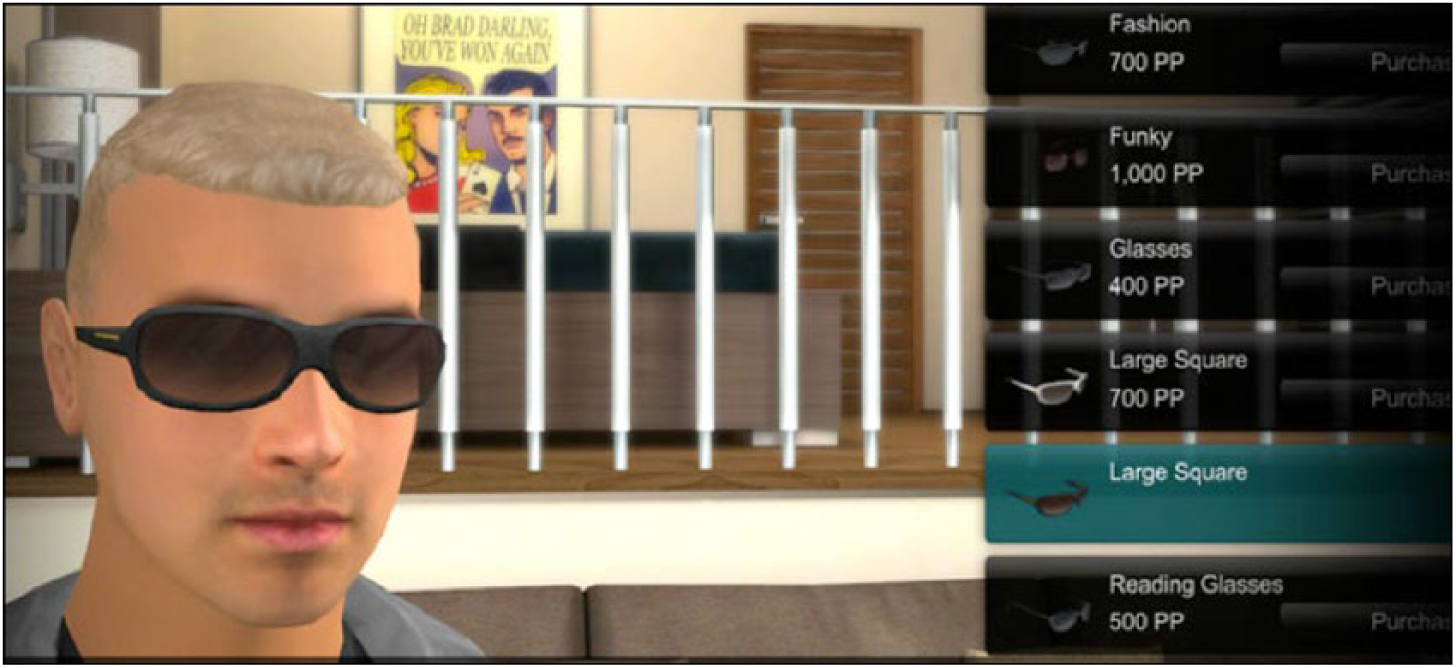
Avatar configuration in the PKR casino.
The tethering of players to PKR through the avatar did not just serve the profits of PKR; it also provided considerable scope for affective and creative investment in avatar customization. The PKR online gambling platform established an environment in which people felt co-present with others. This co-presence was enhanced through the elements of ambient communication that were made possible regarding identity (specifically race and gender) by customizing the avatar and regarding game-related information through the various emotes. This made it meaningful to invest money in customizing the avatar as an expression of self, because the expression of a particular gambler identity shaped the players’ social experience of gambling, which is an important dimension of the gambling experience.
Echoing Schull’s (2012) notion that casino design involves decisions to engineer gamblers’ experience to encourage constant play, PKR’s 3D spaces imitated familiar sites. The settings where poker games were staged echoed spaces of RL gambling. Like in some digital games, players could choose among a variety of stages such as Basement Bar, Egyptian Casino, Monte Carlo, Home Game, Vintage Bar, Vegas Classic, Zen Casino and PKR Studio, a TV studio that remediated the elaborate sets of televised poker. Players inhabited these spaces through their carefully designed avatars. As in the casinos visited by Schull (2012) for her anthropological work, digital spaces in PKR were designed following the principles of ‘architecture of experience’, whereby sights, sounds and the physical location of gambling situations combine to lure gamblers. Reflecting on PKR’s downfall, gambling blogger Andrew Burnett (2017) described the casino’s initially innovative proposition when it launched in 2007: ‘a unique site with amazing graphics, with a very decent player base numbers-wise, and just in time for the virtual reality world kicking in!’ While PKR ultimately failed as a business, the gaming elements that they introduced became industry standards on gambling platforms.
The bankruptcy of PKR revealed the particular success of the avatar in establishing a trusted relationship between the player and the platform. When parent company Microgaming announced that PKR would cease operations in May 2017 due to financial difficulties, players were unable to retrieve their balances immediately. Even though PKR had been in a slow decline for a few years, the player pool was still considerable. About 60,000 accounts had to be processed. In a bold move, a rival casino, PokerStars, agreed to migrate these accounts, and their funds, to their own casino (Pitt, 2017). This move was not without precedent: in 2012, PokerStars incorporated Full Tilt Poker’s player pool after the casino went under (Collson and Chaivarlis, 2012). By doing this, PokerStars gained access to 60,000 users and their balance information, potentially turning some of these into new PokerStars members. Even though in official communications PokerStars’ spokesman Eric Hollreiser claimed that the company wanted to do right by the gambling industry and set a precedent in best practice regarding customer fund segregation, this transaction also speaks of the social capital inherent in player profiles. Some gamblers started playing in PKR in 2007, which amounts to a decade of emotional and financial investment.
PokerStars’ move to incorporate PKR players into its pool reminds us of high-profile acquisitions in the social media industry in which popular apps were bought by tech giants. We can think, for instance, of the 2012 transaction in which Facebook bought Instagram for US$1 billion. Through this move, Facebook acquired access to millions of users and, perhaps more importantly, to millions of existing and future photographs and videos that could provide insight into cultural trends. Instagram has become one of the most popular apps in the world and has expanded Facebook’s reaches and influence even further. Even though Instagram was moderately innovative as an app, a crucial part of its value for Facebook derived from the considerable user pool that it had amassed.
Gambling capital
Affective investment in avatar capital allows gamblers to demonstrate social capital and financial capital, but ties them to a particular gambling platform. In this sense, the gambling capital demonstrated on PKR and similar casinos differs from the kinds of free-floating ‘paratextual’ gaming capital that Mia Consalvo (2007) describes in game culture. Paratexts – the ancillary print (e.g. FAQs) and multimodal texts (e.g. Let’s Play videos) related to digital games – have a semi-parasitic relationship with the games industry, inasmuch as was construed to include a wide variety of player activities. These ranged from activities which challenged ownership of platforms through ‘mod’ chips through to activities which played a supporting role such as text-based FAQs, walkthroughs and collaborative wikis (Consalvo 2007; see also Apperley, 2010; Newman, 2008), which have since been eclipsed by the popularity of let’s play videos and livestreaming services. The gambling capital exemplified in PKR is aligned with that of the gamified social media environments for networked gaming, such as PlayStation Network, Steam and Xbox Live where modes of the demonstration and valuation of social capital are enmeshed with economic capital through the commodity of the platform. Such environments are characterized by tangible economies of reward through trophies and achievements, over which players have limited curatorial control. This does not mean that gamblers become passive consumers trapped within a deterministic structure (cf. Jakobsson, 2011), as the avatar offers an additional qualitative and social dimension to gambling which highlights the risks and stakes of gambling with others. The avatar both creates uncertainty and makes the gambling more ‘real’ by emphasizing that winners and losers are ‘real’ people – with the ability to bluff and themselves be deceived.
The centrality of the avatar as a site of investment on the PKR gambling platform allowed players to cultivate an online persona for their gambling. Depending on the level of investment the player is willing or able to make, the avatar can represent them according to how they wish to be perceived by other gamblers, within the limitations of the platform. But a notion of what representation is the ‘right kind’ is not enforced by the platform, which leaves this open to interpretation by the gambling community. While some gamblers may attempt to create detailed avatars which reflect ‘real’ or aspirational personas, yet others may use avatars to create elaborate fantasy personas, which may deliberately experiment with identity or be a ‘just for fun’ distraction for other gamblers. However, regardless of the detail and care of the avatar’s appearance, the avatar is connected to other public information about the gambler’s account. Importantly, this includes gambling statistics that show how much money has gone into, and been taken out of their account, which represents their winnings or losses in online poker; and how much virtual money they have spent and won in slot machine apps. Other information includes the gambler’s username, online profile pictures and a statement of how long they have been a member of PKR. Collectively, this information offers a more tangible indication of the means of the player in terms of capital, particularly in tracking the real money and time that a gambler has put into the game. Such information illustrates how the affective investment in the avatar exceeds more quantifiable forms of tracking and capture. Through the avatar, gamblers can demonstrate a social commitment to gambling, which can be read alongside these more absolute characteristics.
The co-present avatar environment of PKR created a mutually supportive space where gambling is always accepted and available. The mobility of the gambling devices is distinct from the focus on the site that is found in casino-based gambling. This turn from the spectacular to the mundane is a part of the process of normalizing and routinizing gambling as a social activity. PKR was a relative pioneer into what has now become the full-scale integration of gambling with mobile apps and social media. While this drive from gambling industries has come under some criticism, the experimental emerging economies of high-profile digital gaming networks such as Steam – which famously hired Yanis Varoufakis as an economic consultant during 2012 – have also spawned community-initiated forms of gambling. 1 The legal controversy arising from the widespread adoption of ‘lootboxes’ in mainstream gaming in Belgium, and elsewhere, illustrates the significance of this growth area where digital gaming and gambling are intersecting with emerging digital platforms (Dwan, 2017).
Conclusion
The use of avatars in online gambling may be superfluous to the requirements of the gaming transaction, but creates a value both for the gamblers and for the platform. This value in the case of PKR became one of the tangible assets in their liquidation process. For the gamblers, the avatar provides the experience with a social dimension which makes self-expression in the form of clothing, items and gestures meaningful because through online co-presence it connects online poker to previous forms of co-located play, where ‘expert gamblers’ read people’s body language and demeanour as part of intuiting the relative strength of their hand.
By allowing gamblers to invest their winnings in their avatar, the gamblers become integrated into the community and platform. They are now potential repeat customers, who have left their capital with the house for next time, rather than simply ‘cashing out’. For PKR and other platforms, a key value that this process brings is a routinization that makes online gambling everyday and mundane from the perspective of its availability and security while still maintaining a promise of glamour through the endless potential of designing and redesigning the avatar as a representation of the digital self. With PKR and other forms of gambling apps and social media gambling, the highly structured affect of the casino has been recreated through software. But rather than a spectacular break with mundane routines, gambling is now integrated within and among them. The avatar is a key tool of this integration, which creates the persistent ambient presence of other gamblers while simultaneously emphasizing the social dimensions of gambling.
Footnotes
Acknowledgements
We thank Luke van Ryn for his assistance with preparation of this manuscript, and Daniel Golding for his insightful comments on an early draft that greatly improved the final manuscript.
Funding
This article is part of the research project DP140101503 Avatars and Identities (Justin Clemens, Thomas Apperley and John Frow) funded by the Australian Research Council.
