




Abstract
Recent research has indicated that coverage of women’s sport has become less trivialised and sexualised, compared to historical coverage. This article uses the inaugural season of the AFL Women’s (AFLW) League in 2017 to explore this concept in both media and Twitter framing. It found that most media coverage and tweets were likely to discuss the AFLW as sport, focusing on match previews and reviews. However, there was evidence that women may still be treated differently to men, as the AFLW players who received the most media coverage also had significant off-field stories that were always mentioned alongside their on-field performance. Analysis of the tweets found that more were focused on the cultural change impact of AFLW. This was further exaggerated when looking at the most shared tweets, which were overwhelmingly focused on the socio-cultural impact of AFLW. This study indicates then that women’s sport is continuing to be normalised as part of regular sports reporting, but also that social media did not necessarily share the same frames as media when discussing AFLW. In an increasingly fragmented media environment, this has implications for media’s agenda-building function.
Introduction
After more than 150 years of a men’s league, the first elite-level Australian Rules Football competition for women was launched in 2017. From the official lockout at the first game on February 22, where over 24,000 fans crammed into Princes Park to watch Collingwood and Carlton (Hancock, 2017), the league was seen as a success. AFL women’s (AFLW) attracted significant television ratings, including over 1.7 million across the opening weekend (McIver, 2017), widespread media coverage and Twitter Australia noted that AFLW was one of the most popular sports discussed on the microblogging platform across the year (TwitterSportsAU, 2017). The launch of the new AFLW league offers an interesting opportunity to explore the media context given that the established men’s league is Australia’s most successful sporting code. The 18-team national men’s AFL league generated A$517 million in revenue in 2016 (Warner, 2017). The current A$2.5 billion rights deal, signed in 2015, was the highest price recorded for broadcast rights in Australian sport (Stensholt and Mason, 2015). In 2014, the AFL had the fourth highest average crowd attendance per game, globally, behind only the NFL, German Bundesliga and English Premier League (AAP, 2015). The Australian Football league and the 18 clubs within it therefore generate significant media attention. The AFL listed in its 2012 annual report that it had accredited over 2000 media during the 2011 season, which is 3 times as many journalists that cover federal politics in Australia’s parliament house (Sherwood and Nicholson, 2017). Due to the AFL’s significant influence over the media landscape, the introduction of the women’s league offers a unique opportunity to explore media framing of the first AFLW season. In particular, previous research in Australia indicates that while the volume of media coverage for women’s sport compared to men’s remains low, when that coverage appears it is less likely to be sexist and stereotyped than other contexts (Caple et al., 2011). In addition, this article also employed an analysis of Twitter responses to the first AFLW season, to explore differences and similarities between traditional legacy media framing of AFLW and social media framing through Twitter.
Media coverage of women’s sport
The key theme that emerges from international sports media research is that female athletes and women’s sports receive less media coverage than male athletes and male sports. Longitudinal research in the United States has found that the percentage of women included in news broadcasts has actually trended down over time (Cooky et al., 2013, 2015). When women are represented, they are characterised by personality rather than athletic ability, and more often than not their achievements are trivialised and sometimes presented in a sexualised manner (Bernstein, 2002; Fink, 2015). Research that has examined why sports media continues to be imbalanced points to a number of factors, but that in short, it is the male-dominated nature of sports newsrooms, the ingrained assumptions about readership and specific work routines of sports departments that have led to the established patterns of sports coverage (Rowe, 2007; Sherwood et al., 2017b). The resources available to men’s sport organisations, to provide information subsidies such as media releases and media conferences, indicate that this is partly why men’s sport is able to control the news agenda (Sherwood and Nicholson, 2017; Theberge and Cronk, 1986). In the routinised nature of sports news, men’s sports dominate the news pages partly because of its greater resources that allow them to deliver newsworthy information to journalists on a regular basis, and also that they are considered inherently more newsworthy (Harcup et al., 2001). Yet the recent research indicates that the type of coverage is changing, and women’s sports are more likely to be reported in similar frames to men’s (Musto et al., 2017; Peeters and Elling, 2015; Petty and Pope, 2019).
In Australia, regular Australian Government commissioned research found women’s sport and female athletes receive less coverage than men’s sport and male athletes (Australian Sports Commission, 1985; Caple et al., 2011; Lumby et al., 2014; Phillips, 1997; Stoddart, 1994). This research puts percentage of television coverage at anywhere between 2% and 9% (Caple et al., 2011; Lumby et al., 2014; Phillips, 1997), though women do receive more coverage when it comes to major events such as Olympic and Commonwealth Games (Payne, 2000; Toohey, 1997). While previously research has found coverage also stereotypes and trivialises women’s accomplishments (Lenskyj, 1998), this is not necessarily the case anymore. A significant finding in Lumby et al., (2014) study was that gender stereotyping in Australian media coverage was rare: In the print and television commentary and reporting, analysed in depth in this research, there was a remarkable absence of stereotyping of female athletes. They were very rarely portrayed in a sexual way and most frequently portrayed as competitive and successful. (p. vii)
This was a finding echoed in Sherry et al. (2015) review of images of sportswomen, television coverage of the Rio 2016 Olympics (Xu et al., 2019) and netball coverage (English et al., 2019). Together this indicates that the media coverage of female athletes and women’s sport in Australia, when it occurs, is improving.
Social media, digital media, and women’s sport
Social media and digital media has dramatically altered the traditional relationship between sport and legacy media, as sports organisations and athletes themselves can now bypass media in order to communicate directly to their audiences (Hutchins and Boyle, 2017; Hutchins and Rowe, 2012; Sherwood and Nicholson, 2017). As such, how social media is used in sport has become an expanding area of research in sport management and media (Filo et al., 2015). There is an emerging area of research that examines how female athletes are using social and digital media to challenge and create their own narratives (Heinecken, 2015; MacKay and Dallaire, 2012; Olive, 2015; Thorpe et al., 2017). This research suggests that social media can be a space for both female athletes and women’s sports fans to challenge traditional media discourses, but is mostly focused on niche or non-mainstream sports such as skateboarding blogs and surfing. Studies that have examined social media, in particular, Twitter, in relation to more mainstream sports have found it can simply reinforce stereotypes found in legacy media. For example, Coche’s (2016) study on US Football Federation’s (USSF) two Twitter accounts during major events found a gender gap between the tweets of the women’s national team and the men’s. Similar to traditional media, the USSF framed the women’s team as less important than the men’s, even though Coche’s study purposefully conducted at a time when female soccer was supposed to be prominent because of the international schedule. In an Australian context, research has proposed that Twitter has the potential to influence mainstream coverage of netball, yet it has not yet made significant differences (Vann, 2014; Vann et al., 2015). However, others have found that Twitter can be used as a space for different discourses. An examination of Becky Hammon’s NBA appointment, as the first female coach in the men’s NBA league in the United States, indicated that while some of most tweets were related to one of Twitter’s most common functions, to simply share information, it also became a place for users to share their view that Hammon’s appointment was a significant harbinger for cultural change (Sanderson and Gramlich, 2015). For example, tweets coded for cultural change were likely to express personal feelings on the appointment, such as ‘One more reason to love the #Spurs Becky Hammon hired as NBA’s first woman coach’ (Sanderson and Gramlich, 2015: 117).
Agenda-setting and framing
McCombs’ agenda-setting theory is one of the most widely applied in mass media studies (McCombs, 2005), and its basic premise is that the media cannot directly influence what the public thinks, but it can influence what viewers or readers think about (McCombs, 2005, 2018). Framing theory, in conjunction with agenda-setting theory, helps explain how discourse frames the content already filtered through an agenda-setting process. A frame can be used ‘to select some aspects of a perceived reality and make them more salient in a communicating text’ (Entman, 1993: 52). Framing is useful within media research because the media select and emphasise specific components of an issue or event and ignore or give a lower profile to other components (Entman, 1993). This ultimately has the potential to influence how the public receives and accepts information on the issue. Scheufele (1999) has also argued that frames both shape public perception and facilitate how less informed groups navigate their understanding of a story.
In line with the research that suggests female athletes and women’s sport in Australia are likely to be reported in similar frames to men’s, and also that social media is likely to offer different frames than those found in legacy media, this study used agenda-setting and framing research to explore the following two research questions:
RQ1. What were the main frames present in media coverage of the first season of AFLW?
RQ2. What were the main frames present in tweets of in the first season of AFLW?
Method
This study was conducted in two parts, collection and analysis of media articles, and collection and analysis of Twitter posts. The inaugural AFLW competition ran from February 3 until March 25, 2017, but both social media and media datasets were expanded to cover the period from January 10 to April 9, 2017, to cover both pre- and post-event coverage. A total of 60,898 tweets were collected during this time period, using search terms detailed below through the Twitter API. A total of 1211 media articles were collected through a targeted search through newspaper database Factiva, as well as the AFL’s website www.afl.com.au.
Media coverage
In order to capture media coverage of the AFLW season, a targeted search was conducted using newspaper data analysis tool Factiva, based on the terms AFL Women’s and AFLW, in Australian newspapers. In addition, articles from www.afl.com.au were included, using the same search terms to search the website. It should be noted that www.afl.com.au is a unique proposition in Australian sport media, as it is nominally the league’s official website, yet the league’s governing organisation do not have editorial control. Instead, a company called AFL Media runs the site and associated products (such as the Footy Record), and had publicly stated since its inception their aim was to become the leading source for AFL news by reporting independently. Editor Peter Campbell said in 2015, ‘ultimately the supporters will see through it if it’s not. The editorial staff don’t work to a direction of let’s paint this in a rosy glow’ (Hayes, 2015). The Media, Entertainment and Arts Alliance also won the rights to negotiate AFL Media’s collective bargaining agreement (Ward, 2014) in 2014, indicating they were recognised as an independent media outlet. AFL Media have been successful in gaining a large market share, with readership data indicating they have been the most popular sports website in Australia (Hayes, 2015). While we note that AFL Media is not a legacy media outlet in Australia, for the basis of this article we believed it would be appropriate to combine Australian newspaper data and afl.com.au to examine broadly how the most popular online and print media framed the first season of AFLW.
Combining the afl.com.au and Factiva results led to a total dataset of 1211 articles. This datum was imported in NVivo, where a thematic analysis was conducted, using methods recommended by Saldana (2013; Miles et al., 2013). Initially, two coders worked together to develop initial iterative codes, which were then refined through a second process of coding. Once an initial round of thematic codes had been developed and agreed, the majority of coding was conducted by one researcher. The most common themes found in this media coverage, notably that women’s AFL tending to be reported in similar terms to that of men’s sport, were then used to guide the Twitter coding.
Twitter has increasingly been used as a valid unit of analysis in news and media studies (Bruns and Burgess, 2012), and the decision to use it here was largely based on the fact that Twitter Australia noted that AFLW was one of the most popular sports discussed on the microblogging platform across the year (TwitterSportsAU, 2017). A manual examination was conducted on Twitter to identify the search terms that relevant to the discussions on AFLW competition. Four categories of search terms were identified: (1) general keywords and hashtags used in AFLW, (2) twitter handles of AFLW clubs, (3) hashtags of AFLW clubs and (4) twitter handles of AFLW players. While this dataset then also includes players and clubs, who are likely to have a positively skewed response to the season, we deliberately took this approach to include the widest possible range of tweets that referenced AFLW. We therefore do not claim that this dataset is necessarily representative of simply fans of AFL, but it does represent the majority of posts that referenced AFLW in its first season. The Twitter search used the Twitter API to collect the relevant tweets using the above mentioned four types of search terms. In line with the coding analysis conducted in the media, two researchers worked to manually code an initial sample of 100 Twitter posts. Like the media coverage, the two main frames present were coverage of the league as a game, and AFLW in terms of cultural change. The machine classifier was then trained on the training data using the Orange Data Mining Tool (Demšar et al., 2013). The rest of the dataset was coded using a machine learning–based classifier to automatically capture posts that belong to the above-mentioned categories. This classifier was trained to work on a set of features that were extracted based on the content of the social media post, and provide an output of the probability of each post belonging to above-mentioned categories. Two types of features were extracted based on the content of each social media post: (1) psycholinguistic features and (2) AFLW game-related features. The psycholinguistic features were extracted using Linguistic Inquiry and Word Count (LIWC; Tausczik and Pennebaker, 2010), which is a dictionary-based word-counting tool that assigns words to psychologically meaningful categories. The game-related features employed are two binary features that denoted whether AFL club name or a player name was mentioned in the social media post.
Results
Media coverage
As can be seen in Table 1, just over half of media coverage of AFLW (682 articles, 56.3%) had adopted similar frames to that of men’s sport (Rowe, 2007), that is, match reviews and previews that focused on the outcomes of games. For example, the following match report of Adelaide’s first game run on afl.com.au did not even specify that it was women’s AFL in the opening paragraph.
ADELAIDE has easily accounted for Greater Western Sydney by 36 points in front of a bumper crowd of 9250 at a wet Thebarton Oval on Saturday. The Crows dominated the game from start to finish to run out comfortable winners, 7.6 (48) to 1.6 (12). (www.afl.com.au, 4 February 2017)
Media coverage (n = 1211).

The majority of stories in this category were match previews and reviews that focused on detailing the games and key moments within them. Other stories that fitted into this category included injury stories, team selection news and tribunal news. For example, AFLW used the same disciplinary tribunal system as men’s AFL, and as this example below indicates, they adopted similar reporting structures: THREE players have been offered one-match bans after the first weekend of the inaugural AFL women’s season. Melbourne’s Richelle Cranston, Western Bulldogs midfielder Kirsty Lamb and Docker Ebony Antonio were all charged yesterday after the first sitting of the AFLW match review panel. (The Courier Mail, 7 February 2017)
The majority of these stories, which made up just over half the sample, indicated that women’s AFLW had been accepted into the same reporting structures as men’s AFL, largely following Rowe’s (2007) focus on regular, routinised news leading in and out of a match.
However, equally, there was nuance within coverage that did indicate women were not solely judged on their athletic ability in order to receive media coverage. The three most-mentioned players in the sample, which can be seen in Table 2, were those who had stories that went beyond their ability as a player or influence the game. Moana Hope (206 articles) was the focus of an Australian Story television documentary ahead of the AFLW season, had a close relationship with Western Bulldogs vice-president Susan Alberti and is also a carer for her sister who has a neurological condition. However, she predominantly made the news throughout the season because of her failure to deliver the form that she had earlier in the women’s VFL and AFL exhibition matches. Erin Phillips (204 articles), a former Olympic medal winning basketballer, won the inaugural AFLW best and fairest medal and was one of Adelaide’s best players in their premiership year. But equally her role as a new mother and highly spoken advocate of same-sex marriage, particularly given her own same-sex union was not yet recognised in Australia, was also almost always mentioned in the same context. Sarah Perkins (166 articles) was a full-forward for the premiership winning Adelaide Crows, who was overlooked initially in the AFL draft. She then lost 40 kg and was rookie listed by Adelaide. Coverage of Perkins mentioned her impressive performance in season 1, but also almost always mentioned her weight loss as part of the story, as can be seen in the following example: SARAH ‘Tex’ Perkins has conquered crushing heartbreak, online bullies and weight issues – and today, as South Australia’s newest sporting cult hero, she will set out to deliver a premiership-winning performance for the Adelaide Crows women’s team. (The Advertiser, 25 March 2017)
Most frequently mentioned players or coaches (n = 1211).
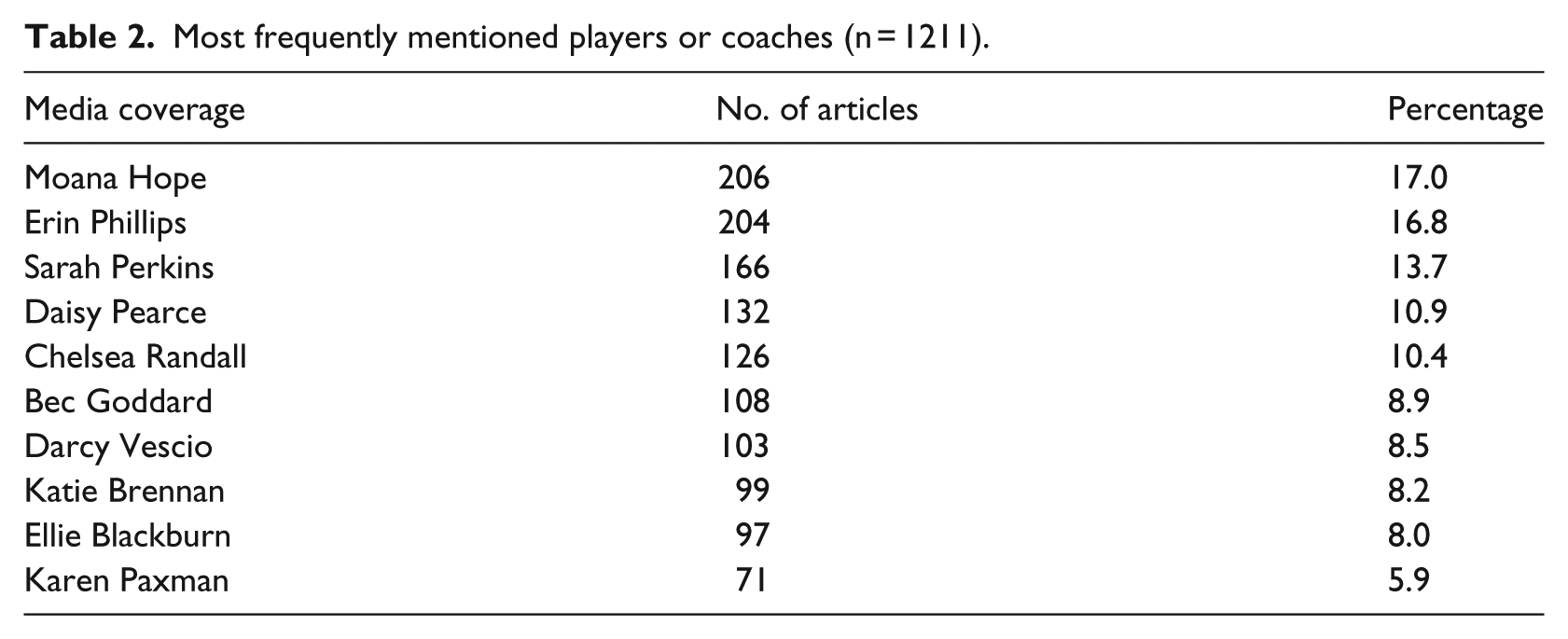
Generally, profile pieces on AFLW players were likely to move outside the frame of simply their footballing career. For example, a story on Collingwood’s Sarah D’Arcy reads as follows: “D’Arcy works as a traffic controller is studying to be a teacher – she’s leaning towards teaching maths and physics in secondary school – and spends her remaining time with people just as passionate about football as she is” (www.afl.com.au, 17 February 2017). These themes surrounding the female players who received the most coverage indicated then that it wasn’t just performance that was likely to lead to coverage, but a combination of performance and a personal story that hits other common news values (Harcup et al., 2001). This could be clearly seen in the coverage of the three women who finished behind Phillips in the inaugural AFLW best and fairest. The two players who tied for second, the Western Bulldogs Ellie Blackburn and Melbourne’s Karen Paxman, received 97 and 71 mentions across the dataset respectively. Fremantle’s Lara Filocamo came third in the AFLW best and fairest voting, yet only received 41 mentions in the media dataset.
The second major theme in the coverage was where AFLW was discussed in the context of cultural change (266 stories, 22.0%). Stories in this frame were those that emphasised the impact that AFLW would have on women, women’s sport and sport more widely, and often were led with a personal perspective. These included stories that referenced these AFLW players as role models; for example, Adelaide Crow Kellie Gibson offered the following quote: ‘growing up I was one of those kids cheering on the guys and now they can look up to us and have the realisation they can play AFL football when they grow up’ (Hobart Mercury, 6 February 2017). They also included a set of stories focused on the general boom in women’s sport in Australia, where AFLW was discussed in conjunction with or comparison to record wage growth and new women’s leagues in sports such as cricket and netball. In one sense, this cultural change coverage was not surprising, because the league was in its first season – there was more opportunity to frame it in a history-making context – similar to the frames found in Twitter coverage of Becky Hammon’s appointment (Sanderson and Gramlich, 2015). Another smaller but relevant story in this theme that received coverage was that of same-sex attracted players and marriage equality in AFLW. Largely this was related Erin Phillips, but also in the coverage of Penny Cula-Reid and Mia-Rae Clifford, an engaged couple that played for different teams. Importantly, however, this indicates that while small – AFLW had brought to light discussions of female athletes who identified as members of the LGBTIQ community – who had previously almost always been relegated from mainstream media discussions (Bruce, 2016).
It is also important to highlight though what wasn’t found in the media coverage. There were few examples of media sexualising athletes, with the exception of one former AFL player turned media commentator who noted memorably, ‘what about their boobs?’, as a reason for why women should not play AFL. However, this media coverage found more stories that called this out than those who supported it. While there were many examples of potentially infantilising language, the analysis revealed that this should not necessarily be taken on face value. A total of 383 articles found instances of the word girl or girls used; however, when explored further the majority of these were found to be used within a quote from female players themselves. For example, see this quote from Abbey Holmes – an Adelaide player based in the Northern Territory: ‘It is just over 45,000 km that the NT girls have done. It is pretty impressive and I am so proud of the way the girls have handled … the work, the training and the family commitments’ (The Australian, March 25). This finding supports work in post-feminist research investigating women’s sport and female athletes, which suggests we need to look outside traditional structures – as the users of this discourse may have different intended uses for words that may have once been considered negative (Bruce, 2016; Toffoletti, 2016).
Twitter coverage
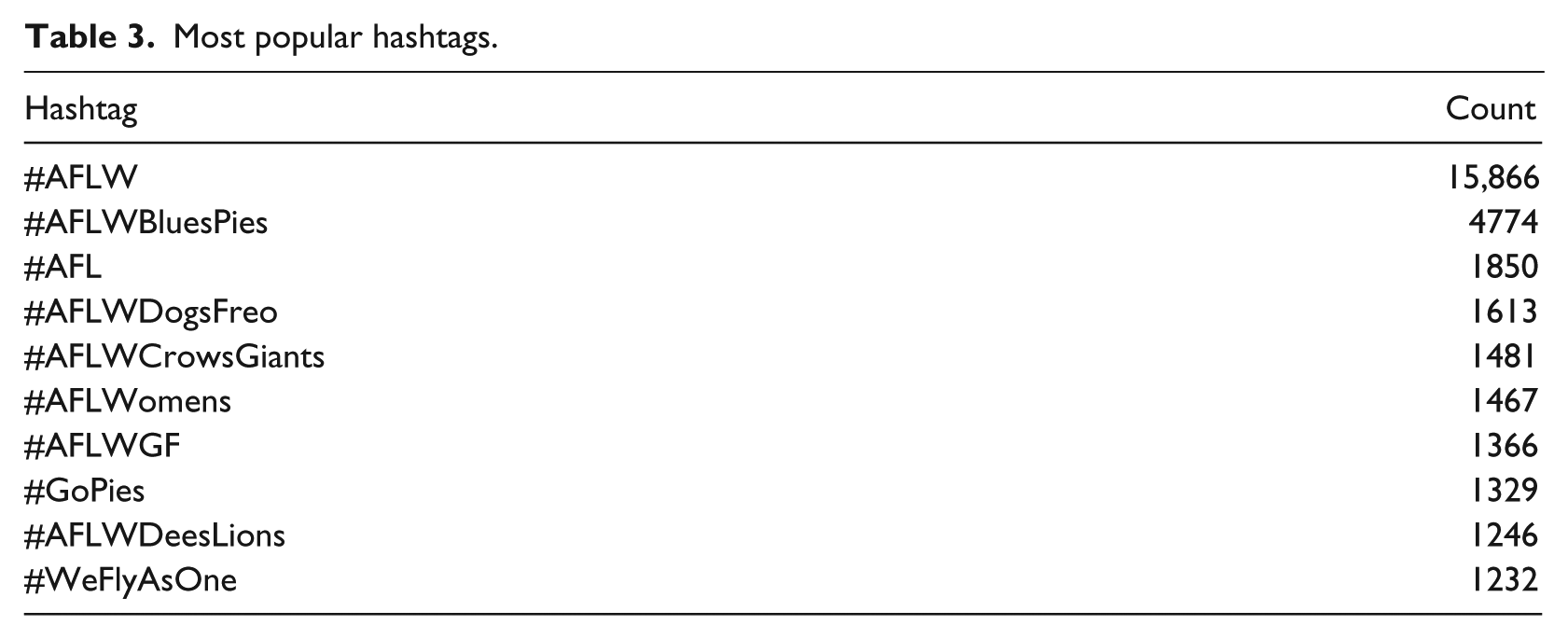
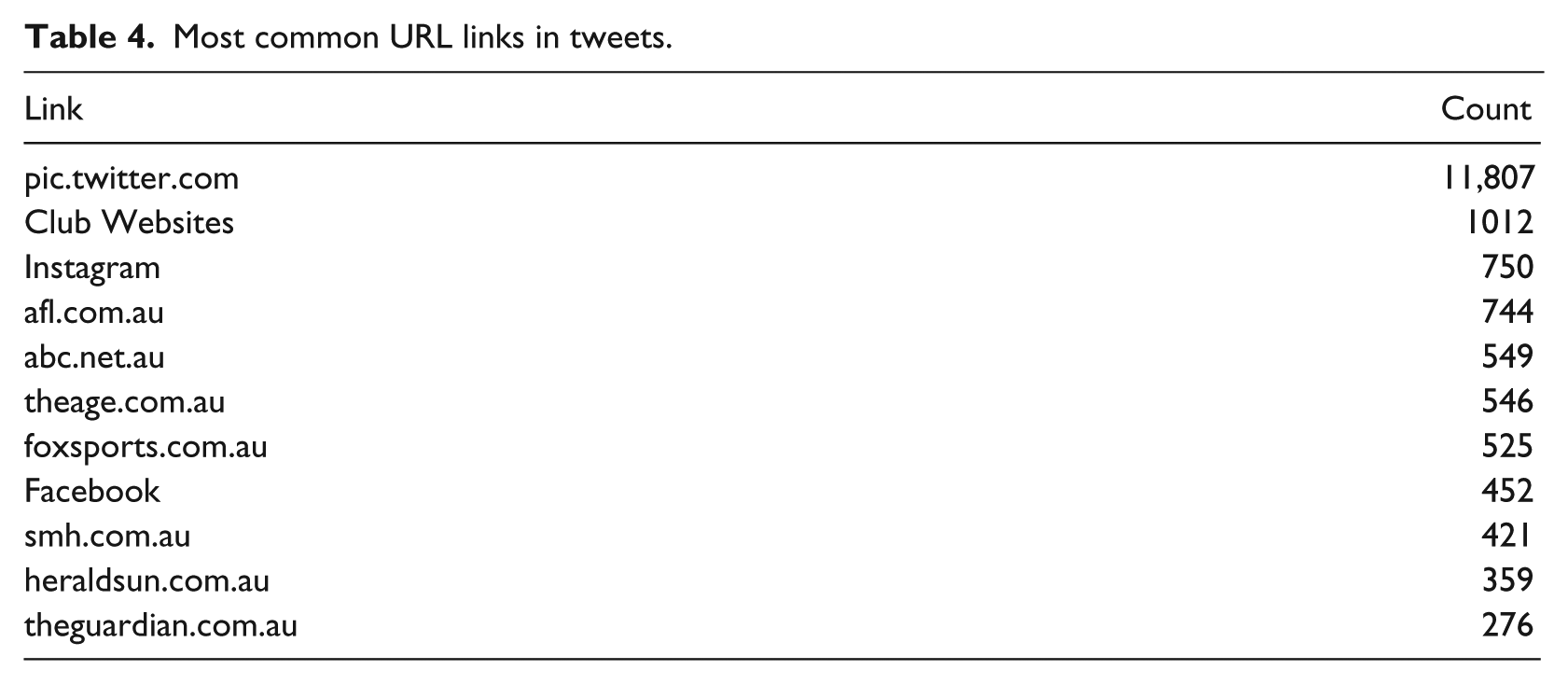
There were 60,898 tweets collected in this dataset, with the biggest spikes occurring around match times. The first game, on February 3, saw the biggest traffic, with a total of 8525 tweets posted in that time. This was also reflected in hashtag use, while the general league hashtag #aflw was the most frequently utilised, the game hashtag for the first game being the second highest used as evident in Table 3. Overall, the opening weekend saw the most traffic. The next biggest day was the AFLW Grand Final. In total, the tweets contained 18,284 URLs and 11,807 Twitter pictures URLs in Table 4, or images attached to the tweets – indicating that a large percentage of tweets were sharing information or pictures about AFLW in addition to the tweeted text.
Most popular hashtags.
Most common URL links in tweets.
As mentioned in the method, two coders were initially used to manually code a selection of the tweets based on the major themes found in the media coverage – tweets about AFLW in a sporting context and also AFLW as a place for cultural change. The majority of the tweets, like the media coverage, were likely to be tweets discussing the games, or sharing game-related content. Using these two codes on this dataset, a total of 43,503 posts were coded as game related, such as these examples below: Lions, Crows dominate AFLW All Australian team ift.tt/2odw0C0. (LionsDi. 29/3/17 12:43) Chelsea Randall’s sublime defensive performance on Tayla Harris helps Adelaide secure AFLW premiership – Fox Sports dlvr.it/NjyG1q. (julsie75. 26/3/17 15:58) Looks like brutal conditions down at Casey YYY. (binarythis. 5/2/17 17:22)
A total of 17,395 were coded as discussing AFLW in terms of its cultural change, such as these examples which were from the Twitter accounts of newspaper journalists: Mo, Daisy, Darcy, Erin. We are on first-name basis with the AFLW stars. No matter if you gushed over them or just watched a bit, great start. (RalphyHeraldSun. 28/3/17 22:36) Lot of people in women’s sport work tirelessly without reward. Really enjoying pleasure they’re getting from this moment. AFLWBluesPies. (RohanConnolly. 3/2/17 21:16)
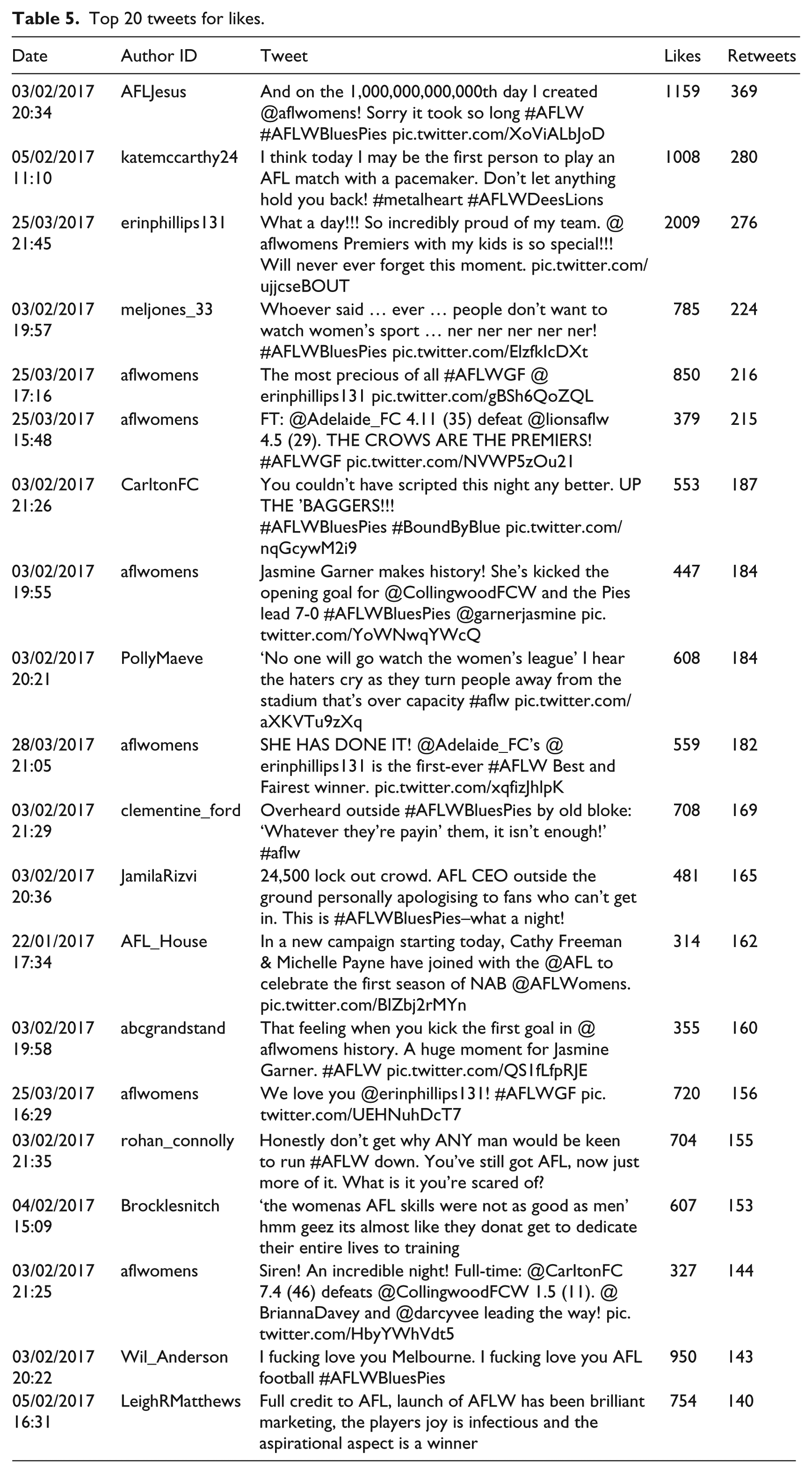
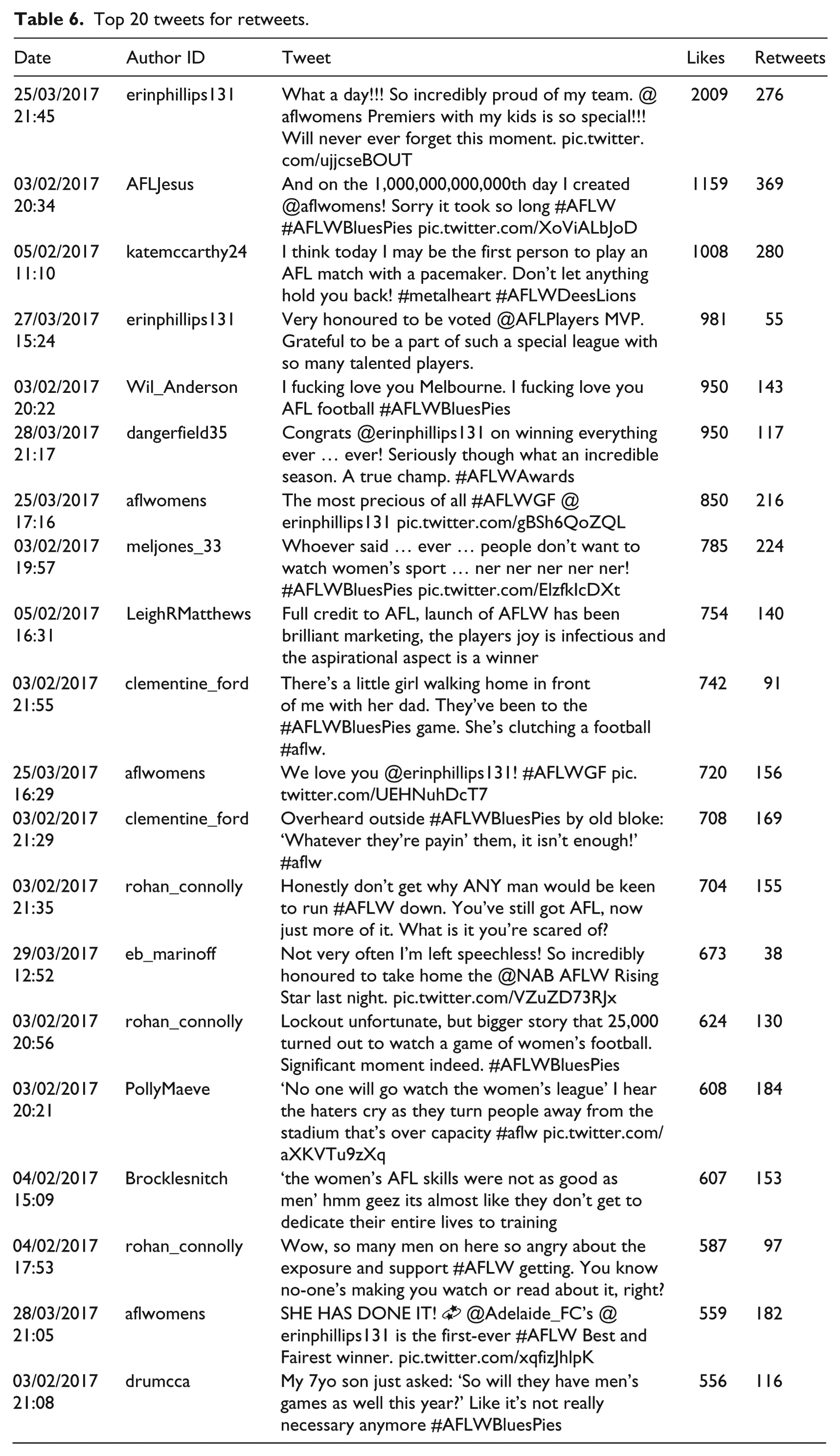
Applying these codes to the tweets with the most engagement further exaggerated this trend. As can be seen in Tables 5 and 6 that show the top tweets for retweets and likes, these were overwhelmingly likely to discuss the cultural change impact of AFLW. Of the top 20 likes, only three were coded in the sports frame, and of the top 20 retweets, just four. These tweets focused on the cultural impact of the AFL, such as former Australian cricketer Mel Jones tweeted ‘Whoever said … ever … people don’t want to watch women’s sport … ner ner ner ner ner! #AFLWBluesPies’. Other popular tweets that were also coded as cultural change included those as personal stories, such as a picture of Erin Phillips’ two children in the AFLW Cup, or Kate McCarthy’s tweet about being the first player to play with a pacemaker.
Top 20 tweets for likes.
Top 20 tweets for retweets.
Discussion
This media study of the first season of AFLW found just over half of the media coverage was mostly focused on the matches, including previews, reviews and other stories related to the game. This suggests that the first season of women’s AFL was covered in similar frames to other women’s sport in Australia, that is, regardless of its volume – it was likely to frame women as athletes first (Caple et al., 2011; Lumby et al., 2014; Sherry et al., 2015). AFLW had been accepted into similar routinised sports news frameworks as men’s (Rowe, 2007), which has also been the case in women’s sport in the United Kingdom (Petty and Pope, 2019) and the Netherlands (Peeters and Elling, 2015). However, this study notes that the way women’s sport was reported may be simply be due to the fact that AFL already has a significant amount of media coverage as it’s an established men’s game, and the women’s game simply fit into these existing structures for AFL. As previous research indicates, sports with better media relations resources are likely to dominate the news agenda (Sherwood et al., 2017a; Theberge and Cronk, 1986). There are more journalists assigned to cover AFL in Australia than there are in federal politics. It could reasonably be assumed then that the structures in place for facilitating the coverage of AFL, both the number of journalists and media staff within clubs, helped achieve similar reporting outcomes. Lessons for other women’s sports on how media coverage that positions women as athletes may be hard to deliver then, if the main strategy that utilised to achieve professional coverage was simply that it sprung from an existing men’s league. However, this research also showed previous themes about women’s sport coverage are still true, in particular, that women need to do more than simply just perform on the field to gain media coverage (Fink, 2015). Those women who appeared most frequently in the media coverage, Moana Hope, Erin Phillips and Sarah Perkins, had a combination of on-field results and an off-field story, which indicates there are still qualitative differences that affect which female athletes gain media coverage.
One interesting result was the small sample of media coverage that either focused on or included athletes’ sexual identity. While previous research has indicated that media primarily only covered heterosexual female athletes and adhered to traditional notions of femininity (Bruce, 2016; Thorpe et al., 2017), this media coverage of same-sex attracted athletes should be recognised as a significant step forward, and is deserving of further exploration.
Another significant finding of this study was the difference in the frames found in media coverage and those found on Twitter. While media coverage did include many stories that discussed AFLW in reference to cultural change, this was more marked on Twitter. In this way this study echoed Sanderson and Gramlich’s (2015) on Becky Hammon, another female entering a once male-sports space. More tweets, particularly those that were the most shared through retweets or likes, focused on the cultural impact of AFLW. This in turn supports the notion that social and digital media can be a place for discourses different to mainstream media to develop (Bruce, 2016; MacKay and Dallaire, 2012; Olive, 2015; Thorpe et al., 2017; Vann, 2014). Also, while difficult to make direct comparisons given different collection protocols and times surrounding Vann’s (2014) collection of netball tweets, the more than 60,000 tweets surrounding AFL were significantly more than the 27,249 tweets measured around the 2013 ANZ Championship netball competition, an elite women’s only competition between Australia and New Zealand – which indicates that there has been an increased use of social media to comment on women’s sport.
Conclusion
This study is one of the first of Australia’s new AFLW League, which is significant itself as a new women’s league in a traditionally male-dominated space. It found that the AFLW league was mostly often incorporated into the routinised nature of sport news work that usually focuses on men’s sport, a cycle of match previews, reviews and other match-related stories (Rowe, 2007). Yet it also emphasised that women still need to do more to feature than simply perform well on field (Fink, 2015), the players who received the most media attention did so for reasons that were simply outside performance.
Another interesting finding was how Twitter’s most popular posts, that is, those that were liked or retweeted, were more likely to discuss the social impact of AFLW. Given it was the first season of AFLW, a new opportunity in an up until then male-dominated sport, this is perhaps not surprising. But it indicates that social media platforms are an interesting point of study as they can offer different perspectives to those found in traditional media coverage. While traditional agenda-building and setting research indicates that the media play a large part in setting the public agenda, this study is yet another that indicates that social media does not necessarily reflect mainstream media coverage (Billings et al., 2015; Kian, 2015). This has potential lessons for media companies themselves, if they continue to amplify the same reporting structures that they have before – when social media indicates that the wider community is discussing a topic differently, it indicates that the balance of power in agenda building may be shifting away from media.
As legacy media declines and segmentation of news increases across platforms, comparative research that tracks both social media and mainstream media coverage, and where they are similar and diverge, will be increasingly important.
There are several limitations with this study. One is that it does not compare the volume of coverage of women’s sport compared with men’s. Given studies over time have indicated there have not been significant changes in this area (Cooky et al., 2015; Lumby et al., 2014), a deliberate choice was made to examine the frames in the media coverage that the women’s league did receive. While we acknowledge that a comparative figure would have been useful to give an updated point of reference for women’s sport in Australia, it was outside the scope of this particular study. Another limitation is the Twitter dataset; we note that it is potentially biased as it does include players and clubs, which are likely to be positively skewed towards the impact of AFL. However, this approach was taken to include the widest possible range of discourse on Twitter discussing AFLW. We also acknowledge that while Twitter noted AFLW was one of the most popular topics on their platform in 2017, it is not the most widely used social media platform in Australia. The 2017 Sensis Social Media report indicated only 32% of the Australian population used Twitter, and therefore analysis of tweets can never be generalised to the wider population.
Another significant limitation is that the Twitter analysis tools used are not necessarily as accurate or reliable as individual researchers conducting qualitative coding. While the data processing approach employed here was useful as it allowed us to code a significantly large dataset, we acknowledge that it may not have contained the same granularity as individual researchers are able to apply. In particular, we acknowledge that this may approach may be even more problematic in the Australian context – where common language traits include swearing as a positive expression, and use of sarcasm. For example, prominent comedian Wil Anderson tweet “I fucking love you Melbourne. I fucking love you AFL football’, that was one of the most popular for both retweets and likes, can clearly be identified as positive by the researcher – but the inclusion of swearing was initially assessed as negative by the algorithm. However, we believe despite these limitations this has still been a useful approach – as it gives us a general overview of what is otherwise too large a dataset to make sense of. As algorithms are developed and refined, particularly for different cultural contexts, we encourage further research in this area that can potentially yield more detailed and accurate results.
