




Abstract
As the Australian Competition and Consumer Commission’s (ACCC) Digital Platforms Inquiry was at pains to point out, social media and search platforms now capture unprecedented shares of Australian media advertising expenditure. However, this loose collection of media forms and the advertising that supports them are some distance from traditional forms of media and advertising. While much has been written about these differences, the nexus between social media and search media forms and their advertising and promotional settlements had received comparatively little attention until the ACCC made it the front and centre of its inquiry. Our concern here is to take up the invitation the ACCC offers: to reorient our scholarly and public discussions of platforms towards the promotional culture of social media and search platforms. We consider the implications for advertiser-supported media, the unique form of advertising they have created and their challenge to public accountability.
Centring the blindspot: the promotional culture of social media and search
This article is presented in two parts. The first part is an original article written by Tom O’Regan and edited by Nicholas Carah. The second part is a commentary written by Nicholas Carah.
Introduction
As the Australian Competition and Consumer Commission’s (ACCC) (2019) Digital Platforms Inquiry was at pains to point out, social media and search platforms now capture unprecedented shares of Australian media advertising expenditure. However, this loose collection of media forms and the advertising that supports them are some distance from traditional forms of media and advertising. While much has been written about these differences, the nexus between social media and search media forms and their advertising and promotional settlements had received comparatively little attention until the ACCC made it the front and centre of its inquiry.
As the ACCC reminds us, audiences and market information about these audiences have long been the central currency of commercial media as media firms have sought to gain the attention of audiences and sell that attention to advertisers and marketers. Similarly, market research firms have created market information on that audience attention to sell to media firms, advertisers and marketers. This commercial media equation made possible not only wholly advertiser-supported audience–market media vehicles like commercial radio and television and free newspapers and magazines. It also made possible dual product media for which cover price and subscriptions supplement advertising to create hybrids of audience and content markets in our newspapers, magazines and pay TV (see Napoli, 2003, 2011).
Social media and search constitute, for the ACCC, a variant of familiar audience market forms. Its business model is rooted in long-established structural forms for sustaining commercial media businesses – the formation and extension of audience markets for which the commodity being traded is the audience and market information about that audience. The ACCC conducted its inquiry with this logic in mind. It did not start, as much media studies has, with a focus on what was new about social media and search: its user-generated content, participatory communication, social networks and online communities. Rather, it started with what was common between social media and search and the commercial media that preceded it. This was its generative core in advertiser-supported and therefore audience market–centric business models. The ACCC then proceeded to show how these audience market dynamics for social media and search drew upon, manipulated and fashioned user-centred and participatory communication for what were long-standing commercial media ends. In doing so the ACCC paid meticulous attention to the very commercial basis for social media and search in the buying and selling of audiences and in the harvesting and monetisation of market information. Both audience and market information commodities have long been features of our commercial media system and connect social media and search to traditional commercial media dynamics. Consequently, what is different about social media and search is not their participatory dynamics as such, but rather their innovation of a new form of audience market.
In taking this stance, the ACCC foregrounded the core role played by advertiser-supported audience market dynamics in the very generation of social media and search. It turned attention to the digital platforms’ market conduct and how their audience markets were functioning. It measured their performance against long-standing norms of market formation and conduct, consumer privacy, market information provision and transparency associated with commercial media more generally. The ACCC focused its attention not on the familiar platform–user relation to which so much attention has been paid, but upon the advertiser–media company relation. It understood this latter relation as fundamental. This relation structures, shapes and enables the user platform, participatory relation itself. By focusing on this relation, the ACCC has challenged media scholars and public discussion alike to attend not just to the co-creative relations between platforms and users, but also the co-creative relations between advertisers and platforms. 1 This relation between platforms and advertisers shapes not only advertising and marketing on the platform but the very co-creational logics of platforms themselves. The participatory culture of platforms is powerfully shaped by the advertiser-supported needs of the platform. The form of advertising is itself interdependent with and a product of the participatory culture of the platforms. This requires us to recognise the ways in which the shape of this user–platform relationship is driven by, and shaped out of, social media and search’s audience market, advertiser-supported development.
Our 2 concern here is to take up the invitation the ACCC offers: to reorient our scholarly and public discussions of platforms towards the promotional culture 3 of social media and search platforms. We want to ponder the important shifts this promotional culture represents in trajectories of advertiser-supported media, the conduct and accountability of advertiser-supported media and in media formation more generally.
These promotional culture aspects of social media and search have contributed in material ways to the massive media industry transformations that have attended social media and search’s development in Australasia and elsewhere. While much attention has been paid to this as a media development – spawning as it has much public debate, new scholarly journals and significant contributions within journals including MIA – it is only with the ACCC’s digital platforms inquiry that the audience markets constructed by social media and search platforms have come into newly sharpened scrutiny and analysis in Australia. The ACCC’s focus upon the advertiser–media–audience nexus draws our attention to the commercial basis for social media and search in the buying and selling of audiences and associated market information.
To this end, we want to make four related points about social media and search platforms.
First, they have transformed audience–market media in a root and branch fashion displacing incumbent media providers and media forms as the primary commercial media form. In doing so, they attract the lion’s share of national advertising expenditure, becoming the dominant players in national advertising and reshaping patterns of employment in commercial media.
Second, they do not rely, as do other commercial media forms, upon attracting audience attention through its own professionally produced media content – programmes, news and infotainment items – but upon the creation of a novel form of distribution. The responsibility for the distribution of this content is now shared between the user, marketer and advertiser, on the one hand, and the platform, on the other. This is a shift from professionally produced content distributed through set channels to a combination of non-professionally produced and professionally produced content and distribution practices in looser, individual user–platform transactions. This novel distribution form is what has allowed social media and search to seek to dissolve, insofar as this is possible, the separation between editorial content and advertising. This has had important consequences for the shape and character of employment in, and the definition of, media industries.
Third, they are not transparent and open to public scrutiny as are traditional commercial media. Not only is the space between advertising and non-advertising narrowed, but the position of media provider and primary market research provider has blurred, eliminating the transparency provided by third-party market information providers and their consensually based conventions for measuring and auditing audiences. Historically developed forms of accountability have relied on the visibility of media content to public view and upon the publication of third-party provided market information (for instance, market and audience research from firms like AC Neilsen and Media Monitors). The current situation is opaque to anyone, but the targeted audience as social media and search content does not permit ready analysis and scrutiny, and without independent third-party auditing and analysis in their market information conventions, 4 they do not provide publicly accountable and inspectable audience measurement systems. 5
Fourth, they have developed their own form of native advertising that is some distance from that of traditional media. This advertising form is interdependent with, and shaped by, the participatory culture of the platforms themselves. This has reduced the gap between non-advertising and advertising content, ensuring that advertising speech and non-advertising speech mingle in ways that muddy user-generated content and promotional content and long-standing public norms distinguishing advertising from non-advertising public speech. This change in the dominant model of advertising affects other advertising models, encouraging them to become more like that of social media and search.
We will below examine each of these in turn. Taken together, they suggest a need for research and public scrutiny on the advertiser-supported character and the advertising and marketing settlements that characterise social media and search.
Social media and search’s transformation of commercial media
Social media and search have transformed Australia’s commercial media landscape. Their market share has grown from a minor part of online media to its dominant form and leading player. Online advertising grew from less than 1% of national advertising expenditures in 2003 to 53% in 2018 (ACCC, 2019: 121). The hold of Google and Facebook on online advertising itself was vividly described by the ACCC: ‘for a typical AU$100 spent by advertisers on online advertising (excluding classifieds): $47 goes to Google . . . $24 goes to Facebook and $29 goes to all other websites and ad tech’ (ACCC, 2019: 122). The ACCC shows online advertising’s rise over 15 years, initially at the expense of print and then, from 2014, also at the expense of each of television and, to a lesser extent, radio. It also shows that between 2013 and 2014, online advertising first eclipsed print and then television to become the dominant advertising medium. For its part, print went from 55% of national advertising in 2003 to just 11% in 2018 (ACCC, 2019: 121); effectively, print and online media have swapped places.
The extent of social media and search’s online share suggest the ‘crowding out of domestic media companies’ (McLeod et al., 2016: 2) by the ‘global’ social media and search and subscription video on demand provider(s) represented by Facebook, Google and Netflix. If national advertising expenditures are the drivers for the structural transformation of Australian commercial media over the past 15 years, then the Australian Bureau of Statistics’ census data on industry employment show the on-the-ground consequence of this diversion of national advertising expenditures to patterns of media industry employment.
The following employment analyses are calculated from custom census tables, obtained from the ABS, of the number of people employed within selected industry classifications for the 1976–2016 censuses. 6 From the census data, we can see that the employment patterns of traditional commercial media have mirrored the decline in the revenue base for advertiser-supported communication.
These shifts in advertising expenditure and industry employment follow shifts in audience attention. Newspaper and magazine employment contracted sharply. Television remained static for a period, but started to fall after 2011 in the wake of the maturing of the social media and search advertising system and the emergence of powerful subscription-based content market competitors like Netflix. While radio and television declines are less directly related to the ascendance of social media and search, their shares of national advertising are declining (see Figure 1).
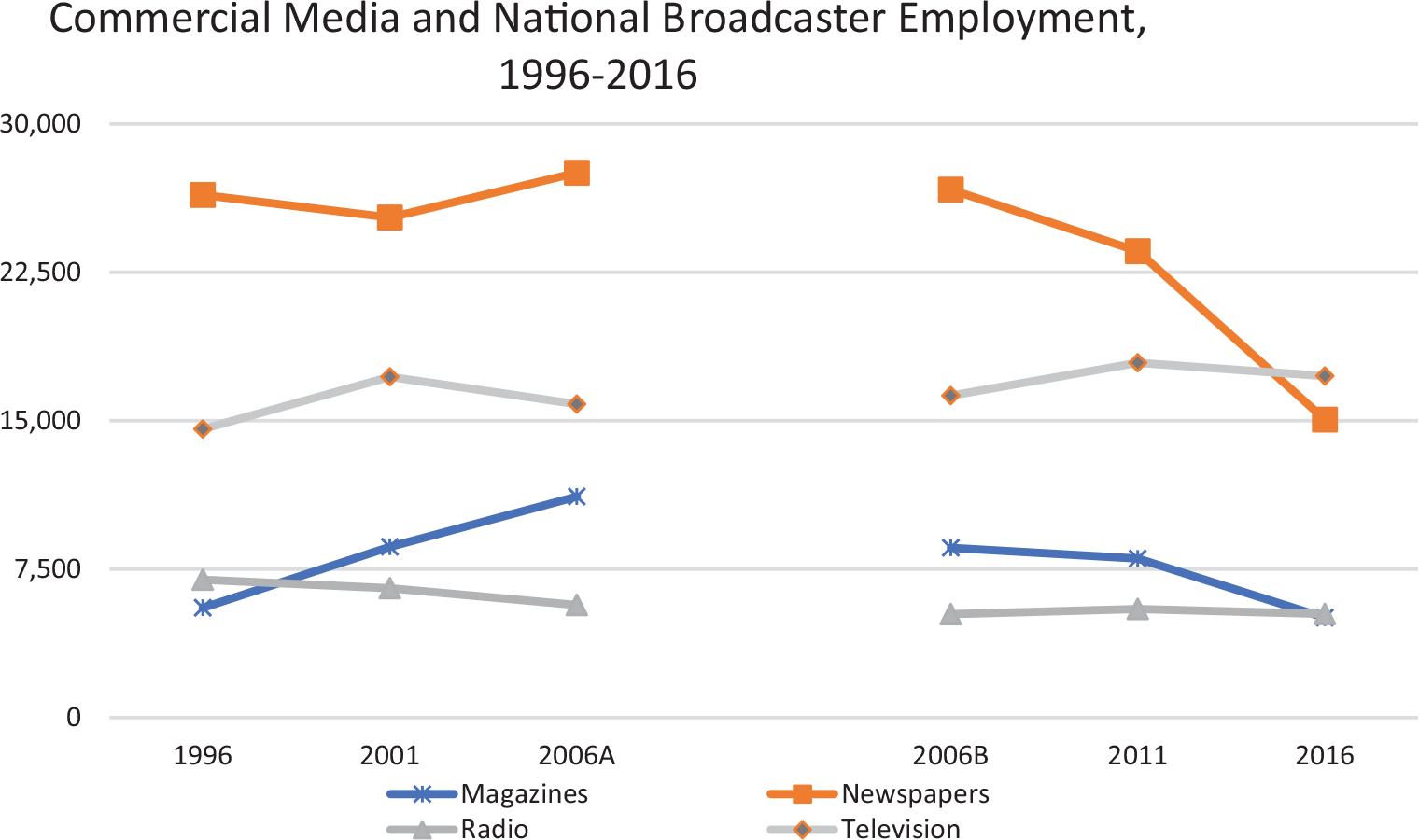
Traditional commercial media industry employment. 7
While we can ascertain advertising expenditures online, we cannot easily point to an online media industry in the way that we can a television and radio industry with its networks and stations, an independent film production sector creating programming for television and cinema release, or newspapers and magazines with their mastheads and centralised operations. Online media, and social media and search particularly, do not have any bespoke visible entities – like pay TV within TV, newspapers and magazines within print – which we can grab onto. The Australian operations of Facebook and Google are essentially only sales (and public affairs) operations of their respective US parent company. As such, they employ only a fraction of those whose occupation involves using social media and search as commercial media in the Australian market. Consequently, we now have a dominant commercial media industry which is not clearly visible and does not allow ready investigation to chart its size, its employment patterns or the contours it takes as a media form. In short, social media and search do not present themselves in ways that allow us to apprehend and describe their contours as media industries.
What these difficulties point to is the structural form that social media and search have taken as media industries. This is encapsulated in part by Facebook and Google’s continued claim to be technology and engineering companies and not media companies. Their argument is that they are intermediaries, facilitators and connectors rather than originators, community and network builders and eco-system providers. Certainly, they are not media content providers, producing and commissioning their own content to attract audiences in their own right in the manner of newspapers, magazines, radio, television and pay TV. 8 They are also not market information providers in the manner of traditional market research and statistical services firms providing third-party content to media providers and the advertisers upon convention-based agreed terms.
However, as media companies, they still trade on non-advertising content to attract and retain attention (so-called ‘eyeballs’). They still focus on providing attractive vehicles for advertisers to target audiences. And, they still develop what James Webster has usefully called ‘market information and user recommendation regimes’ (Webster, 2014) to encourage advertisers to use their platforms. These social media and search platforms provide vehicles for both user-generated and advertiser-generated content. Their ‘media operations’ and content investment turn on their interface design, the features they add, and their continuing experiments shaping user uptake by tuning recommendation algorithms and facilitating user-initiated distribution and circulation. 9
Unfortunately, their industry formation and industry employment patterns are not readily apprehended through a traditional focus upon them as entities in their own right as was the case for television and radio services, newspapers and magazines. Rather, as a particular kind of advertiser-supported media form, they have their own value webs that involve a raft of entities and industries which do more than service social media and search. We need to turn our attention to these aspects of social media and search to help us ascertain where we should look to find the commercial media industry consequences of the development of social media and search and begin to apprehend its extraordinary consequences for the shape and character of our commercial media industries.
Social media and search as media industry
The rise of social media and search has underpinned growth in industries, sectors and occupations that are configured towards producing content for platforms and matching user-generated activity with advertising needs. It has therefore been in the creative services area – those industries most geared towards providing services to businesses, government and not for profits – that the most employment growth has occurred especially within the Software and Digital Content segment (see Figure 2).
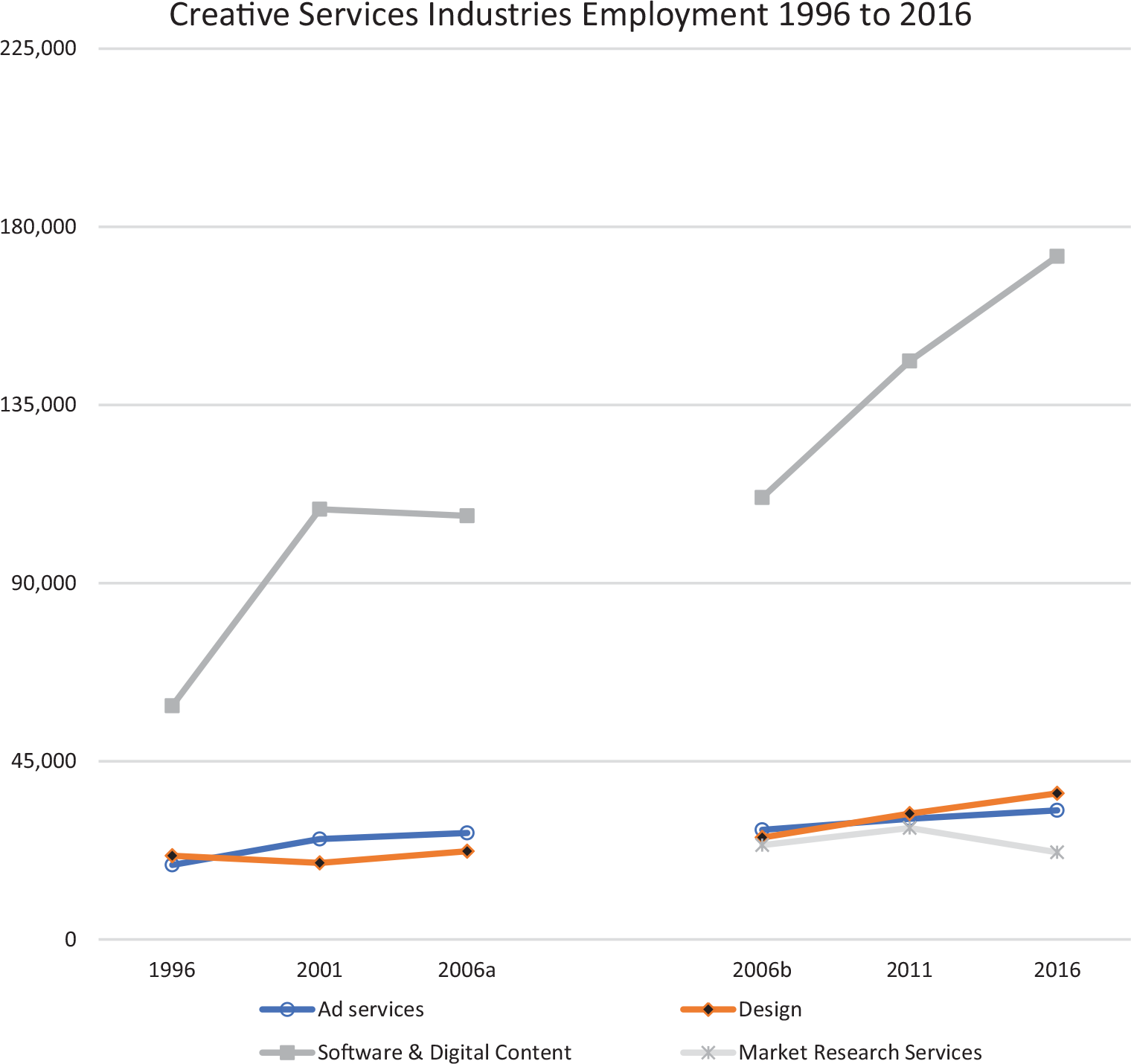
Creative services industry segments employment, 1996–2016.
We also see important structural transformations in patterns of employment within occupations consonant with this industry growth (see Table 1). Commercial media employment patterns have been shifting in line with the production of more advertiser- and marketer-generated media that is published on, and distributed through, social media and search platforms. Advertising and marketing professions, in particular, have seen substantial growth over the entire period closely associated as they are with the advertiser- and marketer-dominated social media and search system.
Employment in advertising and marketing segment occupations, 2006–2016.

Source: custom extracts from ABS Census of Population and Housing.
PR: public relations.
The stand-out among the advertising and marketing professions was the marketing specialist whose numbers increased from 29,731 in 2006 to 50,900 in 2016. Yet there was also solid year-on-year growth for the advertising specialist (3603–5540), the advertising and sales manager, whose numbers more than doubled (872–1852) over the period, copywriters whose numbers were likely swelled by expanding opportunities online which more than made up for declining opportunities in traditional media vehicles (going from 1018 to 1896) and for those marketing professionals for whom a distinction between their activities could not be readily made – these were nearly 6 times larger in 2016 than they were in 2006 (215–1256), reflecting the new online advertising and marketing functions that emerged – jobs such as ‘social media managers’, ‘Pay Per Click (PPC) Advertising Analyst’, ‘Search engine marketing analyst’ (SEM) and ’Search Engine Optimization Specialist’ (SEO).
The one creative services area that has declined and has done so quite rapidly since 2011 is the market research and statistical services industry which was needed to recalibrate itself and its services in the wake of social media and search’s emergence as competitors with their own bespoke market information and user recommendation regimes. These regimes contend with, and challenge, the centrality of independent third-party instruments such as those of Nielsen’s which continue in an online environment (in part as a means of having a check on, and an alternative to, social media platforms’ own market information systems). Market research and statistical services (the industry) now operate in circumstances where social media and search directly challenge them. This challenge comes from platforms undermining the norms of independent third-party market information by providing their own data and analytics direct to advertisers for analysis by in-house specialists – including the SEM and SEO jobs mentioned above. And, it comes from the platforms creating new kinds of responsive and real-time forms of audience profiling and measurement.
The traditional market research and statistical services industry that developed in Australia from the late 1920s had supported significant and growing levels of employment as traditional media and transactions of every kind required additional survey work and systems to identify and calibrate. By contrast, Google and Facebook harvest market information through the activities of the viewer/user as they engage with the platform. They simply do not need the same number of people to create, compile, collect and analyse their transactions from field surveys such as door knocking, telephone or retail stocktake. While Google and Facebook do employ some Australians in developing market information, their effort here is primarily to sell these information services and guide their Australian clients to datasets and practices for their analytical services. The engines for these are developed out of US head offices rather their Australian base. For this reason, Google and Facebook as market information providers barely have an Australian imprint in comparison to Nielsen et al’s. 10
The evidence for this is found by examining the industries in which selected relevant occupations are employed – for instance, market research analysts, statisticians and the 21,200 additional (2006–2016) marketing specialists (see Table 2). 11
Employment within other industries of those in selected market analysis jobs.

Source: custom extracts from ABS Census of Population and Housing.
Of the 21,200 increase in marketing specialist employment between 2006 and 2016, 15,200 jobs were added in industries other than marketing, advertising or market research service – in other words, jobs with advertisers such as banks, manufacturing and retailing. The timing of the increases is likely linked to the rising impact of Google and Facebook’s advertising – 5400 jobs in other industries were added in their early period (2006–2011) and significantly more (12,100) in the later period (2011–2016). By way of contrast, 3700 marketing specialist jobs were added within advertising, marketing and market research in the 2006–2016 period. Table 3 shows the cumulative annual growth rate over the three census periods and the contrast between the negative growth rate of market research analysts (−1.2% overall) and the significantly higher rate of marketing specialists (5.5%) while the workforce grew at an annual rate of 1.5%.
Compound annual growth rate of employment within other industries of those in selected market analysis jobs.
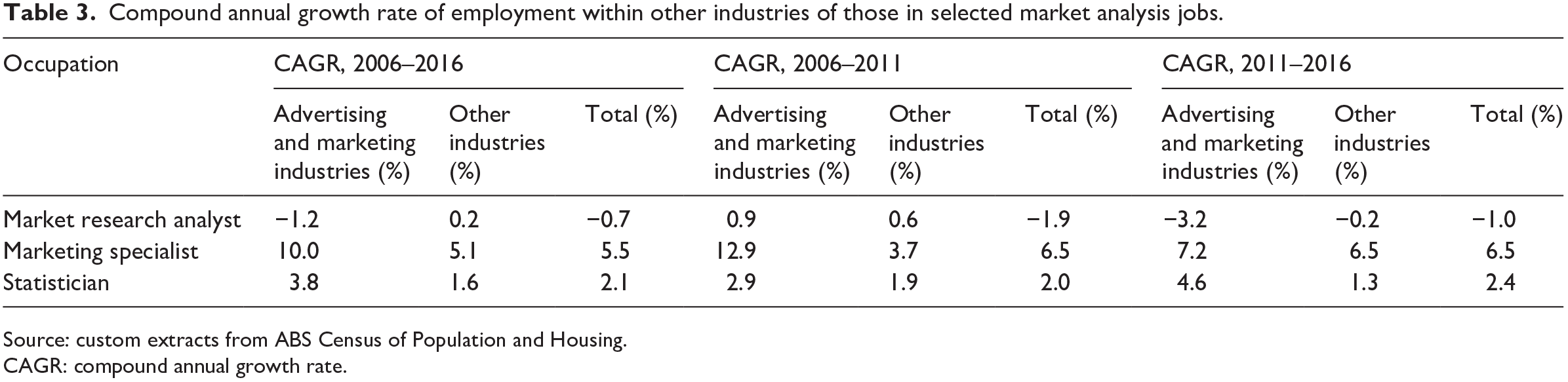
Source: custom extracts from ABS Census of Population and Housing.
CAGR: compound annual growth rate.
This profile of employment fits in important ways the transition from ‘The big “M” Media’ to ‘the small “m” media’. In this distinction, ‘The Media’ are the various, usually large media companies producing professional content (whether high-budget spot advertising and film and television programmes or the editorial content and daily miracle of newspaper and magazine formats). And, ‘the media’ are the raft of media-related output that has grown up in the social media and search space encouraging a variety of companies, associations and organisations to develop media communication vehicles through social media and search that enable them to communicate directly with their clients and their constituencies. The development of ‘the media’ at the expense of ‘The Media’ has been one of the achievements of social media and search.
Social media and search draw on and assemble into a media system mechanisms that more closely resemble patterns that have historically developed in advertising and marketing services than in the media industries of publishing and broadcasting. The advertising and marketing services have long made up a parallel and growing industry alongside these traditional media industries. They were themselves ambiguously a media industry in their own right, producing content in the form of advertisements for screening and display and a service industry providing these advertisements for their commercial clients and arranging them for optimal exposure to targeted consumers in integrated marketing campaigns. Social media and search represents in the first instance a vast structure of advertiser-communication and targeting in which the relation between advertorial and editorial is suspended and in which consumers are targeted in a way that encourages them to pass on and act as the commercial vehicles including distribution vehicles for this advertising. The occupational forms which have emerged are suited to this task.
Social media’s lack of marketing transparency and accountability
While the gap between editorial and advertising in traditional media was fluid, with plenty of grey zones between each, it was nonetheless recognisable as a gap. Furthermore, it was transparent at multiple levels. The distribution and the ‘exhibition’ of publishing and broadcasting were itself public, evident, traceable and reportable. The market information regimes – whether broadcasting ratings and circulation audits – were based on independent third-party market information regimes in which advertisers and advertising agencies, media providers, and market research and statistical service companies contributed.
This gave advertising an eminently public dimension. This publicness created spaces for advertising to be discussed, dissected and pored over by a host of agents spanning regulators, advertisers, marketers, ad agencies, consumers, public health and non-governmental organisations (NGOs) and industry associations regulating standards. It spawned a system of third-party analysis. It was on the basis of its publicness, for instance, that cigarette, alcohol and gambling advertising became actionable public health issues. It was on the basis of large corpora of advertising that content analysis and textual analysis of ads became possible, creating cases against sexist and exploitative advertising and for cultural diversity in advertising. Around its promotional culture grew up a whole raft of institutional responses, norms, forms of regulation and self-regulation in which the monitoring of one’s own and one’s peer’s activities was normalised. By contrast, no such publicness attends the advertising and marketing on social media and search platforms. Often, this advertising communication is not observable outside of the intended target audiences for whom it is visible. Often, it is evanescent disappearing and reappearing marked by events.
The lack of transparency on social media and search requires a new vision and way of seeing advertising and marketing. On the face of it, social media and search looks to transfer the same relation between editorial and advertising from commercial radio and TV, newspapers and magazines to social media and search. The distinctions between user-generated content and advertiser and marketer-generated content seem to mirror the distinction between editorial and advertising. We have the same sense of social benefit and even the public good associated with user-generated content as with the professionally produced news, entertainment and informational media programming. We have the same sense that advertising is the price we pay for this social and communicative amenity.
This has directed scholarly and public attention towards user-generated content just as we mostly attended to the professionally produced content, not the advertising content and strategies of traditional media. We have tended to assume without any evidence to the contrary that the same distanced and distancing relation holds. But social media and search media advertising and marketing is a decided departure from the forms of display, spot, advertorial and classified advertising that long dominated our commercial media. Instead audience attention is sold on the basis of the participatory culture of the platforms. This participatory culture is what enables it not to be public or visible or accountable in the same way. They do not readily allow the advertiser–platform–audience relationship to be transparently available through either their content or their reporting mechanisms. Sitting below the radar, they are neither public nor actionable nor even capable of being formed into a corpus for analysis. Their enlistment of audiences and the efficacy of this enlistment on behalf of the brand, the advertiser and the marketing campaign are hidden. With this lack of visibility comes a distinct and unprecedented lack of corporate accountability. This is the blindspot of our communications research.
As the ACCC observes, a more transparent market with adequate auditing and third-party information provision acting as a check would benefit the efficient functioning of media markets as well as contribute to evidence-based policy. Without this, media and cultural studies researchers cannot translate their methods and perspectives into significant public contributions and debates and policy frameworks relating to digital media. Focusing on just the user–platform relation leaves unattended the significant blindspot that is the promotional culture of the platform.
Erik Barnouw (1978) was able to write his mass media–era classic The Sponsor because of the public nature of the relationship between media firms, advertisers and market researchers. Advertising targeting was visible publicly in display, spot and classified advertising through various media channels; the nature of its targeting, the methodologies for its measurement and the practices of audience measurement, each of which was conducted in industry journals, committees, through associations, and in national reporting in business and general publications alike. At the same time, Congressional scrutiny had demanded more transparency and accountability in these operations in the wake of scandals around quiz-shows, 12 which were implicated in the use of audience measurement to target and manipulate ‘content’. In this media system, the moves towards greater commercial accountability and transparency had positive spillover effects in enabling the nature and character of advertiser–marketer targeting and its alignment or otherwise with public norms to become the subject of sustained scrutiny.
It would be difficult to write The Sponsor today. Unlike the situation in the 1960s and 1970s where advertising was available to sustained scrutiny owing to its ‘public’-ation, the marketplace formed around social media and search does not have the robust forms of transparency and accountability that were available in mass media. The social media and search platform is both media and market information provider, without third-party accountability. Furthermore, the ‘code’ driving audience attention – the architecture of the social media and search system – is claimed to be commercial-in-confidence, whereas the social survey techniques, the modes of its classification and utilisation, were all transparent. 13 The marketplace of attention the platforms create is also that of the media provider with a vested interest in constructing the audience measurement system on its terms.
Conclusion
In a seminal essay on regulation, Lawrence Lessig (2006) counselled the importance of seeing regulation as more than the activities of state regulatory agencies and laws drafted to shape commercial and media transactions. Such regulation was just one of four available kinds. In addition to this regulation by law, there was regulation by code or architecture, by norms and by market configuration. For Lessig, regulation was not just a matter for those seeking to police, monitor or shape communication through legal means and through action of state agencies like the ACCC or ACMA (Australian Media and Communication Authority). Instead, it was a matter for everyone, reaching, as it did, into the many operations and environments in which media operate. This includes not only market participants – advertisers, marketers, production and service providers – but also media audiences and users and the various public groups that were seeking to ensure that media supported positive outcomes. It is with this wider regulatory understanding that we raise here our concerns for the conduct of social media and search platforms.
We need to be concerned not just with what is routinely foregrounded about social media and search – its user norms, the capacity of the platforms and agencies to regulate user conduct, consumer concerns about the privacy of users, and concerns about the capacity of algorithms to maximise audience attention and keep users on their platforms creating social harms. 14 Also necessary is a counterbalancing attention: a concern with the nature and character of advertiser–platform interactions and the way they shape user–platform relations.
This means taking up the ACCC’s lead in centring the governance of the relationship between users, platforms and advertisers; the power of platforms to define the audience market; and the codes and algorithms that constitute the architecture platforms use to foreground and prioritise commercial speech. This all depends on reinstating norms of public scrutiny and accountability that were established in the mass media era. Such norms were developed and fought for over the past 70 years by actors seeking to mitigate harms and make the advertising and marketing interaction with media as accountable as possible.
Like the television of that era, social media and search companies incorporate the fuzzy language and rhetoric of communities and construct the advertiser as a benign sponsor paying for and enabling its public to get free stuff. Not only do social media and search go out of their way to not foreground themselves in or even acknowledge their grounding in these advertiser-supported relations, they also actively hide from viewing the operations of their audience markets.
The promotional culture is not simply a component of social media and search; it is hard-wired into it. At a time when platforms have encouraged and facilitated this unprecedented extension of commercial speech in an advertising system whose contours do not provide easy scrutiny, we are less able, as media scholars, activists and regulators, than we ever were to examine, probe and hold accountable a media form whose operations have largely escaped public scrutiny.
Media and communication scholars, public agencies and not-for-profit foundations focused on the public good are inhibited from exercising the required scrutiny on a vast social media and search ecosystem thoroughly saturated with commercial speech. Today, scholars must cooperate closely with the platforms and in doing so unwittingly become their spokespersons and gatekeepers. But without this access, there is a fundamental lack of transparency around this advertising and marketing, the ways in which its targeting is not visible to anyone but the group involved, its ability to set market information terms that are not open to traditional auditing and convention-based analysis, and cooperation with third-party firms. All these aspects of the social media and search platform make its operations not available to sustained public scrutiny in the manner that befits the largest commercial media service.
In Lessig’s terms, platforms have everything working for them: market regulation is largely the unfettered regulation of their own internal market which affords no dispute mechanism subject to external review; the regulation by code and architecture is their own internal regulation developed and maintained by commercial-in-confidence agreement and which changes all the time; its regulation by norms is through the norms it develops and the public norms it exploits and quietly corrodes. In these circumstances, regulation by law is the minimal available apparatus. 15
For media studies research, the reality of the centricity of advertising and marketing messages in social media and search means coming to terms with its promotional culture. This promotional culture is decidedly not that of traditional media settlements separating non-advertising from advertising. Instead, it is much more pervasive. It is more manipulative, lacking transparency and ordinary forms of accountability, and open to excessive and unreported behaviours. With national advertising expenditures so decisively shifting towards social media and search and with these platforms now becoming the dominant form of advertiser-supported communication, it is time to shift focus towards the promotional cultures that are being brought into being. This involves shifting our attention away from users and their management and practices towards the partnership and association between advertisers and marketers and platforms themselves and how this partnership and these interactions shape user interaction and content generation. Media studies needs, in short, to shift its attention equally to the distinctly different promotional culture that is emerging and the audience markets that form its basis.
We have shown that the transition to social media and search as the dominant form of commercial media has shifted advertising expenditure and patterns of employment, and in doing so created new advertiser–media relations that structure public life. A crucial issue is that this form of advertising is not available to public scrutiny in the ways mass media forms were. This reworking and redevelopment requires a recalibration of media studies’ attention to address its own new media blindspot: the promotional cultural of social media and search.
The promotional culture of the platform: a commentary by Nicholas Carah
In 2018, Professor Tom O’Regan founded a Platform Media research initiative at The University of Queensland. Tom’s enthusiasm for the initiative grew and grew, it sprouted new threads every other week, often outpacing his colleagues’ ability to keep up with it. It was marked by an original and historically rich intellectual inquiry that asked fundamental questions about what platforms are and why they matter. It also reflected Tom’s passionate and tenacious advocacy for his colleagues, and his insistence that we do the work of pushing out the boundaries, and building the future architecture of, the field. To me, the Platform Media initiative is a significant part of his intellectual legacy that will be remembered by us in the years to come.
Among his many interests, a sustained thread in Tom’s thinking about platforms was the way that they were reconfiguring audience markets. He convened a 1-day symposium called ‘The Promotional Culture of the Platform’ in 2019, and we had begun work on a co-authored manuscript based on our thinking about how platforms were transforming the settlements between media, advertisers, market information providers and audiences. We did not finish that piece, but the above is an edited version of a 15,000-word draft Tom had written on the basis of our many conversations.
There are parts of this article that read to me like a rehearsal of conversations we had. In an email accompanying his last draft, Tom wrote, I must admit this whole piece has taken on a life of its own and what began as a way to crib Carah and rewrite him with some touches of my own thrown in has given way to bringing this stuff into connection with a raft of media industry and media history sorts of stuff . . . closely connected with my [project on] media transformations.
Tom would often write emails like this, rehearsing how he was thinking and giving expression to the nature of our intellectual companionship. Lisa Bode (2021) offers a remarkably beautiful account of Tom’s intellectual ethos in her reflection ‘Seeking connections across constellations’; he was always seeking to work by ‘thinking with’ others in a spirit marked by generosity, curiosity and, it has to be said, a sort of irrepressible persistence.
The draft I began work with in a sense moved back and forth between our conversations and Tom’s own analysis of the ACCC platform inquiry, industry and employment data, and arguments about media industries, regulation, policy and history. In places, he set out notes for how he imagined I might develop the argument.
In what follows, I attempt to play out some of these threads that joined us together, and in doing so sketch out how Tom had been thinking about platforms. I think his account is an interesting one; his starting points and historical sensibilities had led him to frame questions and pursue lines of inquiry that are novel and important.
Tom’s first provocation in the piece is that media studies and public discussion about social media and search platforms often begin with, or centres, the user–platform relationship, or the content producer–platform relationship, when the advertiser–platform relationship is the constitutive one. This claim underpins his, perhaps idiosyncratic, use of the term ‘promotional culture’. On the basis of our discussions, I think Tom intends to deliberately augment how this concept is usually used and understood in media and cultural studies of digital media. Most work on the promotional culture of social media focuses on its symbolic, participatory and performative dimensions – the rise of influencers, native advertising, and the incorporation of brands and consumer experiences into the everyday depiction of our lives. Tom’s provocation was that this draws the lens too narrowly. He had in mind the larger circuit of cultural production. Platforms have a promotional culture not because of how brands, influencers and users express themselves (i.e. use the platform), but because platforms are designed with the interests of advertisers and marketers in mind. Platforms build a promotional culture from the ground up. Tom wants to puncture the somewhat nostalgic refrain that social media platforms were public and participatory before they were co-opted by advertisers and commercial interests. To Tom, they were an audience market play from the get go. And, so their promotional culture is one where participatory expression and creativity play out within the coordinates of their audience market imperatives.
This informed several intersecting currents in his thinking. He looked at platforms via his long-standing interests in market information and audience ratings services and conventions. He considered platforms as media industries because they created and transformed audience markets. His argument here about the larger structure of platforms’ audience markets should be read alongside his essay ‘Re-Reading Personal Influence in an Age of Social Media’ (O’Regan, 2021), which he was working on in conjunction with this piece. For Tom, the influencer was an historically significant figure because of the way they embodied how the relationships between ‘mass media’ and ‘personal influence’ are being institutionalised on platforms. The influencer is an unstable category. As platforms rapidly develop their capacity to optimise relationships the role of the influencer changes. In the first era of social media, they acted more like mass media celebrities, but as time goes on they act more like opinion leaders within peer networks. This is because platforms grow more efficient at operationalising influence on more granular scales. In that piece, Tom wanted us to understand platforms as producing a form of promotional culture that operationalised networks of personal influence, an ambition of advertisers since the mid-20th century.
In conjunction with his interest in audience markets, Tom was also in the process of analysing a range of patterns of employment, drawing on industry and employment data from the Australian Bureau of Statistics. In his last email to me about this piece, he wrote, ‘I am trying to improvise an explanation of social media as an industry form with occupational contours that feels difficult and still somewhat quixotic’. In his view, one of the ways we should understand digital platforms as media industries, and understand the nature of their disruption, is by tracing shifts in employment across creative services (including media production, advertising and marketing, and market research), design and information technology sectors. We can observe the decline of some occupational categories and the growth of others. While platforms stimulate employment growth in media and communication roles, they do not directly employ people. In his presentation to the ‘Promotional Culture of the Platform’ symposium, Tom explained, there is no entity in the way there is for newspapers, magazines, television, radio for us to calibrate social media and search, there is no category where it occurs. We therefore need to use proxies. Using proxies is notoriously difficult and dependent on a lot of noise. But proxies are the only available mechanism we have to understand the nature of this industry.
Media and communications roles proliferate as organisations of all kinds seek to use platforms to interface with their publics, audiences and customers. For instance, occupations like photographer, illustrator, multimedia designer, web designer, web developer, video producer, film and video editor, director of photography and media professional all grow from 2006 to 2016, whereas roles like actor, presenter, entertainer and journalist decline (see O’Regan and Young, 2019, for a sustained analysis of employment patterns in journalism).
My conversations with Tom about platforms were often animated by two initial concerns. First, social media and search platforms are media industries because they are now among the largest advertiser-funded companies in the world. Second, they have fundamentally transformed audience markets, the provision of market information and the form of advertising itself. Of particular importance to Tom was that the form of advertising and market information that platforms have created is unavailable to public scrutiny. But once you look under the hood, it is not a simple matter of re-establishing an independent third-party market information system. The platforms had dissolved important settlements between media and advertisers, and between media and the public that were established for print, radio and television. In his undergraduate lectures, Tom would elaborate that the platforms undo the settlement between media and audiences by instituting a ubiquitous form of surveillance, rather than the ethical and voluntary forms of audience and market research associated with mass media. They undo the settlement with advertisers by not having independent third-party auditing of their metrics. And they undo settlements with the public more broadly by breaking down distinctions between advertising and editorial and by refusing their role as media providers, instead presenting themselves as engineering or technology companies who play a neutral role in the circulation of information.
This constitutes an era-defining challenge to media research and policy. Tom’s impulse, I think, is that these settlements need to be reimagined and remade somehow. Our first task is to get to grips with the nature of the transformation, and Tom’s wager is that we will need to start out by grappling with platforms’ advertising models and audience markets. Questions about speech, moderation, curation, recommendation, diversity, accountability, bias and so on are all shaped by the irresistible momentum of the advertising model. And yet, we often frame these questions, problems and solutions without paying much attention to advertising.
We are dealing with a historically significant form of audience commodification. Significant not only because of the way it is transforming advertising and marketing, but because of the broader effects it is having on the possibility of a shared culture, the functioning of public information and the conduct of the democratic process. In the era of mass media (advertiser-supported television, radio and print), market information services (like ratings and other market research services) described the features of an audience commodity on the basis of past viewing, listening and reading practices. Information like ratings and market research played a descriptive role. It described the features of the audience commodity, and advertisers could choose from among the available audiences that media firms had for sale. Advertisers were buying the attention of an audience that, based on past practices, had certain demographic characteristics. Advertiser-supported media organisations were creating entertainment and editorial content that cultivated audiences with features that were desirable to advertisers and working with market information providers to describe those features in evermore fine-grained ways.
Platforms create integrated relationships between audience and market information commodities. They do more than just vertically integrate market information into their business. Market information shifts from describing the features of the audience in past tense, to allowing advertisers to specify the requirements of the audience in future tense. In his piece on Facebook and personal influence, Tom compares the audience research of the mass era with the use of data by platforms. He writes, To adopt an analogy drawn from Donald Mackenzie (2006) the survey research of Katz and Lazarsfeld provided a ‘camera’, a representation of relations as they stood. This was subsequently used by other actors as an ‘engine’ to drive their actions and interventions in the form of advertising campaigns and marketing decisions, media development, scheduling and program evaluation. By contrast, Zuckerberg had a much larger ambition: Facebook was in the business of rendering the distinction between ‘camera’ and ‘engine’ indistinguishable’. (O’Regan, 2021)
I’m inclined to push this point a bit further. It isn’t just that the moment of ‘observing’ the audience gets incorporated into the ‘engine’ for targeting them, it is that the camera and engine are no longer in straightforward ‘observe’ then ‘operate’ relationships. First, the platforms make observation ubiquitous. The audience commodity is valuable not only as a bundle of attention, but because its actions, expressions and affects are continuously rendered into data which deepen the range of ways it can then be constructed as commodities – not just as paying attention, but also the likelihood to act in certain ways, or influence others. The consequence is that rather than describe an already-existing audience, advertisers input specifications for the audience they need to build ‘made to order’. But the depth of the operations does not stop there. The need for the advertiser to be able to describe the specifications is fundamentally altered by platforms. Advertisers and platforms enter into increasingly dynamic exchanges. In the case of commodities like ‘custom’ and ‘lookalike’ audiences, and associated ad formats like ‘dynamic creative’, advertisers, platforms and other third-party data brokers, all provide information that informs the customised construction of both audience and advertisement in relation to each other. At the beginning and end of the process there are no discreet audience specifications, audience and advertisement. Rather, there is a continuous ‘tuning’ of relationships as data-driven processes optimise relationships between users, ads and advertisers. The advertisers use platforms’ proprietary audience-building tools to iteratively refine and ‘tune’ engagement with their targets. Market information services shift from a descriptive role in specifying features of the audience commodity, and auditing the veracity of media firms’ claims, to a much more generative role in the construction and maintenance of the process of ‘optimising’ advertiser–audience relationships. Both advertisements and market information slip out of the public domain and onto the customised feeds of users and dashboards of advertisers.
The audience commodity that platforms now sell is not a reliably described ‘bundle’ of attention or eyeballs, but instead access to a dynamic data-driven process of audience-building. The ‘advertiser uses market research to choose a media channel to distribute an ad to an audience’ relationship is transformed into ‘advertisers access data services via a platform to dynamically manage and optimise audience engagement’ relationship. The platform is a multi-sided market managing these relationships (Helmond et al., 2019). This means the object of our attention in media research and policy needs to be how to make public these processes of optimisation, curation, recommendation and influence.
The settlement we need is not a return to an independent third-party auditing of ‘audiences’ but rather to move towards accounting for the process of ‘optimisation’ of audiences. As the ACCC points out, this is necessary for the functioning of competitive markets, but it is also fundamental to the regulation of media as institutions that play both market and public roles. As Tom put it in an email to me, ‘social media and search have replaced news and print as the dominant media acting as an intermediary between the user/citizen and the world and providing access to legibility to our worlds’. The ACCC platforms inquiry is so consequential because it clearly set out these commitments to both competitive markets and the public value of media, and demonstrated their interconnections.
We live in an era where audience commodification is central to the construction of our public culture more broadly. We require a foundational commitment to the publicness of how information is used to optimise attention and social relationships. To think of the ‘publicness’ of media now is not only to require the content to be public, and information about reach and audiences to be available, but to envision how the way media ‘operate’ on us, and ‘optimise’ social relationships, attention, exchange is made public. Not just public as in visible, but public as in held in common. This is the stakes of the new settlements that are required. We should look to the settlements of the past not only because they have dissolved, but because they show us settlements are possible and need to be brokered among diverse actors. Tom’s call to researchers and policymakers is that the task at hand now is to imagine and fashion new settlements.
Footnotes
Acknowledgements
Peter Higgs undertook the analysis of data relating to employment used in this piece and assisted with editing the analysis in Tom’s draft manuscript.
Funding
The author disclosed receipt of the following financial support for the research, authorship and/or publication of this article: This research was supported by Tom O’Regan’s Australian Research Council Discovery Project DP130101455 ‘Media Transformation in its Australian and International Contexts’. The paper on which this article is based was first presented as part of a joint School of Communication and Arts and Platform Media: Algorithms, Accountability and Design strategic initiative seminar on the Promotional Culture of the Platform.
