




Abstract
Based on the hierarchy of influences model, we explored journalists’ understanding and perceptions about media convergence in Pakistan’s media industry and its influence on journalistic practices and routines. In-depth interviews with Pakistani news practitioners revealed several challenges hindering the successful implementation of media convergence in Pakistan. These challenges included the lack of resources for incorporating digital technologies, the lack of financial incentives, and stringent journalistic work routines, we found that technology-induced routines have severely affected both the personal and the professional lives of media practitioners. The adoption of convergence in Pakistan has been largely based on economic and commercial concerns rather than attempts to improve the quality of media content. Overall, the work contributes to the media convergence literature by providing insights from an emerging non-Western media system.
Introduction
Media convergence has usually been referred to as a cultural shift and an integrative process in which content flows across multiple media platforms, prompting cooperation between different media industries, and resulting in the migratory behavior of media audiences (i.e. Menke et al., 2018). Since the beginning of the 21st century, media convergence has been one of the most studied topics among journalism and mass communication scholars (i.e. Jamil, 2020b; Menke et al., 2018). Researchers have studied various dimensions of convergence in a number of countries, such as the role of convergence in increased recycling of the news in the Greek media landscape (Saridou et al., 2017), acceptance of convergence by editors and media workers due to business reasons (Windscheid et al., 2019) convergence and media freedom in Indonesia (Tapsell, 2015), the success of convergence in South Korea (Pak, 2017), perceptions and challenges of Indian journalists to convergence (Mishra, 2016), and the relationship between convergence and other societal changes in six European countries (Menke et al., 2018).
However, most of these media convergence studies have focused on Western contexts or developed media systems consequently, studies originating from the Global South remains scarce. To address this gap, the current study focuses on Pakistan for several reasons. First, digital technologies (mainly the Internet) arrived in Pakistan around the same time the media started gaining press freedom in the early 2000s (Rehmat, 2019). Because of its evolving media landscape, more than 6,000 journalists have been laid off since 2015, partly due to technological transformation ‘which has upended how people access information’ (Rehmat, 2019: 1). This transformation has forced traditional media to rely more on technology while abandoning their previously held human-intensive organizational structures. Second, the media companies in Pakistan have altered their business model, which traditionally relied on government’s ad spend. Due to changes in socio-political circumstances, they have now turned their focus to digital media (Aurora, 2020). Third, due to personalized media environments (Athique, 2020), Pakistan observed a dramatic increase in the usage of the Internet (with more than 76 million users, 35% of the total population) and social media (with 37 million users, up 17% from 2019) (Kemp, 2020). 1 Combined, these technological shifts along with an evolving business/economic model and media consumption patterns, provide a unique opportunity to study media convergence and its impact in a country that has been largely overlooked by the current literature; a country where the question about the benefits of convergence for the journalism industry, remains unanswered.
In this study, therefore, our goal is to add to the current media convergence literature by focusing on how media convergence is taking shape in a developing country, where the unfolding media industry is comparably young and its freedom still illusive. Furthermore, based on in-depth interviews with key media professionals, we aim to assess the scope and applicability of the hierarchy of influences model (Shoemaker and Reese, 1996) in the media in Pakistan. By doing so, we hope to contribute to the ongoing debate regarding the lack of representation of countries from the Global South in the field of journalism and mass communication generally (de Albuquerque et al., 2020; Ng et al., 2020) and the literature on media convergence, more specifically.
The hierarchy of influences model
The hierarchy of influences model postulated by Shoemaker and Reese (1996) explored the different factors that influence media content. The model is hierarchical and describes the various levels of influence, ranging from individual, routine, organizational, institutional, and social system (Reese, 2019; Reese and Shoemaker, 2016). At the most micro level is the individual level of influence, which presumes that individual characteristics and traits (e.g. professional roles, news values one adheres to, and demographics) shape media content (Reese and Shoemaker, 2016). The routine level focuses on the effects of newsrooms’ routines and expectations from journalists on content production (Hanitzsch et al., 2010). The organizational level of influence refers specifically to the influences of policies and economic imperatives of the media organization (Reese, 2019: 2). At the social-institution level, the focus is on external factors that play a significant role in influencing content production (e.g. advertisers, socio-political institutions). At the macro social systems level, journalists may face influences from social systems as a whole (e.g. ideological processes, norms, and cultural values), affecting media content.
The hierarchy of influences model, however, does not acknowledge technological advancements– a main ingredient in media convergence – as a distinct level of influence. Rather, as Reese and Shoemaker (2016) argued, technology is recognized as a main ingredient that has enabled ‘changes in the media eco-system’ (pp. 389–405) and shifted the boundaries of old concepts, while encouraging new ideas. In their view, technology has allowed ‘transformational connectivity affecting media work, tools, processes, and ways of thinking’ that consequently becomes integrated into practice.
Recently, Reese (2019) explained that digital technology has shifted the balance of how media produce content (e.g. by giving the audience a more active role through various means and thereby influencing content production). The adoption of digital technology and its integration into media production challenged the different media processes and cross-platform integration. Almost a decade ago, Albarran and Moellinger (2013) concluded that technological shifts influenced content production practices and big traditional media companies struggled to integrate digital media and develop a comprehensive convergence model. The challenge to integrate the latest technologies, they explained, led to reduced job opportunities for journalists and unrest among media workers. More recently, studies found that the main obstacle in implementing convergence is not the media organizations but the journalists for whom convergence means multi-tasking and greater workload while dealing with new technologies (Indrati et al., 2018). García-Avilés et al. (2014) explained ‘newsrooms are in a makeover process’ (p. 10) and the requirements of readily accessible digital media eventually force journalists to embrace all dissemination channels.
Technological shifts and their associated challenges in the newsrooms appear to have influenced journalists’ performance at different levels. For example, technology-led convergence, at the micro-level, significantly affect the routines and practices of journalists by influencing organizational practices and structures (Jamil and Appiah-Adjei, 2020). In addition, at the meso-level, the media organizations may offer resources to allow employees to gain required skills, consequently, allowing them to up their cross-platform content generation abilities, as well as their marketability. However, despite this interest in digital technology and convergence in the current literature, the impact of technological shifts on Pakistani media professionals has not yet been established.
The media industry in Pakistan
The media industry in Pakistan is diverse in nature. It provides information and entertainment and is a source of livelihood to more than 2.5 million people (Rehmat, 2019). Pakistan has more than 88 television channels, 209 radio stations, and around 1,800 newspapers in 8 different languages (Jamil, 2020a; Rehmat, 2019). However, despite it being a media-rich country, the contemporary situation of Pakistan’s media industry is like a ship heading nowhere (Rehmat, 2019). Pakistan Electronic Media Regulatory Authority (PEMRA) issued more TV and radio licenses in 2018, while working journalists were becoming unemployed. The apparent counter-intuitive situation has its roots in technological-driven convergence and political and economic benefits. On one hand, the growing adoption of new technologies require fewer people in media organizations, thus spurring the layoffs. On the other hand, the government continues to issue licenses to new (yet conventional) media organizations, which seem to curtail freedom of speech and limit the economic and political benefits to its regulatory bodies (Jamil and Appiah-Adjei, 2020). Meanwhile, the local government, Jamil and Appiah-Adjei (2020) explain, is not in a position to prevent the widespread layoffs due to the adoption of digital technologies by few media organizations, creating fear and hopelessness among the journalism community in terms of job security and the future of the media industry in Pakistan (Rehmat, 2019). To mitigate this situation, local press groups and media conglomerates have emphasized the successive adoption of diverse approaches over the past 5 years to cope with digital media challenges. However, the success of integrating traditional and digital media in Pakistan is still under debate (Jamil and Appiah-Adjei, 2020).
This integration, where media outlets innovate media processes and adopt new technology is known as media convergence (Singer, 2004a, 2004b). Convergence of new media technologies has pushed the media industry in ‘new directions of integration, synchronization, and conglomeration’ (Tapsell, 2015: 183). Owing to this technological convergence, Pakistan’s multi-billion media industry is undergoing significant changes: old TV channels have shut down, various bureau offices have closed, and thousands of journalists and media workers have been laid off in the last 5 years (Rehmat, 2019). For instance, the Jang Group (Pakistan’s largest media conglomerate) has shut down three publications and two bureau offices. Dunya Media Group and The Express Media Group (the two newer players in Pakistan’s media industry) fired more than 200 journalists, and other media outlets, including Dawn (the oldest media house in Pakistan), slashed their employees’ salaries between 15% and 35% in the last 5 years (Rehmat, 2019). Despite these major shifts and ongoing challenges, no study has investigated the Pakistani journalists’ perceptions regarding the diffusion and success of convergence of digital technologies across media platforms and the impact of the various hierarchical factors that has led to Pakistan’s current media crisis.
Media convergence and journalists’ perceptions
Media environments have rapidly changed based on convergence and several factors, including globalization, use of interactive media technologies, evolving business models (Rehmat, 2019), and competition among media organizations battling for audience attention and revenue generation (Strömbäck and Karlsson, 2011). For more than a decade now, digital media, such as websites and social media networks, have allowed people to interact with journalists and media organizations adopted different ways to engage with audiences and increase interactivity (Fortunati et al., 2009). Understanding journalists’ perceptions toward convergence, then, set the foundation for better comprehension on the use of interactive media by traditional outlets (Xiong and Zhang, 2018). These perceptions became key to document because they affect journalistic and professional practices (see Tapsell, 2015).
The perception of media convergence among journalists, consequently, has been extensively studied in various contexts (i.e. Menke et al., 2018; Xiong and Zhang, 2018). Journalists in different countries have had different understandings and perceptions about media convergence. Despite such interest, a review of the current literature shows limited studies on media convergence outside the Western and less developed media systems, specifically in Pakistan – a country in which its vibrant media have been in crisis due to the rapidly changing technological landscape.
The influence of technology-driven convergence
Technology-driven media and convergence have changed the media eco-system on various levels, including the processes and practices of content production (Domingo et al., 2015). Over the years, the continuously changing communication technologies have had drastic effects on the production and consumption of news content (Franklin, 2012). Media outlets have used various types of content management software either built by the company or bought from commercial companies. Journalists have long felt pressure to produce more content at lower cost (Bakker, 2012).
While content management and production have become easier over the last decade, in developing countries news journalists lack training and resources. Developing countries’ media industries have not fully digested the media convergence model. In the context of Pakistan, Jamil (2020b) argues journalism practice has been overwhelmed with the effects of technological innovations. Challenges include limited technical and financial resources and strict legal frameworks. These challenges have influenced journalistic practices, routines, as well as personal and professional lives. Furthermore, socio-political and cultural factors have undermined news professional duties, specifically in regards to press freedom (Jamil, 2020b).
The future of journalism and media convergence
The incorporation of new technology in the media industry raised questions on professionalism, economic sustainability of legacy media organizations, quality of journalism, and ethics (Wahl-Jorgensen et al., 2016). Several scholars addressed the impact of technology on the future of journalism. For example, Zelizer (2019) argues that technology impacts the journalism industry in several areas including journalistic routines, news content, newsroom and organization infrastructure, and the relationship among media outlets, journalists, and the public. Prasad (2019) study suggests that India’s news media is thriving and going digital due to the increase use of Internet and digital advertising. In addition, their study found that interviewees mentioned about the necessity of diversifying revenue streams. Digital medium does not reduce the importance of the journalists. However, traditional organizations need to train journalists even more to produce content for multi platforms (Dutta and Gangopadhyay, 2019).
While digital technologies revolutionized the media industry across the globe, the future of media industries has been uncertain. As Franklin (2014) explained, the production, reporting, and reception of news has changed. His insight mirrors many recent developments in the Pakistani media industry, including layoffs of news professionals and the growth of mobile usage by journalists in their daily journalistic practices (Jamil, 2020a). In the Pakistani context, the media curricula are not regularly revised to meet the needs of an evolving media industry. In this respect, Saleem and Ahmad (2015) suggested that the specialized training in media education is needed for college professors to augment media outlets needs especially skills in multimedia content production in Pakistan. Convergence without training of journalists and digital technologies use without management of resources have been key challenges in Pakistan and media owners are desperately looking for sustainable business models that often are not supported by educational practices and available resources (Rehmat, 2019).
Overall, in the light of the recent literature, it is clear that several studies addressed the media convergence process and its impact on journalism in Western contexts and developed media systems (i.e. Menke et al., 2018; Pak, 2017; Saridou et al., 2017; Windscheid et al., 2019). This particular area, however, has been overlooked in developing countries, including Pakistan.
Research Questions
Given the limited understanding of media convergence in Pakistan and how technology-driven convergence has influenced journalistic practices, we pose the following research questions:
Methodology
We explored the perception of Pakistani journalists through semi-structured interviews in Pakistan. We used a purposive sampling to ensure the diversity of opinions and representations of news organizations of different sizes and document their perceptions and understandings related to media convergence (see Jamil, 2020b). The data for this study was collected between 1 June 2019 and 10 February 2020. We recruited journalists through email, Twitter, and WhatsApp. Information about the participants, the interview process, and data analysis is detailed below.
Participants
Our participants were journalists with varying years of experience, age groups, geographic location, position within an organization, and experience with different media platforms (including print, television, and online media) (see Xiong and Zhang, 2018). To draw on their diverse experiences and environments, we carefully selected journalists that included those from newsrooms of various sized outlets (see Table 1).
Demographics of interviewees.
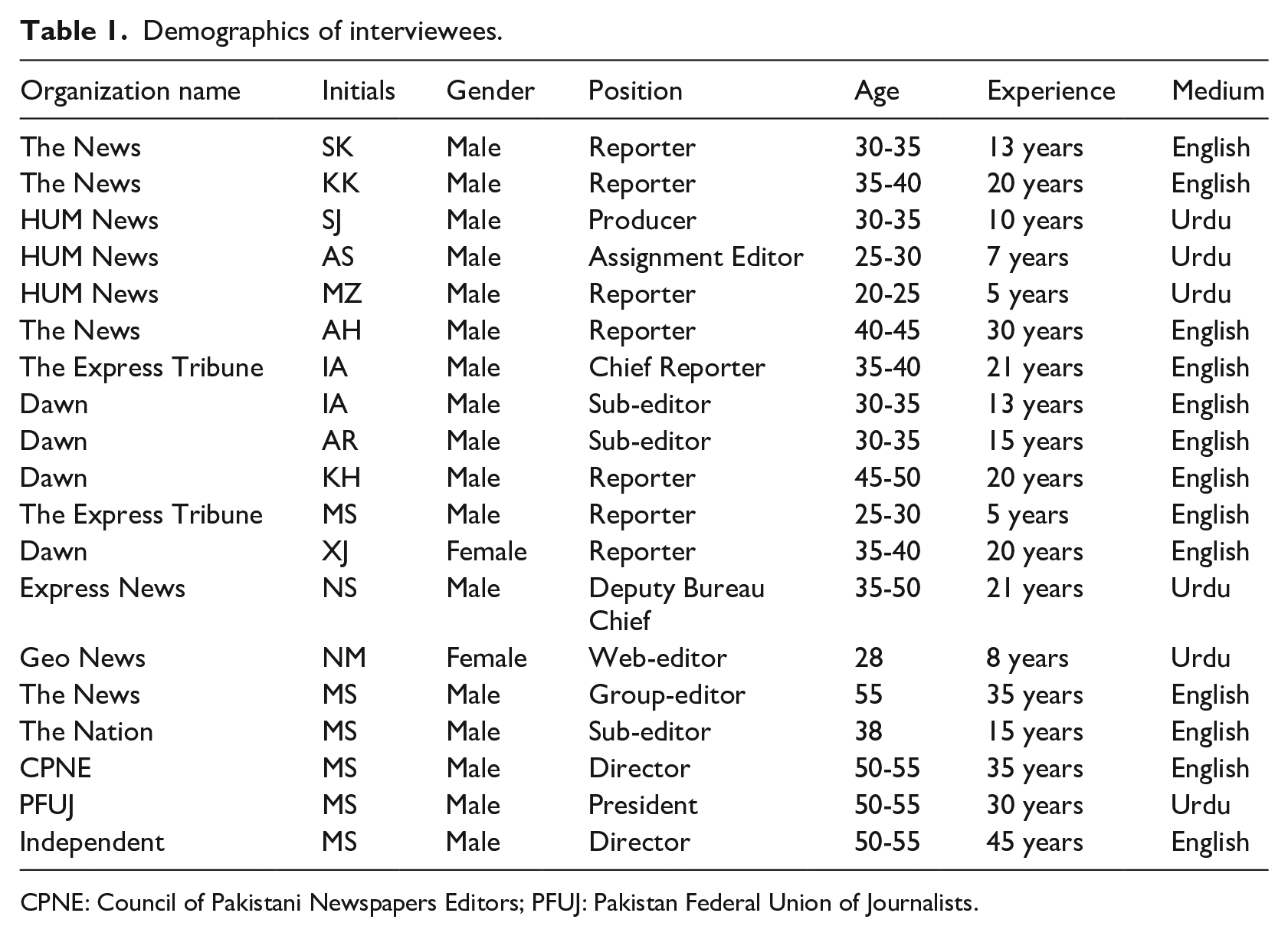
CPNE: Council of Pakistani Newspapers Editors; PFUJ: Pakistan Federal Union of Journalists.
The participants included 17 male and 2 female news professionals between 26 and 60 years old. There were seven reporters, one producer, one assignment editor, one chief reporter, three sub-editors, one group-editor, one web-editor, and one deputy bureau chief. We then categorized them into three levels: The first level included decision makers, such as editors and news directors; the second level included mid-grade media workers, such as sub-editor and city editors; the third level included reporters, chief reporters and field workers who provided us insight into the impact of convergence on the individual level.
All of the participants worked for the English-language media outlets and Urdu language newspapers and television 2 and were affiliated with the following organizations: The Express Tribune, Dawn, The Nation, HUM News, Geo News, Express News, and The News. These newspapers and TV channels are headquartered in Lahore, Islamabad, and Karachi and cover all major and small cities in Pakistan. The participants were all located in Pakistan’s major cities, such as Lahore, Islamabad, and Karachi and had journalism experience ranging from 5 to 35 years.
The interview process
The in-depth interviews were conducted in the English language and face-to-face at the news media outlet, or at press clubs with Lahore-based journalists and via Skype or over the telephone with journalists in other cities, such as Islamabad and Karachi. Participants took part in individual, face-to-face, semistructured, audiorecorded in-depth interviews approved by the Institutional Review Board of the first author’s university. Beyond the sample, to enrich the findings of this qualitative study, three additional interviews were conducted, by following Mishra’s (2016) approach, with one top former newspaper editor (with more than 30 years of editorial experience) and two officials of journalism organizations: the Pakistan Federal Union of Journalists (PFUJ) and the Council of Pakistani Newspapers Editors (CPNE).
Instead of data extraction, our reflexive in-depth interview process created a series of moments to reflect on media convergence. Beyond designing an interview guide that might produce such moments, we spent a significant amount of time preparing for and discussing our role in the interview (see Ureta and Fernández, 2018). Therefore, sometimes, conversations went beyond the interview guide to create in-depth discussions with the participants. This process produced detailed information, specifically as journalists noted the challenges and issues they continue to face with media convergence in Pakistan. The interviews ranged between 35 and 60 minutes long. The identities of all of the participants were kept anonymous. Before the interview, each participant was briefed about the objectives of the study. The interview questions were loosely structured based on the three major categories below:
(a) Understanding and assessing the implementation of media convergence in Pakistan: To understand journalists’ perceptions about media convergence and assess its success in Pakistan, our questions included the following: How do you perceive convergence and to what extent do you see it in your organization? Do you think media convergence is showing success in the local media industry?
(b) The impact of media convergence on journalism practice in Pakistan: To document the various levels of influences, our questions included the following: How does convergence influence your routines and practices? Do you think your organization provides you adequate training to work on digital platforms? What can you tell me about the main challenges of media convergence in Pakistan?
(c) The future of media convergence in Pakistan: To examine what journalists think about the future of journalism in their country, our questions included the following: How do you envision your future in the media industry? Where do see the future of converged journalism in Pakistan?
Data analysis
Research shows that analyzing qualitative data is not only widely used among communication scholars but also rigorous, helping researchers discover participants’ perceptions of a phenomenon (Braun and Clarke, 2006). Prior to interviewing, we as a research team discussed questions related to recruitment and representation and how co-researchers’ identities may guide the interviewing and interpretive practices. Throughout the interviews, we collectively returned to and discussed particular moments from the interviews and alternative ways to make sense of the data. Recordings were saved in a Solid-State Disk (SSD) hard drive and no software was used to transcribe the recordings. We transcribed the interviews and coded the data using an axial coding process to understand the raw data and generate major themes and issues regarding media convergence in Pakistan. During the coding process, we regularly returned to our interview guide – that was based on previous literature and the hierarchy of influences model framework – as well as our research questions. We took notes that were kept separate from the transcriptions (see Shah et al., 2019). This allowed us to compare annotations and discuss valuable information among us.
To interpret and analyze the data, we used a combination of computer software and manual coding. First, we used ATLAS.ti software; the software assists in organizing and making sense of large qualitative datasets (Erba, 2018; Smit, 2002). Participants’ answers were first coded in chronological order during the data collection period using a combination of ‘open coding’, identifying relevant themes line by line, and ‘focused coding’, looking for specific themes to group them into categories to answer our research questions (Charmaz, 2006; Emerson et al., 1995). Then we manually performed ‘theoretical coding’, that provided us with additional insight and allowed us to generate relevant themes. The following section presents our findings.
Findings
Media convergence in Pakistan: existence and understanding (RQ1a)
The first part of our first research question asked about how local journalists understand media convergence in Pakistan. To start with, all of the interviewees showed a clear understanding of the process. They explained it is the coalescing of different media content, such as TV, print, and digital platforms. However, there were variances in how these journalists perceived the current converging media environment in Pakistan.
One journalist from The Nation, for example, elucidated that media convergence in Pakistan is ‘when management of any media house asks to share resources across its different subsidiaries (i.e. TV, press, or web) and not just the content but even human resources’. The vast majority of the interviewees explained that convergence has allowed media owners to ask a single employee to run a ‘one-man show’ where s/he is responsible for producing content across all three types of media platforms. One reporter from a Dawn newspaper conceded that ‘convergence and digitalization of media are the need of the hour in Pakistan, however, it significantly changes journalists work routines because of the lack of training that influences the way journalists report and file a news story’.
While the perceived advantages of media convergence were widely understood among the news professionals interviewed, it appears that participants also recognized that the organizational level, the policies are negatively influencing the process. They explained the increased workload on reporters, negatively affects the successful adoption of convergence and the overall quality of journalism in Pakistan. On one hand, the majority of the journalists interviewed explained that convergence has shown to be beneficial from the financial standpoint, on the other hand, it has severely affected the quality of journalism negatively. One journalist from The Express Tribune aptly said: ‘In journalism, quantity is inversely proportion to quality’. By specifying the augmented expectation to submit a publish-ready news story simultaneously for different mediums, our interviewees noted that it has caused serious pressures and even forced many to quit the profession. A reporter from The News stated: ‘management has used convergence as a cost-cutting tool rather than bringing innovation and quality to journalism’. Such perceptions mirror the findings of Hanitzsch et al. (2010) who argued organizational policies are implemented to balance commercial and professional concerns and accordingly satisfy ownership and financial goals.
Another related concern that emerged was the lack of resources for training to integrate media convergence into the industry in Pakistan. Journalists explained that a lack of training has made their jobs difficult because of the extra pressure of self-learning they feel is required to be able to produce content for different and distinct media platforms. However, despite voicing all of these concerns, the journalists recognized they continue to work under such conditions because the alternative to compliance is the scary thought of unemployment.
The success of media convergence in Pakistan (RQ1b)
The second part of our first research question asked about the way Pakistani journalists assess the implementation of media convergence in their country. Overall, 16 journalists interviewed revealed that journalists are unclear about the successful integration of different media platforms. They highlighted a variety of reasons for this ambiguity. Journalists are wary of their abilities that are required for successful implementation of media convergence. One interviewee blamed the education system, which in their view is not producing capable journalists who can help news organizations converge, while leveraging new technologies. Thus, while most of the news professionals interviewed agreed that Pakistani media have converged to a significant extent, they concede that the lack of competent tech-savvy journalists and institutional support obstruct the successful and full implementation of convergence in the industry. One journalist from the Dawn newspaper noted: The convergence of multiple media platforms would have been proper and effective if the management had a plan for inducting skillful individuals in the respective organization and anticipated the capacity and the workload of its employees. . . because in the absence of such qualified media professionals, cross-platform integration is bound to fail.
All of the journalists interviewed explicitly highlighted the need for more training. None of them received training organized by their media organizations. These journalists recognized their incompetence and were therefore less likely to feel confident in adopting digital technologies. Generally speaking, their overall responses suggest their inability to cope with a changing technological landscape. They feel their media organizations put them at a disadvantage by not helping them learn and thus making their jobs more stressful. Overall, while all Pakistani journalists interviewed showed awareness of what media convergence represents, the prevailing conditions in Pakistan pose significant challenges to successfully implement the integration of different media platforms. These challenges have made them doubt their journalism skills to get the most mileage of media convergence.
Convergence as an influence on journalism practice in Pakistan (RQ2)
Our second research question asked about the way local journalists perceive the impact of media convergence on journalism practice in Pakistan. Careful analysis of the in-depth interviews with Pakistani journalists enabled us to identify determinants related to the individual, routine, organizational, and social institution levels of influence. They are detailed below:
Individual level influence
The language barrier is considered a problem for many Pakistani journalists. Convergence in Pakistan is marred with language bifurcation. The national language of Pakistan is Urdu; hence, the majority of the journalists are well-versed in this language. However, the news websites of major media outlets (i.e. Dawn Group, Jang Group, and Dunya Group) are in English. This content bifurcation has troubled Pakistani journalists. Filing a story in Urdu and translating it into English has often been criticized, they explained, especially if the translation is not done by the reporters themselves because of their limited language skills. A group-editor from The News explained, that ‘it is different to write a news story in mother tongue and then reproduce it in English for another medium (web), while following a completely different set of styling guidelines’. Thus, our analysis here suggests the lack of language proficiency required by news websites of major local media outlets influence journalism practice in Pakistan.
Almost all of the Pakistani journalists interviewed mentioned technological challenges and the absence of proper training. The interviewees explained the shortage of skilled journalists was a major concern. For instance, an editor from HUM News expressed, ‘we need technically savvy people in our newsrooms, but we are not sure what media students are learning in their universities because when they come here, they appear very novice even with basic journalism skills’. Evidently, the technological challenges experienced by Pakistani journalists influence their routines and highlights the negative impact on content production.
Routine level influence
The participants overwhelmingly expressed concern regarding the instant communication technology apps that have made them 24/7 accessible, consequently, impacting their work-life balance and ability to function as journalists. In regards to around the clock journalism, a mid-career reporter from The Nation said that the new communication apps (such as WhatsApp, Facebook Messenger) have allowed my superiors to treat me as if I am always available and can be contacted. This ease of communication has benefits but it has also made me file a newstory in the middle of night which is not normal.
Based on the interviewees, this ease of access appears though to be more cumbersome for early career journalists, who are more likely to have ambitions to succeed and less likely to have family obligations, than their veteran counterparts.
Organization level influence
Organizationally, lack of planning is another influence participants in this study mentioned. The journalists in this study believe the media in Pakistan is controlled by a handful of people, who have quickly adopted and implemented technological shifts into the newsrooms. Such technological decisions, they explained, were made to increase profits and without proper planning. Pakistani journalists were not prepared, and they believe this hampered the successful implementation of media convergence in Pakistan. One journalist from the Dawn newspaper noted that the convergence of multiple media platforms would have been proper and effective if the management had a plan for inducting skillful individuals into the organization. . .. Because in the absence of qualified media professionals, this cross-platform integration was bound to fail.
All of the interviewees were distressed about the financial hardship caused by meagre salaries and the lack of monetary incentives. They expressed dissatisfaction with the lack of resources, including financial gain for publishing for different mediums and training journalists for convergence and cross-platform content production. They also expressed concern about the increased demand to produce more stories under strict deadlines. A young reporter from The Express Tribune aptly explained the adverse effects of limited resources: Media convergence driven by technological advancement has put a serious strain on my job in two different ways. In the past I was required to file one story for a single media outlet, and it was enough to check my email once a day. But now, I am covering multiple beats, frequently filing stories for more than one platform while constantly forced to bee online. This negatively affects my work and, in many cases, distracts me, Second, I am expected to do all this work without any additional incentive. In short, I am overworked and underpaid”.
Social-institution level influence
The vast majority of the journalists interviewed acknowledged that the growing young population in Pakistan is increasingly online and has a progressive appetite for news consumption across multiple platforms. The PFUJ President we interviewed clarified, ‘Pakistan has seen a significant increase in Internet users over the last few years. Advertisement revenue is going to digital platforms. Pakistani media consumers are watching TV on YouTube and reading e-papers’.
Our interviewees argued that people in Pakistan increasingly get their news from websites and social media sites, therefore, it has become imperative for media outlets to keep abreast of digital technologies to produce and disseminate news online. This change in news consumers behavior has diversified the media revenue model as advertisers are increasingly opting for online platforms and media organizations feel the need to maintain their online presence, a finding that is in line with media convergence literature (i.e. Hanitzsch et al., 2010). One reporter form Dawn explained ‘due to this change, the industry is forcing journalists to produce content suitable for multiple platforms to address the diversification of their revenue streams’.
The future of journalism in Pakistan (RQ3)
Our last research question asked how Pakistani journalists envision the future of media convergence in Pakistan. Our interviews revealed that Pakistani journalists do not perceive that media convergence will eliminate traditional media anytime soon. One reporter from The Express Tribune argued: Conventional media isn’t going anywhere because online media requires more sophistication both from consumers as well as managers. Since there is a lack of proper training and understanding of how digital media works, I don’t think it poses any urgent threat to the traditional media environment.
All interviewees explained that for online media to threaten traditional media, it would have to be financially viable. And currently it is not. Further, because of the lack of government policies regarding press freedom issues, licenses required to open new TV channels, Internet and social media regulations, privacy and security issues, and the absence of ethical codes –specifically created for digital media – online media will remain far from being an established substitute to traditional media. In other words, despite expressing fears that the emergence of digital media has the potential to disrupt traditional media, no interviewee explicitly raised alarm bells.
By and large, the Pakistani journalists envisioned a future based on the co-existence of online and traditional media, rather than a competition. One journalist from The News, highlighted the benefits of convergence and the potential of co-existence of multiple platforms: The emergence of social media and the inability of our newspapers to innovate themselves have cost us a lot of readers. At the same time, our website is simply copying the content – which it should not but it is – from TV and print. . . meaning it is delivering content to those millennials who by being online are either accidentally (via social media) or intentionally, exposed to our content. Consequently, if one medium loses readers, another gains a wider and more diverse audience.
This perception of co-existence – where each platform would cater to the particular needs of a specific audience – suggests that neither traditional nor online media will disappear. Further, five of the journalists interviewed mentioned that convergence can introduce the paradox of news abundance in Pakistan. This would be challenging, they explained, because an excess of news from multiple channels can cause news fatigue (Gottfried, 2020), potentially leading audiences to avoid news altogether.
3
Last but not least, our interviewees perceive severe challenges facing the journalism profession in Pakistan. One respondent from CPNE predicted: The traditional media industry’s future is bleak if it continues to rely on government spending and does not modify its revenue model, while acknowledging the prevailing trends. Additionally, the lack of innovation from media owners who don’t see the true potential of convergence and insist on taking measures that prevent them from re-investing in their employees, is an even bigger threat than online media.
Jamil’s (2020a) research suggests that Pakistan needs more research and policy reforms for digital transformation in journalism. Further, the study recommends that more cooperation is needed between government and civil society, and technology developers and policy makers to share knowledge, expertise, and financial resources.
Conclusion
Based on the hierarchy of influences model, we explored journalists’ understanding and perceptions about media convergence in Pakistan’s media industry and its influence on journalistic practices and routines. Our work contributes to the media convergence literature by providing insights from an emerging non-Western media system. First, we showed that despite several challenges hindering the successful implementation of media convergence in Pakistan, journalists have a clear understanding of the process. Second, we identified and explained several determinants related to the individual, routine, organizational, and social institution levels of influence and their impact on journalism practice. Third, for developing nations such as Pakistan, we found that technology is not necessarily an efficient tool, especially when its adoption is forced and hastily planned.
Overall, our in-depth interviews with Pakistani news practitioners, has led us to conclude that in Pakistan, journalists are well aware of convergence and a few mentioned they are now experimenting with digital platforms (i.e. YouTube, Facebook, and Twitter) as a form of entrepreneurship. However, the media industry in Pakistan as a whole, has yet to make full use of media convergence. Moreover, following the findings of Lin (2013) and Xiong and Zhang (2018), our study also showed that the adoption of convergence in Pakistan is mainly due to economic and commercial concerns rather than attempts to improve the quality of media content.
In addition, we found that the emergence and widespread use of digital media technologies has had unintended consequences on journalists in Pakistan, especially with regards to journalism practice. The most significant effect that every interviewee pointed out was how technology, particularly the Internet and messaging apps, has transformed journalism into a 24/7 job. Hence, this technology-induced routine has severely affected both the personal and the professional lives of media practitioners. While it has increased the quantity, it has decreased the quality of media content. In a collectivist society like Pakistan (see Hofstede, 2020), where personal life and relationships take precedence over the professional life, the usual demand of 24/7 availability has become a thorny issue for many journalists – leading to some form of cultural resistance to resent the notion of convergence (see García-Avilés et al., 2014).
Notwithstanding the challenges and lack of resources available to journalists in Pakistan, some still believe in the positive aspects of convergence. The interviewees here acknowledged that the media consumers in Pakistan – like the rest of the world – are changing, and increasingly they want to consume news via digital media technologies, thus highlighting the need for convergence. However, this increased use of digital media does not mean the disappearance of traditional media; instead, our interviewees envision a world of co-existence, where both types of media simultaneously flourish. Journalism as we know it, they said, will not die in Pakistan but will continue to evolve as needed on the social, political, technological, and cultural levels (see McNair, 2009).
Findings further suggested that journalists, by and large, are unsure about their multimedia capabilities in a way that hinders them from making full use of media convergence. Our study revealed several challenges, including the lack of resources for incorporating digital technologies, the lack of financial incentives, and stringent journalistic work routines, that hinder the successful implementation of media convergence in Pakistan. Such challenges are particularly worrisome. We found a general lack of proper training and a good understanding of the different affordances related to multiple digital platforms. In this sense, our study has enriched our understanding of convergence in a struggling developing media system, in which convergence could become a nuisance for working journalists, and consequently, an additional influence. Overall, we hope our work here would add to the broader scientific discussion of merging global theories with regional contexts (see Fahmy, 2020) and contributes to the ongoing extension of communication theories in under-researched areas by identifying common grounds and recognizing differences.
As with any study, the current research is not without its shortcomings. Foremost is the relatively small number of news professionals interviewed that were unevenly distributed between journalists working in single or multiple mediums. Further, it does not take into account the perspective of media management. The present study also does little to explore the relationship of convergence with social norms and cultural values (such as the role of local culture in prompting media organizations to fully adopt convergence). Finally, this work is primarily focused on journalists, thus ignoring the audience, which in return could inform us about the perspective and expectations of the demand side of the chain. Future studies can address these limitations through surveys and participatory observations, which would provide significant insights concerning the patterns observed here. Future research should consider widening the scope of research and integrating cultural and audience perspectives to study media convergence.
