



Abstract
This article aims to explore the media content during the COVID-19 pandemic. It focuses on the pandemic-handling videos released by start-up companies in Indonesia through their official YouTube accounts. As start-ups were also experiencing the impact of the pandemic, one of their biggest challenges was to communicate optimistic messages to the public with the right content and context. Therefore, this article examines the contents of the videos released by start-up companies during the COVID-19 pandemic in Indonesia. Drawing from the data collected between March and December 2020, this qualitative study finds four inspirational media themes: ‘we all are affected by the pandemic’, the appearance of human values, presenting action taken, and optimistic expressions. Further, this article discusses the arrangement of inspirational statements and acts of empathy, which are predominantly mixed with brand identities and echo the value of gotong royong (mutual assistance).
Keywords
Introduction
This article explores the nature of media content by examining the official YouTube channels of technology-based start-up companies in Indonesia. Specifically, it focuses on the videos released by these companies during the COVID-19 pandemic.
As reported by BBC Indonesia, in response to the spread of COVID-19, the Indonesian government (both central and local) decided to limit human movement under the guidelines of Large-Scale Social Restrictions issued by the Ministry of Health (Virus Corona, 2020). These social restrictions severely limited mobility; roads were empty, airports were closed, and land and sea travel were affected. At the same time, economic activities also received great shocks that manifested in the panic buying phenomenon (Shadiqi et al., 2020), stockpiling indications, and scarcity of items that were easy to initially find. Further, Statistics Indonesia (BPS, 2020) reported that Indonesia's economic growth in the first quarter of 2020 slipped to 2.97% (y-on-y) (compared to the 2019 first-quarter figure of 5.07%) and experienced a contraction of 2.41% (q-to-q) over the figure for the previous quarter. This has fashioned a public perception of the impact of government policies on the nation's economic performance. Such a situation would further increase public concern.
The focus of this article is motivated by the present challenging situation due to the pandemic where, disseminating issue-oriented messages is an essential need for the public (Quinn, 2008; Reynolds & Quinn, 2008), as positive inspirational messages during the pandemic may influence the wellbeing of the individual and society. Accordingly, we might ask whether we can observe, in the public communications of large business organizations, a tendency to, or interest in, promoting more positive views of the current and future situation than might be expected. This work seeks extensive knowledge on the nature of this inspirational message during times of difficulties and how profit-oriented brands, displaying sensitivity to the ongoing situation, construct inspirational messages.
The engagement of commercial brands in public communication regarding pandemic- handling in Indonesia is beneficial, but not free of risk. On the one hand, their vast resources and network may position them as ‘opinion leaders’ to instil optimism among Indonesians. On the other hand, one might see the videos that presented the companies’ pandemic-handling activities as part of their branding activities, which eventually earns commercial benefit for the start-up companies. These different views may open up a further discussion about the effect of these videos on the Indonesian public, but the crux of the matter here is that creating an inspirational message in these challenging times is not an easy task. Developing and disseminating a public message in pandemic-like situations tend to be complicated, as it could have a counterproductive impact on the sender of the message and potentially jeopardize the goal of instilling optimism. Therefore, this article is based on the kinds of messages that promote positive feelings – as indicated in previous research, messages that promote ‘well-being’ (Liu et al., 2019; Ryff, 1989; Ryff and Keyes, 1995) or ‘eudaimonic happiness’ (Huta and Waterman, 2014; Oliver and Hartmann, 2010; Oliver and Raney, 2011; Waterman, 1993; Waterman et al., 2008). For this research, we describe these kinds of messages as ‘inspirational media’, which is not directly about promoting the business (even if that is a secondary motive) but which, by their content, may tend to promote in the public more positive feelings, despite the socio-economic challenges.
In our field of study, inquiries on social media content in Indonesia have received attention from researchers, but these inquiries occur in general circumstances. For example, a study in Indonesia used Goffman’s (1959) framework, namely, self-presentation or impression management to study the social media content of a group of users in a particular city (Luik, 2010). Another study has also explored the self-presentation of librarians in Indonesia (Wijayanti and Surachman, 2019). Both studies examined ingratiation, a self-presentation strategy (Jones and Pittman, 1982) that is predominantly used in social media, both by individuals and organizations; the strategy involves praising audiences or sending out positive, nuanced messages to the targeted population (Luik, 2011 Wijayanti and Surachman, 2019). Concerning the circumstances of the COVID-19 pandemic in Indonesia, a study was conducted to examine a local radio's efforts at increasing its revenue (Achmad et al., 2020). However, regarding the inquiry into the new media, little to no research has been conducted on understanding inspirational content offered to the public during an unexpected crisis like the COVID-19 pandemic.
Considering the circumstances above, the author's motivation and the present pandemic situation, this article focuses on answering a key question: What are the contents of the videos released by start-up companies during the COVID-19 pandemic in Indonesia? This study thus analyses the contents of the videos from five start-up companies reportedly valued the highest in Indonesia, namely (alphabetically arranged), Bukalapak. JD.ID, Gojek, Tokopedia, and Traveloka. In 2020, these companies released videos related to the COVID-19 pandemic through their official YouTube accounts. Videos from these particular companies were selected because they were released during the first few months after the pandemic outbreak in Indonesia. Moreover, these videos were launched amid polarized discussions on prioritizing health or the economy during the implementation of large-scale social restrictions. In addition, during that time, these emerging companies were relying on the movements of their riders or ‘partners’ to remain functional. In other words, these larger companies' public communication activities, including their YouTube videos, can significantly promote the Indonesian public's optimism amidst the pandemic.
The remainder of this paper will follow the subsequent structure. The first part of the article will discuss the importance of media content during a crisis. Next, the article will outline the methods used to analyse the media messages that are its focus. Then we will present the findings, discuss their significance, and draw conclusions to include a summary and provide researchers with the implications related to inspirational media content in unforeseen difficulties.
Background
Earlier health crises have shown that health management is made more difficult when the public has been influenced in negative ways by media reporting and messaging, both online and traditional media channels. For instance, learning from the previous similar experience in 2009, a review of media dramatization in the H1N1-related studies on news coverage concludes that ‘media may have–inadvertently–contributed to heightened risk perceptions through a high volume of coverage and an unbalanced emphasis on the threat of H1N1’ (Klemm et al., 2016: 17). Using secondary data from the selected 13 prior content-analytic studies, Klemm et al. (2016: 14–15) found that ‘huge media attention was not parallel to the trajectory of the epidemic, i.e. reflecting the number of infections, but was instead rather event-oriented’, and that ‘efficacy information, despite being the second most prevalent information in news on H1N1, was far less prevalent than threat information’. The takeaway point here is that the previous study, together with other related studies on communicating health through media (Vasterman and Ruigrok, 2013; Yu et al., 2011; Zillmann, 2006), evidently reminds us that media messages at times of crisis like a pandemic are a key to shaping public's perception, in which that perception can shape public's feelings and behaviours toward the crisis.
Besides the risk of dramatization of media coverage, there is a risk of misinformation on digital platforms. Concerning global technology companies’ content moderation policies in handling misinformation during the pandemic, there is a call for more transparent content moderation strategies, which aim to not only provide more reliable content but also increase public trust (Baker et al., 2020). The main reason is that ‘the transmission of false and misleading information, whether shared intentionally or not, can influence beliefs and result in “real-world harm”’ (Baker et al., 2020). The stress on the critical role of (online) media content in influencing users and society at large has brought the policy of content moderation by the social media giants under scrutiny.
Back to the subject of this study, the previous instances indirectly share a concern for the significance of media content for the public in times of crisis, including the current COVID-19 pandemic. Specifically, this study pays attention to media messages that promote the public's optimism in facing the pandemic. A concrete example of this situation is a study of memes and collective coping regarding with the COVID-19 pandemic in Puerto Rico (Ortiz et al., 2021). As the pandemic has become a stressful time for individuals, Ortiz et al. (2021) argue that ‘memes can evolve to be a measure of collective coping in response to stressful situations where humour is used to mitigate such effects’ (p. 169).
Similarly, media presentations by individuals, such as celebrities, who display perseverance in challenging times can trigger a sense of awareness of a specific disease and motivate people to adopt preventive measures (Leung and Cheng, 2016). For example, in self-presentation studies during the current pandemic, infected celebrities used social media to share their COVID-19 statuses with their audiences, spreading awareness, de-stigmatising the disease and amplifying prevention strategies (Mututwa and Matsilele, 2020).
In light of these developments of media content that promotes positive feelings in pandemic-like situations, this study aims to address the gap of knowledge prevalent due to the minimal research on understanding inspirational media in times of crisis. Specifically, considering that profit-oriented brands have released these kinds of content, this study seeks extensive knowledge on the nature of inspirational messages during times of crisis, with the awareness of the socio-economic challenges.
Method
The method used in this study is qualitative content analysis. It focuses on looking for meaning and, ultimately, the theme of the media text from a bottom-up approach (Baxter and Babbie, 2004; Jankowski and Wester, 2002; Jensen, 2002). By definition, qualitative content analysis is ‘a method for systematically describing the meaning of qualitative material’ (Schreier, 2012), and it can involve ‘category development’ (Mayring, 2000) out of the studied texts or ‘systematic classification process of coding and identifying themes or patterns’ (Hsieh and Shannon, 2005). Rather than focusing on the users’ or audiences’ interpretation – which may add to the limitations of this current study, the merit of this systematic categorization approach to analyze media messages lies in its ability to inform us what the key messages are for a particular set of media contents. Therefore, the following are the stages taken for analyzing media messages.
The first stage is based on the sample selection of this study. This study included six start-up companies in Indonesia that are reported as ‘unicorns’, which are start-ups that have a minimum valuation of USD 1 billion (Kamalia, 2020; Lee, 2013). Five out of the six start-ups: Bukalapak. JD.ID, Gojek, Tokopedia, and Traveloka had released videos related to the COVID-19 pandemic in March–December 2020 through their official YouTube accounts. The total duration of the videos is 944 seconds (two start-ups released more than one video); however, each of the videos has a different duration, so the number of analysis units is different for each one. This study took a sample of 158 sequences as the units of analysis. One of them consisted of a combination of several scenes that are sorted based on the narration in each video. The number of units of analysis per video are as follows: the first video had 16 units of analysis; the second video had 31; the third had 19; the fourth had 12; the fifth had 19; the sixth had 12; the seventh had 24; and, the eighth had 25.
The second stage is the textual analysis of the videos. The coding procedure of the qualitative content analysis approach (Elo and Kyngäs, 2008; Erlingsson and Brysiewicz, 2017) was adapted to identify the meaning units, codes, categories, themes and overarching themes. A meaning unit refers to a concise description of the manifest meaning of each sequence. To identify the meaning units, four kinds of data were used: the narration, video, graphics and audio from each video sequence. Then, one to three keywords from each meaning unit were interpreted as the code. Categories were built by examining the similarities and differences in the codes. Next, the results of this category were interpreted to obtain a latent meaning, which then became the constructed themes. The themes themselves were then more abstractly analyzed to discover the overarching themes.
Furthermore, to ensure trustworthiness, researcher triangulation was carried out during the coding process. Since qualitative content analysis involves some degree of text interpretation, triangulating the categorization processes with other researchers is one of the solutions for the trustworthiness issues (Cho and Lee, 2014; Elo et al., 2014; Hsieh and Shannon, 2005; Mayring, 2000). We applied the following suggestion: ‘one researcher is responsible for the analysis and others carefully follow-up on the whole analysis process and categorization’, afterwards, ‘all the researchers should subsequently get together and discuss any divergent opinions concerning the categorization’ (Elo et al., 2014: 5).
Findings
Through the qualitative content analysis of the existing videos, four specific themes of inspirational content emerged, namely: ‘we all are affected by the pandemic’, the appearance of human values, presenting action taken, and optimistic expressions.
‘We all are affected by the pandemic’
The first theme out of the studied videos is the empathetic message that ‘we all are affected by the pandemic’. All the studied videos highlighted this key theme. They presented a similar pattern that the earlier duration of the videos was dominated by the general presentation of this ‘bitter reality’ and followed by conveying the message that individuals, society, and companies were impacted by the pandemic. This way of emphasizing the theme in the videos varies through different categories.
The first category is conveying bitter reality. In this category, the key message shown is an empathic feeling of the unpleasant reality faced by each company, its partners in running existing businesses, and other communities. The bitter reality was that companies can only accept this situation; however, they must continue to struggle against it. The codes seen in this category were an inevitable situation and an income crisis. In the videos, there are examples such as the written texts: ‘2020 dipenuhi dengan kata pertama’ (translated as: ‘2020 is filled with the words: for the first time’) (Traveloka Video #2, 2020), and ‘Setelah adanya pandemi ini, jelas membuat tamu menjadi berkurang’ (translated as: ‘after this pandemic had just started, it is obvious that the hotel guests become fewer’) (Traveloka Video #1, 2020).
The second category found was the shared emotional state presented in most of these videos. From the analysis, five out of eight videos highlighted the shared feelings of individuals who were impacted by the effect of the pandemic. The codes that appeared in the sample videos were feelings of disappointment, reflection, happiness, awe, and reconciliation. To be more specific, an example from the data includes the expression of a woman who was upset because she could not travel, which was accompanied by the visualization of the cancellation of travel plans (Traveloka Video #1, 2020). Another example is a daughter who was reflecting alone in the house while her father was hospitalized (Tokopedia Video #1, 2020). Moreover, we also found that the video from Tokopedia (an e-commerce platform) presented more emphasis on this shared emotional feeling as their YouTube video took a setting of a daughter (mid 20's) who finds herself alone in a house waiting for her father.
The next category relates to the continued operation of the companies amid ongoing social restrictions. This category aims to emphatically assure the viewers that the companies and partners are continuing to work (outdoors) with extra caution during the pandemic. The studied videos provided a special emphasis on the steps that the companies and partners are taking to not ignore looming health problems. The codes in this category were disinfecting (sterilizing) facilities, using masks, measuring body temperature before doing activities, washing hands, socially distancing, maintaining a maximum commitment to work, and implementing standard protocols when on the move. Therefore, the visualization used in the videos was of an employee/partner completing the COVID-19 health protocol while on the move as well as the facility disinfection (sterilization) process for users/consumers.
The last category is the presence of a key message of how this pandemic requires people to do activities from home. The existing videos contain an explicit message on the process of adapting to activities from home rather than, for example, doing them from one's office. Furthermore, the related codes in the videos were the situation of having limited access to people and spaces, online meetings, and getting used to working from home. An example of a scene that illustrates this situation is the visualization of the animated face of a boy working in his house with a sullen face (JD.ID Video #1, 2020). Another example is a daughter who decided to get used to working from home while staying with her father who lives alone (Tokopedia Video #1, 2020).
The appearance of human values
The second theme that relates to inspirational content is the presence of human values in the startup companies’ videos. Firstly, we found that serving the community was presented by six out of eight studied videos. These videos underline the impression that continuing to carry out one's duties and roles even during the pandemic is a part of serving the community. In other words, the videos imply that serving the community is more than just a feeling; it is a real act of service for the people. In the researched videos, the codes were mobility of working, serving action, making consumers comfortable, and being trusted. This category can be seen in examples such as the scene of an employee partner who keeps delivering packages to the customer's place, which is observed in the videos of the ride-hailing start-up company. A travel and accommodation booking start-up company has also presented the scenes of hotel staffs’ preparing the room and welcoming the guests who are coming into the hotel. For the other videos released by e-commerce platforms, serving the community is framed through their companies’ role in keeping facilitating buying and delivering some important items from home without being physically present in a shop during the pandemic.
Besides presenting acts of service, the next manifestation of human values in these videos was to respect everyone who was at the forefront of the pandemic. An included description in the videos seemed to convey that while most people stay at home, the frontline workers of the pandemic continue to work. Three videos explicitly presented the struggle of the forefront workers, such as health workers, who are dealing with the pandemic; one of the examples is the scenes of a sample video (Bukalapak Video #1, 2020) that presented two health workers doing their work while wearing their personal protective equipment, and then, followed by the scene of them looking exhausted and sitting down on the floor of a hospital's corridor. Additionally, one of the videos suggested the partners of these start-up companies as the frontline workers with different roles such as delivering goods and supplies to the people at home. This human value was manifested in the codes as the dedication of forefront workers as well as the respect for them. An example in the videos is the caption: ‘Untuk mereka yang menjadi garda terdepan, kegigihannya membuat kita bisa #dirumahaja mendapatkan rasa nyaman’ (translated as: ‘For those who are at the forefront, your persistence allows us to get a sense of comfort #dirumahaja [#stayathome]’) (Gojek Video #1, 2020).
Furthermore, without undermining the impact of the pandemic, this study found a key message of looking for a silver lining. This category showed the manifestation of human values by inviting the audience to see the positive things during the current difficult situation. Implicitly, these videos invited the audience to stay strong and not give up on the existing situation. The visible forms of code were thinking positively, being role models, performing acts of solidarity, and having the time to be together. An example that showed the positive meaning behind adversity is a scene of Indonesia's quiet 2020 Independence Day celebration that is normally celebrated with various events; then, the scene immediately cuts to the array of people sharing knowledge and opportunities through online communication platforms (Bukalapak Video #1, 2020).
Presenting action taken
Besides empathetically emphasizing the bitter reality and presenting human values in their content, these start-up companies display what has been done so far through their YouTube videos. Specifically, a message that outlines the actions that have been taken for the affected parties, and in some cases, the further actions that will be taken. Therefore, the theme of this third finding focuses on the kinds of actual support found in seven out of eight studied videos.
The first category of this theme is the conveyance of the prioritization of health and safety. In particular, the companies prioritize their partners (workers) who are still working during the social restrictions. In one of the videos, the narrator explicitly stated that ‘their [the workers] health and safety is the priority and aim’ (Gojek Video #1, 2020). Also, this category shows the support of start-ups regarding COVID-19 preventive action given to employees or partners affiliated with the company. Thus, the codes in this category were to protect oneself, to prioritize safety, and to provide health masks and hand sanitisers. An example is a scene of a partner who is maintaining social distance and wearing a mask and the presence of additional facilities to prioritize safety during face-to-face interactions (Gojek Video #1, 2020; Gojek Video #2, 2020). Another example is a scene of a partner (worker) receiving prevention kits such as masks, hand sanitisers, and gloves. Furthermore, there is also a scene that shows food parcels being given to consumers as well as the efforts made to maintain the food's hygiene.
Besides health and safety-related support, the studied videos presented the general support taken by these start-up companies to their workers. In addition to providing COVID-19 prevention kits, the studied videos presented other tangible forms of support such as contributions to the companies’ partners’ (workers) daily supplies. This form of support is reflected in the codes of caring action in the form of giving daily supplies and cash subsidies. Thus, an example is the giving of a package of daily supplies by a company's representative to the partners affiliated with the start-up (Gojek Video #1, 2020; Gojek Video #3, 2020). Apart from the daily supplies to their partners, the studied videos also showed the actions taken by the start-up companies in terms of their working practices (Tokopedia Video #1, 2020; Traveloka Video #2, 2020). Particularly, these videos highlighted how the companies were transitioning to remote working practices. In the dataset, the codes that represented this category were online collaboration and working from home (WFH). One of the examples is a visualization (video collage) of many people who attended a meeting via a video conference platform (Traveloka Video #2, 2020).
The last category of presenting action taken is the awareness building of the start-up companies’ contribution to society, or in a larger context, to the nation. This category indicates the small deeds, including during the pandemic, of the start-up companies that contributed to the broader context of the nation. In this instance, these videos illustrated how companies could participate in providing support to consumers, communities, small and medium-sized enterprises, and the nation (Bukalapak Video #1, 2020; Tokopedia Video #1, 2020; JD.ID Video #1, 2020; Gojek Video #2, 2020; Gojek Video #3, 2020). Therefore, the codes in this category were economic contribution and consumer service contribution. Examples from the data include a text that explicitly mentioned the value contribution of a start-up company to Indonesia's GDP and a text stating that ‘Helping to create impact for the greater good, is part of our DNA’ (Gojek Video #3, 2020).
Optimistic expressions
Another clear feature found in all of the videos was their call for people in Indonesia to remain optimistic about the world, despite the difficulties of the pandemic. As argued before, these videos may deliver optimistic messages, and the branding elements of these commercial companies are somehow included. Therefore, this last theme captures the key message of optimism mixed with each company's brand.
The first key message found in the studied videos is a call for solidarity. Six out of eight videos presented calls for supporting each other in facing the mutual problem of the pandemic. Therefore, this category has codes such as a call for mutual commitment, a call for working together, and verbal appreciation and non-verbal appreciation. In the videos, an example is a written text ‘Jadi yang penting sekarang kita semua #JalanBersama untuk tetap melayani dengan baik’ (translated as: ‘The important thing now is that we all #JalanBersama [go together] to continue serving well’) (Traveloka Video #1, 2020); Traveloka is an online ticket and hotel bookings company. There is also a text ‘Satukan kekuatan dan komitmen dari Sabang sampai Merauke’ (translated as: ‘Let's unite the strength and commitment from Sabang to Merauke [from west to east of Indonesia]’) (Gojek Video #1, 2020). Another way of calling for solidarity was found in the start-ups’ appreciation of the work done by the people facing the pandemic. This was seen in the videos through the codes of verbal appreciation and non-verbal appreciation. One of the examples is a scene of several hotel employees wearing health protocol equipment, giving a Namaste-style greeting. Besides this gesture, there is written text that says ‘Kita optimis keadaan akan balik kayak semula’ (translated as: ‘We are optimistic that things will turn back to how they were before’) (Traveloka Video #1, 2020).
Another optimistic expression delivered by all of the studied videos is ‘we can get through this together’. This subcategory of expression may sound familiar with calling for solidarity, but it underlines the call with the mixture of each startup's brand identity. The common practice in these videos is this emphasis in the middle of the video, as well as at the end, and is accompanied by a hashtag, campaign title and company motto. Moreover, a unique characteristic found alongside this category was that these expressions were modified through a creative combination of video, audio (narrations, jingles, and soundtrack), and graphics according to the brand identity of each start-up. An example is the written text ‘#AnakBangsaBisa lewati ini bersama’ (translated as: ‘#AnakBangsaBisa [We can] get through this together’) (Gojek Video #1, 2020; Gojek Video #2, 2020). The campaign #AnakBangsaBisa has a literal translation as ‘nation's children can’ or ‘Indonesians can’, but ‘Anak Bangsa’ has been translated as ‘we’ to fit the context here. Another example is the written text ‘#JalanBersama dulu, Traveloka kemudian’ (translated as: ‘#JalanBersama [walk or moving together] first, Traveloka later’) (Traveloka Video #1, 2020; Traveloka Video #2, 2020). Therefore, we can read these expressions as a combination of optimistic expression with branding motivation–because after all these studied videos were produced by the profit-oriented companies. Nevertheless, based on our analysis, the working together of ‘inspirational’ and branding motivation in the videos was arranged through a narration of setting up a scene, by presenting the bitter reality and impact of the pandemic and followed by the emphasis of brand identity afterwards.
The last category of optimistic expressions presented in these videos is the key message that you still can celebrate the ‘Big Days’ of Indonesians. Big Days here refer to the religious days and the national celebrations/anniversaries, and these Big Days have a special connection to Indonesians. Therefore, although only two videos presented this kind of message, it is worth mentioned here as this expression might be read as ‘because of the meaning of the Big Days we keep being optimistic in these difficult times’ or as ‘because of our brand and services you can still celebrate the Big Days meaningfully and optimistically’. Both kinds of reading work well to categorize the way these commercial companies ‘normalize’ their message to the public. Therefore, in communicating optimistic messages to reach people's awareness, the messages were often related to these special events. From the dataset, the codes were the celebration of Independence Day and Idul Fitri (Eid al-Fitr). One example in those videos is the presence of written text ‘75 tahun yang lalu kita merdeka dari penjajah, maka 17an kali ini kita juga akan merdeka’ (translated as: ‘75 years ago we were independent from the colonialists, so this year's Independence Day we will also be free’) (Bukalapak Video #1, 2020). Another example is ‘Ramadan tahun ini menjadi berbeda’ (translated as: ‘This year's Ramadan is different’) (JD.ID Video #1, 2020).
Discussion
The result of the analysis provides the basis to answer the question, what do Indonesian start-up companies communicate during the COVID-19 Pandemic? specifically Table 1 presents the summary of content categorization of inspirational media communication by start-up companies in Indonesia through their official YouTube accounts. As described in the findings, the majority of the videos encompass all the categories and there are variations of the creative treatments of the subcategories for each of the videos. Therefore, the summary table does not imply a set of criteria that must be followed as a prescriptive measure, rather it serves as a mapping of key messages constructed during the pandemic.
Result of content categorization.
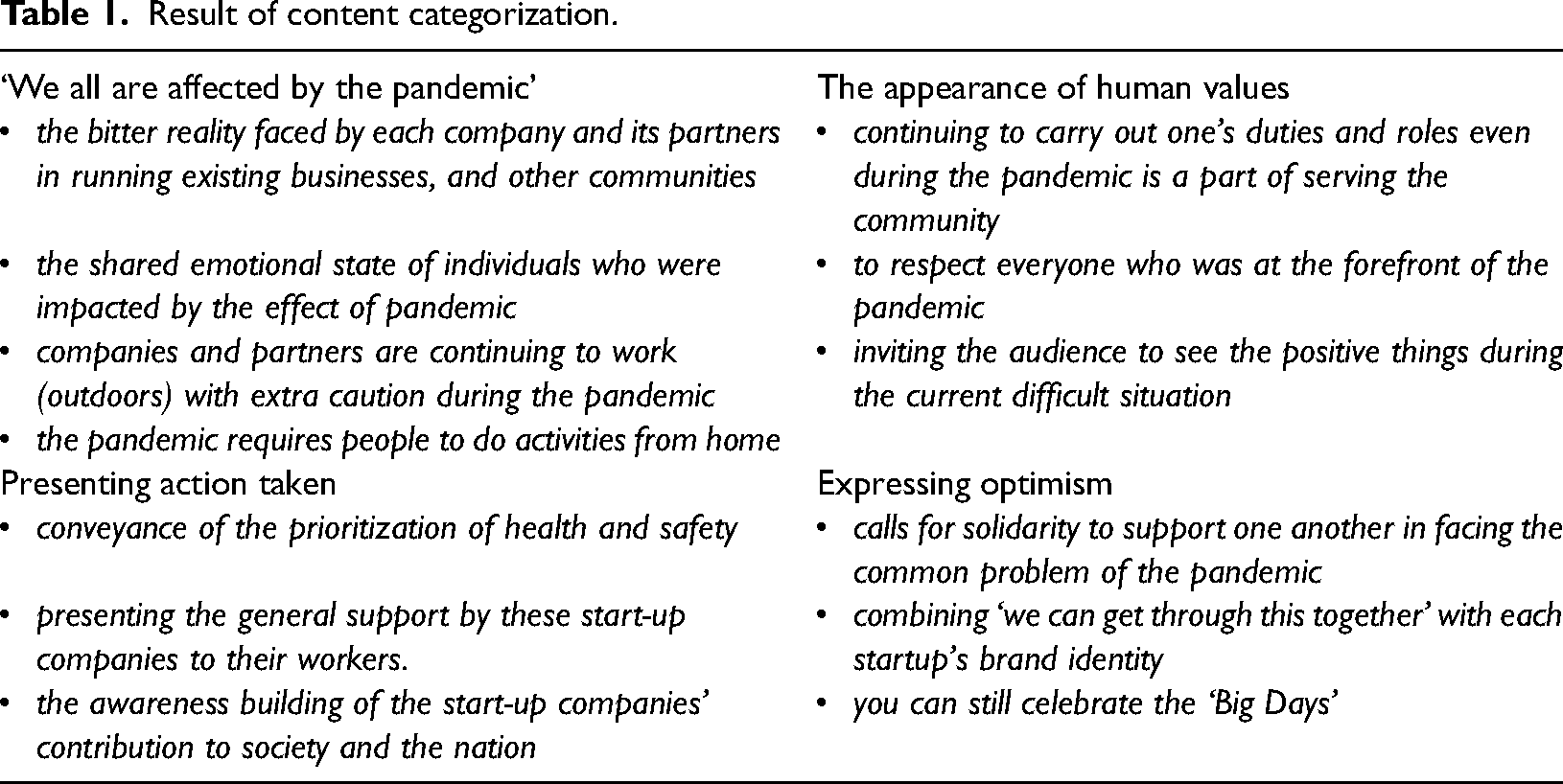
The mapping of content conducted in this study informs us about the archetypal narration used in the initial period of the pandemic outbreak in Indonesia. The public communication of these start-up companies, through their YouTube videos, begins with a set of empathetic communications. For example, the conveyance of “we are all affected” and the bitter reality symbolizes the impact of the pandemic on individuals, businesses, and communities. This kind of communication thus highlights the statements of empathy and action taken by these start-up companies. In other words, they indirectly convey that they understand and have responded to the pandemic situation accordingly.
Further, based on the reading of the video contents, the middle part of most of the videos is dominated by the appearance of human values and actions taken. Specifically, the key messages emphasize the notion of serving the community, portraying the acts of respect for those at the forefront of the pandemic, and looking for a silver lining corresponding to the presentation of action taken during the pandemic. Although a few of the videos make an explicit connection between these two categories in their story, their side-by-side appearance seems to suggest that human values also inspired the companies to act. Above all, empathetic communications in the videos are strengthened with the arrangement of such key messages and creative treatments.
The concluding part of the videos may be dominated by optimistic expressions such as the call for supporting each other and the promise that you still can celebrate Indonesian Big Days, but this part also highlights the presence of start-up companies' brand identity. Through this arrangement, the ending part suggests a mixture of optimistic expression and branding, which may be translated as ‘we can get through this together with the support of our brand.’ The use of different techniques to mix the company jargon through a hashtag is an instance here. Our reading of this story arrangement is that the branding components explicitly and prominently appear at the close because of the situations at that time. Additionally, signs or symbols related to each business appear subtly in most parts of the video.
In terms of the impression created, the findings reveal that these companies' videos promote optimism and specifically echo the value of gotong royong (mutual assistance) to the Indonesian public in managing the pandemic. Gotong royong is a value or an ethos well-known to Indonesians as communal work that can be understood as helping each other or working together. In this context, we argue that the high-valued start-up companies reflected the value in their videos because of the proximity of that ethos to the Indonesian public. Particularly, the content mapping demonstrates framing this pandemic as a communal challenge, helping, and supporting each other in these unforeseen difficulties, and calling for solidarity and togetherness in facing the pandemic challenges.
Therefore, this is the part where there is a risk in delivering an inspirational and optimistic message by a commercial company. These start-up companies such as Gojek rely on the digital infrastructure that allows them to implement the work from home but their ‘partners' and riders rely on fieldwork to deliver goods/packages bought online, and Tokopedia, JD.ID, and Bukalapak, which focus on e-commerce activities and rely on other logistics/delivery companies, endeavored to capture the mood of the nation at that time and came out with this ‘combined' narrative in their videos. The release of these videos may be seen from the companies' viewpoint as a smart business decision: keep connecting with the public-particularly with the customers-in times of difficulties, eventually anticipating customers' loyalty. In other words, these start-up companies deliver their public communication with various inspirational statements and acts of empathy, which is predominantly mixed with brand identities, to relate (affectively) with the public, who are struggling with the pandemic. Whether this form of communication was effective in instilling optimism in the public or jeopardizing it, can be ascertained only through further exploration of the impact of the inspirational content on the audience or in terms of the audience’s reception.
Nevertheless, at the time of writing, there have been a couple of updates regarding the start-up companies. As reported by Kompas, Gojek and Tokopedia have completed their merger to become Grup GoTo (Ramli, 2021). Kompas has also reported that Bukalapak has become the first unicorn to list on the Indonesian Stock Exchange, after their successful in the Initial Public Offering (IPO) (Pertiwi, 2021). Additionally, the other companies are still operating, and maintain an active (digital) media presence vis-à-vis the public.
Conclusion
To sum up, this article argues that during the COVID-19 pandemic, high-valued Indonesian start-up companies presented their inspirational public communications containing empathetic messages and acts of service, accompanied by their brand identities. The impression found from their released YouTube videos is that they are intended to promote optimism and echo gotong royong value to the Indonesian public. We also argue that this way of presentation intends to make the companies relate (affectively) with the public, who are struggling with the pandemic. Specifically, the four themes – ‘we all are affected by the pandemic’, the appearance of human values, presenting action taken, and optimistic expressions – represent a form of media communication that involves a highly subjective approach dependent on the context of the sender and the momentum of delivering it.
Still, there is a set of further questions for future exploration. A comprehensive communication study including the effects on the audience or audience's reception will contribute to our knowledge in understanding the communication of inspirational messages to the public with the right content and context. Additionally, about a year after the release of the videos, two of the companies have merged, and one of them listed on the Indonesian Stock Exchange. Thus, a further study may also explore the relation of this form of public communication and the long-term strategic plan of the companies. Furthermore, one may ask whether this narrative of empathetic communication and branding-optimistic expressions will become a major mode of communication by the businesses in reaching out to their public during the pandemic. Nevertheless, this current study offers an entry point to understand what has been said to the public during the pandemic.
Footnotes
Declaration of conflicting interests
The author(s) declared no potential conflicts of interest with respect to the research, authorship, and/or publication of this article.
Funding
The author(s) disclosed receipt of the following financial support for the research, authorship, and/or publication of this article: This work was supported by the Universitas Kristen Petra (grant number 03/HBK-PENELITIAN/LPPM-UKP/XI/2020).
