



Abstract
Original production by subscription-video-on-demand services (SVOD) is often associated with a U.S. model of premium drama, characterized by high production values, edgy storytelling, and narrative complexity. Yet the internationalization of SVOD production in recent years has complicated this assumption, revealing diverse national experiences. In this article, we test the notion of ‘SVOD exceptionalism’ through a content and production analysis of Australian SVOD originals released by Netflix, Stan, Amazon Prime Video, Paramount+, and Binge (2015–2021). Identifying the characteristic formats, genres, features, and production dynamics of Australian SVOD originals, we explore how these texts connect with the existing patterns of the national production culture. Our findings suggest that SVOD production in Australia has largely extended rather than challenged established storytelling norms, reflecting a production ecology still shaped around broadcast logics. Consequently, we identify the early years of SVOD production in Australia as a period marked less by innovation than by risk mitigation.
Keywords
Introduction
Consumer adoption of subscription video-on-demand (SVOD) services has fundamentally changed Australian television, undermining the long-established dominance of free-to-air networks and reviving the pay-TV business model. As Turner (2018: 130) observed, Australia's enthusiasm for SVOD services – particularly Netflix – has been ‘a crucial catalyst for a series of shifts’ in the national screen culture. Launched in 2015, Netflix Australia is now the nation's dominant service with an estimated 12 million viewers per month (Roy Morgan, 2022). Its main SVOD competitors, Stan, Amazon Prime Video (APV), and Disney+, each attract 4.3 to 4.7 million viewers per month (Roy Morgan, 2022), with Paramount+ and Binge in pursuit. Consumer research suggests SVOD has to some extent displaced commercial free-to-air TV in Australia, with 62% of the population using an SVOD service in the last week compared to 58% for commercial free-to-air TV (Department of Infrastructure, Transport, Regional Development and Communications, 2022).
A growing academic literature has documented SVOD-related impacts in Australia across audiences, industry, and regulation (Cunningham and Scarlata 2020; Dwyer et al., 2018; Rios and Scarlata, 2018; Turner, 2018). However, the impacts of SVOD on other aspects of Australian television are less straightforward and manifest over a longer timeframe: consider the case of production, where the effects of SVOD have only recently become apparent. While Stan and Netflix have been producing a handful of Australian originals each year since 2015, it was not until 2019 – with the expansion of eligibility for the Federal Government's tax offsets incentive scheme to SVODs, the entry of new SVOD competitors, and the ramping-up of production by Netflix and APV – that the rate of local SVOD production increased to its current level of ∼15 titles per year (Table 1). During this period, policy pressure on SVODs to produce more local content was also increasing, crystallized in the release of the Federal Government’s Media Reform Green Paper in 2020 and the subsequent Streaming Services Reporting and Investment Scheme Discussion Paper in 2022. 1 Together, these factors contributed to a boom in Australian SVOD production, albeit a modest one by international standards. 2
Timeline of subscription video-on-demand (SVOD) production and regulation in Australia.

By the end of 2021, Netflix, Stan, APV, Paramount+ and Binge had together released 60 series and movies – a substantial corpus of new screen content that reflects growing investment in, and audience demand for, a new cultural form: the SVOD original (Figure 1). This diverse body of work includes scripted dramas and comedies, reality TV series, movies, documentaries, and kids’ shows. To date, these SVOD titles have attracted little sustained attention from scholars aside from isolated case studies and textual analyses (Brammer, 2019; Johnson, 2019; Russell, 2018; Scarlata et al., 2021). The present article seeks to address this gap. Taking a bird's eye view, we consider the general characteristics of Australian SVOD originals – their formats, genres, distinctive features, and production contexts – to assess how this body of work compares in relation to pre-existing television production norms in Australia. Our inquiry is guided by three research questions. Which genres and formats are preferred in SVOD commissions? What production models have been used, and to what effect? More broadly, how do Australian SVOD originals connect with the existing patterns of the national production culture?
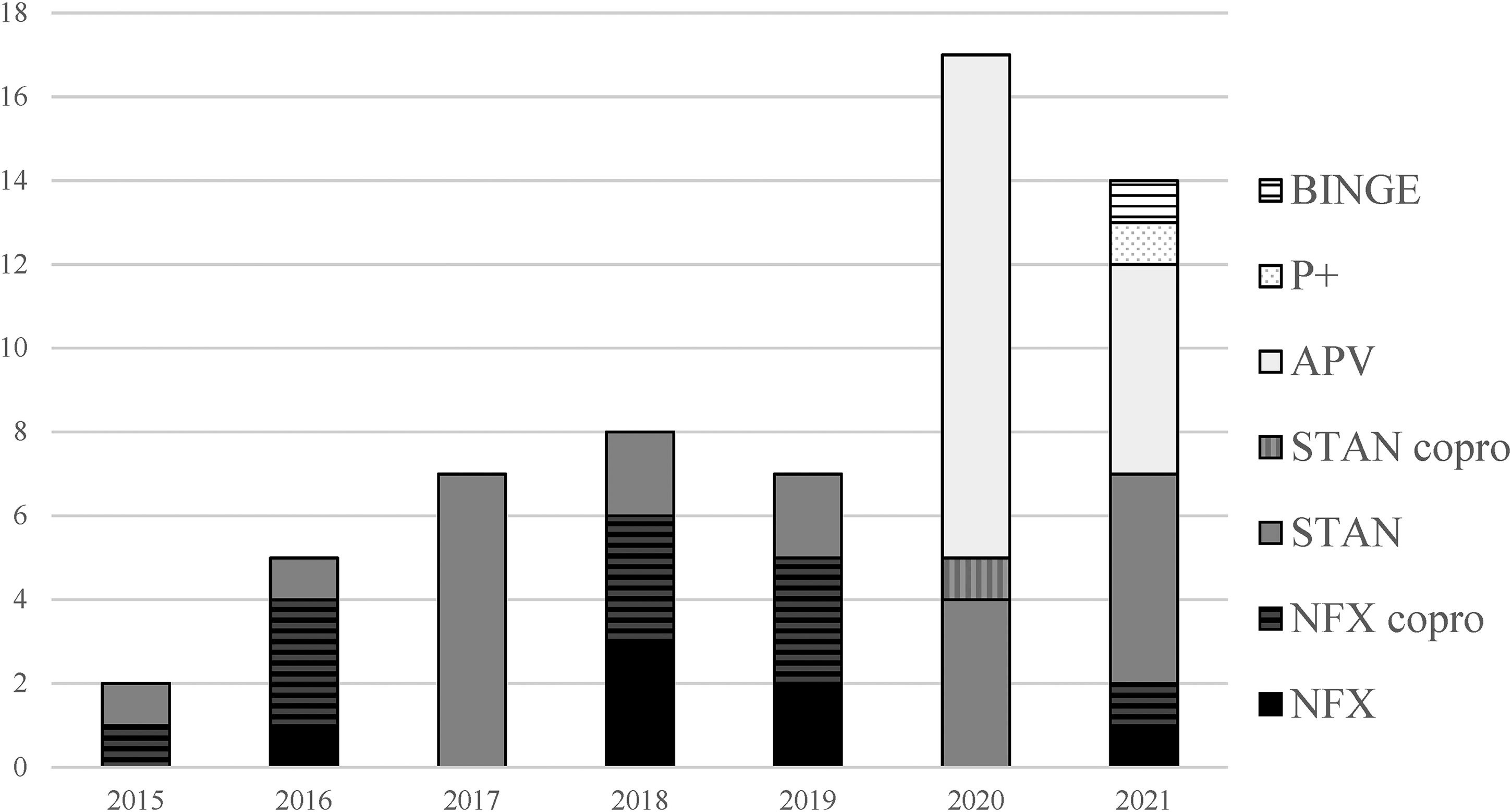
Australian subscription video-on-demand (SVOD) originals, 2015–2021 (full originals and co-productions).
The article proceeds as follows. First, we describe our methods and locate our study within screen research traditions. Second, we present findings from our analysis of SVOD originals and note their characteristics and tendencies. Third, we analyse the institutional context of SVOD production in Australia, explaining how longstanding production relationships and policy settings established over decades extend into, and substantially shape, current production practices. Throughout the article, we complicate what has at times been a one-dimensional debate – essentially a presumption – about SVOD disruptions and the revolutionary nature of streaming. Our analysis points to another possibility, which is that SVOD has come to operate in Australia as an additional window for screen production, largely extending storytelling norms well established in the local screen industry by a production ecology shaped around broadcast logics. Consequently, we identify the early years of SVOD production in Australia as a period marked less by innovation than by risk mitigation.
Making sense of SVOD originals
Since Netflix's initial foray into original content, beginning with House of Cards (2013–2018), SVOD originals have been associated with a model of premium drama characterized by high production values, edgy storytelling, and narrative complexity. Building on the precedents set by premium cable (namely HBO) in the US (Newman and Levine, 2012) and premium pay-TV in Europe (Barra and Scaglioni, 2020), many SVODs have aspired to what Newman and Levine (2012) once described as the ‘cinematization’ of television, prompting claims about the arrival of a ‘Golden Age of television’ (Thompson, 2013). At the same time, SVODs claim to be empowering an emerging generation of creators to tell new kinds of stories: to ‘foster voices that haven’t had an opportunity before’ and to produce ‘stories that feel really unique and differentiated’, according to Netflix executive Kelly Luegenbiehl (as cited by Clarke, 2019). This exceptionalist discourse has been particularly present in Australia, where the tradition of quality scripted drama associated in the US with premium cable has not been a strong feature of the national television culture. When asked to define a Stan original in 2015, Andy Ryan, the head of drama at owner Nine Network, replied: ‘Daring, noisy, high quality and something that feels exclusive – above and beyond what you will see on free-to-air TV’ (Inside Film, 2015). Stan executive Nick Forward likewise spoke of the streamer’s desire to produce bingeable shows ‘that no one else in Australia would have dared to make’ (Inside Film, 2015). These statements seek to differentiate SVOD from linear television, defining it as something more premium, risky, and transgressive.
Such claims require contextualization. The foundations of SVOD production were laid by US services in the previous decade when Netflix – and, to a lesser extent, APV – began commissioning premium dramas and comedies to distinguish their offering from other linear and pay-TV services. During this period, the idea of the SVOD original as something qualitatively different from, and superior to, television-as-we-knew-it was being established in the public relations strategies of the major SVODs – a discourse we might describe as ‘SVOD exceptionalism’. This discourse has endured to define SVOD services in the popular imagination, both in Australia and internationally. However, this was before the ‘streaming wars’ led to a rush of new entrants around 2019, when production output of the major players increased in volume and diversified into a wider range of genres, including reality TV, resulting in what is now a more differentiated approach to programming by most SVOD services. 3
To what degree, then, is this exceptionalist assumption accurate as a description of actual production output during the early years of SVOD in Australia? To answer this question, we undertook a comprehensive content analysis of Australian SVOD output since 2015. Our first step was to systematically view all the SVOD originals released up until the end of 2021. Dividing the titles between us, and revisiting those we had already seen, we created a spreadsheet to capture and compare our notes on genre, format, style, intellectual property source, casting, thematic concerns, and narrative structure of each title. We also identified how each title, in its use of these elements, extended and/or deviated from typical broadcast and pay-TV norms. (A key question in our discussions was: ‘Could this SVOD original conceivably have been made for an Australian linear service?’) Our research also included supplementary media industry analysis to understand the production and commissioning background of each title. We consulted trade publications, industry databases, published interviews, and other trade sources to identify the production companies, key creatives, financiers, and screen agencies supporting each title, and noted any creative involvement by SVOD commissioners during different stages of production, where this was available. 4
Our study was retrospective in nature, focusing on the first six years of SVOD in Australia. This was the period of initial market entry when SVODs were hyped, desirable, and unregulated. Our look back at the origins of SVOD production in Australia underscores the value of studying an emergent media system in its formative years. It also suggests lines of comparison with other retrospective studies of notable transitions in local screen media, including Potter and Lotz’s (2022) analysis of digitization in Australian television and Cunningham’s (1989) textual analyses of the 1980s mini-series, which likewise grappled with an apparent expansion of the ‘horizon of possibility’ in Australian textual forms.
Characteristics of Australian SVOD originals
Our next step was to define the sample more precisely. ‘Original’ is an opaque and contested term used as much for marketing as it is for categorizing content. This necessarily presents definitional challenges, especially since many originals have complex production histories that involve multiple institutions and financing practices. Fortunately, international research has established helpful guidelines for analysing SVOD output (Afilipoaie et al., 2021; Albornoz and Garcia Leiva, 2022; Ball, 2018; Hidalgo-Mari et al., 2020). Afilipoaie et al. (2021) argued that SVOD investment in original content exists along a spectrum that includes exclusive licensing, acquisition upon completion, continuation deals for existing series, co-financing or co-producing titles, and commissioning ‘full’ originals (fully-financed exclusive titles). 5 Following their approach, we defined our sample to include only full originals and co-produced/co-financed titles (hereafter ‘co-productions’), but exclude exclusive acquisitions and continuations. 6 In other words, we included only those texts that would not exist without the involvement of an SVOD. By the end of 2021, Stan, Netflix, APV, Paramount+, and Binge had collectively released 60 such titles: 12 co-productions and 48 full originals. Disney+ and AppleTV+ are not represented here, having not released any local originals during the sample period.
Stan, the first SVOD to commission titles in Australia, has produced the highest number of full originals (22), followed by APV with 17 (although 10 of these are low-budget comedy specials). Netflix has released 7 full originals and 11 co-productions. Netflix's preference for co-productions over full originals reflects its well-documented strategy when entering a new national market (Afilipoaie et al., 2021) to use co-productions as a risk-mitigation strategy. In contrast, all other SVOD originals are full originals, with the sole exception of Stan's The Gloaming (co-produced with Disney's ABC Signature and Starz).
The genre and format characteristics of these originals show strong differences between the commissioning strategies of different services (Figure 2). For example, Stan is the only SVOD to have commissioned feature films: The Second, A Sunburnt Christmas, Nitram, and Christmas at the Farm. 7 Netflix, meanwhile, is the only commissioner actively co-commissioning original kids series, releasing all 10 of the titles in our sample (including Bottersnikes and Gumbles and The New Legends of Monkey). Only a handful of original documentaries have been produced – four in total. These include Stan's true-crime documentary After the Night and Amazon's three Australian sports docos: The Test (cricket), Making Their Mark (Australian Football League) and Head Above Water (Olympic swimming). These commissions and several others since announced, respond to the enormous popularity of sports entertainment in Australia and suggest a low-cost strategy for entering a market in which live rights to major sports have already been acquired in the short-term by linear broadcasters.

Genres of Australian subscription video-on-demand (SVOD) originals.
Unscripted shows – principally stand-up comedy and reality TV – outnumber scripted series by a significant margin (27 unscripted titles compared to 19 scripted titles). Many of these are stand-up comedy specials, released by Stan under its One Night Stan banner and APV under its Australia's Funniest Stand-Up Specials banner. Netflix has also released one Australian stand-up special, Hannah Gadsby's Nannette. While stand-up comedy has been a recurring element within linear broadcast variety formats in Australian television, the hour-long stand-up special has rarely appeared beyond annual comedy festival seasons. As with sports documentaries, stand-up comedy – a cost-effective localization strategy useful for highlighting comedy talent familiar to local audiences (Scarlata, 2020) – represents a departure from broadcast television norms. Interestingly, the entire tranche of 17 stand-up comedy specials commissioned by SVODs in Australia was produced by one company – Melbourne-based Guesswork Television – which is experienced in producing public-service broadcaster-partnered narrative and variety comedy.
Reality TV also features prominently. Stan has produced a local version of the popular reality competition franchise Ru Paul's Drag Race. Netflix made White Rabbit Project, a science investigation series from the team behind Mythbusters, and a reality/travel series Extreme Engagement. Finally, APV called upon many of the local comedic talents in their stand-up series to feature in an Australian version of the Amazon Studios format LOL: Last One Laughing. APV has also tried to capitalize on the success of real-estate reality shows like the Million Dollar Listing franchise on US-cable network Bravo and Selling Sunset on Netflix, with Luxe Listings Sydney. These programmes are familiar, formulaic, and much cheaper to produce than scripted content. For this reason, a unique-title comparison between unscripted and scripted can be misleading. The production cost of a 70-minute stand-up special such as Netflix's Nanette pales in comparison with the cost of a premium scripted series such as Tidelands or Clickbait. This offers an important reminder that measuring the content output of SVODs by titles alone does not necessarily capture the economic or cultural value of individual titles within that corpus.
Leaving aside films, kids’ shows, and unscripted titles, we are left with 19 scripted series: six comedies (No Activity, The Other Guy, Lunatics, Dom and Adrian 2020, Bump, and The Moth Effect) and 13 dramas (Wolf Creek, Romper Stomper, The Letdown, Pine Gap, Tidelands, Bloom, The Commons, The Gloaming, Eden, Clickbait, Back to the Rafters, Spreadsheet, and Love Me). It is scripted production that has most often been in the frame of industry and scholarly discourses about SVOD as the ‘natural home’ of premium, high-end television. So, to what extent does this segment of our sample align with the aforementioned exceptionalist model of premium SVOD? Are they offering something ‘above and beyond what you will see on free-to-air TV’ – or even pay-TV?
SVOD scripted series: Assessing the exceptionalism thesis
Of the 19 scripted comedy and drama series in our sample, only a handful support the association of SVOD with premium adult drama. Stan's Wolf Creek and Romper Stomper are adult-oriented series – horror and social-issues drama, respectively – which spring-boarded off existing well-known Australian film properties and secured the creative involvement of the original film directors and/or cast. The Commons is a glossy science fiction drama, with an international cast including Downton Abbey's Joanne Froggett in the lead role. Netflix's Tidelands – its first Australian full original series – is a generic hybrid (crime, supernatural fantasy, and romance) full of gratuitous sex and violence, offering ‘the kind of edgy, transgressive, adult content that is outside the remit of broadcast television’ (Scarlata et al., 2021: 137). Clickbait, Netflix's Oakland-set, Melbourne-shot drama is an expensive, internationally oriented crime series, the first to be made with the support of federal tax offsets. High-concept, adults-only titles featuring transgressive storylines and extensive location shooting, together these shows represent a concerted attempt by Netflix and Stan to signal their difference from linear television services. They are the closest Australia has come to the kind of exceptionalism associated with SVOD production.
However, most other SVOD scripted commissions are more routine, reflecting a basic familiarity in format, genre, and narrative that positions them firmly within the stylistic norms of Australian broadcast television. Stan's laconic comedy No Activity – Australia's first original SVOD commission – closely resembles in style and content (and shares many cast members with) its creators’ previous work for the Australian Broadcasting Corporation (ABC). The Netflix comedy Lunatics is conceptually an extension of its comedian creator Chris Lilley's earlier series – Summer Heights High and Angry Boys, made for the ABC – albeit at a modestly extended episode length, with entries running up to 38-minutes rather than the broadcast-standard half-hour. APV's first scripted commission Back to the Rafters is a revival of the broadcast family drama Packed to the Rafters, which screened on the Seven Network from 2008 to 2013, and features the same core cast. The single season APV produced (the show was formally axed in October 2021) is significantly shorter than its broadcast source material – just six episodes as compared to the original seasons of up to 22 episodes; however, the ‘condensed’ run (Quinn, 2021) still looks and feels much like Lee's trove of sentimental, multigenerational dramas, such as All Saints (Seven Network) and A Place to Call Home (Seven Network/Foxtel). The Paramount+ comedy Spreadsheet imports well-known British television performer Katherine Parkinson to lead a half-hour sitcom on the foibles of modern dating that recalls earlier sexually frank comedies like the ABC's Laid (2012). Finally, Binge's Love Me – a six-episode hour-long drama based on a Swedish format – features some explicit sexual content but is otherwise consistent with the established style of Australian pay-TV drama produced by Foxtel, Binge's corporate owner.
What can we say about the textual characteristics of these scripted SVOD series? Certainly, there are multiple subgenres represented, from satirical sitcoms to family drama. Yet the visual style, scripting, and casting of most these shows struck us as more or less continuous with linear television norms. Rarely did we feel that we were watching something qualitatively different from the kind of content found on a free-to-air channel or on Foxtel. Where shows felt risqué or transgressive (e.g. Tidelands), this was mostly due to the inclusion of adult elements (sex, swearing, and violence) rather than because of a marked departure from established norms of narration and style. In other words, SVOD scripted production in Australia seems to be defined more by its similarities to linear television than by its difference. What might explain this surprising sense of continuity, which seems to confound what we have been told about SVOD and its revolutionary challenge to linear television? An important consideration here is the longstanding institutional arrangements that shape Australian screen production.
In the foundational 1996 study Australian Television and International Mediascapes, Cunningham and Jacka (1996: 49) developed their analysis of Australia's role in international flows of television programming from the core observation that the national television culture is rooted in two fundamental and long-standing conditions: the television ‘ecology’ of free-to-air public and commercial broadcasters, and the evolving but ever-present mechanisms of subsidy offered by federal and state screen agencies. Although Australia's television industry has seen significant changes since the publication of Cunningham and Jacka's book – from the introduction of pay-TV to the digital transition of the broadcast system and proliferation of multi-channels – these fundamental conditions still undergird the production industry today, and we see this foundation no less in the SVOD field. In practice the production chain has not changed that much: SVODs operating within Australia have largely commissioned experienced creatives that continue to operate within well-established production parameters, maintaining – rather than challenging – the stylistic norms of linear television.
The deep connections between SVOD providers and the existing television mediascape can be seen firstly in corporate ownership. Stan began as a joint venture between Fairfax Media and Nine Entertainment Co. (since merged), the latter owning several Australian broadcasting concerns, including the free-to-air television Nine Network and its affiliated channels. The 2020 entrant Binge, as mentioned, is a subsidiary of the Australian pay-TV channel Foxtel (itself part-owned by the larger multinational News Corp). Paramount+, successor to 10 All Access, is part of Paramount Global, owner of Australian free-to-air commercial broadcaster Network Ten. Even those services that do not have corporate relations with existing Australian broadcasters have worked closely with them when rolling out local content offerings, with Netflix's first significant investments in Australian scripted television (Glitch, The Letdown and Pine Gap) being continuation or co-production arrangements with the ABC, and APV's Back to the Rafters being made by the Seven Network's production arm, Seven Studios.
As noted above, a defining discourse of SVOD exceptionalism has been the claim that SVODs are providing a space for new voices. However, this claim must be reconciled with the production companies commissioned by SVOD services so far. Our analysis of SVOD originals suggests that most SVOD originals are being produced by experienced production firms with an established track record in supplying content to broadcasters and pay-TV (Table 2). Of the 17 production companies involved in scripted SVOD originals, 14 have supplied content to the ABC and six to SBS; nine have supplied to an Australian commercial broadcaster; seven have supplied to an Australian pay-TV broadcaster, and several have a track record in feature film production.
Production companies commissioned to produce scripted subscription video-on-demand (SVOD) originals in Australia, 2015–2021.

Other (film production) companies: Aquarius Pictures (The Other Guy, Love Me) and Emu Creek Pictures (Wolf Creek).
The ABC looms large here, and in some cases, a relationship with the national broadcaster appears to figure significantly in a production firm's later appointment by an SVOD. For instance, Every Cloud Productions, which produced Eden (and A Sunburnt Christmas) for Stan, made its flagship franchise Miss Fisher's Murder Mysteries for the ABC. In the case of Jungle Entertainment, its earliest works in half-hour comedy series for the ABC, such as The Moodys, established a template and track record in sketch-influenced situational comedy, and a cohort of recurring collaborators, which would later carry forward to their Stan original No Activity (and star Patrick Brammall and writer-director Trent O’Donnell would both also work on The Letdown). These connections reflect the important function of the ABC in underwriting the stability of scripted television production in Australia; as Potter and Lotz (2022) described, the 2011–2013 period saw the ABC assume an outsized role in drama investment in Australia, shortly after the institution began outsourcing its original scripted requirements to external suppliers and just prior to the arrival of SVOD originals. Here we acknowledge the role of the primary public broadcaster in fostering a field of sufficiently experienced and resourced production companies that can supply new content to the SVOD entrants.
While Every Cloud and Jungle are independent firms, some prominent SVOD suppliers are larger outfits with close links to transnational media corporations. One example is NBCUniversal International's Matchbox Pictures, which produced Glitch and Clickbait for Netflix. (Three other examples – Playmaker Media, Screentime, and Roadshow Rough Diamond – are discussed below.) As O’Regan and Potter (2013) and Lotz et al. (2021) have observed, these relations of ownership are now characteristic of the Australian production landscape, offering producers the resources to better negotiate the international media marketplace, as well as affording them status as preferred suppliers to national and international television outlets. So, whereas provisional early analyses of the emergence of online screen distribution posited that streaming platforms might bypass traditional media hierarchies and embrace a ‘blurring of the boundaries between amateur and professional content’ (Cunningham and Silver, 2013: 105), within the SVOD field in Australia we can observe that streaming platforms have in fact built up their original content offerings from within the existing institutional landscape, and by dealing with already established and even ‘preferred’ content suppliers to the local broadcasters.
The overall appearance of ‘TV business as usual’ in the SVOD production context can be further seen in the significant role played by federal and state screen subsidy agencies in underwriting this industrial activity. Fourteen of the 19 scripted programs in our sample received some level of support – either production financing or development support – from Screen Australia, and 17 from state agencies, again reflecting what Cunningham and Jacka (1996) identified as the ground conditions for the television industry in Australia.
The familiarity with the funding structures behind SVOD production is also evident in the contribution played by international sales and/or co-funding in the financial viability of SVOD content. While transnational services including Netflix, APV and Paramount+ circulate their content through their own global networks, in the case of a national outfit like Stan, all of its original commissions are sold on or travel outward to international streaming platforms and even traditional linear broadcasters with, for instance, No Activity, The Other Guy and Romper Stomper selling on to CBS All Access (US), Hulu (US), and the BBC (UK), respectively. The prominence of the US and UK markets in the international flow of local SVOD commissions continues Australia's historical position within the ‘world television’ market as a supplier to diverse global communities, but one embedded within what Sinclair et al. (1995) described as the ‘geolinguistic region’ of anglophone countries.
‘Australian’ television style after SVOD
Australian scholars have long grappled with the effects of this geolinguistic positioning on the national television culture. A key claim is that Australian television content has a ‘hybrid’ or ‘recombinant’ flavour that arises from the nation's status both as a consumer of US and UK programming and as a producer with a mandate to supply exports to the anglophone region – resulting in a simultaneous ‘difference and sameness’ dynamic (O’Regan, 1993). This is a dynamic distinct from claims now made about SVOD originals having ‘shifted 45 degrees from what is familiar and readily available on ad-supported linear television’ (Lotz, 2022) but does similarly reflect the pressures international markets exert on the production of content. For Cunningham and Jacka (1996: 33), ‘the Australian television system is a hybrid… an amalgam of the world's major internationally transferable production centres’. Tellingly, many of the SVOD commissions in our dataset can be immediately indexed against narrative and stylistic antecedents from the US and UK industries. Scholars have already commented on the ‘True Blood meets Ocean Girl’ aspects of Netflix's Tidelands (Scarlata et al., 2021). Other conspicuous relations of like to like can be seen in Stan's The Gloaming, which, as with the creator's earlier Foxtel show The Kettering Incident, can be described as ‘True Detective meets Top of the Lake’. Or Eden, which might be log-lined as ‘Twin Peaks meets Euphoria meets Sharp Objects’.
The obvious influence of American cable channel HBO is prominent in these shows – not only in their premises but in some cases in their elevated levels of sexuality and violence – again recalling claims that SVOD platforms are the ‘natural home’ for prestige, a premium cinematic drama of the kind pioneered by HBO. However, it is essential to note that this influence is not entirely new in the Australian context – scholars have already observed the influence of HBO-style ‘complex’ television in broadcast programs such as the ABC's Rake (Campora, 2017). Going back even further, claims about the ‘cinematic’ style in Australian television stretch back to the 1980s scholarship on local mini-series (Cunningham, 1989).
As described by Ward and O’Regan (2011: 43–44), the hybrid nature of Australian television, a function of its destined passage into global flows of televisual content, is expressed in a ‘same but also different’ style – one that must sit comfortably alongside and in relation to the US and UK programming in international markets while also remaining palatable to a national audience. One way in which these duelling forces manifest is in a visual aesthetic that prioritizes images of a recognizable but ‘mythologized’ Australia, as seen, Ward and O’Regan claim, in the ‘utopian’ presentation of the Gold Coast in the Network Ten teen drama H20: Just Add Water. A comparable ‘look’ can be found across many of the SVOD originals in our sample, as in Eden's presentation of its Byron Bay/Northern NSW beach setting, The Commons’ high-tech future Sydney, Tidelands’ Queensland beach community, or in Love Me's evocation of middle-class, inner-urban Melbourne.
The ‘same but also different’ style of Australian television is not constant or inevitable throughout its history. The miniseries of the 1980s, while selling overseas, were explicitly nationalistic and not interchangeable in their narratives and address (Bertrand, 1990). But it has been a consistent characteristic within local production since at least the 1990s. The familiar tonal and stylistic palette of the scripted SVOD commissions in our sample, then, reflects a situation in which streaming platforms are not in the main facilitating new forms of content but rather operating as a new distribution window for existing market forms.
Three case studies: Producers and products
We now turn to three capsule case studies of particular production companies – Playmaker Media, Screentime, and Roadshow Rough Diamond – and their SVOD originals, which will carry the above accounts of production context and textual style in SVOD commissions down to a narrower level of granular specificity. These three companies are among the largest, highest-profile, and most productive SVOD suppliers in Australia, and reflect the aforementioned tendencies including connections with international owners, use of local subsidies, and prior collaboration with local broadcasters. Our analysis shows how these producers’ SVOD commissions, though containing some novel elements attributable to the affordance and stylistic possibilities of streaming, ultimately align closely with Australian television formats and traditions.
Playmaker Media – which supplied Bloom and The Commons to Stan – is a representative instance of a prolific, internationally networked Australian television producer. Its principals David Taylor and David Maher had sustained long careers across the UK and Australian television, including overlapping tenures at Fox Television Studios, before launching the venture in 2009. In 2014, after some successful years producing for public, commercial, and pay-TV – including such titles as The Code (ABC), House Husbands (Nine Network), and SLiDE (Foxtel) – they sold the firm to Sony Pictures Television, a division of the large US/Japanese screen conglomerate Sony. 8
Playmaker's Bloom, released by Stan in 2019, tells the story of a devastating country flood and the appearance of a mysterious new plant with the power to restore youth. The show presents at first as a compelling example of the ‘premium’, ‘cinematized’ possibilities of the streaming paradigm: its cast includes local film stars Bryan Brown and Jackie Weaver, both of whom have significant international profiles; its aesthetic is luxe and appears expensive; and its content is slightly racier than broadcast standards. Most notably, its narrational style reflects industry assumptions about the expanded attention spans of binge viewers, with the early episodes unfurling its story in an oblique and ambiguous fashion. Writer and show-runner Dolman (2019) has explained that he wanted the show to feel ‘like the one big piece’, to be watched ‘in a couple of days’. Yet the show is also obviously aligned with the existing traditions of Australian television. Episode lengths never stretch past a broadcast-friendly 53 minutes. Its small-town setting – shot in Victoria, with the support of Film Victoria – is an ‘Australian anyplace’ that is particular without being specific. The show is easily indexable against local and international antecedents, not only the ABC's Glitch, but also the popular French programme Les Revenants, all of which tell stories about the past resurfacing in a magic-realist small-town setting. This familiarity gives it a typically Australian ‘same but different’ flavour, which facilitated its international export – the show sold to Hulu in the US and the UK video-on-demand service My5.
Like Playmaker, Screentime – which produced Wolf Creek for Stan and Pine Gap for the ABC/Netflix – has a successful track record in producing broadcast series, notably the Underbelly franchise. Founders Bob Campbell and Des Monaghan had long broadcast tenures before forming their firm in 1996 (including simultaneous stints in upper management at the Seven Network). In 2012, they sold a controlling stake in their firm to the French media corporation Banijay.
The Screentime production Pine Gap, a commission for the ABC and Netflix, is a sleek intelligence thriller set around the real US signalling station outside Alice Springs, but filmed mostly in South Australia with the support of the state film agency. Campbell described Screentime's decision to produce for Netflix as a ‘no brainer’, thanks to the platform's openness to doing shows that ‘look and sound different’ (as cited by Groves, 2017). One aspect of that ‘different’ look is apparent in the show's unusual mise-en-scene – director Mat King deploys oblique decentred framings that position the Pine Gap analysts as hemmed in by the monitors and screens that structure their workspace, an approach to composition that draws on the precedents of paranoid thrillers of the 1970s. However, the show also retains the format and length of typical Australian limited drama, running at six episodes, each under 60 minutes in length, suitable for the broadcast timeslots of the ABC (Netflix's co-producer and the show's first window). The narrational style is largely conventional, a product of the long careers of series creators and co-writers Greg Haddrick and Felicity Packard in Australian television. To the extent that its compositional style is cinematic, this can be indexed to international television trends – local critics (Buckmaster, 2018) have argued that Pine Gap's stylistic toolkit borrows from Mr Robot (USA Network, 2015–2019), which likewise developed themes of technological surveillance and paranoia.
Roadshow Rough Diamond contrasts with our previous two cases for being smaller, and newer (it was formed in 2016). Though it began with Les Norton for the ABC and Australian Gangster for the Seven Network, the bulk of its activity has been commissions for Stan: Romper Stomper, Bump, its forthcoming spin-off Year Of, and the yet-to-be-aired Ironside. However, the firm is hardly an industry neophyte. Its principals are the father–son producing team John and Dan Edwards, the former an old hand in Australian broadcasting, with a career stretching back to the 1970s that includes Police Rescue (ABC), The Secret Life of Us (Network Ten), and Love My Way (Fox8). Its owner is Village Roadshow (via its production imprint Roadshow Films) – a theatrical exhibitor and theme park operator with longstanding global ties.
Roadshow Rough Diamond's most successful show for Stan is Bump, which follows the tangled family of school-aged Oly, after she unexpectedly gives birth. Made with major production investment from Screen Australia, and the support of Screen NSW, Bump is the only scripted SVOD commission to be renewed for a third season. The series stands apart for its unusual format – the 10-part seasons consist of half-hour episodes, a duration uncommon in Australian television drama. Co-creator Claudia Karvan, who stars as unexpected grandmother Angie, has said that she could never pitch a half-hour drama before the arrival of SVODs, as 30-minute slots were reserved for comedy programming (as cited by Delaney, 2020). Local critics (Enker, 2021) have commented favourably on the show's ‘unconventional choices’ and its upending of viewer expectations, however, in many respects Bump is recognizable as a product of familiar Australian TV forms. Karvan is a veritable doyenne of the small screen in Australia, having starred for John Edwards on The Secret Life of Us and Love My Way. And while the half-hour format may suggest a liberation of form enabled by streaming, it is alternatively explicable as an appropriation of the half-hour female-focused dramedy format already established within US cable programming by shows such as Sex and the City (HBO) and Better Things (FX). This has facilitated Bump's successful export to linear networks in the anglophone sphere, including the BBC, The CW, and Canada's CBC, as well as to streamers like HBO Max in Latin America, reflecting the show's suitability to the linear schedule as well as the on-demand library.
The above shows – Bloom, Pine Gap, and Bump – all share this basic ‘broadcast friendliness’: they are formatted to be shown in linear television timeslots, and made by producers and production firms with longstanding engagements as ‘preferred suppliers’ to local and international broadcast outlets. The overall picture of Australian SVOD programming that we have observed is of a corpus emerging from within the existing broadcast mediascape, and adhering closely to its storytelling traditions, rather than intruding into it as a disruptive force.
Conclusion
This article has examined the 60 local originals released during the first six years of SVOD in Australia. Our aim was to critically assess the familiar claim that streaming production has revolutionized television style and storytelling, marking an epochal rupture in which linear television norms have been overthrown. We have found mixed evidence on this front. On the one hand, the release of a handful of veritable premium dramas (Wolf Creek, Romper Stomper, Tidelands, The Commons, and Clickbait), the emergence of stand-up comedy specials as a popular SVOD genre, and the embrace of 30-minute dramas such as Bump and Love Me are notable developments in Australian television. Yet we also observe a remarkable ‘broadcast-friendliness’ across the SVOD originals in our sample, most of which have been made by long-time broadcast suppliers and which are industrially and stylistically congruent with broadcast logics. Ultimately the ‘rate of change’ (Cunningham and Silver, 2010) has been gradual, even gentle, rather than sudden and disruptive.
We stress that our study is retrospective and captures only the initial years in what is likely to be a long-term engagement between Australian screen producers, audiences, and SVOD services. Newer entrants including Disney+, AppleTV+, and AcornTV, which had not released any local originals at the time of writing, are poised to release their first Australian-made local originals. Stan has announced a plan to produce 30 titles per year in five years and has flagged further integration with the linear services offered by its broadcast owner, Nine Network. APV has its first batch of premium local scripted titles scheduled for release in the next year. Meanwhile, Netflix's production slate may take a different direction under recently appointed Australian content Director Que Minh Luu, who has signalled her interest in content that is ‘super local… [yet] propulsive and universal’ (Luu as cited by Rugendyke, 2021). All this suggests that the next era of SVOD production in Australia may look different from this early one.
While our analysis has focused mainly on scripted series, upcoming SVOD release slates suggest that feature films and reality programming may become more common, along with further classic broadcast reboots (Heartbreak High, Netflix) and exploitation of existing intellectual property (The Lost Flowers of Alice Hart, APV). International co-productions are another trend to watch. Two of Stan's 2022 releases The Tourist (with BBC/HBO Max) and Wolf Like Me (with Peacock) are big-budget, star-driven shows, with significant international investment – a model central to Stan's future production strategy (Duthie, 2021). In March 2022, Stan stuck a ‘television development alliance’ with Hollywood mini-studio Lionsgate (Frater, 2022). Some form of local content regulation is also on the cards.
These developments may ultimately reshape the overall character of SVOD production in Australia in ways which carry it further away from existing broadcast models. But equally, they may not. As we have argued, SVOD is – for the moment – demonstrably continuous with broadcast traditions in Australia, particularly in its production context and its connections to international flows of media content. The textual characteristics of SVOD originals connect deeply with established and themselves evolving paradigms of Australian TV aesthetics, especially in their hybrid or recombinant nature. While our analysis here has focused on the Australian situation, aspects may also extend to other screen industries within the anglophone sphere and to other small national markets characterized by the import–export dynamics we have described.
Footnotes
Declaration of conflicting interests
The author(s) declared no potential conflicts of interest with respect to the research, authorship, and/or publication of this article.
Funding
The author(s) disclosed receipt of the following financial support for the research, authorship, and/or publication of this article: This work was supported by the Australian Research Council (grant number DP190100978).
