



Abstract
The purpose of this study is to examine Korean listeners’ motivations for listening to political news podcasts drawing on uses and gratifications. This study revealed five motivations: social support, convenience, ease of obtaining political information, diversion/habitual use, and alternative use/de-authoritative flow. The study also confirmed that the extent to which gratifications sought for political news podcasts differs depending on listeners’ political orientations. Liberals have stronger motivations for convenience in use, ease of obtaining political information, and diversion/habitual use compared to conservatives. Furthermore, this research found that the motivations for social support, alternative use, and diversion/habitual use tend to impact political discussions with others, both online and offline, and this process could encourage their intention of political participation as well.
Keywords
Introduction
The audience for podcasts is growing globally, especially amongst younger listeners. South Korea leads the world in the percentage of podcast usage. According to the Digital News Report in Korea 2021, 49% of South Korean respondents had tuned into a podcast within the last month—around 9% higher than the average of 40% in 43 countries (Oh et al., 2021). News podcasts are most popular with young millennials in their 20s (61%) than relatively older generations (30s at 53%, 40s at 47%, 50s at 45%, 60s at 40%). More interestingly, political orientation seems to affect podcast usage: podcasts usage by liberal users (56%) is 8% higher than moderate (48%) and conservative users (48%). Among the genres, politics and current affairs accounted for the largest proportion of listenership (23%), which is 7% higher than the global average.
The annual survey by Korea Press Foundation in 2021 showed similar results where liberal-oriented respondents (8.3%) listened podcasts more than conservatives (5.6%). These results indicate that podcasts are likely to provide liberals with more information about alternative political perspectives. Min (2014) also found that listening to political news podcasts negatively influenced the incumbent conservative candidate's image and favorability ratings among the voters, while positively affecting those of the opposing liberal candidate.
Indeed, political news podcasts played a central role in early 2010 as a key part of the online news source. As political news podcasts provided thoughtful insights into political issues during the presidential elections and Seoul mayoral elections in 2010, such podcasts wield strong political influence on citizens’ decision-making. Listening to news podcasts strongly affected “whom to vote for”; the more people get political news via podcasts, the less they vote for the conservative candidate (Min, 2014).
Since news podcasts became popular alternative media (Park, 2017), podcasts have played a substantial role in disseminating political information ignored by mainstream media (Lee et al., 2012). Park (2017) argues that political discourses in news podcasts contributed to engaging journalism, which allowed ordinary citizens who are usually neglected by mainstream journalism to engage in elite-challenging political action. Providing more in-depth information related to complex political issues, gossips about politicians, and humorous parodies, not only liberal but also conservative podcasts have been favorably shared among various audiences (Lee et al., 2021).
The digital media environment enables people to access multiple news podcasts. Simultaneously, the proliferation of podcast applications and advanced streaming technologies have contributed to the increase of political news podcast listenership. As people can easily select their preferred news source among the abundant choices, people have a tendency to conveniently expose themselves only to political news that corresponds to their political allegiance (Kim et al., 2016). Increasing the audience's choices allows them to explore diverse discourses (Stromer-Galley, 2003), while also allowing them to receive selective exposure to political information that is compatible with their opinions (Garrett, 2009).
As diverse political news podcasts have thrived as an alternative form of journalism among Koreans and the audiences selectively expose themselves to preferred political news podcast, various motivations for listening to this genre of podcasts are expected. Thus, this research helps determine the effect of the motivations for using political news podcasts on political discussion both online and offline and political participation intention. Additionally, the study assumed that Korean listeners’ motivations for listening to political news podcasts would appear differently depending on their political predisposition. As political polarization in South Korea is becoming increasingly severe, the finding of the study would contribute to explain possible attributions people make when listening to political news podcasts. In the end, the findings of the research explain various social phenomenon wherein ordinary citizens become active in political actions and discussions as they engage in political news podcasts.
Literature review
Political news podcasts are defined as news information regarding contemporary politics and current affairs that are streamed or downloaded as digital files to personal digital devices (Park, 2017; Pew Research Center, 2015). Political news podcasts are often characterized as news production done mainly by an individual, groups, or organizations unaffiliated with professional news media (Kim and Lowrey, 2014). Political news podcasts are considered a newly emerging genre of political satire that blends commentary with entertaining elements. The smash-hit of “I’m a Sneaky Trickster,” 1 was a catalyst as it sparked widespread political participation in South Korea by engaging large numbers of previously inactive citizens (Kim et al., 2016; Lee, 2021).
It is noteworthy that politicians, journalists, and even citizens played important roles in the growth of Korean podcasts (Lee et al., 2018). For instance, producers of the famous “I’m a Sneaky Trickster” included a former congressman, an investigative journalist, a former radio producer, and an Internet media journalist. Other famous political podcasts, such as “Maebul Show,” “Chungjeong Guyeok,” “Kim Yongmin Briefing”, “Dasbeoida” are also hosted by famous politicians, political commentators, and citizen journalists. Hence, Korean political news podcasts have been actively utilized by politicians and journalists to directly communicate with audiences and spread their messages to voters (Lee et al., 2018).
Political news podcasts, particularly those representing different political opinions, have become popular alternative media channels attracting audiences seeking a news source covering diverse subjects and perspectives, as mainstream news has been perceived as unfair and biased (Ardèvol-Abreu and Gil De Zúñiga, 2017; Chadha et al., 2012). Politicians and journalism experts contend that non-professionally produced political news podcasts are gaining attention as an alternative news channel, posing a substantial threat to mainstream news media, especially in the agenda-setting function (Lee, 2021). Thus, political news podcasts have the potential to become a powerful counterforce against the mainstream media (Lee, 2021; Park, 2017).
Podcasts and YouTube are both characterized as platforms for getting alternative news sources, however, the political landscape and user characteristics of content distributed in podcasts and YouTube are somewhat different. For podcast users, politics was the most popular topic, whereas music and entertainment were the most popular topics for YouTube users (Embrain, 2019). When it came to channel selection, podcast listeners prioritized content expertise, whereas YouTube viewers prioritized fun (Embrain, 2019).
Additionally, the usage rate of political content in podcasts and YouTube differs depending on users’ political orientations. Based on the number of subscribers in the politics and current affairs category on YouTube, the top channels are conservative-oriented (Kuem and Park, 2020; Choi and Kim, 2021). Most popular news content in podcasts, however, is classified as liberal-oriented (CBS Sisa Jockey Production Team, 2017; Park et al., 2020). As of the first week of November, the weekly rankings under the politics and current affair category in “Podbbang,” Korea's largest online platform for podcast and audio contents, also confirmed that all channels from first to tenth place are liberal oriented.
The usage pattern of YouTube and podcasts by age group is different as well. According to Digital News Report in Korea 2022, the number of podcast users in their 20s has slightly decreased (53%) compared to the previous year (61%), however, the number of older users is relatively low (60s, 47%). For YouTube, compared to the global average (over 60s, 26%), Korean users in their 60s showed the highest usage rate (over 60s, 50%) among all age groups, indicating that the older generation is main user of YouTube, but younger generation is main users of the podcast when consuming political news and current affairs (Choi and Park, 2022). In sum, the study confirmed that podcasts continue to be a reliable source of political information for Korean young generation despite the recent surge in political content on YouTube.
Uses and gratifications of political news podcast
The podcast is a medium capable of transporting the listener through an engaging narrative, by providing a platform for social interaction while allowing them to do their mundane daily chores simultaneously (Perks et al., 2019). Listeners turn to a podcast for up-to-date current events, political discourse, education, advice and self-help, and storytelling, among others (Mou and Lin, 2015). Since the podcast genres are diverse and media itself offers listeners great mobility when listening to podcasts, various motivations for listening to podcasts are expected.
News podcasting is utilized for journalism by ordinary citizens who want to discuss topics of their choice (Perks and Turner, 2019; Perks et al., 2019). Political news podcasts, in particular, are characterized as a type of de-professionalized, de-institutionalized personal news media (Lüders, 2008). Accordingly, it is reasonable to assume that audiences who grew tired of the mainstream news media with similar voices would likely seek alternative news content. Political news podcasts open a new journalism environment for an active and motivated audience. Listeners who select political news podcasts seek an alternative news source that is less institutionalized and less professional but livelier, humorous, and thought-provoking (Mou and Lin, 2015; Nee and Santana, 2021). Gratifications sought for listening to political news podcasts, such as looking for in-depth news on political and social issues, the news representing the voices from different social classes, or seeking an outlet to express dissatisfaction with the political status quo, suggest some resonance with the perceived distrust of mainstream journalism.
Another distinctive characteristic of political news podcasts is that listeners can choose their news consumption to match their political preferences (Iyengar and Hahn, 2009; MacDougall, 2011). Unlike broadcast media, podcasts embody narrowcasting by focusing on specific topics that appeal to particular audiences (Tsagkias et al., 2009). Podcast users subscribe to selected podcast feeds, so it can be assumed that podcast use represents a more active selective exposure than other mass media consumption. Narrowcasting, a characteristic of podcasts, allows podcast listeners to select and listen to content based on their political orientations.
Based on the fact that major popularized news podcasts dealing with political affairs trend to a more liberal left in South Korea, Previous literature has argued that their users would also have a leaning toward the liberal tendency (Kim et al., 2016; Min, 2014; Park, 2017). An individual who is interested in podcasts covering political news and current affairs from a left-wing perspective might not necessarily be an individual with a particular political orientation. Individuals with different political orientations may be interested in the topics and content provided by either conservative or liberal-oriented political news podcasts. However, differences may occur in their gratification sought for political news podcasts according to audiences’ political orientation.
As relatively little research has focused on exploring news audiences’ gratifications sought for political news podcasts, the current study starts with reviewing research about the uses and gratification of podcast listening in general. According to Menduni (2007), podcast is featured as having greater mobility, social interaction with those producing and sharing podcasts, and individualized content. McClung and Johnson (2010) identified three motives for listening to podcasts: entertainment, time-shifting, and literacy building. Perks and Turner (2019) found additional three motivations: cognitive needs (feeding one's brain), multitasking (listening to while completing a mundane task), and parasocial connections (social interaction with podcast hosts and other listeners). In their later study, Perks et al. (2019) developed a scale consisting of four factors: edutainment (entertaining and educational motivations), storytelling (picturing the story in their minds), engagement (interacting with others), and multitasking (listening to podcasts while doing mundane tasks).
We started with a query of what the gratifications sought from listening to a wide range of political news podcasts. Despite the news audiences’ gratifications sought for alternative news content become diverse and the advanced technological environment elicits various genres of political podcasts in South Korea, there has not yet been a great deal of systematic research on exploring gratifications sought for political news podcast listening.
Uses and gratification research has broadened the scope of literature on the motives for searching online political information. Kaye and Johnson (2002) mentioned four primary motivations for connecting to online political information: guidance (for political decision-making), surveillance (to get informed), entertainment, and social utility (to get something to talk about with others). Lee and Hwang (2013) found that gratifications sought for political news podcasts are satirical entertainment on current affairs and politics, political communication with like-minded users, pursuit of political information, overcoming political alienation, rest, and de-authoritative flow. Lee and Kuem (2012) confirmed that the motivations for using political news podcasts in their 20's are pursuit of alternative news sources, resting, time-passing, and mobility.
By combining the existing studies on the motives for using online political information with the literature dealing with the motives for using political news podcasts, common motivations for listening to political news podcasts are the needs for alternative news, social connection with like-minded users, and entertainment. The present study aims to investigate political news podcasts that are still considered a unique form of alternative news media, what gratifications podcast listeners seek, and whether gratifications sought for listening to political news podcast are determined by users’ political orientations. Thus, the study frames following two research questions. RQ1: What is the structure of Korean users’ motivations for listening to political news podcasts?
RQ1-1: Is there any difference in usage motivations depending on the political orientation (conservatives vs. liberals) of the users?
Political news podcast and political discussion
As the online news types become diverse, it is necessary to examine whether news obtained from online sources, such as personal blogs, political commentary channels on YouTube, or political news podcasts rather than traditional online news channels (e.g., NYTimes.com) are effective in eliciting political discussion. This is because news from these nontraditional sources can provide people with novel ideas that lead to shared opinions, which lead to interpersonal political discussion (McLeod et al., 1999). Furthermore, people encounter opposite political views in the news, which they would not be exposed to otherwise, and this can elicit political discussion as well (Mutz and Martin, 2001).
As podcast users can selectively choose political content to match their political preference, news users tend to coalesce among like-minded users. It can be assumed that the salience of group membership can be activated by individuals’ political predispositions (Kim et al., 2016). Therefore, selective exposure to partisan media may facilitate group-based affect (Iyengar et al., 2012). In the context of the listenership of political news podcasts, group-based affect could mean participating in the political discussion either online or offline. A possible explanation for the relationship between like-minded media use and political engagement is that exposure to political information similar to one's perspectives would increase interest in politics and current affairs, which, in turn, leads to political discussion and further actions (MacDougall, 2011).
Communication mediation model
The fundamental idea behind the communication mediation model is that the relationship between individual orientations and outcome behaviors is mediated by communication patterns (McLeod et al., 1999). A solid body of communication research has documented the mediating roles of communication, both news use, and political discussion, for civic engagement and political participation (Gil De Zúñiga et al., 2019; Lee et al., 2012). The model assumes that media influences are indirect but substantial, determining participatory behaviors through their effects on political discussion about news with others. The mediating roles of communication have been widely discussed as communication mediation models in the field of political communication (Gil De Zúñiga et al., 2019; McLeod et al., 1999; Mutz and Martin, 2001; Shah et al., 2007).
The indirect path from news usage to participation via political discussion has been supported by empirical studies for different types of news, including television news (McLeod et al., 1996), political entertainment shows (Lee, 2012; Lee and Yeon, 2022), internet news (Kim et al., 2013; Shah et al., 2007), and social media news (Chan et al., 2017). Early studies delving into the effect of watching television news on political discussion emphasized that informational resources from the news are key for people to engage in political activities as information about political events transmitted through the news media offers subject topics for political conversation and further impacts on eliciting political participation (Sotirovic and McLeod, 2001). Information through news media can be subject topics for political conversations, which, in turn, highlights opportunities for political activities, and eventually ignites participatory motivation.
Unlike prior studies looking at the effect of news media as an information source for boosting interpersonal political conversation, several studies advance a communication mediation model by integrating mass and online information channels. Unconventional online information is positively related to interpersonal political discussion, which leads to high levels of civic participation (Shah et al., 2005). Refining the past models of communication mediation, prior studies distinguished emerging online news sources, such as political blogs, candidates’ social media, and online news magazines from conventional online news such as NYTimes.com or CNN.com, and highlighted the prominent role of the unconventional news media in boosting civic engagement (Lee et al., 2012). Unconventional online news is likely to contain mobilizing information, and be more partisan, more opinionated, and less journalistic than conventional online news (Lee et al., 2012; Shah et al., 2017) that might provide podcast listeners with more controversial issues than those from traditional news outlet and this eventually leads to more turbulent political discussions.
Studies investigating the communication mediation model in political communication so far only have focused on types of news media, such as news on television, political entertainment shows on television, and news through social media as important catalysts for political participation. The current study, however, aims to extend the scope of the communication mediation model by incorporating gratifications sought for listening to political news podcast. By integrating Korean users’ motivations for using political news podcasts, we expected that the communication mediation model would portray a fuller process whereby motivations for consuming unconventional news yields various behavioral outcomes. Toward the end, the study suggests the following two research questions. Accordingly, the research model is proposed in Figure 1. RQ2: Do the motivations for using political news podcasts have any influence on political discussion?
Research model. RQ3: Do the motivations for using political news podcasts have any influence on the political participation intention with political discussion playing the mediator role?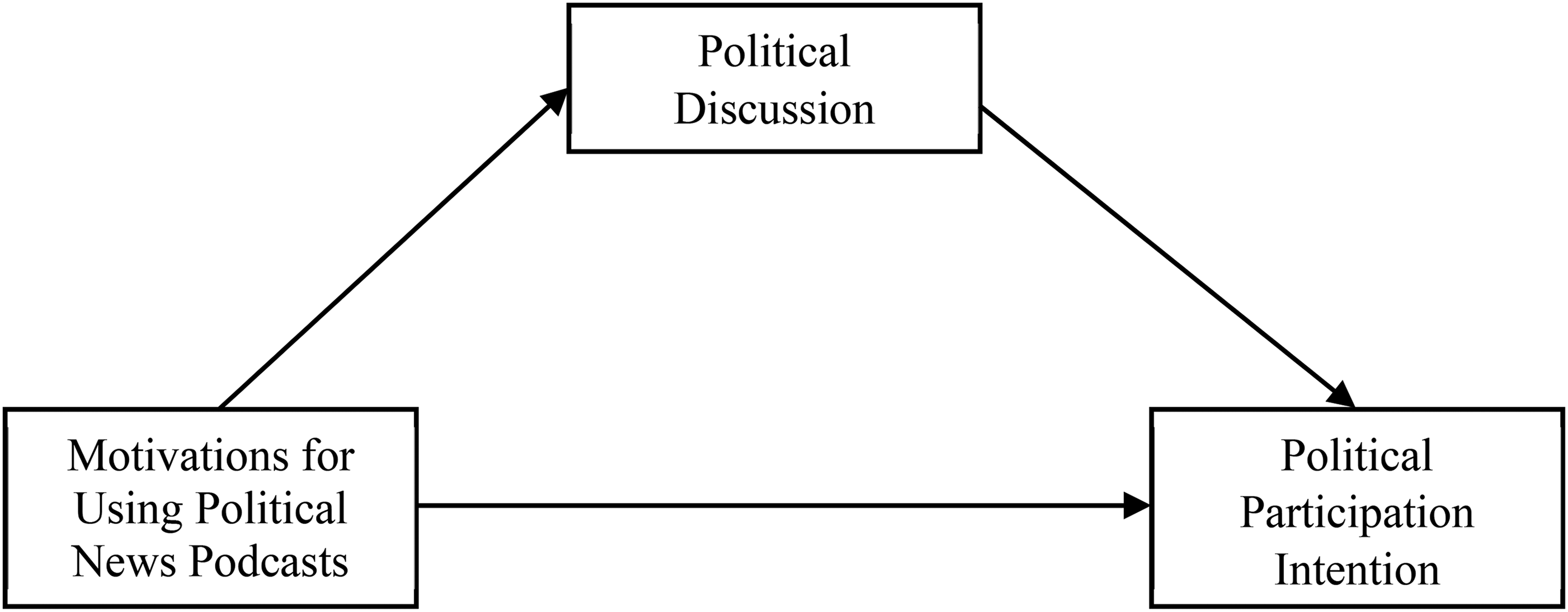
Method
Data collection and sample
The data were collected online by a survey company in South Korea between February 23 and March 3, 2022. Participants were restricted to those who had listened to any political news podcast between the previous 1 month and the time of responding to the survey. 2 In this study, we conducted proportionate stratified sampling considering the age, gender, and residential area of the participants. From the online panels in the pool of the hired survey company, a total of 310 panels were used for analysis.
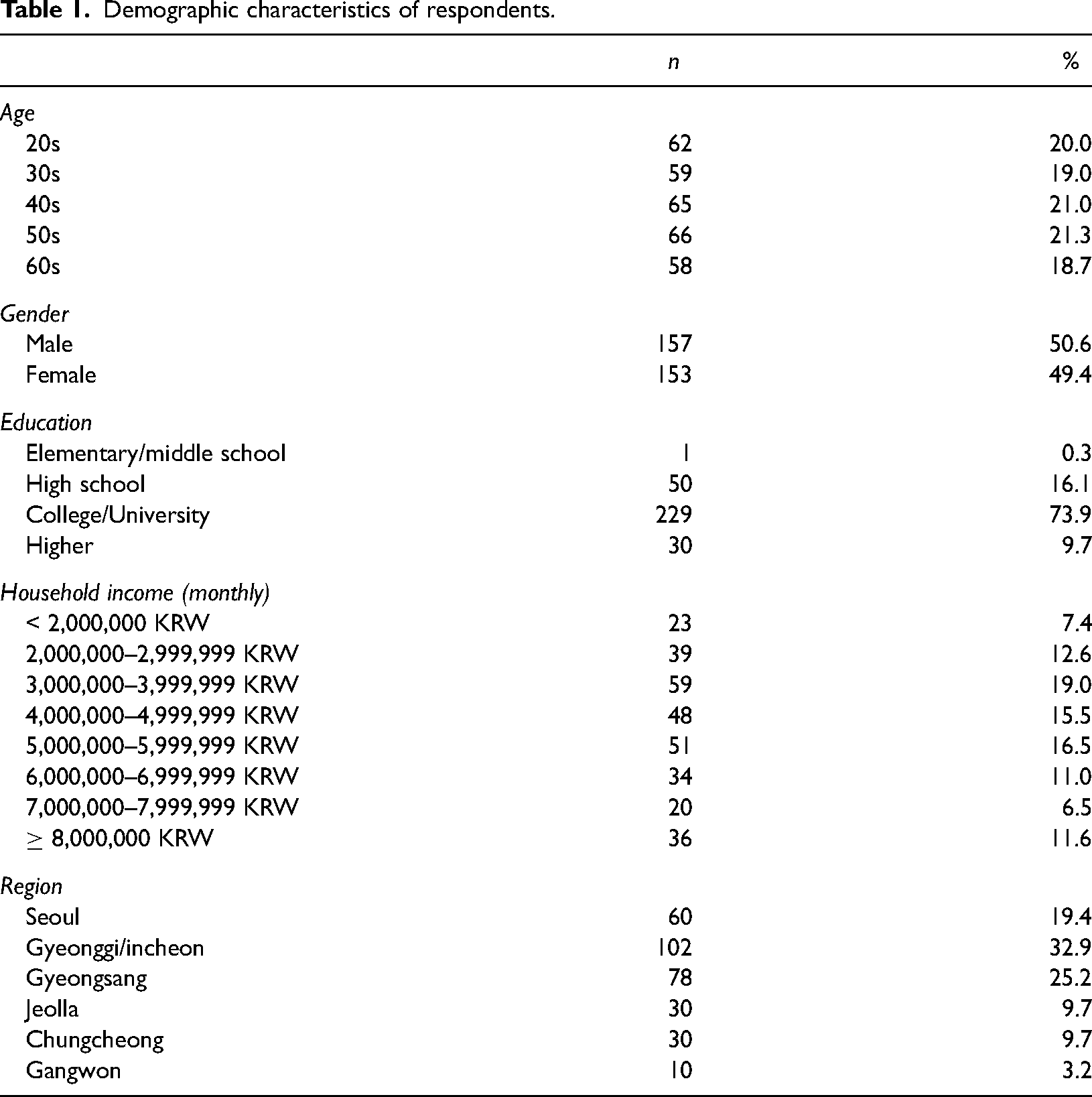
The average age of participants was 44.36 (SD = 13.45) years old. Regarding gender proportion, 157 respondents were males (50.6%) while 153 were females (49.4%). Incheon/Gyeonggi province had the most respondents (32.9%), followed by Gyeongsang, Seoul, Jeolla/Chungcheong, and Gangwon. Table 1 shows the detailed demographic characteristics.
Demographic characteristics of respondents.
Measurements
Political participation measures in this study tapped the respondents’ behavioral intention rather than actual behavior. Behavioral intention, reflecting a consciously formulated plan to perform or not perform a goal-directed behavior, is a reliable predictor of actual behavior (Fishbein, 1967; Netemeyer and Burton, 1990). Political participation such as signing a petition and participation in political talks, rally, protests, or voting can be predicted with respondents’ intention to participate in these political actions (Netemeyer and Burton, 1990).
As for the political participation intention, we selected the questions employed in the previous studies on online or offline political participation (Ho et al., 2011; Hwang et al., 2014; Lee and Hwang, 2013; Shah et al., 2005; Gil De Zúñiga et al., 2012) and modified them for this study. Although some researchers distinguish the expression of political opinions from political acts or make separate online and offline measurements, we integrated them into a single variable for the simplicity of the model. We measured the following eight items on a 7-point Likert scale (1: strongly disagree–7: strongly agree) (Cronbach's α = 0.86): “I will express or share my opinions on political issues through social media, blogs, or private broadcasting platforms,” “I will post comments under other people's posts on political issues to show my opinion,” “I will participate in online voting or petitions regarding political issues or policies,” “I will participate in online discussions regarding political issues,” “If necessary, I will participate in a signature campaign to correct wrongful acts of the government or politicians,” “If circumstances allow, I will participate in the related rallies when a political issue arises (e.g., candlelight rallies for liberals, Taegeukgi—Korean national flag—rallies for conservatives),” “I will donate to the politician or political party which I support,” and “If there is an Assembly election this week, I will cast a vote.” An index was constructed by averaging the scores from these items (M = 4.44, SD = 1.18).
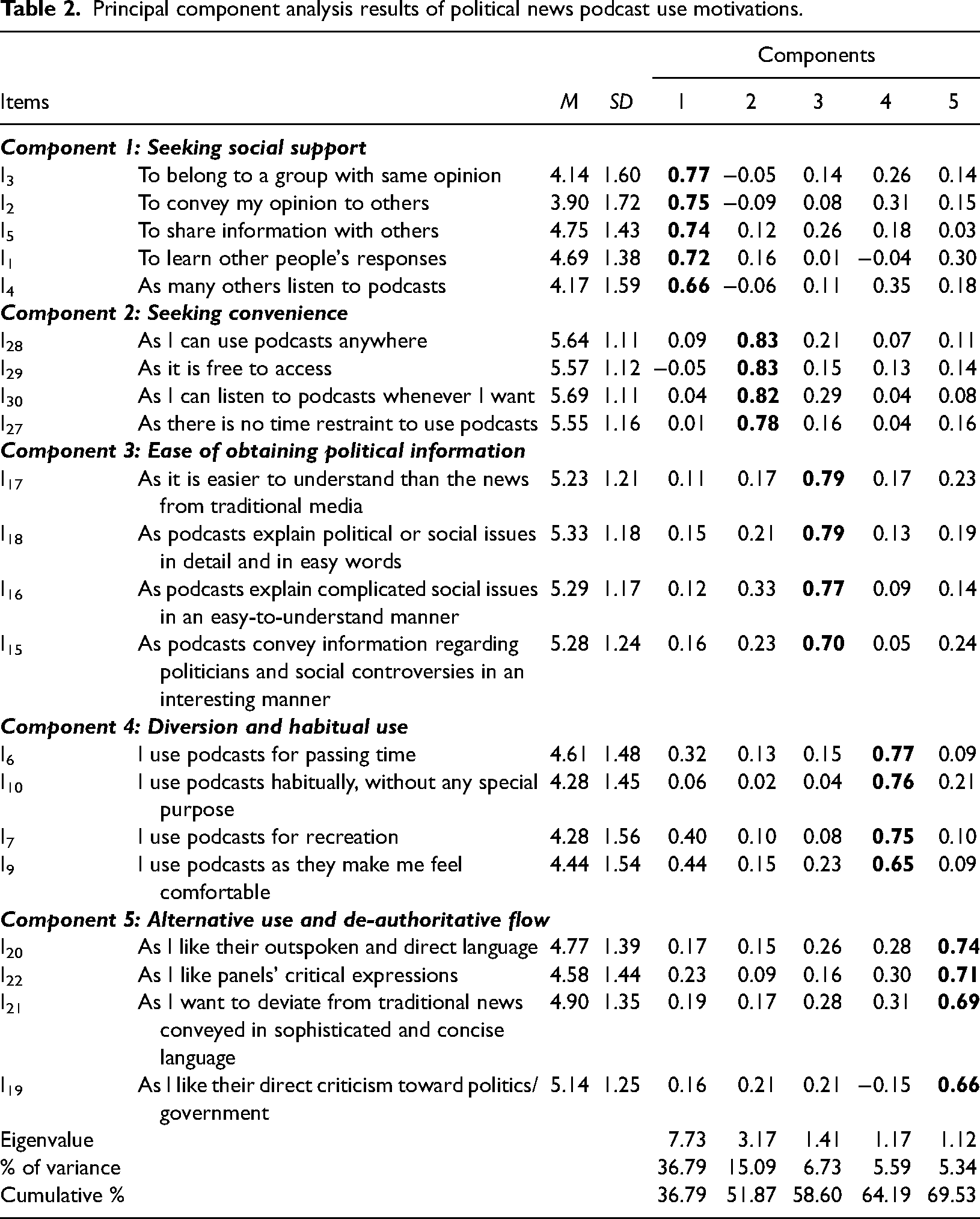
For the motivations for using political news podcasts, we modified the questions employed in previous studies (Lee and Hwang, 2013; Lee and Kuem, 2012; Lee et al., 2021). Considering there are not many studies on motives for using political podcasts and the motives are not consistently extracted, in this study, similar items and factors were integrated. We included a total of 30 items regarding reasons to use political news podcasts (see Table 2) using a 7-point Likert scale. In the process of exploring components, we followed an interpretive process by referring to the factor names derived from previous studies.
Principal component analysis results of political news podcast use motivations.
To measure political discussion, we referred to the study of Shah et al. (2005). However, we measured responses separately for online and offline discussions. The following three items were measured on a 7-point Likert scale (Cronbach's α = 0.91 for online; Cronbach's α = 0.84 for offline): “I have online (or offline) conversations with family members or relatives on political issues,” “I have online (or offline) conversations with my colleagues or superiors/subordinates on political issues,” and “I have online (or offline) conversations with close friends or acquaintances on political issues.” An index was created by averaging across these (Online discussion: M = 3.60, SD = 1.71; Offline discussion: M = 4.53, SD = 1.37).
Political orientation was measured on a 7-point semantic differential scale ranging from 1 (liberal) to 7 (conservative) (M = 3.69, SD = 1.34). The last part of the questionnaire contained demographic questions about age, gender, financial status, and educational background.
Results
In examining RQ1, an exploratory factor analysis with varimax rotation was performed to determine the underlying structure that exists behind the motives for using political podcasts. To select suitable components, those with an eigenvalue of 1.0 or higher were selected. The scree test confirmed that the appropriate number of components was determined as five.
The study set the factor loading for main components greater than 0.6 and for the sub-components below 0.4. Cross-loadings were deleted in order, aiming for the optimal structure. Although I9 was cross-loaded with Component 1, it was not deleted as it is representing a conceptually meaningful for Component 4, and its factor loading is greater than 0.6. Thus, a total of nine out of 30 measurement items were deleted.
The factor analysis produced a five-factor solution, which explained 69.53% of the variance. As shown in Table 2, the first factor was named “seeking social support” (α = 0.85) and the five items explained 36.79% of the variance. The second factor was “seeking convenience” (α = 0.88) and it was reported that the four items explained 15.09% of the total variance. The third component was “ease of seeking political information” (α = 0.87) with the four items explaining 6.73% of the total variance. The fourth component was “diversion and habitual use” (α = 0.85) and the four items explained 5.59% of the total variance. The fifth component was “alternative use and de-authoritative flow” (α = 0.82) with the four items explaining 5.34% of the total variance. De-authoritative flow, in the study, refers to a characteristic of alternative news in which content is relatively free from the dominant discourse, unlike mainstream media. Listeners of political news podcasts seek gratification from interacting with outspoken commentators while understanding the context of political affairs and current issues in detail (Lee, 2021; Lee and Hwang, 2013).
Regarding RQ1-1, we examined whether different motives for listening to political news podcasts were associated with users’ political orientations. After excluding those who responded that they had a neutral political orientation (4 points), we divided respondents into the conservatives (1–3 points) and the liberals (5–7 points) and performed independent samples t-test. The average scores for each of the motivations were higher in the group of those who reported themselves as liberals than in the group of those who reported themselves as conservatives, as shown in Table 3. Such differences in means were reported as significant in three out of five factors.
Independent sample t-test results comparing conservatives and liberals on motivations.

Note: N = 70 (Conservatives), 131 (Liberals)
In the case of seeking convenience, there was a significant difference in the average scores (t = −2.83, p = .005) between the group of liberals (M = 5.77, SD = 0.92) and the conservatives (M = 5.38, SD = 0.91). Further, even to a limited level, there was a significant difference (t = −1.90, p = .059) between the liberals (M = 5.39, SD = 1.01) and the conservatives (M = 5.12, SD = 0.89) as for the ease of obtaining political information, while we also observed a significant difference (t = −1.76, p = .079) between the liberals (M = 4.52, SD = 1.26) and the conservatives (M = 4.19, SD = 1.23) for the motivation of diversion and habitual use. However, regarding the motivation of social support (t = −1.65, p = .101) and the motivation of alternative use (t = −1.02, p = .309), no significant difference in average scores between the two groups was observed.
These results demonstrated that when using political news podcasts, those with liberal-oriented respondents have stronger motivations for convenience in use, ease of obtaining information, and diversion/habitual use compared to conservative respondents. However, there is no difference in the motivations of social support and alternative use and de-authoritative flow between liberals and conservatives.
The effect of motives for using political news podcast on political discussion
We aimed to conduct stage validation of the mediation effect by using the methods of Baron and Kenny (1986) to answer RQ2 and RQ3. In Step 1, there should be a significant relationship between the independent variable and dependent variable (X → Y), and in Step 2, the independent variable should have a significant relationship with the presumed mediating variable (X → M). In Step 3, the mediating variable should have a significant relationship with the dependent variable (M → Y), and finally, in Step 4, the effect of the independent variable on the dependent variable should decline or become insignificant after controlling the effect of the mediating variable (X, M → Y).
Accordingly, we conducted a hierarchical regression analysis to investigate whether the motivations for using political news podcasts had any influence on the political participation intention (Step 1). Socio-demographic variables of age, gender, financial status, and educational background were controlled. Analysis results revealed that all the components of the motivations for using political news podcasts had a positive influence on the intent of political participation, as presented in Table 4. That is, the level of political participation intention rose as the levels of seeking social support (β = 0.40, p = .000), seeking convenience (β = 0.19, p = .000), ease of obtaining information (β = 0.18, p = .000), diversion and habitual use (β = 0.21, p = .000), and alternative use and de-authoritative flow (β = 0.15, p = .002) increased.
Mediation effect of online and offline political discussion.

Note: PI: political participation intention, OND: online discussion, OFFD: offline discussion.
Thereafter, regarding RQ2, we investigated the effect of the motivations of using political podcasts on online and offline political discussion (Step 2). We discovered that social support (β = 0.51, p = .000), diversion and habitual use (β = 0.34, p = .000), and alternative use and de-authoritative flow (β = 0.09, p = .043) had a positive influence on online political discussion. It was also revealed that the motivations of social support (β = 0.34, p = .000), diversion and habitual use (β = 0.14, p = .010), and alternative use and de-authoritative flow (β = 0.13, p = .019) had a positive influence on offline political discussion. Thus, the higher the levels of the motivations of social support, diversion and habitual use, and alternative use and de-authoritative flow, the more political discussions people engage in both online and offline.
Mediation effect of online and offline political discussion
Regarding RQ3, we explored the impact of online and offline political discussion on the political participation intention (Step 3). It was revealed that both online (β = 0.43, p = .000) and offline political discussion (β = 0.24, p = .000) had a significant positive influence on the intent of political participation. Lastly, for the test of the mediation effect of online and offline political discussion, we employed all the variables of the motivations for using political news podcasts and online/offline discussion to examine their effect on the intent of political participation (Step 4). First, the level of influence of the motivations of social support (β = 0.15, p = .003) and alternative use and de-authoritative flow (β = 0.10, p = .030) on the political participation decreased, and those two factors were observed to be statistically significant. Thus, online and offline discussions performed partial mediation in the relationship between the two motivation factors and the political participation intention. Meanwhile, the effect of the motivation of diversion and habitual use on the political participation intention was not statistically significant (β = 0.08, p = .156), indicating that online and offline discussion conducted full mediation in the relationship between those variables.
To prove the significance of the mediation effect, we used Model 4 of the PROCESS macro (Hayes, 2018) and all analyses computed a 95% bias-corrected confidence interval (CI) with 5000 bootstrap resamples. As seen in Table 5, it was confirmed that the indirect effect that seeking political communication affects political participation through online discussion (B = 0.22, SE = 0.05, CI = [0.13, 0.32]) and offline discussion (B = 0.09, SE = 0.03, CI = [0.04, 0.17]). The indirect effect that the motivation of diversional and habitual use influencing political participation through online discussion (B = 0.16, SE = 0.05, CI = [0.08, 0.26]) and offline discussion (B = 0.04, SE = 0.02, CI = [0.004, 0.09]) was significant. Regarding the motivation of alternative use and de-authoritative flow, we could only confirm the significance of the indirect effect, under the motivation effect on the intent of political participation through offline discussion (B = 0.03, SE = 0.02, CI = [0.001, 0.07]).
Paths of the mediation effect of online and offline political discussion.

Note: Statistically significant paths are presented in bold. PI: political participation intention; OND: online discussion; OFFD: offline discussion.
0.004.
0.001.
Consequently, the results confirmed that those who use political news podcasts for the purpose of acquiring political communication or simply use political news podcast for diversion and habitual purposes, or the motivation of alternative use in the objection to the mainstream media, tend to have a political discussion with others both online and offline and this process could encourage their intention of political participation.
Discussion
Drawing on uses and gratifications, this study examined Korean listeners’ motivations for listening to political news podcasts. As the result from RQ1 showed, five motivations for using political news podcasts are social support, convenience, ease of obtaining political information, diversion/habitual use, and alternative use/de-authoritative flow. Although seeking social support, convenience, information, and diversion/habitual use are typical motivations for using podcasts in general (Chan-Olmsted and Wang, 2022), ease of obtaining political information and alternative use/de-authoritative flow is rarely mentioned in uses and gratification research. Political news podcasts in South Korea tend to provide a large amount of political information that is not filtered, unlike information from traditional media. Thus, these two motivations might be interconnected in that listeners tend to tune on nontraditional news sources, like political news podcasts, to obtain political information that is unfiltered, relatively direct and outspoken in critical language.
In addition, this study confirmed that the extent to which listeners sought gratifications from political news podcasts would differ depending on their political orientations, assuming that political news podcast content has the potential to exacerbate listeners’ political polarization. The results from RQ1-1 confirmed that liberals are more motivated by convenience in use, ease of obtaining political information, and diversion/habitual use than conservatives. The result of the study conforms to the Reuter report that liberals thought that listening to news podcasts is more convenient, diversional, habitual, and an easy way to obtain unconventional, political information than conservatives.
The study proved the mediating effect of online and offline political discussion on the relationship between Korean users’ motivations for using political news podcasts and their intention to participate in political activities. Specifically, people who use political news podcasts for gaining social support from others are more likely to discuss political issues both online and offline, which positively affects their intention to participate in politics. The result significantly extends the scope of research by emphasizing listeners’ belief that social support can be obtained by sharing information with others with the same opinion accelerates political discussion online and offline, and furthers their intention of political participation. Podcast listeners seeking alternative news tend to have a political discussions with others, both online and offline, and this process could encourage their intention of political participation as well. Although it is slightly different from information-seeking motivation, people who seek unrefined, critical, and de-authoritative political information may have a higher aspiration to participate in political debate.
Another interesting finding of the study is that diversional and habitual usage of political news podcast encourages political conversation both online and offline, as well as their intention to participate. It can be interpreted that diverse listeners have more political information to share, easing them to bring casual conversations about politics both online and offline more often (Chan-Olmsted and Wang, 2022). Unlike informational or critical listening, habitual listening does not require a specific purpose (Laor, 2022). Habitual behavior can be performed in a stable, frequent, and automatic manners so that habitual listeners’ usage time would be much longer than that of listeners with informational purposes (Kruglanski and Szumowska, 2020). Thus, people using political news podcasts habitually tend to be heavy listeners and this would further affect their behavioral outcomes, such as involving in political discussion and engaging intention in political actions.
Prior studies focusing on news use and political participation have shown that cognitive motives, such as seeking and learning political information positively led to engaging in political discussion and further fostering political participation (Gil De Zúñiga et al., 2019; McLeod et al., 1999; Zhang and Chia, 2006). Unlike previous studies, the result of this study proved that diversional and habitual use of political news and social support (belonging, sharing, and communicating with like-minded others) obtained from listening to political news through podcasts acts as a social capital which in turn would play as a catalyst for political engagement, and further, civic engagement. The unique finding of the study implied that not only the cognitive motivations for listening to the podcast but the psychological and affective motivations of podcast listenership would be a critical factors to foster political conversation and participation.
While the study has meaningful contributions to the existing literature in political news podcasts, this study has several limitations. First, political participation in this study was measured with respondents’ intention to participate in political actions. While behavioral intention is considered a reliable predictor of actual behavior (Fishbein, 1967), future research should aim to increase the validity by measuring respondents’ actual political actions. Second, one of the items for measuring political participation intention is an intention to participate in online discussions. While the measurement of online/offline political discussion refers to an online and offline conversation with family, friends, colleagues, and close acquaintances, the item for measuring intention to political participation would possibly weaken the validity of the study. The validity of the future study would be enhanced by clarifying and implementing the sentence for the measurement items. Third, in the study, political news podcasts are rather broadly defined as news information about politics and current events that are streamed through digital devices (Park, 2017; Pew Research Center, 2015). As YouTube is rising as a major platform for podcasts and both YouTube and podcast currently coexist as a channel for delivering political issues and current affairs, this study suggests that future studies need to examine YouTube as a form of hybrid podcasts in a perspective of the theory of the niche (Dimmick and Rothenbuhler, 2006). Lastly, while the study is meaningful as a means to explain the theoretical mechanism of political news podcasts listenership in South Korea and its impact on political conversation and engagement, more studies are necessary to take an account of changing consumer expectations related to podcasts for globalized comparative research.
Supplemental Material
sj-docx-1-mia-10.1177_1329878X231154052 - Supplemental material for Motives for using news podcasts and political participation intention in South Korea: The mediating effect of political discussion
Supplemental material, sj-docx-1-mia-10.1177_1329878X231154052 for Motives for using news podcasts and political participation intention in South Korea: The mediating effect of political discussion by Yoon Y. Cho, Ahran Park and Jinho Choi in Media International Australia
Footnotes
Declaration of conflicting interests
The author(s) declared no potential conflicts of interest with respect to the research, authorship, and/or publication of this article.
Funding
The author(s) received no financial support for the research, authorship, and/or publication of this article.

Supplemental material
Supplemental material for this article is available online.
Notes
References
Supplementary Material
Please find the following supplemental material available below.
For Open Access articles published under a Creative Commons License, all supplemental material carries the same license as the article it is associated with.
For non-Open Access articles published, all supplemental material carries a non-exclusive license, and permission requests for re-use of supplemental material or any part of supplemental material shall be sent directly to the copyright owner as specified in the copyright notice associated with the article.
