



Abstract
This article explores three dimensions of the current state of gender equality in Serbia: public policy on gender equality, public opinion on gender equality and the context of Serbia’s accession to the EU. Using data from the recent (2010) public opinion survey of citizens’ attitudes towards gender equality, the authors address the following issues: (1) harmonization of public policy on gender equality in Serbia with EU policies; (2) differences between public policy on gender equality in Serbia and citizens’ preferences; (3) convergences/divergences between citizens of Serbia and EU citizens regarding gender equality. As Serbia’s policy of promoting gender equality in the last decade has been dominated by the political goal of accession to the EU, it shows where the opinions converge (violence against women is seen as a priority), and where there are certain differences (intervention in gender equality issues). The authors show the complexity of ideological positions among average Serbian citizens, while highlighting different (and sometimes contradictory) paradigms in the official public policy on gender equality. While Serbian citizens still do not place gender equality high on their political agenda, they are convinced that it has a certain value, which does provide some important pointers for the future.
Introduction
Public opinion in Serbia is usually monitored for ‘national’ issues of high importance, like EU accession or the Kosovo crisis. Gender equality policy is not such a topic, in spite of the fact that it is regularly assessed in the process of EU accession. Gender equality was a marginal issue for voters, because the majority of them did not find or even recognize gender equality as an important issue in choosing where to cast their vote (Ignjatović et al., 2011). In the 2008 general election, citizens mandated the coalition led by the Democratic Party to implement their political agenda, thus making the policy agenda for gender equality tacitly legitimate. 1 One might wonder how much this agenda is actually endorsed by the citizens.
In this article we concentrate on relations between two groups of actors in the policy agenda: policy makers and citizens. In the first part, we explore recent developments related to gender equality policy in Serbia within the EU context: dominant paradigms, issues and policy instruments. In the second part, we focus on public opinion regarding gender equality (the concept of gender equality, perception and policy priorities). We are interested to see whether public opinion on gender equality and the official gender equality policy converge or diverge.
We also take into account the context of Serbia’s accession to the EU, which has been the key driving force for reforms in the last decade. 2 The dominant subtext in public discourse in all domains relevant to harmonization with EU regulations includes the question: ‘Are we there yet?’ The shift towards EU norms and standards also applies to gender equality. In the Serbia 2010 Progress Report, gender equality is evaluated in two sections: a human rights section (women’s rights) and a European standards section (gender equality) (European Commission, 2010a).
Before we pursue the issue of relations between the two groups engaged with the policy agenda, we must first ask what the state of affairs regarding gender equality is in Serbia, and how it compares with the EU. As for decision making, 12.5% of members of the Serbian parliament are women, compared to 25% in the national parliaments of EU member states (European Commission, 2009; NS, 2009). Except for some categories of the population (Roma women), there is an equal proportion of women and men at all levels of education in Serbia. At the university level, women make up a majority of the student population (over 50%), in which is similar to the EU (58% of graduates on average). The employment rate indicates women’s status in the economy: 62.5% in the EU and 44% in Serbia. The percentage of women entrepreneurs in the EU is 33%, and in Serbia it is 23.3%, and gender pay gaps are 17.8% and 16%, respectively. In the EU, there are 3% of women in leading positions in industry, compared to women comprising 14.3% of presidents of governing boards in Serbia. However, some issues are specific to the Serbian transitional economy: there is a low percentage of women with property rights (29.7%), the socioeconomic status of older women in rural areas is low, there are inequalities in the privatization process (redundancy gender gaps) and an earlier retirement age for women (gradually being equalized) (European Commission, 2009; NS, 2009).
The key issues in the health area in Serbia are related to constant stress and unhealthy lifestyles of women, reproductive health and prevention of diseases (screenings). Only one-quarter of women have regular check-ups (Blagojević, 2004). In the media, key issues are similar in Serbia and the EU – discriminatory media content and representation of women in the media. Gender-based violence has been recently recognized as an urgent issue in Serbia (especially domestic violence). Penal policy has been radically changed through recent amendments to the Law on the Family and the Criminal Code. The issues related to violence against women are comparable in Serbia and the EU (European Commission, 2009; NS, 2009).
It seems that some issues are yet to be dealt with, but Serbia ‘is already there’ when it comes to education or employment, and it shares the same problems as EU countries regarding media content and political representation. Some of these issues are recognized in the Serbia Progress Report. 3
Institutionalization of gender equality in Serbia
Northern European gender equality policy went through several historical phases. The first phase was the ‘equal treatment perspective’ (from 1918 to the 1960s), the second phase was the ‘women’s perspective’ (from the 1960s to 1990s); the third is the ‘gender perspective’ (from the 1990s). Each paradigm has its corresponding policy instruments: for the first phase it was equal treatment legislation (a focus on equal rights); during the second phase, positive action (a focus on equality of outcome and separate institutional provision); and gender mainstreaming has been the key instrument for proponents of the gender perspective (equal valuing of difference, managing diversity) (Booth and Bennett, 2002; Rees, 1998; Stratigaki, 2005).
The gender perspective became dominant during the 1990s. It ‘promotes actions that aim to transform the organization of society to a fairer distribution of human responsibilities. It acknowledges the differences between women and between men’ (Booth and Bennett, 2002: 434). Gender equality ‘means an equal visibility, empowerment and participation of both sexes in all spheres of public and private life. Gender equality is the opposite of gender inequality, not of gender difference, and aims to promote the full participation of women and men in society’ (Council of Europe, 1998). Gender mainstreaming is the key policy instrument of the gender perspective. There is a debate now on whether there is a danger that gender mainstreaming could replace the legacy of gender equality policy by ‘dismantling women’s policy machinery’ (Woodward, in Stratigaki, 2005). Booth and Bennett believe that the current mainstream is actually based on an integrated ‘three-legged equality stool’ that incorporates the legacy of all three phases.
Regardless of these paradigmatic debates about the future of gender equality policy, it is evident that gender equality is placed high on EU policy agendas: the Roadmap for Equality of Women and Men 2006–2010 and European Pact for Gender Equality and Strategy for equality between women and men 2010–2015 both indicate the importance of this policy area. The question arises as to whether the current concept of gender equality means the same for all the member states of the EU. It is true that the three-stage concept of gender equality reflects mostly developments in Northern and Western European countries. Member states still differ in the achieved levels of gender equality in various societal domains. 4 The ex-communist EU member states went through a different history of gender equality. They combined the legacy of socialism with the accession process during the 1990s. In these countries, the issue of gender equality has in fact been reduced to women’s equality – gender issues being practically reduced to the status of women, and it continues to influence the dominant gender policy discourse. The problem of ‘policy profiling’ is especially difficult for future (‘hopeful’) EU members like Serbia, that combine a socialist past with current ‘implanting’ of policies originating in the EU.
Within the former Yugoslavia, Serbia has had a long tradition of abiding to the international mainstream of gender equality (the CEDAW). 5 During the turbulent 1990s (economic crisis and wars), gender equality was not systematically dealt with in official public policy, but it was addressed mostly by non-governmental sector and international organizations. 6
From 2001, gender equality has been gradually incorporated into the institutional framework and political mainstream. Two political parties (the Liberal Democratic Party and the then ruling Democratic Party) have addressed the issue of gender equality in their political programmes. The Government of Serbia’s Council for the Equality of Genders (renamed the Council for Gender Equality in 2009) was established in 2004. 7 The Directorate for Gender Equality (GED) was established within the Ministry of Social Affairs in 2007. As a government executive body, the GED has a mandate to initiate legislative improvements, monitor the state of affairs and coordinate national reporting (CEDAW). At the national level, two other institutions have a mandate to deal with practical issues of discrimination and citizens’ rights (including gender equality): the Ombudsman for Citizens’ Rights and the Commissioner for Equality/Discrimination. 8 The mandates of the Council, GED, Ombudsman and Commissioner are complementary. The institutionalization of mechanisms for gender equality is developing at provincial and municipal level, but here we focus on the national level.
The Gender Equality Act (GEA) was adopted in 2009. Some of the mechanisms introduced by this law have been harmonized with regulations in the relevant areas. A quota of 30% for representation of women in political bodies is now mandatory under the Electoral Law. As for public administration, the Amendments to the Law on Public Administration (2007) previously provided a setting for the legal provision of the GEA. Affirmative action is invoked in cases of unequal status of certain social groups. Article 14 of the GEA stipulates that a gender represented at a level of less than 30% in decision-making positions in public administration can be supported by affirmative measures (Zakon o ravnopravnosti polova, 2009). On the other hand, the quota for governing boards in public enterprises has not been followed by amendments to the Act on Public Enterprises.
In this article we are not dealing with discrepancies between the plan and implementation, but aim to understand what is the dominant policy paradigm as stated in strategic documents. Therefore, we focus on the National Strategy for Improving the Position of Women and Promoting Gender Equality in Serbia (NS), as a long-term strategic policy document (2009–2015). Six priority areas for gender equality (decision making, economy, education, health, violence and media) are compatible with strategic documents of the EU. 9
The history and current state of development of gender equality policy in Serbia can be described by the ‘three-legged equality stool’ terminology. It is evident that Serbia has completed the ‘equal treatment’ stage. ‘Gender perspective’ and ‘women’s perspective’ are slowly being introduced concomitantly: the gender perspective in pilot gender mainstreaming in public budgeting and language policies, and institutional gender mainstreaming in legislation. However, it seems that strategic documents are still predominantly based on the ‘women’s perspective’. Affirmative action has been introduced in political participation (the 30% quota in general elections), economic decision making and governance (quotas in publicly owned companies) and quantitative representation of women in media and education content, both as authors and ‘objects’. When it comes to terminology, ‘equality of the sexes’, ‘improving the position of women’ and ‘gender equality’ are used interchangeably. Therefore, questions remain about the meaning of gender equality in Serbian official policy. We focus on the concept of gender equality based on the NS, and introduce another perspective: the views of citizens. In doing so we hope to be able to understand the discrepancies between the official policy that is being created for citizens and reception of the policy by citizens.
Citizens’ perspective on gender equality
Most recent research on gender equality in Serbia deals with specific categories of women (women in science, rural areas, Roma women), sociodemographic differences between women and men (health, ownership, politics, media) and policy and institutional aspects of gender equality. The views of the general public on gender equality have rarely been explored. 10 In 2010, the Centre for Political Studies and Public Opinion Research (CPIJM) of the Institute of Social Sciences (Belgrade) carried out the first survey specifically focused on citizens’ attitudes towards gender equality in Serbia. 11 The survey was based on a representative sample of the population of Serbia aged 15 and above (Table 1).
CPIJM survey 2010 (sample).
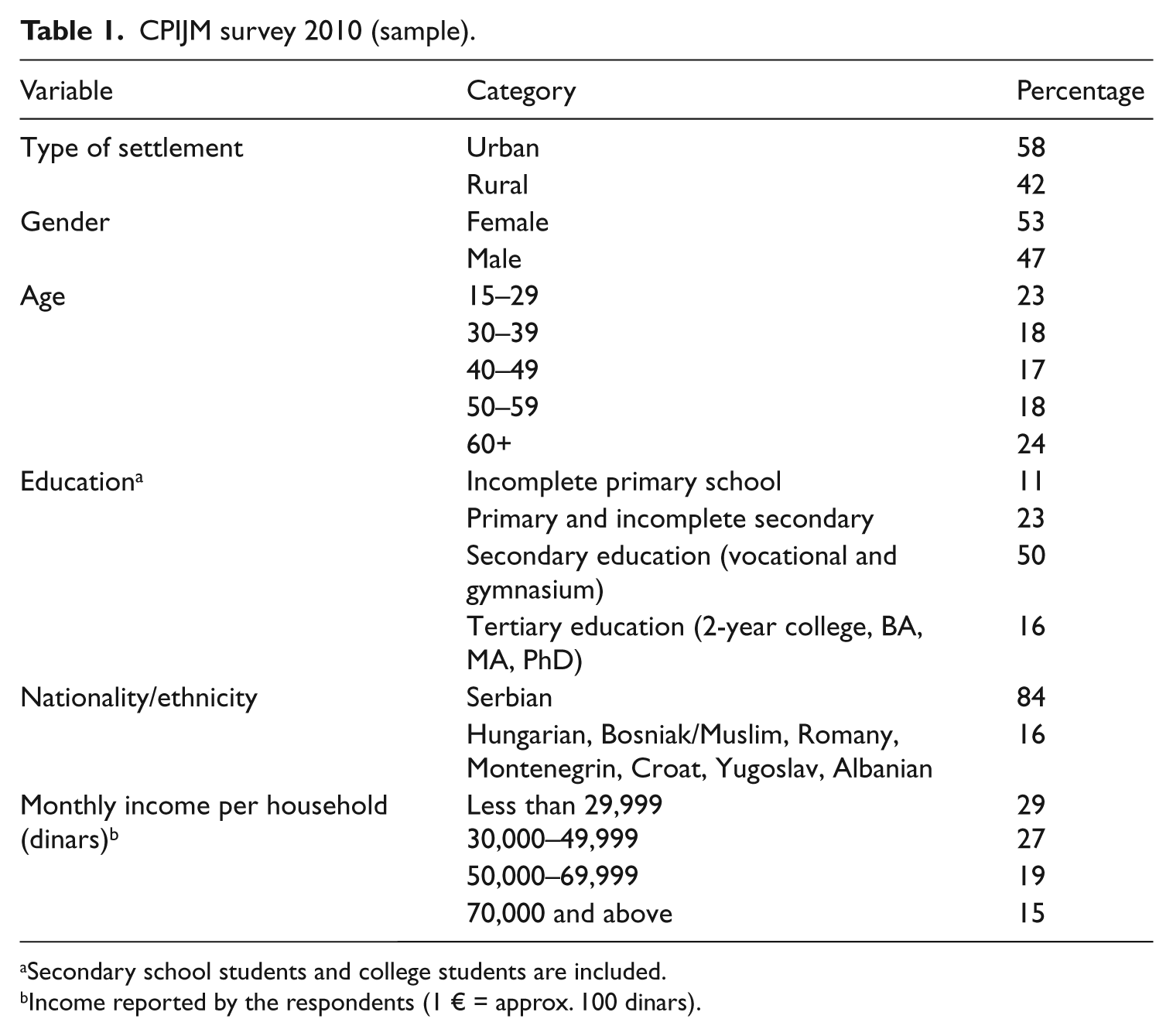
Secondary school students and college students are included.
Income reported by the respondents (1 € = approx. 100 dinars).
What does gender equality mean for the citizens of Serbia?
In the NS, gender equality is defined as a comprehensive transformation of gender hierarchies in society: ‘This document defines a complete, harmonized state policy with the purpose to eliminate discrimination against women, improve their position and integrate a gender equality principle in all spheres [our emphasis] of functioning of system institutions’ (NS, 2009). We hypothesized that citizens’ understanding would be slightly different, due to a socialist ideological legacy: a positive attitude towards ‘public’ areas of education, employment, political activity, but not towards the ‘domestic’ area. 12 The evidence suggests that there has actually been a ‘hybridization’ of traditional/communist and contemporary meanings of this concept. The majority of respondents identify gender equality with ‘elimination of violence against women’ (64%). The next options are ‘equal financial power of both genders’ (47%), ‘achieving gender equality in governing positions’ (44%) and ‘equality in division of household labour’ (41%). Then comes the ‘elimination of gender prejudices in the general population’ (37%). A very low percentage responded to ‘achieving gender equality in curriculum, textbooks and media’ (10%) and ‘use of gender sensitive language’ (6%).
It is clear that five out of seven options (governing positions in politics/economy, education content, violence, prejudices, financial power, household labour, language) are chosen by respondents as facets of gender equality. It is quite impressive that violence against women is the first choice for all citizens. This high sensitivity to violence might be accounted for by organized campaigns against violence and media attention to the activities of organizations dealing with domestic violence. Citizens probably became aware of the social desirability of this option, which is more a sign of methodological bias than a profound social change.
There are no differences between responses for men and women, except with regard to division of household labour, which is placed ‘higher’ on the list by women. Differences among citizens reflect social background (education and occupation) within gender groups: equal division of household labour is higher on the agenda for low-educated women than for women with university degrees. Low-educated men placed the division of household labour higher on the list than male respondents with university degrees. More educated respondents (of both genders) opt for equality in governing positions, elimination of prejudices and gender equality in financial power. Differences between men and women decrease with educational level. Maybe the low-educated respondents find the issue of ‘chores’ to be a more familiar epitome of gender equality compared to the more abstract and complicated issues of ‘prejudice’ or ‘financial equality’. On the other hand, more educated people maybe choose a more sophisticated option that reflects improvements in general social conditions rather than the ‘private matter’ of household chores. Paradoxically, this means that low-educated respondents are more in line with current trend of ‘gender perspective’ than are high-educated respondents. Of course, there is always a possibility that respondents just project their own experiences: low-educated women recognize their own issues of unfair household burdens as a social problem, and high-educated women have already dealt with this problem more successfully, so they do not see it as a general problem.
Citizens’ understanding of gender equality is also manifested in their position on the two compulsory elective subjects (students must choose one) in primary and secondary education: citizenship education and religious education. These subjects were introduced in 2001, and they represent two divergent concepts of gender relations. Citizenship education is much more consistent with the dominant concept of gender equality in current political discourse. Religious education is based on teachings on gender roles/relations from traditional religions (Orthodox and Catholic Christian, Jewish, Muslim). Approximately the same percentage of respondents thought that citizenship education is the preferable model (14%) as for religious education (12%). It turned out that only 14% of citizens indisputably support the concept of gender equality that is promoted by official policy (both the NS and the curriculum). There was no difference between the genders on this question. 13
Perception or (non-)recognition of gender-based discrimination?
Citizens rarely reported gender discrimination/inequality in their personal, professional and social lives. In the CPIJM survey, perceptions of gender discrimination include direct personal experience of gender discrimination and indirect evaluation of gender inequalities in society. Most citizens did not report any direct discrimination in their family, political activity, work and employment, formal institutions, or informal relations with friends and neighbours (the highest response was in family – 14% compared to 3% in political activities). EU citizens have also reported low discrimination: 4% in society, 5% in employment and below 5% in political life and access to education and health care (European Commission, 2009).
Women do experience more discrimination (notably in family and the private social environment). However, social background is more relevant than gender: poor women are more at risk to experience discrimination/violence. There is no difference between women in rural and urban settlements (one-quarter of them experience discrimination in the family). Socioeconomic status seems to be more relevant for discrimination. Over one-third of women whose households struggle to buy food reported discrimination in the family once or several times, and 17% reported it in contacts with neighbours and acquaintances.
As for indirect perception of discrimination, citizens believe that women are experiencing more gender-based discrimination in the work–family domain, but they are divided on the issue of multiple age/gender discrimination of women in employment. The same division of opinion is found in the perception of job segregation. Citizens’ perception of discrimination based on work–family dynamics is compatible with the NS. Half of respondents think that women are more frequently rejected in job applications for a ‘gender-specific’ job (i.e. a ‘male job’). Most believe that women’s jobs are more frequently in jeopardy than men’s because of their family obligations (81% of women and 74% of men agree with this statement).
Attitudes on media content indicate a perception of the ‘third wave’ dimension of ‘awareness’ of ‘subtle’ gender discrimination. The National Strategy emphasizes the issue of stereotypical, humiliating representation of women in the media. However, this issue is recognized by half of the respondents, mostly in TV series and films, and entertainment programmes (music and reality shows). Advertising was mentioned by only 5% of both men and women, compared to EU citizens, who see advertising as the second largest source of sexist stereotypes (the first being the workplace) (European Commission, 2009). One-quarter of EU citizens believe that sexist stereotypes are present in the media (European Commission, 2009: 134). Women in Serbia are just as sensitive as men to prejudices and stereotypes in the media.
Discrepancy between goals and instruments
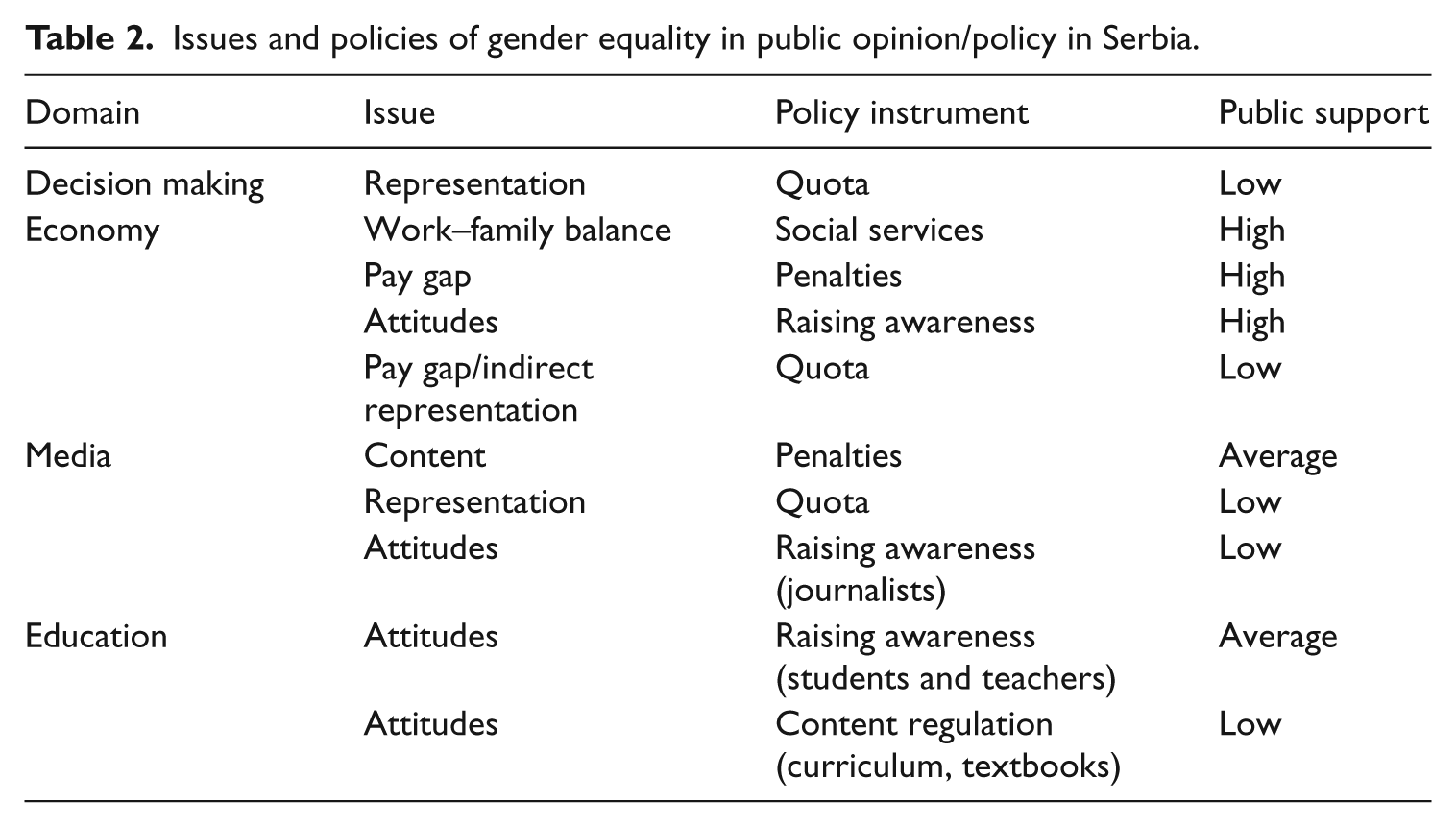
Policy instruments for achieving gender equality can be categorized as follows: regulation (content), quotas (political representation), penalties (pay gap), raising awareness (in education, media) and social policy measures (child care). 14 Citizens have different preferences for policy instruments in different areas. They are divided on instruments for eradication of prejudices, which is high among citizens’ priorities. For example, in education, respondents’ first choice is raising awareness (educating teachers and organizing lectures and workshops for students). A direct measure of content regulation (changing the curriculum and introducing special subjects) is supported by smaller proportion of citizens. Regulation (penalties) is the first instrument for dealing with media content, and education of journalists has less support. Quotas are not perceived very favourably, as only one-fifth of citizens support affirmative action in dealing with issues of representation in politics, the economy and the media. There is a strong support for social policy measures in the work–family balance domain. Table 2 presents different domains and public support for policy instruments (high – over 50%, average – 30–50%, low – below 30%). There are no differences between men and women.
Issues and policies of gender equality in public opinion/policy in Serbia.
Three policies are dominant in dealing with pay gap for both citizens of Serbia and the EU: penalties imposed on companies guilty of gender-based pay discrimination, eradication of prejudices and generally negative accepted ideas concerning women, and making publicly available information on salaries in companies.
Obviously, the data suggest that the citizens’ position is inconsistent with the official position stated in the NS. The key idea behind the rationale for quotas is the belief that they are a quantitative ‘boost’ for the self-consciousness of women, notably their latent strength and political influence. Another premise is that they can help in consolidating ‘women’s interests’ (Mršević, 2007). Some citizens have a positive attitude towards quotas, stating the following reasons: ‘improving representation of women’, ‘possible good effects’, ‘accession to the EU’ 15 and ‘better advocacy for the needs of women’. These citizens make up a minority. Less than one-fifth of citizens would raise the quota to parity (50%) for women in the National Assembly (less than one-quarter of women citizens). Less than half of both men and women agree with the statement, ‘It is time for Serbia to elect a woman as prime minister or president’. Here we raised the question of whether goals and instruments for gender equality are diverging. It seems that citizens implicitly prefer the ‘equality stool’ position that emphasizes ‘equal treatment’ rather than the policy of equal opportunities and affirmative action.
Policy priorities in gender equality
Citizens might not place gender equality high among their political preferences, but they can articulate their position when asked about specific policies. However, they are not consensually in favour of the actions proposed as policy in the NS. Half of citizens agree that some measures should be taken to improve gender equality. Another half is opposed to this. Almost one-fifth of women and men believe that ‘women should fight for equality themselves’ (21% of women and 16% of men). Around 18% of men and 8% of women think that nothing should be done, because equality of men and women is already at a satisfactory level. However, the majority of EU citizens believe that some intervention is needed, unlike the citizens of Serbia (European Commission, 2009).
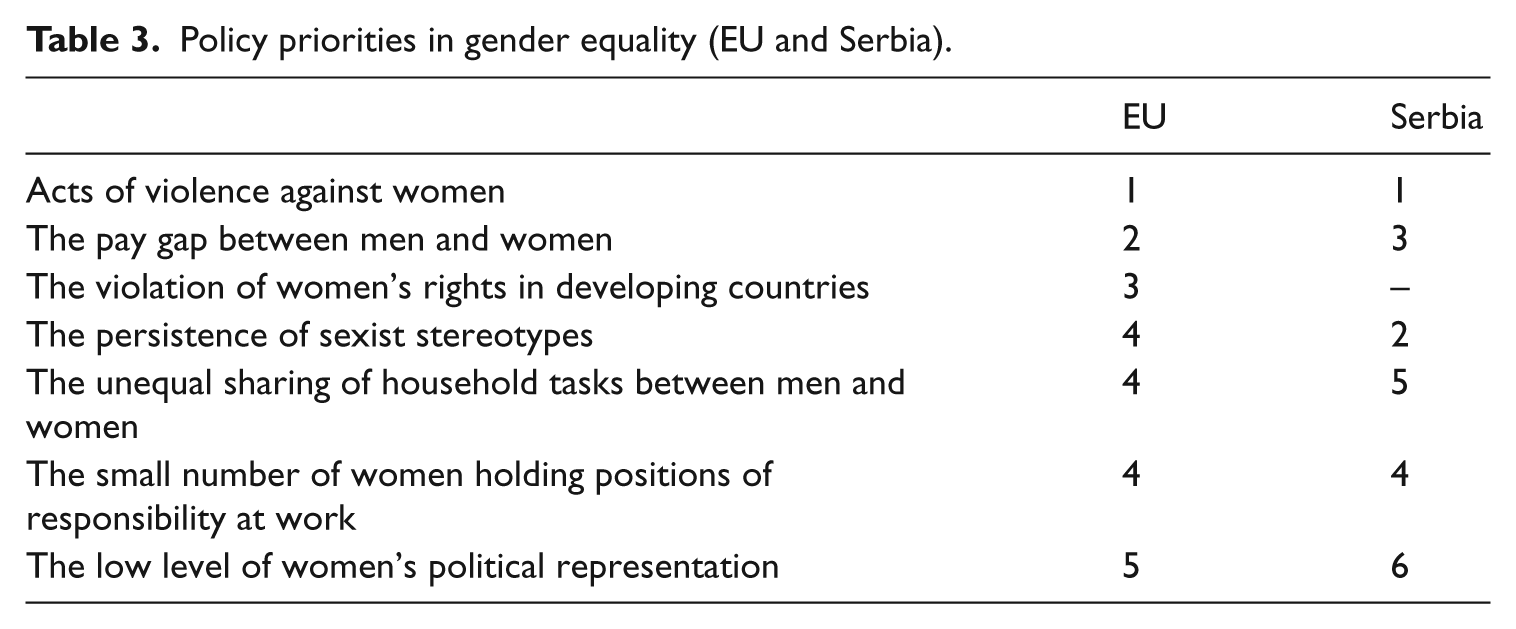
Among those Serbian citizens who are in favour of policy intervention, priority is given to domestic violence against women. Citizens infrequently opted for presentation of women in school programmes and textbooks, unequal representation of women in politics, insufficient budgetary financing of organizations that fight for gender equality and use of gender sensitive language. For EU citizens, the top two priorities are violence against women and the pay gap (European Commission, 2009). Convergence between the citizens of Serbia and the EU is evident in Table 3.
Policy priorities in gender equality (EU and Serbia).
It is interesting to note that political participation is not very high on the citizens’ agenda, and political participation of women is very low at all levels of decision making in Serbia. The legislative quota is 30% for political parties, but in reality the percentage of women does not exceed 20% in national and municipal parliaments (Kolin and Čičkarić, 2010: 163). 16 For this reason, political participation is the first strategic goal in the NS. However, citizens are divided on this goal. They recognize decision making as an element of gender equality, but place it low on the list of policy priorities. One could explain this preference by reference to citizens’ possible belief that the current state of women’s participation is satisfactory. On the other hand, citizens must be aware of the under-representation of women, since their knowledge about gender equality is adequate. Interestingly, EU citizens have also placed political representation low on the agenda. According to the Eurobarometer 2009, 34% of EU citizens support training and measures to encourage women to participate in political life, 29% support raising awareness among political parties and governments and 21% support quotas for seats eligible for women (European Commission, 2009: 97). We believe that citizens equate the goal of ‘promoting political participation of women’ with the instrument for achieving this goal – the quota principle. As mentioned above, quotas are not popular among citizens. Some do not accept the very principle of quotas, since it is ‘interfering with voters’ preference’ or ‘interfering with party activities’. Another reason is their fear of corruption and nepotism that could make the principle of quotas pointless.
It is true that quotas for political representation proved to be ineffective during socialism, and some respondents might have a memory of this period. During socialism, quotas were set for each segment of the society – the young, workers, women. This resulted in some unintended effects for the planned goal of increased participation of women. By appointing to assemblies (federal, national, local) a large proportion of low-educated women, the power of women was actually diminished. Approximately 15–25% of women in representative bodies during socialism simply ‘dissolved’ at the first multiparty elections in the 1990s (decreasing to 1.5% in Serbia) (Markov, 2001).
It is interesting to compare citizens’ perspectives on vulnerable groups with the perspective advanced in the NS. The NS recognizes the concept of multiple discrimination and vulnerable/discriminated categories of women. The NS identifies multiple discrimination among ‘members of national minorities and minority groups, Roma women, disabled women, women refugees or IDPs [internally displaced persons], poor women, rural women, single mothers, women with an alternative sexual orientation’ (NS, 2009). There is a slight divergence between public opinion and public policy in that respect. The majority of men and women in Serbia (two-thirds) believe that single mothers and women who are victims of domestic violence should be the focus of policy intervention. The next group in order of priority are women with disabilities. Two categories of women are recognized as vulnerable by more than one-third of respondents: elderly women and women in rural areas. One group identified as vulnerable in the NS – Roma women – is marginal for citizens. The same goes for sex workers and sexual minorities.
It is evident that citizens are selective in setting their policy priorities (even when they are latent), unlike policy makers who promote the comprehensive transformation of society. For both women and men in Serbia, the urgent issue is violence against women and not, for example, ‘increased participation of women in representative bodies at all levels’ (NS, 2009). Of course, citizens (including women) actually do support many goals consistent with the vision of decision makers: for example, eradication of prejudices and change of attitudes. Violence against women has become an urgent issue after having being brought to the public’s attention through many media campaigns and projects. This indicates that citizens support intervention in the ‘private’ area of family relations, which goes beyond patriarchal residues and communist formalist equality. A question arises as to whether the mainstream policy concept of gender equality as a complete ‘overhaul’ is a realistic option.
Gender equality as a political issue
The issue of gender equality is still marginal in general Serbian political discourse. Political parties rarely make statements on gender issues. However, there are at least two political parties that have included gender equality in their political programmes. One of them is the Democratic Party, being the driving force for promoting a modern version of social democracy of equal opportunity. Paradoxically, although gender equality is not a widely discussed issue in political debates (unlike the issue of EU accession, for example), it is definitely placed on the political agenda and enhanced through an institutional niche of the Directorate of Gender Equality (GED).
However, according to the CPIJM survey, the majority of citizens are not interested in the position on gender equality held by their preferred party, nor do they express any strong interest in considering gender equality issues. The majority of respondents believe that gender equality is not an important issue in politics. Almost half of them did not enquire about the position on gender equality of the party they voted for in the last election. One-quarter of citizens did not ask because they did not consider this to be an important issue. Women and men responded in the same way.
Although they do not recognize it as a political issue, Serbian citizens have an average knowledge of gender equality regulations and institutions. These findings are comparable to the Eurobarometer 2009. 17 In Serbia, men are better informed about gender equality than women, and are also more willing to express their opinion. This finding is consistent with recent research – compared to men, women have a lower level of motivation for political/civic activism and trust in their own capacities to influence policy making (Blagojević, 2004). In Milić’s survey of local feminist/women’s organizations, it was confirmed that the Serbian public is either neutral/indifferent or negative towards their activities. Women’s activism is still distant from citizens in Serbia, since two-thirds of citizens were not able to name any aims, programme or actions of local women’s organizations (Milić, 2004). The majority of women are not interested in gender equality issues. According to a recent study of citizens’ perception of the non-government sector, only 1% of citizens (probably mostly women) is involved in the activities of organizations advocating gender equality issues (Građanske inicijative, 2009). The CPIJM survey found that women either did not enquire about parties’ positions on gender equality in the last election, or did not regard it as an important issue. Only one in ten woman recognized this issue in the election. Therefore, two-thirds of women do not express any interest in the political field of gender equality.
As for political representation, when asked whether they would prefer a man or a woman if they could choose a political candidate with the same qualifications and abilities (from a party close to them), approximately half of citizens said that they could not make a choice according to the criterion of gender (51% of women and 59% of men). Among the rest, citizens chose the same gender as their own: women would prefer a female candidate, and men would prefer a male. Poorly educated women are rather divided on the issue – half of them would rather choose a man. Education matters in opting for women, both men and women with a higher education would rather choose a woman. This might reflect the socially acceptable answer chosen by the well-educated people (supporting affirmation of women is a politically correct answer). We found more differences among women across socioeconomic variables of differentiation than between men and women. As Tremblay said, ‘The capacity of political women to represent women depends less on their sex than on their ideas’ (Tremblay, 2000: 341).
The above findings raise another issue: there is not only a difference between descriptive and substantive representation of women, but the very definition of substantive representation is not consensual. The shaping of gender equality policy in Serbia is primarily driven by a committed ‘gender policy elite’. Activists in women’s organizations and political parties in Serbia still comprise a selected group of women from civil society organizations, international organizations and political parties. Although this is not the focus of our analysis, we would like to point out that the question of political subjectivity in the ‘gender area’ is not yet answered. The discrepancy between representation ‘from below’ and ‘from above’ is still an issue.
Conclusion
Over the last decade, most of the reforms that have been enacted have been driven by Serbia’s strategic foreign policy priority – accession to the EU. At the same time, gender equality has been systematically introduced in the dominant political discourse and public policy. Accession to the EU provides a general framework for policy measures related to gender equality. Serbia has followed a path similar to other post-communist EU member states. The first priority for these countries was to achieve formal compliance with the EU acquis with regard to gender equality (Weiner, 2009). However, according to Bellier and Wilson, ‘the construction of the EU “entails not only a process of harmonization and integration but one of legitimization” ’ (quoted in Weiner, 2009: 225). This process of legitimization must take into account the history of gender equality in Serbia (the socialist legacy, before 1990). This is reflected in different attitudes towards policy intervention. For EU citizens, there is almost a consensus that policy intervention is justifiable. However, only half of Serbian citizens believe that policy intervention is needed. One explanation is that the EU public has been sensitized to the ‘new equality’ concept, while Serbian citizens still rely on the concept of ‘communist equality’ which focused on the ‘public sphere’. As Blagojević said: In comparison to third world countries, in semi-peripheral societies the use of women’s resources does not differ so much in the extent, but in quality: former industrialised societies with a strong egalitarian ideology created educated woman power with a high inclination for employment. Women’s relatively high inclusion in science, and fast feminisation of academic posts, therefore is the consequence of two very opposing sets of conditions: those favourable to women as part of a communist legacy (education, employment, egalitarian ideology) as well [as] those unfavourable for women (‘normalised’ high level of exploitation of women’s resources as a precondition for the development or transition, and a very unfavourable position of science, in general). (Blagojević, 2004: 140; reference omitted)
There are also many similarities between the citizens of Serbia and of the EU. Their policy priorities converge: violence against women is the priority for political intervention. Citizens of both Serbia and the EU have similar levels of reported experience of gender-based discrimination. Their knowledge of gender equality is at the same level. Even some preferences of policy instruments are similar: the least supported measures are election quotas and quotas in governing bodies of publicly owned companies. Therefore, citizens of Serbia and the EU are selective with regard to policy instruments.
Another focus of our analysis – the relation between the official policy on gender equality in Serbia and the citizens’ position – reveals another source of divergence. The official public policy of gender equality in Serbia reflects, at least formally, commitment to all three ‘legs’ of gender equality policy. Affirmative action is the policy of choice in almost all domains, decision making, economy, education and media. However, the ‘gender perspective’ is becoming more relevant in dealing with the issues of values, stereotypes and lifestyles. The idea of a transformed ‘gender contract’ has been introduced in the public discourse.
However, citizens tend to accept a ‘two and a half legged stool’. For example, Serbian citizens do support social policy measures ‘for women’, but not quotas ‘for women’. Both measures belong to the ‘women’s perspective’. There seems to exist a complex political/ideological position on gender equality on the part of the ‘average Serbian citizen’ and public policy makers. Citizens have many positive attitudes related to some aspects of the official concept of gender equality. However, they do not accept all the components of the ‘three-legged stool’. In terms of political theory, citizens opt for two positions. On the one hand, there is a classical liberal position, which focuses on the equal treatment perspective (compatible with ‘communist equality’). From that perspective, citizens tend to see gender equality as an accomplished goal. On the other, there is a social-democratic model of state intervention in ‘creating jobs’ and providing social services designed for women’s needs, which can be categorized as a ‘women’s perspective’ legacy. This dual position reflects the ‘Wollstonecraft dilemma’ (Lombardo, 2003).
The development of gender equality policy in Serbia seems to be caught between citizens and policy makers, intentions and effects, goals and instruments, resulting in a constant renegotiation process. It is important to remain aware of these discrepancies, because ‘grassroots’ support is a condition for the sustainability of any policy. A top-down process of ‘inculcation’ of policy packages has a low chance of long-term success.
Footnotes
Funding
The survey research reported in this article was commissioned by the Gender Equality Directorate (GED) in Belgrade, and financed by the Swedish International Development Agency (SIDA).