



Abstract
This article analyses the cost of motherhood borne by Polish women. The cost of motherhood is defined as a drop in earnings caused by the presence of children. The findings show that motherhood in Poland is associated with a drop in women’s net monthly earnings of around 13–19%. The results also show that the cost of motherhood varies with the number of children and the drop in wages is particularly high for mothers of three or more children. The investigation of mother’s self-selection into employment suggests that the estimated cost would be higher if the choice could be accounted for.
Introduction
Following the transition to a market economy, Poland, similarly to other transition economies, has been facing steadily declining fertility rates. According to the Polish Central Statistical Office the total fertility rate in 1989 amounted to 2.1 but in 2011 it had dropped to 1.3. This constitutes a decrease of almost 40%, placing Poland among the very lowest countries in the fertility ranking of European populations. This dramatic decline is predominantly associated with the country’s changing socio-economic situation caused by the transition. Several factors are argued to be particularly relevant for the observed fertility patterns; these include the availability and the quality of family policies and childcare, changes in the family structure and women’s higher educational attainment (Kotowska et al., 2008).
Despite the dramatically low fertility in Poland, the existing empirical research is silent on the economic dimension of motherhood and in particular the cost of motherhood, defined as the loss in earnings that follows childbirth. However, the loss in women’s earnings caused by the presence of children is a phenomenon that has already been documented for many western economies and it is commonly referred to as ‘a motherhood penalty’ or ‘a family gap’. The decline in earnings caused by motherhood varies in size and ranges from the small declines found in Sweden, Norway, Belgium and France (0–1.5%; Datta Gupta and Smith, 2002; Davies and Pierre, 2005), the moderate declines in Denmark, Spain and Portugal (3–6.5%; Davies and Pierre, 2005; Nielsen et al., 2004; Simonsen and Skipper, 2006) as well as the US (Waldfogel, 1998) to the high drops found in the UK and Germany (12–30%; Davies and Pierre, 2005; Gangl and Ziefle, 2009). None of the existing studies, however, reports on the cost of motherhood for any of the Central Eastern European (CEE) transition economies. 1 This article is therefore among the first that aims to analyse the problem of the drop in women’s wages following motherhood for a transition country.
The quantitative identification of the cost of motherhood is yet a methodologically complex task. In particular, it is problematic to separate the ‘pure’ wage effect of motherhood since women who decide to have children may be systemically different from childless women. A second problem arises because some women drop out of the labour market following childbirth. It is important to account for both these problems simultaneously, as only then is it possible to assess the importance of the relation between children and women’s wages and how it may be addressed by policy.
In this article, in order to report consistent and unbiased estimates of the cost of motherhood, two econometric methods are used: fixed effects estimation and the estimation of the bounds of the effect that reflect the worst/best scenario of the role of women’s self-selection into employment.
The estimated size of the penalty for motherhood varies from around 8% to 19% – depending on the model specification. In many cases, however, the estimates are not precise and they are not always statistically significant. Yet, they suggest that Polish women are indeed penalized for motherhood in the form of lower earnings. The analysis also shows that the more children a woman has, the higher the drop in her earnings. The estimation of the bounds suggests that the estimated effects represent good scenario and if the problem of mother’s self-selection into employment could be accounted for, we would expect to find stronger effects.
The article is structured as follows. The next section provides a comparative analysis of women’s situation in the labour market in communist and post-transition Poland. It also discusses the consequences of the structural changes introduced into the economy for the cost of motherhood incurred by Polish women. The third section provides a theoretical framework for the existence of the family gap. Subsequent sections present the data and the estimation method used in the empirical analysis. The sixth section presents the main findings together with their policy-related interpretations. Finally, the seventh section concludes.
Women in transition
The universal goal of the communist era was to activate the whole national labour force and ensure full employment in the economy. As a result, women’s employment rates were relatively high; in the case of Poland, the female employment rate around the year 1989 was approximately 70% (Pascal and Kwak, 2005). The overall wage level was however low as wages were set centrally according to a wage grid (Münich et al., 2005). As a result, to ensure sufficient resources for a family, a single salary was not enough and both men and women had to work. In Poland, the communist policy of full employment and low wages coexisted with the state support for the traditional model of the family characterized by the traditional gender roles and household division of labour. This traditional family model was maintained by means of a relatively rich social assistance programme aimed at women. Under communism, family and social benefits constituted thus an inseparable part of the state functioning. As noted by Fodor and Glass (2007), they were also a central part of the social engineering project and in many aspects universal for all the communist countries. The forms of state support that existed for families with children in Poland are presented in Table 1. Based on Pascal and Kwak (2005) and Balcerzak-Paradowska (1995) the benefits are grouped into: (1) benefits for mothers (parents), (2) services for children and (3) help for families.
State support for families with children in Poland, 1970–1989.
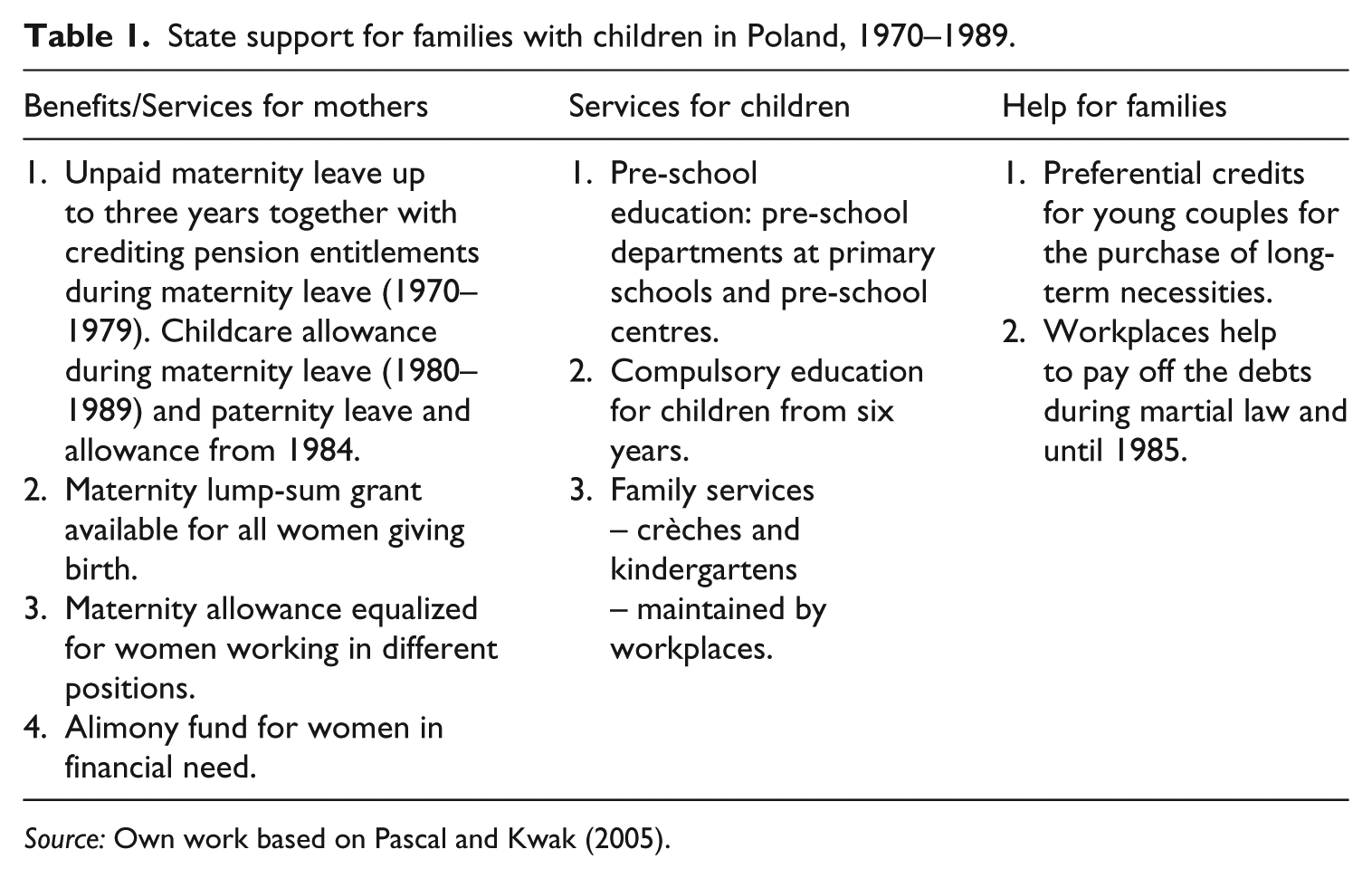
Source: Own work based on Pascal and Kwak (2005).
The introduction of market reforms brought some severe changes to the functioning of the economy, overall living standards and social and wage equality. Together with the changing economic model, some shifts in gender relations also took place. First, the overall decline in labour demand along with the changes in its structure led to a massive drop in employment. As a result, many women became economically inactive and moved from paid work to household-related activities. These changes are still visible in many CEE transition economies, where female employment rates are among the lowest in the European Union. Second, negative changes in the provision of social policies aimed at families with children also took place. In the Polish case, the most important change was perhaps the implementation of the means-tested eligibility criteria for financial support. The distribution of support was also shifted towards larger families. Moreover, the decentralization also involved many childcare establishments, and led to their widespread closure. According to Lisowska (2006), 70% of kindergartens closed in Poland between 1989 and 2001/2002. Additionally, as shown in Table 2, the length of maternity leave was extended so that the care earlier provided by the state in the centrally administrated crèches and kindergartens was now transferred to stay-at-home women. The emerging policy regime in Poland may be therefore characterized by a reduction of public support and increasing privatization of care work. As suggested by Fodor and Glass (2007), such a policy regime can be termed as a ‘private maternalism’.
Changes in the length of maternity leave, 1989–2012.
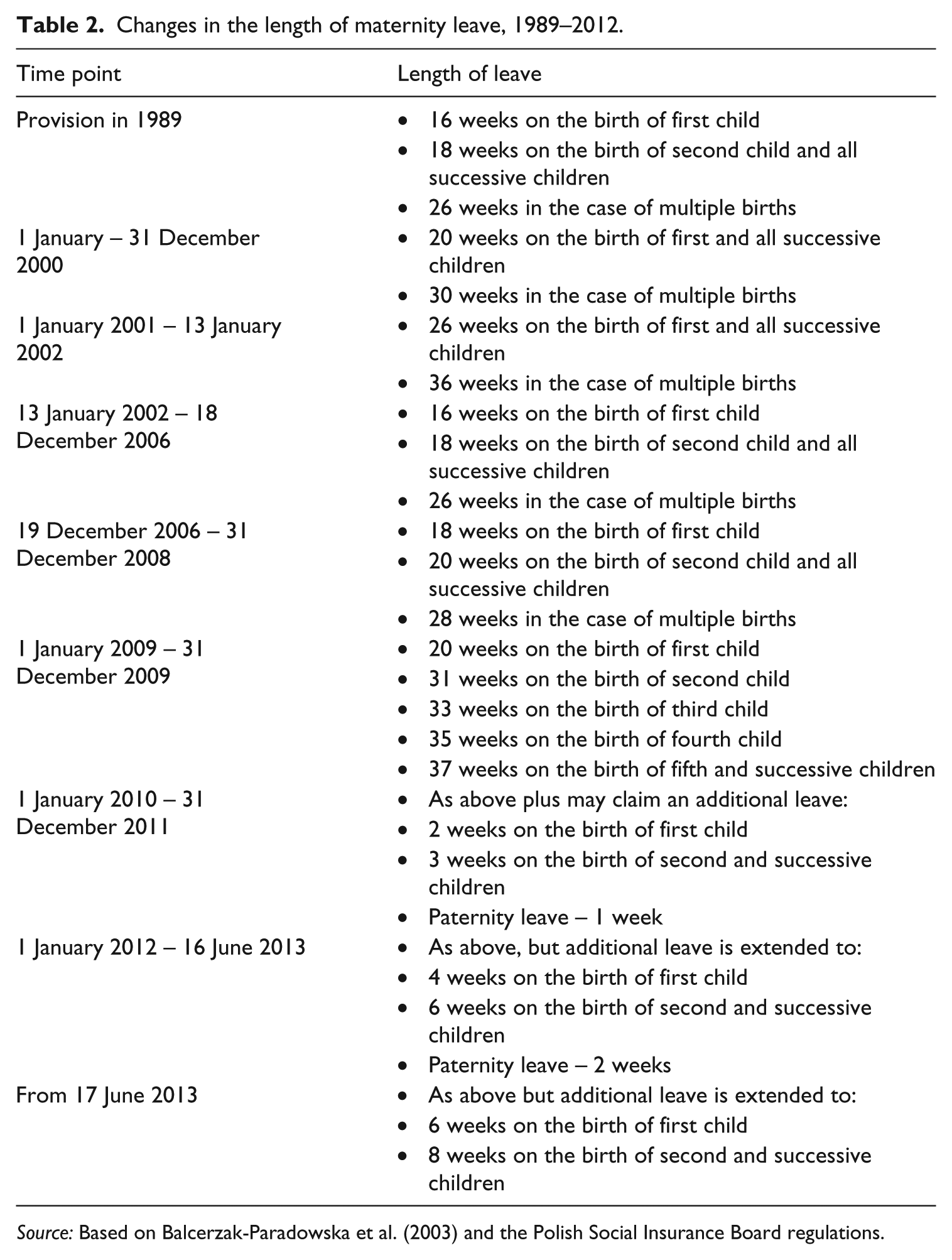
Source: Based on Balcerzak-Paradowska et al. (2003) and the Polish Social Insurance Board regulations.
The model of the woman being the main caretaker in the family and the man being its main breadwinner that emerged in post-transition Poland was successfully sustained for many years. There are two main reasons for this. First, gender issues were not a priority for any of the post-communist governments in Poland and public debate gave them rather limited attention (Balcerzak-Paradowska et al., 2003). Second, post-communist governments faced large financial constraints, so that they were not in a position to reverse initial restrictions on family benefits and care centres. Recently however, some changes in this regard have taken place. In particular, starting from 2014 there exist five forms of leave related to childrearing. These are: (1) maternity leave, (2) additional maternity leave, (3) paternity leave, (4) family leave and (5) parental leave. Basic maternity leave lasts for 20 weeks, during which the mother receives 100% of her average monthly salary from the previous 12 months. 2 Parents may also claim an additional leave of six to eight weeks (depending on the number of children in the family) with full salary. This additional leave may be fully used either by the mother or father, or shared between them. Fathers are also entitled to paternity leave of two weeks with 100% salary. Only individuals who have a permanent employment contract for an indefinite period are entitled to take the leave and receive the benefit. In the case of short-term contracts for a definite period or a certain task, parents are only entitled to the benefits, not the leave. 3 Parents who have a permanent employment contract may in addition take family leave. The leave can be used either by the mother or father or by both parents and it lasts for 26 weeks with salary coverage of 60%. 4 Parents who have a permanent contract may also use the parental leave, which lasts for up to 36 months but does not include any financial benefits. In addition, parents may now also receive financial allowances, such as: (1) family allowance, (2) lump-sum child allowance (based on means-tested eligibility criteria) and (3) allowance for parents of handicapped children.
The changes in state assistance for families and the limited availability of childcare establishments that have emerged following the transition have important implications for the relation between motherhood and wages. Overall, the changes in family policies are likely to make Polish women face high costs for being working mothers. First of all, the closure of the care centres and the extension of the maternity leave period might have induced mothers to stay at home longer, leading to the gradual depreciation of their skills (or more generally their human capital). Moreover, the strict eligibility criteria for the benefits and the increasing unemployment in the country might have led to the situation where some families were not in a position to afford to have children.
Theoretical background on the impact of motherhood on wages
Despite the fact that the literature on the cost of motherhood in western economies has grown to enormous volumes, the mechanisms that underlie this phenomenon are still not that apparent.
The theoretical framework that helps explain why mothers may be experiencing lower earnings than childless women draws heavily on the economics labour supply model. First, in accordance with the theory of specialization (Lundberg and Rose, 2000, 2002), when a child is present in the household, wives tend to specialize in home production, whereas men in the production delivered in the labour market. This means that after giving birth to a child, women tend to spend more of their time at home, taking care of the household and the newly born child. In addition to that, the ‘home-intensity effect’ is present (Lundberg and Rose, 1999), which is reflected in an increase of parent’s value of time (both that of men and women). As a consequence, women value their time spent at home higher than that spent in the labour market. In the case of motherhood women’s labour supply thus tends to decline. Lower labour supply of mothers steadily leads to the decline in their work experience and human capital accumulation. Additionally, atrophy of their market skills may take place during their time out of the labour market. Eventually, once a woman has a child her overall productivity is likely to decrease (Becker, 1985). Moreover, according to Becker (1985) lower productivity of mothers may be also due to the higher efforts they put into home production compared to the efforts exerted in the labour market.
In general, the lower wages of mothers are explained by at least three processes that take place following childbirth: (1) the loss in human capital, (2) the loss in the effort exerted at work and (3) choosing mother-friendly jobs and work adjustments. Most of the empirical studies on the motherhood penalty, however, find a drop in mother’s wages even after controlling for the possible explanations described above. As a consequence, a drop in mother’s earnings is also likely to be attributed to the possible labour market discrimination against mothers (Budig and England, 2001).
Data description
To analyse the cost of motherhood in post-transition Poland this article applies an econometric analysis of the empirical data from the dataset Social Diagnosis 2003–2009 – Objective and Subjective Quality of Life in Poland. The dataset has a longitudinal structure and consists of four waves: 2003, 2005, 2007 and 2009. At present it is the only national dataset that tracks respondents for more than two subsequent years. The dataset forms an unbalanced panel. The percentage of the sample observed for subsequent two years, on which my analysis is based, is around 70%. To test the significance of the attrition for the final sample, the attrition probit (Fitzgerald et al., 1998) is estimated. 5 The pseudo-R2 obtained from the estimation indicates that the observed variables that are included in the model explain only around 5% of sample attrition; the rest of the attrition is not explained. Additionally, the BGLW test for attrition (Becketti et al., 1988) is implemented by regressing log of wages on standard human capital characteristics and other variables used in the analysis (as in equation 1) as well as an attrition indicator and its interactions with all independent variables. The F statistic for a joint significance of attrition and its interaction is equal to F(38,1319) = 1.31 and remains statistically insignificant. Based on that, panel attrition is not considered to cause serious restrictions to the validity of the results.
One of the important limitations of the dataset is the lack of an explicit measure on earnings. The dataset instead collects information on the net monthly income. In the analysis the wage is therefore understood as the net monthly income of individuals who in the last seven days preceding the survey have been working for a wage.
The sample on which the empirical analysis is performed is restricted to female individuals aged 18–40. The lower age bound is chosen following Simonsen and Skipper (2006), who chose it to exclude those individuals who are between two educational levels (e.g. high school and university). Moreover, both the lower and upper age bounds are justified by women’s fertility period.
Methodology
Estimation strategy
The econometric model used to analyse the cost of motherhood has to be carefully selected as there are several analytical problems, which may lead to incorrect estimates. The first problem relates to the fact that only certain women decide to have children. For example, it may be the case that only low/high paid women, who are less/more career oriented, may be more likely to have a child. The second problem arises because some women do not stay in paid employment after giving birth. It may thus happen that only low/high paid women are willing to stay in work when they become mothers.
To account for unobserved differences between mothers and childless women, the fixed effects model (FE), which eliminates these time invariant differences, is used. The FE model takes the following form:
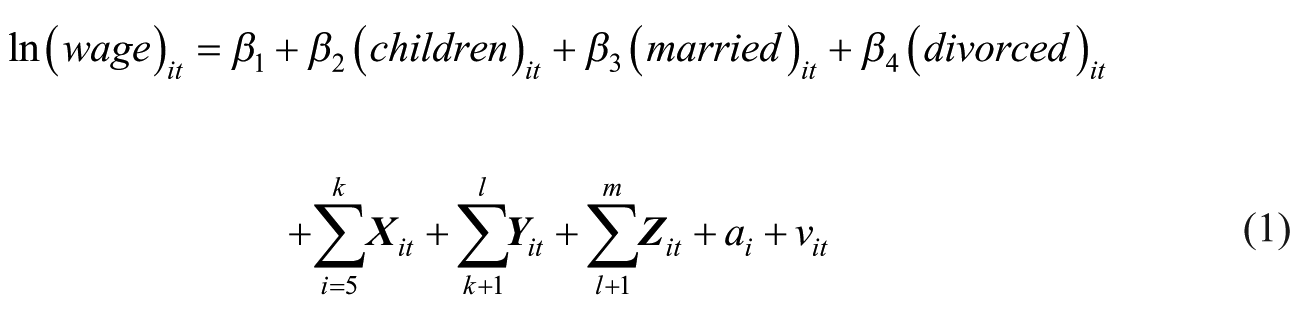
The subscripts i and t denote individual and time levels. Individual fixed effects that are stable over time are captured by
Next, the above equation is re-estimated taking into account the number of children a woman has. Following Budig and England (2001) and Korenman and Neumark (1992), the dummy variable Children is replaced with three dummy variables: One child, Two children, Three or more children (Specification II), as well as three variables indicating the number of children in a given age group (Specification III).
Non-randomness of the sample related to labour market selection
The estimates of the motherhood penalty derived from the fixed effects estimation may still carry the bias related to the fact that some women drop out of the labour market following childbirth. The estimates might therefore be under/overestimated if women who face a high/low penalty of being mothers tend to exit the labour market following childbirth.
In most of the studies that deal with the motherhood penalty and account for the problem of unobserved heterogeneity of women with and without children, the problem of women’s self-selection into employment (working in the labour market) is not taken into account; it is however acknowledged that such a problem exists. In this article the problem of failing to observe all women working before and after the birth of a child is accounted for by Lee’s method (2009) that allows one to derive the best/worst scenario of working selection. The main advantage of this method is that it does not require any exclusion restriction needed for the standard correction method due to Heckman (1979) that is usually adapted when the cost of motherhood is estimated by the linear regression model, which has been proved to provide biased results. 8
The method of Lee (2009) relies on the identification of the excess proportion of childless women that would drop out of the labour market if they had children. The calculated proportion is used for trimming the upper and lower tail of childless women’s earning distribution. The trimming of the distribution relies on the fact that the observed distribution of working non-mothers consists of: (1) a distribution of those who would have been working irrespective of motherhood and (2) a distribution of those who are working because they are non-mothers and would not have been working had they become mothers. Since it is unknown which women remain out of the labour market when they become mothers, the worst/best scenario assumes that they are either at the very top or at the very bottom of the observed wage distribution.
Results
Sample characteristics and summary measures
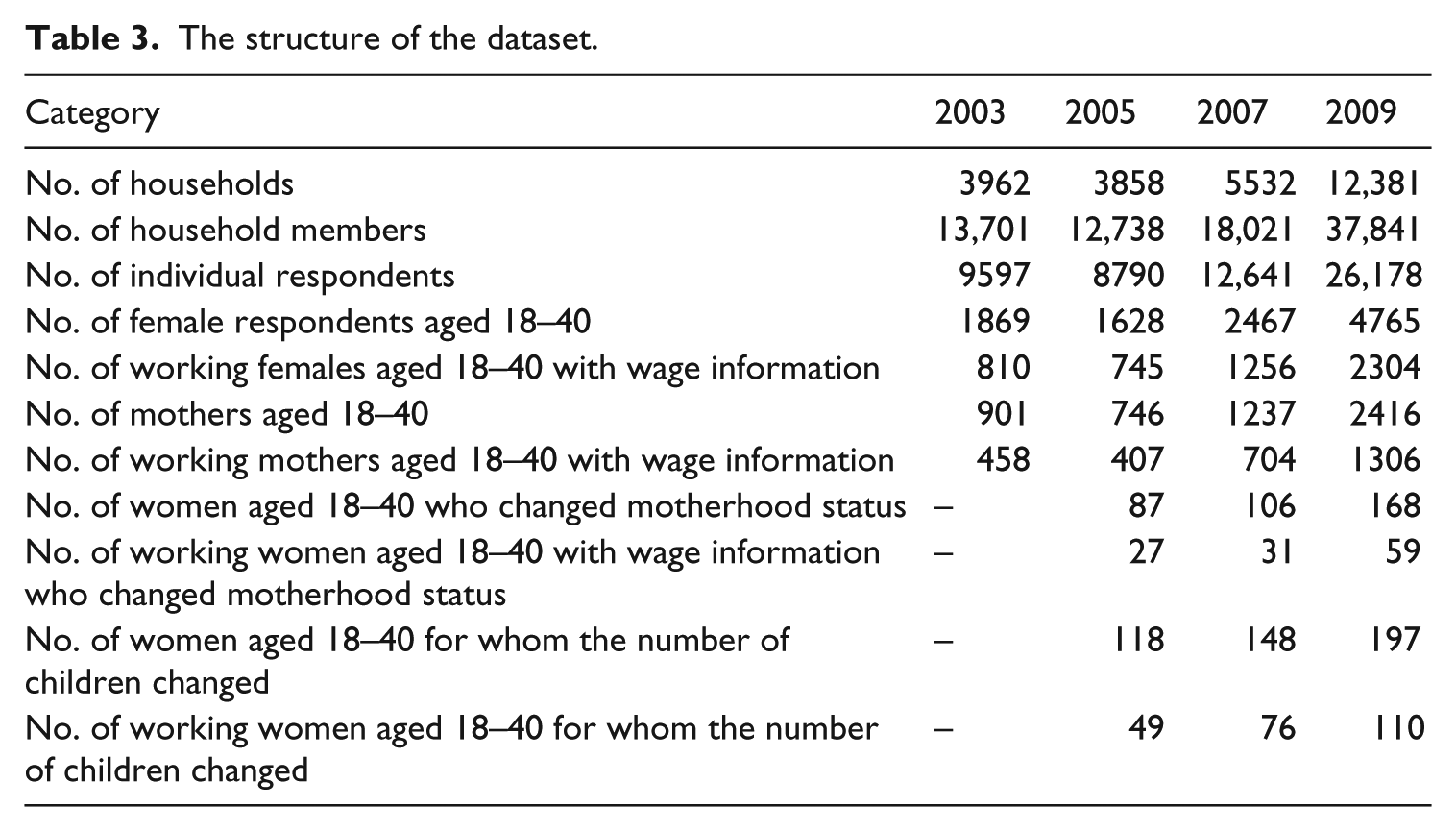
The final sample consists of 5115 women, of whom around 60% were observed for at least two subsequent years. The number of individuals observed each year is shown in Table 3. To identify the effect of children on women’s wages using fixed effect estimation, the sample must contain women who change their motherhood status. 9 As shown in Table 3, over the period analysed 361 women became mothers for the first time. Out of this group, 118 women were observed working before and after the change of their motherhood status.
The structure of the dataset.
The summary statistics of the variables involved in the analysis for the subsamples of mothers and non-mothers for each year are presented in Table 4. The summary measures reveal several interesting findings. There are significant differences between the characteristics of two groups: mothers are older and less educated. The average earnings of mothers and non-mothers are comparable and – except for the year 2007 – only slightly higher for mothers; the differences are not however statistically different from zero.
Comparison of the subsamples of mothers and non-mothers, sample of women aged 18–40.
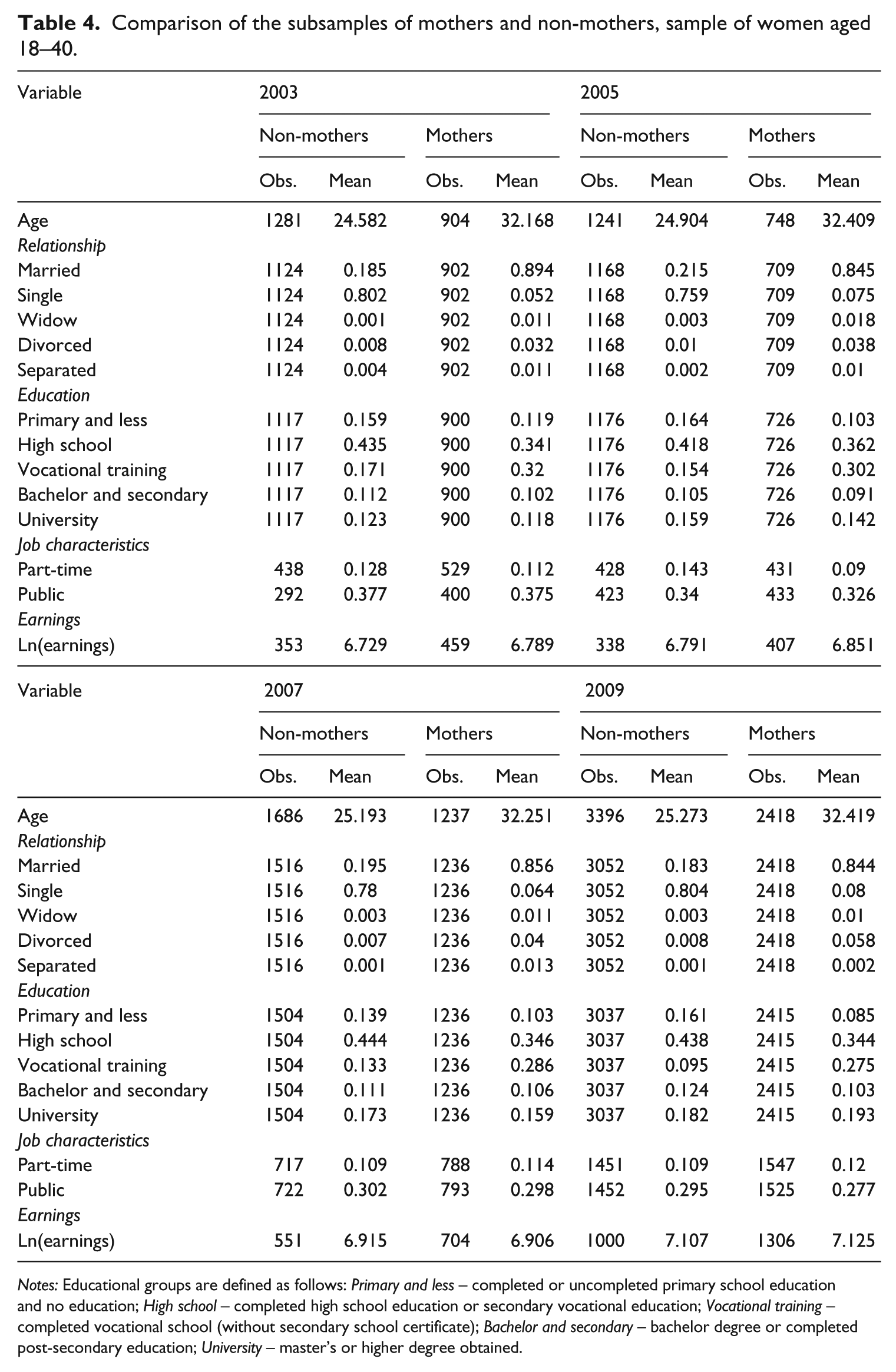
Notes: Educational groups are defined as follows: Primary and less – completed or uncompleted primary school education and no education; High school – completed high school education or secondary vocational education; Vocational training – completed vocational school (without secondary school certificate); Bachelor and secondary – bachelor degree or completed post-secondary education; University – master’s or higher degree obtained.
The main findings on the cost of motherhood in Poland
The FE estimation results of the effect of having at least one child on women’s earnings are presented in Table 5. The impact of motherhood on the wage rate is negative and ranges from 8% in the case of the gross model (no controls except for marital status) to 19% for the full model specification. The estimates of the wage equations that control for the job characteristics, which include a part-time working schedule and work sector (equal to –13.4%), and occupation and household resources (equal to –19%) are however the only significant estimates. 10
Fixed effects estimates of the effect of having children on women’s earnings; sample of working women aged 18–40; dependent variable logarithm of real monthly earnings.
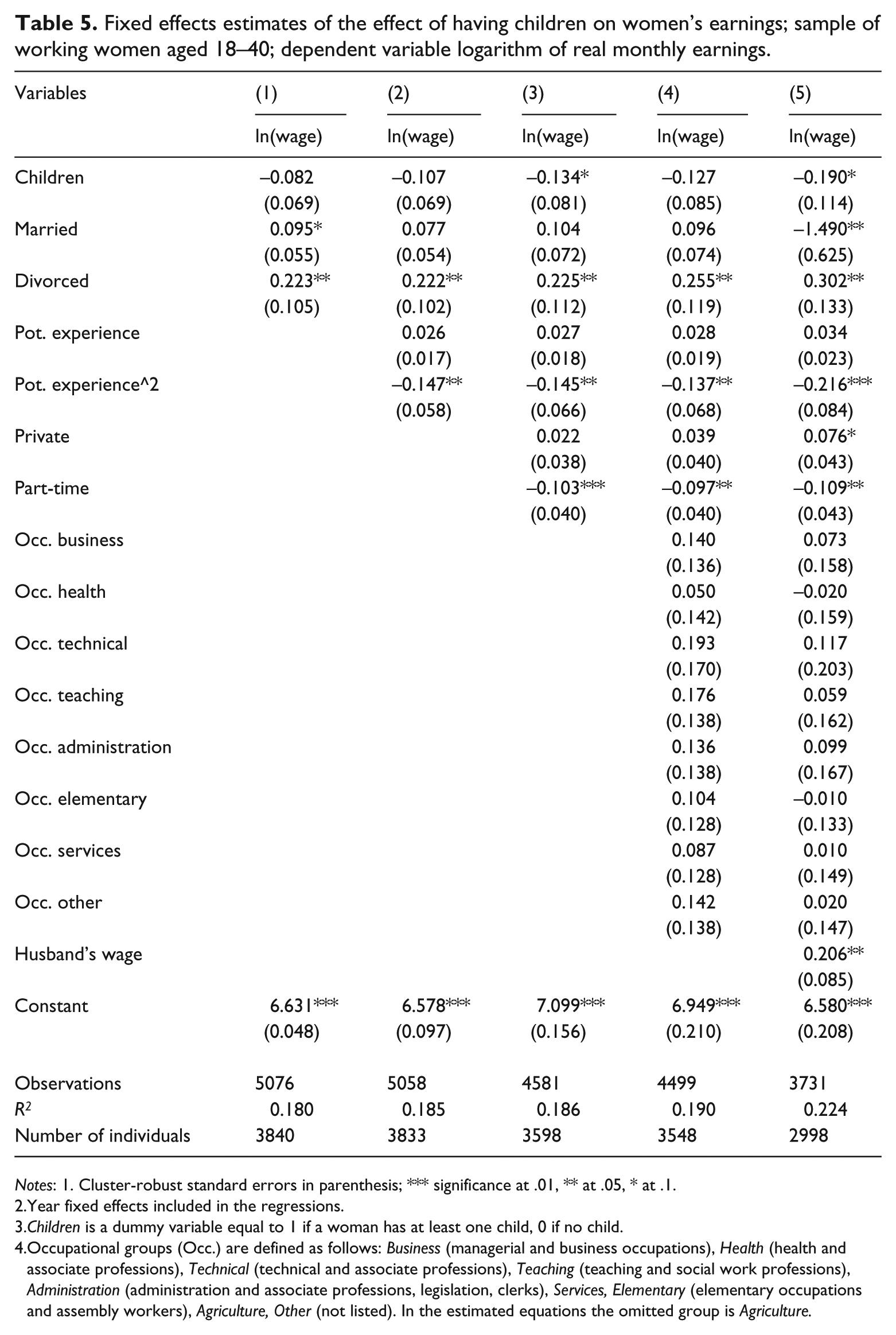
Notes: 1. Cluster-robust standard errors in parenthesis; *** significance at .01, ** at .05, * at .1.
Year fixed effects included in the regressions.
Children is a dummy variable equal to 1 if a woman has at least one child, 0 if no child.
Occupational groups (Occ.) are defined as follows: Business (managerial and business occupations), Health (health and associate professions), Technical (technical and associate professions), Teaching (teaching and social work professions), Administration (administration and associate professions, legislation, clerks), Services, Elementary (elementary occupations and assembly workers), Agriculture, Other (not listed). In the estimated equations the omitted group is Agriculture.
The effect of motherhood defined in terms of the number of children is presented in Table 6. The results show that the drop in women’s wages caused by motherhood is monotonic, but not necessarily linear. The gross model provides an estimate of 7.6% for one child, 16.4% for two children and a high 32% for three or more children. These results are however also weakly statistically significant. The inclusion of human capital controls results in the estimated effects of 10.7%, 18.2% and 32.2% respectively. Controlling for other factors related to job characteristics drives the penalty down for one child to a negative 16–17% and for two children to a negative 22%; the effect for three or more children remains unchanged but is no longer statistically significant. The inclusion of the husband’s wage leads to a further decrease of the effects. Once again the results are only marginally statistically significant. Their comparison however indicates that there is a large difference in the cost of raising two and three or more children. The results thus suggest that for Polish women it might be particularly costly to be a mother of three or more children.
Fixed effects estimates of the effect of children on women’s earnings by number of children; sample of working women aged 18–40; dependent variable logarithm of real monthly earnings.
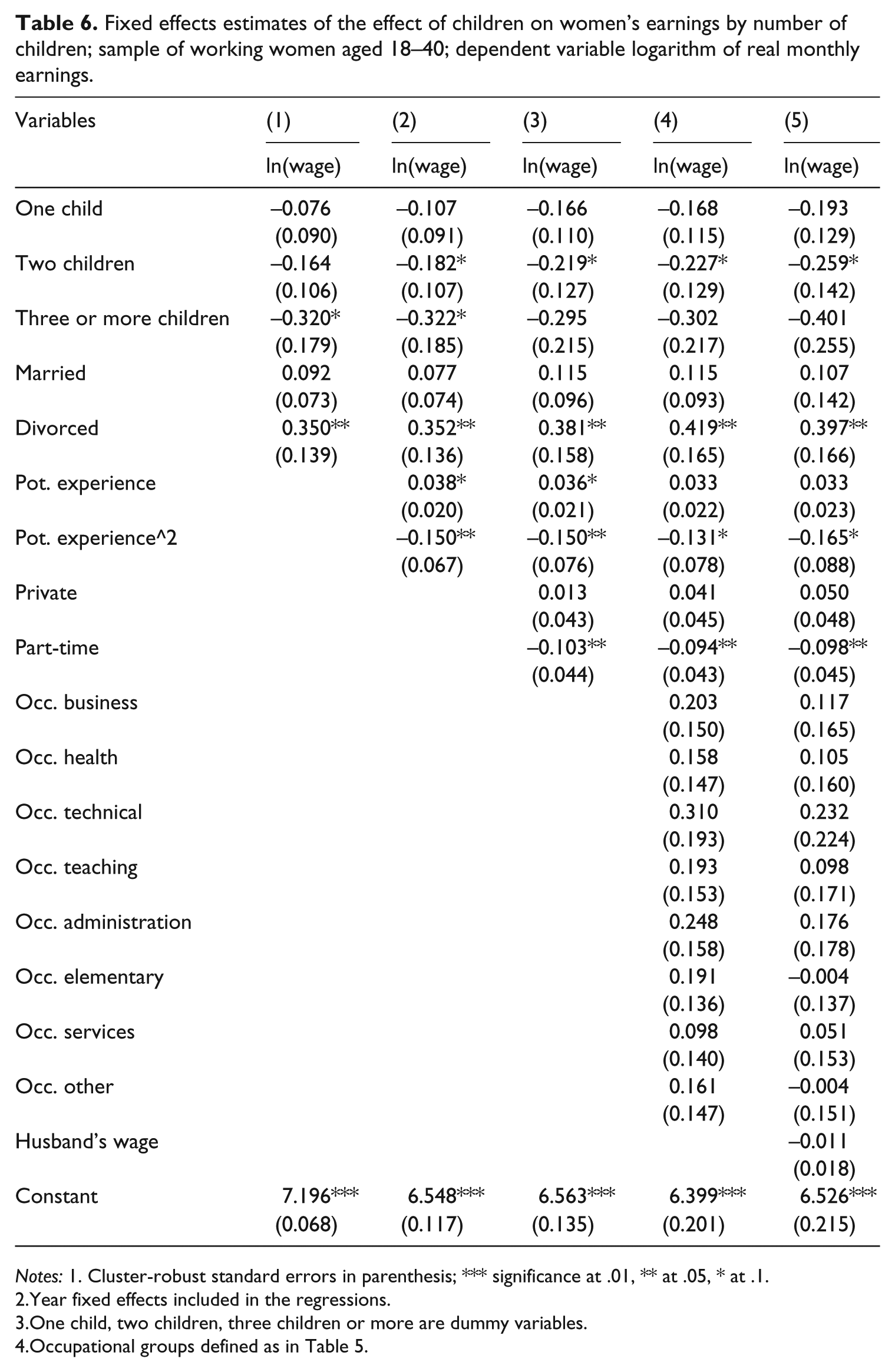
Notes: 1. Cluster-robust standard errors in parenthesis; *** significance at .01, ** at .05, * at .1.
Year fixed effects included in the regressions.
One child, two children, three children or more are dummy variables.
Occupational groups defined as in Table 5.
The estimates on the cost of motherhood that take into account the age of the children are shown in Table 7. The results show that there are no significant effects present. This finding may however be caused by the little variation between women in the number of children who are of different ages.
Fixed effects estimates of the effect of children on women’s earnings by children’s age; sample of working women aged 18–40; dependent variable logarithm of real monthly earnings.
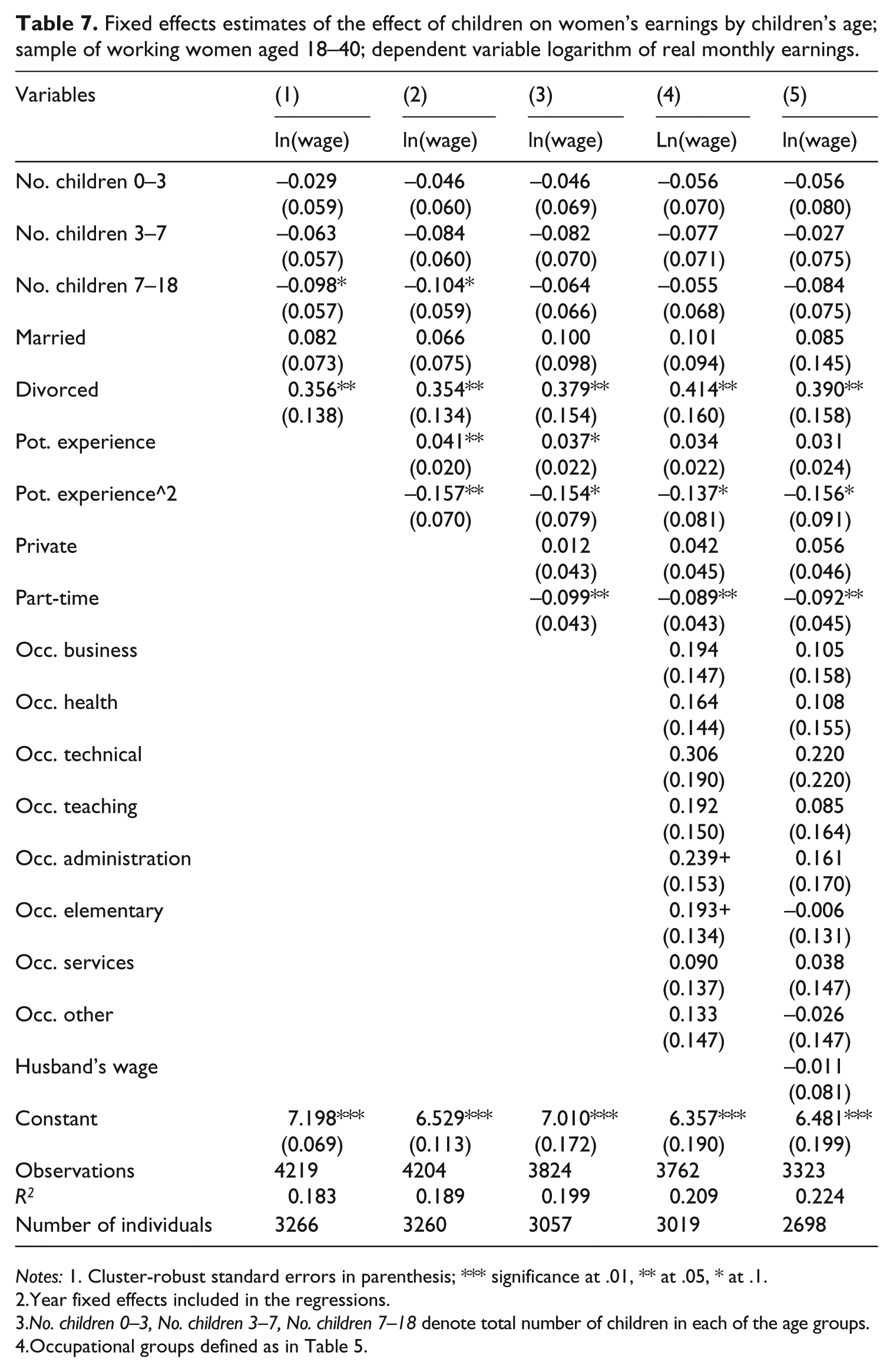
Notes: 1. Cluster-robust standard errors in parenthesis; *** significance at .01, ** at .05, * at .1.
Year fixed effects included in the regressions.
No. children 0–3, No. children 3–7, No. children 7–18 denote total number of children in each of the age groups.
Occupational groups defined as in Table 5.
The findings are interesting in the framework of the present situation of Polish women in the labour market and the provision of childcare and family benefits. The results show that the cost of motherhood is, indeed, high and not all women can afford to have a child. The high drop in women’s earnings caused by women’s more intense specialization in home production and childrearing may be a result of limited access to childcare establishments and the emergence of so-called ‘private maternalism’ discussed earlier.
The role of women’s self-selection into employment
Table 8 reports the estimates of the upper and lower bounds of the motherhood effect. The estimation of the bounds is adapted to the sample of the individuals that are changing their motherhood status over the period of the data collection. The share of working mothers is lower than non-mothers, 59.61% and 63.88% respectively. The mean log earnings are 6.93 and 6.75 for mothers and non-mothers respectively. The upper bound calculated as a difference in the mean obtained from trimmed wage distribution and the observed mean for mothers is −9.12%. The symmetric procedure provides the lower bound of −25.44%.
Estimation of the upper and the lower bounds of the effect of motherhood on women’s earnings; sample of women who are not studying or self-employed (aged 18–40).

The comparison of the estimates of the bounds with the previously derived effects suggests that the coefficients lay on average in the middle but closer to the upper bound of the estimated interval. The fact that the estimated cost of motherhood is closer to the upper bound indicates that low wage earners are more likely to drop out of the labour market after giving birth to a child. Consequently, if the employment selection could be accounted for, the obtained effects would be higher. This finding may reflect high cost of childrearing so that low paid women are likely to subsitute paid work with costly child care. Likewise, due to means-tested eligibility criteria for the family benefits, in the case of low paid women it may be worth dropping the labor market to receive the benefit.
Conclusion
This article provides estimates of the cost of motherhood borne by Polish women. To account for women’s selection into motherhood a fixed effects model is used. The role of women’s self-selection into employment is assessed by the adoption of bounding estimation.
The estimates range from 8 to 19% (depending on the model specification) but are not always statistically significant, suggesting that the relation between motherhood and wages cannot be identified precisely and without error. In general, however, the results suggest that the motherhood penalty in the form of lower wages does exist in Poland. The results also show that the cost of motherhood varies with the number of children and the drop in wages is particularly high for mothers of three or more children.
The estimation of the bounds based on Lee (2009) that tries to identify the role of mother’s self-selection into employment suggests that the initial findings are likely to be higher than the true effects. This means that the problem of failing to observe all mothers choosing to work after the pregnancy should be of particular concern when interpreting the results. If their choice could be accounted for, we would expect to find stronger impact of motherhood on wages.
Further research should concentrate on the changes in the cost of motherhood before and after the market reforms in order to assess the validity of the argument that the post-communism emergence of private maternalism may produce high negative effects of motherhood. Such comparative analysis is however largely limited by the lack of reliable data for the pre-transition period. Moreover, investigation of the countries that have experienced recent historical, economic and most importantly demographic development similar to Poland (particularly Hungary, the Czech and Slovak Republics) might allow one to assess whether the loss in earnings caused by motherhood found for Poland is country-specific or similar high negative effects of children on women’s wages are present in other post-communist economies.
Footnotes
Funding
This research received no specific grant from any funding agency in the public, commercial, or not-for-profit sectors.