



Abstract
Radical right political parties are usually heavily male-dominated; accordingly, previous research has concentrated on the perspective of men. The present study aims to enhance the understanding of the worldview of women within radical right parties. Taking a critical discursive psychological approach, the study looks at how female populist radical right politicians in Sweden and Finland discursively negotiate the tension between the Nordic societal norm of gender equality, on the one hand, and the patriarchal ideology of populist radical right parties, on the other. The analysis suggests that the female populist radical right politicians’ discourse is indeed highly ambivalent. The discursive tension between gender equality and a patriarchal politics is heavily intertwined with two further tensions: first, that of a societal norm against prejudice versus a politics based on xenophobia; and second, that of a culture that cherishes individualism versus a political pressure to homogenize the political or cultural ‘Other’. The study compares the discourse of female populist radical right politicians in the two country contexts. Moreover, it discusses the differences and similarities between this discourse, on the one hand, and that of male populist radical right politicians, on the other. Finally, it analyses the gendered and racialized categorizations accomplished by the discursive patterns, and elaborates on their societal implications.
Keywords
Introduction
This study offers a comparative analysis of how female populist radical right 1 politicians in Sweden and Finland discursively construct their social reality. The motivation for the study stems from the pertinent question of how female politicians negotiate the contradiction between their political home in a party that decries gender equality and is suspicious of female political participation, yet in a Nordic country known as a ‘women-friendly welfare state’ (Norocel, 2013: 153).
Although radical right parties remain male-dominated, female politicians have gained influence and visibility within these parties in many European countries, and have even risen to leadership position in France, Norway and Denmark (Felix, 2015; Meret, 2015). Research has recently begun to show interest in the role of women in populist radical right parties (e.g. Meret, 2015; Mulinari and Neergaard, 2014), yet the topic remains under-studied. The present study aims to increase our comprehension of women’s role in the production and transmission of populist radical right political rhetoric, and of the societal implications of this rhetoric. The study compares discourse contained in political blogs of Swedish and Finnish female populist radical right politicians, analysing how contextual differences between the two countries are reflected in this discourse. Moreover, the study highlights the features that seem to make the discourse of female populist radical right politicians unique compared with that of their male colleagues.
Gender equality versus gendered nationalism
In the present decade the populist radical right parties the Sweden Democrats (Sverigedemokraterna, SD) in Sweden and the Finns Party (Perussuomalaiset, FP) in Finland have succeeded in significantly increasing their popular support and are, at the time of writing, among the three biggest parties in their respective countries. The SD were originally created from violent extreme-right movements, but have since the 1990s made active efforts to rid themselves of extremists and to adopt a more moderate approach. The political roots of the FP, by contrast, lie in the former Finnish rural party (Jungar and Jupskås, 2014). Because of their background the SD are systematically excluded by political opponents and scapegoated by the Swedish media, whereas the FP has acquired an accepted role in Finnish politics, entering government in 2015. The FP has been reluctant to establish any formal relations with the SD, and official cooperation between the two parties remains non-existent (Jungar and Jupskås, 2014).
The political ideologies of the SD and FP have, nevertheless, converged, representing a socio-culturally authoritarian and socio-economically centrist view (Jungar and Jupskås, 2014). The parties’ ethnically nationalistic worldview sees a ‘unified people’ as an ethnic, historical and linguistic entity to which immigration and multiculturalism pose a threat. Moreover, it relies on ideas of gender power and dominance (Mulinari and Neergaard, 2014; Norocel, 2013).
Feminist research has indeed demonstrated the multiple ways – abstract as well as concrete – in which women have been implicated in nationalism (McClintock, 1995; Yuval-Davis and Anthias, 1989). As symbols of national collectivities (e.g. ‘Mother Russia’, the ‘Finnish maiden’
2
) they are included in the discourses that construct ethnic or national categories; and as mothers they serve as biological reproducers of national groups and as transmitters of cultural traditions. The centrality of such notions in the SD and FP ideologies is visible in the chapter about the family in the SD Programme of Principles (2011): The Sweden Democrats are convinced that the core family is the mode of coexistence that has the best potential to give children a stable and safe upbringing-environment. We are also of the opinion that the male and female features are in many cases complementary.
The resemblance with the FP parliamentary election programme (2011) is striking: The family is the foundation of society and children the future of the nation. The Finns Party supports the traditional family-concept. The Finns Party does not accept marriage for same-sex couples, because marriage is meant for a woman and a man.
The populist radical right interpretation of the family thus places white heterosexual men as heads of the family, and women, in their role as mothers and caretakers, as subordinate (Norocel, 2013; Stevens, 1999). The parties’ suspicion of equality between women and men is established further in the fact that neither the SD nor the FP have explicit political aims regarding gender equality. Intriguingly, the notion of gender equality is nevertheless frequently referred to by both parties as a trait that belongs to the Swedish or Finnish nation, and that is being attacked by external intrusion from misogynist cultural – typically Muslim – Others (Keskinen, 2013; Norocel, 2013; Sakki and Pettersson, 2015). Similarly, albeit being opposed to marriage for same-sex couples, the parties depict Islamic culture as intolerant of sexual minorities and thus incompatible with Western culture.
The double-edged stance on gender equality of Nordic populist radical right parties should be examined in light of the reputation as well as the collective self-image within the Nordic countries of ‘world leadership in gender equality’ (Magnusson et al., 2008: 7). Finland was among the first countries in the world to establish women’s suffrage in 1906; Sweden followed in 1921. In the World Economic Forum’s latest Global Gender Gap Report (2014), which maps relative gaps between women and men across the areas of health, education, economy and politics, Finland ranks number two and Sweden number four in international comparison.
Yet, the discourse of gender equality and feminism seems to have become more influential within Swedish than Finnish politics. This is demonstrated for example by the official proclamation by the Swedish foreign minister elected in 2014 that she is pursuing a ‘feminist foreign policy’, as well as by the rising electoral support for the feminist and anti-racist political party Feminist Initiative that has profiled itself as the political antithesis of the SD. Finland, by contrast, presently lacks an equally strong feminist political movement. Sweden furthermore has a more liberal policy regarding the rights of sexual minorities, allowing gay marriage rights since 2009, whereas in Finland such a law was preliminarily approved by the parliament only after a citizens’ initiative in 2014. Relatedly, the queer movement in Sweden is considerably larger than its Finnish counterpart. Thus, the SD and the FP are pursuing their political agendas in similar, yet in aspects that are of crucial interest for the present study, different environments.
Exploring the discourse of female populist radical right politicians
Gender balance is, however, not accomplished within the SD or the FP. Like radical right parties tend to be, both parties are still heavily male-dominated and are in 2015 the parties with the smallest proportion of female MPs: 11 out of 49 in the SD and 12 out of 38 in the FP. Indeed, as Norocel (2013) notes, being simultaneously a woman and a politician seems to go counter to the populist radical right ideology, since women in so doing abandon their designated role within the patriarchal family structure. Skeggs (1997) argues that the classified position we hold (in terms of class, race, gender, etc.) determines how we construct our subjectivities and our view of the social world. In this light it becomes an interesting question how female politicians within populist radical right parties negotiate the contradictory position of being a woman in a party that stands for white male heterosexual privilege and cherishes traditional gender roles (De los Reyes et al., 2002; Fekete, 2006), yet simultaneously in a time and place where gender equality has become ‘common place’ (Billig, 1987) – that is, in a Nordic country. From this extraordinary position, how do they construct and use the notions of gender and femininity? 3 How do they understand and negotiate the populist radical right ideology of gendered nationalism?
A fruitful way to approach an answer to the aforementioned questions is provided by the concept of ideological dilemmas: ‘contrary themes of social knowledge … revealed in everyday discourse’ (Billig et al., 1988: 21). In his work on rhetorical psychology, Billig drew a distinction between what resembles a Marxist understanding of an intellectual, dominating ‘elite’ kind of ideology, on the one hand, and a lived ideology, on the other (Edley, 2001). The concept of lived ideology bears close resemblance to the notions of commonsense or culture, and is, as opposed to intellectual ideology, inherently ambiguous in nature. In our everyday lives we are constantly negotiating contradictory pieces of social knowledge, which can then appear in our discourse in the form of ideological dilemmas. So can, as we shall see, discursive negotiations between a patriarchal political ideology and norms of gender equality.
I choose to concentrate on political blogs of female politicians in populist radical right parties, an area that has been surprisingly neglected within social scientific studies on radical right discourse. Research suggests, however, that blogs through their interactive and collaborative features, which allow the readers to communicate directly with the blogging politician, can serve as platforms for political participation and mobilization (Nilsson and Carlsson, 2014). Moreover, feminist scholars have shown that female politicians rely strongly on web-campaigning in order to develop a personal brand and avoid being gender-stereotyped by mainstream media (Bystrom et al., 2004), and that the interactive and community-fostering nature of the blog space appeals especially to female politicians (Van Zoonen, 2002). Even though the blogs may be directed foremost at a likeminded audience, we have reason not to mitigate the impact of their messages: since also journalists seek information from political blogs, these then have an impact on mainstream media and thus on a broader public (Baumer et al., 2011). Blogs and discussion fora were of utmost importance in the FP’s 2011 parliamentary election campaign (Keskinen, 2013), and may be of even greater significance as a channel for political communication for the SD, whose exclusion by Swedish mainstream media is almost total. Finally, the context of Sweden and Finland entails a particularly interesting setting for the study of populist radical right discourse contained in political blogs, since both countries are at the international forefront in terms of social media penetration (Carlson et al., 2014).
Method
The analytical approach of this study relies on work in critical discursive psychology (CDP) (Edley, 2001; Wetherell, 1998), drawing inspiration from both discursive (Wetherell and Potter, 1992) and rhetorical (Billig, 1987, 1988, 1991; Billig et al., 1988) psychology. CDP strives to unpack the complex relationship between the individual and the discourse, in viewing individuals simultaneously as productions and producers of discourse (Edley, 2001). This perspective allowed me to analyse the content, form and function of the discourse, or put differently: what is being said, how and for what purpose. Furthermore, it rendered it possible to study the discourse as a production of its historical and societal contexts, as well as to elaborate on the societal implications of the discursive patterns.
Ideological dilemmas are a central component of CDP. In this study I was particularly interested in how these dilemmas appear in the blog texts as reflections of their surrounding ideological and social context. In terms of CDP, I studied how the dilemmas appear within various interpretative repertoires, that is, socially derived ways of talking about the world – for example about social categories such as women and men.
The material was drawn from blogs of three female SD and FP politicians, respectively. The bloggers where chosen on the basis that they possess considerable political influence (either as MPs or members of the party executive) and that they are active bloggers. The Swedish bloggers are Paula Bieler, MP and member of the party executive; Carina Herrstedt, MP and vice president of the SD; and Therese Borg, member of the party executive. The Finnish bloggers are Riikka Slunga-Poutsalo, party secretary; Maria Lohela, MP; and Laura Huhtasaari, MP. At the time of writing, the female SD and FP politicians whose discourse is examined in this study hold corresponding positions of power in their respective parties. Except for Paula Bieler whose parents are of Polish origin, the politicians represent the ‘majority’ Swedish or Finnish population, have middle-class backgrounds and come from both rural and metropolitan areas.
The criteria for the selection of texts for this study were that the topics of discussion were related to gender and femininity – discussing gender equality, feminism, sexual minority rights and the position and rights of women – and the time of writing, namely between 2007 and 2014, a period that captures the time preceding and following the national electoral successes of the SD (2010) and the FP (2011). Taken together, the material consists of 100 blog entries. Being fluent in Swedish and Finnish, I have translated the extracts that appear in this article into English, retaining idiomatic expressions and linguistic idiosyncrasies as much as possible.
I carried out the analysis through careful reading and rereading of the textual material. In the initial phase I approached the material from a data-driven content-analytical perspective, which allowed me to code the material according to the themes of discussion. I then analysed these themes from a critical discursive perspective through which I identified the major interpretative repertoires and ideological dilemmas about gender and femininity. In particular, I investigated the rhetorical devices with which these dilemmas were negotiated. Following Billig (1988), in order to understand what the discourse was meant to achieve in a social and political sense, I studied the discourse in its rhetorical context. In this study, the rhetorical context, i.e. the analytical unit, is considered to be one blog entry.
Repertoires about gender and femininity
My analysis identified five dominant interpretative repertoires around the themes of gender and femininity across the entire set of textual blog material. Three ideological dilemmas, which I call ‘feminism versus patriarchy’, ‘tolerance versus xenophobia’ and ‘particularization versus generalization’, were negotiated to different extents within these five repertoires. Throughout the comparative analysis that I present below, I discuss the differences between the Swedish and the Finnish female politicians’ discourse, on the one hand, and relate this discourse to that of their male colleagues, on the other.
‘I am proud of being called Islamophobe!’ 4 – Contrasting the gender culture of Islam with that of Finland and Sweden
This first repertoire was characterized by the dilemma of particularization versus generalization, which stems from the fact that in the discursive context of this study – an individualistic Nordic culture – the pressure to recognize individual differences is difficult to combine with the populist political ideology of homogenizing the outgroup (such as immigrants) and of viewing gender differences as fixed categorizations (Billig, 1988). In the present repertoire, this dilemma was typically negotiated through the rhetorical device of particularization (Billig, 1987) or distinguishing between ‘good’ and ‘bad’ migrants (see also Edley and Wetherell, 2001): ‘In 40% of the rapes that have come to the knowledge of the police in the 2000s, the suspect has been of foreign origin [statistics about criminality among Somalis and Iraqis].’ Foreigners that come here and respect our laws and customs are welcome’ (Huhtasaari 20 May 2011)
An even more common pattern within this repertoire, however, was references to culture, rather than race or ethnicity, as a marker of difference. This ‘cultural essentialism’ (e.g. Hopkins et al., 1997) has been well documented in studies that examine anti-Islamic radical right discourse of male politicians, e.g. in the UK (Wood and Finlay, 2008), the Netherlands (Verkuyten, 2013) and Finland and Sweden (Sakki and Pettersson, 2015). Similarly, within the SD women’s discourse, Islamic culture was systematically described as being hostile towards gender equality. The most apparent ideological dilemma here was that of tolerance versus xenophobia, reflecting the tension between a societal pressure towards tolerance and humanism, on the one hand, and the party’s anti-immigrant agenda, on the other. The dilemma was solved by depicting Islamophobia as the logical reaction to Islamic culture: ‘If you want to call me an Islamophobe because I get scared when people are treated in a barbaric or oppressive way, then I shall be proud of being called Islamophobe!’ (Borg 12 July 2010).
In contrast to the SD women’s discourse where Islam was presented as a present threat, in the FP discourse its consequences were depicted as a future horror-scenario, expressed through hyperbolic formulations: ‘Can you imagine what kind of problems we will have, ever more often [when most immigrants will be Muslims]?’ (Slunga-Poutsalo 7 July 2010). This difference – which also appears in the discourse of male SD and FP members (Sakki and Pettersson, 2015) – should, I argue, be understood in light of the contrast between the liberal Swedish and the strict Finnish immigration policies: in 2014, Sweden received 81,301 and accepted 31,220 asylum applications (Swedish Migration Board, 2014), whereas the corresponding figures in Finland are 3706 and 1346 (Finnish Immigration Service, 2015).
In sum, through what resembles an orientalist discourse (Said, 1978) Swedish and Finnish women were depicted as the victims of the sexualized violence committed by the intruding ‘Other’ man (Blee, 2007; Koonz, 1987). Thus, these women became what Armstrong (1982, in Yuval-Davis, 1997: 23) called the ‘concrete border guards of the nation’. They became the abstract border guards when depicted as national symbols in sentences such as ‘Let’s keep the Finnish maiden a maiden’ (Huhtasaari 28 November 2011): Sweden or Finland is the mother-nation in need of protection from intruders from outside her borders. Whereas such discourse is not confined to female populist radical right politicians, the following repertoire brings forth patterns that seem to set the discourse of these politicians apart from that of their male colleagues.
‘We stand up for immigrant women’s rights when even feminists fall short’ – Othering and victimizing Muslim women
This second repertoire depicted the immigrant, typically Muslim, woman or girl as the cultural Other. Apart from the above-described dilemma of tolerance versus xenophobia, that of feminism versus patriarchy was the predominant one in this repertoire. As discussed above, the latter dilemma stems from the tension between the normative value of gender equality, on the one hand, and the obligation to abide by the patriarchal party ideology, on the other.
The SD discourse was marked by accusations towards female political antagonists of disregarding the gendered violence that occurs within Muslim families: ‘For the Social Democrats equality is mainly a matter of salaries and chief positions for Swedish women, but apparently they don’t care about the freedom of immigrant women and the culturally conditioned suppression, violence and sexualized violence that too many women experience’ (Herrstedt 27 March 2013). Consequently, the self (women in the SD) is implicitly constructed as the only one who is genuinely interested in protecting and helping immigrant (Muslim) women, who in turn are depicted as victims of the suppressive gender culture of Islam. In their interviews with SD women, Mulinari and Neergaard (2014: 52) identified this feature as care racism, ‘where “they” are regarded as a monolithic group without individuality, and where “we” have responsibility for “our” migrants’. Despite the significantly smaller Muslim population in Finland, this theme was present also in the FP discourse: ‘If those women in power in Finland who preach about love and multiculturalism decided that also Muslim women have the right to be exactly as equal as any European woman, they would lose their jobs’ (Lohela 24 January 2008).
This second repertoire did, however, bring forth intriguing differences between the SD and FP women’s discourse. A salient topic throughout the Swedish material was the adverse tone towards the field of gender studies: ‘Perhaps it is more important to research if a fork should be considered female or male?’ (Borg 31 October 2011). Specifically, the ‘nonsense’ character of gender studies is contrasted to the ‘true’ gender equality problem Swedish society is facing: that of honour-related violence, which was often referred to through the use of collective memories of cases of brutal honour-related violence. This theme was absent in the Finnish material, the reason for which can – yet again – be sought in contextual aspects: unlike the SD, the FP women are not faced with a strong ‘counter-discourse’ of gender theory within the Finnish political arena.
Certainly, antagonistic references to female politicians who support multiculturalism and feminism and hold leftist or ‘green’ worldviews abound in male SD and FP members’ discourse as well (e.g. Sakki and Pettersson, 2015). Among the SD this antagonist is personified in female Social Democratic leaders (Norocel, 2013), whereas the FP have coined the term ‘lady in a flower hat’ (kukkahattutäti) for this typically white, well-educated woman who holds a position of power (Keskinen, 2013). Nevertheless, the male SD and FP politicians do not, unlike their female colleagues, express hostility towards these women in terms of accusations of lack of care for the victimized female immigrant Other – a matter that I return to in the discussion below.
‘Why do you women and girls walk alone outside at night?’ – Assigning responsibility to women and celebrating Finnish/Swedish men
Unlike their male colleagues, the present female populist radical right politicians did not completely avoid discussing rape cases where the perpetrators were either unknown or evidently white men. However, these crimes were presented in a strikingly different manner than in the repertoire about Muslim men described above. Here, the ideological dilemma of feminism versus patriarchy was the most dominant:
FP (Lohela 27 October 2007)
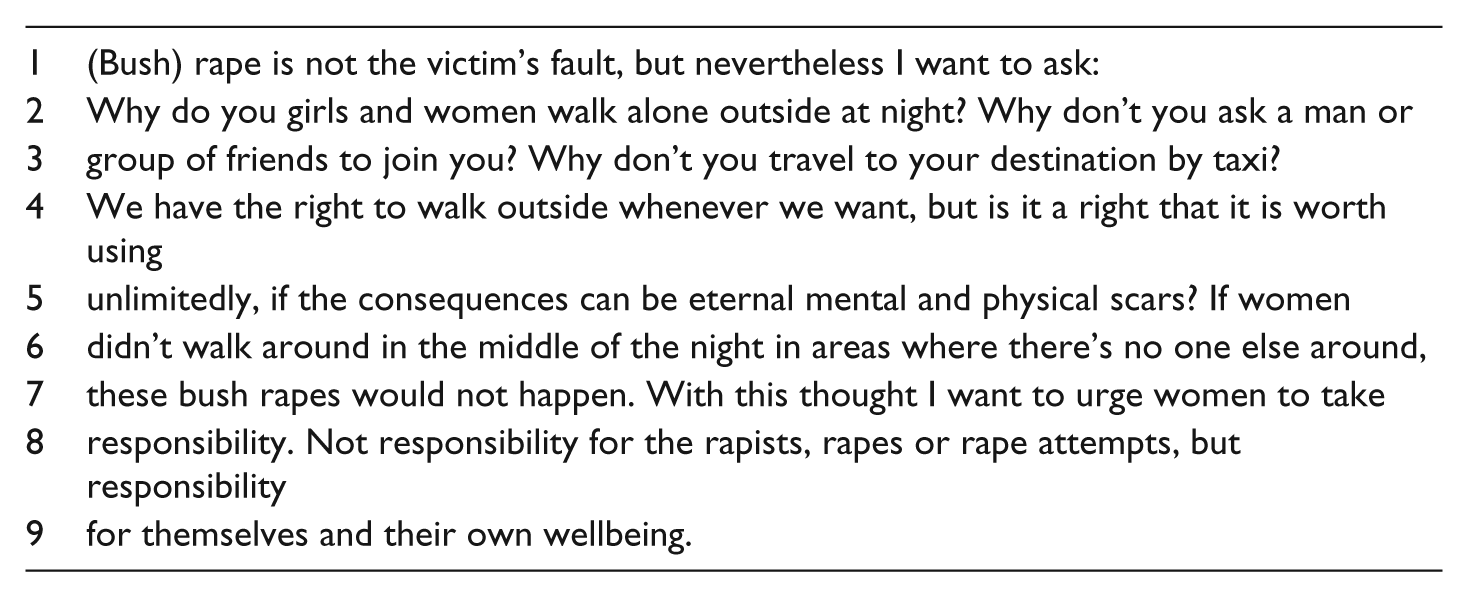
This Finnish extract begins with a disclaimer (line 1) that protects the blogger from accusations about blaming rapes on women. The right to walk outside alone is also contested with a disclaimer (line 4). The straightforward questions directed at the reader, ‘you’, serve efficiently to impose a sense of responsibility on the implicit readers: women (lines 2–3). In the following sentences the blogger keeps changing perspectives, first including herself in the blamed category women (line 4); nevertheless thereafter taking the position of an external moral authority (lines 7–8). Women are not explicitly blamed for the fact that rapes occur; however, the lack of explicit accusations directed at the perpetrators – accusations that were overt and strong when the perpetrators were proven to have been Muslim men in the repertoire presented in the previous section – is striking. Through the careful use of rhetorical devices, the feminism versus patriarchy dilemma is thus discursively solved. These patterns were echoed in the Swedish material in sentences such as ‘I would like to claim that it is a matter of commonsense – under prevailing circumstances – not to go outside alone at night, not to dress too provocatively, to avoid dark places etc.’ (Herrstedt 4 July 2013).
‘Why are women in such a hurry trying to be like men?’ – Arguing against affirmative action for women and minorities; maintaining traditional, heteronormative gender roles
Within the last two repertoires that we now turn to, the differences between the Finnish and Swedish female populist radical right discourse emerge ever more clearly. In the fourth repertoire all three ideological dilemmas described previously were present; however, to different extents in the Swedish as compared with the Finnish material. The repertoire incorporated entries where the low percentage of women in the parties was explained, and where the female bloggers justified their own political choices. The SD as well as the FP were presented as the only truly gender equal parties, who treat people as individuals and not according to gender. This claim served to tackle both the feminism versus patriarchy and the particularization versus generalization dilemma. However, the under-representation of women in the FP was described as a consequence of the media’s lack of interest for the women in the party, whereas the reason given by the SD women was that the scapegoating of the SD and attacks directed at their members scare women away. These differences reflect the diverging treatment the parties receive in their respective countries, by political opponents and the media alike.
The most salient theme within this repertoire, nevertheless, was women’s and men’s conditions in the labour market. The dominance of this theme among the female bloggers is remarkable when compared with the little attention it receives by their male colleagues and within the official party doctrines. The SD and the FP women actively opposed special measures to enhance the position of women, and also of ethnic minorities, as in the Swedish extract below:
SD (Bieler 7 December 2012)
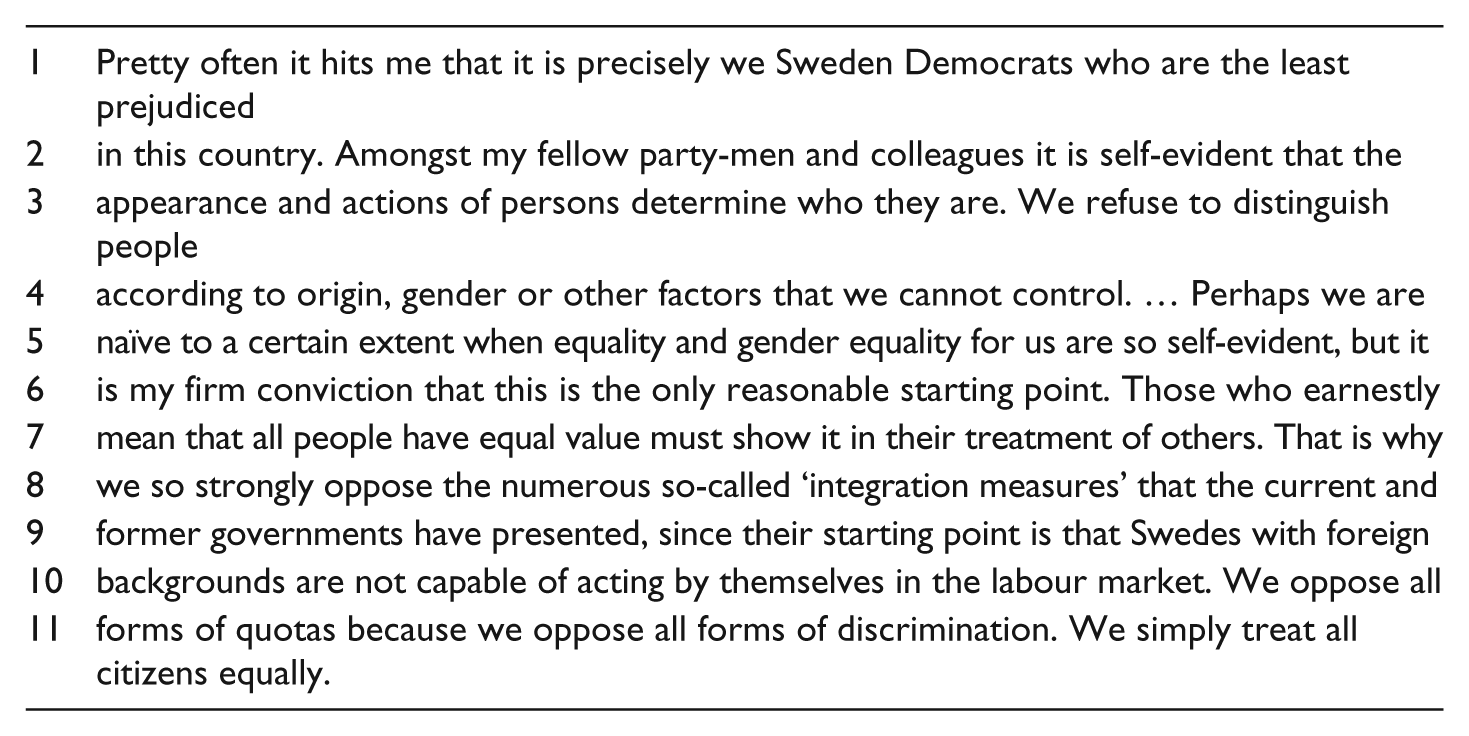
In this extract, the dilemma of tolerance versus xenophobia is present at the beginning as well as the end: possible accusations of prejudice directed at the SD are avoided through a denial of prejudice (lines 1–2), and through the denial of discrimination (line 11). The blogger is also balancing the dilemma of particularization versus generalization when arguing against quotas, which are depicted as generalizing and degrading (lines 7–11), whereas the SD’s opposition to them is presented as caring for the individual regardless of background (lines 2–4). A further rhetorical device that serves to navigate this dilemma is that of egalitarian arguments: the claim that the SD cherish the equal value of all humans serves to implicitly indicate that those who propose special measures for women or minorities do not (lines 4–7).
Previous studies have shown that the argument that gender equality is ‘accomplished’ and requires no further efforts can efficiently be used to counter feminist voices about prevailing inequalities (Lockwood Harris et al., 2012). This was done by the SD bloggers, e.g. in arguing against quotas as in the extract above, and similarly among the FP bloggers: ‘In my opinion Finland is an equal country, and I believe that you can achieve anything with your own qualifications and efforts; regardless of gender’ (Lohela 10 September 2012). In this way, the ideological dilemma of feminism versus patriarchy was negotiated without the need for statements that appear patriarchal to women, on the one hand, or go counter to the party ideology, on the other. This demonstrates the way in which the female populist radical right politicians, similarly to their male colleagues (see Sakki and Pettersson, 2015), use the notion of gender equality as a border between ‘us’ and ‘them’, where ‘they’ may flexibly refer either to political opponents who propose measures for enhancing gender equality, as in the present repertoire, or to the ‘misogynist’ Islamic culture, as in the first.
However, a feature that was much more prevalent in the Finnish than the Swedish material was the depiction of differences between the sexes as ‘god given’ or ‘natural’, as in: ‘Men and women are supposed to be equal even though nature or god have made us different’ (Slunga-Poutsalo 7 February 2011), and in the extract below:
FP (Huhtasaari 24 October 2011)

In this extract the ideological dilemma of feminism versus patriarchy is negotiated through the ‘taken for granted’ depiction of gender relations and differences. This depiction represents the patriarchal party ideology that sees heteronormative gender roles as a fundamental pillar of society, but is nevertheless phrased according to the standards of a modern, gender equal society: the differences maintain harmony and are even desirable. They are about what women and men want – not anything they are forced into (lines 3 and 5).
By contrast, as an overall pattern the position vis-a-vis traditional gender roles seemed significantly more ambivalent for the SD than for the FP women:
SD (Bieler 13 February 2014)
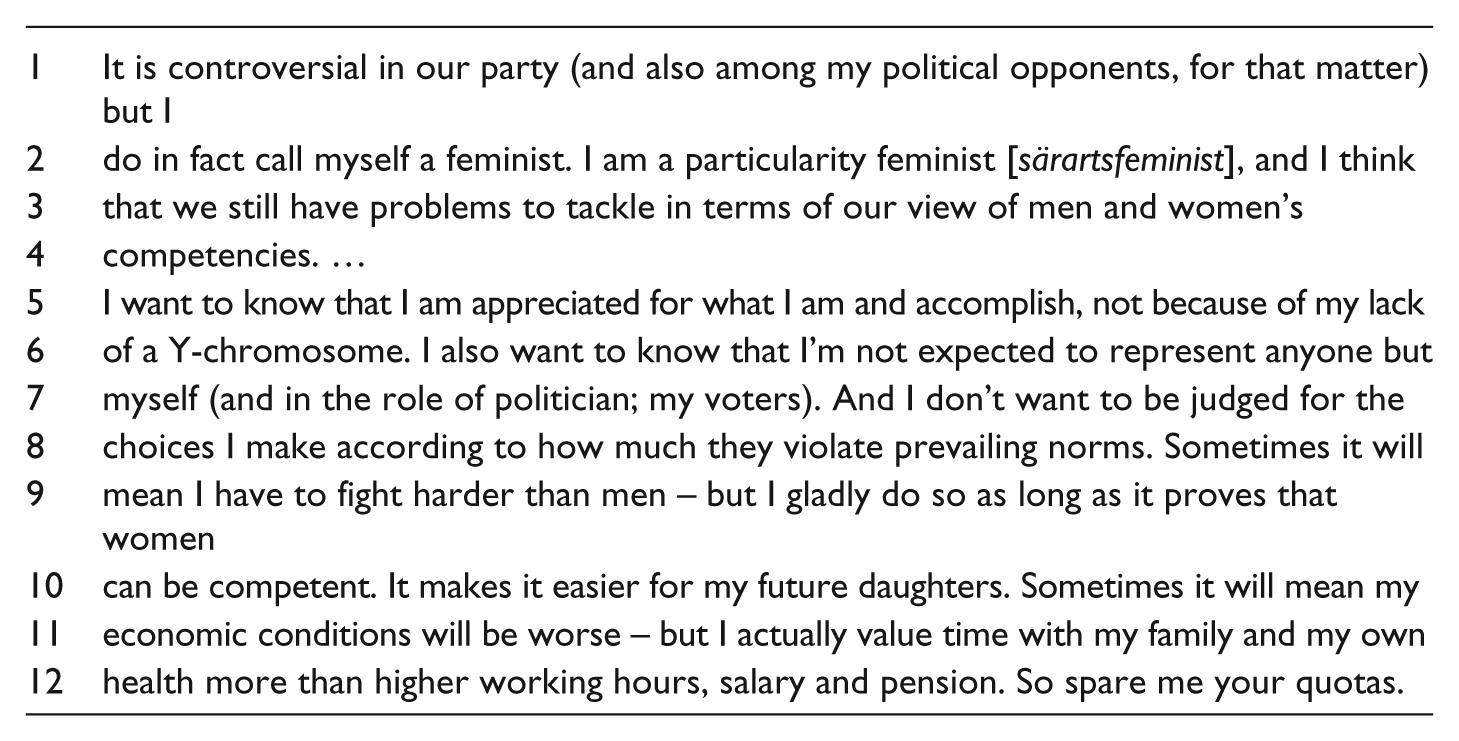
The blogger’s positioning of herself as feminist could at first glance seem to indicate that a positive view towards measures enhancing gender equality will follow. However, in this context, it serves the exact opposite function. The blogger conditions herself as a ‘particularity feminist’, and vaguely refers to persisting problems relating to gender equality: ‘we still have problems’ (lines 2–3). Subsequently, the blogger makes active use of the pronoun ‘I’: she wants to be treated according to her achievements (lines 4–5). Similarly, it is her independent choice to fight harder than men if so required (lines 8–9), and she wants to spend time with her family despite potential economic disadvantages (lines 10–12). Further still, she is framing this choice as a favour to present and future generations of women (lines 9–10). Consequently, the feminism versus patriarchy dilemma is discursively solved though presenting the argument against gender quotas as that of a (conditioned) feminist, not of a representative of a patriarchal ideology. What the blogger leaves unsaid is how she sees the responsibility of men when it comes to career versus family. Equally absent is an overt recipient of the discourse, even though ‘spare me your quotas’ seems to indicate who this is: those who are in favour of quotas, for example, proponents of feminism.
‘There is a special place in hell for women who do not help each other’ – Scapegoating feminists and female political opponents
This leads me to the final repertoire that was, even more strongly than those above, centred on the scapegoating of feminists and female political opponents, and where the dilemma of feminism versus patriarchy took its most conspicuous forms. The female bloggers did not elaborate on different feminist movements and ideologies; rather, they depicted ‘feminism’ in general as an utterly failed project. The topic of feminism was, however, much more dominant within the SD than the FP discourse.
FP (Slunga-Poutsalo 19 January 2014)
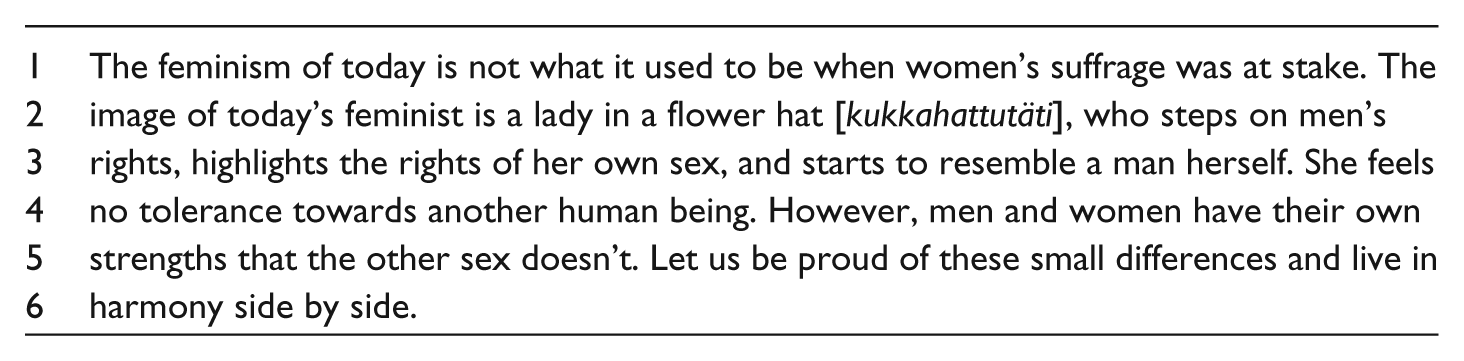
Through the use of consensual language this Finnish blogger manages to present her view as objective and grounded in facts. Feminism, according to her, has come to entail violations of men’s rights and denial of gender differences by prim and fanatic masculine women (lines 2–4). As in extract 3, this blogger also refers to ‘natural’ and desirable differences between men and women (lines 4–6). In summary, while feminism becomes the fanatic male-hating option, the patriarchal FP ideology becomes the tolerant, humanitarian solution.
‘Feminists’ are scapegoated in the Swedish discourse as well; however, in a strikingly different manner:
SD (Borg 13 July 2011)
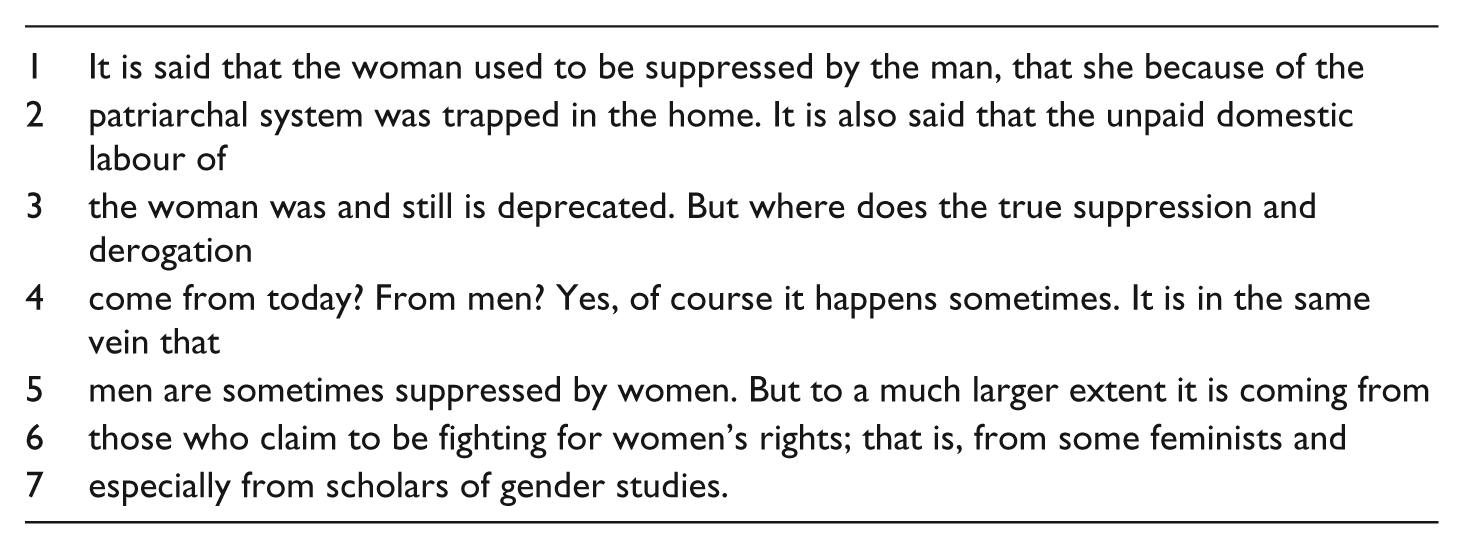
Through the vague formulations ‘it is said’ (lines 1–2) and ‘sometimes’ (line 4), and through equalizing the suppression of women to that of men (lines 4–5) the blogger manages to mitigate the past and present existence of inequality between the sexes. Finally, she implies that feminists and gender scholars are the ones that nowadays stand for the suppression of women (lines 5–7). The argument was based on a longer elaboration of how these women through their ‘sexless’ ideology are pressuring women to become like men, and vice versa – a common theme in the Swedish material. This discourse produces a ‘reversal of misogyny’ (see Van Dijk’s [1993] notion of reversal of racism): those who normally attach a misogynist label to the blogger’s ingroup – the SD – are here accused of this very misogyny.
Discussion
As this study has strived to demonstrate, the discourse of female populist radical right politicians carries notable similarities to, yet is in many regards different from that of their male colleagues. The first repertoire described above, contrasting the gender culture of Islam to that of Sweden and Finland, was an echo of the rhetoric of male politicians within the SD and FP (Sakki and Pettersson, 2015). A further similarity between the ‘female’ and ‘male’ discourse pertains to the depiction of the main political antagonist in the female supporter of multiculturalism, feminism and liberal immigration policies, personified in the ‘feminist’ or the female Social Democrat (in Sweden) and in the ‘lady in a flower hat’ (in Finland). However, the alleged care for the victimized female Muslim Other, the assigning of responsibility to white female victims of rape, as well as the strong prevalence of the topics of feminism and of gender equality in the labour market seem to be discursive properties of the female populist radical right politicians. How are we to interpret this? Apart from the fact that they are women, might there be other ways to understand why female populist radical right politicians are more preoccupied with issues of caring and of women’s rights and responsibilities?
I turn here to the findings of Andrea Petö (2010), whose research concerns women involved in the radical right movement in Hungary. Petö proposes that women’s engagement in radical right movements can be explained by the way in which these women make sense of politics: they regard the state as an analogy of the traditional family, and transfer its hierarchical and gendered roles into politics. Thus, the women take the position of the responsible yet subordinate mothers and caretakers within their party as well. In a sense, then, the differing roles that the female and male politicians achieve through their discourse may indeed ‘complete each other’ in a constellation that is ideal in terms of the populist radical right ideology of gendered nationalism. An intriguing topic for future research would be to explore the role that populist radical right politicians belonging to ethnic minorities play in this constellation.
As for the differences between the Swedish and Finnish female populist radical right politicians, it seems that the dilemma of feminism versus patriarchy was remarkably more problematic for the SD than for the FP women. This difference became especially salient within the fourth and fifth interpretative repertoires, discussing heteronormative gender roles and feminism, respectively. Even though a vast amount of the Swedish discourse was devoted to scapegoating feminists and gender scholars, these discursive attacks were much more dilemmatic than the blatant and straightforward opposition to and distancing from feminism in the Finnish material. I interpret this ambivalent Swedish versus the unanimously anti-feminist Finnish position as a reflection of the fact that SD women continuously have to negotiate their views against a strong feminist movement, whereas the FP do not (yet) have such a feminist political party to tackle. Thus – even though suspicion towards gender equality and feminism is apparent within both party doctrines – because of the stronger influence of both the feminist and the queer movement in Sweden the SD women seem to be forced to develop more nuanced stances on issues pertaining to gender equality, feminism and LGBT rights. By contrast, discourse aimed at maintaining traditional, heteronormative gender roles and arguing against gay marriage and adoption rights were far less ambiguous in the FP material. The SD blogger in extract 4 presents herself as the ‘right’ kind of feminist, in contrast to the ‘wrong’ kind that promotes positive measures for women. Her Finnish colleagues, on the other hand, proclaim on their webpage: ‘We are strong, decision-making women. We are not feminists.’ In fact, one of the FP bloggers has publicly declared that she is a chauvinist (Rantanen, 2013). These examples illustrate remarkably clearly the implications that contextual factors can have for the production of radical right discourse.
In combining social scientific and discursive approaches with theory of gendered nationalism this study has offered only one, yet, I hope, valuable interpretation of the worldview of female populist radical right politicians. This interpretation suggests that these politicians construct discursive categorizations that are gendered and racialized, and that thus serve to maintain and (re)produce gender as well as racial inequalities. These discursive patterns remain faithful to a political ideology of gendered nationalism, while at the same time managing to fit into the surrounding societal norms of tolerance, liberalism and – perhaps most importantly – gender equality. In other words, the female populist radical right politicians present discursive solutions to seemingly irresolvable ideological dilemmas. I claim that it is here that the attraction of their discourse lies – in the eyes of potential male voters but especially in the eyes of a growing number of women. Accordingly, when Liz Fekete (2006: 15) argues: ‘An assimilationist, monocultural society needs its feminist cheerleaders’; I am arguing that a populist radical right party also needs its female cheerleaders.
Footnotes
Declaration of Conflicting Interests
The author(s) declared no potential conflicts of interest with respect to the research, authorship, and/or publication of this article.
Funding
The author(s) disclosed receipt of the following financial support for the research, authorship, and/or publication of this article: This research was funded by the Nylands Nation Research Foundation and by the Finnish Konkordia Foundation.