




Abstract
This article analyses several notable examples of what the author calls the post-Yugoslav women’s cinema of trauma. These films made by women filmmakers challenge the standard tropes of war, as well as normative approaches to war cinema, by highlighting the intimate affective domain of experience, rather than large-scale narratives and collective emotions. The author focuses on the near-silent short and experimental works of Una Gunjak and Šejla Kamerić (both from Bosnia-Herzegovina), and suggests that they offer insightful formal and narrative ways of rethinking the question of what makes a war film, as well as what constitutes a woman’s experience of war. By arguing for a continued, strategic and locally specific use of the term women’s cinema, the author deploys feminist analytics towards inscribing these filmmakers’ work into the transnational flows of knowledge production about marginalized groups and non-Western geographies.
Women’s cinema as war cinema: Post-conflict perspectives
The concept of women’s cinema has haunted feminist inquiries into film ever since Claire Johnston published her seminal essay ‘Women’s cinema as counter-cinema’ in 1973. In it, she set the stage for lively and passionate debates about what constitutes women’s cinema (and the category of woman to begin with), and to what political ends such a term could or should be deployed. Importantly, Johnston’s influential essay concerns itself not with a presumption of women’s cinema as a given fact, but with ‘developing a strategy for women’s cinema’ (Johnston, 1973: 32) in order to counter the ways in which women are both represented and constituted by the dominant patriarchal culture. With respect to these dominant cinematic myths about women, Johnston somewhat controversially argued that women’s cinema should take advantage of Hollywood and its mainstreaming of (male-centric) pleasure, because: ‘[i]t could be argued that precisely because of the iconography of Hollywood, the system offers some resistance to the unconscious workings of myth’ (Johnston, 1973: 33).
Famously, Johnston uses the examples of Ida Lupino and Dorothy Arzner to argue that their work – which was largely a part of mainstream Hollywood – be understood as counter-cinema, since their films are often invested in ‘cracking open the entire fabric of the film and exposing the workings of ideology in the construction of the stereotype of woman’ (Johnston, 1973: 38).
Subsequently, the term women’s cinema has been taken up to various ends, whether through embrace, disavowal or rejection (Butler, 2002). While influential feminist film theorists like Laura Mulvey (1975) advocated the destruction of cinematic pleasure towards engaging in a feminist denial of patriarchal control when it comes to the images of women, others, like Teresa de Lauretis (1984), deployed the concept of women’s cinema in order to argue that there is place for pleasure still. ‘The present task for women’s cinema,’ writes de Lauretis, ‘may not be the destruction of narrative and visual pleasure, but rather the construction of another frame of reference, one in which the measure of desire is no longer just the male subject’ (de Lauretis, 1984: 8). While these works largely reflect a psychoanalytic preoccupation with desire and pleasure, in her later work de Lauretis refocuses the lens and turns towards theorizing women’s cinema as a site where important social issues are to be taken up. In ‘Guerilla in the midst’ (de Lauretis, 1990), she thus argues for the importance of alternative women’s cinema, which she describes as films that: … engage the current problems, the real issues, the things actually at stake in feminist communities on a local scale, and which, although informed by a global perspective, do not assume or aim at a universal, multinational audience, but address a particular one in its specific history of struggles and emergency. (de Lauretis, 1990: 17)
More recently, the term’s contingent and politically strategic importance in the domain of world cinema has been reflected in the renewed interest by feminist film scholars – most notably, Patricia White, who, in the introduction to her Women’s Cinema, World Cinema, writes: The concept of women’s cinema, advocated and contested within feminist film culture of the past four decades, is too often written out of the context of world cinema, trivializing, marginalizing, or dehistoricizing women directors’ achievements and the histories and cultures that sustain them. (White, 2015: 27)
Women’s cinema is, of course, not one thing only, nor should it be used to reiterate simplistic boundaries around defined notions of identity, authorship, aesthetics and politics. But it is critically important to retain the term, as White does, in its contingency, which marks it as a form of difference from, or resistance to, the (still) dominant modes of patriarchal constitution and representation of ‘women,’ cinematic or otherwise. To that end, we can talk about retaining the concept of women’s cinema as an exercise in feminist methodology that Joan W Scott (2002) highlights in discussing feminist reverberations as time–space movements which always need to be locally specific, even when they evoke transnationally recognizable gestures of resistance. Rather than taking ‘woman’ to be an a priori given, feminist reverberations are an analytic deployed in order … to make nuanced distinctions along multiple axes of difference; its theories don’t assume fixed relationships between entities but treat them as the mutable effects of (temporally, culturally, historically) specific power dynamics. (Scott, 2002: 6)
‘Feminism (like any such concept),’ adds Scott, ‘needs to be understood as if in translation,’ and as ‘movement in space and time-history’ (Scott, 2002: 11). To that end, in this article I discuss post-Yugoslav women’s cinema of trauma as a locally specific expression of movement in space and time-history that nevertheless pertains to significant transnational feminist reverberations. The post-Yugoslav women’s cinema of trauma is a body of films with women behind and in front of the camera – but that is not the only thing that links them. They are also films that persistently challenge the dominant Truths about ethno-national identity, gender, and their links to war trauma in the aftermath of a violent ethnic conflict. These films extend an invitation for an ethical encounter with difference, one that unsettles the spectator rather than resolves the moral dilemmas that may ensue.
This article therefore focuses on examples of women’s cinema that, to borrow de Lauretis’s words that pertain here, engage ‘the current problems, the real issues, the things actually at stake in feminist communities on a local scale’ (de Lauretis, 1990: 17). My strategic concept of post-Yugoslav women’s cinema of trauma concerns, of course, the post-conflict context of the former Yugoslavia, and illuminates a body of work by regional women filmmakers that tackles the tropes of dispossession and precarious screen trauma. The analytical move of designating the works of a generationally, ethnically, formally and aesthetically diverse group of women filmmakers as a ‘body of work’ that reflects urgent ethical matters about the post-conflict realities of trauma, gender, witnessing and memory is a performative exercise on my part, meant to open new pathways of understanding the role of such diverse bodies of work when placed on the scale of intricate linkage across the spectrum of what we may call women’s cinema in any given context. I do so in order to explore the links between trans-ethnic traumatic memory and gender identity in the wake of a violent conflict whose effects are still deeply felt in the region. As a body of work, these films circulate affective economies premised on the clandestine pathways of transformative solidarity amid precarious traumatic injury.
A number of post-Yugoslav women directors have in recent years made important films along these lines of linkage across time, space and borders (imagined or real). Examples include Slovenia’s Maja Weiss, whose Guardian of the Frontier (2001) was one of the first regional films with LGBT protagonists, as well as an important critique of regional nationalism and exclusionary politics (Crnković, 2012), which often play out on the bodies of women; Andrea Štaka, who makes diasporic, transnational films about post-Yugoslav women’s experiences; Serbia’s Maja Miloš, whose debut feature Clip (2012) represents one of the most thought-provoking works of cinema about post-socialist millennial girlhood; Bosnia’s Jasmila Žbanić, whose activist cinema challenges the silencing of women’s trauma; Aida Begić, whose films are a quiet testament to women’s perseverance and survival; or Ines Tanović, whose debut feature Our Everyday Life (2015) concerns the post-war family unit and the woman as its stoic pillar. In this article, I place all their varied work within a strategically essentialized, so to speak, category of women’s cinema of trauma, in order to argue for the importance of a discursive framing that illuminates trauma as a site where womanhood-as-identity often emerges in ways that go undetected or unquestioned otherwise. I therefore do not take woman-as-identity to exist a priori – rather, I understand it to be constituted as such in the moment, and in the aftermath, of traumatic impact that consequently lays the groundwork for the emergence of womanhood as collective identity bound by shared trauma. In the wake of a violent conflict, women’s cinema of trauma presents an important venue where solidarity and recognition across invented lines of division (which, in the region, are predominantly ethnic) can be forged.
In the context of post-Yugoslav conflict cinema, the work of women filmmakers – and particularly those belonging to the younger generation – has frequently flown in the face of official nationalist rhetoric that still dominates the region. Meta Mazaj (2013) explores the transnational flows in the works of regional women filmmakers, and argues that their films actively work against the standard tropes of the cinema of self-Balkanization, which was a prevalent, masculinist cinematic mode in the 1990s. In my recent book, Dislocated Screen Memory (Jelača, 2016), I have shown how the films of Jasmila Žbanić and Aida Begić offer provocative explorations of how trauma is gendered and how gender is traumatic in its own right, and moreover, I discussed how Begić’s Children of Sarajevo (2011) is largely about women’s dispossession in light of the new class formations brought on by war. In the present article, my examination of the post-Yugoslav women’s cinema of trauma takes as its central framework that in this post-conflict setting, marked by newly forged yet stubbornly permeable ethno-national borders, this form of cinema – which addresses the trauma of its female subjects – is inherently transnational, or rather, trans-ethno-national. It stages alternatives to the assimilation and upholding of woman-as-identity strictly within ethno-nationalist discourses that position the woman as a victim and martyr whose suffering is then ultimately co-opted to ethno-national(ist) ideological ends. Women’s cinema of trauma challenges such normative and problematic manipulations of female suffering by turning to women’s trans-ethnic trauma as its organizing frame.
In my book I concluded my examination of post-Yugoslav trauma cinema by examining what I call ‘the quiet war film’ (Jelača, 2016: 229) – a number of notable works in post-Yugoslav cinema that approach the examination of war by challenging the standard frameworks of war film as a genre. Namely, they depict war and post-war experience from a decidedly low-key perspective, where silences and what remains outside of the cinematic frame are often more important than what is being conveyed visually and verbally. Moreover, they are not post-conflict films strictly speaking either, since they examine the ways in which war is a continuous experience that extends well beyond the event itself. These films are more about what is, or what becomes ordinary about war, rather than what is extraordinary. They exist in a subdued affective state where silence, routine, and even boredom often prevail over the excess of affective input. Included in that group of post-Yugoslav quiet war films are works such as Days and Hours (Kod amidže Idriza, Pjer Žalica, 2004), Snow (Snijeg, Aida Begić, 2008) and Silent Sonata (Circus Fantasticus, Janez Burger, 2010). These films, I suggested, challenge the conventions of war film by countering its standard affective oversaturation with a deliberate sensory deprivation – be it visual, aural, verbal and so on.
In this article, I explore the concept of the quiet war film through the lens of women’s cinema of trauma, and by focusing on two emerging voices in particular: a filmmaker of a younger generation, Una Gunjak, and established multimedia artist Šejla Kamerić, both from Bosnia-Herzegovina. I show how their work formally constitutes a new language of women’s cinema of trauma, charting new paths towards reflecting female precarity, the routine and bodily memory of war, as well as the (im)possibility of survival.
Body, movement, time, and the Real
In the post-conflict landscape of the former Yugoslavia, addressing trauma in the public sphere has become largely tied to claiming victimization in order to reiterate dominant ethno-political frameworks. At the same time, a number of scholars, artists and cultural workers have turned to the efforts to reclaim trauma in the cultural domain as a means of mobilizing new political subjectivities, beyond existing and administratively omnipresent ethno-national divisions. In order for trauma to be reclaimed this way, new forms of expression, which avoid the pitfalls of being co-opted back into the dominant political regimes that rest on ethno-nationalist ideologies, need to be developed and recognized as emancipatory. Jasmina Husanović addresses this struggle when she writes of: … the paradox that we have to bear witness to trauma both outside and inside the vocabulary of power – the feeling of dislocation, both belonging and not belonging to the community with whose registers of communication we cannot politicize our own experience, but rather often merely bring ourselves back to the state of helplessness, ineloquence, and to a renewed betrayal of trust. (Husanović, 2010: 59)
1
Here, Husanović articulates the conundrum of the inability to express trauma within the dominant discourse that reiterates the political status quo, yet also our simultaneous inability to entirely avoid leaning on such a discourse, or a system of meaning altogether, even if it perpetually fails us. Husanović is nevertheless hopeful, and traces the roots of new emancipatory voices that reclaim trauma outside the dominant ethno-nationalist political frameworks in the context of Bosnia-Herzegovina in several female artists in particular – including Šejla Kamerić.
Kamerić is an acclaimed Bosnian multimedia artist, whose work is described in the following way: ‘Based on her own experiences, memories and dreams, which were influenced by the war in Bosnia and Herzegovina (1992–5), Kamerić’s work takes us to spaces of displacement and discrimination. The weight of her themes stands in powerful contrast to her individual aesthetics and to her choice of delicate materials.’ 2 Her arguably most prominent work to date is ‘Bosnian Girl’ (2003), a simple black and white photograph of the artist in a white tank top over which she copied and pasted a graffiti written by an unknown Dutch soldier in Srebrenica during the war. The graffiti reads: ‘No teeth…? A moustache…? Smel [sic] like shit…? Bosnian girl!’ In her analysis of the image (which was reproduced in poster-size and placed in prominent public places around Sarajevo) and its impact, Elissa Helms finds that the poster both implicated the international community in casting a civilizing gaze at the local population, and at the same time, acted ‘as a conscious distancing of the urban, cosmopolitan artist from the despised rural refugees epitomized by the Srebrenica enclave population’ (2012: 211). More generally, Jasmina Husanović finds that the artist’s works ‘aim to renegotiate the position of a subject and change the parameters of the symbolic system of coordination that categorizes something as life, something as art, something as context, and something as concept’ (Husanović, 2010: 199). Husanović adds that, ‘by dislocating the context/detail/symbol, [Kamerić’s work] draws new politicized meanings tied to war, trauma, identity, otherness, and border’ (Husanović, 2010: 199).
It is important to note that Kamerić frequently collaborates with other international artists in her work. These transnational collaborations stage challenging scenes of encounter with difference and similarity, without collapsing them into relativity and prosaic universalism. For instance, in the recent experimental video installation Thursday (2015), she collaborated with Thai artist Anocha Suwichakornpong. Their resulting work, largely silent, features a number of different transnational settings in which people – mostly women – engage in mundane, everyday activities: from working in a cafe, working in the field, sitting silently in reflection (a recurring theme in Kamerić’s work), ironing clothes and so on. Often it is not easily discernible where in our globalized world different scenes are set, nor which section is directed by which filmmaker, and that becomes a point in and of itself – their authorial stamps should not be all too easily discernible to begin with. Instead, their transnational cinematic collaboration becomes a fluid act of creation that does not belong to either one or the other, but rather to the blending of their artistic voices.
In the remainder of my discussion of Kamerić’s video work, I focus on two of her films that put a magnifying glass on women’s experience of precarity and war, in order to trace the affective dynamics of trauma, space, routine and bodily memory, as they relate to a rethinking of what constitutes a war film, and by extension, as the artist’s contribution to the canon of what I call the post-Yugoslav women’s cinema of trauma. Her short film Happiness (Glück, 2010) opens with the sound of air raid sirens blasting in an unidentified city – the film’s liner notes reveal it to be Berlin. The sirens immediately place us within the framework of precarity and uncertainty tied to war’s invisible threats. Then the film cuts to an interior, and we see a woman covering her face, sitting in front of a typewriter. When she uncovers her face, one recognizes the iconic Yugoslav actress Milena Dravić. For the informed audiences, Dravić’s star text here instantly evokes recognition and familiarity, since she has been a staple of regional cinema for the past several decades, and appeared in some of the most acclaimed and best-known Yugoslav films. At the same time, that instant familiarity is here placed into question when the actress’s presence remains largely silent and enigmatic – the usually talkative star remains entirely mute in Happiness, her role not fully penetrable to the viewer. That process of distancing something that initially seems extremely familiar stages a space for reflection – recognition of another without a full and unquestioned understanding of them.
These dynamics directly extend to the film’s approach to trauma and ineloquence. The film stages an enigmatic snapshot of a seemingly mundane situation, yet one that places enough visual clues so as to indicate that the women in the film are under duress and not entirely in control. Aurally, the film is accompanied mostly by the diegetic sounds of wind, a clock ticking, footsteps or breathing, and occasional string instruments playing non-diegetic melodies. The shots of Dravić’s character in silent reflection are intercut with the images of deserted city streets, and with shots of a younger woman wheeling water canisters through the empty streets. The film places emphasis on the passage and slowness of time, as well as on ineloquence – it has no spoken language, and moreover, Dravić’s character does not manage to type any words either, much as she tries. In her description of the film, Kamerić states that: ‘this film is a potential remembrance in which boundaries between the past, present and the future tend to be erased. Berlin plays a significant role in the film, epitomizing a place in which suffering is part of the past, but is also a potential future.’ 3
Noting also that the film is loosely based on a collection of stories by Yugoslav writer Mirko Kovač, which she read as a teenager during the siege of Sarajevo, Kamerić draws intricate links between the two cities and their traumas – past and future – as well as her own intimate trauma of experiencing war first-hand. These transnational links of trauma across different national, urban geographies are centered around women’s experience, as well as focused on the transgenerational aspects of memory. It remains unclear what the relationship between the two women of different generations is – if they are related, or perhaps the same person (since they do not appear in the same frame).
The short also features discontinuous editing – it cuts back and forth, seamlessly, between autumn and winter from one scene to the next. These shots of the exterior silently cut from one deserted place to another, deliberately emphasizing the stillness and the silence. At one point, Dravić puts a sheet of paper into the typewriter. Music starts for the first time when she starts lightly pressing the keys of the typewriter – but she does not type any words. The string music that starts playing when she lightly touches the keys is somewhat out of tune, as if to convey emotional discord being reflected in the actress’s pensive eyes. The seamless cutting between autumn leaves and snow continues, with sound uninterrupted, to convey the passage of time and also to allude to the incommensurability of space.
Late in the film, a wider shot of the room reveals that Dravić is in a wheelchair. Her immobility and stillness therefore receive another dimension, of a body which faces challenges in moving through space. Later, the young woman who had been wheeling the canisters of water sits at the same desk, in an ordinary chair, wearing the same sweater and fingerless gloves as Dravić – except there is no typewriter in front of her. Again, the question emerges: are they the same person, or somehow related? In the seamless crosscutting between the seasons and between the two women, the film points to the transgenerational continuance of female precarity through time and space, its fluidity, but also stillness. Sitting at the desk, the young woman lights a homemade candle. The close-up of the hands next to the candle then reveals the hands of an older woman, but again, the link between the two women, the younger and the older, is not rendered entirely transparent. As the film’s credits role, the violin plays the sound of an air raid out of tune.
The film’s official synopsis states that it ‘was inspired by Engaged Couple from Heaven, short stories by Mirko Kovač. Like a mantra, these words are an instrument of contemplation, taking us to a new dimension, where pursuit of happiness becomes the only way to survive. This film is a remembrance, a zone where time exists in a different way.’ These notes suggest a way to understand the film’s title, since its frames reflect anything but happiness. Rather, the women in the film strive to maintain a sense of happiness in the stillness of precarious circumstances, albeit to uncertain outcomes. In this silent film, many things are presented as open questions rather than foregone conclusions. There are hints of war trauma scattered throughout: the air raid siren being mimicked by the violin, the wheeling of water canisters, the eerie emptiness of the streets, the barbed wire in the far background of one particular street. Here, Berlin and Sarajevo are linked and made into one seamless urban entity that sustains survival. There are thus both transgenerational and transnational echoes of trauma, memory, resilience and survival captured in its frames, a silent recognition of the uninterrupted continuance rather than of violent breaks. In this, the short startlingly defies standard representations of war and trauma that lean on chaos, suspense and graphic violence. Instead, the film renders the war scene unfamiliar in its stillness, and therefore all the more revealing and unsettling.
This visual approach to the urban setting of war – silence over words, stillness over disruption, choreography over chaos – continues in Kamerić’s feature debut, 1395 Days Without Red (1395 dana bez crvene, 2011). In creating this film, Kamerić collaborated with the acclaimed Albanian installation artist Anri Sala, the two artists ultimately producing two different films as a result. In Kamerić’s film, Sarajevo is the immediate setting, and the film’s titular 1395 days refer to the number of days the city was held under siege by the Bosnian Serb army (1992–1995). Indeed, many local filmmakers have turned to visually depicting this longest siege in modern history. The Sarajevo Group of Auteurs (SaGA), for instance, made poignant documentaries about the siege during the war, often placing children at the forefront of the films’ stories, as innocent and often inarticulate witnesses of horrific atrocities. Moreover, Bosnia’s first post-war narrative feature, Perfect Circle (Savršeni krug, 1997), was directed by one of the founders of SaGA, Ademir Kenović. The film revisits the siege of Sarajevo and continues with the theme of placing children as witnesses of war par excellence. More recently, Aida Begić has examined the plight of the generation of Sarajevo’s war orphans two decades after the war in her Children of Sarajevo (Djeca, 2012), while Serbian director Slobodan Skerlić yet again placed a child protagonist at the forefront of the war scene in So Hot Was the Cannon (Top je bio vreo, 2014), another film about the Sarajevo siege. All these cinematic examples indicate that the siege remains one of the central time–space locations of traumatic memory when it comes to the violent dissolution of Yugoslavia (and, with the Srebrenica genocide, one of its defining events). Cinema perpetually returns to the site of the siege as a way to attempt to grasp that which cannot be fully grasped, due to its extremely traumatic effect. Aida Begić’s Children of Sarajevo, in particular, taps into the inaccessibility of the memory of the siege even for those, such as the war orphans in her film, for whom it has been the formative experience that still casts a shadow over their everyday life some 20 years later.
In that context, Kamerić’s 1395 Days Without Red revisits the scene of the siege in provocative and visually experimental ways. Like Happiness, this film is largely silent – save for a conductor’s occasional instructions given to the orchestra who plays Tchaikovsky’s Symphony No. 6 (Pathetique) throughout the film. Music, which in this film is diegetic, is again deployed to poignant ends, to chart an emotional terrain in place of language, rather than in support of language. The film’s soundscape therefore addresses the senses and elicits pre-cognitive affect rather than a viewer’s conscious understanding or rationality, which are usually attached to language itself. Perhaps this is the only way to address the memory of trauma in a way that does justice to trauma’s inherent ineloquence (Berlant, 2001). While the orchestra plays indoors, and is watched from different sides of the room by people going in and out, most of the film’s scenes take place on city streets, where pedestrians make their way across the town in silence, and in carefully choreographed movements. One of the pedestrians is played by Spanish actress Maribel Verdú (Figure 1), whose expressive face coveys a range of emotions – fear, despair, calm, anxiety, trepidation, relief. In interviews, Kamerić noted that even though the film was largely about her own experiences living under the siege, it was also very important to her that the lead in the film be played by someone who had no immediate, first-hand experience of such kind – an intention that extends to the power of cinema to reflect phantom memories and convey them as real experiences. Moreover, Kamerić noted that it was important to her to retain a sense of artificiality of the war scene depicted in the film – for instance, in depicting present-day Sarajevo with war scars still visible, rather than recreating the original war scene. This is done as a way to signal to the audience that ‘this is not documentation of an event or of an emotion, but rather about memory, which works similarly with everyone.’ 4 That move away from the pressures of documentation frees the artist’s artistic expression from the burdens of objectivity or an all-encompassing perspective in important ways, and allows her to depict intimate memories rather than the officially sanctioned, collective ones.

Maribel Verdú as a Sarajevan walking the streets during the siege (1395 Days Without Red, Šejla Kamerić, 2011).
While pedestrians in the film mostly walk alone, and rarely acknowledge each other, their movement is intimately interconnected through a deeply symbiotic, co-dependent relationship. This is evident when they converge on a street corner and anxiously stand there because, we infer, it is dangerous to cross the street, due to the snipers lurking in the distance. Then quickly and on an invisible cue, they run across the street one by one, or two at a time. No words are spoken, as the residents of the city momentarily sync their movements in order to increase their chances for survival. The unspoken danger (which never materializes but nevertheless remains Real) is eerily imminent as much as it is a routine, everyday occurrence for the inhabitants of the city under siege (Figure 2). In one scene, an older woman stands at the corner for a long time, and then starts walking across the street very slowly, as if in an act of defiance – as she approaches the camera, a sense of dread about her precarious situation grows.
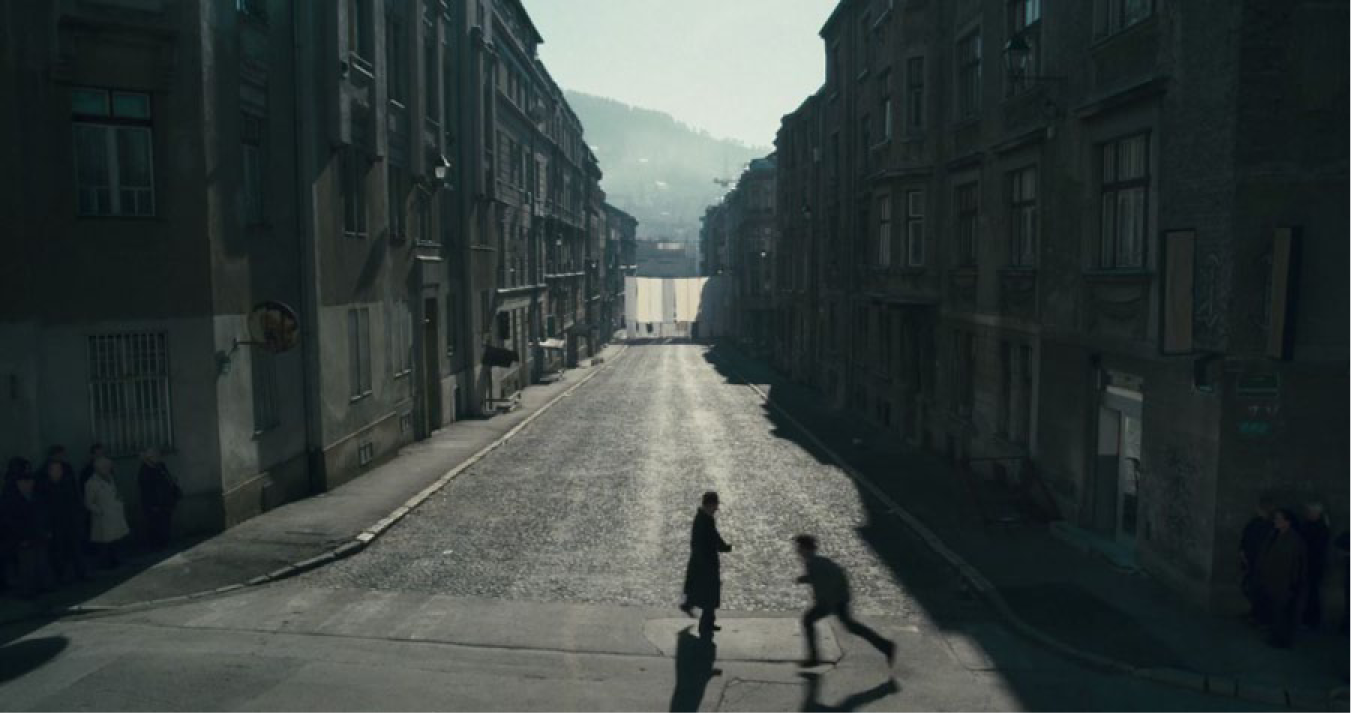
The pedestrians cross the street in a careful choreography of survival (1395 Days Without Red, Šejla Kamerić, 2011).
There are many visual repetitions in the film – the same corners and streets are walked or ran through many times over. The repetitions emphasize the routine of war, as well as the affective, sensory, purely physical experience of it: war is here a bodily, muscle memory. Contrary to how Ivana Maček’s ethnography of the Sarajevo siege has found that in war, ‘chaos and paranoia are the order of the day’ (Maček, 2009: 35), 1935 Days Without Red forgoes chaos as the normative framework of the experience of war, and turns to the silent choreography of movement through time and space – a choreography of walking through the city imprinted with visible war scars (shattered glass, shell holes in building walls). The war is omnipresent so much so that it becomes invisible altogether.
Just like the pedestrians’ movement appears simultaneously deliberate and aimless, so does the passage of time appear to be both pointed but also entirely irrelevant, or of secondary importance. Or rather, the film is about the duration and continuation of time rather than the beginnings and ends. With respect to space, it is about movement rather than arrival. At one point, a static wide shot of a big crossroads shows people running through it at a steady pace, as if engaging in a precise and well-rehearsed dance. Here, ordinariness and extraordinariness are put in a relationship that makes them co-existent, even co-dependent, rather than mutually exclusive.
If ‘[w]ar is a paroxysm of biopolitical breaks, a simultaneous state of exception, and of liminal experiences and spheres of indistinction’ (Husanović, 2010: 21), then Kamerić’s work in Happiness and 1395 Days Without Red taps not only into such liminal experiences and spheres of ‘indistinction’, but also into what is Real about war – Real in the Lacanian sense in which that order is largely unavailable to our consciousness, which resides in the interplay between the symbolic and imaginary orders. In Lacanian understandings, ‘the Real is “the impossible” … because it is impossible to imagine, impossible to integrate into the symbolic order, and impossible to attain in any way. It is this character of impossibility and of resistance to symbolisation which lends the Real its essentially traumatic quality’ (Evans, 1996: 163). The Real is accessible only in the breaks that suspend the semblance of meaning we otherwise take for granted – anxiety and trauma being examples of one such break. The Real is ‘the essential object which isn’t an object any longer, but this something faced with which all words cease and all categories fail, the object of anxiety par excellence’ (Lacan, 1988: 164). Moreover, as Renata Salecl points out, ‘the Real is a dimension which is always missing, but which at the same time always emerges; this elusive dimension, which society tries to incorporate in the symbolic order and thus neutralize, always exceeds society’s grasp’ (Salecl, 2002: 15).
In Kamerić’s work, war as a civilian experience is frequently refused entrance into the symbolic and imaginary orders, as it remains outside the reach of symbolism, meaning, interpretation, and particularly moralizing. It is Real inasmuch as artistic expression can tap into the Real, or at the very least point to its continued presence through invisibility and inarticulation. The experience of the Real is placed here in the affective, pre-cognitive domain. For instance, while most on-screen protagonists in 1395 Days Without Red remain calm and inexpressive, the spectator is placed in the state of anxiety that the threat of violence or death that the citizens quietly and seamlessly face will suddenly and abruptly materialize. It never does, but it nevertheless remains Real, perhaps precisely because it remains off-screen, un-representable but nevertheless undeniable, always there, lurking just around the corner. In Kamerić’s video work, trauma cinema then becomes cinema of the Real, temporarily suspending the primacy of the linguistic in our experiential domain, in order to affectively reflect an impossibility – of survival, of death, and of life.
Touching sensations: War, animal, mother and child
In distinction to Kamerić’s approach, which resists the symbolic and imaginary orders in favor of the Real, Una Gunjak’s short film set during the siege of Sarajevo, Chicken (Kokoška, 2014), turns to the symbolic order as a site where most experience is processed, albeit with an inevitable occasional puncture of the Real. The winner of numerous international awards, including the European Film Award for best short film in 2014, the film offers a snippet from the city’s civilian life during the siege. Its protagonist is a young girl, Selma, who lives with her mother and sister. The short’s cinematic style – handheld camera and frequent extreme close-ups, as well as blurry or partially obstructed POV shots – formally embodies the child’s point of view, which is the central framework from which the story is here conveyed.
The film opens with the shot of Selma playing with a homemade toy gun. The context of war is never spoken of, and only inferred by implication – when Selma opens the window, a sound of gunfire is heard in the distance. The film offers minimal exposition, and only identifies the chronotope (Sarajevo, 1993) at the very end. In the interviews about the film, Gunjak (who experienced the Sarajevo siege as a child herself) has noted that she identified the time and place only at the end because she did not want the viewer to watch the film with preconceived notions about the conflict, or by leaning on familiar and well-trodden tropes about it. Rather, she wanted to convey an experience of immediacy and urgency that is not limited by what one already knows. 5 Moreover, Gunjak has dedicated the film to the generation to whom, like her, war was the first and formative memory. 6
In the film’s opening moments, the mother is just finishing a birthday dress for Selma, and proudly helps her daughter put it on. She notes that the dress is a work in progress and still needs to be ironed, but such seemingly mundane activities are not possible at this time. On this day, Selma’s sixth birthday, the girl receives another gift – a live chicken that her father sends from the front (‘They didn’t have any cake,’ says a fellow soldier who delivers the chicken). Selma instantly creates a strong bond with the animal, emphasized by several scenes in which she endearingly touches and talks to the chicken, and attempts to feed it. The child’s innocence is aligned here with the innocence of the animal, both fairly unaware of the life-threatening circumstances they each find themselves in. The trope of the cinematic children being aligned with animals more so than with human adults is a familiar one, and moreover, frequently deployed in many films that depict children and childhoods. In such occurrences, Karen Lury notes, children ‘forge an uneasy alliance with the natural, animal world in a manner that usurps a conventionally anthropocentric position’ (2010: 15). The effect of such a non-anthropocentric framework is to call attention to those aspects of human existence that are frequently taken for granted and deemed unremarkable, yet upon being illuminated through an alternative lens, reveal something new and even surprising. In the case of The Chicken, the bond that Selma develops with the animal puts the child’s innocence and vulnerability in starker contrast with the outside world of a violent war. In their moments of bonding, the world seems at peace, and the two creatures perfectly at ease with one another (Figure 3).

The child and the animal form a gentle bond (The Chicken, Una Gunjak, 2014).
Yet that outside world of a violent war comes crashing back in abruptly, and forcibly breaks the bond between the animal and the child out of necessity for survival. Upon realizing that her mother plans to cook the chicken for dinner, Selma hastily releases the animal through the window in a desperate attempt to save it. Angry, her mother runs outside to get the chicken back, but instructs Selma and her sister not to follow her under any circumstances. As the girls intently watch through the window, the mother runs into sniper fire and is forced to hide behind a trash dumpster. In one prolonged silent shot, the girls anxiously look on not knowing the fate of their mother, who is out of sight. Then Selma breaks off and starts running down the stairs to get outside. Her sister tries to stop her but is unable to apprehend Selma. As Selma runs down the stairs in slow motion, the sound is muffled and camera lens blurred, as if to visually convey the abrupt entrance of the Real – Selma’s traumatic encounter with the possibility of her mother’s death. As she reaches the bottom of the stairs, she runs into her mother, who had made her way safely back into the building. The two hug in a desperate embrace, the mother’s face reflecting the full extent of the horror they just experienced (Figure 4). The traumatic Real here briefly but dramatically punctures the veneer of everydayness, interrupting such taken for granted activities as child play and dinner plans.

The mother’s and daughter’s horror at encountering the Real (The Chicken, Una Gunjak, 2014).
Back in the apartment, the atmosphere is changed, as Selma appears resigned that the chicken (who the mother managed to get back) will have to die. Selma wraps her hands around the chicken’s neck as if attempting to kill the animal herself. Then, as she stands by and watches silently, the mother cuts the chicken’s throat in the bathtub. The camera lingers on a medium shot of Selma, as the sound of a dying chicken is heard off screen. Then, after a jump cut, a close up of Selma’s face and a telling silence in the bathroom indicate that the chicken has died – but, symbolically, that a childhood has died with the animal as well (Figure 5). In a blurry shot, we see the blood-covered tub, and as the mother washes her bloody hands, her eyes meet Selma’s, their expressions reflecting a silent understanding that with the chicken, something more important has been lost – a child’s innocence. Importantly, Selma’s resignation about the chicken’s demise comes only after she encounters the Real – in the prospect of her mother’s death. That possibility irrevocably breaks the child’s bond with the chicken, who has to be sacrificed, symbolically and literally, in order to secure the family’s survival. The child is therefore returned into the anthropocentric framework as a way of survival under severe precarity that war brings.
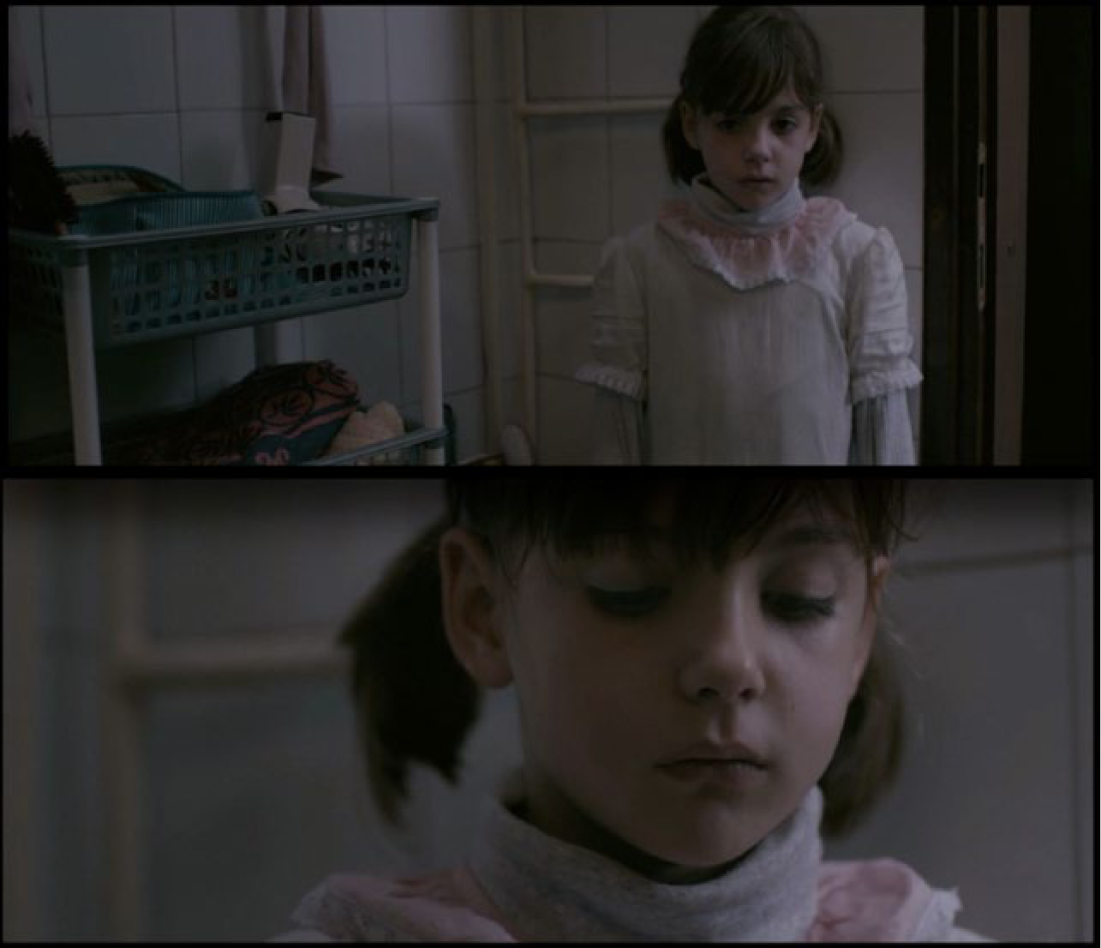
The jump cut that signifies the death of the animal, as well as of childhood (The Chicken, Una Gunjak, 2014).
The following scene shows the mother and daughter in a loving hug – several close-ups of Selma’s hands emphasize the affective impact of the wordless touching, as well as the comfort and mutual care that re-establish the semblance of their daily routine. This is followed by the final shot of a quiet dinner during which Selma, her mother and sister eat chicken and rice under candlelight, the mother gently nudging the children to have more. This seemingly mundane setup is again anything but, punctuating once more the power of the quiet war film, in which life’s everydayness, otherwise taken for granted, is framed as a desperate necessity, and as a means of survival under precarious circumstances where the Real threatens to shutter the frames of daily routine at any given moment in time. That mundane scene is, therefore, the mother’s and daughters’ quiet way of reassuring each other that they are still alive and safe, at least for the time being. The animal had to be sacrificed towards achieving that reassuring scene of family dinner, and childhood innocence lost along the way.
Gunjak’s short presents a significant contribution to the women-centric body of works about the Bosnian War, firmly in line with Žbanić’s Grbavica and Begić’s Snow, for example. In all these films, men remain largely off screen, while women’s experience and survival amid precarity occupy the central frame and drive the story. The relationships between mothers and daughters become central here – whether it is Esma’s desperate attempts to hide the truth from her teenage daughter Sara in Grbavica, the surrogate mother/daughter relationships in Snow, or a mother struggling to maintain the semblance of mundane everydayness for the sake of her young daughters in The Chicken. In the latter, the ruffled dress that the mother makes for Selma’s birthday becomes a particularly poignant symbol of that struggle. While it is beautiful and makes the girl happy, the dress is also, tellingly, not finished: when Selma attempts to steal some rice to feed the chicken, she puts it in the dress pocket, but the rice ends up spilling all over the floor, since the pocket is not really there. Only a semblance of it appears, a protective veneer that maintains the symbolic order and temporarily keeps the traumatic Real from re-entering the frame.
Conclusion: Trans-ethno-national feminism and the re-visioning of women’s cinema
‘How does it happen that in war all human relations get distorted and only national identification prevails?’ asked Renata Salecl in her theorizing about the dissolution of Yugoslavia, and about violent conflicts more generally (Salecl, 2002: 14).
Indeed, in times of war, the dominant framework for maintaining human relations appears to be national identity precisely because the promise of survival is premised on one’s investment in that belonging. At the same time, dominant frameworks are not the only frameworks, and thus we get to the important pockets of resistance where the primacy of national identification is challenged even when it is unthinkable, or unsafe to do so. One important example in the context of the former Yugoslavia are the well-documented actions of the activist group Women in Black (WiB) – a group whom Joan W Scott uses as an illustration of the aforementioned feminist reverberations across time and space. In Scott’s words: What is striking about WiB, in contrast to many earlier feminist peace movements, is that it does not rest on a claim about the sameness of women or the unity of feminists. Instead, WiB’s existence as ‘a means of mobilization and a formula for action’ presumes fundamental differences among feminists, differences of context, differences of history, differences of understandings of the feminine and of feminism itself. (Scott, 2002: 19)
I wish to extend Scott’s theorizing about the feminist reverberations of Women in Black to post-Yugoslav women’s cinema of trauma. In its body of work, essentialism and universalism are poignantly challenged in favor of both visible and invisible particularities that pertain to local experiences, intimate geographies, and bodily movements inscribed as bodily memory. In other words, its filmmakers eschew ‘the bigger picture’ and accompanying grandiose declarations about the war in favor of small, intimate, often silent and non-expository snippets of everyday experience that focus on the primacy of affect rather than on verbal articulations. Affect is a surplus of emotional experience that ‘escapes confinement’ and ‘remains un-actualized, inseparable from but unassimilable to any particular, functionally anchored perspective’ (Massumi, 2002: 35). Affect becomes the central way in which war is experienced here. It is only in the affective domain that the Real can be temporarily encountered. Moreover, the figure of a woman (or a girl) in these films is framed as a subjectivity in perpetual becoming, rather than an a priori category of identity. She is constituted relationally, not in her links to the ethno-nation, but in her ethical, affective encounter with others, marked by the shared struggle for survival and care for one another. That encounter is premised on touching and other forms of physical interaction – such as walking alongside one another in a carefully synchronized choreography – rather than on verbal interaction.
In the canon of post-Yugoslav film, women directors play an increasingly prominent role. Perhaps this is nowhere more evident than in Bosnia-Herzegovina, whose small industry has given rise to a number of influential women filmmakers mentioned throughout this article. The work produced by local women filmmakers is simultaneously rooted in grounded, situated knowledge, and mindful of the cross-ethnic, transnational links that bind womanhood-as-subjectivity across imagined or artificially imposed lines of division. Centrally in the films of Šejla Kamerić and Una Gunjak that I have highlighted here, women are not identified as ethnic subjects – or in relation to the ethno-nation – even when the conflict they are living is concretely rooted in ethnic violence. Rather, their subjectivity is framed through their being witnesses and survivors of extreme trauma that remains unspoken and experienced affectively rather than in language. The transgenerational aspects of female precarity are central to Kamerić’s and Gunjak’s work in these films, and to their respective articulation of trauma through silence and reflection.
In her exploration of trauma cinema, Janet Walker notes that she is interested in exploring ‘the ability of certain films and videos to externalize, publicize, and historicize traumatic material that would otherwise remain at the level of internal, individual psychology’ (Walker, 2005: xix). In its convergence with the catastrophe of war, trauma cinema as war cinema is often overdetermined by genre conventions and prerequisites that place the plight of a male hero (usually a psychologically wounded soldier) at the forefront of transferring individual trauma into a historicized cultural memory. Rarely do the dominant works at the nexus of war and trauma cinema incorporate a third trajectory – women’s cinema – into the aesthetic form such is the one seen in the works of Šejla Kamerić and Una Gunjak. In their work, we could therefore speak about triple occupancy (borrowing from Thomas Elsaesser’s notion of double occupancy) – where all three seemingly separate forms of filmmaking converge and collapse onto one another in order to puncture the veneer of the symbolic, and to, even briefly, access the Real, or depict its continued, undeniable impact. The Real, in turn, reveals war and trauma to be frequent – and frequently overlooked – building blocks of post-Yugoslav women’s cinema.
It is important to also note that the women’s cinema of Šejla Kamerić and Una Gunjak is not focused on desire, female or otherwise – that object of fascination of the large part of early feminist theoretical interventions into cinema. Rather, they are focused on survival, memory, perception, as well as on the power of cinema to visually capture that which cannot be stated through conventional means. In that, both artists engage in ‘re-visioning’ cinema and its role – a feature that, for many feminist thinkers, defines the concept of women’s cinema more so than the essentialist notions about women and female authorship do (Mayne, 1990). Strategically (re)claiming their work as women’s cinema, then, performs the work of transnational feminist reverberations across time and space, and across locally specific contingencies and circumstances. The impact and the political urgency of such re-visioning is certainly different in the post-conflict context of southeastern Europe from how women’s cinema has been theorized in the Western canons of feminist film scholarship, for instance. However, placing the works of non-Western film authors such as Šejla Kamerić and Una Gunjak within the family tree of transnational women’s cinema infuses its genealogy with a renewed sense of urgency for globally-minded, non-Western-centric re-visions.
The interplay of various local versions of the re-vision of the role of art in general and cinema in particular amounts to a transnational feminist ethics, where transnational feminism’s most significant contribution is understood to be, as Lingzhen Wang pointedly claims, ‘its remapping of feminist practice in a politically reassessed global and globalized context without losing sight of the importance of specific feminist practice at any given time and place.’ ‘In other words,’ Wang adds, ‘transnational feminism helps to chart both the linked historical analogies and the different perspectives of disempowered and marginalized groups’ (Wang, 2011: 14, emphasis mine). As examples of the post-Yugoslav women’s cinema of trauma, the works of Šejla Kamerić and Una Gunjak articulate such locally specific historical analogies and different perspectives in innovative and challenging ways that do not settle for preconceived notions about women’s trauma, collective belonging and survival, but rather re-vision new possibilities in their place.
Footnotes
Funding
The author(s) received no financial support for the research, authorship, and/or publication of this article.