



Abstract
This article contributes to understandings of the experiential nature of leadership learning by drawing attention to the role of disruption as an organizing influence on women’s leadership learning, and by generating insights for leadership teaching. Examining leadership learning as an experiential process, we present the development of a typology intended to act as a summary of literature focusing on women’s experiences of leadership learning. Informed by our experiences of developing and using the typology as a teaching aid in two leadership development interventions we progress through a cycle of critical reflections to present a reflexive analysis of the typology’s performative effect and how it brings into being representations of women’s leadership. Moving from initial observations to deeper reflections the analysis draws attention to how disrupting pervades women’s learning of leadership, thus extending our understanding of gender’s influence on organizing learning experiences. The article considers how we, as educators, might forefront disrupting as a process in leadership learning interventions by re-positioning instruments, such as the typology, to problematize and deconstruct leadership learning. We conclude by proposing a reflexive process in the classroom that takes the form of a critical dialogue to enable educators and participants to de-construct their experience.
Introduction
This article aims to contribute to understandings of the experiential nature of leadership learning and to provide insights into leadership teaching. Through a reflexive analysis of the development of a typology intended to act as a summary of women’s experiences of leadership learning, we illuminate the role of disrupting as an organizing influence on women’s leadership learning. Our reflections, based on our experiences of using the typology in two leadership development interventions, also generate insights into how we teach leadership.
The typology we reflexively examine emerged from a review of literature published between 1999 and 2010, and illustrated the informal and experiential nature of women’s leadership learning. Adopting a poststructuralist stance (Baxter, 2008; Ford et al., 2008) that is concerned to examine the performative effect of employing the typology as an epistemic object and how it encourages particular representations of women’s leadership, we progress through a cycle of critical reflections. The critical reflections form a reflexive analysis that move from initial observations of responses to the way in which the typology represents women’s leadership learning, to deeper reflections on how our teaching experience alerts us to disrupting as an organizing influence on women’s learning of leadership. This leads us to consider how we, as academics involved in leadership education and development, can respond to the temptation to categorize and summarize women’s leadership in our teaching practice.
In illuminating the role of disruption as an organizing influence on women’s leadership learning, we extend theories of leadership learning as an informal, relational process (Cunliffe and Eriksen, 2011; Gherardi and Poggio, 2007; Kempster, 2009), informed by experience. Our reflexive analysis contributes therefore to understandings of leadership learning as an experiential process by drawing attention to gender’s influence in organizing learning experiences, particularly the role of disruption as women organize and negotiate their relationship within their organizational context. This generates critical possibilities for leadership learning interventions and encourages us to draw on learning approaches more congruent with relational understandings of leadership.
We begin the article by examining women’s learning of leadership in the context of understandings of learning as an experiential process. We then present a typology of learning developed to summarize learning strategies that are reported as significant to women leaders including self-positioning; developing social capital; disrupting; and critically reflecting. Taking a poststructuralist perspective that is concerned to examine the performative effect of employing the typology as a teaching aid, we offer a series of critical reflections that inform our understandings of women’s leadership learning. Insights on the social, relational nature of leadership learning emerging from this analysis leads to our conclusions, where we consider implications for the teaching of leadership.
Learning leadership as an experiential process
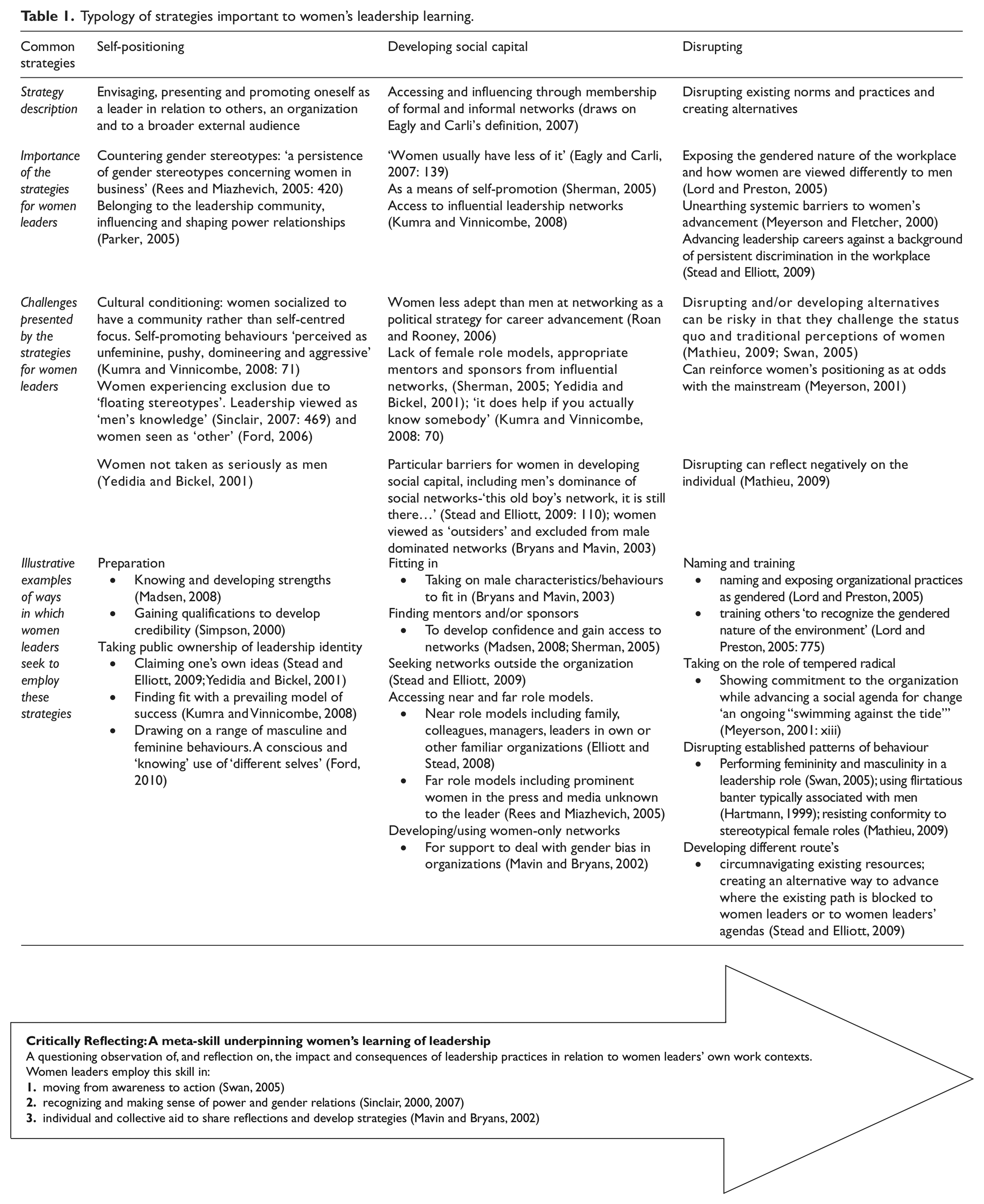
The significance of the role played by experience in leadership learning is a developing focus of empirical attention in the leadership development literature (DeRue and Wellman, 2009; Gherardi and Poggio, 2007; Kempster, 2009; Stead and Elliott, 2009), and experiential learning theory is becoming widely used in the teaching of leadership in a range of formal leadership programmes. However, the ways in which women learn to lead remain relatively unexplored and under-theorized, highlighting a lack of attention paid to the socially situated context in which learning experiences take place. The themes that emerge from the literature, mapped in the typology in Table 1, illustrate the significance of gender to leadership practice drawing attention to the ways in which leading women learn informally to negotiate social practices and processes that are gendered, that is practices and processes that conform to a masculine norm. These observations are nevertheless not reflected in the conceptual underpinnings of experiential learning theory (ELT). As Ramsay (2005: 221) observes, popular models of ELT such as Kolb’s learning cycle assume a separation of events from ‘people as participants, creators and observers’, and so fail to acknowledge the significance of the social (Miettenen, 2000; Ramsay, 2005; Swan et al., 2009). The relationship between the individual leader and the gendered nature of her social context as a fundamental element in organizing leadership learning experience remains obscured. While women’s experiences of leadership learning remain relatively unique, 1 research into women’s leadership and organizational experience more broadly (Ashcraft and Mumby, 2004; Billing and Alvesson, 2009; Hartman, 1999; Kumra and Vinnicombe, 2008; Madsen, 2008) identifies that social conditions such as gender, race and class are not only important in how we conceive of leadership but are fundamental organizing elements in leaders’ learning of leadership. Studies replicating Schein’s (1973, 1975) examination of the dominance of the ‘think manager, think male’ stereotype illustrate the resilience of normative views regarding what those occupying senior positions look like (Eagly, 2005; Schein, 2001). There remains a pressing need therefore for theoretical conceptualizations of leadership learning that occur informally and through experience to reflect women’s experiences of leadership and to inform leadership teaching.
Typology of strategies important to women’s leadership learning.
Thinking critically about experiential learning theory
Reynolds and Vince (2007) describe experiential learning as an approach that challenges the assumption that learning involves the dissemination of knowledge from expert to novice. Rather, ‘learning is seen as a collaborative process, one in which people critically examine the ideas they use to make sense of “experience”’ (p.7). Nevertheless, there is a growing recognition that ELT lacks a ‘theoretically critical foundation’ (Reynolds, 2009: 390). Kayes (2002) observes criticisms of the empirical underpinnings of ELT and theoretical criticisms which argue that ELT emphasizes individual experience, and so fails to take sufficiently into account the context in which those learning experiences takes place. While there is growing recognition of learning as relational, socially reproduced and situated in social theories of learning ‘the category of the “social” is rarely understood as something structured and defined by gender, race or class’ (Swan et al., 2009: 432). Calls for ‘a more socially aware learning’ (Ramsay, 2005: 223) stem from recognition of the limitations placed on the theorization of experiential learning theory by the separation of the individual learner from their concrete experience (cf. Kolb, 1984). In this conception, individuals experience events that are separate from them, and which they can reflect on objectively. In a review of studies that explicitly adopt a relational view of leadership Cunliffe and Eriksen (2011) note that work focusing on the social construction of leadership often focuses on linguistic processes or ‘on frameworks (e.g. Drath et al., 2008), rather than on leaders’ experiences of struggling with “small details” and making judgements in the present moment of their interactions’ (Cunliffe and Eriksen, 2011: 1430).
Critical examinations of assumptions about experience debated in feminist and poststructural work (Brah and Hoy, 1989; Scott, 1992; Swan, 2007) alert us to the importance of seeing experience as ‘culturally framed and shaped’ (Swan, 2007: 204). So if we take the view that leadership experiences are shaped by specific social contexts it follows that a leader’s experience will be influenced by social conditions such as gender, class and ethnicity. Taking an understanding of leadership learning as an inherently social process to the teaching of leadership encourages an approach that facilitates participants’ ability to ‘develop analytical frameworks within which to examine and interrogate experience’ (Swan, 2007: 204) and to critically reflect on the everyday small occurrences, the micro-practices, of leadership practices and interventions. Reflecting on the ‘small details’ (Cunliffe and Eriksen, 2011) of leaders’ everyday experience, can therefore enable us to examine how a woman leader’s development has been shaped by social understandings of gender.
Kayes (2002) proposes a poststructuralist approach to ELT, where he argues for the benefits of ‘defining managerial practice grounded in concrete language’ (p.146) that makes use of methods such as storytelling, life story writing, critical incident interviews and ‘conversational learning’ (Baker et al., 2002) to help learners connect personal knowledge and social knowledge (Kayes, 2002). This poststructural perspective resonates with developments in understandings of leadership that perceive it as a relational, negotiated process (Fletcher, 2004; Ford, 2006; Cunliffe and Eriksen, 2011) that emerges from a particular context, developments that are now being reflected in the teaching of leadership (Reynolds, 2009).
Following Kayes (2002), in this article we are concerned to draw on poststructuralism to draw attention to the gendered nature of social practices, processes, activities and interactions that shape leadership activity (Acker, 1995; Wharton, 2005). In viewing gender as a basic pillar of organizing (Ashcraft and Mumby, 2004: xiv) we hope to develop a greater appreciation and awareness of women’s leadership learning as a social process that provides educators and students with access to a ‘critical discourse’ (Kelan and Jones, 2010: 39) that challenges the prevalence of normative masculine leadership practices.
In the following sections we introduce a typology, generated as a summary of women’s leadership experiences, which will form the basis for a reflexive analysis of our use of the typology in two separate leadership development interventions.
Typologizing women’s leadership learning
We generated the typology through a two stage review of research on women’s leadership experiences. First, we reviewed literature we were using as a resource in our teaching on postgraduate leadership and management programmes. We had selected this literature for teaching on the basis that it included empirical data and interviews with women leaders from differing geographical locations during the period between 1999 and 2010. This literature emerged from a range of searches including searches on ABI/Inform databases using the key words of women, learning and leadership. The literature (detailed in Appendix A, Table 1), comprised six monographs and collections of interviews focused on women and leadership, and 10 articles from peer-reviewed journals. In examining this body of work we noted some common strategies of leadership learning were emerging which encouraged us to conduct a more systematic review. In doing so we were guided by the principle of developing an integration of current work on women’s learning of leadership. Our second stage therefore involved targeting two key peer-reviewed journals in the field of management and leadership learning and education: Academy of Management Learning and Education, and Management Learning, to examine whether this emerging pattern was evident in other studies. We organized our review by (a) conducting searches using a range of key terms and words within a given time span, and (b) by applying inclusion criteria (Kulik and Roberson, 2008; Loyd et al., 2005). We used different combinations of search terms to conduct the review including women, leaders, gender, leadership, leadership development, experience, learning and teaching. This led to 219 hits across both journals.
Applying our inclusion criteria of empirical studies that included narrative accounts – either in the form of qualitative interview data or reflections of women leaders or women managers aspiring to be leaders – we narrowed our results down to 10 studies, leading to a total of 26 studies in our review. Details of the studies from the second review stage are included in Appendix A, Table 2. Our searches revealed a limited but diverse number of accounts of women’s experiences from a range of geographical, although largely western, locations including Australia, Belarus, Sweden, UK and US, and two transnational studies. Studies varied in their focus including: public service institutions such as education and health and local government; consulting firms; small businesses and non-profit organizations. The articles reviewed were also methodologically diverse including in-depth interviews, conversations and stories, survey data and autoethnographic and autobiographical data.
The review and the resulting typology is limited in scope in that it presents an essentially western perspective and does not address fundamental organizing social conditions such as race or class. Despite these limitations we felt this was a useful basis for the development of dialogue on women’s learning of leadership in relation to the teaching of leadership in management education.
The typology
In our review, we identified three major strategies and what we term a meta-skill that are presented in the literature as fundamental to women’s learning of leadership. We summarize these as an emerging typology of learning leadership strategies in Table 1: Self-Positioning; Developing Social Capital; Disrupting, underpinned by the meta-skill of Critically Reflecting.
The typology summarizes the reviewed literature by detailing:
a broad description of each strategy;
an outline of how each strategy is described as important for women leaders;
the challenges that the strategies present for women leaders;
ways in which women leaders seek to employ the strategies;
how women leaders employ the meta-skill of critically reflecting.
We offer a brief description of the typology before developing a reflexive analysis of our experience of using the typology as a teaching aid.
Strategies important to leadership learning and their significance to women leaders
First, it is important to acknowledge that the three strategies summarized in the typology are recognized as important for men and women leaders’ learning. Self-positioning for instance is viewed as important to being recognized as a leader (Kumra and Vinnicombe, 2008; Sherlock and Nathan, 2008); developing social capital, gaining access to and being a member of professional networks is identified as crucial to career advancement ability (Eagly and Carli, 2007; Roan and Rooney, 2006; Sherman, 2005), and disrupting is shown as a way of enforcing change (Beenen and Pinto, 2009; Meyerson, 2001). The purpose of the typology was, however, to draw out strategies of learning leadership that are illustrated in empirical studies as having significance for women leaders. Regarding self-positioning for example, the literature reviewed highlighted that the ability to promote oneself as a leader involves employing self-promoting behaviours that are often traditionally perceived as associated with men such as being assertive, and pushing oneself forward (Kumra and Vinnicombe, 2008). Self-positioning therefore becomes important for women as a way of countering the persistence of gender stereotypes to find ways to belong as a leader. In relation to the strategy of developing social capital, Eagly and Carli (2007) suggest that for women leaders social capital has special significance because women generally have less social capital and access to powerful networks than men. Developing social capital then becomes particularly important as a way for women to promote themselves as leaders and to gain access to influential networks. The third strategy of disrupting is also presented in the literature as being important to women’s learning as a way to: expose the gendered nature of the workplace and how women are viewed differently (Lord and Preston, 2009); advance leadership careers against a background of persistent discrimination against women in the workplace (Stead and Elliott, 2009); and unearth systemic barriers to women’s advancement (Meyerson, 2001).
What challenges do these strategies present to women leaders?
In focusing on women leaders a purpose of the typology was to summarize some of the key challenges that women are reported as encountering in their deployment of common leadership learning strategies. For example, with regard to self-positioning Kumra and Vinnicombe’s (2008) study of the promotion to partner process in a consulting firm observes how women leaders’ reluctance to express ambition might be linked to cultural conditioning. Men, on the other hand, are socialized to lead, to take credit and praise for their achievements and to compete for power and influence. Women, by contrast, Kumra and Vinnicombe (2008) claim, are socialized to have a community rather than a self-centred focus. Self-promoting behaviours and the ability to identify, story and promote oneself as a leader, can therefore go against traditional stereotypes and be ‘perceived as unfeminine, pushy, domineering and aggressive’ (Kumra and Vinnicombe, 2008: 71). A further challenge for women leaders that strongly emerged from our review is not being taken as seriously as men (Yedidia and Bickel, 2001) and what Sinclair’s (2007: 468) autobiographical study of teaching leadership critically to MBAs refers to as ‘floating stereotypes’. In particular she points to the notion of leadership being perceived as ‘men’s knowledge’ (p. 469) placing her as an outsider and so powerless and marginalized.
Developing social capital is also presented in the literature as providing challenges that are particular to women leaders. Roan and Rooney (2006) suggest that women are less adept at using networking as a political strategy; a number of studies (Kumra and Vinnicombe, 2008; Sherman, 2005; Yedidia and Bickel, 2001) point to a lack of female role models and appropriate mentors for women in leadership roles, and studies by Bryans and Mavin (2003) and Stead and Elliott (2009) illustrate how women leaders can be viewed as outsiders and excluded from male dominated networks.
Key challenges identified in our literature review presented by the strategy of disrupting include the level of risk that challenging the status quo can bring. For instance, Swan (2005) narrates how she draws on masculine and feminine attributes in her teaching of leadership and how this can challenge students’ and staff perceptions of how women should behave. This kind of strategy, Mathieu (2009) observes, is risky in that it can unsettle traditional ways of being and provoke resistance. Disrupting can then reinforce women’s positioning as at odds with the mainstream (Meyerson, 2001), resulting in difficulties for the individual concerned (Mathieu, 2009).
How do women leaders seek to employ the strategies?
Our review highlighted that the challenges women encounter then frame the ways in which women seek to employ these strategies. Research by Madsen (2008) and Simpson (2000) points to the importance of preparation when self-positioning, which includes ‘paying meticulous attention to the task of knowing and understanding themselves’ (Madsen, 2008: 11), and gaining qualifications such as an MBA to develop credibility amongst male colleagues (Simpson, 2000). Yedidia and Bickel (2001), and Stead and Elliott (2009) highlight taking public ownership of leadership identity, including explicitly claiming ideas as their own in public settings as a further way in which women might learn to position themselves as leaders. A third way in which women leaders are presented as working to self-position is through finding fit. Kumra and Vinnicombe (2008) note the importance for leaders (male and female) in their study to fit with the organization’s prevailing model of success. For women leaders, who might typically be seen as not fitting the norm, as other (Ford, 2006), this can require the ability to perform different identities including the use of attributes more commonly viewed as masculine (Ford, 2010; Swan, 2005).
The literature also highlights fitting in as a way in which women leaders seek to develop social capital. Bryans and Mavin (2003) observe how women leaders perform male characteristics or behaviours to gain access to networks. Other strategies that research claims women leaders seek to employ to develop social capital include: finding mentors or sponsors to enable access to networks and build confidence (Madsen, 2008; Sherman, 2005); seeking networks outside of the organization when internal networks are difficult to access (Stead and Elliott, 2009); and becoming members of women-only networks for support to deal with gender bias (Mavin and Bryans, 2002). An interesting theme we observed in the literature was the relative lack of role models available to women leaders and how women counter this by drawing on a range of what we term near and far role models. Near role models include family, colleagues, friends, other leaders in their own or familiar organizations (Elliott and Stead, 2008), and far role models include prominent women in the press and media unknown to the leader (Rees and Miazhevich, 2005) whom women leaders draw inspiration from in the absence of accessible role models.
In relation to the strategy of disrupting identified in the literature, the typology highlights four ways in which women leaders seek to challenge existing norms and practices. Lord and Preston’s (2009) autoethnographic study of women working in higher education describes ‘naming and training’ as a process of explicitly naming and thus exposing gendered organizational practices, and the training of others to become aware of how gender operates in the workplace. Meyerson (2001) points to how women might take on the role of tempered radical, that is they retain a commitment to the organization by challenging practice to advance social change. A number of studies also refer to disrupting established patterns of behaviour as a way to challenge existing norms, including: women performing versions of femininity and masculinity in teaching leadership(Swan, 2005); using flirtatious banter more typically associated with men as a form of belonging (Hartman, 1999); and resisting conformity to stereotypical female roles (Mathieu, 2009). A further way in which women seek to disrupt that emerged from the literature involves the developmentof alternative routes to leadership where the existing path is blocked to women leaders. Stead and Elliott (2009) illustrate this through the example of a community activist, who finding no opportunity for representation within existing political parties, developed a new political party that allowed for the inclusion of alternative perspectives and a route for women’s advancement.
Critically reflecting: A meta-skill
In addition to identifying three strategies that emerge from the literature as common to women’s leadership learning the typology identifies critically reflecting as a meta-skill that underpins women’s learning of leadership. Here, critically reflecting is concerned with not only the challenging and questioning of underlying assumptions (Reynolds, 1997), but also the critical observation of leadership activities and their consequences in relation to women leaders’ own work contexts, for instance in recognizing and challenging the gendered nature of the workplace (Lord and Preston, 2009), and being aware, and employing the conscious use, of different selves and behaviours (Ford, 2010). Critically reflecting is thus denoted in the typology as an important skill in enabling women leaders: to develop action from awareness (Swan, 2005); to make sense of the ways in which gender and power relations operate (Sinclair, 2000, 2007); to reflect on their experience, and to develop strategies for action (Mavin and Bryans, 2002).
A poststructuralist perspective
Having described the rationale and details of the typology we now adopt a poststructuralist stance to critically reflect on the performative effect of employing the typology as an epistemic object in our teaching practice. Poststructuralism, as a critical practice, employs deconstruction as an analytical tool and is concerned to challenge and question espoused foundational knowledge (Briggs and Coleman, 2007). A poststructuralist perspective supports relational and socially situated understandings of the learning of leadership in that it encourages a view of learning as emergent from and responsive to participation in social practices, such as leadership, and within particular historical and social contexts, such as organizations (Gherardi et al., 1998; Hamilton, 2006; Kempster, 2006; Lave and Wenger, 1991).
Based on an understanding of people’s lives as ‘inextricably interwoven with the social world around them’ (Collinson, 2003: 528) poststructuralism challenges a ‘dualistic tendency to separate individual from society, mind from body, rationality from emotion’ (p.527). Within a poststructuralist perspective ideas of gender essentialism, that is ideas of an essential maleness or femaleness, are rejected (Francis, 1999). Rather gender is understood as produced and reproduced through discourse. As such poststructuralist approaches reject the idea of the self as fixed, but rather stress the multiple and shifting nature of identities (Collinson, 2003, 2005).
Our critical examination of women’s leadership learning is informed by two aspects of poststructuralist work. By foregrounding gender and by ‘placing the emphasis on the importance of experience and particularly women’s experiences’ (Bryans and Mavin, 2003: 112), we draw on poststructuralist feminist work (Baxter, 2008; Francis 1999; Grogan, 1996). Poststructuralist feminist studies are concerned not only to identify discourses and social structures that marginalize some while privileging others, but are also concerned with social change (Grogan, 1996; Weedon, 1997). In its aim to understand how women’s experiences can better help us in our teaching of leadership an objective of this article therefore is to encourage critical approaches to mainstream leadership teaching.
We also draw on Ford et al.’s (2008) idea of poststructuralism as a critical framework that challenges and deconstructs to critically reflect on our use of the typology as a teaching aid. We therefore contribute to a tradition of critical reflection on the authors’ own experiences, including Sinclair’s (2000, 2007) and Swan’s (2005) reflections on their teaching practice, and Lord and Preston’s (2009) reflections on their experience of occupying leadership roles in higher education.
In their study of leadership identity, Ford et al. (2008) discuss how a poststructuralist perspective draws attention to the performative effect of leadership, that is a recognition that ‘reading, writing and talking are not innocent activities but are actively productive’ (p. 10). Social representations of activities such as leadership can therefore have a performative effect, that is they can actively ‘bring things into being’ through discourse which can ‘come to dominate the ways in which we think so that it seems as if there is no other way of being’ (p. 4).
Taking leadership as a social representation that actively produces and reproduces leadership discourses our analysis examines the performative effect of employing the typology as an epistemic object. In critically reflecting on two leadership development workshops we consider how participants, and how we as teachers, respond to the typology as an epistemic object. Our reflections generate insights into both the nature of women’s leadership learning and how we might re-position pedagogically the typology to provide a deeper learning experience.
The typology in practice
As a teaching aid, our intention for the typology was to offer it as an integrative tool that contextualized different studies (Harzing, 2000; Kayes, 2002) of women leaders’ experiences and made explicit strategies that are reported as significant to women’s learning of leadership. However, while the typology provides a useful means through which to summarize overarching themes drawn from the literature, our experiences of employing the typology as a teaching aid raised significant concerns regarding the representation of women leaders’ learning and how we work with such representations in the teaching of leadership.
For example, a workshop with full-time MA students and a regional business development event aimed at women leaders highlighted that in seeking to typologize women’s leadership learning we are in danger of assuming that women’s experiences are homogenous. We therefore risk presenting a one-dimensional view of what might constitute leadership effectiveness for women, denying the range, depth and diversity of their experiences, thereby reinforcing an asymmetric view of the relationship between gender and leadership. Ford et al. (2008: 5) drawing on Butler’s work (1993) remind us that discourse has a performative impact, that for example ‘sex and gender are achieved through discourses’. The typology as a text therefore brings with it the potential danger of ‘fixing women’ into a narrow possibility and being productive in the development of a homogenous discourse that offers little alternative view of how the world is experienced (Ford et al., 2008: 10). In generating a teaching aid to examine women’s learning of leadership our concern was to provide a framework that would stimulate dialogue about the interplay between the organization and the individual, what Denis et al. (2010) refer to as ‘doing leadership as a practical activity in complex organizations’ (p. 67). A typology representing women’s experiences, while recognizing the relationship between the individual and the organization in the categorization of strategies, nonetheless typifies, generalizes and may ‘fix’ that relationship. In seeking to generalize we offer an understanding of women’s leadership learning that is neat and tidy and loses the messiness, complexity and multiple constructions of the everyday relational dynamics at play in women’s learning of leadership (Gherardi and Poggio, 2007). In short, it encourages us to deconstruct the construction, to disrupt the summary neatness and to dig further into the leadership learning process.
As teachers and researchers of leadership the development of a typology, aimed at offering an accessible model to students, then presents us with an intellectual dilemma. How can we on the one hand seek to represent women’s experiences of leadership learning, and on the other hand develop a nuanced and critical appreciation of these experiences? Our response to this dilemma is to use the typology as an instrument from which to problematize, and gain further insights into, women’s learning of leadership.
A reflexive analysis
We now reflect on our experience of using the typology as a teaching aid on two separate occasions: a seminar on leadership learning to a group of Masters students and a keynote lecture presented to a practitioner audience during a regional business development week. Our reflections have been prompted by our response, as researchers, to the work we have reviewed.
The seminar for Masters students was attended by 16 students (10 women and 6 men), over half of whom had work experience in management roles. The two-hour seminar was presented as examining ‘learning from difference’ and aimed to encourage students to think about the impact of social conditions such as gender on leaders’ learning. The event began with a presentation of the typology by one of the authors including the use of illustrative examples for each of the strategies. This was followed by small group discussions where the students were asked to use the typology as a way of thinking about their own experiences. The keynote presentation at a regional business development week was attended by around 130 individuals, the majority of whom were women, and was promoted by the organizers as providing an insight into women’s leadership skills. The presentation was followed by a 15-minute question and answers session, and then by a ‘networking’ lunch sponsored by a local telecommunications firm.
We present our discussion as a series of reflections on how, in presenting the typology, we were alerted to the performative effect of this kind of summative teaching instrument on us as educators and on participants. By performative effect we mean the way in which the participants respond to the typology and how it ‘brings into being’ (Ford et al., 2008: 4) particular representations of women’s experiences of learning leadership. Our reflections might best be described as cycles of reflective activity reflecting on our immediate observations of reactions to the typology to deeper reflections about our experience of using the typology as a teaching aid. We go on to examine how our experience and reflections have enhanced our appreciation of the experiential nature of women’s learning of leadership and how the implications of these reflections for the typology might be employed to engender a deeper learning experience.
Reflective cycle 1: Immediate observations
Participants’ reactions to the typology
When we introduced the typology we were struck by how the majority of women participants empathized with the illustrative examples of the strategies drawn from the studies. This was communicated with nods, smiles and sometimes laughter during the presentation of the typology, and with verbal affirmation during discussion and small group work. For instance, in presenting the strategy of developing social capital we provide an example from Kumra and Vinnicombe’s (2008) study of the promotion to partner process in a consulting firm. In this example a female director talks about the difficulty she sees in her firm for women accessing social capital. She says: I’m from a bit of the organization where I think a lot of the partners like what I call a ‘good bloke’. Someone who will go out drinking, play snooker, and I can spot a mile off the type of person who’s going to appeal to that sponsorship group and ten to one you’ll see them in the room and think that’s inevitable. (Kumra and Vinnicombe, 2008:71).
This example 2 suggests that if someone fits with the current (male) norm of being a ‘good bloke’ then this offers access to an existing influential group; one which simultaneously excludes others, mainly women, who do not fit. In the business development event, where (the mostly) women participants came from different organizations, they openly remarked on the similarity of their experiences to the examples provided. However, in the Masters seminar recognition and affirmation also took the form of whispered asides. One female student, for example, approached one of the authors afterwards to say she’d found it really interesting and how ‘much of this has happened, and is happening to me’. On the other hand some women felt little empathy with the experiences summarized in the typology and questioned what they saw as the challenging and provocative nature of the typology. This was articulated in terms of gender ‘not being an issue’ for them. These reactions and observations alerted us both to the importance of attending to power dynamics and also to the thorny problem of how we might enable participants on developmental programmes and at events to engage with and articulate those dynamics in ways that are explicit and meaningful. Gherardi and Poggio (2007) indicate the sensitivity required for this kind of work through their use of a narrative approach to leadership development as an experiential activity. This views leadership as a process that recognizes that individuals, within a learning environment, relate to others within a set of power relationships.
While female participants on the whole articulated their empathy or otherwise with the typology, the response of male participants was effectively one of silence; they found it interesting but difficult to comment upon. They largely felt that in terms of looking at leadership the typology excluded rather than invited their participation. In the light of calls to ‘feminize’ course content and design (Simpson, 2006: 188) and research (Kelan and Jones, 2010; Simpson, 2006; Sinclair, 2000, 2007), this points simultaneously to the difficulties of foregrounding gender in teaching and the importance of developing gender awareness among practising and aspiring women and men leaders. In seeking to engage women leaders, we need to recognize that the typology can simultaneously serve to exclude men leaders and potentially close down opportunities for critical reflection on the issues raised. So while an intention of the typology was to illuminate the relational and dynamic nature of leadership in its concern to represent leaders’ experiences in relation to others (Cunliffe and Eriksen, 2011; Gherardi and Poggio, 2007), in practice it appeared to have the effect of fixing women leaders’ experience as oppositional to, rather than in relationship with, men leaders. We acknowledge that the examples chosen to illiustrate the typology risk leading to this effect. This reminds us that conceiving leadership as relational (Cunliffe and Eriksen, 2011) demands a relational ontology, the understanding of social experience as inter-subjective. Leadership is therefore ‘a way of being-in-relation-to-others’ (Cunliffe and Eriksen, 2011: 1431). Rather than encouraging consideration of ways of being in relation to others, the typology appeared to contribute to a leadership discourse that reinforces gender binaries.
The response of participants to the typology raised important questions for us. If we view the typology as an instrument which is concerned with leaders’ identity construction through the problematization of women’s learning of leadership, how might we represent that learning of leadership in our teaching in a way that reflects leadership as relational?
Paying attention to the mundane detail of everyday occurrences
Participants’ responses also emphasized how, in seeking to integrate and summarize women’s leadership learning experiences, the typology can downplay what Cunliffe and Eriksen (2011) term the mundane detail of everyday occurrences that illuminate the embeddedness of power/relational dynamics of being a leader in a particular organization – of what it means to be a leader in that context. For instance the typology refers to disrupting strategies, such as the unearthing of systemic barriers to women’s advancement (Meyerson and Fletcher, 2000). Without sensitive elucidation such strategies can appear to be beyond the reach of anyone engaged in the mundanity of daily organizational life.
This was heightened when we reflected on our experiences of presenting the typology. Our focus in developing the typology had been to work with the detail of women leaders’ experiences and to recognize a wealth of synergies and interconnections, anomalies and differences. Above all, we wanted to present the intricate and complex multiplicity of roles that women leaders have assumed and performed in their learning of leadership (e.g. Swan, 2005). This highlighted a particular challenge not ‘to take leadership out of the realm of everyday experience’, but to present leadership as ‘occurring in embedded experience and relationships’ (Cunliffe and Eriksen: 1429, emphasis in original).
Reflective cycle 2: Deeper reflections
The typology as a boundary object
Our reflection on paying attention to mundane detail encouraged us to think about how the typology simultaneously enabled women to talk about their experiences, but also acted as a boundary object organizing the learning process. By this we mean that the typology, in its aim to integrate and summarize various debates, distances and tidies too neatly the experiences of women leaders represented in the various studies. It assumes ‘a simplified and coherent version of a world’ and positions the leader ‘as a discrete individual who can change situations by applying leadership techniques, principles or strategies’ (Cunliffe and Eriksen, 2011: 1420).
Yet, when we consider the experiences presented in the studies we reviewed more carefully they are not quite as tidy as that. In presenting those experiences in a summary form, participants wanted to know more about the detail. Their interest was stimulated by the words that women leaders used, the way in which they described their thoughts, actions and responses. It was the women’s narratives, their stories, that engendered recognition and engagement. Furthermore, we observed that when using illustrations from the research, participants accessed these experiences to critique and to provide contrast with their own experience. During small group discussions in the event for Masters students, one group discussed how their experiences were both different and similar. Another participant revealed that for her the learning of leadership did not feel so ‘cut and dried’. The typology was simultaneously problematic in its sanitization of women’s experiences and catalytic in stimulating discussion. This encouraged us to think about the pedagogic processes and how we might use the typology more as an instrument through which to access and critique experience, rather than as a summary of experience.
Disrupting is a fundamental organizing influence on women’s leadership learning
Reflecting on the consequences of using the typology in our teaching led us to examine more critically our understanding of women’s leadership learning. Of most significance for us was how using the typology illuminated the role of disrupting as an organizing influence on women leaders’ learning from experience. We observed how, as an epistemic object, the typology was itself disruptive in the way in which it was received; some women felt that a focus on gender was unnecessarily provocative; some men found it difficult to respond to, and while many of the women felt a resonance with the examples this too had a polarizing effect in discussions and group work. In foregrounding gender, the typology unsettled and challenged often unspoken organizational norms. For instance, one of the questions raised at the seminar with Masters students in relation to the ways in which women self-position and develop social capital was: ‘If women leaders try to fit in and be like men doesn’t this cause problems for their credibility with other women?’ This left us wondering how we, as educators, might explicitly use the typology as a means to challenge and to problematize leadership.
Women’s leadership learning: A disrupting process
Our reflexive review on the use of the typology as a teaching aid enhanced our appreciation of the experiential nature of women’s learning of leadership by illuminating disrupting as an organizing influence. Revisiting the literature included in our review through a poststructuralist lens offers further insight into the role of disrupting in women’s learning of leadership. Examining how the experiences presented in the studies represent women’s learning of leadership illuminates disrupting not just as a strategy or category in women’s learning of leadership but as an organizing process. Crossing the boundaries between strategies, disrupting manifests itself throughout our review of women’s leadership learning in the countering, challenging, resisting and unsettling of traditional leadership discourses. We can see this when looking at how women perform disrupting in response to prevalent leadership discourses in multiple ways and at multiple levels.
In an examination of leadership identities through a psychosocial lens Ford (2010), for example, comments that self-positioning is manifest through competing discourses. In an analysis of one woman director’s account Ford observes that through the display of particular masculine competitive behaviours the woman is ‘constructing herself as a powerful force’ – while simultaneously presenting ‘a more feminine, connected and team-focused identity’ (p. 56). The woman director found: that it was not until she became more macho in her approach – particularly with her peers and more senior colleagues – that she began to see positive results. (Ford, 2010: 56)
This example highlights a leadership discourse that is predominantly male and suggests a conscious and ‘knowing practising of different selves’ (Ford, 2010: 56), including disrupting traditional gender stereotypes through the inclusivity of masculine behaviours as a way of responding to that discourse. Similarly, the women’s experiences represented in the literature concerning the development of social capital highlight that women may perform multiple identities in response to the inaccessibility of influential networks including taking on male behaviours (Kanter, 1977; Mavin and Bryans, 2002). We can also see how women disrupt by resisting performing particular identities. Mathieu’s study of performance and gender illustrates how a female IT manager (Carina), who as the only woman at a meeting, refused to take the minutes and comply with mainstream conceptions of women’s work. Carina’s response is discordant with general expectations of women; she is disrupting mainstream ideas of what women do.
Disrupting, as a performative effect of leadership positioning, can also be understood in the way it operates at multiple levels. At an individual level disrupting is manifest in how women leaders feel uneasy in having to perform and behave in certain ways that they view as counter-intuitive, as illustrated by a female consultant in Kumra and Vinnicombe’s (2008) study who felt uncomfortable about promoting herself. At an interactional level disrupting is evident through the performance of multiple identities, as illustrated by Swan’s (2005) selection of different masculine and feminine behaviours in her teaching and work with students and staff. Disrupting can also be seen as operating at organizational and societal levels. Women as a minority in leadership roles are more typically seen as ‘other’ and not the norm (Ford, 2006), thus disrupting traditional understandings of leader and leadership. Parker’s (2005: xix) analysis of race, gender and leadership, for example, observes how stereotypical images of African-American women are inconsistent with, and thereby disrupt, expectations of leaders ‘to look, act and think in ways consistent with the socially constructed meanings of organizational leader and leadership’.
These reflections raise issues for educators regarding how we can make use of frameworks such as the typology in the classroom to illuminate disrupting and to facilitate deeper learning about the relational dynamics of being a woman leader in an organizational setting.
Towards a critical leadership learning framework: Leadership learning as reflexive experience
Our growing lack of ease with the typology’s unintended reification of gender asymmetries has emerged through our observations of the ways it challenged and disrupted existing relations within development interventions. This felt awkward to deal with, especially as it was not our intention to perpetuate stereotypes about possible differences between women and men leaders, and possibly put the women leaders present ill at ease. The disruptive consequences of the typology’s use nevertheless remind us that whichever processes or tools we use to raise awareness of the significance of gender to leadership learning, women’s leadership is always already disruptive. We cannot therefore expect that our teaching, in relation to women’s learning of leadership, will not be disruptive (Sinclair, 2000, 2007).
Reflecting on our own practice, we also need to be mindful of criticisms of experiential learning theory that refer to its tendency to separate events that are inherently social, from individual participants who are events’ co-creators and observers. As Vince (1996: 124) reminds us ‘all educational contexts represent and replicate, within their own internal processes, external social power relations’. How then, either in the classroom or in a public forum, to introduce women’s leadership experiences as a relational process in a way that encourages critical reflection on the issues raised, does not perpetuate gender binaries and recognizes that views and understandings of leadership are partial and influenced by exposure to extant models?
Drawing on Gherardi and Poggio (2007), in previous work (Stead and Elliott, 2009) we have suggested a five-stage experiential learning process to surface individuals’ leadership learning experiences that employs the use of stories as its core process. It is in the interaction of storytelling and listening Gherardi and Poggio (2007), suggest that individual identities ‘are produced and negotiated and that the meaning of experiences is constructed’ (p. 165). The spirit of this approach requires close attention to the epistemology underpinning the learning process, and so we draw on Reynolds’ (1998) proposals for setting a reflexive stance in the classroom that ‘encourages the analysis of roles and relationships in the light of wider contextual processes that they reflect’ (Elliott, 2008: 289). If we experienced a sense of disruption when presenting the typology, and if disruption was a theme that crossed the boundaries between women’s leadership learning strategies, then it seems appropriate to forefront disruption and to mobilize the typology, as epistemic object, in a disruptive way. In working towards a reflexive stance we suggest an approach that is less educator led in presenting the typology, and propose a process that takes the form of a critical dialogue facilitated by the educator to examine the typology in relation to participants’ experiences. Employing the typology as an instrument through which we can problematize and deconstruct women’s learning of leadership affords an opportunity to challenge and disrupt prevailing asymmetric views of gender and leadership and to consider alternative leadership discourses. In practice, we envisage that this might involve inviting participants to consider a range of questions such as: What view of leadership does the typology encourage? How are women’s experiences represented in the typology? How are these representations helpful and how are they problematic in understanding women’s learning of leadership? In what ways does the typology feel challenging or uncomfortable? Which views does the typology privilege and which views does it marginalize/exclude? What do these reflections highlight for you about leadership and learning to lead in your own organization? Employing the typology to challenge and question is less about advocating strategies and coping mechanisms and more about revealing prevalent discourses, uncovering systems of meaning and illuminating the ways in which women leaders are effectively managing and learning within their particular organization. By deconstructing, with the participants, the typology itself to illustrate its biases, occlusions and emergence we create the possibility of a more open, democratic space for engagement and discussion.
Concluding thoughts
In this article we have adopted a poststructuralist stance to examine the performative effects of a typology of women’s leadership learning developed from a literature review. Our reflexive analysis extends theories of leadership learning as an informal, relational process informed by experience by drawing attention to the role of disruption as an organizing influence on women’s leadership learning. Foregrounding gender as central to women’s learning of leadership illuminates how dominant leadership discourses place women in a double bind (Fletcher, 2004), which positions them as disruptive. While prevalent masculine norms of leadership demand particular ways of being and behaving more readily associated with masculine attributes, societal norms expect women’s ways of being and behaving to align more closely with feminine attributes. In their learning of leadership women are generally encouraged to fit the prevailing norm, yet in their very efforts to do so they unsettle and disrupt those norms. Our reflections of using a typology that is intended to summarize women’s leadership experiences, identify the pervasive role of disrupting on women’s leadership learning. These reflections then encourage us to foreground disrupting in our teaching. We propose doing so by adopting a critically reflexive stance that facilitates critique of teaching instruments such as the typology and so provides a platform for participants to debate and challenge their own experience. Finally our reflections alert us to the need for more detailed research on pedagogical processes of teaching leadership and a critical rethinking of how we engage with summative frameworks in our teaching.
Footnotes
Appendix A
Acknowledgements
We thank the reviewers for their detailed and valuable comments in developing this paper.
Funding
This research received no specific grant from any funding agency in the public, commercial or not-for-profit sectors.