




Abstract
This study focuses on individuals working under transient and mobile conditions and the specific competences that they develop to deal with such work conditions. The article examines a specific type of knowledge worker, namely, the mobile project worker who is employed by a technical consultancy but who performs work on various client projects together with members from client organizations. The overall aim of this article is to improve our understanding of the differences among people’s abilities to handle fluid and flexible work conditions. We elaborate on the notion of “liminality” to denote a particular element of flexible work conditions, which consists of continuous movement among assignments and of simultaneous engagement with several organizations. Based on qualitative and interpretative research involving a combination of interviews, diaries, and workshops, this article identifies three levels of specific “liminality competence” that mobile project workers develop to deal with liminality at work.
Introduction
As reported in numerous studies investigating working environments and organizations, work conditions are becoming increasingly flexible both in terms of employment relations and organizational structures (Kashefi, 2007). Prior scholarly investigations have documented several negative outcomes of flexible work conditions, including high levels of stress (Shih, 2004; Zika-Viktorsson et al., 2006), limited opportunities for reflection (Zika-Viktorsson et al., 2006), reduced job satisfaction (Origo and Pagani, 2008), and lack of in-depth learning (Tempest and Starkey, 2004). Barley and Kunda (2004) maintain that flexible work conditions, in general, require that individuals learn to live with such conditions to stay employable and be able to learn on the job. Kalleberg (2003) draws similar conclusions by pointing out the value of developing portable skills to live and learn in increasingly flexible work conditions. However, although easy to speak about, such skills seem to be difficult to obtain. For instance, Lervik et al. (2010) contend that temporariness in work makes it difficult for individuals to “to draw on and mobilize social and material resources for constructing new understandings” (p. 300). This finding supports Sennett’s (1998) well-known claim that flexible project-based work often implies the risk for “corrosion” of the individual’s character.
Yet, if an increasing number of people are engaged in transient and flexible work (Walsh et al., 2006), people must somehow learn to cope and live with such conditions. Nevertheless, research, thus far, has paid limited attention to the competences needed to thrive in a flexible work environment. As a response, this article addresses what we refer to as “mobile project workers”: engineers working as technical consultants who are involved in interdependent, knowledge-intensive, and project-based work on a recurrent basis. This, we argue, is an interesting empirical context for the exploration of the competences required to work under increasingly flexible and project-based work conditions.
This research suggests an interpretative approach to investigate the competences mobile project workers develop to deal with flexible and transient work conditions. In that respect, this article responds to the call by Hislop (2008), which emphasizes that empirical research must devote more attention to the knowledge that engineers must possess to work effectively. To do so, this study builds on prior research on human competences required in the workplace from an interpretative approach (Sandberg, 2000). This view on competence posits that individuals’ understanding of and experiences with their work are essential, if not crucial, for organizing and using their knowledge, skills, and attributes (KSAs) in work settings (Sandberg, 2005). This implies that competence is highly context-specific and rooted in the individual’s perceptions of work, which implies that a specific group of workers can have rather different competences to perform the same type of work (Blomberg, 2004; Chen and Partington, 2006; Paloniemi, 2006; Partington et al., 2005). Consequently, from this perspective, individuals’ conceptions of work largely constitute their competences at work.
Thus, this article focuses on how mobile engineers perceive their work and what attributes and competences are associated with the various conceptions of mobile project work. Accordingly, this research investigates the competences engineers develop to deal not only with complex technical problem solving as such but also with the recurring entering into and exiting from different organizational contexts, different projects, and different teams. This article seeks to reveal whether there are differences among mobile project workers with regard to these competences, and if so, what are these differences.
We use the notion of “liminality” to investigate flexible and temporary work conditions. Liminality has recently been used in organizational studies to describe a situation where the individual’s work requires continuous mobility between assignments and simultaneous engagement among several organizations (e.g. Sturdy et al., 2009). Moreover, we suggest the concept of “liminality competence” to denote the competence that individuals possess to address their mobile and transient work positions.
Liminality and engineering competence
The term liminality originates from the Latin word “limen” and has been used in anthropological studies (Van Gennep, 1960) to refer to various “threshold” situations. In anthropology, it is most commonly used to describe a “betwixt and between position” (Turner, 1982) of two different social states, for example, the transient period in which the adolescent becomes an adult. Liminality is, thus, a position in which the individual is explicitly neither “here” nor “there,” not clearly a child or a grown-up, and could therefore potentially benefit from both positions or from neither position. Lately, liminality has been used in organizational studies to enhance our understanding of employees who find themselves in organizational “threshold situations”, that is, betwixt and between different organizational settings (Sturdy et al., 2009), which is further described by Beech (2011) as a “position of ambiguity and uncertainty” (p. 3). In organizational studies, liminality has been studied in contexts where individuals lack a long-term ongoing relationship with the organization for which they work. For instance, this situation is particularly pertinent to temporary employees and hired consultants (Czarniawska and Mazza, 2003; Garsten, 1999; Handley et al., 2007; Tempest and Starkey, 2004), interim managers (Guimarãres-Costa and Cunha, 2009), engineering scientists (Zabusky and Barley, 1997), and trainees (Eriksson-Zetterquist, 2002). Thus, liminality refers to a work position for which, in the words of Sturdy et al. (2009), “boundaries are not always clear cut but can be graduated and dynamic in the sense of moving between seemingly bounded states of, say, organizational insider and outsider” (p. 636). We believe this adequately captures an essential feature of the daily work condition among knowledge and project workers, which is the empirical focus of this article.
Following Garsten’s (1999) line of argument, we suggest that mobile project workers share some of the salient characteristics of liminality as they are “[l]acking the structural bond created by a regular employment position, yet [are] drawn into extended circles of loyalty” (p. 603). Previous empirical studies into liminality in organizational settings show that liminality can, in fact, turn into a more or less ongoing state in people’s working lives when their job roles imply an ongoing temporary and “in-between” position. Therefore, it should be noted that the interpretation of the concept subscribed to in this article, similar to that of Garsten (1999), deviates from its traditional use and is, in that respect, somewhat “unorthodox” (p. 603). Thus, the concept of liminality as discussed herein has similarities with that of Van Gennep’s original connotation as it implies a transitional state—the work in a temporary assignment or project—in which the individual is in-between, neither clearly an insider nor an outsider. This application differs from its original use in the sense that the mobile project workers do not necessarily reach the incorporation phase, in which they obtain full inside membership of a professional community; instead, they continuously work in the liminal position throughout their project-based career. Therefore, the notion of liminality as developed herein refers to the mobility and temporary features inherent in consulting and project-based work, rather than the “rite of passage” into a new position that was intended in its original context (Van Gennep, 1960). The concept of liminality as a way to conceptualize positions in temporary and project-based work (Kashefi, 2007) has paved the way for interesting and seemingly fruitful alternatives for the study of the dynamics and challenges in contemporary organizations and working life (Kamp et al., 2011).
Liminality in work situations has been associated with a number of negative consequences, including negative stress (Garsten, 1999), lack of affiliation (Zabusky and Barley, 1997), weakening of power, and reduced access to organizational knowledge and resources, such as in-house learning activities (Tempest and Starkey, 2004) and company information (Garsten, 1999). Prior research demonstrates the criticality of addressing liminality in the contemporary workplace and emphasizing its importance in the competence profile among a growing portion of workers, including temporary employees, consultants, and people engaged in a variety of “boundary-spanning” work. For instance, Garsten (1999) claims that liminality calls for a specific set of skills or competences, both for the liminars and for the organizations in which they reside. She argues, For the individual, working as a “temp” entails both opportunities and risks and new demands on skills and competencies. It also places organizations before the challenge to balance the demands for flexible, short-term goals with long-term perspectives and planning. Employer associations, private corporations, state authorities, labour unions, and individuals all have their stakes in the ongoing discussion, emphasizing what they perceive to be the cornerstones of well-functioning organizations and labour markets. (p. 603)
Although Garsten (1999) presents several interesting empirical observations and offers insightful theoretical interpretations, she does not scrutinize in further detail the nature of competences and skills pertaining to liminality at work. Such competence is important so individuals can either successfully avoid or handle the potential negative consequences of liminal work conditions. In addition, liminality competence is important for nurturing and utilizing the potentially positive consequences of liminality at work, for achieving greater job satisfaction, for benefiting from long-term professional development, and possibly for greater opportunities to transfer lessons learned and knowledge across organizational contexts.
The need to report good examples on how to develop liminality competence becomes apparent in empirical studies of the flexible workforce. Grugulis and Stoyanova (2011), for instance, show that novice freelance workers in the television industry become marginalized because of limited access to direct contacts with experts in their field. This, in turn, has significant implications on their opportunities to learn. The authors report that freelancers, as “inside-outsiders” in the firm, have difficulty attaining the core expertise within the firm, which influences their technical skills and long-term network building. In this case, a study of liminality competence could improve our understanding of how people deal, or could deal, with such situations. Most certainly, fostering liminality competence is favorable for organizations that host and hire individuals who work under such conditions (Matusik and Hill, 1998) as a high liminality competence could lead to an extended knowledge source and greater learning opportunities (Tempest and Starkey, 2004), which may produce innovation and creativity effects at the individual, team, and organizational levels (Czarniawska and Mazza, 2003). This possibility constitutes an essential element of knowledge-intensive and dynamic project-based organizations (DeFillippi and Arthur, 1998; Hobday, 2000) where rotations amid assignments, problem-solving contexts, and organizations constitute a potential source of knowledge and innovation (Keegan and Turner, 2001).
This article is based on an in-depth, qualitative study of mobile project workers/technical consultants. The studied consultants are employed by a leading Scandinavian technical consultancy firm and are hired to work in systems development and various types of technical development projects, typically together with people from the client organizations, other suppliers, and technical consultancies. We argue that the mobile project workers are in a liminal position for two primary reasons. First, they are hired as consultants, which means that even though they are employed by the consulting firm, this is not the location and organization where they perform their work, a factor that has several consequences for their affiliation. They do not fully affiliate with the consulting firm because they perform work for, and most commonly in, another company. Neither do they fully affiliate with the client organization, as they are expected to be able to switch assignments, projects, and client firms, and additionally, they are continuously expected to report to and be involved in some of the consulting firm’s activities, such as meetings, appraisal interviews, and career discussions (Borg & Söderlund, 2014). Second, the studied engineers work on projects, which, as observed by Sturdy et al. (2009), can give rise to liminality due to the temporary and cross-functional nature of project teams. In particular, liminality prevails when teams consist of individuals who have a limited history of working together and limited prospects of working together again in the future (Lindkvist, 2005). Because the mobile project workers in this study are “betwixt and between” two organizations, they find themselves in-between the consulting firm, to which they are expected to be loyal, and the client organization, for which they perform their work. Moreover, the mobile workers are betwixt and between the line organization and the project in that the line manager in the client organization makes the decision to hire a consultant based on certain requirements, but the consultant is allocated to a project in which the project manager often, due to the dynamics of project uncertainty, has different ideas on what needs to be done.
The flexible work addressed in this article does not fit squarely with the precarious work addressed in much prior research (cf. Arnold and Bongiovi, 2013). The engineers participating in this study are hired on continuous contracts with a successful consulting firm. Thus, there are a number of factors that differ between conventional contingent work settings, most notably those regarding employment vulnerability and professional stability. Still, their work bears resemblance with other flexible work conditions with regard to the uncertainty of the duration of each assignment and the time spent in the client firm. In addition, mobile project workers are a particularly interesting group not only because they must address multiple belongings and loyalties but also because technical consulting and temporary work are becoming increasingly common for engineers due to the ongoing “projectification” and “flexibilization” of a large number of engineering-intensive industries around the world (Kalleberg, 2001; Söderlund, 2004; Whittington et al., 1999). In general, we believe a study on mobile project workers is highly relevant for enhancing the understanding of not only engineers working in transient project-based settings but also other worker categories that are experiencing some form of liminality.
Hence, in this article, we address mobile project workers as liminars and investigate how they perceive their work. We present findings concerning the liminality competence they develop: competence constituted by their perceptions of work. In this respect, this research sets out to document the importance of understanding not only the consequences of liminality at work per se but, more notably, how individuals experience and address their liminality at work. In other words, this article addresses how mobile project workers, as liminal subjects, “live in today’s organization” (Walsh et al., 2006: 661) and what specific competence they need to take advantage of their liminality.
The competent liminar
Much research has addressed the topic of engineering competence. The results from prior studies of skills and attributes among engineers indicate a number of important qualities regarding technical as well as social dimensions (see, for example, Chatenier et al., 2010; Frank, 2006; Hecker, 1997; Nguyen, 1998). Several of these studies document, more or less, comprehensive sets of skills and competences. Chatenier et al. (2010), for example, identify 34 competences required of engineers engaged in open innovation projects. These studies show a complexity of engineering competences and generally emphasize the need for both social and technical skills among engineers to achieve a high level of engineering performance. However, the majority of studies take their point of departure in an approach that is predominantly work-oriented and rationalistic with regard to its treatment of competence (Håland and Tjora, 2006). In this respect, the competences are exclusively based on activities and attributes that are considered important for successful engineering job performance. Therefore, the studies typically result in a defined repertoire of KSAs that are grouped into a set of analytical categories. For each of the identified categories, engineers demonstrate varying degrees of competence levels, most notably from novice to expert (Dreyfus et al., 1986). Unfortunately, these studies do not indicate whether the engineering competences are actually used, a criticism often leveled at the rationalistic approach to competence (e.g. Partington et al., 2005).
The critique of previous studies regarding the nature of engineering competence echoes what has been proposed in earlier interpretative studies on competence, which most notably is that this literature is too general and does not effectively take into account the contextual aspects of job performance. Sandberg (2000) offers an alternative to the rationalistic approach to engineering competence and concludes that the engineers in his study (engine optimizers employed by an automotive manufacturer) demonstrate three distinctive conceptions of their work, which correlate with three levels of competence with regard to their work. The three conceptions include (a) optimizing separate qualities, (b) optimizing interacting qualities, and (c) optimizing from the customer’s perspective. He moves beyond the conventional skill sets and competences and points out the nested nature between work and its context. He also demonstrates the close link between the conception of work and competence as people’s conceptions of work delimit how their attributes, such as skills and knowledge, are applied to accomplish the work, and in turn, these perceptions delimit their level of competence. Thus, the important implication of Sandberg’s (1994, 2000) work is that individuals’ conception of their work provides the prerequisite for the attributes that they apply at work and, accordingly, their level of competence.
Although Sandberg’s study presents important findings with regard to how engineers perceive and deal with their work, it does not address the nature of context and the flexible elements of much contemporary engineering work. For instance, his study excludes the liminal aspect of engineering work, which has become an increasingly important and integral part of many technology-based industries (Hobday, 2000). As documented in prior research, mobile project workers would certainly need many of the attributes to successfully perform their tasks (Barley and Kunda, 2004). However, the liminal character of their job would, as previously noted, call for additional competences, an issue frequently reported in research on flexible work conditions and in the literature on various types of problem-solving and consulting work (see, for example, Evans et al., 2004; Fincham et al., 2008). As Alvesson (2001) emphasizes, the “capacity to adapt to various contexts and tasks is an important part of consultants’ skills” (p. 866). Moreover, the literature subscribing to a rationalistic approach to competence has resulted in “single-level definitions of competence that provide no progressive framework for development” (Partington et al., 2005: 88), which seems incomplete for an analysis of ambiguous and dynamic work conditions.
Sandberg (2000) argues that skills, abilities, and knowledge necessary for work are preceded to a great extent by the individual’s perception and experience of work. In other words, “it is the workers’ ways of understanding work that form and organize their knowledge and skills into a distinctive competence in performing the work” (Sandberg, 2005: 54). This implies that how an individual makes use of skills and abilities is greatly dependent on how the individual perceives the work and its context. The interpretative approach suggested here allows for the possibility to determine whether different people have different competences and how they make use of their different skills, abilities, and knowledge to perform similar types of work. Following this line of reasoning, liminality competence among mobile project workers and the abilities associated with this particular competence depend on their perception of the work they are performing. Accordingly, it is important to study how mobile project workers experience their work and document how the conceptions of their work situations differ among individuals performing essentially the same job under similar circumstances.
Exploring liminality competence
The empirical data on which this article reports are taken from an in-depth, qualitative study of mobile project workers who work as technical consultants in various types of client projects. The participating consultants are employed by one of Scandinavia’s leading technical consultancies and are hired to work on technology, product, and systems development projects, typically together with people from the client organizations, other suppliers, and other consultancies.
This study follows an earlier study within the same firm (Borg & Söderlund, 2014). The previous study consisted of 25 in-depth interviews with managers and consultants in Advanced Engineering (henceforth, AE, code name). In the initial study, we identified a set of practices that mobile project workers rely upon to sort out and deal with their liminality. This generally raised our interest in the competence the engineers develop in connection with their liminality situation at work, which is the primary focus of this article.
To explore, in further detail, the competences of mobile project workers, we invited 20 consultants from AE to take part in a longitudinal diary study. We selected the number of participants on the basis of Sandberg’s (2000) study of engine optimizers. He noted that the variation in competence repeated itself after approximately 15 participants. From our initial sample of 20 consultants, 15 consultants responded positively and were enrolled in the study. For personal and/or job-related reasons, two of the participants had to terminate their participation in the study, thus resulting in 13 consultants who participated in the entire study.
Adopting an interpretative approach for the study of competence implies at least two things. The first is that analyzing and interpreting the empirical material is a matter of understanding the actual meaning of what is said rather than solely interpreting statements as independent from their context (Dall’Alba, 1996; Säljö, 1996; Sandberg, 2000; Sandberg and Targama, 2007). The second is a search for a holistic view of competence, rather than for a specific set of knowledge, skills and abilities. This second idea means that it is important to study the mobile project workers’ conceptions of their work as this is what constitutes their competence. Hence, we need to explore what mobile project workers “do in their job as a whole, what they find is included in their work and what they perceive as important” (Sandberg, 2000: 13). With regard to liminality, this includes investigations into the perceptions, views, and experiences of liminality and “working in-between.”
Diaries to capture perceptions of liminality at work
To obtain a holistic view of mobile project workers’ job perceptions, this study is based on a research design that relies on a combination of weekly diaries and follow-up interviews. Following the argument in Bolger et al. (2003), the diary method and other self-report tools allow for investigations of the experience and social processes of the diary keepers within a given “lived context.” Furthermore, because diaries allow individuals to note their thoughts and experiences in the context and moments in which they occur, the risk for simplistic retrospection decreases in comparison to research designs that are only based on retrospective interviewing (Bolger et al., 2003). Qualitative diaries have been found to be particularly effective for collecting rich and detailed data from a number of participants over longer time periods (Symon, 1998). Moreover, in times when blogging and twittering are ordinary habits and most people today express their experience and feelings by using all types of social media and Internet software, we assumed that a web-based diary, following a similar design to that of some blogging tools, would be an appropriate, and perhaps even innovative, research instrument. Furthermore, all AE consultants have been trained to express their thoughts and reflections as part of a compulsory knowledge-sharing program. For example, the company arranges internal seminars on a regular basis where the consultants present written reflections of their work, which are followed by discussions and experience sharing with colleagues and senior managers. For these reasons and in this specific empirical context, the use of written reflections was considered a suitable tool for capturing the engineers’ work and work situations.
The diary was structured as a narrative report (Czarniawska, 2008), comprising both time-based and event-based elements. The consultants were asked to write in their diary at least once a week, as well as on occasions that they considered important for their job performance and work situation. The participants were instructed to describe what they were currently doing in their assignments and how they experienced their work, to state what they found motivating and enjoyable in their work situation, and also to report what they found difficult and troublesome and how they dealt with such situations. Through these questions and instructions, our intention was to capture a variety and range of aspects of the participants’ work situations from which we would thereby identify a series of situations that could possibly be caused by liminality at work and then see how the participants in our study perceived and dealt with these identified situations.
The diaries in subsequent stages served as a foundation for in-depth interviews during which the participants elaborated on statements and narratives from their diaries (cf. Czarniawska, 2008; Plowman, 2010). During the 3 months of intense diary writing, we also conducted several meetings with the participants where they met and discussed their work and diary-writing experiences. This provided us with an in-depth understanding of the nature and perception of their work and work conditions. The participants also participated in two separate workshops—one preceding the study to engage the participants and explain the study design (Plowman, 2010) and one when the diary phase of our study was completed. The purpose of the second workshop was to involve the participants in the analysis phase of our research and try out parts of our preliminary analysis. The participants were given their own printed diaries to read and were organized into groups consisting of three or four consultants to discuss similarities and differences across the diaries. For us, the workshop was an additional opportunity to document how the participants talked about their work, their work situation, and their reflections with their fellow colleagues. Both authors observed interactions during workshop discussions. Furthermore, the second workshop was also a means for us to check and test the reliability and validity of our findings.
At the initial stage of our fieldwork, we presented the aim, purpose, and design of the research to a reference group consisting of five managers at AE. During the final stage of our data analysis, we returned to this reference group to present our empirical observations and theoretical interpretations. In particular, this provided additional depth to the dimensions identified in our data analysis and the conceptions that emerged from the interpretation of our findings. This last step was valuable also because these managers had previously worked as consultants themselves, and some of them were still working with client assignments. The managers also shared the same type of experiences and challenges as presented in the work situations addressed in this research. Therefore, their input was important as it further validated the results of the study. To increase the breadth and depth of our data by adding details to the understanding of the work conditions and thereby contrasting our observations with the perceptions of the individuals who participated in the diary study, we interviewed other members of the organization and some of the client representatives.
Data analysis and conception identification
The analysis was conducted in three phases. Initially, a cursory analysis was made prior to the second workshop. In this phase of the analysis, we conducted an in-depth reading of the diaries, looking mainly for how the participating consultants experienced their work and their work conditions. In this phase, we noted how one important difference in their perceptions seemed to be connected to their experience of “work flow,” that is, a mental state where a worker is immersed in a feeling of energized focus (cf. Csikszentmihalyi, 2000). Based on this initial analysis, the participants were asked during the workshop to analyze situations where they had experienced flow or lack of flow, using their diary entries as support. Furthermore, they were instructed to discuss in groups what possibilities and responsibilities they had in such situations.
With the feedback from the second workshop, we entered the second phase of the analysis. This involved reading through the diary entries and interview transcripts and categorizing them according to how the engineers acted in liminal work situations, that is, with an active or passive approach, on the one hand, and with a focus on the technical or social aspects, on the other. This distinction was based on findings in the initial study previously mentioned herein (Borg & Söderlund, 2014). This analysis revealed that some individuals tend to shift continuously between different approaches, while others express a higher reliance on one particular approach. In this respect, the aim of this initial analysis was to identify differences concerning the conceptions and mastering of liminality at work among the studied engineers. The participants were divided into four groups: (a) those who had a high variability in using different approaches; (b) those who mainly relied on a passive approach, but on some occasions applied a more active approach; (c) those who expressed a focus on work as both social- and task-related, but who applied a passive approach in their work; and (d) those who viewed their work as clearly task-related and who primarily applied a passive approach. This step in the analysis suggested that there were different approaches to liminality between the individuals, which served as initial input for a more in-depth analysis of why and how the participants dealt with liminality differently.
As a third phase in the data analysis, the diary entries and the interview transcripts were categorized according to the participants’ perceptions of work. This analysis was informed by Sandberg’s (2000) interpretative study of engineering competence. The analysis addressed what the participants perceived to be their primary tasks and, additionally, how they organized their work and how they dealt with work-related challenges. This part of the analysis resulted in three identified groups of conceptions of work: (a) “work as assignment handling,” (b) “work as a learning platform,” and (c) “work as knowledge transfer.” The technical consultants expressing each conception of work differed from each other with regard to how they perceived their work, what they perceived as meaningful in their work, and how they performed their work. They also delimited and approached their work differently. Moreover, five main attributes emerged from the empirical material. These attributes represent main activities that the individuals expressed they must exercise to conduct their work successfully: analyze needs; deal with change; interpret contracts; create trust; and develop, use, and transfer knowledge. In other words, the attributes reflect what the mobile project workers perceive they do and should do in their work, how they perform their work, and what they believe is important for them to perform their job well. However, depending on the conception of work, the mobile project workers had different views on how to approach these attributes, and they had different understandings and interpretations of the meanings of these attributes (cf. Chen and Partington, 2006). The attributes themselves reflect how the engineers in the empirical study dealt with liminality at work, which will be elaborated in further detail below.
The three identified conceptions constitute three types of liminality competence. Those workers who adopted the third conception (work as knowledge transfer) seemed to enjoy their work more and to make most use of their liminal position, while those who had adopted the conception of work as assignment handling experienced more negative consequences of liminality at work. However, it was also discernible in the empirical material that not all the participants fit easily into one of these two “extreme” conceptions or types, as some displayed a mix of conceptions, and thus were considered an “in-between” type (conception 2: “work as a learning platform”). We subsequently juxtaposed the participants within and across groups, which led to the regrouping of two participants in our study.
The nature of liminality competence
As previously mentioned, the data analysis demonstrated that the mobile project workers expressed three different conceptions of work. Table 1 presents the three distinct perceptions of work: “assignment handling,” “learning platform,” and “knowledge transfer.” The table shows how the mobile project workers approach and perform their work and which abilities they use, depending on their perceptions of their work. The abilities are categorized into five key attributes of their work. The number in brackets for each conception represents the number of participants in our study who hold that particular conception. Below, each of the conceptions is analyzed in further detail.
Liminality competences and corresponding attributes.
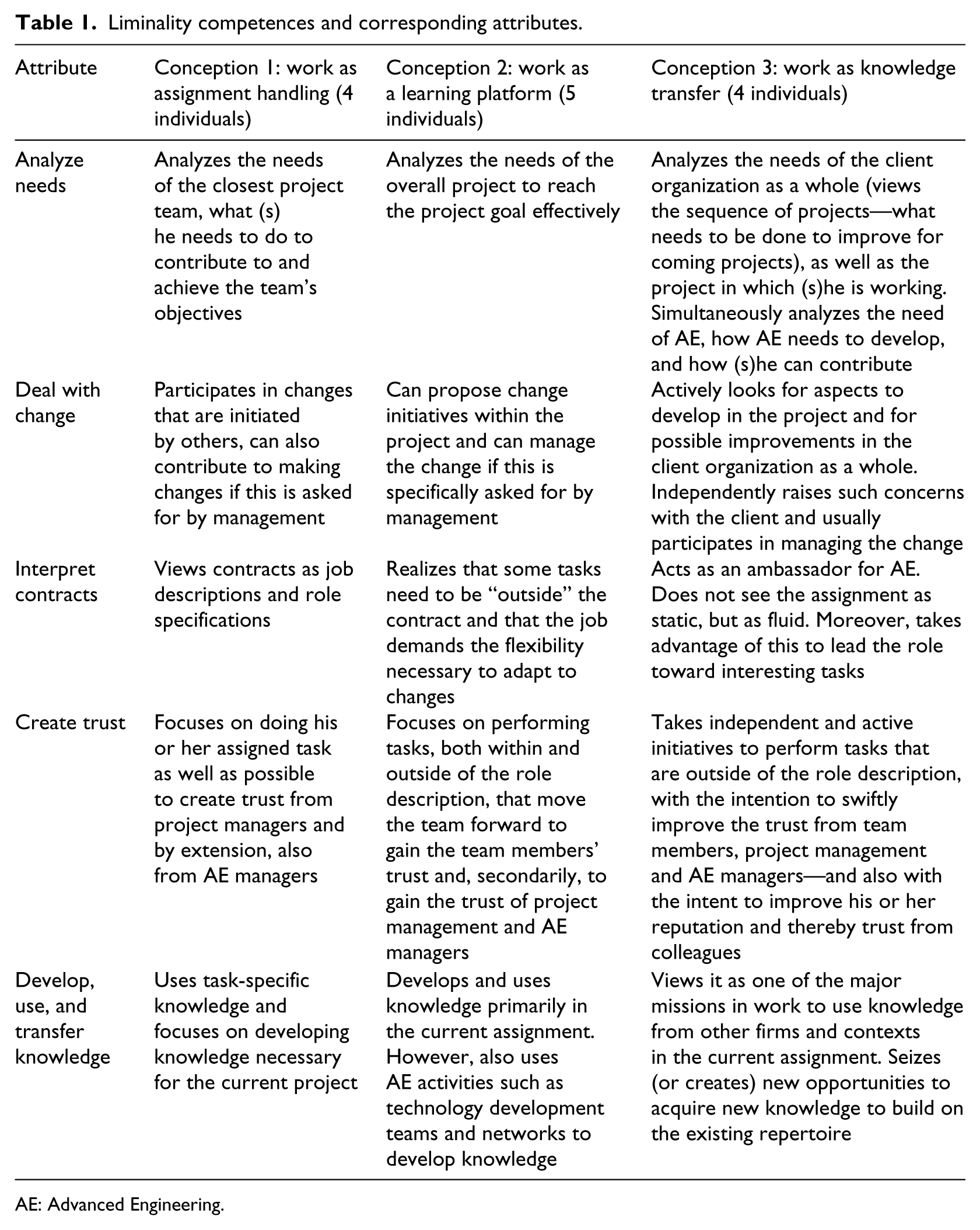
AE: Advanced Engineering.
Conception 1: Work as assignment handling
The engineers who express this conception of work focus foremost on the specified assigned project tasks that have been delegated by their respective client managers. The engineers with this conception of work delimit their work in terms of focusing on the technical development and technical chores of their assignment, and on how they can contribute specifically to the present assignment and client project. When talking about how they experience their work, they generally elaborate on specific parts of the technical aspects of their assignments, particularly on task-specific problem solving in the near future. One clear example of that technical and task-oriented focus is found in one of the participant’s diaries, where he continuously answers the question “what have you been working with” with lengthy references to specific technical operations and tasks.
The participants holding this conception say that they find their motivation in solving technical problems within their specific area of expertise and technical domain. When asked why they became consultants, some of these consultants explain that it was their way to continue working within their technical area of expertise and interest. One of the respondents describes how she, after struggling in the labor market due to cutbacks and the economic recession, was more or less forced into the consulting business:
The firm that I was working at made large cutbacks, so I lost my job. Pretty soon they realized that they had cut back too much, so they announced a position in one of the other departments. I applied and I got it and I worked in that position for a year or so, and then in another job in that department for an additional two years, but I realized it wasn’t my thing—I want to work with design! The way to do that was to work in AE, so I applied and I got a job here.
When these liminars describe their job situation, they often refer to working on a specific project under the same conditions as the other team members. Typically, they do not discuss in any detail how liminality can lead to additional responsibilities or opportunities in their job. These individuals also say that they find very little difference in working as a consultant, in comparison to previous engineering work. The following is an excerpt from one of our interviews:
Do you think it is different to work as a consultant in comparison to your earlier work?
No, not really … It is a job that needs to be done. You know the goal with the work and focus on getting it done.
Instead, liminars holding this conception seek a stable role in the current project and team. When we asked them about shifting assignments, many of them expressed a preference to stay with one client for a long period of time. Contract renewals are mostly associated with feelings of relief and satisfaction—to be given the opportunity to stay in the client organization. The following quote illustrates such a feeling of relief upon receiving the news of an extended contract with his current client:
So, I understand that your assignment with this client will be extended?
Yes! And I wanted to write that down in the diary, that we’ve finally reached that decision.
How does that affect you?
In here [points to the chest]. I feel “yes, there is more work here in the future.” It is a good feeling.
These mobile project workers emphasize the importance of receiving approval and instructions from their project managers or line managers in the client organization. They also emphasize that the main part of their work is to do what is assigned to them and that this is the primary way to gain trust from their managers at AE and the people in the client organization. Furthermore, a recurrent pattern in their diary entries and interviews is that they typically hesitate to take initiative that goes beyond what is expressed in their job descriptions. They prefer having assignments handed to them. The following excerpt is taken from one of our interviews:
You mentioned that, when you were working on [a specific part of the system] you didn’t have as much contact with your manager—how did it affect you?
Well, it didn’t affect me much; [my manager] knows what I am doing there, that I won’t be at my desk, but in the other area. So, in those situations, he estimates how much time it will take, and that estimation is shown on the board, that I should be ready at a certain time. And as long as there aren’t any big differences, he plans the next thing.
[Your manager] handles much of the planning?
Yes, I think that is his job … he is the one that can do it, because he has an overview. Can you paint here? [a parable, researcher’s note] And then I get an idea that the walls should be painted and ceilings and doorposts.
Hence, liminars holding this conception do not seem to deliberately take advantage of their position as consultants to increase their mobility opportunities. Instead, they search for a “safe zone” in the project. In interviews, when asked to speak about their role as consultants, these liminars bring up the potential advantages of being able to move across client organizations and work somewhere else. However, they explicitly express a preference to stay with one client organization for an extended period of time and that prolonged client contracts are coupled with feelings of relief and satisfaction.
Conception 2: Work as a learning platform
Mobile project workers expressing this conception demonstrate awareness that the mobility and in-between position in their work affect their work situation. Furthermore, they recognize mobility as a means for a long-term development of knowledge and competence. When these liminars describe their work, they tend to focus on the particular project on which they are currently working. They often talk about the importance of contributing with their own knowledge to move the project forward.
The liminars holding this conception say that they interpret the client contracts as a general guideline for the work that should be done, rather than a fixed agreement. In that respect, they differ considerably from the engineers holding conception 1. This generally implies that parts of the performed work are of the project worker’s own initiative. Typically, conception 2 liminars think that their mission is to interpret what the client needs them to do. They expect to receive directives from managers, but at the same time, they understand that they sometimes discover tasks that need to be addressed that extend beyond their initial contractual agreements. The liminars expressing this conception also frequently propose improvements when they find it useful for the project. However, although conception 2 liminars acknowledge that they need to interpret the latent needs in their assignment outside of the explicit assignment statement, they express the opinion that they find the fuzziness somewhat frustrating. The following quote, taken from our interview transcripts, is indicative of such a standpoint:
I’ve helped out in the project when something isn’t working. If something isn’t working, people ask me because I’ve worked with this functionality in a previous project. And when they ask for my help, I take the time to help them.
Is that something that you take the initiative for, to help? Or have you received that direction from management?
No, it’s on my own initiative. Sometimes the management says, “good that you took the initiative” or “good that you are involved in this.” At other times, they think it takes too much of my time and tell me to stop helping the other project. So I don’t really know where the limits are. It would be good if they said, “okay, we’ll give you one hour per week for support.” Then maybe I could do two hours of work one week and the next nothing, but I would know.
Unlike liminars who hold the first conception, the mobile project workers holding conception 2 typically say that they are affected by being engaged in multiple firms, that is, AE and one of their client firms. They mention several positive factors offered by AE regarding different personal and professional networks that add to their technical and social skills. They also mention that their “dual engagement” has several positive effects on their professional networks. Moreover, they state that the AE activities can be a way to increase the feeling of being positively challenged by the job. Examples of such activities are internal technical projects in which a small group of employees gather to apply or develop high-end technology, or internal competence development courses and training activities. The activities thus contribute to increased motivation, something that the liminars benefit from if they do not find their current assignment satisfying. Below is one example of a diary entry made by a participant who was getting tired of his current assignment:
I have requested more work at AE, not only client work. …. They have asked me to manage one of AE’s student groups, and to be involved in a technical development team that was just recently launched. … The student group is probably what is going to take the most time, so I will have to plan for that. But I am really looking forward to the technical development team, partly because I’ll get to do something else, and because I’ll get a chance to develop new, and perhaps fun, things.
With respect to building trust, the mobile project workers expressing this conception primarily work to gain the trust of the team members who are directly involved in their current assignment. They believe it is important to balance the directives from management with the varied advice from team members, so that they gain the trust of their team members, while maintaining the trust of their project manager. Still, they view that their main function is to contribute to the project. The following is a quote that is indicative of such a standpoint from one of the respondents who was assigned to introduce and use a new software program in the project:
That is why I still do everything in [the old software]. The plan for me was to take this data and slowly start to make people use the other system. But, like I said, that isn’t really necessary in the project yet, but it’s on the verge of being there.
Hence, liminars holding this second conception are aware of their liminal position and acknowledge positive outcomes that can come from it, such as increased flexibility and access to a greater range of activities that can increase learning and motivation. However, liminality is also coupled with feelings of stress and frustration as it can lead to unclear and fuzzy assignment boundaries.
Conception 3: Work as knowledge transfer
Within this conception, liminars are aware of the nature of mobility inherent in their work, and recurrently speak about the variety of ways to make use of the mobility and the “dual belonging” coupled with working simultaneously for AE and the client organization. In this respect, they differ considerably from those respondents expressing conception 1 and conception 2. The participants holding conception 3 state that working as technical consultants provides them both with the opportunity and the obligation to contribute with a special type of knowledge and competence to the client organizations. This “special competence” consists of adding an external view of the project and the problem-solving context that is very difficult for internal engineers to develop. Thus, these liminars believe it is an advantage to have experience from different and diverse contexts. In the diary entries and interview transcripts, they frequently compare their current assignments with previous assignments to find similarities and differences across different contexts. Based on the understanding of the similarities and differences, they claim it is possible to initiate changes and improvements in their current development projects and to their current problem-solving teams.
Conception 3 liminars also state that although they experience the obligation to try to improve processes and operations, they must be careful and considerate about implementing changes in their client organization. The changes that these liminars initiate can be project-specific and, in some cases, may even concern the structures or processes on an overall business level. The following transcript excerpt from one of our interviews illustrates how one of the participants, after persistent advocating and careful timing, managed to implement a new process that affected not only her project but the whole department at the client site:
If I understand your diary correctly, you started to work on these processes. Can you tell me what happened?
It was quite cool. Since I started at this department I have asked for processes, and everyone has been saying that [the industry] is large and heavy and that the existing processes are not adapted for our work. I have thought that they have been missing something all the time. The people at the department have been focused on getting things done, so they have just been running. But now there is so little time left on this project and the next project will start soon. Thus, if there is a time to start changing the way we work, it is now. Now is the time to practice before the next big scope, and it is cool that people are finally starting to realize that …
You also write that you received comments of appreciation for taking the initiative. Can you tell me more about that?
Well, the feedback partly came from my colleagues on the assignment. I started this visual planning in February, when it was crucial that we got ourselves through each week. At this time, I was pretty tough with sticking to the new process, I felt a bit like a police officer …
One of the reasons why conception 3 mobile project workers implement improvements, but stress the importance of doing it smoothly, is because they see themselves as ambassadors for AE. They work with the explicit goal to create a good reputation for themselves as individuals and hired engineers and for AE as a reliable and professional technical consultancy.
In comparison to the individuals demonstrating conception 1 and conception 2, the liminars who hold this conception state that in many situations they try to promote mobility. They typically expect their assignment to be fuzzy and unclear, and they talk about the contract primarily as a starting point for their work—something that is necessary to begin the project, but not something intended to regulate what they actually should be doing. In addition, these liminars say that much of their work is about interpreting what actually needs to be done in the assignment and for the client organization and that this uncertainty or vagueness is actually one of the main reasons why the client hired them in the first place. This suggests that it is mainly up to the technical consultant to formulate his or her role in the assignment. One of the participants describes how AE consultants discuss a phenomenon called “role sliding,” which means that the role of the hired engineer is continuously changing and that the role may change depending on the problem situation at hand:
You mentioned that you relatively often have to develop your role in the project and in the client organization. Could you develop this a bit further?
Well, usually you get a very concrete role, like being a scrum master for example, or a software developer and that’s it. You get a rather fuzzy description of what you’re supposed to do. Most descriptions are very short and fuzzy. At [client X], the managers have always been open to suggestions for improvement. You are allowed to pursue suggestions and when you do, you develop your role to broaden it, or at least make it into something else. Moreover, you often make contacts and hear about things that need to be done, for example projects that will be run, and if you do, just slide into it—as on a banana skid. Well, role sliding is a typical expression that we use to describe this process.
The notion of “role sliding” is a state that is preferred by the liminars holding this conception. They describe how they seize opportunities that they find in their work to change their role into doing tasks that are, in some cases, not originally within their initial work description or role specification. One such example would be to actively take responsibility for work on dedicated task force teams or to take part in the development of systems and tools within the client’s organizations. This work is largely described as a means to increase the challenges and learning scope of the work, which may help build a foundation for future contracts and assignments.
Concluding discussion
This study focuses on a particular type of worker, namely, the mobile project worker, with a special focus on engineers working as technical consultants who, on a recurrent basis, move from project to project, from client organization to client organization. We argue that the type of engineering work in which they are involved includes significant elements of “liminality” at work. Such liminality arises when work involves simultaneous engagement with several organizations and the continuous movement between assignments and/or projects. Indeed, this would seem a critical part of contemporary working life in general and of technical consulting in particular. Although liminality is part of the work situation for many workers—mobile project workers, consultants, and temporary workers alike—limited attention has been paid to the additional skills, abilities, and competences that such work requires from the individual worker and how the individual worker learns to live with such work conditions. This article suggests that liminality at work requires a complementary competence among mobile project workers, apart from the technical and social skills that have been addressed in prior empirical research. This complementary competence has, in this article, been termed “liminality competence.” As noted earlier, developing such competence seems critical in a time when increasingly more engineering work is performed in fluid and transient problem-solving settings (Lindkvist, 2005).
Relying on an interpretative approach, the empirical findings in this article indicate that the mobile project workers’ perceptions of their work content and work conditions, most notably in terms of multiple commitments and mobility, result in quite different ways of approaching and accomplishing their work. Their perceptions of work and liminality at work, we argue, constitute different forms of liminality competence. The empirical results demonstrate that there are three different and distinctive conceptions, which correspond to three types of liminality competence. Depending on the mobile project workers’ conception—(a) work as assignment handling, (b) work as a learning platform, or (c) work as knowledge transfer—our analysis presents different ways of approaching central attributes associated with liminality at work. These different approaches include analyzing the needs with respect to their assignment, dealing with change, interpreting contracts, creating trust and developing, using and transferring knowledge. Regarding a hierarchy of competences, different levels of liminality competence are evidenced among the mobile project workers. The levels of liminality competence are evaluated by how the mobile project workers conceive and make use of liminality.
Those mobile project workers who express the conception of “work as knowledge transfer” actively make use of their belonging to different organizations by participating in different activities and taking on roles in both organizations, thereby increasing their social networks and their learning possibilities. This means that they not only thrive on mobile and transient work conditions but they typically also make use of the possibilities that liminality offers. They likewise deliberately use liminality to broaden their knowledge. This observation confirms Tempest and Starkey’s (2004) assertion that some individuals seem to acknowledge liminality at work and take advantage of it. With a high level of liminality competence, mobile project workers exploit the opportunity to shape and reshape their assignments and job roles.
Those who perceive “work as assignment handling” try to, in a variety of ways, reduce the degree of liminality at work. In some cases, they even attempt to completely avoid it. In this respect, they express an inclination toward searching for a stable and sheltered work situation. However, they still prefer to work as consultants rather than as a regular employee in their client organization. This is very much because they have found it to be the only way to work within their specific area of interest, technical discipline, or particular problem-solving methodology. They suffer more from the liminality dimension of their engineering work. Accordingly, their conception of work as assignment handling corresponds to a lower level of liminality competence.
Consequently, it is foremost the liminars with a high level of liminality competence that experience the freedom of liminality, as mentioned by Garsten (1999). The liminal position, as noted by Turner (1982), seems to “liberate them from structural obligations” (p. 27). Individuals demonstrating a low level of liminality competence typically face the stressful consequences of weakened feelings of belonging and power that often arise in work conditions associated with liminality by creating a stable environment in their current assignment (Garsten, 1999).
The notion of liminality competence could add explanatory power to why some individuals are able to take advantage of “working in-between”. In the empirical context discussed herein, such explanations may be helpful to unravel why some engineers/technical consultants are better at contributing to transferring knowledge across different organizations and projects. This is a factor that, thus far, has received little attention in the literature on learning across organizations and learning across projects (Prencipe and Tell, 2001). This would also further add to the findings presented in Handley et al. (2007) concerning learning in the consultant–client relationship and the assertion that some consultants find it more challenging to adapt to different contexts and new organizational expectancies. Accordingly, this study emphasizes the importance of considering the individual perspective and individual differences for a complete analysis of transient and temporary work conditions.
The findings presented herein shed new light on prior studies regarding temporary work and flexible work conditions. For instance, in relation to empirical research that has indicated the difficulty for some individuals to draw on and mobilize resources (e.g. Lervik et al., 2010), these differences may now be explained by the varying degrees in liminality competence. Moreover, similar remarks could possibly be made in light of Grugulis and Stoyanova’s (2011) study in which individual learning becomes marginalized due to the peripheral situation that some workers tend to assume in project-based production. It could be argued that a worker with a high level of liminality competence is better able to access other learning networks than those who demonstrate lower levels of liminality competence. However, it is important to keep in mind that liminality competence, as discussed here, is only one part of “engineering competence” and that it does not replace or constitute the whole of it. This means that engineers expressing a higher degree of liminality competence may be better suited for liminality work, which then allows them to broaden their scope of learning, whereas engineers with a lower degree of liminality competence could still be highly competent in their particular area of expertise and perhaps better at developing deeper specialized knowledge within their specific technical discipline. In this respect, this research offers some insights relevant to the literature on knowledge specialization and the linkages between knowledge specialization and knowledge generalization by demonstrating the value of searching for attributes and perceptions of work beyond the conventional, narrow, technical problem solving (Allen and Katz, 1995; Postrel, 2002).
The study reported in this article has a number of limitations. As Alvesson (2001) notes, there may well be significant differences between the consultants’ perceptions of their own roles and competences and the clients’ perceptions of the consultants’ roles and competences. Consultants, for instance, may have a tendency to embellish their own significance and influence in the problem-solving process. Although we have tried to control for this bias, we have not investigated in-depth the performance of every participant who participated in our study. Another limitation is the sample size as we recognize that a larger sample of participants would have been preferable. Initially, we planned to involve 20 engineers in our study. As it turned out, of the 15 who commenced the study, 2 participants had to withdraw from the study. Despite these limitations, we believe that our findings are sufficient to support our principal argument and that little would have been gained by having a larger sample, although the depth and sophistication of our comparisons and analyses of the three primary conceptions would have been more detailed.
Future research should study in greater depth how and why liminality competence evolves and in what situations such competence plays an important role. In this respect, there is a need to contextualize the findings presented in this study and explore not only the nature of liminality competence but also the development of this competence. We also believe that there is a need for further investigation into the competences required to meet the challenges inherent in new organizational forms, particularly into the development of liminality competence in different contexts, whether those contexts are in different project-based industries, among different occupations, or across different geographical regions. One example could be how perceptions differ among workers in different sectors and workers with different backgrounds and cultural contexts and also why such potential differences exist.
Footnotes
Funding
This research recieved funding from the Swedish Research Council (Vetenskapsrådet), Riksbankens Jubileumsfond, and Handelsbankens forskningsstiftelser.