




Abstract
This article explores how storytelling and Greek mythology within classroom-based leadership development may facilitate learning to deal with ambiguity and social construction in leadership practice. We aim to show how using narratives and making explicit tacit plotlines can disrupt thinking and enable participants to experience the emergent process of re-storying. We argue that the projective focus of the re-storying process encourages critical self-reflection and discussion of the socially constructed nature of organisational roles, relationships and leadership. The use of Greek mythology archetypes in combination with re-storying helps participants to question taken-for-granted assumptions of leadership practice, explore emotions and reflect on the past, present and future of a story. Drawing on reflections from practice, we propose a re-storying leadership development workshop and highlight complexities of working within the realm of re-storying and critical self-reflection. This article concludes with an outline of avenues for future research and leadership development practice.
Introduction
The complex, ambiguous and political nature of organisations has been widely recognised as a key challenge for leadership practice and leadership development (Hatch et al., 2005). A common response has been to seek resolution, often through complicated solutions (Wheatley, 1994) focused on technical competence, cognitive-based models and ethical practice as a means to restoring stability. Locking managers firmly into the dominant paradigm of rationality, this has tended to increase instability and uncertainty (Stacey, 2000).
Alternatively, critical and aesthetic leadership scholars (e.g. Collinson, 2011; Edwards et al., 2013; Ford and Harding, 2007; George and Ladkin, 2008; Hansen and Bathurst, 2011; Purg and Sutherland, 2010; Taylor and Ladkin, 2009; Weick, 2007) stress that dealing with these challenges requires an embracing of emancipatory and socially constructed views of organisational reality that provoke ‘inspiration that goes beyond logical argument’ (Hansen and Bathurst, 2011: 255). It has been argued that using aesthetic philosophy and arts-based methods ‘as processes for intervention and change’ (Hansen and Bathurst, 2011: 258) in leadership development allows for deeper engagement with the ‘social processes that construct organisations’ (Hansen and Bathurst, 2011: 256) and counteracts an overreliance on rational models of decision-making.
This article aims to contribute to this aesthetic turn in leadership development through its exploration of the storytelling and Greek mythology literatures as a means to developing dialogic leadership development processes that enable participants to explore the ‘constructed nature of people and reality, emphasising language as a system of distinctions which are central to the construction process’ (Alvesson and Deetz, 2000: 36). Czarniawska (1998) argues that even ‘basic narratives can carry a load of ambiguity and therefore leave openings for the negotiation of meaning’ (p. 3), thus playing an important role in accommodating the uncertainty and ambiguity within organisations (Gabriel, 2000). We will argue that the activity of improvised storytelling and re-storying of narratives, where participants experiment with different plotlines and possible endings, may develop a deeper understanding of the socially constructed and ambiguous nature of organisational reality (Boje, 1991, 2008; Gabriel, 2000). We posit that this disruption of thinking and improvisation of a plotline may further enable participants to project meaning and significance about a wider organisational issue (e.g. change, working relationships, leadership) and access felt experience, ultimately provoking critical self-reflection.
In addition, we argue that working with mythology will support such exploration of social processes, roles and relationships in society. Spence (1994) describes myth as ‘an attempt to explain the relations of man to the universe …’ where characters in the myth embody certain traits and characteristics that are archetypal and that can be found in organisations and societies today as well as the mythical stories (p. 12). Working with these archetypal traits and characteristics in the context of a specific narrative and the emergent process of re-storying allows for exploration of how individual actors interact, influence each other and impact on the outcome of a story. In the context of leadership development, this may encourage participants’ reflection on taken-for-granted assumptions about their organisational roles and relationships.
Our contribution to the leadership development literature is twofold: We provide a conceptual contribution by connecting the emergent process of re-storying with the archetypal nature of Greek mythology to enable insight into how classroom-based leadership development can explore and raise awareness of the socially constructed and ambiguous nature of organisational life. Second, we offer a practical contribution by showing how this can be done within the remit of a re-storying workshop and reflecting critically on facilitator and participant experience of such a workshop.
The remainder of this article is structured as follows. Literatures on storytelling and mythology are reviewed and connected with a view to exploring the value of sensemaking and re-storying for leadership development practice. Based on this conceptual framework and our experiences in the classroom, we then introduce a leadership development workshop that combines storytelling and Greek mythology in a unique way. Two reflections from workshop facilitators and informal feedback from 25 participants are further included to enhance awareness of the potential complexities of working with the re-storying process and critical self-reflection. This article concludes with key themes for future leadership development practice and research.
Storytelling and mythology in leadership development
Our interest in connecting storytelling and mythology within leadership development practice has been particularly nurtured by our reading of Hatch et al. (2005), Gabriel (2004) and Boje (2008). While Boje (2008) and Gabriel (2004) have offered invaluable conceptual insights, it was Hatch et al.’s (2005) use of storytelling, theatre metaphor and Greek mythology to analyse stories told by CEOs in their interviews for the Harvard Business Review that intrigued us most in relation to leadership development practice. The book seems to open up a conceptual and practical gap in relation to how these aesthetic approaches could be used in a leadership development setting. This article responds through both a conceptual discussion of the usefulness of storytelling and Greek mythology for leadership development and practical suggestions of how storytelling and Greek mythology can be combined in a novel way to enhance participants’ sensemaking of organisational reality and critical self-reflection (Reynolds, 1999) in a classroom context.
Storytelling in organisations
‘Storytelling is an art of weaving, of constructing, the product of intimate knowledge’ (Gabriel, 2000: 1). Telling good stories is a form of meaning-making that can help to engage and inspire people, offer security (Bettelheim, 1976), provide moral education (MacIntyre, 1981), advise or warn (Van Dijk, 1975), justify or explain (Kemper, 1984) and entertain (Campbell, 1972). On the other hand, if storytelling goes wrong it can disenchant, mislead, disable communication and disappoint.
Boje (1991) argues that organisational storytelling can be seen as ‘the institutional memory system of the organisation’ (p. 106). It is a reflexive system that reconfigures the past according to the present where stories are retold through multiple authors adding interpretations in order to aid meaning and sensemaking of the present and future. From a postmodern view, organisational stories and storytelling may be seen as a means of reinstalling meaning and facilitating meaning-making in a space that is filled with informational noise (Gabriel, 2000). Official as well as informal organisational stories and narratives reflect, and arguably influence, ways of thinking and political action (Gabriel, 2004). Informal stories can support, subvert or even ridicule official stories, acting as a vent for anger, frustration, fear or hidden desires and fantasies among employees (Gabriel, 2004). Mead (2011) also reflects on the potential for storytelling to aid meaning-making that – in an organisational context – may help individuals and groups to heal wounds caused by traumatic periods of change. He argues that overcoming what he describes as narrative wreckage (i.e. where a traumatic event shatters the sense of self and previously familiar narratives of the organisation or the self seem fake) may require a process of re-storying of those narratives to create new meaning.
Boje (2008) adds to these insights through his conceptualisation of ways of sensemaking. Of particular interest here is his distinction between the traditional retrospective gaze of narratives, the idea of prospective sensemaking, that is, looking into the future, and sensemaking in the ‘here and now’. In doing so, he recognises a narrative’s dynamics that stem from the infinite pasts, nows and futures and makes visible its co-construction by multiple authors and listeners. Coherence is, according to Boje (2008), a fundamental aspect of such narrative constructions, reflecting how the narrative-order with its beginning, tacit plotline and ending is an outcome of the sense we make of actions and decisions in the past and potential decisions in the future and shaped by the emotional and ethical complexities of the here and now. He posits that it is with a view to order and coherence that we need to distinguish carefully between narrative and story, drawing on Derrida (1991) to suggest that ‘the story is the homonym to narrative’ (p. 27) rather than its synonym. In this sense, storying is not about coherence and order but about dispersion (emergence), multiplicity and disorder. As such, Boje (2008) argues that the interplay of story-disorder and narrative-order constitutes the dialogical property of storytelling complexity. It is this interplay, the dialogic, that is particularly visible in what Boje (2008) terms the emerging story and that is a key focus of the rest of this article.
The concept of the emerging story, according to Boje (2008), suggests that ‘each story is socially in motion, relative to sensemaking between bodies (physical, political, social, bodies of ideas etc.), and to another way of telling’ (p. 60). Being in this sphere of emergence implies open-endedness, infinite and undetermined plots and hence working in the context of disorder. It is here that we pick up on Mead’s (2011) suggestion regarding the process of re-storying and argue that it may offer a potentially useful way of embracing and possibly coming to understand the entwined elements of retrospective and prospective sensemaking within the realm of an existing narrative. Re-storying this narrative means changing its plotline and engaging in active improvisation of the unfolding story. Although the telling of the story is future oriented, the process of re-storying may arguably help to nurture our awareness of the dialogic nature and mutually influencing qualities of the narrative-order and the story-disorder relationship (Boje, 2008). This process of re-storying may enable us to experience the open-endedness of Boje’s (2008) emergent story and raise awareness of the retrospective coherence and order of a narrative as well as make visible the existence of an infinite number of parallel plotlines and story endings (story-disorder).
The experience of re-storying may further open up avenues for critical reflection on the role, nature and importance of leaders and leadership in organisational life, potentially helping us to challenge the hegemonic power of the monologic heroic leader narrative present in organisational talk and the mainstream leadership literature (Boje, 2008; Ford et al., 2008). We will argue below that by bringing together the process of re-storying and reflection on the self and relationships at work through the lens of Greek Gods and Goddesses, we potentially make visible aspects of our taken-for-granted assumptions on leadership and organisational roles that are embedded in a collective organisational memory and the particular narrative-order that we intend to disrupt and re-story.
Storytelling in leadership development
Manifold arguments have been made for the general use of storytelling and exploration of organisational stories within leadership development. Musson and Cohen (1999) stress the importance of recognising the significant role that talk in the form of stories, myths, jokes and metaphors plays in the meaning-making in and sensemaking of organisations. According to Boyce (1995), organisational stories can create a sense of unity and common purpose in organisations that needs to be recognised in leadership development. Including storytelling in the management curriculum can facilitate critical reflection on self and others as well as develop the leader’s ability to use stories to make sense of and share knowledge and information in the organisation (Gabriel and Connell, 2010). Working with talk in organisations may further help leaders to ‘surface and critique tacit or taken-for-granted assumptions and beliefs’ (Gray, 2007: 496). Gray (2007) stresses the emotional, symbolic nature of stories that enables leaders to engage more actively with social and political meaning in organisations. He further draws on Alvesson and Willmott’s (1996) call to adopt a more critical approach to storytelling in management education and explore alternative meanings and interpretations of the same organisational myth or story. Gray (2007: 504) argues that this ‘approach is valuing doubt and uncertainty, so that a space can be opened up for critical self-reflection and emancipation’. Abma (2003) reviews further the use of storytelling workshops in the wider remit of management education and focuses particularly on their value as a social context that enables participants to explore stories, relate stories and collaboratively create meaning. Participants in storytelling workshops engage in dialogue that helps them embrace differences within the self and the naturally ambiguous nature of talk, that is, that the meaning of talk and dialogue in organisations is socially constructed and individually interpreted. According to Abma (2003: 236), storytelling workshops may also help participants to ‘deeply think about their experiences and inquire into the narratives that are framing them’.
Building on these existing insights, we argue that an understanding of the social construction of organisational stories, the dialogic relationship of narrative-order, story-disorder (Boje, 2008) and retrospective and prospective sensemaking processes may be nurtured through an engagement in re-storying. Like Gabriel (2004) and Fournier and Grey (2000), we are mindful of the dangers of the commoditisation of storytelling as a means to develop skills of manipulation and control. We contend, nevertheless, that working with stories and re-storying experiences can potentially help leaders to take apart the plot of an existing narrative, to question assumptions and hegemonic discourses influencing the narrative and to ultimately attempt to shape new meaning. Our focus is therefore not on control or manipulation but critical self-reflection and emancipation from dominant narratives in organisational life and the potential this may offer for reconnecting with the organisation’s purpose. Within a leadership development context, it is nevertheless advisable to build in time and space for critical reflection on the power of storytelling and the inherent subjectivity of a storyteller’s interpretation of a particular narrative. It is important to be aware of the ethical implications of poetic licence (Gabriel, 2004) and to reflect equally critically on existing, dominant and potentially oppressive or deceptive storytelling practice. In our own teaching, such reflective space has in the past led to incredibly deep but also unsettling insights for participants into potentially oppressive or manipulative practice in their organisation. One participant, for example, shared his concerns that rumours related to redundancies in his organisation had been spread by senior management as a means to scare employees and make them more amenable to less drastic measures formally introduced down the line. The ensuing group discussion brought to life the complex reality of stories, rumours and gossip and their subjective, travelling, socially constructed nature. In doing so, it also highlights that storytelling requires interaction with an audience and that this audience engages cognitively and emotionally with the story, recreating meaning for themselves through this lived experience.
The engagement and subjective interpretation of the audience will be affected further by the type of story that is told. Hatch et al. (2005) draw on Gabriel’s (2000) typology of primary story types – comic, tragic, epic, romantic – to show how a CEO narrative may resemble a specific story type that triggers a particular impact on the audience of followers. We posit that within a leadership development context, one can draw actively on this typology to disrupt thinking and encourage reflection, highlighting the influence of the story type or narrative-order on the anticipated plot outcome. Recognising that there is an infinite number of other, tacit plotlines may further help to highlight organisational influences on the existing narrative-order. Building on these reflections, participants may enter the emergent process of re-storying, as depicted in Figure 1, and experience story-disorder through the creation of alternative plotlines and perspectives on the same situation.
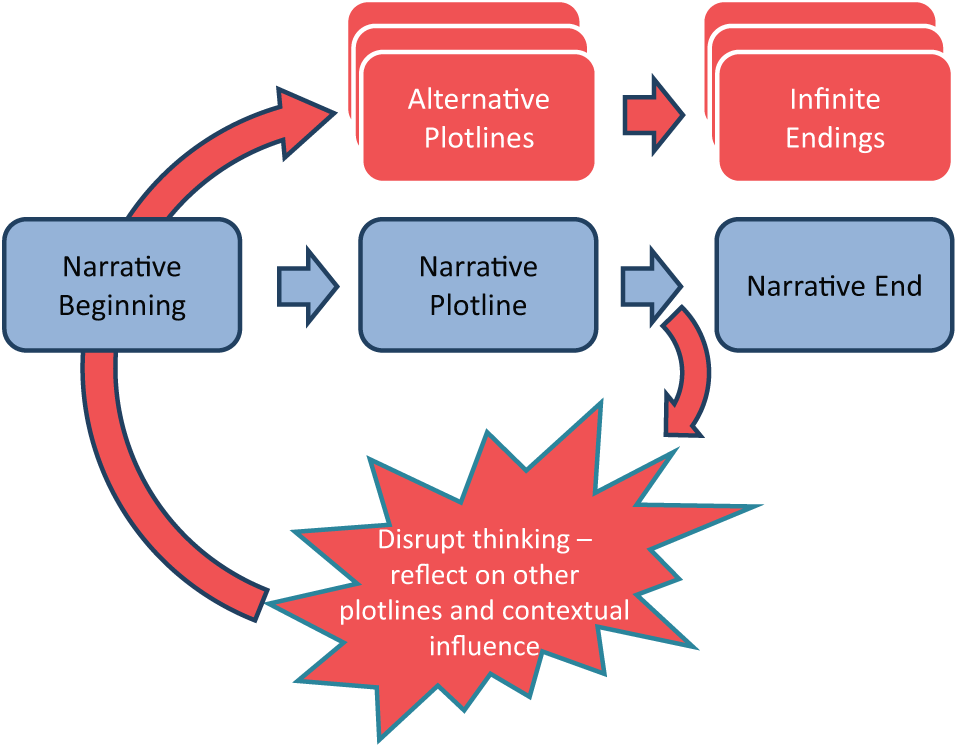
Narrative-order and the process of re-storying.
We argue that experiencing the process of re-storying opens up a space for participants to be able to discuss the meaning of talk in organisations and the socially constructed and individually interpreted nature of organisational stories. Any re-storying experience should therefore be followed up by detailed discussions that unpack the lived experience. These reflective spaces need careful facilitation to encourage participants to critically reflect on the cultural, political and gendered meanings of organisational roles and leadership that are likely to influence and be influenced by dominant plotlines. It can be important to reflect on how organisational cultures and individuals in significant roles may influence through their values, beliefs and practices a narrative to take a certain plotline. This may further encourage the envisaging of ways in which these dominant plotlines could be challenged or re-storied. A lesson for leadership practice could then be to embrace open-endedness, uncertainty and complexity in organisational life and decision-making rather than attempting rationally to control it.
To give this process of reflection and re-storying additional depth, we argue in favour of bringing in the allegory of the Greek Gods and Goddesses.
Mythology in leadership development
Gherardi (2004) argues that myth is the fundamental form of narrative knowledge. Embedded in stories and traditions, myths connect us with the past and future of humanity and nurture our sensemaking process of how our world is enacted through the accounts we and others give of it. Myths can be seen as cultural memory transmitted from one generation to another through stories and also as universal in their existence and application in modern day life (Hatch et al., 2005). We posit below that working with the metaphorical language and archetypal characteristics of Greek Gods and Goddesses may enable participants to engage in critical self-reflection within the safe learning environment of the classroom.
Introducing participants to Greek mythology and particularly the ancient complex constructs of the Greek Gods and Goddesses may aid a multi-faceted self-reflection process through personal identification with these archetypal beings and raising awareness of the often contradictory, even paradoxical, nature of their characteristics. Even the most powerful Greek Gods and Goddesses are ‘flawed heroes’ subject to behave unpredictably on a whim or a fancy – demonstrating their ‘suprahuman’ nature (Lefkowitz, 2003). In the mythical narratives, these Gods and Goddesses can be seen to acknowledge the ‘messy’ and ‘capricious’ (story-disorder) while retaining a clear sense of who they are and what they represent (narrative-order). This is in stark contrast to the ‘unreal’ way in which official organisational stories are typically ‘cleaned-up’ to strengthen their coherence and order before they are recorded and reported. An exploration of the contradictory nature of the Greek Gods and Goddesses can provide insight into ways of accommodating, rather than seeking to resolve, paradox that Stacey (2000, 2010) suggests is an important leadership characteristic in complex organisational environments. Hatch et al. (2005) add that it is the archetypal nature of the characters in Greek mythology that make them in their metaphorical, symbolic format highly transferable to current day situations. They propose that ‘an archetype provides a model or prototype for recognising and acknowledging an aspect of our deep existence’ (Hatch et al., 2005: 75).
Within a leadership development setting, a discussion of the archetypal characteristics of Greek Gods and Goddesses may help to illustrate different aspects of the self in relation to organisational roles and relationships and project possible different selves onto the archetypes. In our own leadership development practice, we have seen participants quickly identifying personally with the vices and virtues of particular Gods in a way that seemed to help them to talk more openly about their own working styles, roles and relationships. Like stories, working with metaphorical, symbolic archetypes allows for greater imagination and envisioning of possible multiple selves as well as realities and visions of present, past and future. Gadamer’s (1986) work on metaphorical language stresses the ability of metaphor or myth to signify similarity in difference and draw the extraordinary out of the ordinary that would usually be left unseen. It further allows an examination of how paradox helps to challenge the often taken-for-granted Black and White approach to effective and ethical leadership in the literature. In the sense of leadership development, the work with Greek mythology may help to understand further the ordinary, day-to-day actions and understand the extraordinary within this reality. It may then trigger exploration of the fluid nature of self-identities (Sinclair, 2011) and the notion of organisational and individual becoming (Cunliffe, 2009). This aims to work against the often criticised assumption of stable, coherent leader or follower identities and rather encourages a view of leader and follower selves as evolving, interpreted and socially constructed.
Combining the process of re-storying and self-reflection through the allegory of Greek mythology in a leadership development workshop allows the participants to explore the social interaction of different characters in the context of a complex problem or story and the multiplicity of plotlines and possible outcomes affected by the social interaction of the characters involved. This may then enhance their skills as leaders to reflect on the self as well as those they work with and understand the evolving, changing nature not only of the physical, political and technical but also of the social and emotional context within which leadership takes place.
Storytelling, mythology and emotions
The literature reviewed above has highlighted the key benefits of an aesthetic turn in leadership development as a means to encouraging understanding of multiple realities, selves and futures in organisations. It has further demonstrated how a combination of re-storying and working with the allegory of Greek mythology in a leadership development context may encourage an engagement with the socially constructed nature of leadership and organisational reality and also create a safe space within which to engage in critical self-reflection.
Finally, we explore here the role of emotions in connection with the use of storytelling and mythology in leadership development. Both storytelling and mythology have been claimed to be strongly linked to emotions and memory (Gabriel and Connell, 2010; Hatch et al., 2005), yet the link between stories, emotions and memory in management education remains underdeveloped. Drawing on Weick’s (1995) work, Boje (2008) introduces emotions as a further sense involved in the sensemaking process of organisational storytelling. A story in itself is an emotionally laden construct that listeners engage with on an equally emotional basis (Gray, 2007). Emotions have been linked to learning, and Antonacopoulou and Gabriel (2001) argue that the two are interrelated, interactive and interdependent where emotions can be seen as learned experiences and learning as an emotional experience. They further stress that both can be seen as powerful sources of meaning and direction but highlight that our knowledge of how emotions affect the learning process is still quite limited. In our experience of working with re-storying and allegory of Greek mythology, it is the emotional aspect of the lived experience that seems to affect participants’ learning process significantly. When talking to participants months after an intervention, they often remember vividly the image of a God or how they felt during the ambiguous uncertain process of re-storying. Some have linked this directly to the story plot they were working with and whether it had been particularly humorous or sad. Equally, we have seen participants display strong emotions during self-reflection processes that were at times difficult to contain in a classroom setting.
Recognised as a focus within aesthetic enquiry in organisations (Hansen and Bathurst, 2011), we see an exploration of emotion in relation to dialogic leadership development work as important and will reflect on this area further in discussion of facilitators’ and participants’ reflections. First, we turn to proposing a classroom-based leadership development workshop that is centred on the use of Greek mythology and re-storying.
Using storytelling and Greek mythology in the classroom
The leadership development workshop introduced in this section represents the authors’ interest in dialogic approaches to leadership development and critical self-reflection as a means to engaging with and surfacing taken-for-granted assumptions on socially constructed roles and relationships as well as the political and gendered nature of leadership and dominant change-based discourses in society and leadership development. We describe below a workshop format we have used predominantly with postgraduate student groups and groups of practicing managers. In response to participant feedback, we would encourage allowing up to 5 hours for the workshop and limiting the group size to a maximum of 16 participants.
Workshop outline
After a detailed introduction to and discussion of the merits of aesthetic methods in leadership development (e.g. Grint, 1997, 2001, 2007; Hatch et al., 2005; Taylor and Ladkin, 2009; Turnbull, 2006), the group is introduced to the use of Greek mythology archetypes for self-reflection. Participants are split into small groups of 4–6 and given a set of Greek Gods and Goddesses cards. Each card is dedicated to a God/Goddess and will contain an image of the God/Goddess as well as brief information on his/her main characteristics. We have usually included 10 different Gods and Goddesses in each card pack and pre-selected these according to their relevance for the general work context, that is, ensuring that the Gods/Goddesses’ characteristics bear a link to organisational life. We have further tried to cover a range of characteristics associated with possible ways of being in a work context such as ‘innovative, risk-taking’ (Hermes), ‘creative’ (Apollo), ‘strategic thinking’ (Athena), ‘competitive’ (Ares), ‘caring’ (Demeter) and ‘global vision’ (Zeus). This selection process could be further tailored to specific organisational contexts that participants share. Interestingly, the most popular cards have tended to be Athena, Apollo and Hermes across our entire participant groups (see the example of Hermes’ card in Figure 2). Each participant is then asked to spend up to 30 minutes reading through the attributes of the Greek Gods and Goddesses. At this point, participants often ask for further clarification of these ancient Greek characters and it is therefore very important that facilitators have some knowledge of Greek mythology and are able to explain and set into context each God or Goddess. 1 Participants are throughout this reflective exercise encouraged to focus on the characteristics of the Gods and Goddesses as archetypal and reflect on the extent to which they identify with any of these characteristics. Participants then choose one or several Gods and Goddesses that they feel represent best who they are at work and how they interact with others. This individual reflection is followed by group discussions where participants talk about their individual reflections and are encouraged to make links to roles and relationships in their workplaces. This often includes vivid conversations where participants talk about their colleagues’ characteristics and behaviours through the lens of the Greek archetypes and reflect on tensions, synergies and paradoxes within roles and relationships at work. Facilitators take part in these group discussions and ask questions where needed to encourage further reflection on embedded assumptions on rationality and stability in organisations and nurture conversations about ambiguity, social construction and underlying processes of power, gender and discourse. In order to allow for detailed discussions, this first part of the workshop should be allocated 90 minutes.
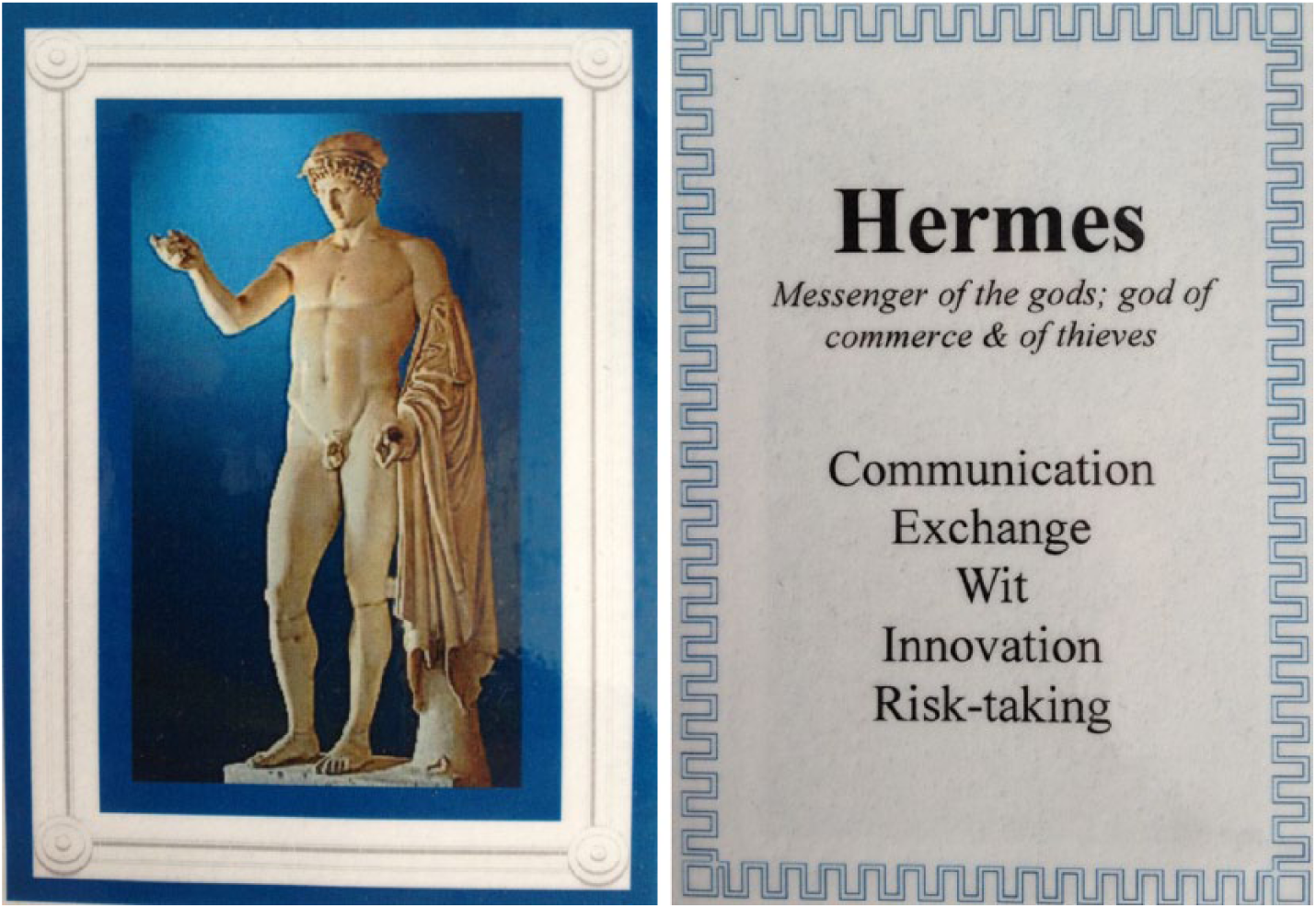
Workshop card for Hermes (Front and Back).
Over the next 60 minutes, facilitators introduce participants to key themes from the storytelling literature to highlight its uses for working with ambiguity. This includes some basic principles of storytelling, narrative sensemaking (Boje, 2008) and an introduction to Gabriel’s (2000) typology of plotlines. We leave space within this facilitator input to encourage the participants to reflect critically on the idea of narrative-order as well as stories, myths and jokes that they have encountered in their organisations.
The participants are then given a short narrative that describes a particular organisational situation and are split into three small groups (typically 3–6 participants in each group). The narrative and hence organisational situation we provide is different for different groups, recognising their work context and learning needs. With groups of practicing managers, we have, for example, used a brief fictional narrative on the financial crisis at Mount Olympus so as to make this narrative transferable and relevant to the often change and crisis-ridden work environments of our participants. Participants are asked to identify the current plotline and to get a sense of the narrative-order currently established. Each group is then allocated one of four plotlines – comedy, tragedy, epic or romance (Gabriel, 2000) – and asked to disrupt the current plotline and re-story the situation according to the new, allocated plotline and create a future ending. Each group is also asked to base the characters in their revised story on the Gods and Goddesses they had chosen during the self-reflection exercise. How the story unfolds and what its ending is therefore depends both on the allocated plotline and the archetypal characters present in the group. Once the story has been developed, each group has 5 minutes to tell it. The groups can choose how they wish to ‘tell’ their story to the whole group, for example, act out, narrate or draw. After 60 minutes of preparation time, the whole group reconvenes, and over the next 45 minutes, each small group ‘tells’ their story. Developing the story in itself is a powerful experience in the small groups, and participants are often surprised by the connections they make, the turns the story takes as it emerges and is co-constructed (Boje, 2008) and how they contribute to its creation from the position of the Greek God or Goddess. Time pressures mean that telling the story is often improvised so that even at this point, the story may be reshaped, providing a valuable experience of the ambiguous, socially constructed nature of organisational life.
The final 45 minutes of the workshop are spent as a whole group exploring how both the plot we choose and the characters involved can shape a story’s ending. The differences and similarities that emerge between the groups’ stories provide rich material to explore in these final discussions, as the stories often seem both predictable and unpredictable, casting different aspects of the situation into light and shadow and often producing quite different futures as a result (Abma, 2003; Musson and Cohen, 1999). This can lead to further discussion of how the use of Greek Gods and Goddesses and the storytelling has enabled participants to explore and project inner thoughts and feelings on themselves and the organisational situation at each stage of the re-storying process. We also try to explore the connections we can draw from this workshop to the challenge for leadership in dealing with ambiguity and uncertainty (Gabriel and Connell, 2010; Gray, 2007; Stacey, 2000).
Desired learning outcomes
We argue that the process of re-storying encourages participants to work through three forms of sensemaking (Boje, 2008): retrospective sensemaking (how did this organisational situation arise), here-and-now sensemaking (what do we as members of this group and our chosen Gods and Goddesses bring to this situation) and prospective sensemaking (how might the situation develop and unfold as a result of our interventions). Bringing Greek mythology archetypes into this process and working with their characteristics provide participants with the opportunity to critically reflect on their own behaviours at work. If facilitated carefully, this provides a safe learning environment as it allows participants to talk about themselves through the lens of the Greek archetypes. Combined with the emergent process of re-storying, this further allows participants to slip into the roles of their chosen Greek Gods and Goddesses to act out possible work scenarios and through this experience help to confront taken-for-granted assumptions on roles and relationships at work. These potential benefits and learning outcomes are arguably relevant for a multitude of different participant groups, ranging from experienced senior managers to early career managers and those without management responsibility.
Reflections from facilitators and participants
In addition to the potential learning outcomes highlighted above, our experience with the use of storytelling and allegory of Greek mythology has also brought insight into the complexities of this type of workshop. We therefore draw here on two reflections captured by two of the authors illustrating their experiences as facilitators with the above outlined workshop: All groups exhibited a certain hesitance and weariness towards the relevance and use of mythology and storytelling in relation to self and leadership. The groups needed encouragement and a degree of facilitation to really engage with the Greek Gods reflexively and go under the surface and beyond mere stating of characteristics. Yet, all groups responded well to facilitation and animated discussions evolved where most participants did enter deep reflection about themselves and also others at their workplace. These reflections involved critical conversations about what participants saw as their own and others’ patterns of behaviour at work, the complexities of self and others in stable and turbulent times and for some groups reflections on gender, power and politics at work. […] As most of the practitioners who took part in the workshops were from organisations that have seen repeated organisational changes, they tended to link quite strongly to our references to gossiping and storytelling in times of change in organisations. […] discussions […] explored – with reference to participants’ experiences at work – the travel of stories through an organisation and the appropriation and changing of these stories by individuals as a means to making sense of past, present and future and as a way of gaining control in times of uncertainty. (Facilitator 1)
Facilitator 1’s largely positive reflection on the workshop also highlights some of the complexities of creating a safe learning environment and the need – as a facilitator – to encourage participants’ reflections and discussions to engage critically with roles and relationships at their workplace. In addition, we add here a reflection from another facilitator that acknowledges the complexity of working with the emotions this type of workshop evokes and the need to make available adequate time and space to deal with this in the classroom: My reflections on these sessions reveal a number of common themes: students and participants’ emotional engagement with the Greek Gods and Goddesses cards; the scenario and storytelling activities prompting a critical and constructive view of leadership and an appreciation of the impact of changing perspectives and storylines on outcomes. […] With all runs we had one or two participants who literally clutched one of the Greek God cards and were very reluctant to give them back. They expressed a feeling that the objective nature of the cards allowed them to be honest about their ‘preferred self’. […] we had a heated exchange over a person’s choice of card with a colleague saying, ‘You are not like that at all, put it back!’ He responded by clutching the card to his heart and saying, ‘leave me alone it is the real me!’ […] the activities raised emotions that I felt; we had not adequately prepared for, or had time to deal with sensitively in a confidential space. (Facilitator 2)
This second reflection highlights two aspects of the active exploration of emotions and inner feelings. First of all, it shows the extent to which emotions evoked through the activities affected individuals’ learning positively. On the other hand, the reflection also highlights the sensitive nature of encouraging active exploration of emotions and inner feelings in a classroom environment. Although mentioned in the thriving literature on aesthetics in leader development (e.g. Taylor and Ladkin, 2009), it is an important issue that needs to be explored further.
In addition to these reflections from a facilitator perspective, we have gathered retrospective reflections from 25 participants (23 postgraduate students and 3 practicing managers) through informal, unstructured focus groups. These were conducted 3–6 months after participants had attended the workshop. One of the key themes in these reflections was the relative ease with which participants could engage with Greek mythology and stories at the workshop as they felt quite familiar with these and therefore able to engage, interact and learn. The participants had been struck by how relevant Greek Gods as archetypes were to understand further roles and relationships in current organisations and how using Greek Gods to understand their own leadership practice and identity had raised many questions that they were still pondering. Indeed, the use of Greek mythology had inspired some participants to read into this and reflect on the development of modern society in light of the relevance of ancient myths. One of the managers reflected on how this workshop and further reflection afterwards had made her realise how ‘hard’ it is to change leadership practice.
Participants felt that the workshop had been very effective in demonstrating the power of story lines, perspectives and how important that can be when receiving and giving information. It had made some participants realise how they can turn things around when viewing something from a different angle and using different words. Participants also agreed that the workshop had encouraged them to raise questions on who they are and who they could be. Participants further realised through the workshop the need to consider who is telling a story, the context and agendas that come with it and that everybody has something to say – even a character like ‘the joker’ in a comic story. For two managers, it was the cards with images of Greek Gods and Goddesses and their characteristics that they recalled most distinctly. One of the managers said that the images had remained in her head with their associated values and attributed this to the emotions the cards had originally raised in relation to her attempt to identify with the images and values. This theme of emotion is closely tied to Facilitator 2’s reflection and warrants further investigation.
Implications for leadership development research and practice
The aim of this article has been to explore how storytelling, re-storying and working with the allegory of Greek mythology in classroom-based leadership development may enable projection (Taylor and Ladkin, 2009), critical self-reflection and learning to deal with ambiguity and the social construction of roles, processes and relationships. Based on our literature review and reflections from practice, we argue that engaging in a process of re-storying enables participants to reflect on narrative-order and experience story-disorder, thus creating opportunities for participants to understand, appreciate and take a multiple perspectives view on organisational life and decision-making. We contend that the use of Greek Gods and Goddesses – who are ‘flawed heroes’ – contributes to the power of this dialogic approach in suggesting the possibilities and potential of accommodating paradox and uncertainty. Working with these ancient Greek archetypes allows participants to develop their ability to embrace the idea of multiplicity and contradiction to challenge taken-for-granted assumptions on essentialist leader identities embedded in leadership and organisational talk (Cunliffe, 2009; Ford and Harding, 2007; George and Ladkin, 2008). Finally, reflections from 25 participants suggest that a combination of re-storying and Greek mythology in a workshop tends to trigger strong emotions and feelings, positively affecting their learning from and memory of the actual workshop. This supports arguments by Hatch et al. (2005) and Gabriel and Connell (2010) on the emotional engagement of the audience and the storytellers with a told or enacted story.
This article has therefore contributed to the aesthetic leadership development literature in two ways: through a theoretical discussion of the role and combination of storytelling and allegory of Greek Gods and Goddesses in leadership development and through the practical description of a workshop for leadership development practice and facilitator and participant reflections on the complexities of such a workshop in a classroom-based context. Future research is now needed to explore further the usefulness of storytelling and Greek mythology across a wide range of participant groups with varied levels of leadership and work experience. With a view to leadership development practice, it is especially the potential benefits of Boje’s (2008) idea of the interaction of retrospective, in the here-and-now and prospective sensemaking through storytelling and re-storying that needs to be further explored. The initial reflections presented here have illustrated that participants have experienced and learned from the dynamics of the re-storying process about the dialogic relationship between narrative-order and story-disorder, hence recognising existing narratives and seeing multiple perspectives and social construction of stories and realities (Abma, 2003; Gabriel, 2000; Gray, 2007). Yet, as the reflections show, such learning is not easy and ‘old habits die hard’. It would be interesting to see whether the use of an existing narrative from the participants’ own workplace context has a positive impact on the re-storying experience and the transferability of the sensemaking processes explored here to their work context.
Robust evaluation studies of aesthetic leadership development practices are still rare and the transfer of learning from the classroom into the workplace underexplored. The reflections from participants of our workshop show that they perceived the work with the mythological archetypes and re-storying to have had a lasting impact on their ability to engage with and apply a multiple perspectives approach in different aspects of their life and study. The exploration of different story lines for the same narrative and discussion of mythical characters and their similarities and differences seem to have engendered a sustainable and transferable understanding of reality as socially constructed. This initial observation needs to be followed up by robust research into the occurrence and transferability of such appreciation of different cognitive, philosophical and emotional perspectives affecting participants’ sensemaking and re-storying of the past, present and future. Equally, while facilitator and participant reflections seemed positive about the workshop’s ability to enable participants to critically reflect on themselves through the lens of the Greek Gods and Goddesses, this needs to be further investigated with other participant groups. Of particular value would also be an exploration of the extent to which critical reflections on the self and in relation to others and taken-for-granted, historically and culturally rooted assumptions on the role of leader, follower and leadership in organisations can occur in a classroom-based setting and are transferable to the work context.
On a practical note and in relation to facilitators and participants’ reflections on the emotional impact of this aesthetic development work, we need to ask some difficult questions to ensure the complexities of working with critical self-reflection are acknowledged. We need to explore the short-term and long-term implications of encouraging deep emotional experiences and how this can be actively linked to learning. In addition, the facilitators’ reflections stressed the need for more substantial preparation for the sensitive nature of participants’ reactions to being encouraged to engage in critical self-reflection and ensuring that participants are engaging freely. We consequently need to understand better what key issues to look out for and how do we deal with these in a classroom setting. Given the lack of research into the link between emotions experienced through storytelling or re-storying and effective learning, these reflections encourage further research into this link and the complexities this bears for doing dialogic leadership development work.
Finally, an additional task could be to explore the potential for expansion of dialogic leadership development work and for links to be forged with other complexity-related concepts such as negative capability (Simpson et al., 2002; Simpson and French, 2006). This is with a view to enhancing participants’ ability to remain in the realm of ‘uncertainties, Mysteries, doubts, without any irritable reaching after fact and reason’ (Keats, 1970: 43, cited French, 2001: 481). Taking a dialogic focus and linking explorations of narrative-order, story-disorder and the idea of negative capability may further allow participants to engage in critical reflection on the hegemonic discourse of the individual heroic leader (Ford, 2010) and open up avenues for other leadership narratives to emerge.
Footnotes
Funding
This research received no specific grant from any funding agency in the public, commercial or not-for-profit sectors.