



Abstract
Organizations increasingly find themselves responding to unprecedented natural disasters that are experienced as complex, unpredictable, and harmful. We examine how organizations make sense and learn from these novel experiences by examining three Australian bushfires. We show how sensemaking and learning occurred during the public inquiries that followed these events, as well as how learning continued afterward with the help of “learning cues.” We propose a model that links public inquiry activities to changes in organizational practices. Given the interesting times in which we live, this model has important implications for future research on how new organizational practices can be enacted after public inquiries have concluded their work.
Introduction
Over the last decade, the earth’s natural environment has provoked a growing and justifiable level of concern over our ability to cope with major catastrophes (Pelling, 2010). Atmospheric scientists are attributing higher temperatures, wind speeds, and moisture deficits to climate change, which is subsequently causing natural disasters that have become more frequent, complex, and devastating (Birkman, 2006). Hence, in the last decade, we have witnessed earthquakes, flooding, droughts, and bushfires becoming more frequent and more damaging (Glade et al., 2010). Such natural disasters are proving to be a challenge for emergency management practitioners, including government ministers, policy-makers, police officers, fire fighters, weather forecasters, and geospatial analysts. Despite being well prepared, organizations still struggle to respond effectively to natural disasters (Mileti, 1999) because their learning from previous events is undermined when new or unfamiliar conditions unfold.
Natural disasters are what Weick (1988) refers to as high impact–low probability events, meaning that they interact with actors, systems, and routines in the organizational environment in a manner that is often rapid, unpredictable, harmful, and on an unprecedented scale. Such disasters impose significant losses and damages on communities globally. Nevertheless, and perhaps surprisingly, critics argue that they have received less scholarly attention than “man-made” crises in organizational, industrial, or political contexts (Sellnow et al., 2002). This study therefore looks specifically at the case of natural disasters to explore how organizational sensemaking and learning unfold in situations where actors struggle with novel conditions. It does so by examining the case of bushfire in Victoria, Australia.
In a normal year, during the summer months, Australia is prone to high levels of bushfire risk, and there are times when such risk is greatly exacerbated by the early onset of summer, prolonged drought, high wind speeds, and low humidity. These conditions mean that when fire is ignited, it creates what Colville et al. (2013b) refer to as “circumstances that are suffused with dynamic complexity” (p. 1201). Three such bushfires that continue to live in the collective memory of Victorians are the focus of this article: the Black Friday Fires, 1939 (71 lives lost); the Ash Wednesday Fires, 1983 (75 lives lost: 47 in Victoria and 28 in South Australia); and the Black Saturday Fires, 2009 (173 lives lost). In each case, the organizations responsible for managing these fires faced conditions that, despite their experience with bushfires, were experienced as surprising, overwhelming, and rare. They represented what Weick (1993) refers to as cosmology episodes, when “the sense of what is occurring and the means to rebuild that sense collapse together” (p. 634). Many of those who lived through them express sentiments that echo Weick (1993): “I’ve never been here before, I have no idea where I am, and I have no idea who can help me” (pp. 634–635).
Our study shows how the inquiries that followed each of these fires constructed them as novel, justifying the need for retrospective sensemaking and learning through deliberative public inquiry processes. It shows how sensemaking and learning occurred during the inquiries, as well as suggesting how “learning cues” provided a basis for the double loop learning that occurred during the inquiry to extend beyond it and lead to changes in organizational practices. In this way, our study responds to the call for research to explore the theoretical and practical importance of how actors “learn to make sense, and make sense to learn” (Colville et al., 2013a: call for papers). It makes the following contributions. First, it provides an empirical exploration of sensemaking and learning associated with three natural disasters that were described as unprecedented, dynamically complex events. Second, it shows how both sensemaking and learning can occur through the process of holding public inquiries. This is important because most of the theoretical focus on public inquiries has been in relation to sensemaking; we know far less about whether and how inquiries engender learning. Third, our study develops a general model that sets the stage for future research on how new organizational practices come into being after inquiries have concluded their work.
The remainder of this article reviews the literature on sensemaking and learning, with a particular focus on public inquiry processes. It then explains the methods associated with our qualitative, interpretive study of three bushfires. We then present the findings and develop a model of sensemaking and learning. Finally, we discuss the implications.
Sensemaking
Sensemaking is “an ongoing process that creates an intersubjective sense of shared meanings through conversation and non-verbal behavior in face to face settings where actors seek to produce, negotiate and maintain a shared sense of meaning” (Gephart et al., 2010: 284–285). It comprises two primary concepts (Weick, 1995). First, the sensing component is built on the premise that actors draw on their lived experience, which is informed by their identity, and influences how they respond to stimuli such as events, triggers, and surprises (Weick et al., 2005). Cognitively, actors struggle to respond in a meaningful way in an environment where events are perceived to be novel, triggers are seen as sudden, and surprise is experienced as continuous because existing cues and frames offer little or no insight into what is unfolding (Colville et al., 2012, 2013b). Second, the making component is built on the premise that people attempt to enact or create sensible environments through “conversational and social practices” (Gephart, 1993: 1469) about specific events to arrive at an understanding about what is plausible, rather than objectively accurate (Weick, 1995). Actors use questioning, framing, bracketing, and storytelling to give meaning to organizational issues in a way that provides the basis for action, even during crises and disasters (Brown and Jones, 2000; Maitlis, 2005).
Crises and disasters trigger “sensebreaking” moments where people lose their ability to impose meaning on events and routines are interrupted (Mantere, et al., 2012). As a result, they also provide powerful conditions for sensemaking as people ask “What is going on?” (Weick, 1993). This questioning provides the opportunity to create new meanings, allowing individuals to understand their experiences and, if there is consensus, facilitate coordinated action (Weick, 1995). However, when individuals fail to understand the implications and lessons to be gleaned from major crises and disasters, they are likely to engage in behaviors with unintended or even tragic consequences because they are confronting novel situations that they do not know how to gauge, process, and manage (Weick, 1990).
Learning
The concept of organizational learning suggests that organizations learn from previous experiences in the same way as individuals share mental modes that detect and correct errors by altering the organization’s theory of action (Argyris and Schön, 1996). Such learning is triggered when actors experience a surprising mismatch between expected and actual results of action and respond to that mismatch through a process of thought and further action that leads them to modify their images of organization or their understandings of organizational phenomena and to restructure their activities so as to bring outcomes and expectations into line, thereby changing organizational theory-in-use. (Argyris and Schön, 1978: 16)
Hence, organizational learning occurs to the extent that actors extract knowledge from systems at the individual and group levels of the organization (Argyris, 1976) so that change can be made in an evidence-based manner through intuiting, interpreting, integrating, and institutionalizing (Crossan, et al., 1999) in ways that identify and correct errors.
Argyris (1976) argues that such learning occurs in two ways. First, single loop learning occurs through error correction, but without altering the underlying governing values of the system and/or organization. Second, double loop learning occurs when errors are corrected by changing governing values and subsequent actions. Thus, single loop learning produces change within the existing organizational culture, while double loop learning leads organizations to re-evaluate governing values and, potentially, change the culture and practices more fundamentally. Moving from single loop learning to double loop learning allows organizations to adjust their culture so that they can escape the clutches of “cultures of entrapment” which produce antilearning (Sutcliffe and Weick, 2003: 73). Antilearning occurs when an organization’s members remain blind to incompetencies and inefficiencies, resulting in inadequate performance that can harm the organization and its stakeholders (Argyris, 1993; Argyris and Schön, 1996).
Public inquiries, sensemaking and learning
Sensemaking and learning are both relevant to public inquiries. Research has found that in addition to the sensemaking that occurs (or fails to occur) during both natural and man-made disasters (e.g. Weick, 1993), sensemaking also takes place in the public inquiries that often follow (e.g. Brown, 2000; Brown and Jones, 2000; Gephart, 1984). In reviewing what happened during the disaster or crisis, public inquiries make sense of it, often in ways that establish accountability, rebuild public confidence, and restore an organization’s legitimacy where failure is evident. Much of this research, accordingly, emphasizes the ceremonial and ritualized nature of inquiries and the way in which they create normalized versions of the “truth” (Brown, et al., 2015). Consequently, through rhetorical accounts, public inquiries will often protect the dominance of powerful organizations, often at the expense of individuals (e.g. Brown, 2004; Gephart, 1993).
Some researchers claim that the ritualized and political aspects of public inquiries serve to inhibit learning (e.g. Buchanan, 2011). Nevertheless, public inquiries are generally expected to result in some form of learning and lead to changes in subsequent practices in order that organizations might respond more effectively in the future (Elliott, 2009). Moreover, some studies have demonstrated that public inquiries of disasters do prompt managers to implement change. For example, Bowman and Kunreuther (1988) show how data generated from multiple public inquiries triggered safety management initiatives in a 500 Fortune chemical company. Similarly, Turner (1976) demonstrates how “cultural readjustment” (p. 381) occurred in UK state organizations following the Aberfan coalmine accident in Wales (1966–1967), the Hixon level crossing collision in England (1968), and the Summerland leisure complex fire in Isle of Man (1974). However, we still know relatively little about how sensemaking and learning during a public inquiry lead to organizations being better prepared for the future. This study therefore explores the relationship between sensemaking and learning activities during public inquiry processes after dynamically complex events, as well as examining the processes leading to changes in organizational practices that occur after inquiries have run their course.
Methodology and research design
Our research is qualitative and interpretive insofar as it examines “the meanings in use by societal members to explain how they directly experience everyday life realities” and examines how particular meanings become shared (Gephart, 2004: 457). We chose such an approach because sensemaking and learning can be considered to be interpretive processes (Argyris, 1976; Brown et al., 2015; Gephart, 1993; Maitlis, 2005), and we are interested in how public inquiries create meanings for the events that give rise to them, as well as for the changes that may follow them. We examine three case studies of bushfires and conduct a textual analysis of the reports produced by three public inquiries. In doing so, we recognize that a public inquiry report is an artefact that has resulted from authorial strategies of selection and omission of material, and which makes use of rhetorical devices … to present an (not the only) understanding of events. (Brown, 2000: 49)
Inquiries are ceremonial events with certain ritualized procedures (Gephart, 1984), embedded in a particular cultural and legal context (Brown, 2000), whose aim is to produce accounts that are plausible, verisimilitudinous, and authoritative (Brown, et al., 2012). Accordingly, when we infer instances of sensemaking and learning from such reports, we do not claim that they are “correct” or “accurate” in their representation of events. Instead, we suggest that sensemaking and learning are “manifest in language, text and discourse including conversations, vocabularies, utterances and documents” (Gephart, 1997: 588), and can therefore be discerned from the analysis of such language.
In addition to inquiry reports, we also analyze other texts that were related to the inquiries but produced afterward as a form of “intertextuality” (Fairclough, 1992). When texts draw on, react to, and transform other texts, certain conclusions can be drawn. For example, in our analysis, when public inquiry reports were referred to in other texts, we were able to make inferences as to whether learning may have taken place. Similarly, insofar as these other texts reported on changes made (or not made) following the inquiries, they provided us with evidence for subsequent changes in organizational practices. In analyzing these texts in this way, we make no inference as to whether the learning was “correct” or whether these changes actually worked. Nor do we use these texts as a form of triangulation, whereby multiple data sources are assumed to represent reality more accurately. Rather, we acknowledge that the views offered in these other texts are subjective and that each genre has its own institutionalized protocols, which shape the rhetoric of their accounts. Nonetheless, these data are still useful to explore learning during and after public inquiries. Finally, we recognize that this article is, itself, an attempt to craft an authoritative account, and we deploy rhetoric in ways consistent with the genre of a scholarly article in order to appeal to our particular audience (cf. Currie and Brown, 2003).
We selected the three case studies—the Black Friday Fires in 1939, the Ash Wednesday Fires in 1983, and the Black Saturday Fires in 2009—because they were perceived to be three of the most significant and damaging natural disasters in Victoria, during which a considerable number of lives and properties were lost (Griffiths, 2010). It therefore appeared likely that sensemaking would occur in the public inquiries that followed them, as in the case of other public inquires dealing with crises (e.g. Brown, 2000; Brown and Jones, 2000; Gephart, 1984; Gephart et al., 1990). Equally, we felt that we would be able to discern evidence of learning (or its absence) from inquiry reports and related texts insofar as public inquiries are expected to be an important vehicle for learning in Australia (Prasser, 1985); and Griffiths (2010) argues that these reports did have a significant influence on emergency management in Victoria. Finally, we felt that the analysis of three case studies would provide more robust findings than selecting a single event.
Data collection
We collected the reports of the public inquiries: the Report of the Royal Commission to Inquire into the Bush Fires of January, 1939 (Black Friday Bushfires); the Report of the Bushfire Review Committee, 16 February 1983 (Ash Wednesday Bushfires); and the Report of the Victorian Bushfires Royal Commission 2009 (Black Saturday Bushfires). We augmented these reports with other texts that were related to the three public inquiries, but produced afterward. Using Factiva, which is a search engine for newspaper articles, TV and radio transcripts, journals, and so on, we identified 20 publicly available interviews with senior fire fighters, commissioners and politicians, 17 newspaper articles, and four web-blogs (see Table 1). These texts were collected because they provided (albeit subjective) views of whether and how sensemaking and learning occurred both during and after the inquiries.
Sources of textual data.

Data analysis
An interpretive approach was used to analyze whether the texts contained evidence of sensemaking and learning and to explore the nature of these processes. Rereading the texts, and relating them to our understanding of sensemaking and learning from the literature, we were able to identify “themes, meanings and patterns in textual data” (cf. Gephart, 1997: 585), from which categories were constructed. These categories became an emergent theory that provided the basis for an inductively derived model showing patterns of sensemaking and learning (cf. Gephart, 1993).
In the first instance, we examined the public inquiry reports for evidence that the bushfires were perceived to be novel, given our interest in how sensemaking and learning occur in response to novel conditions of dynamic complexity. Table 2 shows how perceptions of novelty were inferred from references in the inquiry reports to the bushfires as “unprecedented,” “previously unseen,” “catastrophic,” “new,” “unforeseen,” “unchartered,” and “unknown.” By exploring the excerpts containing these terms, we were able to identify references to accounts by individuals who saw the fires as novel at the time, as well as instances where conclusions of novelty were drawn from the inquiries’ overall deliberations. The inquiry reports were then examined for evidence of sensemaking. Excerpts containing references to “understanding,” “listening,” “review,” and “deliberations” were identified. We then explored these excerpts in more detail to see whether there was evidence that the process of receiving submissions, holding hearings, conducting deliberations, and writing a report had served to make sense of the fires for those involved.
Illustration of codes and quotes for key themes.

CFA: Country Fire Authority.
The next stage of analysis was to look for evidence of learning. In the context of public inquiries, we conceptualized single loop learning in terms of explanations of what had happened and why during the bushfires. We therefore identified and explored excerpts in the inquiry reports containing references to terms like “learning,” “lessons,” “mistake,” and “experience”—looking for evidence of such explanations. We conceptualized double loop learning in the context of the inquiry in terms of recommendations for more fundamental change. We therefore examined excerpts in inquiry reports containing references to “learning,” “continuous learning,” “lessons learned,” “re-evaluate,” “review,” “fundamental,” “change,” and “system” to identify and explore recommendations for fundamental change. We also identified double loop learning that extended beyond the inquiries in the form of subsequent changes in emergency management organizations. To do so, we examined texts produced subsequent to the inquiries to see whether they provided accounts of fundamental changes made after the inquiry and to identify independent views from experts, fire fighters, journalists, and politicians as to whether such learning had taken place. We recognize that views of change as fundamental —including our own—are subjective.
Finally, we explored the link between inquiry recommendations and subsequent changes in organizational practices. Here, we analyzed excerpts from inquiry reports detailing recommendations for fundamental changes and compared them to accounts in subsequent texts detailing how these recommendations were implemented in the form of changes in organizational practices. In this way, we identified what we refer to as “learning cues” in the inquiry reports, as texts produced after the inquiry referred back to certain recommendations in order to explain, justify, or introduce changes in organizational practices.
Findings
In this section, we first show evidence of novelty, sensemaking, and learning in relation to all three inquiries. We conclude by presenting the particular dynamics associated with each of the three fires.
Novelty and sensemaking
The analysis of the inquiry reports suggests that all three bushfires were interpreted as representing novel conditions that had not been experienced before. The reports conveyed this novelty by drawing attention to unprecedented antecedent conditions before and during the major fires. In all three cases, inquiry reports constructed the fire as so overwhelming that individuals could not make sense of it at the time. Such was the unprecedented nature of all three fires that actors struggled to frame what was going on, recognize cues, and bring their existing knowledge to bear on the situation. All three reports concluded that these particular bushfires were novel, unprecedented events, based on witness accounts and expert assessments of conditions at the time of the bushfire: The speed of the fires was appalling. Balls of crackling fire sped at a great pace in advance of the fires, consuming with a roaring, explosive noise, all that they touched. Houses of brick were seen and heard to leap into a roar of flame before the fires had reached them. Some men of science hold the view that the fires generated and were preceded by inflammable gases which became alight. (Report of Black Friday Inquiry; Parliament of Victoria, 1939: 5)
Inquiry reports argued that because of this novelty, existing procedures had failed to contain the fires, allowing them to escalate significantly and detrimentally. The resulting loss of life and damage to property were so great that it should never be allowed to happen again: Black Saturday wrote itself into Victoria’s history with record-breaking weather conditions and bushfires of a scale and ferocity that tested human endurance. (Report of Black Saturday Inquiry; Parliament of Victoria, 2010: vii)
If novelty had made it difficult for emergency services to respond adequately to the fires at the time, then sense needed to be made of that novelty retrospectively, through the submissions, hearings, and, ultimately, the inquiry report: [T]he truly disastrous proportions reached on 16 February, 1983, constituted an unmistakable peak in the disaster record of the State. It was clear, therefore, that in spite of experience of past bushfires and the lessons learned from them, the events of the 1982/83 season needed careful analysis and evaluation. To this end, in conjunction with other initiatives, the Government decided to establish a Bushfire Review Committee. (Report of the Ash Wednesday Inquiry; Parliament of Victoria, 1984: 2)
The inquiries helped to make sense of the past—the apparent novelty of the bushfire could only to be understood through a post hoc inquiry. However, this attempt at comprehension of past events was clearly made with a view to safeguarding the future: We have seen the pain people have endured and continue to bear and, we know it will be a long road to full recovery for many. Bushfire is an intrinsic part of Victoria’s landscape, and if time dims our memory we risk repeating the mistakes of the past. We need to learn from the experiences of Black Saturday and improve the way we prepare for and respond to bushfires. (Report of Black Saturday Inquiry, Parliament of Victoria, 2010: vii)
In this way, the inquiry reports adopted a prospective outlook in relation to future learning: I am determined that this Royal Commission report is never allowed to gather dust. It is crucial that we grasp the opportunity now to make our State safer. I am equally determined that the path forward unites all Victorians in one commitment to do all we can to preserve human life in the face of the threat of bushfires. (Premier of Victoria, quoted in Department of Premier and Cabinet, 2010: para.10)
Single loop and double loop learning
In making sense of the bushfires, the inquiry reports also provided accounts that indicated single loop learning in the form of explanations of what had happened during each of the bushfires and why it had happened: Except that the summer of 1938–39 was unusually dry and that it followed what had already been a period of drought, the causes of the 1939 bushfires have been immediate and remote causes. [I]t will appear that no one cause may properly be said to have been the sole cause. The major, over-riding cause, which comprises all others, is the indifference with which forest fires, as a menace to the interests of us all, have been regarded. (Report of the Black Friday Inquiry, Parliament of Victoria, 1939: 11)
There was also evidence of double loop learning insofar as some inquiry recommendations identified a need to re-evaluate systems that had been considered adequate before the unprecedented nature of fires exposed their limitations. The inquiry reports suggested that preparing for and responding to future bushfires on the scale of those recently experienced would require new practices, routines, and, in some instances, new systems: [W]e need to learn the lessons so that problems can be avoided in the future. The Commission therefore examined the policies, systems and structures needed to ensure that government, fire and emergency services agencies and individuals make informed, effective decisions about their response to bushfires in a way that protects life and minimises loss. (Report of Black Saturday Inquiry, Parliament of Victoria, 2010: 4)
The inquiries were, then, a first step insofar as recommendations argued for a need for fundamental changes in the system of bushfire management that, in turn, would require changes in the practices of specific organizations: A legacy for governments or a legacy for a fire leader I think will be to introduce these recommendations over time to avoid, as best we can, these sort of events that occurred on the seventh of February. (Jack Rush, Queens Counsel assisting the Black Saturday Inquiry, interviewed by Fyfe (2010))
Thus, double loop learning extended beyond the inquiries as changes were implemented in organizations responsible for bushfire management. For example, a Park Ranger who had witnessed the Ash Wednesday Fires commented on changes that followed the public inquiry: Ash Wednesday had jolted fire-fighting services to re-examine how they tackled bushfire. From communications, to the way we transport people, to the way we use aircraft, dozers, the way we configure people across the landscape. It made us look hard at that. It made us look at how we configure our incident management teams, how we train people. (McAloon, 2008: para. 15–16)
Similarly, changes were announced following the Black Saturday Royal Commission, including reducing fuel load on public land while monitoring and carefully managing the ecological consequences of such action; maintaining strategic fire breaks to protect communities and their critical assets, such as water; limiting known fire-starting activities on days with a dangerous fire risk; and encouraging individuals living in unacceptably high bushfire risk areas to relocate to safer environments. (Victoria’s Emergency Services Minister quoted in Department of Premier and Cabinet, 2011: para.10)
Learning cues
In tracing links between inquiry recommendations for fundamental changes and accounts of changes being implemented subsequently, we identified what we refer to as “learning cues.” Like sensemaking cues, learning cues are key fragments of information that serve as “stimuli that gain attention and engender action” (cf. Colville et al., 2014: 217). They are not pre-determined or pre-existing but, rather, are constructed as actors draw on particular fragments of text from inquiry recommendations to explain, justify, and initiate subsequent changes in organizational practices. In this way, learning cues appear to help extend the double loop learning that occurs during the inquiry to the wider setting, providing a basis for subsequent changes in organizational practices.
Sensemaking and learning in the three bushfires
In this section, we present a summary of the sensemaking and learning dynamics that characterize each of the three bushfires. In the case of Black Friday (1939), sensemaking constructed the bushfire as Australia’s worst natural disaster—a novel event compounded by a chronic drought and a lack of accountability (Table 3). In making sense of this novelty, the inquiry engaged in single loop learning by offering explanations as to why the fire occurred and escalated to such a seemingly unprecedented extent. These explanations included the lack of fire-related organizations with responsibility for managing risk in regional areas, an absence of forest management, and conflict among various organizations. Recommendations included the need for a State fire authority, new guidelines for planned burning, and clearer responsibilities for land and forest management. These proposals served as learning cues in that they were referred to in subsequent texts discussing changes in organizational practices. These changes included the establishment of the Country Fire Authority (CFA) whose jurisdiction included fires on private land in regional areas, the institutionalization of planned burning, and the introduction of the 1939 Forest Act, giving the existing Forest Commission complete control of fire management on public land. These changes can be considered to involve double loop learning insofar as they changed the assumptions of emergency management in Victoria in ways that continue to the present day.
Summary of findings from Black Friday 1939.

CFA: Country Fire Authority.
In the case of Ash Wednesday (1983), we again observed that sensemaking constructed the bushfires as novel—the worst natural disaster to date owing to the early onset of summer and irregular fire behavior (Table 4). Single loop learning occurred insofar as explanations in inquiry reports explained the damage caused by the fire in terms of conservative planning on the part of the community, the need for more effective responses from emergency management organizations, and the need for better understanding of fire behavior. Recommendations regarding new education programs, new partnership arrangements, and formal modeling of fire typologies served as learning cues in that they were referred to in subsequent texts discussing changes in organizational practices. These changes included a new “Stay or Go” policy, which was an education program to assist communities living in high bushfire risk areas in their preparation for the fire season. Other changes involved new partnership arrangements and the institutionalization of fire modeling. These changes can be considered to involve double loop learning insofar as the “Stay or Go” policy was developed collaboratively as a result of new partnership arrangements introduced through legislation. It remained the cornerstone of Victoria’s bushfire safety program for more than 25 years, while the new fire management strategy became established practice.
Summary of findings from Ash Wednesday 1983.

Inquiry sensemaking in the case of Black Saturday (2009) constructed these fires as the country’s worst natural disaster resulting from a severe heatwave and an absence of leadership in the line of command and control authority (Table 5). Single loop learning explained the severity of the fire in terms of individuals lacking bushfire safety plans, the build-up of fuel, and the lack of clarification regarding the line of command and control authority. Recommendations regarding fire warnings, planned burn-offs, and a review of the coordination of fire management organizations served as learning cues in that they were referred to in subsequent texts discussing changes in organizational practices. These changes included new forms of warning, defined burn-off targets, and legislation for a new position of Fire Services Commissioner. Again, these changes can be considered to enact double loop learning insofar as they involved radical changes to existing policies and changes in the organization of the overall fire management system.
Summary of findings from Black Saturday 2009.

Sensemaking and learning were thus embodied in the deliberative processes of the three public inquiries. Single loop learning resulted in explanations of what happened and why in inquiry reports, while evidence of double loop learning was found in the form of recommendations for more fundamental changes. Learning cues in the recommendations appeared to gain attention and engender action insofar as they were referred to in relation to subsequent changes in the practices of organizations responsible for bushfire management.
Discussion
Our findings allow us to propose a general model regarding sensemaking and learning during—and after—public inquiries as events move from natural disaster, through the public inquiry deliberations and report, to the aftermath of the inquiry (see Figure 1).
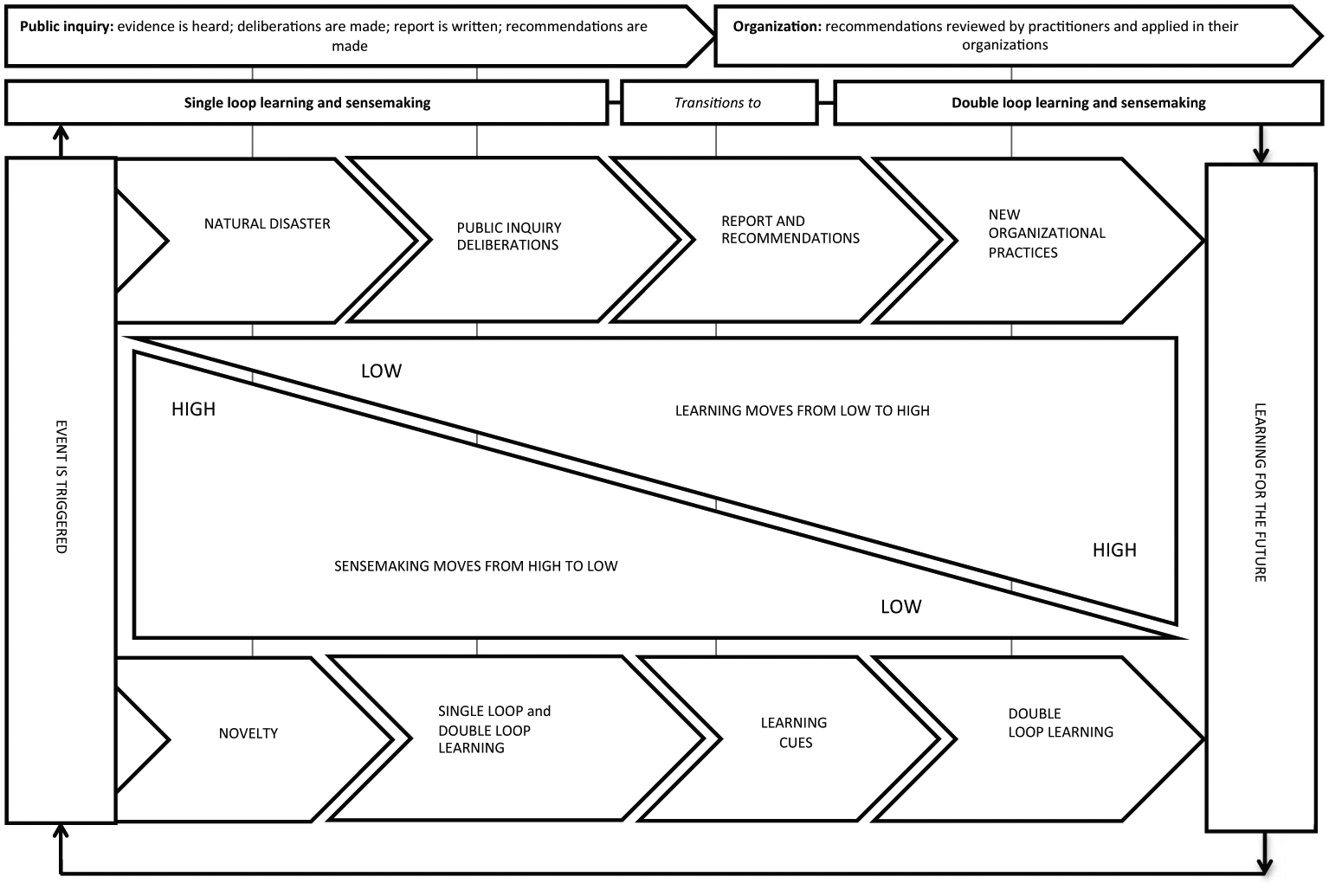
Sensemaking and learning.
First, in all three public inquiries, novelty was attributed to particular circumstances in the natural environment that accounted for these “unprecedented” natural disasters. At the same time, all three inquiries clearly indicated that similar conditions could be expected to occur again in the future. According to inquiry reports, these novel conditions had taken emergency management practitioners by surprise and inhibited sensemaking at the time. We propose that the construction of novelty helps to justify the need for a public inquiry to provide retrospective sensemaking in order to manage future conditions more effectively.
Second, sensemaking during the inquiry reduces the equivocality of the novelty in that it helps to create shared understandings, making it possible to construct plausible explanations of what happened and why. We therefore also propose that sensemaking provides the basis for single loop learning to occur during the inquiry, as well as double loop learning in the form of inquiry recommendations for more fundamental changes.
Third, for inquiries to lead to changes in organizational practices, double loop learning must extend beyond the inquiry. We propose that this process is facilitated by learning cues—stimuli that gain attention and engender action, signifying to others of a need for a specific change, and allowing actors to move from a state of disorder about past events to a new order about future events (cf. Colville et al., 2014) which, in turn, aids the introduction of changes in organizational practices following the inquiry.
Our model helps to develop new theory concerning the link between sensemaking and learning. Whereas Schwandt (2005) suggests that sensemaking and learning are in tension with each other, our study suggests that sensemaking is a basis for learning. Only after sense is made can learning occur. Additionally, whereas Schwandt (2005) suggests that sensemaking may preclude more fundamental learning because actors interpret equivocal cues to align with current knowledge, our study suggests that double loop learning can still occur. There is, then, considerable scope for further research to explore the relationship between sensemaking and learning in more detail. The temporal component is particularly interesting (Colville et al., 2014). Our model suggests that, initially, sensemaking is high and learning low as actors struggle with equivocality. As sense is made, sensemaking activities reduce over time while learning increases, moving from single loop to double loop learning. Ethnographic studies of inquiries would be helpful in investigating the real-time dynamics of sensemaking and learning during the deliberative processes of an inquiry.
Our model also builds on the work of Colville et al. (2014) who show the links between sensemaking, learning, and change within an organization. Our study shows how these activities can transcend organizational boundaries by “moving” from the organization that is the public inquiry into the myriad of organizations that constitute its subject matter. In this regard, we introduce the concept of the learning cue, which appears to play a role in this transition. There has been considerable interest in sensemaking cues (e.g. Colville et al., 2013b), and we feel there is potential for similar research into learning cues, which are similarly equivocal. What constitutes a learning cue—why are some textual fragments taken up and not others? How do they gain attention and engender action, and signify change to others? Do they serve a cognitive function in that certain textual fragments spark learning? Are they rhetorical insofar as some fragments of texts are most effective in persuading other organizational members of the need for change? Or are they political in that certain textual fragments gain political momentum and visibility, making it easier for organizations to implement them? Also, what happens when potential learning cues “fail” and are not picked up? How does this affect the outcomes of an inquiry?
In sum, our model suggests that sensemaking and learning processes do not end with the inquiry report, and if organizations are to address novel events and turbulent conditions, sensemaking and double loop learning must extend beyond the inquiry (cf. Brown et al., 2015). Our model offers some proposals as to how this happens and suggests avenues for future research. For example, more research is required to examine the process of “transitioning” out of the inquiry into the organization. Does sense also have to be made of the inquiry and its report by organizational members before they can engage in double loop learning and introduce new practices? If so, how do these processes occur? What effect does the backdrop of the inquiry have? The construction of a disaster as a novel event appears to frame the sensemaking and learning that occurs during an inquiry; how, then, does the construction of blame and accountability that typically occurs during public inquiries frame the sensemaking and learning that follows? How does being called to appear in front of the inquiry influence organizational members responsible for implementing changes in organizational practices?
We recognize that there are a number of limitations associated with our research. First, our findings are a product of our interpretations of publicly available texts. Hence, like scholars before us, our findings and contributions are a subjective and idiosyncratic reflection of our qualitative and interpretive methodology (e.g. Brown, 2004; Gephart, 1993). Second, other texts may have told a different story: practitioners and politicians may have different private views than those expressed in public inquiries. Third, our inferences concerning double loop learning into the organizational setting are based on publicly available texts and not on direct interviews with, or observations of, organizational members. Also, our study includes no measurement of the effectiveness of the individual changes in preventing and managing bushfires. Our model can only propose relationships that will require further research to establish. Finally, we acknowledge that like the texts on which we base our study, this article is itself an artifact, produced by our authorial strategies and use of rhetoric to produce a particular account (cf. Brown, 2000). These limitations notwithstanding, our study does suggest some promising avenues for future research.
Our model also has important practical implications. Developing and implementing new organizational practices is a difficult challenge for management practitioners, particularly when the organization has lived through traumatic events such as a crisis (Pearson and Clair, 1998). Organization resilience is further tested when practitioners are called to give evidence before public inquiries and, in some instances, blamed for how they managed certain activities (see Vince and Saleem, 2004). To alleviate some of these challenges, our article suggests that practitioners might seek to identify learning cues which they can use to explain, justify, and initiate change, a necessary first step in advancing double loop learning and developing new organizational practices. Our model also has implications for the conduct of inquiries whose commissioners have the vantage of hindsight not afforded to those practitioners managing the disaster at the time. Often, these practitioners are blamed even though the inquiry report suggests that the event under review was novel (Gephart, 1993). We suggest that more procedural emphasis on sensemaking and learning during public inquiries, rather than allocating blame, may result in more robust learning cues that help practitioners to change organizational practices more easily. Consequently, we encourage further research that actively involves those who have lived through events like the ones described here. Such studies may not only increase meaningful learning but also have a cathartic effect whereby actors can reflect on their experiences of a major event and broker them into learning and change, hence returning the organization to a new state of sense after turbulent times.
Conclusion
In the case of natural disasters, government and communities must continue to look to the future when engaging in sensemaking and learning to ensure that they are implementing change that is not blind to the risks ahead. History has the tendency to repeat itself—albeit in novel ways. It seems likely that emergency management organizations in Victoria will continue to be challenged by the novelty of climate change. As one Australian environmental scientist has commented: Worryingly, since 2009 we have experienced more days of “catastrophic” fire danger, and this number will very likely increase in the future. Fire frequency and intensity is also predicted to increase in already fire-prone areas—areas in which a large proportion of the Australian population lives. (Flannery, 2013: para. 8)
The need to encourage and foster double loop learning remains an ongoing challenge, especially since the impetus for change tends to drop away after the disaster in question fades from memory (Griffiths, 2010). Yet, the experiences of those who have lived through such events should remind us of the need to continue to make sense and learn from them: In the usual course of life you cannot gain experience without paying a price but in the experience of the many bushfire-affected families of this state and those in charge of the systems … the price has been immeasurable … It is tragic to pay the price for the experience and not learn the lesson. (Ms Scherman who lost loved ones on Black Saturday, quoted in Parliament of Victoria (2010: xxiv))
Footnotes
Funding
This research received no specific grant from any funding agency in the public, commercial, or not-for-profit sectors.