




Abstract
The vibrancy of a field is predicated on the attraction and sustained efforts of increasing numbers of dedicated scholars. However, in management education research, historically this level of dedicated research appears to have been entrusted to a hearty relative few. In this essay, I examine some commonly presented objections to focusing one’s research attention on issues of the scholarship of teaching and learning in the management realm. Then, I present counterarguments that, although at one time may have been legitimate concerns, increasingly are unfounded. I transition to arguing that some scholars having a dedicated emphasis on management education research is a good, and perhaps even necessary, thing as management education becomes more global. I conclude my discussion by noting pressing opportunities and need areas for further accelerating the development of new management education scholars.
Introduction
I write this piece as one who seeks more company in the realm of management learning and education research. Seeking to increase the fold of those dedicated to publishing research in management education has been my desire for some time (Arbaugh, 2008, 2011; Arbaugh et al., 2013), but to date I have seen evidence suggesting that the growth of the body of scholars in this area has slowed, or even stalled. As has been chronicled in the study of the development (or lack thereof) of other fields within the management discipline, a prospective field’s progress and legitimacy will be hindered unless it is able to attract a body of scholars dedicated to producing quality research and advancing the idea that the area is worthy of study (Hambrick and Chen, 2008; Rynes and Brown, 2011; Zahra and Wright, 2011). Such a level of dedication suggests that a scholar would publish more than one or two articles in a journal or journals in his or her topic area of interest. However, evidence suggests that this practice may not be common in the realm of management education research.
I first observed this pattern through literature reviews of online and blended learning research in business schools I conducted with colleagues at the University of Wisconsin Oshkosh (Arbaugh et al., 2009, 2010). We were surprised to find that in spite of identifying over 200 articles on this topic published over a 15-year period (1994–2009), there were fewer than 15 scholars who had published three or more articles either as authors or co-authors. This finding intrigued me to investigate the extent to which this was true for other management education topics and journals. I compared author prolificacy among some of the journals of the Academy of Management (AOM). From 2002 to 2012, five authors published or had in press three or more articles in Academy of Management Learning & Education (AMLE)’s Research and Reviews section. Of these five, two had served as AMLE editors. 1 By contrast, the AOM journals whose style and presentation of content are most similar to that of AMLE’s Research and Reviews section, Academy of Management Journal (AMJ) and Academy of Management Review (AMR), saw 79 and 14 authors, respectively, publish three or more articles in these journals since AMLE’s September 2002 inaugural issue. 2 Wondering whether this was purely an AMLE issue, I also examined authorship of education-related articles published in Management Learning (ML) over a 10-year period (2005–2014). I found that almost 90 percent of ML’s contributors for management education published one article. Of the 124 who authored or co-authored education-related articles, 13 published more than one article (one being current ML co-editor Ann Cunliffe), with one author (Carole Elliott) publishing three and another author (Yiannis Gabriel) publishing four. Although it is possible that these authors could be publishing a body of work across a variety of outlets such as management education’s “Big Four” journals (Arbaugh, 2008; Rynes and Brown, 2011), it is unlikely that scholars publish in more than two (current ML co-editor Eugene Sadler-Smith being an exception), and almost none have published in all four. Based on my experiences as an author and an editor for management education journals, the “one and done” author is a much more common phenomenon in our realm. These observations suggest that as a community of scholars, management education has a problem attracting sufficient numbers of researchers willing to make dedicated commitments to the field.
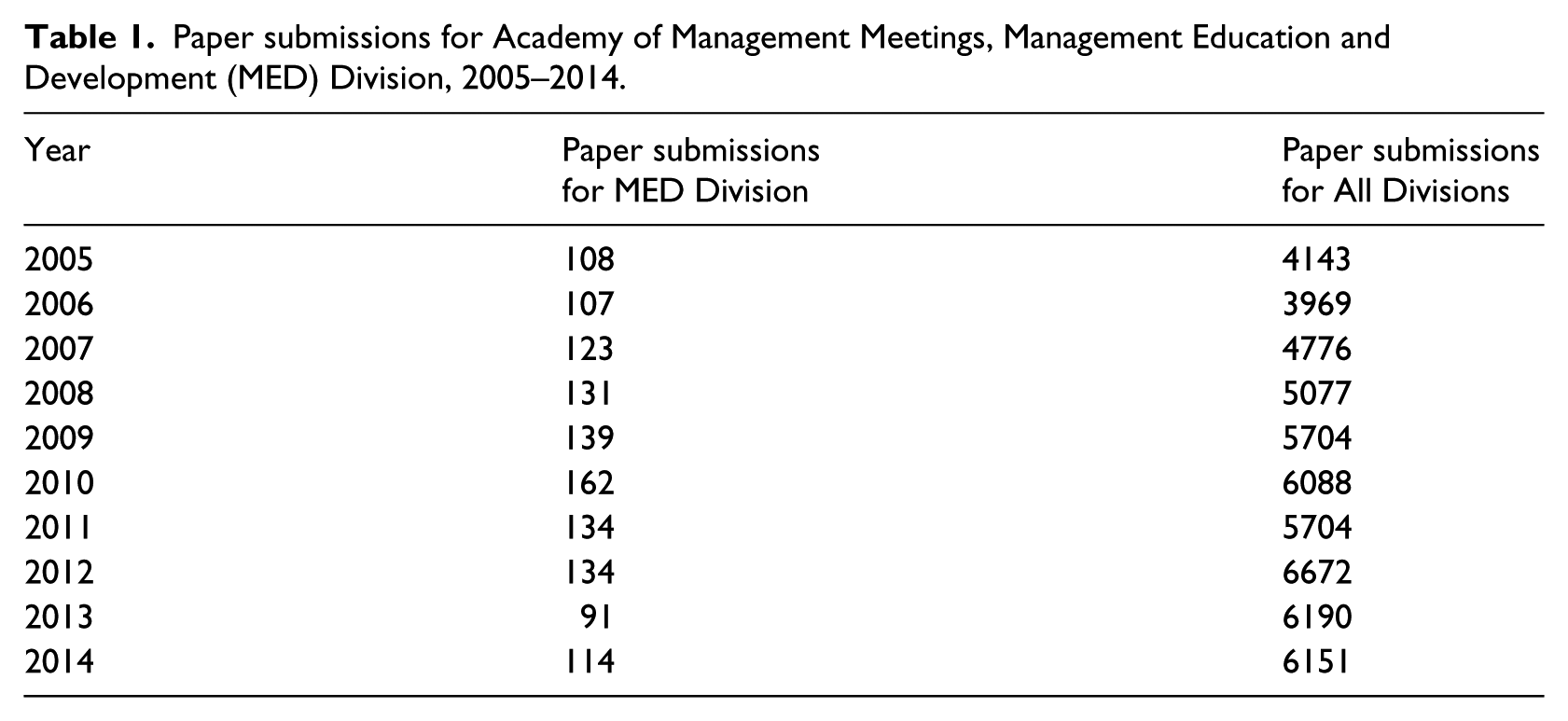
Even though history is not encouraging, examining potential future inputs may paint an even worse picture for the field. Consider the recent history of submissions to the AOM’s Management Education and Development (MED) Division for the annual meeting. Although submissions for the 2015 meeting were up substantially (180 papers), during the previous 10 years MED was trending decidedly downward while the trajectory of submissions for the entire AOM has steadily increased (see Table 1). Although there are other conferences where management education research is presented, the extended trend of lack of growth of submissions for a divisional program that is part of the world’s largest conference for management research when the collective submissions for the conference is growing cannot be a good sign.
Paper submissions for Academy of Management Meetings, Management Education and Development (MED) Division, 2005–2014.
Given this perhaps incomplete, but nonetheless disconcerting portrait, questions regarding the reversal of this situation take on increased urgency. Therefore, in this essay, I propose remedies for our current situation. I first examine common objections to pursuing a dedicated research agenda in management education that pertain to the lack of emphasis and exposure the field gets in doctoral training and beyond. I then argue that those outcomes do not have to be the case, even if the conditions attributed to causing them do not change. I then present positive arguments for pursuing research in management education, including showing several external conditions that are seen as serious concerns for business schools that may represent opportunities for management education researchers. I hope that through these arguments, new entrants into management education research might be encouraged to engage the field more fully, and that those already in the field might use these arguments to counter the perspectives they often encounter from their departmental colleagues and institutional administrators.
Common arguments against a career in management education research
Those of us who have been involved in management education research for some time likely have heard arguments for not pursuing this area of inquiry, most of which fall under some aspect of how it can be damaging to one’s career. Although perhaps these concerns were valid at one time, they are becoming less of an issue today. These concerns pertain to the lack of preparation opportunities for students to pursue educational research in doctoral programs and the perceived potential for scholarly impact of work published in this field. Because these perceptions are changing, there is another more subtle and likely unstated argument against cultivating dedicated scholars: having dedicated scholars raise expectations for management education scholarship may crowd out scholars who have populated the realm, in part because expectations for this work historically have been lower than those for work in the disciplines. I address these objections in the following paragraphs, along with counterarguments.
Management education research is not addressed in doctoral programs
A longstanding challenge for the advancement of management education research is that, for the most part, it has not been addressed in doctoral programs. This lack of attention has at least two impacts on young scholars during their formative years. First, the opportunities to be grounded in the management education literature are somewhat reduced (Billsberry, 2012). Second, the opportunities for mentoring in the area have been somewhat limited. Given the socialization they receive regarding their disciplinary work, it is not surprising that few doctoral students are learning and education scholars, and those that are typically have cultivated that interest on their own.
Although these are significant challenges, they do not have to be insurmountable obstacles. Because our research considers people and organizations, our theories and methods are portable to questions of classroom performance, learner and instructor behaviors, and institutions. Examples of such portability include Nemanich et al.’s (2009) use of knowledge stickiness to examine online undergraduate courses, Thompson and Purdy’s (2009) use of theories of political power and deep structure to examine a business school’s curricular reform efforts, and Dobrow et al.’s (2011) integration of organizational behavior and educational psychology literatures to explain how student choice over assignment weighting increased engagement in MBA courses. Recently, UW Oshkosh colleagues and I developed a framework by which human resources scholars can readily adopt their disciplinary theories and methods to the study of online instructors (Arbaugh et al., 2013). These articles suggest that scholars in the management field can use their disciplinary training as a springboard into studying educational issues in ways that disciplines in the business school, such as accounting and finance, cannot.
Regarding the issue of familiarity with prior literature, although this is a much larger obstacle than when I began studying management education, there is also an increasing number of resources by which scholars can access reviews of the research streams in management education. Armstrong and Fukami’s (2009) handbook on management learning and development provides reviews of several literature streams, and prominent research topics such as entrepreneurship education (Martin et al., 2013; Pittaway and Cope, 2007), networked/online delivery of management education (Arbaugh et al., 2009; Hodgson and Watland, 2004), and MBA programs (Rubin and Dierdorff, 2013) have received extensive recent reviews. Also, with the recent introduction of the Domain Reviews section in the Journal of Management Education (JME), experienced scholars have opportunities to provide current assessments of literature streams, thereby making it easier for prospective scholars to become familiar with these topics relatively quickly.
There are not enough outlets for management education research
After a prospective author identifies the state of the literature of his/her area of interest and possible ways to leverage his/her disciplinary training, there are other obstacles toward pursuing dedicated work in management education research. One obstacle is that there are not as many journal outlets available as there are for discipline-based management research. Although this may be the case, there certainly is no lack of outlets for business and management education scholars. For example, Currie and Pandher’s (2013) recent work using journal listings and expert panel surveys identified 84 journals that publish business and management education research (Full disclosure: I was the decision editor for Currie and Pandher’s article), and based upon a recent study I completed on business education journal bibliometrics (Arbaugh, 2015), it appears that they may have missed some. In addition to the increasing numbers of business education journals, there are possibilities for scholars to publish work on management education in highly regarded educational research or higher education journals. One of the benefits of these studies is that they help further delineate distinctions of journal quality. Currie and Pandher (2013) used input from their survey of active scholars to rate these journals ranging from very high quality (A+) to lesser quality (D), whereas Arbaugh (2015) used citation-based metrics to identify journals that publish highly influential business education articles as opposed to those journals that publish either few and/or rarely cited business education articles.
Not only is there an increasing number of journals, but these journals also reflect an increasing diversity of perspectives within management education research. Studies that have examined work published in prominent management education journals (AMLE, ML, JME, and the Decision Sciences Journal of Innovative Education (DSJIE)) have found that they have distinctive domains (Beatty and Leigh, 2010; Korpiaho et al., 2007; Rynes and Brown, 2011), and the co-editors of ML recently clearly articulated the domain differences between them (Cunliffe and Sadler-Smith, 2014). These journals also represent scholarly communities that may have some overlap, but also have highly distinctive areas. For example, ML seeks to connect strongly “with organization studies and organization theory … in research that advances knowledge of managing, organizing, and education” (Cunliffe and Sadler-Smith, 2014: 4). As for conferences that cultivate communities of management education scholars, in addition to the already-mentioned MED Division of AOM, there are the long-established Organizational Behavior Teaching Conference (OBTC), learning-related themes at the annual Organizational Learning, Knowledge, and Capabilities (OKLC) conference that either directly address or are readily applicable to educational contexts, management education as a prominent theme at the annual Critical Management Studies conference, and the increasing number of tracks devoted to issues in management education at the annual meetings of the Decision Sciences Institute. This abundance of journal and conference opportunities suggests that those who are concerned about the lack of venue for management education research just have not been looking recently and/or thoroughly.
Management education research does not “count”
After an author finds the journals that are the best fit for his or her work, the battle against obstacles is not over. Another common criticism against management education research is that journals in the field are not viewed highly for tenure and/or promotion (Schmidt-Wilk, 2007). However, this criticism also is increasingly without merit. Management education journals have made considerable progress in key journal ranking lists over the last decade. For example, in the latest (2015) Association of Business Schools (ABS) journal listings, AMLE is rated a 4, ML a 3, and JME a 2, respectively. The latest (2013) Australian Business Dean Council (ABDC) journal listings give AMLE its highest rating (A*), and ML and other mainstream business education journals such as Issues in Accounting Education and the Journal of Business Ethics have A ratings. Other educational journals that publish work related to business schools, such as the British Journal of Educational Technology, Environmental Education Research, Studies in Higher Education, and Higher Education, also have A ratings from the ABDC. JME, DSJIE, and several other disciplinary business education journals have B ratings. A B rating places a journal in the upper half of those rated by the ABDC, which suggests an increasingly favorable trend for the viability of management education research. Beyond these results, increasing numbers of US business schools include management education journals in their listings of acceptable publications for promotion and tenure. Although there is room for further progression in these listings, the trends suggest that aspiring management education scholars will have increasingly favorable professional environments in which to present their findings.
Management education research does not lend itself to citation (or other indicators of impact)
A final obstacle for the attraction of dedicated management education scholars is the perceived difficulty in identifying the impact of this work. Much of the influence of management education research is intended to be applied in classrooms by educational practitioners (Lund Dean and Forray, 2014; Schmidt-Wilk, 2008; Stambaugh and Quinn Trank, 2010); therefore, it does not lend itself to being cited by other scholars as readily as does work published in disciplinary journals, and is less likely to attract attention in venues noticed by management practitioners (Aguinis et al., 2012; 2014). Although some have suggested that this should make us less concerned about citations (Brown, 2014), in the context of attracting new dedicated scholars, I argue that we may do well to give more attention to the citation of management education research for at least three reasons (Billsberry, 2012).
First, we likely will better attract new scholars better by building bridges of familiarity rather than constructing obstacles of unfamiliarity. New scholars are likely to come from disciplinary backgrounds where citation-based metrics have become common. Therefore, similar to the issue of portable theories and methods, it seems reasonable for us to give attention to approaches with which they are familiar. Although such metric-based approaches create the potential for opportunism by those unfamiliar with the details of the literatures of our realm, that potential has been (rightly, in my opinion) called out by the co-editors of ML (Cunliffe and Sadler-Smith, 2014). Alternatively, using citation-based approaches to identify leading management education scholars could be an approach prospective new scholars might use to address the concerns regarding mentoring opportunities I mentioned earlier.
Second, taking a literature-based approach to our work may have significant implications for how we approach our teaching. Rather than being a means for arguing the lack of generalizability of approaches to research to those of teaching, attempts to de-emphasize the importance of citations in management education research actually may be more indictment of our collective unwillingness to look at teaching in a scholarly manner. Why is it so unreasonable to ask scholars to ground their approaches to teaching in the same way they ground their approaches to research (Dehler et al., 2010)? Rather than relying solely on our own prior experiences, would we not do a better service for our students by grounding the approaches to our classes in the peer-reviewed wisdom gleaned from other scholars? Finally, as we build bridges to new scholars, in part via citations-based approaches, the issue of lack of citations likely will increasingly take care of itself as these scholars use prior work to ground their research, thereby expanding the field’s domain. Having established the “inside the academy” approach for assessing the impact of our work (Aguinis et al., 2014), we then could move more definitively toward determining and developing indicators of impact from the broader audiences for our teaching-related activities.
We like our ghetto just fine as it is, thank you
I conclude this section of the essay by mentioning a speculative and not commonly publicly mentioned reason for why we may not pursue developing additional dedicated management education scholars. These new entrants could make things uncomfortable for those of us who have established reputations in the area by taking up space on conference programs and in journals where we have become accustomed to presenting and publishing, thereby forcing us to “raise our game” in order to ensure our voices continue to be heard. To this obstacle, I offer both altruistic and self-interested arguments. Appealing to altruism, there is an increasing variety and intensity of challenges being placed upon business schools by students, employers, and political entities regarding our ability to prepare graduates who will make a difference in their workplaces and beyond. Do we not want the best scholars possible wrestling with these issues as they pertain to management education? Appealing to self-interest, these new scholars likely would be building upon the work of those of us already in the realm. Therefore, as their activity increases, so would our own influence.
Emerging arguments for a career in management education research
In addition to the emerging counterarguments to traditional obstacles to pursuing careers in management education research, there are several emerging trends that call for more dedicated research in management education. The irony of these trends is that whereas many in business schools these days consider them as threats, management education scholars can see them as opportunities.
The world is a diverse place
As management education expands around the globe, cross-cultural approaches to its content and conduct become increasingly important (Doh, 2010; Eisenberg et al., 2013a, 2013b). Initial perspectives on the delivery of management education outside of North America and the United Kingdom suggest that traditional content and approaches to management education may not generalize well to other settings (Lamb and Currie, 2011; Liang and Lin, 2008; Liang and Wang, 2004; Ma and Trigo, 2011). This means that there are opportunities to attract scholars from business schools in developing countries to examine the generalizability (or lack thereof) of traditional approaches to management education, propose and examine alternative models, and cultivate practices that, in turn, could be considered for adoption by older, more established business schools. This is a situation where the “liability of newness” (Stinchcombe, 1965: 148) of business schools in these regions could work to the benefit of management education researchers. Because these schools are relatively new, cultural norms regarding expectations of where scholars should publish are less established. Therefore, the obstacles mentioned earlier to doing dedicated work in management education research are less likely to be established, thereby making it potentially easier for scholars to adopt different attitudes toward management education research.
Responding to increased scrutiny from external stakeholders
Conversely, in settings where business schools have been established longer, the external environment is increasingly turbulent. Political entities, donors, corporations, and parents are questioning the value of business school emphasis on research over teaching and other forms of stakeholder engagement (Graduate Management Admissions Council (GMAC), 2013). Amidst those calls for greater accountability, it seems that a greater emphasis on management education research is called for. Why would we not want to be able to show those external constituents (not to mention our students) that we have vetted our teaching approaches in rigorous and robust research on effective practice, and then show that we have scholars building upon this work to make our teaching even better through questioning its foundations and advancing it either by refining those efforts or by generating alternative approaches for our students? It does not require a large leap to make a case that this approach could be used to justify research not only on the process of our teaching, but also on the content of our teaching, thereby helping to better justify research across the business school to our stakeholders.
Management’s opportunity to lead in the business school
Previous studies of political dynamics in business schools suggest that the management discipline often holds relatively lower levels of influence (Rubin and Dierdorff, 2011; Thompson and Purdy, 2009). However, in part because of the advantages of portability of research approaches mentioned earlier, the management discipline is in an uncharacteristic position to lead the business school forward in this area. Although disciplines such as accounting and marketing have established educational research infrastructures (Apostolou et al., 2013; Gray et al., 2012), a disproportionate number of the most cited articles in business education research were written by authors from the management discipline (including multiple articles from ML co-editor Ann Cunliffe; Arbaugh et al., 2014). When presented as a potential solution for the concerns regarding increased external scrutiny, other disciplines may even welcome the idea of allowing us to take the lead in producing this research and articulating it among our external stakeholders.
Engaging practitioners and research subjects without leaving your academic building
Regardless of the geographic setting in which management researchers reside, continual obstacles to quality research are securing funds to do the work and getting access to research settings and data. One sizeable advantage to conducting educational research is that access generally is much easier to attain, and therefore less expensive in terms of time and travel. Because the practitioner audience is management educators, disseminating your work to practitioners can be as easy as talking about your work in department meetings or faculty workshops. In addition to the opportunities for engagement with practitioners, conducting educational research or having departmental colleagues who do can make it easier to build cases for potential research subjects for pedagogical approaches used in your courses.
Additional need areas
Hurrah for the RMLE “unconferences”
One encouraging development to spur the acceleration of management education research across the globe is the creation of the annual Research in Management Learning and Education (RMLE) “unconference.” Originated in 2013 (Billsberry et al., 2013), this event is a gathering of global scholars, journal editors, and other thought leaders in management education to identify and address present issues and to set the agenda for future research. Reflecting the increasing diversity of geographic and other perspectives for management education, the “unconference” is (perhaps intentionally) held in locations other than where management education research has been established traditionally (North America and the United Kingdom). I hope that this event continues to stimulate developments in the field, and heartily encourage readers to attend, contribute their ideas, and build upon others’ ideas while there.
How might management education scholarship be funded?
One obstacle for attending “unconferences” and other management education conferences is lack of funding. Although externally generated research funding may be increasingly common for disciplinary research in business schools, such has not been the case for supporting the study of management education. Unfortunately, even those efforts to fund management education research have met with mixed effects. GMAC’s Management Education Research Institute (MERI) funded efforts I was involved in to study regional effects of MBA education and career shifts of MBA graduates (Hwang et al., 2011), and a faculty fellowship that I used to study disciplinary effects in online MBA courses (Arbaugh, 2013). However, this program has not provided any new grants since 2011, and has been reoriented toward developing edited volumes compiled by management scholars (GMAC, 2013), in part because of a lack of quality of research proposals and a limited number of proposers developing them. The fact that funding programs are being reduced or eliminated suggests that calls like the one provided in this essay should have been going out some time ago.
How might we facilitate mentoring?
As I mentioned earlier in this essay, a relative lack of mentoring opportunities is a significant obstacle. We do not often have the mechanisms for developing the dissertation adviser–doctoral student relationship that is foundational in disciplinary research. Although there are opportunities for new scholars to get feedback on papers at writers’ workshops at various conferences, these tend to be initial efforts where longer-term relations are the exception rather than the rule. Although academic mentoring relationships have their own sets of challenges (De Janasz and Sullivan, 2004; Gersick et al., 2000), it seems that we will be more successful in developing new scholars by being more intentional about identifying and cultivating these relationships than by haphazardly leaving them to chance.
A way forward?
I suspect that I speak for others who have track records in management education in that we wish to be the first of many rather than the faithful few. By no means do I wish to turn business schools into places where the only research we do pertains to ourselves, our classes, and our programs; however, business schools are missing out because relatively few focus on work in this area. I hope that through establishing research frameworks, building our networks, and cultivating relationships with emerging scholars around the world, we can help develop a much larger next generation of management education scholars who will refine and contextualize the positives and counter the concerns regarding business schools and management education.
Footnotes
Funding
This research received no specific grant from any funding agency in the public, commercial, or not-for-profit sectors.