



Abstract
The question of the social relevance and social impact of knowledge has gained prominence. However, the debate appears to have been restricted to academia in North America and the United Kingdom, which possess their idiosyncrasies. This study presents and analyses the dual research system of a Brazilian business school that has both applied and scientific research centres and concludes that (a) the development of the applied research centres had its roots in resistance to the introduction of a scientific business school model, (b) scientific research and applied research generate tensions when they coexist alongside one another, (c) the search for social relevance does not require scientific sophistication, and (d) the objective of generating social impact goes beyond achieving social relevance and requires specific competences that are not related to research activity. This study advocates for a critical and moral perspective with regard to the dominant model of scientific production.
Introduction
In Brazil, far from the most developed academic centres, the debate about the evolution of scientific production and the social role of universities has commanded media attention, revealing the public’s interest in the matter. Media reports have registered the country’s positive evolution in terms of scientific production but criticized the poor quality of this production, which pundits argue has been lacking in relevance both to science and to society (Estadão, 2013; Folha, 2014a). The lack of scientific relevance means the results of research have little influence on science, as measured by citations (Folha, 2014b). Lack of relevance to society relates to the few benefits of Brazilian scientific production to the Brazilian population (Estadão, 2013).
Debate about the role of universities acquires a moral dimension in a developing country that faces problems related to poverty, inequality and the poor quality of its health, education and transportation services. How can we justify the substantial public funds earmarked for financing university research when faced with the supposed lack of social relevance and impact of the knowledge generated?
This study attempts to interact with the debate about the social relevance and social impact of knowledge from the Brazilian context. It seeks to adopt a critical perspective, informed by the ethics of care (Folbre, 2001; Gilligan, 1982; Held, 2006; Noddings, 1984; Sevenhuijsen, 1998; Tronto, 1993). The study presents the experience of the Escola de Administração de Empresas de São Paulo (São Paulo Business Administration School – EAESP), the oldest and most traditional teaching and research institution in Brazil in the management and business field. This institution has what Kieser and Leiner (2009) identified as the dual research system: applied research centres and scientific research centres.
This study highlights a collective reflection process that was conducted by a group of leaders and researchers from the applied research centres (some of whom also worked in the scientific research centres) who were supported by this study’s author. The objective of this process was to address the question ‘How can social impact be increased?’ More specifically, ‘What practices and processes can be employed to develop or organize relevant knowledge and transfer it to interest groups to maximize the possibility of generating social benefits?’ The process was based on the practical experiences of the participants and was conducted through informal interactions, interviews and workshops. It resulted in a set of activities that intends to respond to the above questions.
This study makes three contributions. First, it reveals the possibility of resisting the hegemonic knowledge production mode, demonstrating that particular environmental and cultural conditions determined the rise and growth of applied research centres even when institutional pressures for legitimization (Meyer and Rowan, 1977) determined that priority should be given to scientific research structures. Second, it reveals the tensions that result from the existence of two ways of generating and producing knowledge in the same institution. Third, this study indicates some challenges presented by alternative ways of producing knowledge that require specific competences.
The remainder of this study is organized as follows. The second section approaches the debate about the social impact of knowledge from the Brazilian perspective. The third section addresses the experience of EAESP. The fourth section contains lessons and reflections about the case presented. The fifth section highlights the moral dimension of the question of social relevance and social impact in a developing country.
An outside perspective on debate about the social impact of knowledge
Rigour and relevance
The social relevance and impact of knowledge and the parallel theme about rigour and relevance in research have been widely addressed by scholars. Nicolai and Seidl (2010) counted 133 published articles that are wholly dedicated to the rigour versus relevance debate. However, some authors adopt a critical perspective on how the debate itself has developed. In the introduction to a special edition about organization studies as an applied science, Jarzabkowski et al. (2010) note their surprise at the small number of submissions based on empirical work and declare that there appeared to be a great deal of ‘armchair philosophizing’. Thorpe et al. (2011) observe that the debate frequently occurs between scholars writing in academic journals and that it is ironic that academia reacts to accusations of a lack of relevance by holding even more academic debates. Similarly, Alvesson (2012) recognizes that specialization in organization studies means that most research is of limited interest and a strong feeling exists that the field is irrelevant.
As these authors suggest, the academic debate appears to have advanced to the point of establishing a critique of the dominant way that knowledge in the field is produced, which is frequently referred to as Mode 1. This mode represents traditional scientific research in which research questions are defined and addressed within a particular scientific field and which generate work that is of interest to players in this field (Alvesson, 2012; Pettigrew, 1997, 2001, 2011). The debate also proposes an alternative way that is commonly referred to as Mode 2 in which knowledge is transdisciplinary and produced in a more open context that considers the social implications of the knowledge generated (Gibbons et al., 1994; Nowotny et al., 2001, 2013). Furthermore, the debate adds a critical and reflective perspective on the question of how and for whom knowledge is produced (Bresnen and Burrell, 2012; Starkey et al., 2009).
Historical roots
The starting point of any critique of Mode 1 is often a specific report by the Ford Foundation from the late 1950s, which negatively evaluated North American business schools and indicated that massive infusions of science were called for to strengthen the bases of management and business teaching (Gordon and Howell, 1959). As Kieser and Leiner (2009) observe, the suggestion appears to have been taken so seriously that it generated a disequilibrium that is opposite to the original, creating faculties of professors who are permanently focused on publication in top journals and on their careers as researchers but less concerned with teaching or with the possibility of their research having practical applications.
Four decades after the Ford Foundation report, the theme of a lack of practical relevance and social impact began to occupy the focus of presidential speeches during meetings of the Academy of Management and texts by illustrious North American academics, who expressed their concern about the lack of practical relevance of scientific research (e.g. Hambrick, 1994; Huff, 2000; Rousseau, 2006). Starkey et al. (2009) argue that the current dominant model favours rigour over relevance, leading to the generation of research that interests few beyond the academic community.
An emphasis on rigour instead of relevance favours ivory tower mainstream academics and defenders of the status quo. In Brazil, a new generation of management and organization studies researchers has been educated in graduate programmes within an institutional context that follows the international academic mainstream: they prefer to discuss methods instead of phenomena or research subjects, they focus on publications (preferably in top journals) instead of social impact, and they search for connections with mainstream researchers abroad and dream of becoming quantitative methods experts. Most are Mode 1 researchers, producing academic, mono-disciplinary research, defined and evaluated solely by their peers (see Bertero et al., 1999; Bertero et al., 2013).
It is worth mentioning that the dominance of Mode 1 thinking serves groups beyond the faculty in the scientific research arena, such as the publishers of scientific journals; business school deans and managers, who use lists of the papers published by their faculty members in top journals to improve their reputation and their schools’ position in rankings to attract new students and increase revenues, and, in Brazil, a significant number of bureaucrats working in government agencies that monitor and evaluate research output.
What it means to be a scholar
Pettigrew (1997) argues that scientific research must meet the double challenge of rigour and relevance. In a more recent paper, this same author indicates the conditions for enabling the changes, which are centred on academia becoming more open to society, on collaborative processes that must involve academics and multiple interest groups in the various stages of the research, on the adoption of strategies for knowledge exchange and on the existence of those who translate and expand the knowledge produced (Pettigrew, 2011: 351).
Pettigrew’s arguments echo Boyer’s (1990) seminal work on what it means to be a scholar, considering the complete range of academic and civic mandates (see also Glassick et al., 1997). Boyer criticized the reward systems pervasive at American universities as too narrowly defined and mentions that although research is crucial, a commitment to service is also required. In short, the main objective of higher education is to serve the interests of the larger community.
Beyond the Mode 1 versus Mode 2 dichotomy
Gibbons et al. (1994) argue that Mode 1 knowledge production should give way to Mode 2 knowledge production. In this late mode, a collaborative partnership ideally forms between researchers and practitioners, who jointly define the research topic, choose the method, undertake the analysis and work to disclose the results (Shani et al., 2008).
Although the counter-positioning of ideal types – Mode 1 versus Mode 2 – is intellectually stimulating, it may mask hybrid alternatives and the possibility of generating social impact that may occur regardless of the way knowledge is produced. Indeed, one can suggest a perspective that could include multiple paradigms of knowledge and knowing. For instance, adopting Burrell and Morgan’s (1979) classic framework, one could propose that Mode 1 might be associated with the functionalist paradigm, with an objective view of knowledge, that is, knowledge as a thing or a stock. Mode 2, on the other hand, might be associated with the interpretive paradigm, that is, knowledge as a social construction. One can also hypothesize a Mode R, which might be associated with the radical humanist paradigm or the radical structuralist paradigm, that is, one that focuses on knowledge as a means for emancipation and radical change. Adopting this view instead of the polarized perspective of the debate between ideal types – Mode 1 versus Mode 2 – implies rejecting the rigid separation between theory and practice and looking for a combination of rigour and relevance.
Viewed from the outside, the debate in mainstream academia is relevant and interesting, and it certainly contributes to creating new perspectives on the topic. However, as observed by Jarzabkowski et al. (2010) and by Thorpe et al. (2011), the debate appears to be an internal discussion by academics for academics. There is indeed a lack of empirical research on this topic.
The dual model of knowledge generation
Origins and characteristics of the dual model
EAESP was created in 1954 with the support of a group of professors from Michigan State University. In the decade following its creation, EAESP received funds from the Ford Foundation. This institution had an influence on the provision of scientific bases for management and business teaching in North American business schools. However, as Cooke and Alcadipani (2015) demonstrate, although EAESP received the Ford Foundation funds, their professors moulded the institution according to their own priorities and did not adopt the scientific profile. Instead, they maintained a teaching and management practice orientation.
At the end of the 1980s, professors from EAESP began to establish applied research centres. These centres emerged from a grouping of professors and researchers who had common research interests and out of the identification of social and business demands associated with the themes they investigated. From the beginning, these centres were closer to Mode 2 knowledge production than to Mode 1.
By the end of 2014, EAESP had 12 registered applied research centres with 109 professors in addition to dozens of researchers who were frequently recruited among graduate students, totalling more than 230 people. Table 1 lists the centres and the respective numbers of professors from each. Considerable diversity exists between the centres in terms of their size, activity (generating vs spreading knowledge) and access to resources.
EAESP applied research centres in 2014.
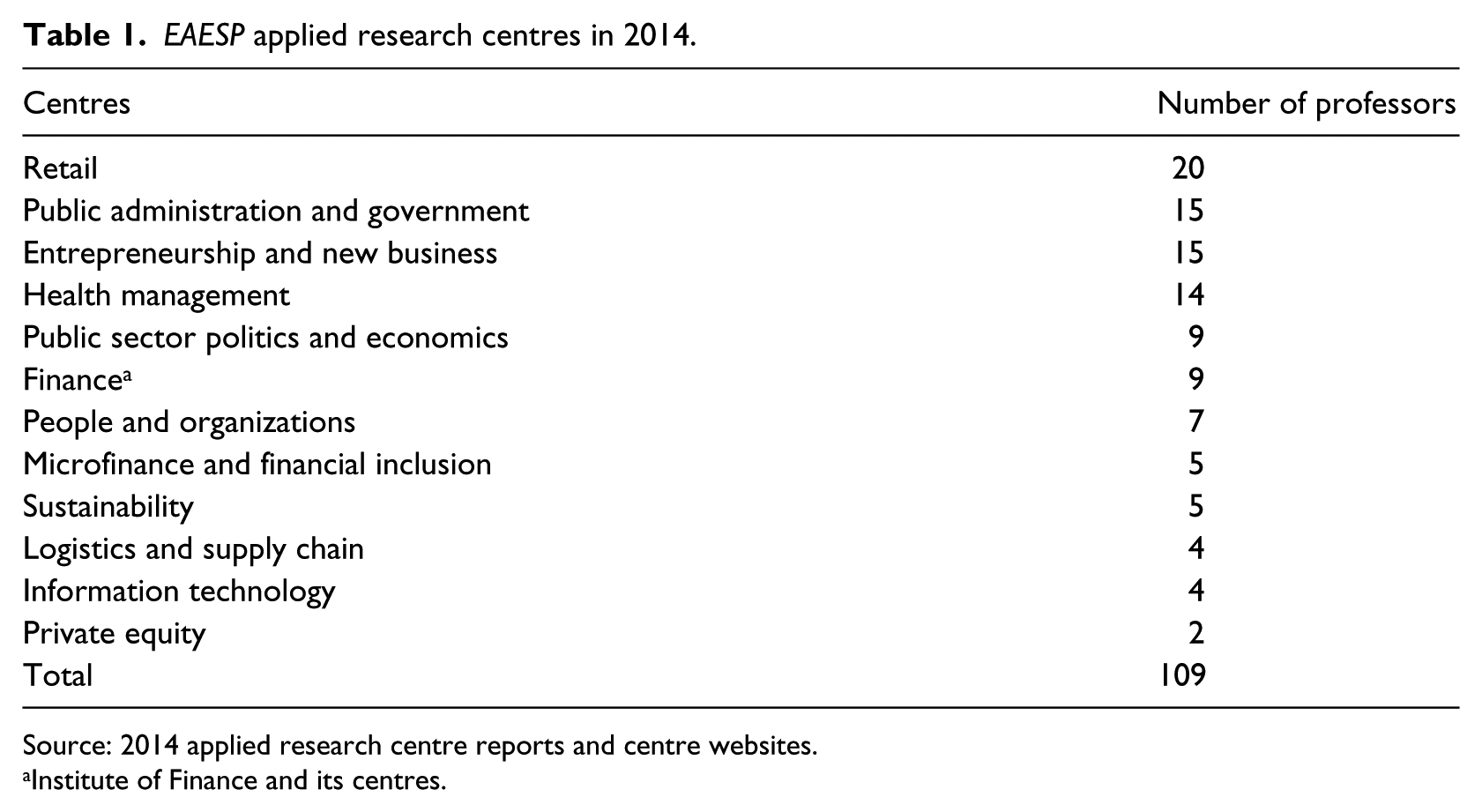
Source: 2014 applied research centre reports and centre websites.
Institute of Finance and its centres.
All the centres are financially self-sufficient and receive external funding to cover the costs of their activities. The centres themselves raise the funds, which in 2013 amounted to approximately US$4m, from class associations and companies (43%), public research development agencies (24%), international organizations (21%) and foundations and non-governmental organizations (NGOs) (12%) (Research FGV-EAESP, 2014).
The applied research system (Mode 2) coexists with the scientific research system (Mode 1) introduced in the mid-1990s. Unlike the applied research centres, which were created from the bottom up, the scientific research centres were created from the top down because of the guidelines of the Brazilian agency that regulates postgraduate programmes and is linked to the Ministry of Education. The activities of the scientific research centres were also strongly encouraged by the Association to Advance Collegiate Schools of Business (AACSB) and the European Foundation for Management Development (EFMD) international certification organizations, which began auditing and certifying EAESP.
The scientific research centres aim to develop and publish papers in top journals. In 2014, the scientific research system had 50 professors located in 10 centres. Table 2 lists the scientific research centres and the respective numbers of professors involved. It is worth mentioning that 22 EAESP professors are highly involved in both systems, and eight of these 22 professors coordinate applied research centres. This characteristic helps bring together scientific and applied research as well as rigour and relevance.
EAESP scientific research centres in 2014.
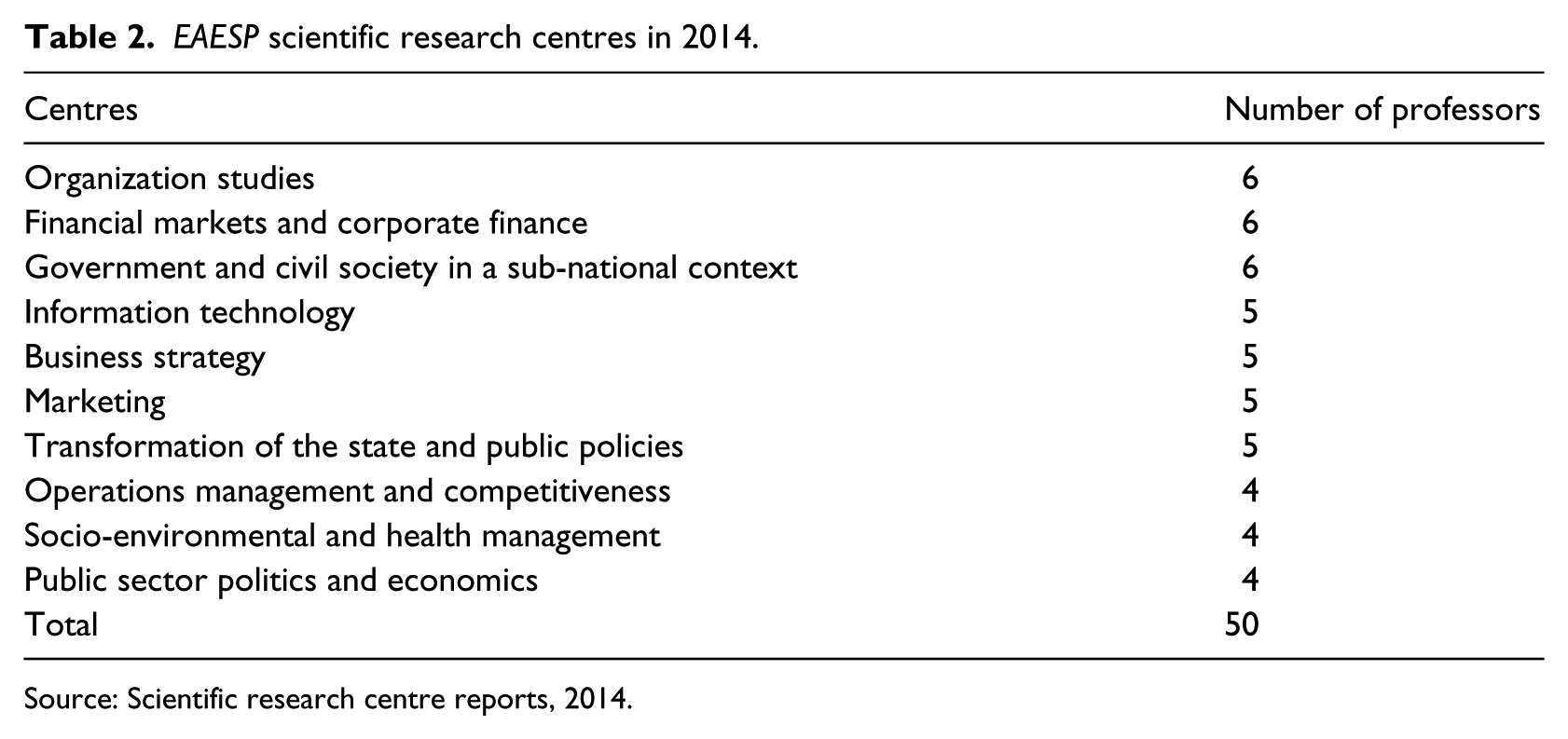
Source: Scientific research centre reports, 2014.
How to increase social impact
From December 2013 to December 2014, several activities were conducted attempting to answer the question ‘How can the social impact of applied research centres be increased?’ During this period, two 8-hour workshops were held (the first in December 2013 and the second in December 2014), as well as four 2-hour meetings (between the two workshops) and various specific meetings and informal conversations.
In the first workshop, the applied research centres were asked to present examples of initiatives that resulted in social impact. The objective was to exchange experiences and generate collective learning about the most effective ways to create social impact. The initial list was later reviewed for this article. Table 3 presents the results, which represent an intentional sample of initiatives for the applied research centres.
Social impact initiatives.
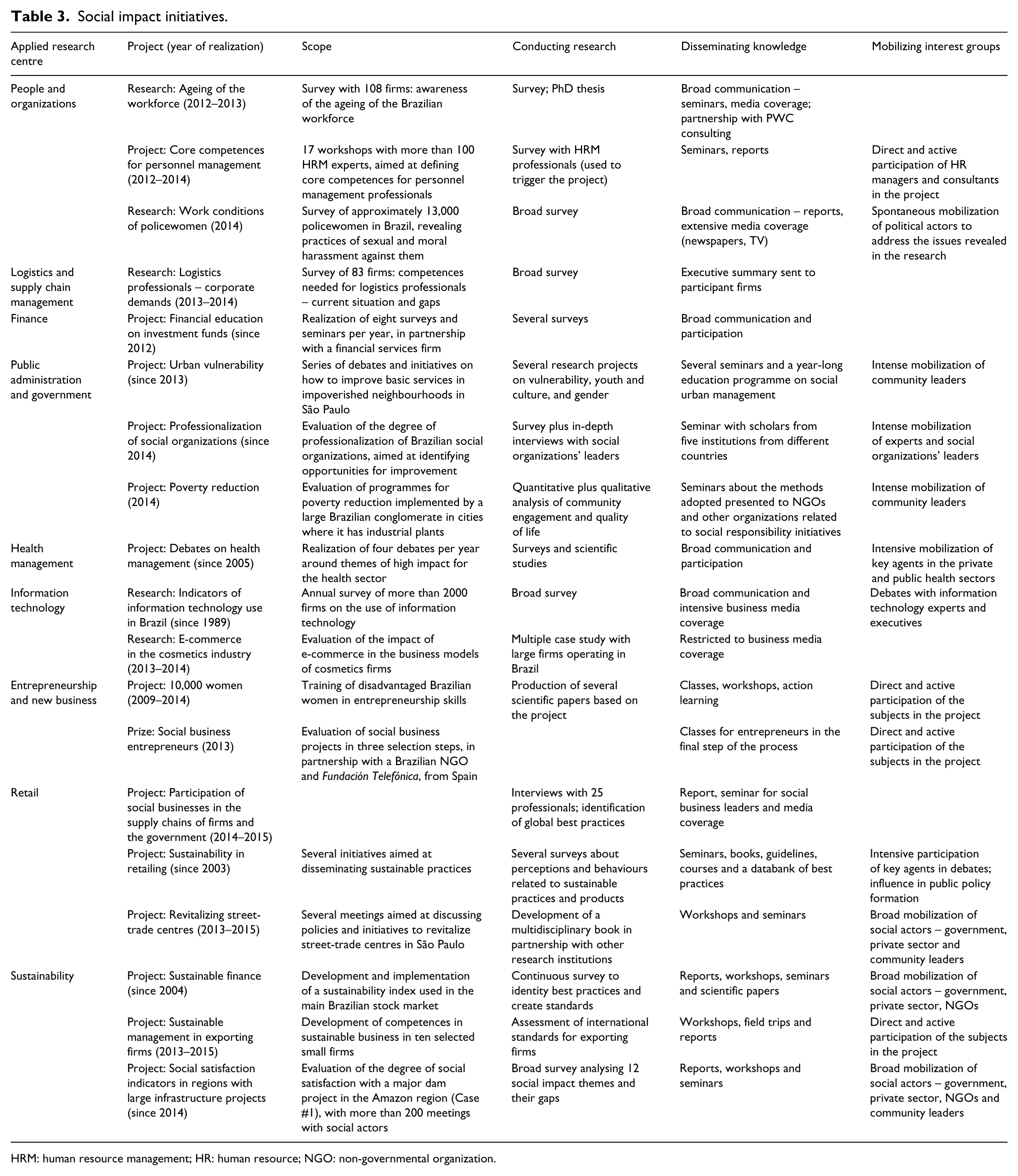
HRM: human resource management; HR: human resource; NGO: non-governmental organization.
A total of 19 initiatives that had been conducted by 10 of the 12 centres are presented. These initiatives were analysed to identify those that focused on knowledge generation (undertaking research) and those that focused on spreading knowledge (communicating and holding events). As a result of the information received, an additional classification category was created, called interest group mobilization, which was highlighted in a number of cases. This new category included activities that foster contact between academics and practitioners and increases the potential for social impact.
The 19 projects were identified by the coordinators of the research centres themselves, as representative or typical of their work. The analysis was based on the yearly reports prepared by the centres (from 2011 to 2015). These reports contain a vast amount of data about the centres’ activities. The reports also contain detailed information about each project. Additional data were obtained through interviews and email communication with centres’ coordinators and project managers.
The survey revealed some relevant outcomes. First, all the topics that the centres addressed had clear social relevance and were aligned with issues that were important to Brazilian society and local organizations. Second, all but 1 of the 19 initiatives involved conducting research, all involved disseminating knowledge, two-thirds involved mobilizing interest groups and two-thirds involved all three activities. This finding also highlights the mobilization of interest groups, which occurred to some degree in most initiatives and was emphasized by the participants as being very important to achieving social impact.
Key activities for social impact
Based on the cases, four key activities (each one with three main characteristics) were identified (see Table 4). These activities occurred or should occur in ways that would increase the social impact of knowledge. It is worth mentioning that these activities may occur individually, in different sequences, or even simultaneously.
Key activities for social impact of knowledge.
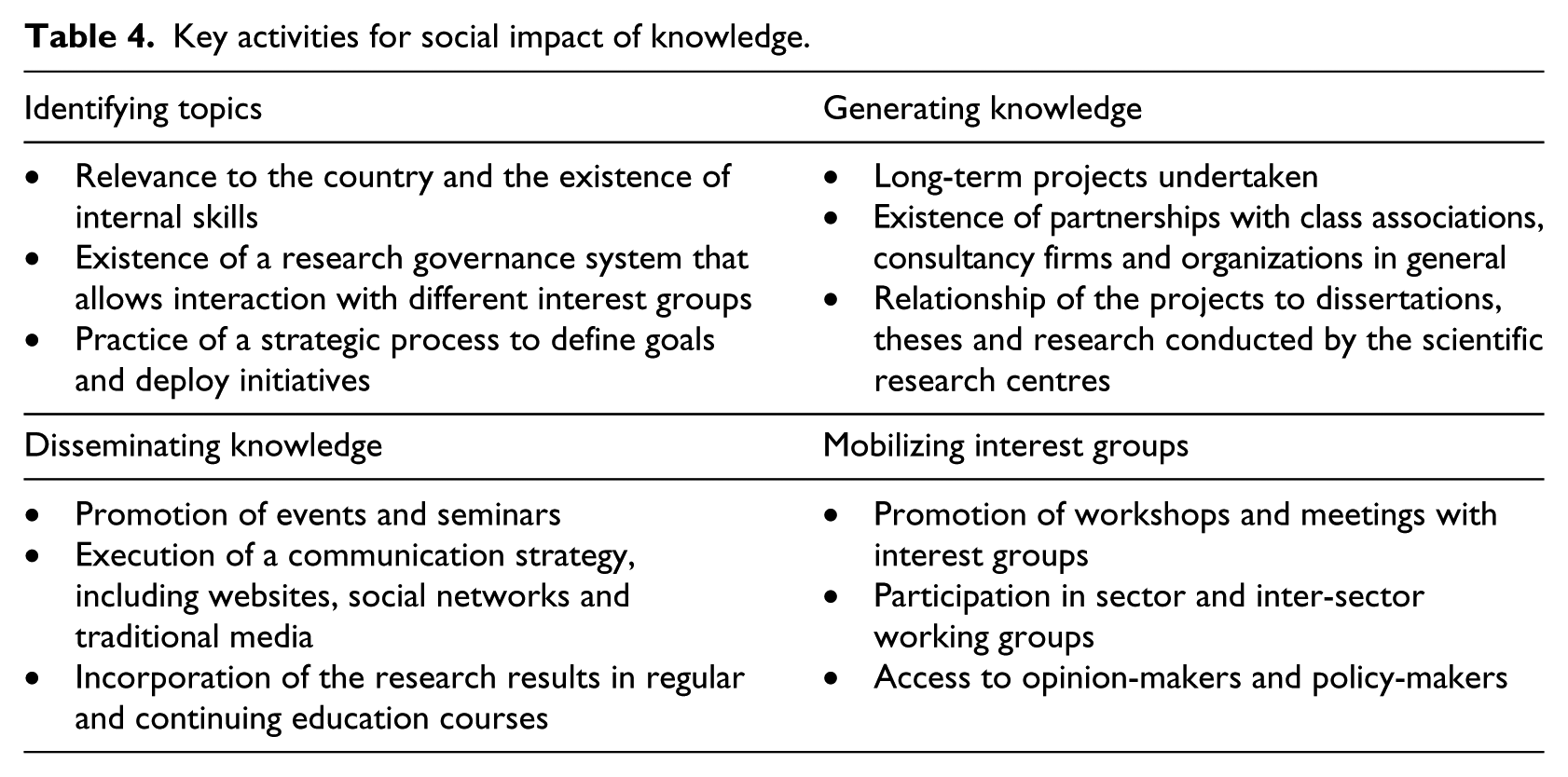
The first key activity relates to identifying topics. Clearly, identifying relevant topics constitutes a starting point for developing research that has social impact. Such topics must be recognized as being important to the country, its organizations and its society (Boyer, 1990; Eisler, 2007; Hankivsky, 2004) and as corresponding to a base of differing internal skills and competences (Barney, 1991). This premise contrasts with the common tendency among scientific researchers to align their research with international academic agendas, which are not always consistent with local realities. The second premise is the existence of a research governance system that must materialize in the form of a committee that comprises multiple interest groups whose mission is to approve the projects’ objectives and scopes and evaluate their results. The third premise is the existence of a formal strategic planning process to guarantee a permanent alignment between the missions, visions and research actions of the applied research centres.
The second key activity relates to knowledge generation. The first premise is to conduct long-term projects that enable building knowledge about broad and complex subjects. The second premise relates to developing and maintaining partnerships with class associations, consultancy companies, social organizations and government organs. This closeness facilitates access to the field to conduct research and helps to establish a commitment to the practical application of the knowledge generated. The third premise relates to establishing links between applied and scientific research through the participation of scientific researchers and PhD and Master’s students. This situation provides applied research with rigour and facilitates access to the field to scientific researchers, thus providing advantages to all.
The third key activity relates to disseminating knowledge. Scientific researchers frequently perceive the end point of their work as publication, ideally in a top journal. In applied research, an article is a way of systematizing and spreading knowledge, and publication is not an end in itself. The first premise relates to promoting events and seminars. Several of these were events for communicating results to opinion-makers and to the media. The second premise relates to executing a communication strategy that should include the use of websites, social networks and the traditional media. The first and the second premises strongly relate to the idea of legitimative relevance (Nicolai and Seidl, 2010). The third premise relates to incorporating the research results into regular and continuing education courses. One may argue that impact through education is particularly relevant because it occurs at a deeper level.
The fourth key activity relates to the mobilization of interest groups. The first premise relates to promoting workshops and meetings with interest groups. The knowledge generated by the research is used with the objective of offering the interest groups new perspectives that could relate to what Nicolai and Seidl (2010) identify as conceptual relevance. The second premise relates to participating in sector and inter-sector working groups. Participation in these groups is important because it draws researchers closer to the decision-making processes.
As previously mentioned, applied research centres are very diverse in terms of their size, activity and access to resources. This diversity is also manifested in their degrees of domination of the four key activities for social impact. Some centres have become notable for their capacity to generate knowledge, but during the time of their existence, they have dedicated little effort to spreading this knowledge. In contrast, others are notable for their capacity to spread existing knowledge and for their relationships with different interest groups, but they dedicate little energy and few resources to generating new knowledge.
Discussion
Resistance and ceremonial behaviour
The establishment and development of EAESP applied research centres can be seen as a story of resistance. From the mid-1990s until the beginning of the 2010s, the centres worked on the margins of a system that values and favours scientific research to the detriment of applied research. As previously mentioned, this system was created from the mid-1990s as a function of the guidelines issued by the agency that controlled postgraduate studies in Brazil and was reinforced by the AACSB and EFMD certification processes to which EAESP was subject. In the late 2000s, these guidelines began to be altered, and greater emphasis is now placed on the question of social impact (AACSB, 2008, 2012, 2013; EFMD, 2013). However, EAESP’s research and career management practices in 2014 still favoured scientific research-oriented researchers. Even so, the applied research centres have grown significantly in terms of the researchers involved, the number of projects undertaken and the amount of financial resources mobilized, based on the personal efforts of the affiliated researchers and their personal commitment to broad societal interests and values (Eisler, 2007; Hankivsky, 2004).
The root of this resistance behaviour and proximity to management practice can be traced back to the early years of EAESP in the 1950s and 1960s, when the institution rejected the plan outlined on the basis of the Ford Foundation report that would have implied a ‘scientific turn’. As Cooke and Alcadipani (2015) observe, EAESP at the time managed to maintain its orientation towards teaching and its proximity to management practice, which was consistent with its location in the largest urban, commercial and industrial centre in the country and with the profile of its professors, who were always more closely aligned with executive and consultancy activities than with research. By adopting ceremonial behaviour (Caldas and Wood, 1997; Wood and Caldas, 2002), the institution appeared to be conforming to pressure, and it retained access to Ford Foundation funds, but below the surface, it conducted its business in the way it believed was best for itself and the country.
Hybridism and tensions
Mode 1 and Mode 2 (Gibbons et al., 1994) coexist at EAESP, forming a dual system (Kieser and Leiner, 2009). This hybrid system is characterized by the coexistence of different strategies, management models and even values (Wood, 2010). However, not all the scientific research centres fully correspond to Mode 1, and not all the applied research centres fully correspond to Mode 2. In fact, a more accurate image of the system would be a continuum, with some centres approaching the ideal models (Mode 1 and Mode 2) but with most situated between the two extremes.
However, tensions exist between the applied and the scientific research centres. The first relevant tension refers to the difference in their focuses. Professors who work in scientific research see themselves as scientists, who employ strict scientific methods. They are frequently aligned with international research groups. Some of them perceive their colleagues who work in applied research as mere practitioners who employ methods that are not very strict and that are oriented to the short-term demands of companies and the market. Conversely, professors in applied research view themselves as researchers who are concerned with real problems and who operate in the real world, seeking solutions to relevant issues; some of them perceive their colleagues who work in scientific research as armchair theoreticians, focused on investigation methods and working with hermetically sealed topics that are of little interest or relevance to management, to business or even to society.
The second relevant tension refers to the different career management systems that serve the two groups. Researchers involved in scientific research groups are all faculty members, have higher salaries than their colleagues who work with applied research, have reduced teaching hours and receive compensation for travel and for research activities. They also have access to prizes for publications and have special status. Researchers who are part of the applied research groups are frequently lecturers, have lower salaries than their colleagues who work in scientific research and have more restricted access to internal research expense allowances. Their internal status is perceived as lower than that of their scientific research colleagues.
It is not rocket science
Alvesson (2012) poses two provocative questions: ‘Aren’t we writing and publishing too much? Does society benefit from all this research?’ (p. 86). Indeed, a considerable distance appears present between the amount of knowledge in scientific journals and the needs of organizations. The Brazilian reality, perhaps similar to the situation in other developing countries, poses challenges that are frequently simple in terms of knowledge about management and business. Many Brazilian companies have chronically low productivity, are not competitive and are in need of basic management tools. Many Brazilian public organizations suffer from basic issues related to lack of proper managerial control and the poor allocation of resources. Many Brazilian NGOs face challenges related to simple strategic definitions, such as where and how to operate. The challenge in helping solve problems and generating social impact is not to generate even more knowledge but rather to have intermediaries who are sensitive to the context (Hotho et al., 2014) and who are capable of translating existing knowledge (Pettigrew, 2011).
Social impact: Beyond social relevance
Nearly all the researchers in the applied research centres aspire to achieve social relevance: they believe that the work they do is important for the country and that they have a role to play in society. However, social impact is more than social relevance: it involves generating, or being capable of generating, change – something that is perceptible, recognizable and, if possible, measurable (Lima and Wood, 2014). The ambition to generate social impact still appears to be beyond the horizon for many of these researchers. They see themselves as participants in collective processes that seek improvements and solutions for organizations and for society, but research that results in a change in managerial practices or public policies still appears to be a distant objective in some cases.
On the other hand, some of the applied research centre projects signalled that it is possible to generate social impact and even revealed how such projects can come about. Such cases also indicated that generating social impact demands specific competences that are not directly related to the research activity. Among such competences are, first, a strong capacity to communicate and develop relationships with the media; second, the capacity to identify, attract and manage relationships with different interest groups; and third, the capacity to carry out activities of advocacy, a political practice that is planned and performed with the aim of influencing decision-makers and decision processes.
Final comments
This study reported the case of a dual research system that was established in a Brazilian business school. The narrative was presented from the viewpoint of an insider (Brannick and Coghlan, 2007). It highlighted the collective work that has been undertaken with the participation of leaders and researchers of 12 applied research centres.
No generalizations can be drawn from the experience as presented. However, this work allows us to perceive the characteristics, possibilities and points of attention of a dual research system (Kieser and Leiner, 2009) and to demonstrate that it is possible, although not easy, to respond to the double hurdles posed by Pettigrew (1997, 2001, 2011) related to the search for rigour and relevance.
The experience presented, particularly the analysis of the 19 projects conducted by the applied research centres (Table 3), returns us to the question of the moral dimension of research mentioned in the introduction: Is it correct and fair to allocate people and funds to projects that have no social relevance or clear social impact? In the case of management and business academia in a developing country such as Brazil, the answer is simple: No!
Indeed, the existence of self-centred systems that are primarily oriented, as indicated by Alvesson (2012), towards generating publications and thus guaranteeing symbolic and material rewards for authors, is likely to cause a feeling of uneasiness. These systems create elite bodies of researchers who are distant from local realities and who are guided by topics and agendas that are divorced from their own environments.
What can be done? Obviously, there is no easy solution. However, several initiatives could be implemented: first, business schools should deemphasize Mode 1 research that is solely oriented towards publication in top journals and stimulate applied research groups that are oriented towards social impact, as described in this article; second, business schools should approach business and business associations to bridge the gap between academic theory and business practice and create research agendas that reflect common interests; third, professional scholarly organizations, such as the Academy of Management (AoM) in the United States, the European Group for Organization Studies (EGOS) in Europe, and the Associação Nacional dos Programas de Pós-graduação (ANPAD) in Brazil, should promote applied research among their members through institutional policies, calls for papers and awards; fourth, certification bodies such as AACSB and EFMD should continue to emphasize the social impact of research and enforce their guidelines among certified business schools; and fifth, government bodies should include social impact in their metrics (the Research Excellence Framework (REF, 2014), in the United Kingdom, provides a good example and a laboratory on what can be accomplished).
In addition, governmental funding agencies should align their choices with national or local priorities, demanding submissions that address relevant issues and provide clear evidence of their social impact. Academics, through representative bodies working under a general social impact framework, could contribute decisively with their expertise to define these priorities. This approach would also guarantee that appropriated methods are applied to research projects so that both relevance and rigour can be achieved. Conversely, as research institutions, business schools should voluntarily abandon their search for notoriety solely through publications in top journals and make hearty efforts to achieve social impact. They could engage their own stakeholders, such as top-level executives, government deputies, NGO activists and other scholars themselves, and define priority themes for applied research. These themes should reflect both the competences and capacities available at the institution and the social, economic and cultural needs of the region or country. Applied research groups should, themselves, follow and align their efforts with this general strategy, engaging their own specific stakeholders in the process.
All that said, it is worth remembering Khurana’s (2007) critiques of business schools. In the very insightful book From Higher Aims to Hired Hands: The Social Transformation of American Business Schools and the Unfulfilled Promise of Management as a Profession, the author argues that the business schools neglected their original purpose – to create a new profession – and lost their way, letting themselves be guided by market forces. According to Khurana, the teaching of management ceased to be an educational activity to become an industry, able to move vast resources and generate enviable profit margins. The quest for social impact discussed in this special issue might be an encouragement for the business schools to recover their higher aims and societal orientation.
Footnotes
Acknowledgements
The author would like to express his gratitude to Rafael Alcadipani and Maria José Tonelli for their comments on early versions of the manuscript; to the anonymous reviewers, for their detailed suggestions; as well as to Escola de Administração de Empresas de São Paulo (EAESP) applied research centre’s leaders, for their unconditional collaboration and enthusiasm with this project.
Funding
The author received financial support from GVpesquisa for the publication of this article.