



Abstract
In this article, we highlight paradoxical tensions generated by in-company action learning. We consider the implications of these tensions for critical action learning, which has critical reflection as a core element of its theory and practice. Using paradox theory as a lens, we analyze data from two in-company action learning programs and build a model relating to critical action learning that has four interlinked features. The model can help evaluate in-company action learning with a view to identifying emotional and political dynamics that are open (or closed) to critical reflection. Such identification assists in making judgements about the appropriateness of critical action learning within a specific organizational context. Our broader contribution is to frame action learning and critical action learning not only as separate approaches but also as potentially interlinked stages in an ongoing process of individual and organizational learning.
Introduction
Action learning encourages people to ‘tackle important organizational or social challenges and learn from their attempts to improve things’ (Pedler and Abbott, 2013: 9). Critical action learning (CAL) additionally connects with the emotions and power relations that both promote and prevent people’s attempts to learn and improve things. CAL depends on critical reflection, which ‘can be understood as a process that inspires engagement with everyday emotions and politics as well as their effects on action’ (Pässilä and Vince, 2015: 48). Such engagement can generate tensions and contradictions. For example, a persistent problem for critically reflective approaches to learning is that efforts to reveal embedded organizational power relations tend to mobilize those power relations against critical reflection (Nicolini et al., 2004). This has led to the conclusion that critical reflection in organizations may be ‘just too difficult’ to implement (Rigg and Trehan, 2008). In this article, we reframe this not as a problem, but as a paradox.
Using paradox theory as an analytical lens (Smith and Lewis, 2011), we argue that it is possible to identify contextually specific, ongoing tensions mobilized by in-company action learning, as well as the likely role of these tensions in the stimulation and suppression of critical reflection. The value of a paradox lens is that it can identify both the more and less amenable tensions of power and politics that support and undermine learning within an organization. This means that it becomes possible to introduce CAL from an informed position, from an awareness of the actual dynamics that are likely to impose political limits on learning, and thereby to encourage and improve opportunities for transformations of practice.
It is not a new idea to say that action learning generates tensions or contradictions (Trehan and Rigg, 2015; Vince, 2012). However, it is a new idea to use paradox as an explicit lens through which to reveal contextually specific tensions arising from action learning and then to utilize these in support of critical reflection. Our contribution to knowledge therefore is to explore and develop the idea that action learning and CAL can be understood as interlinked stages in an ongoing process of individual and organizational learning. In practical terms, we create a model of CAL that has four interlinked features. This model can help evaluate in-company action learning with a view to identifying emotional and political dynamics that are open (or closed) to critical reflection. Such identification assists in making judgements about the appropriateness of CAL within a specific organizational context.
In the following sections of the article, we outline the key elements of the existing literature that combine into our conceptual framework. We provide background information on the two companies involved in our research; the research design and methods used, our approach to analysis of the data, and our findings. Emphasizing the ‘both/and’ (rather than either/or) elements of the findings, we pinpoint the underlying and ongoing tensions of in-company action learning. We identify three interlinked dimensions to the data that helped us to comprehend these tensions in relation to CAL and to build our model. We reflect on the differences between action learning and CAL, and also on the role of critical reflection in building a bridge between them. Finally, we discuss implications for practice.
Conceptual framework
Action learning and CAL
The central idea in action learning is that individuals can be supported to act and then to reflect on their actions to learn from direct experience (Pedler, 2011). This ongoing process of action and reflection is undertaken with peers, who implicitly comprehend and quite often share work problems and issues. Such ‘comrades in adversity’ (Revans, 1983) are similarly engaged in an ongoing struggle to make sense, improve, create, and transform their working practice. Through membership of an action learning group (or ‘set’), individuals develop strategic actions that can be tested and transformed in practice. Therefore, action learning is designed to mobilize learning-in-action, to integrate learning as an everyday work practice. Learning occurs through the process of questioning current knowledge, through taking action as a result of such questioning, and through reflecting on action.
Action learning can provide the opportunity for managers to learn new things about themselves and their practice, to test out new perspectives and approaches, and to discover new ways of working with others (Pedler, 2011). It can also help to impose limits on learning in organizations and reinforce current assumptions and ways of working (Vince, 2012). This second, less acknowledged aspect of action learning is undertaken in support of the existing relations of power. The recognition that action learning has both transformational potential and serves political purposes can underpin a different way of thinking about its design and delivery. Our view is that all approaches to action learning are likely to both support and undermine learning. We should not try to remove or resolve this contradiction because it is integral to learning in organizations.
More recently, it has been acknowledged that learning from experience also needs to be aligned with learning from organizing (Coghlan and Coughlan, 2008; Trehan and Rigg, 2015; Vince, 2004). This perspective addresses the fact that action learning is always undertaken in the context of collective emotional dynamics, complex interpersonal relations, as well as the everyday politics and entrenched power relations that surround our experiences in organizations. Emotional and political dynamics within organizations shape how individuals and collectives are able to take action. This means that all attempts to organize learning are prone to the creation of activities that are potentially self-limiting as well as developmental (Vince, 2008). For example, while people working together in action learning groups can be ‘comrades in adversity,’ they are also just as likely to be ‘adversaries with commonality’ and ‘accomplices in compliance’ (Vince, 2012). Therefore, it is important not only to support individuals’ learning in organizations but also to understand the ways in which organizing and organizations create limits to and possibilities for learning both for individual members and for the organization itself.
CAL is an approach that aims to reveal how underlying emotions and power relations are part of action learning, both as an individual learning process and as an organizational approach to learning (Ram and Trehan, 2010; Rigg and Trehan, 2004; Trehan, 2011; Trehan and Pedler, 2009; Vince, 2004, 2008, 2012). The emphasis of CAL is not only on the empowerment of the individual learner but also on how learning is supported, avoided, and prevented within action learning groups and in organizations through relations of power. Established power relations also create, are connected to, and reinforced by individual and social defenses against emotions such as anxiety, shame, or envy. Action learning groups cannot be detached from the underlying emotions and politics that are part of the context in which they are used. They ‘are beset with the range of inequalities, tensions and emotional fractures that characterize groups, organizations and societies’ (Trehan and Rigg, 2015: 793). A core feature of CAL is the combination of individual and collective reflective practice with the theory of critical reflection in organizations.
Critical reflection
Research into reflection in organizations has recently developed a more collective and organizationally focused theory and practice (Keevers and Treleaven, 2011; Pässilä et al., 2015; Reynolds, 2011; Reynolds and Vince, 2004). This research understands reflection within its emotional and political context, which is to say, beyond the individual reflective practitioner (Schön, 1983) and in the midst of wider relations of authority and power. In management and organization studies, critical reflection is a term that is used to identify reflection in organizations that moves beyond individual practice and touches on relations of power (Pässilä and Vince, 2015). Critical reflection has four underlying features: the desire to question what is taken-for-granted, to unsettle entrenched (and potentially limiting) power relations, to emphasize collective over individual reflection, and to highlight the political contexts within which reflection is both realized and undermined (Reynolds, 1998; Vince and Reynolds, 2009). However, putting critical reflection into practice can be problematic. The idea that critical reflection has an overarching potential to challenge established behavior and norms can become detached from the fact that it may also undermine individual and collective agency: There is a darker side to critical reflection … Set members may find themselves more in conflict with colleagues as a result of critical questioning and sense that they have lost the sense of community at work they might have enjoyed up until then. Shared understandings may be placed in doubt, promoting conflict and cynicism which could undermine the basis of colleagueship, leading to individuals being marginalized because they come to be seen as disruptive or disloyal. (Reynolds, 2011: 412)
Researchers have also identified the ability of critical reflection in organizations to mobilize contradictory forces to assist action. For example, ‘public reflection’ (Raelin, 2001) creates reflective practice as an open dialog across different hierarchical levels of an organization, thereby emphasizing dynamics of accountability and authority that move beyond the individual. ‘Productive reflection’ (Boud et al., 2006) highlights simultaneous reflection on productivity (profit) and quality of working life (well-being) to engage with key power dynamics that inform the contradictory roles and responsibilities of organizational members. ‘Organizing reflection’ (Keevers and Treleaven, 2011; Reynolds and Vince, 2004; Vince, 2002) produces collective and organizationally focused processes for reflection into current and potential ways of organizing. This perspective seeks to engage with the emotions and politics that organizational members frequently wish to avoid.
The contradictions brought about by critical reflection, the simultaneous generation of problem and possibility, stimulate ‘the encouragement to think’ (Willmott, 1994: 127). From previously mentioned research, we can see tensions between what is revealed in public and what remains hidden (Raelin, 2001), between the imperatives of organizational financial success and the well-being and development of organizational members (Boud et al., 2006), and between the individual reflective practitioner and the emotional and political context in which reflective practice is both made possible and denied (Vince, 2002). Our view is that critical reflection in organizations is important because it reveals tensions or contradictions that are embedded in organizational structures and behavior. It simultaneously points toward the potential for learning and change and offers a picture of the barriers and resistances to learning and change (Pässilä and Vince, 2015). The paradoxical tensions generated by critically reflective approaches to learning become a fundamental aspect of comprehending the value and effects of such approaches.
Organizational paradox
Organizational paradoxes have been defined as ‘contradictory yet interrelated elements (dualities) that exist simultaneously and persist over time’ (Smith and Lewis, 2011: 387). Paradox involves the simultaneous presence of contradictory elements; these contradictory elements are bound together as two sides of the same coin (Lewis, 2000); and they persist over time because they are ‘impervious to resolution’ (Smith, 2014: 1593). There is well-established literature that has developed the theory of organizational paradox (Lewis, 2000; Luscher and Lewis, 2008; Smith and Lewis, 2011), as well as providing examples of its functioning in organizations (Andriopoulos and Lewis, 2010; Heracleous and Wirtz, 2014; Smets et al., 2015), and its implications for management, leadership, and decision-making (Lewis et al., 2014; Smith, 2014; Zhang et al., 2015).
In this article, we use paradox theory as an overarching perspective that can ‘widen the scope’ and ‘sharpen the focus’ of the existing ways of thinking about organizational tensions (Lewis and Smith, 2014: 127). This is particularly the case when the elements of paradox are polarized, thereby ‘ignoring or masking their interdependence’ (Lewis and Smith, 2014: 133). For example, what makes critical reflection seem ‘just too difficult’ is the way in which it activates the existing mechanisms, practices, and relationships of power in defense of established ways of behaving, thereby suppressing opportunities for change (Rigg and Trehan, 2008). Defensive reactions to tensions push organizational actors toward choosing one alternative, thereby undermining the creative energy that comes from maintaining persistent, interdependent elements (Smith, 2014).
Because paradox persists, ‘the interplay between its contradictory and interdependent elements can shift, intensifying tensions and/or opening up new possibilities and triggering responses in an ongoing, iterative process’ (Schad et al., 2016: 24). Indeed, such tensions over time have been recognized as important aspects of ‘healthy’ systems (Andriopoulos and Lewis, 2010; Putnam, 2015). One example is provided by Heracleous and Wirtz (2014) who discuss how Singapore Airlines ‘simultaneously balances dual capabilities (seen as poles of the paradoxes) that most other organizations would consider distinct or incompatible’ (p. 141). The persistence of paradoxical elements means that they are dynamic (they are continuous, enacted over time, an integral part of ongoing processes) and mutually reinforcing (as part of ongoing processes, they are interrelated and irresolvable).
A paradox perspective attempts to shift organizational theory from ‘either/or’ approaches to tensions toward ‘both/and’ approaches. ‘Traditional theory relies on rational, logical and linear approaches, whereas a paradox perspective emerges from the surprising, counterintuitive and tense’ (Lewis and Smith, 2014: 143). This suggests that a paradox perspective is inevitably bound up with the emotions generated through complex organizational experience, both individual and collective. Organizational actors may encounter paradox as a ‘discomforting tug-of-war’ that evokes strong emotions. ‘On one hand, actors may respond defensively, clinging to the pole that supports their preferred priorities, skills, and routines … Yet anxiety, fear, and discomfort may also foster creativity, innovation, and change through more strategic responses’ (Lewis and Smith, 2014: 135). For example, in their discussion of innovation paradoxes in product design companies, Andriopoulos and Lewis (2010: 117) identify individuals’ ‘healthy wariness’ as a part of reinforcing a collective mindset of paradox. Fears and concerns are inevitably part of this wariness, but are also seen as integral to the evolution of shared responsibility for managing paradoxes across organizational levels. 1
A summary of our conceptual framework
Our conceptual framework is built from the theoretical perspectives we have outlined above. We summarize and highlight the following:
Action learning is a powerful and enduring approach that helps individuals and collectives to integrate learning into everyday work practice. However, all attempts to organize learning are prone to the creation of activities that are potentially self-limiting as well as developmental. A tension inherent in action learning (we would say with all developmental process in organizations) is that it has the potential to both support learning and undermine it.
CAL aims to reveal how underlying emotions and power relations are part of action learning, both as an individual learning process and as an organizational approach to learning. CAL emphasizes how learning is often supported, avoided, and prevented within action learning groups and in organizations.
Critical reflection is a central characteristic of CAL (Trehan and Rigg, 2015). Critical reflection seeks to discover how underlying emotional dynamics and relations of power are implicated in the tension between the limits and possibilities of action and reflection in organizations. A tension inherent in critical reflection is that it can identify how prevailing power relations can be challenged, but in doing so it mobilizes prevailing power relations against challenge.
Using paradox as an overarching perspective enables us to frame these tensions as persistent contradictions between interdependent elements. The value of this lens within this context is that it can help identify both the more and less amenable tensions of power and politics that support and undermine learning within an organization.
There are two benefits of this framing. First, it enables us to highlight tensions in our empirical data as ‘organizing insights’ (Vince, 2004) that might increase the potential of action learning to address underlying dynamics and issues that seem resistant to change. Second, the focus of paradox theory on persistence and interdependence emphasizes an ongoing process of learning over time with the potential to connect individual learning with critical reflection aimed at organizational change. As we explained in the introduction, paradox theory helps us frame action learning and CAL not only as separate approaches but also as interlinked stages in an ongoing process of individual and organizational learning.
To illustrate and develop this idea, we have sought to identify the specific tensions experienced by participants in two in-company action learning programs and to focus on the role of these tensions in the stimulation and suppression of critical reflection. This helps us comprehend more about how organizations and organizing create limits to and possibilities for learning. Through the identification of tensions associated with action learning, we present a contextually specific picture of the dynamics that impose both political limitations to learning and opportunities for changes in practice.
Research design, methods, and analysis
Our research design is qualitative, interpretive, and informed by a social constructionist epistemology. We sought to identify the thoughts, feelings, and experiences of organizational actors as they participated in action learning as part of in-company management development. We studied two organizations which were using action learning to support ‘business driven’ change. ‘ITSupplyCo’ (a pseudonym) is a South African systems and services company focused on the retail value chain. The organization was founded in 1997 and has grown to become a leading provider of information technology services and solutions, with offices in Cape Town, Johannesburg, and Dubai. ‘FinanceCo’ (also a pseudonym) was established in 1918 and is a South African financial services group. The company’s Head Office is in Cape Town. It has offices in the Western Cape, as well as interests in Africa, Europe, India, the United States, Australia, and South East Asia. FinanceCo provides professional financial advice and financial products to individuals, businesses, and institutions.
We evaluated a 10-month-long Senior Management Development Program (SMDP), between 6 and 12 months after its completion. The SMDP was designed, developed, and implemented by the Executive Development company at the University of Stellenbosch Business School, South Africa. The evaluation was conducted by Faculty from the University of Stellenbosch and the School of Management, University of Bath (UK). The general function of the SMDP within both companies was to support managers in gaining relevant skills and knowledge to enhance organizational capabilities, as well as providing a base for an improved understanding of different business areas. ‘Learning process facilitators’ (LPFs), who are University of Stellenbosch Faculty trained in action learning and coaching, mentored participants throughout the duration of the program.
The facilitation brief was to encourage ‘active reflection,’ create opportunities for feedback from peers, and thereby enhance individual and collaborative learning. At the start of the intervention, facilitators aimed to ensure that each action learning group represented workforce diversity, and groups were composed based on gender, race, age, and function within the company. The role of the LPFs was to support the transfer of learning from the group to the individual participant and their organization. They were ‘a reliable presence’ who helped monitor the learning dynamics of the group, as well as individual learning. There was a clear focus on reflection in the rationale for using action learning, for example: It is our belief that reflection is what effectively links knowledge and information to application. The purpose of this learning intervention in a corporate setting is to help individuals develop and grow their own capabilities. These heightened capabilities are then expected to relate to better performances and by default, improved organizational performance. (LPF)
The SMDP consisted of a mix of activities, including learning modules and individual assignments, as well as ongoing action learning sets.
These activities were set in the context of common organizational politics. Contradictions were apparent in the aspirations of stakeholders involved in commissioning the programs. For example, for one of the senior managers in ITSupplyCo, a primary reason for the program was that we had to have a proper succession plan in place … developing that next level of people, plus exposing them to the senior leadership, so that there was a lot more engagement and they felt a lot more comfortable. So that was how we started off, but the real I suppose the driver was around the ability for individuals to understand themselves. (Line manager 3, ITSupplyCo)
This tension between initiating a strategic or organizational focus on succession and (instead) facilitating individuals’ ‘self-actualization’ reflects broader political relations between hierarchical levels that became embedded in the learning experience (as well as being reinforced through the stated role of the LPFs). This ongoing tension was also connected to some ambivalence about the strategic outcomes of learning. Therefore, while there was a wish ‘to get something that is truly strategic and implementable and develops the learning and also drives the business forward,’ this is also ‘something to strive for and to hold that as an objective, but not necessarily be overly concerned if you don’t fully meet it’ (LM3, ITSupplyCo). It was clear to us that ambivalence as well as enthusiasm characterized stakeholders’ positions from the start of the program.
Data collection and analysis
In all, 33 interviews were conducted within the two participant organizations, 15 in ITSupplyCo and 18 in FinanceCo. All interviews were digitally recorded and transcribed verbatim. Interviews lasted between 60 and 90 minutes, producing around 800 pages of transcriptions. Interviews were conducted with participants (n = 21) and line managers (n = 12) within both companies to review and consider the benefits and challenges brought out by the programs, as well as providing future recommendations. The interview questions to participants and line managers are presented in Appendix 1 at the end of this article.
The interview transcripts were analyzed separately between two members of the research team. This strategy was pragmatic in the sense that it divided the work, but it also provided opportunities for the research group to identify and discuss comparative and contradictory data on the action learning experience, as well as common themes across the two companies. Both sets of data were analyzed using qualitative software packages to undertake an initial coding, identify a wide range of codes, and thereby create ‘a starting point to provide … analytic leads for further exploration’ (Saldaña, 2016: 115). The research team then employed an ‘axial coding’ strategy (Charmaz, 2014) to pinpoint dominant codes and to make a bridge between these codes and emerging categories. Categories were then clustered into a set of selected concepts relating to participants’ experience of action learning and finally grouped into an interrelated set of (second-order) themes. We developed a data structure that captures the relationship between our first-order concepts (with illustrative quotes) and the key themes. For our theory building, we analyzed the themes and distinguished three combined dimensions of the data (see Figure 1).
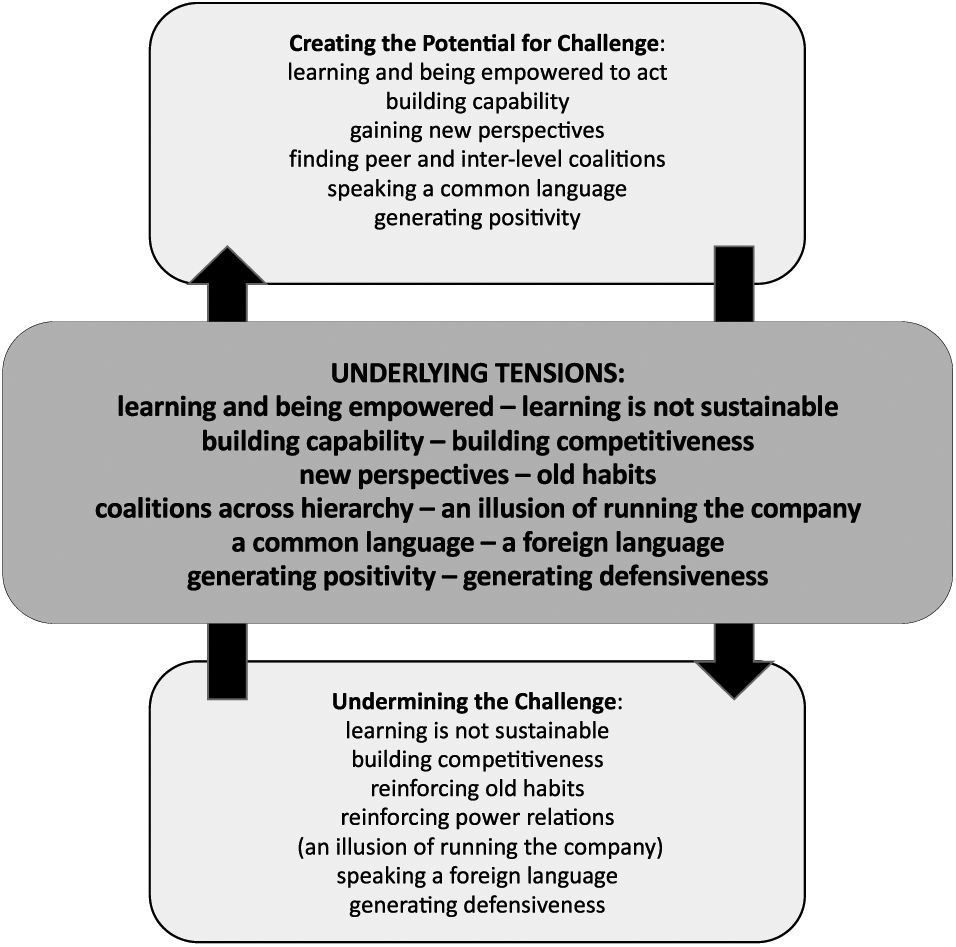
Combined dimensions of the data.
For us, an interesting conclusion in relation to the action learning component of the programs in both companies was that while action learning did empower individuals and create opportunities to challenge established ways of thinking and working, it simultaneously limited change by reinforcing the existing organizational values and assumptions.
Findings
We identified three interlinked, aggregate dimensions to the data that helped us to comprehend the specific tensions mobilized by action learning in the organizations we studied. We have combined these and represented them in Figure 1. In this section of the article, we initially discuss an overarching tension between ‘creating the potential for challenge’ and ‘undermining the challenge’ (the headings associated with the top and bottom boxes of Figure 1). We then discuss and illustrate the specific tensions that emerged from the data (represented in the middle box of Figure 1).
Our data showed us that the action learning programs created the potential for challenge of the existing ways of thinking, working, and interacting, both individual and organizational. For individuals, there were positive feelings about an experience that provided an underlying sense of being empowered to act: I actually, honestly believe that a lot of those thoughts that I had, you know how are we going to do the structure, the patterns, the way forward, is a complete and utter result of the … course that I have been on. (AL1, FinanceCo)
Within both organizations, there was a positive sense of the outcomes of action learning for new capabilities and perspectives; in supporting a common language for change; and in driving coalitions within and across hierarchical layers: The biggest value to us as an organization is that we have so many people with a common language and a common framework now, about leadership and about development, and tool sets, personal mastery, so we talk about these things. (AL6, FinanceCo)
Our data also presented us with a range of personal and organizational dynamics that undermined the potential of the action learning programs to challenge established ways of thinking, working, and interacting. For individuals, their personal empowerment was not sustainable in the context of embedded cynicism, old habits, and well-utilized defenses: I may have understood what people have said to me in the past that I’ve done a management development program and I’ve come back to my workspace and felt trapped because the environment doesn’t allow me to apply the knowledge. (AL1, ITSupplyCo)
Within both organizations, there were ambivalent feelings about the inability of the organizational environment to support action learning; a sense that participants’ involvement in running the company was an illusion; and that the existing power relations were reinforced rather than transformed. There were ongoing tensions between learning and action, and awareness of the gap between them in practice: You have all the responsibilities of managing the team below, but you’re not part of the strategic conversation … (We) interviewed all the senior executives and we were talking strategy and how we ran the business, etc. etc. with them, which kind of made you feel like you were part of a decision making even if you weren’t. (AL7, FinanceCo)
We decided not to see our data as either positive or negative. Certainly, it would be possible to use the data to speculate on the ways in which the positive aspects of individual and organizational experience of action learning could be maximized to overcome at least some of the problems we have identified. However, we also agreed that this would undermine the potential to comprehend the significance of the tensions mobilized by action learning within organizational contexts, as well as weakening the potential to draw out the implications of the data for critical reflection. Instead, we emphasize the ‘both/and’ (rather than either/or) elements of the data to pinpoint the underlying and ongoing tensions of these action learning programs. For example, Everyone wants to be a little bit more innovative, but not very much. (AL6, ITSupplyCo)
The tensions we identified form the main part of this section of our article, and we illustrate these with a selection of quotes from the interviews.
Underlying tensions mobilized by action learning
Our analysis highlights the contradictory elements of people’s lived experience of action learning. It seems to us that the tensions produced by action learning open the possibility of critical reflection because they point toward emotional and political dynamics that characterize ongoing struggles with continuity and change. The strongest tension we found in the data was between action learning offering opportunity and legitimacy to act (coded as ‘being empowered’) and the difficulty of sustaining the learning in the ‘current environment.’ Action learning is designed to encourage testing things out and reflecting on them. It created a sense that ‘almost straightaway we would go and change processes.’ Participants perceived improvements in openness and ‘frank conversations,’ ‘making conversation,’ and ‘being transparent,’ both within their own teams and across the hierarchy: We’re having more kind of more open, frank conversations in, you know, whether it’s a team meeting or whether it’s a one on one with individuals my—my staff are open enough to say to me, you know, you’ve done this, this and this wrong, and I’ve open enough to actually accept the criticism and vice versa, it’s ensuring that we can have those conversations. (AL2, FinanceCo) There’s nobody stopping you and if you come up with an idea they tell you to go right ahead and then come to me with a solution and sell it to me. So they’re open and they’re open to new stuff. (AL11, ITSupplyCo)
The feelings of being empowered that came from being given the opportunity and legitimacy to act contrasted with their experience of the limits imposed by the ‘environment,’ ‘culture,’ or ‘structure’ on their attempts to transform personal and organizational practices. This included participants reencountering their organizations’ structural preference for action over reflection, as well as a range of ‘fixed’ ways of working: I think that has been the biggest barrier there is the fact that the environment doesn’t always call or allow the reflective kind of solution finding, it’s always quick, easy, immediate. (AL7, ITSupplyCo) Well (FinanceCo) gave us a very fixed way of working which obviously it was the start of thinking but why should I do it this way and for our—our topic kind of fell a bit outside of it but once again—but a very strict structure of firstly to do your stakeholder analysis and whatever and whatever and whatever. (AL7, FinanceCo)
Participants recognized that there were implicit limitations on behavior. For example, without these limitations ‘I think I’d be a lot more aggressive in trying to make the change or be the catalyst for change.’ Similarly, ‘I’m passionate about what I do and I enjoy what I do’ sits alongside ‘frustration with the hierarchal type of environment that we are in currently.’
The tension for participants within their organizational environment between being empowered and sustaining learning was further reinforced through perceptions across hierarchical layers of the organizations. One of the line managers reflected, We’re finding like with the management development this year it’s almost like they’re scared to ask for input and they’re scared to come to us for guidance, so they tend to go more to the faculty members for input and direction … Either it’s the level or it’s they don’t want to come across as they don’t know what they are doing. (LM4, FinanceCo)
For this senior manager, the reticence for action comes from participants’ feelings of fear about the level above them, or from not wanting to seem incompetent. An example from one of the FinanceCo participants suggests a different interpretation of the issues across hierarchies: I think for our company … how can I put it; it’s tightly managed by the senior executives. (AL7, FinanceCo)
The tension between capability (the power or ability to act alongside others) and competitiveness (the power or ability to achieve in preference to others) within organizational layers further complicates struggles between continuity and change. There are new responsibilities for individuals: ‘I now have to be able to speak at levels throughout the entire organization’; as well as people ‘bouncing off each other, learning off each other.’ But ‘there are always competitive people around and everyone in the group wants to achieve and wants to sort of not look bad and impress their senior execs.’
There was a similar tension between how action learning supported and encouraged new perspectives and how difficult it is to continue to practice in ways that resist reverting to old habits. New perspectives included insights about personal benefits from action learning and how these were experienced: I’m saying those are the benefits that somehow sneaked up. You were so busy with real life and your subject and your topic and all of that type of stuff that only post the event you realize hang on something’s happened to us … learning. (AL1, ITSupplyCo)
However, while learning is acknowledged, ‘I wouldn’t necessarily say that everything’s been sustainable.’ The underlying idea of action learning is that participants try to sustain their efforts to transform practice over time through questioning and reflection with like-minded others. It did not feel like this to participants in either of the companies, or to senior managers: But then what sort of hindered me was just getting back in … (you) tend to revert back into old habits. (AL10, ITSupplyCo) … you get some really good input, ideas, insights into what you could be doing or should be doing, but you get to the end of the program and everyone goes back to their day job and that stuff doesn’t get implemented. (LM4, FinanceCo)
The participants acknowledged that challenges of implementation were addressed through coalitions within and across hierarchy. The action learning groups ‘opened conversations, so it connected people to each other’; participants started ‘building those networks internally, and collaborating more across some of those’; and they focused on relationship building: You will hear every single person say oh the value is in the relationships you build in the company … but there’s a lot of truth in that. (AL7, FinanceCo)
Increased networking, communication, and relationship building gave participants a sense of being together in a process of strategic, company-wide change. Working together to solve problems does represent a shift in behavior, but it is also fragile and has to be sustained through being positive and presenting a united front: how it is structured the syndicate and the different people in the syndicate allowed you to empower people and help people and then you would take it to your teams and do the same but also to your client. (AL3, FinanceCo) You know, one of the things that you almost have to do a lot on this course is change your own opinions or thoughts or beliefs, quite mid-stream and not cave. You have also got to have the ability to, yes, question, so it comes with the sense of confidence. (AL1, FinanceCo)
Disagreement is done privately. Their togetherness had the effect of emphasizing the similarities between organizational actors at the expense of identifying the differences and opening out opportunities to dissent. While the focus of the action learning is on skills and attitudes that promote more open and potentially challenging conversations, this is primarily focused down or across the organization, with little sign in the data of upward challenge. The in-company action learning gave the impression of focusing on challenging questions for the organizations studied. The questions they addressed were certainly pressing business issues, but they were not questions that sought to activate more fundamental challenges to the existing ways of thinking and working: I believe there were other, more pressing questions that they could have posed … to go and say to the groups, off you go, you know, bring a solution back to the business. (AL2, FinanceCo) If you know that you could potentially come under real scrutiny or you’d be accountable for delivering what you’re saying there, you may not put it in at all or you may think about it twice or you may ask for more time … So the accountability shifts to the senior execs who have now received the information. I think if you retained accountability, it’s like anything—you maybe look at it differently. (AL6, FinanceCo)
The existing ways of thinking and working were also reinforced by the roles of senior managers as the mentors of the participants involved. Building participant skills in working across boundaries increases the potential for dialog, but in practice the positioning and managing of the program reinforced the existing roles and relationships between different levels of leadership. For example, participants spoke of ‘being pushed in a certain direction (by our mentors)’ and there being ‘a lot of defence’ from the executives: So that was a common theme among the executives, that there was a lot of defence, where we were expecting them to kind of just acknowledge that there may be an issue and we need to address it. (AL9, FinanceCo)
The programs were designed to create more openness and dialogue, but these ideas are, to an extent, rhetorical and have tangible limits in practice. Action learning created a sense of there being a common language from which to comprehend the connection with others in a change process. For example: The element that makes it stay alive is the common business language with other people in the company. If it was just me trying to sustain this level of thinking and trying to sustain the concepts and everything and keeping it alive on your own, I think it would be a real challenge. (AL6, ITSupplyCo)
However, this is also simultaneously a foreign language because it opens out the differences as well as the connections with others: My one thought, you know, when going to the courses is often what happens is, you go there and you’re learning, you’re virtually learning a new language and when you come back to your regular environment and nobody really speaks that language … I don’t know whether it’s just human nature or just the reality and the reality is, when you find yourself in a place where nobody speaks your language you often then have to either continually translate which gets tedious after a while. (AL10, ITSupplyCo)
The experience of action learning generated both positive feelings and defensiveness. There were positive feelings about being able to communicate more easily within the organization, as well as the opportunities action learning afforded for personal development: The sense and ease and the comfort that I now have to be able to speak at levels throughout the entire organization helps a bucket load. (AL1, ITSupplyCo) It’s been absolutely wonderful and got me out of that 23-year rut I was in and just given me a whole new focus. (AL11, FinanceCo)
We found defensiveness about connecting with others, having to undertake the program, and around line management relationships: As much as we say like the business operates in silos, as a senior executive I didn’t have a need to engage with a lot of those other people, not because I didn’t want to but there was no need. (LM2, FinanceCo) I didn’t have a choice because I either did it last year or missed it. So I guess I went into the program slightly reluctantly, bullied into it to be completely frank. (AL6, ITSupplyCo) I was actually extremely resentful of the whole process because having like I say, I have the education behind me, I have the knowledge of the business, so I was—I didn’t want to go. (AL7, FinanceCo) I actually did not want to report to [my line manager] at all because he was not a leader in my view, and through this process that was confirmed. (AL9, FinanceCo)
Our findings provided us with a strong sense of contradictory and interrelated dynamics mobilized by the experience of action learning. Rather than separating these in our analysis, we interpreted them as bound together, as ongoing dimensions of people’s experience of action learning within a political environment. We suggest that this perspective—retaining a clear idea of the paradoxical tensions mobilized by action learning—offers an opportunity for critical reflection. This is because it recognizes the inseparability of both the transformational potential of action learning and the political purposes it serves as a process for reasserting compliance to a set of established norms. For example, giving managers the opportunity to contribute to change in a company through action-based learning opportunities, and then taking this away when changes unsettle current ways of working, is a way of discouraging individual actors’ enthusiasm for change. We are not saying that this is necessarily deliberate on the part of those who invested in established patterns of control. We do suggest that making organizational actors aware of such dynamics opens possibilities for unsettling established patterns of control. In the final section of the article, we discuss the value of this perspective in greater detail, as well as highlight some implications for research and practice.
Discussion
Our focus in this article has been on analyzing the paradoxical tensions that can be mobilized by action learning. We have developed this perspective for two reasons: first, we think that it is important to identify such ongoing tensions as a way of understanding how organizations may or may not be open to critical reflection, and, second, to better understand the role of critical reflection as an integral and deliberate aspect of CAL. All action learning is potentially critical in the sense that it is a design for learning in organizations that can reveal established power relations and offer opportunities to transform their consequences in practice. For example, ‘being empowered’ through action learning implied that participants in ITSupplyCo and FinanceCo were authorized to make change happen within their organizations. However, such authorization often proved to be illusory and (or) unsustainable. This was a familiar dynamic for participants. It was less familiar for them to talk about it openly and seek to act on it.
We think that organizational responses to the specific characteristics of critical reflection in context make a difference to whether challenges to the existing ways of working can be sustained or not. For example, in FinanceCo it was clear that action learning had created ‘so many people with a common language,’ but in a broader context it was also clear that these people were ‘not part of the strategic conversation.’ Action learning was used in the organization in a way that made ‘you feel like you were part of the decision-making even if you weren’t.’ This was experienced as both positive (I feel as if I am part of the decision-making) and negative (I know really that I am not). Tensions arising from the use of action learning point to the everyday aspects of power and politics that encourage and undermine learning. In other words, our research has identified the particularities of critical reflection in context as a way of explaining the potential benefits of CAL within that context.
We can explain this assertion in a bit more detail. When we decide that action learning is an appropriate method for learning, we do not necessarily imagine that the reason for using action learning is to mobilize the contradictions that surround learning in organizations. (Primarily, the idea is that it will support individuals to learn from their direct experience by taking action and reflecting on action within a group of peers. The idea is for individuals to transform their own practice over time.) Our argument is that CAL is a reflexive method whereby attempts to transform practice (individual and collective) include an understanding of the contradictions mobilized by such attempts. Action learning supports learning and it can undermine learning; it promotes both learning-in-action and ‘learning inaction’ (Vince, 2008, 2011). We see this contradiction as integral to learning about management and to the effective implementation of managerial roles within organizations. The acceptance that action learning is not only an effective approach to learning but also a barrier to it helps us develop a way of supporting its potential effects. CAL aims to accommodate managers’ desire to learn, and at the same time to address a range of interpersonal and organizational dynamics that discourage development (Trehan, 2011).
Our analysis of action learning in ITSupplyCo and FinanceCo has helped to clarify that CAL requires a distinctive emphasis. It deliberately seeks to offer organizational members a collective, discursive space in which established power relations can be legitimately surfaced and questioned. As Krantz (2010) states: ‘sophisticated work occurs when people can learn publicly, risking personal exposure in the service of developing shared understanding, and collaborating in such a way that vulnerability is neither hidden nor pathologized’ (p. 198). This discursive space may prove important for individual and collective political insight and action, but it is not necessarily transformational. It may create a context in which defensive routines can be transformed into curiosity and challenge, but this does not necessarily undermine established defensive routines. Such routines have a dual purpose. They define the boundaries of expected behavior and action, thereby helping organizational members to comprehend and feel comfortable within their roles. They also limit the behavior and action that is possible within those roles by prescribing ways of working and discouraging risk.
We have emphasized the importance of paradoxical tensions (for example, feeling part of the decision-making, and knowing that you are not) because they raise a significant question: Can the tensions generated by in-company action learning help us ‘find’ critical reflection (in the sense of opening areas of the organization that are amenable to it) and thereby support the strategic relevance of CAL within organizations? Our answer to this is both yes and no. We think that paradoxical tensions mobilized in the service of critical reflection are persistent, interdependent, and likely to be repeated in the actions and practices that result from it. Therefore, while some aspects of prevailing power relations may be transformed, such transformations are likely to both open and close possibilities for further learning and change.
For example, we indicated earlier in the article that from the start, both ambivalence and enthusiasm characterized the aspirations of stakeholders involved in commissioning the programs. There was tension between a strategic focus on succession and the facilitation of individual self-awareness. Senior managers espoused the desire for ‘something that is truly strategic and implementable and develops the learning and also drives the business forward’ but also were prepared not to ‘be overly concerned if you don’t fully meet it’ (LM3, ITSupplyCo). This knowledge offers insight into the political context within which CAL is going to be implemented and therefore can inform all attempts to learn within that context.
Connecting action learning and CAL
By accepting critical reflection as paradoxical rather than problematic, we can propose a tentative model, one that links in-company action learning with CAL. This is represented in Figure 2.

A Model of Critical Action Learning That Builds on In-Company Action Learning.
Figure 2 illustrates the role of critical reflection at the intersection between action learning and CAL. Within the scope of action learning, attempts to tackle organizational challenges and learn from attempts to improve things are likely to mobilize paradoxical tensions. We have illustrated these dynamics in detail above. The tensions that emerge from action learning are examples of the contextually specific emotions and power relations within which learning takes place. These can be acknowledged as ‘organizing insights’ (Vince, 2004), or they can be framed solely in terms of individuals’ learning.
Within the scope of CAL, paradoxical tensions are acknowledged as characteristic of emotions and power relations that both support and undermine attempts to learn, and thereby to improve things. Critical reflection forms a bridge between the generation and acknowledgment of tensions, and how tensions provide organizing insights that can begin to unsettle established ways of working. Accepting the paradoxical tensions that arise from action learning provides opportunities for CAL. CAL engages with political processes that both encourage and limit learning. It supports a collective ‘encouragement to think’ (Willmott, 1994) about learning within the context of underlying emotions and embedded power relations.
In the four boxes at the bottom of Figure 2, we highlight a process that connects action learning and CAL, based on tensions that emerge from in-company action learning. We explain each of these in further detail.
Generating contradictions through action learning
Action learning can be chosen purposely to try and deliver both transformations of individual and collective practice and to reveal tensions that express and capture limits and possibilities for learning and change within a specific context. We think that this dual intentionality is a key element in building a bridge between action learning and CAL as connecting interventions. Action learning raises tensions; CAL seeks to engage with them as an integral aspect of learning in context.
Acknowledging contradictions in the organization
Our research showed that participants in action learning are often aware of the political tensions they face (for example, being explicitly authorized without being given the authority to act); their difficulty is acting in relation to them. However, to ask managers to engage with the contradictions of their roles is also to support their agency in the complex political contexts within which their attempts to transform those roles are enacted. We think that this is a key underlying assumption about the value of CAL.
Unsettling established ways of working through critical reflection on contradictions
It is important to create a collective, discursive space in which established power relations and political dynamics can be legitimately surfaced and questioned. The power relations that characterize an organization (‘the way we do things here’) are always present within in-company learning groups. They are imported consciously and unconsciously as habits and attachments to corporate behaviors and perspectives, as well as to the structures that reinforce them. A key issue therefore is the extent to which it is possible to call behavior and structure into question as an integral aspect of efforts to transform practice. We see this as a deliberate function of a CAL group.
Accepting ongoing contradictions as an encouragement to think
The tensions and contradictions mobilized by critical reflection are likely to be persistent and repeated in the actions and practices that result from CAL. This means that CAL is an approach that does not seek to resolve tensions, but rather seeks to use them in the service of exploring managers’ purposive actions to unsettle political dynamics and power relations that limit learning and change. We see this as an important issue for continuing attempts to utilize CAL in the service of transformations of practice and in supporting ‘the encouragement to think’ (Willmott, 1994) beyond organizational limits on learning.
Implications for practice
Our model raises questions about how to put such an analysis into practice. Once tensions and contradictions are revealed by action learning, how are they related to potential transformations of behavior and structure implied by a more critical approach to action learning? Organizational paradox studies have started to engage with such questions, as well as their associated implications for practice (Andriopoulos and Lewis, 2010; Heracleous and Wirtz, 2014; Smith et al., 2016). For example, Smith et al. (2016) discuss how to foster ‘the unique aspects of competing constituencies and strategies while finding ways to unite them’ (p. 65). They provide an example of how this can be done within a company (in this case, W.L. Gore and Associates): You need a different management structure for innovating than for managing the day-to-day business. The two activities require a different mind-set, different skills, a different focus, a different time frame, and different metrics. So, we establish different organizational structures to manage both, but also create clear linkages such that the teams value each other’s contributions to the whole. (Terri Kelly, CEO of W.L. Gore & Associates, quoted in Smith et al. (2016: 66))
It is easy to imagine that CAL could have a role in sustaining such intersecting structures as simultaneously competing and united; and in engaging with individual and collective learning over time. CAL can support both the ‘structure that reflects’ (the impact of action learning on transformations in practice) and the ‘structure that connects’ (how those transformations connect with established relations of power; Nicolini et al., 2004, our emphasis).
This example suggests to us that CAL (and the tensions and contradictions mobilized by critical reflection) can be used purposefully in support of individual and organizational learning. For example, CAL could be used to reflect and act on being part of the decision-making and not being part of the decision-making, as well as the organizational processes and structures that maintain both ways of relating and the interactions between them. This would make a difference to individuals’ attempts to transform their practice because such attempts would be more clearly situated within the political context that promotes and prevents their learning. The organizational structures that shape practice are also characterized by tensions. As aspects of the existing ways of working are transformed in the service of individual and organizational learning, new ways of working will emerge that undermine learning just as effectively as before. Such paradoxical tensions provide an opportunity to find and perhaps also to keep critical reflection as an integral element of in-company learning.
For practitioners of action learning and CAL, there are two implications of our model. First, action learning asks people to ‘tackle important organizational or social challenges and learn from their attempts to improve things’ (Pedler and Abbott, 2013: 9). While this definition is deliberately open, we think that most practitioners of action learning interpret it in ways that emphasize the individual as the subject of this learning. Our model is seeking to encourage a collective interpretation of learning based on the paradoxical tensions that are mobilized when individuals attempt to learn within the political context of organizations. Therefore, as we seek to develop individual capabilities to learn and change, we must also work with the knowledge that improvement may be undermined if it is separated from the political challenges that arise through people’s attempts to learn.
Second, we argue that critical reflection can be suppressed by action learning, but also that it can be stimulated by action learning, which leads to opportunities for a more deliberate focus on emotions and power relations that support and undermine learning. This idea emphasizes the role of the facilitator in action learning to understand when and how to intervene in the action learning group to identify underlying tensions and their effects, as well as how to engage with the organization to sustain such an initiative. As facilitators of action learning, it will be important to encourage reflection within and outside the group on the ongoing tensions that perpetuate feelings like ‘everyone wants to be a little bit more innovative, but not very much’ (AL6, ITSupplyCo). The skill of the CAL facilitator is in engaging with the emotions and power relations that present themselves within the context of CAL and in terms of the (often contradictory) discourse surrounding CAL within the organization.
Conclusion
In this article, we have illustrated a link between in-company action learning (which focuses on transforming personal and organizational practices), critical reflection (which engages with paradoxical tensions mobilized by action learning), and CAL (which focuses on the underlying emotions and power relations that support and undermine transformations of practice). Our analysis has led us to suggest that action learning and CAL can be seen not only as separate approaches but also as interlinked stages in an ongoing process of individual and organizational learning. These two approaches are similar, but also informed by different assumptions, and they will continue to be used in different contexts for different reasons. However, our study has led us to speculate that it is both a novel and productive approach to think that we can explain more effectively how and why to move from more traditional forms of action learning to CAL. The four interlinked components of our model can be used by practitioners to inform the design, and to review the progress, of their attempts to link the ‘questioning insights’ (Revans, 1983) of individual managers with the ‘organizing insights’ (Vince, 2004) that can arise from critical reflection.
Footnotes
Appendix 1
Acknowledgements
The authors want to thank Professors Michael Reynolds and Mike Pedler for their astute and helpful comments on an earlier draft of this article. They are grateful to the special section editors and the three reviewers for their insightful engagement with the manuscript as it developed. They also want to acknowledge the course participants and line managers who participated in this study and shared their experiences.
Funding
The author(s) received no financial support for the research, authorship, and/or publication of this article.