




Abstract
By providing a holding environment to acknowledge sensitivities and address emotions, leadership programs prove to be powerful spaces for increasing self- and social awareness. However, the challenge is for one to maintain the newly gained self- and social awareness after leaving the holding environment and entering a context characterized by activity and performance. This is a frequently debated challenge for both academics and providers of management learning. Yet, critical moments in this transition remain under-exposed and under-researched. The contribution of this article is a research study—within the context of an international MBA program—of MBA students applying their knowledge from a Leadership Stream in an international consultancy project. This article contributes to the theory and practice of management learning by providing a lens through which subjective experience of critical moments of transition can be understood. In addition it develops the notion of ‘mindful avoidance’, and points to a major and neglected space in the design of management education.
Keywords
Introduction
In today’s organizational life, change, pace, flexibility, mobility, and innovation are core mantras that are related to the increasing pressures to meet aggressive targets and demands (Cooper and Dartington, 2004; Sennet, 1998). Organizations are largely marked by performance cultures, which generate hectic activity, and as a consequence ‘stop people from engaging with what is really going on and the context in which it arises’ (Lucey, 2015: 219). As a response to this context the ‘need for spaces’ is increasingly being addressed in organizational life. The spaces created provide a holding environment that emphasizes ‘the intensive relationship of caregiving and care receiving’ (Kahn, 2001: 262), free from daily stressors and distractions, where sensitivities can be brought to the surface, experiences and emotions can be addressed, explored, and made sense of, and self-awareness increased (Dubouloy, 2004; Kaiser and Kaplan, 2006; Lucey, 2015; Petriglieri et al., 2011; Petriglieri and Petriglieri, 2010).
Research shows that powerful insights can be derived in spaces that provide a holding environment. Two studies in particular—one by Dubouloy (2004), the other by Petriglieri et al. (2011)—have inspired and prompted the research shared in this article.
Using the experiences of executive MBA students, Dubouloy (2004) observed the ways in which the organizational environment contributes to the building of ‘false selves,’ causing the individual’s ‘true self’ to become more and more unreachable (Dubouloy, 2004: 474). In her study, she draws on Winnicott’s framework of true and false selves. The true self is the spontaneous gesture and the personal idea, and ‘only the true self can feel creative and only the true self can feel real’ (Winnicott, 1965: 147). The false self is an unconscious defense mechanism that hides and protects the true self by complying to environmental demands whenever the environment feels insecure (Winnicott, 1965). Duboloy describes how organizational members seek developmental programs as a response to the feeling of distress in organizational life, and concludes that while organizations themselves encourage ‘the false self,’ programs encourage ‘the true self’ (Dubouloy, 2004). Although the use of the false self/true self dichotomy is legitimately questioned by organizational scholars (Tracy and Trethewey, 2005), within the context of this article the dichotomy addresses the significant difference between feeling closed off or distant to feeling real and true to oneself.
In another study, Petriglieri et al. (2011) reported on the outcomes of a year-long ‘Leadership Stream’ where fulltime MBA students as a part of their work were given the opportunity to receive 20 sessions with a psychotherapist during the course of the year. The researchers observe how these students learn from their experiences through psychotherapy; in particular, how they, within the context of the Leadership Stream program, manage to examine their experiences as they occur, acknowledge and manage emotions, and attempt behavioral experiments based on their own emotional exploration (Petriglieri et al., 2011).
Having experience with such spaces, I can acknowledge and attest to the insights they provide; however, I have also witnessed the participants’ struggle to maintain and act on their newly gained self- and social awareness as they transition out of the holding environment provided by such a space, and back into a context of activity and performance. I argue that this critical moment of transition remains under-exposed and under-researched. This article contributes by extending the work of Dubouloy (2004) and Petriglieri et al. (2011) to include an examination of participants’ transition out of a holding environment.
The research for this article comes from the context of an international MBA program, and focuses on the ways in which MBA students apply what they learned in a Leadership Stream in an International Consultancy Project (ICP). The ‘ICP’ is a significant consultancy project with real deliverables to a business client. Although the ICP is within the structure of an MBA program and not a business, the expectation for students to meet targets and demands—core characteristics of organizational life—exist. The study poses the research question: how do participants experience critical moments of self- and social awareness as they transition out of a holding environment (the Leadership Stream) and back into a context of hectic activity and performance (the ICP)? I argue that a deeper understanding of such critical moments of transition is needed in order to better understand the needs of management education, and to focus and sharpen the future design of managerial programs.
The concept of mindful awareness is a major and central component of the study. ‘To be mindful’ is a core value in the context of the Leadership Stream; it invites a distinctive awareness and attention that appeals to all aspects of human life, whenever we may need to turn away from routine behavior and start noticing what we are actually doing (Gunaratana, 2002; Kabat-Zinn, 1994, 2005). The research findings suggest that what ‘might be perceived as mindlessness’ is often an active avoidance of a potentially threatening situation. Participants ignore obvious situations, acting unaware, and even choosing to mindfully avoid them. The notion of ‘mindful avoidance’ provide a lens through which to understand the critical moments of abandoning newly realized self- and social awareness when entering a context of performance. Drawing on the findings, I argue that centrally locating moments of mindful avoidance in the debate is the key to improving the design of managerial programs.
The sequence of the article is as follows. To situate my research within the field of study, I draw from two bodies of literature: systems psychodynamic thinking and the Buddhist tradition of mindfulness. I describe the research context and the ‘triggers’ of the study. After sharing the design and the findings of the study, I discuss the implications and contribution of the study. In this discussion, I develop the central argument of the article: that ‘mindful avoidance’ should be an essential consideration in the future design of managerial programs. I locate my argument and contribution in an unexplored area within existing research and literature, namely, the transition out of the holding environment and back into the context of performance. Finally, I suggest possible consequences for the future design of managerial programs.
‘Below surface’ mindfulness: psychodynamics, mindfulness, and learning
In reviewing how mindfulness has been examined thus far, it is clear that the research suffers from a lack of conceptual agreement on the meaning of mindfulness as a stable platform for applied research (Brown et al., 2007; Grossman, 2008). In the context of the Leadership Stream and this research study, the Buddhist mindfulness tradition and systems psychodynamics inform the conceptualization of mindfulness.
In the Buddhist tradition, mindfulness is rooted in the fundamental activities of consciousness: awareness and attention. While awareness is a way of relating to all internal and external events in an open and receptive way, attention in this context is a focused awareness toward a chosen object in the here-and-now (Kabat-Zinn, 1994, 2005; Shapiro, 2009; Williams and Kabat-Zinn, 2013). Another core component of mindfulness is detachment, which encourages and facilitates a gap between stimulus and reaction, provides a stopping place, and enables the separation of the reactive self from the core experience (Brown and Ryan, 2003). It is this very gap that provides an opportunity to avoid a habitual and automatic emotional reaction to a given event (Wallace, 2006: 67), and increases the likelihood of remaining non-defensively engaged with the present realities (Cavanagh and Spence, 2013). Several authors on mindfulness (Bodhi, 2011; Gethin, 2011; Maex, 2011; Purser and Milillo, 2015; Singla, 2011; Wallace and Shapiro, 2006; Weick and Putnam, 2006) point to the potential pitfall that the depth of Buddhist traditions are lost in the Western use of mindfulness. In Buddhist mindfulness, ‘right mindfulness’ is the seventh path within the noble eightfold path, which is an entire belief system aiming for greater psychological well-being, ethical behavior, and social responsibility (Purser and Milillo, 2015: 6). As the eight paths are mutually related and intertwined, choosing to cultivate just one element of the path—like right mindfulness—can potentially lead to the misconception that the cultivation of mindfulness has nothing to do with ethics, where skillful and unskillful actions are discerned (Purser and Milillo, 2015: 7). In this way, modern accounts of mindfulness can depart from the original meaning, evolving into an instrumental and vague kind of ‘be here now’ mentality (Wallace and Shapiro, 2006) rather than using mindfulness to understand conditions that cause and contribute to suffering and stress (Purser and Milillo, 2015: 18).
The Leadership Stream—and the research study in this article—is grounded in systems psychodynamic thinking, and the conceptualization of mindfulness is contextualized within this thinking. A systems psychodynamic perspective integrates open systems theory and psychoanalytic theory to increase the understanding of both social and organizational phenomena (Miller and Rice, 1967). Within this perspective, attention is drawn to the emotional undertow and ‘the ways in which emotions shape our experience, both consciously and unconsciously’ (Armstrong, 2004) and become strong drivers of behavior in organizational life (Gabriel, 1999; Kaiser and Kaplan, 2006; Kets de Vries, 2006, 2011), extracting ‘the hidden,’ which tend to remain unexplained in mainstream management literature (Gabriel, 1999; Gabriel and Carr, 2002; Hirschhorn, 1990). Within psychodynamic literature, it is evident that unconscious defenses as drivers help individuals to ‘make the uncomfortable comfortable’ (Vince and Martin, 1993: 210) and avoid potential threatening situations, and thereby learning (Bain, 1998; Gabriel and Griffiths, 2002; Hirschhorn, 1990). Some of these defenses help us close off what we do not want to see or hear and instead give in to the temptation of ‘always engaging to something familiar’ (Bion, 1962). While closing off what we do not want to see and hear may be a mechanism of survival, avoidance results in sensory and emotional data becoming and remaining unavailable for thought and reflection by the individual (Bleandonu, 1994): it remains ‘undigested facts’ rather than becoming ‘food for thought’ (Bion, 1962).
Thus, from a psychodynamic perspective, the experience of ‘being mindful’ includes recognizing the notion of ‘the unconscious’ and entering the undertow of emotions as hidden drivers of behavior. One is to become aware of dissociated feelings and actions and to use them as a source of information (Safran and Reading, 2008: 125). This is an attentional form of mindfulness, an open approach that promotes insight (Fransgaard, 2011: 17). Looking through the lens of Buddhist mindfulness and systems psychodynamics, being ‘mindfully aware’ is noticing and entering the undertow of emotions as hidden drivers of behavior, being awake, aware, and attentive to all kinds of intra- and interpersonal data—noticing what is going on internally, as well as externally. Mindful action is choosing a socially responsible response that feels right and real, holding the primary task, well-being, and efficiency of the work group in mind rather than following an automatic response. It is through this lens that the research question is explored and addressed.
Researchers argue that an ethically informed view of mindfulness offers the potential for enlarging the scope of practice toward critical engagement with conditions of suffering in organizations (Purser and Milillo, 2015: 18). A systems psychodynamic informed view of mindfulness—becoming aware of dissociated feelings and actions and using them as a source of information—also implicates critical engagement with existing defensive routines. In the psychodynamic literature on organizational learning, the ways in which established defensive routines work to push back whenever steps are taken to dismantle them is a well-known and documented challenge (Long, 2015; Reynolds, 1999; Reynolds and Vince, 2004; Rigg and Trehan, 2004: 150; Trehan and Rigg, 2008). Thus, finding ways of working with defensive routines and linking ‘raw unconscious forces to our conscious aims’ continues to be ‘a formidable challenge in creating generative organizational environments’ (Krantz, 2001: 155).
Methods
Research context
I now will focus on the context, methods, design, analysis, and findings of the study. The Leadership Stream, is based on ‘a philosophy of self-awareness and self-insight, as well as gaining insights into the behaviour of others’ (Introduction to the Leadership Stream). It is founded on systems psychodynamic thinking and calls for the student to have the courage to explore unconscious and emotional dynamics on organizational, intergroup, group, and individual levels. It comprises a number of lectures, experiential learning retreats, a number of assignments, and an invitation to do psychotherapy, which is accepted by most of the students. During the Leadership Stream, each student writes four individual essays exploring their personal insights and learning experiences. Historically, these essays show progress in self- and social awareness.
Parallel to the Leadership Stream, the students do ICP’s as well—an ICP in the spring and an ICP in the fall. In each ICP, they work in groups with a specific company on a current business challenge. In the year before this study, the following observation was made: in their final essay, a cohort of students were asked to explore and make sense of their insights on individual and group dynamics during the ICP. These essays proved to be more superficial and less reflective than previous essays, which explored the experiences from within the Leadership Stream. One of the most striking observations is the degree to which the students seem to let go of noticing and acting on intra- and interpersonal data as they enter a context of performance.
The participants in this study were MBA students who, during their engagement within a Leadership Stream, had demonstrated a significant increase in self- and social awareness. I collected data from the students while they were doing their second ICP. At that point in time, they had started the transition out of the Leadership Stream, and only had one experiential learning retreat left. They were informed about the study and invited to apply. Because depth and thoroughness in describing one’s individual experience is key in the research design, breadth was forgone, and only two groups were chosen to participate in the research study. Eight groups applied, and while all groups fit the criteria for participating in the study (i.e. they were all transitioning out of the Leadership Stream), I chose the groups that demonstrated a strong commitment to engage with the research study. This was crucial, as my research design depended on their participation—both on group level and on individual level—throughout the entire ICP period. Therefore, I selected the two groups whose application included all individual voices in the group, and who collectively expressed an eagerness to understand the challenge of remaining mindful on intra- and interpersonal data while working on their ICP, a core motivation of the study. The groups primarily consisted of male members from Europe, South America, and China, ranging in age from late 20s to late 30s.
Research design
In the following, I will describe the research design in more detail, as well as the decisions made in choosing relevant methods to address the research question.
In designing this study, two core components of the research question were of utmost importance. First, understanding behavior and the meaning of that behavior in a specific context, as well as drawing inferences about emotional phenomena (Gabriel, 1999: 273). Second, gathering data as close to the ‘here-and-now’ of the lived experience as possible. Therefore, a key factor in the design was the combination of observational data on actual in-the-moment-behavior, with an in-depth exploration of chosen significant incidents exploring the unconscious, the unnoticed, and the unsaid (Svalgaard, 2015). I chose methods to address these core intentions, which led to a design that can be split into two parts:
For 2 days, I observed the actual group behavior while the group was working on the ICP. In order to explore what intra- and interpersonal data they noticed and acted on and why, and what data they let go of, did not notice, or did not act on and why, I regularly stepped out of my role as an observer and engaged the group in a mutual exploration of the actual group behavior. This happened in structured team sessions, where observations, thoughts, and emotions were shared and possible group dynamics explored among the group members.
Because the students continued their work on their ICP without me in the room, the challenge in the next step of the research was to keep capturing data on actual ‘in-the-moment-behaviour’ as close to the lived experience as possible. For this purpose I chose diary studies, as this method offered an opportunity to capture the particulars of experiences in the contexts in which they unfold (Bolger et al., 2003). The students engaged in diary studies during the entire ICP, where they reported subjective experiences of staying with and letting go of intra- and interpersonal data while in the midst of the ICP work. To focus the diaries, I chose to make an event-based design, and I asked the students to notice and regularly register three kinds of moments: (1) moments of mindful awareness where they acted on intra- and interpersonal data, (2) moments of mindful awareness where they did not act on intra- and interpersonal data, and (3) moments where they, in hindsight, considered themselves to be mindless of any such data.
The diaries offered me data on ‘actual in-the-moment-behaviour’ that subsequently was explored in individual sessions at the end of the ICP period. In these sessions, the students identified a significant moment from each of the three categories in their diaries (described above), and explored it individually with the researcher. To commence this exploration, the students made drawings that depicted each of the moments (illustrated in Figure 1).

Three kinds of moments.
Drawing was a powerful method for accessing unconscious meanings, allowing participants to give simple expressions to complex feelings and situations, and to tap into their emotional life (Nossal, 2013). With the drawings as a starting point, they explored the following questions with the researcher: ‘What do I notice that I do/do not stay with and act on—and why?’
These interactions activities provided me with a very rich set of data consisting of 4 days of field observation and field notes, two recorded and transcribed group sessions (90 minutes each), 11 diaries written by the students while doing their ICPs, 11 sets of drawings, and 11 recorded and transcribed individual sessions (90 minutes each). The transcribed sessions consisted of approximately 450 pages.
Analysis
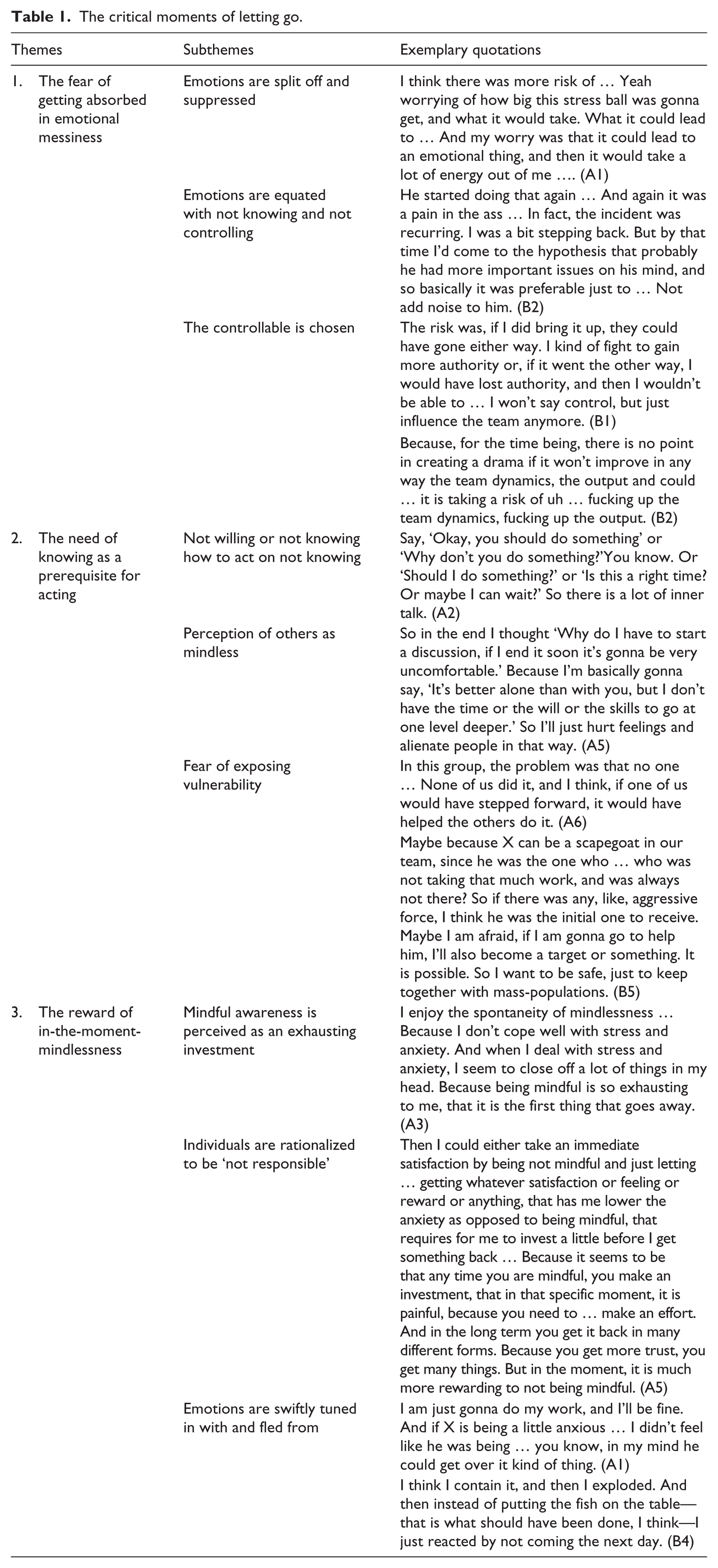
In analyzing the data, I started with a literal and interpretive reading of group and individual sessions, reading through and beyond the data, identifying emerging patterns by writing detailed memos to provide building blocks for reflection and to help crystallize ideas, and constructing concept cards, where data sources, incidents, and quotations were noted to keep a record of coding (Bryman, 1989). Through the whole process of reading and re-reading data, moving back and forth between research question and data, themes were created and recreated. As the final themes started to emerge, I returned to the data and reviewed field notes, transcripts, and drawings to validate these themes. In this process of revisiting the transcripts, looking into incidents and choosing exemplary quotations, minor changes were made and themes as well as subthemes were finally formulated. In exploring the subjective experience of the critical moments where newly gained self- and social awareness from the Leadership Stream was utilized in ‘real work experience,’ I finally extrapolated three strongly held themes from my findings:
Fear of getting absorbed in emotional messiness. The students let go of intra- and interpersonal data when ‘emotional stuff’ threatened to derail control and ‘knowing,’ and introduced a fear of getting absorbed in emotional and relational messiness.
Need to know as a prerequisite for acting. The students let go of intra- and interpersonal data when they simply did not know how to manage and act on the intra- and interpersonal data noticed.
Reward of in-the-moment-mindlessness. The students let go of intra- and interpersonal data when the investment of ‘tuning in and staying with’ became too painful and exhausting, and the ease of ‘ignoring and letting go’ took over.
Findings
I now turn to examine the three themes more in detail. The themes are mutually related, and are not listed in order of significance. I chose the exemplary quotations in Table 1 from individual sessions and they serve as illustrative citations from the data set as a whole. In Table 1, the data are summarized into three themes, which condense critical moments of letting go of intra- and interpersonal data, and into a number of subthemes, which condense characteristics of such critical moments. In the analysis, I chose exemplary quotations to synthesize what comes across in the data set as a whole. To identify the source of the illustrative quotations, I have labeled the groups as ‘A’ and ‘B’; participants from each group are identified by numbers.
The critical moments of letting go.
Fear of getting absorbed in emotional messiness
The moment the real work experience is introduced, what follows is work-related anxiety. As one of the students puts it, To be mindful, it helps having nothing to lose … I don’t have to get stressed or get anxiety from the ‘What happens if this doesn’t work?’. (A5)
During the ICP, the groups had a primary task, which was to complete the business challenge given and to please their client. The focus in the groups reflects result orientation to deliver answers, suggestions, and recommendations on the task given by their client. ‘Stress’ and ‘anxiety’ are terms commonly used in the sessions, linked to questions like ‘What if it doesn’t work? What if we don’t succeed?’
Stress and anxiety were dealt with by distancing from anything that adds to the complexity of a situation. By choosing the rational task-focused problem-solving mode and letting go of intra- and interpersonal data, the students reduce complexity. In and of itself, this may not be surprising; however, given the increased self- and social awareness demonstrated during the Leadership Stream, it is interesting to note how efficiently the split between task and ‘emotional stuff’ is created, and how efficiently insights from the Leadership Stream are compartmentalized the moment a real work experience is introduced. This split occurs across the data set, and links to a widely held desire to not want to get absorbed in emotions, as the perception is that the risk of getting ‘sucked into this’ is high, and will be followed by an equally high risk of derailing the group from the task. (‘What is going on inside me is … I’m just gonna do my work, so I am not getting sucked into this. I need to get this done.’) (A6) Expressions like ‘sucked into,’ ‘derailed,’ ‘leading to more,’ and so on underline a general depiction of noticing data as an uncontrollable and potentially threatening place to go. As intra- and interpersonal data are noticed, it is often rationalized to be better to ‘just leave it,’ like in this example where a follower notices tension and anxiety in the team leader: I could see in his face but maybe for some reason, I don’t know why, maybe because it’s morning or something like that, I just didn’t feel the energy to uhm … to side along … I know that I could have … But I didn’t feel the need … I guess I didn’t really see how bad or how anxious he was getting maybe … uhm, you know, maybe I am projecting, maybe he wasn’t anxious, but maybe he was, but in my mind he was. (A1)
Overwhelmingly, the data show that some introverted energy is spent to tune in with and try to verify intra- and interpersonal data. As stated in the example above, intrapersonal data are often kept internal (‘Maybe I’m just projecting …’) and thus remains untested emotional data, fantasies and hypotheses. While it is argued in the literature that avoidance results in sensory and emotional data remaining ‘undigested facts’ rather than becoming ‘food for thought,’ the data provided in this study suggest that plenty of emotional data do not remain unavailable for thought and reflection on an individual level. On the contrary, emotional data are noticed and energy is spent turning over it, but it remains only half-digested, as it is not shared, discussed, and digested on a group level.
When there is an established structure and a framework for sharing, students start to share, because the first step (the creation of a holding structure) is provided for them. However, initiating the first step when no holding structure is provided feels risky—it gets too messy, and will take time away from the task. Thus, the idea to share is rejected and it is rationalized to be better to slip into ‘mindlessness.’ When this split is efficiently created, task is equated with control and knowing, and emotions are equated with no control and not knowing. In creating this split, the students deprive themselves of any possibility of using emotions, which are seen on an individual as well as a group level as informers.
The need for knowing as a prerequisite for acting
Not knowing whether mindful action will make a difference (better results, increased well-being, less conflict, etc.) leads to suppression and dispersal rather than mindful action. An unwillingness to let go of the sense of control associated with knowing and to enter and stay with the uncomfortable reality of not knowing is widely seen in the data. Interestingly, the students’ perceptions of possible and potential ways to take action is ranked alongside solving, controlling, jumping up, helping out, and ‘putting the fish on the table’ by confronting, and is widely perceived to involve the risk of confrontation and conflict. The possibility to take action on intra- or interpersonal data by sharing what is noticed, by asking questions, or by curiously exploring is remarkably absent: ‘I think, for me the biggest question would be uhhh is noticing really enough? Because even if you notice, but you are not able to control … But if you just notice it, what good is it gonna make?’ (A5)
The data also reveal how the students struggle with the transition out of the Leadership Stream. They seem to presume that speaking to emotions in the project setting is done in the same way as in the learning setting, and their experience is that this will often involve confrontation and conflict. The challenge is to share emotional data in a way that will increase the likelihood that group members are willing to listen and speak to such data in what feels like an authentic way and in accordance with the emotions felt. When met with a real work experience and the characteristics of a performance culture, the tendency is to suppress emotional data and possibly act them out as a consequence.
In this regard, the students seem to hold the assumption—and possible defense—that action is valid only if you know how to control the uncontrollable. The intensity with which this comes forward in the data is surprising to me. What may be perceived as ‘mindless behaviour’ during participant observation turns out to be mindful awareness followed by a choice not to act on what has been noticed. It is interesting to note that behavior that I observed as mindless behavior was also observed as such by other group members, as the avoidance, by its very nature, is not observable in itself. This mistakenly leads to a perception that ‘I’m the only mindful individual here, and the others are mindless,’ which adds to non-transparency and increases the difficulty in navigating in interpersonal complexities. Furthermore, the perception of ‘being the only one who notices’ increases the difficulty in acting on intra- and interpersonal data. The spiral of non-transparency and not knowing becomes a lonely projective spiral, which leaves plenty of room for fantasies, speculation, and rumination. Thus, initiating action in non-transparency is highly anxiety provoking, as sharing intrapersonal data is also putting a piece of yourself out there, which the students refrain from doing because vulnerability feels risky. While the splitting off of vulnerability to some extent remains unavailable for thought and reflection, the data also reveal moments of awareness of this dynamic, as a mindful choice is made to ‘leave it as it is’ in order to keep a position of feeling safe and strong within the group: I find a lot of times, that I’m aware of what I am doing. But I don’t have the strength to stop it … It was driven by an inferiority complex, it was driven by me being sidelined with F1 and F2, who I thought probably the weaker parts in the team. Uh me being uh … me being associated with them …you know, wanting to be … wanting to look better in the light of F3 and F4. (A3)
Thus, newly gained self- and social awareness helps the students reach moments of recognizing strong defensive routines and powerful group dynamics. These moments come across as instances of insight, which, often regrettably, are not tuned in to and acted on.
The reward of in-the-moment-mindlessness
To stay mindful and act mindfully is perceived as a painful investment, and one that is often deemed not worth its cost. In the moment of choice, the students frequently speak of themselves as mindful of avoiding something unpleasant, tuning in and fleeing from, not staying with the emotionally difficult issues, and choosing ‘something easier,’ which can feel rewarding because it does not take any effort. The words ‘draining,’ ‘exhausting,’ and ‘painful’ are widely found across the data set and are generally related to the emotional work involved in being mindfully aware: ‘I enjoy the spontaneity of mindlessness … Because being mindful is so exhausting to me, that it is the first thing that goes away’ (A3).
Thus, the mindful awareness informed by systems psychodynamics—becoming aware of dissociated feelings and actions, and using them as a source of information—is widely held to be energy consuming. The actual mindful awareness of the avoidance in the moment is consequently quickly followed by rationalization or intellectualization that the task, the group, or the student himself or herself is ‘better off’ making the choice of not engaging with the perceived emotional data, or that someone else should do it. This does not only comes forward as an individual defense, but as a powerful group defense, where the groups with ingenuity for self-protection create a culture of engaging less with interpersonal and group dynamics, and turn toward ‘individual responsibility’ and an ‘I-am-not-responsible’ attitude as a core rationalization and defense: Eventually I was aware, that somebody was doing something, that was annoying him, but I mean, I didn’t feel responsible for it. If something is annoying him, he should bring it up. (B4)
This results in both dispersal and displacement in the group as a whole. Being, noticing, and going slow is the opposite of what the students are conditioned to do in the ICP, and going slow also involves increasing complexity, forcing them to notice what they may prefer not to notice. Noticing may threaten powerful defensive routines created in the group; therefore, noticing is avoided by using tactics like speeding up and moving fast from one topic to another: … So I tried to make it as quick as possible and I didn’t even … I wasn’t even listening probably to the discussion. I just wanted to raise it and be done with it. I think that is how I felt. (A5)
Tuning in with the essence of the subjective experience of critical moments, where students let go of their newly gained self- and social awareness, a pattern started to evolve, and a conceptualization of the phenomena ‘mindful avoidance’ started to emerge. The intensity with which this phenomenon is present in the data is thought provoking.
The conceptualization of mindful avoidance
Drawing on the three themes extrapolated from the study’s data set, I suggest that a core challenge in the critical moment of transition is mindful avoidance in the moment of facing a real work experience. Mindful avoidance may easily be misperceived as mindlessness, but really means that intra- and interpersonal data are noticed, but neither shared, spoken to, nor acted upon.
Mindful avoidance is similar to the concept of ‘wilful blindness,’ as described by Heffernan (2011), which similarly refers to incidents of willfully shutting our eyes out of fear of conflict and change, and conveniently filtering out what unsettles us and makes us feel more fragile. Heffernan (2011) addresses broader psychological, social, and societal phenomena like child abuse, political corruption, and so on, which all have as their core dynamic an assertion that ‘as long as it feels safer to do or say nothing, as long as keeping the peace feels more benign, abuse can continue’ (p. 45). As is the case with willful blindness, mindful avoidance is a conscious choice to be blind, as it feels safer and more convenient. However, mindful avoidance concentrates the attention on and tunes in with the moment of letting go of intra- and interpersonal data—the present and exact moment of ‘pushing aside.’ As noted, the literature supports how unconscious defense mechanisms are key in organizational inability to manage learning and change (Gabriel, 1999; Hirschhorn, 1990; Kets de Vries, 2011; Vince, 2011), which makes the need to find ways of working with underlying and unconscious processes (particularly defense mechanisms) urgent (Vince, 1998, 2001). In this article, I argue that the concept of mindful avoidance offers an entry point into this work, as the conceptualization of mindful avoidance provides a vocabulary that helps access and explore defenses as it tunes in with the phenomena that are already ‘in mind,’ but pushed aside. Tuning in with the exact moment of ‘pushing aside’ brings the individual in touch with the unwanted consequences of not acting, as well as the defenses that cause this exact dispersal. By starting with the concrete actions taken and not taken, organizations can explore what potential actions may be taken in the future to test basic assumptions that cause the defensive routines. Thus, I put forward that the conceptualization of mindful avoidance offers an approach to pinpoint those exact moments in a real work experience where participants are caught by powerful underlying individual and collective processes that prevent them from acting on newly gained self- and social awareness.
Schein speaks to the anxiety of learning in the following way: ‘In the prison camps (in Korea), 80% of the people survived the ordeal by being passive. That’s generally the way it is in organizations’ (Coutu, 2002: 104). This thought-provoking statement posits ‘passiveness’ in employees as a major organizational challenge, which aligns with the findings of this study. That is, increasing self- and social awareness does not necessarily lead to mindful action that draws on newly gained self- and social awareness. Therefore, mindful avoidance needs to be addressed and attended to.
Drawing on their insights from the Leadership Stream, the MBA students are highly skilled in noticing and reflecting on defenses in self and others, which creates a baseline for noticing and tuning into the critical moment of avoidance, and providing profound reflections on the avoidance taking place. A core challenge in exploring mindful avoidance is considering that some moments of ‘not acting’ are rational choices as opposed to using rationalization as a defense. As opposed to situations where students make a mindful choice of not acting on intra- and interpersonal data for the sake of the task and not wanting to interrupt the task flow of the group, mindful avoidance is accompanied by a feeling of disappointment, unease, and restlessness, which adds distance to feeling real and true to oneself. A large number of students hold this feeling of disillusionment in moments of mindful avoidance. Therefore, when tuning in with moments of mindful avoidance and recognizing defenses that cause passiveness and avoidance, the students also get in touch with a need, a wish, and a drive to start taking action on some of the data with which they have seemingly let go. Likewise, the exploration also provides them with some first steppingstones for what such action may look like in a context of not knowing.
Holding moments of mindful avoidance central implies that participants are willing to be receptive to ‘data that run contrary to their comfortable stance’ (Raelin, 2001: 17), as sharing intra- and interpersonal data experienced within the group or subsystem of which the individual is a part may also run contrary to the comfort level of the group or subsystem. Drawing on the findings shared in this article, it is argued that creating opportunities to capture and work mindful avoidance needs to be held central in the design of management education. I will address this more thoroughly in the following section.
Discussion
The need for a potential space holding mindful avoidance central
My findings suggest the need for a potential space that helps the individual to transition out of a holding environment and into a context of performance while staying with and acting on newly gained self- and social awareness. Throughout the management literature, an underlying assumption seems to be that an increase in self-awareness will automatically be expressed and conveyed to others (Ladkin and Taylor, 2010). The data in this study do not support this underlying assumption. While acknowledging that the process of becoming more self-aware is a major precondition for establishing new behavioral patterns (Ibarra et al., 2010; Kets de Vries, 2011; Kets de Vries and Korotov, 2007; Petriglieri et al., 2011), the research in this article stresses the fact that ‘mindful avoidance’ is a core barrier to turning newly gained self- and social awareness into behavior when transitioning out of the encapsulation.
In the debate on approaches to learning in management education, scholars enhance the need to address the split between thinking and acting, and engage more profoundly with the multifaceted lived experience of organizational life (Tomkins and Ulus, 2015), where learning is ‘entwined with unfolding human activity’ (Zundel, 2012: 110) and the dynamic context in which management is enacted (Warhurst, 2011). This is arguably a critical aspect of future MBA program designs (Warhurst, 2011). Drawing on the findings of the study in this article, I suggest a design that includes potential spaces featuring a ‘double task’ and the practice of ‘double awareness.’ Drawing on Bridger’s concept of double task, where ‘Task 1’ is the primary task and ‘Task 2’ is the secondary task of learning and self-reviewing (Amado and Ambrose, 2001: 119), I define double awareness as simultaneous awareness and action, where performing on the task and engaging with the emotional work of mindful awareness and action are intertwined within the context of performance and work-related anxiety (Svalgaard, 2017), and thus, consequently ‘in the face of fears and anxieties about failure and disintegration’ (Clancy et al., 2012). I argue that potential spaces, where critical moments of mindful avoidance are noticed, stayed with, and worked on, hold a strong potential for finding ways of acting on newly gained self- and social awareness. Thus, such work has the possibility to address ‘passiveness’ as a core defensive routine, and to start moving from ‘surviving in’ to ‘engaging with’ organizational life. In the following section, I will share some suggestions for key elements in the design of a potential space.
From parallel to intertwined structures
From the data gathered in this study, it is striking to note how the Leadership Stream and the ICPs are seen as very separate entities, and how increased self- and social awareness gained during the Leadership Stream seem to function in parallel with the ICP work rather than being integrated and drawn upon. If task and learning are held separate within all entities of a program, the parallelism of task and emotional work will stay intact. In the specific case illustrated in this article, the ICP can be considered and utilized as a potential space, where participants not only practice double awareness themselves, but also engage with people around them who are practicing double awareness and looking out for mindful avoidance. Drawing on the findings, it is key that participants practice tuning in with moments of mindful avoidance as well as begin initiating the first steps of mindful action.
The potential of diaries—or, as the students referred to them, ‘mindful logs’—can be considered a powerful tool to tune in with mindful avoidance, to bring attention to the gap between insight and action, and to challenge the defensive routine of passivity. Acknowledging and exploring this gap in detail provides the student with tools and a sense of courage to take action, as they do not wish to let go of newly gained insights. The idea of the ‘tempered radical’ put forward by Meyerson and Scully (1995) is helpful in a potential space, holding central the importance of engaging in little acts of self-expression, while balancing ways of acting ‘that are appropriate professionally and authentic personally and politically’ (p. 587). Achieving this balance is the core intention of the potential space.
Limitations of the research study
The research design is a combination of participant observation and diary studies. While participant observation followed by mutual exploration creates an opportunity to capture the lived experience of the ‘here-and-now,’ the diary studies, by their very nature, capture the lived experience more ‘in hindsight’ and less in the moment. In future research, it is critical to keep exploring methods that seek to capture the ‘now-ness’ of the lived experience—methods that tune in with the very process of becoming aware, and seek to ‘recognise what is present but unrecognised’ in the moment (Petitmengin, 2011: 49, 2012).
The data include a relatively limited sample of two different work groups, and while the context is a work-related context of performance, the data are still derived from within the context of an MBA program. Given the presence of mindful avoidance during the work-related context of performance, it is realistic to assume that mindful avoidance will be strongly present within the workplace, too. Still, research that addresses the same research question within the context of the workplace is needed. Demographic considerations like gender, culture, and age and their relation to the practice of mindful action versus mindful avoidance are not addressed in this study and can be rightfully addressed in future research.
Conclusion
The conceptualization of mindful avoidance complements existing studies on the potential of spaces to provide a holding environment (Dubouloy, 2004; Petriglieri et al., 2011) by bringing in observational data on the critical moment of transition, where newly gained self- and social awareness is tuned in with and acted on upon entering a real work experience. The concept of mindful avoidance offers a vocabulary to address a core challenge in this transition. It provides direction to work with defensive routines, access undigested emotional data, and make acting on these data a real and reachable possibility. A potential space that places mindful avoidance as a key component is argued to be of importance in any design of management education. Noticing and working mindful avoidance offers a potential for stepping back from passivity and taking a step toward active and critical engagement, as it involves sharing and speaking to intra- and interpersonal data in a way that feels ‘appropriate professionally and authentic personally and politically’ (Meyerson and Scully, 1995: 587), and by definition involves agendas that may push for change rather than engaging with something familiar. Including potential spaces that notice and work with critical moments of mindful avoidance has the potential to move future management education toward a more contextual approach.
Footnotes
Funding
The author(s) disclosed receipt of the following financial support for the research, authorship, and/or publication of this article: The author received financial support for the research in this article from Innovation Fund Denmark.