




Abstract
In this conceptual article, we argue the importance to the coaching profession of a critical understanding of coaching as a social process in order to promote coaching as an enabler for change and facilitate its use in other cultures and challenging contexts. We start with a critical analysis of the origin of coaching, arguing that neoliberal values have been embedded in the discourse of coaching. We also discuss the impact of coaching as an instrumental and ideological device, sometimes used in organisations as a process of control, and suggest that understanding coaching as a social process has the potential to transform it into an enabler for change. We propose a framework for understanding how different philosophical positions affect the way coaches may respond to the challenges of intercultural or oppressive social contexts. We conclude with a discussion of the implications for coaching research and development.
Keywords
Introduction
Over the past 30 years, coaching has grown from almost a non-existent profession into a booming industry, particularly in Western economies (Segers et al., 2011). Coaches offer their services under banners such as executive, performance and life coaching (ICF, 2012), and practitioners frequently embed coaching techniques and terminologies within established working practices such as training, counselling and social work (Grant, 2017).
However, despite the rapid growth of coaching, there is a lack of acknowledgement of coaching as a social process. In a review of the different contexts of coaching, the most reported is where coaching takes place within an organisational setting, mostly in Western-based corporations and primarily with senior managers (Grant, 2011). Within these settings, coaching is often offered with a promise of improved performance and effectiveness. Fillery-Travis and Cox (2014) confirm that much coaching research comprises outcome studies, where case studies are reported in order to make a positive case for coaching interventions. Many of these studies use quantitative methods to ‘prove’ the efficacy of coaching in a specific work context. Thus, the questions that are often discussed in the coaching literature are whether coaching is effective and what are the models and techniques of coaching that make it most effective.
By contrast, we believe that coaching may also need to be analysed as a social process, where it is viewed as both a product of and a contributor to the reshaping of its social context. From this critical perspective, coaching is not only seen as a technology of the self (Cushion, 2018) that is affected by historical, cultural and social processes such as political structures and power dynamics but also as one that has the potential to shift power and support agency, hence affecting the social structure. We believe it is important to understand how the different aspects of the coaching industry act – consciously or inadvertently – as ideological devices, be it through the training and education of coaches, governmental regulations, accreditation, independent coaching bodies, ethical frameworks, coaching supervision or coaching research.
Recently, Schultz (2010), Du Toit and Sim (2010), Western (2012, 2017) and Shoukry (2016) have all expressed the need for a critical review of the philosophical and theoretical foundations upon which coaching practice is growing. If coaching continues to adhere to an instrumental mind-set, as Western (2012) warns, then critical voices become less and less welcome: coaches and their clients are encouraged to behave within a set of predefined expectations that are, more or less, taken for granted.
Our starting point in this article, therefore, is to examine critically how the growth of coaching is, in part, a reflection of a wider social phenomenon – a Western-led global move towards more focus on the individual as an independent social unit, and the set of personal competences that are claimed to be behind success. In the first part of the article, we highlight how the prevalence of humanistic psychology, the rise of neoliberalism and the commodification of therapeutic and spiritual practices all constitute the background against which coaching has gained its popularity in the Western corporate environment. There, it could be argued that coaching takes place within a discourse of competition, return on investment, goal attainment and self-actualisation and that, from a critical perspective, there is a danger that coaching becomes merely a tool for organisational and social conformity, where individuals get professional help to become more integrated into a pervasive ideology and where power dynamics may be at play. In this section, therefore, we discuss coaching as an enabler of conformity or change and as a process of control or resistance.
Next, we identify that, beyond the context of organisational coaching, a number of emergent contexts are expanding the need for an understanding of coaching as a social process. These contexts include coaching in non-Western cultures, coaching the socially excluded (such as coaching for the poor, minority groups, prisoners, offenders and individuals who are physically or mentally challenged) and coaching in oppressive environments (such as coaching in countries with widespread political and social issues and coaching for refugees or survivors of war). Intercultural and oppressive contexts raise ethical questions around which values coaches seek to uphold: compassion or confrontation, acceptance or criticality, adaptability or resistance. Coaching literature often assumes and encourages coaches’ neutrality (Cushion, 2018). However, in a social context of inequality or oppression, it is both unlikely and sometimes unethical that coaches remain completely neutral (Shoukry, 2017). We discuss these challenges by looking at four positions that coaches may assume in the face of social complexity: denial, substitution, adaptation, and integration and criticality. We then propose a new framework based on Bennett’s (1993) work for understanding how coaches may approach situations where the social context has a significant bearing on the coaching process. We conclude with discussion of the different dimensions that inform the development of an understanding of coaching as a social process.
A critical history of coaching
It has been suggested that coaching has roots in a long tradition of soul guides and psychological helpers (Western, 2017). Subsequently, the rise of coaching as a social process in the late modern, Western context could be seen to stem from the humanistic movement which came to prominence from the 1960s (Grant, 2017; Mihiotis and Argirou, 2016). For example, since that time employee well-being has become all important (Siltaoja et al., 2015). As coaching became more commonplace, it needed to be differentiated from mentoring and counselling. Mentoring is seen as a relationship – often internal within an organisation – whereby someone more experienced provides support and a role model, and counselling is seen as essentially remedial (Gray, 2006). Coaching, on the other hand, is seen as typically performance oriented, with an emphasis on action planning and sustaining change over time (Bachkirova and Cox, 2004; Grant, 2017). To this end, authors such as Whitmore (2009) popularised various goal-focused models of coaching. The GROW model, for example, focuses on Goals, Realities, Options and Will, giving the coach a model for working with the coachee’s individual agenda. In the co-active model of coaching, which has had a significant impact, the fundamental premise involves the view that individuals are autonomous, free and able to make changes in their lives by taking responsibility for their attainments (Whitworth et al., 2007).
Naughton (2002) argues that anxiety, ambition and challenges of modern life have ‘combined to create a market for men and women who could provide, for a fee, a service that older generations have once performed for younger generations as a part of the social contract’ (p. 7). In addition to being used in business settings and professions such as teaching and healthcare, the same models of coaching are also prevalent in other contexts such as the community, where recipients of coaching, often those at a social disadvantage, can set goals to overcome difficult transitions. From a critical perspective, coaching in such settings could be seen as meeting a social need – filling a number of voids in society by substituting for the extended family, for personal service, for caring employers, for smaller class sizes, for deficiencies in the education system, for comprehensive induction programmes and so on. In filling these gaps, coaching seems to appeal to a new millennium sense of altruism, as a result of the breakdown of social networks in the West (Naughton, 2002).
In earlier analysis, Giddens (1991) drew our attention to the proliferation of self-help outlets (books, therapy courses and so on) and the popularising of psychology generally. He argued that in the West we have become more reflexive and less determined by others or traditional expectations as to how we live our lives. What characterised ‘late modernity’ at that time was the increased space given to people to be self-referential or ‘to take their cue from themselves’ (Giddens, 1991: 70). ‘What to do? How to act? How to be?’, said Giddens, are the increasing questions for the individual once (and if) his or her elemental material needs have been met. The coaching process, we would argue, also tends to promote the value of individual knowledge – equal status being given to the coachee’s personal knowledge in planning, implementing and evaluating the content, activities and procedures of the coaching process. Thus, it could be argued that coaching has developed mainly through a need for individual support to achieve personal goals and relies on an understanding of psychological and learning processes that can help coachees to think about the situations and problems and so come to their own solutions.
However, as Maslow (1954) acknowledged, human growth and development theories, such as his own theory of self-actualisation, are influenced by sociocultural systems. In this regard, coaching could also be seen to belong to the neoliberal zeitgeist that has pervaded society since its emergence in the 1970s (Sugarman, 2015). Sugarman (2015) argues that neoliberalism is ‘reformulating person-hood, psychological life, moral and ethical responsibility, and what it means to have selfhood and identity’ (p. 104). He suggests that we now view ourselves as individuals who
administer ourselves as an economic interest with vocabularies of management and performativity (satisfaction, worth, productivity, initiative, effectiveness, skills, goals, risk, networking, and so forth), who invest in our aspirations by adopting expert advice (of psycho- therapists, personal trainers, dieticians, life coaches, financial planners, genetic counselors), and who maximize and express our autonomy through choice (mostly in consumerism). (Sugarman, 2015: 104)
Neoliberal ‘governmentality’ (to use Foucault’s word) works not by domination and oppression of citizens but rather through making individual subjectivity the target of influence and through seemingly benign forms of self-control. The specific project of neoliberal governmentality is one that ‘plays out equally on the levels of social, economic, cultural and personal life’ (Binkley, 2014: 4). Its role is to ‘reconstitute all realms of life within a market-based framework for interaction and provision’ (Binkley, 2014: 4). From this, it is possible to see how coaching is sometimes used as an ally of neoliberalism. Coaching may be embedding neoliberal imperatives in the wide variety of contexts in which it operates.
Jensen and Prieur (2016) further explain the effect of neoliberalism as, on one hand, to make the well-being of human beings depend entirely on their individual competiveness and, on the other hand, to make the ‘post-material, cognitive, connexionist and emotional assets that were hitherto considered personal and irrelevant to the sphere of production […] central to the labour market value of human beings’ (p. 94). The result of such a shift to neoliberalism and a ‘logics of postindustrialism’ is, they suggest, ‘the commodification of the personal’ (p. 94). Neoliberalism has, according to Harvey (2007), become ‘hegemonic as a mode of discourse and has pervasive effects on ways of thought and political-economic practices to the point where it has become incorporated into the common sense way we interpret, live in, and understand the world’ (p. 23). Harvey also points out that while people are free to choose, they are not encouraged to build strong collective institutions, such as unions. Monbiot (2016) sums up the situation in relation to elites and the populace: ‘The freedom that neoliberalism offers, which sounds so beguiling when expressed in general terms, turns out to mean freedom for the pike, not for the minnows’ (p. 3).
Sugarman (2015) identifies how coaching, with its emphasis on enterprising life goals, is ‘eclectic, pragmatic, forward looking, results oriented and aimed at efficient and productive living’ (p. 111). As Binkley (2014) notes,
Neoliberal subjects view life as a competitive game freed from troubling social obligations and cumbersome loyalties […] nothing imposes an obligation, and everything, including one’s own mind, body, and emotional state is a resource, a force to be excited, an opportunity to be developed, exploited or leveraged for advantage. (p. 4)
Building on Binkley’s analysis, Sugarman (2015) argues that coaching’s focus on short-term, well-delineated personal issues and challenges appears to be changing our understanding of relationships, suggesting that ‘relationships are reduced to means-ends calculations, and pursued solely for self-interest and emotional self-optimization’ (p. 111).
Tabarovsky (2015) also points out that coaching is similar in ideology to neoliberalism in that it ‘strives to attain individual responsibility via an accountability based on the construction of moral agency’ and warns that it could be fuelling the individualisation of social issues and outcomes, shaping citizenship and constructing a particular perception of the world (p. 72). She argues that ‘coaching practices in the workplace may serve the neoliberal status quo by influencing organizational leadership and employees’ points of view, favoring conformity with the dominant ideology’ (p. 76). Indeed, as Sugarman (2015) points out, a narrow focus on personal branding and individual attainment, whether through coaching or education, is ‘thin gruel for the educational nourishment of citizens capable of engaging intelligently and sensitively with others in matters of sociocultural and political significance’ (p. 113).
We have argued how coaching has been shaped by a number of cultural and political moves in the Western world. It is a product of a specific social context. However, if coaching is shaped by social structure (and we have used the neoliberal power of the market as an example), then what we get eventually is a discipline that mirrors the social structure that created it, one that plays in favour of the same power structures that exist today, and that is consequently unable to create a real change in the world where it operates.
Coaching: conformity or change
Tabarovsky (2015) suggests that
if coaching is functioning as a tool to reinforce the neoliberal status quo, acting as a technology of power and reproducing the existing neoliberal logic; then it is contributing to conformist behavior instead of encouraging creative thinking that is capable of breaking existing patterns. (p. 77)
This inability to break free from hegemonic discourses such as neoliberalism has exercised many educators and academics (e.g. Brookfield, 1991, 2015), but the debate has not really reached the coaching profession. Indeed, Cushion and Partington (2016) lament that both coaching practice and coaching research ‘appear guilty of “misrecognising” the arbitrary nature of the culture […] and serve to reproduce existing ideology while caught in its ideological web’ (p. 857). Cushion (2018) argues that since knowledge in our society is frequently viewed as neutral and foundational rather than socially and culturally constructed, individual experience is also seen as ‘unproblematic, a given and the source of authentic knowledge’ (p. 84). This leads to the assumption within the coaching process that there is a ‘true self’ existing independently (see Ford and Harding, 2007, for a discussion of this view of the self) and not part of the social realm. Coaching, therefore, becomes bound up within a positivistic framework of client needs, goals and measurable outcomes. Cushion explains how, despite often espousing a constructivist philosophy, the coaching literature seldom takes a critical stance in relation to this notion.
Conformity could also be seen as problematic when coaching leaders and executives, in organisations and governments. A highly positivist and instrumentalised view of the coaching process may result in limited opportunity for those in power to critically examine the implications of their actions, especially if a critical stance is not desired by all sides of the coaching contract (Kempster and Iszatt-White, 2012). What is needed is a critical approach that focuses on collective, situated processes that help us to inquire into organisational practices (Gray, 2007). An understanding of coaching as a social process could allow the process to become an enabler for significant change, helping executives take more holistic responsibility, supporting a critically reflective approach to their actions (McLaughlin and Cox, 2016), encouraging the linking of a social perspective with their organisational goals (Outhwaite and Bettridge, 2009) and promoting understanding of their role in establishing corporate social responsibility (Du Toit and Sim, 2010).
Coaching at work: power, control and resistance
We also want to highlight the lack of recognition in the literature of coaching as a process of control and resistance. Nielsen and Norreklit (2016) have argued that in employee coaching
dialogue is a method of reprogramming the individual’s actions in accordance with the purpose of the system. […] Executive coaching signals that the coach has an authentic interest in helping the manager and promises the development of his potentialities. However, whatever room there is, it is not a free room for self-realisation; it is a room controlled by the organisation. (p. 212)
This is our experience too. When an organisation contracts a coach to work with its employees, there can sometimes be an unarticulated expectation that coaching will ratify and support the organisational values. There is inherent tension in the three-way contract which exists between coach, coachee and the organisation. Louis and Diochon (2014) note that this triangular relationship could extend to include other stakeholders and is often subject to multiple hidden agendas and complex power dynamics.
Diochon and Lovelace (2015) have identified four types of power dynamic in executive coaching:
Coaching as a tool of psychologicalisation – where ‘organisations seek control by identifying the individual as the problem, not organisational systems, policies, or practices’ (Diochon and Lovelace, 2015: 308).
Coaching as a space for conformation – when individuals are ‘required through coaching to change their behaviours to adapt to expected norms’ (Diochon and Lovelace, 2015: 308).
Coaching as the externalisation of the management role – here coaches can be portrayed as ‘fulfilling activities and functions that other organisational members do not want to assume’ (Diochon and Lovelace, 2015: 309).
Coaching as a substitute for the collective – where coaching ‘contributes to making people think they have to develop a personalised relationship to their work and organisation without any reference to the group’ (p. 309).
Coaching is often presented to employees as an opportunity for empowerment and growth. However, several authors have argued that workplace coaching may be acting as a control mechanism. The individualisation and psychologicalisation of political and structural conflicts, in the way neoliberalist systems appear to promote, tend to limit the potential for critically challenging the beliefs and social structures that created the problems in the first place (Du Toit, 2014; Schultz, 2010). The focus on improving performance can be used to discourage employees from reflecting on the structures that oppress them (Western, 2012), thus suppressing any challenge or questioning of the existing system (Brockbank and McGill, 2012). Personal development can ‘be instrumented to format the individual to fit organisational norms’ (Diochon and Lovelace, 2015: 308). When coaches are asked to fill gaps in management, or when managers act as coaches for their employees, the coaching process may become a form of tacit performance evaluation (Ben-Hador, 2016; Kempster and Iszatt-White, 2013), where individuals learn to conform to organisational norms (Rappin, 2005).
Meanwhile, it could be argued that coaching can also act as a space for resistance, as Diochon and Lovelace (2015) note: ‘The coaching space can give rise to both organisational control and personal power mechanisms’ (p. 314). They argue that employees could use workplace coaching to rebuild their understanding, role and connection with the organisation, covertly and creatively resisting being over-powered by organisational dynamics.
Coaching in intercultural and oppressive environments
In this section, we move our focus beyond the Western cultural and economic landscape. We propose that a critical understanding of coaching is also essential when coaching is used in a number of emerging contexts. Examples of such contexts may include coaching in non-Western cultures, coaching people belonging to socially excluded groups and coaching in oppressive environments.
In order to analyse the complexity that arises in these diverse contexts, we introduce, for the purposes of this article, a framework that can help to characterise the types of position that coaches take – sometimes inadvertently – in intercultural and oppressive contexts. The framework is adapted from Bennett’s (1993) model of intercultural sensitivity. Within a social context (defined as the overall setting where coaching is taking place – including culture, social structure, power dynamics and, potentially, the presence of oppression), we propose that coaches may take different stances along two main dimensions:
First, how cultural diversity is understood, whether there is a set of ideal values and norms (Absolutism), or the belief that values and norms are defined within each cultural setting and that no cultural view has primacy over other views (Relativism);
Second, how the existing social order is treated, whether it is preferred to adhere to the accepted values and norms within the social context (Conformism), or it is rather preferred to challenge their limitations and seek to change them if necessary, to achieve a positive outcome (Criticality).
The different positions of coaches along these two continuums (Absolutism to Relativity and Conformism to Criticality) result in four distinct positions that coaches could take towards the overall social context (see Figure 1). The four positions adapted from Bennett (1993) are as follows:
Denial (to ignore the social context and focus on the individual);
Substitution (to propose other cultural and social views as being superior);
Adaptation (to align coaching with the existing social context);
Integration and Criticality (to respect the context and work with it, but help coachees to critically understand it and act on it).
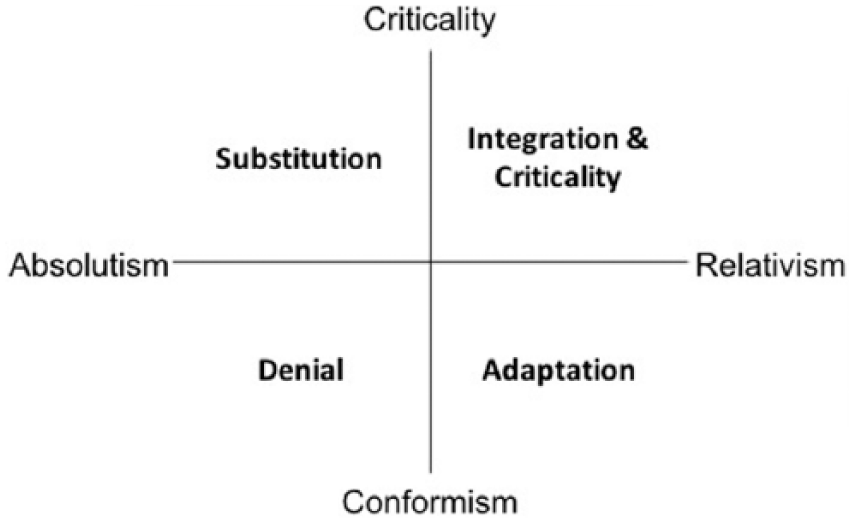
Four positions for working in intercultural contexts.
Each of these four positions, we suggest, has implications for the role that coaching plays as a social process.
Arguably, the position of Denial has been the default position in the coaching literature until relatively recently. The assumption seems to have been that coaching is a value-neutral technology of the self that can be transferred in similar ways to how other technologies, such as medical advances or the Internet, transfer in the world of applied sciences. From this perspective, coaching could be adopted in different contexts and would be expected to seamlessly become a tool for supporting the development and well-being of individuals, organisations and societies, ignoring or denying local social processes. The position of denial maintains absolutism and conformism by avoiding to acknowledge the social context. The implication of such a psycho-technical position is that coaches focus on the individual, the coaching relationship and the coaching process, with little consideration of the social factors in play.
The position of denial is built on the assumption that humans are basically similar everywhere, in the way they develop, get motivated and achieve goals, and that organisations, families and other social units follow similar dynamics everywhere, albeit at an abstracted level. This assumption may have been reinforced by the relative scarcity of published psychological and organisational research from outside the Western world. On the positive side, the position of denial provides simplicity and universality, where a set of relatively simple coaching models could be used in all situations. It suggests that coaches can use research, methodologies and educational materials developed anywhere and can offer their services to almost everyone.
We believe that the position of denial is problematic for several reasons: First, we believe that humans and their socio-historical contexts are intertwined, to the extent that understanding and helping to change one independently from the other are hardly possible. Second, the assumption that coaching is value-neutral needs to be reconsidered. As we have argued in this article, coaching has been heavily influenced by specific cultural and ideological movements, and it carries within its core assumptions values that are primarily upheld in Western democracies. It follows that many of the models, practices and ethical charters that govern coaching need to be seen as cultural devices rather than universal systems, reflecting – for example – a primacy of individualism over collectivism. Third, several authors have expressed scepticism towards the implicit assumption that coaching could function free from the social context. Stelter (2014) argues that as we encounter more diversity and globalisation, values become an essential point of reference for coaching. Values are intertwined with culture, and culture is, by definition, contextual. Authors repeatedly argue that where coaching is provided for individuals belonging to specific social groups, factors such as gender, race and age are at the heart of the coaching process (Ludeman, 2009; Winum, 2005; Wright, 2006). Shoukry (2016) argues that discriminatory and/or oppressive social contexts affect the entire social and psychological experience of the individual and that coaching theories that do not consider the impact of oppression may help in maintaining and reproducing it. The assumed universality of coaching may be beneficial to its growth, but an understanding of the contextual factors that affect coaching is essential to its sustainability.
The second position that coaches may take is Substitution. Here, coaches may be aware that coaching stems from a specific worldview, but hold the belief that such worldview has supremacy over other competing views. From that perspective, humanistic values of individual self-actualisation and free-will are seen as normative ideals that are worthy of substituting values like collectivism. Neoliberal democracies may be seen as advanced systems that lead to thriving societies, where competitiveness and goal-striving are offered as skills that are aligned with achieving success. Whether consciously or unconsciously, coaches can impose their ideals on the coaching process. The position of substitution takes absolutism to mean that cultural systems are bound to progress towards ‘better’ values and criticality to describe the process by which less ideal values and norms are criticised and substituted by better ones.
The position of substitution is particularly tempting when coaching in oppressive environments (e.g. in societies where women or ethnic minorities are systematically disadvantaged), as the coach may represent a worldview that claims to uphold positively imbued values like equality, freedom and justice. In this situation, the position of substitution may allow the coach to challenge the status quo. However, we believe that such perception of supremacy is unlikely to empower clients to find their own way within their social context. The position of substitution may be seen as similar to what Said (1978) described in his seminal work about the position that Western practitioners studying the orient often take. He argues that the ‘Orientalist’ is representative of the Western culture:
… a man who compresses within his own work a major duality of which that work (regardless of its specific form) is the symbolic expression: Occidental consciousness, knowledge, science taking hold of the furthest Oriental reaches as well as the most minute Oriental particulars. Formally the Orientalist sees him-self as accomplishing the union of Orient and Occident, but mainly by reasserting the technological, political, and cultural supremacy of the West. (p. 246)
Taking South Africa as an example, Stout-Rostron (2017) noted that the majority of coaches are predominantly White males, with a pronounced Western and Eurocentric outlook. Similarly, Geber and Keane (2013) argued that Western values still pervade coaching practice there, with little awareness of the cultural bias that this may impose. The belief that Western values, knowledge and systems are superior is not exclusive to Western coaches, but, as Freire (1970) explained, the myth of inferiority becomes internalised as the result of cultural invasion. Those who believe themselves inferior would be the ones to ask for imported values and ideas to replace their own. Coaching practitioners from around the world can seek to get accredited by Western institutions, without necessarily being encouraged to reflect on their own social context, or to integrate their culture into their coaching practice. As a consequence, coaching may eventually become criticised and rejected in many communities as a product of Western cultural invasion.
The third position, Adaptation, has possibly become the most prevalent view in the literature about intercultural coaching. From this perspective, coaches value their clients’ cultural contexts. They respect the uniqueness of each community, try to understand it and seek to adapt to its norms. Sensitivity to and acceptance of the clients’ culture become promoted values. Rosinski (2003) was one of the earlier proponents of this view. He suggested that coaches should use cultural orientation frameworks to understand the contexts of their clients and leverage this understanding to coach them in ways that would be most effective to them. Several authors such as Passmore (2009), Abbott (2010) and Van Nieuwerburgh (2017) also presented case studies and theoretical models to improve the coach’s ability to work with diversity, cross-cultural and intercultural coaching. The position of adaptation infers relativism to mean that cultural diversity is acknowledged without prejudice and takes conformism to describe the process of ensuring coaching aligns to the established norms and values of its context.
While the position of adaptation could be seen as an improvement over the positions of denial and substitution, we believe it also needs to be critically considered. Shoukry (2016) argues that in many cases, studies in cross-cultural coaching seem to favour adaptation over criticality. He provides examples where authors recommend ways to work within the boundaries of a specific culture: by respecting family and religious values; coping with the social hierarchy; avoiding coaching topics that are taboos, like politics, religion and sexual relationships; and avoiding pushing coachees into confrontation with the norms of their society. Another example of adaptation takes place when coaching women in organisations: coaches may try to help their clients fit into the organisational culture, including gender politics and differential gender values, rather than enabling them to function as themselves and transform the organisation (Peltier, 2010).
The underlying principle across many of these accounts is that coaches accept the social order as a given. However, considering that oppressive structures maintain and reproduce themselves as part of the established norms and culture of a community (Dominelli, 2002), it may be argued that coaching – by conforming to the social order – may be reinforcing the oppressive structures and denying coachees the chance to challenge them. As Western (2012) argues, ‘if coaching is not an emancipatory project, then by default it becomes an instrumental project’ (p. 28).
We call the fourth position that coaches may take Integration and Criticality. We believe that this position offers an important balance that may promote capability in handling the complexity inherent in many social settings, especially where oppression and inequality have been institutionalised and internalised and have become part of everyday practices. The position of integration and criticality upholds the same view of relativism as in the position of adaptation, in terms of acknowledging and respecting the cultural context, but balances it with a process of criticality that involves an examination of the assumptions, norms, expectations and limitations of the cultural system and how they affect the individual being coached.
From this perspective, coaches are aware of the overall social context of the individual and recognise how the social context may drive many of the assumptions and behaviours that are discussed in coaching. Coaches are also aware of their own social context and how it influences them. They not only respect their clients within the wider context they live in but are also mindful not to take that context as given. Instead, coaches consciously try to create a balance between, on one hand, integrating the cultural aspects that may support their clients’ needs and improve the effectiveness of coaching and, on the other, supporting their clients in critically reflecting on their social and cultural reality and empowering them to change that reality rather than to merely adapt to it.
However, the position of integration and criticality highlights a number of ethical and practical complexities that require further consideration. The first complexity is highlighted by Van Nieuwerburgh (2017), who argues that for coaches working in interculturally sensitive situations, ‘while being non-judgmental is essential to the creation of mutually respectful relationships […] the stance of “non-judgement” cannot override the code of ethics of a professional coach’ (p. 449). He gives two examples: one is about respecting the law of the jurisdiction where the coachee lives, and the other is about dealing with situations where the coachee may be at risk of harm, regardless of the cultural milieu. These two examples are not unproblematic, given that in oppressive contexts, it is often the case that coachees’ well-being and the full adherence to the laws and norms of the social order are at odds with one another. The implication here is that coaches cannot always be neutral. Instead, they may need to accept the responsibility of enabling their clients to critically examine their social context and its accepted norms and to challenge the oppressive structures that are affecting them and others, as Shoukry (2017) notes:
In every situation where coachees are part of an oppressive social structure, coaching becomes a political process, even when it takes place under the banners of life, career, or developmental coaching. Acknowledging the significance of the social structure, without denying the coachee’s agency, embeds coaching as part of the daily micro-battles of emancipation and social change. (p. 184)
In the meantime, coaches need to ensure their focus remains on the uniqueness of their clients, not reducing them to the socio-historical structures that affect their lives.
A second complexity is that coaches need to be aware of how the social context may affect the coaching process and relationship. One example is when both coach and client, living in the same social context, may share internalised beliefs that affect their ability to engage in a critical discourse. Another example is when coaching takes place within a context of overwhelming power dynamics that threaten the coachee’s ability to exercise agency. Taking action to challenge the social order may have dangerous implications. A third example is where organisational politics and the three-way contract between coach, coachee and the organisation may imply divergent and hidden agendas for the different stakeholders of the coaching process (Louis and Diochon, 2014). These examples imply that coaches who wish to take the position of integration and criticality require higher levels of cultural competence (Lasley et al., 2011), reflective practice and supervision in order to navigate the complexity inherent in these examples.
The way forward
We have so far argued for an increased understanding of coaching as a social process. We have analysed the rise of coaching in the Western world, shaped by neoliberal forces, and then we have discussed how a critical understanding of coaching is essential in intercultural and oppressive environments. In this section, we discuss how coaching theorists and practitioners may want to promote a socially informed perspective in their work.
With the growth of coaching research and professional doctoral studies, particularly in some British and Australian universities, the critical stance is growing. However, if coaching theorists and practitioners want to support the understanding of coaching as a social process to become embedded in the overall coaching ‘eco-system’, they may want to engage further with a number of questions, at the level of theory, research, coaches’ development, coaching market, practice and supervision. We discuss each of these six areas in turn.
First, at a theoretical level, coaching theorists may want to examine the question of assumed and elected neutrality. There is a need to ask what conditions and ethical boundaries would need to exist in order for coaching to be assumed neutral and hence for practitioners to be able to function without the burden of fully understanding the social context. Similarly, questions can be asked about the conditions and limitations of transferability of coaching models across different social contexts. Coaching theorists may also want to develop accessible models that help practitioners assess how the context is affecting them and their clients, by analysing the implications of socio-historical processes, organisational politics and power dynamics for the coaching process.
Next, there is the question of when coaches may choose to assert their personal biases: Should coaches overtly express their values? In situations of injustice, does coaching have a critical role to help highlight or overcome marginality or oppression? Should coaches introduce transformative values or even introduce other emancipatory agendas, such as feminism or environmentalism? Ethical and practical conflicts may arise if the coach wants to bring a strong values base into the coaching space, whether such a stance is overtly expressed or implicitly embedded within the coaching process.
The second key area, supporting the understanding of coaching as a social process, is research. Current coaching research focuses mainly on Western business settings with limited research being done in non-Western countries or in settings outside the corporate arena. As mentioned, outcome studies proliferate and question the benefit of coaching, but often only from the standpoint of the paying client, the organisation. A critical understanding of coaching implies that researchers recognise the different voices that need to be heard: the employee in conflict with the organisation, employees who refuse coaching, clients belonging to socially excluded groups and so forth. In oppressive contexts, researchers may need to extend their scope, from understanding the change that takes place in the individual to analysing how the individual’s social environment responds to that change. This may be particularly important in relation to supporting clients to change their social conditions, as Shoukry (2017) highlights: ‘Given that oppressive environments are often unyielding, supporting action involves careful planning and understanding of the implications of social conflict, as well as dealing with the emotional barriers of change’ (p. 184). Research methodologies and ethical constraints may also need to be considered; researchers aiming to empower the subjects of their social inquiry may want to review the ways with which they undertake and interpret their research.
A third key aspect is the development of coaches. There is a question concerning how coaches learn to become more critical and aware and how this might, in turn, impact the way educational and professional coaching bodies operate. Many coaches may, in their earlier education, have developed a critical view of the world, recognising that social problems are compounded by social institutions (Johnston et al., 2016). But as Johnston et al. (2016) recognise, ‘carrying this education into the practice world, and promoting its related principles and practices, has become evermore challenging’ (p. 13). Coach education programmes could, as Moore and Koning (2016) suggest, help coaches explore issues of identity and understand their role as social agents in challenging social environments.
However, facilitating an understanding of coaching from a social lens is not an easy transformation for educational bodies. Coaching education is often positioned within the business school of a university. Toubiana (2014) has argued that – in business schools – there is a disconnect between educators’ personal conceptions of social justice and the profit-driven ideology and hegemony that govern what and how they teach and how they conduct research. Educators need to work together to understand how to realise ‘the possibilities of the classroom as a dynamic space full of potential energy by which we can engender social change’ (Fotaki and Prasad, 2014: 105), a space where educators ‘use the classroom as a discursive forum in which to develop what Freire (1970) calls critical understanding’ (p. 105).
Looking at the curricula, a possible advance might be to include more critical analysis of the components of coaching – such as listening or reflective practice – in the coach education curriculum. Reflection is seen as a vital part of coach learning (Cushion, 2018). However, as Cushion points out, reflective practice is taken for granted with ‘limited critical analysis of its theoretical foundations, its history or ideology, nor the underlying assumptions that guide it’ (p. 83). Reflective practice is introduced in coach education as a constructivist idea but is often given a positivist epistemological twist by introducing sequential steps (i.e. the SOAP model which encourages rational justification (Plaister-Ten, 2013)). Cox (2013) stresses a symbiotic relationship between phenomenological reflection (generally perceived as reflective practice) and critical thinking, suggesting that each is dependent on the other. She describes the aim of thinking critically as to observe values and beliefs as they arise and examine the assumptions they embrace: This, she argues, is done ‘in the light of all available information: previous experience, vicarious experience, extant knowledge, logic and reasoning. Ultimately it enables the coach and client to explore what the coaching task might be in relation to that experience’ (p. 139). Critical reflection, thus, goes beyond the exploration of personal experience, to allow the making of ‘informed judgements based upon a recognition of the imbalances of knowledge, power and wealth that exist in society and organizations’ (Gray, 2007: 513).
Beyond acquiring a deeply critical stance towards their own practice, coaches may also need to be trained in a range of dimensions that increase their ability to understand their – as well as their clients’ – roles as social agents. Shoukry (2017) suggests these dimensions would include the following: (1) social, cultural and political awareness, possibly tailored to specific relevant contexts; (2) psychological concepts that relate to oppression and empowerment; (3) the ability to facilitate a critical dialogue with their clients; and (4) the ability to facilitate action in challenging social contexts.
A fourth area that can be examined is how a critical stance may translate into the coaching market. In neoliberal contexts, as Sugarman (2015) suggests, the vocabulary of management and performativity have infiltrated the way we administer ourselves. When the market defines its expectations from the ‘coaching service’ using economic terms, coaches are obliged to present their work in the same manner. How then would coaches be able to apply an integral and socially critical perspective to their work, without risking losing the buy-in of their corporate and individual clients? When a coach’s livelihood depends on promoting a positive view of the coaching practice, it would be difficult to spend time/energy critiquing the fundamental underpinnings of that practice. Without responding to these challenges, a critical understanding of coaching can only have traction in academia. Professional coaching bodies may have a role to play here, by encouraging the whole industry to become more aware of the social underpinnings of the practice and introducing a balanced and more holistic vocabulary for coaches to use when promoting their work.
A fifth key area, perhaps the most important, is how a critical understanding of coaching may affect coaching practice. This question has two dimensions: The first is the impact of the social context on the coaching practice. This is particularly important in intercultural and oppressive contexts. The second is the impact of the coach’s disposition with reference to the framework presented earlier in this article. In other words, how does the combination of the social context and the coach’s stance change the way coaching is practised? What differences might be observed in the way the coaching relationship is experienced? How does the language used in coaching change? How do coaching techniques differ in meaning and impact, when applied within different social contexts? How are coaching tools being adapted to serve – for example – an emancipatory purpose? Would coaching succeed in increasing coachees’ awareness of the hegemonic structures at play in their social context, and would it empower them to change these structures?
The sixth and final area is coaching supervision and, more generally, the overall support system for coaches. A first consideration is around the training of supervisors. Johnston et al. (2016) note how conventional models of supervision highlight administrative support, educational and meditative functions: ‘their focus has centred on adaptive learning to help practitioners deal with daily routines and develop skills for reflective practice’ (p. 14). They stress that a range of theories already exist for the critically minded practitioner and suggest that theories such as feminism, critical multiculturalism, social constructionism, postmodernism or postcolonial theory be incorporated into the study of supervision. A second consideration is whether coach and supervisor should share the same critical stance and appreciation of coaching as a social process. Taking this question further, would coaches embracing a critical approach need to group together and offer each other peer support? And would such communities, if ever created, be athematic or be centred around specific social causes or contexts?
Conclusion
In this article, we have argued that coaching needs to be understood as a social process – a product of society and a contributor to its dynamics. We highlighted how coaching originates from socio-historical processes that have changed the West and are gradually changing the world and how, as a relatively young practice, it has the potential to grow and expand further. However, we also recognise that a critical understanding of coaching as a social process is not widespread, but is needed to ensure that coaching will not merely be a tool for conformity that serves the powerful but also an enabler of change that empowers everyone – a critical discipline that is capable of reviewing its own premises and challenging the boundaries of its own social context.
Our aim has been to contribute to the conceptual understanding of coaching as a social process and to offer frameworks and pathways that would help coaching theorists, educators and practitioners to embed such understanding in the coaching eco-system. Through providing a brief critical history of coaching, we have argued that the claim of coaching neutrality may have been playing into the hands of the dominant ideology and hegemonic structures. Meanwhile, we believe that, by helping individuals reassert their agency and supporting them to understand the bigger context of their actions, coaching can help in improving organisations and communities.
We have discussed how a critical understanding of coaching plays out in two distinct contexts: first, in the workplace, where the triangular relationship between coach, coachee and organisation acts as a space for power dynamics and multiple agendas of control and resistance; second, in intercultural and oppressive contexts, where we proposed a framework, adapted from Bennett (1993), for helping coaches to critically explore their position towards the complexity inherent within these contexts.
In order to take this discussion forward, we have presented a number of interconnected paths that need to be progressed. We argued that coaching theorists may need to reassess some taken-for-granted assumptions about coaching; researchers may need to re-examine the scope and methods of their research; educators could emphasise criticality as a key skill for coaches; practitioners wanting to embed a critical stance into their practice may have several ethical and practical questions to answer; and supervisors may need to help coaches critically reflect on how the social context is affecting them and their clients. To borrow the words of Freire (1970), ‘This can be done only by means of the praxis: reflection and action upon the world in order to transform it’ (p. 51).
The evolution of coaching as a critical discipline also needs to coincide with two other key developments: The first development relates to bringing new voices into the coaching community, as it continues to expand into new social contexts. If we want to allow coaching to grow beyond its Western/corporate origins, then we need to ensure that theorists and practitioners from all social contexts are invited to participate in redefining the purpose and nature of coaching. The second development relates the integration between coaching and other disciplines. The growth of critical approaches to professional practice has taken place in many relevant disciplines, like psychology, psychotherapy, education, social work, sports coaching and community theatre. Available research and experience from these disciplines could inform the journey towards a critical theory and practice of coaching. Many of these disciplines have also started to embed coaching into their practices and would equally benefit from mutual engagement with the coaching community.
Footnotes
Funding
The author(s) received no financial support for the research, authorship and/or publication of this article.