



Abstract
The purpose of this article is to explore the relation between organizational presence and the place in which such a presence is enacted. To this end I mobilize Doreen Massey’s processual conceptualization of place as an event consisting of a bundle of trajectories. By following the presentification of a Swedish company, Fjällräven, in the natural environment in the North of Sweden during Fjällräven Classic, I show that the organization is not made present in place, but through place production. I propose the concept of place work to express the work done by representatives of the organization, but also by other humans and nonhumans, to make the throwntogetherness of the place result in a rather coherent and stable construction through which the organization is made present. Place work is therefore work through which organizational presence and place are recursively co-creating. The concept of place work expands what we can learn about the “where” of an organization when building on an ontology of performativity.
While the question of what an organization is has been vastly discussed in organization studies, the question of where an organization is has received less attention (Wilhoit, 2016). Building on an ontology of performativity, the answer to what may be that organizations are configurations of human and nonhuman representatives, that organizations assume meaning as representatives (humans and nonhumans) act in their name, and that organizations materialize in those representatives (Ashcraft et al., 2009). The answer to the latter question, where, would thus need to consider such a dispersed, emergent, and heterogeneous agency (Cooren, 2006; Wilhoit, 2016). There is no easily identifiable entity, the organization, present in an easily identifiable container: the place of the organization (Vásquez and Cooren, 2013; Wilhoit, 2016). Rather, place is constantly being reconstructed and organizational agencies also contribute to such a reconstruction (Cooren et al., 2005; Wilhoit, 2016). If organizations contribute to re-constructing the place in which they are present, how can we understand the relation between organizational presence and the emergent place in which such a presence is enacted? The purpose of this article is to explore this question, taking into account both the social and material dimensions of such a relation (Beyes and Michels, 2011; Beyes and Steyaert, 2012; De Vaujany and Mitev, 2013; Panayiotou, 2015; Wilhoit, 2016).
A sociomaterial sensibility has been previously mobilized in this journal to study processes of place making; that is, how an organizational place with identity-ordering effects emerges in a contested process between designers and users, a process in which materiality, cognition, symbols, and action interplay (Berti et al., 2017). But we still know little about how re-construction of place is related to the presence of an organization, above all, when presence may manifest itself outside the organizational buildings. I focus on this aspect by studying Fjällräven Classic, an outdoor trek organized by the Swedish company Fjällräven. Considering organizational agencies as dispersed, emergent, and heterogeneous (Cooren, 2006) also leads to treating “which places to find organizations in” as an open empirical question and may include the natural environment, usually not considered by organization studies.
To discuss the relation between the presence of an organization and the emergent place in which such a presence is enacted, I build on the idea that organizations only exist and act through their human and nonhuman representatives and what they do (Cooren et al., 2008). Presence is thus not the property of an entity; rather, presence needs to be accomplished through materialities (Gumbrecht, 2004). Building on studies focusing on communicational processes of presentification through which spacing and timing are achieved by multiple and heterogeneous sociomaterial relations (Cooren et al., 2008; Cooren et al., 2005; Vásquez and Cooren, 2013), I focus on presence and place (Wilholt, 2016). My approach is inspired by postmodern human geographer Doreen Massey’s (1994, 2005, 2011) work on space and place as relationally constructed. The crucial characteristic of place is its throwntogetherness (of humans, nonhumans, and geological formations that co-evolve), which requires negotiation to construct temporary boundaries and some degree of coherence, and thus the enactment of power (Massey, 2005).
Building on such an approach to place and the analysis of Fjällräven Classic, I argue that place is not only where presentification happens, but rather that presentification happens through the re-constructions of place as well—a process that I discuss through the concept of place work. At Fjällräven Classic, place work comprises the work done by representatives of an organization, but also by other humans and by nonhumans. The throwntogetherness of the place results in a rather coherent construction through which the organization is made present. This article thus makes a contribution to management learning by proposing an approach to developing analyses, both of the production of organizational presence (Cooren et al., 2008) and of the enactment of place in relation to organizational processes (Berti et al., 2017; Sergot and Saives, 2016).
Organizational presence
An ontology of performativity and a “communication as constitutive of organization” approach treat organizations as having no essence or stable objective properties, but rather as being made and remade in action (Ashcraft et al., 2009; Czarniawska, 2008; Taylor and Van Every, 2011). As Cooren et al. (2008) argue, it is through materialities that something is experienced as having presence. That is, it is through specific agents (humans and nonhumans) that “something” is made present to us. Examples of such agents may be corporate buildings materializing the organization for people passing by, or corporate-sponsored athletes with clearly visible logos on their garments materializing the organization through their performing bodies. Hence, organizations, as social collectives, become embodied in disparate and distributed interactions in which they are enacted by humans/nonhumans acting in their name (Cooren et al., 2008). An organization is thus both an abstraction and the sum of all its embodiments/incarnations. Researchers can analyze how organizations are presentified in communicational acts including interactions, negotiations, and co-constructions (Cooren et al., 2005). Importantly, people managing an organization cannot control how it is presentified, as presentification is always a matter of co-production (Albu and Etter, 2016).
In this article, organizational presence is therefore conceptualized as an organizational achievement requiring one or more agents (human or nonhuman) acting in the name of the organization. Organizational presence is materialized through the organizational agents’ materiality in relation to other materialities. To foreground the processual and sociomaterial character of such an understanding of organizational presence (Orlikowski and Scott, 2008), I use the term “trajectory” rather than agent in the rest of the article for both humans and nonhumans. A trajectory is a story-so-far developed in relation to other trajectories, but also the “process of change in a phenomenon” itself (Massey, 2005: 12). Trajectories are therefore not discrete and stable entities; rather, speaking of co-evolving trajectories enables us to emphasize how agents are both material and continuously relationally re-producing, building on previous configurations of which they have been a part.
Place
Research has focused on how presentification transports an organization in space and time, and how the organization thus materializes in a certain “here and now” (Vásquez and Cooren, 2013). Less attention has been paid to what happens with the “here and now” as such materialization goes on. For instance, Cooren et al. (2008) describe presentification as making the organization part of the landscape, but they do not delve deeper into how the relation between the “landscape” and presentification develops—what happens to the “landscape”? Similarly, Vásquez and Cooren (2013), arguing that the transportation of an organization in time and space is due to hybridity of action (involving humans and nonhumans), provide an account of how communication plays a role in making the organization travel across space-time, materializing it in different “here and now” and ordering different trajectories, by mobilizing a number of humans and nonhumans in a conversation. While this research provides insight into the transportation of organizations in space-time, it does not foreground how presence is related to the place to which the organization is transported and in which it is presentified (Wilhoit, 2016).
To examine such questions, I build on Doreen Massey’s (1994, 2005, 2011) work, in particular her book entitled For Space (2005), in which she articulated an understanding of space close to performative views in organization studies (Beyes and Michels, 2011; Beyes and Steyaert, 2012; De Vaujany and Mitev, 2013; Panayiotou, 2015; Taylor and Spicer, 2007; Tyler and Cohen, 2010). Place (e.g. Sweden or Lapland) is often defined as a meaningful location (Cresswell, 2015) and, Massey (2005) argues, its meaningfulness and coherence are often taken for granted. By contrast, space is often considered more abstract. Massey argues for problematizing and reimagining such a distinction (Massey, 2005). Both space and place are continuously constructed in an open-ended, relational process. As such, space and place are political and emerge through active material practices (Massey, 2005).
As anticipated, trajectories, or co-evolving stories-so-far, is a central concept that Massey (2005) mobilizes. A trajectory is both the history and movement of a phenomenon, which can be of different kinds, from a geological formation to a human being. A trajectory is thus not an entity; it both presents some stability (the story-so-far) and is continuously evolving (movement). Space-time is constituted as trajectories co-evolve in relation. Space is therefore both social and material, and Massey (2005) problematizes its compartmentalization into bounded given places. The local and the global are co-constituted in this relational understanding. While space is defined as a sphere, place can be seen as an event, a temporary constellation of trajectories, always contested and reconstructed in powerful processes (Massey, 2005). Co-evolving trajectories establish temporary boundaries, where “the ‘difference’ of a place must be conceptualized more in the ineffable sense of the constant emergence of uniqueness out of (and within) the specific constellation of interrelations within which that place is set” (Massey, 2005: 68). Through connections, such temporary and possibly contested uniqueness is re-produced, at the expense of parallel constructions. The throwntogetherness characterizing a place, and its negotiation, can thus be studied. The coexistence of a plurality of trajectories requires negotiation to construct temporary boundaries and some degree of coherence, making place re-production about power enactment. Place is thus not only about a configuration of trajectories (how they relate to each other), but also how such a configuration is formed, sustained, contested, and constantly re-produced. The production of place is political as it is about ordering attempts to negotiate the terms for connecting and who gets the right to be present (Massey, 2005). In other words, what is special about place is not some pregiven identity, but ongoing negotiations including humans and nonhumans (Massey, 2005), given that place is both historical—the result of all entanglements—and emergent—what is being woven (Massey, 2011).
To conclude, building on Massey (2005, 2011), I define place as an event consisting of a bundle of co-evolving trajectories, organized in specific configurations in relation to a location. Place is also an enactment of power since the throwntogetherness of trajectories requires negotiation in order for some degree of coherence and uniqueness to be produced.
In the following, I empirically explore how the process of production of organizational presence is related to the place in which it happens. To address this question, I follow the process of producing organizational presence as a number of trajectories do things in the name of Fjällräven by performing Fjällräven Classic. I show how human and nonhuman trajectories are connected and brought together in specific ways to do things in the name of the organization, enacting power in the relationships established and the negotiations carried out. After that, I analyze what happens to the place in which Fjällräven is being presentified and discuss the relation between organizational presence and place in this case.
Method
In this article, I focus on one event, Fjällräven Classic 2016. This event is rather similar to others I studied in a project I conducted on the Swedish outdoors industry, for instance, the Icebug Xperience, but it is also the best known. Fjällräven Classic attracts 2000 participants for 1 week each summer. It is organized by the Swedish outdoor company Fjällräven in cooperation with STF (the Swedish Tourist Association), the Save-the-Kungsleden initiative, and other companies or local associations. It takes place along the most traditional hiking trail in the country, the Kungsleden trail in Lapland, in the north of Sweden. The trail is approximately 100 km long and passes some famous landmarks, such as the highest mountain (Kebnekaise).
This study was conducted following an abductive approach, moving back and forth between theory and close rereading of the empirical material (Dubois and Gadde, 2002). This led to tracing the emergence of configurations of humans, nonhumans, and the geological formations in Lapland. The empirical material produced comprises daily diaries produced by Anton and Josefin (two participants in the event); pictures taken by Anton and Josefin; a group interview after the event with Anton and Josefin; the texts, pictures, and movies produced by the organizers of the event; and texts, movies, and pictures published on the web produced by people commissioned by Fjällräven and by other participants. In my analysis, I foreground the official Fjällräven Classic website and the diaries, since looking at the narratives of the website and the diaries in relation to each other enables me to see both the “polished” version of how trajectories are put in relation and the emergent enactment of the trajectories. Adopting a narrative approach (Czarniawska, 2004), I reproduce the story told by Fjällräven Classic through the website, and by two participants through their diaries, which also reveal the importance to participants of what the website tells them.
The choice of asking two people to take notes was not only practical, but also motivated by the methodological opportunity of having data produced by “ordinary” people interested in hiking and not involved in research (Karrbom Gustavsson, 2005). The two participants were thus not influenced by my emerging theoretical interest. Josefin and Anton are in their twenties, of Swedish nationality and have some hiking experience, but they had never previously participated in a similar event. They were instructed to take as many notes as possible on what was happening, how they felt, and what they did, and also to take pictures. They both started writing the diary before the actual event, describing their preparations. While in the race, they took extensive notes in a notebook, which they rewrote in a Word document after the race was finished.
The narratives that they produced, summing up to approximately 16,000 words, were rich in detail about actions and events, reports of thoughts they had, and descriptions of feelings and their embodied experiences. Hence, even though I did not experience the race myself, I immersed myself in it by reading such narratives and looking at the 350 pictures taken by Josefin and Anton. I thus sought to feel the material, and not only read it (Sergi and Hallin, 2011). During the post-event interview, Josefin, Anton, and I explored together their experience in relation to the narratives in the diaries. It also became clear that the two had not talked to each other when writing the diaries, but that their overall impressions and feelings about the race were very similar. While a larger number of diaries would have provided narratives about the experience from different points of view, the material allows me to explore the journey made by these two people, how they gradually became part of emerging configurations, and how they experienced such configurations in detail.
Making Fjällräven present: the connecting of trajectories presented on the Fjällräven website
In the following, I present a first interpretation of the narrative presented on the Fjällräven Classic website in terms of trajectories making Fjällräven present and trajectories becoming related to those making Fjällräven present. I interpret the humans and nonhumans introduced by the website in terms of trajectories, as summarized in Table 1. I start by identifying them; after that, I explore what they do in relation to each other.
Detailed reading of the first page.

Figure 1 shows how the website approaches the reader, welcoming him/her to an unforgettable experience.

Drawing reproducing the first webpage of the Fjällräven classic event.
Solitary people are hiking in stunning landscapes characterized by green/yellow fields, mountains, and water. The people are carrying equipment and wearing clothes that are highly functional. The page is visually framed by an outdoor map and is part of the Fjällräven page, dominated by the logo: The trail between Nikkaluokta and Abisko has long been one of the most popular hiking trails in the Swedish mountains. The trail goes by Kebnekaise, the highest mountain in Sweden, and proceeds through green valleys and over crystal-clear water to finally reach Abisko tourist station. Fjällräven Classis has made this all more accessible by offering organized logistics, checkpoints, food and support. Welcome to this unforgettable experience! [my translation]
People are welcomed to experience the outdoors in Swedish Lapland without needing to worry about surviving in nature on their own. Fjällräven staff will provide logistics, support, and food, as well as checking regularly on how participants are doing. A movie on the page provides glimpses of how it feels to put up a tent, eat at the campfire, and bathe in a cold river, while a voice states that this is an opportunity to experience a great adventure in the Swedish wilderness in Lapland and that participants meet like-minded people. The founder of Fjällräven, Åke Nordin, wearing a Fjällräven cap, explains the reason for starting this trek: “to get Swedes out to the Swedish mountains.”
Applying the previously introduced lenses on organizational presence (Cooren et al., 2008, Massey, (2005), Table 1 provides an overview of which trajectories introduced in this page materialize Fjällräven and to which other trajectories they are being connected.
The other pages expand and detail this narrative with text and pictures (Figure 2 presents two examples). To experience this unforgettable wilderness, participants need to carry their own equipment and, for safety reasons, a list of compulsory equipment is provided. This is supplemented with information on what to consider when choosing equipment, as this is important to having a good experience, and by examples of Fjällräven products. Along the trail, mobile phones do not work and there is no transport, but the organizers have six checkpoints open 24 hours a day where participants can refill food and gas, have a sauna, or meet medical staff. The organizers also provide a map and a trekking pass to be stamped at the checkpoints. Water, on the other hand, is refilled from small streams along the trail. At night, participants sleep in their own tent that they pitch where they like under the midnight sun. Everyone is given a medal at the end and the Trekkers Inn is waiting for participants in Abisko, with food, music, and drinks. The website also describes in detail the different legs of the trail and provides advice on how best to enjoy them, for instance: From the bridge you see the characteristic mountain Drakryggen [the dragon’s back]. The last part towards Sälka never seems to end. The landscape is the same all the time and the trail zigzags up the mountainside. There are plenty of streams to drink from and nice places to rest. Take the opportunity to enjoy the mountain world at its most beautiful! [my translation]
In more analytical terms, the other pages introduce or expand on trajectories making Fjällräven present, for instance, the checkpoints consisting of Fjällräven tents or possible Fjällräven products to be used. Trajectories making Fjällräven present are also further connected to others, such as the streams, the midnight sun, or the characteristic mountains.
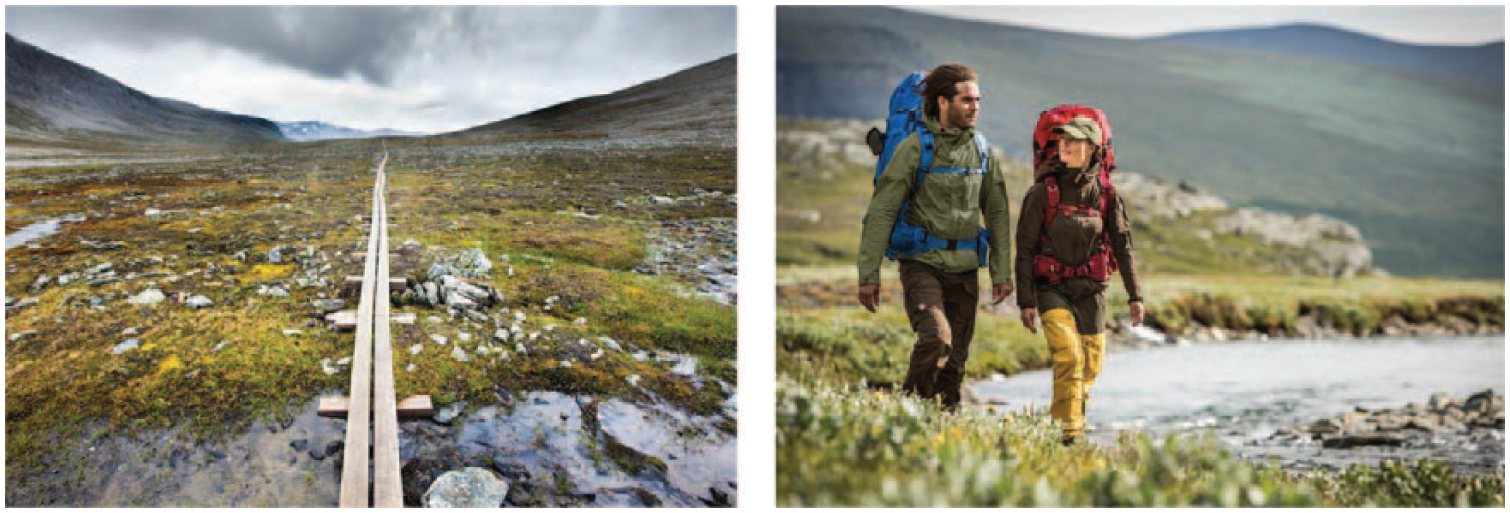
Pictures from the Fjällräven Classic website (2016).
Making Fjällräven present: the connecting and experiencing of trajectories by participants
I now present the narrative produced by two participants through their diaries reporting the experience of preparing for and participating in Fjällräven Classic. Figures 3 and 4 show examples of pictures that illustrate such an experience. In this case too, the narratives introduce humans and nonhumans that can be analytically considered as evolving trajectories. I summarize the trajectories that materialize Fjällräven, making it present, at the end of each section.

Some of the pictures taken by Josefin and Anton from parts of the trek arranged by Fjällräven Classic organizers: the Sami woman’s speech at the start, a checkpoint, the finish-line area.

Some of the pictures taken by Anton and Josefin while hiking the Fjällräven Classic.
In preparation for the event
Josefin and Anton heard about Fjällräven Classic from previous participants/stewards, who often mentioned the positive atmosphere of the trek. For instance, Josefin’s hairdresser describes how she had terrible scrapes and crawled to the finish line, but also how cool it had been. Once registered, they look for information on the Fjällräven Classic website that they think feels Fjällräven through its style, a style one could even characterize as Scandinavian. They carefully read the information on the website and, when planning the trek, they decide to follow the advice of dividing it into legs. They also start to anticipate what they will experience, trusting the website. For instance, the second leg is supposed to be where participants actually start to feel the wilderness and have the possibility of seeing reindeer. The feeling at the finish line is also imagined and described: the feeling will be absolutely fantastic when we finish with aching feet, tired shoulders and tired thighs. At the finish line there will be showers, food and warmth. It feels like a much-desired and promising finish to a long hike! [Anton, diary]
In order to be prepared, they also need to buy/borrow the necessary equipment: First on the [Fjällräven] list is a 65-75 liter rucksack. […] Josefin […] will buy a new rucksack for the hike. She has decided to buy an Osprey as she has good previous experiences of those. [Anton, diary] Honestly, one becomes really tempted to buy new Fjällräven stuff from top to toe [Anton, diary]
As we can see, already far ahead of the event, some trajectories make Fjällräven present (Cooren et al., 2008) and are connected to other trajectories and to the Kungsleden trail, as Table 2 shows.
Detailed reading of the diaries concerning the preparation to the event.

Before the start
At the airport, Josefin and Anton recognize other possible participants by their clothes/equipment. Many participants bring Fjällräven items. Many are not from Sweden, and Josefin wonders if they may be even more nervous than she is, thinking of the challenge ahead. At the arrival airport, in Kiruna, Fjällräven representatives welcome participants with a Fjällräven Classic sign and direct them to a courtesy Fjällräven bus that takes them to the event check-in. During the trip, a woman tells them about Kiruna, the importance of wilderness and the Sami people. At the check-in, Josefin and Anton collect gas and food, a compulsory waste bag, and their map and trekking pass. They talk with a very kind steward about the trail and how to plan for refilling food and gas. All the stewards are wearing Fjällräven clothes. They also talk with a hiking guide. Josefin feels safe knowing that there will be many hiking guides along the trail. In the evening, a seminar in Swedish is offered about the Sami people, flowers, animals, and the trail. Josefin finds it a bit boring. Early the following morning, they take a bus to the starting point. The bus is full of people from outside Sweden and many of them are wearing only Fjällräven clothes.
As can be noted, during the hours before the start of the trek, more trajectories become connected. Among these, Fjällräven staff and Fjällräven Classic signs are examples of trajectories making Fjällräven present, while the Sami people, wilderness, dried food, and flowers are examples of trajectories becoming connected to the trajectories that make Fjällräven present.
Hiking Fjällräven Classic
Once in Nikkaluokta (the start), a Fjällräven representative gives participants some information through a loudspeaker, while Swedish music is played. A Sami woman tells participants about the Sami heritage and how it can be seen in nature, and invites them to “go together, enjoy nature and the animals”. This talk is only in Swedish, and Josefin and Anton wonder whether it is meant to mark the event as Swedish.
The day is rainy and tough. There are a lot of people and hearing the hiking poles of those behind makes one want to walk faster. Towards the end of the day, they reach the first checkpoint, a blue Fjällräven tent, where cinnamon rolls are served. After a couple of hours, they find a flat spot to quickly raise their tent and they cook inside it as it starts raining.
On the first day, we encounter trajectories presentifying Fjällräven and becoming connected to other trajectories, which Table 3 summarizes.
Detailed reading of the diaries concerning the hiking Fjällräven Classic phase, day one.

On the second day, they go on hiking on the trail, and Josefin reflects: I listened more than expected to the lecture [organized by Fjällräven the night before the start] and what [the person] said about walking “with method” – thinking and feeling in advance was a good reminder. [Josefin, diary]
As rains pours down, participants use waterproof clothes. Anton is somewhat surprised to realize that not everyone has highly functional clothes. At the next checkpoint, the surprise is Souvas, a reindeer-meat roll. They change to dry clothes in an STF mountain cabin. The person in charge of it seems not too keen on having so many visitors and is quite rude. Later on, they see some reindeer. Josefin, who has seen many before, is still excited and hopes people from outside Sweden also see them.
On the third day, they have a break at a station where they refill for food (and drink a Coca Cola, which Josefin finds strange). The rain is pouring down, and when they have lunch no one talks, they just save their energy. Once the pass is reached, they warm up in a little cabin. Two Americans also enter, talking about how fascinating Swedish nature is. Later, Josefin thinks: Wonderful with mountain water! Cold and good. It is awesome that you can drink all the water around […] Wonderful! A real feeling of freedom and wilderness experience. [Josefin, diary]
The Fjällräven tents at the next checkpoint can be seen from a distance: Now we have just passed Tjäkta and got the surprise […] – it was coffee, tea and carrot cake. Divinely good! [Josefin, diary]
On the fourth day, it takes a strong will to go on and on. As they hike, they reflect on being in the wilderness: I was thinking of how nice it is to have dry feet and I really felt how dry they were. And just then we arrived at the largest river to wade across. I tried to enjoy the dryness for a few more seconds before starting to wade’ [Josefin, diary] Today I looked up at the mountains, I breathed in deeply and really enjoyed it – it was a wonderful feeling! A feeling of presence and complete happiness. Pure air. [Josefin, diary] And the silence […]. The emptiness and silence […]. The strongest wilderness impressions [Anton, diary]
On the fifth day, the last part of the trail crosses green meadows and the weather is warmer. Participants seem happy and greet each other, exchanging encouraging words about being close to the finish line. Once there, Josefin and Anton are welcomed by people applauding and are given a medal. Their waste bag is properly emptied. After a warm shower, they go to the Trekkers Inn tent for a beer and reindeer meat. The atmosphere is very joyful with music playing: you feel a sense of community with the other trekkers. A ceremony is held and typical Fjällräven rucksacks are given to the children that have finished the trek.
Reading this narrative through the concept of trajectories, we can see that the trajectories presentifying Fjällräven are the same for day 1 as during the rest of the trek, while the trajectories to which they become connected include, to mention a few, different geological formations along the trail, typical Swedish food, pure water, other participants, the Trekkers Inn, and a medal. In the following section, I develop my analysis of these trajectories and explain what happens as they become related.
Organizational presence, place, and place work
Having presented the empirical material, I now develop my interpretation by first discussing how the organization Fjällräven is made present at Fjällräven Classic. I then turn to looking into what happens to the place in which such a presentification happens. Finally, I propose the concept of place work.
Organizational presence—The production of Fjällräven’s presence
In this article, I have defined organizational presence as an organizational achievement requiring one or more trajectories (human or nonhuman) acting in the name of the organization. Organizational presence is materialized through the materiality of the trajectories acting in the name of the organization as they relate to other trajectories (Cooren et al., 2008; Gumbrecht, 2004). As anticipated in the previous sections, with Fjällräven Classic the organization Fjällräven is made present through several trajectories.
The Fjällräven Classic website materializes the event throughout the year and is designed by Fjällräven employees. Several trajectories are brought together and organized on the website. Some, as shown in Table 1, make Fjällräven present (for instance, the name of the event, the logo on the website, and on artifacts shown on the website)—others connect Fjällräven to “Swedish wilderness” (for instance, Swedish mountains, crystal-clear water, reindeer) and give it the role of enabling participants to enjoy “genuine but safe and accessible nature” (for instance, the checkpoints, the trekking pass, the packing list). Note that it is the narratives that speak of wilderness. Analytically, it can be considered a construction of the natural environment, not an entity existing a priori (see also Drennig, 2013; Greider and Garkovich, 1994). In such a configuration, not only is the organization presentified, it is also given meaning. The adjective “Classic” suggests that such a configuration of trajectories is legitimate and recurrent.
During the days of the event, Fjällräven is presentified along the Kungsleden trail (see Table 3). All the participants in the event are enrolled in hiking in the name of Fjällräven, something that is then reported on the website, thus allowing Fjällräven to be made present in a similar way for one more year. Fjällräven is also made present by the logo clearly visible on clothes and artifacts, whether brought by participants or representatives of the company. An important role is played by stewards and guides who interact with participants in the name of Fjällräven, providing support, advice, and surprises. They lend a warm voice to the organization. Participants themselves narrate how “Fjällräven” makes the trek possible. Signs guide and “proper brands” logos on other participants create an atmosphere of “genuine wilderness” (only partly disturbed by not all participants having highly functional clothes, see Drennig, 2013). Generally, the presence of Fjällräven is related to the positive experiences and emotions of the participants.
Hence, Fjällräven Classic can be argued to produce organizational presence according to Cooren et al. (2008). But the event does more than that. The materialization (Gumbrecht, 2004) of the company happens through emergent configurations that bring together trajectories that become related in certain ways to each other and to a location in the North of Sweden. How can we understand the relation between such trajectories and the trail, Lapland, and Sweden?
Place—the re-production of the Kungsleden trail, Lapland and Sweden
I have defined place as an event consisting of a bundle of trajectories related to a location. Such a bundle is organized in a configuration, whose throwntogetherness needs negotiation in order for some degree of coherence and uniqueness to be produced (Massey, 2005, 2011). The Kungsleden trail and its surroundings can accordingly be considered a place that is continuously reproduced by the trajectories arriving at this location and becoming related to it, as well as by the trajectories that are to some degree a stable part of this bundle of trajectories, such as the streams.
When trajectories related to Fjällräven Classic gather along the trail, they also do something to the location around the Kungsleden trail, a central trajectory around which the others become configured. Trajectories that most probably would have not been there otherwise (for instance, many of the participants, the checkpoints, the Trekkers Inn) enter the bundle of trajectories that construct the place around the Kungsleden trail. Following Massey (2005), place is an event—the re-construction of place happening during Fjällräven Classic is limited in time, but so are all re-constructions of place. Moreover, such a reconstruction is repeated year after year, and reaches a wide audience as it is retold in different ways, something that lends it some stability. The website, the participants, Fjällräven staff, other trekkers, people living and working along the trail, and accounts of the trek on the internet contribute to the negotiation of the throwntogetherness of trajectories constructing this place. In this article, I focus on two of these agents, the website and the participants (two of them), and how they contribute to connecting trajectories to the Kungsleden trail.
The website organizes trajectories in a way that reproduces the trail in terms of a place characterized as wilderness, enjoyment, community, safety, accessibility, being Swedish. This is achieved as the trail is connected to trajectories such as an outdoor map, high mountains, stories from previous participants, checkpoints, advice and lists, and the Swedish flag. The way in which trajectories are connected seems to be carefully designed and potential tensions related to the throwntogetherness of different trajectories (and the paradox of making wilderness accessible to and safe for a large number of people) seem to have been resolved. For instance, the waste bag and instructions about how to handle waste seem to compensate for the potentially destructive presence of thousands of people along a trail constructed as genuine wilderness.
Such a designed configuration of trajectories could be hard to maintain if the participant’s practices and experience negotiated the throwntogetherness of trajectories—that is, the construction of the place—in a very different way. Looking at the diaries and how trajectories become related through participants’ narratives, we see they connect most of the trajectories mentioned on the website in a similar way and it seems that here, as well, the throwntogetherness of all these trajectories is mostly unproblematic. For instance, Josefin finds the seminar boring but then uses the advice it gives on how to hike and how to enjoy nature. The Sami people are made part of the place and constructed as part of the exotic character of the event, and of its Swedishness, by including a reindeer-herding trajectory in the emerging configuration, thus concealing possible controversies about reindeer herding and the relation of the Sami to the land (Lantto and Mörkenstam, 2008). Nevertheless, we are given some glimpses of contrasting constructions of the same place as well. One example is the worker at the STF cabin that seems annoyed by hikers from Fjällräven Classic, showing that other configurations of trajectories do exist in the same place during those days.
Moreover, places are relational: they are related to and connected to other places (Massey, (2005). Empirically, we see that the bundle of trajectories is characterized as related to the trail (through the map, for instance), to Lapland (through the Sami woman, for instance) and Sweden (for instance by how the two Americans construct the place as Sweden). While there have historically been tensions between the Sami on one hand, and the state of Sweden on the other (Lantto and Mörkenstam, 2008), Lapland and artifacts from the Sami have been mobilized with the aim of constructing national identity (Werner, 2014). Mountains in Lapland have also been part of the imagery of a national Swedish identity (Werner, 2014). Hence, it is not surprising that the narratives analyzed connect the trail to Lapland and to Sweden—the trail is constituted by Sweden, and Sweden is constituted by the trail.
Place work—the recursive construction of Fjällräven and the Kungsleden trail
Having established that Fjällräven is being presentified at Fjällräven Classic and that such an achievement is related to the place in which it happens, since that place is being re-constructed because of this presentification, I now further delve into this recursive and distributed process. Place is always reproduced as new trajectories come to a location while others leave or change (Massey, (2005). During Fjällräven Classic, it is representatives for Fjällräven that take the initiative to attract certain trajectories to the site. By means of Fjällräven Classic, Fjällräven is thus presentified (Cooren et al., 2008) through materialities (Gumbrecht, 2004) that become part of a specific bundle of trajectories in a location, that is, a specific place (Massey, (2005).
Presentification has been argued as being about making an organization tangible in interaction (Cooren et al., 2008). My analysis shows that such an interaction is embedded in a bundle of trajectories that is both affected by such a presentification and relevant for how presentification unfolds and is experienced. For instance, participants talk of Fjällräven as making an outdoor adventure possible and as a legitimate actor in wilderness. The event attracts many trajectories to the Kungsleden trail (i.e. it reconstructs place, Massey, (2005), at the same time as it builds on the dominant construction of that place. It is thus possible to see that it is crucial to the presentification of Fjällräven, a producer of outdoors clothing and gear, to be related to the construction of safe wilderness, something possible to achieve at this particular location. At the same time, it is through the event organized by organizational representatives, among others, that trajectories enacting wilderness are gathered.
Hence, how the place is enacted, and what it is made to represent, is affected by what representatives of the organization do—more intensely during the Fjällräven Classic days, but also during the rest of the year, given all the narratives produced by the organizers and by participants and spread through texts, pictures, conversations, and so on. Still, the organization is not in complete control of how it is being presentified (Albu and Etter, 2016), nor of how the place is being produced. There are 2000 people and thousands of artifacts, as well as the geological formations, involved in the reproduction of place. This deserves attention as it is in the interests of representatives of the organization that the place is constructed as safe wilderness; that is, in a coherent and specific way. The website is organized in a way that works in this direction. But such coherence does not happen of itself; it needs work by many trajectories, thus being an enactment of power.
In other words, a lot of work is being performed to make the throwntogetherness of the place result in a rather coherent construction to the benefit of the presentification of Fjällräven. I propose to call it place work 1 . This is work initiated by the representatives of the organization. The website and the people/artifacts present at the event control to some extent the configuration of trajectories to develop at the location. But it is also work that is performed by many other humans and nonhumans. As described above, it is both about placing an organization, materializing it in a location, and reconstructing the place at that location. The place and the organization are recursively co-created in place work: Fjällräven is constituted by being materialized in safe wilderness and safe wilderness is produced by trajectories mobilizing in the name of Fjällräven or relating to them.
Place work is not only about which trajectories become connected but also about how they become related and to what effect. Tables 4 and 5 show a categorization of place work done by the website and during Fjällräven Classic, respectively, as well as what this does to the configurations of trajectories related to the Kungsleden trail.
Place work by the website of Fjällräven Classic (not an exhaustive typology of place work).

Place work during Fjällräven Classic (not an exhaustive typology of place work).

Table 4 shows that place work by the website is very much about directing and stabilizing the configuration of trajectories, to the point that one could argue we see an attempt at designing a place. Following Massey (2005), though, place is always inherently potentially unstable and contested given the multiplicity of trajectories present. Interestingly, Table 5 shows that, during Fjällräven Classic, the configurations presented by the webpage are mostly enacted, stabilized, and even defended. As place is political, such a stability is an enactment of power (Massey, 2005). In the narratives, we can see how negotiations and enrollments mostly result in reconstructing safe wilderness, and in reconstructing Fjällräven, as well as participants following Fjällräven’s advice, as a legitimate presence in it—at the expense of other alternative constructions.
On one hand, representatives of Fjällräven seem to be authoring, thus disciplining, the place at the expense of other agencies (Ashcraft et al., 2009). The participants could ignore how the website describes the landscape, which legs it suggests, or how the person giving the seminar suggests ways to walk and enjoy nature. But they mostly do not. Representatives of Fjällräven also seem to author resolutions to possible tensions in ways that make Fjällräven a legitimate, and wished for, presence. For instance, when fatigue could negatively impact on participants’ experience, surprises are provided to turn fatigue into enjoyment.
On the other hand, when the trek is performed, ongoing negotiations and connections re-enact certain trajectories as a legitimate part of wilderness, benefitting the organization at the same time as producing participants as experiencing wilderness. The construction of wilderness based on many technological artifacts being mobilized in the practice of hiking in “nature” makes the presence of Fjällräven and Fjällräven products necessary for wilderness to be experienced (Drennig, 2013)—thereby sustaining a market for the company. Poorly designed rain clothes are constructed as an inappropriate trajectory that simply confirms that functional clothes are legitimate trajectories, and the persisting rain becomes an ally in such a construction. Such a construction reproduces both Fjällräven and properly equipped participants as legitimated presences, defending the configurations that the website had directed. As Table 5 shows, place work during Fjällräven Classic enacted by participants to a large extent aligns with place work by the webpage; as a balance is reached between reproducing wilderness and making it accessible to those properly equipped people, Fjällräven and properly equipped participants become allied in place work that makes their presence legitimate.
Still, some trajectories may challenge this balance and the negotiated throwntogetherness (Massey, (2005). Some examples are people being loud, inexperienced trekkers and/or with non-functional clothes, and Coca Cola being somewhat out of place. But the narratives rearrange such trajectories as exceptions, thus reconstructing the Kungsleden trail coherently as safe wilderness.
Such a seemingly stable coherence is powerful and the place in itself contributes to organizing trajectories (Wilhoit, 2016). Fjällräven Classic is built on an already existing construction—the trail is much older than the event and had been made part of the construction of Sweden and wilderness long before Fjällräven Classic (Werner, 2014). This is not to say that the Kungsleden is wilderness in itself; mountains and streams would not be wilderness without people equipped with functional gear walking on trails and feeling awe and fatigue (Drennig, 2013).
As described, place work is about the negotiation of the throwntogetherness of trajectories gathering in a location. Interestingly, representatives of Fjällräven may not be able to control some trajectories, such as mountains, streams, or the trail. But these are slowly changing and have long been part of the construction of wilderness. Representatives of Fjällräven may, on the other hand, control or influence representations that tend to stabilize how trajectories are connected: for instance, the website, pictures taken by participants, and texts produced by journalists. But most interestingly, as described above, trajectories such as participants or the weather, which in theory are possible sources of destabilization and change, become aligned and enact configurations in ways that stabilize and defend the place presented by the webpage, making themselves and Fjällräven legitimate presences. The performance of Fjällräven Classic thus contributes to reconstructing the Kungsleden trail as wilderness, and to stabilizing it as 2000 people engage in the trek and are supported in it by humans and nonhumans materializing Fjällräven. At the same time, the re-production of such “stabilized wilderness” serves the interest of Fjällräven’s representatives, providing a rationale for the products sold, and providing a place in which to materialize in “the outdoors”.
Note that power is not only discursively enacted; place work is also embodied and emotional (Gherardi, 2016). It is about fatigue, satisfaction, a sense of community, and awe. While such emotional work is emergent for participants as the trek unfolds, it is also stabilized by both representatives of the organization and other participants. Part of it is, in fact, to some extent designed. For instance, the checkpoints with a surprise in terms of food seem to be placed in a way that makes participants experience them in very positive terms, or the Trekkers Inn with its atmosphere of community embracing participants. Part of this is performed by other participants as stories are told, such as descriptions of the strength it takes to cope with fatigue and the satisfaction of arriving sore at the finish line. Such stories contribute to stabilizing the construction of wilderness as demanding but beautiful.
Conclusion
I started this article by claiming that the where of an organization has not received as much attention in producing knowledge about management as the what (Wilhoit, 2016). In order to add to the exploration of the where, I suggested focusing on one question: the relation between the presence of an organization and place. What I propose in my analysis of Fjällräven Classic is that an organization is not present in place, but rather that when certain trajectories make an organization present in a location, they become related to other trajectories. This initiates a re-production of that place and the organization is presentified through place re-production, not in place. The answer to how we can understand the relation between organizational presence and the emergent place in which such a presence is enacted would therefore be that organizational presence and place are recursively co-creating in place work.
In the case of Fjällräven Classic, representatives of the organization engage in place work, trying to design a place and to materialize the organization in it. But place work is also dependent on and performed by many other humans and nonhumans as they become related in an emerging configuration in a location and as the throwntogetherness of such a configuration is negotiated. This work is initiated by representatives of an organization, and it is largely directed and stabilized, but not totally controlled, by them. Place work is thus a distributed, ongoing, emotional effort to stabilize a place and the meaningful materialization of an organization in it. The coherence emerging out of the throwntogetherness of trajectories reflects the impact of different agencies and how they become aligned. At Fjällräven Classic, the place being re-produced is also Sweden. This raises questions regarding which “Sweden” is being produced, which experiences and practices are included, and which are marginalized? Given the current political and media landscapes that have foregrounded issues related to ethnicity and Whiteness, such questions are increasingly important to explore.
The case of Fjällräven may be peculiar. However, the presentification of an organization could be argued as always implying that trajectories that materialize the organization become part of bundles of trajectories that construct places. Place is characterized by both meaningfulness and stability, but also inherent instability (Massey, (2005). Hence, a specific place in which to presentify the organization may bring stability to meanings attached to the organization, but this is an ongoing achievement. The distributed character of place work results in both stability and the possibility of change. While in the case of Fjällräven Classic and the Kungsleden trail stability seems to be achieved, such a result cannot be taken for granted. It depends on whether or not several trajectories align in stabilizing the evolving configuration of trajectories.
In relation to management learning, this study contributes to the stream of literature foregrounding the possibilities for expanding what we know about organizations and management based on an ontology of performativity, in particular, when focusing on the spatial dimension of organizing (e.g. Beyes and Michels, 2011; Beyes and Steyaert, 2012; Panayiotou, 2015; Tyler and Cohen, 2010). The article shows the potential for learning about organizing by exploring questions related to the “where” of organizations through a focus on place as processual, a territory not yet explored in-depth (Sergot and Saives, 2016). This expands how we learn about management and organizing by enabling us to see that the places that representatives of organizations contribute to reproducing extend further than buildings, factories, and offices—places that are often critically studied. At the same time, such place re-production, as well as the production of organizational presence, is distributed, involving more actors than organizational representatives (Albu and Etter, 2016; Beyes and Michels, 2011). Building on a processual understanding of space (e.g. Beyes and Michels, 2011; Beyes and Steyaert, 2012; Panayiotou, 2015; Tyler and Cohen, 2010), this study also adds a more explicit focus on how place is produced (Sergot and Saives, 2016), foregrounding materiality in the production of organizational presence (Ashcraft et al., 2009; De Vaujany and Mitev, 2013),). Organizational presence is shown to be achieved as trajectories become related, thus expanding the focus of studies of organizational presence from interactions (Cooren et al., 2008) to bundles of trajectories. Finally, complementing studies of place making, focused on how spaces are made into places (Berti et al., 2017; Guthey et al., 2014), the concept of place work draws attention to the level of action and relation, of how humans and nonhumans become related in configurations, thus enacting power. Place work may be relevant to consider when developing knowledge on several organizational phenomena, including entrepreneuring (Steyaert, 2007) and branding (Endrissat et al., 2017).
Footnotes
Acknowledgements
The author thanks Josefin and Anton for their work; Alex Wright for discussing the concept of place work; the IEO group at Mälardalen University, the CCO research group at the University of Montreal (Canada), the research group ReCOr at UQAM (Canada); and Viviane Sergi and Nada Endrissat for comments on early versions. The author also thanks the anonymous reviewers and the editor for comments that have helped focusing the paper.
Funding
The author(s) disclosed receipt of the following financial support for the research, authorship, and/or publication of this article: This research has been made possible by the Swedish Research Council funding nr 421-2012-639.
