



Abstract
An ongoing debate exists regarding the ontology of emotions; that is, whether emotions are innate biological artifacts, social/discursive constructions, or—although less common in emotion research—both. Growing neuroscientific research provides strong evidence for the third perspective. Yet, this work foregrounds the individual’s experience, overlooking the role and context of organizing. In this article, we developed a new perspective of emotions and organizing. Our “gestalt” framework unites innate, socially constructed, and discursive ontologies to explain how emotions exist as innate yet latent organizational potentialities, become salient through social interaction, and are embedded in organizations through discourse. Together, these aspects comprise the gestalt emotion experience—where the whole is something more than its parts. The gestalt view offers organizational actors and scholars practical wisdom for navigating and analyzing emotions in organizations.
Introduction
Organizational life is brimming with emotion (Ashkanasy, 2003; Fineman, 1997; Rumens, 2005; Waldron, 2012). As such, there has been considerable scholarly attention to the study of emotions and organizing, including how emotions guide organizational behavior (Pratt and Barnett, 1997), influence communication (Dougherty and Drumheller, 2006; Tracy, 2004; Waldron, 2012), and shape learning (Fineman, 1997; Rumens, 2005; Starkey et al., 2019). While emotion studies as a field have informed organizational and managerial practice, scholars in the field of management learning have called for a renewed focus on new models, frameworks, and theories that extend our understanding and application of the field (Anderson et al., 2020). Research in management learning has aptly challenged the historical prioritization of rationality (Dougherty and Drumheller, 2006; Fineman, 1997; Rumens, 2005; Starkey et al., 2019), setting the stage for deeper investigation into the important role and function of phronesis (i.e. practical wisdom) in the inquiry of emotions and organizing (Shotter and Tsoukas, 2014). We take up this charge to focus on emotions and management learning (Höpfl and Linstead, 1997; Shipton and Sillince, 2013) such that we more fully attend to the recursive, temporary, contested, and oscillating role they play as a function of organizing (Essén and Värlander, 2013; Irving et al., 2019; Iszatt-White and Lenney, 2020), and situate emotion as both a consequence and process of learning (Fineman, 1997). Moreover, we consider the importance of practically wise emotion theory in light of the increasing complexities, ambiguities, and “unceasing flow of activities” inherent in organizational life (Shotter and Tsoukas, 2014: 377). To arrive at such theorizing, we turn to phronesis. An Aristotelian philosophy, phronesis can be described as contextualized and experiential knowledge (Hahn and Vignon, 2019) that allows people to respond skillfully to the flow of life’s unfoldings. Phronesis moves judgment beyond what can be done in a given context toward the active “craft practice” of what should be done (Tracy and Donovan, 2018). This kind of action requires not only a certain sensibility and emotional attunement (Shotter and Tsoukas, 2014), but also “discernible wisdom to not merely know about, but to act virtuously and wisely in a particular situation” (Tracy and Donovan, 2018: 208)—particularly in the face of complexity.
To develop practically wise emotion theory requires that we further investigate the ontological nature of emotions (Barrett, 2012). That is, whether emotions are merely innate, biological artifacts (Boden and Thompson, 2015; Öhman, 1988), whether they are fluid, social, and discursive constructions (Dougherty and Drumheller, 2006; Scarduzio and Tracy, 2015), or—although less common in emotion research—both (Barrett, 2017). This innate-constructed divide has emboldened certain assumptions about emotions and organizations. For example, when considered separately, both perspectives encourage valence narratives (i.e. emotions as “positive” or “negative”); these narratives rationalize particular ways of responding to emotions in organizations, while simultaneously obscuring others. Moreover, this false duality between innate–constructed ontologies tends to ignore the relationship between biology and discourse, thereby missing the possibility of leveraging that relationship to learn, imagine, co-create, and reclaim emotionally-laden experiences. Although there are burgeoning neuroscientific frameworks (e.g. Barrett, 2012, 2017) that support the idea that people experience emotions as both innate and socially constructed, they tend to foreground the experience of the individual, overlooking how innate and constructed views coalesce in the context of organizing. This lacuna calls us to consider a more recursive, integrated, organizationally-contextualized framework that offers insight on wise and collective action.
The purpose of this paper is to provide that framework. Incorporating insights from organizational paradox theory (Hahn and Knight, 2020), we propose a new emotion framework that explains how integrating the innate (Boden and Thompson, 2015), socially constructed (Hochschild, 1983), and discursive (Dougherty and Drumheller, 2006) perspectives better reflects the ongoing and ontological nature of emotions in the context of organizing. We term this a “gestalt view” of emotions. Drawing from Hahn and Knight’s (2020) quantum approach to paradox, the gestalt view explains how emotions exist as innate yet latent potentialities, become salient through social interaction, and come to be embedded and constitutional in organizations through discourse. Together, these aspects comprise the gestalt emotion experience where the whole is something phenomenologically more than its parts. Our gestalt approach allows us to attend to a growing interest in the phronesis of management learning by opening up new possibilities for the study and practice of emotions in organizations (Rigg, 2018; Vu et al., 2018), including how novel emotion experiences can be imagined, created, and learned through language.
An ontology of emotion
On the one hand, emotions are considered universally human “artifacts of evolution, having long ago been advantageous for survival, and are now a fixed component of our biological nature” (Barrett, 2017: 11). From this innate approach, emotions reflect physiological activity that emerges as people respond to arousals and stimuli (Berridge and Kringelbach, 2008; Davis, 1992). This is the preeminent view that permeates the natural sciences (Öhman, 1988), as well as much social scientific work of the 20th century (Webster et al., 2016).
On the other hand, emotions are increasingly conceptualized as social constructions that materialize through ongoing and dynamic interaction (Hochschild, 1983). Research within the constructionist paradigm typically backgrounds the biological foundations of emotions in favor of social dynamics (Hay, 2014; Starkey et al., 2019). Within the constructed camp, there also exists a discursive ontology (Deetz, 1973). The discursive view focuses squarely on the role of communication in the construction of emotions (Miller et al., 2007; Scarduzio and Tracy, 2015). Here, communication goes beyond reflecting emotion and instead creates emotion (McPhee and Zaug, 2000). In other words, emotions are linguistic constructions that materialize through human interaction (Cooren, 2012; Craig, 1999). In either case, the innate and constructed views represent a general bifurcation of thought regarding whether emotions exist prior to human interaction, or if they exist within the folds of meaning-making inherent in social life. This ontological divide has resulted in generally incompatible viewpoints regarding the nature and function of emotions in organizational scholarship (Deetz and Eger, 2014) and the implication for emotions in management learning (Shotter and Tsoukas, 2014).
Recently, however, there has been a growing interest in both the natural and social sciences in pursuing an integrated emotion framework (i.e. one that combines innate and constructed views) by exploring how opposing dynamics (Vince, 2011) and ontologies exist in concert (Barrett, 2012, 2017). This interest reflects a turn toward “complementary holism” whereby inter-paradigmatic conversations, “specifically contoured to understanding an interconnected reality,” consider old phenomena in new ways (Albert et al., 1986: 4; Fairhurst, 2008). Foundational to the integrated perspective of emotion is Barrett’s (2012, 2017) neuroscientific work, which offers significant psychological and physiological evidence suggesting emotions are indeed socially constructed—yet, in the brain (Barrett, 2017). Whereas the innate view of emotion assumes that emotion categories (e.g. happy, angry, sad) “have a distinctive bodily fingerprint,” and the constructed view contends that people’s experience is variant and reliant on context and history (Barrett, 2017: 35), the integrated view transcends this tension by treating context creation and psychological effect as two sides to the same coin. A simplified illustration of an integrated view of emotions works something like this, according to Barrett (2012):
A child hears the word “sad” spoken in three different situations. These three instances are represented in the child’s brain in bits and pieces [. . .] On a fourth occasion, the child sees a boy in her classroom crying, and a teacher uses the word “sad.” The child’s brain constructs the three prior instances as predictions, along with other predictions that are statistically similar in any way to the current situation. This collection of predictions is a concept created in the moment, by virtue of some purely mental similarity among the instances of “Sadness.” [. . .] The prediction that is most similar to the current situation becomes her experience—an instance of emotion. (Barrett, 2012: 118)
Here we can see that “sad” is both a social construction (based on the words) and a biological one (based on connections in the child’s brain). Indeed, Barrett (2012) argues that “emotions are, at the same time, socially constructed and biologically evident” and it is “only when we understand all the elements that construct emotional episodes, in social, psychological, and biological terms, will we understand the nature of emotion” (p. 413).
While this current integrated work offers a valuable step forward, it is incomplete for the purpose of theorizing emotions in organizations. Although this work addresses the social nature of emotions, it still foregrounds the experience of the individual, backgrounding the constitutive process of organizing (McPhee and Zaug, 2000). Considering the recursive relationship between emotions and management learning (Höpfl and Linstead, 1997; Shipton and Sillince, 2013), there is a need to explain how innate, constructed, and specifically discursive views of emotions unfold in the context of organizing so scholars and practitioners can understand, learn, and create their emotional lives with discernment, clarity, and wisdom. As such, there is a need for organizational scholars to reimagine an integrated and organizationally-contextualized framework and further connect the ontological nature of emotions with the pragmatic. Our gestalt framework aims to do just that.
A new “gestalt” framework of emotion
Gestalt is the notion that the whole of a phenomenon is not equal to the sum of its parts (Lakoff and Johnson, 1991). Our gestalt view suggests that when a person experiences an emotion, they will encounter all of the things that comprise the emotion—for example, biological activity, social learning, available language—while, at the same time, experiencing something phenomenologically (i.e. as-lived) different than their mere combination. To illustrate, we turn to and extend the metaphor of baking (Tracy, 2020). A cake, for example, is composed of a list of ingredients including flour, sugar, water, eggs, and butter. Separately, these ingredients are not cake, and each does not constitute that which we have come to understand as cake. Moreover, eating any of these individual ingredients is not the same experience as eating cake. If someone disagrees with this statement, a simple taste-testing experiment will reveal that raw flour tastes nothing like Galette des Rois. Once the flour, sugar, water, eggs, and butter are assembled, they begin to resemble (or perhaps smell like) cake. Once they are heated in the oven, the ingredients undergo a process in which they become both inseparable and uniquely collectively new—they take on a new form (something beautiful), function (something to eat), and meaning (something with which to celebrate). The cake not only tastes different than its parts, but it holds new significance. With each bite of your Charlotte Russe or Croquembouche come memories, histories, and expectations for the future. Moreover, once baked, the cake’s ingredients cannot be pulled apart, unamalgamated, or reverted to their original forms. As such, eating cake will never be the same thing as eating its ingredients. And, while the memory of this cake can be categorized as a particular type of occurrence (homemade cake, birthday cake, cheesecake), the phenomenological experience of any particular cake is—and always will be—slightly different from the rest.
Now, for a moment, consider that the ingredients of this cake are not flour, sugar, water, eggs, and butter—and that the end result is not a tasty treat. Instead, the ingredients are biological activity (Öhman, 1988), social interrelating (Hochschild, 1983), available descriptive language (Tracy, 2004), and co-creation of meaning and social aspects (such as perceived acceptability of a particular emotion) (Weick, 1995). The end result is thus a felt emotional experience. Our gestalt view contends that while emotions are composed of these ingredients, the holistic emotional experience is, paradoxically, irreducible to them. In other words, the innate view (biological activity), constructed view (social interrelating), and discursive view (available language) fit together, not as separate paradigms, but as a constellation of occurrences that make up the experience we perceive as emotion. We argue that one way these paradigms can fit together harmoniously is by situating the phenomena they explore within unique stages of organizing. We draw on Hahn and Knight’s (2020) quantum ontology perspective to explain how the various emotion frameworks emerge at these stages of organizing. Figure 1 summarizes our approach.
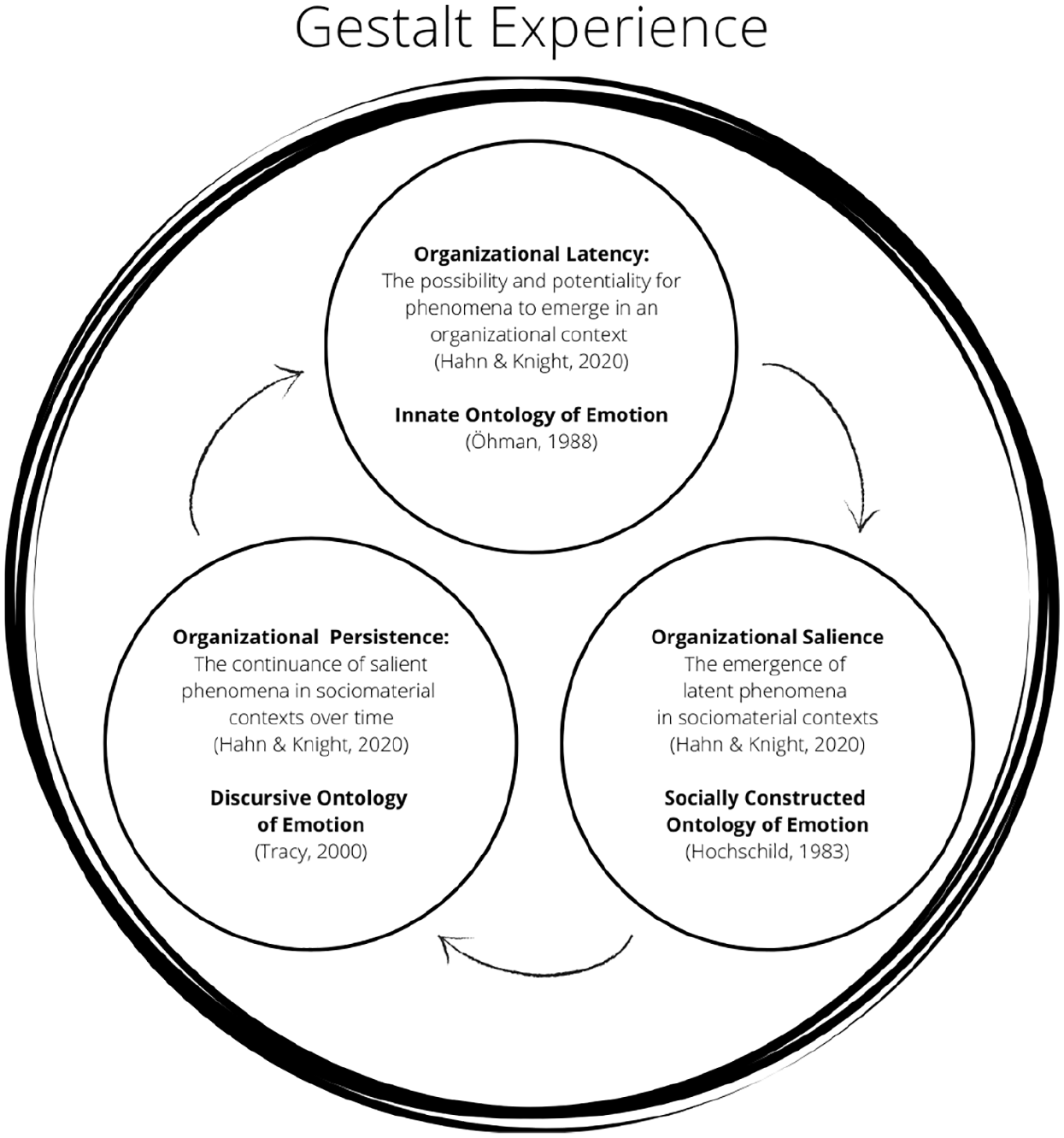
The gestalt approach to emotion.
Adapting a quantum ontology approach
Our gestalt framework centers around Hahn and Knight’s (2020) quantum approach, which applies the ontological foundations of quantum mechanics to the study of organizational phenomena (Barad, 2007; Lord et al., 2015)—specifically, to organizational paradoxes. This approach holds that phenomena exist at three stages of organizing. These are latency, salience, and persistence (Hahn and Knight, 2020). Latency reflects the possibility and potentiality for phenomena to emerge in an organizational context. According to this perspective, structural, material, and biological phenomena may be “real” in a physical sense. However, these phenomena can exist in latency without being recognized by organization actors. Salience, then, reflects the emergence of latent phenomena in sociomaterial contexts. When actors perceive a phenomenon within the context of the organization as sensible (reasonably expected) and sensable (able to be sensed) (Tracy and Donovan, 2018; Weick, 1995), the phenomenon becomes salient. Finally, persistence reflects the continuance of salient phenomena in sociomaterial contexts over time. Through ongoing meaning-making, phenomena become embedded in the organizational structure, culture, and narratives (McPhee and Zaug, 2000), as well as larger institutional systems and structures. The ongoing persistence of such phenomena (discourses of certain emotions in this case), is therefore simultaneously constitutive yet fluid. As an organizing framework, latency, salience, and persistence are cyclic and recursive. They are not discrete categories; rather, they are lenses through which to observe, analyze, and understand phenomena at various stages of organizing.
In their work on organizational paradoxes, Hahn and Knight (2020) mobilized this quantum framework to reconcile what they perceived to be an unclear ontology within paradox scholarship. Just like the ontological debate existent in the emotion literature, the field of organizational paradox—which explores tensions, contradictions, dilemmas, and dialectics—is engaged in a similar debate regarding whether paradoxes are innate (Quinn and Cameron, 1988), constructed (Putnam et al., 2016), or both (Putnam et al., 2016; Smith and Lewis, 2011). In their recent work, Hahn and Knight (2020) demonstrate that paradoxes can be both innate and socially constructed and that these different ontologies show up at stages of organizing (latency, salience, and persistence). According to this view, material or systemic (i.e. innate) paradoxes occur in latency when they exist in an organization’s systems and structures, regardless of whether they are perceived by members of that organization. Additionally, innate paradoxes become relevant in salience and persistence once they are apprehended and promulgated by organizational actors. Thus, innate paradoxes are relevant across all three levels of organizing. Hahn and Knight (2020) contend that socially constructed paradoxes (those created through interaction), are primarily relevant in salience and persistence—even if they reflect ingrained social systems and structures. For example, when actors conjure and then amplify competing tensions, this shows up in salience as either-or thinking, divisive language, and defense mechanisms (Putnam et al., 2016; Smith and Lewis, 2011; Vince and Broussine, 1996). By arguing that opposing ontologies explain phenomena at different stages of organizing, the quantum perspective integrates innate and constructed views without negating the material or social nature of either. While the quantum framework aptly explains organizational paradox, it has yet to be applied to the study of emotions.
We extend and adapt this quantum logic to theorize emotions in organizations. We agree with Hahn and Knight (2020) that seemingly contradictory views can, and do, exist in concert. However, whereas Hahn and Knight (2020) observe two distinct views (the innate and constructed), we observe three (innate, constructed, and discursive). Moreover, whereas Hahn and Knight (2020) suggest that the innate view applies to all stages of organizing (latency, salience, persistence), and the constructed view applies to the latter two (salience, persistence), we simplify the framework by suggesting that there is theoretical and analytical utility to pairing each ontology with one primary organizing stage. We argue that the innate view is useful for explaining and exploring emotion phenomena that exist in latency, the constructionist view is useful for exploring emotion phenomena that emerge in salience, and the discursive view is useful for exploring emotion phenomena that persist over time. This is not to say that these pairings are discrete or immutable categories. Rather, this framework offers conceptual clarity and utility for theorizing how emotions exist and emerge in the context of organizing.
The innate ontology
The innate view of emotions, which emerged in the early scientific era and in the field of psychology, likens emotions to physiological sensations (Berridge and Kringelbach, 2008; Öhman, 1988). Scholars who take the innate view tend to pathologize emotions and frame them as experiences that must be managed (Boden and Thompson, 2015). This focus on managing negative emotions, and promoting positive ones, assumes and prioritizes valence, which is the degree to which emotions are considered positive or negative (Madrid et al., 2014). Here, emotions are treated as universal, brute reflexes that are often at odds with rational thinking (Barrett, 2017) but that influence how people interpret situations, make decisions, and adapt to their environment (Boden and Thompson, 2015). Scholars who take this approach explain how humans behave in patterned ways in response to these arousals and stimuli (Davis, 1992). Research within this domain explores topics such as electrical stimulation in the brain, universal emotion recognition, and typical responses (Barrett, 2012). For example, research shows that heightened states of anxiety tend to hinder creativity, reduce problem-solving capacities (Byron et al., 2010), and increase cognitive rigidity (Lewis, 2000). This is because neural pathways for reasoning first pass through the emotion centers in the brain, and “the information that people receive from their emotions will not only have a direct impact on behavior, but can influence subsequent reasoning” (Keller and Chen, 2017: 73–74). As the adage goes, human beings feel before they think (Öhman, 1988). Or, applied to the organization, humans feel before they behave (Webster et al., 2016) and learn (Fredericks et al., 2008; Mandler and Sarason, 1952). With an emphasis on physiology, the innate view focuses its lens on the impetus (i.e. arousal) behind the emotional experience. As such, innate-view scholars are able to identify, measure, and predict those arousals and behaviors.
However, it is important to recognize that arousing activity is not the same thing as the holistic experience. While brain waves and neural patterns are certainly involved in what we call emotion, they are not equal to emotion, nor do they encapsulate the entirety of the experience. This argument is particularly relevant in the context of organizing. While innate emotion arousals may certainly be salient to particular individuals (namely, the person experiencing them), they may occur in latency when considered in the social or organizational context.
Emotions in latency
Hahn and Knight (2020) conceptualize latency as “indeterminate potentialities [. . .] rather than actualities or ‘real’” experiences (p. 4). Perhaps paradoxically, we argue that while biological activity and cognitive processes that result in the surfacing of emotions are “real” at the individual physiological level, there are “indeterminate potentialities” for what emotion arousals can become. Latent arousals have the potential to become organizationally salient, yet, they may never be brought forth in perception or organizing action. Unless the arousal is constituted in some way—for example, perceived by others or involved in organizing behavior (in the form of action or inaction)—individual emotion arousals do not necessarily result in the manifestation of an emotion at the social or organizational level. For example, if an individual experiences physiological fight-or-flight arousal, but does not enact that arousal in an organizationally-relevant way, this physiological arousal may never have a salient organizing quality. Alternatively, if the person enacts that arousal and it is perceived by others, or it organizes behavior in an organizationally-relevant way—even if no one recognizes it as a particular emotion (e.g. fear, anger)—then it is captured in one of the “indeterminate potentialities” of latency. Thus, we should think about latency as more than just a set of emotions lying under the surface waiting to be activated; instead, we should think about latency as the physiological conditions by which emotions may become constituted in an organization.
Consider the experience of emotional labor, that is, the effort one puts forward to manage their feelings, or display unfelt emotions in order to fulfill others’ expectations of that role or job (Hochschild, 1983). Emotional labor often incites anxiety as a person attempts to resolve disparate attitudes, values, and desires (Pugliesi, 1999; Yoon and Kim, 2013). In response to this dissonance, a person may feel uncomfortable physical arousals such as a tight chest or increased blood pressure (Berridge and Kringelbach, 2008; Davis, 1992). This arousal, captured in the autonomic fight, flight, or freeze responses (Maack et al., 2015), happens automatically in the individual’s body. It is not until the person demonstrates one of those responses (e.g. acts defensively, talks back, scoffs) that the arousal becomes relational (Schmidt et al., 2008). This is not to say that physical experiences are first asocial or innate; we agree with Barrett’s (2017) view that emotions are, all at once, innate, constructed, and discursive. However, we also argue that it is useful to recognize that physical phenomena can exist for the organizational actor in private, even if they result from earlier interactions and sensemaking. In this way, although recursively tangled with social and discursive experiences, physical arousal can occur in latency. The strength of the innate view is that it can identify and explain physical realities at this particular juncture. While the innate view does not capture the entire emotional experience, it is the first “layer” of our metaphorical cake—and latent phenomena are that layer’s ingredients. The next layer is composed of social construction.
The socially constructed ontology
The constructionist view of emotions, which suggests that people “produce part of the environment they face” (Weick, 1995: 30), understands emotions as social experiences that materialize through ongoing and dynamic interaction (Barrett, 2017). This view is concerned with the process by which meaning-making creates emotions in organizations, and how the expression of emotions is negotiated and managed through social and organizational expectations (Hochschild, 1983). For some, this means taking a dramaturgical approach to emotion by highlighting the role of fantasy, fiction, and absurdity, and suggesting that management is “shaped by the forces of emotion, irrationality and conformism” (Starkey et al., 2019: 591). Other research surfaces power dynamics as a critical component of all organizing processes and focuses on the ways employees navigate conflict and identity (Hay, 2014). Yet other constructionist work grapples with the tension between emotion and reason (Essén and Värlander, 2013).
What connects this research is the conceptualization of emotions as local, emergent, and social experiences that are shaped by a collective consciousness and learned through interaction (Weick, 1995). Contrary to the innate view, a constructionist view contends that “there is not some kind of monolithic, singular, fixed environment”; instead, individuals “act, and in doing so create the materials that become the constraints and opportunities they face” (Weick, 1995: 31). Although the constructionist view differs from the innate view in terms of how emotions come to be, it aligns with the innate approach on the topic of valence. From the constructionist perspective, certain organizational emotions (such as happiness and calm) are prioritized, whereas others (such as emotional labor and burnout) are discouraged. As such, constructionists do not see emotions as neutral in nature; they have socially determined values and consequences, and they emerge differently within different cultures and environments (De Leersnyder et al., 2015). In the organizational context, we propose that when an individual’s emotion experience is recognized by others, displayed toward others, or meaningfully involves others (through action or inaction), it organizes behavior in a way that that entangles others (even if they do not identify the specific emotion that is doing the organizing) and thus becomes part of the larger organizational context, moving from latency to salience.
Emotions in salience
Hahn and Knight (2020) describe salience as “the selective enactment of [experiences] in a specific socio-material context” (Hahn and Knight, 2020: 4). Put another way, salience captures organization members’ recognition of a particular situation as sensable (that which can be sensed) and sensible (reasonably expected) (Tracy and Donovan, 2018; Weick, 1995; 2001). One primary way people recognize situations is by tying them to past experiences. Thus, some constructionist work takes a sensemaking perspective by highlighting how people make sense of—or perhaps, make salience of—their emotions based on retrospective reflections of past events (Weick, 1995). For example, when something ambiguous occurs, such as an innate physiological arousal, people respond by fitting the situation into their expectations. In doing so, they often satisfice, which is to rely on reasonable evidence to make sense of their experiences and make choices based on plausibility, rather than accuracy (Weick, 1995, 2007). Thus, what becomes salient is constructed and selected through a relational process of meaning-making between organization members. This is one way that emotions come to be learned. The more people recall or frame situations in a given way, the more likely they are to default to those ways.
Turning again to the concept of emotional labor, the constructionist perspective highlights the organizing nature of day-to-day interactions, such as the enactment of emotions in liminal (temporary, contested, shifting) spaces (Iszatt-White and Lenney, 2020) or as organizational resources (Hochschild, 1983), and asks, “how are meanings and artifacts produced and reproduced in complex nets of collective action?” (Gioia, 1986; Weick, 1995: 172). For example, Hochschild (1983) illuminated “the commercialization of human feeling” by exploring how flight attendants were expected, as part of their job duties, to present certain “positive” emotions at work. Because they were required to express emotions that were often in tension with their felt emotions, these performative displays were laborious (hence the term, emotional labor). This groundbreaking research demonstrated that emotions and related expressions (e.g. smiling) can be socially co-created and then co-opted by the organization as “assets” (Hochschild, 1983). This work reflects the way organizational emotion experiences can be both individual and social.
In sum, the social construction of emotion emerges in organizational salience through actors’ interaction and meaning-making. Salience is critical to the second layer of our gestalt cake. Once salient phenomena are discussed, dialogued, described, labeled, or otherwise meaningfully captured in discourse, the emotion experience transcends into organizational persistence.
The discursive ontology
The discursive view of emotions focuses squarely on the role and function of language. Consistent with a constitutive perspective of communication (Cooren, 2012; Craig, 1999; McPhee and Zaug, 2000), emotions are framed as linguistic constructions that materialize through the experience of human interaction. The discursive view treats communication as foundational to emotion, rather than simply symbolic and representational (Miller et al., 2007; Scarduzio and Tracy, 2015). This constitution is not fixed; rather it is historically produced, fluid, contested, and relational. People collectively experience life through the lens of language (Lakoff and Johnson, 1991), and therefore enact and promulgate emotions through various communicative processes, such as metaphor, storytelling, and sensemaking (Hogler et al., 2008) and, in doing so, create the as-lived experience of emotions. Moreover, it is through language that emotion norms and self-concepts are learned and (re)produced. For example, scholars demonstrate the way communicative identity management and intersectionality shape emotion (Malvini Redden and Scarduzio, 2018), while others show that communicative emotion management constitutes one’s identity (Tracy and Town, 2020; Tracy and Trethewey, 2005; Way, 2013). In either case, language is the co-constructed mechanism through which lived experiences unfold and become manifest.
For example, Dougherty and Drumheller (2006) show that organizational actors discursively experience emotions as interfering, serving, being entwined with, and superseding rationality. Other scholars highlight the way emotions emerge “as a counterforce to rational views of the workplace” and exist as “bursts of color” woven into the fabric of social life (Miller et al., 2007; Planalp, 1999). In their work on communication in courtrooms, for example, Scarduzio and Tracy (2015) found that collective emotional displays enabled sensegiving and sensebreaking that persisted beyond the acute moment in time and shaped the organizational context. Similarly to the innate and constructionist views, the discursive view supports assumptions of valence by framing emotional experiences as more or less productive or destructive for organizational actors and the larger organization. Whether positive or negative, it is through discourse that salient experiences become embedded in routines, processes, systems, and structures (McPhee and Zaug, 2000; Putnam et al., 2016). Returning to the quantum ontology perspective, we propose that once emotion phenomena are meaningfully captured in discourse, they become embedded in the organization and thus occur in organizational persistence.
Emotions in persistence
Hahn and Knight (2020) define persistence as “recurring enactments of salient [experiences] by organizational actors in similar socio-material contexts” (p. 5). Once salient emotional experiences are talked about, named, labeled, and/or collectively shared, they achieve a level of organizational stickiness that persists over time. Returning to the experience of emotional labor, much work has been done within the discursive perspective. For example, Tracy et al. (2007) demonstrate that humor served as a way for 911 call takers to maintain their “preferred notions of self” amidst constant workplace stressors. In research on total institutions, such as cruise ships (Tracy, 2000) and prisons (Tracy, 2004), discursive scholars reveal “communication rules” that govern ongoing appropriate emotion displays (Kramer and Hess, 2002). Likewise, Rivera (2014) demonstrates the discursive ways that US border patrol agents make sense of “dirty work,” in which their identities are tangled with emotion, and shows the way discourse frames how employees manage organizational “taint.” Here, individuals co-arise salience of negative emotional labor experiences with positive organizational identities. Importantly, the whole of these experiences is something different than either on its own. The gestalt experience of the US border patrol agent is also distinct from the emotional experience of other forms of dirty work and emotional labor, yet broad enough to be co-created and constituted by those who work in border patrol. Thus, the discursive view demonstrates the way that communication, emotional labor, and identity converge and become tangled with the personal and private self—creating new organizational contexts that members live in. In short, discourse embeds salient experiences into ongoing organizational interaction that persists over time.
Given its embeddedness, the discursive view illustrates that as phenomena shift into persistence, they become intertwined with power (Foucault, 1973). In fact, some scholars argue that humans are obligated by the rules of our language, and imposed upon by its available emotionality (Tracy, 2004), which always exists “in relation to the power/knowledge discourses within which we are entwined” (p. 514). In other words, not only are emotional experiences constructed through language, but they may also become bound to that language (Wittgenstein, 1953). This perspective suggests that actors can become constrained by the discourses available to them (Lakoff and Johnson, 1991), and how they feel, think, and act may be consistent with—if not entirely bound to—the language they use to make sense of the world (Weick, 1995).
Moreover, the collective identification of an emotional experience, as both a term and a phenomenon, can create “discursive formations” (Fricker, 2007) by which new realms of episteme are discovered through shared patterns of experience and, ultimately, through language (Foucault, 1973). Considering this perspective, scholars argue that the discursive view should “be understood as a practical endeavor, capable of providing conceptual resources for reflecting on real, everyday social, political, and ethical problems” (Cooren, 2012: 13). As one’s vocabulary expands, so will their ability to make sense of the world by selecting for more nuanced concepts and categories (Langer and Moldoveanu, 2000; Weick, 1995). In short, discourse has the ability to reveal and create new realities—realities that become embedded with historical and social memory and that influence the way emotion is learned and experienced by the organizational actor (Fairhurst and Putnam, 2004). This discursive embeddedness and persistence reflect the third layer of our proverbial cake.
It is important to note that the gestalt framework’s pairing of ontological views and organizing stages does not indicate discrete or immutable categories. Indeed, innate phenomena can emerge in salience. Likewise, discursive phenomena can, at times, be more real in a physical sense than any conceptual or linguistic sense (e.g. a loud exclamation following a painful stubbed toe). Furthermore, the boundaries between social and discursive construction are so porous and fluid that it can be difficult to determine where social construction (and salience) stops and discursive construction (and persistence) begins. The goal of our gestalt framework is not to draw discrete boundaries around the three facets of emotions in organizations. Rather, its utility becomes clear when it is applied to analyze the holistic process of organizing—where the whole is more than the sum of its parts.
Applying the gestalt framework: more than the sum of its parts
In the above section, we described how the innate, socially constructed, and discursive views of emotions in organizations exist at various stages of organizing. We mobilized Hahn and Knight’s (2020) quantum ontology perspective to propose that the innate paradigm is particularly useful for explaining phenomena that occur in organizational latency; the social constructionist perspective for activities in organizational salience; and the discursive view for phenomena that persist over time and become embedded in systems and structures (McPhee and Zaug, 2000). This layering comprises the gestalt. As such, the gestalt framework serves as an analytical tool that can elucidate each layer. However, the gestalt experience is something phenomenologically more than the mere combination of these layers, and the gestalt framework does more than describe these layers. Put simply, the gestalt view charts how emotional experiences shift, organizationally, from latency to salience to persistence, highlighting the co-creative, recursive, and fluid process by which emotions move across individual and organizational lines. The gestalt view recognizes that it is these aspects and paradoxically, the inability to detach these aspects from one another, that creates the entire, integral, gestalt experience.
As an example, consider the following gestalt analysis of sexual harassment as an emotional organizational phenomenon (Fricker, 2007). Historically, women have been subject to unwanted advances from men at work. Before 1975, there was no shared meaning or language to describe these events. Nevertheless, women routinely responded to them with innate, biological and physical reactions (e.g. disgust, discomfort, fear). Although these unwanted advances may have organized some women’s individual behavior (e.g. choosing not to take the elevator alone; choosing not to stay late at work), there remained indeterminate potentialities for the organizational salience of these private and individual actions. Moreover, any shared emotion experience remained invisible to the women and their organizations behind a fog of privatization and ambiguity. As the primary emotion experience was a physiological one, this stage can best be described as existing in organizational latency.
At a point in time, women began to recognize each other’s shared experiences, and a collective understanding began to form (Fricker, 2007). Although this emerging social construction reflected moments of discourse—indeed, some meaning making happened through conversation—there still existed no cogent or adequate vocabulary to describe what was taking place. It was messy. It was emerging. It did not yet have a name. It did not yet have a discernible villain. It was befuddling, in part because it was paradoxically uncomfortable and persistent, yet unaddressed. The experience, while shared and recognizable as something, was ambiguous and aconceptual as a particular thing. Thus, while reflecting the ever-porous boundaries between social and discursive construction, we describe this moment in time as emerging in organizational salience.
At some point, conversations became more focused and the silhouette of a nefarious foe became visible through the fog. After much vocalizing and dialoguing about what was happening to them, a group of women authored a term that “embraced a whole range of subtle and unsubtle persistent [unwanted] behaviors” (Fricker, 2007: 150). They called this experience “sexual harassment.” This label was chosen intentionally, after ruling out other options. The messiness and ambiguity of the felt experiences were baked into the meaning and captured in the naming. The term “harassment” also emphasized the directionality of the behavior and identified the villain—importantly, the term “harassment” required no information on the target of the harassment. It mattered not how old, young, beautiful, homely, flirtatious, or aloof the woman was. The term “sexual harassment” organized, mobilized, and constituted the experience in new ways; it sensitized women to otherwise ambiguous events, offered them a means to make sense of their shared experience, and allowed them “realize resources for meaning that were yet only implicit in the social interpretive practices of the time” (Fricker, 2007: 149). Moreover, this authoring became embedded in social and organizational culture, institutionalized through policy and disciplining, and carried forth into the future—for example, with the eventual authoring of #MeToo (Brown and Battle, 2019). These discursive shifts capture how emotional experiences can transcend from salience to persistence, and then continue to evolve.
As a gestalt, “sexual harassment” includes all of its ingredients. It is individually felt, collectively understood, and organizationally (e.g. by way of policy) creative. The shift in understanding, from individual moments of suffering to the gestalt phenomena of “sexual harassment,” allowed women to develop practical wisdom about their personal and shared experience. By understanding the holistic emotional experience of sexual harassment—including physiological reactions, shared meaning-making, and feminine authoring—individuals and organizations are able to see the larger picture and therefore act with insight and discernment, such as more reporting and disciplining (Vijayasiri, 2008) and less ostracizing (Brown and Battle, 2019). In this way, a gestalt understanding can encourage phronesis. What’s more, phronesis can be developed by intentionally naming emotional phenomena. Applied to sexual harassment, Flyvbjerg’s (2012) phronetic questions, “Where are we going? . . .Is this desirable? . . .What should be done?”. . .and “Who gains and who loses, and by which mechanisms of power?” (p. 60) are embedded into the feeling, constructing, and naming of sexual harassment and #MeToo such that through the act of naming, women were able to understand their emotional experiences with more clarity. Here, the gestalt framework reflects practical wisdom that can be cultivated through an awareness (learned or otherwise) of and integration of the innate, constructed, and discursive elements. In addition to the phronesis developed this way, our gestalt framework also encourages practically wise action by reconsidering assumptions of valence.
Gestalts and valence
In the organization sciences, emotion research tends to assume and overemphasize valence, which is the degree to which emotions are considered positive or negative (Madrid et al., 2014). This may be, in part, a result of the current bifurcation between innate and constructed ontologies. From a purely innate view, certain emotions are pathologized. This view tends to focus on the management and outcomes of emotions. From a purely constructionist view, certain emotions are prioritized. This view highlights how emotions manifest through interaction, and the social implications that ensue. In line with the constructionist view, the discursive perspective explores communicative phenomena that give rise to more or less desirable emotion experiences. One result of all of these framings—and the fact that they are typically considered independently—is that emotions are generally understood as better or worse than others. And this assumption underlies social action (Flyvbjerg, 2012).
When considered like this, prescriptive commentary abounds. The growing emergence of wellness programs aimed at increasing positive emotions (e.g. wellbeing) and reducing negative ones (e.g. stress) confirms a largely unchallenged narrative: that negative emotions are inherently problematic and should be removed. Our gestalt model confronts this common assumption. By integrating opposing ontologies (innate, constructed, discursive), and applying those ontologies to different stages of organizing (latency, salience, persistence), the gestalt perspective leaves room for questions such as, How might valence shift across organizing stages such that unpleasant emotion experiences are a fruitful part of the whole? What if all emotions are always both “negative” and “positive?” and What is obscured when emotions are categorized as either good or bad?
While it may be helpful, theoretically and practically, to identify which general emotions create pleasant experiences and which create unpleasant experiences, the field’s tendency to overstress valence amplifies the importance of certain aspects of experience (e.g. the acute felt emotion) and obscures equally important theoretical and practical considerations; namely, how those emotions occur as an integrated gestalt. When categorized as positive or negative, the identifiable results of emotions (e.g. smiling, crying) are treated as the effects of innate emotions. This may be because physical responses can occur (although not always) involuntarily (Barrett, 2017). However, this perception that the effects of emotions are the effects of emotions—as opposed to the effects of emotion gestalts—diminishes the richness of the gestalt experience. We draw from mindfulness philosophy (Brach, 2017; Langer and Moldoveanu, 2000), and Buddhist psychology (de Silva, 2014; Kornfield, 2008) to argue for that richness by showing that regardless of whether experiences are perceived as pleasant or unpleasant in salience, all conceptual emotions are connected with the phenomenological experience of “dukkha,” that is, discomfort (de Silva, 2005; Kornfield, 2008; Vyner, 2018) in latency and persistence.
When an individual feels a “negative” emotion, such as sadness or anger, it is easy to recognize the discomfort. However, when a person feels a “positive” emotion, such as excitement or happiness, it is more difficult to recognize that these experiences emerge from and lead to discomfort as well. Phenomenologically, a felt emotional experience always occurs in relation to the relative absence of that emotion. Put another way, the moment of a felt emotion is sandwiched between other moments in which that emotion is not felt. For example, when a person feels happy or excited, they always—although often subconsciously—recognize that there was a beginning to the emotion and anticipate that there will be an end. As the adage goes, what goes up must come down. Because of this, people become attached to positive experiences and wish for more of them. The common statement, “I want to be happy” reflects this awareness of the always-almost-present-absence of happiness. Therefore, all emotional experiences—whether categorized as “positive” or “negative”—are always in relation to discomfort (de Silva, 2005; Kornfield, 2008). From our gestalt view, which is based on the notion that the whole of something is composed of yet more than its parts, if something (an emotion) always occurs in relation to something else (the lack of that emotion), then that something else must be included in the emotion’s gestalt. As such, all “negative” emotions are in relation to positive, negative, or neutral prior and subsequent experiences. And, all “positive” emotions are likewise in relation to positive, negative, or neutral prior and subsequent experiences. Our gestalt view recognizes this and therefore holds that emotions are neither positive nor negative; rather, they are fluid co-constructions (composed of physiology, social construction, and discourse) that include both the presence and absence of the acute felt emotion.
Consider the emotional experience of “happiness.” In the Western world, happiness is broadly thought of as a positive physiological and psychological experience (Planalp et al., 2009). This can be seen in America’s treatment of the pursuit of happiness as prescriptive. Beginning at the start of the Scientific Revolution, there was a dramatic increase in the number of publications around the topic “prescriptions for happiness,” re-spiking again shortly after WWII (around 1950) (Google Ngram, 2016). After a brief decline, the topic re-emerged in the last two decades (starting in the beginning of the 1990s). During these times, happiness was described by the scientific community as something people must have or acquire the necessary conditions for—as opposed to something a person can do, be, or practice. Unsurprisingly, the social construction and discourse about happiness as innate and physiological positioned happiness as something we must pursue and attain. And when happiness is attained, it is often framed as quick and fleeting (e.g. laughter, butterflies in one’s stomach). Arguably, this framing pushes the felt experience of happiness beyond people’s cognitive horizon; it is always somewhat out of reach (Achor, 2011). When happiness seems fleeting, certain activities (e.g. striving for professional goals, practicing retail therapy) make a great deal of sense. While these types of responses are not inherently problematic, they are certainly incomplete. Returning to phronesis, a gestalt view allows for an expanded understanding of the range of phenomena that co-create emotion, and the range of practically wise actions a person can take. Without this view, organizational understandings of emotion remain tethered to the separate ingredients, lacking the ability to respond to the whole gestalt.
The gestalt view recognizes the ways that social expectations about happiness influence how, when, where, and at what cost the experience of happiness is considered desirable and achievable. By applying the gestalt view, we can see how the same general emotion, for example, “happiness,” can produce incredibly different sensations and observations (Kuhn, 1962). For example, in cultures where happiness is not contextualized in this prescriptive out-of-reach way, calm and tranquil sensations may be experienced as happiness (Kornfield, 2008). A gestalt view of happiness surfaces the physiological, social, and discursive elements, and the positive (comfortable) and negative (uncomfortable) elements, that make up the larger gestalt experience. While it is important that scholars identify the difference between happiness as a physiological experience, constructed conceptualization, or languaged representation, it may be even more useful to hold each in generative tension with one another. As a gestalt, the physical experience of happiness (e.g. butterflies in one’s stomach; tranquil calm) changes based on social conditions (e.g. happiness today compared to pre-WWII; happiness in the US versus other countries). Conceptualizing happiness as a gestalt provides space for this dialogue by acknowledging the critical ways the different “layers of the cake” shape how emotions function in our reality, when they become (un)available to us, in what ways they are available, and why our relationship with them is often so complicated. The gestalt view also addresses how the object of observation (physical, social, discursive) can shift as phenomena are foregrounded or backgrounded, depending on the context and conditions. In short, a gestalt perspective takes a phronetic approach to emotion theory by encouraging researchers to challenge common valence narratives embedded in emotion theory, to reconsider the subsequent prescriptive commentary, and to shine light on expanded possibilities for action.
Theoretical and practical implications
With a gestalt framework, the entire emotional experience is more important than any of the individual facets. Emotions are simultaneously reflective and creative. They are a “web of connections” and information and, at the same time, a “process of human knowledge” (Canary and McPhee, 2010). A gestalt view recognizes that the holistic phenomenon is composed of physiological experiences that emerge as people respond to arousals and stimuli (Davis, 1992), social experiences that develop as people wrestle with and make sense of ambiguous information (Weick, 1995), and discursive constructions that constitute and give meaning to experience (McPhee and Zaug, 2000). Moreover, a gestalt view understands that emotions and learning are recursive (Höpfl and Linstead, 1997), where learning impacts individuals’ emotions (Snell, 1988), and emotions also guide learning (Pratt and Barnett, 1997). A gestalt view recognizes that this recursivity—and an awareness of it—can create the practical wisdom (i.e. phronesis) of emotion. Phronesis moves beyond conceptual and elemental understandings of organizational phenomena (episteme) toward the “honed practice of embodied natural expression,” allowing people to uniquely know what a situation calls for and effectively respond to a given situation (Adame et al., 2021; Tracy and Donovan, 2018: 208). As such, a gestalt framework of emotion provides a more encompassing understanding of emotion that creates new possibilities for action.
Theoretical implications
Our gestalt framework offers three primary theoretical contributions. First, framing emotions as gestalts allows for the integration of opposing frameworks, which may liberate emotion studies from over-structuralized ontologies. By adapting the quantum ontology to the study of emotions, the gestalt view illuminates how emotions are indeed constituted by innate biology, social interaction, and discourse—however, at various phases of organizing. A gestalt view urges emotion theorists to rethink the way emotions are formed (in latency), become collectively experienced (in salience), and endure through the larger discourses surrounding them (in persistence). This framing encourages questions that go beyond talking about what emotions do, and instead seek to understand the complex biological, social, and discursive experiences that shape them.
Second, the gestalt framework provides an analytic tool for researching and theorizing emotions and organizing. Researchers can use the gestalt view to chart the process by which emotions emerge, exist, are learned, and become embedded in organizations. In doing so, they can theorize about the ways emotional experiences exist—for individuals and the collective—as constellations of biological, social, and discursive phenomena. Moreover, the gestalt view allows scholars to identify how each of these elements interact to comprise unique gestalts; yet, capture the way those gestalts are something phenomenologically more than their elements. Much in the same way that a capable chef is more flexible with the proper tools in their kitchen, the gestalt framework expands the theoretical emotion pantry. Additionally, the development of the gestalt framework is, in and of itself, a reflection of the gestalt model. The authoring of the term “emotion gestalts,” and the theorizing about how they emerge, form, and function, creates the potential for people to experience the world of emotion in new ways. Phronetic research is concerned with how dominant values inform social commentary, including theory (Flyvbjerg, 2012). Applied to theories of emotions and organizing, a phronetic approach questions how prevailing views (e.g. innate, constructed, discursive) shape people’s emotional experiences, whether those philosophies promote virtuous action, and how future theorists should respond to them. Just like the term “sexual harassment” changed how women made sense of unwanted advances at work, and how feminist scholars explored those advances (e.g. Fricker, 2007), the new concept of “emotion gestalt” may shift the way emotions are conceptualized and enacted. In this way, our crafting of the gestalt framework reflects a discursive construction of emotion theory, and the persistence stage of organizing, among emotion and organizational scholars.
Third, the gestalt framework has promise as an emancipatory tool in feminist and decolonial scholarship and practice. Rather than reducing emotions to either innate experiences or social constructions, this framework can better place the unique contexts of sexism, racism, and colonial legacies that contribute to complex emotional systems (Benson and Kirsh, 2010; Sherwood, 2009). Critical scholars interested in studying and transforming the emotion experiences of marginalized populations may use gestalt as an analytic tool and theoretical framework. In their research on racism and restorative justice in the workplace, Opie and Roberts (2017) argue current frames of diversity and inclusion work fall short; to truly show Black lives matter in the workplace requires examining colonized emotions in organizations (Benson and Kirsh, 2010). By upending existing perspectives of emotions, a gestalt view can move organizational understandings of emotions beyond traditional definitions into the intersections of human experience. For example, Chen (2018) reimagines silence as a powerful—not meek—communicative tool within colonized spaces. This new historical, contextual, embodied understanding goes beyond definitional views of silence to help (re)elucidate decolonized ways of being. As critical scholars develop finely tailored and context-specific terms that (re)articulate social phenomena, a gestalt understanding can provide insight to these evolving concepts—including their recursive innate, social, and discursive elements. Further, gestalt understandings of experiences can offer liberation from previously gendered or racialized emotional labels. Kleinman (2002) explains how erasing the experiences of women into male-based terms makes it easier to exercise power and control over that group. This “symbolic annihilation” can obscure emotional experiences, even from those who are experiencing them (p. 302). Thus, as reflected in the term “sexual harassment,” authoring a new gestalt can be liberative and constitutive (Fricker, 2007). The gestalt framework helps explain how messy and complex experiences can be co-constructed to create new salient meanings, which are organizationally constituted in the form of policies, laws, workplace protections, and other substantiating conversations. Further, a gestalt framework demonstrates the ways in which phronesis can be used to reclaim gestalts that structure or orient behavior in ways that preserve power structures or disenfranchise others.
Practical implications
Our gestalt approach opens up new possibilities for the practice of emotions in organizations. Additionally, the gestalt view calls attention to aspects of emotion that might have otherwise gone unnoticed, and in doing so “may bring out new ways of practice” (Sandelands, 1991: 260). First, a gestalt view has the ability to change people’s relationship to their learned emotions by allowing individuals to reframe their experiences so that emotions are perceived in dynamic and multiplicitous ways, promoting a more mindful relationship between the experiencer and the experienced. By considering the assemblage of facets that crystallize in the arising (Tracy and Trethewey, 2005) of emotion, people may recognize that seemingly personal emotions are also imbued with cultural connotations, expectations, and valance. The notion that emotion is beyond the self may create some distance between the felt emotion and the person’s identification with it, allowing space for greater individual agency (Kornfield, 2008).
Second, a gestalt view encourages practical wisdom (phronesis) by asking people to reimagine emotional valence such that emotions are neither inherently positive nor negative; rather, they are fluid co-constructions that include both the presence and absence of the felt emotion. Instead of focusing on managing negative emotions, but alternatively embracing the view that pleasant and unpleasant emotions are part of a larger whole, people can learn to respond to those emotions with equanimity (Brach, 2017)—a component of practical wisdom. Equanimity is a state of composure based on an appreciation for all emotional experiences and an awareness of the fluid impermanent nature of those experiences (Kornfield, 2008). This composure involves an unflappableness characterized by “being calm rather than fearful” and “looking for ways to engage with what seems to be inconsistent in the eyes of others” (Gaim, 2018: 504). This approach influences people’s ability to embrace experiences instead of resisting them (Gärtner, 2013). When people practice equanimity, the goal is not to get rid of certain emotions; nor is the goal to accept the emotions as permanent states. Somewhat paradoxically, equanimity encourages people to acknowledge that emotions exist without becoming tethered to them (Brach, 2017). By inviting both pleasant and unpleasant experiences as part of a larger whole, equanimity encourages people to “ride the waves” of their life with more ease and calm—and, to see expanded possibilities for action (Bernard, 2011). A gestalt view encourages this line of thinking by opening up new ways to see and feel the world.
Third, a gestalt view of emotion may allow people to create and learn new emotional experiences in organizations. Gestalts are constituted as a function of their recurring “together over and over in action after action as we go through our daily lives” (Lakoff and Johnson, 1991: 71). They come to feel stable and whole as they are (re)produced. However, gestalts are fluid; they have the ability to shift over time (Kuhn, 1962), to be given new meanings and functions commensurate with social discourses (Lakoff and Johnson, 1991), and they are continuously braided into and out of new cultural, social, and linguistic contexts. To return to our cake metaphor, the process of baking is a process of becoming, and the gestalt framework helps us focus not only the existence of emotions (i.e. the innate biology) or the being of emotions (i.e. social construction), but also on the ongoing becoming (i.e. discursive development) of those emotions at both the individual and organizational level (Tracy and Donovan, 2018).
An awareness of the innate, social, and linguistic construction of emotions as gestalts may provide a roadmap for navigating how emotions may be created and then learned by people and societies and, thus, promote the conscious crafting of new emotional experiences through talk and text. Moreover, people may give themselves access to new experiences by recognizing an ambiguous experience and then (re)claiming it as an emotion gestalt of its own. For example, the term “sexual harassment” opened up new ways of knowing and experiencing something both deeply personal and highly collective (Fricker, 2007). As such, there exists a transformative power in the potential of emotion gestalt shifts—and the possibility for taking back power by adopting new emotion vocabulary. By understanding emotions through the gestalt framework, and utilizing the framework to create and label new gestalts, people may develop a broader spectrum of human experiences.
Future directions
Drawing from Kuhn’s (1962) argument for cross-paradigmatic conversations, we contend that our gestalt framework encourages a generative richness that is useful for expanded, alternate, multiplicitous theorizing—both within and outside of organizational scholarship. One way this might unfold is with a stronger emphasis on discourse and languaging in the construction of emotions (Barrett, 2017). In particular, we are inspired by the possibility of managing and creating novel emotional experiences through intentional communication (Barrett, 2006; Barrett et al., 2007). Future work should investigate this empirically, and theorize more explicitly about the relationship between discourse and crafting new emotions in organizations. Additionally, future work would benefit from exploring relevant emotion experiences through the gestalt framework. In this paper, we considered the broad experience of emotional labor and the specific experience of sexual harassment. Future work may consider new and emergent emotion gestalts—such as the collective workforce anxiety experienced in light of the COVID-19 pandemic (Banjo et al., 2020)—through a gestalt analysis. As Weick (2007) aptly put it, “it takes richness to grasp richness” (p. 16). Finally, the domain of organizational materiality and affect provide an interesting avenue for future research. Affect is “the ongoing flow of sensory force that animates the world” and has been conceptualized as that which precedes the conscious awareness of emotion (Ashcraft and Kuhn, 2018: 179). From a gestalt perspective, affect may serve as another “ingredient,” not only in the social construction of feeling, but also in its material production and perceived valence. Future research may value teasing out the potential implications between emotion gestalts, affect, socio-materiality, and valence.
Conclusion
Our “gestalt” framework unites innate, socially constructed, and discursive ontologies to explain how emotions exist as innate yet latent organizational potentialities, emerge as salient through social interaction, and become embedded in organizations through discourse. The gestalt framework asks scholars to explore what the integration of these opposing ontologies opens up in the context of organizing, and to reconsider valence narratives that underlie current emotion theory. By shining a light on the way emotion experiences are simultaneously crafted from—yet more than—the sum of their parts, our gestalt view provides a useful theoretical framework for exploring the way emotions are presented and represented in the world. The gestalt view also offers people practical wisdom by enabling expanded possibilities for action. We invite others to add the gestalt framework to their metaphorical pastry bag in order to develop the craft practice of exploring and enacting emotions in organizational life.
