




Abstract
Across the globe, organisations are facing significant challenges and operating in increasingly volatile, uncertain, complex and ambiguous environments. In the context of such complexity, effective leadership is ever more important. Recently, a body of work known as ‘Leadership as practice’ and leadership as practice development has been developed as a useful way of thinking about leadership that is shared across organisational members as opposed to being inherent in the traits of individual leaders. At present methodological approaches for capturing and exploring leadership as practice remain in their infancy. This article contributes to leadership learning by arguing that we can learn a great deal about how leadership unfolds and is developed in practice by utilising a theoretical framework called Cultural Historical Activity Theory. Data from two leadership workshops are drawn upon to demonstrate the value of Cultural Historical Activity Theory for making visible the specificities of leadership that emerge collectively and collaboratively in practice. The article concludes with a critical discussion of what we can learn from the Cultural Historical Activity Theory approach and how this can be applied to the study of leadership, leadership learning and leadership development.
Introduction
Across the globe, organisations are facing significant challenges and operating in increasingly volatile, uncertain, complex and ambiguous environments. In the context of such complexity, effective leadership is ever more important (Ham et al., 2011; Kirkup and Morecambe Bay Investigation, 2015; McSherry and Pearce, 2016). Traditional models and theories of leadership have typically focused on the individual leader; such a leader is often depicted as a ‘heroic’ figure situated in the upper echelons of the organisational hierarchy (West et al., 2015). Recently, however, there have been calls for a much wider repertoire of leadership approaches and recognition that leadership takes place at all levels within an organisation and can be enacted by staff ‘from apex to frontline’ (Hartley and Allison, 2000: 39). As follows, a number of new theories of leadership have emerged that recognise that leadership can be shared, distributed, collective and indeed relational in nature, as well as arising in local practices as employees initiate changes and influence decisions (Currie and Lockett, 2011; Ham, 2014; Warwick, 2015).
Recently, a body of work known as ‘Leadership as practice’ (LAP) and ‘leadership as practice development’ (LAPD) has been developed as a useful way of thinking about leadership that is shared across organisational members as opposed to being inherent in the traits of individual leaders (Crevani et al., 2010; Kempster and Gregory, 2017; Raelin, 2011). LAP is sensitive to the notion that leadership can arise within daily situated practices and processes and is typically enacted collectively (Raelin, 2016). LAP offers much promise as a way of understanding leadership that unfolds within peer settings or emerges through the interactions and dialogue of organisational members. However, at present methodological approaches for capturing and exploring LAP remain in their infancy. LAP researchers have called for new ‘holistic’ ways of methodologically revealing the nuances of leadership as it emerges within situated practice (Carroll et al., 2008; Kempster and Gregory, 2017). Such methods, it has been argued, also need to be able to offer insights into the social, political and historical contexts that inform leadership activities (Crevani and Endrissat, 2016).
The contribution that this article makes is to illustrate that we can learn a great deal about how leadership unfolds in practice by utilising a theoretical framework called Cultural Historical Activity Theory (CHAT). Specifically, it is argued that when the different principles of CHAT are used to explore collective activities, examples of leadership that are often veiled within can be ‘made visible’ and more comprehensively understood. Data from two leadership workshops are drawn upon to demonstrate the value of CHAT for making visible the specificities of leadership that emerge collectively and collaboratively in practice. The article begins by first reviewing relevant leadership literature and exploring in more detail the LAP approach. Following this, CHAT as a theoretical framework will be considered. Subsequently, the various principles of CHAT will be used to elucidate leadership that evolves in two leadership workshops. Finally, the article concludes with a critical discussion of what we can learn from the CHAT approach and how this can be applied to the study of leadership and leadership development.
LAP and LAPD
The following section presents a brief literature review of LAP and LAPD. The field of leadership studies has traditionally been concerned with the role of the individual leader, a figure often characterised as heroic and authoritarian, possessing a core set of skills, abilities and traits (Crevani et al., 2010; Parry and Kempster, 2014). Such a figure would typically occupy a senior position in the organisational hierarchy. This more mainstream view of leadership is often referred to as the ‘tripod ontology’, depicted by the image of a leader with a set of followers who together are working towards a common goal (Bennis, 2007: 3). However, this ontology of leadership has been criticised for its pre-occupation with the individual characteristics of the leader such as his or her skills and competencies and its neglect of the social and material aspects of leadership as well as the wider context in which leadership is embedded (Crevani and Endrissat, 2016; Parry and Kempster, 2014). Moreover, it has also been argued that the approach fails to recognise that leadership can emerge in the ongoing flow of social practices and can manifest at any level within an organisation by individuals and groups who occupy various roles and positions (Drath et al., 2008; Raelin, 2011).
Consequently, there have been calls for more integrative leadership perspectives that are sensitive to the relational, socially constructed, collective and emergent nature of leadership (Chia and MacKay, 2007; Uhl-Bien, 2011). The LAP approach has been developed as an alternative leadership theory that recognises the emergent and processual aspects of leadership (Carroll et al., 2008; Kempster, 2018; Kempster and Gregory, 2017; Raelin, 2011). LAP has its origins in social practice theory, a body of thinking that is concerned with how social and material practices are accomplished (Bourdieu, 1990; Cetina et al., 2005; Gherardi, 2009). In contrast to the tripod ontology of leadership with its individualistic and trait focus, LAP is concerned with how leadership materialises in situated daily practices or micro-relational activity. Such organising processes are often collective in nature and are rooted in both context and history (Kempster and Gregory, 2017). As a body of leadership thinking, LAP has three distinct aspects. First, the approach emphasises that organising processes are future-oriented; essentially they are pointed towards a particular direction or set of desired outcomes (Drath et al., 2008; Raelin, 2011). Crevani (2018: 88), for example, explains that Leadership may thus be conceptualised as accomplished in processes producing direction- in other words, we move from what one person does to what the processes are about. Having said that leadership work is associated with producing direction.
Second, the LAP approach places emphasis on the collaborative and collective nature of leadership, shifting away from the actions of an individual towards what people can do together (Raelin, 2011). To accomplish leadership with others, individuals are required to coordinate their knowledge and often subsume their personal interests to benefit the collective (Drath et al., 2008). Third, LAP is underpinned by a process perspective, a view of leadership activity as emergent, unfolding and ongoing. These processes typically occur within micro-level practices but are greatly influenced by macro-level structures such as politics and professional ideology (Crevani and Endrissat, 2016; Raelin, 2018).
In addition to the critique of mainstream leadership perspectives, leadership development approaches and strategies have also fallen subject to a similar review. Denyer and James (2016) offer a robust appraisal of traditional leadership development, arguing that it has thus far been too concerned with the advancement of an individual leader’s skills, competencies and traits. Aligned with practice thinking, it has been suggested that leadership development also needs to be viewed as a social process, one that can take place between people in collaborative formations, ‘with many fine minds working together’ (Bennis, 2007: 4). If leadership development was to be approached in this way, it would require interventions, environments and settings, where leaders can work and learn together through their shared dialogue to address pertinent organisational challenges. One such example would be a collaborative leadership learning group, where people are brought together to probe issues, raise questions and solve challenges in a safe space (Denyer and James, 2016). Developing leaders in such a way would, as Carroll et al. (2008) explain, appear acutely experiential, interactive, situated, embodied, sustained and relational which creates a new kind of engagement with self, others and world. (p. 375)
As an interpretive lens, LAP and LAPD are at a relatively early stage of development; however, they offer great potential as a way of conceptualising leadership processes and they are a fruitful area for empirical leadership research (Carroll et al., 2008; Raelin, 2011). LAP/LAPD researchers have argued for the need for appropriate methodologies and frameworks for capturing the specificities, subtleties and nuances of leadership and leadership development that emerges through practice. Such frameworks need to be holistic and methodologically erudite as well as offering insights into the social, political and historical contexts that inform leadership processes (Crevani and Endrissat, 2016; Kempster et al., 2016).
In this article, an example of LAPD that took place within two workshops is explored. The article offers a contribution to LAP/LAPD thinking by arguing that CHAT, a theoretical framework that has been used widely to explore organisational practices, offers a useful lens to help us to gain a greater understanding about how leaders learn together in practice. Activity Theory helps us to observe the micro-level processes that occur in the leadership workshops and offers useful insights that could be used to structure future leadership development activities. Specifically, this article argues that each of the main principles of Activity Theory (outlined in the subsequent section), when applied to empirical data, can ‘make visible’ aspects of leadership learning within collective activities that may be otherwise unseen. It will be argued, therefore, that much can be learnt from CHAT when researching and theorising collective, emergent and processual forms of leadership and leadership development. In the following section, Activity Theory will be situated in the broader field of practice-based approaches in organisational studies.
Activity Theory as a theory of practice
The ‘practice turn’ – as it is referred to in contemporary social theory – has been gathering momentum since the 1980s (Schatzki et al., 2001). There is considerable discussion about everyday ‘practice’ in academic disciplines ranging from philosophy (Tuomela, 2002), anthropology (Ortner, 2006), psychology and education (Lave and Chaiklin, 1993), and the study of organisational learning and knowledge management (Blackler, 1993; Brown and Duguid, 2001; Nicolini, 2016). In a general sense, practice scholars are interested in people’s activity in organisations and how the notion of practice can offer insights into the ‘doing’ of various organisational phenomena.
Practice-based perspectives in organisational and management arenas have developed as a result of the dualism that exists in social theory between agency and structure, for example, questions around whether social structures shape or determine human action, and to what extent agency can play a part in social development and change. Practice approaches endeavour to overcome this dualism by contending that ‘practice’ is the site at which human behaviour and activity should be explored (Blackler and Regan, 2009) 1 . Within the practice turn in organisational studies, there is no ‘unified’ approach to practice; however, in a general sense, the practice approach takes the view that social phenomenon is constituted by practices or practical orderings of human, material and symbolic elements (Nicolini, 2016). Schatzki et al. (2001) defines practices as ‘embodied, materially mediated arrays of human activity centrally organized around shared understandings (p. 3)’. In this definition, practices are discrete spatiotemporal entities (comprised of actions, doings and sayings) linked by understandings, rules, material arrangements, and time-spaces. Cooking would be an example of such a practice. Practices are connected to other practices to form bundles such as eating and shopping, and buying ingredients. Practices are performed and enacted and it is through ‘doing’ that practices are sustained. Other theories of practice that have similarities to this include actor–network theory (Law, 1992) the communities of practice approach (Lave and Wenger, 1991), the theory of situated action (Suchman, 1987) and CHAT (Blackler, 1995; Engeström, 1987). In different ways, these bodies of scholarly work have made efforts to theorise human behaviour, with each taking a particular stance on how aspects such as the human mind, language, various materials, forms of knowledge and other aspects of culture coalesce to inform what people ‘do’ when practising together.
In this article, a theory of practice known as CHAT is drawn upon to explicate leadership practices. Activity Theory is a ‘work-focussed’ theory of practice that proves constructive for looking at what people do and how they do it (Blackler et al., 2000). The activity system concept provides an integrative framework, encompassing the interactions that take place between individuals, the cultural and historical context of their activity, and the various tools and technologies that mediate that activity. Engeström’s (1993) approach elaborates Activity Theory by identifying specific elements of the activity system, such as the social structuring mechanisms of role, division of labour, tools, and implicit and explicit rules through which individuals interact as they construct activity. This approach has been found useful in Management and Organization Studies, where there is often an interest in studying how individuals coordinate their actions within the collective activity of a group, unit, division or organisation. Activity Theory has some resonance to other theories of practice. For example, through the notion of an activity system the approach tries to avoid the conventional dichotomy between macro- and micro-level explanations, recognising that practices are enacted within broader institutional and structural frameworks. Similar to other approaches, Activity Theory also has a particular stance on knowing and learning, viewing it as an unfolding and emergent process ‘situated in the system of ongoing practices of action in ways that are relational, mediated by artefacts, and always rooted in a context of interaction’ (Nicolini et al., 2003: 3). In this way, Activity Theory shares similarities with relational leadership perspectives that conceptualise leadership as emerging in relational processes and having a fluid, dynamic and provisional nature (Uhl-Bien, 2006). Despite these similarities, Activity Theory as a theoretical framework for understanding practice has some key differences and it is these unique facets that help it to make a unique contribution to understanding LAP. These will be considered in the following section.
The object-oriented activity system
CHAT prioritises collective, task-oriented practices, arguing that the object-oriented ‘activity system’ should be taken as the primary unit of analytical concern (Engeström, 2014). For CHAT, ‘objects’ are the things or projects that people ‘work on’ collectively to transform; they are the activity’s focus, for example, patients in a hospital or pupils in a school (Blackler, 1999). Objects are always the source of motivation within an activity system, with the requirement to transform, develop or ‘work on’ the object propelling those involved forward. Accordingly, objects underpin the collective intentionality of the activity system by providing a common intent for those involved (Engeström, 2001). Within the activity system, the people involved (referred to as subjects) collectively enact their object of activity and produce certain outcomes (e.g. health professionals working with patients to deliver high-quality patient care). Thus, according to CHAT, practices are always collaborative in nature and have a strong social and dialogic aspect (Engeström, 1999).
In this way, CHAT has a particular take on intentionality; people act and have motives and desires, they are intentful agents in an activity system (Kaptelinin and Nardi, 2006). Individuals within the activity system are engaged in the same activity but might vary in their intentions, in this way Activity Theory allows for choice, agency and intentionality. Furthermore, Activity Theory distinguishes between people and things, intentionality is a human endeavour only. Activity Theory thus differs from actor network perspectives that privilege non-human actors with equal status to human actors (Latour, 2007). For Activity Theory, only human actors have agency, motive and consciousness, and while non-human actors can mediate practice, they are not actors in and of themselves.
Cultural means
According to Activity Theory, objects can only be transformed into outcomes when people make use of certain cultural means. When people ‘act’, they naturally draw upon various tools and artefacts which support the accomplishment of their practice. Tools, artefacts and other mediatory means can be material in form, for example, technological tools, instruments and machines, or more symbolic in nature, such as sign systems and also language (Blackler, 1993; Vygotsky, 1978). In addition to tools, practice (activity) is also mediated by a set of rules, norms and conventions that either enable or constrain behaviour. In its recognition for the role of artefacts and other cultural means as mediators of practice, Activity Theory has similarities with situated action approaches which also place emphasis on the need for fine-grained analyses of activity and the mediating effects of artefacts (see, for example, Lave, 1988). However, the theory of situated action de-emphasises the role of durable stable phenomena that exist across situations and activities, for example, ensuing social structures. Situated action models, while sharing some similarities with Activity Theory, focus on single episodes of practice only, considering how individuals respond and act in specific situations. Suchman (1987), for example, in her work describes in detail the practices through which workers try to work out how to use a photocopier. Her work recognises the emergent, relational and provisory nature of practice, yet the broader institutional or societal structures, cultural values, ideologies and norms that shape activity and persist across time and multiple activities fail to be accounted for and explored. Activity Theory with is focus on context and history takes the mediating effect of institutional structures very seriously.
Contradictions and tensions
One of CHAT’s distinctive features as a theory of practice is that it recognises that work practices are both developmental and inherent with inconsistency, paradox and tension (Engeström, 1987). In this way, it provides a unique contribution to exploring the complex, tentative developments taking place in professional work and understanding the way that practitioners do things together in dynamic, disorderly work environments. Contradictions manifest as disturbances, troubles or breakdowns that emerge in practice between members of an activity system. The source of contradictions is usually a series of structural tensions within the system that develop over time. An example could be a series of frictions or disagreements between employees that may arise from the aforementioned clashing professional ideologies or cultural values. While they may initially appear negative in tone, contradictions are by no means an indication of failure within the activity system. In fact, they are to be seen as an inevitable aspect of collective practice and a sign that an activity system needs to develop or change beyond the status quo (Engeström, 2009). When an activity system is driven to work through its inner contradictions, due to ongoing breakdowns or challenges, new creative, innovative and more harmonious modes of practicing are able to emerge (Blackler and Regan, 2009). Other practice theories such as actor–network theory, situated action models and the work of Schatzki et al. (2001) place very little emphasis on the importance of analysing contradictions, conflicts and breakdowns in practice. The notion of contradictions is especially well-suited to understanding the complex, fast-paced and ever-changing work of contemporary leadership practice and leadership development. Activity Theory shows how in everyday leadership work, problems, ruptures, breakdowns and clashes are the source of development and precipitate the need for new and innovative ways of collectively leading organisational activity.
Expansive learning
A further unique aspect of Activity Theory as a theory of practice is that through a term called ‘expansive learning’, it helps to account for the learning processes that occur when people work together to re-configure work practices. Activity Theory uses the term ‘expansive learning’ to explain how, when contradictions and tensions become too problematic, individuals begin to question whether there are better ways of doing things and whether established patterns and practices may need to change. Often, participants share their concerns with one and other and together they begin to explore the contradictions more deeply and collectively imagine and create new ways of doing things. Expansive learning is a creative form of learning, where people come together to create something completely new, that does not yet exist (Engeström, 2016). Expansive learning can lead to new ways of thinking about things, new concepts, ideas and practices and eventually transformations in work structures and qualitatively different models of work. In accounting for and explaining the ways people learn together in practice, Activity Theory differs from other practices approaches. One approach that has some similarity here is the communities of practice approach that originated with the work of Lave and Wenger (1991). The communities of practice approach focuses on how people learn from participation in a community and that this participation requires engagement in the social relations, activities and technologies of that community. Members of the community draw on resources, experiences, stories and tools to help them in their shared endeavours. Examples of communities of practice include group of engineers working on a similar problem or a group of managers helping each other to cope. Learning occurs as the individuals engage in a practice and gain access to that community, a process called ‘legitimate peripheral participation’. Similar to Activity Theory, the communities of practice approach focuses on the activities and interactions of people as they interact with one and other in meaningful ways and in purposeful pursuits. The participants have a joint enterprise and a collective and shared understanding, similar to the Activity Theory notion of object and motive. One of the strengths of Activity Theory compared with COP is that Activity Theory, with its focus on inner contradictions and tensions, provides insights into the structural drivers of change and subsequent learning in practice, offering rich insights into the source of what makes practitioners collectively learn new ways of doing things together. In this way, Activity Theory arguably has more explanatory power in recognising the collective experience of learning and change by focusing on the way in which participants collaborate to bring about new and better ways of practicing.
A further way in which Activity Theory compares with the community of practice approach is that it actively encourages researchers to focus on the historical aspects of practice in their analysis. It is suggested that if practices are to be understood in their full complexity, they must be located in the context of their historical development, or ‘historicity’ (Engeström, 2001, 2018). Activity systems are continually changing and transforming over time and an analysis of their history is necessary to comprehend their current situation. The principle of historicity argues that ‘parts of older phases of activities stay often embedded in them as they develop’ (Kuutti, 1996: 26). A historical analysis of an activity system involves a consideration of how historical circumstances impact current practices as well as an exploration of the history of the activity systems’ constituent parts: objects, mediatory tools, subjects and division of labour (Engeström, 2014). An example here would be exploring how a previous toxic manager in a team left a mark on the team’s culture working relationship and ability to trust each other. While other practice and collective theories do allude to history, Activity Theory places considerable emphasis on this aspect arguing that we cannot understand the status quo without understanding the system historically. Key questions Activity Theory would ask here would be where have we come from? What can and will be done? (Blackler, 2009).
A further notable strength of CHAT as a theory of practice is the advice and guidance it offers researchers with regards to analysing data. Other practice theories considered, while sounding theoretically stimulating, offer little guidance on how to manage empirical data. Contemporary CHAT authors such as Engeström (1993), Nardi (1996) and Blackler et al. (2000) offer practical recommendations as to how the approach can be practically deployed in the exploration and analysis of practice:
Consider the cultural means through which objects are constructed.
Understand the activity system and its components historically.
Analyse the inner contradictions of the system, its troubles and tensions.
Explore the expansive learning possibilities within the activity.
Methods
Research setting
The research study was conducted at a University in the North of England. The participants were all studying for an MSc in Leadership and Management. The participants were first invited to participate in a developmental workshop to explore how leaders could better support employee wellbeing. The specific focus of the research was to gain a better understanding of the challenges that leaders face when dealing with employee wellbeing issues. Scholars have indicated that leaders play a vital role in supporting staff wellbeing and can contribute to the creation of supportive work environments and healthier cultures (Huo et al., 2018; Loon et al., 2019). The research was timely in that many of the organisations where the participants were in leadership roles (i.e. the National Health Service (NHS)) had reported exacerbating work pressures, staff shortages and high levels of stress and absenteeism (Gilbreath and Montesino, 2006). Using the framework of Activity Theory, the leaders shared object of activity in the workshops was employee wellbeing; this was their collective motive or the thing they were working to transform (Blackler and Regan, 2009; Engeström, 2001).
The participants consisted of a number of managers and leaders who worked in a range of organisations such as the NHS and higher Education. The two workshops were run at the same time and facilitated by the author of this article and her colleague who was also interested in leadership dynamics. The focus of the workshops was to explore how leaders could better support employee wellbeing in their own organisations. While the leaders did not all work for the same organisation, they were familiar with one another, having been part of the same MSc cohort for over a year and there was a high level of familiarity, camaraderie and collegiality in both groups. During the workshops, the participants were given a brief introduction to the research focus (leadership and wellbeing) and asked to consider the topic of employee wellbeing in their own organisations. Utilising some of the guiding principles of Activity Theory, the participants were first asked by the facilitator to reflect on the leadership challenges, contradictions and tensions that they currently experienced in relation to wellbeing (contradictions and tensions). During this part of the session the participants also spent some time reflecting on the source of some of the challenges by considering in their workplace. This part of the workshop lasted approximately 30 minutes, during which the leaders shared stories, experiences and insights from their own workplaces. From this, the facilitator encouraged the participants to begin to explore potential solutions and find new ways of leading wellbeing in their organisations.
Procedure
A ‘developmental workshop’ is an approach that is underpinned by Activity Theory. This interventionist methodology is a strategy for organisational change and it encourages participants who share a specific socio-historical context to work together to explore practice and develop new insights (Reid et al., 2015). Developmental workshops have been used in many different types of organisations such as hospitals, schools and offices. In a developmental workshop, practitioners are encouraged to reflect and discuss disturbances, contradictions and tensions in their work and then create new modes of working and operating (Engeström and Sannino, 2010). Two workshops were run concurrently in different rooms of an executive education department. The participants were given a participant information form in advance of the session which outlined the studies purpose and aims. During the workshop, the participants were given further details about the focus of the session and instructions on how to proceed. In line with the principles of the developmental workshop, the participants were first asked to collectively reflect on employee wellbeing issues in their own organisation and consider the main tensions and challenges that were experienced. This part of the discussion lasted approximately 30 minutes and during this time the leaders offered many examples of problems that they experienced when dealing with employee wellbeing. In the second half of the workshop, the leaders were encouraged to collectively envision and design new approaches and initiatives that could help leaders to better support employee wellbeing. Each workshop lasted approximately 1 hour and was audio-recorded and then transcribed.
Reflexivity
The researcher adopted a reflexive approach throughout the research process, critically reflecting on her actions and decisions throughout the data collection and analysis stages. During the analysis, the researcher adopted self-reflexivity by recognising her role in relation to others in the research (Cunliffe, 2008). Specifically, she considered how her own role and position in the research may have affected the participants’ responses. The researcher who also acted as the workshop facilitator had previously been the student’s tutor during their MSc studies and so a level of comfort, trust and rapport had been pre-established. This may have encouraged the participants to be more honest and vulnerable than if the facilitator had been an external person that was unknown to the group. The author also took a reflexive approach to the analysis and interpretation of the data, considering how her implicit assumptions about the world influenced the approach taken. Cunliffe (2008) explains the importance of not unreflexively privileging a theoretical standpoint but interrogating one’s own assumptions. Taking a reflective approach required the researcher to critically reflect on other theoretical approaches in addition to CHAT to understanding collaborative practice such as the communities of practice approach.
Analysis
Initially, an inductive thematic analysis was employed, with the researcher searching the data for key themes and concepts (Silverman, 2006). Following this, the emergent themes were considered in relation to the various principles of activity: the ‘object of activity’, ‘mediatory tools and artefacts’, ‘contradictions’, ‘division of labour’ and ‘historicity’. Each of these provided useful analytical categories to support the process of interpreting and coding the data. In the following section, the data from the two developmental workshops are presented. The Activity Theory principles are applied to the data to ‘make visible’ the leadership that arises through the participant’s interactions and discussions.
Findings
Contradictions, challenges and tensions in leading wellbeing
The activities that took place in the two workshops are a clear example of LAPD. The leadership that occurs does not unfold through the actions of a single individual occupying a senior leadership position but is a collaborative response to the mutually experienced challenges and tensions that the leaders experience in terms of employee wellbeing. The leadership is initiated when the group begin to discuss their shared challenges and tensions in the early part of the workshop discussion. LAP/LAPD scholars would call these ‘antecedent influences’ (Kempster and Gregory, 2017); essentially, these social, historical and contextual tensions (revealed through an Activity Theory analysis) are what drive the leadership that emerges. Leadership then takes place within the flow of the interactions, dialogue and discussions (Crevani et al., 2010; Drath et al., 2008; Uhl-Bien, 2011). Having articulated the main challenges when leading employee wellbeing, the leaders have a distinct sense that they want to improve practices and better support wellbeing in their ‘future practice’. CHAT is especially helpful in making visible these underlying tensions as it encourages us to look for challenges, tensions and contradictions in empirical data. When analysing the discussions that took place in the workshops, it became evident that the leaders had all experienced similar challenges in their organisations when leading employee wellbeing. Using the CHAT principles, a number of key themes were highlighted and some of the quotes from participants are presented in Table 1. One particularly strong theme to emerge as a wellbeing challenge related to heavy workloads of employees. Many of the leaders explained that the sheer amount of work that people had to complete in the day was a significant source of stress and that both themselves and their colleagues were working at maximum capacity. Organisational culture was identified as a related wellbeing challenge, with many of the leaders explaining that in their organisations employees often felt that there was an expectation for them to be available at all times, including evening and weekends. This culture of ‘having to appear available’ had a negative impact on their wellbeing. Added to this, the nature of the work in many organisations was highlighted as a further wellbeing tension. Many of the workshop participants worked for the NHS and felt that the emotional nature of healthcare work, in particular those in direct care roles, often led to high levels of occupational stress for employees. A final contradiction/tension perceptible in the data was the multiple ways in which wellbeing was understood and conceptualised. These differences in perspective are what Activity Theory terms ‘multi-voiced-ness’ and are common in multi-professional group discussions as participants each bring their own personal history and ideology to the conversation (Engeström, 2001). Participants felt that these differences in defining wellbeing meant that it was more challenging to find helpful strategies for leading employee wellbeing.
Contradictions and tensions.

Within leadership literature, scholars have argued that leadership has various antecedent influences which act as a stimulus for leadership processes (Drath et al., 2008). One of the strengths of Activity Theory as a theory of practice is that it prompts us to consider the tensions and contradictions that practitioners experience in their practice as well as the historical source of those challenges. For Activity Theory, if practices are to be understood in their full complexity they must be located in the context of their historical development (Engeström, 2001, 2018). By considering tensions and challenges and their origin, we gain a deeper understanding of why the episode of leadership occurs. Essentially, the Activity Theory principles of contradictions and ‘historicity’ offer useful insights into what generates the leadership and what its antecedent influences actually are. In both of the workshops, the collectively experienced contradictions created a sense of ‘need’ and ‘impetus’ for the leaders to work collaboratively to find ways of resolving problems. Activity Theory and its principles of both contradictions and history is very helpful in alerting us to some of the social, political and contextual issues that exist and impact collective practice, why they have arisen and how they engender leadership responses. In the two workshops, the participants made reference to a number of historical events that had taken place in their organisations such as staffing changes and the erosion of psychologically safe places where they could sit and chat informally to one and other gain social support for work related stresses.
Cultural means: ‘tools’ for leading wellbeing
Having unearthed some of the contradictions and tensions in relation to wellbeing, the leaders went on to propose a number of initiatives or ‘tools’ that could be put in place to better support wellbeing in their organisations. From an LAPD perspective, they have a clear idea of the desired outcome that they are working to achieve (Drath et al., 2008; Raelin, 2011). Interestingly, during the discussion, the leaders moved back and forth between proposing solutions and ideas but then discovering new, additional challenges and problems. When analysing the data, the Activity Theory tenet of ‘tools’ was used to identify the range of wellbeing initiatives that the groups put forward (presented in Table 2). A leader’s ‘style’ and ‘approach’ was one ‘tool’ the participants felt was important for effectively managing wellbeing. In particular, it was felt that leaders who had an empathic, caring style and who regularly listened to employees’ concerns had a positive impact on staff wellbeing. The group also identified that it was helpful when leaders ‘role modelled’ healthy workplace behaviours, for example, not working weekends or sending emails late into the evening. Added to this, it was felt that leaders could play a key role in creating flexible workplace cultures. A further potential ‘tool’ identified was the introduction of wellbeing champions across organisations. A wellbeing champion is a member of the workforce who works to support and enhance the wellbeing of staff by promoting and signposting staff to wellbeing resources and support. Wellbeing champions also act as role models promoting healthy behaviours and practices in the organisation. In addition to wellbeing champions, the participants discussed the need for social spaces for staff, for example, staff common rooms where staff could connect informally, share ideas and support one and other emotionally.
Wellbeing tools.

The Activity Theory tenet of mediatory means is also helpful in that it reminds us that leadership practices rely on various tools and artefacts to support its accomplishment and performance (Blackler, 1993; Vygotsky, 1978). Notably, the way in which tools and artefacts mediate leadership processes has not gained much attention in LAP/LAPD research so far (Kempster and Gregory, 2017). In this research, we see the types of mediatory tools that the participants feel could support better wellbeing in their collective practices going forward. For Activity Theory, all collective practice is mediated by tools and artefacts. These tools can be conceptual tools like mental models, plans and strategies, psychological tools like language or more material/concrete tools like physical, social or virtual spaces that play a role in how humans interact with each other and the world (Engeström, 2001). Thus, the workshop setting itself can be considered an important tool for supporting and sustaining LAPD. The workshop as a tool facilitates what Meschitti (2018) would refer to as ‘leadership work’, an unfolding and ongoing process where participants come together with an array of social and personal resources. A second mediatory tool that mediates the practice is the use of talk and dialogue between the participants. While there is limited empirical research in Activity Theory literature into the use of dialogue, Wells (2002) explains how dialogue can be considered a ‘tool’ that mediates action by supporting the process of reflecting on events, planning actions to be performed and in the envisioning of future possibilities. In the following section, we see how the dialogue between the participants facilitates their shared sense-making of the contradictions and supports the collective envisioning of new solutions and ways of working.
Tensions and extensions: expansive learning in the workshops
Activity Theory prompts analysis of collective activity yet unlike other theories of practice and relational approaches Activity Theory actively encourages researchers to look for and unpack the expansive learning opportunities within shared practice. This is especially useful in aiding our understanding of leadership learning and development in practice. A deeper analysis of the workshop data revealed that an expansive learning process was taking place through the leader’s discussions. This expansive learning process was a fundamental aspect of the leadership that was taking place. Expansive learning is the idea that in activity systems when the tensions and challenges become too overwhelming, individuals begin to collectively envision new ways of conducting organisational activities. The first stage of the expansive cycle was the examination of contradictions and challenges in relation to leading employee wellbeing. During this stage, the participants, through dialogue, began to question and analyse existing practices (e.g. the long hours culture that pervaded many of their organisations). The participants were quite clear on what the main challenges and contradictions were and they found it very easy to identify the underlying source of these challenges and some of their historical origins. Learning took place as the participants through their ‘talk’ shared their experiences in relation to leading wellbeing and began to consider together how certain problems could be addressed. In addition to sharing their experiences, participants also actively challenged each other’s understandings, perspectives and assumptions. This process of exploration, questioning and perspective sharing lasted approximately 30 minutes at which point the group began to then gravitate towards exploring wellbeing solutions. From an Activity Theory perspective, this is the second stage of the expansive cycle and it is what activity theorists term ‘modelling’ (Engeström, 2001). Here, new solutions, instrumentalities and patterns of activity emerge as the group work to propose a range of new wellbeing initiatives. (Engeström, 2001: 151). An example of ‘modelling’ as part of expansive learning is presented below in Table 3:
Modelling wellbeing solutions.
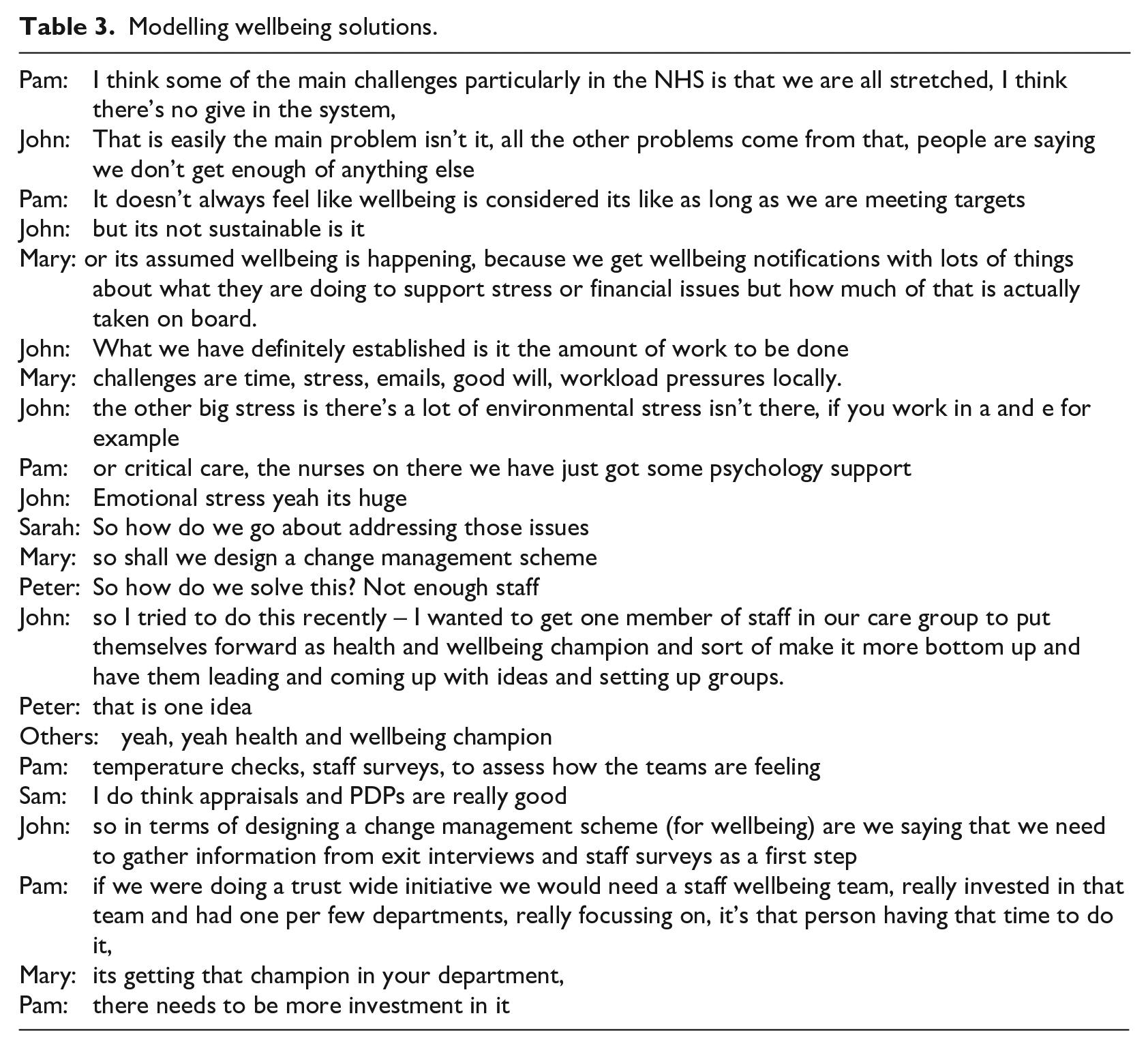
After considering the main wellbeing challenges in their organisations, the participants naturally begin to consider how some of the wellbeing challenges that they collectively identified could be responded to. This is initiated by Sarah’s comment ‘But how do you go about addressing those issues’ and Jenny ‘we need to be more proactive’ followed by Mary a little later in the conversation ‘so shall we design a change management scheme?’ From this the group begin to ‘model’ possibilities and solutions such as a health and wellbeing champion, wellbeing teams and ‘temperature checks’ to monitor how staff are feeling. Table 4 provides a second episode of expansive learning. Similar to the first example, the leaders have spent time discussing and debating the main tensions and contradictions in leading wellbeing in their organisations. Interestingly, for this group, one of the main challenges identified was how to actually define wellbeing. Through their conversation, the group learnt that wellbeing meant something quite different to each of them. Learning about this key contradiction was pivotal in the modelling of new solutions that were then proposed in the expansive cycle. The group reached the conclusion that a ‘one-size-fits-all’ approach to leading wellbeing may not be possible or indeed desirable. A process of expansive learning takes place as the leaders gain new understandings about how differently wellbeing is conceptualised by their co-participants. As the participants learn that wellbeing is a personalised concept, they also learn that the leadership of wellbeing requires a similarly personalised response and a range of initiatives are then proposed.
A process of expansive learning.
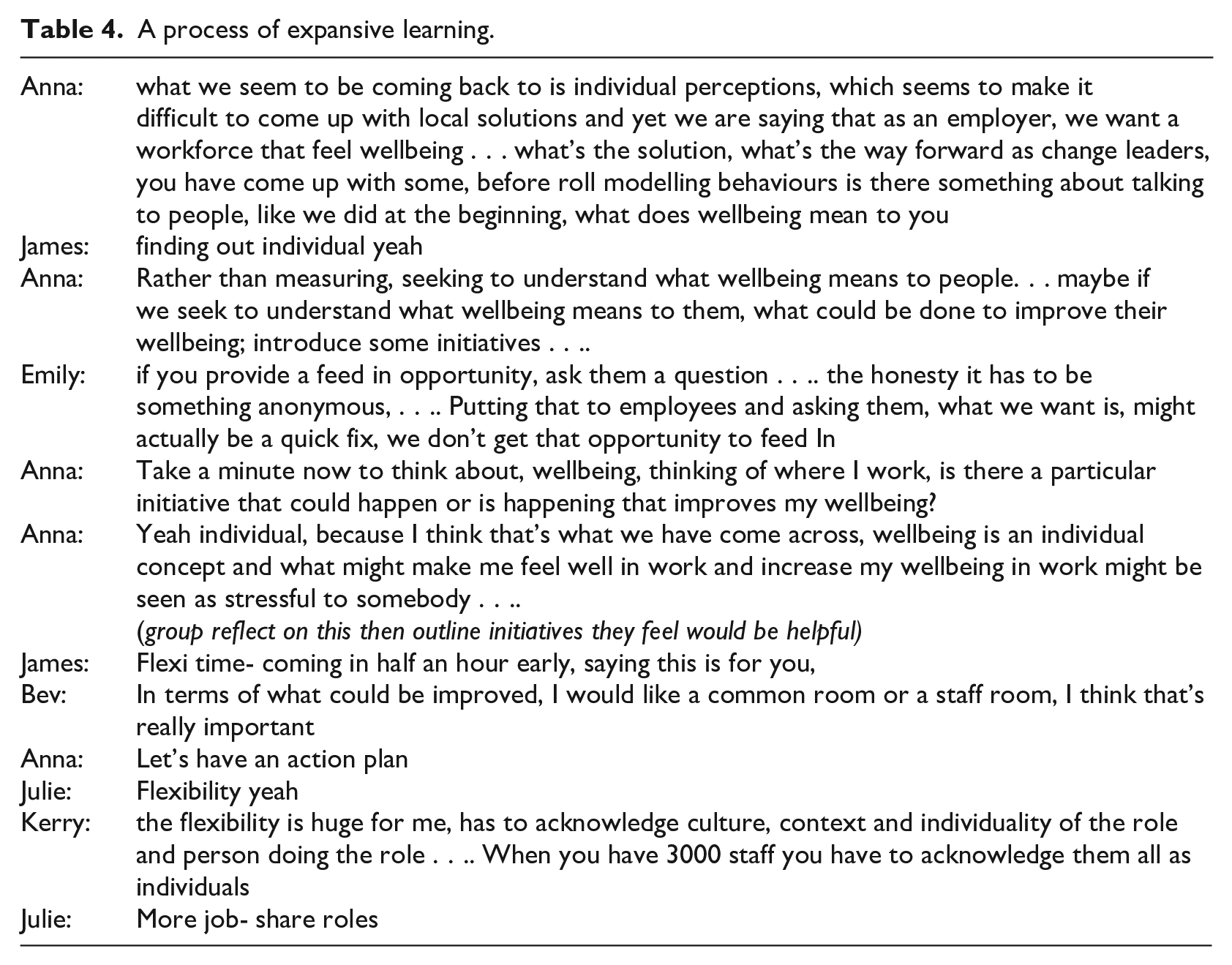
In both of the workshop conversations (Tables 3 and 4), we see how, through conversation and dialogue, expansive learning occurs for the leaders as they move from a state of questioning current challenges to rehearsing possible courses of action. The conversation ‘travels’ in a trajectory from problems to possibilities through the use of open questions, critique, agreement, debate and discussion and the proposing of solutions and ideas (Ramsey, 2016).
Activity Theory reminds us that this process of leadership learning is supported and facilitated by practical tools. Specifically, the developmental workshop provides a ‘place’ where the leaders can confidentiality and openly share their stories, experiences and expertise. The leaders are able to step away from the busy flow of their normal working practices and are provided with the space and time to more deeply consider the topic of employee wellbeing, voice concerns and experiences and through their conversations collectively reflect on the fundamental source of wellbeing challenges. The participants quickly become comfortable openly sharing their thoughts and perspectives with each other as they perceive an increased sense of emotional security. This safety in vulnerability is a condition that generates rich expansive learning as the participants relinquish their own views, and curiously re-examine their own perspectives, taking on board new ways of thinking about wellbeing (Antonacopoulou and Bento, 2018). The safety the leaders feel also affords them courage and confidence to openly challenge their own understandings and those of others. In this way, current knowledge and understanding is transcended leading to solutions and initiatives that would not have been possible without the expansive learning process. Through this relational, dialogic, and interactive learning process, the leaders are also given the opportunity to develop their active listening skills, ability to be sensitive and appreciative to the interpretations of others as well as tolerate and empathetically support the feelings and concerns of their fellow group members. Activity Theory supports this by emphasising that challenges and contradictions are normal and healthy aspects of leadership practice and are to be openly reflected upon and debated. As the leaders go through the process of expansive learning, not only do they learn new things about themselves and their own practice (e.g. learning about how they personally view wellbeing) but they support the growth and learning of others in the workshop (Antonacopoulou and Bento, 2018).
In both episodes of expansive learning, the Activity Theory notion of ‘object of activity’ proves helpful for making visible what drives and generates the collective intentionality of the leaders and helps them to effectively navigate the tensions and contradictions they identified. The leaders in the workshop have a shared conception of what they are working ‘on’, namely, employee wellbeing. The leaders desire to effectively lead wellbeing in their own organisations, creates a source of motivation and that generates their agency. From this shared desire, new strategies are developed that can better address employee wellbeing. Crevani et al. (2010: 81) describe this as ‘the co-construction of a sense of common direction in social interaction’, which subsequently mobilises their collective commitment. From this the tensions they experience are transformed into extensions through the co-creation of a range of emergent wellbeing initiatives (Antonacopoulou, 2008).
Discussion: using CHAT to reveal LAP and LAPD
The activities within the two workshops can reasonably be conceptualised as episodes of leadership. However, not all leadership literature is helpful as a lens for this particular case. With reference to some of the more mainstream leadership literature, there is no apparent evidence of a discernible heroic leadership figure providing direction to a set of followers. Rather, what has been described is leadership that emerges through the conversations, reflections and discussions that take place in a facilitated collective space, examples of ‘leadership as practice development’ (Crevani et al., 2010; Denyer and James, 2016; Raelin, 2011). In the workshops, the leaders are encouraged initially to reflect on challenges and contradictions and once these have been established and explored, they are prompted by the facilitator to envision practical outcomes are developed in the form of new wellbeing tools and initiatives (Drath et al., 2008,). These ideas for new modes of organising emerge as the leaders follow a conversational trajectory where they collectively contemplate, share ideas expertise and experiences and propose new possibilities for future action (Gronn, 2002; Ramsey, 2016).
The contribution of this article is to illustrate that much can be learnt from CHAT as a methodological and theoretical framework for offering deeper insights into the processes involved in LAP and LAPD. It is suggested that the various principles of CHAT such as the activity system, contradictions and tensions, historicity, expansive learning and mediatory tools, provide a holistic framework that can ‘make visible’ fundamental aspects of leadership that may be neglected through other analytical approaches. Essentially, the various CHAT principles offer greater insights into the processes through which LAP emerges when individuals are brought together to achieve desired future outcomes (Drath et al., 2008). The CHAT terminology does not impose limited leadership categories on the data such as leader and follower, but rather recognises the collaborative way that leadership can emerge in the flow of future-focussed activity. In view of this, it is proposed that researchers interested in moving away from an individualistic conception of leadership towards a ‘practice’ orientation should consider utilising CHAT as a framework to guide and focus their research. For scholars, a CHAT approach to studying LAP and LAPD makes visible what people are trying to achieve or work towards in their shared practices (object of activity) the challenges, tensions and contradictions that underpin and generate their collective leadership and the mediating tools and artefacts that support, sustain and comprise the leadership performance. Unlike other practice approaches such as the communities of practice approach (Wenger, 1998). Activity Theory makes visible the underlying structural source (dilemmas, contradictions and tensions) that result in leadership learning. Specifically, we see how collectively experienced challenges set in motion a process that leads to expansive learning for the leaders involved. In this way, we learn that leadership development is not a situated activity, a one-off activity but deeply influenced by wider social, contextual and historical influences.
There is great potential to utilise the CHAT framework to guide LAPD. As emphasised earlier in this article, much leadership education has been focussed on developing managers and leaders in more senior roles and equipping them with a range of leadership skills, traits and competencies. James et al. (2007) in their work on distributed leadership articulate the need for a leadership learning design that moves away from a focus on a leader’s individual characteristics. A practice focus in leadership development would shift away from a ‘competencies’ or ‘skills-based’ focus and place emphasis on the relational and collective aspects of leadership. In addition, leadership development with a practice focus (LAPD) would acknowledge the different levels at which leadership can occur in an organisation. Staff from across the organisational hierarchy could be offered opportunities to partake in leadership development opportunities regardless of position or seniority. Such an approach to leadership development would also support staff to think about how they could engage in and foster more collaborative approaches to leadership in their everyday working routines. A focus on collective and practice-oriented notions of leadership in leadership development would require practical methods such as the developmental workshop described above that can support and encourage agentic collaboration among front-line staff. In line with Activity Theory, leaders could be supported to work together to explore the source of contradictions and disturbances in practice, reflect on them and envision new opportunities and modes of practicing. This would foster opportunities for expansive learning for the leaders involved (Engeström, 1987; Engeström and Sannino, 2010). In the workshop participants would be asked, for example, where do we want to get to? (what are we working on/towards: Object of activity), how have we got here? (history), what are the main tensions and issues we currently face? (contradictions) and what tools do we have or might we need to help us move forward? (mediating tools, technologies, etc.). With an Activity Theory–driven leadership development initiative, leaders would begin to see ongoing tensions and challenges in their work as opportunities for professional growth and learning rather than negative events. This would contrast markedly from a deficit model of leadership development that places its focus on what practitioner’s lack in terms of their own skills (James et al., 2007).
When designing developmental workshops, certain conditions would support the expansive learning process. First, facilitators would need to encourage an open and honest dialogue between the participants, allowing all of the leaders in the group to freely express their perspective without fear of judgement. The participants also need to be clear about what is expected of them during the workshop, for example, active and supportive listening, probing, reflection on their own and others practice, sharing ideas and viewpoints, a willingness to discuss previous failures in terms of their own practice and collaborative problem solving. This kind of developmental workshop underpinned by the principles of Activity Theory could effectively contribute to the development of a particular type of leader; a leader who embraces challenges and sees ongoing learning as a normal part of daily practice. Leaders as learners want to learn and develop wherever they are in terms of their current leadership or career position and no matter where they are in the organisational hierarchy (Antonacopoulou and Bento, 2018). In addition to being a space where leaders acquire new knowledge about organisational issues, developmental workshops designed in this way could also develop important leadership virtues such as having the courage and confidence to challenge other people’s ideas, acting with integrity and social intelligence and a deep commitment to making a positive impact on organisational practice. Such leader character virtues are essential for dealing with the complexities the leaders of today face and have been linked with positive organisational outcomes such as job satisfaction and performance (Crossan et al., 2017). The value of developmental workshops underpinned by Activity Theory principles for developing leader character would be a worthwhile avenue for future LAP research.
In providing a space for leaders and managers to critically reflect on practice, developmental workshops underpinned by Activity Theory would be of likely interest to critical management educators as well as LAP scholars. By encouraging involvement and participation of all members of the organisational hierarchy and not just those in more formal leadership positions, the developmental workshop begins to challenge traditional power relations in leadership and management. The practice of collectively exploring and probing contradictions in practice may also help to reveal and unearth oppressive practices and structures by going beyond the ‘affirmation and reconstitution of the familiar world to recognize other possibilities’ (Calhoun, 1995: 2). In this way, the workshop could become a space for social change as leaders are encouraged in the session to develop a questioning attitude towards existing modes of operating, policies and other knowledge claims in organisational practice. Leaders could also be encouraged in the workshop to critically reflect on their own perspectives, values and actions and consider alternative modes of being and doing. For the leaders in the group, such processes could become a medium for human emancipation (Alvesson and Willmott, 2012). As a theoretical framework, Activity Theory has been criticised for not giving enough account of power (Daniels, 2007). Future research could usefully explore how developmental workshops underpinned by Activity Theory can expose power plays in leadership and management practice and how in the creation of new and better ways of doing things, certain voices and positions are not marginalised.
Conclusion
Activity Theory offers a range of principles and concepts that are pertinent to the study and development of LAP. Activity Theory integrates the notions of object of activity, historicity, contradictions and tensions, mediatory tools and expansive learning into a holistic framework that helps to explain and ‘make visible’ leadership that unfolds and is developed collaboratively. Data from two workshops that aimed to better understand the challenges involved in leading employee wellbeing were drawn upon to elucidate the value of the Activity Theory principles. Activity Theory helps us to learn a great deal about the leadership that arises and how this differs from the more mainstream, trait and heroic forms of leadership. In the two workshops, there were no formally designated leaders or sets of followers; rather, the participants reflect on various challenges and tensions in the leadership of wellbeing and together envision some better, more effective ways of managing employee wellbeing issues. When Activity Theory is brought to bear on the data, we are able to appreciate how leadership arises as a result of a shared conception of contradictions in current practice and a collective desire to improve employee wellbeing. Through the notion of expansive learning, we also develop a deeper appreciation for some of the learning processes that are embedded in collective and practice-based forms of leadership. Thus, this article argues that, first, to gain a more nuanced understanding of episodes of LAP, it would be useful to focus theoretically and methodologically on the principles CHAT proposes. A CHAT focussed study, would enquire into why the episode of LAP has arisen (historicity/contradictions), what those involved are trying to achieve (object of activity), what is in place or needs to be developed to support and sustain the unfolding leadership (mediatory tools/artefacts) and what expansive learning processes manifest. Such an approach would, arguably, lead to a more theoretically incisive understanding of leadership that is accomplished moment by moment in practice. It has also been argued that there is strong potential to design leadership development programmes and initiatives that are sensitive to notions of practice. Activity Theory provides a powerful resource that can support practitioners and management educators in a workshop design similar to that utilised in this article.
