




Abstract
I define “organized numbness” as the organized inability to perceive sensations, a learned desensitization operating in the way our (1) bodies, (2) language, and (3) knowledge are organized. I propose poetic synesthesia’s power to associate several sensory perceptions as a way to unlearn this sort of disembodied habituation. Inspired by the so-called “accursed” French poets of the 19th century, the “long, prodigious, and rational disorganization of all the senses” of synesthesia helps me propose a method for unlearning organized numbness. I illustrate this by “a study in scarlet,” that is, by plunging into the depths of a synesthetic exploration of blood as my “fil rouge” to infuse our working bodies with renewed sensorial and embodied—or rather “embloodied”—life. I end by discussing how cultivating poetic synesthesia can help us unlearn organized numbness in the body, in language, and in knowledge, and how it can instead respectively foster resonance by learning (1) a different embodied habituation of sensorial sensitivity, (2) a language that instead of abstracting us from the senses actually allows us to reconnect with them and to delve deeply into their combined and thereby potentiated power, and (3) an epistemological gateway to the “unknown.”
Keywords
Introduction
On Friday, 7th September 2018, I gave a welcome speech to our new students in the main auditorium. I had purposively chosen a bright turquoise dress knowing that I needed to contrast with the overwhelming presence of the school’s trademark
Toward the end of the third speech, I began feeling sweaty to the point that I was losing my grip over the clicker in my hand. The corner of my eye caught a glimpse of one of the school’s promotional posters, where the word “go!” was written against a red circle ( Figure 1 ). For a split-second, I remember being positively deranged, since to me, as anyone accustomed to traffic lights, a red circle inevitably pushes my body to do the exact opposite: “stop.” Perplexed by this contradictory message, I nevertheless knew the show had to go on, so I carried on, thanks to the adrenaline of being in the spotlight in front of the new students.

GO!
The sensation quickly went from sweat to uncomfortably damp. But I continued talking, paying more attention to the silhouettes of the students I could barely distinguish against the light, than to my bodily sensations. Slowly but surely,
To this day, that experience of miscarriage in the workplace remains one of the most painful memories of my (professional) life. Not only because it resulted in the loss of what could have been my second child, but because of the almost generalized indifference surrounding me. Apart from my colleague Ludivine who drove me to the nearest hospital, no one seemed to notice or care. Not even the students who had front row seats to this spectacle and who probably mistook it for an early and abundant period, or the rest of my colleagues in the following weeks despite knowing what happened, succumbing to its taboo character. I myself was more concerned with proving that I could perform “as usual” and getting the job done than in treating my pregnant body with a bit more consideration and care, asking to reschedule, imposing a break to drink, to sit down or go to the bathroom. I had visibly internalized the dictates of neo-liberal feminism that made me a “capital” needing to meet professional demands at all costs (Rottenberg, 2017). I paid the price in blood, for submitting to masculine ideals of productivity and performance in academia, for hushing and neglecting my bodily needs, for purposively numbing my senses.
This article is first about the need to unlearn such numbness, that I define as the organized inability to perceive sensations, a learned desensitization. Usually understood from a physiological perspective, numbness is an involuntary bodily reaction: we are numbed by the cold, by poor blood circulation in our limbs, or sometimes by fear or shock. We are left paralyzed, seemingly disconnected from our bodies. In all these examples, numbness results from external stimuli (e.g. cold) or strong emotional triggers (e.g. fear, stress). But as illustrated earlier, I argue that numbness can also emerge without a physiological basis, as the result of an organized learned process. In many organizational contexts, we become exceedingly good at purposively learning—theoretically and corporeally—to cultivate numbness without any physiological “help.” We learn to practice detachment, to internalize desensitization, and to foster disembodiment as an ideal work ethos while treating (at least some) embodied manifestations (those not instrumental to our profession) with contempt or even suspicion. Organized numbness will be detailed following this introduction, as operating in the way (1) our bodies, (2) our language, and (3) our knowledge, are organized.
Second, this article develops a rather unexpected way to unlearn this sort of disembodied habituation: through poetry, and more precisely, poetic synesthesia. From the Greek “syn” (with) and “aesthesis” (sensation), this word has different meanings. In neurology, it is a non-pathological involuntary phenomenon that durably links two or more senses in a same cognitive path, for example, when letters or numbers are associated with a specific color or location in space, or when certain words or symbols are immediately associated with an odor, sound, or taste, just like the red circle usually signaling a stop in my story above. In poetry, synesthesia is a figure of style associating several sensory perceptions. It was the so-called “accursed” French poets of the 19th century, 2 such as Charles Baudelaire (1821–1867), Gérard de Nerval (1808–1855), and Arthur Rimbaud (1854–1891), who famously explored poetic synesthesia, engaging with the evocative power of mixing the senses. For example, “the purple perfumes of the Polar Sun” in Rimbaud’s (2017[1871]) Metropolitan, which nicely contrasts with the “Black Sun of Melancholy” in Nerval’s El Desdichado (Kristeva, 1989; Nerval, 1999). This multi-sensory poetry, simply but majestically defined by Rimbaud (2017[1871]) as “a long, prodigious, and rational disorganization of all the senses” will help me propose a method for unlearning organized numbness in the third section.
The fourth section will illustrate the potential of poetic synesthesia through “a study in scarlet,” that is, by plunging into the depths of a synesthetic exploration of blood, my “
Finally, stemming from this synesthetic illustration, I shall discuss how cultivating poetic synesthesia can help us unlearn organized numbness in the body, in language, and in knowledge. Instead, poetic synesthesia can foster resonance by learning (1) a different embodied habituation of sensorial sensitivity, (2) a language that instead of abstracting us from the senses, actually allows us to reconnect with them, and (3) an epistemological gateway to the “unknown.”
Organized numbness, or the censored senses
I will argue that numbness is not only a physiological phenomenon resulting from an external stimulus, but can also be the object of organization. We live in an age of “excarnation” that “makes us lose touch with our senses as our experience becomes ever more mediated” (Kearney, 2021: 2). This is a crisis of the digital era (Lambeir, 2002) aggravated by phenomena like the COVID-19 pandemic, fostering not only physiological numbness with trademark symptoms including the temporal loss of smell and taste 4 but also organized numbness, with touch (and hence, our embodied relationality to others, cf. Clavijo and Perray-Redslob, 2021; Plotnikof et al., 2020), being severely limited through social distancing measures. Organized numbness is then akin to a form of censorship, a taming of the body, a learned internalized desensitization occurring interrelatedly in the body, language, and knowledge.
At the most basic bodily level, organized numbness affects bodies’ sensorial capacity by depriving us of sensory stimuli (e.g. imposing social distancing) or by carefully organizing the context and manner where sensory stimuli can take place (e.g. entering spaces, touching objects or others only after having used sanitizing gel). This is not new, and bodies’ physiological needs and sensory capacities have long been considered as an engineering challenge to be optimized since Taylor’s scientific management, strongly coming back today in the form of algorithmic management (Capelli, 2020). Often blind to the painful, harmful, or sometimes deadly effects of work organization (Orzeck, 2007), these practices are also fueled by the neo-liberal instrumentalization of breaks and the “wellness” discourse as enhancing productivity (Zacher et al., 2014). However, this often leads to paradoxical injunctions, and even cynicism, such as by providing water bottles to encourage hydration without planning time for bathroom breaks as in my opening story.
In her recent ethnography of food-delivery couriers, Le Breton (2021) analyzed how couriers, including herself, internalize the “autonomy paradox” (Fleming, 2017) through their own abstracted disembodiment and algorithmic invisibilization. She learned to discipline and hush, in the name of performance, the parts of her body not directly useful for deliveries and what her senses warned her about (e.g. cold slippery weather, limited visibility on the streets, exhaustion from pedaling up-hill—a topographic detail that algorithms remain oblivious to) lest she be sanctioned by the platform. Indeed, we learn, very early on, to leave our bodies’ non-productive, affective, gendered, and corporeal dimensions, and particularly its dirty and leaky ones, outside the office or shop floor as a gauge of professionalism and productivity and in the name of what a reviewer of this piece justly named “the organizational demand for containment” (Lee, 2018; Pérezts et al., 2015; Sayers and Jones, 2015; Van Amsterdam, 2015).
Organized numbness also operates through language, which goes hand-in-hand with knowledge. This special issue called for exploring how we “can gain knowledge otherwise than through the mediation of language.” Reconnecting with the senses somehow involves challenging logocentrism (Derrida, 1976) and our general obsession with having a verbal epistemic relation to the world. But, furthermore, it is about challenging phallogocentrism, the “(nostalgia for the presence of the one true Word) and disembodied vision” (Haraway, 1988: 590). Indeed, Western science seems trapped by the performative power of the Prologue of the Gospel of John’s opening verse: “In the beginning, was the Word” (logos) (v.1), while often forgetting or minimizing that the “Word became flesh” (v.14). The primacy given to language has tended to overthrow the importance or even the existence of what it names (Nietzsche, 1911). One need only spend 5 minutes in a museum or art gallery and observe one’s fellow visitors: in a matter of seconds, most people’s gaze will quickly drift to the small accompanying plate with the title of the piece and the artist’s name, looking for cues and clues for understanding or even approaching the artwork that they barely even looked at. Instead, they will often privilege the fame of the artist’s name, the collection it comes from, or the title, and be profoundly disappointed, uneasy and swift to move on to the next artwork if the label bears the exceedingly frustrating: “Untitled” or “Painting n°X.” Titles and artists or collections’ names are the “metadata” that our lazy mind looks for when attempting to “know” (i.e. form an idea of) the artwork, and “make sense” of it and of its aesthetic (and monetary) value. The untrained eye will seldom use the aesthetic capacity of the actual sense of sight, or only as a secondary means, when going back and forth from the painting or sculpture to the title, attempting to “see” the connection between the two. As suggested by a reviewer, this is not unlike academia (or even other professions), where we quickly screen name tags and profile pages for reputed journals’ and institutions names (or their absence) to attribute a “value” to someone, instead of, and before, having a non-mediated exchange with them.
Language, and particularly written language, heralds the “official” start of History and “civilization” as we know it, while relegating peoples more based on oral traditions or lacking symbolic means of representation, to the degrading status of “primitive” (Everett, 2019). Hence, words, often guilty as charged, are seen as abstracting away from the senses, the body, and matter more broadly. This tendency is particularly true in the constitution of knowledge, and scientific “truth.” Overall, the Platonic and Cartesian ideal of not trusting one’s senses for all their treachery and inaccuracy, and erecting doubt of the senses’ errors as the basic methodological premise of reasoning (Descartes, 2009) is hard to ignore. The workplace in general is no different from the academic workplace in that regard, where non-productive elements of the body are seen as parasitic and remain distinctly unwelcome (Brewis and Williams, 2019; Fotaki, 2013; Mandalaki and Pérezts, 2021). In academia, such organized numbness appears even to be a gauge not only of our professionalism, but also of the scientific rigor of our work, and should be visible in the way we write science (Beavan, 2019; Fotaki, 2013; Haraway, 1988; Höpfl, 2000; Pullen, 2018; Pullen and Rhodes, 2008). I remember the violence of learning to write with fewer adjectives, shorter sentences, structured format, disembodied and “objective” formalizations that clothe our papers by writing in “proper” conventions (Mandalaki and Pérezts, 2022; Pérezts, forthcoming) as part of my PhD training as an organizational scholar.
So, if organized numbness is learned—in that it is internalized through rules, socialization mechanisms, writing conventions, and ideological premises—how can it be unlearned? I have caught a glimpse of a potential answer in the inspirational lines of recent trends in writing differently in academia (Gilmore et al., 2019; Kiriakos and Tienari, 2018; Mandalaki, 2020; Prasad, 2016; Pullen et al., 2020) that I now wish to develop by focusing on poetic synesthesia.
Learning from poetic synesthesia
As a teenager, I fell in love with the so-called “accursed” 19th-century French poets, learning many of their terrifyingly powerful texts by heart. A key feature of their poetry was synesthesia, a figure of style carefully associating several sensory perceptions to create the unexpected and the beautiful. Not only did they play, twist, explore, and engage with this in a variety of ways, they also explicitly provided elements akin to a theorization of poetic synesthesia. Nowhere is this “programmatic method” made clearer than in Rimbaud’s (2017[1871]) Letters of the Visionary, and in particular, the Letter to Paul Demeny of 15th May 1871 (the italics are mine): [. . .] I say that one must be a Seer, make oneself a Visionary. The Poet makes himself a seer by a long, prodigious, and rational disorganization of all the senses. [. . .] Unspeakable torment where he needs the greatest faith, a superhuman strength, where he becomes, above all others, the great invalid, the great criminal, the great accursed,—and the Supreme Scientist!—For he arrives at the unknown ! [. . .] He attains the unknown, and if, demented, he ends up by losing the meaning of his visions, he will at least have seen them! So what if he is destroyed in his flight through the unheard-of and unnamable things: other horrible workers will come; they will begin at the horizons where the other has fallen! [. . .]
The poet, therefore, is truly the thief of fire.
He is responsible for humanity, for animals even; he will have to make sure his visions can be smelled, fondled, listened to; if what he brings back from beyond has form, he gives it form; if it has none, he gives it none. A language must be found; besides, all speech being idea, the time for a universal language will come! [. . .] This language will be of the soul and for the soul, it will include everything: perfumes, sounds, colors, thought grappling with thought. [. . .].
There is a lot to unpack here. In these lines lie the key to a door that we seldom notice, let alone walk through, but that can change how we engage with the senses, with language itself and with established ways of knowing, particularly in the field of management and organization studies (MOS) where we are in dearth need of reconnection, of unsilencing bodies, and “making them count” otherwise than in neo-liberal standards of written productivity (Clavijo and Perray-Redslob, 2021).
First, this offers a means to reconcile the significance of the senses, not only in and of themselves separately, but more specifically in conjunction with each other, where “visions can be smelled, fondled, listened to.” This strongly echoes Baudelaire’s (1952) poem Correspondences, which constitutes an ode to synesthesia: [. . .] As long-drawn echoes mingle and transfuse Till in a deep, dark unison they swoon, Vast as the night or as the vault of noon— So are commingled perfumes, sounds, and hues. [. . .]
The last verse is particularly revealing: where smell (perfumes), sounds and visual color elements (hues) “answer each other,” if I literally translate from the original French. 5 Baudelaire explains that these “correspondences” are actually constitutive of nature itself. Phenomenologists have reached similar conclusions, highlighting the embodied but also cognitive and deeply affective nature of color. For instance, Michel Henry (2014) tells us how Vassili Kandinski, the painter, used to close his eyes while listening to music and would see colored spots dancing before his eyes. A cognitive phenomenon which is not rare per se, but that without proper attention and intention goes unnoticed. Similarly, synesthesia as a poetic style is a means to provide such intention by disrupting our attention with surprising sensorial associations.
Second, synesthesia reinvents a “universal” language in that “it will include everything: perfumes, sounds, colors, thought grappling with thought.” Only then can it be a language “of the soul and for the soul” through defining the poet’s crucial Promethean responsibility as a “thief of fire” for all humanity and beyond. Pursuing this quest, Rimbaud’s (2017[1871]) poem Vowels explicitly gives a color to each vowel as the building blocks of poetic sounds, sometimes against what other cultural meanings traditionally have ascribed to them: Black A, white E, red I, green U, blue O—vowels. Someday I will open your silent pregnancies A, black belt, hairy with bristling flies, Buzzing over stinking cruelties [. . .]
Despite his young age, Rimbaud is actually at the height of his brief poetic career when he writes this poem at age 17, since he completely stops writing 2 years later. Here, he is precociously experimenting with ways to use language not as a means of translating what he sees into words, but of revealing its true nature that only the poet can “sense.” We then step into a new dimension where language does not only speak of the senses, whether literally or metaphorically, but is in the service of the senses, setting the stage for them to dance.
Third, synesthesia is the door unto the “unknown,” as another figure of the “unsaid.” And the way to lift this veil unto the unknown is through a “long, prodigious and rational disorganization of all the senses.” As organizational scholars, we cannot help but tick, rather uncomfortably I may add, at the use of the word “disorganization” that Rimbaud invites us to intentionally engage in. 6 It goes against all our embodied scientific habitus of studying organizing often under the umbrella of rationalizing processes and structures. But here, not only is it about purposively engaging in disorganizing or in upsetting the status quo, but to do so rationally, taking our time, investing all our energy and wit. Only under such conditions can the unknown be reached—the poet tells us—can language be freed and can our senses intermingle in correspondence, in correspond-dance.
These three dimensions constitute the existential duty of the poet, understood as a visionary, as a seer—a quality much sought in contemporary political and organizational leaders—but that Rimbaud does not characterize in the heroic and masculine terms we find in leadership literature (see Painter-Morland and Deslandes, 2014). Instead, he spells out the humility required of this “great invalid,” warning about the “unspeakable torment” that will have to be faced, calling for “the greatest faith, a superhuman strength.” Indeed, the seer is persecuted as a “great criminal, the great accursed,” but such is the price to pay for the epistemic privilege of attaining “the unknown [. . .] the unheard-of and unnamable things.” I do not know about you, reader, but instead of the business leader this description of the seer reminds me more of the academic (the “Supreme Scientist” in Rimbaud’s words), whose work will be taken up by other “horrible workers” who might have the courage to push the boundaries of the vision even further.
But no explanation can replace an actual attempt of plunging “into the void,” as in Baudelaire’s (1936) Le Voyage. Following the opening story of this article, the next section will unfold a humble illustration of “a long, prodigious and rational disorganization of all the senses” where I explore blood as an object of synesthetic inquiry, progressively going deeper and deeper. First, by letting my words flow freely (sections in italics), followed by short analyses, in order to unlearn the organized numbness of my opening story, and whose implications I will discuss afterwards.
A study in scarlet
It seems to me sometimes my blood is bubbling out As fountains do, in rhythmic sobs; I feel it spout And lapse; I hear it plainly; it makes a murmuring sound; But from what wound it wells, so far I have not found. Baudelaire (1936), The Fountain of Blood.
Hemoglobin
About 10% of my weight. Ouch. Quite frightening if I stop to consider it. Especially when I hemorrhaged losing a fifth of all I had, a fifth of my life, screaming down the dry drain. Two years later I was still recovering. “Warm-blooded mammal.” Yet I feel so cold. Fear of transfusion. Poisoned blood. Purple Biohazard. Yuk. Disgusting. People faint when they see it. Donor. Rare. A-. No, sorry, actually it’s AB+. Long story. Not a week goes by that I don’t hear on some media that cardiovascular related diseases are the n°1 cause of death worldwide.
7
Yet I keep sitting for long hours at my desk, without stretching my legs, too busy writing this paper. I might become part of that scary statistic. I can hear it pounding in my ears. Strident drumming. Blood is deafening, getting stiff.
How can blood, an organic and liquid substance, be deafening or get stiff? Historically, merely studying blood and making claims as to how and why it functions in the body has caused a lot of debate and even bloodshed, in terms of upsetting religious beliefs, scientific paradigms and social relationships. The knowledge around blood has been severely organized, and even policed. Servetus, for instance, was burned at the stake for arguing that blood flows through the lungs to bring the Holy Spirit to the brain and the soul, a blasphemy in the eyes of Calvin (Kruyswijk and Van Hoorn, 2008). When William Harvey (1990) wrote in 1628 that blood circulated through the body in a unidirectional closed circle from and back to the heart, he went against established beliefs dating back to Aristotle that had justified centuries of clinical practices such as bleedings to evacuate the “sick blood” where the pain was located. Back then, his radical idea earned Harvey to be scornfully identified by some of his peers as a circulator, that is, as a traveling charlatan. But although, ultimately, this theory became accepted and rendered bleedings practices obsolete since the same blood flows all over the body, blood (and its diseases) remain a disturbing object of both anatomical and social debate (Mol and Law, 1994). Recently, studies show that as a vehicle of diseases like human immunodeficiency virus (HIV) or Hepatitis C, blood remains an object of social construction, in that it carries a relational symbolic dimension embodied across individuals and beyond their biology (McCarthy and Prokhovnik, 2014; Persson et al., 2019). In our field, a rare exception is Wittock et al.’s (2019) recent study of a Belgian blood establishment, where blood is understood as a complex bio-object to be managed, supplied, and stored (such as in blood banks). It has ontological multiplicity, oscillating between a more or less taboo “commodity” with evident value for the preservation of life in the “blood economy,” and the quintessential priceless “gift” (Wittock et al., 2019: 471). Its complex bio-objectification leads blood to be successively personalized or depersonalized, and the focus of complex coordination mechanisms. These construct who is allowed to be a donor and who is excluded in view of the stigma associated to certain social behaviors such as homosexuality, particularly after the advent of HIV (Martucci, 2010). Regarding blood, the social construction of risk is far from being a mere biological or medical debate (Kent and Farrell, 2014), and so is the symbolic nature of the (moral) ideals behind the substance itself and its uses. Blood appears to be at the heart of complex ontological politics leading to the (tense) reification and enactment of blood through various organizational day-to-day practices (Wittock et al., 2019). Anyone who has been hospitalized, who has hemorrhaged, been transfused or is suffering from a blood-borne disease can testify to the organizational complexity of blood—that as patients we are often excluded from accessing (Vicdan et al., 2022), and that as corpses, we are emptied of in order to be studied (Mol and Law, 1994: 642).
I started with the substance. Its texture now takes me to its color and sound.
Red
Red, the blood of angry men
Black, the dark of ages past
Red, a world about to dawn
Black, the night that ends at last [. . .]
I sung in enthusiastic chorus toward the end of Act I when I appeared in a performance of the musical Les Miserables (by Boublil and Shönberg) in 2005. The stage lights had turned to the bleu-blanc-rouge of the French revolutionaries. What vibrancy! Signing change, signing in red. Our eyes were fiery with blood and our justice-thirsty voices echoed long after the red theatre curtain had fallen. What other color than red to embody the revolution, the radical uplifting, the rapture of revolt, the right to fight for a free life?
After all, we live in a far-from-colorblind society, urging us to fight in order to keep breathing. But red is a color we all bear. I may not share the same skin color as you, but we all bleed the same scarlet. “What is the color of Adam?,” is asked of Ethiopian-born Schlomo in Live and Become (Mihaileanu, 2005) by a group of all-white Jewish judges. Is Adam white, is God white, as his opponent sustains, God being “perfect and pure” (i.e. white, in their view) and Adam being made in His image? Or is Adam, from the Hebrew adama, earth, the color of the soil, actually red (adom)? Can this assonance be pure coincidence? There is no such thing as coincidence in poetry: Borne from the earth and in bleeding childbirth. Red skins. Symbiosis. Red—me. Read-touch-play me in red.
Tantalizing music from The Red Violin (Girard, 1998). Listen. It sings and bleeds. Sing for me.
You come alive, you bleed notes across generations of players who can only get so close to your beauty and whom you suck dry of their lives. Birthing blood enmeshed in notes, traveling scarlet chords. The same voice resounds across oceans of space and time. Always in red. The color is the key to the music. Anna’s signing becomes carmine dripping fixated in mourning woe onto your carefully crafted wooden body. Forever you echo and transcend her. Corigliano’s music stridently pierces my heart as I write, as it did when I birthed my daughter and couldn’t get it out of my head. I could still hear it above my own screams. I could see the red violin dripping blood notes on the hospital walls. Again and again, hoping I wouldn’t succumb to the same fate as Anna dying in childbirth, the sound of the music fusing with my poring blood. 8 With each contraction, I was in the notes. I was the notes. When she was finally born and I got my life back, as well as my voice, it was the only melody I could sing to soothe her faint cries while resting still covered in my blood upon my naked flesh. Red is me. All of ME.
Aren’t our oldest “self-portraits” stenciled reddish silhouettes of our hands in various prehistoric cave paintings around the world, such as the “Cave of the Hands” (Figure 2)? 9 What better way to portray ourselves. How I love splashing blood on a canvas, performance or photograph, and shocking all of you back to your corpo-bloody-reality.
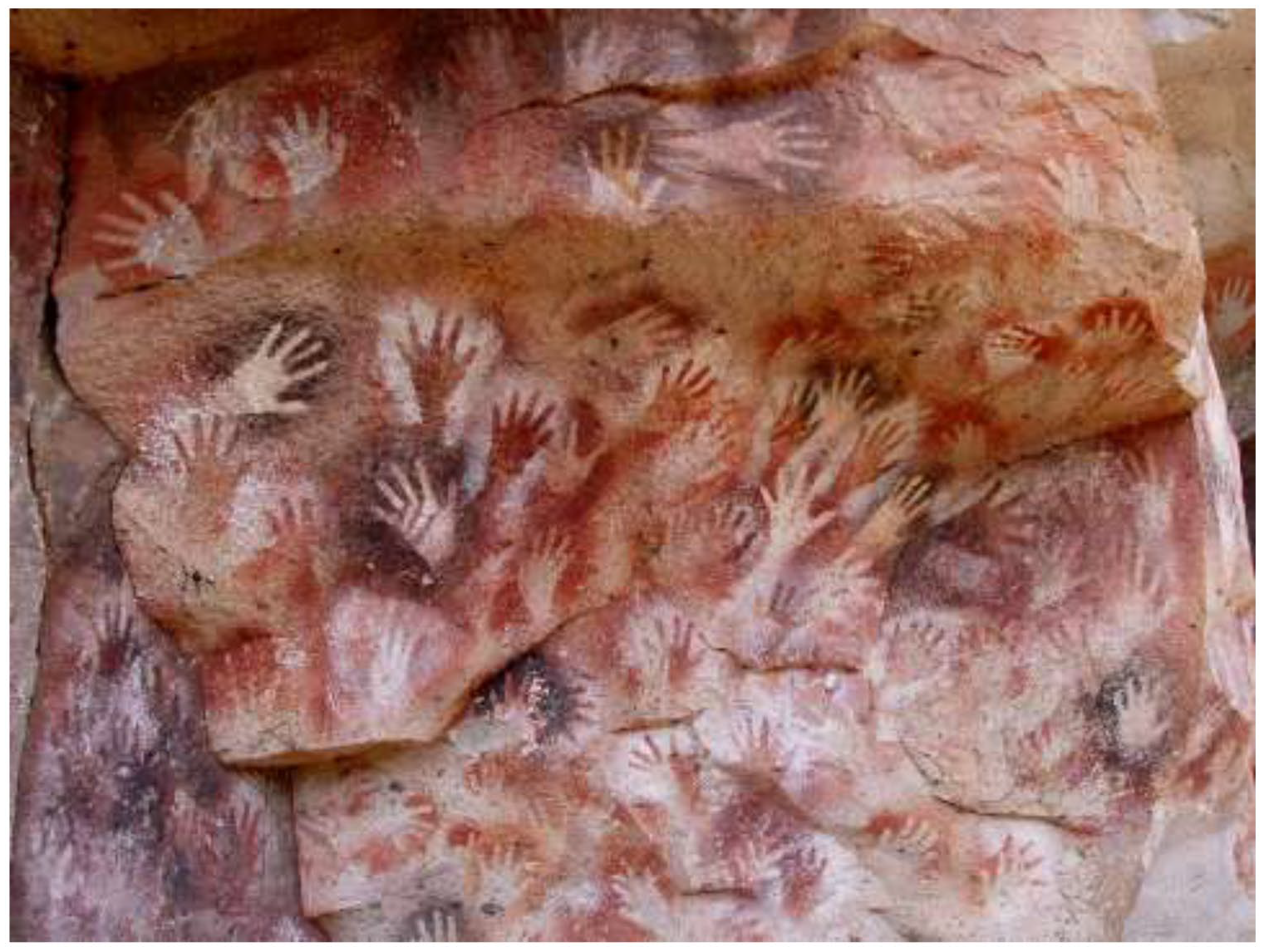
Cueva de las Manos, upon Rio Pinturas, near the town of Perito Moreno in Santa Cruz province, Argentina.
The fact that red was the first color that humans domesticated and learned to use in both cloth-dyeing and painting largely explains the richness of its symbolic significance and material diversity across our history and pre-history, according to color historian Pastoureau (2016). Because it is the color of blood, it is linked to life, and more specifically to power over life, thereby becoming the color of majesty and wealth since Antiquity. It also acquired strong religious significance in the West during the Middle-Ages, being associated both to the blood of Christ (hence its use in papal and religious clothing) and to the fires of Hell, becoming associated to sin: lust, vanity, prostitution, and violence. The protestant reform and humble mendicant orders are largely responsible for the decline of red in Western societies’ hierarchy of colors, considering it to be too vain and too close to papal symbolism, and instead turned to the modesty of black or brown as the new elevated color of spirituality. Following this decline, there was therefore room for red to be imbued with new symbols of vitality: red remains the color of celebration (e.g. Christmas, marriage and bridal attires in many countries), theatricality and solemnity (e.g. theaters’ velvet red curtains, Pastoureau, 2016: 189) and is almost synonymous with all sorts of revolutionary movements and leftist ideologies to the point that it is now a color that inspires fear of change and of instability (Pastoureau, 2016: 170).
Color both affects and is affected, organizes and is organized (Beyes, 2017). In Henry’s words, “the experience of red does not consist of perceiving a red object or even the color red as such, of considering it as red, but in affectively feeling its power in us, its impression” (Henry, 2014: 131, italics in original). Would I have experienced my miscarriage differently, if my institution’s trademark color was blue instead of red? If my clothing had been dark enough to conceal the stain of blood that blurred me into the surrounding décor? How can my red existence be reinvented? What do I learn to see, with this red veil covering my eyes all the time? The vowel “I” is red, writes Rimbaud (2017[1871]): “I, bloody spittle; laughter of pretty lips / Wild with anger or drunken denial.” How can I shed the shackles of the tyranny of blood from my nature as a woman, from my personal, carnal, fleshy, gendered “I”?
Color and sound now take me back to texture, intermingle with smell and circle back to visual portrayals of my fleshy existence.
Period 10
Judy Chicago’s Red Flag (1971). Sarah Maple’s Menstruate with Pride (2010-2011). Christen Clifford’s I want your blood (2013). The start of “proper womanhood,” with all the accompanying rites of passage and other “celebrations.” We learn our womanhood through the mocking eyes on our stained skirts. After which, nothing but siiiiiiiiiiiiiiiiilence. The main character of this tragi-comedy. Totem and taboo. “You wouldn’t happen to have one of those things, would you?” we ask our fellow female colleagues when its irregularity takes us by surprise. Unnamable objects. It’s natural, but shame, shame, shame. Hushed, whispered. An indeterminate referent in order to name the unspeakable, that all females will identify. A red sentence (Zehtabchi, 2018). It even becomes blue on TV commercials, for crying out loud! Well, it actually kind of makes sense since when you consider that blood is only bright red when it’s healthy, oxygenated and leaking, but still Gateway to chronic pain. I’m sawed in half. Crippled. I breathe deep because I cannot even wail. Not allowed to complain. “Stop it, you hysterical bitch. How unprofessional. Deal with it.” Don’t you dare tell me that God created the world and “saw that it was good” (Genesis, 1:31), because there is nothing bloody “good” about this. He (why I am not surprised it’s a he???) has a lot to explain. My body went from linear to cyclical time. I now have to concern myself with calendars. The moon became my new best friend. Will it never end? Oh yeah, right, with menopause and its new menu of delights. I hate tight and white clothes. Arghhhh the beige fabric of the family couch. Whose damned idea was that? The stains just won’t go away. The color itself hurts and weighs heavily on my shoulders. I can sense cameras zooming in on my expanding behind for a week every month. I fear I cannot possibly fit through the door. At night, I’m awakened by the sly feeling of a cursed drop sliding down and inevitably staining my underwear and sheets instead of landing on the uncomfortably huge pad where it fucking belongs. I feel the stench of dry clots clouding my thoughts and filling the air with their sweaty heaviness. Pollution to be purified. Ritual cleansing, Ghusl, Mikveh. Hideous menstruation. Sounds almost like a curse word. Bloody hell. No signs of fecundity allowed in the open. Women on the cover of magazines don’t ever seem to get their periods. They’re perfect, sexually desirable, controlled fertility, no pregnancy, almost like young girls’ bodies, no fat, no shapes, no womanhood, no blood. Sanitized women. The same at work. We must remain available to work. Available to men’s desire, no strings attached. Strings dripping blood pull out the tampons that seal my all lips.
Our truth is indeed “scribbled in blood” (Sayers and Jones, 2015), when month after month we endure varying degrees of pain and discomfort as part of our nature of being women, inevitably bringing upon us not only the taboo of leaky impurity (Lee, 2018; Van Amsterdam, 2015) but also the stigma of diminished productivity in the gendered workplace (Johnston-Robledo and Chrisler, 2013) despite some recent initiatives leading to more openness and improved workplace experience of menstruation (Owen, 2020). But it is surprising how little attention is paid overall by scholars to analyzing this issue, and voicing the bloody truths of women working through their (often painful) periods in seeking to conform to masculine ideals, as well as the truths of women who do not (or no longer) menstruate—yet another taboo (Beck, Brewis and Davies, 2018, 2021; Steffan, 2021). Furthermore, an extra layer of secrecy is added in case of pregnancy and/or miscarriage (Boncori and Smith, 2019), making it exceedingly difficult for such realities to be acknowledged, let alone cared for.
It is like we have no choice but to let ourselves be “frigidified” by the “sex cops” (Cixous, 1976: 877, quoted in Sayers and Jones, 2015: 95). Medicalization becomes the dominant discourse within the neo-liberal feminist imperative of productivity (Rottenberg, 2017), within which women who refuse medication (often hormone-based) actually “want to suffer” as a conscious (sometimes moral) choice (Bobel, 2010). So what to do with the fact that “everyday women (i.e., bleeding women) are problematic for the world, and especially for productivity discourse, because women’s experience directly challenges the epistemology of productivity discourse which is disembodied, runs according to linear clock time” (Sayers and Jones, 2015: 106)? The authors themselves provide the answer: poetry, because the posts they analyzed in their study “sounded like poetry already” in view of their “direct immediacy” (Sayers and Jones, 2015: 106) and because “Poetry is, or at least can be, a language arising directly from the body, from experience, and evoking the body, and can thus ‘trouble’ abstractions of disembodied discourse.” (Sayers and Jones, 2015: 107). Furthermore, writing about menstrual blood is as liberating as it is intimate. I do not believe that I can think of a better way to subsume my menstrual condition and resist shame than “writing passionately in blood, writing in a manner that defies the culturally informed habits of perception and judgement that would perpetuate injustice . . . writing in blood and love that is just as literal as metaphoric” (Diprose, 2002: 190–191, in Beavan, 2019: 51).
There’s still more depth to blood. Let us push synesthesia even further.
Violence, sacrifice, and resurrection
The smell of blood. Süskind’s (1986) Jean-Baptiste Grenouille was a murderer born in stench. I’ve never been so nauseated or voluptuously drawn by every breath I took while reading the book, so vividly impregnated by the words that it took weeks for my nose to forget it. What a perverse pleasure of a book that not only had the distinctive smell of paper—a disappearing luxury in the age of ebooks—but also the smell of crime and mystery, of beauty and odorous ideal, a book you could breathe in, like smoking a cigarette, inhaling its humors, miasma and essences.
Francisco de Goya’s (1814) “Third of May 1808”. Francis Bacon’s (1946) “Painting”. Andy Warhol’s (1981) “Gun”. But none as frightening as Felix Vallotton’s (1898) “La Chambre Rouge,” that leaves the viewer feeling uneasy by the atmosphere of a seeming crime about to happen but that we know nothing of (Pastoureau, 2016: 189) and where Sherlock Holmes might easily show up . . . a “study in scarlet” indeed (
Conan Doyle, 2018
). The key to the mystery is in the color: Blood-Death-Gore. There will be blood. Hard to wash off. Nothing stains like blood. Have a listen at the blood diamonds. Blood money. Rape. Feminicide. “With whose blood were my eyes crafted ?” (Haraway, 1988: 585) Frida Kahlo’s Unos cuantos piquetitos (1935). Women’s blood on the streets, in the back alleys, in the dumplands. Yet it is almost “normal.” Bodies piling up, like the rest of the garbage. The marriage of necro, narco, and capitalism. Blissful screaming union.
We have been habituated to violence in unparalleled proportions. The normalization of violence, of the sight of blood, of death, results in extremely effective desensitization. Epistemologically speaking, although hard to accept, we must face the fact that we are largely the authors of a carefully calculated and highly efficient organization of death and destruction (Banerjee, 2008; Bloomfield et al., 2017) morphed into spectacle, resulting in daily empirical manifestations fueling our shared collective imaginary, instantly propagated by media and simultaneously anesthetizing us, numbing us, to the point that we are no longer neither surprised, nor even appalled (Pérezts, 2021). Valencia (2010) uses the cinematographic genre term “gore” to qualify the shape capitalism is taking under these premises, visibilizing and normalizing mutilation and violence in the bloodiest way possible, with our increasing desensitization calling for an ever more intense representation of violence, in order to maintain its “shock value.” Its monstruosity (Thanem, 2006) accounts for and sustains death’s increasing lucrativeness, gauged by the metrics of productivity, performance, and efficiency (McCann, 2017). And we end up comfortably settled in our “civilized indifference” (Courpasson, 2016), where we can simply “look away,” basking comfortably in the sanitized and even “cultural” version of death (Shah, 2017).
In particular, there is a heavily gendered dimension here, linking masculinization to violence and necropower, rooting the latter in a hyper-hegemonic masculine, hetero-centric, and patriarchal order which is key to understanding issues like feminicide (Valencia, 2010; Wright, 2011) but also less graphic forms of violence such as those in the discourses of right-wing extremists, and daily sexism that continuously reasserts the feminine as the degrading abject element par excellence (Mandalaki and Pérezts, 2021).
More blood. That’s what the gods want. Blood is life-immortal. Undead. Eternal. It’s the price for the world to be reborn, for salvation. Red steps of liquid sacrifice.
The night spent on your back. Open chest. The obsidian knife plunges down to slice the Barbaric they say? Well what about you, drinking the blood of your god every Sunday? Dripping down from the cross into the chalice. Drink. This is my blood, poured out for you. Endless cycle of sacrifice. Damp with lies. Red with reverence. Let me drink it indeed, taste its deceit, touch the velvet abundance. Blood-thirsty-sucking gods. A half-smile of scarlet stained teeth. Is it mocking me? The Exquisitely, deathly blood.
This relatively short word becomes exceedingly longer to pronounce than usual, with every letter being lavishly savored as it is being uttered by Gary Oldman as Count Dracula (
Ford Coppola, 1992
), as if he was tasting and dripping fresh blood from his lips:
Again, the ambiguity of blood in the figure of the vampire, who, like the mosquito or other parasitic creatures, feeds on the blood of its victims until they are sucked dry, thereby ensuring eternal life as an undead. In a recent bloody piece of scholarly work, Riach and Kelly (2015) highlight how vampiric forms and structures are constitutive of contemporary organizational life and its contempt for, and organization of, aging. The macabre and monstrous approach (Thanem, 2006) are an explicit challenge to the sanitized view of organizations, by bringing the inevitability of decay to the forefront in a provocative way. The same profane theme is otherwise declined in many religious rites, from the human sacrifices of the Mesoamerican natives to the heart of Christian imagery. The smell of sacrificial death floats in between a half-remembered dream and a time warp in the short story La Noche boca arriba, 12 as part of the literary “games,” Julio Cortazar (2018) plays with his readers in his short stories, and that has a surprising contemporary echo in many organizational experiences. The need for “fresh blood” de facto turns older blood into a disposable object when having a neophilic focus (Riach and Kelly, 2015) in an attempt to differ the organization’s mortality and decay.
Being so meticulously organized, it is worth wondering whether an escape does not in fact lie within a form of “disorganization,” in order to disrupt this “order of things,” and give such violence another sort of aesthetics and “voice” (Martinez, 2014), maybe even a posthumous one, as a way to fight (and write) back?
Unlearning organized numbness: elements for discussion
Our field has never argued that the senses are not important or are excluded from organizations and organizing, with this special issue contributing to reclaim the embodied, phenomenological, sensory, and affective elements of organizations (Beyes, 2017; Beyes and De Cock, 2017; Canniford et al., 2018; De Vaujany and Aroles, 2019; Jørgensen and Holt, 2019; Küpers, 2014; Styhre, 2013) and learning (Painter et al., 2021; Steyaert et al., 2016). However, among the understudied aspects, my article addresses the notion of organized numbness, understood as the result of an organized learning process of desensitization. With it comes an inevitable isolation, a severing from the relational ties that bind us to the world and to others. Unlearning organized numbness through poetic synesthesia can therefore not only revamp our senses (Kearney, 2021) but also our capacity for resonance (Rosa, 2018) in the organizational settings we live in, as unpacked in three steps as follows.
De-numbing the senses: fostering a different embodied habituation of sensorial sensitivity
Others have shown that we develop an embodied habitus around a particular “sensory order” (Jørgensen and Holt, 2019), that is, the resulting sensory and affective atmosphere as part of the aesthetics of the making of organizational spaces. Engaging in poetic synesthesia can fruitfully extend such perspectives and complement prior work already highlighting the importance of a particular sense (such as sound (De Vaujany and Aroles, 2019; Styhre, 2013), or the “chromatics of organizing” (Beyes and De Cock, 2017)) as well as studies that have analyzed how several senses “work together,” or compensate for each other, also in conjunction to spatiality for instance (Canniford et al., 2018; Hammer, 2015; Hancock et al., 2015). It can help us to reclaim sensorial sensitivity by practicing a rare kind of embodied habituation in the repeated attention paid to the multi-sensory aspects of something (such as blood) or an organizational setting for instance.
Methodologically, fostering sensorial resonance is also close to what Gherardi (2019) calls “attunement,” drawing on the musical metaphor to stress the ethnographic capacity to affect and let oneself be affected by the field (Mandalaki and Pérezts, 2022), complementing calls for more attention being paid to multi-sensory data in ethnography (Hammer, 2015; Pink, 2015) and for embodied research methods more broadly (Thanem and Knights, 2019). We could develop this by turning to insights of phenomenologists, who have peppered their work with considerations of how the senses relate to embodied and affective knowledge (see, for instance, Husserl (1999: 42) meditating on the color red, or Henry’s writings on Kandinski’s paintings and use of color as having a profound affective influence on our relation to the world). Furthermore, integrating a historical perspective can also help us make sense of the evolving practices of sensorial elements, such as color. For instance, is the fact that blue became the “new red” as a preferred color the sign of pigments’ discoveries or technological advancements leading to reinterpreted ideological and symbolic meanings, or the other way around (Pastoureau, 2016: 86)? The same problem has long been expressed, albeit in different terms, by considerations of art and aesthetics. Does art imitate nature, in the classic sense of Aristotle’s (1996) mimesis in order to know it better through representation? I doubt that was the scope of Francis Bacon’s (1986) Blood on the floor, or Andres Serrano’s Blood and Semen (1990) or Precious Blood (1989) (for both works, see Alvarez, 2015). It is hard to imagine Jordan Eagles’ Hemosapien 13 produced in 2009 or Anish Kapoor’s (2018) Blood Solid in those terms. Or rather is it art’s (or poetry’s) “mission” to “express nature” even better than nature itself (Balzac, 1995), as a “manifestation of the spirit” (Hegel, 1998)? Could it be that “Life imitates art far more than art imitates life” (Wilde, 1998: 12) in that nature is actually our “creation,” shaped by the way art teaches us to “see” as already suggested by Baudelaire and Rimbaud?
My “study in scarlet” was a naked attempt (Mandalaki, 2020; Mandalaki and Pérezts, 2022), necessarily limited and vulnerable, to engage in synesthetic writing on/about/through blood. This evidently implies accepting and dealing with phenomenological messiness, which largely explains why such multi-sensory engagement and writing is more often than not, the object of suspicion or contempt. However, for those willing to “see,” this endeavor also carries potential epistemological contributions for reclaiming our sensorial embodiment and decentering our discursive ways of learning and knowing differently through engaging synesthetically with what blood “reveals.” Indeed, blood, in addition to having profound organizational implications, was chosen for its vivid sensory and synesthetic manifestations, rich metaphorical imagery and symbolic powers, that can literally help us in de-numbing our senses, in reconnecting with our working blood-filled bodies, infusing them with renewed sensorial sensitivity.
De-numbing writing: becoming a poet and writing our way back to the senses
While tuning down the importance of language and bringing the affective, sensing body to the foreground does represent an advancement in uncovering alternative forms of writing, learning, and knowing, one must not however “throw away the baby out with the bath water.” In the cinematographic genre, screenplays like that of The Red Violin (Girard, 1998) or more recent experimentations like A Quiet Place (Krasinski, 2018) make sound and silence, or rather the “sounds of silence” along with their evocative imagery, the object of new writing practices, making sound effects a prominent visual element of the written screenplay, and translating into evermore sensorial storytelling in the resulting movie.
14
Increasingly scholarly attention is also fruitfully playing with alternative forms of writing, with prime examples being this journal’s special issue on “Writing Differently” (Gilmore et al., 2019), and the creative writing section handled by a Literary Editor in Accounting, Auditing and Accountability Journal (AAAJ) without seeing language as necessarily abstracting away from the senses. In particular, poetry appears as a form of expression that is inherently empowering and resisting abstraction: “Even if the mind resists, the body responds to poetry. Poetry is felt as well as read. No text is effective if it leaves the reader dead inside” (Sayers and Jones, 2015: 107). Poetry has the demiurgic capacity to compensate weaknesses of other forms of language: We can train ourselves to respect our feelings and to transpose them into a language so they can be shared, and where that language does not exist it is our poetry which helps to fashion it. (Audre Lorde, quoted in Brewis and Williams, 2019: 90)
Poetic synesthesia can go further along these lines, by providing a method which is very clear in its formulation (“a long, prodigious and rational disorganization of the senses”) despite calling for enigmatic and ever-renewed ways of putting this into writing practices. It requires a good dose of “artistic license” and a fair amount of courage (Kiriakos and Tienari, 2018), for such writing to emerge synesthetically in corpus, where all our senses and our embodied selves are allowed to explore uncharted aesthetic territories (Strati, 2007, 2018), particularly in fields like ours which are predominantly far from this. Only then can our rebel tongues, crooked fingers, tired limbs, excited sexes, uncombed hair, untamed imaginations, and free spirits become sites of resistance (Mandalaki, 2020; Martinez, 2014). Our senses then become the gateway to relational affective and embodied learning (Boncori and Smith, 2019; Painter et al., 2021), allowing us to affect and be affected as a stepping point for establishing resonance (Gherardi, 2019) or “correspondence,” in Baudelaire’s terms.
It is a writing of the senses and from the senses, but as Rimbaud (2017[1871]) remarks prior to defining the seer, the first task of she/he who “wants to be a poet is to study one’s own self-awareness, in its entirety” and this implies making “the soul monstrous.” Delving into the depths of the first person (Essén and Värlander, 2013) potentiates our ability to affectively inhabit our own body (what phenomenologist Michel Henry (1975) calls corpropriation) and avoids neo-liberal forms of alienation (Rottenberg, 2017). My “study in scarlet” was a humble way to reconnect my embodied subjectivity with sensorial relationality, by potentiating the combined power of the senses in order to unlearn organized numbness through writing them, about them, through them. Poetic synesthesia is then no longer a language that abstracts away from the senses, but quite the opposite. It is a writing that “touches.”
This is not without risks, as in all forms of writing differently. But this also crucially harbors possibilities for what Baudelaire and Rimbaud both call the capitalized “New,” and for us the possibilities for learning and knowing differently through engaging differently—poetically, synesthetically—with the senses in (a rather desensitized) organizational research.
De-numbing knowledge and learning: becoming a visionary unto the “unknown”
I sought to explore organized numbness, and expressed the need to question it. This seems particularly important in view of its epistemological implications for knowledge and knowing, as well as for processes of learning and unlearning.
Stemming from the two previous subsections, I join numerous calls to rethink the ontological and epistemological (and phallogocentric) primacy given to language as a means to both conduct research (e.g. though interviews or content analysis) and produce research, as if the content’s validity depended upon the form, as a sacralized end in itself (Alvesson and Ashcraft, 2012; Van Maanen, 1995) and could practically stand in lieu of proper theorization. Experimentations are increasingly exploring other forms of sensing as knowing (Gherardi, 2019; Hammer, 2015; Pink, 2015; Strati, 2007; Thanem and Knights, 2019; Warren, 2008). But just as the leaking, exhausted, imperfect, and bleeding body has traditionally been considered an illegitimate, unruly, and shameful site of knowing (Beavan, 2019; Mandalaki and Pérezts, 2021) so has poetry and its disruptive character (Höpfl, 1994; Pelias, 1999), in that it constitutes an explicit threat to the masculine cannons of academic writing (Fotaki, 2013; Höpfl, 2000; Pullen, 2018; Pullen et al., 2020; Pullen and Rhodes, 2008; Sayers and Jones, 2015).
If, according to Cixous, “Nearly the entire history of writing is confounded with the history of reason” (1976: 879, in Sayers and Jones, 2015: 104), following Rimbaud, we can turn reason on its head by placing it in the service of a disorganization of all the senses. I cannot know whether Haraway read Rimbaud, but how she seeks to upset and decenter the classic masculine understanding of rationality, objectivity, and science by discussing vision (inspired by how she imagined her dogs saw the world with their different visual capacities and a heightened sense of smell and hearing) and her situated knowledges (Haraway, 1988) strongly echo Rimbaud’s synesthesia (the italics are mine): The eyes have been used to signify a perverse capacity [. . .] to distance the knowing subject from everybody and everything in the interests of unfettered power. [. . .] And like the god trick, this eye fucks the world to make techno-monsters. [. . .] We need to learn in our bodies [. . .] a knowledge attuned to resonance [. . .]. Science becomes the myth, not of what escapes human agency and responsibility in a realm above the fray, but, rather, of accountability and responsibility for translations and solidarities linking the cacophonous visions and visionary voices that characterize the knowledges of the subjugated. A splitting of senses, a confusion of voice and sight, rather than clear and distinct ideas, becomes the metaphor for the ground of the rational. [. . .] We seek those ruled by partial sight and limited voice—not partiality for its own sake but, rather, for the sake of the connections and unexpected openings situated knowledges make possible. (Haraway, 1988: 581–590)
And although Rimbaud cannot be qualified as having developed a feminist epistemology, in fact, part of becoming a seer or a visionary implies becoming the “Supreme Scientist” in that only the poet is capable of unlocking new ways of learning and of being through writing, in ways strongly resonant to Haraway’s and to what feminist scholars engaged in writing differently in our field today are exploring. It is about a “vision” that is not that of the distant anthropo-centered spectator (from anthropos, upward gazer, see Kearney, 2021: 33), unidirectional and superior (as the masculine or scientific gaze which sees without being seen). Following Kearney (2021), the senses can “learn” to be reciprocal, relational, and synesthetic, as is touch (one cannot touch without being tangible/touched): touch becomes tact, taste becomes savvy, smell becomes flair, sight becomes insight, and sound becomes resonance. This is also when they each become “knowing,” when the metaphorical becomes an embodied and relational intelligence of the senses. It indeed takes two to tango (and to write) (Mandalaki and Pérezts, 2022), when language, like sensory perception, acquires the embodied phenomenological intelligence through becoming reciprocal, “naked,” and synesthetic.
Indeed, humbly and relationally, “to learn is to touch, to be touched by the text” (Beavan, 2019: 91). The vertical depths of what the “accursed poets” call “plunging into the Unknown,” is already being experimented with (Helin, 2020), and further decentering can come through synesthetic playfulness, of daring to (re)color our organizational worlds (Beyes and De Cock, 2017), and infuse them with sensorial (and therefore affective) abundance. We must allow ourselves to feel again, to touch, to taste, see, hear, and smell, and learn to write so. It is through such experimentations that meaningful (and epistemologically empowering) “sense”-making, and perhaps unruly and unexpected answers, can be found. Classic organizational preoccupations on the emergence of novelty in organizations (Garud et al., 2015) can appreciate the unbalancing and decentering of the pre-written script of our certitudes, when the “unknown” and the “new” are fruitfully challenged through the unexpected of synesthesia. It is a possible way to counter our sensorial hunger, particularly after the toll taken on the senses by the disembodiment of phallogocentrism, the digital age, and more recently the pandemic distancing to top it all off (Kearney, 2021).
To conclude—assuming that such a thing makes sense in synesthetic poetry—a final note on the synesthetic process of writing of this article. Despite this text flowing in various iterations and various periods, it was done while concomitantly scrolling up and down the screen, back and forth from about two dozen open windows to keep the key texts and images I resonated with within a click’s reach, listening to the score of the Red Violin, my whole body participating in the pain but also the joy and the sensorial pleasure of writing like this. A rare exercise, exhausting but also deeply vivifying, as a reminder that organizational research is not a sterile futile exercise. So, without further ado, dear reader, let us become seers, get up, and roam the world as poets. Just as we have been trained to develop numbness and to succumb to the general prescription of censoring our senses, of remaining aloof, of ignoring our inner embodied, sensorial, and affective needs—as if this was the necessary condition of a proper, professional, and scientific disposition—we can unlearn it. I will say that again: we can unlearn organized numbness, yes we can! And train the body, the pen, and the mind, to sense-feel-think-imagine-write differently and find a poetic way back to our beating sensorial and Our brains are burning up! —there’s nothing left to do But plunge into the void!—Hell? Heaven?—what’s the odds? We’re bound for the Unknown, in search of something new! Charles Baudelaire (1936) “Le Voyage”
15
Footnotes
Acknowledgements
The author’s warmest thanks to Ludivine Perray, Silvia Gherardi, Emmanouela Mandalaki and Ennio Fedrizzi for their presence at crucial moments regarding this writing of this article, and to the poets and artists mentioned that have inspired her. Her deepest gratitude also goes to Guest Editor Boukje Cnossen and the three wonderful anonymous reviewers for their embodied and thoughtful engagement with her original idea and their invaluable help. Finally, a round of applause, admiration and gratitude goes to the feminist faces and voices during the EGOS 2022 Women’s Network for collectively engaging in feminist repair.
Funding
The author(s) received no financial support for the research, authorship, and/or publication of this article.

#/media/Fichier:Félix_Vallotton,_1898_-_La_chambre_rouge.jpg)