




Abstract
In this autoethnography, I explore learning to become an academic differently in the neoliberal university through a polyphonic dialogue lens. Based on a visual autoethnographic analysis, I explore dialogic moments as relational opportunities for otherness. Through active listening and writing from within ongoing dialogue, I enter a conversation with other ways of existing in and relating to neoliberal academia. I argue that learning to become an academic can encompass dialogic moments in which a neoliberal way of existing in academia, including complying with standards of academic excellence, can become enriched by alternative, and perhaps more authentic, ways of being. A dialogue lens allows for an active, embodied, and involved understanding of multiple forms and meanings of failure and success. My account contributes to the research on learning to become a different kind of academic in neoliberal higher educational institutions. Through dialogue as an ongoing relational and responsive practice, we can foster connections with, and responsibility toward, multiple inner “kins” who voice their “truths,” if such otherness is allowed to animate us. This highlights the importance of being moved in dialogue to challenge hegemonic ways of being.
Keywords
Introduction
In recent decades, higher educational institutions worldwide have witnessed the infiltration of neoliberalism, which has resulted in their corporatization (Marginson and Considine, 2000). In this “new” academia (Kallio et al., 2016), market-oriented logic (Brown, 2015; Huopalainen and Satama, 2019; Nordbäck et al., 2022; Tienari, 2019) and managerialism (Knights and Clarke, 2014; Rintamäki and Alvesson, 2023) rule. This has spurred competition between and within academic institutions (Fotaki and Prasad, 2015), resulting in the introduction of the notion of academic “excellence” (Butler and Spoelstra, 2014).
Academic excellence builds on a metric-based performance assessment of academics, such as publication output and journal rankings (Mingers and Willmott, 2013). Critical scholars have warned of the possible detrimental effects of such performance assessments on the well-being of academics (Fleming, 2020; Harding et al., 2010; Smith and Ulus, 2020), as well as on the research community (Fleming, 2020) and on commitments to science (Skea, 2021) as a whole. It has been argued that the neoliberal force has pervaded the very ethos of universities at the expense of scientific knowledge creation through the introduction of universal academic standards that promote a narrow definition of academic worth (Butler and Spoelstra, 2020).
ECRs (early career researchers) are particularly vulnerable to the neoliberal ethos and to meeting neoliberal standards of academic excellence as they form their academic identities and embark on their learning journeys to become academics (e.g. Crozier and Woolnough, 2020; Weatherall and Ahuja, 2021). The ECRs—broadly referred to as individuals who have earned their PhDs within the past 5 years, a timespan when one is supposed to position oneself within the research community (Huopalainen and Satama, 2019)—are continuously exposed to productivity demands when entering academia (Lund, 2012). Weatherall and Ahuja (2021) argue that conceptualizations of “becoming” under neoliberal conditions have focused on the process leading to a stable and “finalized” professional academic identity for future endeavors. Accordingly, ECR identities have been treated as provisional and chronological in possibly becoming someone within the academic community.
In the process of becoming a future ideal academic identity, ECRs learn that some activities (e.g. publishing in specific 3–4 star journals and building an extensive research network) lead to success and, if accomplished, might result in proving themselves good and worthy of the academic community (Tekeste, 2025). Perceived and demonstrated success builds on excellence as a logic in the neoliberal university, shaping how we talk about publishing and what we publish (Butler and Spoelstra, 2014). I, like many other ECRs, have struggled with a sense of academic worth. Having had a tenure-track position in a top business school for years, I have, from the very beginning of my academic career, been exposed to neoliberal standards of success and their requirements for my career development. In forming an emerging sense of myself as an academic, I have internalized certain definitions of success and failure in academic work. To me, becoming a “true” academic has always meant gaining tenure and arriving at an idealized endpoint. I have been chasing the “island in the sun,” which is tenure, for years. Over time, I have learned from the academic community that tenure happens only through publishing “right” in the journals on “the list.” In my pursuit of achieving this goal, of proving my value to my home institution, as well as to others in the academic community, I have engaged in the publishing game and published for my future. However, I have experienced the constant feeling of never performing enough, of continuously failing, and of losing something, including myself, in the process.
My experiences reflect structural issues in the new academia in general. As a young academic, I embraced the notion of an illusory ideal future academic (Knights and Clarke, 2014), which is based on a linear conception of the academic trajectory (Weatherall and Ahuja, 2021) and driven by the imperative to constantly perform better (Clarke et al., 2012; Spicer et al., 2021). This illusion rests on peer- and self-imposed impossible expectations of an academic superstar, who possesses exceptional intellect as well as social capital (Knights and Clarke, 2014; Tekeste, 2025). Besides holding top publications as the main currency, the ideal academic also performs extremely well in teaching, builds an extensive research network and connections with influential academic institutions, and, as such, relentlessly devotes time and energy to climbing the academic ladder, often sacrificing personal life (e.g. Tekeste, 2025). Knights and Clarke (2014) argue that new academia amplifies uncertainty and anxiety, which have a profound impact on our sense of academic selves. The fear of failing to meet the standards of academic excellence spurs a continuous striving for self-excellence, to which academics, myself included, problematically develop attachments (Vu and Case, 2025).
A narrow definition of how one should become an academic leaves little room for alternative becoming (e.g. Lipton, 2022). It renders deviations from the ideal trajectory, that is, for example, of publishing right, as negative rather than generative for learning to become an academic. In response, recent work on new academia has turned to alternative approaches, such as queer theory (Weatherall and Ahuja, 2021) and feminist new materialism (e.g. Lipton, 2022), when offering autoethnographic experiences for “becoming differently” in the neoliberal university. These accounts have opened the discussion on new ways of thinking about academic becoming, which challenge the assumption of academic becoming through chronological progression (Weatherall and Ahuja, 2021) and the learning process of ECRs as dictated by the universal academic standards of a neoliberal system.
Inspired by such accounts of becoming differently, I explore becoming an ECR in the neoliberal university (e.g. Crozier and Woolnough, 2020; Huopalainen and Satama, 2019; Weatherall and Ahuja, 2021) from a polyphonic dialogue approach (Bakhtin, 1981, 1984). Polyphonic dialogue broadly refers to the ongoing and unfinalized relationships and conversations between multiple voices and perspectives that are struggling to make themselves heard. Through a visual autoethnographic analysis, I explore a more speculative mode (Haraway, 2016) of new academia. Photographs, particularly self-portraits, represent individuals at particular stages of life (Kress and Van Leeuwen, 2020) and can be argued to form an epistemic medium through which we can understand contemporary organizational realities (Quattrone et al., 2021). To add to theorizing about learning to become differently in the new academia, I (re)engage in a series of self-portraits and explore the ideas and feelings about academic work that emerge. I have always had an interest in photography and visual storytelling. During the COVID-19 pandemic, I bought my first camera and began to post my work on social media. It soon occurred to me that many of the photographs and accompanying texts I was posting dealt with my experiences in the new academia. These included my frustration, anxiety, and questioning of my academic worth, alongside the joy and satisfaction I derived from engaging in creative work, including academic writing.
I posit that by engaging with my embodied experiences and feelings, including those as an ECR in the neoliberal university, I can enter a dialogue with otherness. I approach otherness internally, as the multiple and co-existing values and points of view within myself that I can engage in conversation with. A dialogue perspective suggests that through internal dialogue and immersing in experience itself, one can make sense of how one relates to others (Cunliffe, 2002b). Core to the notion of dialogism is the simultaneous co-existence of multiple consciousnesses, each with a valid truth and “voice” from a particular moral standpoint. Dialogue, ever present outside of and within us, forms a relational and responsive practice (Bakhtin, 1981, 1984, 1986). It generates a sense of situated meaning, compassion, and responsibility toward otherness and multiple ways of existing in and with one’s surroundings (Hirschkop, 2021), including the new academia.
A dialogue approach broadens monological as well as chronological conceptions of learning to become an ideal academic (e.g. Weatherall and Ahuja, 2021) to include multiple voices and “truths.” This suggests that the continuous striving for self-excellence can co-exist with alternative ways of existing in the academic workplace if such voices are allowed to be heard and to animate us. My visual autoethnographic analysis offers an empirical example of staying with the current neoliberal “academic trouble” (Haraway, 2016), including the narrow definition of academic excellence (e.g. Butler and Spoelstra, 2014, 2020), by forming kinship with other unexpected, or even silenced, parts of ourselves. Kinship is taking the risk of, as well as responsibility toward, becoming with other “selves” (Haraway, 2018). Engaging with other sides of our academic selves, such as the curious or the writing self, is imperative for imagining alternative academic futures for oneself as well as for the community. This calls for a reflection on how neoliberal forces can inform academic work cultures to varying extents and how internal dialogue can be continuously fostered.
Excellence in new academia
The neoliberal university is grounded in market-oriented logic and values in which economic-centered discourses value the efficient use of resources and competition that fosters an instrumentalized use of knowledge (Fotaki and Prasad, 2015). Such corporatization of the university (Marginson and Considine, 2000) has produced a particular norm of academic “success” based on excellence in both teaching and research (Butler and Spoelstra, 2014, 2020), which translates into the work of academics (Rintamäki and Alvesson, 2023). Such excellence refers to “the confluence of national and institutional forces that determine the ‘rules of play’ for individual researchers to advance within academia” (Butler and Spoelstra, 2014: 538–539). Academic excellence in the neoliberal university manifests in continuous productivity and performance demands (Rintamäki and Alvesson, 2023; Spicer et al., 2021) related to securing grants and publishing papers in a narrow set of highly ranked journals for survival (Lindebaum and Hibbert, 2024), performing well in teaching and supervision, and engaging in service to the academic institution (Segarra and Williams, 2025). These demands result in severe work intensification challenges and affect the well-being of academics, regardless of their age (Segarra and Williams, 2025).
The neoliberal construction of success and excellence also translates into how academic careers are supposed to develop. The normative career journey in new academia is based on a linear trajectory with no interruptions, for example, due to maternity leaves (Huopalainen and Satama, 2019; Lipton, 2022). Being excellent is thus tied to the rapid production of academic output within set time frames, which is authoritative in constructing academic identities and experiences (Crozier and Woolnough, 2020; Weatherall and Ahuja, 2021). A sense of oneself as a “true” academic belonging to an academic community could, from the neoliberal perspective, be argued to be largely shaped by acknowledged success in attaining a standardized career trajectory that is built on productivity demands, such as metrics, that is, citations or research output, as well as on a narrow assessment of research “quality,” that is, journal rankings, with a focus on star publications (Fleming, 2020; Lindebaum and Hibbert, 2024; Mingers and Willmott, 2013). Upon realizing such output (Archer, 2008), an “ideal” and excellent academic scholar is worthy of existence in a university (Butler and Spoelstra, 2020). As we learn the standards of how to be productive, we learn how to become “good” academics (Tekeste, 2025). Perceived failure in acquiring such success often results in imposter syndrome (Crozier and Woolnough, 2020; Knights and Clarke, 2014) as well as stress and burnout (Zábrodská et al., 2018). This productivity demand also fosters, particularly in ECRs, the continuous fear of failure to meet the requirements of excellence that entrap us in neoliberal institutions (Lipton, 2022; Vu and Case, 2025).
The neoliberal conception of the ideal academic thus emphasizes alignment or non-alignment of academic subjects with a narrow and pre-set standard career trajectory and associated activities with which the academic self is in an either-or relationship. In this sense, differences from the “ideal”—that is, being fast, productive, and successful—are defined as deviations from standards of excellence and as individual rather than systemic failures (e.g. Vu and Case, 2025). Such productivity standards are heteronormative, masculine, and exclusive of other perspectives (Pérezts, 2022), and they problematically dictate the standards regarding how and where “worthy” academic research takes place. This hegemonic dichotomy between failure and success leaves little room for the actual generative effects of deviating from the standard of success in the academic workplace (Lipton, 2022; Weatherall and Ahuja, 2021). I argue that such a monological academic voice of productivity silences alternative academic selves and excludes alternative experiences of failure and success in the neoliberal workplace.
I was, in many respects, an ideal PhD student. I engaged in teaching and progressed in writing and publishing, as was expected of me, within the preferred time frame. In retrospect, I now know that I was lucky to have experienced success in publishing several articles during my PhD journey. This perceived success was also fueled by interaction with the people around me. Quite early on, I perceived a set future academic trajectory ahead of me. However, when embarking on the tenure-track journey, the praise soon fell silent. Presented with new teaching duties and significantly reduced time for research, rejection letters from journals started to pile up. For every article rejection, my set trajectory was severely challenged, and the “island” disappeared from my sight. Neoliberal “academic trouble” was accompanied by a persistent feeling of constantly failing and hence not being able to prove my worth and live up to the standards of neoliberal success. By internalizing the conception of the career trajectory and academic work as constant progress and development, I have had a constant feeling of publishing “wrong” or not publishing enough, which has resulted in a depleted sense of my well-being (see e.g. Hurd and Singh, 2021).
This feeling has paradoxically persisted, even when succeeding in a neoliberal sense. Although to some extent I meet the standards of successful academic work in terms of publishing, I have struggled with finding a place of expression or explanation for my embodied experiences of failure and sense of loss. I realize that, due to the instrumentalized use of writing for narrow outlets, the constant evaluation, and only being seen for my performances, I have lost parts of myself in the process. I have lost contact with the person who loved to write and who was curious about where the creative process of working with a text would take her. I have lost contact with the person who experienced true excitement when faced with an empirical puzzle she couldn’t explain. I have lost contact with the researcher.
My experiences are, of course, not unique but symptoms of the broader structural issues in higher educational institutions globally. Fortunately, however, critical studies on higher educational institutions continue to challenge the neoliberal construction of success and excellence (e.g. Vu and Case, 2025), such as by highlighting the experiences of ECRs. For example, by drawing on queer time, Weatherall and Ahuja (2021) offer alternative ways of learning to become an academic through exposing experiences of being out of step, out of place, and out of time. They unravel nonlinearity and alternative rhythms of time and suggest that moments of experienced differences from the normative career trajectory can be generative and constitute opportunities for learning to become an academic differently. Lipton (2022), drawing on new feminist materialism and, in particular, a diffractive approach (Barad, 2007), unravels how becoming an academic takes place through intra-action among, for example, ideas of career, emotions, and materialities, which results in new meanings and relations with the ideal academic self and perceived success and failure. Taken together, these studies question the notion of separability between experiences and subjects in academic becoming and call for approaches that take differences and alternative perspectives into account (Lipton, 2022).
Becoming differently through a dialogue approach
To add to the theorization of becoming differently in the neoliberal university (e.g. Lipton, 2022; Weatherall and Ahuja, 2021), I draw on Mikhail Bakhtin’s (1981, 1984) conceptualization of dialogism, supplemented by an embodied approach to dialogue (e.g. Cunliffe, 2002a, 2002b) as well as Donna Haraway’s (2016) conception of kin and kinship. These approaches share a relational ontology that renders becoming as continuous, open-ended, and always incomplete, which is contrary to the neoliberal approach of becoming and arriving at an ideal state. They recognize polyphony as part of a continuous dialogue with other beings, which refers to many voices, perspectives, truths, and consciousness, which always co-exist. Such voices are embedded in and speak from different social, cultural, and ethical contexts (Sultana and Dovchin, 2022). Dialogue takes place both in the external and internal worlds. I refer to the latter, where the other voices are different perspectives and consciousnesses that co-exist and are ever present in our internal dialogue. From a dialogue approach, our experiences of who we are and are becoming in the academic workplace emerge through the relationships we form with such others, in which each voice and perspective is equally worthy of existence. As such, a dialogue approach recognizes the other as part of becoming and meaning-making. Otherness is what keeps dialogue alive, and the polyphony of voices within can never be managed or tamed, nor should it be. Otherness is thus something to be cherished and harnessed, as it prevents dialogue from closing and opens up the possibility of multiple meanings (Bakhtin, 1984).
Responsiveness and answerability to the other are aspects in which the dialogue perspectives further converge. Engaging in dialogue is an inherently responsive practice (Bakhtin, 1986; Cunliffe, 2002a). Cunliffe (2002a: 130) argues that through embodied dialogue, we create relationships with our surroundings and (re)create ourselves and our possible actions. Whereas Bakhtin argues for openness and responsibility toward alternative ways of existing in and with the surrounding world, Haraway argues for “response-ability,” a collective capacity to attune to and respond to others with whom we are in relationship that emerges through the ongoing process of becoming and co-existing in the world. Haraway (2016) believes that recognizing otherness allows us to enter conversations with other sorts of “being” that we would never expect, which extend beyond the known realm of the neoliberal university’s standards of being. Such a “kin” becomes central in Haraway’s argumentation and includes taking the risks associated with becoming together “with other sorts of selves.” “Kin-making,” Haraway argues, is imperative to building emerging futures, as it allows us to be more open and creative toward the world and our surroundings. What is key for Haraway is that we become responsible toward others through conscious acts of listening. Through active listening and fostering “dialogic moments,” relational opportunities with possible and unexpected selves emerge (Helin, 2014).
A dialogue approach to learning to become an academic thus emphasizes how voices speaking from different positions and configurations connect in ongoing dialogue and the meaning-generating potential of such encounters. Cunliffe (2002b) posits that dialogue exposes the self to experiences and how we relate to others; however, this requires engagement with the experiences themselves. Bakhtin and Haraway share the view that meaning and understanding are situated and embodied and that they emerge through relational connections. As such, a dialogue approach recognizing otherness, along with the responsibility it entails, not only allows for a critical examination of my experiences (Cunliffe, 2002b) in the neoliberal university but also of the meanings of failure and success in that institution.
Recent literature on neoliberalism in higher educational institutions argues that, paradoxically, ECRs can develop an anxious attachment to neoliberal requirements of success that spurs a continuous pursuit of self-excellence and careerism, which constitutes a source of both individual and collective suffering (Vu and Case, 2025). I argue that truly engaging with, and listening to, my own experiences and “suffering” allows for a way into my inner dialogue (Bakhtin, 1981, 1984; Cunliffe, 2002a) with myself as conforming to neoliberalism, that is, I-as-the-neoliberal-other, as well as other internalized voices and perspectives that co-exist alongside this, that is, I-as-the-alternative other. Entering a conversation with otherness from contexts outside of neoliberalism aligns with becoming as an “organic relationship with other spaces and times, both imaginary and concrete” (Sultana and Dovchin, 2022: 82). In Haraway’s (2016) terms, actively listening to and making kin with all perspectives and sorts of selves can help in becoming present, that is, “staying with the trouble” of neoliberalist forces in the academic workplace, since it emphasizes “becoming with.” From a dialogue perspective, I-as-the-external-self becomes answerable to such voices when engaging in dialogue, as these are always seeking a response from other viewpoints (Bakhtin, 1986). Encounters with other “selves” and their existence in the academic workplace have possible generative effects, allowing for “making ontological room for beings that does not fit one’s cast of characters” (Haraway, 2018: 105), as dictated by new academia. My visual autoethnography is a response to recent calls for introspection in the neoliberal university and for exploring academic becoming through autoethnography (Nordbäck et al., 2022).
Visual autoethnography
To explore learning to become differently in the neoliberal university, I engage with a visual autoethnography. As a research method, autoethnography has attracted a growing amount of scholarly attention, particularly when it comes to becoming an ECR (e.g. Huopalainen and Satama, 2019; Nordbäck et al., 2022; Tienari, 2019). While other visual autoethnographic accounts (e.g. Hunter, 2020) have focused on visual displays of the self to others as performances (Bucholtz and Hall, 2005) in line with the ideal neoliberal academic, my visual inquiry allows me to engage with the speculative and vision of other selves (Bakhtin, 1984) through facts as much as fabulations (Bakhtin, 1984; Haraway, 2016; Sultana and Dovchin, 2022). This relates to the very aim of autoethnography, which is to “disrupt the binary of science and art” (Ellis et al., 2011: 283).
Visual autoethnography “offers pathways to realizing the situatedness of the self alongside others that encourages self-reflexivity and critical agency” and “strives to access the multiplicity of truths that exist within a mesh of power relations” (Scarles, 2010: 910, in Hunter, 2020). Visual autoethnography becomes a way of exploring lived experiences through photographs and has been used as a tool for understanding how public portrayals of oneself as an academic unfold on social media, wherein one communicates belonging to a certain academic group, growth, positivity, and professional success (Hunter, 2020). This, however, rests on the assumption of identity performances “on stage,” as they are, to some extent, fabricated, inauthentic, and inherently different from experiences and truths offstage (e.g. Goffman, 1959). As such, these performances can be argued to uphold neoliberal constructions of academic success (Vu and Case, 2025).
Visual portrayals of me as an ECR in the public unfolded somewhat differently. I discovered this when I joined a 52Frames photography challenge. The 52Frames 1 is an online international photography community featuring a weekly themed photography challenge in which anyone interested can participate. I have participated twice in the challenge and produced 104 submissions in total for the 52Frames challenge. Over time, it became clear to me that voicing my personal experiences from academia was often present in my submissions, particularly in the form of self-portraits. I decided to explore this emerging “hunch,” inspired by Haraway (2016: 20), “to follow the threads where they lead in order to track them and find their tangles and patterns crucial for staying with the trouble in real and particular places and times.” I thus reengaged with the photographs and accompanying texts in my 52Frames submissions, in which experiences from academia and academic work were present. These were, in total, 18 submissions, 6 of them self-portraits.
It has been argued that analyzing visuals can generate new conceptual knowledge of issues in organizations, as this not only focuses on what is visible but also on how the visible interplays with what is hidden within the visuals (Quattrone et al., 2021). Photographs and texts constitute multiple modes that are intrinsically interconnected and cannot be separated from one another, providing materialization of the social world (Zilber, 2018). Visuals have the capacity to “speak” their own language as they manifest, challenge, or solidify versions of reality and offer an author an array of resources with which to individualize expressions (Meyer et al., 2013). At the instant of creating the self-portraits, the use of such modes should be treated as both conscious and unconscious choices made by me, reflecting my interests as well as my positioning within academia as a larger social and cultural system at the given time (Kress, 2010; Kress and Van Leeuwen, 2020). As such, my expressed personal experiences in my submissions form a source of cultural understanding (Ellis et al., 2011) of the neoliberal university, a setting in which I am immersed and am a member (Anderson, 2006). I realized that I enacted alternative social positionings (Heizmann and Liu, 2022) and voices (Bakhtin, 1981) in my submissions, manifesting “in-betweenness” in academia (Lipton, 2022), and that accessing such space was enabled by the potential of photographs to take part in future-making and in becoming (Barthes, 2020 [1982]).
Photographs as “punctums”
I was guided by Roland Barthes’ idea of “punctums,” which constitute the subjective and personal delight or pain that we experience when engaging with a photograph, which means that some photographs have the ability to enchant us more than others (Barthes, 2020 [1982]). Punctums are inherently memories at the same time as desires, with an effect on the spectator’s senses and imagination (Bate, 2022).
As such, visuals become sites for negotiating alternative realities, in which their materiality serves as “springboards” for engaging with the unknown. This suggests that what is of interest is not only the material but also “the immateriality of the realities it potentially generates” (Quattrone et al., 2021: 1207). Visuals take part in future-making, through which certain possibilities become realized while others are suppressed; they open us to continuous questions and answers (Knorr-Cetina, 2001). I posit that visuals become imagines agentes (“active images”; italics in original, Quattrone et al., 2021: 1208), inviting dialogue with other selves. Such a “neoconstructive” approach to visualization emphasizes the open-ended nature of becoming and the opening of “novel meaning spaces” (Quattrone et al., 2021: 1202). However, this requires a different epistemological approach, a form of reading and writing from within the ongoing dialogue that also includes the not yet spoken (Helin, 2014) to invite the speculative and things that have not yet come to be (Haraway, 2016).
When (re)engaging with my 52Frames submissions, I was inspired by the emotional rather than numerical value of “data” (Van Amsterdam et al., 2023). I focused on what provoked me in the photographs, and I wrote down the feelings and thoughts that were immediately evoked. Such “writing differently” creates a space for listening to, engaging with, and responding to the calls of silenced others (Van Eck et al., 2021). These others manifested experiences of myself that had been consciously or unconsciously silenced in the new academia (Bakhtin, 1981, 1984). This practice allowed me to contact the affect arising from the relation in-between (Van Amsterdam et al., 2023), which resonates with the responsive and reflexive nature of dialogue (Cunliffe, 2002a, 2002b).
The encounter with punctums has exhaustive potential (Barthes, 2020 [1982]), as it allows voices embedded in different times and space configurations to “speak” and connect with one another (Bakhtin, 1984). As such, punctums allow for an embodied approach to “listening writing” (Helin, 2014); they hold the same capacity as poetic images or metaphors that “provoke a response as we feel rhythm, resonance and reverberation” (Cunliffe, 2002a: 134). When we react with an embodied response, “a relationally engaged dialogic experience,” an opportunity for a relational connection is established, and meaning emerges (Cunliffe, 2002a: 133).
In the following section, by reengaging with my photographs and texts, I-as-an-external-self, the early-career researcher navigating neoliberal academia, engage in dialogue with myself as the neoliberal other as well as with alternative others present in my 52Frames submissions. In the dialogue, such others become “dialogic partners” in a process that is only enabled through active listening. I set out to be open to the various turning points and different directions in my thoughts and emotions when practicing such active listening. I treated what moved me as a response that had to be spoken. Through active listening, the possibility for “dialogic moments” is unleashed and, with this, an assembly of alternative future meanings (Bakhtin, 1986). I approach these relational moments as active spaces in which new ways of making sense of neoliberal academic surroundings and my experiences emerge (Cunliffe, 2002a).
Dialogic moments in the new academia
I open the 52Frames folder on my computer. The punctum can be experienced as an intense moment of what has been and is going to be (Barthes, 2020 [1982]). As I scroll through my 52Frames submissions, a self-portrait catches my attention (Image 1). I realize that the punctum, which affects me in the moment, is the experience of “She is, that is, I am, failing.”
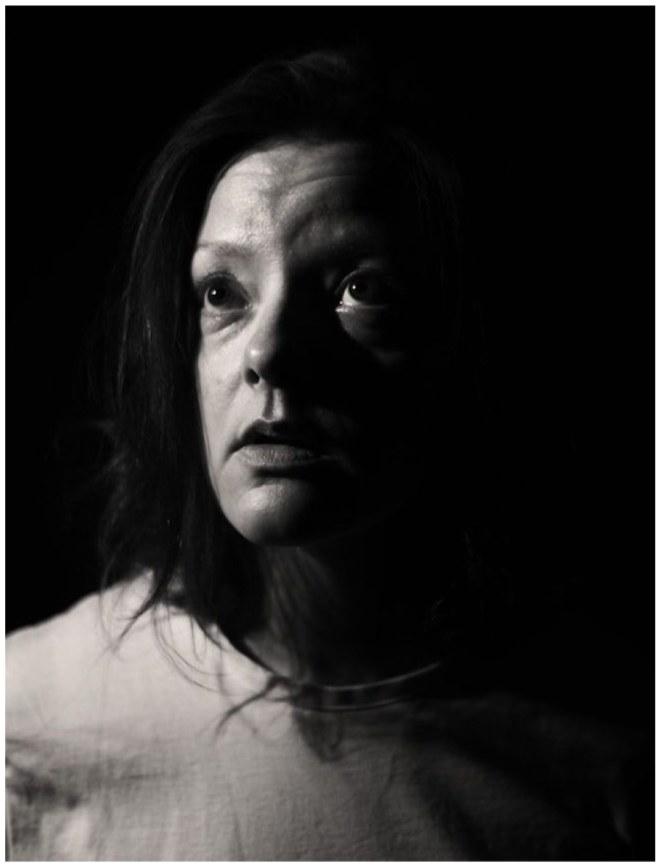
“Beyond the light” (photo no. 47/104, submission week 38, 2022: theme: one light source).
When I-as-the-external-self engages with this photograph, I strongly sense the feeling of being “out of time” (see Weatherall and Ahuja, 2021), with the fear and self-doubt (Knights and Clarke, 2014) of ever meeting the ideal or reaching the destination regardless of my sacrifices and efforts (Tekeste, 2025). I think about my publication list, and the only thing I see is what is not there: the star publication. The empty row in the publication list screams “non-tenured” and “unintellectual.” My throat tightens. A single rejection can break my career. I write:
Time passing What’s your next top publication? Will you ever be “worthy” and belong (Butler and Spoelstra, 2020)?
I feel anxious when I stare at the words in front of me. I realize that such consciousness speaks from and is deeply embedded in the neoliberal context and embodies the “vicious cycle of fear, desire, and attachment to unstable goals” (Vu and Case, 2025: 2). Dialogue can be detected where any discourse, such as in the form of speech or text, presents a “dual directedness,” meaning that there are multiple meanings and directions present (Hirschkop, 2021). When engaging with this submission, I can also sense an alternative other, calling within me from an alternative ethical reality (Bakhtin, 1984). My thoughts wander, and I start to think about when I entered academia, how proud I was to be making a difference, to be engaging in research that would matter, and to be practicing science. But was I just naïve? I realize that this part of me, my commitment to science, driving knowledge-seeking, is very distinct from my experiences of continuously striving for self-excellence. I feel an urge to say:
It’s ok It’s ok to seek top publications To publish on the list But what if publishing “wrong” can be “right”? Follow that light, write for yourself, write for others and the world We owe it to ourselves
I look at the words in front of me. I feel a calm sensation spreading through my body.
Entering dialogue with my different internalized positions offers a space for ethical deliberation, as well as for practicing an openness toward my other voices and experiences. A way to establish a connection in dialogue is through care and openness toward the other without seeking dominance over it or trying to tame it. This “oughtness,” the urge to follow what seems right and true of my moral responsibility toward the future (Bakhtin, 1981, 1986), stays with me. I became curious about this alternative and “unmerged” voice (Helin, 2014) presenting itself. I start to realize that I am drawn to another self-portrait (Image 2), which is a double exposure. Layered on top of my profile is a text from a novel by Alice Munro.

“Losing my religion” (photo no. 11/104, submission week 22, 2023: theme: religion).
In neoliberal academia, you are expected to continuously deliver top publications to advance your academic career, embodying the universal academic slogan “publish or perish” (Martin, 2014). Such ethos favors playing the publication game (Townsend, 2012) and fast and superficial writing. Some research argues that this happens at the expense of quality and academic joy (Butler and Spoelstra, 2012) in conducting meaningful research (Butler and Spoelstra, 2020; Lindebaum and Hibbert, 2024). As an ECR, I am particularly subject to such standardization (Boussebaa and Tienari, 2021) and strive to continuously perform in terms of publishing as I learn how to become the ideal academic.
Photographs are always participating in “something or other,” and, in this sense, they open a space for the arrival of me as the other (Barthes, 2020 [1982]: 25). Reengaging with this submission, I feel the suffering of an alternative other who is crying (Bakhtin, 1984; Hazen, 1993). When reengaging with this submission, I think about the external institutional pressures for publishing rights, and I agonize. I wanted to thrive in academia by practicing a passion, which is writing. The photograph animates me, and I realize that the punctum is the letters, the text on top of my profile. I can feel the pressure from the unexpressed words and stories within me:
You are a “writing subject” A researcher who writes Hours and hours of putting letters into words, words into sentences, sentences into paragraphs You write to understand what you experience in the world Think about writing Your love for writing Letters flowing on a page, a text emerging It was the very craft of writing that lured you into this profession in the first place Let the words flow in you Write, write, write Promise
Such an embodied response constitutes a relational opportunity (Cunliffe, 2002a) to connect with myself as the alternative other as well as to critically examine how I have related to this part of myself (Cunliffe, 2002b). I realize that I have based my academic worth solely on publications in a narrow set of highly ranked journals. I have relied on expectations of success and joy following such publications. But how can I explain the hollowness I feel? I have not stayed true to other truths, my love for writing included (see Kiriakos and Tienari, 2018). A thought appears: what if I do not need to suppress my creative urges for more standardized and instrumental ways of writing? What if being a writing subject makes me worthy of existence in the first place?
Polyphony emerges from the endless relationships between voices, in which meaning is continuously renewed and (re)emerges through, at times, struggle between other selves (Holquist, 2003). From a dialogue point of view, such an experienced struggle between writing for academic publishing and writing for joy becomes necessary and carries new possibilities (Bakhtin, 1984). Bakhtin argues that in order to be able to fully “see” and experience ourselves, the vision of oneself as an “other” in our internal dialogues needs to be appropriated and internalized. Hence, polyphony can only become performative if different voices are allowed to fascinate and enchant us (Letiche, 2010). Through compassion and engaging with the suffering of myself as the other, a space for my transformation as an ECR opens.
When I continue to scroll through the 52Frames submissions, this becomes apparent, as another photograph calls me (Image 3).
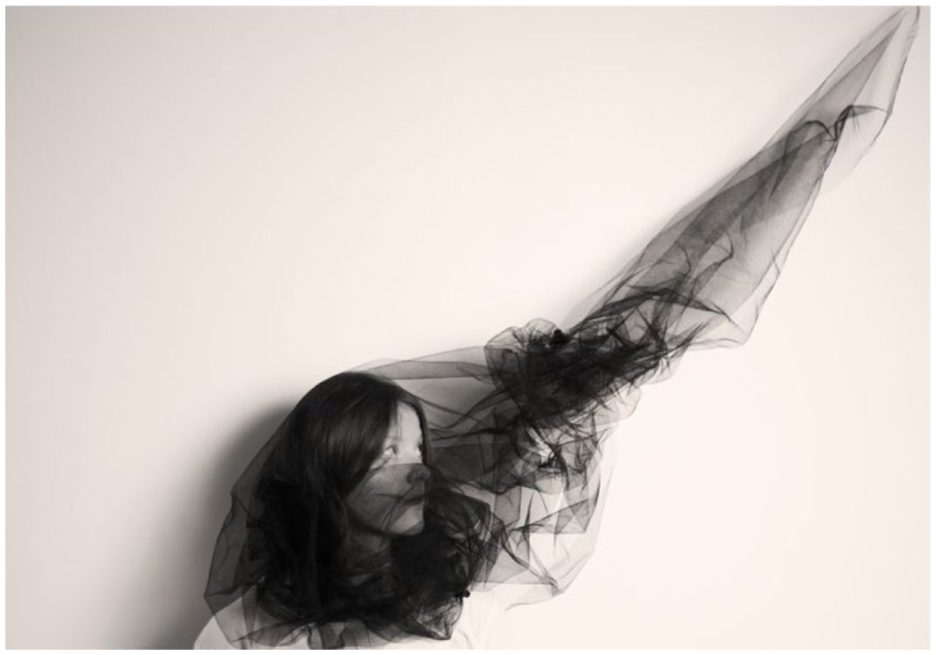
“Mind pull” (photo no. 32/104, submission week 1, 2023: theme: self-portrait).
As I engage with this photograph, I realize that the black veil forms the punctum. I can feel the anxiety creeping over me, the feeling of being trapped:
Unfinished thoughts and abstract ideas The clock is ticking Loose ends that you can’t seem to connect The clock is ticking The tenure clock is ticking
I think about how my creative work has centered on being fast and producing in line with playing the publication game in new academia (see Butler and Spoelstra, 2020; Townsend, 2012). This “ideal” publishing trajectory has been unforgiving when it comes to challenging creative processes and ideas that take time to emerge. These have been deemed too risky, given the pressure to meet neoliberal publication goals. Such publishing goals have driven me to align my creative process with a standardized and instrumentalized way of producing and arriving at an “end” without truly exploring the twists and turns in which the creative process might involve an idea, a text, or myself. As I look at the submission, I also sense the presence of myself as an alternative other who authenticates the co-existence of my creative being and self (Barthes, 2020 [1982]). I think about how I can lose myself for hours in my photography practice, experiencing the joy, flow, and sense of purpose of doing exactly what I am supposed to do at this very moment. I start to write:
Let yourself be consumed by the force Creating yourself, anew, anew Growing your soul Experience becoming Haven’t I always urged you to do so?
Such an embodied response in me speaks from another configuration of needs (Haraway, 2016). I think about how this side of myself truly immerses itself in creative processes, however challenging they might be, and discovers meaning in them. A thought starts to take shape in my mind as I ponder that maybe my academic success is not only an outcome, such as a publication based on external standards. What if the process of creation, no matter the outcome, can be a reward in itself? What if publishing “wrong” but enjoying the process can actually be publishing right?
Staying open to the co-existence of such other consciousness in the dialogue, I feel a specific rhythm (Cunliffe, 2002a) evoked by a leaf in another photograph (Image 4). I can feel the rhythms of winter and spring, of hardship and relief.

“Liminality” (photo no. 51/104, submission week 34, 2022: theme: peace).
The movement provokes me, as the external self, to relate differently to the experience of myself as the neoliberal other in the submission. I feel a sting of sadness when thinking about the years I have spent chasing the version of me that would materialize after cycles of labor as harvest season and publications appear. But who would that person be? I think about how I have never allowed myself to just be, to just “live” in the new academia. I have only endured to eventually arrive at the end state. But what if
Nature arises from the winter Yes, good and bad times repeat, year after year As seasons switch places, you remain You don’t have to endure since you are already (t)here
As I close the 52Frames folder on my computer, I reflect on the situated understandings of my experiences (Cunliffe, 2002a) through dialogue and how it opens a space for questioning what constitutes academic success and failure and if neoliberal academia has the sole power to dictate my experiences. By actively engaging with my inner neoliberal and alternative others and their way of experiencing new academia, I also activate their multiple ethical realities, each co-existing and equally worthy, connected in responses to each other in endless dialogue (Bakhtin, 1981, 1984). Recognizing such co-existence opens possibilities for alternative ways of learning to be in the new academia (Weatherall and Ahuja, 2021).
Staying with the academic trouble through dialogic moments
Has (re)engaging with the photographs enabled me to come to terms with learning to become an academic and, accordingly, to regard myself as an ECR differently (e.g. Weatherall and Ahuja, 2021)? Through inner active dialogue (Bakhtin, 1984), we enter “into the dialogue with one’s own feelings, ideas, and thoughts” (Sullivan and McCarthy, 2008: 539). I realize that I have assigned meaning to what is unfolding in my academic career based on my expectation of an imagined reality (Ricoeur, 1984) that has informed my understanding of who I ought to be in academia to be good and worthy (e.g. Butler and Spoelstra, 2020; Tekeste, 2025). The academic plot has been interpreted solely from the viewpoint of the academic “hero” and what is supposed to happen to this person (Bakhtin, 1984). Such a performed internal other has been loud, speaking from neoliberal values, and has frequently silenced alternative becoming (McKenna, 2010). By consciously and unconsciously disregarding alternative voices in myself, I have come to rely on an idealized epic academic journey that leaves little room for other, more authentic aspects of academic becoming.
Lipton (2022) argues that becoming an academic should include recognizing failure as much as success. A dialogue perspective goes further and suggests that the meanings we assign to academic success and failure are multiple and fluid. Success in a neoliberal sense can be securing top publications and excelling rapidly in academia, as much as it can be experiencing creativity, joy from writing, and building relationships with oneself and the world that matters. Failure can be publishing wrong or not enough, as much as it can be losing yourself, your well-being, and your core values (see, for example, Bristow et al., 2017) in neoliberal surroundings. A dialogue perspective informs me that otherness is part of how I continuously “come into being” and experience myself and the ways of existing and living in the academic workplace. It teaches me to be attentive to the ongoing relational opportunities of kin-making (Cunliffe, 2002a; Haraway, 2016) in the neoliberal workplace and to the opportunities for practicing care and understanding toward myself as a neoliberal researcher struggling to prove my worth simultaneously as I cherish and build sustaining relationships with other parts of myself. Dialogue offers me a way to navigate and explore my inner desires for a more authentic being in the new academia that are hidden and silenced. Such “epiphanies” are not necessarily life-changing (Tienari, 2019) but rather complementary means to confront my ongoing fears of not meeting the standards of excellence, “which in the absence of awareness can be self-defeating and a source of both personal and collective suffering” (Vu and Case, 2025: 2).
Haraway (2016) argues that “otherness” adds richness to the world and that “it matters which ideas we think other ideas with” (p. 31). When ideas are read through one another, they can change the present and the possibilities in the future (Barad, 2007). Furthermore, the dialogue approach tells us that in their most active form, the voices of performed inner others can have an immense impact on myself as an emerging academic, as “each present, uttered word responds and reacts with its every fiber to the invisible speaker, points to something outside itself, beyond its own limits, to the unspoken words of another person” (Bakhtin, 1984: 197). Through active engagement with such others, I can start thinking and feeling polyphonically, making room for different voices—each with a valid perspective and affective tone—to emerge in the academic workplace (Shotter, 2008). To do so, we need to actively listen (Helin, 2014) and learn to be truly present (Haraway, 2016) in the academic trouble, which offers a way into situated experience from and care toward other selves and their way of existing and relating to the world (Bakhtin, 1984; Haraway, 2016). This paves the way for nurturing a place to thrive together—a response-ability (Haraway, 2016)—if we stay open, attuned, and receptive to their co-existence:
Meeting each moment, being alive to the possibilities of becoming, is an ethical call, an invitation that is written into the very matter of all being and becoming. We need to meet the universe halfway, to take responsibility for the role that we play in the world’s differential becoming. (Barad, 2007: 413)
Contribution and conclusions: Rethinking becoming differently in the neoliberal university
My account joins the growing body of work that has called for alternative ways of becoming (e.g. Weatherall and Ahuja, 2021) and engaging with success and failure (Lipton, 2022) in the new academia. It has been argued that established conceptions of learning to become an academic rely on a chronological assumption of a process leading to an ideal destination, that is, to become a possible someone (Weatherall and Ahuja, 2021). Part of that process is learning what success and failure entail and how success is accomplished. The neoliberal conceptions of success and failure build on a narrow set of academic standards (e.g. Archer, 2008), which, if not met, can have consequences for one’s sense of identity and worth as an academic.
Autoethnographic studies have illuminated that learning how to become an academic can build on other experiences in academic work than masculine-centered and chronological career journeys (e.g. Lipton, 2022; Weatherall and Ahuja, 2021). First, my account demonstrates that learning to become an academic differently can be conceptualized through a relational ontology in which becoming is rendered open-ended, unfinalizable, and emerging through connections with potential “other” selves. A dialogue lens challenges the monological conception of the neoliberal academic learning journey as progression toward completeness and an endpoint through an emphasis on polyphony and becoming with.
Relatedly, I argue that learning to become differently unfolds through dialogic moments or encounters (e.g. Weatherall and Ahuja, 2021). What a dialogue approach in particular informs us is that learning to become differently is not only an ongoing relational process but also a responsive one. The dialogue lens nuances the literature by explicitly conceptualizing learning to become an academic differently as an affective and embodied practice of engaging with otherness that can set the “moral machinery in motion” (Hirschkop, 2021: 38). This also generates insights into how the struggles of ECRs, as well as academics in general, stem not only from striving for self-excellence (Vu and Case, 2025) but also from the fact that alternative voices and other “embodied and experiential aspects of organizational life” (Belova et al., 2008: 496) are trying to make themselves heard.
The conceptualization of learning to become differently through polyphony also renders success and failure in the new academia multivoiced and fluid. It sensitizes us to the idea that alongside neoliberal conceptions of success, a multitude of possible meanings, including alternative failures, can co-exist. This challenges the binary approach to success and failure in established theorization and opens up the possibility of different meanings of success and failure that can arise from the connections being made in dialogue. Academic becoming, as a state of ongoing incompleteness, continuously forms dynamic relations with others and their ethical callings (Haraway, 2018, 2016) and opens a space for the situated, involved, and embodied understanding (Cunliffe, 2002a) of success and failure through arresting moments (Shotter, 1996) when one is moved or provoked to respond to the other. This informs our understanding of how neoliberal forces can inform academic work cultures to various extents if alternative voices, such as our creative selves, are allowed to speak, inform, and enchant us (Letiche, 2010; Wright, 2021).
Overall, these conceptualizations have broader implications for the literature on newcomer identity that rest on the idea of learning as development, which has been challenged by “becoming as discontinuous moments of friction and opportunity” (Weatherall and Ahuja, 2021: 418). My account demonstrates becoming as dialogic moments of relational opportunity with otherness. Such moments include being moved and recognizing differences in experience and, as such, fostering an understanding of how one actively internalizes certain experiences as truths. Thus, learning becomes “an active and embodied process in which we are struck and moved to make sense of our experience in a different way” (Cunliffe, 2002b: 57). Actively engaging with such differences can nurture the practice of responding to otherness.
In addition, my autoethnographic account makes a modest contribution to the writing differently movement that adopts a “becoming ontology” in which reading and writing become an affective practice (see, for example, Clavijo and Mandalaki, 2025; Mandalaki, 2024; Van Eck et al., 2021). I join recent research that emphasizes how writing differently is also reading differently and what reading and writing differently do to you (e.g. Clavijo and Mandalaki, 2025), as they hold the possibility to invite the “other in” (Clavijo and Mandalaki, 2025: 880). Through my autoethnography, in which I have reengaged with visuals and texts, as well as writing with silenced voices, a space for connecting with and practicing attunement toward other perspectives (Haraway, 2016) in the neoliberal workplace has been established. Dialogue is always ethically laden, and it is through it that we forge connections and make kin with more authentic sides of ourselves.
Through reading and writing dialogue, a space for connection is created that offers healing as much as voice and power (Clavijo and Mandalaki, 2025; Mandalaki, 2024). Writing such connections into existence opens a space for questioning how our attachments to neoliberal standards of success can be ontologically and ethically challenged. Polyphonic dialogue studies in management and organization studies approach organizations as discursive spaces in which multiple perspectives and voices, both hegemonic and silenced, are in a continuous power struggle (Belova et al., 2008). It has been argued that the only way a momentary inclusion of voices can be achieved in organizations is through the consideration of and opening to the other, which involves seeing through the eyes of the other and taking on aspects of the other and, hence, becoming the other (Jabri, 2004; Jabri et al., 2008). Dialogue operates through language (e.g. Bakhtin, 1981, 1984), and as such, text and speech become a force of their own. This makes me wonder if the introduction of excellence and productivity language in the new academia is a way of “taming” polyphony as the natural state of being. This suggests that recognizing how we are under the influence of certain dominant truths also takes place at the level of language. In conversations in the neoliberal workplace, we need to be active in recognizing the opening and closing forces (Helin, 2014) of dialogue, as this has implications for our continued engagement with other perspectives and the possibility of questioning our experiences (Cunliffe, 2002a, 2002b). This includes paying attention to how we discursively construct and talk about academia and academic work, excellence included (Butler and Spoelstra, 2020). Talking openly about ourselves as incomplete academics and encouraging other sides of ourselves to be actively voiced can create a semantic space for continued dialogue and collective learning (Bosma et al., 2016) in neoliberal institutions, potentially generating new terms for “being” in academia. This is contingent upon active dialogue taking place at the collective level in academic institutions and our being open and receptive to others and their voicing of alternative academic truths.
The meaning potential that is inherent in connecting with other perspectives in learning to become an academic in a neoliberal setting can also enhance management and organization studies with regard to polyphonic learning (e.g. Izak, 2025). A polyphonic approach to learning in organizations renders it open-ended and experimental, rather than focused on finalized understandings (Izak, 2025), wherein new possibilities, endings, and openings are continuously recreated. Harmony is never the focus of polyphonic dialogue but rather ongoing clashes and dissent (Hazen, 1993). Struggles around not proving one’s academic worth can become dialogical points of contact with other selves, claiming their voices and existence in the academic world (Wright, 2021). This directs our attention to the role of gaps and invisibilities in offering spaces for experimentation with meaning-making in organizations. The in-betweenness created by the co-existence of multiple voices also offers the potential for unlearning neoliberal standards of academic excellence. Such unlearning opens up possibilities (de Vaujany, 2025) and can challenge how receptive ECRs are in identifying with the standardized and “ideal” neoliberal academic trajectory (e.g. Nordbäck et al., 2022) in terms of their academic careers. This has the potential to also add to the discussion on newcomer identity as it opens a discussion about ongoing dialogic moments as potential meaning-making mediums and how polyphonic becoming can simultaneously contain resistance toward hegemonic standards of excellence as well as compliance with these. It breaks with the implicit assumption that someone, a neoliberal system included, should “teach” us how to become an ideal academic (Cunliffe, 2002b). This gives me, and us as a collective, agency as polyphonic beings to take charge of our learning and decide who gets to dictate what actually constitutes success and failure in the new academia. As academics, we have a responsibility to continuously question our experiences and the power relations that lay the groundwork for our learning journeys.
By engaging with my photographs as punctums, I have aimed to demonstrate and understand my experiences and struggles in the neoliberal university differently. However, I recognize that the online self might augment certain aspects of my experiences (Atherton, 2023), as online identity performance rests on the assumption that the public self is different from the private and that one performs a version of oneself when entering the public stage (Goffman, 1959). I am also aware of the criticism raised regarding the autoethnographic method’s credibility in general, such as the sole power of the author in both presenting and analyzing the findings (e.g. Le Roux, 2016). Exploring my personal experiences as an ECR has been driven by an aim to theorize social experiences (Le Roux, 2016) from neoliberal academia, as well as to question if the academic practices we enact and uphold (Cunliffe, 2018) constitute the only possible realm of becoming. It is important to note that while my self-portraits expressed resistance toward new academia, some experiences were left unsaid and undisclosed, largely due to the fear of disclosing the identity of the people involved and the resulting repercussions. This raises the question of how authentic public individual efforts of voicing resistance toward the new academia (Bristow et al., 2017) can actually be.
I hope that my autoethnographic account has been able to show how engaging with writing, photography, and other mediums in which the voices of others come through can be an effective world-building practice. Photographs constitute a source of future making “where affect (love, compassion, grief, enthusiasm, and desire) is a guarantee of Being” (Barthes, 2020 [1982]: 139). The future of academia that emerges through my autoethnographic account is one in which we practice care toward our multiple selves and others and we acknowledge and feel responsible for nurturing our own as well as others’ existences in the world. This requires that we focus on more authentic academic community building and cultivate a caring environment in which we can thrive together. It is a future academia in which success and failure are not binary or set but in constant becoming and collective negotiation, continuously remade in relationships with other voices and contexts. Inspired by Haraway, it is a future with multiple academic kin. “Staying with the trouble” of academia would, as such, include truly engaging with our collective experiences from new academia, be it play and joy, as much as criticism and pain (Haraway, 2018).
Autoethnographies and writing differently can be practices of resistance that shed light on what dominant norms and standards do to us (e.g. Boncori et al., 2024). As a privileged white female academic in a welfare state who (at least so far) enjoys academic freedom, I have the capacity to voice my “suffering” from working in a neoliberal university. However, I do acknowledge that not everyone has the same ability to write as resistance. I think about the many voices that remain unheard in neoliberal academia and the collective suffering that is never laid bare. A dialogue lens informs us that one way of practicing resistance in the neoliberal university entails not only externalizing our alternative experiences and voicing our other “selves” to others loudly but also generating a sense of duty to speak up for those who cannot be heard. Part of staying with the academic trouble is recognizing that we are in it together in co-creating the future (Haraway, 2016). We are responsible for using our privileged positions to connect with each other’s voices and speak with a collective voice for a more caring and responsible academia. Through active listening to each other and continuously practicing kinship, we can begin to nurture alternative perspectives in the academic workplace.
Such loud and active voicing, within and beyond academia in various forms, is needed as a form of provocation to start changing ourselves, others, and neoliberal academia (Bristow et al., 2025). Taking photographs and (re)engaging with them became a way for me to combine facts and fabulations (Haraway, 2016) to explore how neoliberal academia includes and excludes possible voices as well as futures. For example, has the neoliberal force not (yet) fully mastered our creative urges as researchers? The possibilities of becoming differently are inherent in each moment (Barad, 2007). I encourage my fellow academics to actively engage in dialogue through different forms of art that can externalize the possibilities for a different future academia; simultaneously, this dialogue provides an arena for social support and care toward ourselves and others (Van Amsterdam et al., 2023). Feminist-inspired methodologies (Van Amsterdam et al., 2023) offer the possibility of making neoliberal academia visible and relatable to (non)academic “others.” If we allow it, the affective space that emerges through polyphonic dialogue holds possibilities to change how we conceive of the neoliberal university.
Footnotes

Ethical considerations
Not required.
Consent to participate
Not applicable.
Consent for publication
Not applicable.
Funding
The author received no financial support for the research, authorship, and/or publication of this article.
Declaration of conflicting interests
The author declared no potential conflicts of interest with respect to the research, authorship, and/or publication of this article.
Data availability statement
The data is available on request from the author.