



Abstract
Traffic noise is a major problem in all large cities. The surface acoustical characteristics (e.g. referred to roads, pedestrian traffic areas, building façades, building surfaces, in general) affect the noise propagation in the urban environment. Through a better outdoor design and management (e.g. by means of green areas, porous asphalt, speed control), or building refurbishment actions (acoustic plaster, absorbing shading devices), the increasing of surface absorption could be useful to mitigate noise environmental pollution, and therefore to reduce the sound levels in the proximity of the building façades for their entire height. The reduction of the noise levels outside the buildings would determine lower indoor noise levels, and therefore a better situation, without direct actions on the building walls. Through a series of noise propagation calculations in urban environments, by means of a three-dimensional simulation model, the influence of some configurations and the potential impact of some intervention solutions are quantified. In the first stage of the research, the analysis of a simplified model is conducted, to evaluate the influence of noise on the building façades, based on a simplified geometry of the urban environment and of the surface acoustic features. The same analysis is validated by means of a more detailed model, corresponding to the configuration of an existing built area, to verify if the analyses performed by means of the simplified model can be extended to more complex layouts. Successively, calculations are developed to quantify the noise levels that occur with different acoustic (absorption of façades, soil, asphalt, or green elements) and geometric (road width, buildings height, presence of balconies, etc.) characteristics to show the potential reduction given by some interventions. Solutions that can lead to a more significant reduction of the noise in correspondence of the façades are then summarized. The simplified geometrical model appears to be suitable for preliminary investigations as the maximum error found for narrower roads is equal to 17%.
Introduction
The urban noise is a problem to face quite in all the cities, due to traffic, industries, and various activities. The attention to the noise pollution problem has grown in the last years. References for the assessment and management of environmental noise in Europe are indicated in the Directive 2002/49/EC 1 that is arrived to its second implementation review (there must be a review once every 5 years). Measures for monitoring the outdoor noise levels have been indicated. The use of strategic noise mapping in relation to noise exposure in and near buildings is considered. After the first 5 years, most Member States (21) had noise limit values, which were legally enforced. In the second review, among the 75% of Member States that have noise limits, less than 25% were able to confirm categorically that these limit values were fully enforced. A particular attention on quiet areas leads to an increase of 50%, but this was accounted for by only five Member States: Austria, Hungary, Ireland, Lithuania, and the United Kingdom.
Regulations to limit the noise inside buildings exist, at national level, in more than 30 countries in Europe,
2
with indications on the requirements of the building façades, to guarantee suitable protection from outdoor emissions. Regulatory requirements for façade sound insulation have been expressed in more ways, directly or indirectly linked to the descriptors defined by EN ISO 717, such as
Minimum façade sound insulation as a function of outdoor noise level (e.g. France, Germany, Lithuania, Netherlands, Austria);
Maximum indoor noise levels (e.g. Denmark, Finland, Iceland, Norway, Serbia);
Maximum “night event” levels—combined with other criteria (e.g. Norway, Serbia).
The required sound insulation depends on the outdoor noise level and the maximum indoor level (defined by the building use). The outdoor noise levels are calculated based on the local traffic data and conditions, and therefore, the limit value depends on the location. In some countries, there are additional limits for night events.
Although the more recent buildings must comply with these requirements, the older ones were often designed with poor attention to the sound insulation. In some cases, it is not possible to plan the acoustic improvement of the existing buildings, if not associated with other actions (i.e. thermal insulation for energy refurbishment, façade restoration), mainly for economical reasons.
However, the increasing outdoor acoustic quality can influence the noise levels in the proximity of the façades positively, for their entire height, and it can act as an improvement of the indoor noise, with lower levels, without modifying the façade sound insulation. It can represent an indirect way to match this goal: the reduction of the source noise levels is already planned at international level for traffic noise, like for many other situations.
Indications for the reduction of the source noise are active at European level, mainly for the new vehicles. The European Regulation 661/2009 3 set out minimum requirements for the external rolling noise of tires. More recently, the European Regulation 540/2014, 4 starting on the assumption that road vehicles represent a significant source of noise in the transport sector, and that traffic noise harms health in numerous ways, further reduces sound level limits for new motor vehicles, with regard to all noise sources, including the air intake over the power train and the exhaust, taking into account the tire contribution. The new limits could bring good results in the next future.
Another element that contributes to noise levels inside buildings, due to outdoor noise pollution, is obviously the noise reflection on the external surfaces. The influence of building layout on the noise levels can be considered in the urban planning jointly with other elements that may contribute to obtain reduced levels of noise pollution. 5 The urban layout can be considered on the basis of a typological classification of the urban forms, like the one proposed in the work by Pedro, 6 by means of a Neighborhood Proximity Model that takes into account the functional and spatial organization of residential units around an outdoor space. It was applied to calculate some form indicators in Silva et al. 7 : the Compactness Index that measures the shape of the urban patch and the fragmentation of the global urban landscape; the Porosity Index or Ratio of Open Space that measures the proportion of open space, compared to the total urban area; the Complexity of the Perimeter Index (Fractal), defined by the perimeter fractal dimension, to describe the complexity of the perimeter of an urban area through the relationship between perimeter and area.
The aim of the research is to highlight the influence of various features: it is not only focused on the urban layout but also on the combined effects of this aspect together with the main characteristics of the façades. For example, balconies can influence the noise field and their appropriate design could contribute to the noise control effectively. An analysis of the insertion loss due to rectangular balconies on a building façade, jointly with the sound reflection and scattering effects from adjacent balconies, shows that the front panel of the balcony determines the screening performance, while the sidewalls of the balcony are insignificant. Moreover, in the absence of a front panel, no acoustic protection can be highlighted, due to the upper balcony reflection, especially for a distant noise source. 8 The effect of the balcony form was investigated in Leea et al., 9 in different configurations, typical of the Korean buildings’ layout, varying the lintel extension, the parapet (front panel) height, the ceiling inclination, and their absorbing properties, by means of simulation and a scale model test. The noise reduction from 2 to 9 dB was found due to the presence of absorbing materials.
An interesting solution to reduce the impact of traffic noise on the building façades has been realized by means of ceiling-mounted reflectors, showing a reduction of road traffic noise up to 7–10 dB(A), compared to an ordinary balcony and indicating a corresponding effect as absorbent ceiling. 10
The importance of quiet façades and quiet areas in the cities is outlined in the QSIDE project, highlighting the need to maintain some parts of a building and outdoor areas quiet. 11 If correct choices or modifications in the design or restoration processes of the outside environment are considered, then indoor noise annoyance and sleep disturbance can be reduced, also in the more exposed sides of the building.
From studies on the influence of diffusely reflecting façades in wide city street canyons, the geometrical reflections were shown to underestimate the total sound pressure level for large source/receiver distance, due to neglecting the diffuse-scattering phenomenon. 12 A study, 13 regarding the influence of the main physical characteristics of the urban shape on noise propagation (such as construction density, existence of open areas, street widths, shape and position of buildings, presence of obstructions or barriers or buildings), highlighted that the profiles of streets with tall buildings on both sides do not always represent a canyon type urban space, because of the discontinuities between the neighboring façades of buildings. In fact, these ones can make the space permeable to noise, contributing to the lower persistence and concentration of reflected sound.
The noise field assessment can be considered therefore affected by three main elements:
The noise sources (mainly traffic noise);
The geometrical layout: building blocks distribution, façade articulation, road width, and so on;
The surface absorption: buildings, ground, green areas, and so on.
The opportunity of the use of a simplified geometric model instead of the actual building layout is investigated, to demonstrate if it can lead to a quite good approximation. In fact, it may allow to limit costs, even if the results can be affected by lower accuracy. After all, detailed models are influenced by a certain approximation level anyway, due to the computational scheme and other uncertainties.
A first step of the research has been dedicated to validate the simplified geometrical model. Then, some variations of the significant parameters have been examined, by means of the simplified configuration, to show that it can be used to obtain quantitative information on the most appropriate noise reduction actions.
Therefore, the influence of noise on the building façades has been evaluated, depending on the geometry of the urban environment (road width, buildings height, presence of balconies, etc.) and the surface acoustic features (absorption of façades, ground, asphalt, green elements), by means of the simplified geometrical model.
The simulation method and procedure
The calculation method is based on a three-dimensional simulation model of noise propagation in urban environments (SoundPLAN) that allows to quantify the influence of some architectural configurations and the potential impact of possible intervention solutions.
Simplified geometrical model
A simplified geometrical model of a straight road (100 m length, four width cases, w = 12-16-20-24 m, each including two sidewalks, 3 m wide), between two continuous rows of buildings of the same height (Figure 1) was considered. The sources have been positioned on the middle of the road (h = 0.6), the receivers are located on the sidewalks, d = 0.5 m from the building façade (hr = 1.5 m, 4.5, 7.5, … step 3 m, up to 30 m, to consider a receiver for each floor).
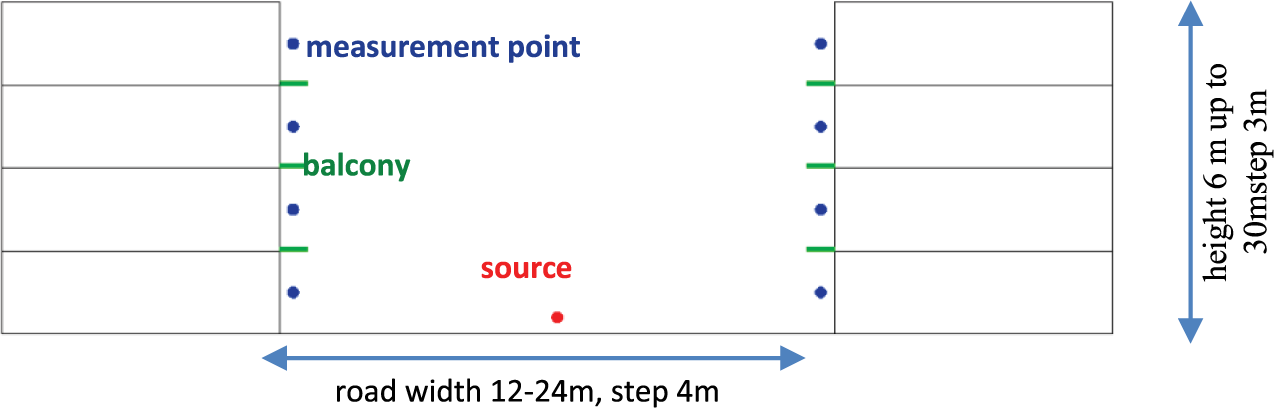
Building layout for the simplified geometrical model.
Existing layout model
To quantify the approximation level of the results that can be obtained by using the simplified geometry model, a real urban layout has been considered, with the aim to verify how affordable can be the results, although with reduced calculation times. From the analysis of the building layout of an existing town (Maringá, Paraná, Brazil), the urban plan with the building distribution, the occupation of the areas, and the width of the roads corresponding to the real case (Figure 2) have been considered. The same measurement points of the simplified model have been considered in the cross section of the road.
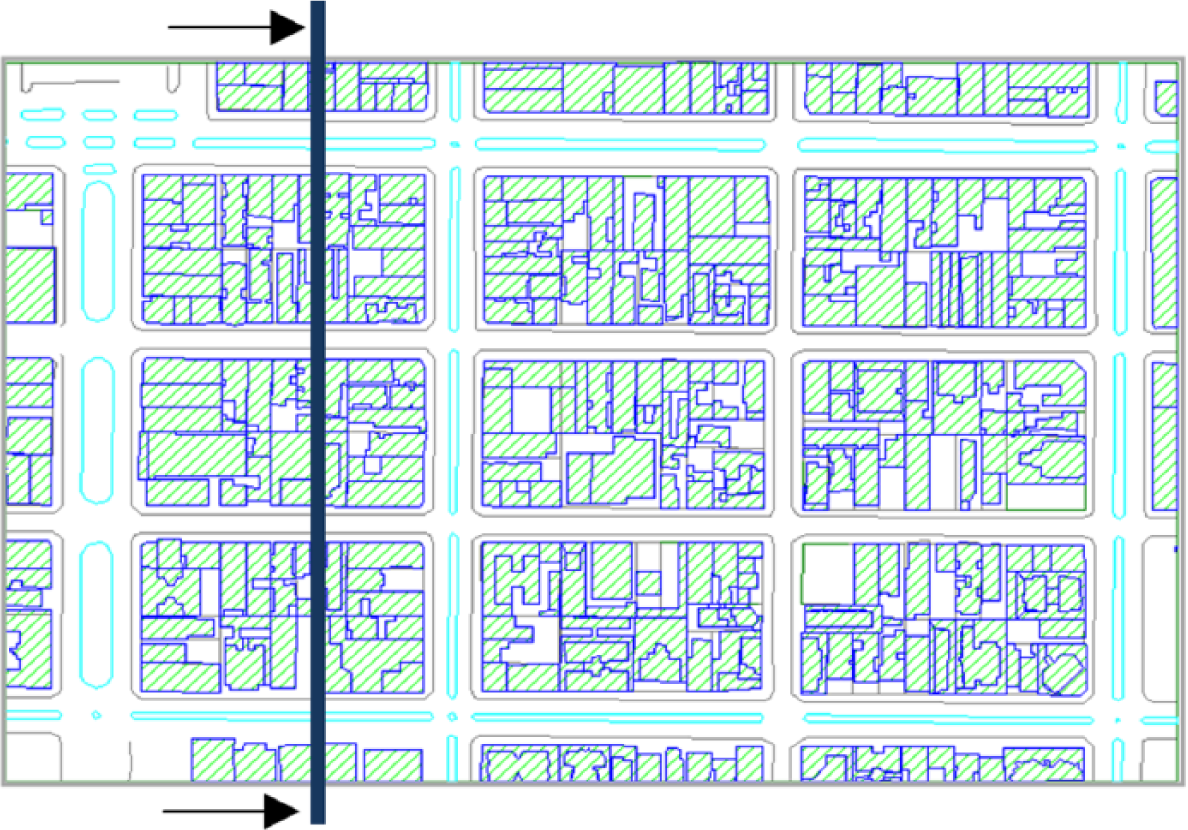
Building layout for the existing town—the black line indicates the analyzed cross section.
Figure 3 shows the cross section, of the real situation: the “Avenida Brasil” (w = 35 m), the “Avenida XV de Novembro (XVN)” (w = 30 m), and the “Rua Santos Dumont (SD)” and the “Rua Neo Alves Martins” (both w = 20 m).

Cross section—urban layout.
Considering the analyzed section, “SD” have buildings with h = 13.5 m only on one side of the road, while in the other one, there is a building of 18 floors. The same happens in “XVN” where buildings have h = 7.5 m on one side, but on the other side, there is the Bristol Metropole Hotel with 15 floors. In “Rua Neo Alves Martins,” there are high buildings on both sides of the road, but not in the analyzed cross section. So, in this road, only receivers up to hr = 4.5 m have been examined.
First phase of the analysis
The first comparison has been performed considering the same acoustic absorption of surfaces in the two configurations: façade a = 0.02; asphalt for the road and sidewalks a = 0.1. The measured sound pressure level in each road (L = 80–86 dB(A)) was used to calibrate the software model applied to the existing layout, while in the simplified model the mean value was assumed (L = 85 dB(A)) for the whole area. The results of the two different approaches were compared in terms of attenuation (difference between source and façade sound level) at a distance 0.5 m from the façade of the buildings in the analyzed section, to quantify the deviation (Figure 4).
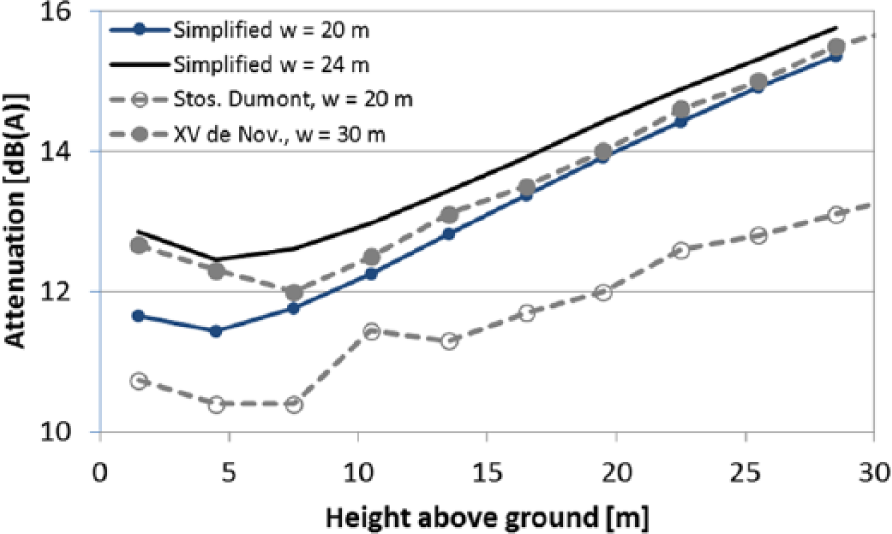
Difference between road noise and sound pressure level on the façade—Comparison between simplified geometrical model and real case.
Second phase of the analysis
In a second phase of the analysis, by means of the simplified configuration, some variations of the significant parameters have been considered:
The height of buildings (from h = 6–30 m, step 3 m);
The presence of glass surface, acoustic plaster, and their percentage on the façade (by means of a mean absorption coefficient a = 0.02–0.6);
The presence of balconies on multiple levels (2nd, 3rd, 4th floor, … up to the 10th floor), by adding a horizontal screen 1 m wide for the whole extension of the buildings along the road, at h = 3 m, 6 m, up to 27 m (step 3 m), to simulate up to nine-level balconies (in Figure 1 in green);
The presence of green areas/gardens/urban parks (trees/soft green ground) and acoustic asphalt for the roads and sidewalks, through the absorption coefficient values a = 0.1, 0.4, 0.9;
The control of the vehicles’ average speed, taken into account with different sound pressure levels of the sources.
Analysis of the results
Validation of the simplified model
The comparison of the results of the simplified geometrical model and the existing urban layout were represented to show the sound attenuation at a distance 0.5 m from the façade of the buildings in the analyzed section (Figure 4).
The most representative situations (XVN and SD), characterized by higher buildings, are represented in comparison with the simplified geometrical model, referring to two road widths, w = 20 m and w = 24 m (Figure 4).
Comparing the results of XVN (w = 30 m) and SD (w = 20 m), the reduction of the noise level with the height is more pronounced for the first one (attenuation equal to 15.5 dB(A) on the 10th floor in XVN, and 13.1 dB(A) on the 10th floor in SD). This can be justified by the fact that wider roads allow greater noise reduction, as the distances are higher, and it can be observed in the simplified tests (attenuation equal to 15.8 dB(A) on the 10th floor road width w = 24 m; and 15.4 dB(A) on the 10th floor road width w = 20 m); moreover, even if the SD-analyzed section presents high buildings, the building height is more irregular in the surroundings. The maximum difference that is observed between the two models reaches 2.3 dB(A), corresponding to 17% of overestimation compared to the actual value, for w = 20 m on the 10th floor.
The difference between the results obtained by the two models appears high, in the case of SD, which corresponds to the narrower road. The error may still be considered acceptable, mostly for wider roads, to make a rather quickly analysis of different situations. In fact, especially in a preliminary study, such simplified model could be a very useful tool.
Analysis of the urban refurbishment actions by means of the simplified geometrical model
As said before, at the end of the first stage, the simplified model shows to be affected by a maximum error of 17% on the results, valid for the most irregular buildings’ layout. Assuming this error is acceptable only for preliminary investigations, in the second part of the analysis, different combinations of input parameters have been considered, by using the simplified model, to show the potential noise level reduction related to geometrical features and surface characteristics. The results of the variations of parameters such as the mean building height and road width (A), façade and roads absorption coefficients (B, C), balconies (D), vehicles’ speed (E) are highlighted. The simulations have been performed assuming two rows of buildings of the same height facing a road.
(A) Two series of simulations were performed with high- and low mean absorption coefficient (i.e. to take into account the presence of transparent and opaque surfaces in a different percentage). Varying the mean buildings height allows to take into account different buildings’ layout and the more or less pronounced effect of “urban canyon.” However, it does not affect significantly the sound field (close to the façade, 0.5 m) for buildings’ height up to 30 m, either at the road level (h = 1.5 m), or on the façade (h = 28.5 m) (Table 1). The reflections between facing surfaces of buildings seem to be not highly influenced by the building height.
Varying the road width, the same behavior is observed (no influence of the height of the buildings), even if lower sound levels on the façade are obviously obtained in the case of wider roads (Table 1). As a secondary result, it is evident that the noise levels on the façade will be lower in the case of wider roads.
(B) The influence of the absorption properties of the buildings’ surfaces on the sound field was analyzed along the façade: a high absorption coefficient (a = 0.6) of the building walls allows lower sound levels close to the façade (Figure 5, Table 2).
Effects of the road width on the noise levels close to the façade.

Mean building height (h = 6, 9, 12, 15, 18, 21, 24, 27, 30 m) and high- or low mean absorption coefficient (a = 0.02 and 0.6) do not seem to have relevant influence on the noise levels close to the façade.
Attenuation effects of the absorbent plaster on the façade.
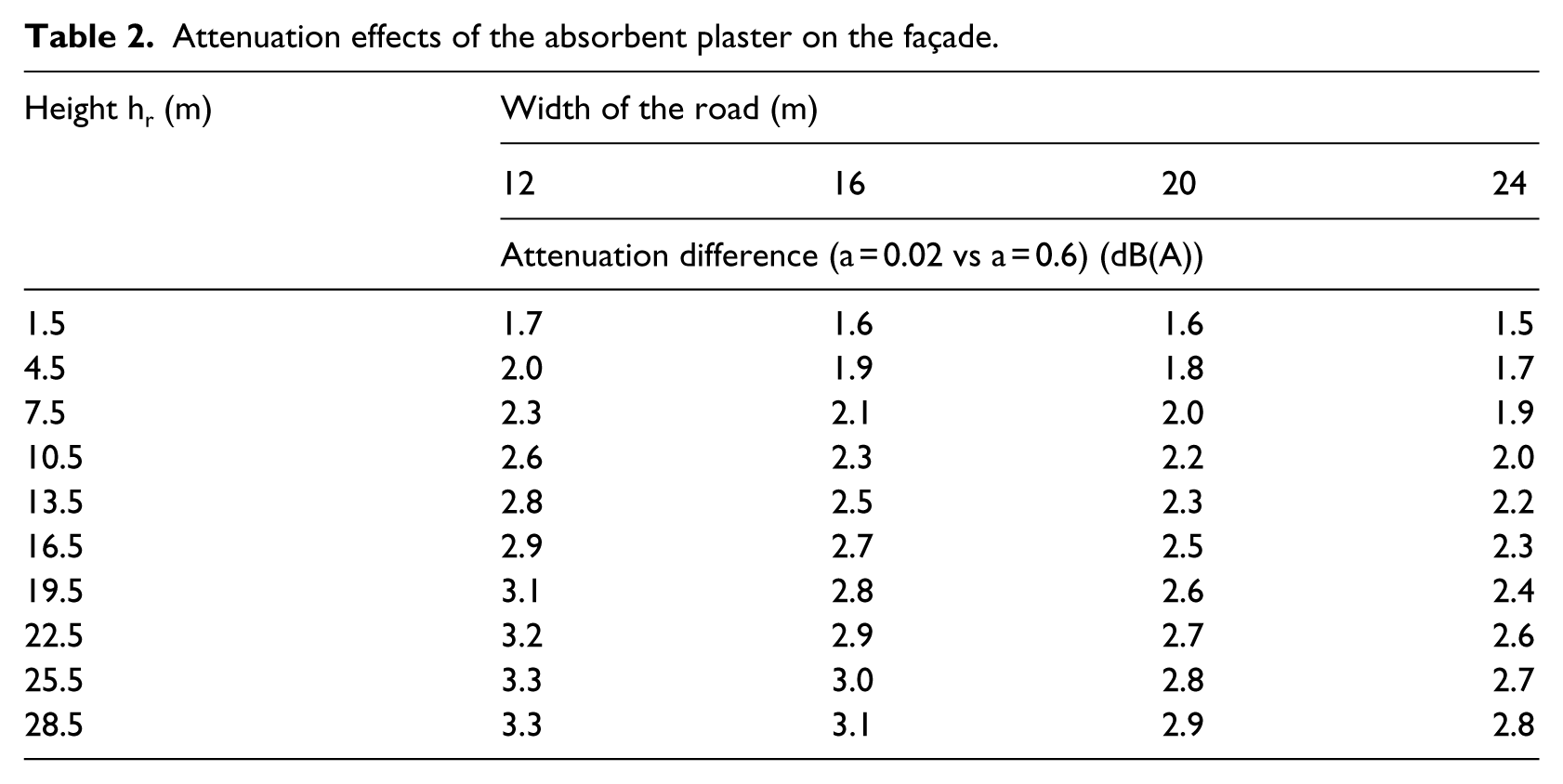

Attenuation effects for different road width (w) and sound absorption (a).
The use of absorbent plaster on the façade in the w = 12 m road provides a reduction of 1.7 dB(A) (average level) in the receiver at hr = 1.5 m and up to 3.3 dB(A) in the receiver positioned at hr = 28.5 m. These values become 1.6 dB(A) and 3.1 dB(A) for w = 16 m road, 1.6 dB(A) and 2.9 dB(A) for w = 20 m road, and 1.5 dB(A) and 2.8 dB(A) for w = 24 m road. Generally, with the same road width, the absorption effect is more marked at the highest positions on the façade: the difference between the sound level with a = 0.02 and 0.6 is greater (in Figure 5 the two groups of lines diverge). The effect is more evident for narrow streets (lower line of each group) where the difference is 3.3 dB(A), while it is 2.8 dB(A) for wider roads (w = 24 m), on the top of the highest building (hr = 28.5 m). Globally, the attenuation due to higher absorption coefficients is lower for wider roads.
(C) The receiver position, hr = 1.5 m, is influenced by the ground absorption effects more than the other positions, and the corresponding sound pressure level is slightly lower than the position above. The presence of green areas and absorbent paving, represented by an absorption value of a = 0.9, does not seem to affect significantly the sound levels close to the façade, at least in relation to the considered extension of the road (w = 12–24 m) and the traffic noise levels (L = 75 and 85 dB(A)). This is probably due to the small ground surface, in comparison with the extension of other considered surfaces.
(D) In some urban configurations, balconies are almost absent (curtain walls), while in other cases, they may represent an important part of the external surfaces. The balconies have been considered as fully reflective screens (a = 0.02), as the absorption effects were already highlighted in C. The balconies change the sound field near the surface of the building for all the widths of the road, even if the effect is less significant for the widest road (Table 3).
Effect of the presence of balconies.

The presence of the balconies does not change the average sound level at hr = 1.5 m, while it produces good reduction for the receiver at hr = 28.5 m, compared to the corresponding case without balconies (Table 3). Higher façade absorption, in addition to the presence of balconies, does not produce significant higher reduction of the sound level.
The balconies obviously represent an effective barrier to the propagation of the noise close to the façade and therefore are useful to protect the internal environment.
(E) Besides all, the control of the average speed of the vehicles as depending on traffic flow produces good results on the façade: an absolute reduction of the average noise level of 10 dB(A) (from 85 to 75 dB(A)) shows the same attenuation depending on the distance from the source, also for the highest floors. Obviously, the source noise reduction can be an effective mean to reach good results inside the building.
Some of the most relevant results have been summarized in Figure 6, where the combined attenuation due to the road width (noise level difference with the value obtained for w = 12 m), the higher façade absorption, and the presence of balconies are compared at two levels of the façade (height hr = 1.5 m and 28.5 m). The higher differences have been reached in the 16-m-wide road with a minimum attenuation increase of 3.2 dB(A) at ground floor level and a maximum attenuation increase of 9.7 dB(A) at the 10th floor, due to the three most significant aspects combined together.
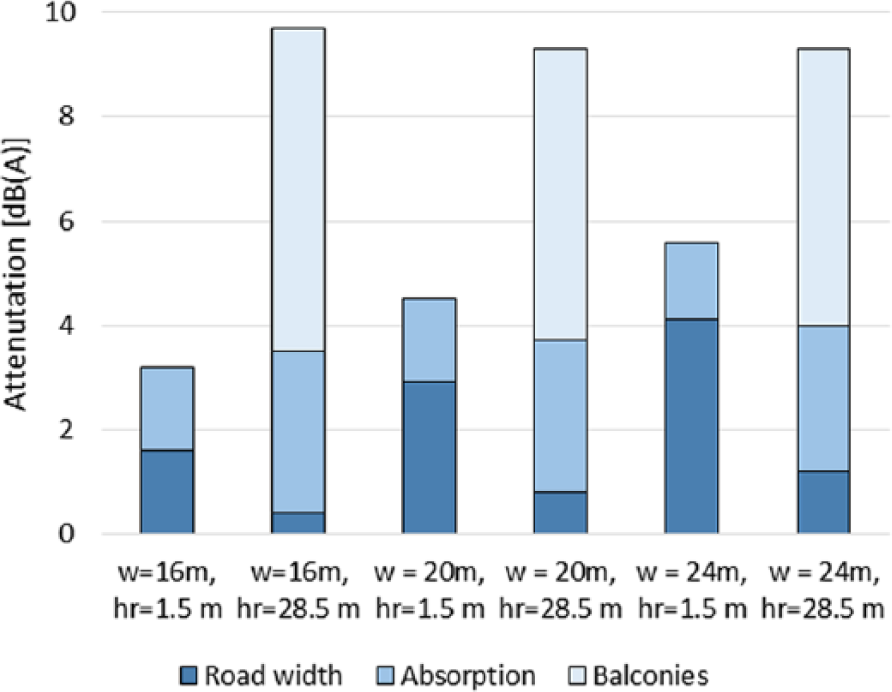
Combined attenuation effects.
With this approach, assuming a 17% error in narrower roads, as shown by the first step of the present study, it is possible to refer to a first-level evaluation of the noise level on the façade depending on some geometrical features and acoustic surface properties.
Conclusion
The possibility to use a simplified geometrical model to obtain affordable information on the noise reduction in the urban environment was analyzed. For this purpose, the results obtained by means of a simplified geometrical model and through an accurate model of an area of a medium-sized city, characterized by modern buildings (Maringá, built since the 1960s) have been analyzed. The results obtained by the simplified geometrical model can be considered acceptable for a first-level investigation, as they appear to be affected by a maximum error of 17%, compared with the model of the effective urban layout. The simplified model has been therefore used to analyze the influence of green areas and absorbent paving, of the absorption properties of the buildings surfaces and the presence of balconies, of some geometrical features (buildings height, road width), and of the control of the average speed of cars, to evaluate the possibility to reduce the computation times.
The results show that the height of the two rows of buildings facing a road does not affect significantly the noise level distribution on the façade at each floor in narrow or wide roads. In narrow roads, more absorbent surfaces give slight better results on the upper floors (higher noise reduction). The presence of green areas and absorbent paving does not seem to affect significantly the sound levels close to the façade, for road width from 12 to 24 m. Balconies work as noise barrier better in narrower roads.
The sound attenuation close to the façades can be effectively evaluated also in the simplified geometrical model, if the buildings surfaces facing the roads are evenly distributed. A deeper analysis of the comparison between the simplified model and the existing buildings’ layout will be developed considering a larger number of cross sections, to quantify more precisely the error and at which level it can be considered acceptable. The true layout must be considered when the surfaces are not regular and their distribution is more complex.
Footnotes
Appendix 1
Declaration of conflicting interests
The author(s) declared no potential conflicts of interest with respect to the research, authorship, and/or publication of this article.
Funding
The author(s) received no financial support for the research, authorship, and/or publication of this article.