




Abstract
The article provides a literature overview regarding the perception of vibrations, with a particular attention to the issues of comfort in buildings. Nowadays, an increasing number of mechanical sources generate vibrations in building structures, causing discomfort to the inhabitants. However, what does “comfort” or “discomfort” really mean? From a purely metrological point of view, it is not possible to define accurately the boundary of “comfort” without performing subjective evaluations. Nevertheless, a promising attempt can be found in perspectives and methods of the recent Soft-Metrology. In this context, theoretical and empirical models and measurement procedures are devoted to define and quantify objective and subjective responses to external stimuli on human, on the basis of several aspects (e.g. annoyance, physiological and psychological effects, behavioral effects).
Introduction
Mechanical vibrations are one of the most recent experiences of the body during human evolution. In fact, before the advent of industry, nobody ever strongly experienced vibrational phenomena with the exception of rare natural events. A similar issue can be also considered from the acoustical point of view. Consequently, the effects of vibration on the human body in terms of perception can be regarded as a field not completely explored and understood yet. Early studies and systematic observations of the effects of vibration on humans, in terms of clinical, medical, psychological, and comfort, date back from the late 19th century. In Figure 1, examples of industry development in Europe are shown.

Pictures of industry development in Dortumd area and the Lancashire textile industry, in the 19th century.
In the 20th century, the scientific literature on the subject is enhanced significantly, along with the increasing development and expansion of industry, transports, and urbanization. One of the first and most popular systematic study on this topic dates back to early 1960s of the last century, by Goldman and von Gierke. In the 1970s, several fundamental works of Griffin on “human vibration” have been published. In the last 50 years, great progresses have been made in this field, and a series of thresholds (related to annoyance, fatigue, discomfort, and pain) are now available and “standardized.”
In this article, after the historical survey in which a brief anthology is collected, the most recent works are presented. Besides, some proposals for further works are introduced as well as some matters on the topic.
Historical survey about “vibrations”
The meaning of vibration, intended as the oscillatory phenomenon of a solid body subjected to a force, is very recent. As a matter of facts, mechanical vibration has become actual experience only after the industrial revolution. The mechanical vibrations phenomena, for example, due to the machineries working and the movement of trains, can be traced back only to the second half of the 18th century. The intensive use of new machinery and/or their proper working suddenly filled the world, until then quiet and silent, of new intense noises and vibrations.
Brief etymological consideration
A brief etymological analysis shows that the Latin term vibratio can be traced back to ancient Greek βρασµος (shaking) and βραζειν (to boil) and then in the Indo-European root *weip- (to swing) and *bhrag-/*bhreg- (to make a noise, to crack). In the late Latin (Paolo Diacono, 8th century), vibrate means “to strike with a weapon” (i.e. vibrate a shot), or it is used metaphorically, for example “vox vibrant in auribus” (Seneca).
The term appears for the first time in Italian, in the metaphorical aforementioned meaning, in Canto XXVII of the Purgatorio of Dante Alighieri (1304) Sì come quando [il sole] i primi raggi vibra (“As when [the sun] vibrates forth his earliest rays,” Longfellow translation). The use of the term with these meanings then spreads in the French area (1510, wielding throwing weapon).
In the Anglo-Saxon literature, the term vibration appears in 1650 as “a shaking, in brandishing,” noun of action from past participle stem of vibrating “set in tremulous motion.” It is interesting to note that, as an example, in the whole William Shakespeare opera, this term, or derivatives, never appears.
The term vibration, as a mechanical phenomenon (e.g. a vibrating string), can be first found in the studies of Galileo (Discorsi e dimostrazioni matematiche intorno a due nuove scienze attenenti alla mecanica e i movimenti locali, 1633) and Newton (Principia Mathematica, 1687).
First evidence of “vibration perception” in late 1800
The systematic study of the vibration phenomena related to human perception begins to be deepened in the second half of the 19th century. The documents listed here do not represent a complete and comprehensive collection. However, at least from a preliminary investigation, they appear to be pioneering works, on the subject of the perception of vibrations.
In Manchester, in 1861, it was published by the British Association for the Advancement of Science— the volume “An inquiry into the theory and application of Railway Breaks” by James Higgin. 1 Higgin addresses, from the technical point of view, some issues on brake systems in trains and proposes new typologies of brake systems. The author mentions that some typologies of brake systems generate vibrations to the train coaches and induce damages to the engine. In what follows, the author shifts the focus of the vibratory phenomenon to the “perceived” mechanical effect; in fact, with other brake systems, “an unpleasant amount of vibration is perceived.” Using proposed improved systems instead, “there cannot be any unpleasant vibration, as some might apprehend,” within the convoy.
However, it is perhaps in 1883, in the American Law Register, where the statement “Noise and Vibration as elements of Nuisance” is used for the first time. 2 The document introduces two relevant issues: “whether nuisance must be established by a verdict at law” and “noise in dwellings.” The author indicates the problem of injuries produced by vibrations, for example, a printing house near a dwelling. Vibrations are not only nuisance but can also cause real damages.
In Figure 2, the main pages of the cited first works about “vibration perception” are depicted.
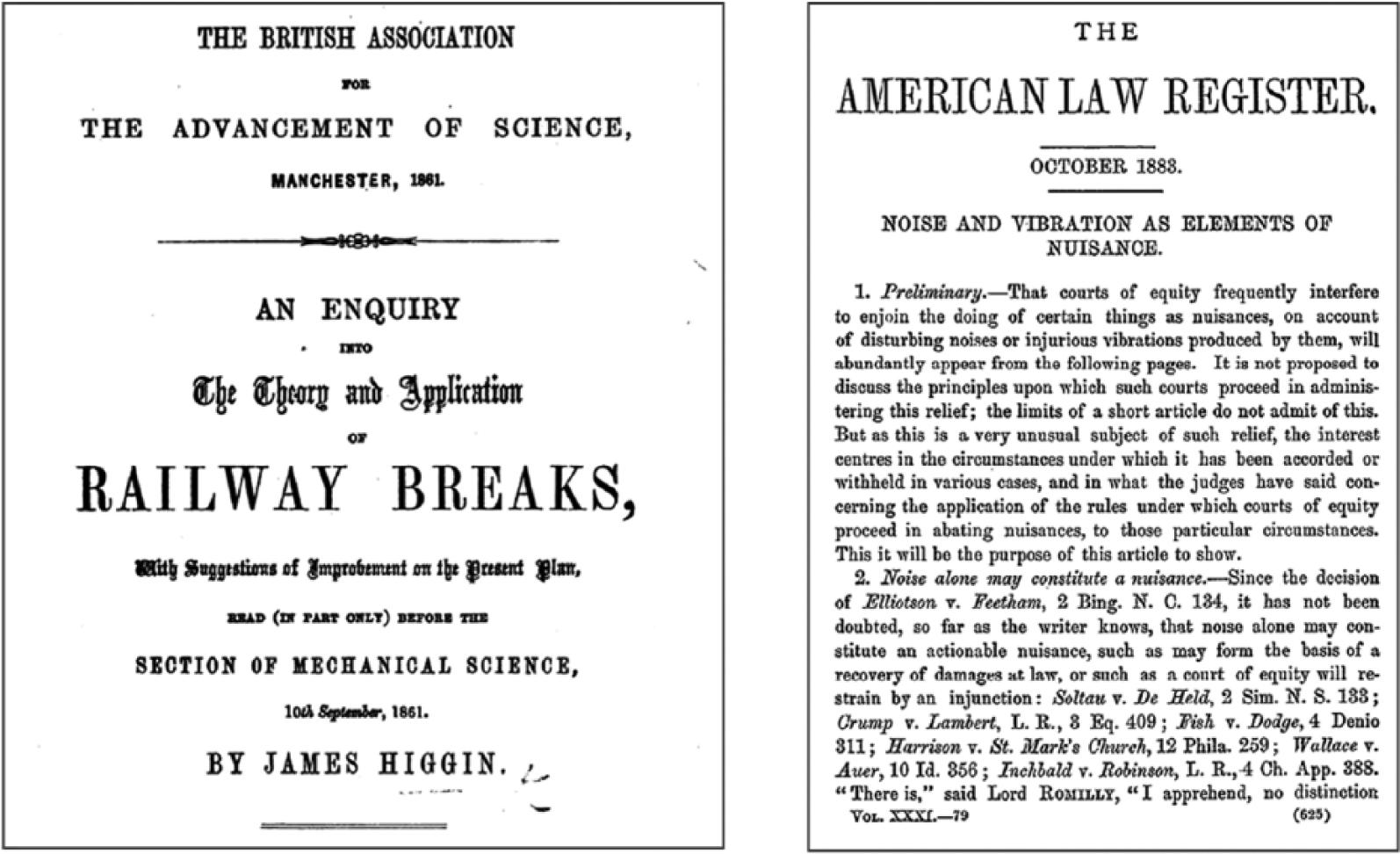
The title page of the Higgin work (1861) and the first page of the American Law Register (1883).
“Vibration perception” from 1900 to 1950
In the first two decades of 1900, it is possible to find out some studies regarding the problem of noise and vibration propagation in buildings. As an example, in 1907, Demarest published “Noise in its legal aspects.” 3 In 1917, Watson 4 published “Recent developments in acoustics of buildings,” and Tuttle and Morton 5 posed a question, “Does concrete construction reduce vibration?” Between 1920 and 1930, the issue of vibrations in buildings due to large construction (piling, drilling) began to be considered with particular attention. 6 In Figure 3, two examples of urban development at the beginning of 20th century are depicted.

Chicago (1917) and New York City (1908).
However, the interest in the mechanical vibration is primarily related to industry and transportation, as a consequence of the development of automobile, large ship, and aircraft industries, as shown in Figure 4. The main interest is to identify systems useful to reduce vibrations, also with the aim of a better “comfort” for passengers, such as in “Noiseless Airplanes Aviation’s Goal” 7 and “The Rubber Industry and the Automobile.” 8

Ford mass production (1910), RMS Aquitania (1913), and Aircraft 24 Witteman-Lewis XNBL-1 (1920s).
As a consequence, in the 1930s, a huge collection of patents was deposited worldwide, regarding systems and materials to reduce vibration in buildings and vehicles, probably also due to the contemporary development of synthetic rubber and fully synthetic thermoplastic industry (such as polybutadiene and polystyrene). It is important to highlight that in 1934 Jacob Pieter Den Hartog, Professor of Mechanical Engineering at MIT, published Mechanical Vibrations. This milestone book (an actual best seller and long seller in mechanics) collects the whole theory of mechanical vibration united with very clear and detailed demonstrations of applied and practical mechanics. 9
From 1940 to 1950, an increased interest in “vibration comfort” can be highlighted in particular from industry, aeronautic, and automotive. As shown in Figure 5, some print advertisements highlight the relevance of comfort in transport. It is possible to identify the first systematic studies on vibration and shock perception; an example is “The analysis of vibration problems.” 10 In Human Factors in Air Transport Design, 11 the effect of vibration on human perception is analyzed in terms of passenger comfort. In this book, both “the basis for the perception of vibrations” and the definition of “thresholds of sensitivity to vibration” are proposed.

Examples of “vibration comfort” in vintage print advertisements.
In Soviet Union, 1942, Lipetz 12 in his “Doctor and patient in the Soviet Union” describes experimental procedures to evaluate human perception: “The hospital contains twenty-one different laboratories for investigations into certain subjects, e.g., ventilation, light, temperature, dust, vibration, etc.” In United States, 1944, Paul E. Sabine 13 in “The problem of industrial noise” talks about the clinical effect of noise and vibration on subjects. And in the paper “The physiological aspects of housing,” 14 the relevance, in building science, of designing in order “to increase physical comfort” is pointed out,
… from 1950 to present day
After World War II, the scientific and technical literature about “vibration perception” incredibly grows. It is actually not possible to follow in detail the whole topic since a great multidisciplinary approach produces many different studies and publications in several fields, such as medical, physiological, psychological, and mechanics. In this context, only a general survey is made. As a matter of fact, the whole knowledge of noise and vibration perception is studied in terms of “ergonomics,” a recent discipline developed in England in 1920s, as a result of psychophysiological studies and the effects of working conditions on the health and productivity of workers. A very detailed survey of references can be found in Handbook of Human Vibration by Griffin, 15 where more than 1200 papers are reported.
In the 1950s, among first studies regarding noise and vibration in terms of city mapping, such as “City planning for noise control” 16 and “Noise control in Toronto’s new subway,” 17 a relevant book about structural vibration control in building was published—“Methods of Sound Insulation and Noise Reduction in Dwellings.” 18 Effects of vibration on human health can be found in “Noise as a factor in health.” 19
In 1960, Goldman and Von Gierke 20 published “The effects of shock and vibration on man.” Medical studies on vibration and shock can be found in “Human tolerance to whole body sinusoidal vibration.” 21 In the 1960s, in the field of ergonomics, scientists and researchers tried to “rate” and quantify the human perception, such as Soliman 22 with “A scale for the degrees of vibration perceptibility and annoyance,” Griffiths and Langdon 23 with “Subjective response to road traffic noise,” and Meyer 24 with “Acoustics and people.”
In 1971, Guignard 25 published the fundamental paper “Human sensitivity to vibration.” Guignard introduced two main issues such as the “comfort criteria,” based on the subjective rating of vibration, and the lack of research on “vibration nuisance.” In 1973, Zepler et al. 26 published a detailed work on “Human response to transportation noise and vibration.” In this article, several topics related to the “vibration perception” are presented, such as noise and vibration combined effect, disturbance on sleep, and the effect on perception and comfort. From the 1970s, methods and criteria of vibration comfort evaluation began to be collected in international Standards, by international and national standard bodies. In 1973, the ISO Standard 2631 “Guide for the evaluation of human exposure to whole-body vibration” was published. This standard is used to assess the effect of environmental vibration on operator health, efficiency, and comfort. Papers based on technical and scientific contents of ISO 2631 allow to upgrade and develop the Standard until today, such as “Duration of whole-body vibration exposure: its effect on comfort,” by Griffin and Whitham. 27
In the 1980s, several works about experimental tests and laboratory facilities in order to evaluate vibration perception, thresholds, and comfort were published. Among others were “Perception, comfort and performance criteria for human beings exposed to whole body pure yaw vibration and vibration containing yaw and translational components,” 28 “Human response to simulated intermittent railway-induced building vibration,” 29 and “Whole-body vibration perception thresholds.” 30
In 1990, through Academic Press, Griffin 15 published the first edition of its fundamental Handbook of Human Vibration. In this book, and following editions, two decades of the author’s studies are collected: it is probably the most complete overview about the topic of “vibration perception.” In 1990s, the scientific literature, about vibration perception, is mainly focused on experimental evidence in in situ conditions. An example is “Traffic-induced building vibrations in Montréal,” 31 in which extensive measurements and detailed analysis of building vibration induced by road traffic in Montréal are reported. The vibration levels are evaluated with reference to human annoyance and the potential for building damage using existing standards (e.g. ISO 2631).
In the first years of the 21st century, Hao et al. 32 published the experimental in situ work “Building vibration to traffic-induced ground motion,” in which he discussed the effects of traffic-induced ground motions on the safety of building structures adjacent to busy roadways, on humans, and on normal operations of sensitive equipment housed in those buildings. A recent study and analysis of vibration perception threshold in laboratory can be found in “Human vibration perception from single- and dual-frequency components.” 33 In this article, a useful method is proposed to evaluate the “annoyance.” In “Perception of vibration and occupant comfort in wind-excited tall buildings,” 34 a review about previous studies on human perception of vibration and tolerance thresholds of wind-induced tall building vibrations is presented. Among the most recent studies published, it is possible to highlight “Measurement of building foundation and ground-borne vibrations due to surface trains and subways.” 35
International Standards
At present day, the reference international Standard about “Vibration perception” and “Vibration perception in buildings” is the ISO 2631 series, in particular ISO 2631-1:2003 36 and ISO 2631-2:2003. 37 In very general terms, ISO 2631 shows a detailed series of procedures and methods to experimentally evaluate whole-body vibrations in relation to human health, wellness and perception, and motion sickness. An in-depth awareness of this Standard is of a paramount importance in the field of vibration perception; it is therefore suggested to handle it. On the basis of principles collected in these ISO standards, several national Standards have been published within peculiar differences related, as an example, to the building technologies and the national laws. A relevant comparative analysis of several national Standards can be found in the recent paper of Zhang et al., 38 in which the need for vibrational comfort design for buildings and current regulations for comfort assessment of structural vibrations of timber floors in Europe have been summarized.
Among others, German Standard DIN 4150-2:1999 39 and Norwegian Standard NS 8176.E:2008 40 give interesting alternative procedures and consideration about comfort. Moreover, both Standards suggest including also the possible effects of noise in the perception of vibration, comfort evaluation, and annoyance. In Standard DIN 4150-2, useful criteria are proposed in order to weigh the energetic content of the vibrational signal as a function of temporal parameters, in terms of exposure, evaluation, and rest periods. Besides, the secondary effects are also taken into account, such as visible movement or vibration of lamp, pictures hanging on the wall, rattling of the windows, movement of glasses, and airborne noise. In Standard NS 8176.E, the combined effects of noise and vibration are discussed in Annex C (informative). It is stated that “noise and vibration will probably constitute the total annoyance for resident” and that “no method has been found anywhere in the world for the measurement or evaluation of the total annoyance when combined effect are included.”
As it is known, vibration and noise in buildings are strictly related; therefore, it seems very useful to provide a combined evaluation of the vibro-acoustic phenomena in terms of perception.
Perception of vibro-acoustic combined effect
International Standards and several national laws state methods, thresholds, and limits to quantify and/or to evaluate the effect of vibration in buildings in terms of human perception. Actually, whenever the term “perception” is used in technical application, the boundary between objective and subjective becomes weak. As recognized by Griffin, in his Handbook of Human Vibration (1990), “comfort, or ‘a conscious well-being’, within a building merely requires the absence of ‘perceptible’ vibration for most of the time.” In general terms, it means that a scientific criterion to quantify the “subjective response” to vibration can be founded, as an example, on the definition of the lower limits of human perception. The lower limit (or threshold) for the perception of vibration can be determined on the basis of experiments on humans and related consistent statistical analysis. As shown in this article and on the basis of literature and standards, the topic of the perception of vibration in building has been developed and analyzed in depth, in the last decades. On the other hand, as suggested by Griffin and other authors, the main “discomfort” in building seems related to a combined effect of noise and vibration. As a matter of fact, noise and vibration occur simultaneously in buildings, and even if the acoustical or vibrational thresholds are within the laws or standards limits, inhabitants declare to be annoyed.
The potential interaction between noise and vibration responses is really complex. Many factors, both objective and subjective, are involved in the noise and vibration interaction. On the basis of a consistent statistical analysis (based on subjective responses of people subjected to noise and vibration effect), the “condition for the subjective equality between the noise and vibration” has been defined by Howart and Griffin 41 as follows

where Lp is the sound pressure level (dB) and ϕv is the vibration magnitude (m/s2).
In terms of environmental noise and vibration analysis, it is possible to rewrite equation (1), as follows

where LAE is the sound exposure level (A-weighted) and VDV is the vibration dose value (Wb-weighted).
It has been observed that the assessment of vibration is increased and decreased by noise, depending on the relative magnitude of the vibration and noise. A composite measure has been proposed to predict annoyance, ψ, caused by a combination of sound exposure level (LAE) and vibration magnitude ϕv

The proposed criteria to predict annoyance is founded on an exposure level of a pure tone (1 kHz) of sound pressure and at 10 Hz of vertical vibration. The criteria to define “annoyance,” or comfort and discomfort, at very low frequency within the lower limit of perception (both acoustical and vibrational) is a challenge for metrology since simple subjective judgment (by means of questionnaires) could lead to a widespread data collection.
The authors of this article, after extensive experimental analysis of both rail-induced vibration in building and noise effect on human subjects, are aware that combined effect involves a peculiar “discomfort.” At the state of the art, standard thresholds of vibration and acoustic exposure do not represent the actual combined threshold, as perceived by human subject, in particular in the frequency range between 0.1 and 80 Hz. The effects of infrasound and very low-frequency sound pressure level on humans are a topic still debated in scientific community.
Recently, on the basis of several experiments, 42 it has been observed that the low-frequency noise induces effect also on human performances. In order to evaluate the actual threshold (or the lower limit perceived) of combined effect of noise and vibration, using the identical approach proposed by Griffin, it is necessary to go through an accurate physiological and behavioral analysis.
A soft-metrological approach
At present day, in order to evaluate possible interaction between noise and mechanical vibration within human perception, through experimental measurements, Soft-Metrological approaches and methodologies are used.43,44
This recent discipline of metrology provides appropriate, and largely innovative, measurement tools and statistical analysis methods in order to investigate human response as a consequence of several external stimuli.
In the opinion of the authors, a suitable definition of discomfort, in terms of noise and vibration stimuli, should go through a more complex investigation than simple “interviews,” by means of standardized questionnaires. As a matter of fact, it has been shown that subjective responses only are generally characterized by very large dispersion in results. 45 A more in-depth physiological and behavioral analysis, in addition to standardized questionnaires, allows defining more accurately the effect of combined stimuli on human perception. Moreover, investigation should be extended at several frequencies and amplitudes of vibration.
Griffin 15 recognized that the influencing factors of the discomfort caused by vibrations are not only related to the source of vibration but also to the gripping force (grip force) and the pressure (push force) acting on the whole body, to the environmental condition (humidity, temperature), to the presence of noise, to gender, age, health, and posture of the subject, and to the psychological characteristics and several other factors.
The design of a suitable experimental procedure thus provides to give multiple stimuli to human subjects, in terms of different frequencies and amplitudes of vibrations, noise and silence, and to collect a large amount of subjective output, in terms of biometric, physiological, behavioral, and psychological data.
Recently at INRIM, a pilot study of vibro-acoustical multisensorial-inducted stimuli on human subject has been designed and realized. The main goal of the study is to define a suitable and accurate method able to give information of actual effects of external stimuli on the perceived vibration on human subjects. In order to make things easy, the experiment has been carried out by evaluating effects of vibration in “hand-arm” biosystem only, instead on “whole body,” as in Griffin’s work.
The hand-arm system is subjected to three different frequency oscillations at two levels of amplitude through an instrumented handhold fixed on an electrodynamic shaker. The pilot experiment has been carried out on 30 volunteers (aged between 20 and 60 years, 16 males and 14 females). Both noisy and silent conditions have been investigated.
Biometric data are the wrist circumferences of each subject. Physiological data collected are the absorbed vibrations by the subject during the test. The aptitude to opposing a certain resistance to a perceived vibration is purely instinctual; therefore, it can be considered a good myographic indicator.
Behavioral data are evaluated from the aptitude of the subject to achieve a defined task during the test. The requested task was to keep the instrumented handhold with a defined strength. The subject can read the force level on a screen.
Psychological data are deducted from the Eysenck test (in order to identify a degree of introversion or extroversion of the subjects) and on the basis of a series of personal opinion requested during the test and at the end of the test, in the form of four direct questionnaires with multiple answers. A positive or negative weighted opinion about the experienced “trickiness” perceived is expected.
A statistical analysis has been previously performed by means of analysis of variance (ANOVA) method in order to collect the first possible relevant correlations among output. From this first analysis, it has been possible to correlate, at least two variables, disregarding the possible influences of other variables. As an example, in Figures 6 and 7, two output correlations are shown. In Figure 6, a correlation between the questionnaires output and the ability to perform a certain requested task (regardless of the influence of any other stimulus) is shown. The ability, in terms of variance, has been evaluated from the aptitude to maintain in time, as constant as possible, the force grip on the handhold: high values of variance mean weak ability. Two classes of data show silent and noisy condition. As a result, negative questionnaire answers seem correlated with less aptitude to maintain the force grip constant in time. In this case, noisy or silent condition does not relevantly affect the overall behavior.
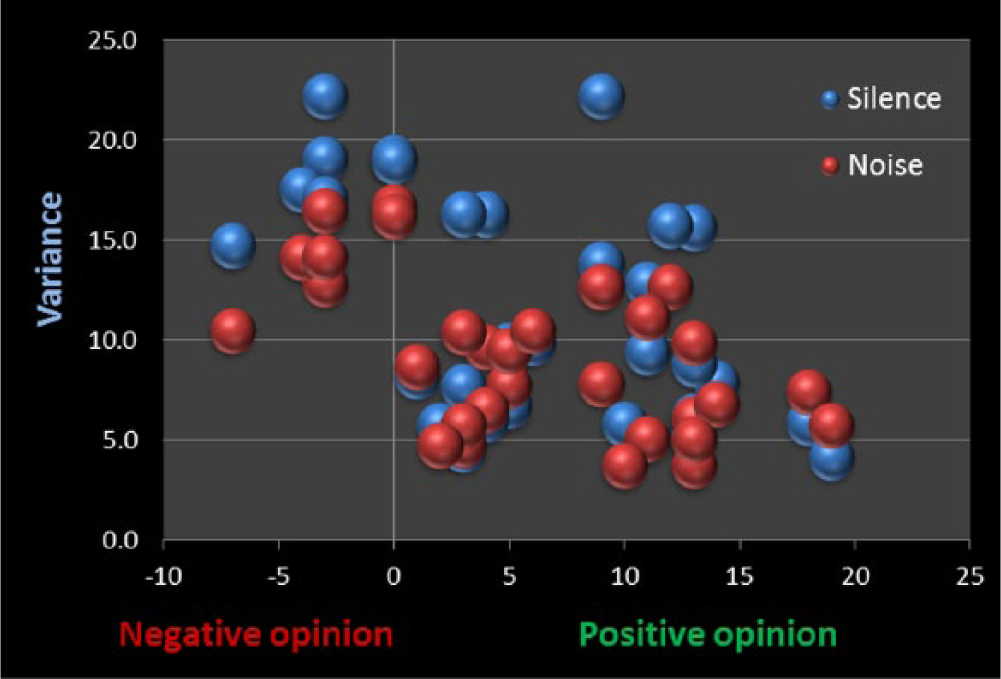
Correlation between negative or positive opinion from questionnaires and task variance.

Correlation between wrist circumferences and absorbed acceleration of vibration.
In Figure 7, a correlation between the wrist circumferences of the subject and the absorbed acceleration, as a function of two different stimuli of vibration acceleration of the handhold, is shown. Frequency of vibration is fixed at 12.5 Hz, and the amplitudes are 0.8 and 2 m/s2. The wrist circumference is related to the myoskeletal mass of the hand-arm system. The absorbed acceleration is an indicator of the instinctual opposed force to the vibration perceived. How much low is the value of absorbed vibration? How much more was the handhold taken weakly? A certain relationship among wrist circumferences (or hand-arm mass) and absorbed acceleration can be highlighted. The amplitude of the absorbed vibration is influenced by the amplitude of perceived vibration, as a function of the hand-arm mass. As a first result, it seems that subjects try to reduce perceived vibration at the half: in average, for a stimulus of 0.8 m/s2, a reaction of about 0.4 m/s 2 is measured. For a stimulus of 2 m/s2, only subjects with great wrist circumference are tendentially able to reach a reaction of about 1 m/s2. These results lead to a more accurate evaluation of the task variance interpretation.
A subsequent comparative analysis of all combined data allows to define and quantify the relevant correlation matrices between stimuli induced and subjective multiple output, by means of multivariable statistical analysis methods.
Footnotes
Declaration of conflicting interests
The author(s) declared no potential conflicts of interest with respect to the research, authorship, and/or publication of this article.
Funding
The author(s) received no financial support for the research, authorship, and/or publication of this article.